EXIT Chart Based Joint Code-Rate and Spreading-Factor Optimisation of
Single-Carrier Interleave Division Multiple Access
Rong Zhang and Lajos Hanzo
School of ECS., Univ. of Southampton, SO17 1BJ, UK.
Tel: +44-23-80-593 125, Fax: +44-23-80-593 045
Email: [email protected], http://www-mobile.ecs.soton.ac.uk
Abstract— In this paper, we consider the joint code-rate and spreading-factor optimisation of turbo-style iterative joint detection and decoding assisted single-carrier interleave divi-sion multiple access (SC-IDMA) systems using different-rate convolutional codes and Extrinsic Information Transfer (EXIT) charts, when communicating over Additive White Gaussian Noise (AWGN) channels. More explicitly, we study the extrinsic infor-mation exchange between two serial concatenated components and maximise the number of users supported by the SC-IDMA system under the constraint of a fixed bandwidth expansion factor, while maintaining a predefined Bit Error Ratio (BER) versus Eb/N0 performance. We found that an optimum code-rate and spreading-factor combination can be found for the SC-IDMA system at low Eb/N0 values, where maintaining a low BER inevitably requires the employment of channel coding. By contrast, at highEb/N0 the system performs best, when no channel coding is used, i.e. DS-spreading is the only means of bandwidth expansion.
I. INTRODUCTION
In wireless spread spectrum communications [1], the em-ployment of channel coding is crucial. Viterbi’s classic work [2] suggests that bandwidth expansion dedicated to low-rate channel coding has the potential of fully exploiting the achievable processing gain, while simultaneously offering a high coding gain as well as approaching the capacity of the multiple access channel contaminated by Additive White Gaussian Noise (AWGN). The terms of Fourier-bandwidth and Shannon-bandwidth 1 were defined by Massey [3] as
early as 1994, recognising that channel coding and spread-ing may be regarded as two relatives, benefitspread-ing somewhat differently from a given bandwidth expansion. As a further development, it was suggested by Veeravalli and Mantravadi in [4] that a given total bandwidth expansion can be considered to be the result of concatenating of both channel coding as well as DS spreading. These considerations lead to the joint optimisation of the channel code-rate and Spreading-Factor (SF) in spread spectrum systems, [4]-[8]. In the early work of Hui [5], it was shown that the system’s effective
Acknowledgements: The work reported in this paper has formed part of the Core 4 Research Programme of the Virtual Centre of Excellence in Mobile and Personal Communications, Mobile VCE, www.mobilevce.com, whose funding support, including that of EPSRC, is gratefully acknowledged. Fully detailed technical reports on this research are available to Industrial Members of Mobile VCE.
1For example, a Direct Sequence (DS) spread spectrum system requires
a significantly higher Fourier-bandwidth than Shannon-bandwidth, since the effective information throughput, which is related to the DS chip-rate by the Spreading Factor (SF), is at least SF times lower than the total Fourier-bandwidth required.
information throughput was maximised by low-rate channel coding, where a bandwidth expansion was imposed purely due to channel coding. However, their conclusion was based on single-user matched filtering aided detection, where a high residual multiuser interference had to be mitigated by the channel codec. Further insightful theoretical analysis based on multiuser detection was then provided by Verdu in [6], confirming the findings of [5] that indeed bandwidth expansion entirely dedicated to channel coding is favoured for single-user matched filter aided detection. By contrast, there is a beneficial tradeoff between the channel coding rate and SF, when linear Multiuser Detection (MUD), such as for example decorrelating or Minimum Mean Square Error (MMSE) MUD is used. These concepts were then further developed in a multicell context in [4]. In [7], Yue and Wang analysed the associated coding and spreading tradeoffs in the context of an iteratively detected CDMA system using Low Density Parity Check (LDPC) codes. These investigations underline the importance of joint code-rate and spreading-factor optimisation in the context of Single-Carrier Interleave Division Multiple Access (SC-IDMA), which is the novel objective of this study.
The concept of IDMA accrued from the philosophy of code-spread CDMA [8] as well as chip-interleaved CDMA [9] and hence inherited all the attractive properties of CDMA. The IDMA philosophy was then further developed by Ping and his team [10], as well as by H¨oher and Sch¨oneich [11]. As alluded to above, IDMA entails reversing the position of Direct Sequence (DS) spreading and interleaving, lead-ing to chip-interleavlead-ing instead of bit-interleavlead-ing. Then the different users can be distinguished by their unique user-specific chip-interleavers combined with turbo-style iterative joint detection as well as channel decoding [12]. Owing to its meritorious properties, IDMA has been proposed for numerous applications, such as next-generation cellular uplink systems [11] as well as for time-hopping Ultra Wide Band (UWB) systems [13]. In this treatise, we invoke EXtrinsic Information Transfer (EXIT) charts [14] to analyse the joint code-rate and spreading-factor optimisation of a SC-IDMA system communicating over an AWGN channel.
The rest of the paper is organised as follows. In Section II, we present the transceiver architecture of IDMA. In Section III, we elaborate on the joint code-rate and spreading-factor optimisation of SC-IDMA communicating over AWGN chan-nels using EXIT chart analysis. In Section IV, this is followed by our simulation results and we conclude our discourse in Section V.
coding
coding
coding
spreading spreading
spreading
Access Channel Multiple
..
.
..
.
MUD SISO
..
.
..
.
DECCDec Des
π−k1
πk
b1
bk
c1
ck
cK
s1
sk
sK
d1
dk
dK bK
π1
πk
πK
Le
M U D(dk(i))
La
DEC(sk(i))
LCDec(ck(i))
La
CDec(ck(i))LDES(ck(i))
Le
DEC(sk(i)) LaM U D(dk(i))
[image:2.595.90.525.49.274.2]LDEC(bk(i))
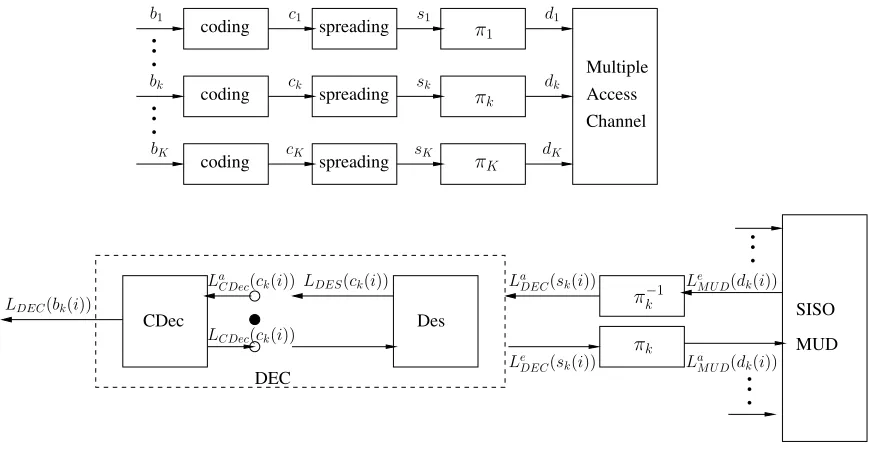
Fig. 1. Transmitter of single-carrier IDMA and its joint soft-in-soft-out multiuser detector, de-spreader (Des) and channel decoder (CDec)
II. TRANSCEIVER OFSINGLE-CARRIERIDMA
Fig. 1 shows the transceiver of an IDMA system. As-suming BPSK modulation, the kth user ’s transmitted bit stream {bk(i);i= 1,2,· · · , M} is firstly channel en-coded at a rate of R = M/N, yielding the encoded stream {ck(i);i= 1,2,· · ·, N}. Then the resultant chan-nel encoded stream is DS spread by a common spread-ing code havspread-ing a spreadspread-ing gain G, yielding the sequence
{sk(i);i= 1,2,· · · , P}, which is then chip-interleaved using a user-specific random chip-interleaver Πk, in order to form the chip stream {dk(i);i= 1,2,· · · , P}. The chip stream is then transmitted through the multiple access channel support-ing K users. This is in contrast to the concept of a classic CDMA system, where the interleaver is between the Forward Error Correction (FEC) coding and DS-spreading stages. The latter classic philosophy corresponds to bit-interleaving.
For the sake of attaining the best possible performance, an iterative receiver is employed [10] [12]. The receiver of Fig. 1 consists of a Soft In Soft Out (SISO) MUD and a bank ofK individual SISO decoders (DEC), which are constituted by the combined Channel Decoder (CDec) and De-spreader (Des). The soft information exchanged between the receiver components is constituted by the extrinsic Log-Likelihood Ratios (LLRs) [15]. At each iteration, the SISO MUD of Fig. 1 generates the extrinsic output informationLeMUD(dk(i)) and deinterleaves it in order to create the stream LaDEC(sk(i)), which is forwarded asa prioriinformation to the SISO DEC, as seen in Fig. 1. In the feedback loop, the SISO DEC computes the extrinsic information stream of LeDEC(sk(i)), which is then interleaved for the sake of generating the stream LaMUD(dk(i))as a priori information for the SISO MUD of Fig. 1. The SISO MUD employs Soft Interference Cancellation (SoIC) on a chip-by-chip basis.
Again, the SISO DEC of Fig. 1 consists of two components, namely the SISO Des and the SISO CDec, where the SISO
Des first computes its a posteriori informationLDES(ck(i)) seen in Fig. 1 by Maximal Ratio Combining (MRC) each a priorisoft chip contributionLaDEC(sk(i)), which is multiplied by the corresponding spreading codes. Then the SISO CDec of Fig. 1 uses the output LLRs received from the SISO Des as its a priori information LaCDec(ck(i)), in order to per-form standardA PosterioriProbability (APP) based detection [15] and two a posteriori LLRs are computed, namely the codeword LLR stream LCDec(ck(i)) acting as the a priori information for the SISO Des and the data LLRsLDEC(bk(i)) representing the transmitted bits bk(i). The SISO Des of Fig. 1 outputs its extrinsic information LeDEC(sk(i))for each chip by subtracting thea prioriinformationLaDEC(sk(i))from the codeword LLRs LCDec(ck(i)). The iterations are terminated, when a predefined termination criterion is satisfied. Finally, the LLRsLDEC(bk(i))of Fig. 1, which represent the original information bits are subjected to a hard decision, yielding dk(i). In this treatise, we use the Log-MAP algorithm [15] for the channel decoder.
III. EXIT CHARTANALYSIS OFJOINTCODE-RATE AND SPREADING-FACTOROPTIMISATION
A. Normalised User-load
We commence our discussion of joint code-rate and spreading-factor optimisation by firstly defining the optimi-sation problem. As in [4], given a fixed total bandwidth ex-pansion factorΩ, we separately treat the bandwidth expansion imposed by FEC coding having a code-rate of Rand by DS-spreading having a DS-spreading factor ofG, yielding:
Ω =G
R. (1)
For the sake of characterising the achievable throughput of the system, we define the normaliseduser-load as:
η= Kmax
whereKmaxis the maximum number of users supported given a fixed bandwidth expansion factorΩandEb/N0value, where Eb is the bit-energy andN0 is the power spectral density of AWGN. Note that given a fixed bandwidth expansion factor
Ω and a channel code-rate R, the affordable DS-spreading factor is determined. Hence,Kmax is a function ofΩ,R and Eb/N0. Equivalently, the joint code-rate and spreading-factor optimisation is essentially equivalent to finding the best code-rate, which maximises the effective normaliseduser-load.
B. Extrinsic Information Transfer Charts
In this subsection, we use EXIT charts for analysing the as-sociated FEC coding versus DS-spreading tradeoffs in the con-text of IDMA. EXIT charts were introduced by ten Brink [14]. This technique relies on computing the mutual information of two constituent components, namely that of the SISO MUD and the SISO DEC, which are denoted by IiMUD, IoMUD, IiDEC, IoDEC. The mutual information I(L;X)between the random variableLand the BPSK modulated coded bitsX is defined as [14]:
1 2
x∈(−1,+1)
+∞
−∞ p(l|x)log2
2p(l|x)
p(l|+ 1) +p(l| −1)dl, (3)
where I(L;X) ∈ [0,1] and p(l|x) is the distribution of the a priori or extrinsic information. It was shown in [14] that the PDF of the mutual information may be approximated by a Gaussian distribution, where the mutual information is a function of the Gaussian distribution’s varianceσ2i.
Next we evaluate the nonlinear functionIo=χ(Ii), which maps the input a priori mutual information Ii ∈ [0,· · ·,1] to the output extrinsic mutual information Io ∈ [0,· · ·,1], where the amount of output extrinsic mutual informationIo∈
[0,· · · ,1]gleaned from the inputa priorimutual information determines the convergence behaviour of this SISO compo-nent. Finally, since the extrinsic information generated by the first SISO component acts as thea prioriinformation for the second SISO component and vice versa, in the EXIT charts we alternately swap the abscissa and ordinate axes, depending on which of the two components acts as the source of a prioriinformation, corresponding to the abscissa, as discussed in [14]. To elaborate a little further, EXIT charts provide us with an insight into the mutual information exchange between the constituent SISO components, where the chip-interleaver allows us to decouple the constituent SISO components, which can be hence analysed separately.
C. EXIT Chart Analysis
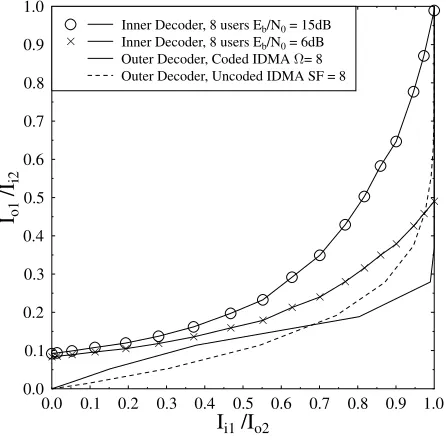
Figs. 2 and 3 shows the EXIT charts of our coded IDMA system associated with a total fixed bandwidth expansion of
Ω = 8. A rateR= 1/2convolutional code having a constraint
length of 3 and octal generator polynomials of [5,7] was used. The piece-wise linear curve represents the EXIT curve of the outer SISO DEC of Fig. 1. Furthermore, the dashed line shows the EXIT curve of the outer SISO DEC of Fig. 1 constituted by the de-spreader associated with a spreading factor ofG= 8, but using no FEC and thus representing uncoded IDMA. More
0.0 0.1 0.2 0.3 0.4 0.5 0.6 0.7 0.8 0.9 1.0
I
i1/I
o20.0 0.1 0.2 0.3 0.4 0.5 0.6 0.7 0.8 0.9 1.0
I
o1/I
i2Inner Decoder, 8 users Eb/N0= 15dB
Inner Decoder, 8 users Eb/N0= 6dB
[image:3.595.311.534.48.268.2]Outer Decoder, Coded IDMA = 8 Outer Decoder, Uncoded IDMA SF = 8
Fig. 2. EXIT chart analysis of coded IDMA over AWGN channels for a bandwidth expansion ofΩ = 8,K= 8users and variousEb/N0 values.
0.0 0.1 0.2 0.3 0.4 0.5 0.6 0.7 0.8 0.9 1.0
I
i1/I
o20.0 0.1 0.2 0.3 0.4 0.5 0.6 0.7 0.8 0.9 1.0
I
o1/I
i2Inner Decoder, 13 users Eb/N0= 10dB
[image:3.595.309.533.311.532.2]Outer Decoder, Coded IDMA = 8 Outer Decoder, Uncoded IDMA SF = 8
Fig. 3. EXIT chart analysis of coded IDMA over AWGN channels for a bandwidth expansion ofΩ = 8, 13 users andEb/N0 = 10dB.
explicitly, it represents an IDMA system using DS-spreading as the only means of bandwidth expansion.
As seen in these two figures, initially the FEC coded EXIT curve indicated by the piece-wise linear curve has a less rapidly increasing nature, but exhibits a more rapidly increasing nature in the vicinity of Ii1/Io2 > 0.68 than the EXIT curve of the uncoded system characterised by the dashed line having the same bandwidth expansion factor of
Ω = 8. Observe in Fig. 2 that at Eb/N0 = 6dB, the EXIT
0.0 0.1 0.2 0.3 0.4 0.5 0.6 0.7 0.8 0.9 1.0
I
i1/I
o20.0 0.1 0.2 0.3 0.4 0.5 0.6 0.7 0.8 0.9 1.0
I
o1/I
i2Inner Decoder, 8 users Inner Decoder, 11 users Outer Decoder, Coded IDMA = 8
Fig. 4. EXIT charts for different number of users supported in coded IDMA over AWGN channels at a bandwidth expansion factor ofΩ = 8andEb/N0 = 10dB, usingR= 1/2convolutional coding
Fig. 3, where the number of users is K = 13 and we have Eb/N0= 10dB, an intersection is observed between the EXIT curve of the SISO MUD and the FEC coded EXIT curve. However, the uncoded IDMA system represented by the EXIT curve marked by the dashed line is capable of supporting such a high number of user. These observations suggest that at this relatively high Eb/N0 value of 10 dB, the FEC coded system becomes unable to support an equally high number of users as the uncoded system at the same bandwidth expansion factor ofΩ = 8. These observations reflect the plausible fact that at highEb/N0values, dedicating bandwidth expansion to FEC coding ultimately reduces the normalised user-load. By contrast, at lowEb/N0values, the employment of FEC coding is inevitable.
Fig. 2 shows the EXIT curve of the SISO MUD (inner decoder) for different Eb/N0 values. Upon increasing the Eb/N0 value from 6 to 15dB, for low values of Ii1/Io2, initially the EXIT curve of the SISO MUD remains similar. However, as expected, the inner decoder’s curve corresponding toEb/N0= 15dB provides a widely open EXIT tunnel, while that recorded at Eb/N0 = 6dB has an intersection with the EXIT curve of the uncoded IDMA. This indicates the plausible fact that an infinitesimally low BER may be achieved at an Eb/N0 = 15dB with a low number of decoding iterations. Observe furthermore in Fig. 2 that the half-rate coded IDMA outer decoder’s EXIT curve exhibits a narrow EXIT tunnel opening at low Ii1/Io2 values, but a wider tunnel opening at Ii1/Io2 values in excess of about 0.68. Hence, the FEC-coded scheme is clearly less likely to experience intersections at relatively low Eb/N0 values. However, the price of this benefit is the higher complexity of each decoding iteration. Figs. 2 and 3 demonstrate that indeed, an optimum code rate and SF exists, when jointly designing the FEC code and the spreading scheme.
Code Octal Constraint SF No. of Iterations Rate Generator length (G) / Trellis States
(Complexity)
R= 1/8 [7 7 5 5] 3 - 10 / 4 (40)
R= 2/8 [5 7 7 7] 3 2 10 / 4 (40)
R= 1/3 [5 7 7] 3 3 10 / 4 (40)
R= 4/8 [5 7] 3 4 10 / 4 (40)
[image:4.595.300.557.53.156.2]R= 2/3 [4 2 6] [1 4 7] 3 5 10 / 4 (40) R= 3/4 [6 2 2 6] [1 6 0 7] 5 6 10 / 4 (40)
[0 2 5 5]
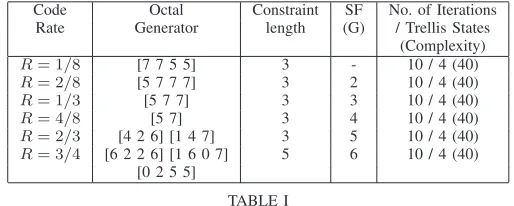
TABLE I
TABLE OF CONVOLUTIONAL CODES USED IN JOINT CODE-RATE AND
SPREADING-FACTOR OPTIMISATION
IV. JOINTCODE-RATE ANDSPREADING-FACTOR OPTIMISATION
Let us now continue our investigations by fixing the band-width expansion factor Ω, the channel code-rate R as well as the Eb/N0 values and investigate the number of users supported, while maintaining a given target BER of10−5. As before, we can solve the joint code-rate and SF optimisation by generating the EXIT curves of both the SISO MUD and the SISO DEC of Fig. 1 and then finding the specific number of users, for which an open EXIT-tunnel exists. More explicitly, we plot the EXIT curve of the SISO MUD for various number of users and the maximum number of user is found, where there is no intersection between the inner and outer codes’ EXIT curves. In Fig. 4, the bandwidth expansion factor was fixed to Ω = 8. A rate R = 1/2 convolutional code was used and Eb/N0 = 10dB was assumed. We found that the maximum number of user supported by the IDMA system was Kmax= 11, corresponding to a normalised user-load of
η = K/Ω = 11/8, where the inner and outer codes’ EXIT
curves ’just’ touch each other.
Let us now proceed by investigating the joint code-rate and SF design by employing the range of different-rate con-volutional codes summarised in Table I, which have similar constraint lengths and were selected from [16]. Importantly, please also observe in Table I that the detection complexity of all the different scenarios are adjusted to be the same in terms of the total number of trellis states, which was determined by the product of the number of trellis states and the number of iterations. We set the target BER toPe= 10−5.
Fig. 5 shows the normaliseduser-loadsupported versus var-ious code-rate and SF combinations for two different Eb/N0 scenarios. It can be seen in Fig. 5 that at Eb/N0= 5dB, the normalised user-load was maximised by a combination of the rate-5/8 code and the SF ofG= 5of Table I, when supporting Kmax = 9users. By contrast, the IDMA system favours the employment of pure spreading without FEC coding at Eb/N0 = 10dB, as can be seen from Fig. 5, reaching η = 1.75 at a rate of R= 1.
0.1 0.2 0.3 0.4 0.5 0.6 0.7 0.8 0.9 1.0 Code Rate
0.0 0.2 0.4 0.6 0.8 1.0 1.2 1.4 1.6 1.8 2.0
Normalised
User
-load
[image:5.595.49.285.50.214.2]Eb/N0= 5dB Eb/N0= 10dB
Fig. 5. Normalised user-load versus code-rate for a fixed bandwidth expansion factor of Ω = 8 and forPe = 10−5 using the convolutional codes of Table I
0.1 0.2 0.3 0.4 0.5 0.6 0.7 0.8 0.9 1.0 Code Rate
0 1 2 3 4 5 6 7 8 9 10 11 12
Required
Eb
/N
0
(dB)
= 1.25 = 1.00
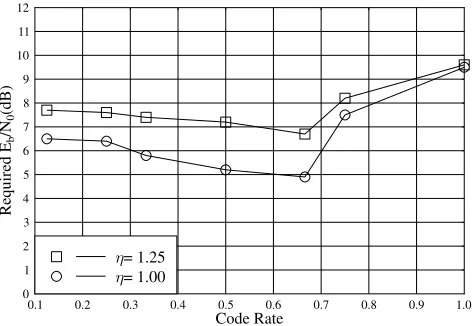
Fig. 6. TheEb/N0 values required for supporting a normalised user-load ofηversus the code-rate at a fixed bandwidth expansion factor ofΩ = 8and forPe= 10−5 using the convolutional codes of Table I
5/8in this scenario. However, having a code-rateRbelow the optimum also requires an increasedEb/N0for supporting the targetuser-load.
These observations were found to be consistent with our previous EXIT chart analysis provided in Figs 2 and 3. At highEb/N0values, where the noise is insignificant, the SISO MUD and the SISO de-spreader become capable of almost completely eliminating the Multiple User Interference (MUI), while at low Eb/N0 values the output extrinsic information LDES(ck(i))of the SISO de-spreader seen in Fig. 1 is gravely noise contaminated, which can only be improved by the relatively low-rate and hence powerful SISO channel decoder. Increasing the code-rate beyond the optimum point weakens the channel decoder and the resultant feedback extrinsic in-formation LCDec(ck(i)) remains noise contaminated, which reduces the achievableuser-load. By contrast, when reducing the code-rate below the optimum point, an extra coding gain is provided, which benefits the system in terms of requiring a reduced number of iterations, but also reduces the number of users that may be supported.
V. CONCLUSION
In this paper, we considered the joint code-rate and spreading-factor optimisation of SC-IDMA system commu-nicating over AWGN channels with the aid of EXIT chart analysis. Different-rate convolutional codes were employed. At high Eb/N0 values, DS-spreading dispensing with FEC was capable of supporting the highest normalised user-load. By contrast, at low Eb/N0 values the employment of coding became crucial, since it improved both the achievable BER and the attainable multiple access capability. Our further research is related to the EXIT chart analysis aided joint code-rate and spreading-factor optimisation of multi-carrier IDMA using LDPC codes.
REFERENCES
[1] L. Hanzo, L.-L. Yang, E.-L. Kuan, and K. Yen,Single- and Multi-Carrier DS-CDMA: Multi-User Detection, Space-Time Spreading, Synchronisa-tion, Networking and Standards. Wiley-IEEE Press, 2003.
[2] A. J. Viterbi, “Very low rate convolutional codes for maximum theo-retical performance of spread spectrum multiple-access channels,”IEEE Journal on Selected Areas in Communication, vol. 8, pp. 641–649, Aug. 1990.
[3] J. Massey, “Information theory aspects of spread-spectrum communi-cations,” inProc. IEEE ISSSTA’94, Oulu, Finland, July 4–6, 1994, pp. 16–20.
[4] V. Veeravalli and A. Mantravadi, “The coding-spreading tradeoff in CDMA systems,”IEEE Transactions on Communications, vol. 20, pp. 396–408, Feb. 2002.
[5] J. Y. N. Hui, “Throughput analysis for code division multiple accessing of the spread spectrum channel,”IEEE Journal on Selected Areas in Communication, vol. SAC-2, pp. 482–486, July 1984.
[6] S. Verdu and S. Shamai, “Spectral efficiency of CDMA with random spreading,”IEEE Transactions on Information Theory, vol. 45, pp. 622– 640, Mar. 1999.
[7] G. Yue and X. Wang, “Coding-spreading tradeoff in LDPC-coded CDMA with turbo multiuser detection,”IEEE Transactions on Wireless Communications, vol. 3, pp. 1734–1745, Sept. 2004.
[8] P. Frenger, P. Orten, and T. Ottosson, “Code-spread CDMA using maxi-mum free distance low-rate convolutional codes,”IEEE Transactions on Wireless Communications, vol. 48, pp. 135 – 144, Jan. 2000. [9] R. H. Mahadevappa and J. G. Proakis, “Mitigating multiple access
interference and intersymbol interference in uncoded CDMA systems with chip-level interleaving,”IEEE Transactions on Wireless Communi-cations, vol. 1, pp. 781–792, Oct. 2002.
[10] L. Ping, L. Liu, K. Wu, and L. W. K., “Interleave-division multiple-access,” IEEE Transactions on Wireless Communications, vol. 5, pp. 938–947, Apr. 2006.
[11] H. Schoeneich and P. A. Hoeher, “Adaptive interleave-division multiple access-A potential air interference for 4G bearer services and wireless LANs,” inProc. WOCN 04, Muscat, Oman, June7–9, 2004, pp. 179 – 182.
[12] X. Wang and H. V. Poor, “Iterative (turbo) soft interference cancellation and decoding for coded CDMA,”IEEE Transactions on Communica-tions, vol. 47, pp. 1046–1061, July 1999.
[13] K. Li, X. Wang, G. Yue, and L. Ping, “A low-rate code-spread and chip-interleaved time-hopping UWB system,”IEEE Journal on Selected Areas in Communication, vol. 24, pp. 864 – 870, Apr. 2006.
[14] S. ten Brink, “Convergence behavior of iteratively decoded parallel concatenated codes,”IEEE Transactions on Communications, vol. 49, pp. 1727–1737, Oct. 2001.
[15] L. Hanzo, T. Liew, and B. Yeap,Turbo Coding, Turbo Equalisation and Space-Time Coding for Transmission over Fading Channels. Wiley-IEEE Press, 2002.
[image:5.595.49.285.272.435.2]