Typed polyadic pi-calculus in bigraphs
∗
Mikkel Bundgaard
IT University of Copenhagen
Vladimiro Sassone
ECS, University of Southampton
Abstract
Bigraphs have been introduced with the aim to provide a topo-graphical meta-model for mobile, distributed agents that can ma-nipulate their own communication links and nested locations. In this paper we examine a presentation of type systems on bigraphical systems using the notion of sorting. We focus our attention on the typed polyadicπ-calculus with capability types `a la Pierce and San-giorgi, which we represent using a novel kind of link sorting called subsorting. Using the theory of relative pushouts we derive a la-belled transition system which yield a coinductive characterisation of a behavioural congruence for the calculus. The results obtained in this paper constitute a promising foundation for the presentation of various type systems for the (polyadic)π-calculus as sortings in the setting of bigraphs.
Categories and Subject Descriptors F.3.2 [Logics and Meanings of Programs]: Semantics of Programming Languages—Process models
General Terms Foundation of computation, semantics of concur-rency, foundations of distributed and mobile systems.
Keywords Bigraphs, typed polyadicπ-calculus, sortings, subsort-ing, bisimulation congruences, relative pushouts.
Introduction
Bigraphical reactive systems (BRS) [8] have been proposed as a topographical meta-model for mobile, distributed agents that can manipulate their own communication linkage and nested locations. Bigraphs generalise both the link structure characteristic of the π-calculus and the nested location structure characteristic of the cal-culus of Mobile Ambients. A bigraph consists of two overlapping structures: a place graph and a link graph. The place graph is a tu-ple of unordered trees that represents the topology of the system. Its roots contain nodes which represent locations or process construc-tors. Some of the leaves may be sites to be filled by other bigraphs, so giving rise to bigraphical (multi-hole) contexts. Each node is typed with a control which prescribes its number of ports. The link graph represents the system’s connectivity. It links together ports and names in the bigraph’s inner and outer interfaces. Names in
∗Supported by ‘DisCo: Semantic Foundations of Distributed Computation,’
EU IHP ‘Marie Curie’ HPMT-CT-2001-00290.
Permission to make digital or hard copies of all or part of this work for personal or classroom use is granted without fee provided that copies are not made or distributed for profit or commercial advantage and that copies bear this notice and the full citation on the first page. To copy otherwise, to republish, to post on servers or to redistribute to lists, requires prior specific permission and/or a fee.
PPDP’06 July 10–12, 2006, Venice, Italy.
Copyright c2006 ACM 1-59593-388-3/06/0007. . . $5.00.
the inner interface represent connection points offered to bigraphs that may fill sites; those in the outer interface represent free names exported by the system.
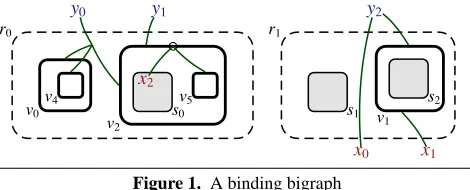
Binding bigraphs extend this basic structure – known as pure bigraphs – by allowing some of the ports of a node to be ‘bind-ing,’ meaning that all other points linked to the port must lie inside the node. A binding port enforces a notion of scope on a bigraph’s links, resembling in such a way the usual notion of binders in the λ-and theπ-calculus. Binding interfaces record topological informa-tion (viz., sites and roots), inner and outer namesets, as well as the binding of names to locations. Fig. 1 depicts a binding bigraph with inner interfaceh3,({x2},∅,∅),{x0,x1,x2}i, reflecting that it consists
of three sites (shaded in the picture) only the first of which con-tains a local name, the binder x2. The bigraph’s outer interface is h2,(∅,∅),{y0,y1,y2}i, with two roots, or locations (drawn in dashed
lines), and only global names.
r0
y0 y1
v0
v4
v2
s0 x2
v5
r1
y2
x1 x0
v1
s2
[image:1.612.318.553.370.465.2]s1
Figure 1. A binding bigraph
Often when representing systems and calculi as bigraphical re-active systems one needs to constrain the allowable compositions of nodes and links. Examples of such constraints are Jensen’s rep-resentation of theπ-calculus with guarded sum [6], where for in-stance nodes of a given controlsum must not contain nodes of the same sort as immediate children, or Leifer and Milner’s treat-ment of Petri nets [13], where transitions can only be connected to places and vice versa. A sorting is used to enforce constraints such as these on a class of bigraphs.
Related work. Place sortings enforce a discipline on the allowed nesting of nodes in place graphs, and was introduced in [15] to rep-resent guarded sums using a two-sorted syntax in finite pure CCS. Place sortings have also been examined in [16], where the author puts forward the notion of kind bigraphs, i.e., bigraphs where the notion of ‘atomic’/‘non-atomic’ controls is generalised in order to specify which kind of controls can be contained inside each other. In his thesis [6], Jensen utilises place sortings and puts their foun-dation of a solid footing by means of general requirements on the sorting functors which ensure that they respect the behavioural the-ory of the unsorted model. In [1] Birkedal et al. investigate bigraph-ical reactive systems as models for global ubiquitous computing. A place sorting that partitions the set of controls in the system is de-ployed to obtain the results in that paper.
Link sortings enforce requirements on the kind of linkage that can occur in a bigraph. Leifer and Milner [13] introduce link sort-ings to encode condition-event Petri nets; the sorting ensures well-formed bigraphs indeed represent Petri nets.
Sewell [20] generalised the capability types of Pierce and San-giorgi to also contain information about locality, so that one can distinguish between local, global communication, or no communi-cation at all. In [5, 4] Hennessy et al. investigate a distributed π-calculus together with a type system which generalises Pierce and Sangiorgi’s by ensuring that processes only can access resources they are given permission to. Contrary to Pierce and Sangiorgi’s, the subtype relation in loc. cit. has bounded meets, a property which is essential to establish our results. Deng and Sangiorgi [3] use sim-ilar capability types and subtyping in order to study the effect of types on the algebraic theory of the (monadic)π-calculus.
K¨onig [12] presents a graphical approach to the asynchronous polyadicπ-calculus using a hypergraph rewriting semantics in the double-pushout approach. The representation of prefixes differs crucially from ours: whilst K¨onig represents prefixes by labelling edges with process graphs, we instead exploit the hierarchical na-ture (viz. nesting) of bigraphs. The work is extended in [11] to also account for simple sorting in the style of Milner.
Technical contributions. The main technical contributions of this paper are as follows.
.We lift the theory of [8] to a sorted setting (§3), and generalise the definition of reflect pushouts (Definition 4).
.We introduce a sorting (Definition 6) which represents the ca-pability types, and prove that it satisfies the requirements for sortings (Theorem 4).
.We derive and characterise labels (Lemma 3) using the bigraph-ical theory of relative pushouts, and prove that we can limit our attention to labels that do not introduce redundant subsorting (Corollary 3).
Due to space limitation we have placed proofs and additional for-mal work in the full version of this paper [2].
Structure of the paper. In §1 we recall the notion of binding bigraph and their behavioural theory. The reader is referred to the appendix – and ultimately to the relevant literature – for a formal introduction. We present link-sortings in§3. In§4 we review the polyadicπ-calculus with capability types and subtyping, and in§5 present it as a sorted bigraphical reactive system. We conclude and propose further work in§6.
1.
Binding bigraphs
We briefly and informally review the binding bigraphs of Milner and Jensen [8,§11] which we generalise to include signatures and sorts for edges. A more formal introduction including the definition
of pure bigraphs and their constituting place and link graphs is given in Appendix A.
We define bigraphical reactive systems with respect to a binding signature and to an edge signature. A binding signatureKconsists of a set of controls K ∈ K, each equipped with a pair of finite ordinals: a binding arity h and a free arity k, in symbols K : h→k. Controls represent the ‘node-types’ that may occur in a bigraph, and the arities of K indicate respectively the number of binding and of free ports of a bigraph’s K-nodes. We set ar(K) = h+k. Signatures also dictate which controls are atomic (i.e. may contain no nested bigraph), and declare each non-atomic control to be either active (i.e. allowing internal reactions to occur) or passive. As every node in a bigraph is associated with a control, a binding signature completely prescribes the number of ports of each node, whether they are binding or not, whether the node can contain other nodes, and whether reaction can occur within the node. For instance, with reference to the binding bigraph of Fig. 1, nodes v4and v0have a
arity-one control, whilst the control associated to v2must have arity
1→1 (the binding port being represented by the small circle on the node).
An edge signature Eis simply a set of edge controls. At the moment we associate no further information to edge controls; they should therefore be thought as elementary edge-types that we will use in§3 to sort edges and express conditions on them.
A binding interface is a triplehm, ~X,Xi, where m – the width – is a finite ordinal representing a list of sites or regions, X is a finite set of names, andX – the locality map – is a m-tuple of pairwise~ disjoint subsets of X which declares some of the names in X as local to specific places in m. If x< X then x is said to be global.~
Binding interfaces describe bigraphs’ external connectivity in terms of number of regions and local/global names. Each bigraph G has both an inner face and an outer face; the former lists requirements on bigraphs to be inserted in G, the latter has the dual role of describing G as a candidate for insertion in a larger bigraphical context.
A pure bigraph is a bigraph with nor local names, i.e. whose faces have trivial locality maps, nor binding ports. It consists of the superimposition of two graph structures sharing a set nodes: the place graph and the link graph (cf. Appendix A). The place graph is determined by a parent map, which describes the nesting of nodes and gives rise to an ordered forest of trees. The number of trees is determined by the width of the outer face; the number of sites by the width of the inner face. The link graph is described by a link map which connects inner names and nodes’ ports to outer names and edges. Both nodes and edges are associated to their respective controlsKandEby a function ctrl.
Bigraphs with compatible interfaces and disjoint node and edge sets can be composed. The composition H◦G : I→I00
of G : I→I0
and H : I0→
I00
is obtained by replacing the H’s ith site with G’s ith region and by coalescing links as prescribed by the correspondence of H’s inner and G’s outer names. The tensor product G⊗H is defined for bigraphs with disjoint node, edge and name sets, giving rise to the bigraph that can be drawn simply by putting G and H side by side. As tensor and composition are partial operations, this yields a so-called precategory (more precisely, a s-category [8]). The following definition lifts these concepts to binding bigraphs.
S : If p is a binder located at a node or, in the case of
local names, at a root w, then every p0
sharing the same link as p must be located at a place w0
(a site, root or node) such that w0<G
uw, i.e. w0is a descendent of w in the nesting determined by (the place graph underlying) G.
If G and H are concrete binding bigraphs with compatible interfaces and disjoint support (i.e., node and edge sets), then their composition◦is defined in terms of composition of the underlying pure bigraphs. Similarly, for the tensor product⊗when, in addition, inner and outer name sets are disjoint.
Bigraph terminology. There is quite a lot of terminology to digest about bigraphs. Here we introduce selectively the main notions we need in the paper.
A point is either a port or a inner name. A link is either a edge or outer name. A link is open if it is a name, closed if is a edge. It is bound if it is a local name or is connected by the link map to a binder; otherwise we say it is free. These terms are extended to the points in the link.
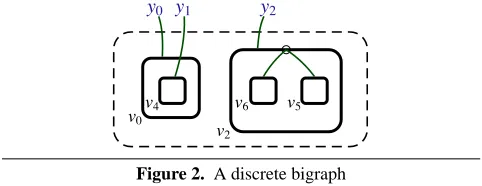
An interface is prime if it has width 1. A binding bigraph G : I → J is prime, if all names in I are local and J is prime. A bigraph is ground if it has unit inner face = h0,(),∅i; these bigraphs represent agents, whereas bigraphs with holes represents contexts. A binding bigraph is discrete if every free link is a name and has exactly one point. We call an edge idle if no point is connected to it. A bigraph is lean if it has no idle edges. The bigraph in Fig. 2 is ground, lean and discrete, as it has no idle edges and its free ports are in a 1-1 correspondence with outer names; its only edge in the bigraph is bound by the binding port of v2. It is an
important result of [8] that bigraphs can be expressed uniquely up-to-isomorphism as a composition of a discrete bigraph and a wiring – i.e. a link graph with no nodes – whose purpose is to reconnect the free links so as to obtain the original edges and name sharing.
Ideally, bigraphs that only differ from the identity of edges and nodes should be equated, as these are conceptually irrelevant. We say that G and H are lean-support equivalent, in symbols GmH, if they are isomorphic after discarding all idle edges. An abstract binding bigraph is a lean-support equivalence class of concrete binding bigraphs. For any signaturesKandEwe have a category B(K,E) and the quotient functor
~·: ´ B(K,E)→B(K,E) .
Observe that abstract bigraphs form a category. The reason that prevents us from working in B(K,E) is that the latter does not possess relative pushouts (RPOs; cf. Appendix B) which is the fun-damental notion on which the dynamic theory of bigraphs rests. The approach developed by Milner, Leifer, and Jensen that we fol-low in this paper is to work in the precategory of concrete bigraphs – where RPOs exist – and then transfer the results to abstract bi-graphs along the quotient functor~·. A parallel approach has been developed in [18, 19, 9] based on the use of bicategories.
Bigraph term language. Bigraphs admit an elegant and fruitful representation via a simple term language; this is an alternative to their the graphical representation, which in the future may be exploited to develop executable specifications. For each non-atomic control K : h→k and every choice of h+k distinct names~y and~x, the term language contains a ion K~x(~y)with inner local names~y, free outer names~x and one site (hole). Similarly, for an atomic control K we have ground atoms like K~x. (Note that terms are subject to α-conversion of inner local names.) Wiring can be obtained from elementary terms like/x, x/X, andpXq, representing respectively the closure of a name x, the substitution of x for a set of names X, and the concretion or ‘globalisation’ of local names X.
Besides composition◦and tensor⊗, terms can be combined by parallel product g k h and prime parallel product h | g which,
differently from⊗, are defined even if h and g share outer names. precisely,kworks like⊗but links the common outer names, while
|merges the multiple regions resulting from k to a single one. The denotations of these combinators as operations on concrete bigraphs are described in Appendix A.
y0 y1 y2
v0 v4
v2
[image:3.612.316.557.129.222.2]v6 v5
Figure 2. A discrete bigraph
The bigraph in Fig. 2 above can be represented in the term language as below, where for the sake of example we assume that node vihas controlKi.
(K0y0⊗idy1)◦K 4 y1 | K
2 y2(z)◦(K
6 z |K
5 z)
Or, omitting◦andids as customary:K0 y0(K
4 y1)|K
2 y2(z)(K
6 z |K5z).
Reactions and transitions. The dynamics of bigraphical reactive systems is defined in terms of a reaction relation on ´ B(K,E) generated from a set of reaction rulesR. Such rules are usually parametric of a very general nature, and may discard and also duplicate their parameters. This must be handled with care, because of name sharing between parameters. We describe next how to derive ground reaction rules from parametric ones by instantiating with ground parameters. As in [8], it suffices to limit ourselves to discrete parameters and affine instantiations, i.e. instantiations that do not duplicate parameters.
A ground (reaction) rule is a pair (r,r0
), where r and r0
are ground bigraphs with the same outer face. Given a set of ground rules, the reaction relation_over agents is the least relation such that D◦r _ D◦r0 for each ground rule (r,
r0
) and each active context D – i.e., contexts whose hole is nested only inside active controls.
A parametric (reaction) rule has a redex R and a reactum R0
, and takes the following form
(R : I→J,R0: I0→J, %) ,
where the inner faces I and I0
are local with widths m and m0
, and% is an instantiation function generated by an injective, not necessar-ily surjective function ¯%: m0→
m. The latter is meant to map the m parameters in the redex to the m0parameters in the reactum
accord-ing to the correspondence prescribed by ¯%. Precisely, any discrete d : → X⊗I is a tensor of discrete primes d =d0⊗ · · · ⊗dm−1.
Essentially,%(d) is their combination underk(i.e., with sharing of outer names) in ¯%-order,%(d)=Xkd%(0)¯ k · · · kd%(m¯ 0−1), worked out
up to lean-support isomorphism in order to guarantee that the prod-uct is well defined. Since some di may be dropped, the resulting outer face may not have all the required names, which is the reason to add the factor X : → h0,(),Xi. Summing up, instantiating the parametric rule with d generates the ground reaction rule
(idX ⊗R)◦d,(idX ⊗R
0
)◦%(d) .
2.
Basic bigraphical reactive systems
The conditions which define a basic BRS enforce important simplifying properties of redexes. Informally, these include ideas such as flatness (no nesting of nodes), guardedness (no inner name is open, no site has a root as parent), simpleness (no inner names are peer, no sites are siblings), and definiteness (no redex involve only a subset of the controls involved in another). Together, they enforce nice categorical properties such as that the parametric redexes are both epi and mono. We refer the reader to the full paper for a formal definition of these requirements, and here we content ourselves with saying that basic BRS yield a tractable transition system whose bisimilarity is a congruence. And of course, that fortunately they are expressive enough to represent the polyadicπ-calculus of this paper.
For an agent a and a ground reaction rule (r,r0
) we aim at de-riving a standard transition a L .a0, as expressed in the diagram
below where L and D are an idem pushout of a and r (informally, think pushout; cf. Appendix B).
L
a
r r!
a! D
Note that D must be an active context. We call the transition system of a BRS consisting of all standard transitions the standard transi-tion system, denoted, and write∼for the associated bisimilarity.
L1. In any BRS equipped with the standard transition system, bisimilarity of (concrete) ground bigraphs is a congruence.
We say that one transition systemMis a sub-lts ofLwhenever the interfaces and transitions ofMare included in the interfaces and transitions ofL.
D2 ( ,). Given a transition systemLand a sub-ltsM. We define a relative bisimulation for
Mas a symmetric relationSsuch that whenever aS b, then for every transition a L.a0
inMwhere L◦b is defined, there exists b0
such that b L .b0
inLand a0S
b0
. We define relative bisimilarity forM, written∼M
L, as the largest relative bisimulation forM(on L). We say thatMis adequate forLwhen∼M
L coincides with∼L
on the agents inM.
We will focus our attention on engaged transitions of prime, ground bigraphs with free outer face. These are transitions where the agent a shares at least one node with the parametric redex R underlying the ground r, and the reason for the restriction is to match our intuition that in order for a transition to be significant, a must actually contribute to it. We writefor the sub-lts of consisting of engaged transitions and∼ for its bisimilarity; we write∼
for the relative bisimilarity foron.
T1 (cf. [8]). In any basic BRSsis adequate forand
∼coincides with∼and is therefore a congruence.
Transferring engaged transitions. In order to transfer ∼ to abstract bigraphs via a quotient functor, we need to enforce more structure on the concrete bigraphs where we derive the be-havioural equivalence. As in [8], we find it convenient to work in ´ Bh(K,E), the sub-precategory of ´ B(K,E) consisting hard bigraphs. These are bigraphs whose place graphs are epi, and can be characterised as those where all non-atomic nodes and roots contain at least one node.
We define place equivalence as the least equivalence which equate bigraphs that only differ on nodes with the special atomic control4with zero arity. Soft lean-support equivalence, writtenm4,
is then taken to be the smallest equivalence including lean-support equivalence and place equivalence. It is easy to prove that we have am4-quotient functor
~·4: ´ Bh(K 4,E
)→B(K,E) ,
where K4 stands for the signature K extended with the fresh
control4. Note that we can make any bigraph in ´ B(K,E) into a bigraph in´ Bh(K4,E
) by placing4-nodes in all roots and non-atomic nodes which break the hard requirement.
Thanks to the properties of basic BRS we can now transfer the bisimilarity∼ for free prime engaged transitions from the hard concrete setting to the (soft) abstract setting while the induced bisimilarity remains a congruence.
T2 (cf. [8]). Let ´ Bh(K4,E) be a hard concrete basic BRS whose all redexes are4-free. Then
1. a∼b in´ Bh(K4,E
) iff ~a4∼~b4in B(K,E). 2.∼is a congruence in B(K,E).
3.
Sorted binding bigraphs
We are now ready to define link-sorted binding bigraphs generalis-ing the idea of [13] to also include sorts to edge signatures. Usgeneralis-ing the same notation as loc. cit., we letΘdenote a non-empty set of sorts and useθto range overΘ.
We enrich the edge signatureEby ascribing a sort inΘto each edge control. We say thatEisΘ-sorted. A binding bigraph onK
andEisΘ-sorted if both its interfaces are enriched by ascribing a sort to each name. We differ from previous work by say that a port p has sort S , when p points to a link with sort S , i.e. ports inherit their sorting from the link they are connected to. We denote by´ Sh(Θ,K,E) the monoidal precategory of sorted hard binding bigraphs whose identities, composition, and tensor product are defined in terms of the underlying binding bigraphs.
D3 ( ). A sorting (discipline) is a tuple Σ =(Θ,K,E,Φ),whereEisΘ-sorted andΦis a condition onΘ -sorted binding bigraphs overK andE. The conditionΦmust be satisfied by the identities and preserved by both composition and tensor product.
We say that a binding bigraph in´ Sh(Θ,K,E) isΣ-sorted if it satisfiesΦ. Often, whenΣis understood from the context, we omit Σand just callΣ-sorted bigraph well-sorted. TheΣ-sorted bind-ing bigraphs form a monoidal sub-precategory of ´ Sh(Θ,K,E) denoted by ´ Sh(Σ). If ´R is a set of Σ-sorted reaction rules, ´ Sh(Σ,´R) is aΣ-sorted BRS.
Together with the sorting we of course have a forgetful functor which we call a sorting functorΣ: ´ Sh(Σ)→´ Bh(K,E).Like the forgetful functor from binding bigraphs to pure bigraphs the forgetful functor induced by the sorting is faithful.
D4 ( , ). Let F
be a functor on a precategory´A, and let i range over{0,1}. ThenF
creates RPOs if, whenever Dibounds Aiin ´A, any RPO forF(Ai) relative to the boundF(Di) has a uniqueF-preimage that is an RPO for Airelative to Di.
F weakly reflects pushouts if, whenever Diis an IPO for Ai in
Di to be a pushout for Ai. This slight change of definition allows for a greater range of sortings while still enjoying the benefits of a tractable transition system based on engaged transitions.
Sorted binding bigraphs support a notion of basic BRS analo-gous to the one described for (unsorted) binding bigraphs in the previous section. We can prove that the sorting functor reflects and preserves this property, and therefore retrace the development in§2. The following theorem matches very closely the one in [13], and ensures the existence of RPOs and guarantees that coincides withon free prime interfaces when the sorting functor satisfies the conditions of Definition 4.
T3 ( ). In´ Sh(Σ,´R)
•IfΣcreates RPOs, then bisimilarity for the standard transition system,∼, is a congruence.
•If in additionΣweakly reflects pushouts and ´Ris basic, then
∼
is adequate for∼.
As in the previous section we let
~·4: ´ Sh(K4,E)→S(K,E)
be the quotient functor bym4, and we can again transfer the
con-gruential bisimilarity∼from the hard concrete setting to the soft abstract setting.
C1. Let ´ Sh(K4,E) be a hard sorted concrete BRS that is basic and whose all redexes are4-free. Then
1. a∼b in´ Sh(K4,E
) iff ~a4∼~b4in S(K,E). 2.∼is a congruence in S(K,E).
We have now taken the theory of sorted binding bigraphs as far as required to provide a treatment of the polyadicπ-calculus with a tractable labelled transition system and a congruential bisimilarity.
Sorting for the polyadicπ-calculus
In this subsection we present a sorting for binding bigraphs, sub-sorting, where we require that the sort of a point connected to a link is a subsort of the link’s sort, and that lower bounds can be expressed on sets of sorts. Most of the constructions in this section require the existence of bounded meets between pair of sorts.
D5 ( ). Let S be a set of sorts and ≤ a preorder onS. The meet of a pair of sorts T and T0
, written TuT0
, is a sort S such that S ≤T , S ≤T0
, and for all other sorts S0
with the same property, we have S0 ≤
S . We say that the preorder has bounded meets if whenever U≤T and U≤T0
, then there exists a meet of T and T0
.
In the definition below, function pack is responsible for com-bining a list of sorts and a type constructor from a set Q to re-turn the sort resulting from their combination. A constructor q∈Q can be covariant, contravariant or invariant on each of its argu-ments. We use this information to derive a preorder relation ≤
on S∗ ×
Q; namely, for S ≤ T and a q covariant on i we set (...,S, ...,q)≤(...,T, ...,q), where S is the ith element in the tuple; dually, (...,T, ...,q)≤(...,S, ...,q) if q is contravariant on i. We also assume a non-commutative partial multiplication×on Q. This in-duces a partial multiplication (T~,q)×(~S,q0
) defined as (T~, ~S,q×q0
) exactly when q×q0
is, andS~ ≤T componentwise. We then aug-~ ment our preorder by stipulating that (T~, ~S,q×q0) precedes both
(T~,q) and (S~,q0
). Function pack will be required to be monotonic with respect to such a preorder structure.
D6 (). A subsortingΣ =(Θ,K,E,Φ) is a set
Swith a preorder≤with bounded meets, together with a partial
injective monotonic function pack :S∗×
Q * S, which takes a tuple of sorts and a type constructor q and returns a sort. Every control K ∈ K with ar(K) = n > 0 is associated with a type constructor qK ∈Q and a partition of n into two sets,CKandVK, of respectively communication and value ports. If q is covariant on i and K’s ith port is a value port, then it must be a binding port. The edge signatureEdelivers an arbitrary assignment of sorts to edge controls, and the conditionΦis as follows:
•For each inner name x : S , if T is the sort of its link, then T ≤S .
•For each K-node v and each c∈ CK, let S be the sort of v’s cor-responding port; we require that S ≤pack(S1, . . . ,S|VK|,qK),
where Siis the sort of v’s ith port inVK.
Intuitively the first requirement ensures that we can always use subsumption on sorts, while the second requirement allows us to express lower bounds on the combination of a tuple of sorts under the appropriate type constructor. The condition about binding ports guarantees well-sortedness when subsorting under a covariant constructor. It is straightforward to prove that subsorting is satisfied by identities and preserved by composition and tensor product.
In the following we will useUsto denote the subsorting func-tor which maps a well-sorted bigraph to the underlying binding bi-graph. FunctorUsdoes not reflect pushout in the sense of [13]. It is however possible to prove thatUsweakly reflects pushouts, since the outer interface of an IPO is the smallest possible. We can show the following results for subsorting.
T4. The subsorting functorUscreates RPOs and weakly reflects pushouts.
Most of the concepts of §1 can be transferred to subsorted bigraphs with only minor changes. Notably, for parallel productk
and prime product|we require that shared names have a common subsort and in the resulting outer face we associate to them the meet of their sorts. Instantiation and reaction rules can then be transferred to the sorted setting mutatis mutandis.
4.
Polyadic pi-calculus
In this section we briefly introduce the polyadicπ-calculus of [14] with a variant of Pierce and Sangiorgi’s type system [17], where we have capability types and a subsorting relation with bounded meets as in [5, 4]. We assume an infinite set of namesNand and let m,n range overN. We let P and Q range over process expressions, and S , T , and U over sorts. The setPπof process expressions is defined
by the following grammar
P ::=0 P|P
0
(νn : S )P nhm1, ...,mii.P
n(m1: S1, ...,mi: Si).P .
We usePπ/αto denote the set ofα-equivalence classes of process
expressions, as we consider processes up toα-equivalence. We write (ν˜n : ˜S )P for the restriction in process P of a set of names ˜n with associated sorts ˜S .
For brevity we will not define structural congruence in this paper. We remark however that we include the following rule, for πa generic prefix:π.(νn : S )P ≡π (νn : S )π.P, if n < fn(π). An
evaluation context is a context whose hole is not under a prefix. We write P{m0
1,...,m
0
i/m
1,...,mi} for the simultaneous capture-avoiding substitution of ˜m0
jfor ˜mjin P. The reaction relation→πis the least
binary relation overPπ/α satisfying the following rule and closed
under evaluation contexts and structural congruence
n(m1: S1, ...,mi: Si).P|nhm01, ...,m 0
ii.Q→πPσ|Q
,
whereσ={m0 1, ...,m
0
Ti≤Ti0, i=1, ...,n (T1, ...,Tn)r≤(T
0 1, ...,T
0
n) r
Ti≤Ti0, i=1, ...,n (T10, ...,T
0
n) w≤
(T1, ...,Tn)w
Ti≤T
0
i and Si≤S
0
i, i=1, ...,n (T1, ...,Tn; S
0 1, ...,S
0
n) b≤
(T10, ...,T 0
n; S1, ...,Sn)b
Ti≤T0
i, i=1, ...,n (T1, ...,Tn; S1, ...,Sn)b≤(T
0 1, ...,T
0
n) r
Ti≤T0
i, i=1, ...,n (S1, ...,Sn; T
0 1, ...,T
0
n) b≤
[image:6.612.58.556.70.249.2](T1, ...,Tn)w
Figure 3. The subsort relation
Γ`0 :◦
Γ`P :◦ Γ`Q :◦
Γ`P|Q :◦
Γ,n : S `P :◦
Γ`(νn : S )P :◦
Γ(n)≤(S1, ...,Sn)r Γ,m1: S1, ...,mn: Sn`P :◦ Γ`n(m1: S1, ...,mn: Sn).P :◦
Γ(n)≤(Γ(m1), ...,Γ(mn))w Γ`P :◦
[image:6.612.65.280.332.391.2]Γ`nhm1, ...,mni.P :◦
Figure 4. The typing judgement
Now we introduce a sorting mechanism inspired by [5, 4]. We use I to range over input/output tags defined as I ::=r
w b, which represent respectively the receive capability, the send capability, and the capability to both send and receive. The set of sortsSof our type system is defined by the following rules.
()I:: Type
T1...Tn:: Type
(T1, ...,Tn)r:: Type
T1...Tn:: Type
(T1, ...,Tn)w:: Type
T1...Tn:: Type S1...Sn:: Type Si≤Ti
(T1, ...,Tn; S1, ...,Sn)b:: Type
The most interesting rule is the one for theb-tag. In a sort (T1, . . . ,Tn; S1, . . . ,Sn)b the first set of components, T1, . . . ,Tn,
captures the sort’s input capability, whilst the second set, S1, ...,Sn,
captures the output capability. The side-condition on rule Si ≤ Ti, which uses the subsort relation (cf. below) ensures that the communicated output on a channel belongs to a subsort of the expected input sort. We will omit the annotation S :: Type on sorts. A sorting Γ is a finite partial mapping from names to sorts; writingΓ,a : S we tacitly assume that a < Γ. Clearly, the order
of bindings inΓ is immaterial. We introduce a subsort relation,
≤, on sorts as the least preorder satisfying the rules of Fig. 3. The rules express that ther-tag (resp.w-tag) is a covariant (resp. contravariant) constructor. On the other hand, the b-tag operator is covariant on the first set of components and contravariant on the second. The typing judgementΓ ` P : ◦in Fig. 4 says that the process P is well-sorted under the assumptionΓ, which must contain all the free names of P. The rules are self-explanatory, but note that the rules for input and output checks that the sort of the name n is a subsort of the expected sort. This type system enjoys the following standard result.
L2 ( ). IfΓ`P :◦, thenΓ`P0:◦for each P→πP0
.
5.
Bigraphical representation
We now proceed to represent the polyadicπ-calculus and its sub-sorting as a bigraphical reactive system. Our encoding slightly ex-tend Jensen’s presentation of the synchronous monadicπ-calculus in [6], which in turn is based upon Jensen and Milner’s encod-ing of the asynchronousπ-calculus in [7, 8]. Firstly and foremost, we straightforwardly extend the presentation from the monadic π-calculus to the polyadicπ-calculus. We then consider the sorted polyadicπ-calculus with capability types and subtyping.
In the following we will writeΓbfor the empty ground bigraph with the outer faceh1,(),dom(Γ),Γi, interpretingΓ as a function from names to sorts;subX:h1,(),X,sorti → h1,(),X,sort0iwill denote the substitution that acts as the identity on the set of names X, whilst possibly changing the sort of some of them to a subsort, i.e. sort0
(x)≤sort(x), for all names x∈X. Finally, we writehsorti
as a shorthand for the free prime interfaceh1,(),dom(sort),sorti.
D7 (). Sorting is an instance of subsorting in Def-inition 6. The set of sortsSis the one defined in the previous sec-tion, while Q is the set of tags{b,r,w}withr×w=band
pack(S0, . . . ,Sn,q)=(S0, . . . ,Sn)q ,
defined when the target type exists. The signature will have count-ably manysendandgetcontrols. Allsendcontrols are associated withw, and their value ports are contravariant;getcontrols withr, and their value ports are covariant (and binding).
D8 ( ). The sorted BRS
Sπ≤=Sπ≤(Σπ≤,Rπ≤)
has signaturesKπ≤andEπ≤defined as follows. The edge signature Eπ≤provides a set of controls in one-to-one correspondence with
the sorts inS. The node signature Kπ≤ consists of two infinite
families of non-atomic passive controls, for i a finite ordinal,
send: 0→(i+1) get: i→1 .
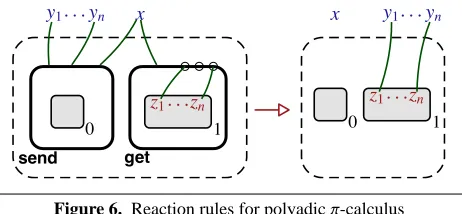
The rule setRπ≤ consists of a family ofΣ-sorted reaction rules
depicted in Fig. 6. The outer names y1, . . . ,ynhave sorts T1, . . . ,Tn,
the local names z1, . . . ,znand the edges they are connected to have
sort U1, . . . ,Un, and the name x has sort (U1, . . . ,Un; T1, . . . ,Tn)b.
y1...yn x
send
0
get
1
z1...z n
!
x y1...yn
0 1
z1...zn
Figure 6. Reaction rules for polyadicπ-calculus
[image:6.612.322.553.587.694.2]~Γ`0 :◦= Γb
~Γ`P|Q :◦=~Γ`P :◦|~Γ`Q :◦
~Γ`(νn : S )P :◦=(/n : S )~Γ,n : S`P :◦
~Γ`nhm1, . . . ,mii.P :◦=sendn,m1,...,mi(~Γ`P :◦)
~Γ`n(m1: S1, . . . ,mi: Si).P :◦=getn(m1,...,mi)(m1, . . . ,mi)(~Γ,m1: S1, . . . ,mi: Si`P :◦)
Figure 5. Translation of a well-typed processΓ`P :◦
length i of appropriate type. Observe that in order for the sort of x to be well-formed, Ti ≤Ui must hold. Note also that we require the input and the output sorts to matche precisely the sort of x, the name carrying the message. This ‘minimal’ description induce a large set of reaction rules, since the context of the reaction can use subsumption to obtain reactions where the sorts do not match pre-cisely. We can therefore apply the reaction rule to an agent in any well-sorted setting, as long as asendnode is linked to agetnode. Even though the rules are specified using a minimal description they are not as good as one would desire, as they give rise to too many transitions, as e.g. transitions that introduce redundant sub-sorting. We conjecture that it is not possible to identify a complete set of reaction rules which does not give rise to such transitions. An obvious attempt would be to assume the existence of minimal and maximal sorts and give the outer names yithe maximal sort, which can then subsort correctly in the context. However this will only work if the sorts of ziare also given the maximal sort, as otherwise the rule will not be well-typed. So even with minimal and maximal sorts we could not describe the reaction rules without indexing over the types. Nevertheless, we will prove that we can limit our atten-tion to the transiatten-tions which introduce no redundant subsorting, and still obtain the same congruence.
In Fig. 5 we define a translation~−of a well-typed process
Γ ` P : ◦ to bigraphs inductively on the typing derivation of P. The target set is the homset → hΓi of Sπ≤. We map
the inactive process to the empty bigraph with the correct outer interface; parallel composition is translated into a prime product; restriction is mapped to a name closure of the appropriate sort; and prefixes are translated into a node of the respective controls.
P1 ( ).Γ`P :◦ ≡πΓ` P0:◦if
and only if~Γ`P :◦=~Γ`P0:◦
Since sorting is preserved by tensor product, and since the ad-dition of a name x can be obtained by tensoring with an idle x, weakening of sorting environments follows for free. Also narrow-ing comes for free, as sortnarrow-ing is preserved by composition, and nar-rowing can be expressed by composing with a substitution. In the following, we write aπto denote theπ-calculus process – unique up-to structural congruence – corresponding to the agent a.
T5 ( ). For every well-typed pro-cessΓ`P :◦and agent a :→ hΓiwe have
~Γ`P :◦_a if and only if P→πaπ
The dynamic correspondence between the polyadicπ-calculus and its presentation as a bigraphical reactive system has been achieved by working in soft abstract bigraphs. In order to examine the behavioural theory it would be convenient to use hard con-crete bigraphs for their notions of engagedness and RPOs, and then transfer the results back into soft abstract bigraphs.
We let ´ Sπ≤
def
=´ Sh(Σ4
π≤,´Rπ≤) be the preimage of Sπ≤
under the qoutient functor~·4, so that every rule in ´Rπ≤is a lean
preimage of a rule in Rπ≤. This makes ´ Sπ≤ a hard concrete
sorted BRS. As the sorting in ´ Sπ≤is an instance of subsorting
we obtain the following results. relatingand.
C2.
1. In´ Sπ≤the bisimilarity∼is a congruence.
2. a∼b in´ Sπ≤if and only if~a4∼~b4in Sπ≤.
3. The bisimilarity∼is a congruence in Sπ≤.
The bisimilarity∼in Sπ≤ in turn induces an equivalence ∼indinPπ/α. This is the smallest relation on well-sortedPπ/α
pro-cesses relating aπand bπ, in symbolsΓ`aπ∼ind bπ:◦, whenever
a and b are related by∼and have outer facehΓi.
T6. The relation∼indis a congruence.
We follow the same procedure as in [8] to derive transitions, with an extension to ensure well-sortedness. As mentioned above, due to the subsorting and the way the reaction rules are specified, the transitions we obtain may contain redundant subsorting in their labels. However, we prove that we can limit our attention to a subset of labels which do no not contain redundant subsorting. We start by characterising the engaged transitions generated by the RPO construction in Sπ≤.
L3 ( Sπ≤). Let a :hsortibe
an agent in Sπ≤and a
L . a0
one of its engaged transitions. We can characterise a, L, and a0
in the following forms
a=(/Z : ˜S )(ra|b)
L=hσi |rL:hsorti → hsort0i
a0=σ(/Z : ˜S )(y1. . .yn/(z1. . .zn)c2|c1|b) :hsort 0
i
where, up to a bijection on names, one of the cases in Fig. 7 holds (ignore the L for the moment). In the first (resp. second) case we require that x∈ X and that c2 (resp. c1, respectively) is discrete
with names not in X∪Z. In the third case we require that x0,x1∈X
and that they have a common subsort.
In all the cases the substitutionσcan introduce subsorting on the names in X (or, in the third case, on the names in Xr{xi}).
Furthermore in the first case the sort of x is a subsort of sort(x)u
(S1, . . . ,Sn)r, where S1, . . . ,Snare the sort of the edges pointed to by z1, . . . ,zn. In the second case the sort of x must be a subsort of
sort(x)u(sort0
(y1), . . . ,sort0(yn))w. Finally, in the third case the sort
of ximust be a subsort of sort(x0)usort(x1).
So for a transition a L .a0
ra rL σ L
sendxy1...ync1 getx(z1...zn)c2 subX x(z1: S1, ...,zn: Sn)c2π
getx(z
1...zn)c2 sendxy1...ync1 subX xhy1, . . . ,ynic1π sendx0y1...ync1|getx1(z1...zn)c2 1 subXr{xi}|xi/xi xi/xi
[image:8.612.62.515.75.141.2]sendxy1...ync1|getx(z1...zn)c2 1 subX τ
Figure 7. Characterisation of transitions
to the inner names zi. Secondly, the generation of ground reaction rules from parametric ones also adds redundant subsorting. This happens as the grounding of reaction rules maps the parameter’s names (and their sort) through without requiring a minimal-sorting condition. There appears to be no easy fix, as the current sorting does not allow to ‘minimal-sort’ all bigraphs.
These additional ground reaction rules again affect the deriva-tion of transideriva-tions. The IPO property of a transideriva-tion, a L .a0
,
L
a
r r!
a! D
enforces that the label L is minimal with respect to the given agent a and the chosen ground reaction rule r. Having an infinite number of reaction rules, we have no elegant way to ensure that we only use the minimal reaction rule (among those that only differ on the sorts in their outer face), i.e. the one that introduces the least subsorting when deriving the label.
In order to examine a specific set of reaction rules, we define a sub-lts of , denoted , which has the same agents as but only those transitions fromthat do not introduce redundant subsorting. We then prove a proposition stating that ifand satisfies some simple conditions, then their bisimilarity relations coincide. Following existing terminology, we say that a well-sorted bigraph is a resorting if its image under the sorting functor is an identity, and we letϕrange over resortings. We say that a label L introduces a redundant subsort if it can be obtained from another label M and a non-identity resortingϕas in the first bullet item of the following proposition.
P2. LetLbe a transition system andMa sub-lts thereof with the following three properties
•If a L. a0
is a transition inL, then there exists a resorting ϕand a transition a M. a00
in Msuch that L = ϕM and a0=ϕa00
.
•If a M. a0
is a transition inL, then for any resortingϕwith the appropriate inner face there exists a transition a ϕM. ϕa0
inL.
•ϕa L . a0
is a transition inLif and only if a Lϕ. a0
is a transition inL.
ThenMis adequate forL.
We now consider a subset of transitions that introduce no redun-dant subsorts. This is a subset of the labels of Lemma 3, where the substitutionσassign to x the sort sort(x)u(S1, . . . ,Sn)rin sort0, in the first case, and sort(x)u(sort0(y
1), . . . ,sort0(yn))w, in the second
one. In the third case x is assigned sort sort(x0)usort(x1). We call
such transitions precise, and we letdenote the resulting transi-tion system and∼prebe the corresponding bisimulation. Asand satisfy the conditions of Proposition 2 we obtain the following.
C3.is adequate for.
We can derive a characterisation of the labels forPπ/αfrom the
one obtained in Lemma 3 for engaged transitions. In the definition below, for L an engaged label in Sπ≤, label L refers to the
corresponding cell of the fourth column in Fig. 7.
D9 ( ). The induced transition rela-tion Iindis the smallest relation on typing judgements such that
Γ`P :◦ LIind Γ0 `P0:◦if~Γ`P :◦ L .~Γ0`P0:◦is a
precise engaged transition in Sπ≤.
We now can prove that such labels yield a coinductive charac-terisation of the induced equivalence.
L4.Γ `P∼ind Q :◦if and only ifΓ` PRQ :◦for some Iind-bisimulationR.
Hence, we have identified a suitably small set of labels using the framework of bigraphical reactive system which corresponds to the expected set of labels. And we have proved that the derived labelled transition system characterises the induced congruence.
6.
Conclusion and future work
In this paper we have used link-sortings to represent the capability types of Pierce and Sangiorgi in the setting of bigraphs. To this end we have conservatively extended the definition of link graphs to include edge controls, and extended the notion of link-sortings to binding bigraphs. We have proven that the theory developed in [8] can be lifted to a sorted setting with only minor adjustments. Hence, we are able to derive a labelled transition system and a congruential behavioural equivalence for the polyadicπ-calculus with capability types. We have furthermore proved that we can confine attention to labelled transitions that do not introduce any redundant subsorting of the agent involved in the transition; indeed, this smaller set of labels induce the same congruence as the full set of labels.
These results are promising, since they provide a foundation for presenting many of the existing type systems for the (polyadic) π-calculus and for similar calculi as sortings in a bigraphical reac-tive framework. The advantage of that resides of course in the re-casting of very successful, yet often incompatible theories, in the uniform, unifying behavioural theory of bigraphical reactive sys-tems, as well as the development and furthering of the foundational framework itself. Technically, we remark that our slight generalisa-tion from ‘reflects pushouts’ to ‘weakly reflects pushouts’ allows us to present a wider variety of sortings while enjoying all the benefits of the framework of engaged transitions to derive labelled transi-tions.
We have not yet examined how the derived congruence relates to the traditional equivalences for the polyadicπ-calculus. In par-ticular, it would be important to compare the congruence with the typed bisimilarity of [4, 3].
The subsorting presented in the paper relies crucially on the existence of bounded meets, that we use to construct RPOs and to (weakly) reflect pushouts. The requirement of bounded meets is only necessary since we consider a type system with subsorts. It would be interesting to examine more general sufficient conditions on type systems and their features that allow to present them as sortings in a bigraphical reactive system.
Bigraphs are by definition typed with an outer and an inner face; concrete bigraphs in addition have support sets associated to them. So far we have only assigned sorts to interfaces and controls, and not to the bigraph as a whole, as we traditionally do when we consider programming languages, as for instance the λ-calculus, or some process calculi. We plan to examine sortings that assign sorts to and express properties of whole bigraphs, not just their components.
Acknowledgements. For numerous helpful discussions and cor-respondence we are indebted to Søren Debois, Shane O’Conchuir, Ole Jensen, James Leifer, and last but not least Robin Milner.
References
[1] L. B, S. D, E. E, T. H,H. N.
Bi-graphical models of context-aware systems. In Proc. of FOSSACS’06, volume3921of LNCS, pages187–201. Springer2006.
[2] M. B V. S. Typed polyadicπ-calculus in
bigraphs. To appear as Technical Report, manuscript available on request,2006.
[3] Y. D D. S. Towards an algebraic theory of typed
mobile processes. Theoretical Computer Science,350(2–3):188–212, 2006.
[4] M. H J. R. Typed behavioural equivalences for
processes in the presence of subtyping. Mathematical Structures in
Computer Science,14(5):651–684,2004.
[5] M. H J. R. Resource access control in systems of
mobile agents. Information and Computation,173(1):82–120,2002.
[6] O. H. J. Mobile Processes in Bigraphs. PhD thesis, Department
of Computer Science, Aalborg University,2006. Forthcoming.
[7] O. H. J R. M. Bigraphs and transitions. In Proc. of
POPL’03, pages38–49. ACM Press2003.
[8] O. H. J R. M. Bigraphs and mobile processes (revised).
Technical Report UCAM-CL-TR-580, University of Cambridge, Computer Laboratory2004.
[9] B. K, V. S P. S´ . Labels from Reductions:
Towards a General Theory. In First International Conference on
Algebras and Coalgebras in Computer Science, volume3629on
LNCS, pages30–50, Springer2005.
[10] N. K. Type systems for concurrent programs. In Proc. of
10th Anniversary Colloquium of UNU/IIST, volume2757of LNCS, pages439–453, Springer2003.
[11] B. K¨. A general framework for types in graph rewriting. In Proc.
of FSTTCS’00, volume1974of LNCS, pages373–384. Springer 2000.
[12] B. K¨. A graph rewriting semantics for the polyadic pi-calculus. In Proc. of GT-VMT’00, pages451–458. Carleton Scientific2000.
[13] J. J. L R. M. Transition systems, link graphs and Petri
nets. Technical Report UCAM-CL-TR-598, University of Cambridge, Computer Laboratory2004.
[14] R. M. The polyadicπ-calculus: A tutorial. In Logic and Algebra
of Specification, pages203–246, Springer1993.
[15] R. M. Pure bigraphs: Structure and dynamics. Information and
Computation,204(1):60–122,2006.
[16] S. O’C. Kind bigraphs – static theory. Technical Report TCD-CS-2005-36, Trinity College Dublin, Computer Science Department 2005.
[17] B. C. P D. S. Typing and subtyping for mobile
processes. Mathematical Structures in Computer Science,6(5):409– 453,1996.
[18] V. S P. S´ . Deriving Bisimulation Congruences
using 2-Categories. Nordic Journal of Computing vol.10(2),163– 183,2003.
[19] V. S P. S´ . Locating Reactions using 2-Categories.
Theoretical Computer Science vol.333(1-2),297–327,2005.
[20] P. S. Global/local subtyping and capability inference for a distributed pi-calculus. In Proc. of ICALP’98, volume1443of LNCS, pages695–706. Springer1998.
A.
Binding bigraphs, formally
This section briefly recalls the main concepts of binding bigraphs, starting from their constituting place and link graph. We use]for the union of sets known or assumed to be disjoint, and for the union of functions where the domains are such. We define the support of a place graph to be the node set, and the support of a link graph and a pure bigraph to be both the node set and the edge set. We define bigraphs and more generally bigraphical reactive systems with respect to a signature.
D10 (). A signatureKis a set whose elements are called controls. Each control K∈ Kis assigned an arity ar(K), that determines its number of ports. A control can be atomic, and then not allowed to contain further structure. Non-atomic controls can be active. Controls which are not active are called passive.
We begin by defining the two constitutes of a pure bigraph: the place graph and the link graph.
D11 ( ). A place graph over a signature K with inner width m and outer width n, both finite ordinals, is a structure GP =(V,ctrl,prnt) : m → n consisting of a finite set of nodes V; a control map ctrl : V → K, which assigns controls to nodes; and a parent map prnt : m]V→V]n, which assigns each node and site to parent node or root. The parent map is acyclic, i.e. prntk(v)
,v for all k>0 and v∈V. An atomic node may not be a
parent.
The widths m and n index respectively the sites and roots of A respectively. Sites and nodes are called places. We write w>A w0
, or just w>w0
, to indicate that w=prntk(w0
), for some k>0.
D12 ( ). The composition of two place graphs Ai=(Vi,ctrli,prnti) : mi →mi+1is defined when
A0and A1have disjoint support. Then the composition A1◦A0is
(V0]V1,ctrl0]ctrl1,prnt) : m0 → m2, where prnt is defined as
(idV0]prnt1)◦(prnt0]idV1).
D13 ( ). The tensor prod-uct of place graphs is defined as follows. On widths m⊗n is the sum of m and n. For two place graphs Ai: mi→ni, their tensor product A0⊗A1: m0⊗m1 →n0⊗n1is defined when A0and A1have
dis-joint support. The tensor product is then defined by ‘shifting’ the sites and roots of A1upwards by m0and n0, respectively, and then
taking the union of the two parent maps.
Informally the tensor product of two place graphs is the juxta-position of the two graphs.
Ob-serve that they are closed under both composition and tensor prod-uct.
The definition of link graphs follows the pattern of place graphs.
D15 ( ). A link graph over a signatureKwith finite sets X and Y of respectively of inner and outer names is a structure GL=(V,E,ctrl,link) : X→Y consisting of a finite set of nodes V; a finite set of edges E; a control map ctrl : V→ K; and a link map link : X]P→E]Y, where Pdef=P
v∈Var(ctrl(v)) is called the set of ports of GL.
The inner names X and the ports P are collectively referred to as the points of GL, the edges E and outer names Y as its links. A link is idle if it has no preimage under the link map; a link graph is lean if it has no idle edges. A link is open if it is an (outer) name; it is closed if it is an edge. A point is open if its (image under) the link map is open, otherwise it is closed.
D16 ( ). The composition of two link graphs Ai=(Vi,Ei,ctrli,linki) : Xi→Xi+1is defined when
A0and A1have disjoint supports. Then the composition A1◦A0is
(V0]V1,E0]E1,ctrl0]ctrl1,link) : X0→X2, where link is defined
as follows. For every p∈X0]P0]P1, where Piis the set of ports
of Ai
link(p)=
link0(p) if p∈X0]P0and link0(p)∈E0
link1(p) if p∈X0]P0and link0(p)=x∈X1
link1(p) if p∈P1 .
D17 ( ). The tensor prod-uct of link graphs is defined as follows. On name sets X⊗Y is defined as the union, whenever X and Y are disjoint. For two link graphs Ai: Xi→Yi, their tensor product A0⊗A1: X0⊗X1→Y0⊗Y1
is defined when both interface products are defined and when A0
and A1have disjoint support. The tensor product is then the union
of the two link maps.
D18 ( ). A pure bigraph is the superimposi-tion of a place and a link graph sharing the set of nodes and the control map. Namely, G=(V,E,ctrl,prnt,link) :hm,Xi → hn,Yi
where GP = (V,ctrl,prnt) : m → n is a place graph, and GL = (V,E,ctrl,link) : X→Y is a link graph.
Sometimes we will write a pure bigraph G as G=hGP,GLi, a combination of its two constituents. We define the composition and the tensor product of two pure bigraphs in terms of the underlying place and link graph.
D19 ( ). The composition of two pure bigraphs Gi: Ii → Ii+1 is defined when G0 and G1 have
disjoint support. We define G1◦G0ashGP1 ◦G
P
0,G
L
1◦G
L
0i: I0→I2.
D20 ( ). The tensor prod-uct of two pure bigraphs is defined as follows. On interfaces,
hm,Xi ⊗ hn,Yi is hm+n,X]Yi when X and Y are disjoint. Given two bigraphs Gi: Ii → Ji their tensor product G0⊗G1 is hGP
0⊗G
P
1,G
L
0⊗G
L
1i : I0⊗I1 → J0⊗J1, when the interfaces are
defined and G0and G1have disjoint support.
We now enhance pure bigraphs with a primitive mechanism of scoping and binding for names and edges. The first ingredient is to equip nodes with binding ports; the definition of binding bigraphs will then enforce that all points linked to it must lie inside the node.
D21 ( ). A binding signatureKassigns to each control K a pair of finite ordinals, the binding arity h and the free arity k, written K : h→ k, which determine respectively its number of binding and non-binding ports. Of course, ar(K)=
h+k. A control can be atomic. Non-atomic controls can be active. Controls which are not active are called passive. If K is atomic, then h=0.
In order to enforce a discipline of containment for links the no-tion of interface must be extended to also assign names to localities, as below.
D22 ( ). A binding interface is a tuple I=hm,loc,Xi, where Iu=hm,Xiis a pure interface and loc : X* m is a partial locality map which associates names X with sites. If loc(x)=s then x is located at s, or is local to s. If loc(x)=⊥then x is global.
Given an interfacehm,loc,Xi, we often denote the locality map loc as a vectorX of length m of pairwise disjoint subsets of X,~ corresponding to the loc-preimages of each site. The names in X not occurring in this way are of course global. We say that an interface I is local (resp. global) if all its names are local (resp. global).
D23 ( ). A binding bigraph G : I → J consists of an underlying pure bigraph Gu: Iu → Juwith extra structure as follows. Declare the binders of G to be the binding ports of its nodes together with the local names of its outer face J. Then G must satisfy the following:
SR: If p is a binder located at a node or, in the case of
local names, at a root w, then every peer p0in the same link as
p must be located at a place w0(a site, root or node) such that
w0<G
uw.
A bigraph is ground if its inner interface is = h0,(),∅i, the unit interface. We remark that bigraphs as defined above are usually referred to as ‘concrete’ bigraphs, as opposed to ‘abstract’ bigraphs than can be obtained by forgetting the identities of nodes and edges via a quotient construction (cf. below).
In order to express sorting disciplines that involve also condi-tions on edges, we find it convenient to extend the definition of bigraphs with the addition of edge controls. An edge signatureEis a set whose elements are called edge controls. Edge controls will be ranged over by L. Each bigraph G will therefore be equipped also with an edge map edgectrlG: E→ Eanalogous to the control map ctrl. As a matter of notation, since any ambiguity can be solved from the context, in the following we shall simply denote both the ‘control’ and ‘edge’ maps with the symbol ctrl.
Concrete binding bigraphs are the arrows of a so-called pre-category, that is a category but for a partial composition operation. More precisely, they give rise to a particularly well-behaved precat-egory, an s-catprecat-egory, which support a suitable quotient construction to translate results from concrete to abstract bigraphs. We refer the reader to [13] for the details. A parallel approach has been proposed in [18, 19, 9] based on the notion of bicategories.
D24. The precategory´ B(K,E) of concrete binding bi-graphs over signaturesKandEhas binding interfaces as objects and binding bigraphs as arrows. If G : I→ J and H : J → K are concrete binding bigraphs with disjoint support, then their compo-sition is defined directly in terms of compocompo-sition of the underlying pure bigraphs.
H◦Gdef=Hu◦Gu
In the same manner, the identitiesidI: I→I, where I=hm,loc,Xi are defined in terms of the underlying identities. We denote by ´ Bh(K,E) the subprecategory of ´ B(K,E) consisting of hard