CSP specification to Java Programs
Letu Yang and Michael R. Poppleton
Dependable Systems and Software Engineering University of Southampton
Southampton, SO17 1BJ, UK {ly03r,mrp}@ecs.soton.ac.uk
Abstract. A recent contribution to the formal specification and verifica-tion of concurrent systems is the integraverifica-tion of the state- and event-based approaches B and CSP, specifically in the ProB model checking tool. At the implementation end of the development, concurrent programming in Java remains a demanding and error-prone activity, because of the need to verify critical properties of safety and liveness as well as func-tional correctness. This work contributes to the automated development of concurrent Java programs from such integrated specifications. The JCSP package was originally designed as a proven clean Java concur-rency vehicle for the implementation of certain CSP specifications. In the context of best current Java concurrent programming practice, we extend the original JCSP package to support the integrated B and CSP speci-fication by implementing new channel classes. We propose rules for the automated translation of the integrated specification to multi-threaded Java using the extended JCSP channel classes. We briefly present a pro-totype translation tool which extends ProB, with a worked example, and conclude with a strategy for formally verifying the translation.
1
Introduction
The difficulty of concurrency motivated the development of formal languages for modelling concurrent processes such as CSP [SS00] and CCS [RM89]. The capability of formal and automated [MK99,FS03] verification of safety and live-ness properties in such concurrency models, before transformation into code, has added real value to industrial systems, including hardware systems[JP04], software systems[JL04], and communication protocols [SD04]. Formal analysis techniques have been applied to concurrent Java programs: [LP05] and [BM02] provide languages to add assertions to Java programs, and employ runtime veri-fication techniques to verify the assertions. Such approaches are concerned with the satisfaction of assertions, not explicit verification against a formal concur-rency model. An explicit formal concurconcur-rency model, which can be verifiably transformed into a concurrent Java program, represents a useful contribution.
One recent trend in formal approaches to system design is to integrate the state- and event-based approaches. State-based specification is appropriate when data structure and its atomic transition is relatively complex; event-based specifi-cation is preferred when design complexity lies in behaviour, i.e. event and action sequencing between system elements. In general of course, significant systems will present design complexity, and consequently require rich modelling capabilities, in both aspects. [Bu99,TS99] have proposed the integration of the state-based B method [Ab96] and CSP, an event-based process algebra. The ProB [BL05] tool supports model checking of combined B and CSP specifications1. A composite specification in ProB uses B for data definition and operations. A CSP speci-fication is employed as a filter on the invocations of atomic B operations, thus guiding their execution sequence.
Peter Welch’s JCSP package [PM00a] provides a high-level concurrency model for Java, implementing theOccam language [ST95], a concurrent programming language that directly implements a subset of CSP. JCSP is based on the point-to-point communication model of Occam. The correctness of the JCSP transla-tion of the Occam channel to a JCSP channel class has been formally proved [PM00b]: the CSP model of the JCSP channel communication is shown to re-fine the CSP/Occam concurrency model. Raju [RR03] has developed a tool to translate subset CSP models directly to JCSP. The tool does not extend beyond theOccam subset of CSP, and does not scale, in our experience, beyond small textbook examples. Furthermore, through our experience with JCSP and Raju’s tool, we find that the point-to-pointOccamcommunication model limits the ca-pability of JCSP for developing concurrent systems based on other concurrency models.
Being event-based, CSP is insufficiently expressive of the data aspect of sys-tems; JCSP is similarly limited. In [RR03], data declaration and assignment are manually added to the Java programs generated by the tool; this can easily break the correctness of the system model which is proved by FDR tool.
Motivated by both the Java concurrency issues and the integrated formal method approaches, we present a translation strategy, which converts combined B and CSP specifications in ProB into Java programs using an extended JCSP
package. The design of the translation rules has taken some inspiration from [OC04], which defines a translation fromCircus to JCSP.
In Section 2, we briefly introduce the existing JCSP package. We then dis-cuss the reasons for extending the original package, and the new features of the extended JCSP package. In Section 3, we demonstrate the translation strategy from the combined B and CSP specification to Java programs, and discuss the translation tool which implements these rules in Prolog. In Section 4, we illus-trate the translation with a Chef-and-Dining-Philosophers example. In Section 5, we outline the verification required of this translation process as future work. Section 6 discuss future work and conclusions.
2
The Extended JCSP package
2.1 JCSP
JCSP [PM00a] is a Java package for developing concurrent Java Programs. It implements theOccamsubset of the CSP language [SS00], as well as some other features of CSP, in a series of process and channel classes. TheOccam language definition is based on that of CSP, but is aimed at modelling channel communi-cation.Occamchannels are based on CSP events. However,Occamchannels are only applied for modelling point to point communication, while CSP events are used in more general concurrency models. In Figure 1, the concurrency model of JCSP andOccamis briefly illustrated in CSP syntax. CSP processesProcAand ProcB synchronize with each other on channelA, while B and C are unsynchro-nized channels. The synchronization happens when ProcB is ready to output datay atA!y, andProcAis ready to input datax atA?x.
ProcA = A?x→B→ProcA ProcB = C →A!y→ProcB
Fig. 1.A CSP specification for Occam/JCSP concurrency
A Java application using theJ CSP package consists of a number of objects of J CSP process classes running in parallel. The process objects communicate with each other via objects of JCSP channel classes. All the process classes used here implement an abstract JCSP process class CSProcess. The channel classes all inherit theinputchannel andoutputchannel interfaces of the JCSP package. JCSP supports two process objects synchronizing and communicating data through a JCSP channel object. A JCSP process blocks when it requires a data communication with the other process on a specific channel. Only when both the output and input side processes of the channel are ready for the data communication, is the data is transmitted through the channel.
Any2OneChannel andAny2AnyChannel classes handle more than two processes, the synchronization still only involves two processes. ForAny2OneChannel, many writer processes and one reader process are associated on the channel. All the requests from writer processes are grouped into a queue. At a given time, only the reader and one writer actually synchronize with each other and pass data through the channel. Thus the synchronization model still is the point-to-point communication ofOccam.
JCSP does support synchronization between more than two channels with a Barrier class. However, Barrier is not implemented as a JCSP channel class, and uses a simple counter to resolve the synchronization. Therefore it can not help to do multi-way synchronization in a manner faithful to the CSP concurrency model.
2.2 Why We Extend JCSP
As the JCSP package was designed to implement the Occam subset of CSP in Java, it cannot be directly used for translating the combined B and CSP specification in ProB. The reasons for this are twofold.
For the CSP part, the combined specification uses a bigger CSP subset than that of JCSP package. Important CSP language features, especially some con-currency facilities such as Alphabetized Parallel, are not supported by JCSP. In developing a concurrent Java system, the synchronization between more than two threads on a certain data transition is a typical concurrency problem, which can be easily specified using CSP. This problem is also identified by JDK5.0, and injava.util.concurrency package, aCyclicBarrier class is build to imple-ment this synchronization in a high-level facility. However, modelling this kind of concurrency in Occam gives the programmer extra work implementing the synchronization on the shared thread. Implementing them in JCSP also requires extra facility classes to resolve the synchronization.
Figure 2 shows the CSP specification of a parallel hardware interface. The interface reads eight bits from eight different channels, and when all the bits are ready, it generates a byte from the bits. In the specification, each bit process B(i) gets a bit using event get(i)?bit, and then waits for the makebyte event. The bit processes interleave with each other. The parallel interface process PI repeatedly makes bytes with the makebyte event, when all the bits are ready. The Main process requires all the processes to synchronize on the makebyte event. As the CSP model of this example has nine processes synchronizing on the same event, it can not be directly translated into Java using the original JCSP package.
B(i) = get(i)?bit→makebyte.byte→B(i) PI = makebyte.byte →PI
Bsys = |||i:1..8@ B(i)
Main = PI [|{makebyte}|] Bsys
*|||declares a set of interleaving processes
* A[|c|]B is the syntax for Alphabetized Parallel, which means that processes A and B synchronize on a set of eventsc
Fig. 2.CSP specification of Parallel Interface
Since the JCSP package is designed for implementing CSP specifications in Java, it has no facility to implement the B part of the combined specification in Java. Therefore we need a strategy for translating the B specifications into Java. Fortunately, the B specification used for the automatic translation is mainly from the B0 subset of the B language, which represents a simple programming language designed to be automatically translatable to target languages of choice. The B+CSP channel combines a B operation wih a CSP event; the operational semantics of this is given in [BL05].
2.3 The Extended JCSP Package
The JCSP package is extended with new channel and facility classes. The new “parallel/choice” channel class PaChoChannel implements the features of com-bined B and CSP specifications which are not included in the original JCSP package. The facility classes implement external choice for the extended channel class.
The extended channel and facility classes are designed as an add-on package for the original JCSP. JCSP process classes can declare and use the new channel classes in a similar manner to using the original JCSP channel classes. As all the changes have been preserved inside the channel and facility classes, there are no significant changes in using them in process classes.
ClassPaChoChannel supports synchronization between more than two pro-cesses. It keeps track of all the processes associated with this channel. When all the associated processes are ready, the data operations in the channel are triggered. After the data operations complete, all the associated processes are notified.
PaChoChannel also supports thedot event c.v, wherecis a CSP event and
v is a data item on it. The synchronization of dot data channels is not only decided by the name of the channels, but also by the dot data values. Two processes, using the same channel c but with different values of v (e.g. c.x,
c.y), will not synchronize with each other. This implementation is based on the B+CSP semantics. The input c?xand output c!xevents are also supported by the new channel class.
specifying concurrent systems. Furthermore, some new facility classes implement external choice for the extended channel classes.
The main issue for implementing the B part of the combined specification is how to implement the data transitions of a B operation into a combined channel class. ThePaChoChannel class implements theSerializable interface of Java, and has an abstract method run. The subclasses of PaChoChannel overwrite the run method by putting in the target Java code of the B data transitions. Therun method is executed when all the associated processes are ready for the execution of the channel class.
Thus, the extended JCSP package supports a bigger subset of CSP than the original JCSP, as well as providing facilities to implement the B part of the combined specifications in Java. This makes it possible to translate the combined B and CSP specifications into Java programs. An example with the extended channel class is discussed in Chapter 4.
The synchronization supported by the extended channel class is implemented with concurrency primitives from Java monitors, which exclude the facilities deprecated by Java 5.0. The correctness of this implementation needs to be verified; a formal proof strategy is proposed later in Section 5.
3
Translation Strategy and Tool
A series of translation rules are developed to structure the automatic translation. The rules are used recursively to generate a set of Java classes from a combined B and CSP specification. We discuss some of the key translation rules in this section. The translation tool implements the translation rules in Prolog.
3.1 Translation Strategy and Rules
In the translation, each combined B+CSP channel is translated into an object of a channel class. Each process in the CSP part of the combined specification is translated into an object of a JCSP process class. Indexed processes are trans-lated into different objects of the same JCSP process class. Their indices are treated as parameters of the JCSP class constructor.
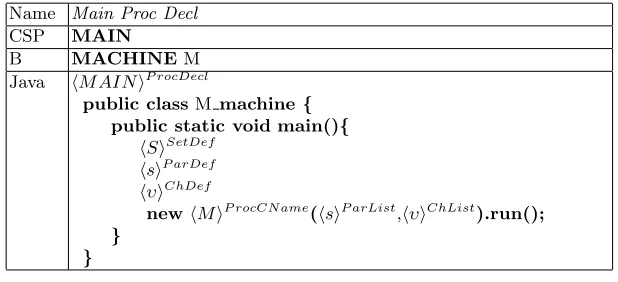
Translation of the MAIN Process The translation strategy is mainly based on the execution behaviour of the system which is specified in theMAINprocess, which is the core process of the CSP part. The translation rules set generates the executable Java class for the target application. It starts with the MAIN process with ruleMain Proc Decl, and recursively generates process classes for all the associated CSP processes.
declare the channel objects for all the channels, and generate channel classes. Finally, it generates the code for declaring the MAIN process object, including the code of therun call.
Name Main Proc Decl
CSP MAIN
B MACHINEM
Java hM AI NiP rocDecl
public classMmachine{ public static void main(){
hSiSetDef
hsiP arDef
hυiChDef
newhMiP rocCN ame(hsiP arList,hυiChList).run();
[image:7.595.153.462.160.301.2]} }
Table 1.Rule 0: Rule for Declaring Main Process
Support of Multi-way Synchronization One important feature of the ex-tended JCSP channel is the support of multi-way synchronization. The parallel structure is handled by rules from the rule setProcE. For example, the combina-tion of the indexed parallel processes is translated by ruleProcE (Re-Parallel).
Name ProcE (Re-Parallel)
CSP [|υ |]n:a@ P(n)
Java CSProcess[] procs ={
newhPiP rocCN ame(hsiP arList,hυiChList,hυ
1iChList,a1), ...
newhPiP rocCN ame(hsiP arList,hυiChList,hυ
niChList,an)
}
new Parallel(procs).run();
Table 2.Rule 9: Rule for Replicated Alphabetized Parallel
In rule ProcE (Re-Parallel) (Table 2), hPiP rocCN ame refers to the name of
the indexed process class, while each process object from P(a1) to P(an) is
an instance of that process class. These process objects synchronize on a set of channels υ. Each process object may include a set of channels υn, which do
not synchronize with other indexed processes here.PaChoChannel class provides
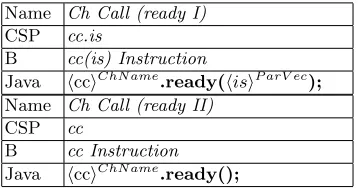
ready methods to support multi-way synchronization. When a JCSP process is ready for the execution of a channel, it calls the ready method of the channel, and waits for other processes which also synchronize on this channel. As there may or may not be data on the channel, different implementations of theready
methods are provided. Table 3 shows the different rules for translating theready
call.
[image:7.595.133.482.392.487.2]For rule Par Vec, the set is of input parameters are grouped intoVector, and performs as a single parameter forready method.
Name Ch Call (ready I)
CSP cc.is
B cc(is) Instruction
Java hcciChN ame.ready(hisiP arV ec);
Name Ch Call (ready II)
CSP cc
B cc Instruction
[image:8.595.219.398.150.244.2]Java hcciChN ame.ready();
Table 3.Rule 6: Rule for Channel Call , ready
Translation of Combined Channels The main issue in translating the com-bined B+CSP channels is how to resolve the parameters from both B and CSP sides. In the original JCSP, as there is no data transition inside the channel, a data xon a channel Ch is simply passed through the channel. Here a process with channel Ch!xsynchronizes with a process withCh?xevent.
Name ChC
B os←cc(is) Instruction
Java public classhcciChCN ame extends PaChoChannel {
hisiP arDef
hosiP arDef
publichcciChCN ame(hisiP arDef){
hisiP arRel
}
public void run(){
hI nstructioniBInstruction
} }
Table 4.Rule 29: Rule for Extended Channel Classes
Therefore, in the target Java program, two process classes use theread and
write methods of JCSP channel classes to communicate the data:
Process 1: ... run(){
...; Ch.write(x); ...
}
...
Process 2: ... run(){
...; x = Ch.read(); ...
}
...
[image:8.595.158.462.363.499.2]semantics of the combined B+CSP channel are: (σ,P)→A(σ′,P′).σandσ′ are
the before and after B states for executing operation o, whileP andP′ are the before and after processes for processing channelch. The combined channel A is a unification of the CSP channelch.a1, ..., aj and the B operationo =o1,...,om ← op(i1,...,in), where j =m+n. Therefore, the combined B+CSP channel A
can be expressed as:A.s1. . . . .sm.sm+1. . . . .sm+n.
In the translation, botho1 ... omand i1 ...in are treated as parameter lists
for the channel classes. In ruleChC(Table 4),o1, .., omare translated into Java
objects os, which are the output parameters, and i1, ..., in are translated into
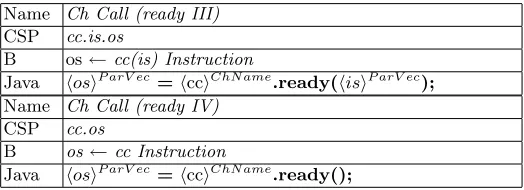
is, which are the input parameters. RulePar Defobtains information from the B specification as before. In the channel class, is are static parameters whose values won’t be changed.osare private parameters of the channel class and are made externally visible by being returned by theready method.osare returned as a JavaVector, as defined in rule Par Vec.
The two translation rules in Table 5 show how the process gets the output parameters from the ready call.
Name Ch Call (ready III)
CSP cc.is.os
B os←cc(is) Instruction
Java hosiP arV ec=hcciChN ame.ready(hisiP arV ec);
Name Ch Call (ready IV)
CSP cc.os
B os←cc Instruction
[image:9.595.177.439.327.422.2]Java hosiP arV ec=hcciChN ame.ready();
Table 5.Rule 6 (continue): Rule for Channel Call , ready
Translation of B B0 is a concrete low-level deterministic imperative program-ming language. It is the target language for generating concrete programs from verified abstract B machines, and it is translatable to high-level programming languages [BB1,VT02].
3.2 Translation Tool
The automatic translation tool is constructed as part of the ProB tool. Our translation tool is also developed inSICStusProlog, which is the implementation language for ProB.
In ProB, the B+CSP specification is parsed and interpreted into Prolog terms, which express the operational semantics of the combined specification. The translation tool works in the same environment as ProB, acquires informa-tion on the combined specificainforma-tion from the Prolog terms, and translates the information into the Java program.
4
Examples
In this section we illustrate how the translation tool works. The example we used here is a simplified version of theWot, no Chicken example from [We00]. The example was originally constructed for emphasizing fairness issues in the wait/notify strategy of Java concurrent programming. We use the example to demonstrate the automatic production of a concurrent Java program from a B+CSP specification. Our version of the example is simplified in omitting the lazy philosopher who raises the fairness issues.
This example includes a chef who cooks chicken, a canteen which is used to store the chicken, and several philosophers who consume the chicken. The chef spends some time to cook a number of chickens and then put them in the canteen. The philosophers take time to think, then take chicken from the canteen and eat. The CSP specification in Figure 3 shows the behaviour of the system. TheMain process is the core process. It consists of aChef process, and several Chicken(i)processes and Philosopher processesPhil(i). ThePhil(i)processes do not synchronize with each other, while all theChicken(i) processes synchronize on theput event. ThePhil(i)processes andChicken(i)processes synchronize on thegetchicken(i)event. TheChef process synchronizes with other processes on theput event.
Main = SYSTEM[|{put}|]Chef
Phil(i) = gotocanteen.i→getchicken.i→backtoseat.i→eat.i→thinking.i→Phil(i) Chef = cook→put→Chef
Chicken(i) = put→getchicken.i→Chicken(i) PHILS =|||i:N@ Phil(i)
CHICKENS = [|put|] i:N@ CHICKEN(i).
SYSTEM = PHILS[|{getchicken}|]CHICKENS
Fig. 3.Chef-Philosophers example: CSP part
MACHINE chicken ...
SETS
PhilStates ={thinking, hungry, full}; ...
OPERATIONS ...
gotocanteen(pp) =
SELECT pp:Phils THEN state(pp) := hungry END;
getchicken(pp) =
SELECT pp:Phils THEN chicken(pp) := 1k
canteen := canteen - 1 END;
eat(pp) =
SELECT pp:Phils THEN chicken(pp) := 0k state(pp) := full END;
backtoseat(pp) =
SELECT pp:Phils THEN state(pp) := eating END;
... END
Fig. 4.Chef-Philosophers example: B part
The execution of the B operations are guarded by the CSP specification. Therefore, the translation tool generates a JCSP process object for each process in the CSP specification.
In Figure 5, thePhils process groups all the interleavingPhil processes into a process array. Using the translation rule for indexed interleaving, which is sim-ilar to the rule for indexed parallel in Table 2, the targetPhils.java class builds an arrayprocs for all thePhil process objects, and runs all of them in parallel. All the associated channel objects are passed to the process object through its constructor as parameters. The index numbers of all thePhil processes are also passed to them as parameters. A target JCSP process class, which is translated
public classPhilsimplementsCSProcess{
PaChoChannelgotocanteen;
PaChoChannelgetchicken;
PaChoChannelbacktoseat;
PaChoChanneleat;
PaChoChannelthinking; /* Constructor of the class */
public voidrun(){ CSProcess[] procs ={
new Phil(gotocanteen, getchicken, backtoseat, eat, thinking, 1), new Phil(gotocanteen, getchicken,
backtoseat, eat, thinking, 2), new Phil(gotocanteen, getchicken,
backtoseat, eat, thinking, 3), new Phil(gotocanteen, getchicken,
backtoseat, eat, thinking, 4), new Phil(gotocanteen, getchicken,
backtoseat, eat, thinking, 5) };
new Parallel(procs).run(); }
}
Fig. 5.Target Java Class:Phils.java
from the Phil(i) process, is shown in Figure 6. All the channel objects in the Phil.java are created by the superior processPhils. So a processPhil(i) needs to synchronize on some shared channel objects with other processes. ThePhil
chan-public classPhilimplementsCSProcess{
PaChoChannelgotocanteen;
PaChoChannelgetchicken;
PaChoChannelbacktoseat;
PaChoChanneleat;
PaChoChannelthinking; Integer num;
/* Constructor of the class */
public voidrun(){
while(true){
gotocanteen.dotready(this,num); getchicken.dotready(this,num); backtoseat.dotready(this,num); eat.dotready(this,num); thinking.dotready(this,num); }
} }
Fig. 6.Target Java Class:Phil.java
nel objects. The execution sequence of all channel objects in the run method implements the trace semantics of the CSP processPhil(i). When the process is ready for the execution of a channel object, it calls theready method, blocks itself, and waits for other processes, which also synchronize on this channel, to be ready for execution.
In the process class, channel objects are declared as instances ofPaChoChannel
classes. Actually, they have their own channel classes which extendPaChoChannel
class. Therefore, when a undefined channel class is referred, it needs to be gen-erated from the combined specification of the channel. The Eat.java class in Figure 7 is the target channel class ofeat channel. This channel class is gener-ated using translation ruleChC, which is discussed in the previous section.
public classeatextendsPaChoChannel{ Integer[] chicken;
PhilStates state;
public getchicken(Integer[] chicken, PhilStates[] state){
super();
this.state = state; this.chicken = chicken; }
public synchronized void run(){ Integer dotvalueint =
(Integer)curdotvalue;
chicken[dotvalueint.intValue()] = 0; state[dotvalueint.intValue()] =
PhilStates.FULL; }
}
Fig. 7.Target Java Class:Eat.java
In therun method of theeat class,chicken is a global array which records the number of chickens that each philosopher has. Changing thechicken record of the current philosopher to 0 implements the data transitionchicken(pp) := 0 in the B operations.PhilStates is a enumeration class which indicates the status of a philosopher. It can be THINKING, HUNGRY and FULL. After a philosopher eats a chicken, his status changes to FULL. The global arraystate
is used to store the status of all the philosophers. Changing the status of the current philosopher to FULL implements the data transitionstate(pp) := full
5
Correctness Proof Strategy
A correctness verification is required for the translation. In [RR03,OC04], the translations are discussed without considering the correctness of the translations. Formal verification which proves the correctness of the translation in terms of semantic models of the specification and Java programs respectively would be the best solution. We propose a more modest approach based on [WM00] for future work. The new PaChoChannel class is designed to represent the behaviour of the combined B+CSP channel in the target Java application. To use the new channel class more confidently, we still need to formally prove that it is a correct implementation of the combined B+CSP channel.
In [WM00], the correctness of Welch’s original JCSP channel classes is proved. Each JCSP channel class (i.e. Java implementation) is formally specified by a CSP model. The desired channel behaviour (which the JCSP class implements) is also specified in CSP. The refinement checking tool FDR is used to prove the two CSP models equivalent: that is, JCSP refines CSP and CSP refines JCSP. A number of such proofs are required: there are a number of JCSP channel classes, implementing the various capabilities of CSP channels. The proof strategy starts with the simpleOne2OneChannel class without alternation, and gradually builds formal models for more complex JCSP channel classes.
To prove the correctness of the PaChoChannel class, a similar strategy is proposed: to prove that the implementation refines the specification. First, a B+CSP model for thePaChoChannel class is built. Then, the required behaviour of the combined B+CSP channel is specified with B+CSP specifications. As the ProB tool supports refinement checking between B+CSP models, we can prove thePaChoChannel class correctly implements (i.e. refines) the B+CSP channel. The construction of a concrete model for thePaChoChannel class with full functionality will be a significant task, as will its verification. Hence we would start with an abstract model ofPaChoChannel with simple functionality, grad-ually building concrete models with incremental data and concurrency capabil-ities.
6
Related Work and Conclusion
Our work aims at automatically generating concurrent Java programs from proven formal specifications. To achieve this, we extend the original JCSP pack-age to implement the combined B and CSP specification in Java. A set of lation rules are developed to formalize the translation, and the automatic trans-lation tool is built upon the transtrans-lation rule set. We also propose a formal veri-fication strategy for proving the correctness of the translation.
broken by such revision. From our experience, the tool only works on some specific examples, and seems unstable.
In [OC04], a set of translation rules are proposed for translating a subset of the Circus specification language to Java using JCSP. The translation is re-stricted because the JCSP package lacks the ability to implement data transitions of theCircuslanguage. Therefore, [OC04] proposes future work to extend JCSP to support the full Circus semantics. They also plan to develop an automatic translation tool using their rules.
[MK99] presents a strategy of using a process algebra language,F SP (Finite State Processes) to build a formal concurrency model of Java concurrent pro-gramming. TheLT SA(Labelled Transition System Analyser) tool is adopted to translate theF SP descriptions to a graphical representation. It also checks desir-able and undesirdesir-able properties of theF SP model. However, it doesn’t provide exhaustive rules or tool support to link theF SP syntax with the Java language. The development of the concurrent Java code relies on users’ experience of this approach. Correctness of the target Java program cannot be proved formally.
JML [LP05] and Jassda [BM02] are runtime verification approaches for us-ing formal methods to help develop concurrent Java programs. They both have assertion languages to specify pre- and post-conditions, and temporal properties of Java programs. The assertions can be checked at runtime to see whether they are preserved during the execution of the Java programs. The Java programs still need to be constructed manually.
An ambitious project [VH00] developed a toolJava Path Finder(JPF), which integrates model checking, program analysis and testing for Java programs. The JPF tool can generate a state model of the Java program via the support of its own Java Virtual Machine(J V MJ P F). Accordingly, formally defined properties
and assertions can be verified in the state model. To avoid state explosion, the Java language features that can be used inJPF are restricted.
Future plans include a substantial case study using the translation tool. The stability and scalability of the translation strategy and the tool will be the focus of this exercise. The development of a GUI (Graphical User Interface) is also planned. It will provide facilities for configuring the translation, and interfacing with the target Java application.
Acknowledgements:We would like to thank Denis A. Nicole for his very helpful comments.
References
[BB1] Didier Bert, Sylvain Boulm´e, Marie-Laure Potet, Antoine Requet, Laurent Voisin.: Adaptable Translator of B Specifications to Embedded C Programs In FME 2003: Formal Methods, LNCS 2805, pp. 94-113, Pise, Sept. 2003. [BL05] M. J. Butler and M. Leuschel.: Combining CSP and B for Specification and
Property Verification. FM 2005: 221-236
[Bu99] M. J. Butler.: csp2B: A Practical Approach to Combining CSP and B. In World Congress on Formal Methods, pages 490-508, 1999.
[FS03] Formal Systems(Europoe) Ltd.: Failures-Divergence Refinement: FDR2 User Manual, 2003
[Go04] B. Goetz.: Concurrency in JDK 5.0. Technical report, IBM, 2004.
[JL04] J. Lawrence.: Practical Application of CSP and FDR to Software Design. In 25 Years Communicating Sequential Processes, 151-174, 2004.
[JP04] J. Peleska.: Applied Formal Methods - From CSP to Executable Hybrid Spec-ifications. In 25 Years Communicating Sequential Processes, 293-320, 2004. [Ab96] J.-R. Abrial.: The B-Book: Assigning Programs toMeanings. Cambridge
Uni-versity Press, 1996.
[LP05] G. T. Leavens, E. Poll, C. Clifton, Y. Cheon, C. Ruby, D. Cok, P. Muller, and J. Kiniry.: JML Reference Manual. 2005.
[MK99] J.Magee and J. Kramer.: Concurrency: State Models & Java Programs. John Wiley and Sons, 1999.
[MPA05] J. Manson, W. Pugh, and S. V. Adve.: The Java Memory Model. In POPL 05: Proceedings of the 32nd ACM SIGPLAN-SIGACT , 378-391, New York, NY, USA, 2005. ACM Press
[MW] H. Muller and K. Walrath.: Threads and Swing. http://java.sun.com/products/jfc/tsc/articles/threads/threads1.html
[OC04] M. Oliveira and A. Cavalcanti.: From Circus to JCSP. In Sixth International Conference on Formal Engineering Methods, November 2004.
[Pu00] W. Pugh.: The Java Memory Model is Fatally Flawed. Concurrency: Practice and Experience,12(6)(2000) 445-455
[PM00a] P. H. Welch and J. M. Martin.: A CSP Model for Java Multithreading. In ICSE 2000, pages 114-122, June 2000.
[PM00b] P. H. Welch and J. M. Martin.: Formal Analysis of Concurrent Java System. In Communicating Process Architectures 2000.
[RM89] R.Milner.: Communication and Concurrency. Prentice-Hall, Inc., 1989. [RR03] V. Raju, L. Rong, and G. S. Stiles.: Automatic Conversion of CSP to CTJ,
JCSP, and CCSP. In Communicating Process Architectures 2003, pages 63-81, 2003.
[SD04] S. Schneider and R. Delicata.: Verifying Security Protocols: An Application of CSP. In 25 Years Communicating Sequential Processes, 243-263, 2004. [SS00] S. Schneider.: Concurrent and Real-Time System: The CSP Approach. John
Wiley and Sons LTD, 2000.
[ST95] S.-T. M. Limited.: Occam 2.1 Reference Manual, 1995.
[TS99] H. Treharne and S. Schneider.: Using a Process Algebra to Control B Opera-tions. In IFM, pages 437-456, 1999.
[VH00] W. Visser, K. Havelund, G. Brat, and S. Park.: Model checking programs. In Int. Conf. on Automated Software Engineering, 2000
[VT02] J. C. Voisinet, B. Tatibouet and A. Hammand.: JBTools: An experimental platform for the formal B method. In PPPJ’ 2002 , 137-140, 2002.
[We00] P. Welch. Wow, no chicken? http://wotug.ukc.ac.uk/parallel/groups /wotug/java/discussion/3.html.