PARALLEL-IN-SPACE-TIME, ADAPTIVE FINITE ELEMENT
FRAMEWORK FOR NONLINEAR PARABOLIC EQUATIONS
∗ROBERT DYJA†, BASKAR GANAPATHYSUBRAMANIAN‡, AND KRISTOFFER G. VAN DER ZEE§
Abstract. We present an adaptive methodology for the solution of (linear and) nonlinear time dependent problems that is especially tailored for massively parallel computations. The basic concept is to solve for large blocks of space-time unknowns instead of marching sequentially in time. The methodology is a combination of a computationally efficient implementation of a parallel-in-space-time finite element solver coupled with a posteriori space-parallel-in-space-time error estimates and a parallel mesh generator. While we focus on spatial adaptivity in this work, the methodology enables simultaneous adaptivity in both space and time domains. We explore this basic concept in the context of a variety of time steppers including Θ-schemes and backward difference formulas. We specifically illustrate this framework with applications involving time dependent linear, quasi-linear, and semilinear diffusion equations. We focus on investigating how the coupled space-time refinement indicators for this class of problems affect spatial adaptivity. Finally, we show good scaling behavior up to 150,000 proces-sors on the NCSA Blue Waters machine. This conceptually simple methodology enables scaling on next generation multicore machines by simultaneously solving for a large number of timesteps, and reducing computational overhead by locally refining spatial blocks that can track localized features. This methodology also opens up the possibility of efficiently incorporating adjoint equations for er-ror estimators and inverse design problems, since blocks of space-time are simultaneously solved and stored in memory.
Key words. parabolic problems, parallel-in-time, finite element method, adaptive mesh refine-ment
AMS subject classifications. 65M22, 65Y05
DOI. 10.1137/16M108985X
1. Introduction.
We describe the methodology and application examples of
space-time block adaptive solutions to parabolic partial differential equations. This
approach is primarily motivated by the necessity of designing computational
method-ologies that can scale to leverage the availability of very large computing clusters
(exascale and beyond). For evolution problems, the standard approach of
decom-posing the spatial domain is a powerful paradigm of parallelization. However, for
a fixed spatial discretization, the efficiency of purely spatial domain decomposition
degrades substantially beyond a threshold—usually tens of thousands of processors—
which make this approach unsuitable on larger machines.
1To overcome this barrier,
∗Submitted to the journal’s Software and High-Performance Computing section August 17, 2016;
accepted for publication (in revised form) November 27, 2017; published electronically May 1, 2018. http://www.siam.org/journals/sisc/40-3/M108985.html
Funding: The work of the first and second authors was supported by NSF 1435587, NSF XSEDE resources at TACC, as well as an exploratory account on NCSA Blue Waters (with thanks to Brett Bode). The work of the third author was supported by the Engineering and Physical Sciences Research Council (EPSRC) under grant EP/I036427/1.
†Czestochowa University of Technology, 42-201 Czestochowa, Poland ([email protected]). ‡Corresponding author. Iowa State University, Ames, IA 50011 ([email protected]).
§School of Mathematical Sciences, University of Nottingham, University Park, Nottingham NG7
2RD, UK ([email protected]).
1There are a few approaches that scale reasonably well even on very large number of processors;
see, for instance, Dendro [29]. However, there is still a case to be made for space-time approaches; for example, moderate spatial problems that have to be solved over a long time horizon.
a natural approach is to consider the time domain as an additional dimension and
simultaneously solve for blocks of time, instead of the standard approach of sequential
time stepping [12].
This concept of solving for blocks of space-time has resulted in several promising
approaches to time parallel integration that have been developed over the past century,
but which are gaining increasing attention due to that availability of appropriate
com-puting resources. Broadly
2one can consider three types of parallelization approaches
to solving a space-time problem. The first type of methods explicitly parallelizes only
over time, and leaves spatial parallelism (and spatial adaptivity) undefined [21, 12].
These methods may also be considered as shooting methods [15]. The second type
of methods explicitly parallelizes over space, and leaves temporal parallelism (and
temporal adaptivity) undefined. These methods include wave form relaxation
meth-ods that attempt to reconcile the solution at spatial boundaries between space-time
blocks [15]. The third type of methods explicitly targets parallelism (and adaptivity)
in space and time. The current work seeks to advance type three methods. In the
more narrow context of finite element methods, early work on type three methods
was considered by Hughes and coworkers [19, 18], Tezduyar et al. [30], and Potanza
and Reddy [26], while variations on this theme have recently been explored by several
groups [6, 8, 22, 23, 27, 34].
The concept of solving for blocks of time simultaneously has recently gained a lot
of attention to enable effective usage of exascale computing resources.
3In addition to
this obvious advantage, solving for space-time blocks also allows natural incorporation
of a posteriori error estimates for mesh adaptivity, and enables the solution of inverse
problems involving adjoints [14, 13]. This has several additional tangible benefits
in the context of computational overhead. For evolution problems—including wave
equations, and problems involving moving interfaces like bubbles and shocks—that
exhibit localized behavior in space and time, solving in blocks of space-time that
are locally refined to match the local behavior provides substantial computational
gain [8]. Similarly, the availability of error estimates across a block of time allows
optimal choices of space and time adaptivity.
Motivated by these considerations, this paper presents a methodology for the
so-lution of time dependent linear, quasi-linear, and semi-linear diffusion equations in
three dimensions. We discuss the development of a parallel adaptive framework for
the solution of large blocks of space-time. We detail the development of the block
space-time framework for two classes of time steppers (
θ
-schemes, backward
differ-ence formula (BDF)). We subsequently define
a posteriori space-time error indicators
to identify spatial regions for mesh adaption. We show representative results
us-ing problems with analytical solutions and illustrate scalus-ing behavior up to 150,000
processors. Finally, we demonstrate that for sufficiently large problems the block
space-time approach enjoys a substantial speedup over sequential time stepping.
The outline of the rest of the paper is as follows: sections 2 and 3 detail the block
space-time framework for linear and nonlinear evolution equations, respectively.
Sec-tion 4 discusses the space-time error estimates for these classes of problems. In secSec-tion
5, we discuss implementation details. Section 6 illustrates several numerical
exam-ples of the framework and shows scaling performance and analysis. We conclude in
section 7.
2We thank the anonymous reviewer for suggesting this classification.
3See, for instance, the U.S. DOE’s Exascale Mathematics Working Group [17].
2. Basic space-time formulation: linear and nonlinear versions.
2.1. Space-time framework for a linear problem.
Given a bounded domain
Ω
∈
R
3, and a finite time domain [0
, T
], consider the parabolic equation that solves,
for
u
: Ω
×
[0
, T
]
→
R
,
(1)
(
∂
tu
(x
, t
)
− ∇ ·
κ
∇
u
(x
, t
) =
f
(x
, t
)
in Ω
×
[0
, T
]
,
u
(x
,
0) =
u
0,
where
f
: Ω×[0
, T
]
→
R
is a smooth source function, and
κ >
0. We consider, without
loss of generality, that Dirichlet boundary conditions are imposed on the boundary Γ,
unless otherwise specified. Considering a tessellation,
T ≡ {Ω
1, . . . ,
Ω
e, . . .
}, of the
domain Ω into elements with average size
h
, the weak form of this equation is given
as
(2)
(
find
u
h(·
, t
)
∈ U
h:
(
w
h, ∂
t
u
h(·
, t
)) + (∇
w
h, κ
∇
u
h(·
, t
)) = (
w
h, f
)
∀
w
h∈ V
h,
where (
. , .
) is the
L
2inner product on Ω and
(3)
U
h
:=
u
h|
u
h∈
H
1(Ω)
,
u
h∈
P
(Ω
e)
∀
e
,
V
h:=
w
h|
w
h∈
H
1(Ω)
,
w
h∈
P
(Ω
e)
∀
e
with
P
(Ω
e) being the space of the standard polynomial finite element shape
func-tions on element Ω
e. To obtain a fully discretized form, we employ a time-stepping
technique on the above semidiscrete equation. While any time-stepping method can
be used, as an example, consider the Euler backward formula that is defined on a
discretization
{0
, t
1, t
2, . . . , T
}
of the time domain:
(4)
w
h,
u
h n+1
−
u
hn∆
t
+
∇
w
h, κ
∇
u
hn+1=
w
h, f
n+1for
n
= 0
,
1
, . . . ,
where the subscript denotes evaluation at that discrete time, and ∆
t
=
t
n+1−
t
nis
the time step.
Following standard FEM practice, with the tessellation of the domain resulting
in
k
nodal values that describe spatial variation of the field
u
, (4) can be expressed
in terms of matrix-vector products as
(5)
Mu
n+1+ ∆
t
Ku
n+1=
Mu
n+ ∆
t
f
n+1for
n
= 0
,
1
, . . . ,
where
M
and
K
are the global mass and stiffness matrices, respectively.
4u
n+1
and
u
nare vectors containing the nodal values of the field
u
at time step
n
+ 1 and
n
,
respectively. Equation (5) represents the system of equations solved to get the solution
for time step
n
+ 1. The size of vector
u
is equal to the number of nodal unknowns,
k
. Similarly matrices
K,
M
are sparse matrices of size
k
×
k
.
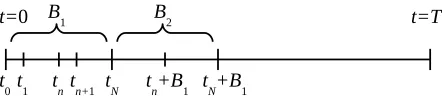
Consider a blockwise division of the total time domain. Each block,
B
i, consists
of multiple time steps. This is schematically represented in Figure 1. Instead of
sequentially solving for each time step (as in (5)), consider solving for the field variable
in a complete time block,
B
, consisting of
N
time steps simultaneously, i.e., solve for
u
i, i
= 1
, . . . , N
, simultaneously.
4With some abuse of notation, the elements of matrixMare equal toM
ij= (whi, whj) and matrix
Kare equal toKij= (∇whi, κ∇wjh).
B
1B
2t=
0
t
nt
n+1t
Nt
N+B
1t=T
t
0t
1t
n+B
1Fig. 1. Indexing of time steps per block(B). Number of time steps per block is equal to N.
This results in a block diagonal matrix of size (
N
×
k
)-by-(
N
×
k
) given by
(6)
I
−M
M
+ ∆
t
K
−M
M
+ ∆
t
K
. .
.
−M
M
+ ∆
t
K
u
0u
1u
2..
.
u
N
=
IC
∆
t
f
1∆
t
f
2..
.
∆
t
f
N
,
where
I
is an identity matrix (of size
k
) and the IC are the imposed initial conditions.
This system solves for
N
time steps at once with a total number of unknowns equal
to
N
×
k
.
Remark
1. Essentially, we convert the problem of sequentially solving for N time
steps into a problem of solving for N unknowns simultaneously. By treating the
un-known nodal values at different time steps as multiple degrees of freedom (DOFs)
associated with each spatial node, we can leverage standard algorithmic approaches
(assembly, memory usage) tailored for multiple DOFs problems. Note that by framing
the temporal unknowns as multiple DOFs at each spatial point, the load distribution of
the problem across processors is still based on a distribution of the spatial mesh across
P
processors. However, each processor now has
N
times more unknowns than the
sequential case (5). This allows
P
to be much larger than for the sequential case while
allowing for efficient parallel performance.
5Many approaches in uncertainty
quantifi-cation (polynomial chaos representation, spectral stochastic methods) leverage such
an approach of representing field variation along additional dimensions (stochastic
dimensions) as simply an additional DOF at each spatial location [25, 33, 10, 28].
2.2. Space-time framework for nonlinear problems.
Extending the
ap-proach to certain nonlinear problems is straightforward. Consider the case where
κ
is a function of the dependent variable,
u
. We assume that
κ
(
u
) satisfies
appropri-ate smoothness and boundedness assumptions to ensure existence and uniqueness,
0
< κ
≤
κ
(
u
)
≤
κ <
∞. In this case the weak form for a block
B
is
(7)
w
h,
u
h n+1
−
u
hn∆
t
+
∇
w
h, κ
(
u
hn+1)∇
u
hn+1=
w
h, f
n+1for
n
= 0
,
1
, . . . , N .
The solutions to such nonlinear equations are usually via (quasi-)Newton schemes.
The methodology involves construction of the Jacobian and residual, which are used
to compute updates. This is represented in matrix-vector terms as
J
ui n+1δ
u
i+1
n+1
=
F
ui n+1,
u
i+1
n+1
=
u
i
n+1
+
δ
u
i+1
n+1
(8)
for
i
= 1
, . . . ,
until convergence and for
n
= 0
,
1
, . . . ,
5This is specifically illustrated in the results which show scalability for a range of differentN=
1,10,50,100,200,500,1000.
[image:4.612.146.367.94.144.2]where
J
uin+1
is the Jacobian (or linearized form), and
F
uin+1is the residual of the above
equation, both computed using
u
in+1
. More specifically, for the nonlinear diffusion
equations defined by (7), the residual,
F
uin+1
, is given by
(9)
F
ui n+1=
1
∆
t
Mu
i n+1
−
1
∆
t
Mu
n−
K(u
i n+1
)u
i
n+1
−
f
n+1,
where
K(u
in+1
) denotes the solution dependent stiffness matrix. The Jacobian is given
as
(10)
J
ui n+1=
1
∆
t
M
+
K(u
in+1) +
dK(u
in+1
)
d
u
.
Instead of sequentially solving for each time step (as in (9)), consider solving for
the field variable in a complete time block,
B
, consisting of
N
time steps
simultane-ously. That is,
(11)
J
ui1
−
1∆t
M
J
ui2
. .
.
−
1∆t
M
J
uiN
δ
u
i1+1δ
u
i2+1..
.
δ
u
iN+1
=
F
ui1
F
ui2
..
.
F
uiN
and
u
i1+1u
i2+1..
.
u
iN+1
=
u
i1u
i2..
.
u
i N
+
δ
u
i1+1δ
u
i2+1..
.
δ
u
iN+1
.
Remark
2. One can alternatively ignore the off-diagonal entries of the block
Ja-cobian to construct an approximate diagonal JaJa-cobian.
The propagation of time
information is then limited to the residual on the right-hand side. We tried both
approaches, with the latter approach taking more iterations to convergence, while
providing substantial ease of implementation. Unless otherwise stated, all our results
are based on the latter approach.
3. Space-time formulation: Higher-order time schemes.
We next look at
extending the space-time strategy to incorporate two families of higher-order
time-steppers: Θ-scheme and BDF. We consider linear and nonlinear diffusion and,
more-over, we also consider the treatment of the Allen–Cahn equation, which is a parabolic
PDE with a lower-order nonlinearity, whose solution has evolving layers and for which
adaptivity is particularly useful.
3.1. Θ-scheme: Linear equation.
The semidiscrete form of the Θ-scheme—
which is a generalization of the Euler backward scheme—is as follows:
(12)
(
w, u
n+1)
−
(
w, u
n) + ∆
t
[(1
−
Θ) (∇
w, κ
∇
u
n) + Θ (∇
w, κ
∇
u
n+1)]
= ∆
t
[(1
−
Θ) (
w, f
n) + Θ (
w, f
n+1)] for
n
= 0
,
1
, . . . .
The fully discrete matrix-vector representation is given by
(13)
Mu
n+1−
Mu
n+ ∆
t
(1
−
Θ)
Ku
n+ ∆
t
ΘKu
n+1= ∆
t
(1
−
Θ)
f
n+ ∆
t
Θf
n+1for
n
= 0
,
1
, . . . .
Again, it is straightforward to group and simultaneously solve for
N
time steps
to-gether. The corresponding matrix form is expressed as
(14)
I
−M
+ ∆
t
(1
−
Θ)K
M
+ ∆
t
ΘK
−M
+ ∆
t
(1
−
Θ)K
M
+ ∆
t
ΘK
. .
.
−M
+ ∆
t
(1
−
Θ)K
M
+ ∆
t
ΘK
u
0u
1u
2..
.
u
N
=
IC
∆
t
[(1
−
Θ)f
0+ Θf
1]
∆
t
[(1
−
Θ)f
1+ Θf
2]
..
.
∆
t
[(1
−
Θ)f
N−1+ Θf
N]
.
Again, the global space-time matrix (15) has a block structure.
3.2. Θ-scheme: Nonlinear diffusion with variable coefficient.
The
corre-sponding weak form for this case is given as
(15)
w
h,
u
h n+1
−
u
hn∆
t
+ (1
−
Θ)
∇
w
h, κ
(
u
hn)∇
u
hn+ Θ
∇
w
h, κ
(
u
hn+1)∇
u
hn+1= (1
−
Θ)
w
h, f
n+ Θ
w
h, f
n+1for
n
= 0
,
1
, . . . .
The Jacobian is
(16)
J
uin+1
=
M
+ ∆
t
Θ
K(u
in+1) +
dK(u
i n+1
)
d
u
,
while the residual is given by
(17)
F
uin+1
=
Mu
i
n+1
−Mu
n+ ∆
t
Θ
K(u
in+1)u
i
n+1
−
f
n+1+ ∆
t
(1
−
Θ) (K(u
n)u
n−
f
n)
.
Again, it is straightforward to group and simultaneously solve for
N
time steps
to-gether. Define diagonal blocks equal to
(18)
D
k=
M
+ ∆
t
Θ
K(u
ik) +
d
K(u
ik
)
du
with the the upper index denoting, as before, Newton–Raphson iteration. The
corre-sponding (diagonal) block Jacobian (see Remark 2) is given by
(19)
D
1D
2. .
.
D
N
.
3.3. Θ-scheme: Allen–Cahn equation.
The Allen–Cahn equation is a
semi-linear diffusion equation with a nonsemi-linear reaction term:
(20)
∂
tu
(x
, t
)
−
∆
u
(x
, t
) +
−2f
(
u
) = 0
,
where
f
(
u
) is a nonlinear function of
u
, usually
f
(
u
) =
u u
2−
1
. The initial
condi-tion is
u
(x
,
0) =
u
0along with zero flux conditions in the boundaries.
The corresponding semidiscrete form is given as
(21)
w
h, ∂
tu
h+
∇
w
h,
∇
u
h+
−2w
h, f
(
u
h)
= 0
.
Using the Θ-scheme results in the fully discrete form
(22)
w
h, u
hn+1+ ∆
t
Θ
∇
w
h,
∇
u
hn+1+
−2w
h, f
(
u
hn+1)
=
w
h, u
hn−
∆
t
(1
−
Θ)
∇
w
h,
∇
u
hn+
−2w
h, f
(
u
hn)
.
Again, it is straightforward to group and simultaneously solve for
N
time steps
to-gether. The corresponding (diagonal) block Jacobian is given as
(23)
M
+ ∆
t
Θ
K(u
i1
) +
−2 df(ui1)
du
M
+ ∆
t
Θ
K(u
i2
) +
−2 df(ui
2)
du
. .
.
M
+ ∆
t
Θ
K(u
iN) +
−2 df(uiN)du
.
Alternative schemes for the Allen–Cahn equation and other phase-field models are
described in, e.g., [16].
3.4. BDF-based time steppers.
BDF-based time steppers of order
s
utilize
the solution at
s
previous time steps to construct the solution at the next time step.
A general
s
order BDF scheme is given as
(24)
s
X
k=0
α
ku
n+k= ∆
tβg
n+s,
where the left-hand side is the BDF scheme representation of the time derivative,
∂u∂t,
in terms of the solution
u
iat time point
i
, and the right-hand side collects all other
terms. Here,
α
and
β
are known BDF coefficients [7]. A first-order (
s
= 1) BDF
scheme is identical to the Euler backward scheme described earlier. The simplest
multistep scheme is for
s
= 2 and for the linear diffusion equation it is given as
(25)
w
h, u
hn+2−
4
3
w
h
, u
h n+1+
1
3
w
h
, u
h n+
2
3
∆
t
∇
w
h
, κ
∇
u
h n+2=
2
3
∆
t w
h
, f
n+2.
Again, it is straightforward to group and simultaneously solve for
N
time steps
to-gether.
6The corresponding space-time block equations are as follows:
(26)
I
−M
M
+ ∆
t
K
13
M
−
4
3
M
M
+
2
3
∆
t
K
. .
.
13
M
−
4
3
M
M
+
2
3
∆
t
K
u
0u
1u
2..
.
u
N
=
IC
∆
t
f
1 23
∆
t
f
2..
.
23
∆
t
f
N
.
As expected, higher-order multistep methods produce block matrices that have a
larger bandwidth. It is clear that nonlinear problems can be treated similarly.
6Note that the first time step is approximated using a backward Euler time stepper as the
second-order BDF scheme requires knowledge of the solution at two previous time steps.
4. Adaptive meshing for the block space-time method: Residual-based
error estimator.
A central idea of this work is to develop a block space-time
method-ology that can be integrated with mesh adaptivity. This will enable targeted
refine-ment of regions that exhibit variations in the corresponding block of time. Mesh
adaptivity requires the definition of an indicator function that determines which
re-gions of the space require refinement/coarsening. In this work, we build on prior work
and utilize standard residual-based error indicators (see, e.g., [4, 32, 31]) and construct
space-time analogues by averaging or taking the maximum across the time block.
Al-ternative duality-based indicators for nonlinear parabolic problems are described in,
e.g., [8, 9, 11].
Residual-based error indicators
η
eare constructed for each spatial element, Ω
e,
and consist of two terms—an interior residual,
r
intand a jump residual,
r
jump[32]:
(27)
η
e2=
h
2ek
r
hintk
2L2(Ω
e)
+
h
ek
r
h jumpk
2
L2(∂Ω
e)
,
where
h
eis the size of element, Ω
e. For example, for the linear and quasi-linear
diffusion equation, the detailed derivation of the interior and jump residual is available
in the work of Verf¨
urth [32]. We refer the interested reader to that work and only
show the key results here. Basically, the two terms are constructed (as the name
suggests) from the definition of the residual:
(28)
R
h(
w
) = (
w, f
)
−
w, ∂
t
u
h− ∇
w, κ
(
u
h)∇
u
h.
This residual is decomposed into elementwise terms as
(29)
R
h(
w
) =
X
e
Z
Ωe
wr
inthdΩ +
Z
Γe
wr
hjumpdΓ
,
where
(30)
r
hint=
f
−
∂
tu
h+
∇ ·
κ
(
u
h)∇
u
hand
(31)
r
jumph=
0
on
∂
Ω
e∩
Γ
h,
κ
(
u
h)∇
u
h+·
n
++
κ
(
u
h)∇
u
h−·
n
−on
∂
Ω
e\
Γ
h,
where Γ
his that part of the boundary with Dirichlet conditions imposed.
The interior and jump residuals for the Allen–Cahn equations are similarly defined
as
(32)
r
hint=
−2f
(
u
h)
−
∂
tu
h+ ∆
u
hand
(33)
r
hjump=
0
on
∂
Ω
e∩
Γ
h,
∇
u
h+
·
n
++
∇
u
h−·
n
−on
∂
Ω
e\
Γ
h.
Recall that we are using error indicators defined over a block of time. We extend
the concept of error indicator defined at one time step to the notion of an error
indi-cator defined over a block of time steps. There are several choices of error indiindi-cators
with two of them being the average value of the error indicator across the block of
time for an element
e
,
(34)
η
e,avg=
N
X
n=1
η
e,nN
,
and the maximum value in the block of time for an element
e
,
(35)
η
e,max=
max
n=1,2,...,N
η
e,n.
The former approach is advantageous for slow variations in the block and avoids
frequent migrating of elements between processors, which can negatively affect
scal-ability. The latter approach is advantageous when there are rapid changes across a
few time steps. In this case the error estimator is not “diffused” by time steps where
the solution is changing slowly.
Remark
3. In this work, we approximate the semidiscrete term,
∂u∂t
, in terms of
its finite difference representation (Θ or BDF scheme). An implicit assumption is that
the time steps are small enough that this approximation is valid. Ideally, one would
choose a consistent representation in both space and time, i.e., using a finite element
representation for time variations [26, 19]. This provides several advantages in terms
of mathematical elegance. We defer this development to a subsequent paper.
5. Implementation details.
We utilize our in-house scalable, parallel finite
ele-ment method (FEM) framework that is optimized for distributed memory computing.
The FEM software library is implemented in C++ and uses object oriented software
principles. Linear algebra, parallel matrix, and vector storage are all performed by
the PETSc library [5]. PETSc modules (KSP, SNES) are used to solve (non)linear
equations. Specifically, we use the hierarchical GMRES solvers as part of the PETSc
software suite (KSP construct) for solving the linear system. These solvers have been
shown to scale exceptionally well to hundreds of thousands of processors [24]. We use
the block Jacobi preconditioner in conjunction with the GMRES routine. The FEM
library is dynamically linked to the parallel hierarchical grid (PHG) library [2] which
is a three dimensional (3D) parallel mesh refinement framework with inbuilt load
bal-ancing. PHG uses a bisection-type algorithm [35], specifically newest vertex bisection
to refine/coarsen elements.
7PHG operates on simplex elements and produces
con-forming meshes after refinement. We remind the reader that we are able to utilize
parallel tools for 3D mesh adaptivity due to formulating our space-time problem as
a spatial problem with
N
DOFs. Additional implementation details are provided in
the appendix.
We perform scaling studies on two machines. Preliminary scaling was performed
on the TACC Stampede [3]. Stampede consists of 6400 compute nodes each equipped
with two Intel E5-2680 8-core processors. We also performed scaling on NCSA Blue
Waters [1]. Blue Waters consists of 22,640 nodes, each consisting of two AMD 6276
Interlagos processors for a total of 362,240 computing cores.
6. Numerical examples.
In this section we illustrate our adaptive
parallel-in-space-time framework on a variety of linear and nonlinear diffusion equations. We
show how the framework scales with increasing DOFs as well as increasing the size of
the time-blocks, i.e., increasing
N
.
6.1. Problem A: Linear diffusion.
We first consider the linear case.
We
set
κ
= 1 in (1), and consider a time horizon of
T
= 1. We use the method of
manufactured solutions to construct the forcing term in (1) to ensure an analytical
solution,
u
:
(36)
u
(
x, y, z, t
) = exp (−
α
(
x, y, z, t
))
,
7In the newest vertex bisection, the edge that lies opposite to the newest node is divided.
where
α
(
x, y, z, t
) is equal to
(37)
α
(
x, y, z, t
) =
(
x
−
x
0(
t
))
2
+ (
y
−
y
0(
t
))
2+ (
z
−
z
0(
t
))
2d
2and
x
0(
t
) =
a
cos(
ωt
) +
b ,
y
0(
t
) =
a
sin(
ωt
) +
b ,
z
0(
t
) =
b
with
a
= 0
.
2,
b
= 0
.
5,
ω
= 2
π
,
d
= 0
.
1. Thus,
u
is a rotating exponential hill centered
at the midplane and rotating on a circle with a radius of 0.2 and with an angular
speed of 2
π
(and hence a period of 1). This manufactured solution is constructed by
the following forcing term
(38)
f
(x
, t
) =
−
4((
x
−
x
0
)
2+ (
y
−
y
0)
2+ (
z
−
z
0)
2)
d
4−
6
d
2−
2
aω
cos(
tω
)(
y
−
y
0)
−
sin(
tω
)(
x
−
x
0)
d
2exp (−
α
(
x, y, z, t
))
.
The equation is solved in the unit cube [0
,
1]
×
[0
,
1]
×
[0
,
1]. Every boundary face of
the region has an essential boundary condition with prescribed value of
u
equal to the
value computed from (36).
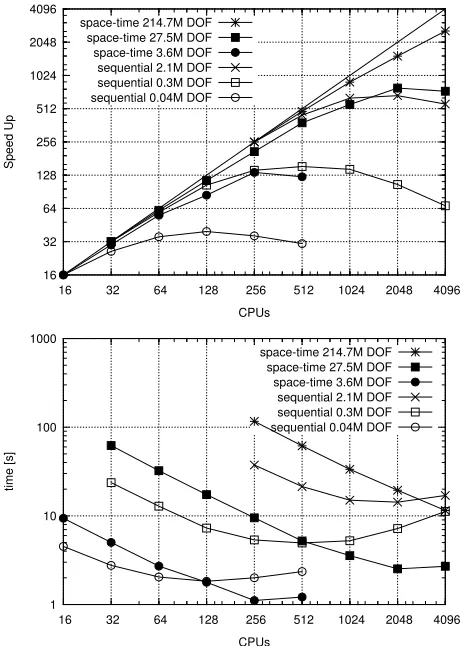
We first investigate the comparative scaling performance of the space-time
ap-proach with a sequential apap-proach. We use a time step of 0.01 and solve for a block
of 100 time steps. The space-time approach solves for this block of 100 time steps
simultaneously, while the sequential approach steps through the time steps, solving
for one time step at a time. Figure 2(top) shows scaling
8on TACC Stampede for
three sets of spatial discretization, 32
3, 64
3, and 128
3trilinear elements. While this
corresponds to 0
.
04
M,
0
.
3
M,
and 2
.
1
M
DOFs for the sequential approach (that is
then solved 100 times), the space-time approach corresponds to 3
.
6
M,
27
.
5
M
, and
214
.
7
M
DOFs (since they solve for all 100 time steps simultaneously). We can clearly
see that the space-time approach exhibits better scalability over a larger range of
processor counts, with the sequential approach tapering off at a much lower processor
count. For instance, for the 128
3discretization, the space-time approach shows good
scaling behavior across the full range of processors investigated, while the sequential
approach exhibits its best performance at 1024 processors.
We next look at the
total time to solve
for the full time horizon [0
, T
]. We plot
this in Figure 2(bottom). As anticipated from the scaling studies, the space-time
approach gives consistent performance improvements for a larger range of processor
counts. This translates into consistent reduction of total time to solve with increasing
processor count. While the sequential approach has lower total time to solve for
smaller processor counts, beyond a certain processor count threshold the space-time
approach outperforms the sequential approach.
9This is about 2048 processors for the
largest spatial discretization (128
3) considered. This bodes well for making a total
8The minimum number of processors used for any problem in this work was 16. Thus all scaling
results are compared with the 16 processor result.
9One of the reviewers pointed out that Figures 2(bottom) and 5(bottom) that explore strong
scaling are similar to those produced by the parareal [21] (Lions, Maday, and Turinici) and multigrid reduction in time [12] (Falgout et al.) methods. It is interesting to see qualitatively similar results using different approaches to parallel-in-time.
16 32 64 128 256 512 1024 2048 4096
16 32 64 128 256 512 1024 2048 4096
Speed Up
CPUs space-time 214.7M DOF
space-time 27.5M DOF space-time 3.6M DOF sequential 2.1M DOF sequential 0.3M DOF sequential 0.04M DOF
1 10 100 1000
16 32 64 128 256 512 1024 2048 4096
time [s]
CPUs
space-time 214.7M DOF space-time 27.5M DOF space-time 3.6M DOF sequential 2.1M DOF sequential 0.3M DOF sequential 0.04M DOF
Fig. 2. Scaling studies on TACC Stampede. Comparison between sequential time stepping and the space-time approach. The equation being solved is the linear diffusion equation withN= 100time steps in a time block and discretized using the Euler backward scheme. The spatial discretizations used are323,643, and1283. Top plot shows speedup comparisons while bottom plot shows time to solution.
time to solve argument when using large processor counts (especially, as will be shown
later in this section, using
∼
100,000 processors on the NCSA Blue Waters machine).
Furthermore, the total time to solve metric for the space-time approach will become
even more competitive for more complex problems involving complex geometries and
multiple remeshing that will require I/O.
Remark
4. In some sense, by solving problems in space-time instead of marching
forward in time, we are essentially making a computationally cheaper problem (of
solving a spatial problem at one time step) more expensive. However, as we make the
case,
10there are several mitigating factors that warrant this approach. These factors
include (a) hitting the limits of scaling when using purely sequential approaches, (b)
the ability to store and solve the full time horizon with significant implications to
solving adjoint problems, (c) the ability to only perform spatial adaptivity in blocks
greatly simplifying storage, and, finally, (d) as a first step to simultaneous adaptivity
in space and in time [19], which would prove very significant.
10Several other researchers have also made this case [12, 6, 20].
[image:11.612.141.371.99.422.2]32 64 128 256 512 1024 2048
32 64 128 256 512 1024 2048
Speed Up
CPUs sequential time stepper
10 time steps in block 50 time steps in block 100 time steps in block 200 time steps in block 500 time steps in block 1000 time steps in block
1 10 100 1000 10000
32 64 128 256 512 1024 2048
time [s]
CPUs
sequential time stepper 10 time steps in block 50 time steps in block 100 time steps in block 200 time steps in block 500 time steps in block 1000 time steps in block
Fig. 3. Speedup results on TACC Stampede for different sizes ofN. The equation being solved is the linear diffusion equation withN= 1,10,50,100,200,500,1000time steps in a time block and discretized using the Euler backward scheme. The spatial discretization is643.
We next look at how increasing the number of time steps,
N
, in a time block
impacts performance of the space-time approach. Increasing
N
essentially increases
the DOFs per spatial node in the space-time framework. We again consider the time
interval [0
, T
= 1]. We investigate scaling behavior for a wide range of
N
ranging from
N
= 1 (the sequential case) to
N
= 1000. Figure 3(top) plots the scaling results on
TACC Stampede using up to 2048 processors. Notice that as
N
increases the curves
tend towards the ideal scaling line. This is consistent with earlier results in Figure
2 that show that increasing total DOFs results in better scaling performance. This
is especially encouraging as it indicates that utilizing larger blocks of time (which
translates to large total DOFs) results in lower total time to solve compared to a
sequential approach. This is clearly seen in Figure 3(bottom) which plots the total
time to solve over the full horizon [0
, T
]. The processor count at which the space-time
approach beats the sequential approach shows an increasing trend with increasing
N
,
with
N
= 10 taking less time than the sequential approach beyond just 256 processors,
and the
N
≥
200 potentially required more than 4096 processors to take less time
than the sequential approach.
We next explore the number of GMRES iterations required to reach a relative
tolerance (−
ksp rtol
) of 10
−8as a function of increasing
N
. Table 1 lists the number
of iterations of the GMRES solver taken for various
N
’s with a spatial discretization
into 64
3trilinear elements when run on 64 processors. Interestingly, the number of
iterations saturates around 200 for
N
≥
50. We emphasize that we have not tried to
Table 1
Number of GMRES iterations needed to solve one space-time block of given size. In all cases the block Jacobi preconditioner was used. The spatial discretization is643.
N 1 (seq) 10 50 100 200 500 1000
Iterations 54 116 206 211 211 207 203
1 10 100
32 64 128 256 512 1024 2048
Time [s]
CPUs
430k DOF per CPU 215k DOF per CPU 107k DOF per CPU 54k DOF per CPU 27k DOF per CPU
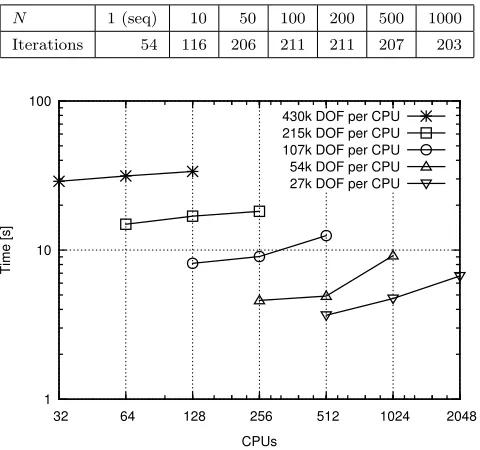
Fig. 4. Weak scalability results on TACC Stampede for different numbers of DOFs per CPU.
The same DOFs per CPU was achieved by using different numbers of time steps per block.
optimize the linear algebra portion (solver + preconditioner) of the method, relying
completely on PETSc modules. We expect that performance improvement may be
achieved by carefully choosing the solver and preconditioners as well as including the
full Jacobian (see Remark 2). An alternative question that we were unable to explore
in this work was to understand how the number of GMRES iterations changes as the
space-time system (and not just the time block,
N
) is refined.
While Figures 2 and 3 illustrate the
strong scalability
of the space-time approach,
we also test the
weak scalability
of the space-time framework. We consider five
dif-ferent starting problem sizes (i.e., a starting spatial discretization and
N
), which are
represented in terms of different DOFs per processor (
DOF sproc= 27
K,
54
K,
107
K,
215
K,
430
K
). For each starting problem size, we consider two doublings of the total DOFs
while keeping the DOFs per processor fixed (i.e., double the total problem size, but
also double the number of processors the problem is solved on). Figure 4 plots these
weak scalability results. Ideal weak scalability is said to be exhibited when the
to-tal time to solution remains unchanged with increasing toto-tal problem size. Here,
we see that for low DOFs per processor (27
K
, and 54
K
DOFs per processor) weak
scaling is quite poor, but improves significantly for higher DOFs per processor
sce-narios.
Having established that the space-time approach is well suited for deploying on
larger numbers of processors, we next look at scaling performance on the NCSA Blue
Waters machine. The NCSA Blue Waters machine allowed us to test the space-time
framework for a wide range of processor counts ranging from 2
4= 32 processors up
to 2
17= 131
,
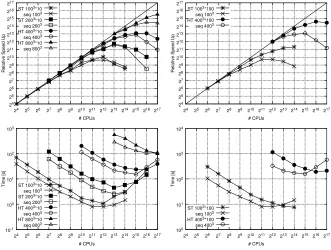
072 processors. We evaluate strong scaling under two campaigns of
simulations. The first campaign considers
N
= 10, and four spatial discretizations
24
25
26
27
28
29
210
211
212
213
214
215
216
217
24 25 26 27 28 29 210 211 212 213 214 215 216 217
Relative Speed Up
# CPUs ST 1003*10
seq 1003
ST 2003*10
seq 2003
HT 4003*10
seq 4003
HT 8003*10
seq 8003
24
25
26
27
28
29
210
211
212
213
214
215
216
217
24 25 26 27 28 29 210 211 212 213 214 215 216 217
Relative Speed Up
# CPUs
ST 1003*100
seq 1003
HT 4003*100
seq 4003
10-1
100
101
102
103
24 25 26 27 28 29 210 211 212 213 214 215 216 217
Time [s]
# CPUs
ST 1003*10
seq 1003
ST 2003*10
seq 2003
HT 4003*10
seq 4003
HT 8003*10
seq 8003
100
101
102
103
104
24 25 26 27 28 29 210 211 212 213 214 215 216 217
Time [s]
# CPUs ST 1003*100
seq 1003
HT 4003*100
seq 4003
Fig. 5. Speedup on NCSA Blue Waters for linear diffusion equation with time blockN = 10
on the left andN= 100 on the right.
of the domain into 100
3, 200
3, 400
3, and 800
3trilinear elements. The results of the
scaling studies are plotted in Figure 5(left top). The space-time approach produces
consistent performance across a wide range of processors, with some degradation of
performance at very high processor counts. Figure 5(left bottom) plots the total
time to solve of the full time horizon [0
, T
] for this set of simulations. This plot
clearly shows that there is a processor count (especially for the larger problems 200
3,
400
3, and 800
3) beyond which the space-time approach outperforms the sequential
approach. These trends in scalability as well as the time to solve are even more
apparent in the second campaign that considers a larger time block of
N
= 100 (i.e.,
more DOFs per processor) and spatial discretizations of the domain into 100
3and
400
3trilinear elements. The scalability results are plotted in Figure 5(right top), and
total time to solve results are plotted in Figure 5(right bottom).
We next look at the effect of adaptive meshing on the solution. Note that the
analytical solution to the PDE is a rotating exponential hill centered at the midplane.
We deploy the space-time approach with a residual-based error estimator considering a
time horizon of [0
, T
= 1] using a time step of 0.01. We consider a time block consisting
of
N
= 100, which is one full rotation of the exponential hill in the midplane. Figure 6
shows part of the refined spatial mesh after 20 refinement iterations. We remind the
reader that each iteration consists of solving the space-time problem, constructing the
time-averaged elemental refinement indicators using (34), and then refining the 3D
mesh according to the indicators. Given that this is a moving source problem, this
refinement is clearly around the location where the peak of the hill passes (centered
0.2 away from the midpoint with a thickness of 0.1).
We finally compare spatial convergence rates for three implementations: (a)
se-quential time stepping with no spatial adaptivity, (b) space-time implementation with
[image:14.612.90.421.99.349.2]Fig. 6.Refined mesh: view from top (left) and front (right).
0.0001 0.001 0.01 0.1
[image:15.612.143.382.99.211.2] [image:15.612.151.361.250.397.2]0.01 0.1
last ||e||
L2
h sequential space-time space-time, adapt
Fig. 7.Spatial convergence for linear diffusion equation with time-step0.01. Error isku−uhk2 at the last time-step plotted as a function of the average element size¯h.
no spatial adaptivity, and (c) space-time implementation with spatial adaptivity. We
plot convergence in Figure 7, where the error is
k
u
−
u
hk
2. The first two
implementa-tions (obviously) overlap, with the adaptive mesh implementation showing a reduced
error. All three curves show a slope of 2, which is to be expected. Figure 8 shows
time-step convergence, with expected slopes of 1 and 2 for backward Euler and BDFs,
respectively.
6.2. Problem B: Nonlinear diffusion.
For the nonlinear case, we set the
coefficient
κ
(
u
) = 1 + 10
u
2and we choose an exact solution such that
|
u
| ≤
1, thus
bounding
κ
. As before, we choose our analytical solution to be given by (36). The
forcing term,
f
, is consequently
(39)
f
(x
, t
)
=
80
u
d
4(
x
−
x
0)
2+ (
y
−
y
0)
2+ (
z
−
z
0)
2
exp (−2
α
(
x, y, z, t
))
+ 1 + 10
u
2
4
(
x
−
x
0)
2+ (
y
−
y
0)
2+ (
z
−
z
0)
2
d
4−
6
d
2
exp (−
α
(
x, y, z, t
))
−
2
aω
cos(
tω
) (
y
−
y
0)
−
sin(
tω
) (
x
−
x
0)
d
2exp (−
α
(
x, y, z, t
))
.
1e-05 0.0001 0.001 0.01
0.001 0.01
[image:16.612.150.362.100.246.2] [image:16.612.152.359.295.442.2]0.1 1
last ||e||
L2
dt
EB BDF2
Fig. 8.Time convergence for linear diffusion equation. Error isku−uhk2at the last time step plotted versus time step.
24
25
26
27
28
29
210
211
212
213
214
215
216
217
24 25 26 27 28 29 210 211 212 213 214 215 216 217
Relative Spe
ed Up
# CPUs
1003*10
2003*10
4003*10
5503*10
Fig. 9.Speedup on NCSA Blue Waters for the nonlinear diffusion equation.
The spatial and temporal domain over which the problem is solved remain
un-changed from the linear case. Similarly to the linear case, we investigate scaling
performance of the space-time approach. We however limit scaling studies to the
NCSA Blue Waters machine, which provides a larger range of processor counts. We
set
N
= 10, and consider four different spatial discretizations, 100
3, 200
3, 400
3, and
550
3. Figure 9 plots the scaling behavior of these problems across a wide range of
processor counts.
11As before, the space-time approach exhibits very promising and
consistent scaling. While we do not show total time to solve analysis, our results
in-dicate that comparison with the sequential time-stepping approach will show similar
trends here as was shown for the case of the linear problem in Figure 5(left bottom).
We next look at the effect of adaptive meshing on the solution. We deploy the
space-time approach with residual based error estimator for a time horizon of [0
, T
= 1]
using a time step of 0.01. We consider a time block consisting of
N
= 100, which
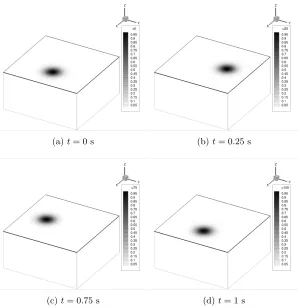
is one full rotation of the exponential hill in the midplane. Figure 10 plots several
time snapshots of the moving nonlinear source problem, with the solution accurately
11We use the PETSc SNES construct with a line search option. We set−ksp rtoland−snes rtol
to 10−8for all runs.
(a)t= 0 s (b)t= 0.25 s
[image:17.612.108.406.97.405.2](c)t= 0.75 s (d)t= 1 s
Fig. 10.Snapshots of the solution at different time points on the midplane.
0.0001 0.001 0.01 0.1
[image:17.612.151.360.456.601.2]0.01 0.1
last ||e||
L2
h
sequential space-time, adapt space-time
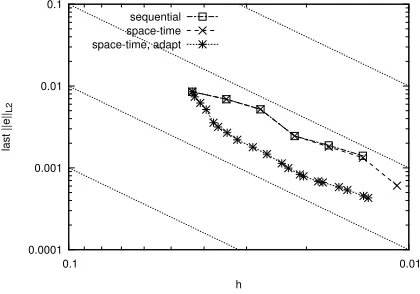
Fig. 11.Spatial convergence for nonlinear heat equation with timestep0.01. Error isku−uhk2 at the last time step plotted as a function of the average element size¯h.
tracking the moving source. In Figure 11, we plot spatial convergence for three
im-plementations: (a) sequential time stepping with no spatial adaptivity, (b) space-time
implementation with no spatial adaptivity, and (c) space-time implementation with
24
25
26
27
28
29
210
211
212
213
214
215
216
217
24 25 26 27 28 29 210 211 212 213 214 215 216 217
Relative Spe
ed Up
# CPUs
1003*10
2003*10
4003*10
5503*10
Fig. 12.Speedup on NCSA Blue Waters for Allen–Cahn problem.
spatial adaptivity (plotted with the average element size). Convergence rates follow
along expected lines with a slope of 2.
6.3. Problem C: Allen–Cahn.
In this final example, we solve the modified
Allen–Cahn problem. The key physics which is described by this nonlinear equation
essentially occurs in a highly localized region of the domain on a surface of codimension
1 which is evolving in time, thus representing a moving interface. Adaptive refinement
and coarsening has been a very effective approach to accurately resolve this localized
region, and a space-time approach with spatial adaptivity represents a very interesting
approach to solving this problem. The equation is given as
∂u∂t=
−
D f
(
u
)
−
C
n2∇
2u
,
where
(40)
f
(
u
) = 2
Au
1
−
3
u
+ 2
u
2−
k
and
D
= 1,
C
n= 0
.
1,
A
= 16,
k
= 0
.
1. The initial conditions are
(41)
u
(
x
) = 0
.
5 + 0
.
5 tanh
r
−
0
.
5
q
2
A
C
n
,
r
=
p
x
2+
y
2+
z
2,
with zero flux conditions on all boundaries. This represents an initial solid of radius,
r
= 0
.
5, that is melting. Using symmetry arguments, we consider a single octant of
the space [0 : 1]
×
[0 : 1]
×
[0 : 1]. Similarly to the previous cases, we investigate
scaling performance of the space-time approach. We again limit scaling studies to
the NCSA Blue Waters machine, which provides a larger range of processor counts.
We set
N
= 10 and use a time step of
δt
= 0
.
02, and consider four different spatial
discretizations of 100
3, 200
3, 400
3, and 550
3trilinear elements. Figure 12 plots the
scaling behavior of these problems across a wide range of processor counts. As before,
the space-time approach exhibits very promising and consistent scaling.
As a final result, we compare the adaptive mesh generated by the space-time
framework with the adaptive mesh generated by the sequential approach. We consider
the time domain [0
,
1] during which the initial sphere shrinks to about 70% of its
original volume. We choose a time step of
δt
= 0
.
02 and consider
N
= 50. We remind
the reader that each iteration consists of solving the space-time problem, constructing
the time-averaged elemental refinement indicators using (34), and then refining the
(a)t= 0 s (b)t= 0.5 s (c)t= 1.0 s
[image:19.612.89.431.96.363.2](d)t= 0 s (e)t= 0.5 s (f)t= 1.0 s
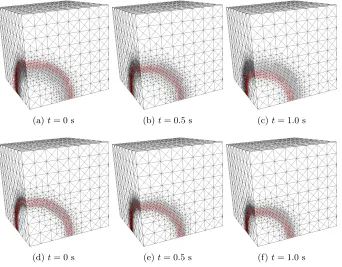
Fig. 13. Mesh after20refinement iterations with superimposed solution at times 0 s, 0.5s,
1s using the space-time adaptive approach (top). For comparison, view of adaptive mesh from the sequential solution (bottom).
3D mesh according to the indicators. In contrast, the sequential problem consists of
solving for each time step, constructing the refinement indicators, and then refining
the 3D mesh according to the indicators at each time step.
12Figure 13 illustrates
the adaptive mesh refinement across the time block with the top row representing
the space-time approach mesh and solution, and the bottom row representing the
sequential approach mesh and solution. Notice that in the sequential approach the
band of refined elements is moving with the moving front across the snapshots plotted.
In contrast, the refinement of the space-time mesh is more “smeared” across the region
that the moving front traverses in this time block. This results in an interplay between
a slightly increased number of degrees of freedom that are being solved for, versus the
computational overhead involved in repeated remeshing.
7. Conclusion.
We present formulation, implementation details, and
represen-tative examples of a parallel-in-space-time-based adaptive methodology for the
solu-tion of (linear and) nonlinear time dependent problems. This is based on the simple
concept of solving for large blocks of space-time unknowns instead of marching
se-quentially in time, which results in a block lower triangular system. This is analogous
to recent approaches like parareal and MGRIT that solve for large space-time blocks.
For the nonlinear problems, MGRIT (and parareal) use full approximation storage
multigrid methods; in contrast, the approach taken here linearizes the entire
space-time block and solves the linearization inside of a global space-space-time Newton solve.
12For computational efficiency, this is usually done every few time steps.