Wolves, football, and ambient computing:
Facilitating collaboration in problem solving systems
through the study of human and animal groups
David W. Eccles
Learning Systems Institute, and the Department of
Educational Psychology and Learning Systems,
Florida State University
C-4600 University Center,
Tallahassee, FL 32306, USA
[email protected]
Paul T. Groth
Intelligence, Agents, Multimedia Group
School of Electronics and Computer Science,
University of Southampton,
Southampton, SO17 1TW,
United Kingdom
[email protected]
ABSTRACT
This paper describes how computer-human interaction in ambient computing environments can be best informed by conceptualizing of such environments as problem solving systems. Typically, such systems comprise multiple human and technological agents that meet the demands imposed by problem constraints through dynamic collaboration. A key assertion is that the design of ambient computing environments towards efficacious human-machine collaboration can benefit from an understanding of competence models of human-human and animal-animal collaboration. Consequently, design principles for such environments are derived from a review of competent collaboration in human groups, such as sport teams, and animal groups, such as wolf packs.
Author Keywords
Ambient computing, collaboration, computer-human interaction, pervasive computing, problem solving.
ACM Classification Keywords
H.5.m. Information Interfaces and Presentation (e.g., HCI): Miscellaneous.
INTRODUCTION
No matter what benefits are touted by the producers of new technology, the user always seems to experience some workload cost. Consequently, in designing ambient technologies, there is a risk of creating ubiquitous workload costs. In some cases, technology can be designed or implemented so poorly that the workload cost is greater
than the workload saving, the so-called “make-work” cases. This article describes how ambient technologies can work in a coordinated way with human agents in order to create problem solving systems (PSSs) that meet the demands imposed by the problems humans face throughout the average day, while minimizing the workload costs that so often accompany technological innovation.
AMBIENT PROBLEM SOLVING SYSTEMS
A reason commonly proposed for problems associated with technology is that its design is driven primarily by advances in technology itself, with little attention to human characteristics or the problems faced by humans. Consequently, researchers have proposed that the impetus for technological innovation should be steered away from advances in technological capabilities and towards making design more human- and problem-centered.
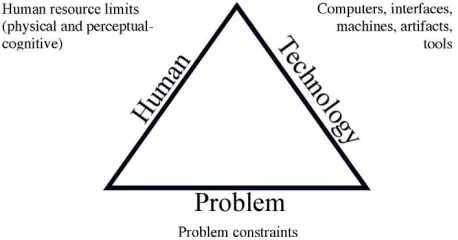
However, a focus on the problem, the human, or the technology, will fall short of informing design because each of these aspects impacts the others [c.f., 4]. Problem constraints often impose demands that cannot be met given natural human limitations in cognitive and physical resources: For example, we can only count so fast or see so far. One solution is to adapt oneself to the problem constraints: Training and practice at a given problem leads to cognitive and physical adaptations to problem constraints that result in more efficient solution processes [3]. However, humans are often unable or unwilling to adapt themselves and thus turn to adapting the environment instead [9]. Technology is a form of environmental adaptation that effectively augments human problem solving capabilities.
change in technology would affect the amount of resources the human would need to apply to the problem. Figure 1 illustrates such interaction.
The joint contribution of human and technological resources to solving our many everyday problems can be considered a PSS [c.f., 5, 13]. For example, when I type text from a book into a document on a computer, I place a
pencil on the book parallel to the last-read line. This is because it is difficult to locate this line from within the overall text when looking from the screen to the book. The pencil is a featural singleton [29]; that is, a distinguishable feature in an otherwise relatively homogenous visual display. Thus, the pencil avoids the comprehensive searching required to locate less distinguishable features; that is, my line of text [24].
The pencil placement is a simple and effective form of technology. An implicit awareness of the interaction between human resource limits and the problem constraints drove technological innovation, which, in turn, created a PSS comprising human and technological agents that together exhibited problem solving capabilities superior to human or technological problem solving capabilities alone: I cannot discriminate between lines of text as rapidly as when using the pencil.
[image:2.612.61.290.145.265.2]Another example of the joint contribution of human and technological resources to problem solving is apparent in solutions to insight problems. When humans are trying to solve problems involving insight and creativity, they often experience “a-ha” moments, which are ephemeral and often unpredicted moments of enhanced cognitive functioning [10, 11]. These arise frequently during periods of relaxation, such as while in bed, toileting and showering, and become more difficult to recall as time elapses from their onset, which presents problems with regard to capitalizing upon them. Their short duration, unpredictability, and inconvenient timing might be considered a natural human limitation: There would be no problem with capitalizing upon a-ha moments if we were able to remember permanently and lucidly everything that occurred during the moment. By contrast, we do not possess this faculty, and are aware of the nature of our
“a-ha” moments and so create an “insight PSS” by employing strategically positioned technological devices to record these moments as fast and in as much detail as possible. These include note pads and tape-recorders, which we often leave by the bed.
Furthermore, by identifying areas of a problem in which technology is employed to create a PSS, we can map out where the resource limitations of the human interact with the problem [c.f., 8]. For example, a large quantity of reminders pertaining to future actions that are left about a house might suggest that the owner has a problem with prospective memory (remembering to take planned actions) [8]. These reminders might be in the form of notes, reminding the owner to visit the bank at lunchtime that day, and be found stuck on the inside of the individual’s closet, refrigerator door, and front door, so that they serve their function as the owner prepares for work in the morning. Alternatively, recalling the interactions of problem, technology and human, it might tell us something about the problem: Perhaps the individual’s day is very busy, making remembering to the visit the bank difficult, or the bank visit is unusually important, making forgetting the visit disastrous.
While these are simple examples, other researchers have been exploring similar concepts in a range of domains, including complex domains involving multiple human and technological agents. For example, Hutchins’ [6, 7] studies of aircraft cockpit and maritime navigation operations provided detailed examples of the interactive relationships between problem constraints, human resource limits, and technology. In the following quote, Hutchins [6] summarizes his cockpit research, and exemplifies the notion of the employment of technologies that extend human resource limits and, in turn, create PSSs comprising both human and technological agents. Note that Hutchins also provides evidence that the nature of the cockpit components provides a “map” of the shortcomings of the human memory system in dealing with the demands imposed by cockpit problem constraints.
The cockpit system remembers its speeds [but]…[t]he memory of the cockpit…is not made primarily of pilot memory. A complete theory of individual human memory would not be sufficient to understand that which we wish to understand because so much memory function takes place outside the individual. In some sense, what the theory of human memory explains is not how the system works, but why this system must contain so many components that are functionally implicated in cockpit memory, yet are external to the pilots themselves. (p. 286)
In their daily lives, humans attempt to solve multiple and overlapping problems that extend over space and time. Figure 1. The relations between problem constraints,
Problem constraints can also vary within and between problems. Consequently, the demands imposed on humans are changing constantly. For a simple example, imagine an individual is driving a car through a town when she receives a telephone call on a cell-phone from a business client. There will be a change in the demands on the driver’s attentional resources when the telephone conversation
begins, because the driver must now allocate attention to the road ahead and the conversation.
The changing demands imposed on a human are such that PSSs are often dynamic: Humans may recruit more or fewer human and technological agents and the agents might be used in different ways, in order to meet changing demands [c.f., 6]. For example, the driver in the earlier example might employ cruise control, a technological agent, to be able to allocate more attention to the telephone conversation, or might employ a passenger, a human agent with “spare” attentional resources, to take the call. resume control of the car from the cruise agent.
Figure 2 provides an alternative and hypothetical example. The figure demonstrates how the demands imposed on two different types of human resources by the constraints of three different problems can change over time, and how they can occasionally exceed an individual human’s resource limits. For simplicity, the problems are shown as being undertaken serially but, in reality, problems are often undertaken in parallel. The problem constraints in the latter half of the time period of problems 1 and 3 impose a resource demand that exceeds an individual human’s limitations in resource type 1 (which might, for example, be that of working memory) indicated by areas A and C. Similarly, the problem constraints throughout problem 2 impose a resource demand that exceeds an individual human’s limitations in resource type 2 (which might, for example, be that of arm reach) indicated by area B.
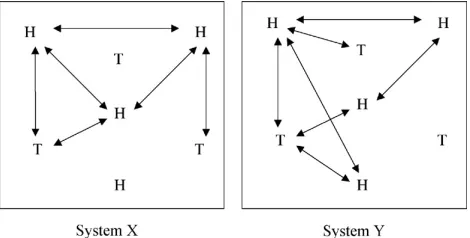
With regard to the example provided in Figure 2, the human might create a PSS comprising a set of human and technological agents specific to overcoming the resource
deficits indicated by areas A and C, so that the demands imposed by the constraints of problems 1 and 3, respectively, could be met. Similarly, the human might create a PSS comprising a different set of agents specific to overcoming the resource deficit indicated by area B, so that the demands imposed by the constraints of problem 2 could be met. Figure 3 is a schematic diagram demonstrating two such PSSs. The systems differ in terms of the type and number of agents employed, and, in turn, the interaction between agents. To exemplify the notion that different configurations of agents are required to meet different demands, we might imagine that system X in Figure 3 would be able to meet the demands of problems 1 and 3 in Figure 2, and system Y in Figure 3 would be able to overcome the demands of problem 2 in Figure 2.
Consequently, we argue that ambient technology is not a new concept. The pencil aiding copy-typing, and the note pad and tape recorder aiding insight capture, are two simple examples of how we create ambient technologies. Historically, humans have contrived, and surrounded themselves with numerous technological agents to form PSSs that have superior problem solving capabilities to humans working alone. We move between and create multiple and overlapping PSSs continually in our daily routines without realizing it [c.f., 23]. The handbrake handle in our car enables us to exert a force on our wheels that is beyond our physical strength and the telephone enables us to speak to people who are out of the range of our voice. These technologies have been driven predominantly by an understanding, often implicit, of the interactions between the problem constraints, human limitations, and technology.
Modern ambient technology is more exciting, however, owing to the technological agents’ increasing autonomy. Previously, our employment of technology has been purposeful and effortful: I must to first decide to place the pencil correctly when typing text, and then perform the action to place it there. However, automata require less continuous control. The opportunity provided in modern ambient environments is that technologies employ themselves automatically as problem constraints change to form part of new PSSs. The vision is that a “team” of relatively autonomous agents, both human and technological, move in and out of operation dynamically as responses to changes in demands imposed by the variety of problems we face in our everyday lives.
Figure 2. Schematic diagram of changes over time in the demands imposed on two different types of human resources by the constraints of three different problems.
Areas labeled A, B, and C denote the resource deficits created by the demands imposed by problems 1, 2, and 3
[image:3.612.52.299.151.260.2]respectively.
[image:3.612.321.556.611.730.2]However, automata have paradoxical effects. There is an important shift in system characteristics when the introduction of automata adds active agents other than humans to PSSs. PSSs becomes characterized by collaboration between multiple autonomous agents each performing their own operations. And here the problems begin. A predominant factor contributing to PSS ineffectuality is a lack of understanding about how to achieve collaboration among the constituent agents and how to avoid the chaos that can ensue when each agent is capable of “being off doing its own thing” [27, 28].
INFORMING THE DESIGN OF HUMAN-MACHINE COLLABORATION THROUGH THE STUDY OF HUMAN-HUMAN AND ANIMAL-ANIMAL COLLABORATION
Researchers have recently argued that insights to this problem can be gained from studies of competent collaboration in other multi-agent systems. Such systems are found in human groups, such as work and sports teams, and animal groups, such as wolf packs [14, P. Feltovich, personal communication, 16]. Like our vision of moving between ubiquitous multi-agent systems in ambient technology environments, we move between ubiquitous multi-agent social systems in our everyday lives, such as work and sport teams, and friendship and family groups. Competence models of human-machine collaboration in ambient technology environments might be derived by studying successful human-human collaboration [2]. A key characteristic of competent human collaboration is the ability to achieve team coordination; that is, when appropriate team members integrate the appropriate operations at the appropriate times to form a composition of operations that solve a team problem or task. When faced with a task, an individual problem solver must possess or gain knowledge only about the task itself, known as taskwork knowledge. This includes 1) knowledge of the current task status and 2) knowledge of operations needed to complete the task. However, in order to achieve coordination, an individual operating in a team that is undertaking a problem or task must also gain knowledge about the team, known as teamwork knowledge [20]. This includes 3) knowledge of what operations the individual team member must perform, 4) knowledge of what operations the other team members will perform, and 5) knowledge of how and when the individual’s operations are to be integrated with the other members’ operations. Thus, teamwork knowledge allows an individual team member to anticipate upcoming operations, and thus to integrate the appropriate operation at the appropriate time.
The team, as a unit, also has an additional requirement: 6) All of the above knowledge must be the same across team members. For example, a two-person team that includes you and me must meet the following criteria if we are to be successful at our team task: Your knowledge of what you are going to do and when you are going to do it must be the same as my knowledge of what you are going to do and when you are going to do it, and vice versa. Psychologists
studying teams have adopted the term shared mental model (SMM) to describe when all team members have gained the same knowledge of the taskwork and teamwork required for a given task [1]. An American football team could not achieve its highly complicated maneuvers without first ensuring that all players have gained a SMM of its future operations, which is exemplified by the now general usage of the football coach’s question “Are we all reading from the same playbook?”
Team communication is a key contributor to establishing a SMM [12]. Team members must use communication to establish at least a superficial SMM to begin a solution attempt, and must gain feedback from agents to update their SMM of the solution process: Has an agent began/completed/failed a given task, is an agent available/unavailable for a/another task, what is an agent doing next and how long will it take? There are three key communication types that facilitate SMM acquisition: intentional verbal (IVC) and intentional non-verbal (INC), and unintentional non-verbal (UNC). IVC and INC involve speaking or non-verbally signaling respectively to other team members in order that their SMM is kept current. IVC is highly flexible because humans share a vast code, which is natural language, with which to encode and decode cognitions.
operations differently to achieve coordination. Consequently, human resources were wasted.
However, consider the difference if the machine was replaced with a secretary. Upon answering the telephone, the secretary would check if anyone was present before taking a message. Alternatively, the worker might see the secretary and shout, “I’ll get it”, rather than let the secretary answer it. However, if the secretary did not see anyone, he would answer the telephone and take a message. If a worker subsequently looked up from a desk and saw the secretary using the telephone and writing a note, she could shout “I’ll get it” and then walk over to take the call before the secretary rang off. In these scenarios, the human agents gained easily a SMM of the each others’ operations by communicating: For example, when the worker says “I’ll get it”, the secretary gains knowledge that the worker will walk to the telephone, and thus the secretary would not take a message. Thus, coordination is achieved and human resources are not wasted.
Research on animal groups has also revealed that coordination depends on effective inter-animal communication [P. Feltovich, personal communication]. Animals exhibit displays that, like those of humans, allow or disallow other animals to collaborate and allow the prediction of future operations [22]. For example, animals have ways to display a readiness of opportunity to interact, which includes kinds of chirping, various forms of bowing, “Tidbitting,” in which a morsel of food is offered, and touching. By contrast, an absence of opportunity to interact is indicated by various forms of the sticking-out-of-the-tongue, displaying tongue, chattering barks, and vocalizations at special and unusual frequencies. For species that depend on coordinated locomotion, such as geese, which fly as a group, locomotion displays can indicate that the animal is about to move, which include head-tossing in geese and dances in honeybees, and is moving, such as various forms of vocalizations [22]. By contrast, one frequently documented shortcoming of automata is their poor communicative capabilities [27, 28]. Thus, in PSSs that characterize ambient technology environments, the human agent is often provided with limited information about the activity of technological agents. Thus, human agents are less able to obtain a SMM in PSSs comprising technological agents, exemplified by statements from human agents such as “What is it doing now?” In turn, the coordination required for collaboration is undermined.
Thus, competence models of collaborative multi-agent systems have implications for design principles. Principally, in collaborative multi-agent endeavors, performance will be related to the extent to which all system agents gain a SMM. This model will pertain to the current status of the problem, which solution strategies are going to be adopted, and which agent will undertake which operation at which time. To help achieve this, increases in the autonomy of
technological agents will require a proportionate increase in sensible information about their status [27, 28].
Current technologies are often designed to provide limited post-performance information such as “X is/cannot be completed”, which is of limited use in achieving SMMs [27, 28]. Thus, technologies must include clear indicators, in various sensory modes, conveying continually-available information about current and, more critically, future operations: For example, I am un/available to be tasked; I can/cannot communicate with you for X minutes; this is the problem we are working, this is what I think we are doing towards solving the problem, and this is what I am doing towards solving the problem; this is how long I think it will take; this is the intended outcome; this is what I will do after finishing the current task; and this is what I think you are doing will I’m doing this.
Consequently, human agents can anticipate the operations of technological agents and coordinate their own operations accordingly. For example, continual feedback is provided during file-copy operations in some disk operating systems. This feedback is in the form of graphic information indicating which file is being copied at any given time and the estimated remaining time required to complete the task. Thus, the user can gain easily knowledge about whether an operation is being performed, which operation is being performed, whether the operation being performed is the correct operation, and how long it will take. In turn, the user can coordinate their operations with the agent’s, such as commencing other tasks which will take a similar amount of time to complete as the file-copy task.
A second frequently documented shortcoming of automata is their lack of context sensitivity compared to humans. Thus, automata are not only often poor communicators, but poor at detecting communication, and in turn are less able to update their equivalent of a SMM by being less able to sense other agents’ operations. Thus, technological agents must rely more on the direct communication of environmental context by human agents (e.g., through a screen interface) than on sensed changes in the problem status and agents’ operations [18].
going to do it. The SMM of agent operations required by all agents would not have been achieved, and thus coordination would break down. Thus, reciprocal communication is necessary for coordination [15].
IMPLICATIONS FOR DESIGN
In summary, studies of competent collaboration in human and animal groups have clear implications for designing effective multi-agent PSSs in ambient technology environments.
1. Design for teams. Conceptualize of technological agents as members of a “team” of agents that constitutes a problem solving system, rather than as stand-alone machines used simply to off-load work when convenient.
2. Design for availability. To enhance team functioning, design to make the technological agents’ mental models readily and continually available to human agents, in contrast to the silent black boxes that characterize much of modern technology.
3. Design for prediction. Design agents to allow prediction: Technological agents should not only convey their current operations but should also convey sequences of intended operations, and provide time estimates of operation completion.
4. Design for signaling. Use intuitive and conventional signaling in various sensory modes to convey this information.
5. Design for detection. While a more challenging objective, technological agents should be designed to be context sensitive enough to detect other agents’ operations and the problem status in order to obtain a SMM.
6. Design for visibility. Being in the background doesn't mean being invisible; invisibility will lead to coordination breakdowns in ambient technology environments.
CONCLUSION
To modify Mark Weiser’s original position [25], we believe that we should aim for the vision of multiple technologies working together over space and time with human agents in order to create PSSs that can meet the demands imposed by the constraints of the problems that we face throughout our average day. However, the agents that comprise those PSSs must be able to work collaboratively or ambient technology will simply introduce omnipresent burdens. We propose that a better understanding of how humans and animals collaborate within their groups will continue to inform human-machine collaboration such that human and technological agents can achieve within ambient PSSs the same “seamless coordination” exhibited in wolf pack hunting or superbowl football plays.
ACKNOWLEDGMENTS
We thank Paul Feltovich for information on communication in animal groups.
REFERENCES
1. Cannon-Bowers, J. A., Salas, E., & Converse, S. A.
(1993). Shared mental models in expert decision making teams. In N. J. Castellan, Jr. (Ed.), Current issues in individual and group decision making (pp. 221-246). Hillsdale, NJ: Erlbaum.
2. Christoffersen, K., & Woods, D. D. (2002). How to
make automated systems team players. In E. Salas (Ed.), Advances in human performance and cognitive engineering research, Volume 2. Oxford, England: JAI Press/Elsevier.
3. Ericsson, K. A., & Lehmann, A. C. (1996). Expert and
exceptional performance: Evidence of maximal adaptation to task constraints. Annual Review of Psychology, 47, 273-305.
4. Hoffman, R. R., Hayes, P., Ford, K. M., & Hancock, P.
A. (May/June2002). The triples rule. IEEE: Intelligent Systems, 62-65.
5. Hollan, J. D., Hutchins, E., & Kirsch, D. (2001).
Distributed cognition: a new foundation for human-computer interaction. ACM Transactions in Computer-Human Interaction, 7, 174-196.
6. Hutchins, E. (1995a). Cognition in the wild. Cambridge,
MA: MIT Press.
7. Hutchins, E. (1995b). How a cockpit remembers its
speeds. Cognitive Science, 19, 265-288.
8. Kirsh, D. (1995). The intelligent use of space. Artificial
Intelligence, 73, 31-68.
9. Kirsh, D. (1996). Adapting the environment instead of
oneself. Adaptive Behavior, 4, 415-452.
10.Luria, A. R. (1974). The working brain. London:
Penguin.
11.Luria, A. R. (1983). The working brain: An introduction
to neuropsychology (B. Haigh, Trans.). Harmondsworth, England: Penguin. (Original work published in 1973).
12.MacMillan, J., Entin, E.E., & Serfaty, D. (2002). A
framework for understanding the relationship between team structure and the communication necessary for effective team cognition. In E. Salas, S. M. Fiore, & J. A. Cannon-Bowers (Eds.), Team cognition: Process and performance at the inter- and intra-individual level (pp. 112-139). Washington, DC: American Psychological Association.
13.Norman, D. A. (1992). Turn signals are the facial
expressions of automobiles. Boston, MA: Addison Wesley.
14.Norman, D. A. (1991). Cognitive artifacts. In J. M.
human-computer interface (pp. 17–38). New York: Cambridge University Press.
15.Norman, D. A. (1990). The “problem” of automation:
Inappropriate feedback and interaction, not “over-automation.” Philosophical Transactions of the Royal Society of London, 585-593
16.Patterson, E.S., & Woods, D. D. (2001). Shift changes,
updates, and the on-call model in space shuttle mission control. Computer Supported Cooperative Work, 10, 317-346.
17.Patterson, E. S., Woods, D. D., Sarter, N. B., &
Watts-Perotti, J. (1998, May). Patterns in cooperative cognition. COOP ’98, Third International Conference on the Design of Cooperative Systems, 13-23.
18.Potter, S. S., Roth, E. M., Woods, D. D., & Elm, W.
(2000). Bootstrapping multiple converging cognitive task analysis techniques for system design. In J. M. C. Schraagen, S. F. Chipman, & V. L. Shalin (Eds.), Cognitive task analysis (pp. 317-340). Mahwah, NJ: Lawrence Erlbaum Associates.
19.Rehman, K., Stajano, F., & Coulouris, G. (2002).
Interfacing with the invisible computer. Proc. Second Nordic Conference on Human-Computer Interaction, 213-216.
20.Rouse, W. B., Cannon-Bowers, J. A., & Salas, E.
(1992). The role of mental models in team performance in complex systems. IEEE Transactions on Systems, Man, and Cybernetics, 22, 1296-1308.
21.Segal, L. D. (1994). Actions speak louder than words:
How pilots use nonverbal information for crew communications. Proc. Human Factors and Ergonomics Society 37th Annual Meeting, 1228-1232.
22.Smith, W. J. (1977). The behavior of communicating.
Cambridge, MA: Harvard University Press.
23.Tolmie, P., Pycock, J., Diggins, T., MacLean, A., &
Karsenty, A. (2002). Unremarkable computing. Proc. CHI 2002, CHI Letters, 1(1), 399-406.
24.Treisman, A. M. (1991). Search, similarity, and
integration of features between and within dimensions. Journal of Experimental Psychology: Human Perception and Performance, 17, 652-676.
25.Weiser, M. (1991). The computer for the twenty-first
century. Scientific American, 94-10.
26.Wittenbaum, G. M., Vaughan, S. I., & Stasser, G.
(1998). Coordination in task-performing groups. In R. S. Tindale & L. Heath (Eds.), Theory and research on small groups: Social psychological applications to social issues (Vol. 4, pp. 177-204). New York: Plenum.
27.Woods, D. D. (1997). Human-centered software agents:
Lessons from clumsy automation. In J. Flanagan, T. Huang, P. Jones, & S. Kasif, S. (Eds.), Human centered systems: Information, interactivity, and intelligence (pp. 288-293). Washington, DC: National Science Foundation.
28.Woods, D.D., & Sarter, N.B. (2000). Learning from
automation surprises and “going sour” accidents. In N. B. Sarter & R. Amalberti (Eds.), Cognitive engineering in the aviation domain (pp. 327-353). Hillsdale, NJ: LEA.
29.Yantis, S. (1993). Stimulus-driven attentional capture.