TE
AM
FL
Y
For quite a long time, computer security was a rather narrow field of study that was populated mainly by theoretical computer scientists, electrical engineers, and applied mathematicians. With the proliferation of open systems in general, and of the Internet and the World Wide Web (WWW) in particular, this situation has changed funda-mentally. Today, computer and network practitioners are equally interested in computer security, since they require technologies and solutions that can be used to secure applications related to electronic commerce. Against this background, the field of com-puter security has become very broad and includes many topics of interest. The aim of this series is to publish state-of-the-art, high standard technical books on topics related to computer security. Further information about the series can be found on the WWW at the following URL:
http://www.esecurity.ch/serieseditor.html
Also, if you’d like to contribute to the series by writing a book about a topic related to computer security, feel free to contact either the Commissioning Editor or the Series Editor at Artech House.
Multicast and Group Security
Thomas Hardjono
Lakshminath R. Dondeti
Artech House
Boston
*London
Library of Congress Cataloging-in-Publication Data Hardjono, Thomas.
Multicast and group security / Thomas Hardjono, Lakshminath R. Dondeti. p. cm.—(Artech House computer security series)
Includes bibliographical references and index. ISBN 1-58053-342-6 (alk. paper)
1. Multicasting (Computer networks)—Security measures. 2. Computer networks—Security measures.
I. Dondeti, Lakshminath R. II. Title. TK5105.887.H37 2003
005.8—dc21 2003048097
British Library Cataloguing in Publication Data Hardjono, Thomas
Multicast and group security—(Artech House computer security series) 1. Multicasting (Computer networks)—Security measures
I. Title II. Dondeti, Lakshminath R. 005.8
ISBN 1-58053-342-6
Cover design by Christina Stone
q2003 ARTECH HOUSE, INC.
685 Canton Street Norwood, MA 02062
All rights reserved. Printed and bound in the United States of America. No part of this book may be reproduced or utilized in any form or by any means, electronic or mechanical, including photocopying, recording, or by any information storage and retrieval system without permission in writing from the publisher.
All terms mentioned in this book that are known to be trademarks or service marks have been appropriately capitalized. Artech House cannot attest to the accuracy of this information. Use of a term in this book should not be regarded as affecting the validity of any trademark or service mark.
International Standard Book Number: 1-58053-342-6 Library of Congress Catalog Card Number: 2003048097
To Joan and Elizabeth —Thomas
Contents
Foreword
. . .xv
Preface
. . .xvii
Acknowledgments
. . .xxi
1
Introduction
. . .1
1.1 Motivation for multicast security . . . 2
1.2 Multicast content protection . . . 5
1.2.1 Problem area 1: Secure multicast data handling. . . 5
1.2.2 Problem area 2: Management of keying material . . . 7
1.2.3 Problem area 3: Multicast security policies. . . 11
1.3 Infrastructure protection. . . 12
1.4 Applications of secure multicasting . . . 13
1.5 Road map . . . 13
References. . . 14
2
Framework for multicast and group security
. . .17
2.1 The problem scope of multicast security . . . 17
2.2 Fundamental issues . . . 19
2.2.1 Routing infrastructure protection. . . 20
2.2.2 Controlled access to the multicast distribution tree. . . 20
2.2.3 Management of keying material . . . 21
2.3 Transport and applications issues . . . 23
2.3.1 Security of Reliable Multicast protocols. . . 23
2.3.2 Applications requirements and other issues . . . 24
2.4 The IETF problem scope for multicast and group security . . . 25
2.4.1 A brief history of multicast security efforts in the IETF. . . 25
2.4.2 The IETF multicast security Reference Framework. . . 27
2.4.3 Elements of the Reference Framework. . . 28
2.5 Three problem areas in the management of keying material . . . 30
2.5.1 Problem area 1: Multicast data handling . . . 31
2.5.2 Problem area 2: Management of keying material . . . 32
2.5.3 Problem area 3: Multicast security policies. . . 33
2.6 The building blocks approach . . . 34
2.6.1 Motivation for building blocks. . . 34
2.6.2 Functional building blocks. . . 38
2.7 Summary . . . 42
References. . . 43
3
Multicast data authentication
. . .45
3.1 Issues in multicast data authentication . . . 46
3.1.1 Providing group authentication. . . 48
3.1.2 Providing source authentication. . . 49
3.2 Digital signatures for source authentication . . . 50
3.2.1 Block signatures and individual packet authentication . . . 51
3.3 Hash chaining to authenticate streaming data . . . 55
3.3.1 Graph representation of hash chaining. . . 56
3.3.2 Efficient multichained stream signature. . . 58
3.3.3 Augmented chaining. . . 59
3.3.4 Piggybacking. . . 59
3.3.5 Discussion on hash chaining for authentication . . . 60
3.4 MAC-based source authentication of unreliable streams . . . 61
3.4.1 TESLA initialization. . . 63
3.4.2 MAC-based authentication of packets by the sender. . . 64
3.4.3 Packet processing at the receivers in TESLA. . . 65
3.4.4 Enhancements to TESLA. . . 66
3.4.5 Applicability analysis of TESLA . . . 67
3.5 IPsec ESP and MESP . . . 68
3.6 Summary . . . 69
References. . . 70
4
Introduction to group key management
. . .73
4.1 A model for group key management . . . 74
4.2 Requirements in group key management . . . 76
4.2.1 Security requirements of unicast key management . . . 76
4.3 Security requirements of group key management . . . 79
4.4 GSA management . . . 82
4.4.1 The GSA model . . . 83
4.4.2 Definition of GSA. . . 85
4.5 Classification of the group key management problem. . . 86
4.6 Summary . . . 88
References. . . 88
5
Architectures and protocols for group
key management
. . .91
5.1 Architectural issues and motivations . . . 93
5.2 IKAM . . . 94
5.2.1 Domains, areas, and key distributors. . . 95
5.2.2 Multicast groups for data and control. . . 96
5.2.3 Keys: Multicast groups and control multicast groups. . . 98
5.2.4 Control multicast groups: Address allocation . . . 99
5.2.5 Arrangement of keys in the domain. . . 100
5.3 Iolus . . . 103
5.3.1 Hierarchical subgrouping. . . 104
5.3.2 Subgroup key management . . . 105
5.3.3 Secure group communication in Iolus. . . 106
5.3.4 Limitations of Iolus architecture . . . 108
5.4 Key distribution protocols. . . 108
5.4.1 GKMP. . . 108
5.4.2 GSAKMP . . . 112
5.4.3 GDOI. . . 117
5.5 Summary . . . 126
References. . . 126
6
Group key management algorithms
. . .129
6.1 Batch and periodic rekeying . . . 131
6.1.1 Trade-offs in batch rekeying. . . 132
6.2 MARKS . . . 134
6.3 LKH . . . 136
6.3.1 Initializing an LKH . . . 137
6.3.2 Adding a member to a key tree. . . 137
6.3.3 Join rekeying in LKH. . . 138
6.3.4 Efficient join rekeying using LKH+ . . . 140
6.3.5 Leave rekeying in LKH . . . 140
6.3.6 Efficient leave rekeying using OFCs . . . 141
6.4 OFT. . . 142
6.4.1 Initializing an OFT. . . 144
6.4.2 Join rekeying in OFT . . . 145
6.4.3 Leave rekeying in OFT . . . 146
6.5 Batch processing of membership changes in key trees . . . 148
6.6 Reliable transport of rekey messages . . . 148
6.6.1 Repeated retransmission of rekey message . . . 148
6.6.2 FEC for reliability . . . 149
6.6.3 Weighted key assignment for reliable transport. . . 149
6.7 Stateless key revocation algorithms . . . 150
6.7.1 STR for membership revocation . . . 151
6.7.2 SDR for membership revocation. . . 152
x Contents
TE
AM
FL
Y
6.8 Summary . . . 154
References. . . 156
7
Group security policy
. . .159
7.1 Group security policy framework . . . 161
7.2 Classification of group security policy . . . 164
7.2.1 Announcement policy . . . 165
7.2.2 Membership policy . . . 166
7.2.3 Access control or authorization policy. . . 166
7.2.4 Data protection policy . . . 166
7.2.5 Group management delegation policy. . . 167
7.2.6 Key distribution policy. . . 168
7.2.7 Compromise recovery policy . . . 168
7.3 Group security policy specification . . . 169
7.3.1 Ismene policy specification . . . 169
7.3.2 CCNT. . . 170
7.3.3 GSPT. . . 171
7.3.4 Discussion on policy specification languages. . . 173
7.4 Policy negotiation and reconciliation . . . 174
7.4.1 Ismene policy reconciliation . . . 174
7.4.2 Policy negotiation in DCCM . . . 175
7.5 Group security policy enforcement . . . 176
7.5.1 Policy distribution and enforcement in GDOI. . . 176
7.5.2 Antigone policy framework. . . 177
7.5.3 GSAKMP policy distribution and enforcement . . . 178
7.6 Summary . . . 178
References. . . 179
8
Securing multicast routing protocols
. . .181
8.1 The three components of multicast security . . . 182
8.1.1 General types of attacks in multicast routing . . . 184
8.1.2 Multicast routing and security. . . 185
8.2 Overview of multicast routing . . . 186
8.2.1 Classification of multicast routing protocols . . . 188
8.2.2 DVMRP . . . 188
8.2.3 PIM-SM. . . 189
8.2.4 IGMP. . . 191
8.2.5 SSM. . . 193
8.3 Security requirements in unicast and multicast routing . . . 194
8.4 PIM-SM security . . . 197
8.4.1 Background. . . 197
8.4.2 PIM authentication. . . 198
8.4.3 SKMP for PIMv2. . . 199
8.4.4 Revised PIM-SM: Security issues . . . 202
8.4.5 Revised PIM-SM: Possible solutions . . . 204
8.5 MSDP security . . . 205
8.6 IGMP security . . . 207
8.6.1 Membership authorization and authentication issues. . . 209
8.6.2 Membership authorization approaches . . . 210
8.6.3 Message authentication approaches. . . 212
8.6.4 Open issues. . . 213
8.7 Security in other routing protocols . . . 214
8.7.1 Secure CBT multicasting: SMKD . . . 214
8.7.2 KHIP. . . 215
8.8 Summary . . . 216
References. . . 218
9
Security in Reliable Multicast protocols
. . .223
9.1 Classification of RM protocols . . . 225
9.1.1 Good throughput strategies. . . 226
9.1.2 Network entity participation and support . . . 228
9.2 Generic security requirements for RM protocols. . . 229
9.3 Security of TRACK protocols. . . 231
9.3.1 Model of TRACK . . . 232
9.3.2 RMTP-II. . . 232
9.3.3 TRAM . . . 237
9.4 Security of NORM protocols . . . 238
9.4.1 Model of NORM. . . 239
9.4.2 PGM . . . 244
9.5 Security of FEC-based protocols . . . 247
9.6 Summary . . . 248
References. . . 249
10
Applications of multicast and their security
. . .253
10.1 Stock market data distribution . . . 254
10.1.1 Background. . . 254
10.1.2 Network topology . . . 254
10.1.3 Security requirements and possible approaches. . . 255
10.2 Local area IP Television . . . 257
10.2.1 Background. . . 258
10.2.2 Network topology . . . 259
10.2.3 Security requirements and possible approaches. . . 260
10.3 Nonreal-time multicast distribution . . . 261
10.3.1 MFTP. . . 262
10.3.2 Security requirements of MFTP applications. . . 264
10.3.3 Security solutions for MFTP . . . 264
10.4 SecureGroups project . . . 266
10.4.1 Impact of mobility on group key management . . . 267
10.5 Summary. . . 268
References. . . 268
11
Conclusion and future work
. . .271
11.1 IETF multicast security framework . . . 272
11.2 Secure multicast data transmission . . . 272
11.2.1 Group authentication. . . 273
11.2.2 Source authentication . . . 274
11.3 Group key distribution . . . 274
11.3.1 Reliable transport of rekey messages. . . 275
11.3.2 Secure multicast group management. . . 276
11.3.3 Distributed group key management . . . 277
11.3.4 Secure group communication between mobile members in wireless environments. . . 277
11.4 Policy . . . 278
11.5 Infrastructure protection. . . 278
11.6 Future direction and final words . . . 280
Glossary
. . .283
About the Authors
. . .295
Index
. . .297
Foreword
B
oth multicast and security present interesting technological challenges. Put them together into multicast security, and you have a lot of daunting but interesting problems.What are some of the challenges of multicast security? The designers of multicast envision its use to distribute content simultaneously to huge numbers of receivers. If only those receivers are allowed to see the content, it must be encrypted. But how can an encryption key be efficiently distributed to so many receivers? Furthermore, a key for encrypting data should be changed periodically, since cryptographers frown on encrypting a lot of data with the same key. And it should perhaps be changed when the membership of the group changes. Suppose group members pay to receive the content (such as premium TV channels). When a member leaves the group, one cannot force the member to forget the key. More subtly, it might be desirable to change the key when a new member joins the group (so they cannot record encrypted content they were not entitled to, and then join for a short time in order to discover the key, enabling them to decrypt content they had not paid for).
Another issue in secure communication is integrity protection and authentication of the data. With a secret key scheme, someone who is verifying the data must know the same secret that was used to create the integrity check. With two-party communication this is not a problem. If Alice is sending something to Bob, with an integrity check created out of a key that only the two of them share, if the integrity check is valid, Bob knows that only Alice or Bob could have created the message. If Bob knows it wasn’t him, then it has to be Alice.
However, if the same scheme is used in group communication, where Alice is sending the content to thousands of receivers, then each of those
thousands of receivers would have to know the same secret Alice used in order to generate the integrity check. Which means the content could have originated with any member of the group. One might trust all the group members to ‘‘read’’ the data, but you want to cryptographically protect against them being able to generate data and claim it came from Alice.
An alternative is to use public key cryptography, but it would be slow to generate and verify digital signatures on every packet. So the multicast security designers have devised schemes with the per-source authenticity allowed by public key cryptography without the performance penalty.
The authors have spent a significant chunk of their lives nurturing this new field. Thomas Hardjono has been working in the field since 1988—way before the world was ready for it, but a good time for forward thinking. Since then he has been trying to make it a reality. He was cochair of the multicast security group in IETF since it was born in the IRTF and graduated into a working group in IETF. Lakshminath Dondeti chose it, out of all possible topics in computer science, for his Ph.D. dissertation, and has also been active in standardizing it, first in the IRTF group, and now in the IETF multicast security group.
Dr. Radia Perlman Distinguished Engineer Sun Microsystems Laboratories May 2003
Preface
T
he area of networked group communications is by no means a new field of study. For several years now, researchers and engineers have been studying more efficient ways to harness the potential of Internet protocol (IP)-based networks as the basis for communications in multiparty scenarios. There are many possible approaches to multiparty or group communica-tions, and there are different communications methods and protocols that can be deployed to establish communications within a group. One such method isIP multicast—which takes place at the IP network layer within the transmission control protocol/Internet protocol (TCP/IP) model.Although there have been several books dedicated to IP multicast and other forms of group communications, none has been dedicated to the topic of security in IP multicast networks and the applications that use them. This book attempts to fill that gap, and provide a snapshot of the current state of the art in the network industry.
In many ways, the area of multicast security is still in its infancy. Although the concept of IP multicast can be traced back to the earlier works of Deering in the late 1980s, serious attention was given to IP multicast—and thus to its security issues—only in the late 1990s. At this time, various players in the industry, notably the content industry, saw the potential of IP multicast as a vehicle for delivering data to vast numbers of users.
The industry’s interest in IP multicast is reflected in (or resulted in) the establishment of the various multicast-related working groups in theInternet Engineering Task Force (IETF). They were seen as a means to speed up the standardization of multicast-related protocols, and therefore the imple-mentation and deployment of IP multicast in the wider community. The promise of broadband access to millions of homes across North America
provided the underlying impetus for maturing these multicast-related protocols, and for getting products out the door.
Much of the material in this book is gathered from efforts being conducted within the IETF—which is the primary standards-setting body for IP-related protocols—and its sister organization, the Internet Research Task Force (IRTF). The first community in the IETF that began addressing multicast security was the Secure Multicast Group (fondly nicknamed
SMuG), established within the IRTF in early 1998. Since SMuG was established under the IRTF, it functioned as a research group and therefore did not in itself produce standards. However, what SMuG chose to do as a research group was to survey the broader area of group communications security, develop a reference framework, and produce a number of ‘‘near-standards’’ documents that could be carried over into a formal working group in the IETF. Indeed, such a working group was established under the IETF in early 2000 in the form of the Multicast Security (MSEC) working group, which was heir to much of the the SMuG research group work.
How to read this book
The contents of this book are grouped according to areas related to multicast and group security. Chapter 1 provides an introduction and outlines three problem areas that will be the focus for the ensuing chapters. These problems areas are defined in the Reference Framework which underlies the work of the SMuG research group in the IRTF and the MSEC working group in the IETF. Chapter 2 delves deeper into this Reference Framework.
Readers interested in the problem of data authentication in multicast will find that Chapter 3 provides introductory material on this topic, as well as discussion on more advanced techniques and algorithms to address the problem.
The problem of key management for groups (group key management) is addressed in Chapters 4, 5, and 6:
w Chapter 4 explains the differences between pair-wise key management
and group key management, and explains the security requirements in both cases. It then provides the definition of the Group Security Association (GSA), which extends the Security Association (SA) definition currently understood and deployed in the well-known industry protocols such as Internet key exchange (IKE) and IP security (IPsec).
w Chapter 5 focuses on group key management architectures and protocols,
and explains what the terms ‘‘architecture’’ and ‘‘protocol’’ mean in the context of key management. It goes over two basic group key manage-ment architectures; namely, the hierarchic and flat architectures. The chapter then provides an overview of some group key management protocols that have been proposed.
w Chapter 6 focuses on the third aspect of group key management; namely,
the algorithms used to manage the cryptographic keys that are used to protect the data (the traffic encryption keys or TEKs), and the keys used to protect the TEK (the key encryption keys or KEKs). The chapter discusses a number of these algorithms, as well as aspects of each.
Security-related policy has always been an interesting as well as contentious topic for many security practitioners. This topic is covered in Chapter 7 with specific reference to multicast and group security. The discussion includes a classification of the various group-oriented policies, and examples of how they are used with specific group key management protocols.
Routing protocol protection is the topic of Chapter 8. In particular, this chapter looks into the issues and requirements for multicast routing, above and beyond the requirements of unicast routing. An overview of a number of popular multicast routing protocols is provided, followed by a discussion on the security issues and possible solutions of two of the most common protocols, namely Protocol Independent Multicast-Sparse Mode (PIM-SM) and IGMP.
Chapter 9 focuses on the issue of security in Reliable Multicast (RM) protocols, which typically execute at the transport layer. A classification of RM protocols is provided to illustrate the differences in approach adopted by the various RM protocols. The chapter then focuses on the tree-based positive acknowledgment (TRACK) and negative acknowledgment–oriented Reliable Multicast (NORM) families of RM protocols, providing a possible security model for each, and some suggested approaches to minimize threats to the protocols.
For readers interested in real-life examples of the use of IP multicast security, Chapter 10 provides a number of applications of multicast, and discusses the security issues relating to each environment.
Finally, Chapter 11 summarizes our discussion on multicast and group security and provides directions for future research.
TE
AM
FL
Y
Acknowledgments
T
he technologies, ideas, and implementations presented in this book could not have been possible without the hard work and support of the various people active in the area of multicast security, and in the broader IETF community.We especially thank those whose participation over the years in the multicast security community in the IETF has shaped much of the work presented in this book (in alphabetical order): David Balenson, Mark Baugher, Bob Briscoe, Brad Cain, Ran Canetti, Elisabetta Carrara, Pau-Chen Cheng, Dah Ming Chiu, Andrea Colgrove, Peter Dinsmore, Naganand Doraswamy, Martin Euchner, Eric Harder, Dan Harkins, Hugh Harney, Haixiang He, Paul Judge, Miriam Kadansky, Steve Kent, Amit Kleinmann, Fredrik Lindholm, Doug Maughan, Pat McDaniel, David McGrew, Catherine Meadows, Uri Meth, Inder Monga, Carl Muckenhirn, Mats Na¨slund, Hilarie Orman, Adrian Perrig, Radha Poovendran, Atul Prakash, Bob Quinn, Pankaj Rohatgi, Debanjan Saha, Gene Tsudik, Brian Weis, and Joe Wesley.
We also thank those in the RMT and routing communities in the IETF who have made significant contributions to the multicast security effort (in alphabetical order): Carsten Borman, Ken Calvert, Steve Deering, Bill Fenner, Brian Haberman, Mark Handley, Roger Kermode, Isidor Kouvelas, Mike Luby, Alison Mankin, Colin Perkins, Radia Perlman, Tom Pusateri, Hal Sandick, Tony Speakman, Lorenzo Vicisano, Liming Wei, Brian Whetten, and Aidan Williams. We apologize to those whose names were inadvertently omitted from these lists. We would like to express our appreciation to Donald Knuth, Leslie Lamport, and countless others who developed the wonderful typesetting system, LATEX, without which we could not have produced the
manuscript in time.
We thank Warwick Ford and Judy Lin (Verisign), and Don Fedyk and Bilel Jamoussi (Nortel Networks) for their support, especially during the latter stages of the manuscript preparation. Special thanks to Rolf Oppliger and Tim Pitts from Artech House for not giving up, and Tiina Ruonamaa, Ruth Harris, Judi Stone, Jessica Nelinder, and Jill Stoodley for their assistance in various stages of the publishing process. We are grateful to the anonymous reviewer(s) for their constructive criticism and suggestions, which helped improve the quality of this book.
Finally, we thank our wives Elizabeth and Sridevi for their love, support, and encouragement during the countless hours spent writing, editing, and reviewing this book, time that otherwise would have been spent with them.
Introduction
S
atellite TV distribution, software distribution, stock quote streaming, Web caching, and multimedia conferencing are examples of applications that require one-to-many or many-to-many group communication. Multicast enables efficient group communication by allowing the sender to transmit a single copy of data, with network elements such as routers and switches making copies as necessary for the receivers. Thus multicast reduces the computational load at the sender, as well as the number of copies of data on the network.Unfortunately, despite the vast amount of research and development of multicast protocols in the past decade, deploy-ment of multicast applications has been slow. While some attri-bute this to no ‘‘killer applications,’’ the major factor is, in fact, that multicast services lack support for traffic management, accounting and billing, reliability, and security.
We identify multicast security as one of the important prob-lems to solve for the successful deployment of group communica-tion applicacommunica-tions. For example, investors would like a guarantee that the stock quotes being delivered via multicast are indeed authentic. Similarly, providers would like to limit content dis-tribution to subscribers who paid for the service. Finally, another aspect of security, confidentiality, is a requirement of applications such as conferencing, as well as corporate and military com-munications via the Internet. In summary, popular applications of multicast require data integrity, access control, and privacy.
IP multicast scales well due its open model. Receivers can join and senders can transmit data to a multicast group, without
1
C H A P T E R
1
Contents
1.1 Motivation for multicast security
1.2 Multicast content protection
1.3 Infrastructure protection
1.4 Applications of secure multicasting
any interaction with a centralized entity. However, the same open model makes it difficult to support multicast access control. For privacy, the group members need to have a common key, which may require interaction with a centralized entity. Thus the challenge in front of us is to secure multicast communications without sacrificing scalability.
There are three distinct problem areas to consider in providing multicast security services. First, senders need to encrypt and authenticate multicast data. For encryption, the group members require a common key among themselves. Furthermore, access control can be enforced by distributing a common key to the group membership, without having to change the IP multicast model. When group membership changes, the common key may need to be rekeyed and distributed to the new set of authorized members. Thus scalablegroup key distribution and rekeying schemes are an important part of a secure multicast solution. Next, members must be able to verify that the data received is indeed sent by an authorized sender. Thereforedata origin authenticationand data encryption constitute one of the problem areas. In addition, the different multicast applications—ranging from many-to-many interactive communications to one-to-many-to-many off-line distribution of data—have varying requirements for end systems, communications, and security.Group policyallows the group owner or content provider to specify these requirements as well as expected group behavior due to changes in operational environment.
In addition to content protection, we identify multicast infrastructure protection as another important requirement, considering the impact of a denial of service (DoS) attack on the mass distribution service model of multicast. Specifically, multicast routing protocols, Reliable Multicast protocols, and the Internet group management protocol (IGMP) need integrity protection of the control messages for correct operation. Without integrity protection, unauthorized members might flood a multicast tree or illegally pull unnecessary traffic, resulting in denial of service to authorized members. Therefore we need to address control message authentication as well as host or router authorization.
The remainder of this chapter discusses multicast content and infrastructure protection further, and refers to chapters in the book that cover the subtopics therein.
1.1
Motivation for multicast security
Multicasting is an efficient solution for group communication on the Internet. Instead of sending a separate copy of data per receiver, a sender can
send just a single copy, and the multicast routers in the network make copies and forward packets appropriately to all the receivers. Thus multicasting utilizes network resources such as bandwidth and buffer space efficiently, and reduces load at the sender(s) as well as the transit routers.
IP multicast is designed to be massively scalable. Receivers do not directly contact the sender(s) to express their interest in receiving data. Instead, a receiver sends a message to the first hop multicast router that it is interested in receiving data sent to a particular multicast group. Specifically, receivers use the Internet Group Management Protocol [1] to express their interest in receiving data sent to a given group. The multicast forwarding tree itself is established using a routing protocol such as protocol independent multicast (PIM) [2, 3].
While the advantages of multicasting are clear, there are several obstacles for widespread deployment [4]. The popular applications of the Internet are based on unicast, and are dependent on the reliability and sometimes security of the transmission. Most applications use hypertext transfer protocol (HTTP), file transfer protocol (FTP) or telnet, which run over TCP for reliability, and most e-commerce applications run over the secure socket layer (SSL). Reliable unicast transmission has long been taken for granted, and most of us look for the gold lock icon on our Web browsers before entering a password, credit card number, or other sensitive information. End-users and application service providers (ASPs) expect reliability and security for multicast communication as well. Of course not all unicast and multicast applications need reliability or security.
IP multicast communications may need to be encrypted even if data confidentiality is not a requirement. Content providers can charge for unicast data transfers rather easily on the Internet. Charging for software downloads, and monthly subscription to digital libraries and on-line magazines, is commonplace on the Internet. The same cannot be said for multicast applications. This is mainly due to the anonymous receiver model of IP multicast. Any receiver can request to receive data, and the sender has no control over group membership. Similarly, anybody can send data to a multicast group.
One expects access control to be enforced at a higher layer, typically by the applications. Consider the alternative of enforcing access control using IGMP. An edge router could check whether a host is a member, before forwarding a (join) request for multicast data. But once the data flows into a shared medium-based local area network (LAN), all hosts on the LAN get access to the data—whether they are members or not, or whether all members paid for the service or just one. Thus encrypting multicast data and distributing the encryption key to the members is the only way to ensure controlled access to
data. In other words, secure multicast enables content providers to enforce access control, and thus be able to charge for multicast data services.
Access control is only one of the motivating factors for securing multicast communications. Applications in general may need privacy, authentication, integrity, and non-repudiation of multicast data. Moreover, these require-ments may have different levels of importance for different applications. For example, some applications may need message source authentication only (e.g., stock quote distribution), whereas others may need privacy as well as authentication. In other words, we must be able to provide a selectable level of security in protecting multicast communications.
Mass distribution of data via multicast is of concern to Internet service providers(ISPs). Any sender can start sending data to a multicast group and, similarly, any host can ‘‘pull’’ unnecessary multicast traffic, thus wasting network resources such as buffer space on routers and bandwidth on the links. These concerns need to be addressed as well. Multicast routing protocols and Reliable Multicast protocols may need integrity protection for their control messages, to fend off adversaries that may modify, delete, or inject control messages, thus causing denial of service. We discuss these threats to multicast infrastructure in more detail later in this chapter.
Thus, it can be seen that multicast security is motivated by enforcement of group access control, confidentiality and authentication of data transmis-sion, and protection of the network infrastructure. Except for group access control, these requirements have been addressed for unicast communica-tions. Unfortunately, solutions designed for one-to-one communications cannot be used directly for group communications. Specifically, multiparty security policy negotiation may not converge, and distributed group key agreement protocols do not scale to large groups. Note that neither security nor any other service should come at the expense of scalability. In addition to scalability, different applications have different security requirements, and one-size-fits-all solutions will not work for many multicast applications.
The number of senders in a group is an important factor in designing a secure group communication protocol. In many applications there is only one sender.Source-specific multicast(SSM) is a routing paradigm1specifically designed to support one-sender multicast. Examples of single sender applications include pay-per-view broadcasts, stock quote distribution via multicast on the Internet, and Web cache synchronization.
Traditional multicasting, sometimes referred to as the Internet standard multicast (ISM) or any sender multicast (ASM), supports multisender
1. Multicast routing protocols need to be made to be SSM-compliant, (e.g., PIM-SSM).
communication. The presence of multiple senders introduces several new problems in providing secure multicast services. First, different senders may have different policy requirements, which may be conflicting and thus hard to enforce. Second, mechanisms for replay protection are harder to design for the multisender case. Therefore, we limit our discussion to single sender multicast. However, popular applications such as multimedia conferencing involving multiple senders may also need privacy or message integrity for some sessions. Since these applications typically have only a few senders, one possibility is to use few instances of a secured one-to-many multicast.
1.2
Multicast content protection
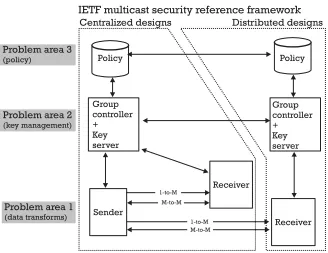
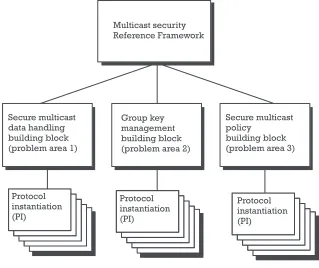
The IRTF SMuG Research Group and IETF MSEC Working Group identified three problem areas in providing secure group communications: secure multicast data handling, management of keying material, and multicast security policies. Chapter 2 contains a detailed description of the problem areas and building blocks. In the rest of this section, we define the problem areas, briefly explore the solution space, and discuss application-specific requirements.
1.2.1 Problem area 1: Secure multicast data handling
In this section, we address the problem of secure multicast data transmission. More precisely, we discuss data transforms for multicast data secrecy and integrity protection. For data secrecy, the sender needs to encrypt data with a secret key which is known to the group members: that is, hosts that are authorized to receive multicast data. Scalable distribution and rekeying of a group key is a complex problem and is designated as a problem area in itself. IPsec encapsulating security payload (ESP)[5] transforms for secrecy are applicable to private multicast communication as well. The only caveat is that the replay protection mechanism of ESP works only for single sender multicast communication. ESP also supports message authentication code (MAC)-based integrity protection for unicast communication. In two party communication, MAC-based authentication is sufficient for a receiver to determine whether a packet originated at the sender. Unfortunately, that is not the case in multiparty communication.
Consider two communicating peers, Alice and Bob, who each hold a secret key for message authentication. Alice uses the key to compute a message authentication code (MAC, e.g., cipher block chaining (CBC) MAC, or hash-based MAC (HMAC) [6]) of the message, and sends the message
along with the MAC to the receiver. Bob repeats the procedure to compute the MAC, and compares it with the received MAC. If the MACs are identical, Bob knows that the message has not been modified en route. He also knows that since he has not sent the message, Alice must have sent it, assuming the authentication key has not been compromised.
We can use MACs for authenticating group communications following a similar procedure as above, but with a reduced level of integrity protection. Consider a group, consisting of Alice, Bob, and Cindy, holding an authentication key. Alice might use a MAC to authenticate a message sent to Bob and Cindy. Bob (or Cindy), however, does not know whether the message has been sent or last modified by Alice or Cindy (or Bob). In general, members of a group can verify only that nonmembers, that is, people who do not hold the group authentication key, have not changed the data in transit.
Group authentication [7] is the property that guarantees only that a message was sent (last modified) by a member of the group. Since a MAC can be used for group authentication, it is rather inexpensive to authenticate even streaming data in real time. For group authentication, the sender needs to establish a common key with the group members. The problem of key distribution is addressed in the next section, and IPsec ESP can be used to carry group authenticated multicast data.
In most applications, receivers must be able to establish the source of the data, at least for themselves. In other words, we need data source authentication. A stronger version of the above property, referred to as non-repudiation, enables a receiver to prove the origin of data to any impartial third party.
However, source authentication of multicast data is a difficult problem. The simplest solution is to digitally sign each packet. But signing each packet is computationally expensive, and introduces excessive per packet commu-nication overhead. Several solutions have been documented that amortize the cost of digital signatures over multiple packets. Chapter 3 provides a detailed description of the state-of-the-art in stream source authentication techniques.
Unfortunately, ESP cannot be used to carry source authenticated multicast data. A couple of variants of ESP called multicast ESP (MESP) [8] and application layer MESP (AMESP) have been proposed at the IETF to accommodate source authentication schemes for multicasting. MESP, similar to IPsec ESP, operates in the network layer, whereas AMESP is the applica-tion layer counterpart. Implementing IPsec ESP or MESP requires kernel-level modifications—which are not possible in some cases, and may result in delayed deployment. AMESP is the transform to use in such cases.
Application requirements
Application requirements greatly influence the solution space for data origin authentication. First, an application may require non-repudiation or source authentication or just group authentication. Next, data transmission may be reliable or lossy. Furthermore, the sender or the receivers may have limited buffer space or computational power (e.g., on mobile devices), or have heterogeneous capacities. Receivers may also be at vastly different distances from the sender. Finally, the application may involve bulk data transfer(s) or streaming. Clearly, a one-size-fits-all solution is not applicable for source authentication of multicast data.
1.2.2 Problem area 2: Management of keying material
Group access control, privacy, and group authentication of multicast data require that a common key be distributed to the current members of the secure group. We use a logical entity called group controller and key server
(GCKS) to provide access control and key distribution services. A GCKS represents both the entity and functions relating to the issuance and management of cryptographic keys used by a multicast group, and conducts user authentication and authorization checks on each candidate member of the multicast group.
Unicast security negotiation protocols such as IKE [9] result in a separate key per instance, and cannot directly be used for group communications. Instead, a centralized entity such as the GCKS needs to download group key(s) separately to each member via a secure channel.2
Member registration
Each member contacts the GCKS to register [10] and join the group. After mutual authentication, the GCKS verifies the host’s membership, establishes a secure channel, and downloads group keys and policy to the member. Registration is a one-to-one exchange between the GCKS (or one of its authorized representatives) and each member. This one-to-one secure exchange requires similar protections as in IKE or SSL, such as protection from man-in-the-middle, replay and denial of service attacks, connection hijacking, and so forth.
2. Distributed group key agreement schemes have been documented, but they are inefficient for groups of hundreds of members or more.
Scalable registration/initialization of large groups. Since registration is a one-to-one exchange, employing a single point of contact for all members is not efficient. Fortunately, there are several ways to expedite the process. First, the functionality of GCKS registration could be distributed over several entities. Second, members may register at their convenience, thereby avoiding large number of registration requests at the same time. This process is similar to purchasing tickets for sporting events and theater performances at Ticket Master outlets and authorized travel agents.
Group rekeying
Since encryption keys have lifetimes, the GCKS must rekey the group key before it expires. Otherwise, most if not all members may send a request to the GCKS for the new key simultaneously, resulting in rekey request implosion in large groups. Furthermore, consider the problem of enforcing access control in a dynamic group, that is, a group where membership changes frequently. The GCKS may need to rekey the group and distribute the new group key to the current members each time membership changes.
Forward and backward access control. Consider group key distribution to a large and dynamic group. In most applications, while some members join at the beginning of the session and leave at the end, others may join and leave any time during the session. In other words, some members may be allowed to participate in a secure group for only a limited duration. Consider also that a host might be recording multicast data sent before it is authorized to join a group. Therefore, the GCKS needs to change the group key and distribute the new key to all members. Otherwise, the joining host can decrypt data sent before it became a member of the group. We refer to this property as backward access control. Similarly, the GCKS needs to change the group key when a member leaves, so as not to allow the departing member to decrypt future group communications. This property is known as forward access control. In summary, to ensure that only current authorized members can decrypt group data, backward and forward access control must be enforced.
Rekey messages can be sent via unicast or by multicast for efficient distribution. Similar to registration messages, rekey messages must also be protected from replay attacks, and must be signed by the GCKS for authenticity.
Impact of group membership dynamics. The size and dynamics of the group have a significant impact on the enforcement of forward and backward
8 Introduction
TE
AM
FL
Y
access control. Consider a naı¨ve approach to group key management. The sender or the GCKS shares a separate secret key with each member. When a member leaves, the manager must send the new group key encrypted separately with each of the remaining members’ secret keys. Since the computational overhead at the sender and the communication overhead of this scheme grow with group size, it is inefficient for large and highly dynamic groups.
Group security association
For secure unicast, two communicating peers negotiate security parameters to establish an Internet security association and key management protocol (ISAKMP) SA, which protects the negotiation of an IPsec SA for secure data transmission [11]. Following a similar model, the group security association (GSA) [12] is being standardized at the IETF, and has three parts. The first is the registration SA which protects the key download during the registration protocol. The key download consists of a rekey SA and a data security SA. The rekey SA protects updates to the current rekey SA or a data security SA. The data security SA itself protects multicast data transmission. Examples of a data security SA include IPsec ESP, MESP, and AMESP.
Group key distribution architectures, protocols, and algorithms
We classify the group key distribution literature into architectures, protocols, and algorithms for group key management. Group key distribution
architecturessuch as Iolus [13] and Internet keying architecture for multicast (IKAM) [14] use hierarchical subgrouping for efficient group management. They divide members into subgroups, designate members or third-party agents as subgroup managers (SGMs), and delegate group key management tasks to the SGMs. This topic is covered further in Chapter 5.
The term protocols is used to describe the set of procedures, message exchanges, and message payloads that govern the behavior of the entities involved in supporting a secure group (e.g., servers), and those participating in a group (e.g., hosts). Group domain of interpretation (GDOI) [15] and group security association key management protocol (GSAKMP) [16] are solutions that fall into this category. This topic is addressed in Chapter 5.
Architectures and protocols benefit from each other. For example, Iolus or IKAM can use GDOI for registration and rekeying within a subgroup. Similarly GSAKMP allows some members to be designated as subgroup managers for scalability. Both architectures and protocols can benefit from the group key management algorithms, described below, for efficient group rekeying.
Group key managementalgorithmstypically use logical subgrouping for efficient key distribution and rekeying. (Contrast this with subgrouping by group key management architectures described earlier.) Each logical subgroup has an associated key encryption key (KEK) used to encrypt other KEKs or the group key. We identify two classes of group key management algorithms based on the interdependency of rekey messages. In the first, based on logical key hierarchies (LKH) or key trees [17], each member holds a subset of the KEKs, and the GCKS changes those KEKs and the group key when the member joins or leaves. At most, each KEK must be encrypted with as many keys as the degree of the key tree. Thus rekeying using logical key hierarchies requires fewer (logarithmic in number of members) messages, and fewer key computations at the GCKS. In the second class of algorithms, the GCKS divides the authorized members into predefined logical subsets, and sends the group key encrypted with the subset keys. This interesting subject is central to efficient group key management, and is discussed in depth in Chapter 6.
Reliable transport of rekey messages. Rekey messages are typically sent via multicast for efficiency. It is the responsibility of the GCKS to ensure that all members have the current data security and rekey SAs. Otherwise, authorized members may be inadvertently excluded from being able to decrypt group communications. Therefore, the GCKS must use a reliable transport mechanism to send rekey messages. Reliable multicasting is a hard problem, but there are several documented solutions. We discuss reliable transport of rekey messages in this section.
Rekey messages are typically short (for a single membership change in large groups and for small groups in general), which makes it easy to design a reliable delivery protocol. On the other hand, the security requirements add an additional dimension to the problem. There are also some special cases where membership changes are processed in a batch, increasing their size. Finally, among all the KEKs sent in a rekey message, as many as half the members need only a single KEK. We need to take advantage of these properties in designing a rekey message(s) and a protocol for their reliable delivery. Three categories of solutions have been proposed:
1. Because in many cases rekey messages are small (fitting in one or two IP packets), the GCKS may repeatedly retransmit rekey messages.
2. The GCKS may use an existing Reliable Multicast protocol or infrastructure.
3. We may use forward error correction to encode rekey packets, using feedback negative acknowledgements or (NACKs) from members to build the next round of rekey message [18]. Note however that feedback-based reliable delivery may result in implosion of feedback messages at the GCKS.
Application requirements
Application requirements greatly influence the design choices of a solution for group key distribution. In some cases, such as in a pure pay-per-view (PPV) application, all of the SA information needed for the session may be distributed at the time of registration or initialization of a session. Thus there is no rekeying due to membership changes, which obviates the need for an efficient group key management algorithm. Rekey SA may not be necessary for group key management schemes that rely solely on point-to-point communications (e.g., for small groups). Strict enforcement of forward and backward access control may not be necessary in some applications. More precisely, membership changes may be processed periodically or in a batch [19], even if the membership changes happen at different times. Therefore a group key management solution must offer selectable/ configurable levels of security.
1.2.3 Problem area 3: Multicast security policies
Multicast security policies provide the rules of operation for the other two problem areas: management of keying material and multicast data handling. We consider two different types of groups, namely, small interactive groups and large groups with one or a few senders. In single-sender groups, the sender is either the content owner or its representative. The content owner typically specifies who can receive the data and what amount of protection is needed, and designates a GCKS and a sender. The GCKS is responsible for both distribution and enforcement of policy. The sender is also partially responsible for enforcing policy. Interactive groups sometimes have a moderator that can be considered as thegroup owner. Policy in small groups may be negotiated [20], but negotiation does not converge in large groups. Alternatively, the group owner may distribute and enforce policy.
Content owners specify only a high-level policy which must then be translated into more precise rules so that the policy can be enforced with available security mechanisms. Policy languages such as Ismene [21], cyptographic context negotiation template (CCNT) [20], and group security policy token (GSPT) [16] have been proposed for unambiguous specification of group policies.
Secure group policy components
Groups bring up several new policy issues compared to peer-to-peer communications. In groups, different entities have different capabilities and roles, and authorization policy defines members, sender(s), and GCKS and its authorized representatives (e.g., subordinate GCKS and rekey server). Access control lists (ACL) and capability certificates are examples of mechanisms for access control enforcement. Policy also dictates which encryption or authentication algorithm to use for rekeying as well as secure data communications. Furthermore, the content owner specifies whether the GCKS should rekey after each membership change, or process such changes periodically. Group policy should also include expected member behavior when a member does not have the latest GSA. Application requirements, the value of content, and sometimes the mechanisms supported by the sender and GCKS all affect the group policy.
We end this section with a note on policy distribution in groups. Recall that policy negotiation does not converge in large groups. However, policy distribution brings up an interesting problem. Since there is no negotia-tion, members might want to know if they can participate before signing up (i.e., paying money to get access) to receive data. In other words, some of the policy needs to be predistributed. However, it is not a sound practice to advertise the policy of a secure group for all the world to see. Therefore, depending on application requirements, some of the policy is predistributed, while the rest is distributed by the GCKS to authorized members only. Chapter 7 provides a detailed discussion of group policy requirements and solutions.
1.3
Infrastructure protection
Aside from content protection, we need to consider threats to multicast infrastructure. There are three components to this problem, corresponding to sender access control, multicast routing infrastructure protection, and receiver access control.
Recall that in the traditional multicast model, a sender can transmit data to any multicast group; it does not even need to be a member of the group. Therefore, an adversary could inject data onto a multicast tree and waste network resources, such as buffer space on the routers and bandwidth on the links. This problem has begun to be addressed in the recent development of the SSM model, and some traditional protocols have been modified to conform to the SSM model (e.g., PIM-SSM [22]).
Next, in order for a unicast or a multicast routing protocol to behave correctly, all the control packets exchanged among the routers implement-ing the protocol must be protected against malicious modifications and deletions, and insertions of bogus control packets. Multicast routing protocol security is the topic of Chapter 8.
Similar to multicast routing protocols, Reliable Multicast protocols operate by exchanging control messages among the entities involved in the protocol. For a Reliable Multicast protocol to function properly, its control messages must be (at least) protected from modifications in transit. Reliable Multicast protocol security is addressed in Chapter 9.
Finally, recall that any host can join a multicast group and pull the distribution tree toward itself. An adversary could exploit this feature and pull unnecessary multicast traffic, causing denial of service. Therefore, for infrastructure protection, edge routers must allow only authorized members to pull multicast data.
1.4
Applications of secure multicasting
Data encryption and key distribution to authorized members supports group access control without modifying the IP multicast model. Access control enables content providers to control data distribution, and charge for content. Satellite TV distribution is an application that needs support for group access control.
Several multicast applications require data confidentiality or message integrity. Investors receiving stock quotes need a guarantee that the data is being sent by an authorized sender, and has not been modified en route. Several corporations transmit sensitive information such as software, database, and inventory updates using multicast ftp (MFTP) [23]. We discuss solutions to protect confidentiality and data integrity of MFTP communications in Section 10. Multimedia conferencing over the Internet needs protocols and mechanisms for privacy and data integrity. Finally, multicastvirtual private network(VPN) is an application that enables forming a private network, say, between all branches of a bank, over the Internet.
1.5
Road map
We expect that the readers understand encryption, data integrity, host authentication, and other basic cryptographic properties. The readers should also be familiar with network security protocol requirements such as protection against man-in-the-middle, replay, connection hijacking, and
denial of service attacks. We also expect the readers to have some knowledge of the IPsec terminology.
The next chapter describes the framework for multicast security de-veloped at the IRTF SMuG Research Group and IETF MSEC Working Group. Problem area 1, that is, secure multicast data handling, is the topic of Chapter 3. Management of keying material, otherwise known as problem area 2, is introduced in Chapter 4, with further coverage in the following two chapters. Chapter 5 describes group key management architectures and protocols, and Chapter 6 discusses group key management algorithms. Secure group policy, labeled as problem area 3, is the subject of Chapter 7. Infrastructure protection is the topic of the next two chapters. Routing protocol security is covered in Chapter 8, and Reliable Multicast protocol security is the subject of Chapter 9. Applications of secure multicasting is the topic of the following chapter. Chapter 11 concludes the book with a discussion on future topics.
There are a number of ways to read the material presented here. The chapters on each problem area are more or less independent. The current chapter and Chapter 2 provide an insight into the problem space of multicast security. Chapters 8 and 9 provide a summary of the multicast infrastructure security requirements and solutions. They are independent of the other chapters and could be read separately.
References
[1] Cain, B., et al., ‘‘Internet Group Management Protocol, Version 3,’’ draft-ietf-idmr-igmp-v3-09.txt, IETF, January 2002, work in progress.
[2] Deering, S., et al., ‘‘The PIM Architecture for Wide-Area Multicast Routing,’’
IEEE/ACM Trans. on Networking, Vol. 4, No. 2, 1996, pp. 153–162.
[3] Estrin, D., et al., ‘‘Protocol Independent Multicast-Sparse Mode (PIM-SM): Protocol Specification,’’ RFC 2362 (experimental), IETF, June 1998.
[4] Diot, C., et al., ‘‘Deployment Issues for the IP Multicast Service and Architecture,’’ IEEE Network, Special Issue on Multicasting, January/February 2000.
[5] Kent, S., and R. Atkinson, ‘‘IP Encapsulating Security Payload (ESP),’’ RFC 2406 (proposed standard), IETF, November 1998.
[6] Krawczyk, H., M. Bellare, and R. Canetti, ‘‘HMAC: Keyed-Hashing for Message Authentication,’’ RFC 2104 (informational), IETF, February 1997. [7] Canetti, R., et al., ‘‘Multicast Security: A Taxonomy and Efficient
Construc-tions,’’ inProc. of IEEE INFOCOM, New York, March 1999.
[8] Canetti, R., P. Rohatgi, and P. Cheng, ‘‘Multicast Data Security Transforma-tions: Requirements, Considerations, and Proposed Design,’’ draft-irtf-smug-data-transforms-00.txt, IRTF, June 2000, work in progress.
[9] Harkins, D., and D. Carrel, ‘‘The Internet Key Exchange (IKE),’’ RFC 2409 (proposed standard), IETF, November 1998.
[10] Baugher, M., et al., ‘‘Group Key Management Architecture,’’ draft-ietf-msec-gkmarch-02.txt, IETF, March 2002, work in progress.
[11] Kent, S., and R. Atkinson, ‘‘Security Architecture for the Internet Protocol,’’ RFC 2401 (proposed standard), IETF, November 1998.
[12] Hardjono, T., M. Baugher, and H. Harney, ‘‘Group Security Association (GSA) Management in IP Multicast,’’ inProc. of the 16th International Conference on Information Security (IFIP/SEC), Paris, France, June 2001.
[13] Mittra, S., ‘‘Iolus: A Framework for Scalable Secure Multicasting,’’ inProc. of ACM SIGCOMM, Cannes, France, September 1997, pp. 277–288.
[14] Hardjono, T., B. Cain, and I. Monga, ‘‘Intra-Domain Group Key Management Protocol,’’ draft-ietf-ipsec-intragkm-02.txt, IETF, February 2000, work in progress.
[15] Baugher, M., et al., ‘‘Group Domain of Interpretation for ISAKMP,’’ draft-ietf-msec-gdoi-04.txt, IETF, March 2002, work in progress.
[16] Harney, H., et al., ‘‘Group Secure Association Key Management Protocol,’’ draft-ietf-msec-gsakmp-sec-00.txt, IETF, March 2001, work in progress. [17] Wallner, D., E. Harder, and R. Agee, ‘‘Key Management for Multicast: Issues
and Architectures,’’ RFC 2627 (informational), IETF, June 1999.
[18] Yang, Y. R., et al., ‘‘Reliable Group Rekeying: Design and Performance Analysis,’’ inProc. of ACM SIGCOMM, San Diego, CA, August 2001.
[19] Setia, S., et al., ‘‘Kronos: A Scalable Rekeying Approach for Secure Multicast,’’ inProc. of IEEE Symposium on Security and Privacy, Oakland, CA, May 2000. [20] Dinsmore, P. T., et al., ‘‘Policy-Based Security Management for Large Dynamic
Groups: An Overview of the DCCM Project,’’ inProc. of the DARPA Information Survivability Conference & Exposition, Vol. I of II (DISCEX), Hilton Head, SC, January 2000, pp. 64–73.
[21] McDaniel, P., and A. Prakash, Ismene: Provisioning and Policy Reconciliation in Secure Group Communication, Technical Report CSE-TR-438-00, Electrical Engineering and Computer Science, University of Michigan, December 2000. [22] Holbrook, H., and B. Cain, ‘‘Source Specific Multicast for IP,’’
draft-ietf-ssm-arch-00.txt, IETF, November 2001, work in progress.
[23] Miller, K., et al., ‘‘Starburst Multicast File Transfer Protocol (MFTP) Specification,’’ draft-miller-mftp-spec-03.txt, IRTF, April 1998, work in progress.
Framework for multicast
and group security
T
he problem of security for multicast and group security concerns not only content protection of the data or traffic being delivered to a group through IP multicast, but also concerns the protection of the network infrastructure that implements the multicast-related protocols. Therefore, one of the first tasks in looking at multicast security is to understand the landscape and define a reasonable scope or definition of the problems at hand.Consequently, the aim of this chapter is to subdivide the complex problem of multicast and group security into manage-able pieces. This chapter also reports on the IETF’s approach in addressing these pieces. The subdivision also provides a road-map for subsequent chapters dealing with specific issues.
2.1
The problem scope of multicast security
The problem of multicast and group security is complex because it involves several aspects of the Internet architecture, and covers all layers in the communications stack, above (and including) the network layer.
In order to reduce the complexity of the problems at hand, we have identified two broad categories of problems, denoting them as multicast fundamental issues and multicast transport and applications issues (see Figure 2.1). The first category of
17
C H A P T E R
2
Contents
2.1 The problem scope of multicast security
2.2 Fundamental issues
2.3 Transport and applications issues
2.4 The IETF problem scope for multicast and group security
2.5 Three problem areas in the management of keying material
2.6 The building blocks approach
issues covers the basic security problems in multicast and group security, whose solutions represent building blocks for solving other problems, including those of the second category:
w Fundamental issues:
w Routing infrastructure protection;
w Controlled access to the multicast distribution tree (or group
membership management);
w Management of keying material; w Transport and applications issues:
w Security ofReliable Multicast(RM) protocols; w Applications requirements and other issues.
The thinking is that the fundamental issues need to be solved in order to provide a minimal level of security for IP multicast at the network layer. Without these fundamental issues being addressed, the transport and applications issues would be very difficult—if not impossible—to solve from a practical perspective. Thus, for example, without routing infrastructure protection (as a fundamental issue to be solved), data protection at the application layer would be less effective, as there would no be guarantee that the multicast routing protocol at the network layer would function correctly in the face of attacks (e.g., bogus control IP packets).
Figure 2.1 Problem scope of multicast security.
18 Framework for multicast and group security
TE
AM
FL
Y
2.2
Fundamental issues
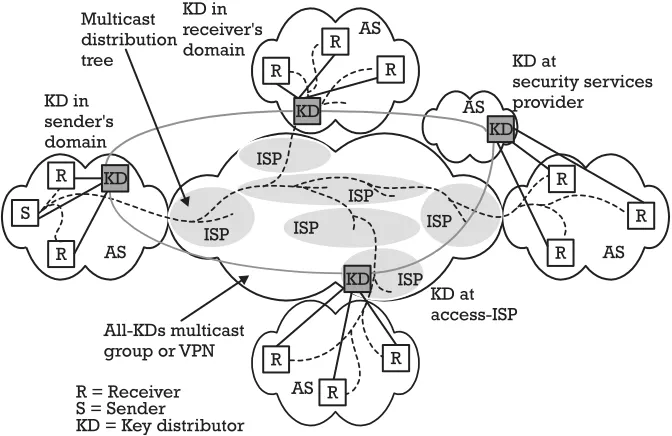
The fundamental issues can also be viewed from a topological perspective (see Figure 2.2), where topological boundaries add to the complexity of the issues at hand.
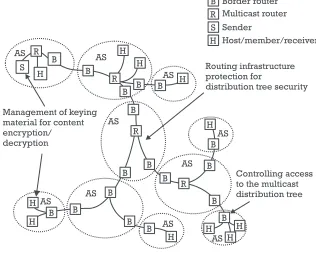
In Figure 2.2, the entities shown include the sender. This sends multicast packets through the multicast distribution tree, represented by the curved tree that spans across severalautonomous systems(ASs) or domains, including stub ASs, access domains (e.g., access ISP), and transit ISPs. The multicast here is assumed to be a one-to-many multicast with a single sender. The figure does not show multicast tunnels between domains, or tunnels that carry multicast packets. A border router is shown within each domain’s ingress and egress points for the distribution tree. Each branch point (fanout) in the distribution tree is shown to occur at either a multicast router (which is assumed to be also a unicast router), or a border router. The hosts are shown to be the receiver members of the multicast group, attached to a multicast router in their respective domains.
[image:42.504.126.442.317.571.2]Using Figure 2.2 as a guide, we briefly describe the fundamental issues as follows.
Figure 2.2 Fundamental problems in multicast and group security.
2.2.1 Routing infrastructure protection
A multicast routing protocol (such as PIM [1, 2], distance vector multicast routing protocol (DVMRP) [3] or multicast extensions to open shortest path first (MOSPF) [4]) creates a multicast distribution tree that effectively routes packets from the sender(s) to the receivers who are connected to the tree at its ‘‘edges.’’ Here multicast routers in several domains must maintain state information that allows a router to route multicast packets pertaining to a group to the correct outgoing interfaces, to downstream multicast routers, and finally to the receivers. In order for the content to be delivered in a timely fashion to its correct recipients, the multicast distribution tree must behave according to the precise specification as intended by its protocol designers (assuming no errors in the design itself).
In order for a unicast or a multicast routing protocol to behave correctly, all the control packets exchanged among the routers implementing the protocol must be protected against malicious modifications and deletions, and insertions of bogus control packets. This is true for both unicast and multicast routers, since routing tables in routers are often shared between the unicast protocols and the multicast protocols, and the actual shape of the multicast distribution tree is determined to a large extent by the unicast routing table.
Thus routing protection, both unicast and multicast, is a key requirement for the end goal of multicast security. This implies that at the network layer cryptographic protection of control packets is needed (which usually means authentication and integrity protection of control packets), which in turn implies that cryptographic key management and policy management is required for routing entities. This topic will be discussed further in Chapter 8.
2.2.2 Controlled access to the multicast distribution tree
The basic IP multicast model as defined by [5] allows for any host to become a member of the group simply by requesting to join the group. Unless they happen to be on the same subnet, group members in [5] are typically unaware of the existence of other members in the group. Although this IP multicast model may be attractive in its native form from the perspective of scalability, from the perspective of security such uncontrolled behavior may be undesirable. Thus, once a multicast distribution tree has been protected and is correctly functioning according to its specification, a related problem is that of controlled access to the distribution tree by potential hosts/members of a group.