Prentice Hall
Open Source Software Development Series
Arnold Robbins, Series Editor“Real world code from real world applications”
Open Source technology has revolutionized the computing world. Many large-scale projects are in production use worldwide, such as Apache, MySQL, and Postgres, with programmers writing applications in a variety of languages including Perl, Python, and PHP. These technologies are in use on many different systems, ranging from proprietary systems, to Linux systems, to traditional UNIX systems, to mainframes.
The Prentice Hall Open Source Software Development Series is designed to bring you the best of these Open Source technologies. Not only will you learn how to use them for your projects, but you will learn from them. By seeing real code from real applications, you will learn the best practices of Open Source developers the world over.
Titles currently in the series include:
Linux® Debugging and Performance Tuning: Tips and Techniques
Steve Best
0131492470, Paper, ©2006
Understanding AJAX: Using JavaScript to Create Rich Internet Applications
Joshua Eichorn
0132216353, Paper, ©2007
Embedded Linux Primer
Christopher Hallinan 0131679848, Paper, ©2007
SELinux by Example
Frank Mayer, David Caplan, Karl MacMillan 0131963694, Paper, ©2007
UNIX to Linux® Porting
Alfredo Mendoza, Chakarat Skawratananond, Artis Walker 0131871099, Paper, ©2006
Linux Programming by Example: The Fundamentals
Arnold Robbins
0131429647, Paper, ©2004
The Linux® Kernel Primer: A Top-Down Approach for x86 and PowerPC Architectures
The Apache Modules Book
Application Development
with Apache
Nick Kew
Many of the designations used by manufacturers and sellers to distinguish their products are claimed as trade-marks. Where those designations appear in this book, and the publisher was aware of a trademark claim, the designations have been printed with initial capital letters or in all capitals.
The author and publisher have taken care in the preparation of this book, but make no expressed or implied war-ranty of any kind and assume no responsibility for errors or omissions. No liability is assumed for incidental or con-sequential damages in connection with or arising out of the use of the information or programs contained herein. The publisher offers excellent discounts on this book when ordered in quantity for bulk purchases or special sales, which may include electronic versions and/or custom covers and content particular to your business, training goals, marketing focus, and branding interests. For more information, please contact:
U.S. Corporate and Government Sales (800) 382-3419
[email protected] For sales outside the United States, please contact:
International Sales
Visit us on the Web: www.prenhallprofessional.com Library of Congress Cataloging-in-Publication Data Kew, Nick.
The Apache modules book : application development with Apache / Nick Kew. p. cm.
Includes bibliographical references and index. ISBN 0-13-240967-4 (pbk. : alk. paper)
1. Apache (Computer file : Apache Group) 2. Web servers—Computer programs. 3. Application software— Development. I. Title.
TK5105.8885.A63K49 2007 005.7'1376—dc22
2006036623 Copyright © 2007 Pearson Education, Inc.
All rights reserved. Printed in the United States of America. This publication is protected by copyright, and per-mission must be obtained from the publisher prior to any prohibited reproduction, storage in a retrieval sys-tem, or transmission in any form or by any means, electronic, mechanical, photocopying, recording, or likewise. For information regarding permissions, write to:
Pearson Education, Inc.
Rights and Contracts Department One Lake Street
Upper Saddle River, NJ 07458 Fax: (201) 236-3290
ISBN 0-13-240967-4
To all who share my dream, and are working to help make it happen …
… the dream of a world where your work, your colleagues, and your opportunities in life are not dictated by where you live or how far you commute. Where the
old-fashioned office of the nineteenth and twentieth centuries has passed into history, along with its soul-destroying bums-on-seats culture and Dilbertian work practices. A world inclusive of those who cannotwork in a standard office. A world
inclusive of those who reject car-dependence, but embrace a full and active life. A world inclusive of those who seek to fit study and learning into a busy life, yet have no accessible library, let alone university. Of those who are housebound …
Our information infrastructure is poised to liberate us all. We who develop with Apache are playing a small but exciting part in that. This work is
Foreword . . . xxi
Preface. . . xxiii
Acknowledgments. . . xxvii
About the Author . . . xxix
Chapter 1 Applications Development with Apache . . . 1
1.1 A Brief History of the Apache Web Server. . . 1
1.1.1 Apache 1 . . . 1
1.1.2 Apache 2 . . . 2
1.2 The Apache Software Foundation . . . 3
1.2.1 Meritocracy . . . 4
1.2.2 Roles . . . 4
1.2.3 Philosophy . . . 6
1.3 The Apache Development Process . . . 6
1.3.1 The Apache Codebase . . . 7
1.3.2 Development Forums. . . 9
1.3.3 Developers . . . 10
1.3.4 Participation. . . 11
1.4 Apache and Intellectual Property . . . 12
1.4.1 The Apache License . . . 12
1.4.2 Third-Party Intellectual Property . . . 15
1.5 Further Reading. . . 16
1.5.1 Interactive Online Forums . . . 16
1.5.2 Conferences . . . 17
1.5.3 Websites . . . 17
1.6 Summary . . . 19
Chapter 2 The Apache Platform and Architecture . . . 21
2.1 Overview . . . 21
2.2 Two-Phase Operation . . . 22
2.2.1 Start-up Phase . . . 23
2.2.2 Operational Phase . . . 25
2.2.3 Shutdown. . . 26
2.3 Multi-Processing Modules . . . 26
2.3.1 Why MPMs? . . . 26
2.3.2 The UNIX-Family MPMs . . . 27
2.3.3 Working with MPMs and Operating Systems . . . 28
2.4 Basic Concepts and Structures . . . 29
2.4.1 request_rec . . . 30
2.4.2 server_rec . . . 35
2.4.3 conn_rec . . . 37
2.4.4 process_rec . . . 39
2.5 Other Key API Components . . . 39
2.6 Apache Configuration Basics . . . 41
2.7 Request Processing in Apache . . . 42
2.7.1 Content Generation . . . 42
2.7.2 Request Processing Phases . . . 43
2.7.3 Processing Hooks . . . 44
2.7.4 The Data Axis and Filters. . . 46
2.7.5 Order of Processing . . . 49
2.7.6 Processing Hooks . . . 50
2.8 Summary . . . 51
Chapter 3 The Apache Portable Runtime . . . 53
3.1 APR. . . 54
3.2 APR-UTIL . . . 56
3.3 Basic Conventions . . . 57
3.3.1 Reference Manual: API Documentation and Doxygen. . . 57
3.3.2 Namespacing . . . 57
3.3.3 Declaration Macros . . . 58
3.3.4 apr_status_t and Return Values . . . 58
3.3.5 Conditional Compilation . . . 59
3.4 Resource Management: APR Pools . . . 59
3.4.1 The Problem of Resource Management . . . 60
3.4.2 APR Pools . . . 61
3.4.3 Resource Lifetime. . . 65
3.4.4 Limitations of Pools . . . 68
3.5 Selected APR Topics . . . 68
3.5.1 Strings and Formats . . . 69
3.5.2 Internationalization . . . 69
3.5.3 Time and Date . . . 70
3.5.4 Data Structs . . . 70
3.5.5 Buckets and Brigades . . . 74
3.5.6 Filesystem. . . 76
3.5.7 Network . . . 76
3.5.8 Encoding and Cryptography . . . 76
3.5.9 URI Handling . . . 77
3.5.10 Processes and Threads . . . 78
3.5.11 Resource Pooling . . . 78
3.5.12 API Extensions . . . 79
3.6 Databases in APR/Apache . . . 79
3.6.1 DBMs and apr_dbm . . . 80
3.6.2 SQL Databases and apr_dbd . . . 82
3.7 Summary . . . 83
Chapter 4 Programming Techniques and Caveats. . . 85
4.1 Apache Coding Conventions . . . 85
4.1.1 Lines . . . 86
4.1.2 Functions . . . 86
4.1.3 Blocks. . . 86
4.1.4 Flow Control . . . 87
4.1.5 Declarations . . . 87
4.1.6 Comments . . . 87
4.2 Managing Module Data. . . 88
4.2.1 Configuration Vectors . . . 88
4.2.2 Lifetime Scopes . . . 88
4.3 Communicating Between Modules . . . 90
4.4 Thread-Safe Programming Issues . . . 92
4.5 Managing Persistent Data . . . 93
4.5.1 Thread Safety . . . 93
4.5.2 Memory/Resource Management. . . 96
4.6 Cross-Platform Programming Issues . . . 99
4.6.1 Example: Creating a Temporary File . . . 100
4.7 Cross-MPM Programming Issues . . . 101
4.7.1 Process and Global Locks . . . 102
4.7.2 Shared Memory . . . 104
4.8 Secure Programming Issues . . . 106
4.8.1 The Precautionary Principle: Trust Nothing . . . 107
4.8.2 Denial of Service: Limit the Damage . . . 109
4.8.3 Help the Operating System to Help You . . . 111
4.9 External Dependencies and Libraries . . . 114
4.9.1 Third-Part Libraries . . . 114
4.9.2 Library Good Practice . . . 114
4.9.3 Building Modules with Libraries . . . 118
4.10 Modules Written and Compiled in Other Languages . . . 120
4.11 Summary . . . 122
Chapter 5 Writing a Content Generator . . . 123
5.1 The HelloWorld Module . . . 124
5.1.1 The Module Skeleton . . . 124
5.1.2 Return Values . . . 126
5.1.3 The Handler Field . . . 127
5.1.4 The Complete Module . . . 127
5.1.5 Using the request_rec Object . . . 129
5.2 The Request, the Response, and the Environment. . . 130
5.2.1 Module I/O . . . 132
5.2.2 Reading Form Data . . . 138
5.3 The Default Handler . . . 144
5.4 Summary . . . 148
Chapter 6 Request Processing Cycle and Metadata Handlers . . . 151
6.1 HTTP . . . 152
6.1.1 The HTTP Protocol. . . 152
6.1.2 Anatomy of an HTTP Request . . . 153
6.2 Request Processing in Apache . . . 155
6.2.1 Mapping to the Filesystem . . . 156
6.2.2 Content Negotiation . . . 158
6.2.3 Security . . . 160
6.2.4 Caching . . . 160
6.2.5 Private Metadata. . . 160
6.2.6 Logging . . . 161
6.3 Diverting a Request: The Internal Redirect . . . 161
6.3.1 Error Documents . . . 162
6.3.2 Dealing with Malformed and Malicious Requests . . . 163
6.4 Gathering Information: Subrequests . . . 163
6.4.1 Example . . . 165
6.5 Developing a Module . . . 168
6.5.1 Selecting Different Variants of a Document . . . 168
6.5.2 Error Handling and Reusability . . . 172
6.6 Summary . . . 174
Chapter 7 AAA: Access, Authentication, and Authorization . . . 177
7.1 Security . . . 177
7.1.1 Authentication: Levels of Security . . . 178
7.1.2 Login on the Web . . . 180
7.2 An Overview of AAA. . . 180
7.3 AAA in Apache 1.x and 2.0 . . . 182
7.4 AAA in Apache 2.1/2.2 . . . 182
7.4.1 Host-Based Access Control. . . 183
7.4.2 Authentication: check_user_id . . . 183
7.4.3 Password Lookup . . . 184
7.4.4 Authorization . . . 184
7.5 AAA Logic . . . 185
7.5.1 Authentication and Require . . . 186
7.5.2 Denying Access . . . 186
7.5.3 Authentication Methods. . . 187
7.6 Writing AAA Modules . . . 187
7.6.1 A Basic Authentication Provider. . . 188
7.6.2 An Authorization Function . . . 190
7.6.3 Configuration. . . 193
7.6.4 Basic and Digest Authentication Providers . . . 193
7.7 Implementing a Custom Login Scheme. . . 195
7.7.1 Session Management with SQL . . . 196
7.7.2 Working Without Browser Authentication Dialogs . . . 197
7.8 Summary . . . 199
Chapter 8 Filter Modules . . . 201
8.1 Input and Output Filters . . . 202
8.2 Content, Protocol, and Connection Filters . . . 202
8.3 Anatomy of a Filter . . . 205
8.3.1 Callback Function . . . 205
8.3.2 Pipelining. . . 205
8.4 The Filter API and Objects . . . 207
8.4.1 Output Filters . . . 207
8.4.2 Input Filters . . . 207
8.5 Filter Objects. . . 208
8.6 Filter I/O . . . 210
8.7 Smart Filtering in Apache 2.2 . . . 211
8.7.1 Preprocessing and Postprocessing . . . 212
8.7.2 mod_filter . . . 213
8.7.3 Filter Self-configuration . . . 213
8.7.4 Protocol Handling . . . 215
8.8 Example: Filtering Text by Direct Manipulation of Buckets . . . 217
8.8.1 Bucket Functions . . . 217
8.8.2 The Filter . . . 218
8.9 Complex Parsing . . . 221
8.10 Filtering Through an Existing Parser . . . 225
8.11 stdio-Like Filter I/O . . . 227
8.12 Input Filters and the Pull API . . . 230
8.12.1 Mode . . . 231
8.12.2 Block . . . 231
8.12.3 readbytes . . . 231
8.12.4 Input Filter Example . . . 232
8.13 Summary . . . 235
Chapter 9 Configuration for Modules . . . 237
9.1 Configuration Basics . . . 237
9.2 Configuration Data Structs . . . 239
9.3 Managing a Module Configuration . . . 239
9.3.1 Module Configuration . . . 239
9.3.2 Server and Directory Configuration . . . 240
9.4 Implementing Configuration Directives . . . 242
9.4.1 Configuration Functions . . . 242
9.4.2 Example . . . 244
9.4.3 User Data in Configuration Functions . . . 244
9.4.4 Prepackaged Configuration Functions . . . 245
9.4.5 Scope of Configuration . . . 246
9.4.6 Configuration Function Types . . . 246
9.5 The Configuration Hierarchy . . . 250
9.6 Context in Configuration Functions . . . 255
9.6.1 Context Checking . . . 255
9.6.2 Method and <Limit> . . . 256
9.7 Custom Configuration Containers . . . 257
9.8 Alternative Configuration Methods . . . 261
9.9 Summary . . . 262
Chapter 10 Extending the API . . . 263
10.1 Implementing New Functions in Apache. . . 264
10.1.1 Exporting Functions. . . 264
10.1.2 Optional Functions . . . 265
10.2 Hooks and Optional Hooks . . . 267
10.2.1 A Closer Look at Hooks. . . 267
10.2.2 Order of Execution . . . 269
10.2.3 Optional Hooks Example: mod_authz_dbd . . . 270
10.3 The Provider API. . . 272
10.3.1 Implementation . . . 274
10.3.2 Implementing a Provider . . . 275
10.4 Providing a Service . . . 277
10.4.1 Example: mod_dbd . . . 277
10.4.2 Implementing the reslist. . . 278
10.5 Cross-Platform API Builds. . . 284
10.5.1 Using Preprocessor Directives. . . 285
10.5.2 Declaring the Module API . . . 286
10.6 Summary . . . 288
Chapter 11 The Apache Database Framework . . . 289
11.1 The Need for a New Framework . . . 290
11.1.1 Apache 1.x/2.0 Versus Apache 2.2 . . . 290
11.1.2 Connection Pooling . . . 290
11.2 The DBD Architecture . . . 292
11.3 The apr_dbd API. . . 292
11.3.1 Database Operations . . . 294
11.3.2 API Functions . . . 298
11.4 The ap_dbd API . . . 302
11.5 An Example Application Module: mod_authn_dbd . . . 303
11.6 Developing a New DBD Driver . . . 306
11.6.1 The apr_dbd_internal.h Header File . . . 307
11.6.2 Exporting a Driver . . . 307
11.6.3 The Driver Functions . . . 309
11.7 Summary . . . 320
Chapter 12 Module Debugging . . . 323
12.1 Logging for Debugging . . . 324
12.1.1 The Error Log . . . 324
12.1.2 Debugging . . . 326
12.2 Running Apache Under a Debugger . . . 327
12.2.1 Server Start-up and Debugging . . . 329
12.2.2 Debugging and MPMs. . . 331
12.2.3 Tracing a Crash . . . 331
12.2.4 Debugging a Core Dump. . . 332
12.3 Special-Purpose Hooks and Modules . . . 333
12.3.1 Standard Modules . . . 333
12.3.2 Fatal Exception Modules . . . 336
12.3.3 Modules to Deal with Abnormal Running . . . 337
12.4 Filter Debugging . . . 338
12.4.1 mod_diagnostics. . . 338
12.5 Summary . . . 341
Appendix A Apache License. . . 343
Appendix B Contributor License Agreements . . . 349
Individual CLA . . . 349
Corporate CLA . . . 353
Appendix C Hypertext Transfer Protocol: HTTP/1.1 . . . 357
Status of This Memo . . . 357
Copyright Notice. . . 358
Abstract . . . 358
1 Introduction . . . 358
1.1 Purpose . . . 358
1.2 Requirements . . . 359
1.3 Terminology . . . 359
1.4 Overall Operation . . . 364
2 Notational Conventions and Generic Grammar . . . 366
2.1 Augmented BNF . . . 366
2.2 Basic Rules . . . 368
3 Protocol Parameters . . . 370
3.1 HTTP Version . . . 370
3.2 Uniform Resource Identifiers . . . 371
3.3 Date/Time Formats . . . 373
3.4 Character Sets . . . 374
3.5 Content Codings. . . 375
3.6 Transfer Codings . . . 376
3.7 Media Types . . . 379
3.8 Product Tokens . . . 381
3.9 Quality Values . . . 381
3.10 Language Tags . . . 382
3.11 Entity Tags . . . 382
3.12 Range Units . . . 383
4 HTTP Message . . . 383
4.1 Message Types . . . 383
4.2 Message Headers . . . 384
4.3 Message Body . . . 385
4.4 Message Length . . . 386
4.5 General Header Fields . . . 387
5 Request. . . 388
5.1 Request-Line . . . 388
5.2 The Resource Identified by a Request . . . 390
5.3 Request Header Fields . . . 391
6 Response. . . 392
6.1 Status-Line . . . 392
6.2 Response Header Fields. . . 394
7 Entity . . . 394
7.1 Entity Header Fields . . . 395
7.2 Entity Body. . . 395
8 Connections . . . 396
8.1 Persistent Connections . . . 396
8.2 Message Transmission Requirements . . . 400
9 Method Definitions . . . 403
9.1 Safe and Idempotent Methods. . . 403
9.2 OPTIONS . . . 404
9.3 GET . . . 405
9.4 HEAD. . . 406
9.5 POST . . . 407
9.6 PUT . . . 408
9.7 DELETE. . . 409
9.8 TRACE . . . 409
9.9 CONNECT . . . 410
10 Status Code Definitions . . . 410
10.1 Informational 1xx . . . 410
10.2 Successful 2xx . . . 411
10.3 Redirection 3xx . . . 414
10.4 Client Error 4xx . . . 418
10.5 Server Error 5xx . . . 423
11 Access Authentication . . . 424
12 Content Negotiation . . . 424
12.1 Server-Driven Negotiation . . . 425
12.2 Agent-Driven Negotiation. . . 426
12.3 Transparent Negotiation . . . 427
13 Caching in HTTP . . . 427
13.2 Expiration Model . . . 433
13.3 Validation Model. . . 438
13.4 Response Cacheability . . . 444
13.5 Constructing Responses from Caches . . . 445
13.6 Caching Negotiated Responses . . . 449
13.7 Shared and Non-shared Caches . . . 450
13.8 Errors or Incomplete Response Cache Behavior . . . 450
13.9 Side Effects of GET and HEAD . . . 451
13.10 Invalidation After Updates or Deletions . . . 451
13.11 Write-Through Mandatory . . . 452
13.12 Cache Replacement . . . 452
13.13 History Lists . . . 452
14 Header Field Definitions . . . 453
14.1 Accept . . . 453
14.2 Accept-Charset . . . 455
14.3 Accept-Encoding . . . 456
14.4 Accept-Language . . . 457
14.5 Accept-Ranges . . . 459
14.6 Age . . . 459
14.7 Allow. . . 459
14.8 Authorization . . . 460
14.9 Cache-Control . . . 461
14.10 Connection . . . 470
14.11 Content-Encoding. . . 471
14.12 Content-Language. . . 472
14.13 Content-Length . . . 473
14.14 Content-Location . . . 473
14.15 Content-MD5. . . 474
14.16 Content-Range . . . 476
14.17 Content-Type . . . 478
14.18 Date . . . 478
14.19 ETag . . . 480
14.20 Expect . . . 480
14.21 Expires . . . 481
14.22 From . . . 482
14.23 Host . . . 482
14.24 If-Match . . . 483
14.25 If-Modified-Since . . . 484
14.26 If-None-Match . . . 486
14.27 If-Range . . . 487
14.28 If-Unmodified-Since . . . 488
14.29 Last-Modified . . . 488
14.30 Location . . . 489
14.31 Max-Forwards . . . 489
14.32 Pragma . . . 490
14.33 Proxy-Authenticate . . . 491
14.34 Proxy-Authorization . . . 491
14.35 Range . . . 492
14.36 Referer. . . 494
14.37 Retry-After . . . 494
14.38 Server . . . 495
14.39 TE. . . 495
14.40 Trailer . . . 497
14.41 Transfer-Encoding . . . 497
14.42 Upgrade . . . 498
14.43 User-Agent . . . 499
14.44 Vary. . . 499
14.45 Via . . . 500
14.46 Warning . . . 501
14.47 WWW-Authenticate . . . 504
15 Security Considerations . . . 504
15.1 Personal Information. . . 505
15.2 Attacks Based on File and Path Names . . . 507
15.3 DNS Spoofing. . . 508
15.4 Location Headers and Spoofing. . . 508
15.5 Content-Disposition Issues . . . 509
15.6 Authentication Credentials and Idle Clients . . . 509
15.7 Proxies and Caching . . . 509
16 Acknowledgments. . . 510
17 References. . . 512
18 Authors’ Addresses . . . 516
19 Appendices . . . 518
19.1 Internet Media Type message/http and application/http . . . 518
19.2 Internet Media Type multipart/byteranges. . . 519
19.3 Tolerant Applications . . . 520
19.4 Differences Between HTTP Entities and RFC 2045 Entities . . . 521
19.5 Additional Features . . . 524
19.6 Compatibility with Previous Versions . . . 525
20 Index . . . 529
21 Full Copyright Statement . . . 530
Acknowledgment . . . 530
Index . . . 531
xxi
Foreword
Nick’s book is something that we’ve long been waiting for. The “Eagle Book,” which came out in 1999, was a great book, but it focused primarily on mod_perl. Thus
it was a rather different thing from this book.
And this book comes along at just the right time. With web applications needing more and more scalability, we’re all looking for ways for our code to run faster, use fewer resources, have tighter integration with the webserver, and just plain be more robust.
It used to be sufficient to write Perl CGI programs to run even large websites, but over the years most of us have moved to mod_perl, PHP, Ruby on Rails, and other
development tools that allow us to build bigger, faster, cheaper. Those of us looking for that next thing, wondering if it might be best to write our applications as an Apache module, tend to get frustrated with the lack of decent documentation and examples.
For the most part, when you ask on IRC for documentation of how to write an Apache module, the answers include looking at the code of some existing module, or looking at API documentation that was, at best, somewhat elderly and, for the most part, intended for Apache 1.3.
When Nick told me that he was going to write this book, I made sure to sign up for the first copy. I knew that Nick was the right person for the job because of his prolific module authoring and his numerous helpful tutorials.
xxii Foreword
example code almost right away and will want to try it out. And don’t be afraid to experiment.
You’ve picked the right book. This is sure to become the de facto standard docu-ment about how to write an Apache module.
xxiii
Preface
Introduction
The Apache Web Server (commonly known as “Apache”) is, by most measures, the leading server on the Web today. For ten years it has been the unrivaled and unchal-lenged market leader, with approximately 70 percent of all websites running Apache. It is backed by a vibrant and active development community that operates under the umbrella of the Apache Software Foundation (ASF), and it is supported by a wide range of people and organizations, ranging from giants such as IBM down to individual consultants.
The key characteristics of Apache are its openness and diversity. The source code is completely open: Not only the current version, but also past versions and experi-mental development versions can be downloaded by anyone from apache.org. The development process is also open, with the exception of a few matters dealing with project management. Apache’s diversity is a reflection of its user and developer com-munities: It is equally at home in an ultra-high-volume site that receives tens of thousands of hits per second, a complex and highly dynamic web application, a bridge to a separate application server, or a simple homepage host. The inclusion of developers from such diverse roles helps ensure that Apache continues to serve all of these widely differing environments successfully.
Audience and Readership
This book is intended for software developers who are working with the Apache Web Server. It is the first such book published since March 1999, and the first and (to date) only developer book that is relevant to Apache 2.
The book’s primary purpose is to serve as an in-depth textbook for module devel-opers working with Apache. The narrative and examples deal with development in C, and a working knowledge of C is assumed. However, the Apache architecture and API are shared by major scripting environments such as mod_perl and mod_python, as well as C. With the exception of Chapter 3 (on the Apache
Portable Runtime), much of this book should also be relevant to developers work-ing with scriptwork-ing languages at any level more advanced than standard CGI.
The current Apache release—version 2.2—is the primary focus of this book. Version 2.2.0 was released in December 2005 and, given Apache’s development cycle, is likely to remain current for some time (the previous stable version 2.0 was released in April 2002). This book is also very relevant to developers who are still working with version 2.0 (the architecture and API are substantially the same across all 2.x versions), and is expected to remain valid for the foreseeable future.
Organization and Scope
This book comprises twelve chapters and three appendixes.
The first chapter is a nontechnical overview that sets the scene and introduces the social, cultural, and legal background of Apache. It is followed by an extended tech-nical introduction and overview that is spread over the next three chapters. Chapter 2 is a technical overview of the Apache architecture and API. Chapter 3 introduces the Apache Portable Runtime (APR), a semi-autonomous library that is used throughout Apache and relieves the programmer of many of the traditional burdens of C programming. Chapter 4 discusses general programming techniques appro-priate to working with Apache, to ensure that your modules work well across dif-ferent platforms and environments, remain secure, and don’t present difficulties to systems administrators.
The central part of the book moves from the general to the specific. Chapters 5–8 present detailed discussions of various aspects of the core function of a webserver— namely, processing HTTP requests. A number of real-life modules are developed in these chapters. Chapter 5 starts with a “Hello World” example and takes you to the
Preface xxv
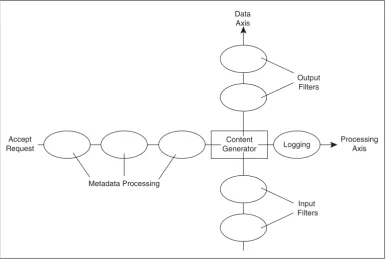
point where you can duplicate the function of a CGI or PHP script as a module. Chapter 6 describes the request processing cycle and working with HTTP meta-data. Chapter 7 goes into more detail about identifying users and handling access control. Chapter 8 presents the filter chain and techniques for transforming incom-ing and outgoincom-ing data; it includes a thorough theoretical exposition and several examples. Chapter 9 completes the core topics by describing how to work with con-figuration data.
Chapters 10 and 11 present more advanced topics that are nevertheless essential reading for serious application developers. Chapter 10 looks at the mechanics of how the API works, and describes how a module can extend it or introduce an entirely new API or service for other modules. Chapter 11 presents the DBD frame-work for SQL database applications. Chapter 12 briefly discusses troubleshooting and debugging techniques.
The appendixes include Apache legal documents reproduced from the Web. They are extremely relevant to the book but were not written by the author. Appendix A is the Apache License. Appendix B includes the Contributor License Agreements, which cover issues related to intellectual property. Finally, the authoritative Hypertext Transfer Protocol (HTTP/1.1) standard (RFC 2616) is reproduced in full in Appendix C as reference documentation for developers of web applications.
What the Book Does Not Cover
This book is firmly focused on applications development, so it has very little to say about systems programming for or with Apache. In particular, if your goal is to port Apache to a hitherto-unsupported platform, the book offers no more than a pointer to the areas of code you’ll need to work on.
Sources
Some of the modules used as examples are written especially for this book or simi-lar instructional materials:
• Chapter 5: mod_helloworld
• Chapter 6: mod_choices(derived from a non-open-source module)
• Chapter 7: mod_authnz_day
• Chapter 8: mod_txt(written originally for www.apachetutor.org)
These modules can be downloaded from www.apachetutor.org.
All of the more substantial modules are taken from real-life sources. Except where otherwise indicated and referenced by URL, all modules are taken from either the Apache standard distribution (httpd.apache.org) or the author’s company’s site
(apache.webthing.com). Please note that the use of any source code in this book
does not imply a license to copy it other than for purely personal use. Please refer to the license terms in the original sources of each module.
xxvii
Acknowledgments
The Apache Web Server is the work of a worldwide community, on whose collec-tive wisdom I have drawn in writing this book. I am privileged to work within this community as a developer and educator.
I am grateful to my series editor Arnold Robbins, and to reviewers Brian France, Brad Nicholes, Noirin Plunkett, and Ivan Ristic for drawing my attention to errors and other weaknesses in the original manuscript and suggesting improvements. I am especially grateful to Rich Bowen for agreeing to take the time to write a fore-word (Rich is, of course, better known as the author of several well-respected Apache books, as well as much of the documentation at apache.org). Finally,
thanks to my commissioning editor Catherine Nolan and her team at Prentice Hall for bringing this project from manuscript to publication.
The source code examples presented here are drawn mostly from my own work, but many are taken from the Apache core code and are the work of the larger Apache community. Likewise, the text is mostly mine, but draws in part on other sources:
The ASF overview (Section 1.2) is drawn from www.apache.org.
The brief introduction to buckets and brigades in Chapter 3 is drawn from the API documentation.
The introductions to Jeff Trawick’s introspection modules in Chapter 12 are mostly Jeff ’s.
Appendix C is copyright by the Internet Society and is reproduced under the terms of its own copyright notice (C.21). All other third-party material used is reproduced here under the terms of the Apache License (Appendix A).
Source code used here is licensed under various licenses. Please refer to the original sources before copying code from this book other than for strictly personal use.
All illustrations used are the original work of the author. However, some are drawn from existing sources:
Chapter 2: Figures 2-2, 2-3, and 2-4 are reproduced from www.apachetutor.org.
Chapter 8: Figures 8-1 and 8-2 were first used in the author’s tutorial presentations. Figures 8-3 and 8-4 are reproduced from documentation at httpd.apache.org.
Chapter 10: Figure 10-1 is reproduced from documentation at apache.webthing.com.
Chapter 11: Figure 11-1 is reproduced from documentation at httpd.apache.org.
xxix
About the Author
Nick Kew is a veteran developer, with more than twenty years’ professional software and systems experience since graduating from Cambridge University. He is a mem-ber of the Apache Web Server core development team and Project Management Committee, and of the Apache Software Foundation. He is lead architect of the Apache DBD framework (Apache/SQL integration) and a major contributor to other subsystems—most notably, filtering and proxying. In addition to his work within the Apache team, Kew’s company WebThing, Ltd., distributes more than twenty modules (specializing in smart XML and other markup-aware applications), and he is responsible for the well-respected ApacheTutor website.
Since the 1980s, Kew has been an enthusiastic proponent of the potential of a ubiq-uitous IT infrastructure to liberate us from enslavement to accidents of geography, and especially the misery of daily commuting. Now he is working to help make it happen. In addition to his work with Apache, he serves as Invited Expert with the World Wide Web Consortium in its accessibility and quality assurance (QA) activ-ities, and is a member of the Web Design Group.
1.1 A Brief History of the Apache Web Server
1.1.1 Apache 1
The Apache Web Server was originally created in 1995. It was based on and derived from the earlier NCSA server, written by the National Center for Supercomputing Applications (which also developed the Mosaic browser, predecessor to most of today’s browsers, with a direct line to Netscape and Mozilla, and considerable influ-ence over others, including MSIE). The first production server under the Apache name was version 1.0.0, released in December 1995.
As a webserver, Apache was an immediate success. By April 1996, it had overtaken the NCSA server as the most widely used webserver on the Internet, a position it has occupied ever since. But it wasn’t a general-purpose applications platform: The native API was fairly limiting, and the return on development effort for programmers was
1
1
Applications Development
unattractive compared to some of the alternatives available as higher-level program-ming layers. Nevertheless, some useful application modules—most notably, the extraordinary mod_rewrite—were developed.
The first applications development framework to make a major splash was Perl, under both CGI and mod_perl. The main programming book and most
applica-tion developers concentrated on Perl, because mod_perl presented the first really
useful and easy-to-use API. The Java Servlet API and numerous other scripting lan-guages, including the current market leader PHP, soon followed.
The last major new release of the original Apache server was version 1.3, which was introduced in June 1998. Apache 1.3 has continued in maintenance mode and remains popular today, although new development work has long since moved to Apache 2.
1.1.2 Apache 2
Recognizing the limitations of Apache’s original, hackish architecture, the Apache developers began a major new codebase in 2000, leading to the first production release of Apache 2.0 in April 2002. Salient features of Apache 2 include the following:
• The native API is much improved and the APR library is a separate entity. This helps programmers overcome most of the drawbacks of C programming—in particular, the problems of cross-platform programming and resource manage-ment. Working with Apache 2, C programmers can expect levels of productiv-ity more commonly associated with higher-level and scripting languages.
• A new extension architecture enables development of a whole new class of applications, as well as far cleaner implementations of existing modules and applications. This book will discuss in detail how to take advantage of this extension architecture.
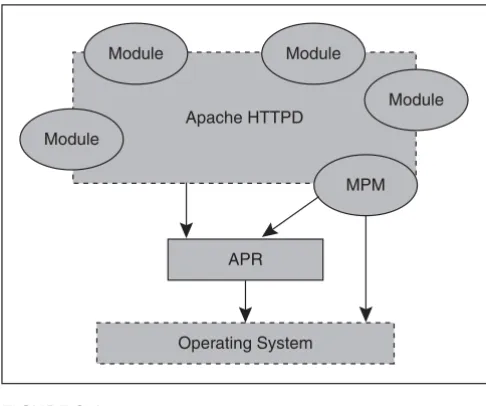
• A new core architecture makes Apache 2 a truly cross-platform server. The operating system layer has itself become a module (the MPM), enabling it to be separately tuned for each operating system. Whereas Apache 1 was a UNIX application that was ported with many limitations to other platforms, Apache 2 is truly cross-platform and is not tied to UNIX features, some of which perform poorly on, for example, Windows or Netware. The introduction of threaded MPMs also improves scalability on UNIX in many applications.
The downside of Apache 2 is that the API is not backward compatible with Apache 1, so many third-party modules and applications have been slow to upgrade to version 2.
Apache 2.2 was released as a stable version in December 2005 and features further major enhancements. It preserves (and extends) the Apache 2.0 API, so that mod-ules and applications written for Apache 2.0 will work with Apache 2.2. Notable improvements in version 2.2 include scalability and applications architecture. Where Apache 2.0 offered the foundations of a powerful applications platform, Apache 2.2 has added walls and a roof.
1.2 The Apache Software Foundation
The Apache Software Foundation (ASF) provides organizational, legal, and finan-cial support for a broad range of open-source software projects. The ASF provides an established framework for intellectual property and financial contributions that simultaneously limits contributors’ potential legal exposure. Through a collabora-tive and meritocratic development process, Apache projects deliver enterprise-grade, freely available software products that attract large communities of users. The prag-matic Apache License makes it easy for all users—whether commercial enterprises or individuals—to deploy Apache products.
Formerly known as the Apache Group, the ASF has been incorporated as a mem-bership-based, not-for-profit corporation to ensure that the Apache projects con-tinue to exist beyond the participation of individual volunteers. Individuals who have demonstrated a commitment to collaborative open-source software develop-ment, through sustained participation and contributions within the ASF’s projects, are eligible for membership in the ASF. An individual is awarded membership after nomination and approval by a majority of the existing ASF members. Thus the ASF is governed by the community it most directly serves—the people collaborating within its projects.
The ASF members periodically elect a Board of Directors to manage the Foundation’s organizational affairs, as accorded by the ASF bylaws. The Board, in turn, appoints officers who oversee the day-to-day operations of the ASF. A num-ber of public records of the ASF’s operations are made available to the community.
1.2.1 Meritocracy
Unlike many other software development efforts conducted under an open-source license, the Apache Web Server was not initiated by a single developer (for exam-ple, like the Linux Kernel or the Perl/Python languages), but rather started as a diverse group of people who shared common interests and got to know one another by exchanging information, fixes, and suggestions.
As the group started to develop its own version of the software, moving away from the NCSA version, more people were attracted to the effort. They started to help out, first by sending little patches, or suggestions, or replying to e-mail on the mail list, and later by making more important contributions.
When the group felt that a person had “earned” the right to be part of the devel-opment community, its members granted the individual direct access to the code repository. This approach both expanded the group and increased its ability to develop the Apache program and maintain it more effectively.
We call this basic principle meritocracy—literally, “government of merit.” The mer-itocracy process scaled very well without creating friction. Unlike in other situations where power is a scarce and conservative resource, in the Apache group newcomers were seen as volunteers who wanted to help, rather than as people who wanted to steal a position.
At the same time, because there is no pressure to recruit more members, Apache is not scrabbling for scarce talent in a competitive environment. Instead, it can afford to restrict itself to people with a proven track record of contributions and a positive attitude. And because it is a virtual community, it is worldwide and not constrained by geography.
1.2.2 Roles
The meritocracy supports a variety of roles.
User
A user is someone who uses the software. Users contribute to the Apache projects by providing feedback to developers in the form of bug reports and feature
suggestions. Users may also participate in the Apache community by helping other users on mailing lists and user support forums.
Developer
A developer is a user who contributes to a project by submitting code or documen-tation. Developers take extra steps to participate in a project, are active on the devel-oper mailing list, participate in discussions, and provide patches, documentation, suggestions, and criticism. Developers are also known as contributors.
Committer
A committer is a developer who was given write access to the code repository and has a signed Contributor License Agreement (CLA) on file. All committers have an
apache.orgmail address. Not needing to depend on other people for the patches,
these individuals actually make short-term decisions for the project, subject to over-sight from the Project Management Committee (PMC).
PMC Member
A PMC member is a developer or a committer who was elected to the PMC on a merit basis, in recognition of his or her role in the evolution of the project and demonstration of commitment. PMC members have write access to the code repos-itory, an apache.orgmail address, the right to vote on community-related
deci-sions, and the right to propose an active user for committer status. The PMC as a whole is the entity that controls the project.
ASF Member
An ASF member is a person who was nominated by current ASF members and elected due to merit based on his or her role in the evolution and progress of the ASF. Members care for the ASF itself. This concern is usually demonstrated through the roots of project-related and cross-project activities. Legally, a member is a “shareholder” of the Foundation, one of the owners. ASF members have the right to elect the Board of Directors, to stand as a candidate for the Board election, to propose a committer for membership, and to participate in a wide range of other roles within the ASF.
1.2.3 Philosophy
While there is not an official list, certain principles have been cited as the core beliefs of philosophy behind the ASF. These principles are sometimes referred to as “The Apache Way”:
• Collaborative software development
• Commercial-friendly standard license
• Consistently high-quality software
• Respectful, honest, technical-based interaction
• Faithful implementation of standards
• Security as a mandatory feature
1.3 The Apache Development Process
Apache development is both a top-down and a bottom-up process. From the top come Big Ideas: major new features or capabilities that involve significant rework-ing or new components, and may take many months or even years to pass from inception to maturity. From the bottom come small patches, to deal with bugs or add features that are simple to support within the current software.
Somewhere between these extremes is the typical module: a self-contained plug-in implementing new features of interest to its author and often others. A module may implement core webserver functionality, a general-purpose service, a small but vital function, or a single-purpose application. A module that is of sufficiently general interest may, if offered, be incorporated into the core Apache distribution. However, that inclusion will not happen if the module adds external dependencies such as third-party libraries, or if any concerns arise regarding the module’s licensing or intellectual property issues. Such modules may be distributed independently by their developers or by third parties, such as a company supporting Apache or the packagers of a Linux distribution.
1.3.1 The Apache Codebase
Like any other software project, Apache maintains a codebase. This codebase is divided into projects; those relevant to the webserver are httpd (which includes
code, documentation, and build files) and apr.
1.3.1.1 Subversion
All Apache code is kept in a repository at http://svn.apache.org/. The code is
managed by Subversion (SVN),1 a modern revision-control system suitable for
large-scale multi-developer projects. This is a relatively recent (2004) change from an older but broadly similar system, CVS.
Read access to the entire repository is public, but write access is limited to commit-ters. Read access includes the ability to view any point in the development history of Apache, including reviewing any single or cumulative change, brief explanations of reasons for changes (e.g., bugs fixed, new capabilities, internal improvements), the date of the change, and the person responsible for making the change.
1.3.1.2 Branches: Trunk, Development, and Stable
The code repository contains a trunk and several different branches. The default version of any file is the trunk of the repository. In Apache, this version represents work in progress. It is, by definition, untested, and it generally includes experi-mental code in at least some areas.
The current stable branch is Apache httpd 2.2, which is found in/branches/2.2.x/.
Also maintained (albeit minimally) are the older 2.0 and 1.3 branches, although nei-ther is the subject of much developer effort.
New branches may also be created on an ad hoc basis for experimental code. For example, a substantial reworking of parts of the core code took place while Apache 2.2 was in beta testing, to support asynchronous I/O. This code was ini-tially too experimental to develop in the trunk, so the developers involved in this work created a new development branch. The new codebase has subsequently sta-bilized and been merged into the trunk, and should eventually be included in the next stable release (version 2.4).
1.3 The Apache Development Process 7
1.3.1.3 Review and Consensus
The Apache developers operate under different development policies for stable and development code:
• Stable code is always Review-Then-Commit (RTC). That means any code going into a branch marked as stable—even the most trivial patch—musthave been through a proper review process.
• Development code is Commit-Then-Review (CTR). That means code can be added, changed, or removed by a committer acting unilaterally, and reviewed in place by other developers (of course, SVN makes it easy to reverse a change where necessary). Nevertheless, major changes should be reviewed before com-mitting, or worked on in a separate development branch.
1.3.1.4 Backports
New code is first added to the trunk. If a developer wants this code to become part of a stable branch (typically a minor enhancement or bug fix), it is proposed for backporting. The mechanism for this is a file called STATUS, which contains a list
of current issues including votes for backport.
To qualify for backporting, any change must collect at least three positive votes from committers. A positive vote means that the voter has reviewed the change and is satisfied with it, so three such votes is a fairly good indicator that the change is sound. Even simple bug fixes are subject to this rule, which means that noncritical bugs can sometimes take a frustratingly long time to fix while awaiting attention from enough committers. Having collected three positive votes and no veto, a change may be added to a stable branch.
A committer who reviews a change and is not happy with it may note his or her reservations about it, or even veto the change. The rules require that a veto must be accompanied by an explanation and/or an alternative proposal for accomplishing the objectives of the change. A vetoed change may be either dropped or revised to deal with the objections and submitted for a new vote. A veto or a non-veto reservation will typically be resolved by discussion of the relevant issues in the developer forums.
1.3.1.5 Releases
From time to time, a new release of Apache is made available. Releases of the current stable codebase (versions 2.2.x at the time of this book’s writing) give users the
advantages of the most recent improvements and bug fixes. Such releases will be marked as the best available version and recommended to users. A release is usually prompted by developers thinking that enough minor changes have accumulated to warrant a new version, but may also be hurried if a security problem comes to the developers’ attention. A developer will volunteer to be release managerto deal with the administrative issues and create the release, while others will concentrate on applying any approved and pending updates in the STATUSfile for the stable codebase.
Current policy is that even-numbered branches are stable, while odd-numbered branches are intended for development. (This policy represents a change from earlier versions: Apache 1.3 is stable, but early 2.0 releases were not.) Thus 2.0.x (since April 2002) and 2.2.x releases are stable, while 2.1.x releases were intended for alpha testing and later beta testing for Apache 2.2. Version 2.1 was approximately 10 months in alpha testing and 3 months in beta testing before its final release as stable version 2.2.
A released version should build, install, and run cleanly on any supported platform. For stable releases, meeting these criteria is a must; for development releases, it is also the intention, though it is less critical. To ensure that the release satisfies these conditions, the release manager first creates a build for the release from the appro-priate SVN branch, and then announces it to the Apache developers and testers. This allows enough time for many developers and testers to install and run the build version on a wide range of different hardware, operating systems, and applications before it is announced to the general public. If a serious problem arises in this test-ing, the build is not released.
All releases are PGP-signed by the release manager responsible. Public keys for many Apache developers, including all release managers, are available at
http://www.apache.org/dist/httpd/KEYS.
1.3.2 Development Forums
The primary development forum for the Apache Web Server is the mailing list
[email protected]. All technical matters of Apache development are
dis-cussed there. A similar development list, [email protected],serves APR
devel-opment. These forums are 100% open and public, and all discussions are archived in several places (referenced at the end of this chapter).
Another popular development forum is Internet Relay Chat (IRC). The Apache developer channels are #httpd-devand#apronirc.freenode.net. These
ven-ues are also fully public and open.
The Apache Bugzilla at http://issues.apache.org/is a searchable database of
bug reports, enhancement requests, and patches, both current and historical. This database is also fully open and public. Note that because it is fully open, it contains a significant proportion of bogus reports (some of which cannot be closed and are shown as “reopened”) and nebulous reports that cannot be verified. It also contains a number of reports marked PatchAvailablethat are deliberately left open, where
it is felt that a patch might be useful for some users but is not appropriate for inclu-sion in the standard Apache distribution.
The full and accurate archive of all code additions and changes is the Subversion repository at http://svn.apache.org/. This repository is updated in real time as
code is changed. Read access is fully open and public, but write access is limited to authorized committers. Noteworthy files in Subversion include STATUS, which
contains current discussions and votes, and CHANGES, which provides the executive
summary of changes to a stable/release branch.
1.3.3 Developers
It is important to Apache that the diversity of its users be reflected in its development community. There is no question of an Apache project becoming dominated by any one company or group of companies. Some developers (including this author) work either as freelance consultants or for very small companies. Other developers come from the larger vendors such as IBM, Red Hat, and Novell; from the big users such as Google, Yahoo!, and Ask Jeeves; and from universities and other noncommercial organizations. Whereas the majority of developers are employed by companies, the independents outnumber any single corporate contingent.
Perhaps more importantly, the developers reflect the wide range of roles that Apache fulfills. Those who are running it on ultra-busy sites such as CNN or HEAnet need to sustain loads of tens of thousands of concurrent users on a 24/7 basis, so they care about performance, scalability, and stability. Application sites, such as this author’s Site Valet, are concerned with extending Apache beyond its original web-server role and using it as an application web-server. E-commerce sites are concerned with both security and reliability issues. Hosting companies need to support widely differing users and delegate control while maintaining security and stability. Having active developers from such a wide range of backgrounds ensures that Apache works well in all of these environments.
Finally, we are by no means an exclusive “hacker” community. Although software development and maintenance is the biggest single activity carried out by Apache developers, some members have risen to the top of the Apache hierarchy without writing a single line of C code! Support, documentation, and organizational roles are as highly valued as programming.
1.3.4 Participation
Participation in any of the Apache forums is open to anyone with a contribution to make. There are many ways to contribute, and all are highly valued:
• Coding. Patches for issues brought up in Bugzilla are very welcome. Contributions to current subjects of debate found on the developer lists, or highlighted in STATUS, are always welcome. The programmer looking for
something to do is also invited to search the codebase in SVN for TODO or FIXME notes. Patches are most welcome when they can be applied cleanly
(diff -u or svn -diff format) and are clearly motivated and explained.
Patches can be posted to the developer list or to Bugzilla.
• Documentation.The documentation is held in SVN. All original documents are in an XML format that is a subset of DocBook. New documentation or improvements (patches) to existing documentation are always welcome.
• Translation. The documentation is provided in a number of languages, but not all pages are available in all languages. Neither are the translations always up to date with the originals. If you have the language skills, look for missing or outdated pages in your language, and fix them!
• Testing.Build and test code on your platform, particularly if you use an unusual platform. Build it with unusual environments and toolkits: Does it build and install cleanly? Stress-test it in all your most unusual tasks. If it fails, or if you find unexpected changes from an earlier version, try and diagnose what’s going on. Report any bugs you find to the developer mailing list or Bugzilla. Try to ensure that whatever you describe is clear and reproducible behavior.
• Build. Maintaining the Apache build and installation setup is an important task, but one for which (at the time of this book’s writing) we are not well equipped. Even the most widely used GNU autoconf-based installation for UNIX/Linux family platforms would benefit from an overhaul.
1.4 Apache and Intellectual Property
All Apache projects are copyrighted by the ASF and licensed under the Apache License. At the same time, the ASF and PMC take strong measures to ensure that no third-party intellectual property is used in Apache code without legally binding, written permission to distribute it under the Apache License. Note that while Apache holds the copyright for the entirety of a project, parts of a project may remain copyrighted by individual contributors and be licensed under ASF terms.
1.4.1 The Apache License
The Apache License (found in Appendix A) is a free software license, in the tradi-tion of the older BSD and MIT software licenses, but with an important additradi-tional clause appropriate to our times. It satisfies all accepted definitions of free and open-source software.
Given that the language of free software may be confusing to some readers, let’s pause to clarify some important points. Please note that this is just basic back-ground information, and is certainly not legal advice for users in any particular country.
Free Speech, Not Free Beer
Free beer is nice. Free speech is important!
When we talk of software freedom, we are using the word in the sense of free speech. The key freedom in software is the freedom for every user to do whatever it takes to meet his or her own needs (or, of course, to hire someone to do that). Making the source code available is a necessary part of freedom.
Cost is not relevant to software freedom. Apache is available at a wide range of costs, from a no-cost download, to a package bundled in, for example, a commer-cial Linux distribution, to a fully paid product backed by a commercommer-cial support organization.
Not Public Domain
Like most other free software, Apache is notin the public domain. It is copyrighted by the ASF and subject to a license. The difference between this status and “tradi-tional” commercial software licenses is that the Apache License is a great deal more friendly and less restrictive.
Not Shareware, Nagware, or Adware
Shareware and its modern variants are concepts alien to free software. They are commonly (though not always) associated with low-quality, amateur products, and today they are more likely to be driven by marketing than by engineering.
Not GPL
The oldest and best-known (but also much-misrepresented) free software license is the GNU General Public License (GPL), written and owned by the Free Software Foundation (FSF). The GPL introduced a concept known as copyleft.The basic prin-ciple can be summarized as follows: “We are granting you these freedoms, and you can’t take them away from anyone else.” This policy is sometimes seen as business unfriendly, because copyleft software cannot be incorporated willy-nilly into non-free products.2The Apache License is explicitly business friendly; it is notcopyleft.
In fact, the Apache License is not even compatible with the GPL.3 That is, each
license includes provisions that are incompatible with the other license: GPL soft-ware cannot be distributed on ASF terms because copyleft is a restriction incom-patible with ASF policy. ASF-licensed software cannot be distributed on GPL terms. Here’s what the FSF has to say on the subject:
This is a free software license but it is incompatible with the GPL. The Apache Software License is incompatible with the GPL because it has a specific requirement that is not in the GPL: it has certain patent termi-nation cases that the GPL does not require. (We don’t think those patent termination cases are inherently a bad idea, but nonetheless they are incompatible with the GNU GPL.4)
Note that none of these issues is a problem for end users or for third parties such as module developers or distributors. Linux (GPL) vendors routinely include Apache in their products, and many Apache modules are GPL licensed. It’s no problem for the Linux distributors to comply with both licenses, or for the module developers
1.4 Apache and Intellectual Property 13
2. This is a much-misunderstood topic. The GPL is a great deal less restrictive than it is often portrayed in the media. For details, see http://www.fsf.org/licensing/.
3. This discussion refers to GPL version 2 (1991). Version 3 is currently in preparation, and a draft has been posted for discussion. It appears likely that it will be possible to distribute Apache software under version 3 of the GPL, but not the reverse.
to apply their own choice of license to their work. Even the famously purist and legally meticulous Debian distribution5distributes GPL modules with Apache.
Where the incompatibility in licenses may pose a problem is in the interface with GPL software. Consider its implications for MySQL,6 an SQL database package
licensed under the GPL. To comply with the GPL requirements of MySQL, the Apache/APR driver7for MySQL is also GPL licensed and, therefore, cannot be
dis-tributed within Apache by the ASF. Instead, it is available as a separate download from the author’s site or as a separate package from a third party. This is relevant to users who compile Apache themselves, but those users who install Apache from packages need never concern themselves with the details.
Patents and the Anti-Piracy Clause
The greatest danger to technology developers today comes from patents. This is par-ticularly true in the United States, where the patent system was seen for many years as an instrument of economic imperialism: Let’s grant thousands of patents to “our” companies, then enforce those patents worldwide through the World Trade Organization (WTO) treaties to gain a global competitive advantage. Consequently, the U.S. Patent Office has issued huge numbers of patents while making no attempt at effective scrutiny or quality control. Many of these patents are in the hands of peo-ple who have no interest in technology, but rather seek to extort money from legiti-mate businesses.
This is, in a very real sense, today’s piracy. In the past, rulers of a country, province, or city would assert a claim over “their” seas, charge a substantial levy on foreign shipping to pass through their territory, and license privateers to enforce their prop-erty rights and seize any unlicensed ship passing through. Similarly, today’s patent holders seek to charge levies to legitimate business, and use lawyers to enforce their property. In fact, the situation today is arguably worse than in the olden days, in that there are hugely more patents than there ever were nautical pirates, and there are no longer any safe shipping lanes.
One unusual restriction in the Apache License deals with this issue as far as possi-ble. Acceptance of the Apache License requires the licensee not to assert any patent rights it may claim against the ASF or Apache users.
14 Chapter 1 • Applications Development with Apache
To the best of my knowledge, Apache has remained clear of intellectual property lawsuits. This contrasts with the situation faced by Linux in the SCO lawsuits (although it appears likely that Linux will be vindicated8), and more strongly with
the situation involving Microsoft, whose end users have paid substantial damages to third parties over patent infringements in Microsoft software.9,10
1.4.2 Third-Party Intellectual Property
Apache’s intellectual property is protected by copyright and the license. Of course, it is also critically important that Apache doesn’t violate anyone else’s intellectual property. That means that all significant contributions to Apache must be properly donated:
• Before a developer can become a committer, he or she must sign a Contributor License Agreement (CLA) that gives the ASF all necessary rights to use that developer’s contributions and to license them to third parties on ASF terms. The CLA also binds a contributor to ensure that contributions which are not their own original work are signed over to the ASF before including them in Apache. The full CLA appears in Appendix B.
• When a developer is not his or her own master (e.g., an employee whose employer may have rights over his or her work), a Corporate CLA signed by an authorized officer of the employer (e.g., CTO or IT Director) is also required. The full CCLA also appears in Appendix B.
• All relevant CLAs and CCLAs must be on file with the ASF before an indi-vidual can be granted commit access. These agreements serve to ensure that committers and their employers cannot prevent the ASF or Apache users mak-ing use of their contributed work.
1.4 Apache and Intellectual Property 15
8. SCO’s main lawsuits are against UNIX and Linux developer IBM and former UNIX owner Novell, not end users. One of its two suits against Linux users (Daimler-Chrysler) has already been thrown out of court; the other (Autozone) is on hold pending the outcome of the IBM and Novell cases.
Responsibility
In the first instance, it is the responsibility of each committer to ensure that his or her contributions don’t violate third-party intellectual property.
The overall responsibility lies with the PMC, which will query any contribution that raises doubts—in particular, major new contributions.
Audit
If despite all due care, problems with third-party intellectual property should arise, Apache has a full audit trail managed by Subversion. Thus, in the worst case, any problematic code can be identified and removed.
1.5 Further Reading
1.5.1 Interactive Online Forums
Public Mailing Lists
The Apache Module Developers list [email protected] is an
appropriate place for discussion of any module development issues. This list moved from [email protected] in September 2006, so check the
archives of both lists.
The official developers list for the Apache Web Server is[email protected].
You are welcome to participate, but please stay on topic.
The official developers list for the Apache Portable Runtime is[email protected].
You are welcome to participate, but please stay on topic.
The Apache users list [email protected]is an appropriate forum for
gen-eral discussion and user support questions.
Usenet
The comp.infosystems.www.servers.[unix|windows|mac|misc] newsgroups
are appropriate for general discussion and questions about Apache on the respective platforms.
Online Chat
There are several channels relevant to Apache on irc://irc.freenode.net: #apache—general support/unofficial helpdesk channel. Ask meaningful questions
and wait for an answer. But do your homework first. In particular, look in the error log! Pay attention to fajita, the #apache ’bot; many of the regulars work by prompt-ing her to answer your questions and/or post URLs to the relevant documentation pages.
#apache-modules—the channel for module development. It is likely to be
appro-priate for readers of this book.
#apr—the semi-official APR channel, including automated live notification of all
changes to the APR repository.
#httpd-dev—the semi-official channel for webserver development, including
automated live notification of all changes to the repository, including documenta-tion and the website.
#asfinfra—the Apache infrastructure channel.
1.5.2 Conferences
The ASF organizes ApacheCon conferences devoted to ASF projects. These confer-ences bring together many of the developers (who know each other well from the online forums but may never otherwise meet face-to-face). Users may come just to learn, but some also bring new insights to the developers. A busy program of tuto-rials and talks by both developers and users is complemented by both organized and informal social events.
1.5.3 Websites
Official and Semi-official Apache Sites
http://www.apache.org/—Apache Software Foundation http://httpd.apache.org/—Apache Web Server http://apr.apache.org/—APR home site
http://svn.apache.org/—Apache code repository and complete history
http://issues.apache.org/—Bugs and issues database http://modules.apache.org/—Apache modules register
http://asylum.zones.apache.org/modules/—Updated modules register
(work in progress)
http://mail-archives.apache.org/—Mailing list archives
http://people.apache.org/—Pages of individual Apache committers http://apachecon.com/—ApacheCon conference
http://perl.apache.org/—mod_perl(Apache API in Perl)
http://www.modpython.org/—mod_python(Apache API in Python)
http://tcl.apache.org/—TCL language in Apache
http://httpd.apache.org/cli/—mod_aspdotnet(Microsoft’s asp dot net)
Third-Party Extensions
http://apache.webthing.com/—More than 20 modules by the author of this book http://www.outoforder.cc/—12 featured modules and other relevant work http://www.php.net/—PHP language
http://www.rubyonrails.org/—Ruby on Rails
Developer Documentation
http://docx.webperf.org/—API reference
http://www.apachetutor.org/dev/—Developer tutorial site created and
main-tained by the author of this book
http://dev.ariel-networks.com/apr/apr-tutorial/html/apr-tutorial.html—
A useful tutorial for APR, decoupling it from its role in the webserver
http://www.apache-modules.com/—Companion site to an Apache modules
book that was never completed
Other Tutorials, News, and Articles
http://www.onlamp.com/pub/q/all_apache_articles—A wide range of
articles
http://www.apachelounge.com/—News site together with Windows binary
downloads (often available before the “official” ones)
http://marc.theaimsgroup.com/—Mailing list archives
1.6 Summary
This chapter examined the social, historical, and legal background of Apache and its culture. Specifically, Chapter 1 considered the following topics:
• The historical context of Apache httpd
• The Apache Software Foundation and its culture
• The Apache developers, processes, and resources for development and support, including how to participate
• Apache’s approach to intellectual property, including the Apache License and the safeguards against misuse of third-party intellectual property
Chapter 1 was decidedly nontechnical. In contrast, the remainder of the book is all about programming with Apache, starting with a comprehensive overview, and moving to hands-on treatment of module and application development.