White Rose Research Online URL for this paper:
http://eprints.whiterose.ac.uk/2109/
Monograph:
Clark, S.D. and Toner, J.P. (1997) Application of Advanced Stated Preference Design
Methodology. Working Paper. Institute of Transport Studies, University of Leeds , Leeds,
UK.
Working Paper 485
Reuse
Unless indicated otherwise, fulltext items are protected by copyright with all rights reserved. The copyright exception in section 29 of the Copyright, Designs and Patents Act 1988 allows the making of a single copy solely for the purpose of non-commercial research or private study within the limits of fair dealing. The publisher or other rights-holder may allow further reproduction and re-use of this version - refer to the White Rose Research Online record for this item. Where records identify the publisher as the copyright holder, users can verify any specific terms of use on the publisher’s website.
Takedown
If you consider content in White Rose Research Online to be in breach of UK law, please notify us by
White Rose Research Online
http://eprints.whiterose.ac.uk/
Institute of Transport Studies
University of Leeds
This is an ITS Working Paper produced and published by the University of
Leeds. ITS Working Papers are intended to provide information and encourage
discussion on a topic in advance of formal publication. They represent only the
views of the authors, and do not necessarily reflect the views or approval of the
sponsors.
White Rose Repository URL for this paper:
http://eprints.whiterose.ac.uk/
2109
Published paper
Stephen Clark and Jeremy Toner (1997)
Application of Advanced Stated
Preference Design Methodology.
Institute of Transport Studies, University of
Leeds, Working Paper 485
EPSRC Research Working Paper
APPLICATION OF ADVANCED STATED PREFERENCE DESIGN
METHODOLOGY
Stephen Clark and Jeremy Toner
Document Control Information
Title
: APPLICATION OF ADVANCED STATED PREFERENCE DESIGN
METHODOLOGY
Authors
:
Stephen Clark and Jeremy Toner
Reference Number
:
9612/01
Version
:
1.0
Date
: 14
February
1997
Distribution
:
SDC, JPTAvailability
:
Unrestricted
File
:
E:\HOME\SP\WP485.WP6
Authorised by
:
Stephen Clark
ITS Working Paper 485
ISSN 0142-8942
December 1996
APPLICATION OF ADVANCED STATED PREFERENCE
DESIGN METHODOLOGY
SD Clark
JP Toner
This work was undertaken on a project sponsored by the Engineering and Physical Sciences
esearch Council (Grant Ref: GR/J81242)
R
CONTENTS
ABSTRACT... 1
1 BACKGROUND ... 1
2 MODELLING ... 3
3
NEW DESIGN METHODOLOGY ... 4
4 TWO
VARIABLES... 5
4.1
PRODUCING THE DESIGN ... 5
4.2
TESTING THE DESIGN... 9
4.2.1 What's happening in the neighbourhood?... 10
4.2.2 Divide and conquer... 11
4.2.3 The wider picture... 13
5 THREE
VARIABLES... 13
6 FOUR
VARIABLES ... 16
7
TWO VARIABLES PLUS ASC ... 18
8 CONSTRAINTS... 20
9 CONCLUSIONS ... 22
REFERENCES... 22
ABSTRACT
This paper demonstrates the application of the design methodology developed in the Advanced Stated
Preference Design project to stated preference experiments. The paper considers binary response
experimental designs of two, three and four variables. In addition the special case of a two variable
design with an alternative specific constant is also considered. Alternative optimality criteria are
discussed. The paper concludes with recommendations on how to apply the design methodology
successfully.
1 BACKGROUND
Many of the issues surrounding the current design process for stated preference (SP) techniques are
discussed in Fowkes (1996) so only a brief overview is given here.
The form of the SP experiments considered here are binary response experiments. Here the
respondent is presented with a small (typically between 9 and 16) number of scenarios. Each scenario
consists of a pair of alternatives (typically, though not necessarily, between two modes), between
which the respondent is invited to choose. Each choice is described by a number of attributes
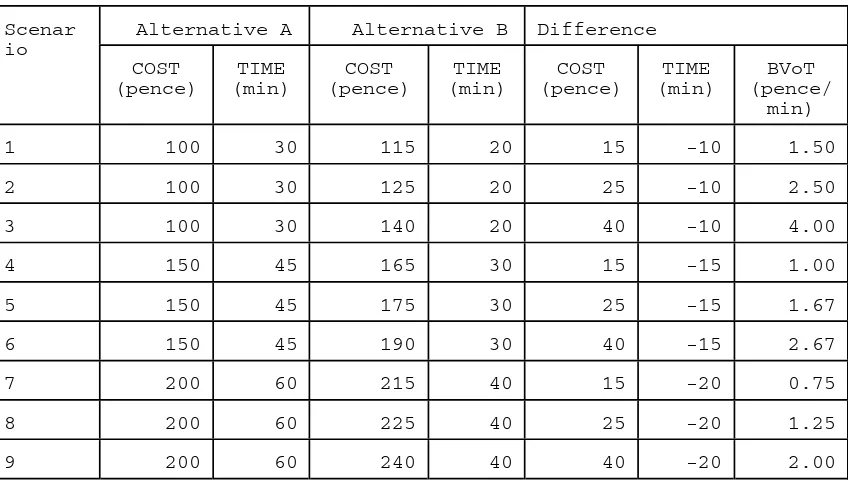
(typically including cost and time) which are presented as values. A typical two variable SP design,
taken from Fowkes and Nash (1991), is given in table 1.
Alternative A Alternative B Difference
Scenar io
COST (pence)
TIME (min)
COST (pence)
TIME (min)
COST (pence)
TIME (min)
BVoT (pence/
min)
1 100 30 115 20 15 -10 1.50
2 100 30 125 20 25 -10 2.50
3 100 30 140 20 40 -10 4.00
4 150 45 165 30 15 -15 1.00
5 150 45 175 30 25 -15 1.67
6 150 45 190 30 40 -15 2.67
7 200 60 215 40 15 -20 0.75
8 200 60 225 40 25 -20 1.25
[image:6.595.76.500.401.642.2]9 200 60 240 40 40 -20 2.00
Table 1 : A possible binary choice SP design
In this design, alternative B is always the faster but more expensive option. This need not always be
the case, a mixture of either alternative being the faster, more expensive is acceptable. In fact it is
possible to have one of the alternatives being both the faster and cheaper option.
express the attributes as the differences in their levels. Thus the question becomes a direct trade-off
between savings in time and cost.
A feature of the design in table 1 is that the correlations between all the attribute differences is zero.
Such a design is said to be orthogonal. This is the first of two widely used design criteria. The
supposed reason for ensuring that this property exists is that this would produce the most efficient
estimates from any model estimation procedure, primarily from an analogy with least squares
regression (Fowkes, 1996).
Another item of information which can be extracted from the design in table 1 are the boundary
values of time (BVoT), ie COST difference divided by TIME difference. These values show at what
time valuation individuals are indifferent between alternatives. Thus for scenario 1, if an individual's
value of time is 1.5 pence per minute then they are indifferent between alternatives A and B in this
scenario. If their value of time is less than 1.5, then they would be expected to choose the slower but
cheaper option (alternative A). If their value of time is greater than 1.5, then alternative B should be
the preferred option. It is possible to plot a graphical representation of the spread of BVoT's. This
plot for the design in table 1 is given in figure 1.
7 4 8 1 5 9 6 3 scenario
BVoT
[image:7.595.66.525.343.414.2]
0 0.75 1.00 1.25 1.50 1.67 2.00 2.67 4.00
Figure 1 : Boundary value map of table 1 design
Figure 1 begins to show how effective a design should be at recovering a range of values of time. In
the discussion which follows a perfect knowledge on the part of the respondent is assumed (ie
deterministic choice). If the respondents are thought to follow compensatory choice processes, some
form of randomness is incorporated into the decision process which represents incorrect (or
inconsistent) choices.
With reference to the example design, if the value of time is greater than 4.00 then all the respondents
will chose the faster, more expensive option. Thus the only clear result will be that the lower bound
of value of time is 4.00. If the value is between 2.67 and 4.00 then all the respondents will chose the
faster, more expensive alternative, except for scenario 3, in which case they would select the slower,
cheaper option. In this case there is both a lower and upper bound on the value of time. The interval
is however wide, at 1.33. If the value of time is between 1.50 and 1.67 then the choice will be the
faster, more expensive mode for scenarios 7, 4, 8 and 1 and the slower, cheaper mode for scenarios 5,
9, 6 and 3. The interval is also narrow at 0.16. Intuitive inspection suggests that this design would
perform well at recovering values of time in the range 1.00 to 2.00.
This methodology is the second design technique which is widely employed in SP design, namely
trying to ensure that there is a reasonable coverage of boundary values near an expected value of
time. There is an extension of this technique into a three variable case, where the boundary points
become boundary rays, with an intercept and a slope (Fowkes 1991).
which give orthogonality and also give a reasonable coverage of boundary values.
2 MODELLING
Once an SP design has been designed it is used in an experiment to try and extract a valuation of the
measure of interest (in the example given in section 1 it would be the value of time). A model of
individuals behaviour is required from which parameter values can be estimated. An assumption used
here is to derive a set of utilities, for each alternative, which is a linear combination of the attribute
levels. The expression of this utility will be of the form:
ε
β
β
ε
β
β
+
TIME
+
COST
=
U
+
TIME
+
COST
=
U
b 2 b 1 b a 2 a 1 a(1
a)
(1
b
)
An individual will be expected to choose the option which has the highest utility, U
aor U
b, depending
on the values for the parameters
1and
2. It is also worth noting that most estimation packages do
not directly estimate the
i's, but instead estimate a scaled
iie
i, where
1and
2are the 'true'
i's.
When estimating values of time (see below) these 's are irrelevant since they cancel out, but if the
estimates are to be used for forecasting purposes then the true underlying
i's will be required. In
what follows
1and
2should be strictly interpreted as
1and
2.
The expectations of (1) can be converted into probabilities such that an individual makes their
decision in favour of alternative A if:
0)
>
U
-U
Pr(
=
Pr(a)
)
U
>
U
Pr(
=
Pr(a)
b a b a(2
a)
(2
b
)
An alternative expression for this choice utility is the utility difference expression:
ε
β
β
COST
+
TIME
+
=
U
1∆
2∆
∆
∆
(3
)
Where COST is (COST
b- COST
a)
TIME is (TIME
b- TIME
a)
Both
1and
2are assumed negative since spending extra money or time on a given trip should cause
dis-utility. If U is greater than 0 then the individual prefers alternative A whilst if it is less than 0
then alternative B is the preferred choice. The values of
1and
2are usually estimated using
The probability expression then becomes:
0)
>
U
Pr(
=
Pr(a)
∆
(4
)
Which, under certain assumptions about the distribution of the error terms, can be calculated from:
e
+
1
1
=
Pr(a)
( COST+ TIME)2
1∆ β ∆
β
(5
)
Thus if this probability is greater than 0.5 then one would assume that the individual will chose
alternative A and otherwise alternative B.
The expression (
2/
1) gives a valuation for the overall value of time (VoT).
Expressions can be derived for the variances of the parameters
1and
2and the ratio
2/
1(Watson
et al, 1996). These expressions involve:
1,
2, COST, TIME and additionally in the later
case, Var(
1), Var(
2) and Covariance(
1 , 2.).
3
NEW DESIGN METHODOLOGY
Given an expression for the variance of the parameters, a sensible approach is to derive a design
which, for a given
1and
2, chooses COST and TIME to minimise these variances. This is
essentially the new methodology. In reality the values of
1and
2will be unknown until the survey is
conducted which is something of a drawback, however, information from pilot or previous full
studies may inform the choice of
1and
2, thereby overcoming this drawback.
It has been shown that the adoption of this methodology will produce a design with certain properties
(Wardman and Toner, 1996):
•
The Pr(a) = p* which will equal 0.9168 or 0.0832; and
•
The t-ratio of the parameters will be given by the expression:
4)
-u
(
2
n
=
t
* 2(6
)
where u is the utility difference which produces p* in (5), ie ±2.399;
n is the number of scenarios.
In the case under consideration here there are two parameters whose variance can be minimised.
When one variable is at its minimum variance, the other may not be. Thus a number of approaches
suggest themselves:
(1) Successive minimisation of Var(
1) and Var(
2);
(2) Successive minimisation of t(
1) and t(
2) (minimisation since
1and
2are negative) ;
))
Var(
w
(
i i2
=1 i
β
∑
(4) Weighted minimisation of:
|
)
t(betasubi
|
-t
(
w
(
*i 2
=1 i
∑
Cases (1) and (2) would require iterative minimisation loops, whilst cases (3) and (4) require only
one minimisation. Other minimisation criteria are also possible, eg involving the ratio of t(
i) to t* or
a weighted sum of the Var(
i)'s and Var(VoT). Since Var(VoT) is unbounded, however, constraints
may be required here. The results presented in this paper were obtained from FORTRAN programs
which used the NAG (Ford and Pool, 1984) minimisation routine E04JAF. Similar minimisation
routines to perform these tasks can be found in popular spreadsheets.
4 TWO
VARIABLES
4.1
PRODUCING THE DESIGN
The initial design used to illustrate the application of the new methodology is that given in table 1. As
a first step towards the application of this new methodology an exercise was conducted to ensure that
the expressions for the variance parameters were correct. The responses of 20 individuals, with
values of
1=-0.1 and
2=-0.2, to the design in table 1 were simulated. The ALOGIT package (1992)
was then used to estimate the _ˆ
1, _ˆ
2, se(_ˆ
1) and se(_ˆ
2) values from this simulation. These se values are
then compared with the same information from the analytical variance expressions. This comparison
is given in table 2:
Method _ˆ1 _ˆ2 se(_ˆ1) se(_ˆ2)
ALOGIT -0.1236 -0.2390 0.0194 0.0367
[image:10.595.73.388.494.556.2]Analytical -0.1236 -0.2390 0.01936 0.03666
Table 2 : Comparison of ALOGIT and analytical expression results
For this section it has been decided to optimise around given values of
1=-0.1 and
2=-0.2. The
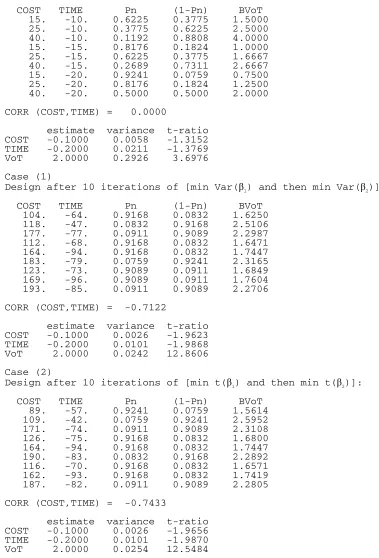
initial design and the final optimal design for cases (1) and (2) as outlined in section 3, are given in
figure 2. The t* value for a nine scenario design with one individual is 1.9882. The starting point for
both cases is the initial design. Each case has produced a different solution, demonstrating that there
is no unique optimal design. In practice, only integer values of TIME and COST differences are of
use so the final optimal designs are integerised in figure 2. Both cases have produced near p* and t*
values and if non-integer variables are allowed p* values are guaranteed. With the t-ratios only the
last optimised parameter,
2in this experiment will be at t*. Each t-ratio is based on one replication
of the survey and if many individuals were interviewed then these t-ratios would increase.
Initial design
COST TIME Pn (1-Pn) BVoT 15. -10. 0.6225 0.3775 1.5000 25. -10. 0.3775 0.6225 2.5000 40. -10. 0.1192 0.8808 4.0000 15. -15. 0.8176 0.1824 1.0000 25. -15. 0.6225 0.3775 1.6667 40. -15. 0.2689 0.7311 2.6667 15. -20. 0.9241 0.0759 0.7500 25. -20. 0.8176 0.1824 1.2500 40. -20. 0.5000 0.5000 2.0000
CORR (COST,TIME) = 0.0000
estimate variance t-ratio COST -0.1000 0.0058 -1.3152 TIME -0.2000 0.0211 -1.3769 VoT 2.0000 0.2926 3.6976
Case (1)
Design after 10 iterations of [min Var( 1) and then min Var( 2)]:
COST TIME Pn (1-Pn) BVoT 104. -64. 0.9168 0.0832 1.6250 118. -47. 0.0832 0.9168 2.5106 177. -77. 0.0911 0.9089 2.2987 112. -68. 0.9168 0.0832 1.6471 164. -94. 0.9168 0.0832 1.7447 183. -79. 0.0759 0.9241 2.3165 123. -73. 0.9089 0.0911 1.6849 169. -96. 0.9089 0.0911 1.7604 193. -85. 0.0911 0.9089 2.2706
CORR (COST,TIME) = -0.7122
estimate variance t-ratio COST -0.1000 0.0026 -1.9623 TIME -0.2000 0.0101 -1.9868 VoT 2.0000 0.0242 12.8606
Case (2)
Design after 10 iterations of [min t( 1) and then min t( 2)]:
COST TIME Pn (1-Pn) BVoT 89. -57. 0.9241 0.0759 1.5614 109. -42. 0.0759 0.9241 2.5952 171. -74. 0.0911 0.9089 2.3108 126. -75. 0.9168 0.0832 1.6800 164. -94. 0.9168 0.0832 1.7447 190. -83. 0.0832 0.9168 2.2892 116. -70. 0.9168 0.0832 1.6571 162. -93. 0.9168 0.0832 1.7419 187. -82. 0.0911 0.9089 2.2805
CORR (COST,TIME) = -0.7433
[image:11.595.137.516.137.695.2]estimate variance t-ratio COST -0.1000 0.0026 -1.9656 TIME -0.2000 0.0101 -1.9870 VoT 2.0000 0.0254 12.5484
Figure 2 : Initial and final designs for cases (1) and (2)
stage, 0 is the starting point, 1 is after minimisation of t(
1), 2 is after minimisation of t(
2) and 3 is
the final result.
Figure 3 shows that the parameter being optimised
reaches the t* value, whilst the other loses the t* value. As the iterations progress, however, the
extent of this loss deteriorates. The t-ratio for VoT after an initial dip, rises with each iteration. Figure
5 shows the nature of the design at each iteration. The positive line is the maximum cost difference
across all nine scenarios whilst the negative line is the minimum time difference across all nine
scenarios.
A clear saw-tooth pattern is apparent in this figure. A minimisation of t(
1) increases the maximum
COST difference whilst decreasing the
absolute
value of the TIME difference. A minimisation of
t(
2) produces the opposite effect. The more iterations, the larger these maximum and minimum
t(VoT)=5.6758, which is still an improvement on the starting value of t(VoT)=3.6976. The actual
design is provided in figure 6.
COST TIME Pn (1-Pn) BVoT 46. -35. 0.9168 0.0832 1.3143 53. -14. 0.0759 0.9241 3.7857 80. -28. 0.0832 0.9168 2.8571 51. -37. 0.9089 0.0911 1.3784 73. -49. 0.9241 0.0759 1.4898 81. -29. 0.0911 0.9089 2.7931 55. -40. 0.9241 0.0759 1.3750 76. -50. 0.9168 0.0832 1.5200 88. -32. 0.0832 0.9168 2.7500
CORR (COST,TIME) = -0.1317
[image:13.595.142.410.416.591.2]estimate variance t-ratio COST -0.1000 0.0028 -1.8804 TIME -0.2000 0.0101 -1.9868 VoT 2.0000 0.1242 5.6758
Figure 6 : Final Design with 'reasonable' differences
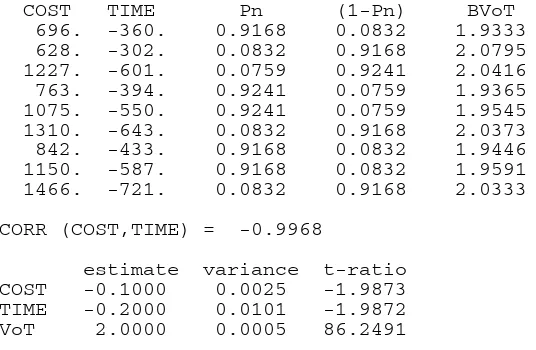
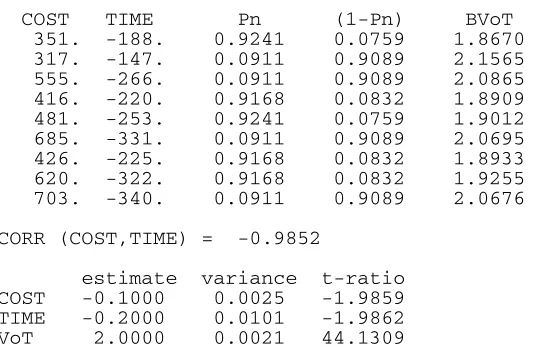
The final designs in cases (3) and (4), with equal weight given to COST and TIME are given in figure
7.
Case (3)
Design after one minimisation of t( i):
COST TIME Pn (1-Pn) BVoT 696. -360. 0.9168 0.0832 1.9333 628. -302. 0.0832 0.9168 2.0795 1227. -601. 0.0759 0.9241 2.0416 763. -394. 0.9241 0.0759 1.9365 1075. -550. 0.9241 0.0759 1.9545 1310. -643. 0.0832 0.9168 2.0373 842. -433. 0.9168 0.0832 1.9446 1150. -587. 0.9168 0.0832 1.9591 1466. -721. 0.0832 0.9168 2.0333
CORR (COST,TIME) = -0.9968
Case (4)
Design after one minimisation of (t*-t( i))2
:
COST TIME Pn (1-Pn) BVoT 351. -188. 0.9241 0.0759 1.8670 317. -147. 0.0911 0.9089 2.1565 555. -266. 0.0911 0.9089 2.0865 416. -220. 0.9168 0.0832 1.8909 481. -253. 0.9241 0.0759 1.9012 685. -331. 0.0911 0.9089 2.0695 426. -225. 0.9168 0.0832 1.8933 620. -322. 0.9168 0.0832 1.9255 703. -340. 0.0911 0.9089 2.0676
CORR (COST,TIME) = -0.9852
[image:14.595.143.415.138.314.2]estimate variance t-ratio COST -0.1000 0.0025 -1.9859 TIME -0.2000 0.0101 -1.9862 VoT 2.0000 0.0021 44.1309
Figure 7 : Initial and final designs for cases (3) and (4)
Both these cases have quickly produced higher t(VoT) values than those seen for cases (1) and (2).
Case (4) has near p* across all scenarios and t* values for both parameters. The drawback, especially
in case (3), is much higher COST and TIME differences.
4.2
TESTING THE DESIGN
The results in figures 2 and 6 show how well the design performs at recovering values of
1and
2around which the design is optimised. The next question is how an optimised design will perform
when recovering other combinations of
1and
2? Three situations may arise:
(1)
It is known with a fair degree of confidence the vicinity of the
1and
2values;
(2)
It is known with a great deal of confidence a range of
1and
2values
(3)
Nothing is known about the location of the
1and
2values.
To explore these situations three experiments are conducted. The first is to sample alternative
1and
2
values in the neighbourhood of the design values, and test them with the design (situation 1). The
second is to use the methodology to try and recovering different combinations of
1and
2values
(situation 2). The final experiment is to construct a grid of
1and
2values and test the performance
4.2.1 What's happening in the neighbourhood?
An optimal design is constructed, based on the
second iteration of
2in case (2).
A large sample of five hundred alternative values of
1
and
2are randomly sampled from the triangular
distributions in the upper portion of figure 8. These
values produce the distribution of VoT given in the
lower portion of figure 8. Extremes of as large as
5.0 have been allowed. The t-ratios for these 500
alternative values are then calculated on the separate
assumptions of the use of the initial, (orthogonal)
design and the optimal design.
The distribution of the t(
1), t(
2) and t(VoT) under
The optimal design has produced a more uniform distribution of t-ratios for
1and
2in comparison
with the more peaked distribution provided by the orthogonal design. The optimal design has
produced fewer small t-ratios and more high t-ratios for t(VoT) than the orthogonal design.
4.2.2 Divide and conquer
Instead of using all nine scenarios to try and recover a fixed combination of
1and
2values, it may
be more efficient to partition the scenarios. Thus the first three scenarios could be used to recover
1aand
2a, the next three
1band
2band the last three
1cand
2cvalues. Careful consideration needs to
be given to the approach adopted. Issues worth considering are:
(a)
Should the exercise treat each design as an series of independent mini-SP's? This would
involve an approach similar to that used above but only using the appropriate scenarios
during each optimisation. The scenarios would then be assembled for the full SP.
(b)
Would the allocation of scenarios to
1and
2combinations be significant?
(c)
An integrated SP may be required, were the full design is used to calculate the variance
expressions during optimisation (unlike (a) above) but only the relevant scenarios are
changed during optimisation.
(d)
In this case, is the order in which each combination is optimised significant?
To explore issue (a) the nine scenario design of table 1 is used to recover
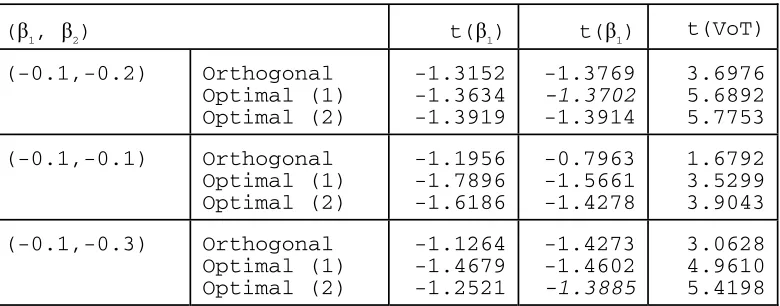
1and
2values of
In all but one case (given in italics) this new design has produced an improvement in the t-ratios, and
always an improvement for t(VoT).
The rows labelled Optimal (2) shows the effect of allocating the parameter combinations to different
scenarios (issue b above). Here (-0.1,-0.2) has been allocated to scenarios 4,5 and 6; (-0.1,-0.1) to
scenarios 7,8 and 9 and (-0.1,-0.3) to 1, 2 and 3. Clearly this has an effect since Optimal (1) is
different to Optimal (2) but the improvement over the optimal design is still present.
(
1,
2)
t(
1)
t(
1)
t(VoT)
(-0.1,-0.2)
Orthogonal
Optimal (1)
Optimal (2)
-1.3152
-1.3634
-1.3919
-1.3769
-1.3702
-1.3914
3.6976
5.6892
5.7753
(-0.1,-0.1)
Orthogonal
Optimal (1)
Optimal (2)
-1.1956
-1.7896
-1.6186
-0.7963
-1.5661
-1.4278
1.6792
3.5299
3.9043
(-0.1,-0.3)
Orthogonal
Optimal (1)
Optimal (2)
-1.1264
-1.4679
-1.2521
-1.4273
-1.4602
-1.3885
[image:17.595.76.466.213.366.2]3.0628
4.9610
5.4198
Table 3 : Comparison of Orthogonal and Optimal designs
The alternative approach suggested in (c) above is where the full design is used to calculate the variance
values, but only a subset of the scenarios are allowed to change during optimisation.
The first three scenarios are once again optimised around (-0.1,-0.2) as above, but all nine scenarios are
used to calculate the variances during optimisation. When this stage has been completed the next three
scenarios are used to optimise for (-0.1,-0.1), again changing only these scenarios but using the full design
to calculate the variances. After stage three, where the design is around (-0.1, -0.3) the final design is
complete.
A fuller account of this complex process, with only two iterations, is show in appendix A. Adopting this
approach gives the summary results presented as Optimal (1) in table 4. This approach has produced an
improvement in the t-ratios over the orthogonal design. No consistent pattern emerges when the optimal
results in table 3 are compared with those in table 4.
(
1,
2)
t(
1)
t(
1)
t(VoT)
(-0.1,-0.2)
Orthogonal
Optimal (1)
Optimal (2)
-1.3152
-1.6737
-1.5126
-1.3769
-1.6380
-1.6157
3.6976
4.4300
5.4991
(-0.1,-0.1)
Orthogonal
Optimal (1)
Optimal (2)
-1.1956
-1.6402
-1.3823
-0.7963
-1.7142
-1.4469
1.6792
5.0985
4.6902
(-0.1,-0.3)
Orthogonal
Optimal (1)
Optimal (2)
-1.1264
-1.3555
-1.4544
-1.4273
-1.4075
-1.4500
3.0628
4.9854
6.4594
Table 4 : Comparison of Orthogonal and Optimal integrated designs
4.2.3
The wider picture
An optimal design is constructed, based on the second iteration of
2in case (2). This design was then
used to calculate a grid of t(VoT) values based on values of
1and
2in the range [-0.05,-1.00] in steps of
[image:18.595.71.460.111.262.2]-0.05. Figure 12 shows the 3D plot for the orthogonal design whilst figure 13 shows the corresponding
plot for the optimal design.
Figure 12 is characterised by a shallow but wide plateau, whilst figure 13 has two sharper, more
concentrated, ridges. Inspection of these two graphs suggests that if the actual
1and
2values fall within
either of these two ridges then the optimal design is best, otherwise the orthogonal design may be better.
5 THREE
VARIABLES
The three variable design is a natural extension to that of two variables. Here the utility equations are
given by the expressions:
A complicating factor is that the construction of point based boundary values are no longer possible. By
way of example consider the SP design given in table 5, taken from a study by Preston and Wardman
(1991).
Alternative A Alternative B
Difference (B-A)
COST (pence)
TIME (min)
DEPART (min)
COST (pence)
TIME (min)
DEPART (min)
COST (pence)
TIME (min)
DEPART (min)
Intercept Slope
1 50 40 0 50 25 30 0 -15 30 0.00 2.0
2 30 45 0 0 25 30 -30 -20 30 -1.50 1.5
3 100 45 0 50 35 30 -50 -10 30 -5.00 3.0
4 75 40 0 0 35 30 -75 -5 30 -15.0 6.0
5 0 40 0 0 35 60 0 -5 60 0.00 12.0
6 80 45 0 50 35 60 -30 -10 60 -3.00 6.0
7 50 45 0 0 25 60 -50 -20 60 -2.50 3.0
8 125 40 0 50 25 60 -75 -15 60 -5.00 4.0
9 50 45 0 50 25 30 0 -20 30 0.00 1.5
10 30 40 0 0 25 30 -30 -15 30 -2.00 2.0
11 100 40 0 50 35 30 -50 -5 30 -10.0 6.0
12 75 45 0 0 35 30 -75 -10 30 -7.50 3.0
13 0 45 0 0 35 60 0 -10 60 0.00 6.0
14 80 40 0 50 35 60 -30 -5 60 -6.00 12.0
15 50 40 0 0 25 60 -50 -15 60 -3.33 4.0
16 125 45 0 50 25 60 -75 -20 60 -3.75 3.0
Table 5 : A possible binary choice three variable SP design
Fowkes (1991) proposes that a boundary ray map may be constructed from this design, where the
intercept and slope of the ray are given by the following expression.
TIME
-DEPARTURE
VoD
+
DELTATIME
-COST
=
BVoT
∆
∆
∆
(8
)
The units of journey time and departure time change are in single legs of a journey whilst the cost is for a
round trip of two legs. To keep the units consistent the costs have been halved. This map is characterised
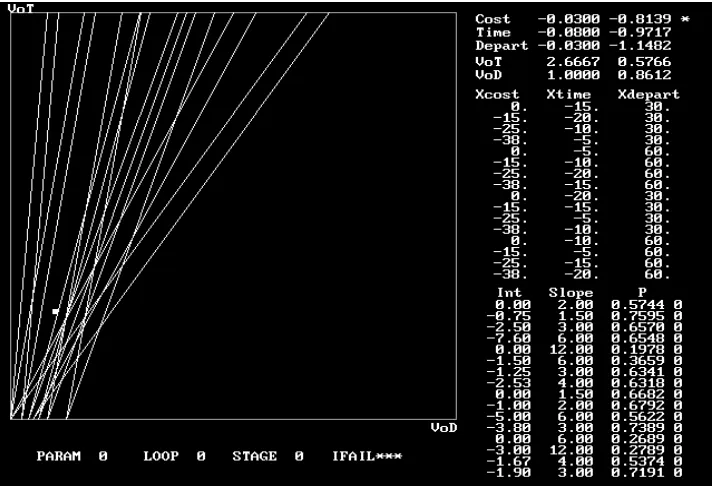
by non-positive intercepts with the VoT axis and positive slopes. Note that for the t-ratios, the information
presented is based on only one replication of the survey. The information in figure 14 does not suggest
that the t-ratios of VoT or VoD from the surveys will be as low as 0.5731 or 0.8555
[image:20.595.185.542.111.354.2]After only one iteration, the t-ratio of the last optimised parameter ( DEPARTURE) is near its t* value of
2.6510, and the t-ratios of VoT and VoD have shown considerable improvement. The p values are also
close to p*.
During the iterative process the same features as were seen for the two variable case are apparent, namely:
optimised parameter near t*; other parameters sub-t* but improving; p's at or near p* and increases in the
magnitude of the differences. After ten iterations, the t-ratios for VoT and VoD are high at 11.7439 and
10.5658.
Much of the discussion of section 4.2 with regard to the testing of the design is relevant to a three variable
design. The performance will be good in the neighbourhood of the design point and divide and conquer
approaches are equally applicable to a three variable design. An idea of the wider picture is difficult to
gain since a 4D plot would be required to show the performance of each design at distant points.
6 FOUR
VARIABLES
The application of this methodology to a four variable design begins to show its utility over traditional
approaches for designing SP experiments. Clearly a graphical representation of the design is difficult to
envisage, requiring a 3D plot of graphical planes.
The test design for a binary choice case is shown in table 6. This design is taken from Toner (1991). For
space considerations, only the difference values for the variables are shown.
Fare (pence)
Walk (min)
Wait (min)
IVTime (min)
1 150 -12 -10 -10
2 150 -7 -6 -7
3 150 -4 -3 -4
4 50 -12 -6 -4
5 50 -7 -3 -10
6 50 -4 -10 -7
8 80 -7 -10 -4
[image:22.595.72.331.110.145.2]9 80 -4 -6 -10
Table 6 : A possible binary choice four variable SP design (in differences)
Initial design
COST WALK WAIT IVTIME Pn (1-Pn) 150. -12. -10. -10. 0.1516 0.8484 150. -7. -6. -7. 0.1000 0.9000 150. -4. -3. -4. 0.0718 0.9282 50. -12. -6. -4. 0.4611 0.5389 50. -7. -3. -10. 0.4502 0.5498 50. -4. -10. -7. 0.4693 0.5307 80. -12. -3. -7. 0.3189 0.6811 80. -7. -10. -4. 0.3208 0.6792 80. -4. -6. -10. 0.3165 0.6835 COST WALK WAIT IVTIME
COST 1.0000 0.0000 0.0000 0.0000 WALK 0.0000 1.0000 0.0000 0.0000 WAIT 0.0000 0.0000 1.0000 0.0000 IVTIME 0.0000 0.0000 0.0000 1.0000
estimate t-ratio
Cost -0.0200 -0.8976 * Walk T -0.0340 -0.1778 Wait T -0.0440 -0.1965 IVTime -0.0430 -0.1815 estimate t-ratio
Walk/C 1.7000 0.1878 Wait/C 2.2000 0.2077 Time/C 2.1500 0.1940
Design after min(t( 1)),min(t( 2)),min(t( 3)),min(t( 4))
COST WALK WAIT IVTIME Pn (1-Pn) 144. -81. 16. 36. 0.0849 0.9151 141. -23. -9. 17. 0.0853 0.9147 138. -9. -18. 18. 0.0805 0.9195 91. -303. 69. 182. 0.0847 0.9153 211. 16. 74. -242. 0.9158 0.0842 155. 117. -170. 66. 0.0805 0.9195 377. -211. -25. -39. 0.9177 0.0823 129. 7. -98. -20. 0.9133 0.0867 48. 112. 62. -118. 0.0815 0.9185 COST WALK WAIT IVTIME
COST 1.0000 -0.3459 -0.1527 -0.2405 WALK -0.3459 1.0000 -0.3670 -0.4856 WAIT -0.1527 -0.3670 1.0000 -0.2846 IVTIME -0.2405 -0.4856 -0.2846 1.0000
estimate t-ratio
Cost -0.0200 -1.5593 Walk T -0.0340 -1.6787 Wait T -0.0440 -1.5530 IVTime -0.0430 -1.9880 * estimate t-ratio
Design after min(t( 1)),min(t( 2)),min(t( 3)),min(t( 4)) 10 times
COST WALK WAIT IVTIME Pn (1-Pn) 550. -238. -321. 317. 0.0820 0.9180 585. 67. -473. 215. 0.0823 0.9177 350. -61. -387. 337. 0.0840 0.9160 -91. -702. 113. 538. 0.0818 0.9182 1039. 265. 209. -850. 0.0805 0.9195 335. 799. -914. 92. 0.9164 0.0836 1645. -1007. 224. -254. 0.9171 0.0829 516. -12. -147. -136. 0.9171 0.0829 121. 469. 8. -379. 0.0816 0.9184
COST WALK WAIT IVTIME COST 1.0000 -0.3821 0.3581 -0.5315 WALK -0.3821 1.0000 -0.5898 -0.2778 WAIT 0.3581 -0.5898 1.0000 -0.4592 IVTIME -0.5315 -0.2778 -0.4592 1.0000
estimate t-ratio Cost -0.0200 -1.9576 Walk T -0.0340 -1.9609 Wait T -0.0440 -1.9610 IVTime -0.0430 -1.9881 *
[image:24.595.149.450.141.414.2]estimate t-ratio Walk/C 1.7000 10.6499 Wait/C 2.2000 10.0233 Time/C 2.1500 10.7921
Figure 17 : Initial, first optimised and final designs for table 6
Once again all the features seen for the two variable situation occur here. The p values are close to p*, as
seen previously.
7
TWO VARIABLES PLUS ASC
The equation for the utility of each mode given in (1) can be modified to include an alternative specific
constant (ASC). The role of this constant is to account for factors which are not specifically included in
the design when determining the attractiveness of one mode over another. The revised form of equation
(1) becomes:
ε
β
β
ε
β
β
+
TIME
+
COST
=
U
+
TIME
+
COST
+
ASC
=
U
b 2 b 1 b a 2 a 1a
(9
a)
(9
b
)
If the ASC is estimated to be negative then, all other things being equal, U
a< U
band alternative B would
be preferred over A. If the ASC is positive then A would be the preferred mode. This revised form can be
cast into the general form of an SP by setting one of the variables to a constant value. Table 7 gives an
illustrative example of a two variable design with a range of ASC's, taken from Fowkes (1991).
Alternative A Alternative B Difference (A-B)
COST (£)
TIME (min)
COST (£)
TIME (min)
COST TIME BVoT (pence/min)
ASC=0 ASC=2 ASC=5
1 40 460 20 260 20.00 240.00 10.00 9.00 7.50
2 60 460 50 260 10.00 250.00 5.00 4.00 2.50
3 60 610 50 210 10.00 200.00 2.50 2.00 1.25
4 40 310 20 210 20.00 190.00 20.00 18.00 15.00
5 60 460 20 360 40.00 320.00 40.00 38.00 35.00
6 40 310 50 360 -10.00 370.00 20.00 24.00 30.00
Table 7 : Two variable with an ASC design
[image:25.595.141.456.379.749.2]If there is an expectation that the ASC is zero then the methodology used in section 4 can be applied.
Otherwise the optimisation process must take account of the presence of the ASC but must not alter its
value since it is, like
1and
2, a given parameter.
Figure 18 shows the results after 15 iterations of min(t(
1)) and min(t(
2)) with ASC's of 2.00 and 5.00.
Initial design with ASC=2.00
ASC COST TIME Pn (1-Pn) BVoT 2. 20. -200. 0.0573 0.9427 0.0900 2. 10. -200. 0.5498 0.4502 0.0400 2. 10. -400. 0.8022 0.1978 0.0200 2. 20. -100. 0.0323 0.9677 0.1800 2. 40. -100. 0.0001 0.9999 0.3800 2. -10. 50. 0.9910 0.0090 0.2400
CORR (COST,TIME) = -0.5247
ASC 2.00000 6.63744 0.77630 COST -0.30000 0.08949 -1.00285 TIME -0.00600 0.00017 -0.45634 T/C 0.02000 15450.01465 0.00016
Design after 10 iterations
ASC COST TIME Pn (1-Pn) BVoT 2. 178. -214. 0.0000 1.0000 0.8224 2. 5. -283. 0.9001 0.0999 0.0106 2. 19. -977. 0.8968 0.1032 0.0174 2. 19. -160. 0.0607 0.9393 0.1062 2. 18. -128. 0.0671 0.9329 0.1250 2. -1. 814. 0.0702 0.9298 0.0037
CORR (COST,TIME) = -0.2230
ASC 2.00000 2.70369 1.21633 COST -0.30000 0.08331 -1.03938 TIME -0.00600 0.00002 -1.46319 T/C 0.02000 1111.05481 0.00060
Initial design with ASC=5.00
5. 10. -200. 0.9608 0.0392 0.0250 5. 10. -400. 0.9879 0.0121 0.0125 5. 20. -100. 0.4013 0.5987 0.1500 5. 40. -100. 0.0017 0.9983 0.3500 5. -10. 50. 0.9995 0.0005 0.3000
CORR (COST,TIME) = -0.5247
ASC 5.00000 4.88852 2.26142 COST -0.30000 0.21312 -0.64985 TIME -0.00600 0.00059 -0.24766 T/C 0.02000 59243.35547 0.00008
Design after 10 iterations
ASC COST TIME Pn (1-Pn) BVoT 5. 193. -178. 0.0000 1.0000 1.0562 5. 12. -163. 0.9151 0.0849 0.0429 5. 28. -958. 0.9128 0.0872 0.0240 5. -82. -121. 1.0000 0.0000 -0.7190 5. 24. 20. 0.0895 0.9105 -0.9500 5. 15. 461. 0.0940 0.9060 -0.0217
CORR (COST,TIME) = -0.1552
[image:26.595.148.450.109.403.2]ASC 5.00000 1.93686 3.59270 COST -0.30000 0.13150 -0.82730 TIME -0.00600 0.00002 -1.32280 T/C 0.02000 2065.62158 0.00044
Figure 18 : Initial and final designs for ASC=2.00 and ASC=5.00.
In both cases the final design has produced improvements in the t-ratios for all parameters. For the case
where ASC=2.00, the final optimised design does not possess p* values, the first time this feature has
been noted. When ASC=5.00 the design does contains some near p* but also some 1.0 or 0.0 p's. The
final t(
2) value in this design, 1.32280 corresponds to a t*=1.32548 with n=4, ie the number of scenarios
with p*'s.
8 CONSTRAINTS
One undesirable feature of this methodology is the tendency to produce large magnitude differences in the
variables. This may be practically impossible or infeasible. One approach is to set limits on these
differences. The optimisation process can either be stopped when any of these limits are exceeded or
constrained to operate within these limits. The first approach was adopted in section 4 where the design
after only two iterations was chosen as the best. This design still gave a reasonable increase in all the
t-ratio's over the initial design. The second approach is to specify constraints in the optimisation process.
By way of example, the COST variable can be constrained to lie within [1,100] and the TIME to be
within [-50,-1]. When this modification is applied, the results are as given in figure 19.
Initial design (as given in figure 2)
15. -15. 0.8176 0.1824 1.0000 25. -15. 0.6225 0.3775 1.6667 40. -15. 0.2689 0.7311 2.6667 15. -20. 0.9241 0.0759 0.7500 25. -20. 0.8176 0.1824 1.2500 40. -20. 0.5000 0.5000 2.0000
CORR (COST,TIME) = 0.0000
estimate variance t-ratio
COST -0.1000 0.0058 -1.3152 TIME -0.2000 0.0211 -1.3769 VoT 2.0000 0.2926 3.6976
Final design after 10 iterations of min(t( 1)) and min(t( 2))
COST TIME Pn (1-Pn) BVoT 76. -50. 0.9168 0.0832 1.5200 95. -35. 0.0759 0.9241 2.7143 95. -36. 0.0911 0.9089 2.6389 76. -50. 0.9168 0.0832 1.5200 76. -50. 0.9168 0.0832 1.5200 95. -35. 0.0759 0.9241 2.7143 76. -50. 0.9168 0.0832 1.5200 76. -50. 0.9168 0.0832 1.5200 95. -36. 0.0911 0.9089 2.6389
CORR (COST,TIME) = 0.9989
estimate variance t-ratio
COST -0.1000 0.0027 -1.9123 TIME -0.2000 0.0101 -1.9871 VoT 2.0000 0.0806 7.0445
Final design after 1 iteration of (t*-t( i))2
COST TIME Pn (1-Pn) BVoT 40. -32. 0.9168 0.0832 1.2500 100. -38. 0.0832 0.9168 2.6316 100. -38. 0.0832 0.9168 2.6316 55. -40. 0.9241 0.0759 1.3750 76. -50. 0.9168 0.0832 1.5200 100. -38. 0.0832 0.9168 2.6316 61. -42. 0.9089 0.0911 1.4524 76. -50. 0.9168 0.0832 1.5200 100. -38. 0.0832 0.9168 2.6316
CORR (COST,TIME) = -0.0461
estimate variance t-ratio
[image:27.595.137.470.95.647.2]COST -0.1000 0.0026 -1.9595 TIME -0.2000 0.0103 -1.9721 VoT 2.0000 0.0889 6.7096
Figure 19 : Constrained two variable design
9 CONCLUSIONS
This paper has demonstrated that the methodology devised can be applied to practical binary choice
Stated Preference designs. To summarise, the methodology is:
•
simple in its application;
•
able to deliver real, quantifiable benefits over traditional SP design methodologies;
•
is applicable to an n-variable design, n>2;
•
can accommodate designs with alternative specific constants;
•
flexible enough to code an incorporate a variety of user requirements;
•
works within constraints;
•
simple to implement in spreadsheets or FORTRAN code.
REFERENCES
Hague Consulting Group (1992). "ALOGIT Users' Guide, version 3.2".
Ford, B and Pool, JCT (1984). "The Evolving NAG Library Service. Sources and Development of
Mathematical Software."
Prentice-Hall
, pp375-397.
Fowkes, AS (1991). "Recent developments in Stated Preference techniques in transport research".
PTRC-SAM, Sussex 1991, published as
Transportation Planning Methods
, Code P347, pp.251-263, PTRC,
London
Fowkes, AS (1996). "The development of Stated Preference Techniques in Transport Planning".
ITS
Working Paper 479
, Institute for Transport Studies, University of Leeds, Leeds.
Fowkes, AS and Nash, CA (eds) (1991). "Analysing Demand for Rail Travel".
Avebury Publishing
Group
, Chapter 4, pp33-56.
Fowkes, AS and Wardman, M (1993). "Non-orthogonal Stated Preference design". PTRC-SAM, UMIST
1993, published as
Transportation Planning Methods
, Code P366, pp.91-97, PTRC, London
Toner, JP (1991). "The economics of regulation of the taxi trade in British towns".
Unpublished PhD
Thesis
, University of Leeds, Leeds, UK.
Preston, J and Wardman, M (1991). "The use of hypothetical questioning techniques to assess the future
demand for travel in the Nottingham area".
UTSG 23rd Annual Conference, University of Nottingham.
Wardman, M and Toner, JP (1996). "Issues in Model Specification".
Paper to PTRC Conference on Value
of Time
, London, October 1996.
APPENDIX
Non-integrated
The three parameter pairs (-0.1,-0.2), (-0.1,-0.1) and (-0.1,-0.3) with the initial design
COST TIME Pn (1-Pn) BVoT 15. -10. 0.6225 0.3775 1.5000 25. -10. 0.3775 0.6225 2.5000 40. -10. 0.1192 0.8808 4.0000 15. -15. 0.8176 0.1824 1.0000 25. -15. 0.6225 0.3775 1.6667 40. -15. 0.2689 0.7311 2.6667 15. -20. 0.9241 0.0759 0.7500 25. -20. 0.8176 0.1824 1.2500 40. -20. 0.5000 0.5000 2.0000
CORR (COST,TIME) = 0.0000
COST -0.1000 0.0058 -1.3152 TIME -0.2000 0.0211 -1.3769 VoT 2.0000 0.2926 3.6976
COST TIME Pn (1-Pn) BVoT 15. -10. 0.3775 0.6225 1.5000 25. -10. 0.1824 0.8176 2.5000 40. -10. 0.0474 0.9526 4.0000 15. -15. 0.5000 0.5000 1.0000 25. -15. 0.2689 0.7311 1.6667 40. -15. 0.0759 0.9241 2.6667 15. -20. 0.6225 0.3775 0.7500 25. -20. 0.3775 0.6225 1.2500 40. -20. 0.1192 0.8808 2.0000
CORR (COST,TIME) = 0.0000
estimate variance t-ratio COST -0.1000 0.0070 -1.1956 TIME -0.1000 0.0158 -0.7963 VoT 1.0000 0.3546 1.6792
COST TIME Pn (1-Pn) BVoT 15. -10. 0.8176 0.1824 1.5000 25. -10. 0.6225 0.3775 2.5000 40. -10. 0.2689 0.7311 4.0000 15. -15. 0.9526 0.0474 1.0000 25. -15. 0.8808 0.1192 1.6667 40. -15. 0.6225 0.3775 2.6667 15. -20. 0.9890 0.0110 0.7500 25. -20. 0.9707 0.0293 1.2500 40. -20. 0.8808 0.1192 2.0000
CORR (COST,TIME) = 0.0000
Optimise (-0.1,-0.2)
COST TIME Pn (1-Pn) BVoT 61. -42. 0.9089 0.0911 1.4524 22. 1. 0.0832 0.9168 -22.0000 38. -7. 0.0832 0.9168 5.4286
estimate variance t-ratio COST -0.1000 0.0100 -0.9994 TIME -0.2000 0.0304 -1.1470 VoT 2.0000 0.8794 2.1328
COST TIME Pn (1-Pn) BVoT 90. -57. 0.9168 0.0832 1.5789 33. -4. 0.0759 0.9241 8.2500 57. -17. 0.0911 0.9089 3.3529
estimate variance t-ratio COST -0.1000 0.0086 -1.0775 TIME -0.2000 0.0304 -1.1469 VoT 2.0000 0.4153 3.1033
Optimise (-0.1,-0.1)
COST TIME Pn (1-Pn) BVoT 59. -83. 0.9168 0.0832 0.7108 24. 1. 0.0759 0.9241 -24.0000 35. -11. 0.0832 0.9168 3.1818
estimate variance t-ratio COST -0.1000 0.0102 -0.9915 TIME -0.1000 0.0076 -1.1474 VoT 1.0000 0.2505 1.9980
COST TIME Pn (1-Pn) BVoT 89. -113. 0.9168 0.0832 0.7876 35. -11. 0.0832 0.9168 3.1818 54. -30. 0.0832 0.9168 1.8000
estimate variance t-ratio COST -0.1000 0.0087 -1.0736 TIME -0.1000 0.0076 -1.1479 VoT 1.0000 0.1087 3.0328
Optimise (-0.1,-0.3)
COST TIME Pn (1-Pn) BVoT 32. -19. 0.9241 0.0759 1.6842 47. -24. 0.9241 0.0759 1.9583 79. -18. 0.0759 0.9241 4.3889
estimate variance t-ratio COST -0.1000 0.0091 -1.0475 TIME -0.3000 0.0685 -1.1465 VoT 3.0000 1.3551 2.5771
COST TIME Pn (1-Pn) BVoT 42. -22. 0.9168 0.0832 1.9091 62. -29. 0.9241 0.0759 2.1379 104. -27. 0.0911 0.9089 3.8519
All three segments are assembled to give the final design and the t-ratios are calculated.
COST TIME Pn (1-Pn) BVoT 90. -57. 0.9168 0.0832 1.5789 33. -4. 0.0759 0.9241 8.2500 57. -17. 0.0911 0.9089 3.3529 89. -113. 1.0000 0.0000 0.7876 35. -11. 0.2142 0.7858 3.1818 54. -30. 0.6457 0.3543 1.8000 42. -22. 0.5498 0.4502 1.9091 62. -29. 0.4013 0.5987 2.1379 104. -27. 0.0067 0.9933 3.8519
CORR (COST,TIME) = -0.6348
estimate variance t-ratio COST -0.1000 0.0054 -1.3634 TIME -0.2000 0.0213 -1.3706 VoT 2.0000 0.1236 5.6893
COST TIME Pn (1-Pn) BVoT 90. -57. 0.0356 0.9644 1.5789 33. -4. 0.0522 0.9478 8.2500 57. -17. 0.0180 0.9820 3.3529 89. -113. 0.9168 0.0832 0.7876 35. -11. 0.0832 0.9168 3.1818 54. -30. 0.0832 0.9168 1.8000 42. -22. 0.1192 0.8808 1.9091 62. -29. 0.0356 0.9644 2.1379 104. -27. 0.0005 0.9995 3.8519
CORR (COST,TIME) = -0.6348
estimate variance t-ratio COST -0.1000 0.0031 -1.7896 TIME -0.1000 0.0041 -1.5661 VoT 1.0000 0.0803 3.5299
COST TIME Pn (1-Pn) BVoT 90. -57. 0.9997 0.0003 1.5789 33. -4. 0.1091 0.8909 8.2500 57. -17. 0.3543 0.6457 3.3529 89. -113. 1.0000 0.0000 0.7876 35. -11. 0.4502 0.5498 3.1818 54. -30. 0.9734 0.0266 1.8000 42. -22. 0.9168 0.0832 1.9091 62. -29. 0.9241 0.0759 2.1379 104. -27. 0.0911 0.9089 3.8519
CORR (COST,TIME) = -0.6348
Integrated
The starting designs are the same as those for the non-integrated process
Optimise (-0.1,-0.2)
COST TIME Pn (1-Pn) BVoT
104. -64. 0.9168 0.0832 1.6250 Only change
47. -11. 0.0759 0.9241 4.2727 these three
94. -35. 0.0832 0.9168 2.6857 scenarios
15. -15. 0.8176 0.1824 1.0000 25. -15. 0.6225 0.3775 1.6667 40. -15. 0.2689 0.7311 2.6667 15. -20. 0.9241 0.0759 0.7500 25. -20. 0.8176 0.1824 1.2500 40. -20. 0.5000 0.5000 2.0000
CORR (COST,TIME) = -0.8316
estimate variance t-ratio COST -0.1000 0.0041 -1.5593 TIME -0.2000 0.0149 -1.6375 VoT 2.0000 0.1505 5.1550
Optimise (-0.1,-0.1)
COST TIME Pn (1-Pn) BVoT 104. -64. 0.0180 0.9820 1.6250 47. -11. 0.0266 0.9734 4.2727 94. -35. 0.0027 0.9973 2.6857
163. -187. 0.9168 0.0832 0.8717 Only change
5. 19. 0.0832 0.9168 -0.2632 these three
34. -10. 0.0832 0.9168 3.4000 scenarios
15. -20. 0.6225 0.3775 0.7500 25. -20. 0.3775 0.6225 1.2500 40. -20. 0.1192 0.8808 2.0000
CORR (COST,TIME) = -0.9099
estimate variance t-ratio COST -0.1000 0.0043 -1.5333 TIME -0.1000 0.0039 -1.6025 VoT 1.0000 0.0363 5.2499
Optimise (-0.1,-0.3)
COST TIME Pn (1-Pn) BVoT 104. -64. 0.9998 0.0002 1.6250 47. -11. 0.1978 0.8022 4.2727 94. -35. 0.7503 0.2497 2.6857 163. -187. 1.0000 0.0000 0.8717 5. 19. 0.0020 0.9980 -0.2632 34. -10. 0.4013 0.5987 3.4000
-42. 6. 0.9168 0.0832 7.0000 Only change
-16. -3. 0.9241 0.0759 -5.3333 these three
26. -17. 0.9241 0.0759 1.5294 scenarios
CORR (COST,TIME) = -0.8693
The three parameter pairs with optimal design
COST TIME Pn (1-Pn) BVoT 104. -64. 0.9168 0.0832 1.6250 47. -11. 0.0759 0.9241 4.2727 94. -35. 0.0832 0.9168 2.6857 163. -187. 1.0000 0.0000 0.8717 5. 19. 0.0134 0.9866 -0.2632 34. -10. 0.1978 0.8022 3.4000 -42. 6. 0.9526 0.0474 7.0000 -16. -3. 0.9002 0.0998 -5.3333 26. -17. 0.6900 0.3100 1.5294
CORR (COST,TIME) = -0.8693
estimate variance t-ratio COST -0.1000 0.0036 -1.6737 TIME -0.2000 0.0149 -1.6380 VoT 2.0000 0.2038 4.4300
COST TIME Pn (1-Pn) BVoT 104. -64. 0.0180 0.9820 1.6250 47. -11. 0.0266 0.9734 4.2727 94. -35. 0.0027 0.9973 2.6857 163. -187. 0.9168 0.0832 0.8717 5. 19. 0.0832 0.9168 -0.2632 34. -10. 0.0832 0.9168 3.4000 -42. 6. 0.9734 0.0266 7.0000 -16. -3. 0.8699 0.1301 -5.3333 26. -17. 0.2891 0.7109 1.5294
CORR (COST,TIME) = -0.8693
estimate variance t-ratio COST -0.1000 0.0037 -1.6402 TIME -0.1000 0.0034 -1.7142 VoT 1.0000 0.0385 5.0985
COST TIME Pn (1-Pn) BVoT 104. -64. 0.9998 0.0002 1.6250 47. -11. 0.1978 0.8022 4.2727 94. -35. 0.7503 0.2497 2.6857 163. -187. 1.0000 0.0000 0.8717 5. 19. 0.0020 0.9980 -0.2632 34. -10. 0.4013 0.5987 3.4000 -42. 6. 0.9168 0.0832 7.0000 -16. -3. 0.9241 0.0759 -5.3333 26. -17. 0.9241 0.0759 1.5294
CORR (COST,TIME) = -0.8693
Change the sequence of parameter pairs
Optimise (-0.1,-0.3)
COST TIME Pn (1-Pn) BVoT 15. -10. 0.8176 0.1824 1.5000 25. -10. 0.6225 0.3775 2.5000 40. -10. 0.2689 0.7311 4.0000 15. -15. 0.9526 0.0474 1.0000 25. -15. 0.8808 0.1192 1.6667 40. -15. 0.6225 0.3775 2.6667
-145. 40. 0.9241 0.0759 3.6250 Only change
-71. 16. 0.9089 0.0911 4.4375 these three
-159. 61. 0.0832 0.9168 2.6066 scenarios
CORR (COST,TIME) = -0.9782
estimate variance t-ratio COST -0.1000 0.0038 -1.6221 TIME -0.3000 0.0322 -1.6708 VoT 3.0000 0.1888 6.9036
Optimise (-0.1,-0.2)
COST TIME Pn (1-Pn) BVoT
140. -82. 0.9168 0.0832 1.7073 Only change
-9. 16. 0.0911 0.9089 0.5625 these three
28. -2. 0.0832 0.9168 14.0000 scenarios
15. -15. 0.8176 0.1824 1.0000 25. -15. 0.6225 0.3775 1.6667 40. -15. 0.2689 0.7311 2.6667 -145. 40. 0.9985 0.0015 3.6250 -71. 16. 0.9802 0.0198 4.4375 -159. 61. 0.9759 0.0241 2.6066
CORR (COST,TIME) = -0.9528
estimate variance t-ratio COST -0.1000 0.0042 -1.5390 TIME -0.2000 0.0155 -1.6090 VoT 2.0000 0.1438 5.2734
Optimise (-0.1,-0.1)
COST TIME Pn (1-Pn) BVoT 140. -82. 0.0030 0.9970 1.7073 -9. 16. 0.3318 0.6682 0.5625 28. -2. 0.0691 0.9309 14.0000
145. -169. 0.9168 0.0832 0.8580 Only change
37. -13. 0.0832 0.9168 2.8462 these three
67. -43. 0.0832 0.9168 1.5581 scenarios
-145. 40. 1.0000 0.0000 3.6250 -71. 16. 0.9959 0.0041 4.4375 -159. 61. 0.9999 0.0001 2.6066
CORR (COST,TIME) = -0.8878
The three parameter pairs with optimal design
COST TIME Pn (1-Pn) BVoT 140. -82. 1.0000 0.0000 1.7073 -9. 16. 0.0198 0.9802 0.5625 28. -2. 0.0998 0.9002 14.0000 145. -169. 1.0000 0.0000 0.8580 37. -13. 0.5498 0.4502 2.8462 67. -43. 0.9980 0.0020 1.5581 -145. 40. 0.9241 0.0759 3.6250 -71. 16. 0.9089 0.0911 4.4375 -159. 61. 0.0832 0.9168 2.6066
CORR (COST,TIME) = -0.8878
estimate variance t-ratio COST -0.1000 0.0047 -1.4544 TIME -0.3000 0.0428 -1.4500 VoT 3.0000 0.2157 6.4594
COST TIME Pn (1-Pn) BVoT 140. -82. 0.9168 0.0832 1.7073 -9. 16. 0.0911 0.9089 0.5625 28. -2. 0.0832 0.9168 14.0000 145. -169. 1.0000 0.0000 0.8580 37. -13. 0.2497 0.7503 2.8462 67. -43. 0.8699 0.1301 1.5581 -145. 40. 0.9985 0.0015 3.6250 -71. 16. 0.9802 0.0198 4.4375 -159. 61. 0.9759 0.0241 2.6066
CORR (COST,TIME) = -0.8878
estimate variance t-ratio COST -0.1000 0.0044 -1.5126 TIME -0.2000 0.0153 -1.6157 VoT 2.0000 0.1323 5.4991
COST TIME Pn (1-Pn) BVoT 140. -82. 0.0030 0.9970 1.7073 -9. 16. 0.3318 0.6682 0.5625 28. -2. 0.0691 0.9309 14.0000 145. -169. 0.9168 0.0832 0.8580 37. -13. 0.0832 0.9168 2.8462 67. -43. 0.0832 0.9168 1.5581 -145. 40. 1.0000 0.0000 3.6250 -71. 16. 0.9959 0.0041 4.4375 -159. 61. 0.9999 0.0001 2.6066
CORR (COST,TIME) = -0.8878