Copyright © 2014 CTTS.IN, All right reserved 226
The Unitary Quantum Theory and Modern Quantum Picture
of the World
Leo G. Sapogin
Department of Physics, Technical University (MADI),
64 Leningradsky pr., A-319, Moscow, 125319, Russia,e-mail:[email protected]
V. A. Dzhanibekov
Department of Cosmophysics, Tomsk State University, 36 Lenina st., 634050, Tomsk, Russia. e-mail: [email protected]
Yu. A. Ryabov
Department of Mathematics, Technical University (MADI),
64 Leningradsky pr., A-319, 125319, Moscow, Russia,e-mail:[email protected]
Abstract - The present article discuses the problems of new Unitary Quantum Theory in its applications to the different aspects of the reality. There are spectacular examples of such applications.
Keywords - Unitary Quantum Theory, Standard Model, Quantum Electrodynamics, Maxwell Equations, Schrodinger Equation, Solid State.
1.
I
NTRODUCTIONIt seems that the majority of researches have absolutely forgotten the fact that one of the master spirits of contemporary world, A. Einstein, till the end of his life had not adopted the standard quantum mechanics at all. Better to cite his well-known words: «Great initial success of the quantum theory could not make me believe in a dice game being the basis of it. I do not believe this principal conception being an appropriate foundation for physics as a whole… Physicists think me an old fool, but I am convinced that the future development of physics will go in another direction than heretofore I reject the main idea of modern statistical quantum theory… I’ m quite sure that the existing statistical character of modern quantum theory should be ascribed to the fact that that theory operates with incomplete descriptions of physical systems only.» A.Einstein (back translation).
At the first stage of quantum mechanics evolution in the frame of classical physics theory the mechanism of corpuscular-wave dualism was not discovered at all, as it was done later in the UQT [2-4, 13-15, 23]. It is worth a surprise that the super abstract quantum ideology ad hoc designed by Niels Bohr was suitable in general for the description of quantum reality. An explorer did contradict anything by strictly using new frequently paradoxical quantum rules, and any paradox could be removed by the simple prohibition of its analysis. Although many researches tried to solve these problems they were not successful. The outspoken interpretation of quantum theory had become out of any criticism. More over the determination of simulators describing one of the sides of quantum reality had been announced as the main target of
quantum science, while the picture in figures and a-going had become simply an optional target.
Nevertheless one general philosophic problem had been remaining: the dual principles of the fundamental physics. There were particles as some points being the source of a field that could not be reduced to the field itself; the researchers did not do their utmost, though. Introduction of this micro-particle had resulted in a wide range of different divergences - anybody knows that electric power of a point charge equals infinity. A lot of ideas had appeared, absolutely brilliant ideas from mathematical point of view, suitable for these appearing infinities abolishing. We can use as a cover the words of P.A.Dirac:
“most physicists are completely satisfied with the existing situation. They consider relativistic quantum field theory and electrodynamics to be quite perfect theories and it is not necessary to be anxious about the situation. I should say that I do not like that at all, because according to such perfect theory we have to neglect, without any reason, infinities that appear in the equations. It is just mathematical nonsense. Usually in mathematics the value can be rejected only in the case it were too small, but not because it is infinitely big and someone would like to get rid of it”. Direction in Physics, New York, 1978 (back translation).
The substantial success of the quantum mechanics (particularly in the stationary cases) was based on the simple correlation of de Broglie wave length and geometric properties of potential. Formally the particle was considered as a point; in other case it was difficult to add probability amplitude character to the wave function. But the point-character of a charge as well the principle of Complementarity did not allow to go ahead in the elementary particles structure and thus the further development of the quantum theory of the field in the frames of the assumed paradigm had resulted in total fiasco of the field quantum theory itself.
associates of the concept would be expressed the most clearly by the following words of A.Einstein: “We could therefore regard matter as being constituted by the regions of space in which the field is extremely strong. A thrown stone is, from this point of view, a changing field in which the states of the greatest field intensity travel through space with the velocity of the stone. There is no place in this new kind of physics both for the field and the matter, for the Field is the only reality... and the laws of motion would automatically follow from the laws of field”. (back translation). By (M. Jemmer, [1]) definition of the particle as a wave packet is the item for some unitary theory.
The first articles concerning this matter were published in [2-4]. The entire term “unitary” belongs to who has
classified quantum wave’s theories, and it is correlated with the theories that represent particle as a wave packet. In Unitary Quantum Theory a particle is described as a wave packet that in its movement is periodically spreading along the Metagalaxy and is gathering again. For such moving wave packet both the relativistic and the classical mechanics follow from these unitary quantum equations, probably the Maxwell equations and the gravitation follow from exact UQT equations [8,13-15], but this has not been proved yet being the problem of the future. Nevertheless the UQT scalar equation (a telegraph type) in general makes it possible to obtain not only Schrodinger but also Maxwell equations [14, 15]. The field of investigations of the Unified Unitary Quantum Theory (UUQT) is the most profound level of substance: the level of elementary particles and quantum effects.
As well known all particles have besides corpuscular properties wave properties too (particles can interfere with each other or with themselves), and their behavior is described by means of the wave function. In the case of a particle moved in the free space, the wave function is described as de Broglie plane wave which wavelength is inverse to the momentum of the particle. If the particle is slowing down or accelerating by applied fields then its wavelength is increasing or decreasing, respectively. The wave itself has no physical interpretation, but the squared value of its amplitude is proportional to the probability to find the particle in a defined place. That is why these
waves are also called “waves of probability” or “waves of knowledge”, etc.
There is another problem: the particle has no exact value for coordinate and for momentum at the same time, although either value could be measured arbitrarily closely (uncertainty relation).That is why the definition of trajectory of a quantum particle has no sense.
As opposed to the laws of the classical physics with its determinism where one can predict results of the motion of separate particles, in the quantum theory one can only predict the probability of the behavior of separate particles. Even the nature does not know the way a particle goes by in the case of diffraction by two slits. But it is not the most depressing. The Quantum Physics has wave-corpuscle dualism as well as field dualism and matter dualism. All particles act as sources of field, but it
appears that they are only points which have no relation
to these fields, and one can’t tell anything in concrete
about them.
Let us continue to confuse the reader. We shall consider an extremely simple experiment with single particles in the terms of the modern quantum theory. It will allow us to understand what is going on and will be useful for us in the future.
Let single photons fall on a semitransparent mirror directed at the angle of 45 degrees to their stream. Semitransparents means that a half of the falling light is reflected and another one passes by. Photon counters are installed on the paths of reflected and passed rays (Fig.1).
Fig.1. Experiments with individual photons on semitransparent mirror.
In the terms of the wave theory everything is simple: an incident wave will be reflected and will be passed partially.
But particles as they are indivisible have to be reflected or be passed by. If a counter of reflected beam s particles registers an event it is evidently to suppose that the second counter will register nothing. It is easy to see that if one will re-unite passed and reflected beams and sends them to the screen then...it's all about the way how we are going to argue.
From the wave theory there will be an interference pattern, but from the corpuscular theory it will not occur. In fact, an interference pattern is observed in experiments even for single photons, and our suppositions are wrong to say the least. In order to spare the doubts about how is it possible, it is better to forbid one to think about it. And the principle of Complementarity in modern physics does it in any case.
It allows to ask only the questions for which it`s possible to give an answer by experimentally only. When one tries to find a particle it means that one rejects to observe the interference pattern and vice versa. As though we could know from experiment either a particle has passed by or has been reflected, we would realize the real particle behavior. But it`s impossible to do by the means of macro-instruments.
The principle of Complementary makes the quantum
Copyright © 2014 CTTS.IN, All right reserved be here, may be there , as it is possible in the terms of the
clearly probabilistic point of view”(E.Schrodinger). In other words a wave acts in the whole area simultaneously,
not “may be here, may be there”, otherwise there wouldn’t be any diffraction or interference.
Eventually we have to admit that the prohibitions of the principle of Complementarity respond to the weakness philosophy, and the role of this principle is obviously analogous to the role of a calorie, a phlogiston and other obsolete concepts.
2.
U
NIFIEDF
IELDT
HEORYA
PPROACHLet us ask the questions that are forbidden by the principle of Complementarity. What is the wave of an electron? What is the behavior of an electron indeed, when nobody looks at it? (it`s natural behavior?) How does it manage to go through a potential barrier when its energy is less than the barrier height (tunneling effect)? How does it, as it is indivisible, go simultaneously by two slits which are divided by a great distance in comparison with its own size? What kind of structure has an atom of hydrogen constructed at the lowest energy state (s-state)? How can the probabilistic consideration of a wave function to result from the mathematical formalism of the theory? Why is the actual Quantum Mechanics reversible? This is a primary law, and the irreversibility has to follow from it for dispose the paradoxes in the statistical mechanics. Last but not least: what structure has the electron itself described in the terms of probability? This is a huge complex of mysteries. All (or almost all) physicists resigned and even prefer not to speak about it. But there is also someone who does speak. Paul Langevin even called the formalism of Quantum Mechanics with its principle of Complementarity the
“intellectual debauch”.
E. Schrodinger wrote that he “was happy for three months” when he had got the idea to consider the particle as the packet (bunch) of de Broglie waves until the English mathematician Darwin proved that the packet would spread and vanish. But the trouble of all of these attempts (E.Schrodinger, Louis de Broglie, etc) was the fact they always tried to construct it by means of de Broglie waves with such dispersion that any wave packet has to spread. The including of nonlinearity (Louis de Broglie) just extremely complicated the problem but
didn’t solve it.
3.
U
NIFIEDU
NITARYQ
UANTUMT
HEORYI
NTERPRETATIONThe critical feature of the Unified Unitary Quantum Theory (UUQT) is the fact that it describes the particle as a bunch (packet) of certain unified field, but not as a questionable structure of the de Broglie waves of probability.
For spying upon the particles which we consider as very small bunches of the real field, let us consider a Hypothetic Observer (HO) which is able to measure the parameters of these bunches with the hypothetic microprobe. Dimensions of microprobe are much less
than the dimensions of the particles. The result of these measurements will be certain structure function that describes bunch of the real field. Obviously, this
hypothetic HO and microprobe couldn’t exist, but our
thought experiments will be as simple as possible.
Fig. 2. Behaviour of wave packet in linear dispersion medium (i.e., rather like a series of stroboscopic
photographs).
after impact. The frequency
S
of these free oscillations is very high: it is proportional to the rest energy of the particle and it is equal to the frequency ofthe so called Schrodinger`s trembling (“zitter
-bewegung”).
,
2
mc
S
1
2 2c
v
Within the motion there arise de Broglie vibrations with
frequency
B
mv
2
/
due to dispersion.At small energies
s
>>
B
and the presence of quick own oscillations has no influence on experiment. So, all quantum phenomena result from de Broglie oscillations.The value of frequency
B
tends to
s
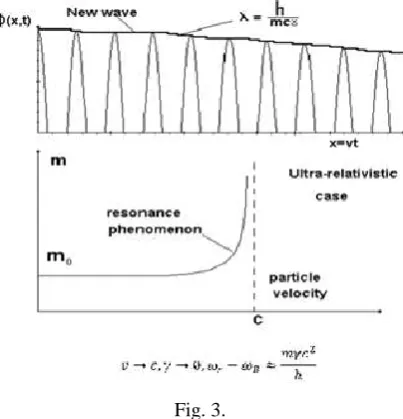
with growth of energy and resonance phenomenon appears that results in oscillating amplitude increase and in mass growth. Thus the well-known graph of particle mass dependence on the velocity (Fig.3) approaching to light s velocity constitutes actually a half of usual resonance curve for forced oscillation of harmonic oscillator if energy dissipation is absent. In the case whenv
c
, frequency
B
s
(frequency resonance),0
and the beats appear with difference frequency
/
2
d
s
B
mc
and particle will obtain absolutely new low-frequency envelop with wave length
mc
h
This is a new wave. This can be checked experimental in CERN. In ultra-relativistic limit case the value of
becomes much greater as typical dimension of quantum system it (new wave) interacts with. Now the length of new wave grows with energy contrary to de Broglie wave length slowly decreasing, and particle requires the form of quasi-stationary wave packet moving in accordance with classical laws. That explains the success of hydrodynamics fluid theory concerning with numerous particle birth when the packet having extremely big amplitude is able to split into series of packets with smaller amplitudes.Fig. 3.
Copyright © 2014 CTTS.IN, All right reserved Corpuscular properties occur due to the localization of a
wave packet in a small spatial region. The wave properties of the de Broglie waves can be explained in the following way: when the wave packet approaches to the
diffraction system (for example Young’s experiment with
two slits) then we have an ordinary diffraction of partial waves by splites, and the diffraction pattern of partial waves appears at the screen. HO could observe it with his microprobes.
As these packets are not overlapped then everything is linear and the superposition of the partial waves creates a total diffraction pattern modulated by the de Broglie
wave, although the plain de Broglie wave doesn’t exist at
all. It should be stressed that de Broglie wave is a packets locus of points of maximum in his motion, and it is a superposition of partial waves, that is why it appears in any diffraction and interference experiment.
4.
Q
UANTUMM
EASUREMENTSLet us try to consider real instruments, which are always macroscopic. Atomic nuclei and electron shells are situated very near to each other and form a very numerous, but discrete series. A transition from the one such a state to another is a quantum jump. That is why the absorption and emitting of energy between the atomic systems is carried out by means of the quanta. However, it doesn`t mean that in the motion process the quantum or the particle propagates as something constant and indivisible. The energy of the particle can be divided or changed by vacuum fluctuations. The wave packet of a photon, for example, can, in the issue of the overlapping of vacuum fluctuation, turn into meson at short time, and photon can disguise oneself as a proton or as a neutron. It s assumed in the ordinary quantum field theory that a proton has an atmosphere mesons; it follows from the interpretation of the results of its collisions with another particles. There is no mesons atmosphere indeed. A proton appears and disappears during its motion constantly at the de Broglie wavelength, and its mass
changes periodically from the double value of a proton’s
mass to zero, taken on the intermediate values of mesons masses.
Eventually, all of the quantum measurements are based on energy absorption and present inconvertible processes [5, 6, 13-15]. For every instrument founded a particle will operate, a quantum of energy is needed at least, thus it is
a threshold energy of instrument defining it’s
responsively. By the way, we would like to notice that our HO (Hypothetic Observer) uses the instruments with zero threshold energy that is why it can register even vacuum fluctuations.
Fig.4. Quantum measurements.
Let us consider the process of interaction of a particle with a macro-instrument [5, 6]. As soon as the particle is a wave packet, its energy is proportional to the intensity of the packet, but it can be changed because of periodic
spreading’s and appearances. Besides the packet itself can
be divided during the interactions. The macro-instrument to register a particle has to wait for a moment when the total energy of the particle and of the fluctuation of the atom would be more or equal to threshold energy. It is clear that the probability of the operation of the apparatus will be proportional to the amplitude of the wave packet, or more exactly, to the value of intensity of the envelope of the wave function. If the wave packet with a too low intensity in comparison with threshold energy of the macro-instrument approaches to the macro-instrument, the great fluctuation of vacuum is required, but the probability of such an event is too small, and it means that the probability to detect the particle is small too (Fig. 4). The theory of the quantum measurements is developed in the Unified Unitary Quantum Theory (UUQT), and the statistical interpretation follows now from the theory, but not just postulated, as it was before in the conventional quantum theory. This point of view requires automatically that the value of the dispersion of vacuum fluctuations is finite that, in another turn, requires the finiteness of the Universe.
5. U
NITARYQ
UANTUMI
LLUSTRATIONSThe uncertainty relation arises because energy and momentum are not constants, but they periodically change because of the dispersion owing to disappearance and appearance of the particle [2-4]. Besides because of statistical laws of measurements with macroinstruments, there is no any way to measure anything accurately owing to the unpredictable fluctuations of the vacuum. HO (Hypothetic Observer) could predict the coordinate, the momentum or the energy of the packet, if he would be the only one in the Universe, i.e. in the case of absence of the vacuum fluctuations.
determinism of Laplace went absolutely lost in the modern physics as well as in the future one. Maxwell was right when he told; “the true logic of the universe is calculation of the probabilities”. (back translation). The envelope of partial waves, occurring due to linear transformations at the wave packet and being in the ruins of splitting of the packet corresponds to Huygens principle. It explains how the relating of a moving particle with a monochromatic de Broglie wave is formally possible, propagating in the direction of the motion, and with all wave properties. There are partial waves that we consider as participants of diffraction and interference, but due to the principle of superposition we get the same result as if it a de Broglie wave would participate at the process.
The new linear equations of the UUQT allow the time inversion with simultaneous replacing of the wave function with a conjugated one, with the formal reversibility. Actually this reversibility takes place just in the case if the Universe consisted of the only one particle, as in the real world the recovering of the previous vacuum fluctuation is also needed for the total reversibility of the process. But there is a simultaneous reversibility of all processes in the Universe required for it that is impossible. It doesn`t mean that quantum processes are inconvertible, just the reversibility has a statistical character, but now direction of the current of time defines entropy only.
The envelope, introduced before, is accurately monochromatic, but it does not exist as a traveling plane wave with such properties in the reality. Though it is related to the energy of the particle, the following
definitions, such as “waves of the probability”, ”waves of the knowledge”, could be related with it too. In contrast
to the general quantum theory, now a very important phase is coming. It is the most easy to show it as the tunneling effect.
We would like to mention these established quantum phenomena to the reader. If we have a sufficiently narrow barrier with the height that is larger than the energy of an incident particle, according to the classical mechanics it will never go through the barrier. In the general quantum theory, the incident wave reflects and passes by partially, and we have a finite quantity of the probability that the particle will be behind the barrier. In these cases the general Quantum Mechanics states that the particle makes a tunnel in the barrier for itself, hiding the method of creation of this tunnel.
Let us listen to what HO says of this process? If a particle is approaching closely to a potential barrier in the phase of an absolute collapse, then it easily goes through the barrier, not interacting with it because of linear of all of equations for the small amplitude of the field. It just appears behind the barrier, without interacting with it, if its width is much less than de Broglie wavelength. And there is no necessity for it to make a tunnel. However, if it approaches in the phase with the maximal value of the packet, then the particle would be reflected because of the nonlinear interaction of the waves with the field of the barrier.
Now let us return to the experiment with the semitransparent mirror, discussed above. In terms of the described point of view, the wave packet (particle) will be divided at the mirror and enter in every beam, that depends on the packet phase near the mirror and on the structure of the mirror in this place. We have, in general, two not equal wave packets fragments with less values of the amplitude that can interfere. The changing of the parts of the fragments does not follow by because all process are linear, i.e. they are not dependants on amplitude. Besides the probability of detecting of the fragments is reduced, because an appreciable fluctuation of the vacuum is necessary for arising of threshold of detection of the counter. Consequently, in the results of the measurements the particles have to be lost or be observed as single particles in both of the beams simultaneously. The creation of two particles from a single is not a confusing fact, because the energy of the fragments will be reconstructed to the necessary level by means of the vacuum fluctuation. Note, the statement of Standard Quantum Mechanics that the particle may be presented simultaneously in many points of quantum world sounds strange from the common sense and remained for decades without any understanding of principal things. Within bounds of UQT scientific explanations are correct in principle.
At present time we have an ambiguous situation when high-tech experiments with fantastic results have been carried out, for example the classical experiments of Brown and Twiss and the variations of them (Fig. 1). It was found out that frequently both of the counters detect particles simultaneously, that is confirmed by the proposed mechanism. Furthermore, most of such experiments (including experiments with entangled photons) confirm directly this interpretation. The results of experiments with entangled particles are quite simple and understandable within bounds of UQT, and the idea to seek some over light mystic relations between particles is fully meaningless.
In consequence, an increasing number of photon pairs is always observed in the beam of light. However, it was found out that it is possible to carry out experiments whose effect remains also in the situation when there is no any way for any induced radiation. If we will collide particles of any kind, and if in the colliding point one or two particles are vanished, then they have to go against another without any interaction. Indeed, in the
Copyright © 2014 CTTS.IN, All right reserved Quantum object is getting classical one with a
simultaneous increasing of its mass, i.e. in the case of superposition of a large number of wave packets. The case when all of packets consisting a body will consolidate and spread simultaneously is impossible in physics, as they have different velocities and masses. That is why such a combination seems as a stable and permanent object, moving according to the classical mechanics laws, though every packet is described in terms of the Quantum Mechanics. It looks like all particles in the Universe owe their existence to each other, and the Universe itself is just a mathematical illusion, a trick.
In justice to the adherents of the Complementary we have to say the following. They do not retract it, though they have to wriggle, they have to tell that particles always go to the mirror as correlated pairs, and one of them goes through, but the second is reflected. Of course we need to consider the induced radiation effect, when
the one atom’s radiation is increasing the probability of
emitting from another excited atom of the same source, but it does not always happen. Let us return to the principle of Complementary. It is clear, that if we would not be interested in the nature of the particle and consider it just as an indivisible point then the principle of Complementary is correct. It is a very curious principle and it is amazing how N. Bohr could invent it.
In recent years a numerous of experiments was carried out, which found out superluminal speeds. Not debating if the special theory of relativity is right or not, let us show that in the Unified Unitary Quantum Theory (UUQT) any velocity is possible and the velocity of light is not maximum possible.
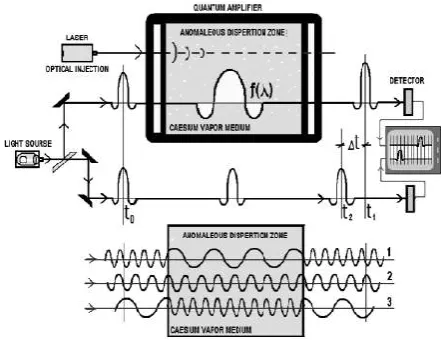
Fig. 5. Experiments of L.Wang - superluminal light propagation.
Let us consider Euclidean plain space, in which the photon propagates along the X-axis. According to the UUQT it is a wave packet and it could be presented as an infinite sum of harmonic components, that exist on the X-axis, figuratively speaking, placed at a distance of a million light years ahead and backwards. Now if we place on the X-axis arbitrarily far some special device, creating an anomalistic high dispersion, then the photon could
occur at the exit of the device, because the harmonic components shifted each other. The most interesting in this process is that nothing has moved between incident and reconstructed photons at this velocity! With other words, the conventional definition of the velocity is getting obsolete [19, 23].
Such experiments were carried out by several teams (in Berkeley, Vienna, Cologne, Florence, etc.) and they emerged the superluminal speeds. The most interesting were Lijun Wang`s investigations [27] in which the velocity 310 times higher than the speed of the light (Fig. 5) was found. Wang gives the same interpretation as ours, but only for an impulse of light. In this case it is a wrong interpretation, because in the experiment the envelope of the light pulse is not distorted absolutely, but it has to be obligatory, and Wang notices that it is amazed. He supposes that the special theory of relativity is absolutely destroyed. But it is not quite true.
Our idea that particles are wave packets is an absolutely original idea for the world wide science. The waves at the Fig. 5 have to be realized as separated partial waves of the spectral decomposition of the wave packets of the separated photons, but not as a spectral decomposition of the light pulse. Then the form of the momentum envelope will not be distorted.
The aspects of the Unitary Quantum Theory are confirmed by results of their practical applications to traditional tasks of physics. The UUQT allows firstly in the international science, not either to compute the electron charge and the fine structure constant (1/137) with the great precision (0.3%) [9-10] but even to compute masses of many elementary particles [15, 16, 18] (with the accuracy of 0.1-0.003%)! It s amazing that in the calculated spectrum of masses there is a particle mass about 131.7 GeV (L=2,m=2) that could be called Higgs boson [24].
The Modern Standard Model and quantum theories of field couldn`t even raise these problems mathematically. It should be stressed than when we will find the spectrum
of masses and charge of electron, time won’t be a part of
the ultimate equations and it will stay Newtonian. In the Unified Unitary Quantum Theory all interactions and particle production (packet split) are considered as an effect of diffraction of the packets by each other because of the nonlinearity. An analytical solution of these tasks will require new mathematical methods, and it is not even clear how to start with it at presence.
6. Approximated Equation with the
Oscillating Charge.
[8] in 1984, and only in 1988 they solved the dimensionless scalar version of this equation that allows to get the fine structure constant 1/137 and electron charge with accuracy 0.3% [9,10].
In this approximation of the UUQT, the wave packet is realized as a spatial divided electric charge that oscillates, its equation depends on time, coordinate and velocity and it could work in the rough model of the particle as oscillated charge, so we can exploit the Newton equations. It is becoming easy to see the tunneling effect: while the moving particle is approaching to the potential barrier, in the phase when the charge is extremely small, it is easy for it to go through the barrier, and when the quantity of the charge is large, the repulsion force is increasing, and the particle will be reflected. The numerical solution of these equations [14-16, 20], for the most common quantum tasks emerges approximately the same results as the calculation of the general Quantum Mechanics (QM). By the way, by means of the UUQT it
is possible to get this equation from the Schrodinger’s
one with very low energies [14,15]. But there are though some interesting differences. The equations of motion of the oscillated charge were not treated in physics before and they have an important difference from the classical laws of motion - the invariance of the motion in the relation to invariance translations. It means the absence of the great classical momentum and energy conservation laws. They appear in the UUQT and then in the classical mechanics only with an averaging for all particles. Now we obtain Uncertainty relations [13-15, 19, 23]. As far as the particle (wave packet) is periodically appearing and vanishing at de Broglie wave length (more precisely, the packet disappears twice, and the probability of its detecting is sufficiently big in maximum region only) the position of such a packet may be detected with error
2
x
and then2
h
P
x
As at measuring of momentum module is inevitable the error P= 2P, then we have following inequality:
h
P
x
. The statements of standard quantum mechanics that particles do not have a trajectory become more understandable. Of course, there is a lot of truth in those words. First, it is possible to say so about intermittent (dotted) motion of the particle with oscillating charge. Second, any packet (particle) is able during its motion to split into few parts. Each of those parts being summed with vacuum fluctuation may product, in principle, some new particles. Or visa versa the broken particle may vanish at all and contribute to general fluctuating chaos of the vacuum. But in any case it is better to have more clear idea of particle concrete motion than operate with generally accepted nowadays-obscure sentence about lack of trajectory.Fig. 6.
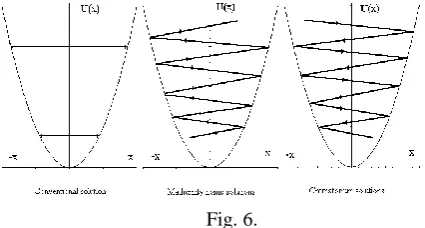
The consideration of the problems concerning oscillations of particles with an oscillating charge in a parabolic well (harmonic oscillator) besides the common results of QM for stationary states results in two different solutions that are shown on Fig. 6. New amazing solutions appeared,
one of them was called “Maternity home” and another was called “Crematorium”. In the first case the energy of
the particle can increase indefinitely, furthermore if we proceed from a very low initial quantity in the equation, it results in the increasing of the energy of the particle in the production of the matter, indeed. The second solution could due to collapse (disappear) of the matter-particle. These solutions are logically independent directly, and their appearance depends on initial phase. With other words, one solution describes the matter (energy) production, and another one its collapse; and it may be said that the Unified Unitary Quantum Theory (UUQT) allows to describe the creation of the matter and the Universe, but not as a result of the Big Bang. The
Universe wouldn’t be given to us in the static form, it
arose in some way and it continues to develop, and we could see that one of the basic features is the filling of space by matter.
7.
N
EWS
OURCES OFE
NERGYAs well known, in all experiments the local law of energy conservation (LEC) and the law of conservation of momentum in individual quantum processes are correct only for high-energy states. For low energies we can’t claim that, because of the uncertainty relation and the stochastic nature of QM`s predictions. That is why the idea of the global, but not of local LEC exists invisibly in the QM and it is not a new one.
For the physics it only means that for the stationary solution with fixed discrete energy levels (the general QM) of the velocity of the particle reflected by a wall is equal to incident one. The UUQT allows to consider another ways too. Thus if the velocity of the particle for every reflection is decreasing, then it is corresponding to
the “Crematorium” solution, but if it is increasing, then it
is corresponding to the “Maternity home”. What scenario
would turn to the reality depends on the initial phase of the wave function and on the energy of the particle. Besides the UUQT is fundamentally inapplicable for closed systems, because such systems are idealizations, which are very useful, but not according to the base of consideration used in the UUQT.
Copyright © 2014 CTTS.IN, All right reserved Anyway, the whole modern science, including the
Quantum Mechanics (QM), is still based on the great LEC. However, there is a difficult situation in the Quantum Mechanics. It deals with the fact that the LEC follows only from the Newton mechanics. QM generalizes the facts of the classical mechanics including all of its laws, but its results have a sufficiently statistical nature, they are correct only for large amounts of particles. But how do we have to consider single particles, with their individual processes? It appears that for the single particles LEC does not follow from QM (!), thus individual events are absolutely incidental and do not follow this law. To evade this question it was announced that Quantum Mechanics does not describe individual events (!?)
Let us discuss a thought experiment. To make our reasons more simple let operate a certain quantum ball-particle. If the ball is approaching to the wall, then its velocity after reflection will always be equal to the incident velocity (here we neglect a quantity of the friction force and consider that the ball and the wall are perfectly elastic). In the case of the quantum ball the velocity after the reflection would possess the whole arrange of the values, in different experiments under equal conditions. There would be some balls that would be reflected with velocities that are higher and some that are lower than the initial velocity, and some of them with velocities equal to the incident one, and every case would be considered statistically in the terms of the Quantum Mechanics. Let us answer the following question: what would happen if we place another wall opposite the first, and would try to increase the velocity of the ball after every reflection? Then we would get increasing of energy of the ball without action of any external force. The energetic of the systems in the XXI century will treat the question of constructing of initial conditions for a numerous quantity
of particles to realize only the “Maternity home” solution so that the “Crematorium” solution would be damped as
far as possible. But it depends on the selection of initial phases and the geometry of the system.
Thus, if we use the ideas of the Unified Unitary Quantum Theory appropriately then does not exist a general prohibition for creating of a quantum perpetuum mobile. Formally there is no such a prohibition even in the general Quantum Mechanics, because there are no conservation laws for a single process under the low energy conditions, but it treats with probabilities instead of this. In other words, the Quantum Mechanics (QM) also offers opportunities for getting energy by collecting of random process someway. It seems that UUQT affords today such an opportunity and suggests the ways how to regulate the values of probabilities.
Together with theoretical investigations plentiful of numerical solutions of equations with oscillating charge were performed, momentum of particles falling with different velocities were summarized and the result was compared to momentum of reflected particles. It was found out that for different repulsive potentials, the total momentum of reflected particles is equal to momentum of the falling particles with a high accuracy, but for a single
scattering particle the value of momentum could be either less or more than the momentum of the falling particle. This problem is very complicated and it requires subsequent researches as all this depends on initial conditions (velocity, phase, distance) complexly as well. The prospects following from the UUQT are not even the most significant. Any flat bans as the impossibility of perpetuum mobile creation and any other confirmations of the immovability of conservation laws are unacceptable in philosophy. No, these laws would never be neglected; but there would be such areas in science and technology, very limited in the beginning, so that these laws would be not enough.
The problem of existing of the global conservation laws (we have proved that they are not local laws) is left in abeyance. Nothing but the idleness and atavism of the human thinking lead to it. But this idleness of thinking --concerning the physics-- manifests itself in the intuitive atavism for the Newton laws.
Yes, the conservation laws are incontestable in the classical mechanics and in terms of this theory a continuously operating machine is theoretically impossible. It should be stressed that the conservation laws were transferred to the Quantum Mechanics as an object of worship of the classical mechanics. But the Quantum Mechanics is more fundamental, Newton laws follow from it as a particular case. And if in the terms of the Unitary Quantum Mechanics a possibility to get energy from nothing is theoretically possible, thus a quantum perpetuum mobile could be constructed.
It is made possible by means of the equation with oscillating charge. It describes single particles; the difference in their behavior depends on the initial phase of the wave function, but there are no conservation laws for an individual particle at all, they appear only after an ensemble averaging. The equation with an oscillating charge is absolutely new type of motion equation [11-17]. For such equation energy and impulse conversation laws do not exist. It appears after the ensemble averaging. By the way Schrodinger mechanics also do not propose energy conversation laws for small energies (it can offer only a probability of this or that event happening) but it cannot advise how to combine processes and energy liberation while UQT can. A theorem on the circulation does not work in the equation with oscillating charge that allows to use different way to move charge from the point A to the point B, but different ways operations will be diverse and this difference should be used.
The authors are trying to design new power plant working at these principles. We think that such a plant will be able to produce energy with extremely small spending of energy. If such power program would be fulfilled on our Planet then it will no doubt result in overheating of the environment. But UQT suggests the solution again: we can construct refrigerating plants which realize the
for the explanation of huge amount of heat being produced. It is the responsibility of the UQT solutions
“Maternity home”[13-15, 19, 20, 23, 34]. So it looks like catalysis mechanism described [13-15, 22]. Besides all the equation with oscillating charge is quite good in describing the wave properties of the particle. We predict that experiments on the diffraction reflection of electrons from the lattice (classical experiments of Davisson Germer) can be simulated by supercomputer, but authors do not have such possibility.
Interestingly enough, there are devices called Testatik Machine M/L Converter from religious group Methernitha. They belong to a religious Christian commune, situated in Linden near Bern. Theirs maker is Swiss physicist Paul Baumann living in the commune. These fantastic devices run as direct current generators, are made as a four dimensions (sizes) type with power value of 0.1, 0.3, 3 and 10 kW. In outward appearance this device resembles an electrostatic machine with Leyden jars, so familiar from school physics laboratory. There are two acrylic discs with 36 narrow sectors of thin aluminium stuck to it. The discs rotate in different directions and their mechanical energy is hundreds times lower that produced energy it accounts for about 100 mW in measurements. The largest device with the power value of 10 kW has disc diameters more than 2 m, and the smallest has 20 cm; the device with the power value of 3 kW has 20 kg in weight. There is no cooling or heating of the air during the long operation of the device, it just smells of ozone there. It was found out that the inventor
doesn’t clearly understand the principle of operation of
the device.
Professor S. Marinov (Austria), whom the commune had given as a present the device with the power value of 100
W wrote in his book called “Difficult way to the truth
--documents on the violation of conservation laws” , issued
in 1989 by International Publishers East-West: “I can confirm without any doubt that this device is a classical perpetuum mobile. Without any initial impact, it could rotate an unlimited long period of time and generate electrical energy equal to 100 W... In that device, the motor and generator are connected... However, it is not clear how it is possible”. (back translation).
The authors of the Unified Unitary Quantum Theory know approximately how this device is constructed, but in this article we are going to do only what is absolutely clear: we are going to show that the operation of this device completely corresponds with the UUQT. Evidently, it operates due to the charge separation concept.
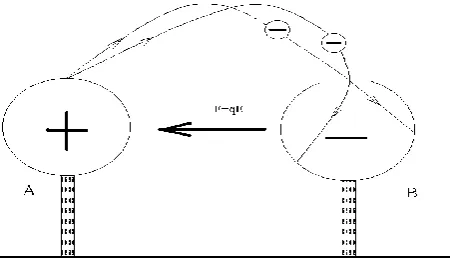
Fig. 7. Work for transferring the charge depends on the mode of transferring and on the path.
Let us consider two metallic spherical surfaces with a hole isolated from the Earth and from each other. If we carry a first electron from sphere A to the inner surface of sphere B through the hole by means of an isolated stick, then there appears a potential difference. Further, if we carry the second one and the subsequent electrons, sphere A would attract the carried charge, and B -would repeal it. It is clear that to move the charge we will have to spend energy. (Fig. 7).
In the Technical University MADI (Moscow) professor V.I. Uchastkin gives lectures on the Unified Unitary Quantum Theory (UUQT) and new energy sources. In his explanations, he uses the figurative analogy: Let us consider a sack of potatoes which mass is m. If we carried it to the fourth floor (the height is h), then we spend the quantity of work opposite to the gravitational field which is equal to mgh. And if we throw it down we would get kinetic energy , and these quantities would be equal to each other. But we could also carry not the whole sack, but every potato one by one. The work of one quantum of a potato s transfer depends on time, velocity and coordinate, and it must be carried in such way that the spent work would be minimal. If you carry the whole
sack in this way, you can get the quantity . So, there are no changes in the system, but the energy has appeared.
8.
C
ONSERVATIONL
AWS ANDU
NITARYQ
UANTUMT
HEORYInventors and swindlers of every stripe and range many years tried to construct or even to design perpetuum mobile, i.e. imaginary mechanism able to work without outside energy supply. Peter the First (Russian Emperor Peter Great) had even established Russian Academy of Science for such researches (see. V.L. Keerpechev,
“Talks about mechanics”, Gostechisdat, 1951, page 289),
Copyright © 2014 CTTS.IN, All right reserved Academy for mathematical proof that a boat with engine
and screw propeller would never have faster speed than sailing ship!
Magnificent successes of classical thermodynamics have strengthened Humanity confidence in Divine Infallibility of Conservation Laws. Today it is considered nearly indecent to call in question these laws.
First of all let us clarify the origin of conservation laws in classical mechanics [13-15,19,20,23]. Nearly each textbook contains a statement that Energy Conservation Law (ECL) results from homogeneity of time, Momentum Conservation Law results from homogeneity of space, and Angular Momentum Conservation Law – from isotropy of space. And so many people are impressed that Laws themselves result from space-time properties that nowadays are no doubt a relativistic conception. But for example angular momentum is not a relativistic conception already. Therefore such restricted approach is not totally correct, Newton's second law of motion or relativistic dynamics equation and concept of system closeness should be attracted. More over the requested space- time properties themselves are usually wrongly being interpreted. For example, it is assumed that time homogeneity means simple equivalence among all moments of time and homogeneity and isotropy of space means equivalence of all its points and absence of preferential direction in space (all directions are equal) correspondingly.
But these statements are sensu stricto wrong. For example, within many mechanical systems the Earth center direction and horizontal direction differ in principle (for example, pendulum clock located in horizontal plane will not work at all). We can say the same about the body being at the top of the hill, it is able to roll dawn independently, but according to classical mechanics it never climbs by itself. And for a person, being young or old, these moments of time are not equal at all. Hereinafter we would like to explain in what way all that should be understand.
Time homogeneity implies that, if at any two moments of time in two similar closed systems somebody run two similar experiments, their results would not differ. Space homogeneity and isotropy means that if closed system is moved from one part of the space to another or oriented in other way, nothing would be changed. Derivation of energy and momentum conservation laws from Newton equation is quite simple in idea. Viz., let us write down the main equation of dynamics in form of
dt
dP
F
For closed system F=0 (there are no external forces) and the equation possess the integralConst
P
expressing the momentum conservation law.
Now let’s write the main equation of dynamics in the form:
dt
d
m
m
a
v
F
and scalar-wise multiply it by v
2
2
2 2 3 1 3 1
mv
dt
d
v
dt
d
m
v
dt
dv
m
dt
d
m
i i i i iv
v
v
F
,where v is a modulus of velocity vector v. For the closed system F=0 it exists the integral
Const
mv
2
2
expressing one of the forms of energy conservation law.
Using the definition of the angular momentum for the particle, i.e.
r
P
L
and differentiating it both parts by t, we obtain
dt
d
dt
d
dt
d
P
r
P
r
L
As the momentum vector is parallel to velocity vector, the first bracket is equal to zero. And basing on the equation and on definition of central force, as one not creating a momentum, we get
0
dt
dP
r
and L=Const.In the case of central force within unclosed system angular momentum remains constant in value and direction.
The energy and momentum conservation laws can be easily obtained within relativistic dynamics from relativistic relation between energy and momentum
4 2 2 2 2
c
m
c
P
E
The term
m
2c
4is an invariant, i.e. it is similar within all reference frames. In other words it is a some kind of constant. This relation can be written in rather different formConst
c
P
E
2
2 2
To satisfy that relation one should admit that
Const
E
andP
Const
And that is nothing else than energy and momentum conservation laws.
But strictly speaking there is in relativistic mechanics there is a law of conservation of four-momentum vector
P
, but we are not going to stop at these details. In accordance with the classical mechanics, the energy conservation law signifies that energy of closed system remains constant, hence, if at the moment t=0 the energy of such system is denoted byE
0, and at themoment t is denoted by
E
t, thent
E
E
0
.that theory we have the same integrals of motion as in classical mechanics. Some value L would be an integral of motion if
0
L
H
t
L
dt
L
d
,
As
L
H ,
is determined by commutator of operator
L
and of Hamilton’s operator
H
, so any quantity L, being not evidently dependent on time will be an integral ofmotion if its operator commutes with
H
. When quantity L is not evidently dependent of time, then the first terms in (3.2.2) vanishes. As remainder we have
L
H
dt
L
d
,
,and, as we know, the quantum Poisson bracket vanishes for the integrals of motion being not evidently dependent on time. Thus,
L
0
dt
d
.
In any good work dealing with quantum theory it was shown that probability
w
to observe at any moment t any value of such motion integralL
, does not depend on time either. We will denote below such integrals ofmotion
L
n. As far operators
L
and
H
commuted they had common eigen-functions that were functions of stationary states. We should note that the last were obtained from solution of Schroedinger equation without time (not containing t) which is derived from full Schroedinger equation if
t
E
i
exp
t
r
,
r
0 ,i.e. if this equation has the periodic solutions. The solutions of Schroedinger equation not containing t satisfy conservation laws, which are, in fact, dictated by condition of total time-independence. The expansions of such solutions in eigen-functions’ have the form
n n n
L
L
,
n n n
E
H
, where
n n n n n nn t c t x
E i exp x c t x , ,
c
exp
i
E
t
c
exp
i
E
t
t
c
n n n n n
0
.As (3.2.4) is eigen-functions’ expansion of the operator
n
L
, the probability does not depend on time, i.e.
L
t
c
t
c
Const
w
n,
n 2
n0
2
We should note once more that it is the probability to observe some given value that is time-independent, while, the value itself is occasional in each individual case.
As far the energy is an integral of motion and probability w(E,t) to find out at the moment t energy value to be equal to Е is time-independent, then:
0
)
,
dt
t
E
dw
Quantum energy conservation law in the above mentioned form assume the possibility of energy determination at the current moment of time not taking into account its uncontrolled changes due to influence of the process of measurement itself. That situation did not rise any doubts within classical mechanics. But according to quantum theory (as we have written already in [13-15]), the energy can be measured without disturbance of its value only up to
E
,where
- is the duration of measuring process. Formally, there are no troubles for energy conservation law, as the energy is the integral of motion and we have arbitrary large time interval to accomplish long measuring. For example, let measure within time
, then leave the system alone for the time Т, and then measure the energy once again. The energy conservation law in standard quantum mechanics states that the result of the secondmeasuring will coincide to
E
with the results ofthe first measurement. But even according to standard quantum theory all this is not totally logical, because really existing vacuum fluctuations may meddle and they are able to change the result. Here we have evident violation of conservation law due to vacuum fluctuations, although the integrals of motion exist (contrary to UQT). The standard quantum theory carefully avoids the question of conservation laws for single events at small energies.
Copyright © 2014 CTTS.IN, All right reserved It is well known that local laws of energy and momentum
conservation for the individual quantum processes are valid within all experiments at high energies only. We can not say so in the cases of law energies at least due to uncertainty relation and stochastic nature of all predictions in quantum theory. The idea of global but not local energy conservation law is invisibly presenting in quantum mechanics and in any case is not new. From the physical viewpoint it just means that in stationary solutions with fixed discrete energies (standard quantum mechanics) the velocity of a particle reflected from the wall is equal to the velocity of an incident particle. If the particle energy decreases at each reflection, then that case corresponds to solution type “crematorium” and if increases – to “maternity home” solution. The scenarios under which events will be developed depend on the initial phase of the wave function and particle energy. In the strict Unitary Quantum Theory and in the theory of quantum measuring (chapter 1) un-removable vacuum fluctuations part a great role. It is quite clear these fluctuations being totally unforeseen and non-invariant with respect to space and time translations. In other words, within UQT there are no habitual space-time properties. Now space-time is heterogeneous and non-isotropic. For example, if the experiment is replaced in any other point of the space or repeated at other time,
then in the point where the particle’s parameters were
examining and particle is interacting with macro-device, another value of vacuum fluctuations would appear (differing from the previous one) that would give another result. Of course that is true for small energies and individual events (particles) only.
The Unitary Quantum Theory is much more destructive with regard to the notion of Closed System. For single events at small energies that notion is inapplicable at all because at any moment of time and in any place where the particle is located (for example, within potential hole) vacuum fluctuation may be abruptly changed. It may occur thanks to various causes; either due to the nature of vacuum fluctuations, or due to the tunneling effect of other random particle.
Some times it is stated that energy conservation laws follow from E.Noether theorem, although those results have been contained in the works of D.Gilbert and F.Klein. For any physical system, the motion equations of which can be obtained from variational principle, every one-parameter continuous transformation, that is keeping the variation functional invariant, corresponds only one differential law of conservation and then there exists explicitly conserved quantity. However, it can be easily seen that vacuum fluctuations being imposed on varying functional (Lagrangian) does not remain constant (in any case it seems so today) under parametrical transformations. That consideration does not work too without ensemble averaging either.
In other words, all requirements that lead to classical laws of conservation are absent now. It is hard to expect that the entire laws of conservation will remain valid in that situation for the single particles at small energies. But nowadays it seems that classical laws of energy,
momentum and angular momentum conservation for the single quantum objects do not work at small energies due to the periodic appearance and disappearance of particles. All direct experimental checks of the conservation laws were carried out in the cases of great energies but in the cases of small energies for single particles probability results can be obtained only. In that case it is indecently even to recollect the idea of conservation law.
And now a bit of Philosophy for reader. Local Energy Conservation Law (LECL) for individual processes results from the Newton equations for closed systems. It is naive to think that its local formulation will remain constant forever. And it would be a gross error to transfer ECL without alterations from Newton mechanics to quantum processes inside microcosm. Definitely speaking references to the first law of thermodynamics are baseless because it is a postulate. For example, in his letter to one inventor the famous Russian mathematician N.N.Lousin
wrote: “ first law of thermodynamics was a product of
unsuccessful attempts of the humanity to create perpetuum mobile and frankly speaking did not follow
from anything” .Today we can say with more belief that no resourceful machines within the network of Newton mechanics are able to realize perpetuum mobile, and the decree of French Academy, accepted in 1755 to consider no projects of perpetuum mobile is still valid. We should add that is apparently true for all projects based on Newton mechanics only.
It is characteristic of the understanding the position ECL in modern physics that this low is bringing down, especially in theory, to the rank of second-order conclusion from the equations of motion. Some physicists reduce ECL to the statement of the first law of thermodynamics, others as for example D.I.Blochintsev [79] consider that “it is quite possible with further development of new theory ECL form will be transformed”. As F.Engels wrote in his “Natural
dialectics”: “…no one of physicists does not, in particular, consider ECL as everlasting and absolute law of the nature, as a law of spontaneous transformation of substance motion forms and quantitative permanency of that motion at its transformations.” Many of them are thinking in another manner as, for example,
M.P.Bronshtein. He wrote in his work “Substance structure” ECL is one of the basic laws of Newton mechanics. And nevertheless Newton had not attributed to that law rather general character that law had in reality. The reason of that Newton mistaken point of view at ECL was quite interesting… Now it is understandable that in the light of the above mentioned such point of view was not wrong at all. And we should remind that
Newton had foreseen in his “theory of bout” many things
even quantum mechanics.