This is a repository copy of
Modelling health state preference data using a non-parametric
Bayesian method
.
White Rose Research Online URL for this paper:
http://eprints.whiterose.ac.uk/10933/
Monograph:
Kharroubi, S. and McCabe, C. (2006) Modelling health state preference data using a
non-parametric Bayesian method. UNSPECIFIED. (Unpublished)
HEDS Discussion Paper 06/01
[email protected] https://eprints.whiterose.ac.uk/ Reuse
Unless indicated otherwise, fulltext items are protected by copyright with all rights reserved. The copyright exception in section 29 of the Copyright, Designs and Patents Act 1988 allows the making of a single copy solely for the purpose of non-commercial research or private study within the limits of fair dealing. The publisher or other rights-holder may allow further reproduction and re-use of this version - refer to the White Rose Research Online record for this item. Where records identify the publisher as the copyright holder, users can verify any specific terms of use on the publisher’s website.
Takedown
If you consider content in White Rose Research Online to be in breach of UK law, please notify us by
HEDS Discussion Paper 06/01
Disclaimer:
This is a Discussion Paper produced and published by the Health Economics
and Decision Science (HEDS) Section at the School of Health and Related
Research (ScHARR), University of Sheffield. HEDS Discussion Papers are
intended to provide information and encourage discussion on a topic in
advance of formal publication. They represent only the views of the authors,
and do not necessarily reflect the views or approval of the sponsors.
White Rose Repository URL for this paper:
Once a version of Discussion Paper content is published in a peer-reviewed
journal, this typically supersedes the Discussion Paper and readers are invited
to cite the published version in preference to the original version.
Published paper
None.
The University of Sheffield
ScHARR
School of Health and Related Research
Health Economics and Decision Science
Discussion Paper Series
February 2006
Ref: 06/1
Modelling health state preference data using a
non-parametric Bayesian method
Samer Kharroubi and Christopher McCabe
Health Economics and Decision Science
Corresponding Author: Christopher McCabe
Health Economics and Decision Science School of Health and Related Research University of Sheffield
Regent Court, Sheffield, UK S1 4DA
Email: [email protected]
Abstract
This paper reports on the findings from the application of a recently reported
approach to modelling health state valuation data. The approach applies a
nonparametric model to estimate the revised version of the Health Utilities Index
Mark 2 (HUI 2) health state valuation algorithm using Bayesian methods. The data
set is the UK HUI 2 valuation study where a sample of 51 states defined by the HUI 2
was valued by a sample of the UK general population using standard gamble. The
paper presents the results from applying the nonparametric model and compares these
to the original model estimated using a conventional parametric random effects
model. The two models are compared in terms of their predictive performance. The
paper discusses the implications of these results for future applications of the HUI 2
and further work in this field.
JEL classification: I1
1. Introduction
There has been an increasing use of preference-based measures of health related
quality of life in order to calculate quality adjusted life years for use in cost
effectiveness analyses. These preference-based measures are standardised
multi-dimensional health state classifications with pre-existing preference or utility weights
elicited from a sample of the general population. There are currently a number of
such preference-based measures, including the EQ-5D (Brooks, 1996), HUI2 & 3
(Torrance et al, 1996; Feeny et al, 2002), 15D (Sintonen, 1994, 1995), AQoL
(Hawthorn et al, 2001), QWB (Kaplan et al, 1988) and the SF-6D (Brazier et al,
2002). All of these measures describe a large number of health states, such that it is
not feasible to obtain direct valuations for each health state. Thus models are
constructed to predict the values for all states in a descriptive system based upon
direct valuations of a sample of states.
Health state values present a significant challenge for conventional statistical
modelling procedures due to their nature, namely: skewed, truncated, non-continuous
and hierarchical (Brazier et al, 2002). Attempts to statistically model these data have
met with some success in the EQ-5D, SF-6D and HUI2 (Dolan, 1997 and Brazier et
al, 2002, McCabe et al 2005a). However, there were concerns with the size of the
prediction errors, non-monotonicity in some estimated health state values and an
apparent systematic pattern in the prediction errors. Recently, Kharroubi et al (2005)
reported an alternative, non-parametric Bayesian method for modelling health state
preference data. This paper reports the application of this method to the UK HUI2
valuation data reported by McCabe et al, and compares the results with the
conventional random effect regression model.
The next section of this paper provides a brief description of the UK HUI2 valuation
survey. A detailed description has been reported elsewhere. (McCabe et al, 2005a)
In section 3 the results from each approach are presented and compared in terms of
their ability to predict actual values. We conclude with a discussion of the results and
their implication for the HUI2 and future approaches to modelling health state
2. The Health Utilities Index Mark 2
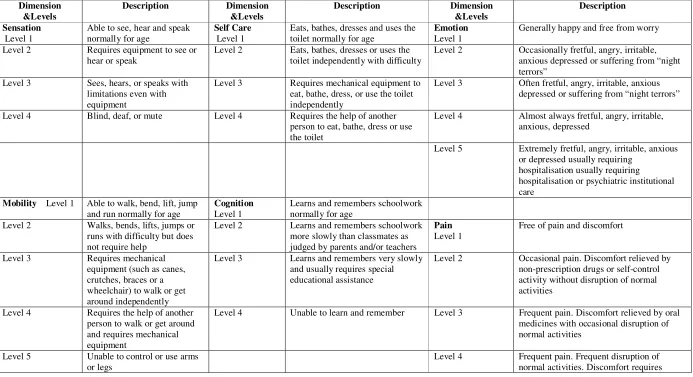
The HUI2 is a preference-based multi-attribute health related quality of life
instrument specifically developed for use with children.(Torrance et al, 1996) It
consists of seven attributes (sensation, mobility, emotion, cognition, self care, pain
and fertility), each of which has between three and five levels. The levels describe a
range, from ‘normal functioning for age’ to ‘extreme disability’. (Table 1). When it is
used as a generic instrument, fertility is excluded. (Torrance et al, 1996). The generic
version of the instrument was used for the UK valuation survey.
As part of a large study of outcomes following paediatric intensive care in the United
Kingdom, 3 separate valuation surveys were undertaken. These have been described
in detail elsewhere. (McCabe 2005a, b). The work reported in this paper utilises the
data from two of those surveys.
One hundred and ninety nine respondents provided valuations for 51 health states in
the HUI2 descriptive system, using the standard gamble technique following the
methods described by Furlong et al. (1990) The mean number of valuations per
health state was 24 (range 9 to 29).
Fifty one respondents provided valuations for 14 health states from the HUI2
descriptive system not valued in the Valuation Survey, using the same standard
gamble technique and script as in the Valuation Survey.
3. Modelling
The generic HUI2 descriptive system describes 8000 possible health states and the
empirical survey could obtain valuations for only a small subset. The aim of
modelling is to estimate health state utility values for all states. The utility associated
with a health state is assumed to be a function of that state, hence by estimating a
relationship between the descriptive system and the observed values we can infer
values for all states. Valuation surveys generate data with a complex structure
creating a number of problems for estimation and a variety of techniques have been
relationships with particular assumptions about functional form, but here we contrast
this conventional parametric approach reported by McCabe et al (2005a) with a more
realistic and flexible nonparametric model.
A general model for health state valuations can be described by:
ij j ij
ij f
y = (x ,α +) ε , (1)
where, for i = 1, 2, …, nj and j = 1,2, …, m, xij is the ith health state valued by
respondent j and the dependent variable yij is the adjusted SG score given by
respondent j for that health state. The general model has two sets of independent,
zero-mean, random effect terms: εij is a random error term associated with each
observation and αj is a term to allow for individual characteristics of respondent j.
The interpretation of f(xij,αj) is as the true indifference SG value that respondent j
has for health state xij. The objective is to obtain a health state utility measure for the
population as a whole, and this is generally taken to be the mean of the
respondent-level health state utilities across the population. In order to account for different
populations, it is possible to model αj in terms of respondent-level covariates such as
age, gender or socio-economic factors, but the principal objective of the HUI2
valuation study was to estimate a health state utility function for the UK population as
a whole.
3.1 The parametric approach
McCabe et al (2005a) specify the following model for respondent j’s health state
utility:
j ij j
ij
f(x ,α )=µ+θ′I(x )+α , (2)
where µ and θ denote unknown parameters, I(xij) is a vector of dummy explanatory
variables. In the simplest, no-interactions, case of this model, I(xij) is a vector of
terms Iδλ(xij) for each level λ > 1 of dimension δ of the HUI 2. For example,
) (
32 ij
irritable, anxious depressed or suffering from “night terrors”). For any given health
state xij, Iδλ(xij) is defined as:
)
( ij
Iδλ x = 1 if, for state xij, dimension δ is at level λ.
)
( ij
Iδλ x = 0 if, for state xij, dimension δ is not at level λ
In all, there are 21 of these terms, with level λ = 1 acting as a baseline for each
dimension. Hence the intercept parameter µ represents the health state utility value
for state (111111), and summing the coefficients θδλ of the ‘on’ dummies derives the
value of any other state.
More generally, I(xij) can include additional dummy variables to account for
interactions between the levels of different dimensions, and the model selected by
McCabe et al (2005a) included no such interaction term.
Estimation of this random effects model is via generalised least squares or maximum
likelihood. Since αj has zero mean, the population health state utility for state x in
this model is simply µ+θ′I(x).
3.2 The nonparametric approach
Kharroubi et al. (2005) build a new Bayesian statistical nonparametric model to
describe the intrinsic characteristics of individual health state valuation data that is
argued to be more theoretically appropriate than previous parametric models. For
respondent j, the health state utility of state xij is
{
1 ( )}
) exp( 1 ) ,
( ij j j u ij
f x α = − α − x . (3)
Note that the individual respondent term αj enters multiplicatively rather than
additively as in (2). In the Kharroubi et al. (2005) model, the distribution of αj is
where tj is the vector of covariates for respondent j. Note here that t’s are centred to
ensure that they have zero means, and hence that the value of exp(α) for a typical
person is 1.
The term u(x) is the median health state utility of health state x.1 It is treated as an
unknown function and in a nonparametric framework it therefore becomes a random
variable. The model for u(x) is
u(x) ∼ N(γ +β′x,σ2), (4)
and furthermore the values of u(x) and u(x′) for two different states x and x′ have a
correlation c(x,x′) which decreases as the distance between x and x′ increases. The
effect of this is to assert that if x and x′ describe very similar health states (in the
sense that their levels are the same or close in all dimensions) their utilities will be
approximately the same, and so the preference function varies smoothly as the health
state changes.
Note that the mean health state utility in (3) is
{
1 ( )}
1 )
(x u x
u = −α − ,
where α is the mean value of exp(α) over the whole population. This will not in
general be 1, and so the population (mean) health state utility is not the same as the
median health state utility u(x). More details of the nonparametric modelling and
evaluation of α are given in Kharroubi et al (2005).
The models and the programs to undertake the Bayesian approach were written in
Matlab and are available on our website (http://www.shef.ac.uk/chebs).
4. Results
Given the overall aim is to predict health states valuations, the best way to compare
the two models is via their predictive ability. The models are compared on Figures 1
and 2, where the predicted and actual mean values for the 51 health states valued in
1
Consider the case when there are no covariates, the distribution of αj is normal, so it has zero
the survey have been plotted with health states ordered by actual health state values.
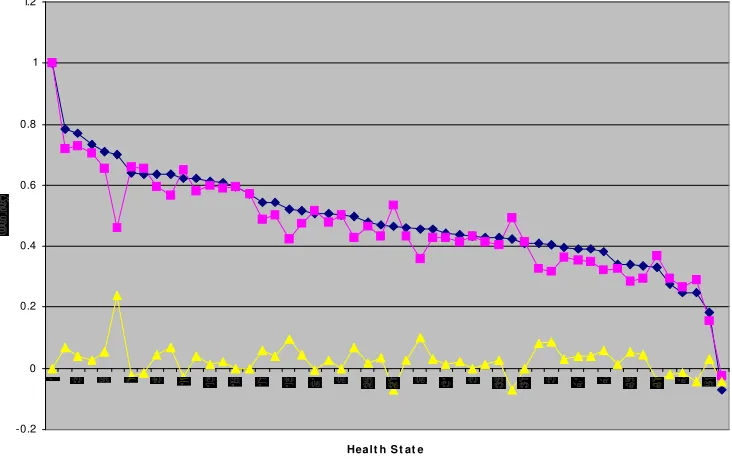
Figure 1 presents the resulting predicted mean health state valuations (dotted line) for
the parametric model (2), along with actual mean health state valuations (solid line).
The dashed line represents the errors obtained by the difference between the two
valuations. Figure 2 presents the corresponding plots for the nonparametric model.
There is a very close level of agreement between the parametric and non-parametric
model. The only exception to this being state (3,1,3,3,3,1). The parametric model
predicts the observed mean value considerably more accurately than the
non-parametric model. We consider this finding in more details below.
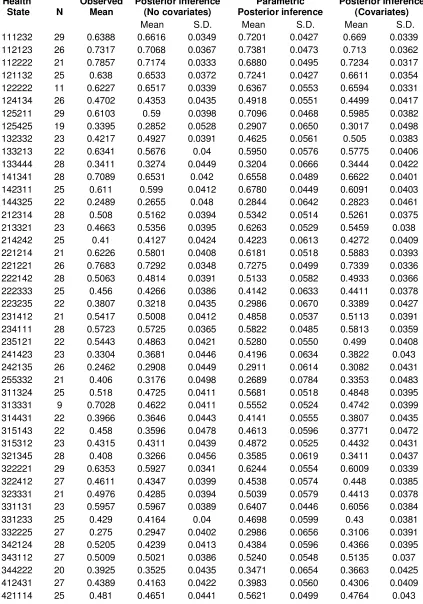
Table 2 shows the inference for the mean health state utility values of the 51 health
states valued in the Valuation Survey and the 12 states that were valued in the
Validation Survey. For each state, Table 2 reports the observed sample mean health
state utility and the predicted mean and standard deviation for the population mean
health state utility from both the nonparametric and parametric models. The states
marked with an asterisk were not valued in the valuation survey. Across the 51 states
that were used in the study, the predictive performance of the nonparametric model is
better than the parametric model overall, with a root mean square error (RMSE) of
0.055 for the nonparametric model and 0.060 for the parametric model. Very few
health states are valued worse than death in either model. Finally, it can be seen that
the standard deviations of the predictions are larger for the parametric model.
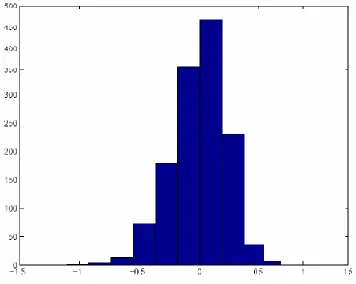
As always, it is important to check the validity of the assumed models. Figure 3 plots
a histogram of residuals across all 1370 health state valuations for the parametric
model and Figure 4 plots the corresponding residuals for the nonparametric model.
According to these models we would expect these to be approximately normal.
Figures 3 and 4 broadly support this, although there is some evidence of skewness
which is more obvious in Figure 3. This is not surprising, given the negative skewness
in the original SG data at the individual level. However, the degree of skewness is
probably not high enough to invalidate the analyses in both models, which assume
normally distributed errors. An important finding of Figures 3 and 4 is that the
nonparametric model clearly yields smaller residuals, and so fits the data better. The
the parametric model. However, this in part reflects fact that the histogram for the
parametric model has been calculated the frequentist way, regarding the individual
random effects as being just random and so part of the error. The histogram for the
nonparametric model has been calculated using the Bayesian convention, in which the
random effects are handled more like a fixed effect in frequentist terms.
A better test of the validity of the model is to investigate its ability to predict the
values for states that have not been used in the estimation. Data relating to 10 selected
health states were removed from the estimation data, and the models fitted on data for
the remaining 41 states. Table 3 presents the true sample means for the 10 omitted
states, together with their predicted mean and standard deviation values from the
parametric and nonparametric models estimated on the reduced data set. The
predictive performance of the nonparametric model is better than the parametric
model overall, with RMSEs of 0.050 and 0.090 respectively. It can be seen that the
nonparametric model predicts the omitted data quite well, and better than the
parametric model. It is to be noted that the predictive standard deviations here for
both models are larger than those in Table 2, because the model in Table 2 is
predicting the data on which it was estimated, whereas the model in Table 3 is
predicting out of sample data. The parametric standard errors are larger than the
nonparametric ones, primarily because the nonparametric analysis is able to make use
of other evaluations by the same respondents to estimate their individual random
effects, which the frequentist analysis can not do.
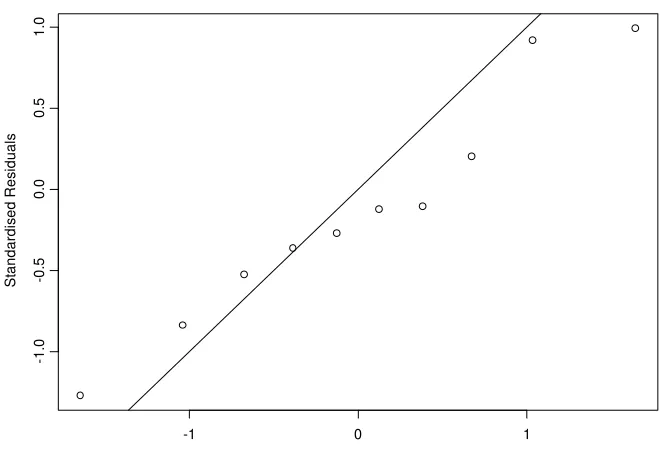
Figures 5 and 6 show the Q-Q plots of standardised predictive errors for the 12 health
states sample means, for the parametric and nonparametric models respectively. In
each figure the straight line corresponds to the theoretical N(0,1) distribution. Figure 5
suggests that the parametric model is not well validated by its predictive performance.
In contrast, it is apparent from Figure 6 that the nonparametric model predictions are
well validated. The mean of the standardised residuals for the parametric model is
-0.66 compared to -0.14 for the nonparametric one.
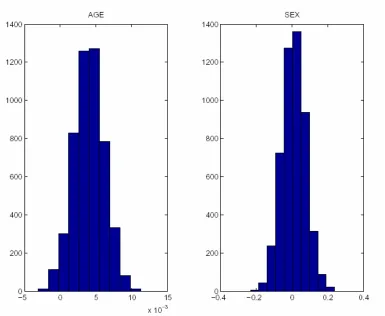
To capture the impact of the respondent characteristics, Figure 7 shows the
age. These results indicate that age has a strong effect, as it is not centred on zero.
Sex is centred very close to zero, and thus has a negligible effect. To demonstrate the
impact of adjusting for age on the mean health state values, results are presented for
the states listed in Table 2 with and without adjusting for covariates. Actual UK age
distribution was taken from the UK census of 2001 (www.statistics.gov.uk/census).
These results show that the largest differences between health state values are for the
most severe HUI 2 health state. Mean health state values for the pits state are
-0.0256 and -0.0018 with and without adjusting for age respectively with difference of
0.0238. This difference declines as states become milder. This suggests that the
magnitude of the gain of moving from a severe to mild state will be a smaller for
older age groups. We consider this finding in more detail in the discussion section.
5. Discussion
This paper reports the findings from applying a new approach to modelling health
state valuation data. The approach applies a nonparametric model to estimate health
state utility values for the HUI2 using Bayesian methods. We have presented two sets
of analyses; the first has compared a Bayesian main-effects model with the existing
conventional main effects model, (McCabe 2005a). The second has utilised the
flexibility of the non-parametric Bayesian method to examine the impact of covariates
on health state values.
The main effects Bayesian model represents a significant improvement on the
conventional model. Perhaps more importantly, the Bayesian method is more robust
to reductions in the quantity of data available for model estimation, than the
conventional model. The conventional model estimated on 41 health states produces a
number of large prediction errors. This is perhaps unsurprising, as the Bayesian
method supplements the data with prior knowledge on the correlation between health
state values. It is important that the specified co-relations are acceptable to the users
of the modelled values. Assuming this criterion is met, the Bayesian modelling
approach makes efficient use of the information provided by typically small health
It is worth noting that the Bayesian model produces a very poor prediction for one
state (313331). The explanation for this may lie in considering the nature of this
health state. It combines substantial limitations in sensation, emotion, cognition, and
self-care with full functioning on mobility and freedom from pain. This health state
may well have been extremely difficult for respondents to visualise. Is it plausible that
an individual can combine ‘Able to walk, bend, lift, jump and run normally for age’
with ‘Requires mechanical equipment to eat, bathe, dress, or use the toilet
independently’? The potential problem with the plausibility of the health state is
confounded by the small number of observations for the health state; n=9. There were
relatively few observations for one other health state, (122222), however both models
produce reasonable predictions for this state, suggesting that the plausibility of state
(313331) is the more likely explanation of the poor predictive performance. To
facilitate comparison with the published statistical model we have reported the model
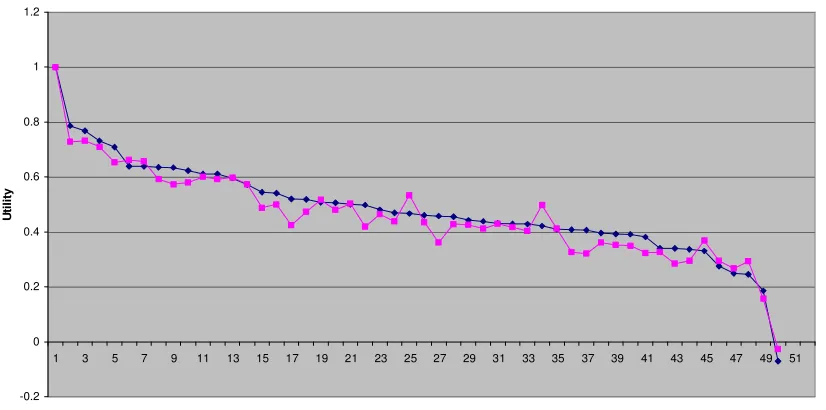
estimated on the 51 states. (McCabe 2005a). However, Figures 8 and 9 report the
results of the Bayesian main effects model estimates on the dataset with state
(313331) and both states (313331) and (122222) excluded respectively. It is clearly
that the Bayesian model is improved as a result of this exclusion.
As reported earlier, the covariates analysis showed that whilst gender is not an
important determinant of health state values, whilst age is. For milder health states,
the predicted values do not vary much with age; however, the more severe the health
state, the greater the impact of age on the health state value. There are at least two
possible explanations for this result. Older respondents may genuinely put a lower
value on lower levels of functioning; i.e the more time you have lived, the more
important it is that the remaining years are lived at a reasonable level of functional
health. Alternatively, it may be that younger respondents did not adhere to the
instruction that the health state would last for 60 years or assumed that over such a
long period of time, advances in medical science would improve the level of health
related quality of life associated with any given functional condition. It may also be
that the cognitive burden of the HUI2 question was too great and the values obtained
were artefacts of the process and do not reflect actual preferences.
This result is, to some degree, at odds with the existing literature on the relationship
experience of ill-health, adaptation leads them to place higher values on poor health
states compared to younger people. Analyses by Kharroubi et al of the SF-6D data has
found this type of relationship.(Personal Communication). Dolan’s analysis of the UK
EQ-5D data reported a similar relationship, however, the increasing value is only
observed over a limited age range; by 50 years of age the EQ-5D data show the same
decreasing value with age as seen in the HUI2 data. In addition, this relationship is
more pronounced in the severe health states in both the HUI2 and EQ-5D datasets.
These results do have important implications for the use of published valuation
algorithms. If the analyst is interested in obtaining an estimate of the current
population mean value for a given health state, the effect of the changing age profile
of the general population needs to be taken into account.
(http://www.statistics.gov.uk/cci/nugget.asp?ID=949). Our results indicate that, for
any given health state, the current mean values should be lower than the values of 10
years ago, because of the change in the age distribution of the population. Thus,
ceteris paribus the health gain from preventing individuals entering these health states
will be greater and thus more cost effective.
The observed relationship between age and utility may have implications for our
understanding of the difference between patient and general population health state
values. As ill-health is positively correlated with age; ceteris paribus, patients’ values
are likely to be lower than general population values. Thus, the degree of adaptation
that leads to the observation that patients value health states more highly than the
general population may be larger than currently thought. At a minimum, future
analyses of comparative data should control for age when estimating the scale of
divergence between patient and general population values.
The covariates model has the potential to estimate health state valuation tariffs for
sub-groups of populations; and for populations with different socio-economic profiles.
Such tariffs are valuable in their own right and would also be very useful in the design
of HUI2 health state valuation surveys for other countries; acting as informative
priors. In addition, covariates models will allow the detailed exploration of the
observed international variations in the health state value models for instruments such
References
Brazier, J.E., Roberts, J. & Deverill, M., 2002. The estimation of a preference-based
measure of health from the SF-36 . Journal of Health Economics 21, 271(292).
Brooks, R., 1996. EuroQol: the current state of play. Health policy 37, 53(72).
Dolan, P., 1997. Modeling valuation for Euroqol health states. Medical Care 35,
351(363).
Dolan, P., 2000. The effect of age on health state valuations. J. Health Services
Research and Policy 5, 17-21.
Feeny, D. H., Furlong, W. J., Torrance, G. W., Goldsmith, C.H., Zenglong, Z.,
Depauw, S., Denton, M., and Boyle, M., 2002. Multi-attribute and single-attribute
utility function for the Health Utility Index Mark 3 system. Medical care 40(20),
113(128).
Furlong, W. J., Feeny, D. H., Torrance, G. W., Bar, R., and Horsman, J. 1990. Guide
to design and development of health state utility instrumentation. CHEPA Working Paper #90-9, McMaster University Hamilton, Ontario.
Hawthorne G., Richardson G., Atherton_Day N., 2001. A comparison of the
Assessment of Quality of Life (AQoL) with four other generic utility instruments.
Annals of Medicine 33, 358--370.
Kaplan, R.M., & Anderson, J.P., 1988. A general health policy model: update and
application. Health Services Research23, 203--235.
Kharroubi, S. A., O'Hagan, A. and Brazier, J. E., 2005. Estimating Utilities from
individual health state preference data: a nonparametric Bayesian approach. Applied
Statistics 54, 879-895.
McCabe C. Stevens K. Roberts J. Brazier JE. 2005a. Health state values for the
McCabe C. Stevens K. Brazier JE. 2005b. Utility scores for the Health Utilities
Index Mark 2: an empirical assessment of alternative mapping functions. Medical
Care 43;627-635
Sintonen H., 1994. The 15D-measure of health-related quality of life. I. Reliability,
validity and sensitivity of its health state descriptive system. National Centre for
Health Program Evaluation, Working Paper 41, Melbourne.
Sintonen H., 1995. The 15D-measure of health-related quality of life. II. Feasibility,
reliability and validity of its valuation system. National Centre for Health Program
Evaluation, Working Paper 42, Melbourne.
Torrance, G. W., Feeny, D. H., Furlong, W. J. Barr, R. D., Zhang, Y., Wang, Q. A.
1996. Multi-attribute utility function for a comprehensive health status classification
Figure 1. Sample mean and predicted health states valuations for the parametric model.
Actual vs Predictive valuations
-0.4 -0.2 0 0.2 0.4 0.6 0.8 1 1.2 13579 1 1 1 3 1 5 1 7 1 9 2 1 2 3 2 5 2 7 2 9 3 1 3 3 3 5 3 7 3 9 4 1 4 3 4 5 4 7 4 9 5 1 Health State U ti li ty
Observed Mean Predicted Mean Residuals
Figure 2. Sample mean and predicted health states valuations for the nonparametric model.
Actual vs Predictive valuations
-0.2 0 0.2 0.4 0.6 0.8 1 1.2
Hea l t h S t at e
[image:18.612.127.493.450.682.2]Figure3. Residuals for the parametric model for each of the 1370 individual health state
[image:19.612.127.483.107.390.2]valuations.
Figure 4. Residuals for the nonparametric model for each of the 1370 individual health state
[image:19.612.129.485.437.721.2]Figure 5. Q-Q plot of standardised predictive errors for the parametric model for the 10 out of sample health states.
Quantiles of Standard Normal
S ta n d a rd is e d R e s id u a ls
-1 0 1
-2 .0 -1 .5 -1 .0 -0 .5 0 .0 0 .5
Figure 6. Q-Q plot of standardised predictive errors for the nonparametric model for the 10
out of sample health states.
Quantiles of Standard Normal
S ta n d a rd is e d R e s id u a ls
-1 0 1
[image:20.612.135.469.464.692.2]Table 1: The Health Utilities Index Mark 2
Dimension &Levels
Description Dimension
&Levels
Description Dimension
&Levels
Description
Sensation
Level 1
Able to see, hear and speak normally for age
Self Care
Level 1
Eats, bathes, dresses and uses the toilet normally for age
Emotion
Level 1
Generally happy and free from worry
Level 2 Requires equipment to see or hear or speak
Level 2 Eats, bathes, dresses or uses the toilet independently with difficulty
Level 2 Occasionally fretful, angry, irritable, anxious depressed or suffering from “night terrors”
Level 3 Sees, hears, or speaks with limitations even with equipment
Level 3 Requires mechanical equipment to eat, bathe, dress, or use the toilet independently
Level 3 Often fretful, angry, irritable, anxious depressed or suffering from “night terrors”
Level 4 Blind, deaf, or mute Level 4 Requires the help of another person to eat, bathe, dress or use the toilet
Level 4 Almost always fretful, angry, irritable, anxious, depressed
Level 5 Extremely fretful, angry, irritable, anxious or depressed usually requiring
hospitalisation usually requiring
hospitalisation or psychiatric institutional care
Mobility Level 1 Able to walk, bend, lift, jump and run normally for age
Cognition
Level 1
Learns and remembers schoolwork normally for age
Level 2 Walks, bends, lifts, jumps or runs with difficulty but does not require help
Level 2 Learns and remembers schoolwork more slowly than classmates as judged by parents and/or teachers
Pain
Level 1
Free of pain and discomfort
Level 3 Requires mechanical equipment (such as canes, crutches, braces or a wheelchair) to walk or get around independently
Level 3 Learns and remembers very slowly and usually requires special educational assistance
Level 2 Occasional pain. Discomfort relieved by non-prescription drugs or self-control activity without disruption of normal activities
Level 4 Requires the help of another person to walk or get around and requires mechanical equipment
Level 4 Unable to learn and remember Level 3 Frequent pain. Discomfort relieved by oral medicines with occasional disruption of normal activities
Level 5 Unable to control or use arms or legs
19
prescription narcotics for relief
Table 2: Inference for the 63 health states
Health State N
Observed Mean Non Parametric Posterior inference (No covariates) Parametric Posterior inference Non Parametric Posterior inference (Covariates)
423122 21 0.4429 0.4286 0.0447 0.4494 0.0620 0.4391 0.0424 424313 23 0.3913 0.3507 0.045 0.3302 0.0645 0.3661 0.044 431322 27 0.4287 0.404 0.0407 0.3940 0.0602 0.4177 0.0383 445234 28 0.1857 0.1537 0.048 0.1285 0.0703 0.1718 0.0469 452241 23 0.337 0.2928 0.049 0.3954 0.0771 0.311 0.0485 455445 167 -0.0701 -0.0256 0.0363 -0.0609 0.0878 -0.0018 0.0327 121434* NA NA 0.4654 0.0698 0.5056 0.0545 0.4784 0.0676 211223* NA NA 0.6424 0.0473 0.6632 0.0537 0.6499 0.0459 224112* NA NA 0.5742 0.0518 0.5430 0.0528 0.5824 0.0505 232141* NA NA 0.5372 0.0541 0.5525 0.0543 0.5487 0.0522 311124* NA NA 0.535 0.062 0.6643 0.0459 0.5449 0.0604 322222* NA NA 0.5296 0.0405 0.5141 0.0605 0.5397 0.0398 342223* NA NA 0.4015 0.0489 0.4287 0.0656 0.4151 0.0473 341314* NA NA 0.3644 0.0677 0.4886 0.0536 0.3773 0.0655 421313* NA NA 0.4363 0.0587 0.5116 0.0566 0.4487 0.0571 444335* NA NA 0.0993 0.0632 -0.0034 0.0715 0.1187 0.0613 221321* NA NA 0.6374 0.0469 0.6867 0.0496 0.6449 0.0455 342411* NA NA 0.4305 0.0677 0.4839 0.0542 0.4433 0.0657
Table 3: Out of sample predictions for 10 health states
Nonparametric posterior inference
Parametric inference
missing state N
true sample
mean Mean (s.d.) mean (s.d.)
122222 11 0.6227 0.6462 0.0862 0.679 0.1120 133213 22 0.6341 0.5655 0.0747 0.592 0.0874 212314 28 0.5080 0.5157 0.0716 0.613 0.0782 222142 28 0.5063 0.5434 0.0707 0.567 0.0829 235121 22 0.5443 0.5294 0.0742 0.519 0.0865 314431 22 0.3966 0.4247 0.0776 0.390 0.0858 322221 29 0.6353 0.573 0.0629 0.664 0.0791 332225 27 0.2750 0.3647 0.0706 0.354 0.0870 421114 25 0.4810 0.4915 0.0843 0.649 0.0791 452241 23 0.3370 0.4101 0.0873 0.481 0.0978
[image:25.612.118.503.385.701.2]Figure 8. Sample mean and predicted health states valuations for the nonparametric model
excluding 313331 health state.
Actual vs Predictive valuations
-0.2 0 0.2 0.4 0.6 0.8 1 1.2
1 3 5 7 9 11 13 15 17 19 21 23 25 27 29 31 33 35 37 39 41 43 45 47 49 51
Health State
U
ti
li
ty
Observed Mean Predicted Mean
Figure 9. Sample mean and predicted health states valuations for the nonparametric model
excluding both 313331 and 122222 health states.
Actual vs Predictive valuations
-0.2 0 0.2 0.4 0.6 0.8 1 1.2
1 3 5 7 9 11 13 15 17 19 21 23 25 27 29 31 33 35 37 39 41 43 45 47 49 51
Health State
U
ti
li
ty
[image:26.612.124.521.149.355.2] [image:26.612.120.533.477.682.2]