Multi-objective Optimisation using Learning Automata and its
Applications in Power Systems
Thesis submitted in accordance with the requirements of the University of Liverpool
for the degree of Doctor of Philosophy
in
Electrical Engineering and Electronics
by
Huilian Liao, B.Sc.(Eng.), M.Sc.(Eng.)
Multi-objective Optimisation using Learning Automata and its Applications in Power Systems
by
Huilian Liao
Copyright 2011
I would like to give my heartfelt thanks to my supervisor, Professor Q. H. Wu,
whose encouragement, guidance and support enabled me to develop a deep
under-standing of my work. Without his consistent and illuminating instruction, my
re-search work and my life could not proceed to this stage. The rere-search skill, writing
skill and presenting skill he taught me will benefit me throughout my life, as well as
his inspiring insight into life philosophy and poetry.
I would like to show my gratitude to Dr. L. Jiang, my second supervisor, for
his kind guidance with his knowledge of power systems. I would also like to thank
Overseas Research Students Awards Scheme for the financial support it provided
for my research work at the University of Liverpool.
I offer my regards and blessings to all of the members of the Intelligence
En-gineering and Industrial Automation Research Group, the University of Liverpool,
especially to Dr. W.H. Tang, Dr. M.S. Li, Dr. D.Y. Shi, Dr. T.Y. Ji, Dr. J. Buse, Mr.
L. Wang, and Dr. W.J. Tang. Special thanks also go to my friends, Lesley, Louis,
Tony, Nick, and a precious couple Trevor and Ning, for their support and friendship.
My thanks also go to the Department of Electrical Engineering and Electronics at
the University of Liverpool, for providing the research facilities that made it possible
for me to carry out this research.
Last but not least, my thanks go to my beloved family for their loving
consider-ations and great confidence in me through these years.
Abstract
Learning automata are a major branch of machine learning designed to find the
optimal action to a learning task in a random environment. Interactions with
en-vironment and repetitive learning of a number of individual units, which are
in-dependent and structurally simple, enable the learning automata to tackle complex
learning problems. Systems built with learning automata have been successfully
em-ployed in many difficult learning situations over the years. They have also been
in-vestigated in solving optimisation problems. However, the performance of the
learn-ing automata in solvlearn-ing complex optimisation problems, such as high-dimensional
optimisation problems and multi-objective optimisation problems, has not been fully
investigated. Therefore, this thesis is devoted to exploring the potential of learning
automata in solving complex optimisation problems. In the thesis, Function
Optimi-sation by Learning Automata (FOLA) and Multi-objective OptimiOptimi-sation by
Learn-ing Automata (MOLA) have been developed for sLearn-ingle and multi-objective complex
optimisation problems respectively.
In FOLA, the search domain of a complex optimisation problem is divided into
cells and represented by cell values. Each automaton of FOLA conducts
dimen-sional search actions according to the path values which are calculated based on the
cell values situated on the searching path. During the optimisation process, cell
val-ues are continuously updated using the valval-ues of the automata states, and stored in
memory. In this way, the information obtained prior to the current state can be
col-lected and efficiently used. With these approaches, FOLA is able to undertake search
in continuous states and achieve accurate solutions efficiently. To fully analyse the
performance of FOLA, it has been tested based on twenty-two benchmark functions
[1], which represent a wide range of challenging optimisation problems. FOLA has
which have been reported to solve the same benchmark functions promisingly in
lit-erature. The experimental results have demonstrated the superiority of FOLA over
the other EAs for most benchmark functions, in terms of the convergence rate and
accuracy of finding optimal solutions. FOLA has shown its capability to solve
high-dimensional multi-modal problems. The experiment also shows that FOLA is able
to greatly reduce computation time, especially for high-dimensional functions.
Most optimisation problems existing in the real world have more than one
objec-tive. These problems aim to find evenly distributed Pareto fronts which are the plots
of the objective function values of the optimal solutions [2]. They can be tackled
by combining the multiple objectives into one single objective function that can be
solved by a single-objective optimisation algorithm. However, this method suffers
from the drawback of large computation load, and has difficulty in finding
non-convex Pareto fronts. Therefore, it is important to develop alternative optimisers
that can be used for complex multi-objective problems. Based on FOLA, MOLA is
proposed to solve complex multi-objective optimisation problems. MOLA mainly
comprises two processes: the process of searching and the process of learning from
neighborhood. The process of searching is carried out through a tournament that is
held between Pareto global search and Pareto local search. This tournament can
lead to a better trade-off between exploitation and exploration, which is a
criti-cal factor in finding the optimal solution. In the process of learning, the
relation-ship of neighborhood among the non-dominated solutions is investigated, as it is
believed that useful information that can benefit the search is embeded in
neigh-borhood. Based on the relationship, non-dominated solutions are updated based
on their neighbors. Through these processes, MOLA is able to find evenly
dis-tributed Pareto fronts for complex optimisation problems. MOLA has been
com-pared with two popular weighted-sum based algorithms, Multi-Objective Genetic
Algorithm (MOGA) and Multi-Objective Particle Swarm Optimiser (MOPSO), on
four multi-objective benchmark functions that comprise low and high-dimensional
models, convex and non-convex models, and continuous and discontinuous models
respectively. Besides, MOLA has been also compared with the latest developments
of Pareto front-based multi-objective algorithms, Multi-Objective Evolutionary
Al-gorithm based on Decomposition (MOEA/D) and Non-dominated Sorting Genetic
Algorithm II (NSGA-II), on the basis of thirteen widely used multi-objective
func-tions [3], which comprise complex Pareto set shapes. The simulation results have
shown that MOLA greatly exhibits its superiority over the other algorithms, as it can
find accurate and evenly distributed non-dominated solutions, and its Pareto fronts
are wider than those obtained by the other algorithms. Besides, MOLA consumes
less computation time, whilst finding more accurate non-dominated solutions.
In the thesis, the application of FOLA and MOLA in solving optimal power
flow problems of power systems has been investigated. Optimal power flow
prob-lems are very important in power system operation and planning, especially
eco-nomic power system dispatch and voltage stability enhancement problems, which
have attracted more and more attention around the world. FOLA has also been
applied to solve the power flow problems which concern with fuel cost
minimisa-tion, voltage profile improvement and voltage stability enhancement, based on the
IEEE 30-bus and IEEE 57-bus systems. FOLA is fully compared with improved
Particle Swarm Optimisation (PSO) and Genetic Algorithm (GA). The simulation
results have demonstrated that FOLA is able to offer more accurate solutions with
shorter computation times, in comparison with the improved PSO and GA,
particu-larly on the IEEE 57-bus system. FOLA is also applied to solve the optimal power
flow problems in the power systems where the operation condition varies for a short
period time. Although the varying operation condition is considered here, these
problems are considered as static problems in a short period of time. In this case,
the fluctuating power output will affect the power flow calculation, and it can cause
instability which results in severe detriments in the power systems. In this case,
an algorithm which can provide security to the power systems is highly demanded.
Simulation studies have been carried out among FOLA, the improved PSO and GA,
based on the modified IEEE 30-bus and 57-bus systems, which are embedded with
time-varying power outputs. The simulation results have demonstrated that FOLA
is able to track the changes of the power system configuration more rapidly and
solutions with shorter computation time, in comparison with PSO and GA. FOLA is
also compared with two recently-proposed EAs, Comprehensive Learning Particle
Swarm Optimiser (CLPSO) and Cooperative Particle Swarm Optimisation (CPSO),
based on the IEEE 118-bus system. Advantages of FOLA have been demonstrated
by the fact that FOLA reduces the fuel cost greatly and enhances the voltage
stabil-ity of the power system. Nowadays, wind power is expected to be largely increased
in power systems, due to its inexhaustible and nonpolluting merits. However, it
brings new challenges to power system operation when wind power is connected
to the grid of power systems. The study is undertaken on the modified IEEE
30-bus power system and new England test power system, which are incorporated with
fixed-speed and variable-speed wind generators respectively. MOLA has been fully
compared with MOEA/D and NSGA-II in solving the multi-objective optimisation
problem, which aims to reduce the operational cost and enhance voltage stability
simultaneously. The simulation results have demonstrated that MOLA performs
better than MOEA/D and NSGA-II, as MOLA can find wider and evenly distributed
Pareto fronts, and obtain more accurate Pareto optimal solutions efficiently.
Addi-tionally, MOLA consistently finds larger hypervolume and smaller diversity metric
than MOEA/D and NSGA-II under different circumstances. MOLA has presented
its superiority by finding wider Pareto fronts than MOEA/D and obtaining more
ac-curate solutions than NSGA-II, while using much less function evaluations. MOLA
has also been applied to solve the multi-objective optimisation problem in
deregu-lated market, which aims to maximise the social benefit and enhance voltage
sta-bility in the IEEE 30-bus power system. MOLA greatly increases the social benefit
and improves the voltage stability. It can find wide and evenly distributed Pareto
fronts, and obtain accurate Pareto optimal solutions efficiently.
Declaration
The author hereby declares that this thesis is a record of work carried out in the Department of Electrical Engineering and Electronics at the University of Liverpool during the period from October 2008 to September 2011. The thesis is original in content except where otherwise indicated.
List of Figures xii
List of Tables xv
1 Introduction 1
1.1 Motivations and Objectives . . . 1
1.2 Optimisation Algorithms . . . 4
1.2.1 Classical optimisation algorithms . . . 5
1.2.2 Evolutionary Algorithms . . . 5
1.3 Introduction to Learning Automata . . . 13
1.3.1 Basic elements . . . 14
1.3.2 Several learning automata methods . . . 19
1.4 Overview of this Thesis . . . 25
1.5 Contributions of the Research . . . 27
1
Developments of Learning Automata-based Optimisation
Algorithms
31
2 Functional Optimisation by Learning Automata 32 2.1 Introduction . . . 322.2 The FOLA Method . . . 33
2.2.1 An automaton and its reinforcement scheme . . . 35
2.2.2 The pseudocode of FOLA . . . 40
2.2.3 Search behaviors of FOLA . . . 41
2.3 Compared with Classical EAs . . . 43
2.3.1 Benchmark functions . . . 43
2.3.2 Evaluation on 30-dimensional functions . . . 44
2.3.3 Evaluation on 300-dimensional functions . . . 48
2.3.4 Discussion . . . 50
2.4 Compared with Recently-proposed EAs . . . 54
2.4.1 Benchmark functions . . . 54
2.4.2 Compared with CLPSO and CPSO . . . 55
2.4.3 Compared with GS-SOMA, OLPSO, SOPEN and SamACO 60
2.5 Conclusions . . . 65
3 Multi-objective Optimisation by Learning Automata 67 3.1 Introduction . . . 67
3.2 The MOLA Method . . . 70
3.2.1 An automaton and its reinforcement scheme . . . 71
3.2.2 Forming the Pareto set . . . 72
3.2.3 The process of searching and learning . . . 73
3.2.4 The implementation of MOLA . . . 78
3.3 Compared with Weighted-sum Based Algorithms . . . 79
3.3.1 Benchmark functions . . . 79
3.3.2 Simulation results . . . 80
3.3.3 Remarking . . . 84
3.4 Compared with Pareto Front-based Algorithms . . . 87
3.4.1 Performance metrics . . . 87
3.4.2 Simulation results . . . 91
3.5 Conclusions . . . 114
2
Power System Applications Using Learning Automata-based
Optimisation Algorithms
121
4 The Application of FOLA on Optimal Power Flow Problems 122 4.1 Introduction . . . 1224.2 Evaluation on Dispatch and Voltage Stability Enhancement Problems 124 4.2.1 Problem formulation . . . 124
4.2.2 Simulation results . . . 129
4.3 Evaluation in Dynamic Wind Power Penetrated Systems . . . 135
4.3.1 Problem formulation . . . 135
4.3.2 Simulation results . . . 137
4.4 Conclusions . . . 145
5 The Application of MOLA in Multi-objective Optimal Power Flow Prob-lems 148 5.0.1 Introduction . . . 148
5.1 Evaluation on Power Systems with Fixed-speed Wind Generators . . 150
5.1.1 Problem formulation . . . 150
5.1.2 Simulation studies . . . 151
5.2 Evaluation on Power Systems with Variable-speed Wind Generators 157 5.2.1 Problem formulation . . . 157
5.2.2 Simulation studies . . . 161
5.3 Evaluation in Deregulated Power Market . . . 169
5.4 Conclusions . . . 173
6 Conclusions and Future Work 175 6.1 Conclusions . . . 175
6.2 Suggestions for Future Work . . . 178
A Benchmark Functions 180 A.1 Unimodal Benchmark Functions . . . 180
A.2 Multimodal Benchmark Functions . . . 181
A.3 Multimodal Benchmark Functions with Rotation and Shift . . . 183
A.4 Multi-objective Benchmark Functions for Weighted-sum Based Al-gorithms . . . 186
A.5 Multi-objective Benchmark Functions for Pareto front-based Algo-rithms . . . 187
B Notations in Thesis 193 B.1 Notations in PSO and LA . . . 193
B.2 Notations in FOLA and MOLA . . . 195
B.3 Notations in Power Systems . . . 197
B.4 List of Abbreviations and Notations . . . 199
References 201
List of Figures
1.1 Block diagram of the interaction between a Learning Automaton
and environment . . . 14
1.2 The three aspects of LA . . . 15
1.3 The illustration of an automaton . . . 15
2.1 The structure of learning automata for FOLA . . . 34
2.2 The two possible paths taken by a search starting at dimensional statexi on theith dimension . . . 36
2.3 The illustration of the search behavior of automata . . . 43
2.4 The comparison of convergence rates among PSO, GA, FEP and FOLA on the 30-dimensional benchmark functionsF8(x)∼F13(x) . 52 2.5 The comparison of convergence rates among FOLA, CLPSO and CPSO on the nine benchmark functions,Frs1(x)∼Frs6(x) . . . 58
2.6 The comparison of convergence rates among FOLA, CLPSO and CPSO on the nine benchmark functions,Frs7(x)∼Frs9(x) . . . 59
2.7 The comparison of computation time consumed by FOLA, CLPSO and CPSO with respect to different dimensionality, on benchmark functionsFrs1(x)andFrs2(x) . . . 61
3.1 Dominance relation in multi-objective problems . . . 68
3.2 The illustration of findingF∗ . . . . 75
3.3 The illustration ofX’s neighborhood . . . 77
3.4 The flowchart of one cycle of the tournament . . . 79
3.5 Pareto fronts obtained by MOGA, MOPSO and MOLA on Function I: (a) 2 dimensions; (b) 30 dimensions . . . 81
3.6 Pareto fronts obtained by MOGA, MOPSO and MOLA on Function II: (a) 2 dimensions; (b) 30 dimensions . . . 82
3.7 Pareto fronts obtained by MOGA, MOPSO and MOLA on Function III . . . 83
3.8 Pareto fronts obtained by MOGA, MOPSO and MOLA on Function IV . . . 84
3.9 The computation time consumed by MOGA, MOPSO and MOLA in solving multi-objective Function I with different dimensions. . . . 85
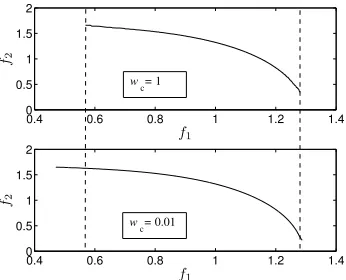
3.11 Pareto front obtained by MOLA on Function I whenwcandNfemax
are set to different values . . . 87
3.12 Illustration of weighted-sum methods . . . 88
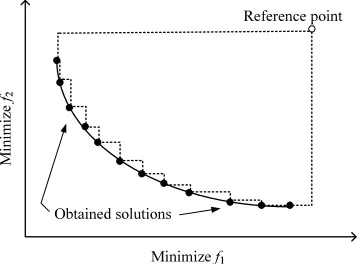
3.13 The illustration of hypervolume . . . 89
3.14 The illustration of the diversity metric . . . 90
3.15 The illustration of s.a.s. (a) Attainment surfaces of three indepen-dent runs; (b) s.a.s. obtained from the three runs . . . 92
3.16 s.a.s. obtained by MOEA/D, NSGA-II and MOLA on Fun1-1 . . . . 95
3.17 s.a.s. obtained by MOEA/D, NSGA-II and MOLA on Fun1-2 . . . . 96
3.18 s.a.s. obtained by MOEA/D, NSGA-II and MOLA on Fun1-3 . . . . 97
3.19 s.a.s. obtained by MOEA/D, NSGA-II and MOLA on Fun2-1 . . . . 100
3.20 s.a.s. obtained by MOEA/D, NSGA-II and MOLA on Fun2-2 . . . . 101
3.21 s.a.s. obtained by MOEA/D, NSGA-II and MOLA on Fun2-3 . . . . 102
3.22 s.a.s obtained by MOEA/D, NSGA-II and MOLA on Fun3 . . . 107
3.23 s.a.s obtained by MOEA/D, NSGA-II and MOLA on Fun4 . . . 108
3.24 s.a.s obtained by MOEA/D, NSGA-II and MOLA on Fun5 . . . 109
3.25 s.a.s obtained by MOEA/D, NSGA-II and MOLA on Fun6 . . . 110
3.26 s.a.s obtained by MOEA/D, NSGA-II and MOLA on Fun7 . . . 111
3.27 s.a.s obtained by MOEA/D, NSGA-II and MOLA on Fun8 . . . 112
3.28 s.a.s obtained by MOEA/D, NSGA-II and MOLA on Fun9 . . . 113
3.29 s.a.s obtained by MOEA/D, NSGA-II and MOLA on Fun10 . . . . 116
3.30 s.a.s obtained by MOEA/D, NSGA-II and MOLA on Fun11 . . . . 117
3.31 s.a.s obtained by MOEA/D, NSGA-II and MOLA on Fun12 . . . . 118
3.32 s.a.s obtained by MOEA/D, NSGA-II and MOLA on Fun13 . . . . 119
4.1 Diagram of an electrical system . . . 125
4.2 Single-line diagram of the IEEE 30-bus system . . . 130
4.3 Single-line diagram of the IEEE 57-bus system . . . 133
4.4 Simplified equivalent circuit of asynchronous generator . . . 135
4.5 The performance comparison among PSO, GA and FOLA in solv-ing case 1 on the modified IEEE 30-bus system . . . 139
4.6 The performance comparison among PSO, GA and FOLA in solv-ing case 2 on the modified IEEE 30-bus system . . . 140
4.7 The performance comparison among PSO, GA and FOLA in solv-ing case 1 on the modified IEEE 57-bus system . . . 142
4.8 The performance comparison among PSO, GA and FOLA in solv-ing case 2 on the modified IEEE 57-bus system . . . 142
4.9 Single-line diagram of the IEEE 118-bus system . . . 144
4.10 The performance comparison among FOLA, CLPSO and CPSO on the IEEE 118-bus power system: (a) for case 1; (b) for case 2 . . . . 145
5.1 Pareto fronts obtained by MOEA/D, NSGA-II and MOLA on the IEEE 30-bus wind power penetrated system . . . 152
5.2 Pareto fronts (in separate subfigures) obtained by MOEA/D,
NSGA-II and MOLA on the IEEE 30-bus wind power penetrated system . . 152
5.3 Single-line diagram of the modified new England wind power
pen-etrated system . . . 154
5.4 Pareto fronts obtained by MOEA/D, NSGA-II and MOLA on the
modified new England wind power penetrated system . . . 154
5.5 The relationship between wind speed and real power output . . . 160
5.6 Pareto fronts obtained by MOEA/D, NSGA-II and MOLA on the
IEEE 30-bus power system with wind power penetration . . . 162
5.7 Pareto fronts (in separate subfigures) obtained by MOEA/D,
NSGA-II and MOLA on the IEEE 30-bus power system with wind power penetration . . . 163
5.8 Convergence characteristics of MOEA/D, NSGA-II and MOLA on
the IEEE 30-bus power system with wind power penetration . . . . 165
5.9 Pareto fronts obtained by MOEA/D, NSGA-II and MOLA on the
modified new England wind power penetrated system . . . 166 5.10 Convergence characteristics of MOEA/D, NSGA-II and MOLA on
the new England wind power penetrated system penetrated with wind power . . . 168
5.11 The values ofP V P obtained by MOEA/D, NSGA-II and MOLA . 170
5.12 Pareto fronts obtained by MOEA/D, NSGA-II and MOLA on the IEEE 30-bus power system . . . 171 5.13 Details of the Pareto fronts obtained by MOEA/D, NSGA-II and
MOLA on the IEEE 30-bus power system . . . 172 5.14 Pareto fronts obtained by MOEA/D, NSGA-II and MOLA (in
sub-figures) on the IEEE 30-bus power system . . . 173
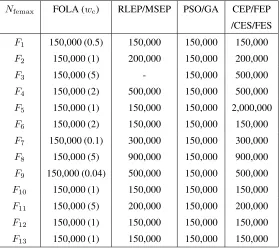
2.1 The setting ofNfemaxfor 30-dimensional benchmark functionsF1∼F13 45
2.2 Comparison among FOLA and the other eight algorithms on
30-dimensional benchmark functions F1∼F7: Average fitness value / (Standard deviation) / (Rank) . . . 47
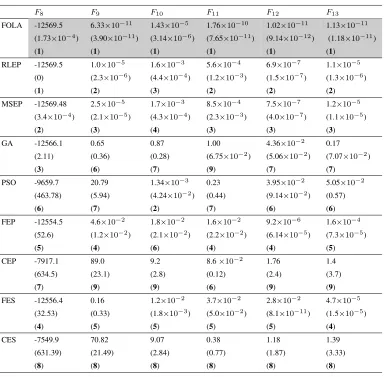
2.3 Comparison among FOLA and the other eight algorithms on
30-dimensional benchmark functionsF8∼F13: Average fitness value / (Standard deviation) / (Rank) . . . 48
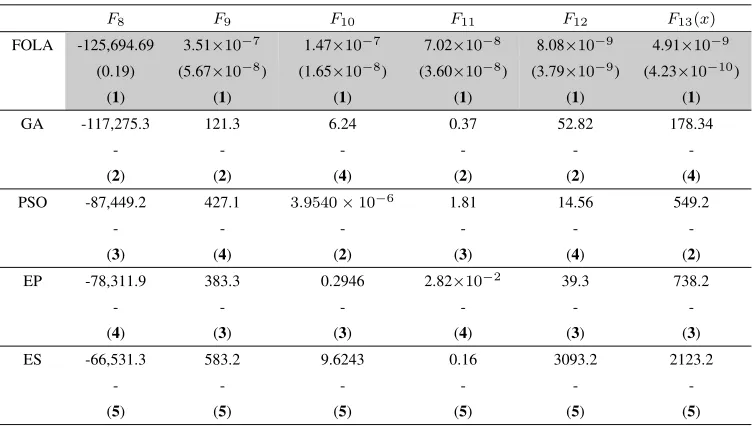
2.4 Comparison among FOLA, GA, PSO, EP and ES on 300-dimensional
benchmark functionsF8(x)∼F13(x): Average fitness value / (Stan-dard deviation) / (Rank) . . . 50
2.5 Computation time (s) consumed by PSO, GA, PSO and FOLA when
solving the 30-dimensional benchmark functionsF8(x)∼F13(x) . . 53 2.6 The average fitness values obtained with differentwcandNfemax . . 54
2.7 Comparison among FOLA, CLPSO and CPSO on 30-dimensional
benchmark functions Frs1∼Frs9, including Average fitness value, Standard deviation andt-test . . . 56
2.8 Computation time (s) consumed by FOLA, CLPSO and CPSO when
solving the benchmark functions,Frs1(x)∼Frs9(x). . . 59
2.9 Comparison between FOLA and GS-SOMA on functionsFrs5, Frs6
andFrs8 . . . 62
2.10 Comparison between FOLA and OLPSO on four functions . . . 63
2.11 Comparison between FOLA and SOPEN on 30- and 100-dimensional functionsFrs1andFrs4 without shift and bias . . . 64 2.12 Comparison between FOLA and SOPEN on 100-dimensional
func-tionsFrs1andFrs4 without shift and bias . . . 64 2.13 Comparison between FOLA and SamACO on five benchmark
func-tions . . . 65
3.1 The setting of Nfemin for solving Function I with different
dimen-sionality . . . 85
3.2 The number of non-dominated solutions obtained by MOLA when
wcandNfemaxare set to different values . . . 86
3.3 The setting of reference solution and extreme solutions; HV and
∆obtained by MOEA/D, NSGA-II and MOLA on Fun1 (including
mean and standard deviation) . . . 94
3.4 The setting of reference solution and extreme solutions; HV and
∆obtained by MOEA/D, NSGA-II and MOLA on Fun2 (including
mean and standard deviation) . . . 99
3.5 D˜, HV and ∆ obtained by MOEA/D, NSGA-II and MOLA on
Fun3-Fun9 (including mean and standard deviation) . . . 106
3.6 D˜ obtained by NSGA-II, MOEA/D and MOLA on Fun10-Fun13
(including mean and standard deviation) . . . 115
4.1 The performance comparison among FOLA, PSO and GA in case 1
on the IEEE 30-bus system . . . 131
4.2 The performance comparison among FOLA, PSO and GA in case 2
on the IEEE 30-bus system . . . 131
4.3 The performance comparison among FOLA, PSO and GA in case 3
on the IEEE 30-bus system . . . 132
4.4 The computation time (s) consumed by FOLA, PSO and GA on the
IEEE 30-bus system . . . 132
4.5 The performance comparison among FOLA, PSO and GA in case 1
on the IEEE 57-bus system . . . 134
4.6 The performance comparison among FOLA, PSO and GA in case 2
on the IEEE 57-bus system . . . 134
4.7 The performance comparison among FOLA, PSO and GA in case 3
on the IEEE 57-bus system . . . 134
4.8 The computation time (s) consumed by FOLA, PSO and GA on the
IEEE 57-bus system . . . 135 4.9 The parameters setting of induction generators . . . 138 4.10 The maximum real power output (MW) of the wind generator in
multiple time periods . . . 138 4.11 The computation time (s) consumed by FOLA, PSO and GA on the
IEEE 30-bus system . . . 141 4.12 The computation time (s) consumed by FOLA, PSO and GA on the
modified IEEE 57-bus system . . . 143 4.13 The minimum fitness values obtained by FOLA, CLPSO and CPSO
in different time periods . . . 146 4.14 Computation time (s) consumed by FOLA, CLPSO and CPSO . . . 146
5.1 The setting of reference solution and extreme solutions;HV and∆
obtained by MOEA/D, NSGA-II and MOLA on the modified IEEE 30-bus power system (including mean and standard deviation) . . . 153
England test system (including mean and standard deviation) . . . . 155
5.3 Load demand (MW) at bus 10 . . . 155
5.4 Wind speed . . . 156
5.5 The minimum objective fitness values derived by MOEA/D,
NSGA-II and MOLA in the dynamic environment . . . 156
5.6 The setting of reference solution and extreme solutions;HV and∆
obtained by MOEA/D, NSGA-II and MOLA in dynamic environ-ment: Hours 1-12 (including mean and standard deviation) . . . 158
5.7 The setting of reference solution and extreme solutions;HV and∆
obtained by MOEA/D, NSGA-II and MOLA in dynamic environ-ment: Hours 13-24 (including mean and standard deviation) . . . . 159
5.8 The wind speed and number of wind turbines in the wind farms . . . 162
5.9 The setting of reference solution and extreme solutions;HV and∆
obtained by NSGA-II, MOEA/D and MOLA on the modified IEEE 30-bus power system (including mean and standard deviation) . . . 164 5.10 Load demand (MW) at bus 10 . . . 164 5.11 Wind speed for the dynamic IEEE 30-bus power system . . . 164 5.12 The wind speed and number of wind turbines in the wind farms . . . 166
5.13 The setting of reference solution and extreme solutions;HV and∆
obtained by NSGA-II, MOEA/D and MOLA on the modified new England test system (including mean and standard deviation) . . . . 167 5.14 Wind speed for dynamic new England wind power penetrated system 168 5.15 The computation time (s) consumed by MOEA/D, NSGA-II and
MOLA on the IEEE 30-bus power system . . . 173
List of Abbreviations and Notations
Introduction
1.1
Motivations and Objectives
While the mathematics of optimisation has been studied for about a century, the
increasing complexity of real-world optimisation problems and the development of
computation capability have stimulated new interest in the topic. Classical
gradient-based optimisation algorithms have been fully investigated and applied for solving
a wide range of current engineering and public service problems [4]. However,
they are insufficient when solving the multi-model optimisation problems which are
non-differentiable and non-convex and contain many local optima. Furthermore,
their convergence is largely dependent on the initial points of search. To solve these
problems, researchers began to explore the biological evolution and animal
behav-iors in the nature, which serves as a fertile source of concepts, principles and
mecha-nisms. Biologically-inspired optimisation algorithms have thrived over the last few
decades due to their ability of solving multi-modal problems [5], especially
Evo-lutionary Algorithms (EAs), which present their applicability in solving complex
problems. However these algorithms suffer from the drawbacks of redundant
com-putation load and slow convergence rate, i.e. they can hardly achieve an accurate
solution given limited computation time. These drawbacks mainly result from their
population-based search approach, in which there is a high level of randomness and
1.1 Motivations and Objectives 2
application in large-scale optimisation problems, such as optimal power flow
prob-lems in power systems, routing probprob-lems in telecommunication networks and traffic
systems. Further improvement of EAs is limited. This thesis is concerned with an
alternative approach to function optimisation, based on learning automata.
Nature has presented the significance of learning ability. For instance, in the
wilderness which is full of dangers, each careless action could lead to death, thus
creatures have to learn how to select the actions which are suitable to the
environ-ment. With this inspiration, the feasibility of using a learning method for problem
solving has been explored by researchers [6], such as learning automata methods.
Learning automata methods do not belong to the class of EAs which mainly adopt
biological evolution concept. A learning automaton is considered as a system which
modifies its strategy on basis of its experience by collecting and processing
informa-tion regarding the environment, in order to achieve the desired goal or the optimal
performance in some sense. It is believed that the learning automata, which have
the ability of learning and memorization, can be connected in a way which would
be suitable for tackling complex learning problems. The learning automata methods
have made a significant impact on many areas, such as system control and pattern
classification. They have also been applied to resolve optimisation problems. In
contrast to EAs, the learning automata methods, despite having a solid theoretical
background, are less popularly applied for solving complex optimisation problems.
The objective of this thesis is to discover the potential of Learning Automata
meth-ods (LA) by developing LA-based optimisation algorithms, which can reduce the
unnecessary randomness and large computation load caused by a large number of
population adopted by EAs.
Besides the single objective optimisation mentioned above, multi-objective
opti-misation is with no doubt a very important research topic, due to the multi-objective
nature of many practical optimisation problems in the real world. Multi-objective
optimisation aims to optimise several performance attributes of the problem
simul-taneously and obtains a series of non-inferior alternative Pareto optimal solutions.
There are two standard methods for treating multi-objective problems. One is to
combine the individual objective functions into a single composite function using
the weighted-sum method or weighted Tchebycheff method. However, the problem
lies with the proper selection of the weights or utility functions to characterize the
decision-maker’s preferences. In practice, it can be very difficult to precisely and
accurately select these weights, even for someone who is familiar with the problem
domain. Small perturbations in the weights can sometimes lead to quite different
solutions [7]. Another drawback of these approaches is that they greatly increase
the computation load, as the algorithm needs to be executed many times in order
to obtain a set of Pareto optimal solutions. In addition, these weighted-objective
methods are only capable of solving convex Pareto front problems and have a
dif-ficulty in solving the multi-objective problems whose Pareto fronts are non-convex
[7]. Nonetheless, there is no way to predetermine if a problem is convex or
con-cave in many applications. Instead of using weighted-sum method, an alternative
is employing Pareto-front based methods, which apply a population of
individu-als, and each of them represents one Pareto optimal solution. These approaches are
extended from EAs, thus they suffer from the same drawbacks regarding
population-based methods, which have been mentioned above. Besides, some of these methods
employ non-dominated sorting strategy to rank the individuals of the population,
which could further increase the computational complexity. This thesis is to develop
an LA-based multi-objective optimisation algorithm, so as to increase the efficiency
of the search, through comprehensively making use of the information collected in
each function evaluation.
Another objective of the thesis is to apply the developed LA-based algorithms
to solve practical problems in power systems. Power system dispatch,
environ-mental concerns and power security are becoming more and more important in
terms of power system operation and planning. These problems are non-differential,
non-linear, high-dimensional and complicatedly constrained. As it is known that
the power system configuration (e.g.power demand, wind power outputs) changes
throughout the whole day, which leads to the varying property of the optimisation
problem. To a certain extent, the property of these problems is unknown in advance,
and it can vary widely as power configuration slightly changes. These features make
1.2 Optimisation Algorithms 4
suitable for this specific area has not been paid enough attention yet, though some
efforts have been made by researchers who favor EAs. With the high demand of
these problems, the application of EAs is limited in this case, due to their instability
and unpredictable computation load. To overcome this problem, this thesis is also
concerned with the application of LA-based algorithms in complex power systems.
1.2
Optimisation Algorithms
Optimisation refers to systematically finding the optimal solutions to the
opti-misation problems to be resolved, under certain constraints. There are mainly two
categories of optimisation problems, single-objective and multi-objective
optimisa-tion problems. Single-objective optimisaoptimisa-tion problems aim to finding a single best
solution, which is usually the minimal or the maximal evaluation value of the
ob-jective function. On the other hand, multi-obob-jective optimisation problems usually
have no unique, perfect solution, but a series of non-inferior alternative solutions,
Pareto optimal solutions (or called non-dominated solutions), which represent the
possible trade-off among conflicting objectives. The Pareto optimal solutions form
a Pareto front in the objective space. The optimisation target is to find the set of
Pareto optimal solutions which are evenly distributed along the Pareto front [2].
In order to seek the solution which has the best evaluation value of the objective
functions, or a desired combination of two or more optimal fitness values of the
con-flicting objectives, a variety of optimisation algorithms have been developed in the
past century. Classical optimisation algorithms have been largely applied for
solv-ing a wide range of engineersolv-ing and public service problems [4]. However, these
algorithms cannot solve complex multi-model optimisation problems desirably.
Re-searchers began to explore the nature over the past several decades, and develop
var-ious bio-inspired/nature-inspired optimisation techniques, which operate in a rather
different way from the classical methods, and allow scientists and engineers to solve
optimisation problems where the classical methods are not applicable.
1.2.1
Classical optimisation algorithms
Classical optimisation algorithms, having a solid theoretical background, are
analytical and usually make use of the techniques of differential calculus to locate
the optimum point. They assume that the function is differentiable twice with
re-spect to the design variables, and the derivatives are continuous. Since some of the
practical problems involve objective functions that are not continuous and/or
dif-ferentiable, the classical optimisation techniques have a limited scope in practical
applications. However, classical optimisation algorithms still play an important part
in the field of optimisation. For instance, simplex-based method [8] is a popular
algorithm for numerically solving linear programming problems [9]. Interior point
methods are widely used to solve linear and nonlinear convex optimisation
prob-lems [10][11], which have a convex landscape of the objective functions. In order to
improve convergence rate, many classical optimisation methods are based on
evalu-ating Hessians and gradients [4], such as Newton’s method, Quasi-Newton methods
and steepest descent, and so on. The drawback of these methods is that they increase
the computational cost of each iteration, due to the computational complexity of
evaluating gradients and Hessians.
1.2.2
Evolutionary Algorithms
Since classical optimisation algorithms cannot be used to solve complex
multi-model optimisation problems desirably, a great deal of research activities were
car-ried out from the inspiration of nature [12], and since then, a large number of new
optimisation algorithms have been developed. These methods have been used to
solve various optimisation problems. Meanwhile, these novel optimisation
algo-rithms do not need to run for a large number of times when solving multi-modal
problems, which makes their application efficient. Among these novel
optimisa-tion algorithms, EAs, which incorporate the major behaviours of a biological
evolu-tionary process and a principle of ‘the survival of the fittest’ into their algorithmic
framework [13], have been investigated comprehensively over the last twenty years
individu-1.2 Optimisation Algorithms 6
als which evolve through iterative process, in order to search for a desired location
in the solution space.
Genetic evolution-based EAs
Genetic evolution-based EAs fall into four major categories: Genetic Algorithm
(GA) [16], Evolutionary Programming (EP) [17], Genetic Programming (GP) [18]
and Evolutionary Strategy (ES) [19]. These methods share the principles of survival
of the fittest.
• The basic concept of GA was first pioneered by John Holland in the 70s [16], and it derives from a metaphor of the evolution process in nature. To be
spe-cific, GA refers to a particular class of EAs that uses the techniques inspired by
evolutionary biology, such as inheritance, mutation, selection, and crossover
[16].
GA is implemented using a population of strings (called chromosomes), which
encode candidate solutions (called individuals) to an optimisation problem,
and evolve towards better solutions [20] [21]. Traditionally, the strings were
in the form of binary values, but later, other forms, such as real-value
cod-ing [22], are also possible [23]. The selection of the type of codcod-ing relates
to the types of the optimisation problem. General GA includes five basic
op-erations: initialisation, selection, crossover, mutation and termination [16].
During the stage of initialisation, a population of individuals are randomly
generated in the solution space. These solutions evolve as generations
pro-ceed. In each generation, the fitness value of each individual in the population
is evaluated. Individual solutions are selected through a fitness-based process,
where the solutions that have better fitness values are often more likely to be
reselected. Some selection strategies rate the fitness value of each solution
and preferentially select the best solutions. However, most selection
meth-ods adopt probability-based selection, in which the probability of reselecting
better solutions is large, and at the same time the solutions which have
rel-atively poor fitness values can also be selected, but in a smaller probability.
This strategy helps GA preserve population diversity and prevent premature
convergence. The most well-studied selection methods include roulette wheel
selection and tournament selection [24]. Through the stage of selection, an
intermediate population is obtained and used to reproduce a new population.
In this case, multiple individuals are stochastically selected from the current
population to perform operators crossover and mutation. Crossover and
mu-tation are regarded as the main causes of the efficiency of genetic algorithms.
Crossover allows the method to combine some hopeful schemata, join the
information contained in the parent chromosomes, and produce new
individ-uals. With crossover, good results can be obtained with a random matching
of the individuals [22], and thus quickly progress towards the optimal regions
of the search space. On the other hand, mutation brings the diversity among
the population, by changing the values of part of the chromosomes. With the
operations of crossover and mutation, a brand new population is generated,
and it will be used in the next generation. The algorithm either terminates
when a maximum number of generations has been produced, or stops when a
satisfactory fitness level for the population has been reached.
GA can be well extended to solve multi-objective optimisation problems.
Ref-erence [7] provides an overview and tutorial of GA which is developed
specif-ically for problems with multiple objectives. There are mainly two ways of
applying GA in solving multi-objective problems: 1) multiple objectives can
be regulated into a single objective, using weighted-sum method or Lagrange
method, before applying GA. This method is widely used, such as
Weight-Based Genetic Algorithm [25], Random Weighted Genetic Algorithm [26]
and Multi-Objective Genetic Algorithm (MOGA) [7]; 2) being a
population-based approach, a generic single-objective GA can be modified to find a set
of multiple non-dominated solutions in a single run, such as Non-dominated
Sorting Genetic Algorithm [27], Dynamic Multi-objective Evolutionary
Al-gorithm [28] and Fast Non-dominated Sorting Genetic AlAl-gorithm (NSGA-II)
[29].
1.2 Optimisation Algorithms 8
experimented and applied in many fields in engineering worlds [21][30][31][32].
A review of their implementations and some application domains can be found
in reference [33].
• EP was first proposed as an approach to artificial intelligence by Fogel in 1960 [17]. However, it was not applied with such a success to many numerical and
combinatorial optimisation problems until 1990 [34].
Similar to GA, EP seeks the optimal solution by evolving the population, in
which each individual represents a candidate solution to the problem, over a
number of generations or iterations. However, unlike other EAs, no
recombi-nation operators are applied in EP. The optimisation process can be
summa-rized into two major steps [17]: the solutions locating in the current population
are mutated; the next generation is selected from both the mutated and the
cur-rent solutions. According to survival of the fittest, the filial generation in EP
is generated from the fittest parent generation which is selected through
rank-ing strategy [35]. Mutation is used to generate new solutions (offsprrank-ing). The
method of mutation could vary dramatically with respect to specific problems,
and it is a critical operation for EP, as it affects the behaviour of individuals
greatly. The contemporary variant, Fast EP (FEP), uses a Cauchy mutation
instead of Gaussian mutation. By introducing the Cauchy mutation, FEP is
more likely to generate an offspring which is far away from its parent, due
to its long flat tails. According to the experimental studies, the improvement
enhances the global search ability of EP [1]. EP does not only conduct the
mutation operation, but also capitalises on a continuous crossover operation
in the evolution process.
EP is comprehensively investigated for multi-objective problems, such as Fast
Multi-Objective Evolutionary Programming [36], which uses fuzzy rank-sum
concept and diversified selection, different multi-objective evolutionary
pro-gramming [37], which has been used for detecting computer network
at-tacks, and Multi-Objective Evolutionary Programming [38], which has been
successfully applied in combined economic emission dispatch and economic
emission dispatch problems in complex power systems.
• GP is a type of EAs which is on basis of the evolutionary progress
devel-oped by Koza[18]. It can solve various complex optimisations and searching
problems successfully. GP is a domain-independent method that genetically
breeds a population of computer programs to solve a problem. It is an
exten-sion of the GA, but the structures of the population in GP are not fixed-length
character strings used in GA. In GP, the candidate solutions to the problem
[39] are programs, which are expressed in genetic programming as syntax
trees rather than as lines of code. Trees can be easily evaluated in a
recur-sive manner. Every tree node has an operator function, and every terminal
node has an operand, making mathematical expressions easy to evolve and
evaluate. With tree structures representing trial solutions, GP can be applied
to search for the optimal solution, and also used to search for mathematical
functions to describe an unknown model.
The genetic operators used in GP include crossover, mutation, reproduction,
gene duplication, and gene deletion. Mutation affects the population
individ-ually. If one individual is selected to perform crossover, it will simply switch
one of its nodes with another that is from another individual in the population.
With the tree-based representation, it can only replace the node’s information,
or it can replace a whole branch from the selected node. In the latter case,
the crossover is regarded as a replacement of the whole branch. These two
operators are applied to the chromosome in each generation.
• ES was invented in 1963 by Ingo Rechenberg, Hans-Paul Schwefel at the
Technical University of Berlin (TUB) while searching for the optimal shapes
of bodies in a flow [19][40]. ES is a kind of EAs where individuals are
en-coded by a set of real-valued “object variables”. For each object variable, an
individual also has a “strategy variable” which determines the degree of
muta-tion to be applied to the corresponding object variable. The strategy variables
also mutate, allowing the rate of mutation of the object variables to vary. The
1.2 Optimisation Algorithms 10
point (parent) and the result of its mutation (child). In each generation, a
vector of object variables is created by mutating the parent with an identical
standard deviation. The fitness value of the child individual is compared with
that of its parent, and the one with the better fitness value survives. This
se-lection mechanism is identified as (1+1)-ES. However, this mechanism may
result in converging to premature results during the optimisation process, due
to a lack of diversity. To overcome this drawback, a multi-membered ES with
µ parents, (µ+1)-ES, was proposed by Rechenberg [41]. In this method, µ
parent individuals can participate in the generation of one offspring
individ-ual. This operation has a similar effect to the crossover process in GA. There
are other ES variants based on this improvement, such as (1+λ)-ES, where
λ mutants are generated from the same parent; (µ+λ)-ES, where the best
µindividuals are produced from the union of parents and offspring (i.e. the selection operates on the joined set of parents and offspring); and (µ, λ)-ES, where only the bestµoffspring individuals are used to form the next parent generation [42].
ES has been applied to solve practical problems in the field of engineering,
such as the optimisation problem in power plant [43].
Swarm intelligence-base EAs
With the exception of the class of EAs which adopts the biological evolutionary
progress, there are also some EAs which are based on swarm intelligence. Swarm
intelligence is the collective behavior of decentralized self-organized systems [44].
These systems are typically made up of a population of simple agents. These agents
follow very simple rules, and no centralized control structure dictates how individual
agents should behave. Although there is no centralized control or the provision of a
global model, agents interact locally with one another and with their environment.
Hence, local interactions between such agents lead to the emergence of “intelligent”
global behavior. These coherent global patterns could be unknown to the individual
agents. A certain degree of randomness is applied to the local interactions between
agents, in order to keep diversity among the swarm. Natural examples of swarm
intelligence include bird flocking, ant colonies, animal herding, bacterial growth,
and fish schooling,etc.
• Particle Swarm Optimisation (PSO) is a stochastic optimisation technique de-veloped by Eberhart and Kennedy [45][44]. It is inspired by computer
sim-ulations of various interpretations of the movement of organisms in a flock
of birds or a school of fishes. PSO is popular in the research field of
optimi-sation in the last decade for its simplicity of implementation, few parameters
and high convergence rate [46].
In PSO, the population is called a swarm, and each individual of the
pop-ulation is called a particle. PSO works on the social behavior of particles
in the swarm, by remembering the best location of itself and the best
expe-rience of other individuals in the swarm. The particles alter their velocities
according to their records at each iteration. Assume that the search space is
N-dimensional, and the number of particles is np. The position vector and velocity vector of the particlei(i=1,2,. . . ,np) are denoted byZi=(zi1,. . . ,ziN)
andVi=(vi1, . . . ,viN) respectively. The best position of particleiand the fittest
particle found so far in the swarm are represented by Pli=(pli1,. . . ,pliN) and Pg=(pg1,. . . ,pgN) respectively. At each iteration, every component of the
ve-locity vector of particleiis updated according to:
vijn+1 =wvijn +cf1ζ1(plij −znij) +cf2ζ2(pgj−zijn) (1.2.1)
And each component of the position vector is updated according to the
fol-lowing equation:
zijn+1 =zijn +vijn+1 (1.2.2)
wherendenotes the iteration number; wis the inertia weight [47];ζ1 andζ2
are random numbers in the range [0,1]. Constantscf1 andcf2, called accelera-tion factors, are used to adjust particles’ trajectory using its own previous best
position and the best solution found in the group. The velocity obtained from
(1.2.1) makes particles to some extent move towards the global optimum. The
1.2 Optimisation Algorithms 12
An important variant of standard PSO utilized a constriction factor, which was
proposed by Clerc [48]. By reducing the inertia weightw in each iteration, it ensures the stability of convergence, and it leads to higher quality of the
solutions compared with the standard PSO when solving unimodal functions,
which have only one local minimum. However, an over-decreased inertia
weight reduces the velocity of particle,i.e., the particle is trapped more easily
at local optima in multimodal optimisation problems which have a number
of local optima. Other variants of the PSO have also been developed in
re-cent years, such as Particle Swarm Optimisation with Passive Congregation
[49], Unified Particle Swarm Optimisation, Fully Informed Particle Swarm
and most recently, Cooperative Particle Swarm Optimisation (CPSO) [50] and
Comprehensive Learning Particle Swarm Optimisation (CLPSO) [51]. These
algorithms have produced encouraging results in both benchmark testing and
real-world applications.
• Ant colony optimisation algorithm (ACO) is another approach which is based
on swarm intelligence [52]. It models ant colony behaviour, including ant
foraging behaviour, brood sorting, nest building, and self-assembling. Ants
wander randomly, and deposit pheromone trails on the way back to the colony
after finding food. If other ants find a pheromone path, they are more likely
to discontinue their random travel, and follow the trail until reaching the food
source. Subsequently, they reinforce the pheromone trails. The pheromone
trails evaporate with time, resulting in a reduction of the strength of attraction.
This process is simulated by ACO to find an optimal solution.
ACO has been applied to many combinatorial optimisation problems, in which
the set of feasible solutions is discrete or can be reduced to discrete. Taking
Traveling Salesman Problem (a popular combinatorial problem) as an
exam-ple, the solution obtained by ACO is much better than the one found by a GA
[53]. After more than ten years of studies, both its application effectiveness
and its theoretical background have made ACO a successful EA in the
com-binatorial optimisation domain [54]. Besides, the applications of ACO range
from quadratic assignment to protein folding and vehicles routing. A number
of derived methods have been adopted to solve dynamic problems, stochastic
problems, multi-targets and parallel implementations [55].
• Recently, a Group Search Optimiser (GSO) was developed at the University of Liverpool [56], which was inspired by animal searching behaviour and group
living theory [57]. The strategies of information-sharing [58] and
producer-scrounger models [59] are employed in GSO. There are mainly three roles in
a group: producer, scrounger and ranger. Producer, regarded as the leader of
the group, is usually located in promising area, and seeks food source for the
rest of the group. There is only one producer in the group. In each iteration,
the producer is renewed and are selected from the best members. On the other
hand, scroungers follow the producer and find opportunities to share the
infor-mation found by producer and search resource uncovered by other scroungers.
Apart from the producers,80%of the rest members are randomly selected as
scroungers, and the scroungers are renewed in each iteration as well. The
re-mainder members are rangers. They walk randomly in the searching space, by
dispersing themselves from their original positions. This behavior increases
the diversity in the group, and discourages members from being trapped in
local optima. Concepts from this framework are employed metaphorically
to design optimum searching strategies for solving continuous optimisations.
GSO is extended to solve objective optimisation problems using
multi-ple producers. Scroungers search around one of the producer and one of the
non-dominated solutions. The number of the producers is equal to that of the
objective functions. This method has been successfully applied to solve the
problem of device placement in power systems [60].
1.3
Introduction to Learning Automata
The first learning automaton model was developed in mathematical psychology,
and then developed by Bushet al. [61], Atkinsonet al. [62] and Tsetlin [63]. Learn-ing automata select their current actions based on past experiences learned through
collect-1.3 Introduction to Learning Automata 14
ing and processing current information regarding the environment, be capable of
changing their structure and parameters as time evolves, in order to achieve the
de-sired goal or the optimal performance. The learning automata methods have already
made a significant impact on many areas of system control and pattern classification,
such as power system control [64][65], vehicle suspension control [66] and
noise-tolerant learning of hyperplane classification [67],etc. They have also been inves-tigated in solving optimisation problems. For instance, the method of
continuous-action learning automata has been applied for stochastic optimisation [68][69]; the
algorithm of genetic learning automata was proposed to resolve function
optimi-sation problems [70][71]. However, few literature has reported that the learning
automata methods, despite having a solid theoretical background, can outperform
EAs in solving complex optimisation problems, particularly for high-dimensional
optimisation problems. In addition, they have also been applied to solve
objective optimisation problems [72], but only limited in low-dimensional
multi-objective problems.
1.3.1
Basic elements
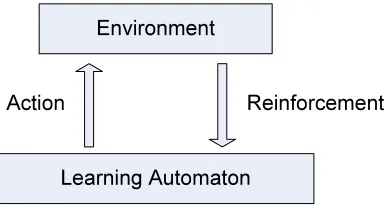
A general block diagram of the interaction between environment and an
automa-ton is provided in Fig. 1.1.
Environment
Learning Automaton
[image:32.612.212.406.440.543.2]Reinforcement Action
Figure 1.1: Block diagram of the interaction between a Learning Automaton and environment
The learning process of learning automata can be simply described as follows
[73]: during the interaction with environment, the automaton randomly selects an
action from the action set that includes the possible actions the automaton can take
at its current state, based on a probability distribution. The probabilities of
select-ing the actions are the same initially. Then the environment generates a response to
the action, named reinforcement signal. According to the response, the automaton
updates the action probability distribution. The algorithm used to update the action
probabilities is called the learning algorithm or reinforcement scheme. Afterwards,
a new action is selected according to the updated probability distribution. Regarding
this action, a response is elicited by the environment, and the procedure is repeated.
It can be seen that the implementation of learning automata mainly concentrates
on three aspects: how to select actions, learning algorithm and reinforcement
sig-nal, as given in Fig. 1.2. Unlike EAs that mainly apply the concept of biological
evolutionary concept, learning automata methods are based on action selection and
probability distribution.
LA
Action
selection algorithmLearning Reinforcement signal
Figure 1.2: The three aspects of LA
The automaton
The state X X={X ,X,,X
}
Input set R R={r,r,,r }
or {( ′ ′)}
Output set A A={a,a,,a
}
Transition Function F
Output function G
Figure 1.3: The illustration of an automaton
A learning automaton is an adaptive decision-making unit situated in a random
environment. The learning automaton learns the optimal action through repeated
interactions with its environment. The illustration of an automaton is given in Fig.
1.3. Being an adaptive discrete machine, an automaton can be described as:
1.3 Introduction to Learning Automata 16
These entities are described precisely as follows:
• Thestateof the automaton at instantn, denoted byX(n), is an element of the finite set:
X ={X1, X2, . . . , XXN} (1.3.2)
• The output or action of an automaton at instant n, denoted by a(n), is an element of the finite set:
A={a1, a2, . . . , aaN} (1.3.3)
• The input to an automaton at instantn, denoted byr(n), is an element of a set
R, which could be either a finite set or an infinite set, such as an interval on the real line. Thus,
R ={r1, r2, . . . , rrN}orR={( ˜α,β˜)} (1.3.4)
whereα˜andβ˜are real numbers.
• The probability of choosing actioniat instantn, denoted bypi(n), is an ele-ment of the finite set:
P ={p1, p2, . . . , paN} (1.3.5)
• F(·,·) is transition function, which determines the state at instant (n + 1) regarding the state and input at instantn:
X(n+ 1) =F[X(n), r(n)] (1.3.6)
or F is a mapping from X ×R → X. F could be either deterministic or
stochastic.
• Output functionG(·)determines the output of the automaton at any instantn
according to its current state:
a(n) =G[X(n)] (1.3.7)
orGis a mappingX →A. It is again either deterministic or stochastic.
• T represents the reinforcement scheme (learning algorithm), which deter-mines the action probabilities at instantn + 1 regarding the probabilities at instantn:
p(n+ 1) =T[p(n)] (1.3.8)
Basically, the automaton takes in a sequence of inputs and outputs a sequence
of actions with respect to the observation time n. The working of an automaton
can be described as follows: given an initial stateX(0), actiona(0)is determined by functionG. Based on current state, the response generated by the environment,
r(0), and the transition function determine the next state X(1). These operations are performed recursively, and in this way, the state sequence and action sequence
are obtained according to any given input sequence [74].
In terms of functionsFandG, there are two types of automaton:
• Deterministic automaton. For this automaton, functions F and G are both
deterministic mappings. It means that with a given initial state and a given
input, the succeeding state and action are uniquely specified. The mappings
of the two functions can be represented either in the form of matrices or graphs
if the input set is finite. Corresponding to each input, the matrix or the graph
can indicate how the present state transfers to a new state. In this case, the
transition matrices consist of elements that are only either 0 or 1.
• Stochastic automaton. For this automaton, at least one of the functionsFand
G is stochastic. In other words, given an initial state and an input, there is
no certainty concerning the succeeding state and action, which are associated
with probabilities. If transition functionFis stochastic, given the present state
and input, the next state is at random, andFgives the conditional probabilities
(or called transition probabilities) of reaching the various states. If the output
functionGis stochastic, given the present state, the action taken is at random
and is determined by the conditional probabilities provided byG.
1.3 Introduction to Learning Automata 18
transition matrix are constants which take values in the interval [0,1], and each
transition matrix is a stochastic matrix. On the other hand, if the transition
probability at instantnis updated on the basis of the input at that instant, the automaton is called a variable-structure stochastic automaton. The elements
of the transition matrix are in [0,1], but they are no longer constants any more,
as they are updated withn.
The environment
Environment refers to the aggregate of all the external conditions and influences
which would affect the automata [74]. The role of the environment is to establish
the relationship between the actions taken by the automaton and the signal inputs
to the automaton [69]. An environment can be mathematically defined as a triple
{A, C, R}. A represents a finite input set. R represents the output set, i.ethe en-vironment’s response to the action taken by the automaton. The environment is
referred to as aP-model environment when its response belongs to the binary set
{0,1}; the environment is named asS-model environment when its response takes an arbitrary value in the closed segment [0,1]; Q-model environment refers to the environment whose response is one of a finite number of values in the interval [0,1].
The environment is characterized by C, which represents the penalty probability,
i.e.the likelihood that the application of an action to the environment will result in a penalty output. If the penalty probabilities are constant, the environment is said to
be stationary; otherwise, it is nonstationary.
Reinforcement schemes
Reinforcement schemes are the methods used to update action probabilities at
each instant. They were originally proposed to model animal learning [61], but later
it was found that they can be applied in the field of learning automata successfully.
Choosing reinforcement scheme is a crucial factor that affects the performance of
learning automata [75]. In general, a reinforcement scheme can be represented by:
p(n+ 1) =T[p(n), r(n), a(n)] (1.3.9)
whereTis a learning operator;r(n)anda(n)represent the input to the automaton and the action taken by the automaton at instantn, respectively.
The basic idea behind a reinforcement scheme can be described as follows: if
the automaton selects an actionai at instantnand receives a nonpenalty input, the action probability of the actionai,i.e. pi(n), will be increased, and the probabilities for all other actions will be decreased. In this case, the change occurring onpi(n)is
called reward. For a penalty input,pi(n)is decreased and other action probabilities are increased. At this moment, the change applied onpi(n)is called penalty.
If pi(n + 1)is a linear function of pi(n), the reinforcement scheme can be de-scribed as linear, such as Linear Reward-Inaction (LR−I) algorithm [74], which is
known to be very effective in many applications. TheLR−Iupdates the action
prob-abilities as follows (assuminga(n) =ai):
pi(n+ 1) =pi(n) + ˜λr(n)(1−pi(n))
pj(n+ 1) =pj(n)−λr˜ (n)pj(n), for allj 6=i (1.3.10) On the other hand, if pi(n+ 1)is a nonlinear function ofpi(n), the reinforcement scheme is said to be nonlinear. Several non-linear schemes have been suggested by
Viswanathan and Narendra [76], Lakshmivarahan and Thathachar [77]. Sometimes,
it is advantageous to use different schemes to update pi(n), while the selection of
the reinforcement scheme depends on the intervals the value ofpi(n)lies in.
1.3.2
Several learning automata methods
Although each individual of the learning automata is an independent unit in a
simple structure, a group of learning automata can be connected in a way which
would be suitable for tackling complex learning problems. Systems built with LA
have been successfully employed in many difficult learning situations over the years.
This has also led to the concept of LA being generalized in a number of directions,
1.3 Introduction to Learning Automata 20
Finite Action-set Learning Automaton (FALA)
The original notion of learning automaton is derived from what is called finite
action-set learning automaton (FALA) [74]. FALA is the learning automaton for
which the number of possible actions is finite,i.e.the size of the action-set is finite. This type of learning automaton has been studied extensively.
A learning automaton is an adaptive decision-making device that learns the
op-timal action out of a set of actions through repeated interactions with a random
environment [78], as described in Section 1.3.1. There are two characteristics of the
learning automata: 1) the action choice is based on a probability distribution over
the action-set; 2) and the probability distribution is updated at each instant based on
the reinforcement feedback from the environment.
The operation of FALA consists of repetitions of the following several steps:
choosing action randomly, receiving reinforcement from environment and updating
action probability. The process can be specifically described as follows: at each
instantn, the automaton chooses an actionarandomly, based on its current action probability distribution,p(n) = (p1(n), . . . , paN(n))T, wherepi(n) = prob[a(n) = ai]andPaN
i=1pi(n) = 1,∀n. The action chosen by the automaton is the input to the
environment. The environment responds to the action with a stochastic reaction or
reinforcement, r(n), which is the input to the automaton. The higher the value of the reinforcement signal, the more desirable the action. Let
Fi =E[r(n)|a(n) = ai], i= 1, . . . , aN (1.3.11)
Fi is often referred to as reward probability of action ai. Define an index I by
FI = max{Fi}. Then the action aI is called the optimal action. The learning automaton has no knowledge of the reward probabilities. The automaton’s objective
is to identify the optimal action. The goal is achieved through a learning algorithm
that updates, at each instantn, the action probability distributionp, through the most recent interaction with the environment, namely, using the pair{a(n), r(n)}.