City, University of London Institutional Repository
Citation
:
Morgan, G., Barrett-Jones, S. and Stoneham, H. (2007). The first signs of language: Phonological development in British sign language. Applied Psycholinguistics, 28(1), pp. 3-22. doi: 10.1017/S0142716407070014This is the unspecified version of the paper.
This version of the publication may differ from the final published
version.
Permanent repository link: http://openaccess.city.ac.uk/363/
Link to published version
:
http://dx.doi.org/10.1017/S0142716407070014Copyright and reuse:
City Research Online aims to make research
outputs of City, University of London available to a wider audience.
Copyright and Moral Rights remain with the author(s) and/or copyright
holders. URLs from City Research Online may be freely distributed and
linked to.
City Research Online: http://openaccess.city.ac.uk/ [email protected]
The first signs of language: phonological development in British Sign Language∗
Gary Morgan, Sarah Barrett-Jones & Helen Stoneham
City University, London
Corresponding author:
Dr. Gary Morgan
Language and Communication Science
City University, London
Northampton Sq, London, EC1V0HB
Tel: (020) 7040 8291
Fax: (020) 7040 8577
Email: [email protected]
Short title: First signs of language
Abstract
A total of 1018 signs in one deaf child’s naturalistic interaction with her deaf mother, between the
ages 19-24 months were analysed. This study summarises regular modification processes in the
phonology of the child sign’s handshape, location, movement and prosody. Firstly changes to
signs were explained by the notion of phonological markedness. Secondly, the child managed her
production of first signs through two universal processes: structural change and substitution.
Constraints unique to the visual modality also caused sign language specific acquisition patterns,
namely: more errors for handshape articulation in locations in peripheral vision, a high frequency
of whole sign repetitions and feature group rather than one-to-one phoneme substitutions as in
The phonology of sign 1
The first linguistic descriptions of American Sign Language (ASL) by Stokoe, Casterline &
Croneberg, (1965) and Klima & Bellugi (1979) showed that meaningful signs could be broken
down into meaningless smaller handshape, movement and location segments. Just as minimal
pairs in spoken languages differ by one phoneme only e.g. [ki] vs. [ti], the same is true of signs
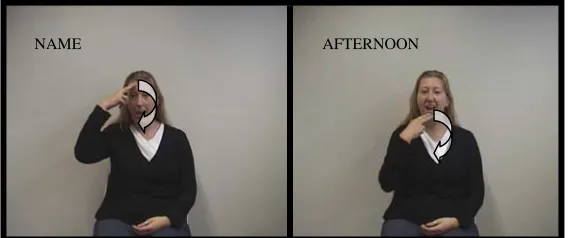
that differ in only one segment. For example, the BSL signs NAME and AFTERNOON have the
same handshape and outward movement, but differ in the location (the hand moves from the
forehead in NAME and the chin in AFTERNOON).
--Insert Figure 1 about here--
The movement and location segments of a sign can also be characterised as containing sets of
minimal meaningless features. In spoken languages consonant segments can be specified as
coronal or labial while in sign the location segments can be specified as being, for example at the
forehead, chin, shoulders or chest. How a sign language organises these phonological segments
and features into a hierarchical feature geometry is captured in one theory of ASL phonology: the
‘Prosodic Model’ (Brentari, 1998). Hierarchical organisation in the Prosodic Model underlies
how phonological markedness of form is determined. The term markedness has many different
interpretations within linguistic theory. Here ‘marked’ refers to the most complex segments (i.e.
the most numbers of features). Markedness also refers to the set of least commonly occurring
forms in the language. Conversely ‘unmarked’ forms are phonetically and phonologically simple
and are the most frequently occurring in the language.
Handshape.
In the Prosodic Model, handshapes are represented in terms of a hierarchy of selected phonetic
features (such as which fingers get extended or flexed and how contact between fingers is made).
acoustically/articulatorily more difficult than others (e.g. oral vowels). In a sign, different
handshapes will select a differing number of features, which determines the markedness of
particular handshapes. Marked handshapes are more phonologically complex (i.e. contain the
greatest number of selected features) than unmarked as well as being motorically more difficult.
Unmarked handshapes involve the fewest number of selected features. For example the index
finger point handshape (G) has only two features: a value for which of the fingers are selected
(one index finger) and a value for the flexion of the non-selected fingers (all flexed). A marked
handshape, such as one where the thumb, index and middle finger are extended (v + thumb),
requires more selection of features in its phonological representation. Unmarked handshapes
appear most often in the lexicons of the world’s different sign languages. For example the
handshapes flat hand (B), open hand(5), fisted hand(A) and G are found in 50% of all BSL signs
(Sutton-Spence & Woll, 1999 p162). Additionally some researchers include a relaxed open hand
handshape (lax-5) in the unmarked class with no overt formational features (Meier, 2005).
Movement.
Signs differ in their path of primary movement. For example, the BSL sign SAD is produced
with a straight path down, while the sign FARM has a curved path. Signs also vary in whether
the movement takes a simple linear path (e.g. RENT moves forward and backwards in a straight
line) or a more complex circular path (e.g. SHEEP). These last two types of movement (circular
versus linear) differ in their motoric difficulty also. The development of the motor coordination
needed to move the hands in straight lines or circles will play some part in how these components
are learned by children.
A sign may have no path movement itself but will incorporate a hand-internal movement, such as
addition to their primary path movement. As the sign moves along a path, the hand also makes a
secondary movement. The prosodic timing of these movement combinations is important, as the
hand-internal movement is often reduplicated and spread throughout the sign’s movement rather
than at the start or end of the sign. For example, in the sign FIRE the hands move up and down
while simultaneously the fingers wiggle several times during the sign’s movement. These signs
are made up of two movement features: a path and a hand-internal change (which is sometimes
reduplicated). In the Prosodic Model different movements are made up of a combination of
hierarchical features in a similar way to the phonological representation of handshapes, allowing
markedness of movement to be represented. Signs with simultaneous path and hand-internal
movements would be represented as the most marked forms in this model. There is no process
directly comparable to simultaneous path and hand-internal movement of hands in spoken
language phonology. Spoken words can have several elements produced in close proximity as for
example in consonant clusters. Perhaps more comparable are spoken words with simultaneous
features such as nasality or retroflexion.
Location.
Many signs are formed in a neutral location in front of the signer but signs also contrast with each
other in where they are located on the body (see the minimal pair NAME and AFTERNOON). In
the Prosodic Model a sign is specified first for one of three planes in sign space, then its region on
or around the body and finally for eight place distinctions (forearm, elbow shoulder etc) at each
region (Brentari, 1998). Currently it is not clear in the Prosodic Model how markedness of
different place distinctions can be predicted. The production complexity of different signs at
different locations is also relevant, for example in BSL there is a fine-grained minimal pair
distinction between the mouth and chin location in the signs JEALOUS and CHOCOLATE
respectively. Signers spend most time looking at the lower face of their conversation partner
Prosodic patterns.
Prosody consists of intricate patterns of rhythmic and intonational structure. The study of sign
language prosody is less well documented than the phonological and syntactic levels but some
studies have proposed that sign languages exploit sets of regular prosodic features. Nespor &
Sandler (1999) found the following phonetic correlates to the phonological phrase: reduplicated
final signs, holds at the end of the final sign, or pauses after the last sign of the phrase. As part of
the prosody many signs are also produced with an identical reduplicated movement e.g. DOG,
BROTHER or SCHOOL. A difference between signs and words is that the majority of signs are
monosyllabic (bysyllabic signs occur but are less frequent). Different theories argue that like all
spoken words, signs must consist of at least one syllable and specifically for sign this must be a
movement of some type (e.g. Sandler, 1989; Brentari, 1998). In spoken languages,
monomorphemic words with reduplicated identical syllables (e.g. [mʌmʌ]) are far less common
than in sign languages (Channon, 2002; MacNeilage & Davis, 2000, Meier, 2005).
The prosody of the sign is thus based on both the timing of the sign’s complete articulation from
beginning to end (including reduplications and holds) and the fixed ordering of different
segments within the movement. A common pattern in spoken words is for vowels and
consonants to be articulated in slots in the prosodic structure in a fixed order with different
lengths of time for each slot. One striking aspect of sign language prosody is that the different
phonological segments get expressed simultaneously. Signers do not first fully articulate the
handshape and then move the sign instead both elements are produced simultaneously. This
coordination of elements contrasts with spoken words which have clear linear segmental
The acquisition of sign language phonology
Most previous research on sign development at the level of phonology has been carried
out on ASL e.g. McIntire (1977), Boyes-Braem (1990), Marentette & Mayberry (2000); Meier, et
al (1998), Meier (2005). In contrast there have been very few studies of the adult phonology of
BSL (Brennan, 1984) or its development (Carter, 1983; Harris, et al 1989; Clibbens & Harris,
1993). Clibbens and Harris (1993) following McIntire’s work on ASL, suggested that the
differences between children’s early signs and the adult sign target, might be the result of
modification processes akin to those proposed for children’s spoken language development.
Studies of the development of different sign languages have reported that children produce more
errors in the production of handshapes than for the movement and location segments and that the
first handshapes in children’s signs are the unmarked kind (ASL: Siedlecki & Bonvillian, 1997;
Marentette & Mayberry, 2000; Cheek et al, 2001; BSL: Clibbens & Harris 1993; Brazilian Sign
Language: Karnopp, 2002; Norwegian Sign Language: von Tetzchner, 1994; Finnish Sign
Language: Takkinen, 2003).
For BSL, Clibbens & Harris (1993) reported that the child in their study used only the
A
and
5
handshapes
until 19 months, after which she added the G handshape. In naturalistic signing thechild replaced the marked handshapes in the target with unmarked handshapes in her production.
In spoken language development children replace adult target sounds not yet mastered, with
sounds already part of their productive speech. Children also begin with the simplest and most
unmarked speech sounds and then gradually extend their repertoires (Locke, 1990; Vihman,
1996). Children do however sometimes produce a sounds in one word but not in another
suggesting ease of articulation is not the whole story (Smith, 1973). Each modality provides
different solutions for how first signs or words get produced during this stage. In speech
gliding. In sign, the development of the marked handshapes requires increasingly independent
operation of individual fingers. Boyes-Braem (1990) proposed handshape errors were caused by
the culmination of several factors rather than just fine motor control. She argued that across all
sign languages, patterns of handshape development could be predicted by the motoric and
phonological complexity of the sign, as well as the availability of visual and tactile feedback
during production. Visual feedback is also involved in spoken language development where
children need to see mouth patterns to distinguish between similar speech sounds (e.g. Mills,
1983). Because of the modality, visual feedback may play more of a role during sign acquisition
than in speech.
The literature on children’s motor development suggests extralinguistic factors may play a role in
signing children’s articulation of different types of signs. In all children’s motor development,
the reduplication of cycles of movement or stereotypes (rocking, waving, kicking etc) is a
common occurrence (Thelen, 1979). The emergence of an adequate timing control mechanism is
essential to the development and learning of such rhythmic coordinated actions. Reduplication is
considered an important cue in monitoring the timing of these types of movement cycles (Thelen,
1995). Another important motor development is the ability to inhibit movement. Children during
the first 12 months of life have difficulty inhibiting the action of one hand when the other hand is
moving, as seen in their early reaching and placing of objects. A final component that needs to be
considered is proximalisation. This process is again typical in children up to 12 months of age
and describes infants as first having control of those limb joints closest to the torso (e.g. the
shoulder or elbow). During maturation the child develops control of more distant joints but
before this happens movements that are normally carried out on distal joints (e.g. writing) may
Cheek et al, (2001) reported that during the first 18 months of ASL development, hand-internal
movements (wiggles, rubs etc) are either displaced to different locations or likely to be deleted
altogether (see also Meier, 2005: 217-218). Location causes children fewer linguistic problems
than handshape and movement. However signs located on the face and head where phonological
contrasts are fine-grained, continue to cause problems after 24 months (Siedlecki & Bonvillian,
1993; Juncos et al, 1997; Marentette & Mayberry, 2000). In spoken language, speech contrasts
that require subtle changes in place of articulation e.g. /f/ and /ɵ/ are difficult to master at the start
of development. Despite the difficulty in getting target locations on the face correct, signs
located on the face and head are very prevalent in first signs (the other location being in front of
the body), so much so that the head and face are sometimes used as replacements for other
locations (Conlin et al, 2000). The head and face may give the child more salient information
through tactile feedback as to where the hands are. These parts of the body may also be more
salient in children’s developing body schema (e.g. Butterworth, 1992). There have been very few
studies of children’s development of the prosodic properties of sign language (Hamilton, 1986;
Seidl et al, 2004). Over-reduplication of signs by children is a common occurrence through the
addition of reduplications to single-movement and multiple-movement signs (Meier et al, 1998;
Cheek et al, 2001). Clibbens & Harris (1993) noted that children sometimes improved on a sign
form, making it more like the adult target, over the series of additional reduplications.
Turning to the present study we ask how theoretical models of sign language phonology shed
light on developmental data and also how developmental processes in children’s first signs
compare with those previously described for the development of first words.
Method
Subject
Gemma is a deaf child of deaf parents and at the time of data collection had no other
siblings. All of Gemma’s grandparents are hearing. She was identified as deaf in the first weeks
of life through targeted screening. This meant that her parents knew from the outset that their
child was deaf and used BSL with her from birth onwards. At the start of data collection Gemma
was 19 months old and had attended a private nursery 3 days a week from the age of 6 months.
The staff had a developing vocabulary of BSL signs and used these to communicate with Gemma.
Although there are no available norms for BSL development for a child of this age, her language
at 19 months was similar to other reported studies for same age deaf children learning ASL (e.g.
Newport & Meier, 1985) and also similar to typically developing hearing children acquiring
spoken language. Gemma received regular assessments by speech and language therapists who
reported no intellectual or social impairments.
Data collection and coding
Gemma’s signing between the ages 19- 24 months was recorded in the family home with 19
recordings each of 50 minutes. The language sample consisted of a total of 1018 sign tokens. All
of this data were based on naturalistic interaction between the child and her mother in free play.
A general methodological issue in sign language acquisition research is what should be counted
as a sign and what is non-linguistic gesture (see Meier & Newport, 1990; Volterra & Erting,
1994). We adopted the Casey (2003) definition of a sign whereby manual productions are
evaluated on form (how close to target); semantic content (used in semantically appropriate
ways); linguistic content (combined with other linguistic devices e.g. pronouns, negation etc); the
child’s age (by 18 months most native signers have an established vocabulary) and native signer
All signs were compared with the mother’s input to Gemma as the target. Data coding took place
in two rounds. First all possible signs were identified with times on the videotape recorded.
Once the child’s signs were identified, they were then described with respect to the three main
phonological segments (handshape, location and movement) as well as coding for the timing and
reduplication of the sign.
Any differences between the adult target and the child’s sign were noted using a written
shorthand description of the child form.2 Coding of handshape features was based on Kyle &
Woll (1985) and throughout the coding of handshape description was phonologically based (e.g.
more similar to a 5 handshape than a B handshape). Codes were used that most matched the
child’s form rather than creating extra phonetic labels for every possible configuration between a
5 and a B handshape. For example, the mother’s sign BIRD is produced with an index finger and
thumb closing movement at the nose (like the action of a beak opening). In the child’s production
there were several differences to this target, which were recorded as in table 1.
--Insert Table 1 about here--
As convention, inter-coder reliability was carried out on 10% of the data and agreement was
established at over 80%. Coders discussed any disagreements until a consensus was reached. If
this was not possible the form was discounted.
Results
Handshape development.
There were 416 recognisable signs produced with an un-adult like selection of handshape (41% of
total corpus). The number of occurrences of different handshapes varied greatly across the
appropriately by the child during the period of data collection (e.g. W,Y,F and I). Figures for each
type of handshape are shown in Table 2.
--Insert Table 2 about here--
The unmarked BSL handshapes (G, A, B, 5) and the neutral handshape (lax 5) were the most
frequently attempted (57%) and produced most appropriately by the child (42-72% correct). It
was not the case that there were one-to-one substitutions of handshapes e.g. G always for H.
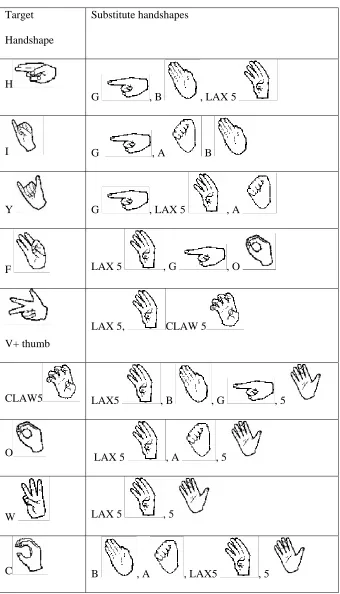
Substitutions fell within groups (e.g. 5 and A for O, A and B for I). This pattern is shown in Table
3.
--Insert Table 3 about here--
Movement development.
Gemma changed the target movement of her signs in three ways: a) by using a different path of
movement (e.g. linear instead of circular), b) by changing the sign’s hand-internal movement (e.g.
a target finger flick changed to an open-close) and c) by changing the combination of path and
secondary hand-internal movements e.g. producing one but not the other or producing both but
not simultaneously). Each of these is described in turn.
PATH CHANGES
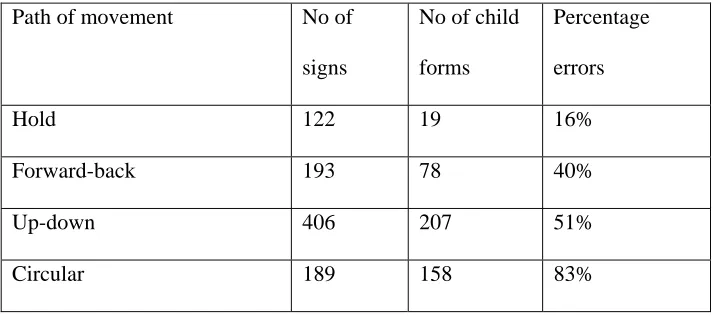
There were 462 signs with changes in the movement (45% of total). Signs with complex circular
movement were produced least accurately across the data. Table 4 shows the range of movement
paths that Gemma used in her first signs, as well as the frequency and appropriateness of each
--Insert Table 4 about here--
PRIMARY HAND-INTERNAL MOVEMENT CHANGES
There were 198 signs in the corpus that required a primary hand internal movement but no path
movement. Nearly half of these (92) were produced differently to the adult target by the child.
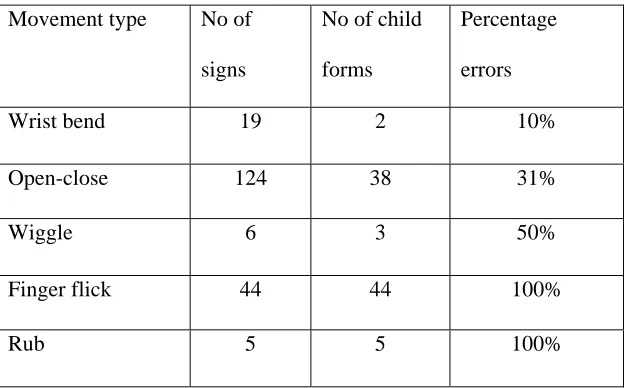
The most frequent type of target hand-internal movement attempted was open-close, but the
hand-internal movement wrist-bend was most accurately used by the child. Child errors were
through omissions, proximalisations and substitutions. Gemma’s overall use of hand-internal
movements is shown in Table 5.
--Insert Table about 5 here--
PATH AND SECONDARY HAND-INTERNAL MOVEMENT COMBINATION CHANGES
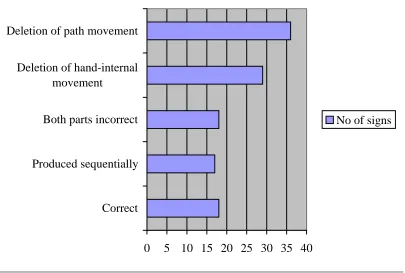
Gemma attempted 118 signs that required a simultaneous path and hand-internal movement. In
100 of the signs, Gemma made an error compared with the adult target and the rest were
produced correctly. The errors types observed were through the child: a) producing the two
components sequentially rather than simultaneously (17%), b) producing one movement
appropriately but not both (only path 29%; only hand-internal 36%) or c) producing both
components inappropriately (18%). The numbers of signs produced with different types of errors
are shown in Figure 2.
--Insert Figure 2 about here--
Location.
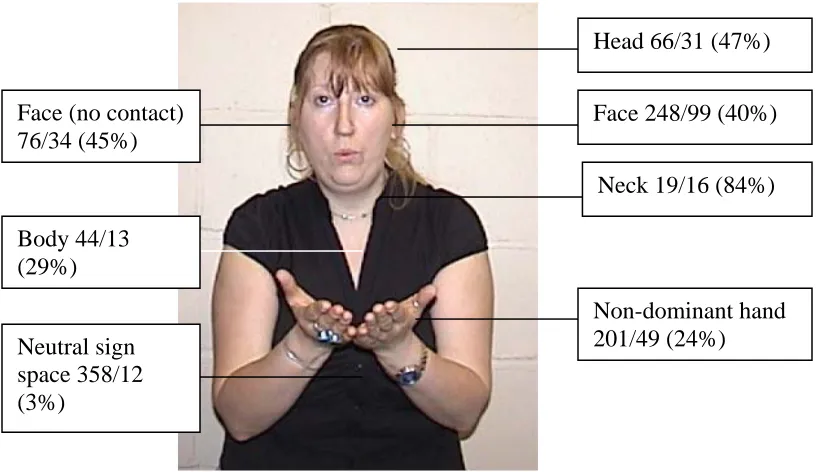
This was the most accurate part of the child’s signs and produced with only 25% errors or 255
Within these 255 sign errors, 71% were through enlargement of the location from the target to the
child form e.g. from the temple to the cheek. Withstanding only a 25% error rate, difficulty in
getting the location correct varied systematically. The neck with a small size of target space and
minimum visual feedback for the child was the most difficult (84% errors). See Figure 3.
--Insert Figure about 3 here--
Prosodic structure
REDUPLICATION
Many of Gemma’s signs were produced with the un-adult-like addition of reduplication (47%).
Signs that in the adult target had one movement e.g. TABLE were produced with several
movements. Similarly signs that in the adult target had two or three identical movements e.g.
HORSE or BIRD were also produced with reduplications of the whole sign. From the 482 signs
there was an improvement in the sign’s target form during the reduplications in only 50 cases and
conversely in 27 cases the over-reduplication caused the sign’s form to deteriorate compared to
the target.
TIMING
We observed 19% of signs produced with an error in the timing of the articulation. Timing refers
to the coordination of the execution of each part of the sign’s articulation. The most common
type of error observed (115 tokens) was through the insertion of an extraneous hold into the
movement segment of the sign.
Discussion.
locations and with 47% of the sign’s prosodic features. Some of the child forms observed in this
single case-study (such as substitution) have been reported in earlier studies of BSL development
(e.g. Clibbens & Harris, 1993) and also in research on children’s acquisition of other sign
languages (e.g. Karnopp, 2002; Tetzchner, 1994; Takkinen, 2003).
Other child forms (i.e. changes to prosodic structure and hand-internal movement errors) have not
been reported on in as much detail previously. Cheek et al (2001) and Meier (2005) mention that
hand-internal movements tend to be deleted in children’s first signs. In keeping with hearing
children’s phonological development in English, Gemma’s age and language development put her
in the period where phonological processes are understood to be present in the development of
the lexicon (Bernhardt & Stemberger, 1998). Two questions are asked here: 1. How do children’s
first signs follow phonological processes from within a sign phonology theory? 2. Which
processes identified in spoken language development can account for children’s first signs? We
tackle both questions in the following sections.
Structural changes
In research on spoken language development a set of processes change the shape of the target
word including: deletion of final word consonants; deletion of weak syllables; reduplication of
strong syllables and finally consonant cluster reduction. For example some children insert an
unstressed syllable into words with consonant clusters thus producing [bəlæk] instead of [blæk].
In Gemma’s signing, structural changes leading to changes in the shape of the sign were rendered
in four main ways: 1) Movement deletion; 2) Sign reduplication; 3) Movement and Location
MOVEMENT DELETION
A consistent error was deletion of hand-internal movements when they needed to be combined
with a path movement. Within the 100 errors there were interesting subtypes. In 17 cases, the
child pulled apart the two movement components and articulated them sequentially. For example
in the sign HOW-MANY the hands move side-to-side repeatedly while the fingers wiggle. In
Gemma’s sign the side-to-side movement was first completed then followed by the finger wiggle
hand-internal movement. At this age, Gemma has not yet mastered the production of targets with
overlapped path and hand-internal movement. A difficulty with the co-ordination of the path and
hand-internal features is predicted in the Prosodic Model, as these are the most marked features of
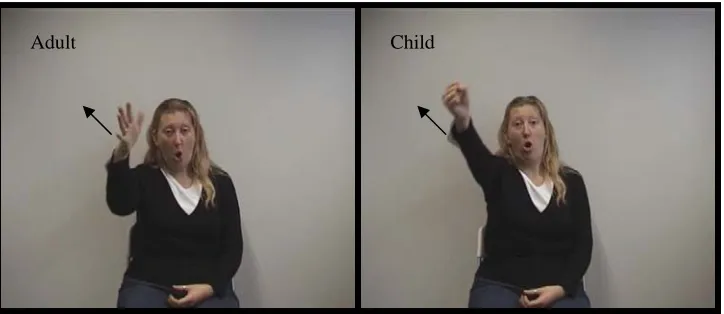
a sign’s movement. One way to deal with this complex production is to delete one element in the
combination. For example THROW (a putative iconic sign) moved outward but had no
open-close movement at the end of the path (see figure 4).
--Insert Figure about 4 here--
In the signs with hand-internal but not path movement (e.g. UNDERSTAND), the hand-internal
movement was always substituted rather than deleted altogether. Data from development
therefore strengthens the notion that the syllable structure of the sign must contain some
movement feature. In a hierarchical model of sign phonology it is just these hand-internal
movements that appear (hand-aperture) as the most complex features in the tree (Brentari, 1998).
The phonological markedness of the sign’s movement is based on the addition of features to more
basic movement forms. In signs with only hand-internal movement the child’s strategy was to
use an open-close movement rather than the target hand-aperture feature e.g. wiggle, rub etc.
This suggests that the child recognised that movement is obligatory in the sign’s phonological
In these complex signs the child chooses to delete one of the movements as there is already an
alternative movement feature in the phonological representation. The hand-internal feature is not
obligatory when a path has been used and vice versa. The phonology of the sign means that
deletion does not target weak syllables as it does in speech development (Smith, 1973; Vihman;
1996). The movement segment needs to appear throughout the sign’s articulation rather than on
individual syllables or parts. It was not the case that all hand-internal and path combinations
were deleted.
SIGN REDUPLICATION
In 482 signs (47% of sample) Gemma produced signs with over-reduplication. These cases were
made up of the reduplication of whole signs that do not require reduplication in the citation form
(e.g. AEROPLANE) as well as the reduplication of whole signs that already had reduplications in
their citation form (e.g. BIRD). The addition of reduplications was to the whole sign rather than
parts of the sign. Clibbens & Harris (1993) suggested that reduplication might enable to child to
improve the form of the sign over the course of the reduplications. In this sense reduplication is a
‘practice’ strategy adopted by the child. We observed improvements in only about 10% of the 482
cases. In spoken English development reduplication of strong syllables is common between ages
18-24 months but not whole word reduplication (Grunwell, 1997). The sign TABLE in the adult
target comes to a stop once the hands separate out to shoulder distance after one movement
without any reduplication of movement. Gemma signed TABLE with several reduplicated
movements and it was noticeable that she reduced the size of the movement (to less than shoulder
width) with each cycle. If these reduplicated forms were considered to be single signs for
Gemma, then in her phonological representation the sign would actually be increasing in
complexity, as each cycle would add syllables rather than simplifying. A sign with a hypothetical
complexity is not increased but only repeated during the reduplication. The structure would
therefore be ‘1-2’, ‘1-2’, ‘1-2’.
Another linguistic explanation may lie in the prosodic structure of the sign. If these reduplicated
signs were single signs rather than sequences, then reduplication increases the time between the
start and end of the sign and therefore elongates the prosody. If the signs were multi-morphemic,
elongating the prosody would function to allow the child more time to assemble the word.
However at this stage in development Gemma was still using single signs without morphological
inflections. Meier (2005) writes that mono-morphemic forms with reduplication of identical
syllable structure are more common in sign than spoken languages. This difference may mean
syllable reduplication is adopted with whole signs rather than internal parts. Meier et al
(submitted) emphasize the role of children’s inability to inhibit movement as being a major factor
in signing children’s problems with reduplication and found that signing infants between 8-17
months were more accurate with signs that in the target input had reduplicated movements. In the
present study Gemma reduplicated both single and repeated movement signs and indeed other
studies of similar aged children have reported no problems in reduplication at all (Juncos et al,
1997).
A final piece of the reduplication puzzle comes from characteristics of the input to signing
children. Adult signers spend a considerable time adjusting their signing so as to make it more
visually salient (e.g. Harris et al, 1989; Holzrichter & Meier, 2000; Spencer & Harris, 2005).
Woll, Kyle & Ackerman (1988) discuss how mothers’ models for children to repeat (‘sign it like
this’) often include over-reduplications or a single movement extended in space and time, while
acknowledgements of children’s attempts to sign appear without reduplication. Therefore one
ENLARGEMENT 3
Only 25% of Gemma’s signs were produced with an error in the location segment. Within these
255 signs, 71% of errors were due to changing the target location of the sign to a larger neighbour
on the body (e.g. neck to chest; temple to side of face). In one instance Gemma signed COW
onto her cheek instead of the temple as in the target. The temple is a smaller area than the whole
side of the face. FROG was signed onto the larger area of the chest rather than as in the target on
the small location under the chin. In another, HOT was made covering the whole of the bottom
part of the face rather than a location just in front of the mouth. Importantly we were comparing
Gemma’s locations with those produced by the mother (the mother used the temple for the sign
COW). Marentette & Mayberry (2000) report that one child acquiring ASL made location errors
by using anatomical neighbours e.g. temple was replaced by head, shoulder by trunk, hand by
trunk etc. But they do not mention that many of these replacement locations were larger than the
targets. The Prosodic Model does not make a complexity distinction between regions (e.g. face)
and smaller places on the body (e.g. cheek) (Brentari, 1998). Our developmental data suggest
that region should be organised above place in the feature geometry and within place there should
be ordered complexity.
In the present data, the child preferred larger location features in her own signing. This did not
seem to be a function of a difference in numbers of signs produced at that location i.e. fewer
attempts leading to fewer errors. There were 358 signs articulated in neutral sign space in front of
the trunk (the largest specified location) with 3% error and 324 signs on or near the face with a
far greater 41% error. These figures strongly suggest smaller locations are more marked features
within the sign’s representation. Additionally locations not in direct vision were most difficult
for the child. Within this category, size of location also predicted error rate: there were far fewer
errors for signs articulated on the head (47%) than on the neck (84%). Previous research has
Bonvillian, 1993; Volterra &, Erting, 1994). Non-linguistic factors may also be involved. Poor
motor control may have lead Gemma to ‘miss’ target signs in small locations and arrive instead at
approximate neighbours. The development of proprioceptive perception would help children to
self monitor their signs not in direct vision (e.g. Thelen, 1995).
INSERTIONS
Gemma regularly changed the sign’s structure by altering the target prosody in different ways. In
115 signs she inserted extraneous holds between handshape changes and movements. In one
instance: CAKE was produced with a pause between the up-down movements in the middle of
the sign. In another example THANK-YOU was produced with a hold at the chin location at the
start and end of the movement. Added holds change the overall shape of the sign by stretching
out the time between the realised segments.
Children acquiring spoken words often separate out clusters of consonants by deleting consonants
or adding unstressed vowels. A similar connected process in Gemma’s signing is the splitting
apart of simultaneously articulated segments in the target input so that the timing of the
handshape and movement was not coordinated correctly. The signs involving hand-internal and
path movement combinations (e.g. FIRE) posed problems for Gemma because of the
co-ordination of two movement features. There were 20 signs where the timing of the handshape
was either too early or too late and so not spread across both location segments of the sign. These
child forms may be due to a difficulty in the coordination of the segmental and prosodic features
of the sign. Gemma’s strategy is to change a sign’s simultaneous realisation of more than one
segment into a sequential realisation of the form. This lengthens the sign’s prosodic form by the
Substitution is widely reported on in the spoken language acquisition literature is (e.g.
Vihman, 1996). Substitutions or replacements of sounds in children’s first words are guided by
feature markedness, as well as the child’s own rule system at that point in development.
Sometimes sounds are replaced in one word but appear in other words (Smith, 1973). When
Gemma made a handshape substitution, in many cases she substituted the sign’s target marked
handshape for more frequently occurring handshapes with higher degree of appropriateness in her
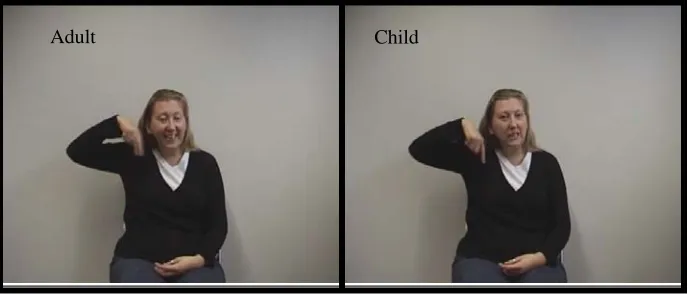
current phonological inventory. For example the features V in CHERRY and V + thumb in
RABBIT were replaced with the unmarked handshapes G and 5 respectively (see CHERRY in
figure 5).
--Insert Figure about 5 here--
Brentari (1998) makes clear predictions for which handshapes are marked, based on the number
of features present in the phonological representation. Simultaneous extension and flexion of
fingers is one more feature in the representation than one of these movements in isolation. In
development, children will simplify their production by reducing the number of features specified
in the output. In contrast to spoken language development where children have
phoneme-to-phoneme replacement rules, Gemma’s errors were all through a marked handshape being
replaced by a group of different unmarked forms. There may be some systematic visual
correspondence between target handshapes and replacements. The G handshape appears as a
replacement in all the handshapes that have a ‘pointing’ appearance (I, Y, H, F) while not at all as
a replacement for the more ‘fist-like’ handshapes (C, W, O, claw 5) where LAX 5 was common.
Marentette & Mayberry (2000) report the same pattern for ASL acquisition, where substitution of
handshape revolved around ‘handshape primes’, which are maximally perceptually distinctive
The preference for unmarked forms could also be seen in Gemma’s movement
substitutions. For example, the circular movement in BOAT was replaced by the child
with a linear up-and-down movement. The circular movement in BLUE and SHEEP
were replaced with forward-backwards movements. Instead of deleting movement
entirely she used linear movements as possibly the default feature for this slot in the
phonological representation of the sign. Brentari’s Prosodic Model does not specify
which path of movement features are more marked than others.
Modality issues
Although we identified several examples of substitution processes in early BSL, only
hand-internal movement substitutions have what looks like to be a one-to-one correspondence
between adult target movement and child movement (although it is largely open-closes for all the
different hand-internal movement). Substitution processes in BSL development represent
consistent interchanges between groups of forms, e.g. unmarked handshapes for marked
handshapes and linear for circular movements. Substitution between groups of sounds rather than
individual phonemes is a process not reported on in spoken language development where
phoneme-to-phoneme substitutions are more common. An additional modality difference was
that structural changes through reduplication, deletion of movement features or prosodic
elongation were realised as whole sign changes instead of as in speech through the deletion of
individual weak syllables or initial consonants. This difference may be related to the preference
for a monosyllabic structure in sign.
Signing and speaking are different types of communicative behaviours in other ways. Children
acquiring sign need to perceive linguistic forms in different parts of their visual field. Although
peripheral location is important, so that the head is less problematic than, for example, space on
the neck.
Conclusions
The patterns observed in this single-case of a child acquiring BSL as a first language point to the
role of rules for representing signs at the level of phonology. The detailed description of one
child’s signing presented in this study has therefore allowed us to confirm different types of child
forms reported across studies of various children of the same age acquiring diverse sign
languages and has provided us with valuable developmental data on normal first language
acquisition in BSL. This study also presents a preliminary theoretical account of prosodic
development in a signed language. Right from the beginning of sign and spoken language
acquisition, children are guided by constraints such as ease of articulation and markedness of
phonological form. Although not complete mirror reflections of each other, the parallels across
sign and spoken language development are far greater than the differences. These findings lend
weight to the idea that children approach language learning whether on the tongue or off the
References.
Agrafiotis, D., Canagarajah, N., Bull, D.R. & Dye, M. (2003). Perceptually optimised sign
language video coding based on eye tracking analysis. Electron. Lett., 39 (24), 1703-1705.
Bonvillian, J,. Orlansky, M. and Novack, L. (1993). Developmental Milestones:
Sign Language Acquisition and Motor Development. Child Development 54:1435-45.
Boyes Braem, P. (1990). Acquisition of the handshape in American Sign Language: a
preliminary analysis. In Volterra V & Erting C J (eds), From Gesture to Language in
Hearing and Deaf Children, pp 107-127. Washington DC: Gallaudet University Press.
Brennan, M. (1984). Words in hand. A structural analysis of the signs of British Sign Language.
Edinburgh : Moray House Coll. of Education
Brentari, D. (1998). A Prosodic Model of Sign Language Phonology. MIT Press
Brentari, D. (2002). Modality Differences in Sign Language Phonology and Morphophonemics.
In R. Meier, D. Quinto, K Cormier (eds.) Modality in Language and Linguistic Theory,
35-64. Cambridge University Press.
Butterworth, G. (1992). Origins of self-perception in infancy. Psychological Inquirey, 3, 103-111
Casey, S. (2003). Relationships between gestures and signed languages: indicating participants in
actions. In: A. Baker, B. van den Bogaerde, Beppie & O. Crasborn (eds).Cross-linguistic
perspectives in sign language research. pp. 95-118
Carter, M. (1983). The acquisition of British Sign Language (BSL). York Papers in Linguistics
10. pp. 23-48
Channon, R. (2002). Signs are Single Segments. Phonological Representations and Temporal
Sequencing in ASL and other Signed Languages Sign Language & Linguistics 5, 99 102
Cheek, A., Cormier, K., Repp, A. & Meier, R.P. (2001). Prelinguistic gesture predicts mastery
Clibbens, J. and Harris, M. (1993) Phonological processes and sign language development. In
D.Messer & G.Turner (Eds) Critical influences on child language acquisition and
development. London: Macmillan, New York: St Martin'‘s Press.
Conlin K E, Mirus G R, Mauk C & Meier R P. (2000). The acquisition of first sign place,
handshape and movement. In Chamberlain C, Morford J & Mayberry R (eds), Language
Acquisition by Eye. Mahwah, New Jersey: Lawrence Erlbaum Associates. Pp 51-70
Crasborn, O. (2001) Phonetic implementation of phonological categories in Sign Language of the
Netherlands. Utrecht: LOT. PhD dissertation
Gesell, A., & Thompson, H. (1934). Infant behavior: Its genesis and growth. New York:
McGraw-Hill.
Grunwell, P. (1997). Natural phonology. In M. J. Ball and R. D. Kent (Eds.) The New
Phonologies. San Diego: Singular. pp. 35-75.
Hamilton, H. (1986). Perception of sign features by deaf children. Sign Language Studies, 50,
73-77
Harris, M., Clibbens, J., Chasin, J. & Tibbitts, R. (1989). The social context of early sign
language development. First Language, 9, 81-97.
Holzrichter, A. S., & Meier, R. P. (2000). Child-directed signing in American Sign Language. In:
C. Chamberlain, J. P. Morford, & R. Mayberry (eds.), Language Acquisition by Eye.
Mahwah, NJ: Erlbaum, pp. 25-40.
Juncos, O., Caamano, A., Justo, M. J., Lopez, E., Rivas, R. M. & Lopez, Y. & Sola, F. (1997).
Primeras palabras en la Legua de Signos Espanola (LSE). Estructura formal, semantica y
contextual. Revisita Logop. Fon., Audiol., 17, pp 170-181.
Kantor, R. (1980). The Acquisition of Classifiers in American Sign Language.
Karnopp, L B (2002). Phonology acquisition in Brazilian Sign Language. In Morgan G & Woll
B (eds), Directions in Sign Language Acquisition. Amsterdam: John Benjamins Publishing
Company. Pp. 29 53
Klima, E. & Bellugi, U. (1979). The Signs of Language. Cambridge: Harvard University Press.
Kyle, JG & Woll, B. (1985) Sign Language: the study of deaf people and their language.
Cambridge University Press.
Locke, J.L. (1990). Structure and stimulation in the ontogeny of spoken language.
Developmental Psychobiology, 23, 621-644
MacNeilage, P.F. & Davis, B.L. (2000). On the Origin of Internal Structure of Word Forms.
Science 21 April 2000: Vol. 288. no. 5465, pp. 527 - 531
Marentette, P. F. & Mayberry R. I. (2000). Principles for an emerging phonological system: a
case study early American Sign Language acquisition. In Chamberlain C, Morford J &
Mayberry R (eds), Language Acquisition by Eye. Mahwah, NJ: Lawrence Erlbaum
Associates. Pp 71-90
McIntire M. (1977). The acquisition of American Sign Language hand configurations. Sign
Language Studies, 16, pp 247-266.
Meier R P, Mauk C, Cheek, A., & Moreland, C. (Submitted). The form of children’s early
signs:Iconic or motor determinants? Language Learning & Development
Meier R P. (2000). Shared motoric factors in the acquisition of sign and speech. In Emmorey K
& Lane H (eds), The Signs of Language Revisited: an Anthology to Honor Ursula Bellugi
and Edward Klima, pp 103-114. Mahwah, NJ: Lawrence Erlbaum Associates.
Meier, R. P. (2005). The forms of early signs: explaining signing children’s articulatory
development. In B. Schick, M. Marschark & P Spencer (eds). Advances in the
Sign-Language Development of Deaf and Hard-of-Hearing Children. Oxford, UK: Oxford
Meier, Richard P., & Newport, Elissa L. (1990). Out of the hands of babes: On a possible sign
advantage in language acquisition. Language 66:1-23.
Meier R P, Mauk C, Mirus G R & Conlin K E, (1998). Motoric constraints on early sign
language acquisition. In Clark E (ed) Proceedings of the 29th Annual Child Language
Research Forum. Stanford, California: CSLI.
Mills, A. (1983) Ed. Language Acquisition in the Blind Child. Child language: normal and
deficient.
Nespor, M. & Sandler, W. (1999). Prosody in Israeli Sign Language.
Language and Speech 42 (2&3), 143-176.
Newport, E. L., & Meier, R.P. (1985). The acquisition of American Sign Language. In D.I.
Slobin (ed.). The crosslinguistic study of language acquisition. Volume 1: The data, ,
881-938. Hillsdale, NJ: Lawrence Erlbaum Associates.
Sandler, W. (1989). Phonological representation of the sign. Dordrecht: Foris.
Seidl, A., Johnson, E., Redman, D. & Brentari, D. (2004). Segmentation of clauses in English,
Dutch and American Sign Language. Paper presented at BUCLD, Boston. November 2004.
Siedlecki, T. & Bonvillian, J. D. (1993). Location, handshape and movement: young children’s
acquisition of the formational aspects of American Sign Language. Sign Language Studies,
78, pp 31-52.
Siedlecki, T. & Bonvillian, J. D. (1997). Young children’s acquisition of the handshape aspect of
American Sign Language: parental report findings. Applied Psycholinguistics, 18, pp
17-31
Snow D. (1997). Children's acquisition of speech timing in English: a comparative study of voice
onset time and final syllable vowel lengthening. Journal of Child Language 24, 35-56.
Stokoe, W.C., Casterline, D. & Croneberg, C. (1965). A Dictionary of American Sign Language.
Washington DC: Gallaudet College Press.
Smith, N.V. (1973). The acquisition of phonology. Cambridge: Cambridge University Press
.
Sutton-Spence, R. L. & Woll, B. (1999). The Linguistics of British Sign Language: an
Introduction. Cambridge: Cambridge University Press.
Takkinen, R. (2003). Variation of handshape features in the acquisition process. In: Baker, A.,
van den Bogaerde, B. & Crasborn, O. (eds). Cross-linguistic perspectives in sign language
research. Hamburg: Signum. pp. 81-94
Thelen E (1979), Rhythmical stereotypies in normal human infants. Anim Behav 27:
699-715.
Thelen, E. (1995). Origins of origins of motor control. Behavioral and Brain Sciences, 18,
780-783.
von Tetzchner, S. (1994). First signs acquired by a Norwegian deaf child with hearing parents.
Sign language Studies, 44, 225-257.
Vihman, M. (1996). Phonological Development: the Origins of Language in the Child. Oxford,
UK: Blackwell Publishers.
Vihman, M. & McCune, L. (1994). When is a word a word? Journal of Child Language 21
517-542.
Volterra, V. and Erting, C. J. (eds). (1994). From gesture to language in hearing and deaf
children. Springer Verlag, NY.
Volterra, V., Iverson, J. & Castrataro, M. (2005) The development of gesture in hearing and deaf
children. In B. Schick, M. Marschark & P Spencer (eds). Advances in the Sign-Language
Woll, B (1998). Development of signed and spoken languages. In Gregory, S and Powers, S (eds)
Table 1 Shorthand description of a child sign with errors described for each component
Sign Handshape Movement Location Timing/reduplication
BIRD lax 5 hand Open-close of
whole hand
Table 2 Handshape production errors calculated as a percentage of the total number of
signs used with that handshape on the dominant hand.
Handshape N of
target
signs
No of
inappropriate
selections
% Handshape N of
target signs No of inappropriate selections % A
122 37 30%
V+ thumb
15 14 93%
5
34 11 32%
CLAW5
37 35 95%
G
201 68 34%
C
23 22 96%
B
149 87 58%
I
28 28 100%
O
13 12 92%
F
30 30 100%
H
82 76 93%
Y
37 37 100%
W
Table 3 Groups of substituted handshapes made when the child was attempting to form
different target handshapes.
Target
Handshape
Substitute handshapes
H
G , B , LAX 5
I G , A B
Y G , LAX 5 , A
F LAX 5 , G , O
V+ thumb
LAX 5, CLAW 5
CLAW5 LAX5 , B , G , 5
O LAX 5 , A , 5
W LAX 5 , 5
Table 4 Errors in path of movement.
Path of movement No of
signs
No of child
forms
Percentage
errors
Hold 122 19 16%
Forward-back 193 78 40%
Up-down 406 207 51%
Table 5 Hand-internal movements
Movement type No of
signs
No of child
forms
Percentage
errors
Wrist bend 19 2 10%
Open-close 124 38 31%
Wiggle 6 3 50%
Finger flick 44 44 100%
Figure captions
Figure 1. A minimal phonological pair in BSL differing on the location part of the sign – the forehead in
NAME (left) and the chin in AFTERNOON. The sign moves outward from both locations. All
other parts of the sign are identical.
Figure 2.The different types of path and hand-internal combinations attempted by the child.
Figure 3. Changes in the location of signs. Figures refer to the number of signs attempted at that location,
number of errors and % error.
Figure 4. Deletion of hand-internal movement (hand-close) in the sign THROW. In the adult target on
the left the hand opens as the sign moves forward. In the child’s sign only the forward movement
is retained.
Figure 5. Handshape substitution in the sign CHERRY. The adult target handshape (V) on the left is
AFTERNOON NAME
[image:37.612.89.373.86.205.2]0
5
10 15 20 25 30 35 40
Correct
Produced sequentially
Both parts incorrect
Deletion of hand-internal
movement
Deletion of path movement
[image:38.612.97.502.113.386.2]No of signs
Neutral sign
space 358/12
(3%)
Non-dominant hand
201/49 (24%)
Body 44/13
(29%)
Neck 19/16 (84%)
Face (no contact)
76/34 (45%)
Face 248/99 (40%)
Head 66/31 (47%)
[image:39.612.89.498.96.332.2]Adult Child
Child Adult
[image:41.612.90.435.122.269.2]Footnotes
∗ The authors would like to thank Chloe Marshall, Rachael-Anne Knight, Elisabeth Johnson,
Tanya Denmark and anonymous reviewers for comments on earlier versions of the manuscript.
1
Signs are glossed in uppercase with hyphens where more than one English word is required. When describing different handshapes in sign language research it is customary to use symbols (e.g. 5, A, B, etc) derived from the handshapes associated with the American 1-handed alphabet (with the addition of some handshapes associated with numbers).
2Currently there are no standard written phonetic transcription alphabets such as the IPA
available for sign languages although different transcription systems do exist (see Crasborn, 2001).
3