A new computation method for a staggered grid
of 3D EM field conservative modeling
Elena Yu. Fomenko1and Toru Mogi2
1Geoelectromagnetic Research Institute RAS, Troitsk, Moscow Region 142092, Russia 2Institute of Seismology and Volcanology, Hokkaido University, Sapporo 060-0810, Japan
(Received January 9, 2001; Revised August 8, 2001; Accepted September 21, 2001)
A new three-dimensional (3D) MT modeling scheme conserving electric current and magnetic flux is developed. The scheme is based on finite difference (FD) staggered rectangular non-uniform grid formulation for the secondary electric field with continuous components of tangential electric and normal magnetic fields, in contrast to existing FD algorithms with a discontinuous E-field at the face of the cells. The scheme leads to a sparse 13-band complex symmetrical system of linear equations, which is effectively solved by fast and stable conjugate gradient (CG) methods. The preconditioning procedure was used to decrease the condition of a number of an ill-conditioned matrix system by several orders and stably and quickly solves the matrix system. The special module for the correction of divergence-free current J greatly increased the speed of convergence and accuracy, especially at low frequencies and for high-contrast resistivity or conductivity structures. A special procedure was developed to improve the accuracy of tangential magnetic and vertical electrical components at the Earth’s surface and at the interface with a large conductivity contrast. The validity of the new algorithm was demonstrated for difficult models with high-contrast resistivity structures including topography and for COMMEMI project models.
1.
Introduction
Much progress has been made in three-dimensional (3D) EM modeling with integral equation (IE), finite difference (FD), and finite element (FE) methods in the recent years (e.g. Wannamaker, 1991; Mackieet al., 1993; Alumbaughet al., 1996; Smith, 1996; Avdeevet al., 1997; Weidelt, 1999; Xionget al., 1999; Fomenko, 1999; Varentsov, 1999; and Sasaki, 1999). Models with an arbitrarily complex 3D resis-tivity distribution, including topography and high-resisresis-tivity contrast, require a large number of grid nodes. These mod-els are especially difficult for using IE methods due to a full matrix system of orderN3(N: number of nodes), thus these problems are mainly solved by FD or FE schemes. Known FD and FE schemes are incomplete for solving such difficult problems and thus require improvement. The fol-lowing issues should be addressed: good accuracy over a wide range of frequencies, non-monotonic behavior of the residual, causing uncertainty of termination criteria, speed of convergence and stability of the numerical scheme. Thus, special attention has been devoted to schemes which obey the conservation laws of electric current and magnetic flux in a frequency domain for quasi-stationary electromagnetic fields. This approach leads to success in staggered finite dif-ference (SFD) schemes based on magnetic fields (Mackieet al., 1993) and on electric fields (Smith, 1996; Alumbaughet al., 1996; Weidelt, 1999; Xionget al., 1999).
This paper describes a new step in the development of an electric-field solution leading to a fast, accurate,
economi-Copy right c The Society of Geomagnetism and Earth, Planetary and Space Sciences (SGEPSS); The Seismological Society of Japan; The Volcanological Society of Japan; The Geodetic Society of Japan; The Japanese Society for Planetary Sciences.
cal, and conservative SFD scheme for wide-band frequen-cies and high-contrast structures. Our SFD scheme is based on an electric secondary field with continuous components at a staggered grid.
2.
Algorithm
2.1 Approximation and conservation laws
First, we introduce a rectangular, non-uniform ‘Normal Grid’ with coordinates of the nodesxi,yj,zkand grid cells
i = xi+1−xi,j = yj+1−yj,k = zk+1 −zk. We also define a ‘Central Grid’ with coordinates of the nodes
xi=(xi +xi+1)/2,yj=(yj+yj+1)/2,zk= (zk+zk+1)/2 and grid cellsi =(i+i+1)/2,j =(j+j+1)/2,
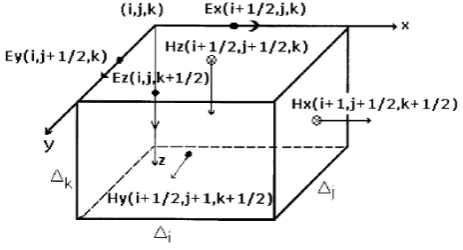
k =(k+k+1)/2. Based on these grids, we construct a staggered grid (Fig. 1). The electric field (E) is taken to be at the center of the prism edges, and the magnetic field (H) is taken to be at the center of the interfaces. Thus,Eis always tangential andHis always normal to the conductivity and both are always continuous at the staggered grid.
Assuming the time harmonic dependence e−iωt (ω:
an-gular frequency) and ignoring the displacement current in magnetotelluric modeling, Maxwell’s equations for the total electric field (E) and magnetic field (H) in a staggered grid lead to
4
Hdl=
σEds, (1)
4
Edl=iωμ
Hds, (2)
4
d Vi j k
(σE)ds=0, or div(σE)=0, (3)
Fig. 1. A staggered grid cellV(i,j,k). Tangential electric and normal magnetic field components are sampled at the center of edges (E) and at the center of interfaces (H), all of them are continuous. i,j,k
denote the sizes of the cells.
4
d Vi j k
(H)ds=0, or divH=0, (4)
whereμis the magnetic permeability andσ is the conduc-tivity distribution in the cells of a normal grid.
We will use the formulation for secondary fields because it usually provides more stable and accurate solutions than formulations for total fields. The primary fields Ep, Hp are selected to satisfy (1)–(4) for a model with primary conductivity σp. For the secondary fields Es=E−Ep, unit vectors correspondingly along thex,y,zdirections.
After staggered finite difference (SFD) approximation of Eqs. (1) and (2), we obtain six scalar equations shown as (5) and (6):
The original system describing (5), (6) is a pair of coupled first-order equations forEandH. In order to decrease the number of equations, we eliminate H-field from Eq. (5) using the right-hand side of Eq. (6). The second-order SFD equation was introduced as follows:
5A(Es+Ep)=5AEtotal=0. (7)
The matrix 5A is neither Hermitian nor symmetric, but it can be transformed to the complex symmetric matrix Aˆ by multiplying the obtained equations by factor i forEx
members in the right side,j forEyandkforEz.
After moving the primary fieldEp to the right-hand side,
Iis the identity matrix.
Other elements of the operatorAˆ have similar forms. Let us now consider the conservation laws describing (3) and (4) on the staggered grid. The SFD operators, intro-duced in (8.1)–(8.3), automatically provide the following vector equalities:
∇s f d×(∇φ)=0 for any SFD scalarφ, (10.1) div(∇s f d×F)=0 for any SFD vectorF, (10.2)
∇s f d× ∇s f d×F= −∇s f d2 F+ ∇s f ddivs f dF
for any SFD vectorF, (10.3)
and the following two SFD conservation laws on the stag-gered grid are introduced, when thedivoperator is applied to the original equations (5) and (6) for the total fields:
divs f djtotal=divs f d(σE)=0, (11) iωμdivs f dH=0. (12)
Equations (11), (12) do not hold automatically whenσ = 0 (in the air) orω=0 (static case), as well as at low frequen-cies where computer round-off errors increase, even if dou-ble precision is used. Our transformation from the pair of coupledE-Hequations of the first order (5), (6) to the final stand-alone second-order Eq. (9) forEfield cannot automat-ically provide conservation laws (11), (12) in these cases, due to the elimination of matrix entries associated with re-gions whereσ = 0 in theE-Hformulation. In the regions whereσ =0 (air or insulator layer/body in the earth), ifE is an SFD solution, any E+ ∇φis also an SFD solution. Moreover, the final linear system (9) is ill-conditioned be-cause the main part of its operator (Ax x,Ayy,Azz) contains
an ill-conditioned Laplace operator. In order to overcome these problems, we use σ = 10−8∼10−10 S/m instead of
σ =0 and solve Eq. (9) for theEs-field together with Eq.
(11), periodically making divergence-free corrections to the currentj= σEto suppress computer round-off errors (see the details in Subsection 2.7).
Atω=0, the electric field becomes curl-free, thus it can be expressed asE= ∇φ. If we add Eq. (11), we will avoid uncertainty when calculating the electric field, because these two equations follow in the stationary equationφ=0.
It is very important to note that solving Eq. (9) without the conservation law (11) as a stand-alone equation causes inac-curate calculations of theEandHfields, especially at low
frequencies, in the vicinity of a dipole source (Alumbaughet al., 1996), and for large grids containing 100,000 and more cells (the condition number of the matrix is more than 108). The H-field is calculated using the curl-operator in the generalized Eq. (5) and (6) after solving Eq. (9) and (11) at the staggered grid (see Subsection 2.6). Due to the vector equality (10.2) and (6), the resulting magnetic field is auto-matically divergence-free with staggered grid and satisfies the conservation law in (12).
Using the Taylor series, it is easy to show that the pro-posed scheme has second-order approximation at the uni-form grid (i =j=k)and first-order approximation in
the area of non-uniform grid cells. 2.2 Boundary conditions
Equations (1)–(4) for the all E,Hcomponents uniquely determine the currentσEand magnetic fieldHthroughout the 3D model, when the tangentialEorHcomponents are specified at the boundary (Harrington, 1961).
In this study, we used simple boundary conditions (BC) for the tangential components of the secondary electric field Es
tang at each vertical boundary surface;
Estang =0. (13) If the modelling area has 2D anomalous bodies, we set
∂E/∂n=0 or ∂Es/∂n= −∂Ep/∂n (14) at the vertical plane, which is normal to the 2D prolongated body.
Along the top and bottom faces, bilinear interpolated hor-izontal fields from the four corner 1D sections are specified. Asymptotic boundary conditions (ABC), considered to be more accurate, can be constructed for the Es field at the
staggered grid using a generalization of the approach offered by Zhdanovet al.(1982) and Spichak (1985). Taking into account the behavior of the electric field toward infinity, use of the ABC reduces the size of the 3D modeling area but, in our case, leads to the loss of symmetrical property of the matrix which requires us to store 13 bands of the matrix in the computer memory, instead of three bands in the symmetrical case. Moreover, the ABC require knowledge of the three components of theEfield at the boundary. By this reason we did not use ABC. We retain the simple BC (13) and (14), even for large grids (250,000 cells following in 750,000 equations). We overcame the issues using an effective preconditioning of the matrix and a fast solver, which are described below.
2.3 Primary E-field
In magnetotellurics, a primary field Ep is usually based
on a 1D normal section (E1D) or solution of a 2D-simplified
problem on the outer grid (E2D) (Mackieet al., 1993). The
primary fieldsEp,Hpmust satisfy (1)–(4) for a model with primaryσpconductivity distribution. In particular, when 1D
normal sections are equal at both left and right sides, the memberAˆpEpin the right-hand side of Eq. (9) equals zero. The memberAˆpEp is not zero for other models due to the appearance of a secondary current at the conjunction of 1D sections.
2.4 Preconditioning of the matrix
ill-condi-tioned Laplace operator. The condition number (condAˆ) usually takes a range of 107∼1014, which depends on the number of grid cells and the irregularity of the grid. More-over, the matrix operatorAˆ is indefinite because it contains
∇ operator (see (10.3)). Thus, we have to make precon-ditioning before solving the linear system (9) in order to greatly diminish the condition number. We use effective ILU preconditioner (Implicit LU factorization by Cholesky) for the main blocks ofAx x,Ayy,Azzonly because the main part
of the ill-conditioned matrix operatorAˆ is concentrated in its main blocks. This operation decreases the condition number by several orders, resulting in a linear system with condAˆ being not more than 103, and greatly accelerates speed of convergence (Smith, 1996; Fomenko, 1999).
The original systemAEˆ s =bis replaced by a
precondi-tioned system with appropriateK1andK2preconditioners:
(K−11AKˆ −21)(K2Es)=K−11b, (15)
where a preconditioned matrixK−11AKˆ −21is close enough to the identity matrixI. The preconditionerMfor the operator
ˆ
A=L+D+U is constructed by using Cholesky’s ILU factorization of matrixAˆ:
M=(5D+L)(5D)−1(5D+U), (16)
where a new diagonal5Dis calculated using the matrix diag-onalD, lowerLand upperUtriangular sub-matrices without diagonalD. The SSOR preconditioning, a simple particular case of LU preconditioning, uses matrixDinstead of5Din (16). The simplest, but only rough, is the diagonal (or Ja-cobi) preconditionerM = D−1, whereK
1 = K2 = D1/2. We used a right preconditioning scheme whereK1 =Iand K2=Min this study.
2.5 Solvers of the linear system
A comprehensive study of the numerical effectiveness for a new advanced group of conjugate gradient iterative solvers BICGSTAB (Van der Vorst, 1992), BICGSTAB2 (Steijpen
et al., 1994), QMRSTAB (Chanet al., 1994), Chebyshev’s solver (Manteuffelet al., 1995) was numerically examined by Varentsov (1999) and Fomenko (1999). All of these CG methods belong to the group of three-step methods, which provide the global minimization of the residual within cer-tain iterations and give fast quasi-monotonic convergence. This group of methods is essentially more stable and faster than the CG methods of the previous generation such as gen-eralized minimal residuals algorithm (MRA—Mackieet al., 1993), BI-CG and its modifications (Smith, 1996; Weaver
et al., 1999; Fomenko, 1999) or successive over relaxation method (SOR—Spichak, 1992). The latter methods be-longed to the group of two-step methods which provides minimization of the residual at the current iteration only. More important, the new methods provide fast convergence for the difficult models with high resistivity contrasts and a large variety of grid cell sizes where the old methods (MRA, SOR) fail (Fomenko, 1999).
The criteria for the normalizedr/ro and precondi-tioned M−1r,r/ro residualr=b−AEˆ s, as well as
for theD∗ |divJ|/Jvalue (D: average size of the cells) and En+1 −En/En+1 (n: number of iteration) were
usually achieved (1% accuracy) in the first tens of itera-tions for grids of moderate size (30,000–60,000 cells) when QMRSTAB or BiCGSTAB solvers were used. These crite-ria were sometimes evaluated byEn−Eref/Eref< εin relation to the ‘reference’ solution which is calculated with maximum accuracy (10−12and better) (Fomenko, 1999). A more accurate and reliable termination criterion was pro-posed by Varentsov (1999) for the magnetic field, and it has been transformed to the electric field in this study. The cri-terion is given by:
delE/Es< ε, (17) where delEmeans the difference inl2norm between theE field before the divergence correction (18) and the corrected Efield solution.
2.6 Calculation of H-field
TheHfield is calculated using the curl-operator in Eq. (6) after solving Eqs. (9) and (11) at the staggered grid. Tan-gential electric and normal magnetic field components are continuous at the staggered grid due to our selection of grid nodes. It helps to stably calculate the magnetic Hz com-ponent in the center of cell interfacesxi+1/2,yj+1/2at each level z = zk by using formula (6.3). The horizontal com-ponents Hx andHy are first calculated at the levelsz =zk
andz = zk−1by using formulae (6.1)–(6.2). Then we cal-culateHx andHyatz =zkby vertical linear interpolation, involving HxandHyvalues atz=zk,z=zk−1.
A special algorithm was derived to improve the accuracy of the horizontal magnetic componentsHxandHyat the
sur-face levelzk0 =0 and at the interfaceszkwith high-contrast
of the conductivity/resistivity. This program does not use rotEoperator, where its derivative are not accurately calcu-lated in the area of large conductivity contrasts. First, val-ues of continuous components Ex, Ey andHz are
interpo-lated vertically to the levelzk−1/4involving the correspond-ing values atzk andzk−1. Then, instead of (5.1)–(5.2), we
which contain interpolated valuesEx,EyandHzat a depth
zk−1/4, earlier calculated Hx or Hy at a depth zk−1/2 and do not contain Ez. Components Hix,j−1/2,k or Hiy−1/2,j,kare calculated at the levelzkin the center of the edges by using formula(5.2)or(5.1). Finally,HxandHycomponents are interpolated horizontally from the center of the edges to the center of the cell interfacesxi−1/2,yj−1/2,zk.
2.7 Div J correction and accuracy control during an iterative process
whereσ =0 orω=0 and also at the low frequencies dur-ing the iterative process due to computer-rounddur-ing errors. Thus, following Smith (1996) and Mackieet al.(1993), we also make an adaptive correction of theE-field by adding a gradient of unknown SFD potentialφ to the iterative solu-tionE(N) at the Nth iteration. The corrected electric field
E(N,cor)=E(N)+ ∇φsatisfies the equation,
divj(N)=div(σE(N,cor))=0=divσE(N)+div(σ∇φ).
The potentialφis calculated from the scalar SFD boundary problem:
−div(σ∇φ)=div(σE(N)), (18)
with boundary conditionφ|bnd=0.
Equation (18) is numerically solved using termination cri-teria
div(σE(N)+ ∇φ)/div(σE(N)) ≤ε.
Numerical experiments demonstrated that ε = 10−2∼ 10−4 is efficient and correction should be done after 6∼30 iterations. Correcting is especially useful after a significant increase (10∼50% depending on the grid size and solver) of the residual within three successive iterations, resulting in great acceleration of the speed of convergence for the following criteria inl2norm:
(a) r(N)/r(0)< εandM−1r(N),r(N)/r
o< εfor the relative residual,
(b) D· divj(N+1)/j(N) < εfor the total current j(N)
(Dis the average cell size),
(c) E(N),s −E(N−1),s/E(N),s < ε for the numerical
solutionE(N),s.
Numerical results can be found in the papers of Smith (1996), Varentsov (1999) and Fomenko (1999). Maximum acceleration (up to 100 times) was achieved at low frequen-cies.
2.8 The essential features of the algorithm
The advantages of the algorithm presented here are sum-marized as follows:
(a) The matrixAˆ is complex symmetric and sparse, the algorithm requires very economical computer memory. Ma-trixAˆ has 13 bands. We need not store in the memory the eight bands in blocksAx y,Ax z,Ayx,Ayz,Azx,Azy, because
these bands contain only short arrays of grid cells; i−1,
j−1,k−1. Other blocks (Ax x,Ayy,Azz) have five bands, but we need to store only three bands in the memory due to the complex symmetry of these blocks. Moreover, only the diagonal is complex, others bands are real.
FD algorithms for the magnetic field (Mackieet al., 1993; Varentsov, 1999) require the storing of at least seven bands in the memory (matrix has 13 bands). FE methods have at least 27 bands and require 14 bands to be stored (Xionget al., 1999).
(b) Our choice of staggered grid nodes (Fig. 1) allows us to simplify the formulation of the boundary conditions. We use only two components of the electric field at the boundary planes. These components are tangential and continuous,
so we do not need values of the normal component of the electric field.
(c) The effective ILU preconditioning of the ill-condi-tioned matrix essentially decreases the condition number in comparison with more simple preconditioning procedures (Alumbaughet al., 1996; Weidelt, 1999; Xionget al., 1999; Spichak, 1992) providing with fast convergence, high accu-racy and stable solution follows in a wide range of frequen-cies, even in conductivity contrasts of up to 500,000 times (Fomenko, 1999). A comparison of different precondition-ers was made by Fomenko (1999) and Varentsov (1999).
(d) The correction of divergence-free current during the iteration process allows us to obtain highly accurate results in the air nodes and in a wide range of frequencies, and the correction greatly accelerates the speed of convergence at low frequencies. Numerical results were demonstrated by Smith (1996) and Fomenko (1999).
(e) The proposed FD algorithm allows effective model-ing at irregular staggered grids in comparison with IE meth-ods that mainly use regular grids. The numerical results for the 3d2 COMMEMI model in the next section demonstrate the high accuracy at irregular grids, which is no less than the accuracy of IE methods. The usage of irregular grids allows us to decrease the number of equations and calculation time, because we can only take small cell sizes near the conduc-tivity breaks.
3.
Numerical Examples
The validity of the proposed algorithm was checked using several models simulated with independent methods. 3.1 Methodical research
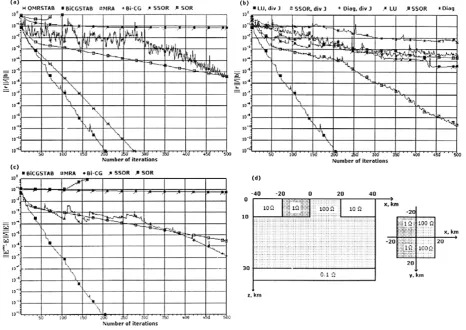
To demonstrate the essential features and effectiveness of the algorithm, we will show some methodical calcula-tions. These calculations were made for the 3d2 COM-MEMI model (Fig. 2), i.e. one of the 3D models of the Com-parison of Modeling in Electromagnetic Induction (COM-MEMI) project (Zhdanovet al., 1997).
The 3d2 COMMEMI model consists of two adjacent 1
and 100 m blocks of dimensions X : 20×Y : 40×
Z : 10 km. The normal section of the model consists of three layers with resistivities of 10, 100, and 0.1m. The upper two layers are 10 and 20 km thick, respectively. The conductivity contrast ratio in this model is up to 1000 and the main difficulty for the calculations is the presence of a strong resistivity contrast at the surface.
The irregular grid was used in this study. The cell size in the central part of the anomalous bodies was X : 2×Y : 2×Z : 0.84 km. The smaller cells were taken to be near the adjacent planes and the cell sizes extended to large distances from the blocks. The difference between the maximum and minimum size of the grid cell was two orders, the model was composed of 32×28×24=21,504 cells. The condition number of the linear system in (9) was more than 1010. The computations were made at a period of 100 sec, and used the double precision on the PC (CPU: Pentium-III 500 MHz).
Figure 2(a) demonstrates the effectiveness of different solvers. The normalized residual r/ro and |divJ|/
Fig. 2. The 3d2 COMMEMI model simulation at 100 sec.,Expolarization. The panel (a) demonstrates the effectiveness of different solvers. Panel (b)
shows the significance of using the divJcorrection procedure. The effectiveness of the different preconditioners (LU, SSOR and Diag.) is shown in panel (b). Panel (c) illustrates the convergence of an iterative solution to the reference solution for different solvers.
BICGSTAB is faster but shows more oscillations. It provide high-accuracy solutions (up to 12 order) within 200 itera-tions and less than 1% accuracy in 20 iteraitera-tions. The sec-ond group of solvers (MRA, BICG : two-step solvers, see Mackie et al., 1993 and Smith, 1996) showed essentially slower convergence which was not so smooth. The third group: SSOR, SOR (see Spichak, 1992) could not calculate the 3d2 model effectively at the irregular grid. The SSOR showed very slow convergence and practically stopped at 10% accuracy both for the residual and for the E-solution (Figs. 2(a) and 2(c)), and the SOR does not provide conver-gence at all.
We also investigated preconditioned normalized resid-ualM−1r,r/ro, relative error for the secondary field
En+1 −En/En+1, and normalized error for the refer-ence solution En −Eref/Eref at each iteration. All of them have the same quasi-monotonic behavior, thus the first and second ones are not shown here. The illustration of convergence to the reference solution is shown in Fig. 2(c). The normalized error En −Eref/Eref also has quasi-monotonic behavior. The reference solution was calculated with the best accuracy model (IG6 grid, see Table 1) by us-ing the termination criterion shown in (17) forε = 10−10. Our numerous calculations showed that obtaining each next order of accuracy depend only slightly on the period and size of matrix when we use the best three-step solvers, in contrast
to the second and third group of solvers.
Figure 2(b) shows the effectiveness of different precon-ditioning schemes and the importance of the divJ correc-tion procedure. The lines ‘LU’, ‘SSOR’ and ‘Diag’ demon-strate convergence for the different preconditioners without divJ correction, and the lines ‘LU, divJ’, ‘SSOR, divJ’ and ‘Diag, divJ’ show convergence when the divJ correc-tion procedure is used. It is obvious that the divJcorrection procedure greatly accelerates convergence. The LU precon-ditioner is several times faster than the SSOR and 20–100 times faster than the simple diagonal preconditioner (de-pending on the grid size, frequency, and model). The diago-nal preconditioning (Diag) is very rough for ill-conditioned systems, it may require thousands of iterations to obtain 1% accuracy (Alumbaughet al., 1996; Xionget al., 1999).
Our numerical experiments at different periods confirmed the theoretical expectations discussed in Subsection 2.7. The maximum acceleration of the convergence (up to 100 times) was obtained at low frequencies due to divJ correc-tion, similar to the results of Smith (1996).
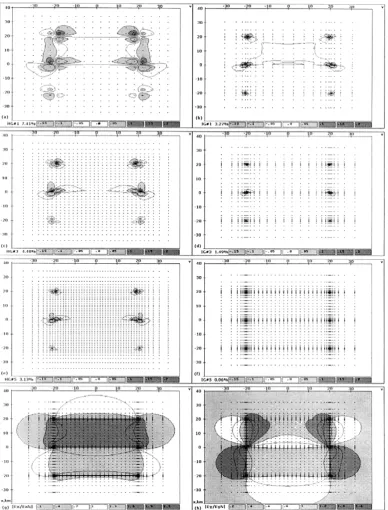
ex-Fig. 3. The COMMEMI 3d2 model simulation at 100 sec. The convergence at the sequence of quasi-homogeneous and irregular grids to the reference solution. Panels (g) and (h) show normalized amplitudes ofEx/ExNandEy/ENy components forExandEypolarization, respectively. The left panels
(a), (c), (e) show the difference between solutions at a given grid and reference solutionEx−Erefx /Erefx at the homogeneous grids HG, right panels,
(b), (d), (f) for the irregular grids IG (Expolarization).
tended the cell size to outside the bodies. The irregular grids used small cells near conductivity breaks, thus provid-ing better approximation in these areas. The 3D modelprovid-ing area wasX : [−165 km,165 km],Y : [−165 km,165 km],
Z : [−100 km,40 km], and the extent of drawing the re-sults X : [−40 km,40 km],Y : [−40 km,40 km] at the surfacez =0. The solution at the best gridIG6was taken as the reference solution and it was calculated at the best accuracy level using the termination criterion shown in (17) for ε = 10−10%. Solutions at the other grids were
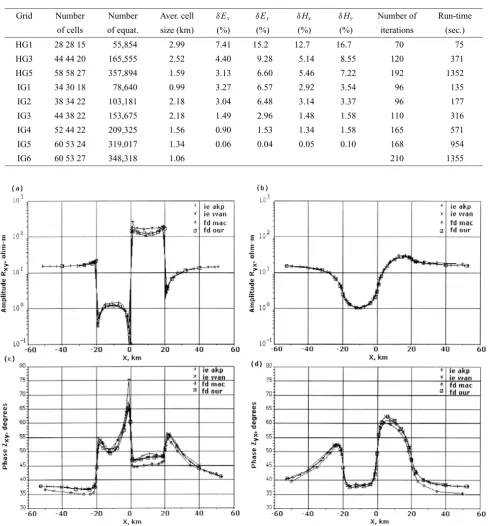
Table 1. The convergence condition for various quasi-homogeneous and irregular grids. Model: 3d2 COMMEMI, computing period at 100 sec. Ex, Hy were computing at the Ex polarization case and Ey, Hx were computed at the Ey polarization case. Error was estimated as
δEx(%) = Erefx −Ex/Erefx ·100. The computing used BiCGSTAB as the solver and terminated atε = 0.1% by using the termination
crite-ria shown in (17). The run-time shown in this table is the case using a PC with Pentium III/500 MHz CPU.
Grid Number Number Aver. cell δEx δEy δHx δHy Number of Run-time
of cells of equat. size (km) (%) (%) (%) (%) iterations (sec.)
HG1 28 28 15 55,854 2.99 7.41 15.2 12.7 16.7 70 75
HG3 44 44 20 165,555 2.52 4.40 9.28 5.14 8.55 120 371
HG5 58 58 27 357,894 1.59 3.13 6.60 5.46 7.22 192 1352
IG1 34 30 18 78,640 0.99 3.27 6.57 2.92 3.54 96 135
IG2 38 34 22 103,181 2.18 3.04 6.48 3.14 3.37 96 177
IG3 44 38 22 153,675 2.18 1.49 2.96 1.48 1.58 110 316
IG4 52 44 22 209,325 1.56 0.90 1.53 1.34 1.58 165 571
IG5 60 53 24 319,017 1.34 0.06 0.04 0.05 0.10 168 954
IG6 60 53 27 348,318 1.06 210 1355
Fig. 4. The 3d2 COMMEMI model simulation at 100 sec. forEx polarization. Panels (a) and (b) are apparent resistivitiesRx yandRyx, respectively,
while panels (c) and (d) are phases of impedancesZx yandZyx. The comparison are between results from Avdeevet al.(1997) IE code–“ie akp”,
Wannamaker (1991) IE code–“ie wan”, Mackieet al.(1993) FD code–“fd mac” and our FD code in this study–“fd our”.
3.2 Comparison for 3d2 COMMEMI model
We calculated MT responses at a period of 100 sec. and compared our results with the IE solution of Avdeevet al.
(1997), the IE solution of Wannamaker (1991), and the FD solution of Mackieet al.(1993). The results of Avdeevet al.
(1997) were obtained directly from the authors, other results
km, are near the boundaries. The run time forε=0.01% in stop-criteria (17) was 88 sec. on a PC with Pentium-II/400 MHz . Avdeevet al.(1997) used a homogeneous grid inside the block with horizontal dimensions ofX : 1×Y : 1 km and with vertical dimensions of Z : 1, 1.5, 2, 2.5 and 3 km in the block area. The run time for 40×40×5=8,000 cells using a Pentium/586 PC was approximately 5 min. Mackie
et al.(1993) used a rougher irregular grid withX : 5×Y : 5 km horizontal dimensions in the central part of the blocks (28×28 cells on XOY plane) andX : 1.25×Y : 1.25 km cells near the conductivity contrasts. The run time was 25 min for Mackie’s code using a CRAY-2/4-256 computer.
Figure 4 shows the apparent resistivities Rx y, Ryx and phases of impedanceZx y,Zyx along the central profiley=
0. In general, all results showed good agreement between the curves. Our results are closest to the IE solution of Wannamaker (1991). In spite of using a horizontal cell size in the central part of the blocks that was twice larger than that of Avdeevet al.(1997), we only had small misfits with their results, because we used the irregular grid. Some visible differences were seen between our results, the IE solutions (Wannamaker, 1991; Avdeevet al., 1997) and the Mackieet al.(1993) FD results. We explain this by using a rough grid in the central part of the blocks of Mackieet al.
The size of the grid is very important for the accuracy, as shown in the comprehensive comparison of the 3d2 COM-MEMI model and two other models (Varentsovet al., 2000). Four algorithms; two IE methods (Wannamaker, 1991; Xionget al., 1999) and two FD methods (Varentsov, 1999; Fomenko, 1999) were compared. This comparison used a modern powerful PC and large grids with smaller cells than the former COMMEMI-I project (Zhdanovet al., 1997). In particular, this new COMMEMI comparison showed that the size of the grid essentially influences the approximation and accuracy of the calculation ofEandHcomponents. Mackie
et al.(1993) used a grid with the average size as used in COMMEMI-I. Our FD method here, Avdeevet al.(1997) and Wannamaker (1991) used grids with smaller cells, so we obtained good coincidence between all of us and a vis-ible difference from Mackieet al.(1993). The referenced COMMEMI report (Varentsovet al., 2000) contains many comparative results.
3.3 2D topography model
Topography is represented as an anomaly in the air layer in our program. To do this, we should overcome the problem of a large resistivity contrast between the air layer and the ground. We selected a 2D-topography model ‘trapezoidal hill’ (Fig. 5) to check the validity of our method for a re-sistivity contrast 106 times between air and the hill. Con-ductivities of the host and the hill have 10−2 S/m, air has 10−8 S/m, and the frequency is 2 Hz. In the hill area, we used X : 50×Y : 100×Z : 28 m cells (the hill consists of 16 rows of cells). Outside the hill, irregular cells were used. The ratio between the maximum and minimum size of the grid cell was 90. The total number of nodes were 64×25×38=60,800.
We compared the calculated apparent resistivity Rx y and
Ryx with the FD results of Ngoc (1980) and the FE results by Wannamakeret al.(1986). One percent accuracy for the normalized residualr/r0is achieved after 43 iterations
Fig. 5. 2D MT simulation of a trapezoidal hill at 2 Hz. Our FD results, ‘Rxy fom’ and ‘Ryx fom’, are compared with the FD results of ‘Rxy ngoc’, ‘Ryx ngoc’ (Ngoc, 1980) and FE results of ‘Rxy wan’ and ‘Ryx wan’ (Wannamakeret al., 1986). The hill is composed of 16 grids in the vertical direction and each cell size isX: 50×Y: 100×Z: 28 m.
in the Ex polarization (TM mode) and 72 iterations in the Eypolarization (TE mode), and it required 115 and 190 sec.
of computing time, respectively, using a PC with Pentium 166 MHz CPU. The H-field was calculated as described in Subsection 2.6. The Eand Hfields were computed at the center of the rectangular cell faces xi, yj at each level
z = zk. Our results agree well with the FE solution of Wannamakeret al.(1986), for both TM (Rx y) and TE (Ryx) modes. Ours and the FE solution, however, have visible differences from the FD solution of Ngoc (1980) for Rx y, but have good coincidence forRyx.
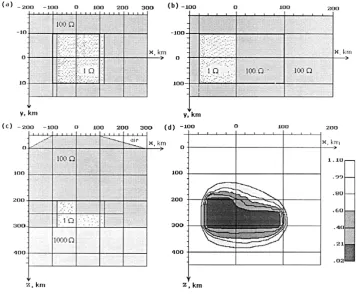
3.4 Model with topography and water reservoir We considered a model that studies the interaction of the topography with subsurface structures such as a low resistivity water reservoir. The topography is represented by a local 3D hill of 500 m width in thexdirection, 200 m in the ydirection and a height of 50 m (Fig. 6). The hill is formed by the cells with conductivityσ = 10−2S/m. The first layer is 300 m thick andσ1 = 10−2 S/m, the second layer (host)—σ2=10−3S/m;σair=10−8S/m.
There are two water reservoirs with conductivityσwater= 1.0 S/m under the hill. Their sizes are shown in Fig. 5. The left reservoir is represented by 4 ×4×4 cells, the right reservoir by 4×4×2 cells. The model is composed of 37 ×26×41 = 39,442 cells. One percent accuracy for r/r0 was obtained within 19 iterations in the Ex
Fig. 6. The MT simulation of water reservoir with a topography model computing at 10 Hz. The upper panels show the XY section of the model, panel (b) atz=200 m and panel (a) atz=250 m, bold contours show the perimeter of the hill atz=50 m. Panel (c) shows the XOZ section of the model at
y=0. Panel (d) shows the calculated normalized electric field amplitude|Ex/Exp|forExpolarization.
required 105 sec. using a PC (Pentium 166 MHz CPU). The normalized amplitude of the electric field|Ex/E
p
x|for the Ex polarization case is shown in Fig. 6. The results of 3D
modeling accurately represent the water reservoir contour in the XOZ plane in spite of using a rough grid with only a few cells for each body and only two cells in theZ direction for the second body. The value ofEx/Expfalls five times inside
the water reservoir.
4.
Conclusions
The fast, accurate, and economical staggered grid finite difference method is developed for calculating 3D conser-vative electromagnetic fields in 3D media with topography and high resistivity contrasts over a wide range of frequen-cies. It has a good choice of staggered grids, a simple but effective preconditioner, support of divergence-free current, and powerful CG solvers. The proposed scheme is econom-ical: computer memory requirements depend linearly on the number of grid cells because the matrix of the linear sys-tem is banded. Most of the applied problems can be solved with a PC of 64–128 MB memory. The algorithm has ob-tained 1% accuracy with quasi-monotonic convergence of normalized residual within the first ten iterations using grids of moderate size (30,000–100,000 cells), and within hun-dred of iterations for extremely high accuracy. The accu-racy of our FD code is comparable with the accuaccu-racy of IE algorithms. The effective preconditioning allows high-accuracy results using irregular grids, which decreases the number of cells and calculation time, because we can take small cells only near the conductivity breaks. The method
is effectively applicable to models with large resistivity con-trasts and complicated topography.
Due to the high accuracy of wide-band frequencies (up to 10 decades), the method is applicable for computing a time-domain response. Another additional advantage of the presented method is that the conductivity distribution is con-centrated only at the diagonal of the matrix. Because of this, the approach is attractive for use in inverse problems.
Acknowledgments. This research was supported by JCR Co. Ltd., JMC Geothermal Engineering Co. Ltd., and RFBR grant 98-05-65411. The authors thank Dmitry Avdeev, Alexey Kuvshinov, and Oleg Pankratov for providing numerical results for comparison. We are also grateful to Ivan Varentsov and Vjacheslav Spichak for many fruitful discussions during this study. We also thank our reviewers, Philip Wannamaker and Yasuo Ogawa, for their detailed comments, which helped us to improve this paper.
References
Alumbaugh, D. L., G. A. Newmann, L. Prevost, and J. Shadid, Three-dimensional wide-band electromagnetic modeling on massively parallel computers,Radio Sci.,31, 1–23, 1996.
Avdeev, D. B., A. V. Kuvshinov, O. V. Pankratov,et al., High performance three dimensional electromagnetic modeling using modified Neumann series. Wide-band numerical solution and examples,J. Geomag. Geo-electr.,49, 1519–1539, 1997.
Chan, T. F., E. Gallopoulos, V. Simoncini,et al., A quasi-minimal residual variant of the Bi-CGSTAB algorithm for non-symmetric systems,SIAM J. Sci. Statist. Comput.,15, 338–347, 1994.
Harrington, R. F., Time-harmonic electromagnetic fields, McGraw-Hill Book Co., 1961.
Mackie, R. L., T. R. Madden, and P. E. Wannamaker, Three-dimensional magnetotelluric modeling using finite difference equations—Theory and comparisons to integral equation solutions,Geophysics,58, 215–226, 1993.
Manteuffel, T. A., G. Starke, and R. S. Varga, Adaptive k-step iterative methods for non-symmetric systems of linear equations,Electron. Trans. on Num. Analysis.,3, 50–65, 1995.
Ngoc, P. V., Magnetotelluric survey of the mount Meager region of the Squamish Valley (British Columbia), Geomagnetic Service of Canada, Earth Physics Branch of the Dept. of Energy, Mines and Resources Canada, OF Rep., 80-8-E, 1980.
Sasaki, Y., Three-Dimensinal Frequency-Domain Electromagnetic Model-ing UsModel-ing the Finite-Difference Method,Buturi-Tansa (Geophysical Ex-ploration),52, 421–431, 1999 (in Japanese with English abstract and figure captions).
Smith, J. T., Conservative modelling of 3-D electromagnetic fields, Geo-physics,61, 1308–1324, 1996.
Spichak, V. V., Differential boundary conditions for the electric and mag-netic fields in the infinite conductive media,Electromagnetic Sounding of the Earth, Moscow, IZMIRAN, 13–21, 1985 (in Russian).
Spichak, V. V., Mathematical modeling of EM fields in 3D inhomogeneous media, 191 pp., Moscow, Nauka, 1992 (in Russian).
Steijpen, G. L. G., H. A. Van der Vorst, and D. R. Fokkema, BICGSTAB(1) and other hybrid BiCG methods,Num. Algorithms,7, 75–109, 1994. Van der Vorst, H. A., BI-CGSTAB: a fast and smoothly convergent variant
of Bi-CG for the solution of non-symmetric linear systems,SIAM J. Sci. Statist. Comput.,13, 631–644, 1992.
Varentsov, Iv. M., The selection of effective finite difference solvers in 3D electromagnetics modeling, inThe Second International Symposium on Three-Dimensional Electromagnetics (3DEM-2), Salt Lake City, Utah, USA, Extended Abstracts, edited by P. Wannamaker and M. Zhdanov, pp. 201–204, 1999.
Varentsov, Iv. M., E. Yu. Fomenko, N. G. Golubev, S. Mehanee, G. Hursan, and M. Zhdanov, Comparative study of 3-D finite-difference and integral equation methods, Annual Report of the Consortium for Electromagnetic Modeling and Inversion (CEMI), University of Utah, Salt Lake City, 401–440, 2000.
Wannamaker, P. E., Advances in modeling three-dimensional magnetotel-luric responses using integral equations,Geophysics, 56, 1716–1728, 1991.
Wannamaker, P. E., J. A. Stodt, and L. Rijo, Two-dimensional topo-graphic responses in magnetotellurics modeled using finite elements,
Geophysics,51, 2131–2144, 1986.
Weaver, J. T., A. K. Agarwal, and X. H. Pu, Recent developments in three-dimensional finite difference modelling of the magnetic field in geo-electromagnetic induction, inThree-Dimensional Electromagnetics, edited by M. Oristaglio and B. Spies, SEG, pp. 131–141, 1999. Weidelt, P., Three-dimensional conductivity models: implications of
elec-tric anisotropy, inThree-Dimensional Electromagnetics, edited by M. Oristaglio and B. Spies, SEG, pp. 119–137, 1999.
Xiong, Z., A. Raiche, and F. Sugeng, Efficient solutions of full domain 3D electromagnetic modelling problems, inThe Second International Sym-posium on Three-Dimensional Electromagnetics (3DEM-2), Salt Lake City, Utah, USA, Extended Abstracts, edited by P. Wannamaker and M. Zhdanov, pp. 3–7, 1999.
Zhdanov, M. S., N. G. Golubev, V. V. Spichak, and Iv. M. Varentsov, The construction of effective methods for electromagnetic modeling,
Geophys. J. R. Astr. Soc.,68, 589–607, 1982.
Zhdanov, M. S., Iv. M. Varentsov, J. T. Weaver, N. G. Golubev, and V. A. Krylov, Methods for modeling electromagnetic fields (results from COMMEMI),J. Appl. Geophys.,37, 133–271, 1997.