Closing the
Generational
Start-Up Gap
Mark Hart
Professor of Entrepreneurship and Small Business: Aston University
Jonathan Levie
Professor of Entrepreneurship: University of Strathclyde
We’re committed to promoting
economic growth and to
fostering the right conditions
for people to turn their ideas
into business success.
RBS Inspiring Enterprise
is how we encourage more
Foreword
RBS has been helping people start-up and grow their businesses since
our inception in 1727. We recognise the critically important role we play in
helping to create the right conditions for people to turn their ideas into
business success.
Almost a quarter of UK businesses bank with RBS. Through our products,
services, partnerships and sponsorships, we support businesses of all
shapes and sizes in every sector of the economy. In addition, we focus
our efforts on areas and groups that, with additional support, could play a
stronger role in the entrepreneurial economy. Our current focus is on closing the gender gap by
helping more women start in business; providing funding and support for the social business sector;
and on the topic of this report – supporting more young people to start-up in business.
At RBS, we have a strong track record of supporting young people to build skills and start up in
business. Last year we helped 90,000 young people through our programmes in schools, universities
and the community. We are the leading supporter of The Prince’s Trust Enterprise Programme, which
every year helps 6,000 young people from disadvantaged backgrounds explore enterprise and start a
business. Our student enterprise programmes, run by Find Invest Grow, encouraged 50,000
university students to develop new skills and explore their business ideas. In schools we deliver
thousands of enterprise education lessons through our MoneySense programme. But more needs to
be done to make sure that young people today get the best shot at becoming the successful
entrepreneurs of tomorrow.
RBS commissioned this report from Aston University because we wanted a detailed picture of youth
entrepreneurship in the UK so we could understand what more can be done. This report provides a
fresh look at the efficiency of the UK’s entrepreneurial system, identifies the barriers to enterprise and
suggests how the gap between entrepreneurial intention and action can be closed.
The report shows that, despite people under the age of 25 having much higher rates of intent to start
up a business than people in their thirties and forties, they are only half as likely to actually start a
business. This highlights a generational ‘start-up gap’ that clearly needs to be addressed.
The report suggests that closing the start-up gap will need a concerted and co-ordinated effort from a
host of companies and agencies that work in this area. Critically we need to ensure that starting a
business is seen as a genuine option for young people and that they have the support and skills to put
their ideas into action. We hope that you will find this report useful.
Chris Sullivan
Executive summary
Youth Entrepreneurship in Context
International evidence suggests that there are high levels of latent or potential entrepreneurship amongst young people. These high levels of latent entrepreneurship are not being translated into similar number of young people setting up and running their own business.
Youth unemployment has been recognised as a long-standing problem across the world. From 1998 the rate of youth unemployment continually grew, both in developed and developing countries. It has become worse since the start of the global financial crisis in 2007. The current group of unemployed young people has been described as a ‘lost generation’ (ILO, 2010). To overcome the situation, one option is to develop youth entrepreneurship.
A recent ILO report1has highlighted very clearly the international scale of this problem for young people and
has sought to stimulate a call to action in national policy agendas. The promotion of youth
entrepreneurship and self-employment has been identified as an important strand of policies to reduce youth unemployment. This report is designed to re-visit the rationale lying behind policies designed to increase youth entrepreneurship and to provide some recommendations for future action.
Global Entrepreneurship Monitor (GEM)
We set out the evidence to ensure we understand the nature and trends in youth entrepreneurship as well as the barriers and difficulties for those young people seeking to start their own business. We rely on the Global Entrepreneurship Monitor (GEM) international datasets to provide detailed information on young people and their entrepreneurial attitudes, aspirations and activity. This is the only source of consistent annual data that identifies those active in business creation, what those businesses are, and their growth aspirations.
The State of Youth Entrepreneurship in the UK
We can see from the selected case studies (Michael Korn; Kevin Patrick; Aaron Jones; Michelle Buchanan and Ryan Longmuir) that in the midst of recession in the UK, many young people are taking control of their future and investing time and money in new business ventures. However, we need to understand how to unlock the entrepreneurial potential in many thousands more young people.
Ten years of GEM UK and Global data was analysed to provide a profile of youth entrepreneurship in the UK. The analysis is summarised as follows (Section 3):
I The steady rise in early-stage entrepreneurial activity among young Welsh people since 2002 is particularly striking – from 3.5% in 2002 to a remarkable 10% in 2011.
I Young people in the UK lag behind their US counterparts in terms of the level of engagement in the early stage of venture creation.
I The proportion of young people in the UK who indicate that they will set up in business within the next three years has remained largely unchanged through the economic crisis – although it has been consistently lower than in the US.
I The optimism of young people with the desire to set up a new business is not reflected in the numbers who actually go on and do so. Indeed, many who start abandon within 12 months and this is in stark contrast to those aged over 30.
I Young people in the UK tend to set up new businesses in certain sectors: for example retail and business services constitute 41% of sector choices of young early-stage entrepreneurs in the UK and US and an even higher proportion in France (50%) and Germany (56%).
I Young people, whether they are running their own business or not, tell us that getting finance and lack of skills/knowledge are their biggest challenges in the start-up process.
I Young entrepreneurs tend to rely more heavily on family for sources of funds to start their business – reflecting the difficulties they experienced in securing funds. But Scotland would appear to be different with a greater number of young entrepreneurs successfully getting bank finance and financial support from government programmes.
Raising the Game for Young People
Do enterprise awareness campaigns and entrepreneurship education and training really make a difference for young people as they survey their options for a career choice? The evidence from the GEM UK and Global datasets would suggest that there are some positive effects.
We have shown that raising awareness of entrepreneurship (using Global Entrepreneurship Week as an example) and compulsory entrepreneurship education and training can have a positive impact on young people’s awareness of the benefits of starting their own business, their intention to do so in the short-term and actual early-stage entrepreneurial start-up rates.
Entrepreneurship training is most effective in contexts with favourable institutional environments, where the training induced positive skills, perceptions and intentions can be translated into action. Training appears to be particularly effective in western European countries with low rates of early-stage entrepreneurial activity, such as Belgium, France, Germany and the United Kingdom, where significant gains equal to a doubling of the odds of engaging in early-stage entrepreneurial activity were recorded among trained individuals.
However, our analysis shows that UK entrepreneurship educators spend too much time on technical skills such as business plan writing and financial forecasting and not enough on encouraging students to spend time in the market, engaging with potential customers on the issues they are facing. Work placement may be providing this ‘face time’ in a way that class based training fails to do. When it comes to skills, however, class-based training in college or university has a stronger effect than work placements.
Conclusions
Why good intentions of young people rarely convert to successful start-ups, and what – and what not – to do about it.
Across almost all industrialised countries, unemployment rates are highest among people2just out of college.
International evidence suggests that there are high levels of latent or potential entrepreneurship amongst young people. These high levels of latent entrepreneurship are not being translated into similar levels of young people setting up and running their own business.
This report has confirmed this finding once again in the context of the UK and has been able to identify some reasons why this is the case – in particular, the reality of raising finance for the new venture and having the necessary skills to run the business. Young people are facing real challenges in these two areas – even more so if we seek to connect an entrepreneurship agenda with the growing population of disengaged young people in the most deprived communities across the UK.
We have shown through the GEM Global and UK data that developing awareness of entrepreneurship and engaging with entrepreneurship education and training helps many young people. But the data also shows that entrepreneurship is not for everyone, and highlights the importance of prior work experience to both business start-up success and access to finance. This makes it difficult to use entrepreneurship as a long-term, large-scale solution to high rates of youth unemployment. We therefore need consider youth
entrepreneurship as one part of a wider approach, rather than the single – or key – solution to rising youth unemployment.
Recommendations
Strengthening an entrepreneurial culture among young people in the UK calls for a three-pronged strategy: build the awareness, develop the relevant skills and support their businesses with tangible support – especially finance. We have a fantastic foundation in the UK with a range of organisations (some old some new) delivering excellent support for young people but we need to review, consolidate and co-ordinate – especially with a focus on young people who are in danger of being marginalised for a generation. The recommendations set out below represent an agenda for a range of audiences, including banks and other financial institutions situated in local communities in terms of finance, and organisations in the education sector as we intensify our efforts to ensure that the appropriate skills are available and delivered in innovative and impactful ways.
In more detail this involves building on what we effectively do well:
I Entrepreneurship Education and Training:Including entrepreneurial and management studies at all levels of education. The key issue is to ensure that teachers/lecturers become “entrepreneurial” educators and providing them with the tools they need. One of the most significant aspects of enterprise education is to involve industry and business organisations to provide an opportunity for young people to get hands on experience and increase their awareness of the business and economic environment. Embedding entrepreneurship curricula in schools, colleges and universities is an effective way of changing attitudes towards entrepreneurship. The partnership with educators and entrepreneurs is crucial to ensure that training in starting a business focuses on opportunity perception and
engagement with customers, rather than just generic business or enterprise training.
I Finance for Start-ups:special programmes need to be designed to provide capital to young would-be entrepreneurs. We need to develop new products and new ways of introducing young people into conversations about risk and money. Perhaps peer-to-peer lenders that take capital from all lenders but lend only to young borrowers could be set up to circumvent the low-levels of young entrepreneurs using bank finance. Networking systems could be established to match young entrepreneurs with equity investors. The development of crowd funding is an important opportunity to be exploited in this context. We welcome the recent announcement of a pilot BIS Start-Up Loans Scheme which will provide £10m to agencies already working to encourage young people to set up their own business3.
I Creating an Entrepreneurial Culture:We have national campaigns – e.g., Global Entrepreneurship Week (GEW) – and national competitions – e.g., Shell LiveWIRE – and business reality programmes on TV. These have all played a significant role for some young people but their impact on the aggregate picture has been negligible – until now perhaps. The use of social media will be of crucial importance for communicating with young people. The A-Fund’s Social Breakfast project in Birmingham is one example of many across the country which will provide important vehicles for the entrepreneurship message.
I Successful Young Entrepreneur Role Models:we know that a significant part of learning in an individual happens through role models. It is a fact that every youth or individual grows up having one or more role models who they try to emulate. Therefore, engaging successful youth and adult entrepreneurs as Youth Entrepreneurship ambassadors would be one of the best strategies to motivate and build Youth
Entrepreneurship culture amongst the youth.
I Entrepreneurial Networks:Following on from that we have a number of enterprise networks across the university sector (e.g., NACUE – National Association of College; University Entrepreneurs; and the RBS ESSA – Enterprising Student Societies Accreditation); in the UK and there is an enormous opportunity to get them engaged with young people living in the communities around campus. The recent
development of new business accelerator models within universities is an important innovation. While in the accelerator young people interact intensively with each other and accelerator staff to increase their entrepreneurial capital.
I Business Experience:engaging successful small business entrepreneurs in addressing the challenges facing young people and promoting youth entrepreneurship can effectively and collectively build an ‘entrepreneurial system’ in local communities. The role of Business Schools across the UK would be instrumental in this re-focus.
I Demonstrating Social Impact of Entrepreneurship:Young people care about the world around them and we need to place the social and environmental impact of entrepreneurship centre stage in any dialogue about business formation. Setting out the benefits of the social value of the entrepreneurial model will engage them even more than more traditional models of business – as illustrated by our case studies in Section 2.
We have a fantastic
foundation in the UK with a
range of organisations (some
old, some new) delivering
excellent support for young
people. We need to review,
consolidate and co-ordinate
– especially with a focus on
young people who are in
Contents
1.
Introduction
1.1
A Crisis for Young People and Society
10
1.2 What we set out to Achieve
11
2.
Young Entrepreneurs in Action – celebrating success
2.1 Introduction
12
2.2 Summary
14
3.
Efficiency of the UK’s Entrepreneurial System for Young People
3.1 Introduction
15
3.2 How many Young Entrepreneurs are there in the UK?
15
3.3 Trends in Start-up across the UK Home Nations by Age
16
3.4 International Trends in Entrepreneurial Intention and Start-up
17
3.5 Youthful Enthusiasm for Entrepreneurship – reality bites with age?
19
3.6 What Types of Businesses do Young People Start?
21
3.7 Barriers to Business Start-up for Young People
22
3.8 How do Young People Fund their New Businesses?
23
3.9 Summary
25
4.
Raising the Game for Young People
4.1 Introduction
26
4.2 Developing Awareness of Entrepreneurial Opportunities
26
4.3 Entrepreneurship Education and Training
28
4.4 Summary
30
5.
Conclusions and Recommendations
5.1 Summary of Findings
31
1. Introduction
1.1 A Crisis for Young People and Society
It is clear that amongst the fall-out from the financial crisis and economic downturn since 2008 there has been a growing concern about the massive disengagement of young people from the formal economy in many economies across the world. This has manifested itself in many ways but most notably in those young people “not in education, employment or training” ( NEETs). Faced with a further five decades of income generation a growing number of young people in their late teens and early 20s are confronted with what seems like an impossible challenge – finding some form of meaningful economic and social activity.
Youth unemployment has been recognised as a long standing problem across the world. From 1998 the rate of youth unemployment continuously grew both in developed and developing countries. It has become worse since the start of the global financial crisis in 2007. The current group of unemployed young people has been described as a ‘lost generation’ (ILO, 2010). In the UK there are now over a million young people (16-24 years) in the NEETs category and this number is unlikely to fall significantly in the short-term. Continuous unemployment entraps young people in a cycle of debt to cover their basic needs. A recent joint study4found that one in every five young people in the UK (18-34 years) has £10K debt and one in
three has no savings. Continuation of this situation could end up with a generation in poverty when they retire. To overcome this situation, one option is to develop youth entrepreneurship. Many have observed a high level of desire among young people for entrepreneurship but which has not been realised in the actual number of start-ups5.
A recent ILO report6has highlighted very clearly the international scale of this problem for young people
and has sought to stimulate a call to action in national policy agendas. The promotion of youth
entrepreneurship and self-employment has been identified as an important strand of policies to reduce youth unemployment7. This is not new thinking and there have been a number of initiatives over the years
specifically designed to enhance the skill-set of young people and support the development of their business ideas8. Many have gone on to establish successful businesses which not only provide financial
independence for their founders but provide employment and income for many others. Whilst this is an attractive proposition for many governments the extent to which stimulating youth entrepreneurship can reduce unemployment remains a matter of much debate. This report is designed to re-visit the rationale lying behind policies designed to increase youth entrepreneurship and to provide some recommendations for future action.
4 Think Tank Forum and Chartered Insurance Institute – Daily Telegraph, August 5, 20012, ‘Financial crisis: ‘iPod generation’ most at risk from credit crunch as one in five has £10k debts.’
5 Greene, F.J. (2005) Youth Entrepreneurship: Latent Entrepreneurship, Market Failure and Enterprise Support, University of Warwick, Working Paper no-87. 6 International Labour Conference (ILO), 101st Session, 2012, Report V: “The Youth Employment Crisis: Time for Action”, ILO, Geneva, 2012.
7 Baker, K. (2008), Fostering a Global Spirit of Youth Enterprise, http://www.youthbusiness.org/PDF/FosteringAGlobalSpirit.pdf
Despite the numerous success stories of young entrepreneurs and the range of support for young people to set up their own business it is still the case that the UK is lagging behind the US and is comparable to some of its major international competitors (i.e., France and Germany) Part of the problem would seem to be the low level of transition between young people indicating that they would like to run their own business and those that actually go on and do it. In summary, the international evidence suggests that while there are high levels of latent or potential entrepreneurship amongst young people this is not translated into large numbers of young people setting up and running their own business9.
1.2 What we set out to Achieve
This report is designed to provide a stimulus to some major fresh thinking about the ways in which young people can be encouraged and supported into starting their own business – as a starting point for their five decades of self-sustaining economic activity. As we have already acknowledged there are a range of specific organisations and initiatives devoted to encouraging and preparing young people to develop their enterprise skills and to assess the benefits of running their own business – in short to become an
entrepreneur. However, too often youth is rarely treated as a sector in its own right (like education or health) and is not officially recognized as a cross-cutting issue (like gender).
We start by setting out the evidence to ensure we understand the nature and trends in youth
entrepreneurship as well as the barriers and difficulties for those young people seeking to start their own business. We rely on the Global Entrepreneurship Monitor (GEM)10international datasets to provide
detailed information on young people and their entrepreneurial attitudes, aspirations and activity. This is the only source of consistent annual data that identifies those active in business creation, what those businesses are, and their growth aspirations. From 2000 to 2011 almost 80 countries have been involved and over 1.5 million interviews have been completed. It is for that reason that we draw extensively on the unique GEM data in this report (see Box A for some of the technical detail on the GEM data).
We then take a critical look at the ‘enterprise industry’ for young people and seek to identify the positive outcomes from the range of organisations, programmes and initiatives that currently operate in the UK. We conclude by setting out some recommendations for the engagement of young people to the idea and reality of running their own business.
9 Greene, FJ (2005) “Youth Entrepreneurship: Latent Entrepreneurship, Market Failure and Enterprise Support”, WBS Working Paper No. 87.
10 See www.gemconsortium.org for more details about the origins and methodology of the GEM Global project. The GEM programme was developed in the UK in 1998, and produced a standardized procedure for using random samples of adults to identify individuals active at different stages of the firm creation process, from start-up ventures to established firms. Since inception this research protocol has been implemented in almost 80 countries representing over three quarters of the world population. Most European countries, including the UK, have completed annual assessments since 1999. The GEM programme is not just another source of data; it can be seen as a new paradigm of research and operationalization of aspects of entrepreneurship. The GEM data is now well accepted within the academic and policy community.
GEM provides data on the entrepreneurial profile of young people – their attitudes, aspirations and actual engagement in setting up their own business. The GEM national surveys covering ~ 60 countries each year consistently report that the highest number of entrepreneurs can be found in the 25-34 age group. The headline measure in the GEM dataset is the number of people in the early stage of setting up their own business (the GEM Total early-stage Entrepreneurial Activity index – the TEA index). GEM creates an index of early stage entrepreneurial activity (known as TEA) using the following approach: the TEA index is the sum of those respondents classified as nascent entrepreneurs and new firm entrepreneurs. The TEA index does not measure all entrepreneurial activity and is not based on a survey of business entities. It measures the characteristics of entrepreneurial individuals and the types of entities they establish. As such it is a unique and internationally comparative measure of the cultural propensity of a nation, or region, to be entrepreneurial.
2. Young Entrepreneurs in Action –
Celebrating their Success
2.1 Introduction
There are thousands of examples across the UK of the entrepreneurial ability of young people. In a wide range of local contexts there are award-winning examples of individuals deciding that setting up and running their own business will be their first step towards financial independence. Many of these businesses demonstrate the three key the characteristics of an entrepreneurs – identifying the
opportunity; responding with innovative thinking and extracting value from the business proposition. We introduce five young entrepreneurs operating successful businesses in the UK in the midst of recession. Their personal stories and their businesses are a testament to entrepreneurial spirit among young people in the UK today. They are Michael Korn the inventor; Kevin Patrick the serial entrepreneur, Aaron Jones the ethical entrepreneur and Ryan Longmuir and Michelle Buchanan who have both been supported through the Prince’s Scottish Youth Business Trust (PSYBT).
Michael Korn, a 30 year old entrepreneur from East Finchley won the coveted title of Shell LiveWIRE Young Entrepreneur of the Year 2011 and £10,000 for his invention, KwickScreen, which is already being used in the NHS to bring an end to the misery of mixed sex wards.
On winning the award Michael said: “It’s a great honour to win the Shell LiveWIRE Young Entrepreneur of the Year title. I started my company when I realised there was a need to ensure that dignity and privacy of people in hospital needed to be better protected. From that simple insight I have been driven to build my business over the last 4 years in the UK. I will use the £10,000 that I have won to target the international healthcare markets.”
Source: Shell LiveWIRE
Box 1
Young Entrepreneur of the Year (2011)
Kevin Patrick is a serial entrepreneur who set up his first money making venture aged 11 as a result of suffering extreme racism at school. He then set up Capoeira Custom Clothing in October 2007 after running it as a Young Enterprise company aged 14 and was awarded the World’s Youngest Entrepreneur by Barclays for getting a business account with them. The business is now re-branded as Team Tops which is aiming to become a million pound business in the next 12 – 18 months. Team Tops itself is a trading name of my limited company KPatrick Projects Ltd which acts as a holding company to Team Tops and a few other businesses: www.team-tops.co.uk: www.labelnoire.co.uk: www.londoncottoncompany.com.
There are a few other companies which are getting their websites developed. He is also been involved in the metal business which turned over quite significant amounts of money. Today he is a 19 year old entrepreneur writing a first book educating young people about how to run a business whilst being in education. He is the incoming president of Surrey University Entrepreneurs.
Source: NACUE
Aaron Jones was working and travelling in India and Cambodia, when he was moved by the huge amount of poverty and lack of education in the rural provinces. Yet the children’s parents were well educated in the arts and crafts proving to be skilled artisans. Thus, the idea of combining two of his passions (humanitarianism & fashion) developed into Fikay, socially sustainable fashion. The idea was conceived in May 2011 and there was 3 month incubation period while traveling and then in August he decided to pursue the idea and started to show people the products and ask them their opinions. This testing phase proved very successful. At this time he was working full-time for BT in a summer job in central London and did not have the money to start a venture. However, he knew that a student loan would allow this so he waited until university started.
In January 2012 he had the opportunity to compete in a university entrepreneurial knowledge and learning exchange with 11 other students. This stimulated the early stages of what is now his business plan and exposing his ideas to wider scrutiny. That experience made him determined to work harder to make the business more solid and he realised that funding was needed to make this a viable start-up. With the support of other young entrepreneurs, NACUE and a wide group of mentors Fikay is now beginning to make its mark.
•
Fikay sells a large range of creative and exciting Recycled Ethically Produced bags, wallets and purses.•
Fikay is a heartfelt passionate, bold answer to environmental and social issues solved through Fashion.•
Fikay is helping to solve complex social issues by stopping the problem where it starts.•
Fikay is empowering local families through employment and training as artisans paying ethical living wages and giving a percentage of profit to Cambodia-based charities.Source: NACUE
Box 3
Young Ethical Entrepreneur
We now turn to two examples of the work of the Prince’s Scottish Youth Business Trust (PSYBT)11. For
almost 25 years The Prince’s Scottish Youth Business Trust has helped young people in Scotland to start up and continue in business, providing access to finance, training and mentoring support. Since 1989 PSYBT has invested over £37 million into Scotland’s economy which has helped to fund over 11,500 businesses. As an integral part of the enterprise landscape in Scotland, a key part of their success is experience working in partnership with a wide selection of enterprise agencies. Regional staff are hosted by organisations such as Business Gateway, Local Authorities and other key supporters, to ensure a joined up approach to supporting young people in their local communities.
Michelle Buchanan has translated her strong marketing skills and sales background into a successful domestic and office cleaning business in the Stirling area. Cleaning Angels is the result of her innovative, unique and enthusiastic approach to the cleaning sector and has become highly regarded for the services it provides.
Having taken a degree in Marketing at Stirling University, Michelle, 25, was looking at ways of creating a good work/life balance between her career and caring for her young family (her son has profound disabilities). Using the knowledge gained during her studies, she developed her business idea together with experience she already had in customer relations. With guidance from the SURE team at the University she met with the PSYBT Regional Manager who is based at the University one day per week. PSYBT initially awarded Michelle a Market Test Grant to test the potential for her idea. Her first steps into starting up produced good feedback. She started working with the local Business Gateway and then submitted a full business plan to the PSYBT panel and was awarded start-up funding in 2008. Michelle’s determination and self-motivation have ensured that Cleaning Angels has progressed strongly since start-up. Based at her office at Stirling University Innovation Park, she has a regular clientele for domestic cleaning and a staff of 5 cleaners, herself included.
Source: PSYBT
Box 4
Prince’s Scottish Youth Business Trust –
Supporting Young Entrepreneurs
Ryan Longmuir started his business Regis Banqueting Ltd in 2003 after spotting a gap in the market for high quality catering at an affordable price. Regis Banqueting Ltd cater for all occasions such as weddings, parties and corporate hospitality events and count Bentley motor cars and O2 mobile phones amongst their customer base.
Ryan, who grew up on a council estate just outside of Glasgow and left school with no qualifications or career ambitions. Before long he began abusing drugs and soon his life spiralled out of control. At 20 years old Ryan hit rock bottom and decided to make serious changes in his life. He found support and guidance from a local church group and slowly started to turn things around. Over the next three years, he worked with recovering drug addicts and helped them to overcome their own addictions.
With growing ambitions to be financially secure and continuing his work helping others from disadvantaged backgrounds, Ryan considered the idea of starting his own business. He attended various training courses being run by Business Gateway and found a work placement at a local café. It was then that he approached PSYBT who gave him the necessary finance and support to get his catering business off the ground. “I presented my business plan and while I didn’t have any business experience I had done all my research and I was determined to make a success of things. Thankfully, they shared my enthusiasm and believed in me.”
Nine years on, Ryan’s business has grown considerably and he has ambitious plans for the future. Ryan will continue to provide employment opportunities for disadvantaged young people. Ryan is also a PSYBT Ambassador and helps to raise the profile of the Charity’s work across a variety of sectors. He makes regular donations to the Trust.
Source: PSYBT
Box 5
Prince’s Scottish Youth Business Trust –
Supporting Young Entrepreneurs
2.2 Summary
3. Efficiency of the UK’s Entrepreneurial
System for Young People
3.1 Introduction
This section provides an overview of the numbers of young people in the UK who would expect to start their own business as well as those actively involved in setting up a new business venture and provides some international comparisons. We also present data across the UK home nations of England, Scotland, Wales and Northern Ireland. We do this for 2011 and also for the period 2002-2011. We go on to show what types of businesses they are setting up, how they are funded and the barriers they are facing.
3.2 How many Young Entrepreneurs are there in the UK?
[image:15.595.71.379.460.640.2]Using the GEM TEA index we can answer the question about how entrepreneurial young people are in the UK compared to other countries (Figure 1). We can see that around 6 per cent of young people (18-24 years) in the UK are either nascent or new business entrepreneurs – that is, one in every 17. This compares favourably to France but lags behind the US where nearly one in ten young people are actively engaged in creating a new business venture. We can also see that individuals aged between 25-44 display the highest levels of entrepreneurial activity which is the same in the US, France and Germany although the levels are somewhat different.
Figure 1: Total early-stage Entrepreneurial Activity (TEA) in the UK, France, Germany and the US by Age Group (2011)
16.0
14.0
12.0
10.0
8.0
6.0
4.0
2.0
0.0
United Kingdom France Germany United States
%
o
f
A
d
u
lt
P
o
p
u
la
ti
o
n
a
g
e
d
18
–
6
4
■18 – 24 ■25 – 34 ■35 – 44 ■45 – 54 ■55 – 64
12 GEM collects data on the actual age of the respondent and when we examine this more closely there seems to be a natural break in UK GEM activity data between the age of 29 and 30. This does not correspond to the more standard age groups used in analysis of the Population Census.
When we examine the trend since 2002 for the slightly wider 18-29 age group in the UK we observe a sharp increase in early-stage entrepreneurship since 2010 – the increase for older individuals (30+) had commenced a year earlier in 2009 (Figure 2). This increase in the entrepreneurial activity of young people in 2011 in the UK is almost entirely driven by a rise in individuals beginning the active planning phase of a new business venture (i.e., nascent entrepreneurs) and may reflect the rising level of unemployment for this age group. In other words many more young people began to actively investigate the potential of running their own business as the economic recovery stalled. The issue here is whether they were
[image:16.595.73.361.249.394.2]adequately equipped to engage in these new ventures and how durable these businesses will turn out to be which may be related to the type and size of businesses being set up in the first place.
Figure 2: Total early-stage Entrepreneurial Activity (TEA) in the UK by Age Group (2002-2011)
8.0%
7.0%
6.0%
5.0%
4.0%
3.0%
2.0%
2002 2003 2004 2005 2006 2007 2008 2009 2010 2011 Age 18 – 29 Age 30 – 64
Source: GEM Global Adult Population Survey (APS) 2002-2011
3.3 Trends in Start-ups across the UK Home Nations by Age
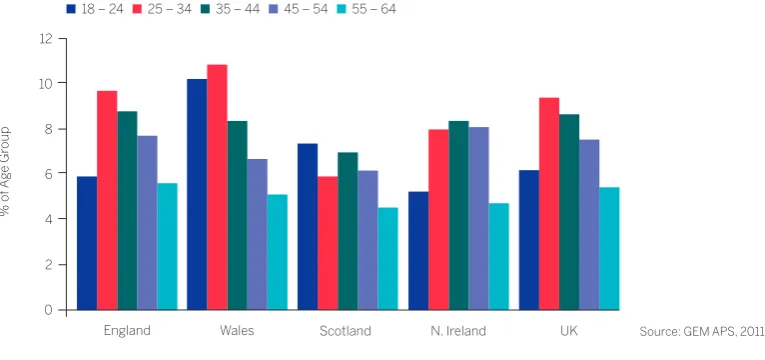
There are also some interesting trends emerging across the UK home nations. For example, for the second year running the age group with the highest level of early-stage entrepreneurial activity (i.e., the GEM TEA index) in Scotland was 18-24 year olds (Figure 3). Wales portrays a similar finding. This relatively high rate of entrepreneurial activity among 18-24 year olds in Scotland and Wales is unusual. The average ratio of the TEA rate among 18-24 year olds to the TEA rate among 25-34 year olds across all 23 innovation-driven countries that participated in GEM in 2011 was 65%. In both Scotland and Wales there is no significant difference between these two age groups.
Figure 3: Total early-stage Entrepreneurial Activity in the UK Home Nations by Age Group, 2011
12
10
8
6
4
2
0
%
o
f
A
g
e
G
ro
u
p
England Wales Scotland N. Ireland UK
■18 – 24 ■25 – 34 ■35 – 44 ■45 – 54 ■55 – 64
[image:16.595.74.457.574.754.2]Looking at this over time reveals some interesting results. When we group 18 to 29 year olds together, a clear increase in activity across all four home nations can be seen (Figure 4), and across the UK as a whole. This rise is statistically significant, while the rise among 30 to 64 year olds as a group is not. The steady rise in early-stage entrepreneurial activity among young Welsh people is since 2002 particularly striking – from 3.5% in 2002 to a remarkable 10% in 2011. There may be some connection to the increase in enterprise education and training rather than being driven solely by youth inactivity rates.
[image:17.595.71.406.327.499.2]During this time, the Welsh Government implemented an Entrepreneurship Action Plan for Wales, covering all levels of the education system. For example, in the 2008 GEM survey, 58% of 18 to 29 year olds in Wales agreed they had received training in starting a business provided by a college or university that was not part of their formal education, compared with only 35% in Scotland, 39% in England and 29% in Northern Ireland. Almost half (48%) of adults aged 18 to 29 surveyed in Wales in 2010 agreed that they had taken part in any activities at school, college or university that made them think about starting a business or being their own boss.
Figure 4: Trend in Total early-stage Entrepreneurial Activity in the UK Home Nations for 18 to 29 year olds, 2002 to 2011
12.0%
10.0%
8.0%
6.0%
4.0%
2.0%
.0%
2002 2003 2004 2005 2006 2007 2008 2009 2010 2011
T
E
A
R
a
te
(%
a
g
e
d
18
–
2
9
)
England Wales Scotland N. Ireland
Source: GEM APS, 2002-2011
3.4 International Trends in Entrepreneurial Intention and Start-up
Figure 5 shows that intention to start a new business rates among young people in the US, France and Germany appear to be more sensitive to the economic environment than intention rates in the UK. We see a rising trend in France and Germany between 2002 and 2007, followed by a crash in intention rates in 2008. Rates subsequently recovered in 2009 in France, but not in Germany. In the US, we see a rising trend up to 2008 and then a crash in 2009, with no recovery in 2010.
Figure 5: Intention rates (expectation that one will start a business in the next 3 years) in the UK, US, France and Germany, 2002 to 2010.
35.0%
30.0%
25.0%
20.0%
15.0%
10.0%
5.0%
0.0%
2002 2003 2004 2005 2006 2007 2008 2009 2010 UK US France Germany
Source: GEM APS, 2002-2010
[image:18.595.72.348.398.569.2]Figure 6 shows that young people in the UK have lower early-stage entrepreneurial activity rates than young people in the US, but very similar rates to young people in France and Germany. Over the 2002 to 2010 period, the trend is flat for the UK and Germany, rising for France and declining for the US
Figure 6: Total early-stage Entrepreneurial Rates in the UK, US, France and Germany, 2002 to 2010
16.0%
14.0%
12.0%
10.0%
8.0%
6.0%
4.0%
2.0%
0.0%
2002 2003 2004 2005 2006 2007 2008 2009 2010 UK US France Germany
3.5 Youthful Enthusiasm for Entrepreneurship – reality bites with age?
We know from GEM UK data that young people have a more favourable attitude towards entrepreneurship than older people. While the positive perception of starting a business as a career declined over the 2003 to 2011 period, Figure 7 shows that it remained higher among younger than older people. A recent study of the impact of business reality TV programmes on attitudes towards entrepreneurship in society may help explain these age differences13. Taken as a whole, these business reality programmes tended to have more effect on
[image:19.595.73.469.275.420.2]younger and male non-entrepreneurs in terms of making them want to start their own business, while they had more effect on young and female non-entrepreneurs in terms of making them think more positively about entrepreneurs in general. Older people were more likely not to be influenced by these programmes.
Figure 7: Trend in agreement with statement that most people consider starting a new business a desirable career choice, 2003 to 2011, by age group.
70%
65%
60%
55%
50%
45%
40%
2003 2004 2005 2006 2007 2008 2009 2010 2011 Age 18 – 34 UK Age 35 – 64 UK
%
o
f
A
d
u
lt
s
Source: Global Entrepreneurship Monitor (GEM) UK Adult Population Survey 2003-2011.
13 Levie, J; Hart, M and Mohammed Shamsul Karim (2011) “Impact of the Media on Entrepreneurial Intentions and Actions”, BIS Research Report, March 2011
Do these more positive attitudes translate into higher levels of actual new venture creation? We now turn our attention to future start-up intentions and ‘persistence’ as an entrepreneur in the market place for young people.
% o f A d u lt P o p u la ti o n 12.0% 10.0% 8.0% 6.0% 4.0% 2.0% 0.0%
0 0.5 1 1.5 2 2.5 3 3.5 Ent Activity Ent Intention
1 = Young Adult (Age 18-24); 2 = Older Adult (Age 25-44) & 3 = Old (Age 45-64) Older Adult 7.7% Younger Adult 9.5%
Young Adult 3.6%
Old 4.0% Older Adult 6.4%
[image:20.595.72.307.121.267.2]Source: Global Entrepreneurship Monitor (GEM) UK Adult Population Survey 2002-2010.
Figure 8: Difference of Entrepreneurial Intention and Activity of Different Age Groups in UK.
14 There were only 20 nascent entrepreneurs aged less than 30 in the sample, so we need to be cautious about more detailed analysis. However, this does support work done on the full GEM UK 2009 database which showed that young adults were much more likely to have been a nascent in the past year but given up compared to older adults.
Second, in the first attempt to track GEM respondents over time between 2009 and 2010, we observe that there is, however, a significant difference between those aged under 30 and older individuals in the
proportion dropping out of the entrepreneurial process altogether. Just under half (45%) of individuals less than 30 years of age who had begun to plan a new business in 2009 became a new business owner one year later, compared with three-quarters (72.6%) of those aged 30 or more. Put another way a third (35%) of those under 30 who had started to plan a new business became a non-entrepreneur one year later, compared with 12.3% of those aged 30 or more14.
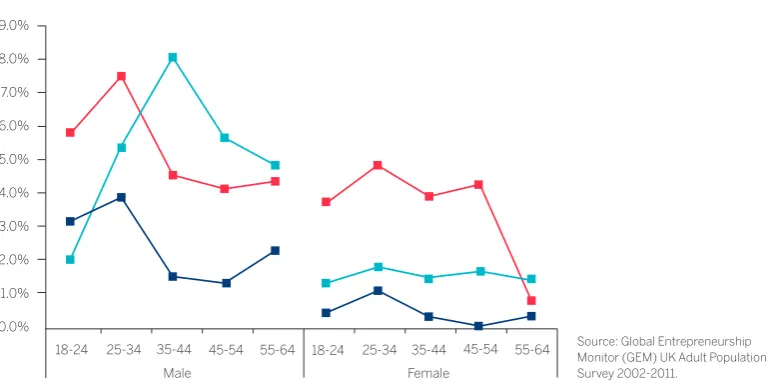
Is it the case that young people simply do not have the necessary skills and confidence to translate their intention into action? Do those young people who take the initial steps to set up a new business venture (i.e., nascent entrepreneurs) give up in the face of the challenges they face? Using GEM UK 2011 data we can begin to provide some answers to these questions. Figure 9 shows the proportion of people by different age groups and gender who are not currently nascent entrepreneurs in 2011 but did actively try to start a business that they would own in whole or in part at some time in the previous 12 months. Contrasting this to the proportion of nascent and new business owners in 2011, it is clear that young people are not getting started. There are also interesting gender-age patterns with young men much more likely to try to start a business and give up than young women.
Figure 9: Tried to Start a Business and Abandoned by Age and Gender (2011)
9.0% 8.0% 7.0% 6.0% 5.0% 4.0% 3.0% 2.0% 1.0% 0.0%
18-24 25-34 35-44 45-54 55-64 18-24 25-34 35-44 45-54
Tried to start in past 12 months Nascent entrepreneur New business owner
55-64
Male Female
[image:20.595.76.465.558.753.2]We also find that young people seem to give up the attempt to start a business much sooner than older individuals. Examining GEM data for 2011 on the length of time people tried before they gave up (in months) we find that young people (18-24 years) gave up in half the time compared to those aged 25-54 years: after two months compared with over four-five months.
3.6 What Types of Businesses do Young People Start?
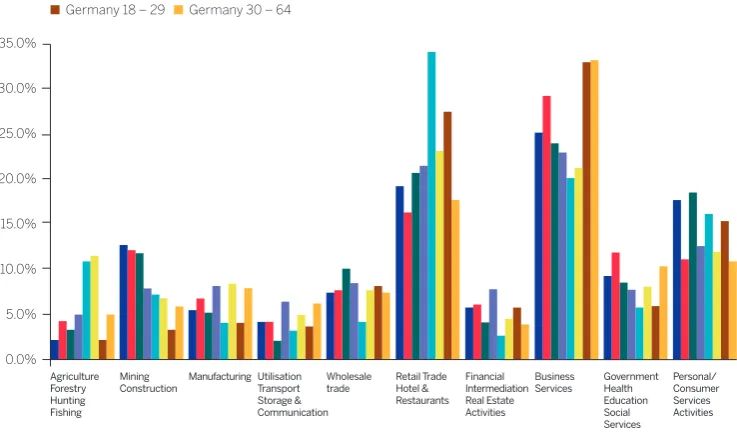
Young people in the UK and its benchmark countries tend to set up new businesses in certain sectors: for example retail and personal or business services, rather than others, for example agriculture,
[image:21.595.72.441.378.597.2]manufacturing and business services (Figure 10). However, there are some country differences too. For example, young people in France are more likely to be retailers than young people in the UK, US or Germany, while 30% of both young and older early-stage entrepreneurs in Germany are in business services; a higher proportion than in other countries. About twice as many early-stage entrepreneurs in the UK and US are in construction as in France and Germany. We can also see the dominance of two sectors across all four countries; retail and business services constitute 41% of sector choices of young early-stage entrepreneurs in the UK and US and an even higher proportion in France (50%) and Germany (56%).
Figure 10: Sector Differences in Start-up Businesses by Age Group
35.0% 30.0% 25.0% 20.0% 15.0% 10.0% 5.0% 0.0% Agriculture Forestry Hunting Fishing
■UK 18 – 29 ■UK 30 – 64 ■US 18 – 29 ■US 30 – 64 ■France 18 – 29 ■France 30 – 64
■Germany 18 – 29 ■Germany 30 – 64
Mining Construction Manufacturing Utilisation Transport Storage & Communication Wholesale trade Retail Trade Hotel & Restaurants Financial Intermediation Real Estate Activities Business Services Government Health Education Social Services Personal/ Consumer Services Activities
3.7 Barriers to Business Start-up for Young People
It is often argued that young adults lack “entrepreneurial capital”, which includes relevant skills, social networks, financial capital and credibility – and the commitment needed to make a new business work. Before engaging with that argument we present some evidence from the GEM UK data for two groups of young people – those who are currently running their own business (entrepreneurs) and those that are not (non-entrepreneurs). We do this in order to get a more complete picture from those who have actually gone on to establish their business as well as those who had tried but had failed or had not yet succeeded. With the first group we ask about the difficulties they encountered when starting a business while for the second group we ask them about the barriers that prevented them from doing so.
Table 1 shows that the two biggest barriers most frequently cited by young non-entrepreneurs in the UK are the same as the two biggest difficulties most frequently cited by young entrepreneurs (i.e., getting finance and lack of skills/knowledge). Finance has long been recognised as a particular issue for young people seeking to start-up their own business as they lack the established security15.
However, the frequency of mention of other barriers or difficulties is different between the two age groups16.
Young non-entrepreneurs and young entrepreneurs were more likely to mention getting finance for the business as a barrier or difficulty than older entrepreneurs/entrepreneurs. While young
non-entrepreneurs cited lack of skills as a barrier to starting a business it was older non-entrepreneurs rather than younger entrepreneurs who were more likely to report that this had been their biggest difficulty.
[image:22.595.74.524.409.745.2]15 See Youth Business International (2011) Youth Entrepreneurship: Closing the Gap. Prince’s Trust Youth Business International, London. 16 Significant differences between younger and older individuals are highlighted in bold.
Table 1: Barriers to starting a business and difficulties encountered in starting a business by Age
Biggest barrier Biggest difficulty (non-entrepreneurs) (entrepreneurs)
Barrier/Difficulty 18-29 years 30-64 years 18-29 years 30-64 years
Getting finance for the business (2005 to 2010) 63 47 61 43
Lack of skills/knowledge (2004 to 2010) 18 11 16 30
Lack of interest in starting a business (2004 to 2010) 12 18 1 6
Not having an idea for a business (2004 to 2010) 11 9 0 4
The time commitment it would require (2004 to 2010) 11 10 3 5
Loss of security/income from current job (2008 to 2010) 10 15 3 4
The chance that the business might fail (2004 to 2010) 7 8 4 4
Fear of debt (2008 to 2010) 5 4 5 12
The economic climate at the moment (2010 only) 4 7 13 9
Age (2004 to 2010) 4 11 0 0
The complexity of regulations (2004 to 2010) 2 3 14 16
The economic climate at the moment (2005 to 2010) 1 2 – –
Getting customers 0 0 7 9
Getting staff 0 0 7 6
Non-entrepreneurs are more likely to mention lack of interest, not having an idea or the time commitment it would require, while entrepreneurs are more likely to mention the economic climate (in 2011) or the
complexity of regulations. Seven per cent of young entrepreneurs also mentioned the difficulty of getting customers and staff whereas these were not mentioned at all by non-entrepreneurs.
3.8 How do Young People Fund their New Businesses?
We have just seen that three out of every five young entrepreneurs report that they had difficulties obtaining finance for their start-up business. We now turn our attention to the specific sources of finance used by individuals who are in the active planning stage of their new business venture – the nascent entrepreneurs. Again we compare young people to older individuals. For both age groups across the UK around one in two entrepreneurs report that they fund all the start-up costs themselves (Table 2). There are some variations across the home nations with nascent entrepreneurs in Scotland and Northern Ireland more likely to fully fund their new business ventures themselves than in England and Wales.
[image:23.595.72.525.425.675.2]Young entrepreneurs in the very early stages of their new business venture rely more on family than older individuals as a source of funding (Table 2). This is particularly the case in Scotland. However, a third of young Scottish entrepreneurs also expect funding from banks and government agencies which is a higher proportion than in other parts of the UK. In Northern Ireland only around one in 10 young entrepreneurs expect to secure funding from banks and government programmes.
Table 2: Percentage of younger and older nascent entrepreneurs expecting to secure different sources of external funding, by home nation, 2006 to 2010.
England Wales Scotland N. Ireland
Type of funding expected 18-29 30-64 18-29 30-64 18-29 30-64 18-29 30-64
All funded by entrepreneur 42 52 42 53 53 56 50 58
None funded by entrepreneur 3 3 1 3 0 1 2 1
Banks or other financial institutions 19 21 28 16 34 28 11 23
Government programmes 21 12 21 15 32 14 13 16
Close family member (spouse, parent, sibling) 18 8 14 7 25 10 14 6
Other relatives, kin or blood relations 14 4 3 4 14 5 3 2
Work colleagues 8 7 10 5 9 13 17 4
Friends or neighbours 10 4 1 1 2 3 0 1
A stranger 4 4 2 3 0 3 3 4
Any other source 8 7 5 7 14 5 8 9
No funding needed 5 5 5 6 2 3 8 3
Source: GEM UK APS Surveys 2006 to 2010.
A Fund is a locality based youth investment programme aimed at unleashing the talent and potential of Birmingham’s young people particularly in its hardest hit neighbourhoods.
Ideation Spaces
“Being in the right space / having the right people around you”
A key aspect of the A Fund is to create spaces whereby young people can grow and develop their enterprise ideas, within experimentation centres or ‘Fab Labs’ located across the community in schools, colleges and youth centres.
Networks
‘There’s nothing here, everything happens in London”
The A Fund programme has specific focus on developing and encouraging youth networks whereby like-minded young people can connect and develop ideas and enterprising opportunities can grow at a local economic level. A particular strand of the programme is to ‘knit’ together services and opportunities across the city creating a single and holistic eco-system of enterprise support.
Social Media and Web 2.0
Social media is critical in engaging young people. The A Fund has developed an on-line platform in partnership with 00:/ and Socialbreakfast.org which allows young people to develop their ideas, networks and access finance using crowd funding software.
On-going Mentoring
“More than money we need time”
Young people require additional development support in taking them from the class room to the board room, which is beyond finance and traditional business support services. They require one to one mentoring which engages the ‘whole’ journey of entrepreneurship meeting the wider needs of young people. We found that in supporting young people we needed to develop a service/programme that catered for the emotional/psychological needs not just the functional requirements of setting up a business.
Graduated Finance
Risk and the inability to manage it is a problem for young people – we created a ‘Graduated finance model’ blending grant and traditional investment models enabling young people to experience, explore and grow. Within the networks, links and partnerships have been made with local and institutional investors to support young entrepreneurs when this is required.
By providing a new approach to unlocking young people’s capabilities, the Fund will reduce youth unemployment and
disaffection as well as offsetting the effects of potentially greater childhood poverty and reduced youth services. The A-Fund will provide integrated access to new learning programmes and investment ranging from crowd-funding to stipends and equity stakes, as well as a range of physical places and events to invent, build, and share emerging ideas, projects, prototypes, and whole new ventures.
Source: the A Fund (Accord Group, Birmingham)
The A-Fund will also help to secure the economic future of the West Midlands by providing opportunities for the next generation of enterprising, optimistic, creative people.
Accord Group (Birmingham)
3.9 Summary
What have we learnt about youth entrepreneurship in the UK?
I Young people in the UK lag behind their US counterparts in terms of the level of engagement in the early stage of venture creation.
I The proportion of young people in the UK who indicate that they will set up in business within the next three years has remained largely unchanged through the economic crisis – although it has been consistently lower than in the US.
I The optimism of young people about their desire to set up a new business is not reflected in the numbers who actually go on and do so. Indeed, many who start abandon within 12 months and this is in stark contrast to those aged over 30 years of age.
I Young people in the UK tend to set up new businesses in certain sectors: for example retail and business services constitute 41% of sector choices of young early-stage entrepreneurs in the UK and US and an even higher proportion in France (50%) and Germany (56%).
I There has been a steady rise in early-stage entrepreneurial activity among young Welsh people is since 2002 particularly striking – from 3.5% in 2002 to a remarkable 10% in 2011.
I Young people, whether they are running their own business or not, tell us that getting finance and lack of skills/knowledge are their biggest challenges in the start-up process.
I Young entrepreneurs tend to rely more heavily on family for sources of funds to start their business – reflecting the difficulties they experienced in securing funds. But Scotland would appear to be different with a greater number of young entrepreneurs successfully getting bank finance and financial support from government programmes. Young people in Northern Ireland are less likely to report they access these sources of funding as they seek to start their new business.
4. Raising the Game for Young People?
4.1 Introduction
We have shown that there is a great deal more entrepreneurial intention than entrepreneurial action among young people in the UK and the task now is to think about the ways in which that gap can be closed. There is a widely held belief by policymakers and funders that capacity development services have an impact on the nature and scale of youth entrepreneurship. The route to achieving this objective is to raise the extent to which young people can identify opportunities for new business activity and to enhance their skills and abilities to be able to respond to these opportunities. Can the bar be raised for a group of young people who have the desire but rarely follow it through?
There has been a proliferation of enterprise awareness (e.g., Global Entrepreneurship Week) and
entrepreneurship education and training schemes in recent years at a global level and in the UK there is the evolving interaction between the activity of long-established organisations (e.g., The Prince’s Trust; Shell LiveWIRE and Young Enterprise) and more recent initiatives (e.g., NACUE; the RBS ESSA). However, there is little evidence about the quality or impact of youth entrepreneurship programmes as very few projects have been carefully evaluated17. Those that have been subject to rigorous evaluation produce results which are, at
best, agnostic on the entrepreneurial outcome of the intervention on the young person18.
It is necessary to recognise that to produce an increase in entrepreneurial activity among young people requires a mechanism such as a financial incentive or the advice of a mentor must work in the specific context of the young person. By context we mean such things as family characteristics (e.g., parents or guardians who run their own business) or the nature of the neighbourhood where an individual comes from (e.g., level of deprivation; conflict; social class) which may enhance or constrain the operation of the mechanism. However, there is usually more than one mechanism at work and, consequently, there is a clear need to establish their relative contribution to the outcome of a young person setting up their own business. These other mechanisms can include such things as the personality traits of the individual themselves which provide motivational stimuli as well as prior exposure to other ‘enterprise enhancing’ experiences earlier in their school career. We set out below some of the most recent evidence for the UK on two aspects of this debate. First, we look at the ability to increase awareness of the opportunities and benefits of starting a new business venture at an early age. Second, we focus on the impact of formal enterprise education and training on the likelihood of a young person setting up his or her own business.
4.2 Developing Awareness of Entrepreneurial Opportunities
Are national awareness campaigns aimed at stimulating entrepreneurial attitudes, intentions and activity effective? We take as an example Global Entrepreneurship Week (GEW)19run since 2011 by the Prince’s
Trust Youth Business International (YBI). There are two aspects of GEW we examine – does participation in any of the events associated with the campaign increase a young person’s desire to start their own business and more crucially, does it actually increase the likelihood of them actually doing so?
18 Greene, F and Storey, D J (2004) An assessment of a venture creation programme: the case of Shell LiveWIRE. Entrepreneurship and Regional Development, 16 (2). pp. 145-159.
Future Start-up Intention
Evidence from the GEM UK 2009 survey would suggest that participation is associated with future entrepreneurial intentions. Overall, a slightly higher proportion of 18-29 year olds who have participated in GEW report that they intend to start a business within the next three years: 10.2% compared with 8.1% who had not participated. There are also important gender differences with young men who had participated in GEW significantly more likely than young women participants to report that they intend to start a business within the next 3 years: 14.8% compared to 5.7%.
Participants in GEW are more likely to report that they have the necessary skills to start a business (47.2% compared to 43.3%) and that they do not see fear of failure as a reason to prevent them starting a new business venture (27.9% compared to 37.8%). People who have heard of GEW are significantly more likely to report that they perceive good opportunities for start-up in their local area – however, participation in GEW events does not significantly increase their level of ‘opportunity perception’ although there is a positive association all other things being equal (e.g., controlling for education and gender of the respondent). Again this points to the fact that participants in GEW events already have a pre-disposition towards entrepreneurial behaviour.
A more sophisticated analysis of the GEM UK data on GEW, which controls for the characteristics of the respondent (i.e., age, gender, ethnicity, education, household income, parental business ownership, region), shows that there is a positive and significant association between participation in GEW and the intention to start a business in the next three years20.
However, this significant relationship disappears when we include the entrepreneurial attitudes21of the
respondent in the model – although the association is still positive – in other words participants in GEW may well bring with them a set of attitudes which are more entrepreneurial than those who do not
participate. This means that the events may well be appealing to, and involving, a group of individuals who already display a more positive set of entrepreneurial attitudes. In particular, these are represented by two of the four core GEM entrepreneurial attitudes: self-perception of start-up skills and know an entrepreneur.
So, as we seek to assess the impact of participation in the organised activities which are part of GEW, it is crucial to control for this self-selection bias among those individuals who engage22. The results show that
there is a positive and significant association between future start-up intention for those individuals who had participated in an activity organised as part of GEW around 9 months previously.
20 That is, we ask about participation in GEW events in the November prior to the GEM UK survey in the Spring of the following year.
21 These are the GEM variables on fear of failure; know an entrepreneur; self-perception of start-up skills and that there are good opportunities for start-up in the local area.
22 Technically, we do this through a two-stage process the first stage of which is modelling the likelihood of an individual to participate in GEW. Once we do that we can move on to the second stage which models the impact of participation on entrepreneurial outcomes for the individual while controlling for any bias in their characteristics (e.g., less risk averse or parental business ownership).
Nascent or New Business Ownership
The descriptive analysis has shown that there is no simple two-way association between participation in GEW and early-stage entrepreneurial activity (i.e., nascent and new business ownership – the GEM TEA rate)23. Overall, therefore, we conclude that participation in the activities organised as part of GEW may
contribute to increasing the prevalence of future start-up intention (within three years) but appear to have no immediate effect on the actual number of new business start-up attempts.
4.3 Entrepreneurship Education and Training
We know that public spending on education and secondary school enrollment has risen and that public spending on education is higher than the average for mature market G20 countries24. In particular, more
than half of UK new and established entrepreneurs25saw improvement in specific programmes at
universities and business schools, in entrepreneurship conferences and seminars, showing a higher perception than in other similar countries. The National Council for Graduate Entrepreneurship (NCGE), launched in 2004, is a good example. It brings together universities, private sector businesses and the regional agencies in projects to promote entrepreneurship to students and postgraduates. The NCGE has the aim of raising the profile of entrepreneurship and of highlighting the option of starting a business as a career choice among students and graduates.
Researchers have suggested that education and training for entrepreneurship should positively impact entrepreneurial activity by enhancing skills required to start-up and grow a business, by enhancing cognitive ability of individuals to manage the complexities involved in opportunity recognition and assessment, and by affecting their cultural attitudes and behavioural dispositions26.
Demonstrating these effects, however, has been a challenge. First, there may be considerable self-selection into entrepreneurship education. Second, the effects may be long-term rather than instantaneous. For example, in the short term, graduates of entrepreneurship education may recognise the need to amass specific knowledge and decide to defer action. Third, there is the need for adequate control groups to demonstrate effects. Fourth, individuals may receive such education and training at several points in their lives, such as at school, university, or after formal education, and it may take the form of traditional learning or more practical through a placement.
Again turning to the GEM UK dataset we are able to provide some evidence to help understand they ways in which education and training can make a difference to the employment choices of young people27. The GEM
survey asks questions of all respondents about their involvement in enterprise education at various stages – school, college, university and government programmes. We are interested in seeing if there are any impacts on the ability of individuals to recognise opportunities for start-up and whether their self-perception of their start-up skills is enhanced. These are seen as the two key mechanisms by which individuals can be encouraged to think more seriously about becoming an entrepreneur28.
24 The Nice Côte d’Azur 2011 Entrepreneurship Barometer, Ernst & Young 25 GEM UK Annual Population Surveys (APS) 2002-2008.
26 See, for example, Honig (2004); DeTienne and Chandler (2004), and Peterman and Kennedy (2003); Alicia Coduras MartÍnez, Jonathan Levie, Donna J. Kelley, Rögnvaldur J. Sæmundsson and Thomas Schøtt (2010) A Global Perspective on Entrepreneurship Education and Training, GEM Global.
27 Levie, J; Hart, M and Anyadike-Danes, M (2009) “The Effect of Business or Enterprise Training on Opportunity Recognition and Entrepreneurial Skills of Graduates and Non-Graduates in the UK”, Frontiers in Entrepreneurial Research, Babson College, US. This more detailed study of the GEM UK data was undertaken as part of the GEM Global study – see footnote 22.
The results from the GEM UK data suggest that business training at school has no significant effect on
opportunity recognition or skills perception of graduates. Business or enterprise training at college or university enterprise education has the strongest effect of the four types tested, and has a stronger effect on skills
perception than knowing a recent startup entrepreneur (a proxy for social networks that include entrepreneurs).
Among graduates, government-run business or enterprise training programmes only had a significant (but weak) effect on skills perception of volunteer participants but not on those who were required to take the programmes. Effects on opportunity recognition were weaker, except for work placement, and again compulsory government programmes of business or enterprise training had no significant effect.
It appears that work placement has a significant and positive effect on both opportunity and skills
perception, in about equal measure, and that this is true for both compulsory and voluntary programmes. Courses at school or college that have built-in work placements appear to make a real, if limited, difference to the entrepreneurial capacity of students who become graduates. In relation to opportunity perception, they have about the same effect as previous experience in starting or running a business.
Among non-graduates, business or enterprise training in schools did have a significant effect on skills, but only if it was voluntary. Both voluntary and compulsory attendance at training programmes in college also had significant and positive effects on skills perception, but not on opportunity perception. Voluntary and compulsory placement in small and medium-sized businesses had around the same positive and
significant effect on the odds of an individual perceiving good opportunities to start a business locally as it had on graduates. Voluntary participation in government programmes had a positive effect on skills self-perception but not on opportunity self-perception.
These results have implications for enterprise education and training policy. They suggest that government-run start your own business programmes in which participants feel compelled to attend have no effect on either opportunity recognition or skills self-perception for either graduates or non-graduates. However, enterprise education and training at college or university (or at school for non-graduates) does have a discernible positive effect on skills self-perception, while work placement whilst at school or college had a significant effect on both opportunity perception and skills self-perception. This suggests that a