Object Lessons:
A “Learning Object” Approach
to E-Learning for Social Work Education
Neil Ballantyne
SUMMARY.Learning objects are bite-sized digital learning resources designed to tackle the e-learning adoption problem by virtue of their scale, adaptability, and interoperability. The learning object approach advocates the creation of small e-learning resources rather than whole courses: resources that can be mixed and matched; used in a traditional
Neil Ballantyne, BSc (Hons), is Learning Technology Manager, Scottish Institute for Excellence in Social Work Education, Room D001, David Stow Building, Univer-sity of Strathclyde, 76 Southbrae Drive, Glasgow G13 1PP, Scotland, UK (E-mail: [email protected].) (Project Website: http://www.storcuram.ac.uk).
The project described in this article is funded by the Scottish Institute for Excel-lence in Social Work Education: http://www.sieswe.org/.
[Haworth co-indexing entry note]: “Object Lessons: A ‘Learning Object’ Approach to E-Learning for Social Work Education.” Ballantyne, Neil. Co-published simultaneously inJournal of Technology in Hu-man Services(The Haworth Press, Inc.) Vol. 25, No. 1/2, 2007, pp. 1-16; and:HUSITA7–The 7th Interna-tional Conference of Human Services Information Technology Applications: Digital Inclusion–Building a Digital Inclusive Society(eds: C. K. Law, Yu Cheung Wong, and John Yat Chu Fung) The Haworth Press, Inc., 2007, pp. 1-16. Single or multiple copies of this article are available for a fee from The Haworth Docu-ment Delivery Service [1-800-HAWORTH, 9:00 a.m. - 5:00 p.m. (EST). E-mail address: docdelivery@ haworthpress.com].
or online learning environment; and adapted for reuse in other discipline areas and in other countries. Storing learning objects within a subject specific digital repository to enable search, discovery, sharing and use adds considerable value to the model. This paper explores the rationale for a learning object approach to e-learning and reflects on early expe-riences in developing a national learning object repository for social work education in Scotland.doi:10.1300/J017v25n01_01 [Article copies available for a fee from The Haworth Document Delivery Service: 1-800-HAWORTH. E-mail address: <[email protected]> Website: <http://www.HaworthPress.com> © 2007 by The Haworth Press, Inc. All rights reserved.]
KEYWORDS.E-learning, learning objects, digital repositories, web-based learning
INTRODUCTION
The emergence of the World Wide Web and web-based applications, the development of international interoperability standards and specifi-cations, the widespread adoption within universities of virtual learning environments (VLEs)–such as WebCT and Blackboard, and the slow but steady diffusion of broadband access on campus and at home are creating the conditions for a significant step-change in the use of e-learning within higher education. The term e-learning is used here as a generic term, defined by the UK Joint Information Systems Committee (JISC) as “. . .learning facilitated and supported through the use of in-formation and communications technology” (JISC, 2004). A recent JISC good practice guide stated that “e-learning can cover a spectrum of activities from supporting learning, to blended learning (the combina-tion of tradicombina-tional and e-learning practices), to learning that is delivered entirely online. Whatever the technology, however, learning is the vital element.”
material (for example: Evans, Petrakis, & Swain, 2001; Seabury, 2003). However, growing evidence of the value of e-learning, and improve-ments in the technological infrastructure have not yet led to the wide-spread adoption of e-learning in social work education. In a recent audit of e-learning resources for social work education, commissioned by the UK Department of Health, Rafferty and Waldman (2003) reported that:
The list of the range of available resources indicates that learners and educators are well-supported in the provision of resources re-lated to knowledge management and research skills, although many of these are generic rather than social work orientated. How-ever, in terms of content rich, interactive resources to support the-ory and practice related to different areas of social work, the resources available are very limited. (pp. 10-11)
Building e-learning capacity for social work education is problem-atic. The production of high quality e-learning resources is a skilled task, and digital resources can be very expensive to produce: a fact that, as Littlejohn (2003) points out “. . .makes resource development only viable for courses with large student numbers or a sizeable budget.” This is not a description of most schools of social work. Equally, although some publishers are venturing into the creation of digital learning re-sources, social work is not a market segment that will warrant significant investment–except where there is a crossover with mass-market subject areas (such as psychology or sociology).
In this context the idea of joint investment by schools of social work in the centralized production of e-learning content is a strategy that might seem to recommend itself. However, centralising content produc-tion may solve one problem only to create another: heavy investment in expensive content that is not widely adopted by educators. The history of educational technology is littered with examples of costly initiatives where the learning resources produced failed to diffuse beyond the ini-tial sites of development. Several reasons have been identified for this problem including: problems with technical interoperability; the resis-tance and/or lack of skills and confidence of educators; and the “not in-vented here syndrome” (i.e., the alleged reluctance of educators to adopt a learning resource they were not involved in developing).
adaptability by educators and interoperability with systems. These de-velopments include the emergence of a learning object approach to learning resource design and development (Littlejohn, 2003; McGreal, 2004; Wiley, 2000a); the arrival of learning object repositories for man-aging and sharing digital learning resources (Duncan & Ekmekcioglu, 2003); and the adoption of internationally agreed standards and specifi-cations for learning object interoperability (Olivier & Liber, 2003).
This article will, firstly, discuss the rationale for a learning object ap-proach and the role of learning object repositories; secondly, describe the way in which a collaboration between nine universities in Scotland is attempting to implement a learning object approach for social work education; and finally, explore some pedagogical issues and issues for the development of a learning object economy.
LEARNING OBJECTS
AND LEARNING OBJECT REPOSITORIES
Wiley (2000b) captured the essence of the learning object ap-proach when he observed that “. . . the fundamental idea behind learning objects is that instructional designers can build small (rela-tive to the size of the entire course) instructional components that can be reused a number of times in different learning contexts.” This idea of small, self-contained, reusable components that can be aggregated and disaggregated with other components has been borrowed from object orientated programming, though applied in the very different context of instructional design (Sosteric & Hesemeier, 2004).
Developing an understanding of the learning object approach is not helped by the many different definitions of learning objects within the literature: definitions that range from the very general to the highly spe-cific (McGreal, 2004). One of the most widely cited definitions is that offered by Wiley (2003a): “Any digital resource that can be reused to support learning.” Downes (2004, p. 28-29) elucidates the approach by defining five key characteristics of learning objects. He argues that learning objects are, or ought to be:
• shareable–may be produced centrally but used in many different courses;
• digital–can be distributed using the Internet;
• interoperable–capable of being used by different institutions using different tools and systems; and
• discoverable–users can easily locate useful educational resources.
It’s an unfortunate fact–and a significant weakness–that the language and concepts associated with the learning object approach can seem clumsy, unfamiliar, and off-putting to most educators (Friesen, 2004). However, one of the main strengths of the approach is that it has a good fit with the way educators actually go about the business of course con-struction in the non-digital world. During a single lesson within a course on stress management a social work educator might use the following re-sources: an image of the endocrine system to illustrate the physical effects of stress; a diagram of a theoretical model of stressors in the environment; a table with reported research findings of stress levels amongst social workers; a learning activity where students self-assess their own stress levels. Each of these elements can be considered as separate assets used in the production of the course session, aggregated together for a partic-ular educational purpose and combined with a narrative exposition of-fered by the educator. Each time the educator presents the lesson he or she might add new or updated content, or might recombine the assets and use them slightly differently for a class working at a different educational level, or for a different professional context such as school-based social workers. The resources described above, including the narrative exposi-tion, could equally be made available as digital assets combined and re-combined by educators in different ways to produce learning objects and delivered in the classroom or online.
ob-ject approach offers a way of accessing digital learning resources that are adaptable, and that can be combined with other digital and tradi-tional resources as the educator sees fit.
The degree of reusability of a learning object is a function of its “size” or scope, often described as the granularity of a learning object (Duncan, 2003a; South & Monson, 2000). Although there is a broad consensus that it is useful to think about the different degrees of granu-larity a learning object possesses, and that the degree of granugranu-larity has implications for the reusability of a learning object, there is no agree-ment in the literature on how best to describe these different degrees of granularity. The IEEE Learning Technology Standards Committee (2002) identifies four different levels of learning object aggregation or “functional granularity” of learning objects from the finest grained, such as a single image or other digital asset, through to the largest level of a complete certificated course:
• Level 1: The smallest level of aggregation, e.g., raw media data or fragments;
• Level 2: A collection of level 1 learning objects, e.g., a lesson. • Level 3: A collection of level 2 learning objects, e.g., a course. • Level 4: The largest level of granularity, e.g., a set of courses that
lead to a certificate.
Others argue that the term learning object ought to be reserved for a collection of digital assets linked to a specific learning objective (Wag-ner, 2002) and would describe the lower levels of granularity–such as a single image or text fragment–as information objects and/or content ob-jects.
to managing her daughter’s sexual behaviour?”; then, by providing a specific context and focus, we will have created an educationally useful learning experience. The same image of the genogram, contextualised in a different way, could equally be used with student nurses studying ge-netic inheritance. South and Monson (2000) argue that, “For our in-structional needs, objects have the greatest potential for reuse when they center on a single, core concept. At this level, they can easily slip into another context while still retaining significant instructional util-ity.”
Since collections of learning objects are designed to be used inde-pendently, and/or in combination with each other, the objects are of most value when stored in a database or repository with descriptions of their characteristics that are sufficiently rich to allow instructors to search for and find the resources they require. If the learning objects are to be shared by a large community of users and be capable of being ex-changed with other repositories, then both the repositories and the de-scriptions of the learning objects need to be interoperable. Several international learning technology bodies–including major proprietary vendors–have been working together for several years to produce just such a set of international standards and specifications (Olivier & Liber, 2003) including standards for descriptions of learning objects, other-wise known as learning object metadata (IEEE Learning Technology Standards Committee, 2002).
and metadata and so are used tolocateanddeliverthe learning object (Downes, 2004).
A learning object repository is not to be confused with a virtual learn-ing environment (VLE) like WebCT or Blackboard–though it may store content that can be deployed within a VLE. A repository is more like a library containing digital resources where instructors can search, view and download educational content they will then use in the classroom, or upload into a VLE, or embed into the teaching and learning environ-ment in some other way. Since a learning object could be a text-based file describing a learning activity–for example, an exercise designed to illustrate some issues about the different roles people take in group set-tings–the instructor may simply download the file, print, copy and dis-tribute it by hand for use in a face-to-face class. Equally, an instructor could use a learning object repository to discover a multimedia case study of a family struggling to come to terms with a grandparent’s Alz-heimer’s disease that she could download for presentation in the class-room using a data projector, and/or place on her school VLE for groups of students to review and discuss during an online discussion. So, in this sense, the learning object repository provides the infrastructure, and the learning object approach gives the design principles, that enable the sharing and discovery of educational resources that may be used to sup-port learning in a traditional classroom and/or an online learning envi-ronment (Duncan, 2003b). The repository is neutral with regard to pedagogy, but the learning object will carry with it a greater or lesser de-gree of pedagogical specificity depending on its design and level of granularity.
THE LEARNING EXCHANGE
The initiative is using the Intralibrary learning object repository
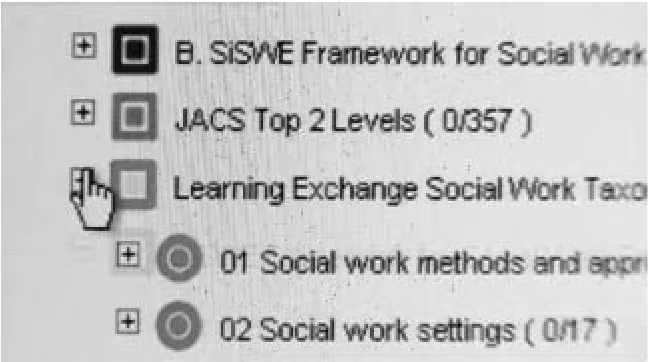
http:// www.intrallect.com/as the storehouse for our content. Although this is a proprietary product it was selected because of the vendor’s strong commitment to open standards and maximum interoperability with other systems. Since the repository was released–in late 2006–so-cial work educators and learners who are authorised users have been able to gain authenticated access from their desktop using a normal web browser (Figure 1). They are able to search for resources by key word or phrase, or browse the repository using a specially designed social work education taxonomy. Once a suitable learning object is located it can be viewed within the repository and downloaded into the user’s own sys-tem. Users are also be able to add Amazon style comments on individ-ual learning objects they have used, and award a learning object a “star-rating” introducing a degree of user-contributed quality assur-ance. We intend developing this “recommender system” to enable users to share ideas and experiences about different ways of embedding the learning objects.
[image:9.612.144.469.457.638.2]The initiative is commissioned to populate the learning object reposi-tory with learning objects from three different sources: new multimedia learning objects created from scratch; learning objects re-purposed from existing published learning materials–with the agreement of rights
holders; and learning objects from educators, materials “as is” (i.e., ma-terial created by educators whether in the form of PowerPoint slides, text-based learning activities, handouts or other content deemed to be educationally useful). Our content is therefore likely to include every-thing from a short text-based learning activity on risk assessment, through an audio clip from a radio programme on autism, to an interac-tive multimedia case study highlighting attachment issues in child de-velopment. The remainder of this section will focus on our plans for the development of multimedia learning objects created from scratch.
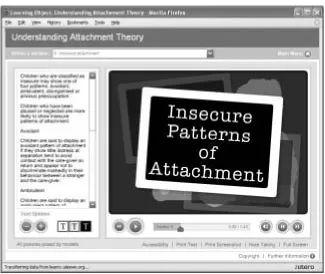
The initiative is funded to create multimedia learning objects, and to assist in this process we have developed a set of priority areas and a learn-ing object production process includlearn-ing: a content specification tem-plate (one for conceptual learning objects; and another for case-based learning objects); a two-stage peer review process to assure quality; and a Macromedia Flash-based software template for the actual learning ob-jects (further information available from the Learning Exchange web-sitehttp://www.sieswe.org/learnx). The content specification template and the peer review process have been adapted from the UCeL project: a medical education learning object project based at the University of Cambridge (Leeder & Morales, 2004; see http://www.ucel.ac.uk/ for further information).
During the earlier start-up phase of the initiative the project team were acutely conscious that their success would be highly contingent on the extent to which the learning objects produced were actually used by educators. Every effort was made to ensure maximum consultation, col-laboration, and buy-in from our user community. A project advisory group was established including one social work educator from each of the nine Scottish universities offering social work education in Scot-land, plus other key stakeholders from employer groups and agency-based practice teachers. In addition, project staff held workshops at each of the partner universities–and at other conferences. The learning object specification template to capture the ideas of workshop partici-pants, many of whom have been subsequently recruited as content pro-viders for the learning objects. This was an arduous process and one that involved project staff in many hours of planning and negotiation. How-ever, it is a process that has a good fit with the values of social work and should ensure a stronger sense of ownership of the learning objects created.
accessi-bility improvements in the latest version of Flash and a positive review of the new version published by the UK Royal National Institute for the Blind,http://www.rnib.org.uk.
This template–shown in Figure 2–has been designed to conform to accessibility standards; has a user-friendly standard approach to naviga-tion; and includes other standard features such as a glossary, copyright information, references, information about the authors, etc. It is in itself designed to be a reusable shell for multimedia content and can incorpo-rate text from an external XML file, making textual content easy to up-date and revise. Flash learning objects have the added advantage of being very scalable, so their size can easily be increased or decreased to be presented on a web page, or projected in a large lecture theatre, mak-ing them ideal for blendmak-ing online and face-to-face learnmak-ing.
[image:11.612.144.469.368.642.2]At the same time as developing the learning object repository, devel-oping multimedia content, and repurposing other material, project staff
offered a national staff development programme to support social work educators in embedding the new materials imaginatively into the curric-ulum. At this early stage in the development of the project we cannot yet report on outcomes, but plans are in hand to evaluate two aspects of the project: the usability and accessibility of our learning objects; and the overall impact of the project on teaching and learning.
CONCLUDING ISSUES
The Learning Object Economy
One of the most promising aspects of a learning object approach to e-learning is the idea that widespread adoption of this approach may lead to the emergence of a learning object economy. This vision of a learning object economy has been described by some commentators as a new educational marketplace staked out by commercial content pro-viders, with learning objects as educational commodities circulating in the new market (Purcel, 2003). However, just as there are different per-spectives and approaches to engaging with the economics of the mar-ketplace, so learning object economies may also be constituted in different ways. For example, Campbell (2003) argues that“. . . within public sector education, we are more likely to see the emergence of mi-cro-trading economies where resources are exchanged within and be-tween recognised communities of practice.” The idea of the “learning commons” is another perspective, with members of a particular munity of practice sharing resources for the benefit of the wider com-munity, underpinned by some agreed rules for exchange and the protection of intellectual property rights. The Creative Commons initia-tive in the U.S., http://creativecommons.org/ is one approach to safe-guarding the rights of authors whilst facilitating not-for-profit sharing within the wider community.
This approach is also necessary if we are to protect the intellectual property rights of content providers (a mix of university academics, commercial publishers, not-for-profit organisations, and governmental bodies) and at the same time capitalize on the capacity of Web-based delivery and international standards to make possible the trans-global exchange of learning objects for social work education. Resolving is-sues around intellectual property rights, and the more human and cul-tural dimensions of learning object use and exchange may, however, prove to be less tractable than the creation of content.
Pedagogical Issues
While the learning object approach offers great potential to create a pool of adaptable learning resources accessible by social work educa-tors globally, the mere fact of accessing learning resources, however compelling, will not of itself necessarily lead to effective educational outcomes. Indeed, some commentators have become concerned that an undue emphasis on learning objects within the learning technology lit-erature carries with it the risk of an inappropriate accent on content, and on individualised, information-transmission approaches to learning, rather than more constructivist and collaborative approaches. There are, however, three responses to this critique.
Firstly, if learning objects were designed only for individual users and consisted only of mini-multimedia lectures, concerns about infor-mation-transmission would be well-founded. However, a learning ob-ject might be a learning activity or a case study used as the focus for collaborative problem-based learning. And even the most conceptual and information-based learning object will only achieve its educational value if embedded in some kind of student learning activity that pro-motes internal dialogue for the learner and/or external dialogue with other learners and tutors: a fact that is recognised inside the project and forms the rationale for our staff development programme.
the teacher in supplying a structure, a set of activities and occasional course-specific material that act as the ‘glue’ to tie together the entire course” (p. 18).
Thirdly, within the learning technology community there is growing interest in emerging standards for learning design (see, for example, Koper & Tattersall, 2005). Learning design is about standardised ways of describing learning activities and learning processes that could them-selves be captured and shared inside a repository–a welcome emphasis that does not contradict the learning objects approach but could work ef-fectively alongside learning objects. E-learning is not all that there is to learning for social work, and the learning object approach is not all that there is to e-learning. It may help us to build a valuable and necessary infrastructure for social work education in the 21st century, but is no more likely to replace the need for intelligent educational design than li-braries are likely to replace universities.
REFERENCES
Bertera, E.M., & Littlefield, M. (2003). Evaluation of electronic discussion forums in social work diversity education: A comparison of anonymous and identified partici-pation.Journal of Technology in Human Services,21(4), 53-71.
Campbell, L. (2003). Engaging with the learning object economy. In A. Littlejohn (Ed.),Reusing online learning resources: A sustainable approach to e-learning(pp. 35-45). London: Kogan Page.
Cooper, L. (2001). Using on-line technology to teach controversial issues.New Tech-nology in the Human Services,13(3-4), 11-21.
Cuban, L. (2001).Oversold and underused: Computers in the classroom. Cambridge, MA: Harvard University Press.
Downes, S. (2004). Learning objects: Resources for learning worldwide. In R. McGreal (Ed.), Online education using learning objects (pp. 21-31). London: Routledge Falmer.
Duncan, C. (2003a). Granularization. In A. Littlejohn (Ed.),Reusing online learning resources: A sustainable approach to e-learning(pp. 12-19). London: Kogan Page. Duncan, C. (2003b). Digital repositories: E-learning for everyone. Retrieved 17th January,
2005, from http://www.intrallect.com/products/intralibrary/papers/elearninternational_ edin_feb2003.pdf.
Duncan, C., & Ekmekcioglu, C. (2003). Digital libraries and repositories. In A. Littlejohn (Ed.), Reusing online learning resources: A sustainable approach to e-learning. London: Kogan Page.
Friesen, N. (2004). Three objections to learning objects. In R. McGreal (Ed.),Online education using learning objects(pp. 59-70). London: Routledge Falmer. Hick, S. (1999). Rethinking the debate: Social work education on the internet.New
Technology in the Human Services,12(3-4), 65-74.
Hodge, D. (2004). Creating a virtual community of learners using WebCT: Lessons learned.Journal of Technology in Human Services,22(3), 69-78.
IEEE Learning Technology Standards Committee (2002). Draft standard for learning object metadata. Retrieved 15th January, 2005, from http://ltsc.ieee.org/wg12/ 20020612-Final-LOM-Draft.html.
JISC (2004). Effective practice with e-learning: A good practice guide in designing for e-learning. Retrieved 15th January, 2005, from http://www.jisc.ac.uk/uploaded_ documents/ACF5D0.pdf.
Knowles, A.J. (2001). Implementing web-based learning: Evaluation results from a mental health course.Journal of Technology in Human Services,18(3/4), 171-187. Koper, R., & Tattersall, C. (Eds.) (2005).Learning design: A handbook on modelling
and delivering networked education and training. London: Springer Verlag. Kreuger, L., & Stretch, J. J. (2000). How hypermodern technology in social work
edu-cation bites back.Journal of Social Work Education,36(1), 103-115.
Leeder, D., & Morales, R. (2004). Universities collaboration in elearning (ucel): Post-fordism in action. Retrieved 20th December, 2004, from http://www.ucel. ac.uk/documents/docs/LEEDERMORALES.pdf.
Littlejohn, A. (Ed.) (2003).Reusing online learning resources. London: Kogan Page. Massimo, V.S. (2003). Integrating the webct discussion feature into social work courses: An assessment focused on pedagogy and practicality.Journal of Technol-ogy in Human Services,22(1), 49-65.
McGreal, R. (Ed.) (2004).Online education using learning objects. London: Routledge Falmer.
Olivier, B., & Liber, O. (2003). Learning content interoperability standards. In A. Littlejohn (Ed.), Reusing online learning resources: A sustainable approach to e-learning. London: Kogan Page.
Purcel, J. (2003). Capitalizing on the learning object economy: The strategic benefits of standard learning objects. Retrieved 20th December, 2004, from http://www.learningobjectsnetwork.com/resources/LONWhitePaper_Strategic Benefits OfStandardLearningObjects.pdf.
Rafferty, J., & Waldman, J. (2003).Building capacity to support the social work de-gree: A scoping study for the department of health e-learning steering group. Southampton: University of Southampton.
Schoech, D. (2000). Teaching over the internet: Results of one doctoral course. Re-search on Social Work Practice,10(4), 467-486.
Seabury, B. (2003). On-line, computer-based, interactive simulations: Bridging class-room and field.Journal of Technology in Human Services,22(1), 29-48.
Sosteric, M., & Hesemeier, S. (2004). A first step towards a theory of learning objects. In R. McGreal (Ed.),Online education using learning objects. London: Routledge Falmer.
Wagner, E.D. (2002). Steps to creating a content strategy for your organization.
eLearning Developers’ Journal. Retrieved 21st January, 2005, from http://www. elearningguild.com/pdf/2/102902MGT-H.pdf.
Wiley, D.A. (2000a). The instructional use of learning objects. Bloomington, IN: AECT.
Wiley, D.A. (2000b). Connecting learning objects to instructional design theory.The instructional use of learning objects.Retrieved 20th December, 2004, from http:// www.reusability.org/read/chapters/wiley.pdf.
Wiley, D. (2003a). Learning objects–a definition. In A. Kovalchick & K. Dawson (Eds.),Educational technology: An encyclopedia. Santa Barbara CA: ABC-CLIO. Wiley, D. (2003b). Learning objects: Difficulties and opportunities. Retrieved 20th
December, 2004, from http://wiley.ed.usu.edu/docs/lo_do.pdf.