PEER REVIEWED JOURNAL, OCT-NOV 2018, VOL- 6/30
Copyright © 2017, Scholarly Research Journal for Interdisciplinary Studies
T E A C H I N G E F F E C T I V E N E S S O F S E N I O R S E C O N D A R Y S C H O O L
T E A C H E R S I N RELATION TO TEACHING EXPERIENCE, GENDER AND
EDUCATIONAL QUALIFICATION
Sapna Sen, Ph. D.
Assistant Professor (Education), Dronacharya PG College of Education, Rait, Distt. Kangra
The present research study was undertaken to investigate teaching effectiveness of senior secondary school teachers and how it is influenced by gender, teaching experience and educational qualification. Descriptive survey method was employed for the present investigation. Multistage sampling technique was used to select the sample of 187 senior secondary school teachers from Kangra district of Himachal Pradesh. Teacher Effectiveness Scale by Parmod Kumar and D. N. Muthawas used to gather the data. The data were analyzed with the help of descriptive and inferential statistics. The findings of the study shown that teaching experience has no significant impact on teaching effectiveness of senior secondary school teachers. Male and female teachers do not differ significantly from each other with respect to their effectiveness in teaching. High qualification has nothing to do with the effectiveness in teaching in case of senior secondary school teachers. The educational implications have been discussed in the end of the research paper.
Keywords: Teaching Effectiveness, Teaching Experience, Educational Qualification.
INTRODUCTION
Teacher effectiveness means perfection of optimum level of efficiency and productivity on
the part of the teacher. It refers to the height of maturity during the life span of the teacher. In
the words of Ryan, “The teacher is supposed to be the hub of educational system from whom
everything emanates.” Both the eastern and western records strongly suggest that the
effective teachers attract a large number of pupils around them and their glory is reflected in
terms of the achievement of their pupils.Effective teaching must ensure maximization of
learning experiences. It aims at achieving the objectives of education to the optimum.
Effective teaching can be achieved with the help of skillful teaching. Teaching and learning
are the two aspects of the same coin, and education implies the study of teaching skills and
practice.If the density of a nation is being shaped in its classroom, teacher is the architect of
the density. It is rightly said that the more efficiencies the teacher has, the more efficient the
teacher is and the more effective is his teaching. Teacher effectiveness is related to the
outcomes that reflect the achievement of students and the objectives of education. Rao (1995) Scholarly Research Journal's is licensed Based on a work at www.srjis.com
Copyright © 2017, Scholarly Research Journal for Interdisciplinary Studies
reported that there were no significant relations between teacher effectiveness and the income
or years of service of the teachers. Significant relations were found between teacher
effectiveness, creativity and inter-personal relationships. Significant difference was found
between rural and urban teachers with reference to inter-personal relationships.Gurpreet
(2005) found that there is significant difference in the teacher effectiveness of male and
female teachers and females are more effectiveness than male teachers.Bala (2007) studied of
burnout in secondary school teachers in relation to teacher effectiveness and found that there
exists a significant relationship between personal accomplishment of burnout and teacher
effectiveness of male and female secondary school teachers.Jain (2007) revealed that the
teaching effectiveness and attitudes of teachers towards teaching profession with respect to
sex, type of school and teaching experience were found to be significant. The study observed
that less experienced female teachers teaching in private schools exhibits better classroom
teaching. A significant negative relationship exists between the attitude and teaching
effectiveness of teachers.Gaur and Singh (2009) conducted a study to compare the teacher
effectiveness of secondary school teachers with their correlates as marital status, type of
schools and caste. A sample of 84 secondary school teachers of Mathura region were selected
randomly. The tool used was teacher effectiveness scale by P. Kumar and D.N. Mutha. The
results revealed that no significant difference was found between the secondary school
teachers of Mathura region on their effectiveness with their correlates as government/private,
married/unmarried and general/schedule caste. On the contrary, significant difference was
found between the teacher belonging to the general and other backward caste and the teachers
belonging to schedule caste and other backward caste on their effectiveness in teaching.
OBJECTIVES
1. To study the difference in teaching effectiveness of senior secondary school teachers
with different length ofteaching experience.
2. To study gender-wise difference in teaching effectiveness of senior secondary
school teachers.
3. To study educational qualification-wise difference in teaching effectiveness of
senior secondary school teachers.
HYPOTHESES
1. There will be no significant difference in teaching effectiveness of senior secondary
Copyright © 2017, Scholarly Research Journal for Interdisciplinary Studies
2. There will be no significant gender-wise difference in teaching effectiveness of
senior secondary school teachers.
3. There will beno significant educational qualification-wisedifference in teaching
effectiveness of senior secondary school teachers.
RESEARCH METHOD
“Descriptive Method of Research” was used for carrying out present study.
SAMPLING
In the present investigation, a representative sample of 187 teachers of senior secondary
school from Kangra district of Himachal Pradesh was selected by applying multistage
sampling technique.
RESEARCH TOOL USED
Teaching Effectiveness Scale by Dr. Parmod Kumar and Dr. D.N. Mutha.
ANALYSIS OF DATA
The data were analyzed with the help of descriptive and inferential statistics.
1. Teaching Effectivenessin RelationtoLength of Teaching Experience of Senior
Secondary School Teachers
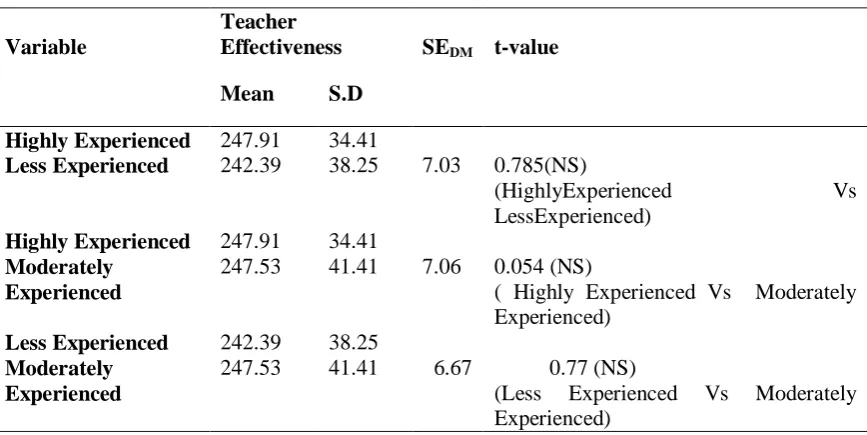
The means of teaching effectiveness scores of teachers with different length of teaching
[image:3.595.82.516.517.734.2]experience along with number, S.D. and t-value are given in Table 1.
Table 1 Means of Teaching Effectiveness Scores and Difference between Means for
Three Different Groups classified on the basis of Teaching Experience
NS- Not Significant
Variable
Teacher
Effectiveness SEDM t-value
Mean S.D
Highly Experienced 247.91 34.41
7.03 0.785(NS)
(HighlyExperienced Vs LessExperienced)
Less Experienced 242.39 38.25
Highly Experienced 247.91 34.41
7.06 0.054 (NS)
( Highly Experienced Vs Moderately Experienced)
Moderately Experienced
247.53 41.41
Less Experienced 242.39 38.25
6.67 0.77 (NS)
(Less Experienced Vs Moderately Experienced)
Moderately Experienced
Copyright © 2017, Scholarly Research Journal for Interdisciplinary Studies
Table 1 shows that the t-value testing the mean difference (5.52) in the teaching
effectiveness scoresbetween highly experienced group and less experienced group of
teachers came out to be 0.785 which is less than table value of t (1.96) even at 0.05 level of
significance, for df 185. Similarly, the t-value testing the mean difference in teaching
effectiveness scores between highly experienced and moderately experienced group of
teachers was found to be 0.054 which is also less than thetable value of t (1.96) at 0.05 level
of significance, for df 185.Hence, it may be concluded that highly experiencedteachers
possessed almost similar level of effectiveness in teaching as compared to moderately or
less experienced teachers.In the similar manner, Table 1 depicts that the t-value testing the
mean difference in the teaching effectiveness scores between less experienced group and
moderately experienced group was found to be 0.77 which is less than the table value of t
(1.96) even at 0.05 level of significance, fordf185. Therefore, it may be inferred that
moderately experienced teachers and lessexperienced teachers do not differ significantly
from each other with regard to their teaching effectiveness. Hence, the Hypothesis No. 1
that, “There will be no significant difference in teaching effectiveness of senior secondary
school teachers with different length of teaching experience”, was accepted.
Gender-wise Difference in Teaching Effectiveness of Senior Secondary School
Teachers:
The means of teaching effectiveness scores of male and female teachers along with
number, S.D. and t-value are given in Table 2.
Table 2 Gender-Wise Difference in Teaching Effectiveness of Senior
Secondary School Teachers
Variable
Teacher Effectiveness
SEDM t-value
Mean S.D.
Male 243.61 40.37
5.71 0.971 (NS)
Female 248.85 36.67
NS- Not Significant.
It may be observed from Table 2 that mean scores on the variable of teacher
effectiveness of male and female senior secondary school teachers are 243.61 and 248.85
respectively. The calculated value of „t‟ for comparing the means of teaching effectiveness
scores of male and female senior secondary school teachers came out to be 0.971, for df 185
Copyright © 2017, Scholarly Research Journal for Interdisciplinary Studies
significance.So, it may be averred that male and female teachers do not differ significantly
from each other with respect to their effectiveness in teaching.Hence, the Hypothesis No. 2
that,“There will be no significant gender-wise difference in teaching effectiveness of senior secondary school teachers” was accepted.
Educational Qualification-wiseDifferencein Teaching Effectiveness of Senior Secondary
School Teachers:
The means of teaching effectiveness scores of highlyqualified andless qualified
teachers along with number, S.D. and t-value are given in Table 3.
Table 3 Educational Qualification-wise Difference in Teaching Effectiveness of Senior
Secondary School Teachers
Variable Teacher Effectiveness SEDM t-value
Mean S.D
Teachers with High Qualification 247.13 40.56
5.71 0.198 (NS)
Teachers with Less Qualification 246.00 37.04
NS- Not Significant
Table 3 shows that the respective mean values ofhighly qualified and less qualified
teachers with respect to their teaching effectiveness scores were found to be 247.13and246.00
respectively andthe „t-value‟ testing the significance of mean difference was calculated to be
0.198 which is lower than the table value (1.96) at 0.05 level of significance,for df185.Hence,
the Hypothesis No. 3 that, “There will be no significant educational qualification-wise
difference in teaching effectiveness of senior secondary school teachers”,was accepted.So, it
may be inferred that high qualification has nothing to do with the effectiveness in teaching in
case of senior secondary school teachers.
DISCUSSION OF FINDINGS
On the basis of analysis and interpretation of data, following conclusions may be
abstracted out in respect of the present study. Senior secondary school teachers with different
length of teaching experience do not differ significantly from each other with regard to their
teaching effectiveness. It may be concluded that highly experienced teachers have exhibited
higher mean of teaching effectiveness score (247.91) as compared to the mean teaching
effectiveness score of teachers with either moderate or less teaching experience. But the mean
differences were non-significant. Similarly, moderately and less experienced teachers did not
Copyright © 2017, Scholarly Research Journal for Interdisciplinary Studies
female senior secondary school teachers did not differ significantly from each other with
respect to their teaching effectiveness. However, it may be concluded that mean teaching
effectiveness score (248.85) of female teachers is somewhat higher than the mean teaching
effectiveness score (243.61) of male senior secondary school teachers.Highly qualified and
less qualified senior secondary school teachers did not differ significantly with regard to their
teaching effectiveness. However, the mean teaching effectiveness score (247.13) of highly
qualified teachers is little bit greater than the mean teaching effectiveness score (246.00) of
less qualified senior secondary school teachers. On the basis of these findings, certain
implications may be drawn to enhance teacher effectiveness among senior secondary school
teachers. If the teacher wants to become more effective in the class, he should plan his
strategies as well as lesson plans according to the needs and interests of the students before
entering in class. The teachers need to have basic skills as a part of their repertoire of
teaching effectiveness. For this, a module for development of teaching skills at in-service
training level needs to be developed. Teachers should use new methods, skills, audio-visual
aids for making their teaching effective. The teachers should have mastery over the subject.
Teachers should possess positive outlook towards their profession. The teachers, very often,
ignore their weaknesses which simultaneously affects the teaching-learning process. So, the
teachers should improve their weaknesses for betterment of the students. The teachers should
enhance their knowledge from time to time through different ways like; in-service training
programmes, workshops etc. The findings of present study have shown that level of teaching
effectiveness of teachers positively affects the effectiveness in teaching. Hence, the teacher
should enhance their sense of effectiveness through mastery experiences. The teacher should
have complete mastery of his subject as well as other functions related to class and school
management. The teacher should always strive for achieving his goals and make efforts to
develop the ideal characteristic of the role model. Those who have a high sense of
effectiveness about their teaching capabilities can motivate their students and enhance
cognitive development. Hence, it is of great importance that teachers working in schools
should be highly talented and have a high level of teaching effectiveness. Steps should be
taken to upgrade their knowledge and skills as well as improving their level of teaching
Copyright © 2017, Scholarly Research Journal for Interdisciplinary Studies REFERENCES
Bala, R. (2007). A study of burnout in secondary school teachers in relation to teacher effectiveness.M.Ed. Dissertation,Chandigarh:Punjab University.
Gurpreet (2005).Astudy of effectiveness in relation to teaching competency.M.Ed. Dissertation,Chandigarh: Punjab University.
Jain, Rachana (2007). A study of teaching effectiveness of teachers and their attitudes towards teaching profession.Journal of Indian Education, XXXIII(1), 77.