Law, Derek (2007)
Making science count: Open Access and its impact on
the visibility of science.
In: Institutional Archives for research. Experiences
and projects in open Access. Proceedings. Rome Nov. 30 - Dec 1, 2006.
Rapporti ISTISAN. Istituto Superiore di Sanità, Rome.
http://eprints.cdlr.strath.ac.uk/
2841
/
This is an author-produced version of a paper published in
Institutional Archives for research. Experiences and projects in open
Access. Proceedings.
Strathprints is designed to allow users to access the research
output of the University of Strathclyde. Copyright © and Moral
Rights for the papers on this site are retained by the individual
authors and/or other copyright owners. Users may download
and/or print one copy of any article(s) in Strathprints to facilitate
their private study or for non-commercial research. You may not
engage in further distribution of the material or use it for any
profitmaking activities or any commercial gain. You may freely
distribute the url (
http://eprints.cdlr.strath.ac.uk
) of the Strathprints
website.
Making science count: Open Access and its impact on
the visibility of science
Derek Law
University of Strathclyde, Glasgow
Introduction
Science publishing is a large global industry. A recent study indicates the sheer volume of what is involved (Worlock,2006). It is believed that there are over twenty thousand peer-reviewed scholarly journals serving a multi-million audience of whom about 5.5 million are themselves researchers. The majority of those journals – some 60% - are now available online, although most also still have print versions. A growing number, currently around 10%, operate some form of open access publication model. This industry generated over €4 billion for English language STM journals alone in 2004. Although that is only a proportion of the total, these are the only available figures which offer reasonably accurate figures on the scale of this huge industry. And it is precisely the sheer size of this global economic phenomenon which blinds many publishers and even authors to the fact that publishing exists to support research; research does not exist to support publishing.
The Future of Scholarly Communication
The Internet and the World Wide Web have brought undreamt of opportunities and problems to scholarly communication. And yet the issues remain fundamentally the same as always – Archiving, Access and the Advancement of Science.
Archiving. Hitherto a network of national and university libraries has
ensured the retention of the scientific corpus through the provision of copies of published works at different and multiple locations. This infrastructure is much less certain in an electronic environment where information is typically leased rather than purchased and where legal deposit remains unusual. And yet the short life span of publishers compared with the longevity of libraries and universities is almost legendary. Nor has it been the historic role of publishers to ensure permanent archiving. And yet science is built on previous results. It famously exists in the quotation “standing on the shoulders of giants”, a phrase used as the motto of Google Scholar, but traceable back via Isaac Newton to Bernard of Chartres. That long term archiving and preservation role looks to have its best support in repositories.
Access. The PubMed 1000 Exercise (Kiley, 2007) showed that even in
the best found libraries and organisations, researchers did not have access to 10-20% of the relevant published papers. For most researchers the position is much worse. If research is to be read and if research is to be seen, it must be readily accessible. Again repositories provide better access free at the point of use than commercial journals with their the toll barriers. That said institutional repositories depend on a vibrant publishing industry which not just allows but encourages self archiving.
Advancement of Science. Repositories have the additional value of
technology in advancing collaborative working. Repositories then have a key role to play here.
History
The movement to create subject based repositories can be dated to The arXiv, which was originally developed by Paul Ginsparg and started in 1991 as an archive for preprints in physics, but later expanded to include mathematics, computer science, nonlinear science and, most recently, quantitative biology. A small number of other subject based repositories have then developed over the last decade. The trend shifted towards institutional repositories from about the year 2000 as easy to use shareware became widely available, followed in 2001 by the creation of the now widely adopted OAI-PMH protocol which allowed harvesting of data from repositories. A whole series of policy statements have followed, each marking a step in the growing prominence and importance of the Open Access movement:
The first was the Budapest Open Access Initiative of December 2001. There were thirteen initial signatories, a number which had grown to over 360 organizations and 4,000 individuals by August 2006.
This was followed by a string of national or research funder statements supporting OA
- the Bethesda Statement, 2003 - the Berlin Declaration, 2003 - the Scottish Declaration, 2004
- the National Institutes of Health, 2004 - Research Councils UK, 2006,
- The Bangalore Policy statement for Developing Countries
Significant favourable reports added further momentum from the UK Science and Technology Committee in 2004 and the European Commission in 2006.
Figure1
Current Activity
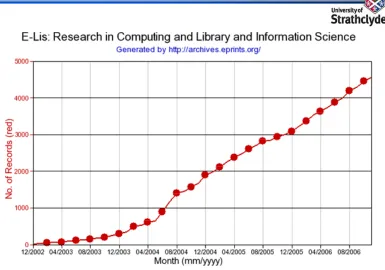
We can then see that awareness of Open Access is increasing amongst scholars in all disciplines, and while the number of repositories has increased at an average of 1 per day over the last year, the rate of deposit of articles has also increased. This can be demonstrated by this typical graph for the E-Lis subject repository:
Figure 2
Issues
(2004) has shown a similar four-fold increase in citations in Physics. Mueller (2006) found a similarly large change in impact factors in general internal medicine journals. Hajjem(2006) demonstrated the same effect within biology, business, psychology and sociology journals and Antelman (2005) in philosophy, politics, electrical & electronic engineering and mathematics. There seems overwhelming evidence that such self-archiving increases citation and therefore the effectiveness of scholarly communication in all disciplines.
There is no real barrier to deposit. Some 92% of journals permit self-archiving as shown by the SHERPA/RoMEO site at
http://romeo.eprints.org/stats.php or www.sherpa.ac.uk/romeo.php
Yet Swan (2006) has discovered that only 24% of authors have deposited papers in a repository, while only 15% of researchers deposit regularly in institutional archives. This figure will surely change as the major funding agencies mandate deposit. These figures are all the more surprising given that such deposit not only impacts on citation volume but also impacts on citation speed – and hence influences recognition of the research.
Swan (2006a) has demonstrated that Open Access articles are cited earlier, and, as shown below, they are downloaded more often. As Figure 3 (below) demonstrates, open access abstracts are viewed more frequently. As Swan’s work has shown there is a significant correlation between downloads today and citations two years later. This correlation has two immediate implications:
(1) Download counts can be used as early performance
indicators for papers and authors, even before their impact is reflected in citation counts
(2) Enhancing usage impact is yet another reason for authors to provide open access to their articles by self-archiving them.
As a small example take a paper by this author describing convergence of support services at the University of Strathclyde. This was published in the United States as a book chapter late in 2003. It has not yet been cited (to the author’s knowledge) and does not appear in Google Scholar. It was mounted in the institutional repository in late 2005 and over twelve months attracted attention as follows:
Figure3
The place of useful learning: convergence at the University of Strathclyde
Abstract views and document downloads for all years
The numbers in (parentheses) are the number of distinct countries that views/downloads originated from.
Abstracts Downloads
Views 288 (15) 84 (7)
Views by country (derived from IP address of query) for all years
Country Abstracts Downloads
United States 215 50
Our Intranet 32 13
United Kingdom 13 11
Switzerland 4 6
Czech Republic 3 2
Ireland 1 1
Palestinian Territory 1 1
Japan 6 0
Germany 3 0
Italy 3 0
Sweden 3 0
India 1 0
Spain 1 0
Poland 1 0
Portugal 1 0
abstract views originating from 15 distinct 288
countries Grand Totals:
document downloads originating from 7 distinct
84
What is interesting is not just the interest generated by deposit, but the spread of countries from which searches have been made. This is evidently much greater than the reach of an expensive monograph from a small American publishing house.
Now whatever view is taken of research quality there are a variety of models which attempt to express it through metrics. Impact factors, h-factors, g-factors and the rest are all used in an attempt to balance quality and quantity (Lehmann, 2006). What is common to all of them is the use of citations to assess impact. When aggregated these are used to create league tables of institutional quality. Ultimately this is a factor in the award of institutional funding. There is then every reason for researchers to see an incentive to use repositories to increase citations.
Other initiatives
Institutional Repositories are not, of course, the only vehicle for promoting the outputs of science. Perhaps the best known national initiative is Cream of Science in the Netherlands (DARE, 2007).
Figure 4.
This project has identified the principle scientists in that country and then sought to deposit the work of 229 of them in a repository to showcase the best research. This has obvious resonance with a variety of government agendas to promote the country in every sphere and appeals to the personal vanity of the individual. This initiative has been much admired and is already being explored as a model for the UK.
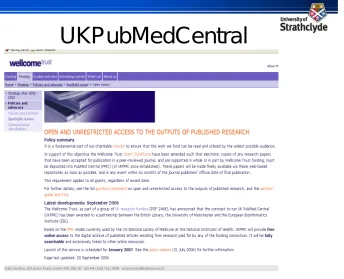
Another major initiative has just been launched in medicine. Although it’s initial focus and funding is from the UK, it seems to have clear European ambitions. Based on the well known PubMed Central - the US National Institutes of Health free digital archive of biomedical and life sciences journal literature – UK PubMed Central aims to provides a stable, permanent and free-to-access online digital archive of full-text, peer-reviewed research publications.
[image:10.612.121.465.437.716.2]Launched in January 2007, the initial phase of developing UKPMC involves mirroring the PMC database, and implementing a manuscript submission system to enable UK scientists to submit their research papers for inclusion in UKPMC. The project is supported by the eight major UK biomedical funding agencies who between them fund over 90% of research in biomedicine in the UK. The fact that they have mandated deposit will not only lead to a much higher rate of deposit but should give UK scientists an edge in terms of citation.
Figure 5. UKPubMedCentral
Why does it matter?
Increasingly metrics are being used to determine the quality of research. Increasingly we can expect citation, downloads etc. to determine not only past performance but also future grants. Already free software exists which allows a direct comparison of the impact of individuals (http://www.harzing.com/resources.htm). However many reservations one may have and how ever crude a tool this might be, it will be used. One of the most systematised structures operates in the United Kingdom, where individual researchers are assessed into five categories
0 = not submitted for assessment 1* = nationally significant
2* = international reputation
3* = working ONLY at international level 4* = global superstar
A popular prejudice is that such 4* “galacticos” are probably Nobel prizewinners or at least have their own television series, while “normal researchers will be 2* or 3*. Most of the judgements are based on metrics, which are measured by peer group esteem; the research environment; publications and increasingly their citations.
Increasingly too, universities wish to perform well in the published league tables of universities. If we look at the world league table of universities, it uses only two metrics:
- Who knows/mentions the institution in a survey
- Citation count
Universities wish to be seen to be well placed in these league tables. And how are these measures most easily increased?.... By depositing papers in the institutional repository!
As Sir John Sulston, Nobel Prizewinner and the British scientist behind the Human Genome Project put it “Ensuring that the outputs of research are freely available to all is the best way to maximise their utility” (Kiley, 2007)
References
Antelman, K. (2004) Do Open-Access Articles Have a Greater Research Impact?
Brody, T., Stamerjohanns, H., Vallieres, F., Harnad, S., Yves, G. and Charles, O. (2004) The effect of Open Access on Citation Impact.
http://eprints.resist.ecs.soton.ac.uk/9941/
DARE (2007) http://www.creamofscience.org/en/page/language.view/keur.page
[page viewed on 19th February 2007]
Hajjem, C., Gingras, Y., Brody, T., Carr, L. and Harnad, S. (2005) Open Access to Research Increases Citation Impact. Technical Report, Institut des sciences cognitives, Université du Québec à Montréal.
Kiley, Robert (2007) cited by him in a presentation made to the 2007 Conference
Scientific Publishing in the European Research Area Brussels, 2007
Lawrence S. Online or Invisible? Nature (2001) 411:521. http://www.neci.nec.com/~lawrence/papers/online-nature01/
Lehmann, S., Jackson, Andrew D., Lautrup, Benny E. (2006). Measures for Measures
Nature 444 pp1003-1004
Mueller, P.S., Murali, N.S., Cha, S.S., Erwin, P.J., Ghosh, A.K. The effect of online status on the impact factors of general internal medicine journals Netherlands journal of medicine (2006), Vol. 64, No. 2
Swan, Alma (2006) Repositories overview: Policies and implementation. Powerpoint presentation given at the Open Scholarship 2006 Conference.
http://hdl.handle.net/1905/649
Swan, Alma (2006a) The institutional repository: what it can do for your institution and what the institution can do for the repository. ANKOS Workshop 2006
Worlock, David Assessing the Evidence. Presentation to the STM Frankfurt