UTAS
Performance appraisal of a
•
four-stroke Hydrogen
internal combustion engine
Patrick Hugh Burke
BE(Hons)
Mech
Submitted in fulfillment of the requirements for the degree of Master
of Engineering Science (MEngSc)
Declaration and Authority of Access
Declaration and Authority of Access
This thesis contains no material that has been accepted for a degree or diploma by the
University of Tasmania or any other institution, except by way of background
information and has been duly acknowledged in this thesis, and to the best of the author's
knowledge and belief no material has previously been published or written by another
person except where due acknowledgment is made in the text of this thesis.
This thesis contains confidential information and is not to be disclosed or made available
for loan or copy without the expressed permission of the University of Tasmania. Once
released the thesis may be made available for loan and limited copying in accordance
with the Copyright Act 1968.
Signed: r
Date: /Y(
Acknowledgements ii
Acknowledgements
Firstly, I would like to thank my supervisors Associate Professor Vishy Karri and Dr.
Yasir Al-Abdeli for their guidance, encouragement, support and friendship throughout
the duration of this project. Their complementing teaching styles have made the process a
thorough and enjoyable learning experience.
I thank Bernadette, Tom, Katharine and Prof. Frank Bullen for their assistance in proof
reading the thesis. Their help has made this document a more pleasurable reading
experience.
I would like to extend my gratitude the workshop staff, Peter Seward, Nathan Smith, Ray
LeFevre, Steven Avery, Bernard Chenery and Nick Embrey for their patience, assistance
and advise throughout the project.
Thanks also to my post graduate colleagues for their assistance and friendship over the
past year. In particular Phuong Nguyen, David Butler, Dr. Hafez Hafez, Justin Sewart
and Todd Houstein deserve special mention for their help.
I wish to thank Australia Post for their generous donation of the subject of this project,
'the posite bike'. In addition, staff at the Australia Post workshop were more than willing
to share their technical knowledge for which I am thankful.
Finally, I would like to thank my family and friends for their endless care, support,
encouragement and distraction during the past year. They have been a source of much
Abstract iii
Abstract
Fossil fuel depletion and environmental factors had lead the search for alternative
transportation fuels. One such alternative is hydrogen. Of the potential transportation
fuels of the future hydrogen is the only one which is both sustainable and
environmentally friendly.
A good understanding of the quantitative and qualitative trends are available in the
literature, for petrol driven vehicles, as established knowledge. However, understanding
of the near zero emissions and associated conversion technology, using hydrogen as fuel,
has been in the domain of few automotive applications around the world.
This work is aimed at converting a commercially available vehicle to operate on
hydrogen as a design and manufacturing exercise to showcase the use of alternative fuel.
The chosen vehicle is the Honda CT110 motor bike or better known as the Australia Post
`postie bike'.
In this thesis, a rigorous design process for conversion to hydrogen is proposed and
implemented from first principles. The test rig development associated with the
calculations for fuel flow rates and associated engine management systems are an integral
part of this overall systematic design. As part of the investigation an innovative fuel
injection system together with fuel-air-intake system is designed and incorporated.
Traditional problems with pre-ignition in hydrogen engines are found to be minimized by
developed systematic design techniques.
As part of this investigation a comprehensive range of engine operating conditions are
investigated using both petrol and hydrogen as fuel. The comparisons have shown that for
the same operating conditions, hydrogen powered vehicles suffer losses in power and
thermal efficiency. With the performance requirements of the vehicle in mind the
reductions in performance are not seen as a major compromise. Exhaust emission
performance showed significant reduction in oxides of nitrogen and no significant
emissions of hydrocarbons, carbon dioxide and carbon monoxide. Future potential
developments suggested by this work is expected to improve performance outputs
Contents iv
Contents
Declaration and Authority of Access
Acknowledgements ii
Abstract iii
Contents iv
CHAPTER 1 Introduction 2
CHAPTER 2 Literature Survey 6
2.1 Internal Combustion Engines 7
2.1.1 Introduction 7
2.1.2 History 7
2.1.3 The Automobile 8
2.1.4 Types of combustion engines 8
2.1.5 Internal combustion engine operation and function 9
2.1.6 Two Wheeled Vehicles 11
2.2 Alternative Powering of Vehicles 12
2.2.1 Rationale of Alternately Powered Vehicles 12
2.2.2 Compressed Natural Gas 14
2.2.3 Liquefied Natural Gas 15
2.2.4 Liquefied Petroleum Gas 16
2.2.5 Electric 17
2.2.6 Bio-Diesel 20
2.2.7 Ethanol 21
2.2.8 Hydrogen 22
2.3 Hydrogen Uses 24
2.3.1 Fuel Cells 24
2.3.2 Hydrogen Internal Combustion Engines 27
2.4 Hydrogen Properties 28
2.5 Hydrogen as an Internal Combustion Engine fuel 30
2.5.1 Sustainability 31
2.5.2 Emissions 32
2.5.3 Ignition Limits 33
2.5.4 Pre-ignition, Backfiring and Flashback 33
2.5.5 Engine Performance 35
2.5.6 Storage limitations 36
2.5.7 Other Limitations 36
2.6 Hydrogen Storage 37
2.6.1 Storage based on needs 37
2.6.2 Compressed Hydrogen Gas 37
2.6.3 Liquid Hydrogen Storage 38
2.6.4 Metal and Complex Hydrides 39
CHAPTER 3 Experimental Design 41
3.1 Testing Equipment 42
3.1.1 Honda CT110 42
3.1.2 Dyno Dynamics 450M Dynamometer 44
Contents
3.1.4 Hydrogen Flow Board 46
3.1.5 RPM Counter 46
3.1.6 Gas Analyzer 47
3.1.7 Throttle Position Sensor 47
3.1.8 Engine Temperature Sensor 48
3.1.9 Atmospheric Temperature and Humidity probe 49
3.2 Testing guidelines 50
3.2.1 Introduction 50
3.2.2 Accuracy of equipment 51
3.2.3 Test Conditions 51
3.3 Testing calculations and relevant background 53
3.3.1 Thermal Efficiency 53
3.3.2 Emissions 53
3.4 Gasoline Testing 54
3.4.1 Power Output vs. Air-Fuel Ratio (AFR) 55
3.4.2 Thermal Efficiency vs. Air Fuel Ratio (AFR) 57
3.4.3 Emissions vs. Air Fuel Ratio (AFR) 59
3.5 Hydrogen Testing 61
3.5.1 Power Output vs. Throttle Position (TP) 62
3.5.2 Thermal Efficiency vs. Throttle Position (TP) 64
3.5.3 Emissions vs. Throttle Position (TP) 66
CHAPTER 4 Vehicle Conversion to Hydrogen 68
4.1 Introduction 69
4.2 Fuel Delivery Method 70
4.2.1 Fuel Lines 72
4.2.2 Fuel Injectors 73
4.2.3 Ignition System 76
4.2.4 Inlet Manifold Design 79
4.3 Fuel Injection and Spark Ignition Control 83
4.3.1 Engine Management System 83
4.3.2 EMS Set up and Programming 86
4.3.3 Sensors 87
4.4 Fuel Storage 92 .
4.4.1 Laboratory Testing 92
4.4.2 Dynamometer tuning operation 93
4.4.3 Dynamometer testing operation 96
4.4.4 Road operation 96
4.4.5 Safety Issues 99
CHAPTER 5 Performance of Gasoline and Hydrogen internal combustion engines 102
5.1 Testing accuracy 103
5.1.1 Compliance with testing guidelines 103
5.2 Gasoline Engine Qualitative Analysis 104
5.2.1 General comments about engine and equipment performance 104
5.2.2 Qualitative trends of the effects of major process variables on power 106
Contents vi
5.3 Qualitative Analysis of the Hydrogen IC engine 112
5.3.1 General comments about the engine and equipment performance 112
5.3.2 Qualitative trends of the effects of major process variables on power 114
5.3.3 Qualitative trends of the effects of major process variables on thermal efficiency 115 5.3.4 Qualitative trends of the effects of major process variables on exhaust emissions 116
5.4 Quantitative Comparison of Performance 118
5.4.1 Power as a means to compare gasoline to Hydrogen Engines 119
5.4.2 Thermal efficiency as a means to compare gasoline to Hydrogen Engines 122
5.4.3 Emissions 124
5.5 Testing and Data Analysis Conclusions 128
CHAPTER 6 Final Concluding Remarks and Proposed Future Work 129
6.1 Final Concluding Remarks 130
6.1.1 Literature Study 130
6.1.2 Power and Thermal Efficiency Comparison 130
6.1.3 Emissions 131
6.1.4 Social Acceptance 131
6.2 Proposed Future Work 131
6.2.1 EMS Development 131
6.2.2 Compression Ratio 132
6.2.3 Valve Timing 132
6.2.4 Fuel Pressure 133
6.2.5 Sensor Accuracy and Repeatability 133
6.2.6 Storage Development 133
6.2.7 Solenoid Valve 134
6.2.8 Control of Air Flow 134
6.2.9 Further Emission Development and Study 134
References 136
APPENDIX A: Experimental Data 140
APPENDIX Al: Hydrogen Testing Data 140
APPENDIX A2: Gasoline Testing Data 141
APPENDIX B: Experimental Equipment 143
APPENDIX Bl: Dyno Dynamics 450M Dynamometer 143
APPENDIX B2: Hydrogen Flowmeter 145
APPENDIX B3: RPM Counter 147
APPENDIX B4: Atmospheric Temperature and Humidity Probe 148
APPENDIX C: Conversion Equipment 150
APPENDIX Cl: Gaseous Fuel Injectors 150
APPENDIX C2: Ignition Coil 152
APPENDIX C3: Ignition Module 153
APPENDIX C4: MoTec M4 Engine Management System Specifications 154
APPENDIX C5: Reference Sensor 159
Contents vii
APPENDIX D: Determination of Net Power 162
APPENDIX E: Calculated flow rate from flowmeter data 164
APPENDIX F: Manifold Temperature Distribution for Honda CT110 under gasoline
operation 165
APPENDIX G: Cam sensor Design 166
APPENDIX Cl: Toothed Gear 166
APPENDIX G2: Cam Housing 167
APPENDIX G3: Cam Housing Mounting Flange 168
APPENDIX H: Inlet Manifold Layout Design 169
APPENDIX I: EMS Programming Setup 170
Chapter One - Introduction 2
Chapter One - Introduction 3
The depletion of natural non-renewable resources has necessitated the development of
alternative energy sources. Many countries around the world are channeling research
efforts to both identify a alternative energy sources and build working prototypes to
demonstrate the technology. It is estimated that in 2025 the demand for all forms of
energy is projected to be 54 percent more than total consumption in 2001. On the other
hand, Kyoto protocol has emphasized the need for reduced emissions and several
countries joining the consortium have initiated efforts to reduce the environmental effects
of fossil fuel usage in both stationary and mobile applications. World energy outlooks
predict that third world energy use will increase by 91 percent over the next two decades,
while rising 33 percent in industrialized nations. Furthermore, the carbon dioxide
emissions is projected to rise from 23.9 billion tons in 2001 to 37.1 billion tons in 2025,
whereas the developing world will account for 61 percent of the increase because of
reliance on coal and other fossil fuels.
It has been established that the use of fossil fuels has led to climate changes and
contributes towards the green house effect. The majority of fossil fuel combustion
processes produce carbon monoxide, carbon dioxide, nitrous oxides, sulfur oxides and
other harmful emissions. These pollutants have numerous health and environmental
impacts, including urban smog and global environmental problems. In order to minimize
the environmental damage, it is necessary to make the transition to a cleaner and
renewable energy source. With limited fossil fuel resources and their depletion in the near
future, the selection and use of renewable energy even more imperative.
Hydrogen is the most abundant element in the universe and unlike most other energy
carriers is carbon free. Hydrogen can assume a key role covering the growing energy
demand and lessen dependence on non-renewable energy sources. Hydrogen assisted fuel
cell systems can produce electricity without harmful emissions. It is also demonstrated in
the last century that hydrogen has the potential for automotive applications and stationary
Chapter One - Introduction 4
development needs to be done before hydrogen use in fuel cells before the technology
can compete with conventional methods in economical terms.
Using of hydrogen in internal combustion engines can achieve the key benefits of fuel
cell vehicles at a much reduced lower cost. While the combustion 'know how' of a
gasoline engine is an established science, little or no information, in the public domain, is
available that comprehensively explains the hydrogen powered internal combustion
engines. Any matured knowledge related to hydrogen internal combustion engines is in
the domain of major automotive companies such as BMW, Mazda, Toyota and more
recently Ford.
The economic justification for building a fully-fledged hydrogen internal combustion
engine plant for automotive applications is questionable, with current prices associated
with hydrogen production and engine production relatively high. Nevertheless, a good
understanding and parallel progress of the hydrogen internal combustion engine
technology is essential when the unit cost of hydrogen production is affordable.
Converting existing gasoline engines to operate on hydrogen as a fuel is currently seen as
the most near term hydrogen transport technology. This creates a transition time where
the current internal combustion engines are ready for 'conversion' to run on hydrogen
rather than having to buy a brand new hydrogen engine. This will also alleviate large
infrastructure changes to the internal combustion engine production. The need to
understand and establish a 'modular approach' to converting gasoline internal
combustion engines to run on hydrogen is essential. In this thesis, a Honda CT110
gasoline engine is converted to run on hydrogen. A methodology and systematic
approach to modular changes to the engine to accommodate hydrogen as fuel is proposed.
The innovative design proposed is built as a working prototype with 'tailor made' air-fuel
intake systems, fuel injection, fuel ignition and state of the art engine management
systems. The effect of the major process variables on the engine performance for power,
thermal efficiency and exhaust emissions will be established for both gasoline and
hydrogen running conditions. This work, as a routine, compares the power and thermal
Chapter One - Introduction 5
conditions. The unique fuel intake systems built in this work are seen as having generic
applications to similar engines of higher capacity. While every effort is made to minimize
required conversion changes and associated costs, it is shown in this work that the
majority of the costs involved are with the engine management system. This work argues
that a significant loss of power compared to the gasoline engine and associated thermal
efficiencies do not justify the exclusion of this adaption with zero carbon based emissions
and reduced nitrous of oxides of hydrogen engine. It is also argued that the
socio-environmental benefits that these emerging technologies can bring have lot more
significance in the long range.
University of Tasmania (UTAS), School of Engineering, has a growing research team in
this emerging field. With an established new research laboratory for applied hydrogen
research in 2004, the automotive applications of hydrogen can now be readily
investigated. The new research facility has been build as a part of the HART (Hydrogen
Allied Renewable Technology) program, which is joint research program between
University of Tasmania and Hydro Tasmania. The thesis presents an important
collaborative work between Australia Post and UTAS in order to design, build and
appraise the performance of a Honda CT 110 ('postie bike') engine converted to run from
Chapter Two - Literature Survey 6
CHAPTER 2 Literature Survey
"I believe that water will one day be employed as a fuel, that hydrogen and oxygen will constitute it, used singly or together,
Chapter Two - Literature Survey 7
2.1 Internal Combustion Engines
2.1.1 Introduction
Heat engines convert chemical energy into mechanical energy by the process of
combustion. Internal combustion engines are a special type of heat engine wherein the
process of heat addition (combustion) is achieved inside the engine. Conversely, other
heat engines such as Stirling engines and steam engines can be categorized as external
combustion engines since the process heat addition into the working fluid occurs outside
the engine.
One of the most prevalent places combustion engines are used is in the transport sector,
namely automobiles, trucks and aeroplanes. Small internal combustion engines are also
used in more diversified applications such as motorbikes, outboard engines, lawnmowers,
chainsaws and generators to name only a few.
2.1.2 History
The first to experiment with the internal combustion
engine was Dutch physicist Christian Huygens
shown in figure 2.1. Although these first attempts
occurred as far back as the 1860s, it was not until
1859 that an effective gasoline powered engine was
developed. This was achieved when French
engineer J J Tienne Lenior built a double acting
(spark) ignition engine that could be operated
continuously [11]. It was during this same period
that another Frenchman named de Rochas
[image:14.556.55.463.394.616.2]formulated basic internal combustion theories and
Figure 2.1: Christian Huygens 1101
the German, Dr. Nicholas Otto, developed the four stroke principle of operation. Even
Chapter Two - Literature Survey 8
2.1.3 The Automobile
The main components of an automobile are:
1. the basic structure including the frame, suspension system, axles and wheels;
2. the engine;
3. the transmission systems;
4. auxiliaries such as starter motors, lights and electronics;
5. controls such as steering and brakes [13].
The automobile as we know it was not invented in a single day by a single inventor. The
history of the automobile reflects an evolution which took place over time. It is estimated
that over 100,000 patents created the modern automobile [3].
In 1769, the very first self powered road vehicle was a military tractor invented by French
engineer and mechanic, Nicolas Joseph Cugnot (1725 - 1804). Cugnot's vehicle was
powered by a steam engine built at the Paris Arsenal (by mechanic Brezin). By the early
1900s, gasoline cars started to outsell all other types of motor vehicles. The market was
growing for economical automobiles and the need for industrial (scale) production was
pressing [14].
Manufacturers became more common and the production line, which revolutionized the
industry, came into place. Even today, developments in the automobile are ongoing with
new structural materials, more efficient engine designs and electronics and intelligent
systems are acting today to develop the market.
Automobiles can be classified as:
1. Auto cycles;
2. Motor cycles and scooters;
3. Cars, jeeps;
4. Buses and Trucks [13].
2.1.4 Types of combustion engines
Internal combustion engines are classified according to the cycle of operation and the
mode of combustion [15]. There are two cycles of operation, namely the two stroke cycle
and the four stroke cycle. The cycle of operation refers to how many strokes are required
Chapter Two - Literature Survey 9
gas exchange process, where the products of combustion are exhausted and replaced by
fresh gasses and the power process in which the charge is compressed, ignited and the hot
gas is expanded for useful work.
The two modes of combustion, spark ignition (SI) and compression ignition (CI) are also
commonly used as a means of classification. Each of these is characterized by differing
forms of ignition.
SI and CI engines use fuels with differing combustion characteristics. More commonly in
Australia we see the use of petrol (commonly referred to as gasoline) as the fuel source.
Petrol fuels are designed to resist autoignition during the compression stroke and should
normally ignite only under the presence of an initiating source (electric spark).
The common fuel in CI engines is Diesel. Diesel fuels are produced so they autoignite in
the high pressure and temperature conditions associated with the compression stroke.
2.1.5 Internal combustion engine operation and function
A reciprocating engine, also often known as a piston engine, is an engine that utilizes one
or more pistons in order to convert pressure into a rotating motion [16]. The movement of
the piston occurs in a space called the engine cylinder. The periodic linear movement of
the piston inside the engine cylinder generates an enclosed region of space with
constantly moving volume. This region of space is called the combustion chamber and is
where the air fuel mixture is ignited and combustion takes place.
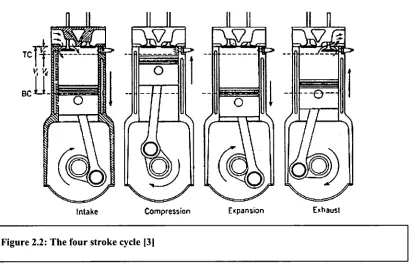
The four stroke engine has four major phases which are shown in figure 2.2 and
classified as:
• Intake stroke
• Compression Stroke
• Power Stroke
Chapter Two - Literature Survey 10
TC
[image:17.556.49.464.188.452.2]Intake Compression Expansion Exhaust
Figure 2.2: The four stroke cycle 131
These four phases (in whole) describe the stages of a single power (thermodynamic)
cycle and are controlled by the positions of the intake and exhaust valves as well as the
piston inside the cylinder. The intake valve allows a new charge of air-fuel-mix to enter
the cylinder, whilst the exhaust valve allows burnt gases to leave the cylinder. The timing
of the closure and opening of these valves is governed by the camshaft. Both the
camshaft and the piston are driven by the crankshaft. In this way, the rates of motion for
both the piston and the camshaft (valves) are governed by the rate of rotation of the
crankshaft. It is this rate of rotation that is also displayed in the Rev/Min counter in a
vehicle.
Variations in the timing of the closure and opening of valves as well as the point at which
ignition (sparking) occur have a great effect on the performance of internal combustion
Figure 2.3: The first successful two wheeled vehicle 191
Chapter Two - Literature Survey 11
2.1.6 Two Wheeled Vehicles
Two wheeled vehicles such as motor cycles and scooters have been an integral part of the
transportation sector for many years. These vehicles are seen by many as an efficient and
convenient method of transport. This view stems from the fact that a smaller total weight
(rider plus vehicle) arises, which optimizes fuel economy. Such vehicles are also more
convenient to maneuver and park particularly in busy metropolitan areas and high
population centres. However, pollution from many of such vehicles causes health
problems as well as serious deterioration in the quality of air. Fuel conversion
technologies are seen as an excellent way to combat this problem.
The first successful two-wheeler was the Hildebrand & Wolfmueller, patented in Munich
in 1894 shown in figure 2.3. The engine for this vehicle was a parallel twin, mounted low
on the frame. It was water-cooled, and had a water tank/radiator built into the top of the
rear fender [17]. Since then two wheeled vehicles have also undergone continued
development.
Today in Australia
most owners of two
wheeled vehicles
consist of
recreational users and
inner city riders. In
much more densely
populated countries
across Asia much
inner city travelling is
achieved on two and
three wheeled
vehicles and this market is rapidly growing with them occupying 50-90% of vehicles
Chapter Two - Literature Survey 12
2.2 Alternative Powering of Vehicles
2.2.1 Rationale of Alternately Powered Vehicles
In 2003-2004 Australia imported 23511 ML' of crude oil and other refinery feedstock
valued at over 6500 million dollars [20]. Of this amount more than half came from the
Middle East and Indonesia. Much of this import market was used by the automotive
industry which increased automotive fuel sales by 1% across the sector in 2004 [20].
From a consumer perspective there are 1000 cars to each 675 people in Australia and this
number has been increasing steadily over the past 33 years [21]. This continual growth
and reliance on foreign strategic energy resources threatens national and economic
security and is a non-sustainable practice [22]. The fact that these imports occur from
highly turbulent areas of the globe can also make this supply prone to instability.
One way of alleviating (and gradually phasing out) the reliance on imported fossil based
fuels destined for the automobile market is through the development of vehicles which
run on alternative sources of fuel. Environmental awareness and the application of more
stringent pollution standards from vehicle emissions is another impetus behind the
rationale for the use of alternative fuels and methods of powering vehicles. This is true
whether the (fossil based) fuels are locally or externally sourced. Indeed, it is believed
that the surface temperature of the earth has risen by 0.6°C since the late 19th century.
This rise could be a result of increased fossil fuel usage over this period [23]. CO2
emissions have also increased by 33% since 1987 in the Oceania region alone. On a
national scale, Australia is in the top 20 CO2 emitting countries worldwide and along
with Japan, contributes to 97% of the CO2 emissions from the region [24]. The steady
rise in CO2 emissions is shown in figure 2.4. Replacing gasoline in vehicles with alternate
(renewably sourced) fuels is expected to significantly reduce CO2 emissions from the
transportation sector. Additionally, alternate fuels offer reduced emissions of
ozone-forming pollutants such as carbon monoxide (CO) and nitrogen oxides (NO) [22].
Chapter Two - Literature Survey 13
Me
tr
ic
Tons
o
f
Car
bon
2.82.1
1.4
0.7
OA n
1950
•
1 • 1 • 1t
1960 1970 1980 1990 2000
Year
Figure 2.4: Worldwide emissions of Carbon Dioxide over the past 50 years 141
The following section outlines the most prevalent alternative fuels which are likely to
become available. It details their advantages, disadvantages and strategic developments
1. 1'4
"-I
k-4
14Figure 2.5: Natural Gas capture
Chapter Two - Literature Survey 14
2.2.2 Compressed Natural Gas
In the transportation sector, natural gas has been
considered as an alternative to gasoline for many years.
The first natural gas vehicle was developed in the 1930s.
Today, there are over 30 different models of CNG busses
available in the US [25].
Natural Gas is a significant component of the world's
energy supply. It is a fossil fuel and is drawn from gas
wells or in conjunction with crude oil production shown in
figure 2.5. Like oil and coal, this means that it is,
essentially, the remains of plants and animals and
microorganisms that lived millions of years ago. Also like
oil and coal natural gas is a limited non-sustainable resource.
A typical composition of Natural gas shown in table 2.1:
Table 2.1: Natural Gas typical composition 1261
Constituent Chemical Symbol % of Natural Gas
Methane CH4 70-90
Ethane C2H6 0-20
Propane C3H8 0-20
Butane C411 1 o 0-20
Carbon Dioxide CO2 0-8
Oxygen 02 0-0.2
Nitrogen N2 0-5
Hydrogen sulphide H2S 0-5
Rare Gases A, He, Ne, Xe trace
CNG is odourless, colourless and tasteless. For this reason an odorant is normally added
to the gas for safety reasons. CNG vehicles store natural gas in high pressure cylinders
Chapter Two - Literature Survey 15
Because natural gas is mostly methane, natural gas vehicles have much lower
non-methane hydrocarbon emissions than gasoline vehicles, but higher emissions of non-methane
[28]. Reductions of carbon monoxide has been shown to be 90-97%, carbon dioxide by
25% and nitrous oxide emissions by 35-60% due to the combustion of natural gas
compared to gasoline. [27].
CNG will most likely be seen in heavy-medium duty fleet vehicles initially before
commercially viable vehicles are available due mainly to costing.
2.2.3 Liquefied Natural Gas
Liquefied Natural Gas (LNG) is produced when natural gas is cooled to 126°C below
zero. It is odorless, colorless, non-corrosive and nontoxic. The result of further processing
is the end product being almost 100% methane [29]. Trace elements of ethane, propane
and heavier hydrocarbons are also present. When vaporized and mixed with air it burns
only in concentrations of 5% to 15% on a volumetric basis.
The process of liquefying
natural gas to LNG
reduces the volume of the
fluid by almost 600 times.
This high density means
that LNG is easy to
transport, it can serve to
make economical those
stranded natural gas
deposits for which the
construction of pipelines is
uneconomical [30]. For Figure 2.6: LNG import terminal in Maryland, US 181
many countries where
natural gas is not in abundance LNG provides an option where compressed natural gas
Figure 2.7: LPG Converted vehicle showing storage tank 121
Chapter Two - Literature Survey 16
To date LNG vehicles have been mostly restricted to heavy duty vehicles because the
complexities of on board storage make LNG not suited for light duty vehicles. The
storage limitations make the gas currently unsuitable for use with two-wheeled vehicles.
As the heavy duty market is mostly made up of diesel engines, the comparison of LNG
performance and emissions wise is best done against diesel.
LNG produces significant reductions in emissions compared to diesel. From a general
perspective, LNG engines [29]
• Produce half the particulate matter of diesel vehicles;
• significantly reduce carbon monoxide emissions;
• reduce nitrogen oxide emissions by 50%;
• potentially reduce carbon dioxide by 25% and;
• can drastically reduce toxic and carcinogenic pollutants.
2.2.4 Liquefied Petroleum Gas
Liquefied Petroleum Gas (LPG) is predominantly a mixture of hydrocarbon gases
(mainly propane C3H8 and
butane C4H10). When
pressurized, these gases
liquefy. LPG can also occur
naturally with other
hydrocarbons in oil and gas
fields, or it can be extracted
at oil refineries during the
production of other
petroleum products [31].
LNG has seen relative
success in converted vehicles that are running commonly on the road today. Figure 2.7
Chapter Two - Literature Survey 17
The main component gases of LPG are :
• Propane (C3H8)
• Propylene (C3H6)
• Butane (C4H10)
In 1999-2000, Australia produced 4,367 ML of naturally occurring LPG and 1,674.4 ML
of refinery produced LPG. In the period, Australia exported 2,858.9 ML of LPG and
imported 518.9 ML of this fuel[31].
Combustion of LPG is a more environmentally friendly solution for transportation
applications than petrol and diesel [32].
However, LPG (like gasoline and diesel) is a finite resource which will inevitably run
out. Tests have shown that LPG engines produce approximately 15 per cent less
greenhouse emissions than their petrol powered counterpart.
Comparisons of the levels of noxious gas emissions from LPG and petrol vehicles are
inconclusive, with test results indicating both higher and lower levels than petrol
vehicles. [33]
2.2.5 Electric
Electric vehicles are propelled by electric motors powered through batteries. Such
vehicles do not produce any tailpipe emissions, although the elegant image of George
Jetson driving his electric vehicle to work without polluting the environment is
ambiguous to say the least. Batteries (in electric vehicles) need to be constantly charged .
If this electric (battery charging) power is sourced from a non-renewable some level of
pollution must also occur. Despite this, electric motors possess greater efficiency than
their internal combustion engine counterpart and, if charged from a renewable energy
source can reduce environmental damage. The Electric Auto Association claims that even
with the effect of electricity generation, electric vehicles are 95% cleaner than the
average 2002 vehicle [34].
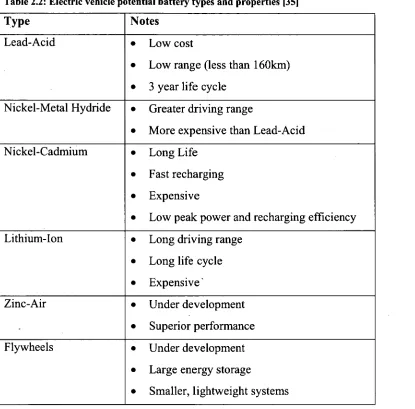
There are several sources of batteries that can be utilized in battery powered electric
Chapter Two - Literature Survey 18
Table 2.2: Electric vehicle potential battery types and properties [351
Type Notes
Lead-Acid • Low cost
• Low range (less than 160km)
• 3 year life cycle
Nickel-Metal Hydride • Greater driving range
• More expensive than Lead-Acid
Nickel-Cadmium • Long Life
• Fast recharging
• Expensive
• Low peak power and recharging efficiency
Lithium-Ion • Long driving range
• Long life cycle
• Expensive'
Zinc-Air • Under development
• Superior performance
Flywheels • Under development
• Large energy storage
• Smaller, lightweight systems
It is difficult to see a future for purely electric powered vehicles due to the constant
refueling costs and initial cost associated with the vehicles. They are likely to be more
prevalent as fuel cell/combustion engine hybrids.
A hybrid vehicle is one that is powered by more than one source [36]. Near term hybrid
vehicles are powered by an electric engine and a gasoline powered internal combustion
engine such as the Toyota Prius (shown in figure 2.8) or the Honda Insight (shown in
figure 2.9). The electric motor does not need an external power supply for recharging. Its
batteries are recharged by regenerative braking. This means that energy from forward
momentum is captured during braking. This energy is then used to recharge the batteries.
Chapter Two - Literature Survey 19
higher and freeway speeds, it shifts to both the gasoline motor and the electric motor,
while also recharging the battery [37].
Manufacturers of these vehicles boast
excellent fuel efficiency when compared
with their non-hybrid counterparts. Toyota
claims one tank (45 litres) can drive the
vehicle over 1000 kms. The vehicles are
currently priced at $37999 and are available
in Australia [38]. The Honda Insight is not Figure 2.8: The Toyota Prius 141
currently available in Australia but its
efficiency is claimed to be 155 km/litre [39].
The future of Hybrid electric vehicles could well include alternative fuels. This is
because the performance losses accounted in many alternative fuels when compared with
gasoline could be overcome with a Hybrid vehicle. Ford currently runs a vehicle
prototype which it a Hydrogen internal combustion engine / electric engine Hybrid.
Another promising electrical energy source for transportation is the fuel cell. Like a
battery a fuel cell uses electrochemical energy to create electricity. Most car companies
are researching fuel cell technology for future developments. Fuel cell technology is
detailed further in the Hydrogen section of this chapter.
Solar power is another way of powering an electric vehicle. Solar vehicles either use
direct sunlight to power vehicles or use solar energy to charge batteries which run electric
motors. Either way, this requires the use of photovoltaic (PV) cells (or modules made of
PV cells) to convert sunlight into electricity [40]. However, solar cars are not likely to be
the main power source of electric
transportation. Most prototypes produce
less than 1500 watts which is not enough
to power a standard vehicle. It is for this
reason that such vehicles are generally
designed to be very light (less than 200kg)
which is not desirable in an accident
situation [37].
Chapter Two - Literature Survey 20
2.2.6 Bio-Diesel
Bio-diesel is a diesel replacement fuel made from natural, renewable sources such as
soybean oil, canola oil, sunflower oil, cottonseed oil and animal fats. Up to 20%
bio-diesel blends (mixed with petroleum bio-diesel) can be used in most bio-diesel engines without
any design modifications. Higher blends are attainable with small engine modifications
but storage of the fuel becomes more complicated [41].
Bio-diesel provides similar horsepower, torque and fuel economy as petro-diesel. It has a
higher cetane number which increases engine performance. It also has high quality
lubricant properties which can extend the life of heavy duty engines [35].
The most common blends in use today are B20 and B100. B20 is 20% biodiesel mixed
with 80% gasoline diesel. B100 is 100% biodiesel.
Bio-diesel shows excellent environmental performance when compared with regular
diesel. Reductions in carbon monoxide, particulate emissions, hydrocarbon emissions and
sulfate emissions have all been observed [35].
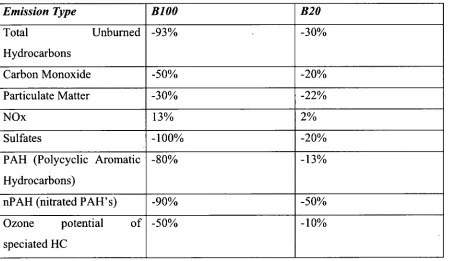
Bio-diesel has had a complete evaluation of emission results and potential health effects
submitted to the U.S. Environmental Protection Agency (EPA) under the Clean Air Act
[image:27.557.45.496.477.738.2]Section 211(b) [42]. Results are shown in table 2.3 below:
Table 2.3: Percentage reductions in emissions with Bio-Diesel fuels compared to conventional diesel 1421
Emission Type B100 B20
Total Unburned
Hydrocarbons
-93% -30%
Carbon Monoxide -50% -20%
Particulate Matter -30% -22%
NOx 13% 2%
Sulfates -100% -20%
PAH (Polycyclic Aromatic
Hydrocarbons)
-80% -13%
nPAH (nitrated PAH' s) -90% -50%
Ozone potential of
speciated HC
Chapter Two - Literature Survey 21
Bio-diesel is a near term alternative fuel source. Technology barriers are not as great as
with many of the other (alternative) transportation fuels. The fuel can be used in existing
vehicles without expensive modifications. In general B20 costs less than 10 cents more
per litre than conventional diesel [43]. Barriers exist in feedstock supply whereby there
is not a sustainable industry to support the supply of oil. It is possible that bio-diesel has
the opportunity to be integrated into the market slowly with mixture strength.
2.2.7 Ethanol
Ethanol (CH3CH2OH) is made up of a group of chemical compounds whose molecules
contain a hydroxyl group, -OH, bonded to a carbon atom [44]. Ethanol is mostly derived
from crops which contain sugar (e.g. sugar cane or sugar beet), or by pretreatment of
starchy crops (e.g. corn or wheat) or cellulose to produce sugars [33]. In fact anything
containing sugar, starch or cellulose can be fermented and distilled into ethanol. Despite
this, the need for huge land (plantation) areas to produce significant amounts of ethanol
is a serious consideration from an environmental perspective. Additionally many believe
that food itself is too precious to burn.
Many vehicles on the road today can or are being run on ethanol blended fuels. Most of
today's commercially available vehicles can run on ethanol blends (E10) which is 10%
Figure 2.10: Refueling station at Kennedy Space Station in the US 161.
Ethanol and 90% gasoline.
In
some areasthis has been mandated to improve air
quality [44]. Strictly speaking though this
mix is not classed as an alternative fuel.
Under the US Energy Act of 1992, ethanol
blends of 85% (E85) are classed as an
alternative fuel. E85 is the most common
and popular blend for light duty vehicles.
Vehicles which can run on such blends are
called flexible fuel vehicles (FFV's). Figure 2.10 shows an E85 refueling station at the
Chapter Two - Literature Survey 22
Ethanol is advantageous as an alternative fuel because it comes from a sustainable
feedstock. The National Corn Grower's Association of America has been supporting
Ethanol as an alternative fuel for over 20 years, possibly due to the reduction in corn
sales and the need for product diversification. Ethanol is sold into the gasoline blending
market where it competes with other oxygenates and octane components and with
gasoline itself. Therefore, ethanol's price is significantly affected by its value to refiners
in these markets [45].
From the perspective of tailpipe emissions, ethanol offers significant reductions in
pollution when compared to conventional gasoline. Generally, pure ethanol combustion
when compared to gasoline combustion:
[46]
• produces fewer total toxins;
• 15 % reductions in ozone-forming volatile organic compounds
• 40% reductions in carbon monoxide
• 20% reductions in particulate emissions
• 10% reductions in nitrogen oxide emissions
• 80% reductions in sulfate emissions
2.2.8 Hydrogen
From an environmental point of view, hydrogen is the most likely candidate for
alternative fuels in the foreseeable future [47]. This prognosis arises from the fact that
hydrogen has the potential to provide ultimate freedom from the fuel crisis [48].
Hydrogen also provides the possibility of providing a sustainably fueled transport sector.
Moreover, hydrogen fuelled engines have the potential for substantially cleaner emissions
than other engines [49].
The use of hydrogen to power vehicles holds advantages over other fuels in that:
• it can be made by splitting water using electricity derived from renewable sources
such as wind and solar energy;
• there are wide methods of production;
Chapter Two - Literature Survey 23
• can be used to power both internal combustion engines as well as fuel cells
• has a heating value three times that of petrol;
• is not toxic (but can cause asphyxiation in large concentrations);
• it dissipates quickly in air;
• can be stored both in gas as well as liquefied form;
• has wide flammability limits making it readily ignitable in combustion engines.
The interest in Hydrogen as a transportation fuel has increased significantly over the past
few decades with applications in automobiles, light and medium duty vehicles, buses and
mining vehicles [50]. In Australia, the 2003 National Hydrogen Study predicts that for
the years 2030 and 2050, transport will be the largest demand sector for hydrogen.
Almost every car manufacturing company has some sort of prototype Hydrogen powered
vehicle. However some features of Hydrogen also constitute barriers to its adoption as an
alternative transportation fuel. These include:
• electrolysis (production of hydrogen from water) is a relatively energy expensive
process; [51]
• gaseous hydrogen has a low energy density when calculated per unit volume;
• the wide flammability limits of hydrogen together with its low ignition energy
make it a fire and explosion hazard; [51] [52].
However the use of all transportation fuels (flammable fluids) requires adherence to
stringent safety considerations For the successful implementation of any of the
alternative fuels mentioned, certain developments will need to be made. As far as most
desirable outputs and sustainability, Hydrogen is definitely the fuel which shows the
Chapter Two - Literature Survey 24
2.3 Hydrogen Uses
Hydrogen can be utilized to power two different types of vehicles: fuel cells and internal
combustion engines.
2.3.1 Fuel Cells
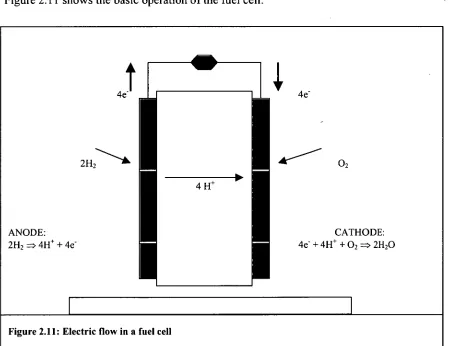
A fuel cell is an (electrochemical) energy conversion device which uses hydrogen and
oxygen(from air) to produce electricity and heat (Larminie et al 2000As such, a fuel cell
can be likened to a battery in that it operates silently and uses a chemical processes to
produce electricity. Basic operation governs that a fuel cell consists of an anode, cathode,
electrolyte and catalyst similar in principle to battery operation. However, unlike a
[image:31.556.42.491.359.705.2]battery, a fuel cell provides power directly so long as fuel is supplied to it, like an engine.
Figure 2.11 shows the basic operation of the fuel cell.
4e- 4e-
2H2 02
ANODE: 2H2 = 4H+ + 4e
CATHODE:
4e + 4H+ +02 = 21120
Chapter Two - Literature Survey 25
The elegance and simplicity of fuel cells has ensured a steady rate of development since
its invention. At the same time the development has been retarded somewhat by the
highly competitive energy market.
In 1800, scientists William Nicholson and Anthony Carlisle described the process of
using electricity to decompose water into hydrogen and oxygen. William Robert Grove,
however took this idea one step further or, more accurately, one step in reverse in 1838.
Grove discovered that by arranging two platinum electrodes with one end of each
immersed in a container of sulphuric acid and the other end separately sealed in
containers of oxygen and hydrogen, a constant current would flow between the electrodes
(Cahan D et al 2000).
In 1977 the International Energy Agency launched the 'Production and Utilization of
Hydrogen Program' to accelerate the acceptance and widespread use of hydrogen
technology (Elam et al, 1999). The agency identified that fuel cell and hydrogen
technology has potential for locations where energy supply infrastructure does not exist.
It followed on that applications were developed in submarines and space crafts (Wilder
2001).
Recent developments in fuel cells have been driven more so by the commercial sector
than in early development. This has led to a plethora of companies becoming involved in
fuel cell development and sales. Several of the large car companies have released
prototype vehicles powered by fuel cell and hydrogen power. The marketing of these
'clean vehicles' has become an integral part of promoting companies as environmentally
friendly rather than manufacturing the cars for commercial use.
There are at least five unique fuel cell types, each with differing strengths providing
advantages and disadvantages in certain applications. These are mainly known by the
type of electrolyte material used (Wilder 2001).
Chapter Two - Literature Survey 26
Table 2.4: Types of Fuel Cells (Wilder 2001).
Fuel Cell Type Operating Range (°C)
Proton Exchange Membrane (PEM) 50 — 100
Alkaline Fuel Cell (AFC) 50 — 200
Phosphoric Acid (PAFC) z 220
Molten Carbonate (MCFC) z 650
Solid Oxide (SOFC) z 500 — 1000
The two major physical problems which resulted in the development of these fuel cell
types are:
1. Slow reaction rate (leading to slow current flows);
2. hydrogen is not always readily available and that it exists in different forms and
states.
(Larminie et al 2000)
The Ford Focus fuel cell hybrid is shown in figure 2.12.
Unfortunately the development of fuel cell vehicles is still in its infancy and faces several
barriers. Firstly the market is not there for fuel cell vehicles costing $80000 [53].
Technical developments in material and manufacturing science are a crucial factor in the
acceptance of fuel cells. Currently there are no companies that have the skills and
resources to bring fuel cells to the market [53]. Due to high costs and lack of thorough
technology development, a transport hydrogen economy through fuel cells is not
expected to be realized until beyond 2050 [54].
There is a common school of thought
however, that we do not need to wait for
fuel cell vehicles to become available
before we start reaping the benefits of
hydrogen as a transportation fuel. The
cost of a Hydrogen Internal Combustion
Engine is much less than that of a fuel
cell and the power system of the vehicle
Figure 2.13: The Ford Model U Ill
Chapter Two - Literature Survey 27
2.3.2 Hydrogen Internal Combustion Engines
The use of Hydrogen in internal combustion engines and hybrid( electric vehicles) can
achieve all the key benefits of fuel cell vehicles much sooner and at lower cost. Hydrogen
use in internal combustion engines can pave the way for the future development of fuel
cell technology through creating infrastructure and improving public awareness [56].
The market penetration of Hydrogen in the transport sector is initially likely to be a
combination of fuel cell demonstration projects and hydrogen internal combustion
engines and their related hybrids. This trend has been recognized by Ford with the
development of the H2RVa hybrid
electric/hydrogen engine vehicle being used in
the US. [57] . Another vehicle being
considered by Ford in this respect is the
Model U vehicle (shown in figure 2.13) which
is estimated to achieve more than 400 km per
tank of Hydrogen [1].
Considered potentially even more near term
than hybrid vehicles are vehicles which would
be converted to run from gasoline to hydrogen. Converting existing vehicles on the road
to be operated by hydrogen would increase the potential market for the fuel significantly.
Realistically speaking people will not be prepared to spend tens of thousands of extra
dollars in order to have a brand new Hydrogen vehicle. Simple, economic conversion
technologies may be the initial solution to the development of the Hydrogen economy.
The basis of this project is to develop conversion techniques for a small engine which
could be applied further to more commercial markets. The hydrogen internal combustion
Chapter Two - Literature Survey 28
2.4 Hydrogen Properties
The hydrogen molecule is the smallest and lightest in nature with a molecular weight of
2.016. Hydrogen is a colorless and odorless gas with a density of about 14 times less than
air [58].
Some properties of hydrogen are listed in Table 2.5
Table 2.5: Hydrogen Properties 158 .
Property Unit Value
Density kg/m3 0.0838
Higher Heating Value MJ/kg 141.90
MJ/ m3 11.89
Lower Heating Value MJ/kg 19600
MJ/ m3 10.05
Boiling Temperature K 20.3
Density as Liquid kg/m3 70.8
Critical Point
• Temperature K 32.94
• Pressure Bar 12.84
• Density kg/m3 31.40
Self ignition temperature K 858
Ignition limits in air (vol. %) 4-75
Stoichiometric mixture in air (vol. %) 29.53
Flame temperature in air K 2318
Diffusion coefficient cm3/s 0.61
Chapter Two - Literature Survey 29
In its natural (room temperature) state hydrogen exists as a gas. It has the second lowest
boiling and melting point of all substances, second only to helium. It is a liquid below its
boiling point of 20K (-253°C) and solid below its melting point of 14K (-259 °C)
(atmospheric pressure). [59]. These properties become important in design when storage
technologies are being decided upon. The BMW 7i series is powered by liquid hydrogen
which requires the fuel to be kept between 14 and 20K.
Pure hydrogen is clear in appearance. In daylight a stream of leaking hydrogen is
invisible which is a major safety issue [59]. Scent compounds are often added to other
gases to increase the chance of leak recognition. These gases include Mercaptan and
Thiophane [60]. Gases of this type are not commonly added to hydrogen because a pure
strain of the gas is usually preferred. Developments in this field may make hydrogen a
safer gas, especially in combustion engine hydrogen use where purity is not of such great
importance.
The difference between the volume occupied by liquid and gaseous hydrogen can be
appreciated by considering its expansion ratio. Expansion ratio between liquid and gas is
1:848 at atmospheric conditions. From this it can be seen why we require pressurized
vessels to store hydrogen, as to store a useful amount of gas at atmospheric conditions
would be worthless. When hydrogen is stored in a high pressure vessel (3600psig) the
expansion ratio changes to 1:240 [59]. Releasing such a gas into the environment around
it must be done in a controlled manner. The use of regulators, both single and duel stage
is an important part of the design of a gaseous system. (The advantage of duel stage
Chapter Two - Literature Survey 30
2.5 Hydrogen as an Internal Combustion Engine fuel
Hydrogen has many properties that make it an advantageous fuel for combustion engines.
The byproducts of hydrogen with air consist of water, oxygen and nitrogen. This has
obvious positive implications in the ongoing journey to reduce damaging tail pipe
emissions [61].
Hydrogen is not a newly conceived transportation fuel. The earliest recorded attempt to
operate an engine on Hydrogen was Rev. W. Cecil in 1820. The attempt was not
considered successful but Cecil pointed out some special features for the potential of
Hydrogen as fuel [62]. In the 1920s German engineer Rudolf Erren converted the
internal combustion engines of trucks, buses and submarines to use hydrogen or
hydrogen mixtures. British scientist and Marxist writer J.B.S. Haldane introduced the
concept of renewable hydrogen in his paper, Science and the Future, by proposing that
"there will be great power stations where during windy weather the surplus power will be
used for the electrolytic decomposition of water into oxygen and hydrogen." [63]. It is
reported that over 100 vehicles were converted to hydrogen and gasoline/hydrogen
mixtures operation in England and Germany in the 1930s. These conversions were more
out of laboratory curiosity than necessity. During the World Wars it was discovered that
there may be shortage of petroleum fuels and some more investigations were undertaken.
The third phase of Hydrogen internal combustion engine development began in the 1970s
when scientists and environmentalists realized that there was going to be a fuel crisis and
that vehicles were having an effect on the environment [62].
The research that continues today is still based on the final phase of Hydrogen
development: to find a fuel that is both sustainable and environmentally friendly. Much
work has been world wide to advance the Hydrogen engine as a possible replacement for
its petroleum engine. Most of the work has considered ways of reducing phenomena such
as backfire, pre-ignition and knocking which have previously troubled the Hydrogen
engine.
Today the Hydrogen engine stands stronger than ever before with rising instability in fuel
sources and increasing environmental problems due to vehicles. This coupled with the
70
60
0
30
20
10
0
.1-
• Consumption • Product ion 13 Reserves
Chapter Two - Literature Survey 31
powered internal combustion vehicles built by car manufacturers, with the vision of
making them available for trial on the road. The intrinsic advantages of Hydrogen over its
alternative fuel counterparts have generated great excitement in the vehicle
manufacturing market, with greater coverage and support given to the concept.
North Far East Western Eastern Latin kiddie East Africa America and Europe Europe and America
Oceania FS U
Figure 2.14: World Oil Consumption, Production and Reserves 1661
The following section gives an overview of some of the advantages and challenges which
the Hydrogen internal combustion engine possess and face.
2.5.1 Sustainability
Hydrogen is seen as an important future energy carrier and provides potential for
sustainable development [49]. Current automotive technologies predominantly use fossil
fuel technology which is a finite resource. Of probably greater significance is that oil may
become an uneconomical resource in the future due to several factors. For example, the
oil we purchase today is largely from coastal areas. Coastal oil is easier to locate, easier
to set up for safe pumping, and easier to transport to a refinery [64]. Access to oil
refineries will become more difficult and hence more expensive due to difficulties in
Chapter Two - Literature Survey 32
Of similar importance to oil sustainability could be political issues. Oil is more likely to
become unavailable before it runs out. 56% of world oil reserves exist in the politically
unstable Middle East with Saudi Arabia possessing 39% of this figure. Figure 2.14 shows
the distribution of world oil supplies and the consumption of the product between
countries. Recent unstability in the Middle East region has meant a spike in oil prices
[65]. From a political point of view to have a sustainable fuel source which is not reliant
on imports would advantageous.
Hydrogen has the potential to be derived from a variety of different sources, many
renewable and readily available. Given economics of scale, hydrogen could become
economically and environmentally sustainable.
Perhaps instability in the Middle East would not exist if oil was not a valued commodity.
2.5.2 Emissions
When used as a combustion fuel Hydrogen bums 'cleaner' than its industry counterparts
such as petroleum. The combustion process emits low levels of pollutants in the form of
nitrous oxide, but these can be virtually eliminated by various combustion control
methods [52]. In the context of current transportation fuels, Hydrogen is classed as
exceptionally clean. Emissions from a Hydrogen operated engine are free of noxious
pollutants such as carbon monoxide, carbon dioxide and other greenhouse gases,
hydrocarbons, sulfur oxides, smoke, lead or other toxic metals, sulfuric acid, ozone and
other oxidants, formaldehydes and benzene and other organic compounds [48].
The road vehicle has traditionally been one of the major sources of harmful gasses in our
environment. Motor vehicles currently on the road emit large quantities of carbon
monoxide, hydrocarbons, nitrogen oxides and such toxic substances like fine particulates.
Because of the rapid growth of Third World countries and vehicle population, the effect
is having serious air pollution problems in both built up city areas and even lakes, streams
Chapter Two - Literature Survey 33
2.5.3 Ignition Limits
Hydrogen/air mixtures can burn over a wide volume ratios, between 4% and 75% [58].
This means that as a combustion fuel hydrogen has very attractive properties, in that it
can burn over a wider range of flammability limits compared to other fuels as shown in
table 2.6 (below).
Table 2.6: Ignition limits of various transportation fuels 1581.
Fuel Ignition limits in air (%)
Hydrogen 4-75
Methane 5.3-15
Propane 2.2-9.6
Methanol 6-36.5
Gasoline 1-7.6
Diesel 0.6-5.5
The relatively wider flammability limits of hydrogen add to its danger if leaked. In a
small enclosure, even a limited amount hydrogen could easily make the area an explosion
hazard.
Despite this, other characteristics of hydrogen gas make it attractive as a fuel. For
example, hydrogen has a minimum ignition energy of approximately 0.02mJ, which is
about an order of magnitude less than that of natural gas [67]. However, this same
property means that with hydrogen come additional safety and operational implications.
2.5.4 Pre-ignition, Backfiring and Flashback
Hydrogen has a low ignition energy when mixed with air. The low ignition energy also
yields a fast flame speed in comparison with mixtures of methane and iso-octane [51].
The implications of this fast burning flame means that ignition timing can be delayed
with regards to top dead centre (TDC).
However, the lower ignition energy of Hydrogen can also mean that relatively weak
energy sources like static electricity can readily become a source of ignition [50].
Chapter Two - Literature Survey 34
This latter situation creates problems with premature ignition (pre-ignition), flashback
and backfiring. Preventing this type of erratic operation is one of the challenges in
running a hydrogen engine [68].
Pre-ignition, defined as the early ignition of the fuel-air charge due to hot spots present in
the cylinder chamber. It can cause power loss and piston damage [69].
Backfires occur in the intake or exhaust system and take the form of a loud explosion. It
can be a result of engine pre-ignition in the inlet or excessive fuel in the exhaust.
Flashback occurs when the flame in a gas torch burns back (upstream) into a fuel supply
line [70]. Most serious fire accidents with gaseous fuel systems are caused by flashbacks.
A flashback can travel through a supply system at speeds of up to 13 metres per second
.[60].
To avoid the occurrence of such behavior, a number of design features can be included in
hydrogen powered internal combustion engines and include:
• Timed injection either into the inlet manifold or directly into the cylinder. Such
injection of Hydrogen means that fuels mixtures are less likely to pre-ignite
which results in better engine performance [51]. It should also be noted that
optimum fuel injection should start at, or before, top dead centre and be advanced
with engine speed [71].
• Variable spark ignition timing facilitates the control of the burning mixture. The
variation in spark timing with Hydrogen is more effective in controlling the
combustion process than with other fuels due to the ease of flammability that the
hydrogen fuel possess.
• Greater attention to heat transfer off the design of Hydrogen engines can lead to
the elimination of potential pre-ignition points which results in reduced
backfiring [51].
• Leaner engine mixtures can be employed to reduce backfiring. Air to fuel ratios
(A) of 2 have resulted in backfire safe operation. However with such lean
mixtures power output decreases [71].
• Flashbacks can be eliminated by using fuel injectors in combination with
flashback arrestors. Gas specific fuel injectors facilitate one way through flow
Chapter Two - Literature Survey 35
arrestors in tandem with these fuel injectors only serves to further avoid the
hydrogen storage vessel from igniting. Such flashback arrestors are fitted with a
sintered flame trap which quenches the flame. Additionally, an integral
non-return valve closes off the gas supply in the event of a pressure wave entering the
flashback arrestor [60].
2.5.5 Engine Performance
Hydrogen fuelled engines suffer from reduced power output due mainly to the lower
heating value of hydrogen gas (on a volume basis) and the lean mixtures which are
usually employed [51]. At a stoichiometric air-to-fuel ratio, hydrogen displaces only 29%
of the combustion chamber. As a result the energy content of the mixture will be less than
it would be if a denser fuel such as gasoline was used [68].
Comparisons between the power output of hydrogen engines with the their gasoline
fuelled counterparts have varied with (theoretically) as little 15% loss for earburetted and
port injected engines and up to a 15% increase in power for direct (cylinder) injected
engines [68]. In this context, several methods can be used to improve the performance of
hydrogen engines.
• Using accurate fuel metering (e.g., via solenoid controlled fuel injectors) to control
the air-to-fuel ratio and enable hydrogen engines to run at wide open throttle. This
type of unthrottled operation leads to increased power output. However, a throttle
body or choke may still be required during start-up and idling [72]. The wider
flammability limits of hydrogen allow the omittance of the throttle valve, the greatest
benefit being better engine efficiency due to reduced suction losses[71]
• Higher compression ratios can be applied satisfactorily to increase the power and
efficiency. This is due to the fast burning characteristics of the lean burning
hydrogen-air mixtures [51]. The increase of compression ratio results in a sharp
increase of the cylinder's top pressure [55]. From a conversion point of view it is
important to consider an engine's physical strength before drastically altering the
compression ratio.
• Variable valve timing is a feature which enhances higher volumetric efficiency [51].