• No results found

The Effect of Plant Growth Promoting Rhizobacteria on Barley Seedling Growth, Nutrient Uptake, Some Soil Properties, and Bacterial Counts

N/A
N/A
Protected

Academic year: 2020

Share "The Effect of Plant Growth Promoting Rhizobacteria on Barley Seedling Growth, Nutrient Uptake, Some Soil Properties, and Bacterial Counts"

Copied!
11
0
0

Loading.... (view fulltext now)

Full text

(1)

The Effect of Plant Growth Promoting Rhizobacteria on Barley

Seedling Growth, Nutrient Uptake, Some Soil Properties, and

Bacterial Counts

Ramazan ÇAKMAKÇI1,2,*, Mesude Figen DÖNMEZ3, Ümmügülsüm ERDO⁄AN2 1Atatürk University, Biotechnology Application and Research Centre, 25240 Erzurum - TURKEY

2Atatürk University Technical Vocational School, ‹spir, 25900 Erzurum - TURKEY 3

Atatürk University Faculty of Agriculture, Department of Plant Protection, 25240 Erzurum - TURKEY

Received: 22.01.2007

Abstract:This study was conducted with barley in greenhouse conditions in order to investigate seed inoculation with 5 different N2-fixing (Bacillus licheniformis RC02, Rhodobacter capsulatus RC04, Paenibacillus polymyxa RC05, Pseudomonas putida RC06, and

Bacillus OSU-142) and 2 different phosphate-solubilising (Bacillus megaterium RC01 and Bacillus M-13) bacteria in comparison to control and mineral fertiliser (N and P) application. Among the strains used in the present study, 6 plant growth promoting rhizobacteria (PGPR) stimulated indole acetic acid (IAA) production and 3 of them stimulated phosphate solubilisation; all bacterial strains fixed N2and significantly increased the growth of barley. Available phosphate in soil was significantly increased by seed

inoculation with Bacillus M-13 and B. megaterium RC01. Maximum NO3-N was found in soil after inoculation with N2-fixing Bacillus OSU-142, followed by P. polymyxa RC05 and R. capsulatus RC04. Total culturable bacteria count increased in all treatments with time, whereas N2-fixing bacteria decreased with time, except with B. megaterium RC01 inoculation. The data suggest that seed inoculation of barley with plant PGPR increased root weight by 17.9%-32.1% as compared to the control, and increased shoot weight by 28.8%-54.2%, depending on the species. N2-fixing bacterial inoculation significantly increased uptake of N, Fe, Mn, and Zn by barley. The production of hormones is suggested to be one of the mechanisms by which PGPR stimulate barley growth. Effective Bacillus species, such as OSU-142, RC07, M-13, P. polymyxa RC05, P. putida RC06, and R. capsulatus RC04, may be used in agriculture.

Key Words:Plant growth-promoting bacteria, IAA, nitrogen fixation, phosphate solubilisation, barley

Bitki Geliflmesini Teflvik Eden Bakterilerin Arpa geliflimi, Besin Al›m›, Baz› Toprak Özellikleri ve Bakteri Say›s›na Etkisi

Özet:Bu araflt›rmada befl azot fikseri (Bacillus licheniformis RC02, Rhodobacter capsulatus RC04, Paenibacillus polymyxa RC05, Pseudomonas putida RC06 ve Bacillus OSU-142) ve iki fosfat çözücü (Bacillus megaterium RC01 ve Bacillus M-13) bakteri afl›lamas›n›n kontrol, N ve P gübresi ile karfl›laflt›rmal› olarak sera koflullar›nda arpa bitkisinin geliflimi üzerine etkisi test edilmifltir. Test edilen bitki geliflimini teflvik edici bakterilerin (PGPR) alt›s›n›n indol asetik asit üretti¤i, üçünün fosfat çözebildi¤i ve bütün izolatlar›n azot fiksetti¤i ve arpa geliflimini teflvik etti¤i belirlenmifltir. Bacillus M-13 ve B. megaterium RC01 afl›lamas› toprakta al›nabilir P miktar› önemli ölçüde art›rm›flt›r. Toprakta en yüksek NO3-N miktar› Bacillus OSU-142 afl›lamas›yla elde edilirken, bunu P. polymyxa RC05 ve R. capsulatus RC04 takip etmifltir. Bütün uygulamalar toprakta toplam bakteri say›s›n› art›rm›fl, topraktaki azot fikseri say›s› B. megaterium RC01 d›fl›ndaki uygulamalarla zamanla azalm›flt›r. Bitki geliflimini teflvik edici bakteri afl›lamalar›, bakteri sufllar›na ba¤l› olarak, arpa kök a¤›rl›¤›n› %17.9-32.1, gövde a¤›rl›¤›n› ise % 28.8- 54.2 oran›nda art›rm›flt›r. Azot fikseri bakteri afl›lamalar› arpa N, Fe, Mn ve Zn al›m›n› önemli düzeyde art›rm›fl ve bakterilerce hormon üretiminin bitkisel geliflimi teflvik mekanizmalardan biri oldu¤u belirlenmifltir. Bacillus OSU-142, RC07 ve M-13 gibi etkin Bacillus türlerinin ve P. polymyxa RC05, P. putida RC06 ve R. capsulatus RC04 izolatlar›n›n tar›mda kullan›labilece¤i sonucuna var›lm›flt›r.

Anahtar Sözcükler:Bitki geliflimini teflvik edici bakteri, ‹AA, azot fiksasyonu, fosfat çözücülü¤ü, arpa

(2)

Introduction

Micro-organisms are important for agriculture in order to promote the circulation of plant nutrients and reduce the need for chemical fertilisers. Plant growth promoting rhizobacteria (PGPR) are able to exert a beneficial effect upon plant growth. Biological N fixation (BNF) provides a major source of nitrogen for plants as a part of environmentally friendly agricultural practices. Apart from fixing N2, PGPR can affect plant growth directly by the synthesis of phytohormones and vitamins, inhibiting plant ethylene synthesis, enhancing stress resistance, improving nutrient uptake, solubilising inorganic phosphate, and mineralising organic phosphate (Dobbelaere et al., 2003; Lucy et al., 2004). Plant growth benefits due to the addition of PGPR include increases in germination rate, root growth, yield, leaf area, chlorophyll content, nitrogen content, protein content, tolerance to drought, shoot and root weight, and delayed leaf senescence (Dobbelaere et al., 2003; Çakmakçı, 2005a, 2005b). Trials with rhizosphere-associated plant growth-promoting N2-fixing and P-solubilising Bacillus species indicated yield increases in rice (Sudha et al., 1999), barley (Çakmakçı et al., 2001; fiahin et al., 2004), wheat (de Freitas, 2000; Çakmakçı et al., 2007), canola (de Freitas et al., 1997), maize (Pal, 1998), sugar beet (Çakmakçı et al., 1999), sugarcane (Sundara et al., 2002), conifer species (Bent et al., 2002), and apples (Aslantafl et al., 2007). Bacillus strains increased total bacteria and the PSB population, and/or root and shoot dry weight, as well as total N and P uptake by plants (Canbolat et al., 2006). Plant growth responses were variable and dependent upon the inoculant strain, soil organic matter content, growing stage, harvest date, and growth parameters evaluated (Çakmakçı et al., 2006). Some reports have shown the effect of plant growth promoting substances, such as phytohormones, produced by PGPR (Gutierrez Mañero et al., 2001; Aslantafl et al., 2007).

One of the most often reported PGPR is Bacillus polymyxa, which is now called Paenibacillus polymyxa (Timmusk et al., 1999; Bezzate et al., 2000). It has range of reported properties, including nitrogen fixation (Coelho et al., 2003; Çakmakçı et al., 2006), P-solubilisation (de Freitas et al., 1997), antibiotic production (Rosado and Seldin, 1993), cytokinin production (Timmusk et al., 1999), and increased root and shoot growth (Sudha et al., 1999). Some strains of

Rhodobacter are known to fix N2(Drepper et al., 2002), but they have not been extensively studied (Gallon, 2001). Pseudomonas inoculants significantly increased root dry weight in spring wheat (Walley and Germida, 1997) and yield in sugar beet (Çakmakçı et al., 2001), and promoted the growth of spinach (Urashima and Hori, 2003; Çakmakçı et al., 2007), while Bacillus megaterium increased grain yield of rice and barley (Çakmakçı et al., 1999; Khan et al., 2003), and reduced the required P fertilisation of sugarcane by 25% (Sundara et al., 2002).

This study was undertaken in order to investigate the effectiveness of novel bacterial strains isolated from barley and wheat rhizosphere soils, as well as previously identified strains. The objectives of this study were to determine the effect of different harvest times on PGPR strains with the potential for N2-fixing, phosphate solubilisation, and phytohormones-production to be used as bio-fertilisers, and to evaluate the effects on microbial counts, some soil chemical properties, and plant growth parameters.

Materials and Methods

Isolation and characterisation of bacterial strains

The bacterial strains Rhodobacter capsulatus RC04, Paenibacillus polymyxa RC05, and Pseudomonas putida RC06 were isolated from the rhizospheres of wheat and barley (Çakmakçı et al., 2006). Bacillus OSU-142 were originally isolated from tomato plants at Ohio State University (USA) and Bacillus M-13 was isolated from pepper plants at Atatürk University, Turkey (fiahin et al., 2004). Paenibacillus polymyxa RC05, Pseudomonas putida RC06 and Bacillus OSU-142 was the most effective N2-fixing bacteria in previous field experiments with sugar beet (Çakmakçı et al., 2006) and in greenhouse experiments with wheat and spinach (Çakmakçı et al., 2007). The bacterial strains were characterised by morphological, biochemical, and physiological tests, including pigment production on nutrient agar medium, the Gram reaction, catalase and oxidase production, starch hydrolysis, nitrate reduction activities, and growth at 36 ºC on N-free basal medium (Forbes et al., 1998).

(3)

Identification System v.4.5, MIS Operating manual, 145 pp, MIDI, Inc., Newark, DE, USA). Bacterial strains were initially isolated from the rhizosphere of wheat and barley. Plants were uprooted along with a good amount of non-rhizosphere soil, brought immediately to the laboratory in polythene bags, and air-dried. The non-rhizosphere soil was removed by gentle shaking, leaving behind the rhizosphere soil. The soil adhering strongly to the root was referred to as rhizosphere soil. The rhizosphere soil was collected from roots by dipping and gentle shaking in sterilised water under aseptic conditions (Khalid et al., 2004).

From each sample 10 g of soil was aseptically weighed and transferred to an Erlenmeyer flask containing 100 ml of sterilised water, which was shaken for 30 min at 150 rpm. Immediately after shaking, a series of 10-fold dilutions of the suspension were made for each sample by pipetting 1-ml aliquots into 9 ml of sterilised water. The final dilution was 105-fold; 0.1 ml of each dilution of the series was placed on a petri dish with nutrient agar. For each dilution 3 replicate dishes were made. Dishes were placed in an incubator at 28 ± 1 ºC for 7 days. Rhizobacteria isolates were selected to represent distinct types based on differences in colony morphology, including colony form, elevation, and pigment production.

Extraction and analysis of FAMEs, and identification of bacterial species

Preparation and analysis of FAMEs from whole-cell fatty acids of bacterial strains were performed according to the method described by the MIDI system manual. Approximately 40 mg of living cells grown on TSBA medium was harvested, added to 1 ml of 1.2 M NaOH in 50% aqueous methanol with 5 glass beads (3 mm in diameter) in a screw cap tube, and incubated at 100 °C for 30 min in a water bath. Then, the saponified samples were cooled at room temperature for 25 min, acidified and methylated by adding 2 ml of 54% 6 N HCl in 46% aqueous methanol, and incubated at 80 °C for 10 min in a water bath. After rapid cooling, methylated fatty acids were extracted with 1.25 ml of 50% methyl-tert butyl ether (MTBE) in hexane. MIDI-FAME were extracted from each isolate using the standard and recommended procedure, consisting of saponification, derivatisation, extraction, and final base washing. Cellular FAME was separated with a Hewlett Packard 6890 CG on a fused-silica capillary column (cross-linked 5% phenylmethyl

silicone; 25 m, 0.22 mm) with hydrogen as the carrier gas and analysed with Sherlock v.4.5 MIDI software using the aerobe TSBA 40 method and TSBA 40 library (MIDI Network USA).

Quantification of IAA production and phosphate-solubilising capacity

These bacteria were also tested for auxin production (IAA-like substances), as described by Bent et al. (2001), and phosphate solubilisation capacity (Pal, 1998; Mehta and Nautiyal, 2001). The flasks were incubated for 18 h at 27 °C with 100 rpm rotary shaking. Following this, 125-ml flasks containing 40 ml of half-strength TSB supplemented with 0.0, 0.1 and 25 mg of tryptophan ml-1 were inoculated with ml-1 ml of each strain. After incubation for 48, 72, and 168 h, the density of each culture was measured spectrophotometrically at 600 nm and then the bacterial cells were removed from the culture medium by centrifugation. The level of indoles present in the culture fluid was estimated colorimetrically. The concentration of IAA in the bacterial eluates was measured using Salkowski’s reagent (50 ml 35% HClO4 + 1 ml FeCl3) (Loper and Schroth, 1986). Each reaction mixture was centrifuged. Absorbance at 530 nm was measured in a Shimadzu UV-1208 spectrophotometer. Bacterial cells were separated from the supernatant by centrifugation at 10,000 rpm for 30 min. The concentration of IAA in each culture medium was determined by comparison with a standard curve. The IAA produced by each strain was measured in triplicate. In addition, samples were taken after 48, 72, and 168 h of growth for determination of indole acetic acid for thin layer chromatography (TLC) and for high performance liquid chromatography-mass spectrometry (HPLC-MS) analysis. Separation of indole in ethyl-acetate fraction was carried out in chloroform-ethyl acetate-formic acid.

(4)

Microbial populations

The rhizosphere soil adhering to the root was separated by gentle tapping and samples were prepared. Soil samples were analysed to enumerate the colony-forming units (CFU) of (total) bacteria, and N2-fixing and P-solubilising bacteria following serial dilution and the pour plate method (Salle, 1973) in asparagine-mannitol agar, N-free solid malate-sucrose medium (Döbereiner, 1989), and sucrose-tricalcium phosphate agar (Pikovskaya, 1948) media, respectively. From each sample 10 g of soil was aseptically weighed and transferred to an Erlenmeyer flask containing 100 ml of sterilised water, and shaken for 30 min at about 150 rpm. Immediately after shaking, each suspension was diluted 10-fold by pipetting 1-ml aliquots into 9 ml of sterilised water. A 108-fold final dilution was obtained and 0.1 ml of each dilution of the series was placed on a petri dish with nutrient broth (NB). For each dilution 3 replicate dishes were made. The agar plates were incubated at 30 ºC for 7 days (aerobically). After the incubation period, the CFU of the bacteria that developed on the respective agar plates was counted with the standard method. Data from each replicate were averaged for a soil sample and expressed as CFU per gram of oven-dried soil.

Seed inoculation

For this experiment, pure cultures were grown in NB at 28 °C and diluted to a final concentration of 109CFU ml–1in sterile distilled water containing 0.025% Tween 20. Barley seeds were surface-sterilised in 70% ethanol for 2 min and in 1.2% sodium hypochlorite for 10 min, and then rinsed 10 times in sterile tap water. Seeds were then treated with the bacterial suspensions for 30 min under sterilised conditions. Cell densities in the suspension were adjusted to a final density of approximately 108CFU seed–1.

Greenhouse experiment

Pots were sterilised with 20% sodium hypochlorite solution, filled with non-sterile soil, and seeded. Soil samples were analysed for pH (McLean, 1982), particle size (Gee and Bauder, 1986), organic matter (Nelson and Sommers, 1982), total mineral N, NH4

+

–N and NO3 –

– N (Bremner 1982), 0.5 M NaHCO3

–P (Olsen and Sommers, 1982), cation exchange capacity (Rhoades, 1982), and exchangeable cations (Ca+Mg, K, and Na) (Thomas, 1982). The loam soil had an organic matter content of

1.8% and 0.4% free carbonate (pH 6.9). Available soil P (P2O5) level was medium (13.9 mg kg

–1

). Mineral NH4 +

-N and NO3

-N content was 10.9 and 8.5 mg kg–1, respectively. Exchangeable K and Ca+Mg content was 1.6 and 17.8 me/100 g–1, respectively; available Fe, Mn, Zn, and Cu content was 4.7, 3.4, 2.6, and 1.8 ppm, respectively. The following treatments with 3 replicates were investigated: (1) control (without bacteria inoculation or mineral fertilisers), (2) N fertiliser (40 mg N kg–1soil in the form of urea), (3) P fertiliser (20 mg P kg–1soil in the form triple super phosphate), (4) Bacillus megaterium RC01, (5) Bacillus M-13, (6) Bacillus licheniformis RC02, (7) Rhodobacter capsulatus RC04, (8) Paenibacillus polymyxa RC05, (9) Pseudomonas putida RC06, and (10) Bacillus OSU-142. There were 10 treatments, 3 harvest times, and 3 replicates, totalling 90 pots. The pots were arranged in a completely randomised factorial design in the greenhouse. Barley seeds were placed at the same depth (approx. 2.5 cm below the soil surface) in all pots (5-l pot capacity). The seedlings were grown in the greenhouse under natural light, which provided a 15 h photoperiod, temperatures of 16-25 °C, and relative humidity of 55%. Plants were thinned at the earliest possible time to maintain the desired number of uniform plants (5 seedlings per pot) in each pot. The pots were watered to 60% water holding capacity and were maintained at this moisture content by watering to weight every 2-3 days.

The plants were harvested 15, 30, and 45 days after sowing, with minimal damage to the root system, then washed gently under running tap water to remove the adhering soil particles, and analysed. At harvest the root system was separated from the shoots, which were oven dried for 3 days at 70 ºC. Total root length was measured according to Farrell et al. (1993). Macronutrient (N, P, K, Ca, and Mg) and micronutrient (Fe, Mn, Zn, and Cu) contents of barley seedlings were determined according to the Association of Official Analytical Chemists (Helrich, 1990). The data were subjected to analysis of variance using STATISTICA v.5.1 and means were separated according to Duncan’s multiple range test.

Results

(5)
[image:5.595.46.270.479.632.2]

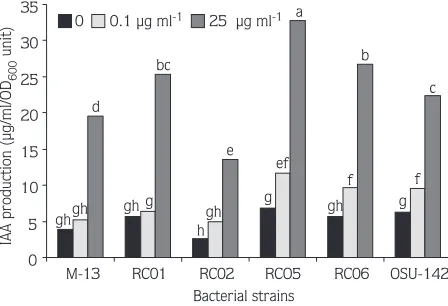
20.4 µg solubilised P per ml of culture per day, respectively. All isolates were oxidase-, nitrate reduction-, and catalase-positive, as well as able to grow in N-free basal medium. Of the inoculated strains of PGPR, 6 were able to produce plant growth promoting phytohormones (Figure 1). The amount of IAA produced varied among the species, ranging from 2.6 to 32.8 µg of IAA ml-1 culture. In the absence of tryptophan supplements, the 6 PGPR produced very low levels of IAA; however, when these 6 strains were grown in the presence of 25 µg ml–1 tryptophan for approximately 48-168 h, the tested strains responded by producing higher levels of IAA (Figure 1). Measurement of IAA by HPLC confirmed that, in the presence of a high concentration of tryptophan (25 µg m–1), P. polymyxa RC05 produced high levels of IAA (32.8 ± 2.6 µg ml–1/OD600 unit), while less IAA was detected in the medium from RC02 (13.6 ± 1.3 µg ml–1/OD600unit).

In comparison with other treatments, B. megaterium RC01 and Bacillus M-13 inoculation produced the lowest pH in soil, whereas no statistical difference was recorded between the other treatments (Table 1). In general, soil pH values decreased in all treatments with time. Of the 10 treatments, maximum available P content of the soil was seen in soil treated with P fertiliser, followed by Bacillus M-13 and B. megaterium RC01. Bacillus M-13 and B. megaterium RC01 inoculation increased available P by 27.9% and 10.3%, respectively, compared to control pots.

Bacterial inoculation significantly increased NO3-N and total mineral N in soil. Of the bacterial inoculants, maximum NO3-N in soil was measured in the N2-fixing Bacillus OSU-142, followed by P. polymyxa RC05, and R. capsulatus RC04. The results showed that all the inoculated bacterium increased mineral N concentration in soil. There was no significant difference in the concentration of extractable NH4-N in the soil between the different bacteria inoculants, except Bacillus OSU-142, which resulted in a greater concentration of NO3-N than NH4-N. Irrespective of the treatment, maximum concentration of NO3-N and NH4-N were observed on days 15 and 30, respectively, and, thereafter, a decline was observed. Soil NO3-N and NH4-N decreased with time (Table 1).

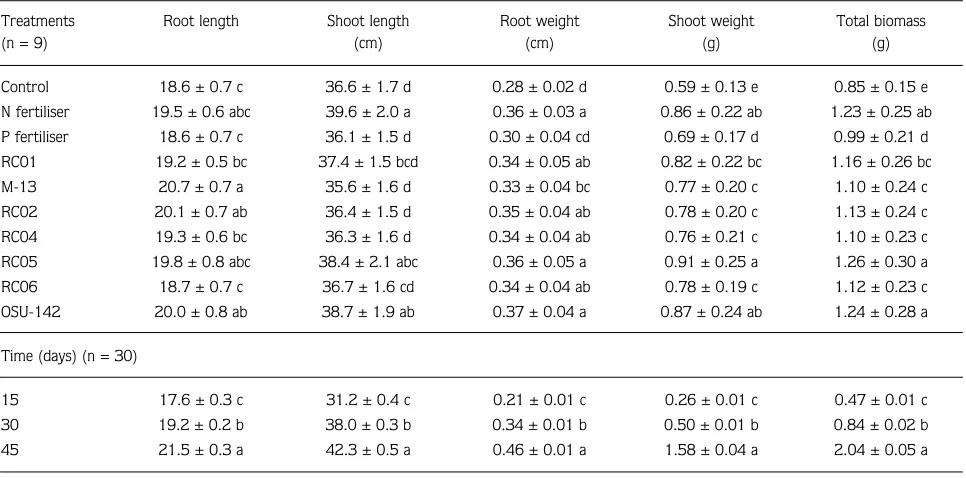
Bacterial inoculations and mineral fertiliser application significantly affected the growth of barley (Table 2). Root and shoot length and/or weight increased with all treatments, with time. Three bacteria increased root length of barley plants significantly compared to control and P fertiliser, especially Bacillus M-13, followed by Bacillus licheniformis RC02, and Bacillus OSU-142. Maximum shoot length in barley was seen when N fertilisers were added, followed by Bacillus OSU-142 and P. polymyxa RC05. The root length and shoot weight increased to a greater degree with P-solubilising Bacillus M-13 than with P fertilisation.

All the treatments, except for P fertiliser, enhanced root, shoot, and total weight as compared to the control. Root weight enhancement was greatest in response to Bacillus OSU-142, whereas maximal shoot weight resulted from P. polymyxa RC05; however, the addition of N fertiliser was as effective as P. polymyxa RC05 (Table 2). All treatments significantly increased root weight of barley, particularly Bacillus OSU-142 (0.37 g plant–1, 32.1% more than the control), followed by P. polymyxa RC05 and N fertiliser (0.36 g plant–1, 28.6% more than the control), and Bacillus licheniformis RC02 (0.35 g plant–1, 25.0% more than the control).

Statistically significant differences in shoot weight were observed for P. polymyxa RC05 and Bacillus OSU-142, as compared to other bacteria (Table 2). Of the bacterial inoculations, N2-fixing P. polymyxa RC05 and Bacillus OSU-142 inoculation produced the highest total weight, while barley treated with P-solubilising Bacillus M-13 had the lowest total weight. Plants treated with P. polymyxa RC05 had the highest shoot and total weight,

0 5 10 15 20 25 30 35

M-13 RC01 RC02 RCO5 RC06 OSU-142

Bacterial strains

IAA production (µg/ml/OD

600

unit)

0 0.1 µg ml-1 25 µg ml-1

ghgh gh gh gh

g g g

d

bc

h e

ef a

f b

f c

(6)
[image:6.595.44.526.85.317.2]

Table 1. The effect of PGPR and fertiliser application on available P, mineral nitrogen, and bacterial count in soil.

Treatments pHa Available NO3-N NH4-N Total Bacteria Free-living N2-fixing P-solubilising

(n = 9) P (ppm) (ppm) (ppm) (×106) b bacteria (×106) b bacteriab

Control 6.80 a 13.6 cde 8.1 f 10.7 b 3.9 g 0.19 f 1.2 ×10⁴

N fertiliser 6.80 a 13.8 cde 22.9 cb 36.9 a 8.3 f 0.18 f ND P fertiliser 6.87 a 24.9 a 7.1 f 10.6 bc 9.0 e 0.18 f ND RC01 6.69 b 15.0 c 20.3 d 9.9 bcd 10.7 c 2.36 bc 1.54 ×10⁶

M-13 6.72 b 17.4 b 13.5 e 9.3 bc 11.8 a 1.43 e 2.48 × 10⁶

RC02 6.87 a 14.1 cde 21.6 cd 9.7 bcd 10.8 c 2.20 c ND RC04 6.86 a 14.3 cde 22.8 cb 9.1 bcd 10.1 d 1.93 d ND RC05 6.82 a 14.6 cd 23.4 b 8.9 cd 10.5 c 3.04 a ND RC06 6.88 a 14.5 cde 22.1 cb 9.3 bcd 10.6 c 2.54 b ND OSU-142 6.83 a 14.4 cde 25.0 a 8.7 d 11.3 b 2.86 a ND

Time (days) (n = 30)

15 6.90 a 15.7 a 19.5 a 12.4 a 7.7 c 2.07 a

-30 6.80 b 15.8 a 18.7 a 13.1 a 9.2 b 1.83 a

-45 6.74 c 15.4 a 17.8 b 11.4 b 12.2 a 1.18 b

-RC01: Bacillus megaterium RC01; M-13: Bacillus M-13; RC02: Bacillus licheniformis RC02; RC04: Rhodobacter capsulatus RC04; RC05: Paenibacillus polymyxa RC05; RC06: Pseudomonas putida RC06; OSU-142: Bacillus OSU-142.

aValues followed by same letter did not differ significantly from Duncan's multiple range tests at 5% significance. b

Total number of colony-forming units (cfu) g–1dry soil. ND: Not determined.

Table 2. The effect of mineral fertiliser and inoculation of barley with PGPR on the length and weight of shoots and roots in nonsterile soil.

Treatments Root length Shoot length Root weight Shoot weight Total biomass

(n = 9) (cm) (cm) (g) (g)

Control 18.6 ± 0.7 c 36.6 ± 1.7 d 0.28 ± 0.02 d 0.59 ± 0.13 e 0.85 ± 0.15 e N fertiliser 19.5 ± 0.6 abc 39.6 ± 2.0 a 0.36 ± 0.03 a 0.86 ± 0.22 ab 1.23 ± 0.25 ab P fertiliser 18.6 ± 0.7 c 36.1 ± 1.5 d 0.30 ± 0.04 cd 0.69 ± 0.17 d 0.99 ± 0.21 d RC01 19.2 ± 0.5 bc 37.4 ± 1.5 bcd 0.34 ± 0.05 ab 0.82 ± 0.22 bc 1.16 ± 0.26 bc M-13 20.7 ± 0.7 a 35.6 ± 1.6 d 0.33 ± 0.04 bc 0.77 ± 0.20 c 1.10 ± 0.24 c RC02 20.1 ± 0.7 ab 36.4 ± 1.5 d 0.35 ± 0.04 ab 0.78 ± 0.20 c 1.13 ± 0.24 c RC04 19.3 ± 0.6 bc 36.3 ± 1.6 d 0.34 ± 0.04 ab 0.76 ± 0.21 c 1.10 ± 0.23 c RC05 19.8 ± 0.8 abc 38.4 ± 2.1 abc 0.36 ± 0.05 a 0.91 ± 0.25 a 1.26 ± 0.30 a RC06 18.7 ± 0.7 c 36.7 ± 1.6 cd 0.34 ± 0.04 ab 0.78 ± 0.19 c 1.12 ± 0.23 c OSU-142 20.0 ± 0.8 ab 38.7 ± 1.9 ab 0.37 ± 0.04 a 0.87 ± 0.24 ab 1.24 ± 0.28 a

Time (days) (n = 30)

15 17.6 ± 0.3 c 31.2 ± 0.4 c 0.21 ± 0.01 c 0.26 ± 0.01 c 0.47 ± 0.01 c 30 19.2 ± 0.2 b 38.0 ± 0.3 b 0.34 ± 0.01 b 0.50 ± 0.01 b 0.84 ± 0.02 b 45 21.5 ± 0.3 a 42.3 ± 0.5 a 0.46 ± 0.01 a 1.58 ± 0.04 a 2.04 ± 0.05 a

a

[image:6.595.43.526.439.678.2]
(7)

while control plants had the lowest weight. Barley treated with P fertiliser had values lower than plants treated with bacterial inoculation, but values higher than the control. The greatest response was observed with P. polymyxa RC05, followed by Bacillus OSU-142, N fertiliser, and B. megaterium RC01.

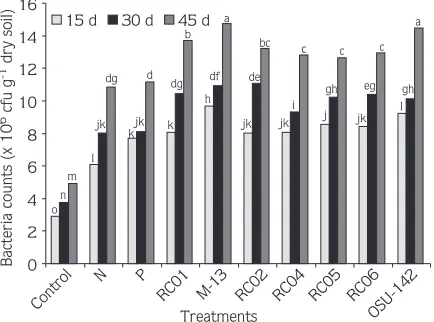
Total bacteria density varied between 2.9 and 14.8 × 10⁶ g–1soil, depending on the particular treatment. The bacterial population density at 45 days was significantly greater than at 15 or 30 days, in all treatments (Table 1, Figure 2). The highest density was observed with P-solubilising Bacillus M-13. The density of N2-fixing organisms ranged between 1.4 ×10⁵and 4.1 ×10⁶CFU g–1(Figure 3).

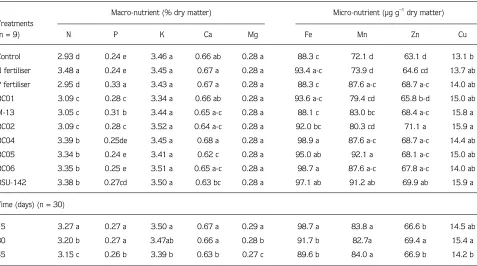
P-solubilising bacteria and N2-fixing Bacillus OSU-142 enhanced P content in barley seedlings. All bacteria significantly increased N content in barley seedlings compared to the control. N2-fixing R. capsulatus RC04, P. polymyxa RC05, Ps. putida RC06, and Bacillus OSU-142 inoculation significantly increased uptake of N, Fe, Mn, and Zn by barley seedlings compared to the uninoculated control (Table 3).

Discussion

The results showed that the highest available P in soil was obtained in pots treated with P fertiliser, followed by inoculation with P-solubilising Bacillus M-13 and B. megaterium RC01, while the lowest available P was noted in control pots and those to which N was applied.

Apart from P fertiliser and Bacillus M-13, no significant differences were found between the various treatments. In comparison with other treatments, B. megaterium RC01 and Bacillus M-13 inoculation gave the lowest pH in soil. Available P in response to Bacillus M-13 and B. megaterium RC01 was higher than in response to the other strains tested. This may have been due to the solubilisation of insoluble P with Bacillus M-13 and B. megaterium RC01 treatment. Available P increased as pH decreased. Some bacteria may solubilise inorganic P due to excretion of organic acids (de Freitas et al., 1997; Pal, 1998; Vessey, 2003). Generally, the solubility of calcium phosphates increases with decreasing pH (Gahoonia et al., 1992).

Seed inoculation and the use of N fertilisers resulted in increased NO3-N soil content as compared to the control and P fertilisers. This may have been due to the fixation of nitrogen. Soil mineral NO3-N in the pots treated with Bacillus OSU-142 was significantly greater than in all the other treatments. This result showed that all the inoculated bacteria contributed to the increase of mineral nitrogen and significantly enhanced the growth of barley, as compared to the control.

Bacillus OSU-142, Bacillus M-13, and Bacillus licheniformis RC02 increased root length in comparison to the control and P fertiliser. Of the bacterial inoculations, Bacillus M-13 produced the highest root length, while Ps. putida RC06 produced the lowest root length. Statistically significant differences in NO3-N, root and shoot weight, and bacterial count were observed

0 2 4 6 8 10 12 14 16 Control N P

RC01 M-13 RC02 RC04 RC05 RC06 OSU-142 Treatments

Bacteria counts (x 10

6 cfu g -1 dry soil)

15 d 30 d 45 d

o n m l dg k d k b a df h bc de i a l

jk jk jk jk

gh

jk dg

c c c

eg gh

[image:7.595.296.521.488.656.2]

j

Figure 2. The effects of PGPR and time on the proliferation of bacteria in soil. Different lowercase letters indicate significant differences (P < 0.01).

Control

N P

RC01 M-13 RC02 RC04 RC05 RC06 OSU-142 Treatments

N2

-fixing bacteria count (x 10

6 cfu g -1 dry soil)

15 d 30 d 45 d

0 1 2 3 4 5

n n n n n n n n n

i i i i

l gh l b m j

gef fg a c k d h de h j

[image:7.595.51.268.493.654.2]
(8)

between all bacterial inoculates and the control. Inoculation with N2-fixing and P-solubilising bacteria increased barley root weight by 17.9%-32.1%, depending on the species, while N fertiliser increased root weight by 28.6% compared to the control. The plants inoculated with P. polymyxa RC05, Bacillus OSU-142, and B. megaterium RC01 had the greatest differences in shoot and total weight as compared to control plants. The greatest IAA-producing P. polymyxa RC05 produced the greatest root and shoot weight, while no statistical difference in root length was observed in the control. The phytohormone-producing bacteria encouraged adventitious root formation. Rapid establishment of roots, whether by elongation of primary roots or by proliferation of lateral and adventitious roots, is beneficial to young barley seedlings. PGPR inoculation may effectively increase the surface area of roots (Richardson, 2001) and root weight (Çakmakçı et al., 2007). Inoculation with P. polymyxa increased the mass of root-adhering soil in wheat (Bezzate et al., 2000), and increased shoot and root growth in rice (Sudha et al., 1999). Likewise, B. polymyxa enhanced grain yield in

wheat (de Freitas, 2000) and stimulated the growth of conifer species (Bent et al., 2002).

[image:8.595.47.524.85.351.2]

The data summarised in Table 1 demonstrate that N2 -fixing and P-solubilising bacteria were present in the natural soil (control), but that their populations were quite low. Those bacteria probably originated from the soil, water supply, or air. Seed inoculation and fertiliser treatment significantly increased the bacteria count. Microbial growth in the rhizosphere may be limited by available N. Roots are very effective competitors with micro-organisms for N (Hodge et al., 2000). If the competition for N between roots and micro-organisms is reduced, the growth conditions for micro-organisms improve and the number of micro-organisms increases (Marschner, 1995). Our experimental data indicated that inoculation of the N2-fixing and P-solubilising bacteria helped in maintaining a higher number of total bacteria for up to 45 days. The soil microbial community appeared to increase with both mineral fertilisation and bacterial inoculation. The beneficial effect of inoculation on microbial population may have been due to an increase in the supply of available P and N, directly and indirectly

Table 3. The effect of PGPR and fertiliser application on nutrient concentration.

Macro-nutrient (% dry matter) Micro-nutrient (µg g–1dry matter) Treatments

(n = 9) N P K Ca Mg Fe Mn Zn Cu

Control 2.93 d 0.24 e 3.46 a 0.66 ab 0.28 a 88.3 c 72.1 d 63.1 d 13.1 b N fertiliser 3.48 a 0.24 e 3.45 a 0.67 a 0.28 a 93.4 a-c 73.9 d 64.6 cd 13.7 ab P fertiliser 2.95 d 0.33 a 3.43 a 0.67 a 0.28 a 88.3 c 87.6 a-c 68.7 a-c 14.0 ab RC01 3.09 c 0.28 c 3.34 a 0.66 ab 0.28 a 93.6 a-c 79.4 cd 65.8 b-d 15.0 ab M-13 3.05 c 0.31 b 3.44 a 0.65 a-c 0.28 a 88.1 c 83.0 bc 68.4 a-c 15.8 a RC02 3.09 c 0.28 c 3.52 a 0.64 a-c 0.28 a 92.0 bc 80.3 cd 71.1 a 15.9 a RC04 3.39 b 0.25de 3.45 a 0.68 a 0.28 a 98.9 a 87.6 a-c 68.7 a-c 14.4 ab RC05 3.34 b 0.24 e 3.41 a 0.62 c 0.28 a 95.0 ab 92.1 a 68.1 a-c 15.0 ab RC06 3.35 b 0.25 e 3.51 a 0.65 a-c 0.28 a 98.7 a 87.6 a-c 67.8 a-c 14.0 ab OSU-142 3.38 b 0.27cd 3.50 a 0.63 bc 0.28 a 97.1 ab 91.2 ab 69.9 ab 15.9 a

Time (days) (n = 30)

15 3.27 a 0.27 a 3.50 a 0.67 a 0.29 a 98.7 a 83.8 a 66.6 b 14.5 ab 30 3.20 b 0.27 a 3.47ab 0.66 a 0.28 b 91.7 b 82.7a 69.4 a 15.4 a 45 3.15 c 0.26 b 3.39 b 0.63 b 0.27 c 89.6 b 84.0 a 66.9 b 14.2 b

(9)

through changing the growth rate and metabolic activities of the crop, which resulted in more root exudates and thereby created a favourable habitat for the growth and development of micro-organisms. The results showed that the population of total bacteria increased during the course of the experiment. Furthermore, the density of N fixers tested in the present study decreased over time (Table 1). The PGPR used here did not survive well in inoculated soil. The inoculated bacterial population, except B. megaterium RC01, declined rapidly within the first 4 weeks.

On average, seed inoculation with N2-fixing Bacillus licheniformis RC02, R. capsulatus RC04, P. polymyxa RC05, Ps. putida RC06, and Bacillus OSU-142, and N fertilisers increased mineral N content by 66.5%, 69.7%, 71.8%, 67.0%, 79.3%, and 218.0%, respectively in comparison to the control, and increased total biomass weight by 32.9%, 29.4%, 48.2%, 31.8%, 45.9%, and 44.7%, respectively. The data indicated that the reason for the stimulation of barley growth by N2-fixing bacteria was not merely its nitrogen fixing ability. Likewise, root length and shoot weight were increased to a greater extent by P-solubilising Bacillus M-13 than by P fertilisation. In contrast, soil available P was significantly lower in response to inoculation with Bacillus M-13 than to P fertiliser. The plants grown in the N fertiliser pots had higher N content than those grown in bacterial inoculated pots, and inoculated plants contained more N than the control plants. Plant response to these bacteria could be associated with other mechanisms, rather than by direct N fixation and P solubilisation. The production of hormones has been suggested as one of the mechanisms by which PGPR stimulate plant growth. N2 -fixing bacteria inoculation significantly increased uptake of N, Fe, Mn, and Zn by barley seedlings as compared to the uninoculated control. The concentration of P in barley seedlings increased with P-solubilising bacteria.

The data of the present study showed that the bacteria strains tested were able to produce and extracellularly secrete auxin indole-3-acetic acid. It is possible that the tested PGPR strains affected root hormone levels by producing IAA and/or other plant hormones in the rhizosphere, which were then absorbed by the root. The positive relationship between barley growth and the level of bacterial hormones is well supported by the present study, which indicated that root and shoot weight were enhanced by phytohormone-producing strains. Researchers have recently identified cytokinin, gibberellin, auxin, and ACC deaminase production by PGPR (Timmusk et al., 1999; Gutierrez Mañero et al., 2001; Vessey, 2003). Many plant-associated bacteria have the ability to produce the plant growth regulator indole-3-acetic acid, and IAA may play the most important role in plant growth promotion (Bent et al., 2001; Patten and Glick, 2002; Aslantafl et al., 2007). Application of IAA to P-deficient plants increased root surface area, carbohydrate release, and acid-phosphatase activity (Wittenmayer and Merbach, 2005).

The present experiment revealed that inoculation was an effective treatment for improving the parameters measured, especially with reference to the increase in shoot and root biomass, soil NO3-N content, and bacterial count. The favourable effect of inoculation on plant growth, and improved N and P nutrition may have been due to the production of growth promoting substances by PGPR. PGPR change root growth and morphology, increase plant growth, and can influence the density of micro-organisms. Nitrogen fixing ability did not directly correlate with the growth promoting effect in the present study. Thus, the plant growth stimulation effect of the PGPR tested can be explained not only by their N2-fixation and/or P-solubilisation ability but also by their production of hormone-like secondary metabolites.

References

Aslantafl, R., R. Çakmakçı and F. fiahin. 2007. Effect of plant growth promoting rhizobacteria on young apple trees growth and fruit yield under orchard conditions. Sci. Hortic. 111: 371-377. Bent, E., C. Breuil, S. Enebak and C.P. Chanway. 2002. Surface

colonization of lodgepole pine (Pinus contorta var. latifolia[Dougl. Engelm.]) roots by Pseudomonas fluorescens and Paenibacillus polymyxa under gnotobiotic conditions. Plant Soil 241: 187-196.

Bent, E., S. Tuzun, C.P. Chanway and S. Enebak. 2001. Alterations in plant growth and in root hormone levels of lodgepole pines inoculated with rhizobacteria. Can. J. Microbiol. 47: 793-800. Bezzate, S., S. Aymerich, R. Chambert, S. Czarnes, O. Berge and T.

(10)

Bremner, S.M. 1982. Total nitrogen. In: Methods of Soil Analysis, Part 2, Chemical and Microbiological Properties (Ed. A.L. Page, R.H. Miller and D.R. Keeney), American Society of Agronomy, Madison, Wisconsin, USA. pp. 595-624.

Çakmakçı, R. 2005a. Bitki gelifliminde fosfat çözücü bakterilerin önemi. Selçuk Üniv. Ziraat Fakültesi Dergisi 35: 93-108.

Çakmakçı, R. 2005b. Bitki geliflimini teflvik eden rizobakterilerin tarımda kullanımı. Atatürk Üniv. Ziraat Fakültesi Dergisi 36: 97-107.

Çakmakçı, R., F. Dönmez, A. Aydın and F. fiahin. 2006. Growth promotion of plants by plant growth-promoting rhizobacteria under greenhouse and two different field soil conditions. Soil Biol. Biochem. 38: 1482-1487.

Çakmakçı, R., F. Kantar and F. fiahin. 2001. Effect of N2-fixing bacterial

inoculations on yield of sugar beet and barley. J. Plant Nutr. Soil Sci. 164: 527-531.

Çakmakçı, R., F. Kantar and Ö.F. Algur. 1999. Sugar beet and barley yields in relation to Bacillus polymyxa and Bacillus megaterium var. phosphaticum inoculation. J. Plant Nutr. Soil Sci. 162: 437-442.

Çakmakçı, R., M. Erat, Ü.G. Erdo¤an and M.F. Dönmez. 2007. The influence of PGPR on growth parameters, antioxidant and pentose phosphate oxidative cycle enzymes in wheat and spinach plants. J. Plant Nutr. Soil Sci. 170: 288-295.

Canbolat, M., S. Bilen, R. Çakmakçı, F. fiahin and A. Aydın. 2006. Effect of plant growth promoting rhizobacteria and soil compaction on barley seedling growth, nutrient uptake, soil properties and rhizosphere microflora. Biol. Fertil. Soils 42: 350-357. Clesscerl, L.S., A.E. Greenberg and A.D. Eaton. 1998. Standard

Methods for the Examination of Water and Wastewater (20th ed.), APHA-AWWA-WEF, Washington, DC.

Coelho, M.R.R., I. Von der Weid, V. Zahner and L. Seldin. 2003. Character of nitrogen-fixing Paenibacillus species by polymerase chain reaction-restriction fragment length polymorphism analysis o part of genes encoding 16S rRNA and 23S rRNA and by multilocus enzyme electrophoresis. FEMS Microbiol. Lett. 222: 243-250.

de Freitas, J.R. 2000. Yield and N assimilation of winter wheat (Triticum aestivum L., var Norstar) inoculated with rhizobacteria. Pedobiologia 44: 97-104.

de Freitas, J.R., M.R. Banerjee and J.J. Germida. 1997. Phosphate-solubilizing rhizobacteria enhance the growth and yield but not phosphorus uptake of canola (Brassica napus L.). Biol. Fertil. Soils 24: 358-364.

Dobbelaere, S., J. Vanderleyden, and Y. Yaacov Okon. 2003. Plant growth-promoting effects of diazotrophs in the rhizosphere. Critical Rev. Plant Sci. 22: 107-149.

Döbereiner, J. 1989. Isolation and identification of root associated diazotrophs. In: Nitrogen Fixation with Non-Legumes (Ed. F.A. Skinner), Kluwer, Dordrecht, pp. 103-108.

Drepper, T., K. Raabe, D. Giaourakis, M. Gendrullis, B. Masepohl and W. Klipp. 2002. The Hfq-like protein NrfA of the phototrophic purple bacterium Rhodobacter capsulatus controls nitrogen via regulation of nif A and anf A expression. FEMS Microbiol. Lett. 215: 221-227.

Farrell, R.E., F.L.Walley, A.P. Lukey and J.J. Germida. 1993. Manual and digital line-intercept methods for measuring root length: a comparison. Agron. J. 85: 1233-1237.

Forbes, B.A., D.F. Sahm and A.S. Weissfeld. 1998. Bailey and Scott’s Diagnostic Microbiology, 11th ed., Mosby Inc., St. Louis, Missouri, USA.

Gahoonia, T.S., N. Claassen and A. Junk. 1992. Mobilization of phosphate in different soils by ryegrass supplied with ammonium or nitrate. Plant Soil 140: 241-248.

Gallon, J.R. 2001. N2 fixation in phototrophs: adaptation to a specialized way of life. Plant Soil 230: 39-48.

Gutierrez Mañero, F.J., B. Ramos, A. Probanza, J. Mehouachi, F.R. Tadeo and M. Talón. 2001. The plant-growth promoting rhizobacteria Bacillus pumilus and Bacillus licheniformis produce high amounts of physiologically active gibberellins. Physiol. Plantarum. 111: 206-211.

Helrich, K. 1990. Official Methods of Analysis of the Association of Official Analytical Chemists, 15th ed. Vol 1, Association of Official Analytical Chemists (AOAC), Arlington, Virginia, USA.

Hodge, A., J. Stewart, D. Robinson, B.S. Griffiths and A.H. Fitter. 2000. Competition between roots and soil micro-organisms for nutrient from nitrogen rich patches of varying complexity. J. Ecol. 88: 150-164.

Jackson, M.L. 1973. Soil Chemical Analysis. Constable & Co. Ltd., London.

Khalid, A., M. Arshad and Z.A. Zahir. 2004. Screening plant growth-promoting rhizobacteria for improving growth and yield of wheat. J. Appl. Microbiol. 96: 473-480.

Khan, M.R., N.C. Talukdar and D. Thakuria. 2003. Detection of Azospirillum and PSB in rice rhizosphere soil by protein and antibiotic resistance profile and their effect on grain yield of rice. Indian J. Biotechnol. 2: 246-250.

Loper, J.E. and M.N. Schroth. 1986. Influence of bacterial sources of indole-3-acetic acid on root elongation of sugar beet. Phytopatho. 76: 386-389.

Lucy, M., E. Reed and B.R. Glick. 2004. Applications of free living plant growth-promoting rhizobacteria. Antonie van Leeuwenhoek, 86: 1-25.

Marschner, H. 1995. Mineral Nutrition of Higher Plants. 2nd ed., Academic Press, London.

(11)

Mehta, S. and C.S. Nautiyal. 2001. An efficient method for qualitative screening of phosphate-solubilizing bacteria. Curr. Microbiol. 43: 51-56.

Nelson, D.W. and L.E. Sommers. 1982. Total carbon, organic carbon and organic matter. In: Methods of Soil Analysis, Part 2, Chemical and Microbiological Properties (Ed. A.L. Page, R.H. Miller and D.R. Keeney), American Society of Agronomy, Madison, Wisconsin, USA, pp. 539-579.

Olsen, S.R. and L.E. Sommers. 1982. Phosphorus. In: Methods of Soil Analysis, Part 2, Chemical and Microbiological Properties (Ed. A.L. Page, R.H. Miller and D.R. Keeney), American Society of Agronomy, Madison, Wisconsin, USA, pp. 403-427.

Pal, S.S. 1998. Interaction of an acid tolerant strain of phosphate solubilizing bacteria with a few acid tolerant crops. Plant Soil 198: 169-177.

Patten, C.L. and B.R. Glick. 2002. Role of Pseudomonas putida indoleacetic acid in development of the host plant root system. Appl. Environ. Microbiol. 68: 3795-3801.

Pikovskaya, R.E. 1948. Mobilization of phosphates in soil in connection with vital activities of some microbial species. Microbiologia. 17: 362-370.

Rhoades, J.D. 1982. Cation exchange capacity. In: Methods of Soil Analysis, Part 2, Chemical and Microbiological Properties (Ed. A.L. Page, R.H. Miller and D.R. Keeney), American Society of Agronomy, Madison, Wisconsin, USA, pp. 149-157.

Richardson, A.E. 2001. Prospects for using soil microorganisms to improve the acquisition of phosphorus by plants. J. Plant Physiol. 28: 897-906.

Rosado, A.S. and L. Seldin. 1993. Production of a potentially novel anti-microbial substance by Bacillus polymyxa. World J. Microbiol. Biotechnol. 9: 37-43.

fiahin, F., R. Çakmakç› and F. Kantar. 2004. Sugar beet and barley yields in relation to inoculation with N2-fixing and phosphate solubilizing bacteria. Plant and Soil 265: 123-129.

Salle, A.J. 1973. Laboratory Manual on Fundamental Principles of Bacteriology. McGraw-Hill Book Company, New York, USA. Sudha, S.N., R. Jayakumar and V. Sekar. 1999. Introduction and

expression of the cry1Ac gene of Bacillus thuringiensis in a cereal-associated bacterium, Bacillus polymyxa. Curr. Microbiol. 38: 163-167.

Sundara, B., V. Natarajan and K. Hari. 2002. Influence of phosphorus solubilizing bacteria on the changes in soil available phosphorus and sugarcane and sugar yield. Field Crop Res. 77: 43-49. Thomas, G.W. 1982. Exchangeable cations. In: Methods of Soil Analysis,

Part 2, Chemical and Microbiological Properties (Ed. A.L. Page, R.H. Miller and D.R. Keeney), American Society of Agronomy, Madison, Wisconsin, USA, pp. 159-164.

Timmusk, S., B. Nicander, U. Granhall and E. Tillberg. 1999. Cytokinin production by Paenibacillus polymyxa. Soil Biol. Biochem. 31: 1847-1852.

Urashima, Y. and K. Hori. 2003. Selection of PGPR which promotes the growth of spinach. Japanese J. Soil Sci. Plant Nutr. 74: 157-162. Vessey, J.K. 2003. Plant growth promoting rhizobacteria as

biofertilizers. Plant Soil 255: 571-586.

Walley, F.L. and J.J. Germida. 1997. Response of spring wheat (Triticum aestivum) to interactions between Pseudomonas species and Glomus clarum NT4. Biol. Fertil. Soils 24: 365-371. Wittenmayer, L. and W. Merbach. 2005. Plant responses to drought

Figure

Figure 1. Production of IAA by PGPR in the presence of variousconcentrations of tryptophan (µg ml–1)
Table 1. The effect of PGPR and fertiliser application on available P, mineral nitrogen, and bacterial count in soil
Figure 2. The effects of PGPR and time on the proliferation of bacteriain soil. Different lowercase letters indicate significantdifferences (P < 0.01).
Table 3. The effect of PGPR and fertiliser application on nutrient concentration.

References

Related documents

In practice, what language is used as medium of instruction in Ghanaian upper basic schools (P4 to JHS) despite government’s policy of using English as medium of instruction.. What

• Use sterile planting material, clean of diseases, nematodes, banana root borer, and other insect pest. Examples: HWT, trim, tissue culture, etc.) Planting virus-free seed

The increase is mainly due to additional expenses for the delivery of the Gold Coast 2018 Commonwealth Games (GC2018) venues and increased expenses for the Business and

The nonlinear model accepts input variations in airplane lift, ground level, and command limit force (for vertical drop impact transients, however, the controller

It is difficult to actually list out what inspires good content and a commendable website since. there are so many types, purposes and objectives

By adding nutritional products to the medication order sets and adding an electronic nutrition administration record (ENAR) tab, the multidisciplinary team sought to

Therefore, we conclude that the HPT cells have a common response component in global gene expression variation during short term and long term cad- mium exposure.. Gene

Club meeting, fly-in, and cookout at Warren- ton Airpark. Saturday, September