Challenges in offering engineering programs at a new
campus
David Thorpe
University of Southern Queensland, Springfield, Australia [email protected]
Taryn Swan
University of Southern Queensland, Springfield, Australia [email protected]
Delphine Hannigan
University of Southern Queensland, Springfield, Australia [email protected]
Abstract: Engineering was first offered at the new Springfield campus of the University of Southern Queensland in 2007, with programs at both Associate Degree and Bachelor of Engineering Technology level, with a focus on Civil Engineering and Infrastructure Management.
Several of the students come from low socio-economic backgrounds, with a number being the first in their family to study at University. Within this particular cohort there are a large percentage of mature aged students. . The teaching of mathematics to these students has been problematic due to the fact that for many their last contact with mathematics was a considerable period of time before they commenced their University study. A number of the students also had a fairly low level of achievement in high school mathematics. In addition, the initial lack of laboratory facilities presented a range of challenges to developing vibrant engineering programs at the Springfield campus. In 2009 these challenges have now either been successfully overcome or are being actively addressed, with the next potential challenge being to further expand the engineering programs at the Campus.
Introduction
The University of Southern Queensland (USQ) established its Springfield campus (near Ipswich in Queensland) in 2006. An engineering program was offered at this campus in 2007, with nine inaugural students in the three year Bachelor of Engineering Technology in Civil Engineering (University of Southern Queensland, 2009a). A two year Associate Degree in Civil Engineering (University of Southern Queensland, 2009b) and an Infrastructure Management variation of the Bachelor of Engineering Technology were added in 2008.
Since this time, the number of engineering students enrolled at the Springfield campus of the
University has grown from nine initial students to 53 current students. These students typically study between two to three courses on campus per semester. A number of the students are enrolled in a part-time or external study mode.
mathematical background. A further issue is the need for engineering students to have reasonable access to laboratory facilities.
In addition to discussing the student cohort at this campus, this paper discusses in detail how these challenges have been met, including structuring classes to cater for students who are working full-time and studying part-time, innovations in teaching mathematics at the campus and the provision of facilities for laboratory and field work through partnering with other organisations.
Description of the Student Cohort
Research has shown that the cultural backgrounds of undergraduate students are becoming
increasingly diverse and there is also an increase in the age of students enrolling in university study (Bridge, 2006). Further, students are coming from broader regions of the community. Bridge advises that non-traditional learners are increasingly becoming a substantial presence at universities. In fact, Bridge concedes that universities should expect to see a growing number of these students in the future. Future first year graduates will present at university from many different cultures and socio-economic groups with existing and varied knowledge levels.
In today's society, there exist many factors that constrain the ability of students to actively engage in tertiary education, however, non-traditional students face additional barriers. Walters (1996) advises that many mature aged students doubt whether they are able to complete the tasks required to succeed within tertiary education. These tasks include writing essays, doing exams, class presentations, and speaking up to respond to and ask questions within tutorials. Further, Walters believes that there also exists a fear of failure, exacerbated by previous negative experiences during earlier education. Lawler and Hore (1980) identified work, children, marriage and social life as factors that impact on the tertiary studies of mature students. O’Shea (2007) speaks of numerous difficulties that second-chance learners encounter encompassing social, academic, economic and personal issues. Research shows that there are also practical aspects which impact the studies of non-traditional learners such as time, location, costs and childcare (McGivney, 2006). Walters highlights costs by adding that eeconomically disadvantaged students will find university fees a heavy burden.
The Springfield Campus of the University of Southern Queensland recently surveyed students to investigate these issues. Demographic information obtained identified that over half of the non-traditional students (58%) were single, 38% had participated in a Tertiary Preparation Program and 40% had completed a TAFE course. Thirty-three percent of students had enrolled in university previously but did not complete their studies for that enrolment.
Approximately 50% of all the Springfield students sampled were the first in their family to attend university. Participants were asked to nominate why they made the decision to attend university. The potential for higher income, personal achievement and furthering their education were selected as the major reasons by all students. Specific factors nominated included wanting to take a skill back to their rural community, and to be able to contribute to their chosen field.
It also found that 41.5 per cent of students are from families with incomes of less than $47,000 per year, and could therefore be considered to be at a lower socio-economic status (SES) than the community as a whole. This assessment is subject to modification, as there appears to be no clear definition of low socio-economic status in Australia (SES; Jones, 2001). Currently, identifying SES for tertiary students is done by obtaining the postcode of their home address. Jones highlights that there is much criticism of this method because of the large amount of variation in SES between individuals from the same postcode area. However, given that 41.5 per cent of the students at the campus are from families with relatively low household incomes, it is a reasonable assumption that USQ Springfield students tend to have a higher proportion of students from lower SES backgrounds than may occur at several other University campuses.
students raised included (a) lack of recognition for already obtained skills and knowledge, (b) lack of understanding from family about university and their failure to provide support, and (c) the competing pressure of external commitments (i.e. sport, committees) as difficulties impacting their studies. Improvements requested by non-traditional students to assist with their success at university included external classes, online lectures, 24 hour photocopier access, improved timetable and allowance for flexibility in lecture/tutorial times, increased library resources, better third semester options to allow individuals to complete their degree earlier, additional support groups and mentoring programs, and assistance in establishing industry contacts. These findings support Walters (1996), who identified that external commitments (e.g. family responsibilities) require flexibility in timetabling and assessment deadlines to cater for these students.
Addressing Challenges Related to the Student Cohort
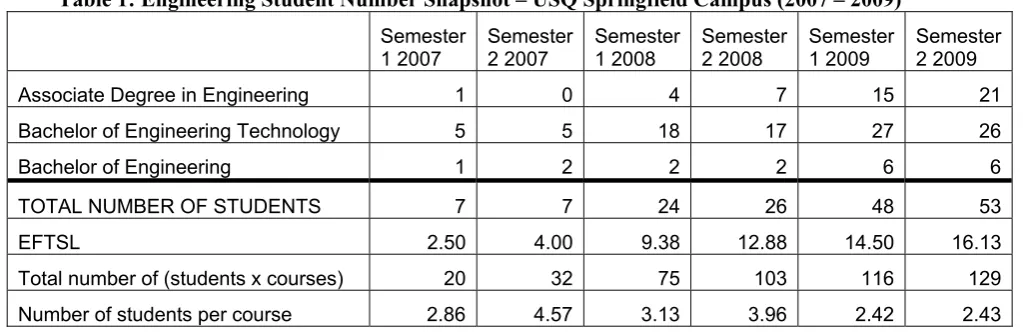
[image:3.595.42.554.409.576.2]Entry into the engineering program at the USQ Springfield campus occurs twice per year, at the start of Semester 1 and the start of Semester 2. As shown in Table 1 below, engineering student numbers have been growing steadily since the program first commenced in Semester 1, 2007. The most popular program is the Bachelor of Engineering Technology, although the Associate Degree in Engineering, which may be considered similar to an entry level program into engineering, is rapidly growing in numbers (from 1 to 21). The equivalent full-time student load (EFTSL) has also grown over time, and currently stands at 16.1. It is noted that the number of students per course offered has decreased. This is likely to be a reflection of the part-time attendance of many of the students, which is likely with a student cohort that has a high proportion of mature aged students. A further possible reason may be that a number of students would also be studying externally through the Toowoomba campus of the University as well as undertaking study at the Springfield campus. This would occur predominately in the later years of the program, when students are studying electives that are not available at the Springfield campus.
Table 1: Engineering Student Number Snapshot – USQ Springfield Campus (2007 – 2009)
Grade Point Averages (GPAs) for the engineering courses are reasonable, with the mean GPA for Semester 1 courses over the period 2007 to 2009 being 3.9/7. This GPA figure includes students who did not sit examinations or who did not fully participate in their study and it can therefore be
concluded that most students who attempted their courses normally completed them satisfactorily. This is a good result particularly given the previously described characteristics of the student cohort. The characteristics of this student cohort have required a close and caring approach to students in order to make them comfortable in the University environment. The small classes at the campus, and the smaller size of the campus itself, have facilitated this approach. In addition, there has been a strong emphasis on integrating the students into the student body both at the campus and wider University level. For example, at orientation sessions students are given Faculty wide presentations by staff from the main Toowoomba campus of the University as well as by Springfield campus staff. Social life is also catered for with regular staff-student barbeques. A recent initiative is to identify, counsel and develop study plans for at-risk students. Staff have an open door policy so that students feel
Semester
1 2007 Semester 2 2007 Semester 1 2008 Semester 2 2008 Semester 1 2009 Semester 2 2009
Associate Degree in Engineering 1 0 4 7 15 21
Bachelor of Engineering Technology 5 5 18 17 27 26
Bachelor of Engineering 1 2 2 2 6 6
TOTAL NUMBER OF STUDENTS 7 7 24 26 48 53
EFTSL 2.50 4.00 9.38 12.88 14.50 16.13
Total number of (students x courses) 20 32 75 103 116 129
encouraged to meet and discuss academic and other concerns. Administrative staff play a significant role in meeting the needs of students and maintaining good relationships between staff and students. The requirement to accommodate part-time students has led to classes being structured so that students have minimum time away from their employment. For this reason, classes are conducted once per week, in single blocks of time ranging from two hours to five hours, depending on the course.
Challenges in Teaching Mathematics
One of the critical areas in engineering education is developing in students a sound skills basis in mathematics. This area has struggled to attract interest, particularly in a student cohort in which a large proportion of students do not have strong familiarity or confidence with mathematics. Even though the students are initially studying a course which requires fundamental mathematics they still question why they have to study mathematics in the first place. Sazhin (1998) suggests that teaching mathematics to engineering students is about finding the balance between practical applications and in-depth understanding of mathematical equations. Therefore the approach taken is to explicitly explain why mathematics is important in engineering for future courses in the student’s study program consequently in their later careers as engineers. As the Springfield student cohort tends to be mature-aged, many of the students have not used mathematics to a large extent in their careers before entering University, or have not engaged in mathematics required in engineering since leaving high school many years before. As such, when students encounter mathematical subjects which require a large amount of calculation, they have forgotten many of the basic principles of high-school mathematics. Therefore in order to successfully teach this cohort of students it has been necessary to achieve a balance between simply teaching mathematics and helping the students understand the mechanics behind what is being taught. It has also been necessary to clearly explain to the students that the main motivation behind studying mathematics is that to become a practical engineer they will be required to have a good understanding of the mechanics behind every design.
Some of the students enrolled in the mathematical subjects have even lacked the basic principles of how to use a calculator and simple calculation rules (such as any number times 0 is always 0). Thus balancing teaching to incorporate students encountering these issues with students who have a good grasp of the basic concepts has been challenging. It has therefore been important to develop
techniques to cater for all learners regardless of their background, motivation and self esteem to have a good understanding of the basic principles of mathematics and to demonstrate how mathematics is indispensable to the engineering community. The main objective has been to support the students to enhance their understanding of mathematics and target essential but troublesome or forgotten knowledge. The approach taken is as follows:
1. The most important issue when teaching mathematics to students is to make sessions fun and enjoyable and ensure that all students gain the most out of each and every session. When students stop coming to class then they are in real danger of failing the subject. Therefore, lecturers have to make themselves very approachable so that students actually “want” to attend class. They also need to take steps to develop mathematical skills in engineering students with a low level of mathematics who have enrolled in the course. Each week the lecturer conducts a formal lecture, but includes compulsory reading, handouts and small group teaching to supplement the course material. Formal lectures of and by themselves have been criticized (Gibbs, 1981). However despite this, the lecturer has continued to use this method as the main teaching method but includes modifications. Formal lectures can be a problem because if a student misses a key point at the start of the lecture and as a result is often lost throughout the rest of the lecture. It is therefore important to reiterate key points throughout the lecture. Also the pace of formal lectures is set by the demonstrator; often it can be too quick for some students and too slow for other students. Due to these two facts the lecturer needs to make all students undertake set problems in class and to write the solutions on the board for other students to see. This way the lecturer has time to walk around the whole class and make sure everyone had grasped the concept, and
advanced students as the lecturer can encourage them with increasing challenges to their learning process, though providing for individual differences and learning (Marsh, 2008, p. 209). The second issue which was found to be very important when teaching mathematics to engineering students is that it is very important to clearly define the steps involved in the logical explanation of a concept such as presenting algebraic equations. Students do not easily recognise even the most obvious mistakes and therefore clear and concise explanation is required for all concepts. Thus the development of well explained course materials has helped to enhance students’ understanding of mathematics.
2. Together with each formal lecture the lecturer should also develop handouts that complement what has been taught in each lecture. The lectures consist of prepared lecture notes so that the students have guidance within the lecture but also involve them in writing and explaining concepts on the whiteboards, thus providing a learning scaffold for the students. Talking through mathematically concepts step-by-step allows students quality time to ask questions and clarify any issues. This way, concepts are more likely to be followed and understood.
3. To enhance student learning and experience the lecturer can also direct students to video clips which they can download and watch in their own time. This use of multi-media has allowed students who may have been “too shy” in class to ask questions and to use the opportunity to review some of the more difficult mathematical concepts.
4. Finally each student should be given the opportunity to participate in weekly tutorial sessions. These sessions are designed to allow each student experience with mastering concepts learnt throughout the week and to facilitate group discussions on difficult concepts. Peer learning approaches, using students who have completed the course successfully the previous year as study leaders in a “Meet-Up” group, have also facilitated this process.
In conclusion, engineering students learning mathematics need a clear and relevant explanation as to why e knowledge of mathematics is essential in their future practical work as an engineer. To tackle the issue of the limited mathematically ability of many students, formal lectures have been
supplemented with compulsory readings, step-by-step instructions, group interactions when
performing calculations, video clips and comprehensive handouts. When demonstrating mathematical concepts the lecturer also endeavours to illustrate the practical importance of these concepts thereby encouraging a deep holistic approach to each student’s learning.
In addition to the enhancement of teaching of mathematics as outlined above, the Faculty has now introduced a lower level of mathematics in the Associate Degree, and restricts entry into Bachelor degree programs to students with a reasonable proficiency in mathematics. Students successfully completing the Associate Degree level of mathematics are then able to progress through the higher levels of mathematics taught in the Bachelor Degree program.
Challenges in Providing Laboratory Facilities
The University of Southern Queensland provides an Engineering education that is well grounded in theory, but also has a sound practical aspect. There is a strong emphasis in its engineering programs on practical work, such as laboratory work or field work. Because of the large proportion of students studying through distance education, this practical work is administered through special practice courses.
As the USQ Springfield campus is located in a developing area, it has not been difficult to find
complete practice course. This situation is expected to change as the campus student population increases and it becomes viable for the University to offer further practice courses at the campus.
Conclusion
This paper has discussed the academic issues associated with commencing a new engineering program at a new regional University campus located in a lower socio-economic area. There are also many other issues involved: such as promotion of the programs and their courses; liaison with schools and the community; and linkages with industry and engagement of suitable staff; that are beyond the scope of this paper.
This paper has described steps taken to better meet the issues arising from the student cohort at the campus, including a detailed discussion of the teaching of mathematics. It has also described how issues associated with the provision of laboratory facilities are being overcome.
The engineering programs at the USQ Springfield campus continue to develop, with additional programs being proposed for the future. Given this, in combination with the continued growth in student numbers, the location of the campus in a developing urban environment, and the recognition by teaching staff of the particular student learning needs, the engineering programs at the campus are likely to continue growing strongly into the future.
References
Bridge, W. (2006). Non-traditional learners in higher education. In Paul Ashwin (ed.), Changing higher education: The development of learning and teaching, New York, NY: Routledge, pp. 58-68. Gibbs, G. (1981). Twenty Terrible reasons for lecturing. Oxford: Politechnic.
Jones, R. (2001). Identifying Higher Education Students from Low Socio-Economic Status Backgrounds and Regional and Remote Areas. Retrieved August 13, 2009, from
http://www.dest.gov.au/archive/highered/eippubs/eip02_4/index.htm
Lawler, N. & Hore, T. (1980). Problems, costs and benefits. In T. Hore & L.H.T. West (Eds.), Mature students in Australian higher education. Victoria, Australia: Acacia. pp. 140-157
McGivney, V. (1996). Staying or leaving the course: Non-completion and retention of mature students in further and higher education. Leicester, England: National Institute of Adult Continuing Education.
Marsh, C.J. (2008). Becoming a teacher : knowledge, skills and issues. 4th ed. Frenchs Foirest NSW: Perason Education.
O’Shea, S. (2007). Well, I got here but what happens next? Exploring the narratives of first year female students who are the first in the family to attend university’, Journal of the Australian and New Zealand Student Services Association, 29, 36-51.
Sazhin, S.S. (1998). Teaching Mathematics to Engineering Students. International Journal Engineering Education, 14(2), 145-152.
University of Southern Queensland (2009a). Bachelor of Engineering Technology (BETC) program. Toowoomba: University of Southern Queensland.
University of Southern Queensland (2009b). Associate Degree in Engineering (ADNG) program. Toowoomba: University of Southern Queensland.
Walters, M. (1996). Mature students: Overcoming the barriers to higher education. Mature students in higher education. Paper from the 1996 Conference. Retrieved December 4, 2008 from
http://www.ucc.ie/publications/heeu/Mature/mature_3.htm#Mature%20Students%20-%20Overcoming University College Cork.