Rochester Institute of Technology
RIT Scholar Works
Theses
Thesis/Dissertation Collections
1965
An Experimental Study of the Problems at High
Temperature Developments
Pravin Lalwani
Follow this and additional works at:
http://scholarworks.rit.edu/theses
This Senior Project is brought to you for free and open access by the Thesis/Dissertation Collections at RIT Scholar Works. It has been accepted for inclusion in Theses by an authorized administrator of RIT Scholar Works. For more information, please [email protected].
Recommended Citation
AN EXPERIMENTAL STUDY OP THE
PROBLEMS AT HIGH TEMPERATURE DEVELOPMENTS
A THESIS
PRESENTED TO THE
THESIS COMMITTEE
ROCHESTER INSTITUTE OP TECHNOIOGY
ROCHESTER,
NEW YORKIN PARTIAL FULFILLMENT
OF THE REQUIREMENTS FOR THE DEGREE
BACHELOR OP SCIENCE IN PRINTING
By
Pravin C. Lalwani
TABLE OF CONTENTS
Page
Introduction I
The
Experiment
1Discussion
4
Results 11
Conclusion
14
Bibliography
15
Acknowledgements
17
List
ofTables
Table Page
List of Figures
Figure
1M&
I The unit used to expose the films. 1
List
ofGraphs
Graph Page
1 Time temperature chart.
5
2 Time - Temperature
graphs.
6
3
Continuous tone test results at higher temperatures 12by
usingS.D.R.
1 and without use of S.D.R. 1.13
4
Apparent
dot area graphs at high temperatures bothIntroduction
This paper is the discussion of a study related to high
temperature
processing of lith films. The results of hightemp
erature development vary considerably compared to those of estab
lished
normal conditions. This proves true even though the othervariables are held constant.
"Elevation
of temperature may increase the rate ofdevelop
ment
by increasing
dissociation of thedeveloping
agent,by
in-creasing the rate of diffusion
transfer
of chemicals throughstagnant liquid
layers,
andfinally by
a effect upon the reactionproper. In general, the rate of development increases
by
a factorof about 2 for each 15 F rise in temperature upto 125 F at
which point it is 8 or 10 times that of 68 F."
-1-Upto a certain extent, the effect of increase in temperature
upon the rate of processing can be compensated
by introducing
somechemical changes in the developer. To study these effects in the
experiment,
developing
at various temperatures was carried outand the
developing
time was kept constant. Use of Kodak SDR 1 *was investigated. The amount of SDR 1 added to the developer varied
according to temperature changes introduced. The main aim was to
achieve normal results.
+(a restrainer recommended for Kodalith
developer)
1 Ives
C.E.,
RussellH.D.,
and CrabtreeJ.I.,
"Fundamental factors in rapid processing", Research
Laboratories
Eastman Kodak Company. Communication
No.
1585
from the KodakExperiment
The theoratical discussion about the facts and problems of high
temperature development suggests the necessity of using special
techniques at higher temperatures.
To study the effects of higher temperature
development,
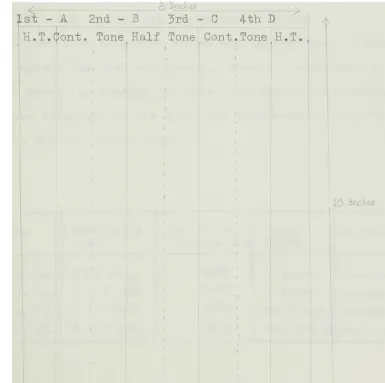
anexperiment was carried out, which is described here. A large Kodak
Step
Tablet 8 X 10 inchwas used on which strips of Kodak Magenta Contact Screen and of l.o. NeutralDensity
were stripped. This reproduced four even strips of 1
2
inch wide, each yielding half part 8continuous tone and other half of halftone image at one exposure.
This was mounted in an acetate window and punched with Kodak
Register Punch. Kodalith Orthe Type
3,
Estar base9
X 12 film waspunched and then exposed in contact using a register pin bar in a
vacumm printing frame.
Fig.
1i
3rd - C
1st - A
2nd - B 3rd - C 4th D
H.T.Cont. Tone Half Tone Cont.Tone H.T.
r r '
1
[image:8.565.129.514.388.771.2]Figure 2
Page 2
Kodak
Step
TH.T.
j.1-1 ^y*-*m+m* -_*TT.
Cont.
Tone/
H.T.t^<aj>-juo^^wwjM'
Til
.^,-u^WU' m^
Emulsion down. Emulsion up.All the film strips were given identical exposure in the entire experiment with tungston light source.
The system used to
identify
different strips is as follows-Four film sheets were exposed and each cut in
4
strips. The firstfour strips of each film were labeled as
Al,
A2,
A3,
A4,
. Thesecond, third and fourth strips were labeled so as
Bl,
B2,
B3,
B4;
CI,
C2,
C3,
C4,
andDI, D2, D3, D4,
respectively. Each set ofAs,
Bs,
Cs,
and Ds were kept in different boxes.These
sets were developed at various temperatures.A.S.A.
agitation system was used
throughout.
Kodalith developers A andB l:l were used. An attempt was made to maintain the temperatures
of all other solutions at the developer
temperature.
Thefollowing
table gives the processing details.
Table l
Film Strips
Developing
TimeDeveloper
Temperature
Kod^cSDR-l
Agitation
l* -^2*
3
*4
*Bl, B2, B3>
B4.Gl
C2,
C-^,
C^.Dx,
D2,
D3,
D4.2^4
min.2
l/4
min.2
l/4
min.2
l/4
min.Page
3
A Welch Densichron densitometer was used to measure the con
tinuous tone densities. Densities of each strips of all the sets
were measured, and mean densities for each set was calculated.
Apparent
dot area of all halftone tests was measured on DensichronDot Area Meter of all strips and the mean calculated for each set.
To get exact dot area it is desirable to have hard dot negative;
but in this experiment, comparision between the sets
being
theprominent
factor,
apparent dot area of soft dot test was measured.Four strips of each particular sets were made togive more
consis-tant and reliable results.
The main perspective of this experiment was to obtain similar
characteristic curves of the tests at various temperatures
by
introducing
changes in processing. Characteristic curves for each setPage
4
Discussion
Temperature
Control is always desirable to get consistant reproductions. But in tropical climates, where the temperature goes
up to
120F,
itis,
manytimes,
not possible. At higher temperatures,
more precautions, more equipments to control processingare required. The rate of development is much influenced
by temp
erature changes, but the effect varies wi. th different types of
developers. Most
developers,
with the exception ofhighly
alklinedevelopers
can be safely used at temperatures up to 75 F providedthe development time is properly shortened and effective
hardening
rinse and
fixing
baths are used."In general normal room temperatures are satisfactory,
(excluding
tropical countries) and a level of 65 F or 68F is often recommend
ed. The solution brought to a temperature of 68F is then in
equilibrium with temperature of the ambient air and is
likely
toremain so for a considerable period of time"-2
Below 68F reaction
is slow and becomes impracticable for the
busy
dark-room.But there is no reason why one should not have 70F or 75F as
a standard figure.
Only
the question is the criteria which is required to be reproduced and the development time required to produce
the required criteria. Whatever normal temperature is selected, it
is always best to
keep
it constant as far as possible.^
Graham R.W. "Sensi tome
try
for the timetemperature
chart"(The
British Journal ofPhotography
-109,
June15,
1962.)
(2 10
9.
8
7...
5..
4.Clix..
3-Mul
Time.
~\wpe.ta\ut
e,Glarf5cak
-x Pixh
-Tewpe&ature.iflF:
7 AxU- T'rntCLo'f^
"4 I 4 i T
Page
5
_
-. nn
i
.ZHEETt2Jtiifl.
U.ttn. r I:
^fc
?f
UfcKrt1
il-LoGarithMr 4sf 6
p 7of 8oP 85"F qoF qsF
Sis
rzyr..
282 )00 qsl qo 6St eo Ts' 70 68"3 67 o tSS-60 i* Page
6
Sco|l * me. 4xi fix fe^petai
if
Nin irhE. Mptl tu N > to xaf & iult F.^2^ll,. ^hv a^m;,
I-J
*
RJL
3M,Vi.
"Time m
Mum
les
-ji-y fM,'n
Min-Page
7
"More
extreme values of solution temperature can be used ofcourse. High speed processing at elevated temperatures can be
undertaken at values of 90OF - 100F for example; or these temper
atures are quite common in the tropics".
3
On the other
hand,
sometimes it is required todevelop
atvery low temperatures even. Hern and Crabtree4 studied low temper
ature developments
by
adding ethylneglycol to their developers, downto
-25C.
They
found a linear relationship between temperaturesand the logarithm of time of development. This linear relationship
holds true irrespective of ranges.
With the information available from Kodak Pamphlet No.
Q-ll,,
which was used for this experiment, the time temperature charts were
constructed
by
1.Plotting
the arithmetic values of temperatureagai nst the logarithmic values of time . and
2.
3By
plotting the arithmetic values of temperature against the development time. The graphs
prove the existing straight linear relationships.
Mr. R.W.
Graham,
in his paper"Sensi tometry
For The Time-Temperature
Chart,
"5 gives the formula for the Evaluation ofTemper
ature Coefficient for
Developer/
Film Combination - Authorstates,
"If with a given sensitive material, the times of development requir
ed to produce a given value of gamma are known for two
temperatures,
then the TC
(Temperature
Coefficient)
can easily be found for these5
Ibid.^Mees
C.E.K. "Thetheory
of the photographic process."^Graham
R.W."Sensitometry
for the time temperature chart"(The
British Journal ofPhotography
-109,
June
15,
1962)
Page 8
conditions
by
theformula:
Log
TC lo =(Log
t-log
t')
10T'
- T
Where
t and t' represent the development times at temperaturesT and
T*.
Which shows graphically that the logarithm of thedevelopment
time is proportional to the temperature".The
following
example givenby
the author proves thisreadily-Suppose
the same gamma of 0*8 is obtainedby
developing
a filmfor 6 minutes at 20C as
5
minutes at 23C - then:log
TC10o
=(i0g
6 -log 5)
10 23-20=0.7782 -^0.
6990
10=
0>792/j
QrQ>264
TC10
=1.83
It is expedient to obviate the above calculations
by
plottingthe graphs. It is not necessary to know the TC in order to determine
the time of development for various
temperatures,
but it is necessaryto have the two time-gamma curves,
(which
cover the practical valuesof the gamma) Obtained
by developing
at two different temperaturesseparated
by
10oC.5*The temperature charts are useful i n
determining
newdevelop
ment time at different temperatures. Temperature increase influences
and reduces the time factor greatly.
"One another effect of high temperature is the growth in the
fog
level than usual and for this reason the amount of Potassium Bromide
in the developers may be increased upto about twice the normal
(this
increase can be even more in the case of developers which contain
Metol.)
The time of development may thenhave
to beincreased
andPage
9
Most prominent requirement at higher temperature development
is to
keep
the
temperatures of all the solutions equal, andfairly
constant.
Developer,
hardening
or non-swelling stopbath,
fixing
bath and even the washing water must be at the same temperatures
as to avoid the swelling and contraction of the gelatine layer."6
"If a swollen film is subjected to a sudden change in temper
ature, a
leather-like
network of line may appear over part or allthe film. This effect is known as "reticulation". In mild cases,
it may stimulate the effect of graininess of the silver image."7
"Excessive
swelling andsoftening
of gelatine may be reducedby
the addition of Sodium Sulphate(Gauber's
salt) to the developerin a proportion up to
3
oz. to every 20 oz. of working strengthdeveloper. This does not harden the gelatine, but reduces its
swelling; it does not have any adverse effect on
development,
butexposure and development times may have to be increased. A harden
ing fixing
bath should be used."^It is always advisable to immerse the film material in a
pre-hardening
bath before development to make the material susceptibleto endure the hightemperature. After thorough rinse, processing can
be done with usual developers and an acid
fixing
bath.6Cartwright
H.M.,
F.R.P.S. " Photographic Process."Ilford Gr?hic Arts
Manual,
Volume1,
PliotoEngraving.
(Percy
Lund,
Humphries and Co.Ltd.,
London andBradford
1962)
pp. 140-141.
^"Notes
on Tropical Photography" Kodak SalesService
pamplet No.C-24
(Eastman
KacL dc Company.Rochester,
N.Y. 14650 - 1958)
p.20Page 10
The final rinse in running water or in several changes of water
can be reduced to about
10-15
minutes. The soluble salts arewashed out more vigorously at higher temperatures. "But the in
sufficient washing will cause rapid staining of films stored in
tropical areas, due to decomposition of residual silver
Drying
of the film which has been allowed to swell excessivelymay
be
slow even atfairly
high temperatures. To minimize the damageto the emulsion, air circulation at high relative
humidity
is essential. The emulsions are susceptible to abrasion at high temperatures
9
Page 11
Results
The perspective of this experiment was to obtain the character
istic curves of the sensitometric strips processed at higher temper
atures,
similar to those of normal development with requiredchemical c hanges in the process. Here the term normal development
is referred to the sample
strip
processed according to manufacturer'srecommendations at 680 F for 2
1/4
minutes.Results of the experiment are seen
by
the graphs which depictthat the
Characteristic
Curves of the samples, processed at 83Fand 88F for 2
1/4
minutes with3
parts of S.D.R. 1 and5
parts ofSDR 1 respectively mixed in the
developer,
are similar to theC.
Curves of the normal. The Characteristic curve of the sample pro
cessed at 88 F without any changes in developer solution, differs
greatly from the normal curve shapes. There is a lateral s lift in
the Characteristic Curves of 68F and 88F
(with
SDR 1). "The lateraldifference of two or more sensitometric curves is an indication of
differences in sensitivity."1^
This can be manipulated and the
desired results obtained
by
changes in the exposure time. Thesensitometric curve of 88F without any modifications in processing,
has greater contrast than other three samples, this can be avoided
by
changes indeveloping
time. The use of S.D.R. 1 in the developersolution as is recommended
by
manufacturer, gives us identical resultswith normal established results.
i0Archer
H. Brent "The principales of Sensitometry" Part IIReprints on Reproduction Photography, Rochester Institute of
e 12
^00
-?eJative
Locf
Exposure-o
4- to <
>
^
o IOZ
Page
14
Conclusion
The
development
and the processing results of lith films intropical
regions involve certain modifications in the process. Thiscan
be
achievedby
adjustments in exposure times and alsoby
providingthe
facilities
to control the effects of temperature on development.This
experiment has covered the approach to the processing oflith films at higher temperatures
by
using S.D.R. 1 in thedevelop
ing
solution.(By
makin: modifications in the developer solution.)From the results of the study, it is concluded that the recommended
amounts of
S.D.R.
introduced in developer solution at higher temperatures1
can produce identical results to those of the established
conditions. It is important to
keep
the temperature valuesconstant-whatever criteria is to be reproduced.
'Kodak Formulas for the Graphic Arts'
Kodak Pamphlet No.
Q-ll,
contains the table for the use of Kodak restrainer SDR-1 with
Literature
Cited
-Page
15
Archer H.
Brent
Cartwright H.M.
1962
Graham R.W.
1962
Ives
C.E.,
RussellH.D.,
and CrabtreeJ.I.,
1954
Mees
C.E.K.
"The
Principles ofSensitomery
" PartII,
Reprintson
Reproduction
Photography. RochesterInstitute
ofTechnology, Rochester,
N.Y. p. 36."Photographic
Process". Ilford Graphic ArtsManual.
"Vol.
1,
PhotoEngraving
p.p. 140-141.(Percy
Land,
Humphries & Co.Ltd,
London andBradford.
)
"Sensitometry
for the time temperature chart"The British Journal of
Photography,
109,
June
15,
1962.
p.434.
"Fundamental factors rapid Processing" The
Journal of
Photographic
Science
Vol.
2 p. 10."The
theory
of the photographicprocess1*
"
Notes on Tropical Photography"
Kodak sales service pamphlet No. C-24- p. 20
(Eastman
KodakCompany,
Rochester,
N.Y.14
650)
The
following
references are not cited specifically in thispaper.
However,
the information these references contain isclosely related to the work described in the text.
Denstman Hal "The last word on
developing
of Lith films"1962 In Plant Offset Printer
-July-Aug.
1962 p.p. 12.Dupont Graphic Arts Register
1963
"Better Control of Film Process Variables"Dupont Photo Products
department. Vol.
4,
No.
2,5.ROCHESTER
INSTITUTEOfTB
Page 16
Hi slop
W.B.
1962
Parker J.T. and
Sugden
L.J.
1963
Shands F.L.
"Some
notes on lith Development"Graphic
Technology
No.9.
Sept-Oct. 1962pp. 46-47.
"Determining
the Resistance of PhotographicEmulsions to Damage
during
Processing.11Photographic.Scien.ee and Engineering.
Vol.7,
Number 1.
January
-February
1963. p.47."Film processing variables are worth the
Effort."
The Photograver's Bulletin. Vol.52
Page
17
Acknowledgement
I am indebted to
Mr.
H. Brent Archer of Rochester Institute ofTechnology
for his helpful discussions and guidance to me throughoutmy experiment. I am also greatful to Eastman Kodak Research Labora
tories for their
help
and information.The work reported here is based on the experiments conducted
at
R.I.T.,
Rochester. I express my gratitude to the Institute andthe professors for the co-operation in providing the