Running Head: POMS META-ANALYSIS
The Profile of Mood States and Athletic Performance: A Meta-analysis
Christopher J. Beedie,
Abstract
The present study was a meta-analysis of 29 published studies that used the Profile of Mood States (POMS) to investigate relationships between mood and athletic achievement or between mood and performance outcome. Results showed that effect sizes (ESs) for level of achievement were minimal (n = 15, Weighted Mean ES = 0.10, SD = 0.07), a finding
consistent with a previous meta-analysis by Rowley, Landers, Kyllo, and Etnier (1995). Larger effects were found for performance outcome (n = 17, Weighted Mean ES = 0.31, SD = 0.12). Effects were moderate for Vigor, Confusion, and Depression, small for Anger and Tension, and very small for Fatigue. All effects were in the direction predicted by Morgan’s (1985) mental health model. Effects were larger in sports of short duration, in sports
involving open skills, and where performance was judged using self-referenced criteria. Findings suggest that the POMS has utility in the prediction of performance outcome but not in the prediction of level of achievement.
The Profile of Mood States and Athletic Performance: A Meta-analysis There is a strong intuitive and anecdotal association between mood states and sport performance. However, empirical support for mood-performance relationships has been equivocal, despite the fact that more than 250 published studies have examined mood responses in sport and exercise settings (LeUnes & Burger, 1998)
Sport psychology researchers have relied almost exclusively upon the Profile of Mood States (POMS: McNair, Lorr & Droppleman, 1971) as the measure of mood when examining links with athletic performance. The use of the POMS in sport was pioneered by Morgan and his co-workers (e.g. Morgan 1974; Morgan & Johnson, 1978; Morgan & Pollock, 1977; Nagle, Morgan, Hellickson, Serfass, & Alexander, 1975) who demonstrated that, when compared to population norms, the mood profiles of athletes particularly at the elite level were characterized by above average Vigor scores and below average scores for Tension, Depression, Anger, Fatigue, and Confusion. Morgan termed such a pattern of mood responses an iceberg profile and proposed that it was reflective of positive mental health (Morgan, 1980, 1985).
participants in sport and exercise (see Terry & Hall, 1996) confirmed that an iceberg profile is “normal” for athletes, thereby supporting Morgan’s mental health model.
In respect of the second research question, reliable conclusions have been far more elusive. Terry (1995a) proposed that individual differences in skill and conditioning make it “entirely unreasonable” (p.310) to expect mood to predict athletic achievement and Renger (1993) went as far as calling for researchers to “abandon the POMS” (p.83) in research on successful and unsuccessful athletes. However, given that some findings are supportive of the differentiation of athletic achievement from mood scores (e.g., Morgan, Brown, Raglin, O’Connor, & Ellickson, 1987; Terry & Hall, 1996; Trafton, Meyers, & Skelly, 1998), it appears that this research question has yet to be answered fully.
The suggestion that POMS scores are predictive of performance among athletes of homogeneous ability is perhaps the most intuitively reliable association, yet a definitive answer to this research question has also proved elusive. It has been proposed by Terry (1995a) that the prediction of performance from mood is maximized when situational variables which potentially moderate the mood-performance link are considered. Salient factors include the duration of the event, the type of skills involved, the number of co-acting performers, and the measure of performance used. A quantitative assessment of the
effectiveness of mood measures to predict performance outcome, where potential moderating variables are considered, has not yet been accomplished.
ESs also represent data points which may be subjected to further statistical analysis. Having located 33 studies considered appropriate for inclusion in a meta-analysis, Rowley et al. reported an overall ES of 0.15 which, although statistically different from zero, is small by the criterion proposed by Thomas and Nelson (1996). The authors concluded that the iceberg profile accounted for less than 1% of the variance in performance outcome.
The present study extended the work of Rowley et al.(1995) in at least five ways. First, since the cut off date for Rowley et al.’s meta-analysis (January, 1992) over 100 further studies using the POMS in a sport-related investigation have been published. A further meta-analysis was necessary to encompass this recent research. Second, the present study
separated studies that sought to identify mood differences among athletes of different levels of achievement from studies that used mood to predict performance outcome among athletes of similar levels of achievement, whereas Rowley et al. (1995) grouped together all studies investigating mood-performance relationships regardless of the specific research question addressed.
Third, the present study explored relationships between individual subscales of the POMS and performance whereas Rowley et al. (1995) assessed the predictive effectiveness of the iceberg profile as a total entity and, by reporting a single ES for each study, may have masked the direction and magnitude of effects for individual subscales. Given their purpose of assessing the extent to which successful athletic performance is associated with an iceberg profile, the a priori assumption made by Rowley et al. was that Vigor would facilitate
than less successful athletes) would be combined to show a small overall ES of 0.18. However, it is possible that higher reports of Anger by successful athletes may reflect its facilitative effect upon performance in the situation in question. If all mood dimensions were conceptualised as potentially facilitative or debilitative of performance (i.e., the ES for Anger becomes +0.70), an overall ES of 0.42 would result from the above example. The rationale for investigating mood dimensions separately rather than collectively is strengthened by evidence that successful athletes report higher Anger scores than unsuccessful athletes in karate (McGowan & Miller, 1989; McGowan, Miller, & Henschen, 1990; Terry & Slade, 1995); and higher Tension and Anger scores in cross country running (Cockerill, Nevill & Lyons, 1991).
Fourth, the present study examined the possible moderating influence of type and duration of sport upon mood-performance relationships. In the Rowley et al. meta-analysis, the influence of type of sport was examined by coding sports as “aerobic” or “strength”, the latter category comprising all sports which did not fall into the former category. It was concluded that the type of sport did not significantly moderate mood-performance
relationships. However, the categorization of sports into aerobic or strength grouped sports such as wrestling, shooting and soccer in the same category (strength sports) and took limited account of the actual nature of the sport (e.g., open versus closed skills, long versus short duration events, team versus individual sports). Given the tentative evidence that these variables do moderate the influence of mood on performance (see Terry, 1995a), a more sensitive classification of type and duration of sport is warranted.
example, Rowley et al. (1995) found that studies in which the categorization of performance was unclear reported larger effects than studies using clear performance criteria, although unfortunately they did not fully explain what constituted clarity in this respect. Terry (1995a) proposed that a self-referenced performance criterion, such as percentage of personal best or the achievement of performance goals, would be a more sensitive measure of the quality of performance than objective criteria such as win/loss or selected/not selected and therefore would yield larger effects. This proposal has not yet been tested empirically.
In summary, the purpose of the present study was to provide an objective summary of research investigating mood and performance relationships using meta-analysis techniques. The analysis assessed mood-performance relationships for each subscale of the POMS separately. It was hypothesised that mood scores would not discriminate between athletes of different levels of achievement but would demonstrate significant effects in terms of
predicting performance from mood among athletes of similar ability. It was further
hypothesized that this predictive effectiveness would be moderated by type and duration of sport and the performance measure employed.
Method
Selection of Studies
Studies for potential inclusion in the meta-analysis were identified from three sources: computer searches, manual searches, and journal searches. The computer searches included ERIC, Medline, PsychLIT, and SPORTdiscus. Keywords used in the computer searches included Profile of Mood States, POMS, and Mood. Manual searches were conducted
searches to locate recent studies not yet included in the computerized databases were also conducted in 15 relevant journals: British Journal of Psychology, British Journal of Sports Medicine, International Journal of Sports Medicine, International Journal of Sport
Psychology, Journal of Applied Psychology, Journal of Applied Sport Psychology, Journal of Science and Medicine in Sport, Journal of Sport and Exercise Psychology, Journal of Sport Behavior, Journal of Sports Sciences, Medicine and Science in Sport and Exercise,
Perceptual and Motor Skills, Sports Medicine, Research Quarterly for Exercise and Sport, and The Sport Psychologist. All studies published up to October 1998 were considered for inclusion.
Clearly, the result of an objective summary of findings from the literature is linked directly to which studies are included in the meta-analysis. Glass (1977) recommended that meta-analysts should integrate as much suitable research as possible but should account for differences in approach and methodology. In the present study, the principal difference accounted for was the nature of the research question investigated. Therefore, the first inclusion criterion was that a study used the POMS to either (a) discriminate between at least two groups of athletes where a clear difference in level of achievement existed, such as expert versus novice, or (b) predict performance outcome among athletes of similar achievement levels. Studies that reported appropriate data were considered eligible for inclusion even if the stated aim of the study was other than to examine the effects of mood on performance (e.g. Berger & Owen, 1983). Studies satisfying criterion (a) were analysed in Meta-analysis 1 (MA1), referred to a “level of achievement”, whilst studies satisfying
The inclusion or exclusion of unpublished studies in a meta-analysis is a thorny issue. It has been proposed that published studies tend to report larger effects than unpublished studies (North, McCullagh, & Tran, 1990), the inference being that their exclusion may inflate mean effect sizes. On the other hand, unpublished studies are not subject to peer review and may not be of sufficient scientific merit to warrant inclusion. Given that Rowley et al. (1995) reported no difference in overall effect size between published and unpublished studies in the area of mood research, it was judged that unpublished studies should be excluded from the present meta-analysis.
Another issue, also raised by Rowley et al. (1995), is the timing of mood assessment relative to the performance in question. In trying to summarize the evidence pertaining to the prediction of performance from mood responses (i.e., MA2), an implicit assumption is that the quality of an athlete’s performance may be influenced by his or her mood at the pre-performance and/or the mid-pre-performance periods but not the post-pre-performance period. Clearly post-performance mood may be influenced by the preceding performance but the reverse cannot be true. Also, some studies have assessed pre-performance mood
retrospectively (i.e., after performance) and this data may be contaminated by the effects of performance outcome. Therefore all studies where participants reported mood at the post-performance stage were excluded from MA2.
asterix): Cockerill et al. (1991); Craighead, Privette, Vallianos, and Byrkit (1986); *Daiss, LeUnes, and Nation (1986); *Daus, Wilson, and Freeman (1986); DeMers (1983); Durtschi and Weiss (1986); Dyer and Crouch (1987); *Frazier, (1988); Friend and LeUnes (1990); Hall and Terry (1995)1; Hassmen, Koivula, and Hansson (1998); Lane and Terry (1998a); LeUnes and Nation (1982); *McGowan and Miller (1989); Morgan, O’Conner, Ellickson, and Bradley (1988); Nagle, Morgan, Hellickson, Serfas, and Alexander (1975); Nation and LeUnes (1983); Newby and Simpson (1991, 1994, 1996); Newcombe and Boyle (1995); Riddick (1984); *Robinson and Howe (1987); Silva, Schultz, Haslam, and Murray (1981); Thomas, Zebas, Bahrke, Araujo, and Etheridge (1983); *Wilson, Morley, and Bird (1980); and Wormington, Cockerill, and Nevill (1992).
A total of 13 studies representing 2,285 participants were selected for inclusion in MA1, and a total of 16 studies representing 1,126 participants were selected for inclusion in MA2. Effect sizes were calculated separately when data were reported in distinct sub-groups (e.g., males and females in Berger & Owen, 1983; two different competitions in McGowan, Miller, & Henschen, 1990; lightweight and heavyweight rowers in Morgan & Johnson, 1978). A total of 90 effect sizes were entered into MA1and 102 effect sizes into MA2.
Estimation of Effect Sizes
Effect sizes were calculated using procedures recommended by Glass (1977) and Hedges and Olkin (1985). These procedures are summarised in a tutorial on the use of meta-analysis in exercise and sport by Thomas and French (1986). Fundamentally, an effect size is equal to the mean difference between two groups divided by the standard deviation of group scores.
1
As this paper was co-authored by one of the authors of the present study, it would have been possible to obtain
the relevant data. This also applies to Lane and Terry (1998a). However, it was decided to exclude all studies
There has been some debate over which standard deviation should be used in this calculation. The present analysis used the pooled standard deviation as it corrects for any bias due to sample size. Also, as ESs are positively biased in small samples, a correction factor was used as recommended by Hedges and Olkin (1985). To establish the overall effect size for each mood dimension a weighted mean was calculated using the formula recommended by
Thomas and French (1986, p.199). A weighted mean is a more precise estimate of the overall effect as it gives more weight to effect sizes with smaller variances. The use of a weighted mean precludes the calculation of standard deviations.
Selection of Data
In some studies the calculation of ESs involved decisions about which data were most relevant. For example, many studies in MA1 reported data for more than two groups of athletes (e.g., McGowan et al., 1990), raising the issue of which between-group comparison would provide the most meaningful information. Morgan (1980) proposed that differences in the mood scores of athletes and population norms were greater when the elite performer was considered, a proposal supported by the findings of Terry and Hall (1996). Given the suggestion that differences in reported mood widen as differences in level of achievement increase, ESs were calculated based on comparisons between the most extreme ability groups in any particular study.
Coding of Variables
All studies to be included in the meta-analyses were coded for variables that could potentially moderate the relationships of interest. Based on Terry’s (1995a) proposals, the most pertinent variables included the type (e.g., open/closed skill, team/individual
performance) and duration of the sport involved, the range of ability among the participant groups, the operational definition of performance success, the time of administration of the mood measure, and the response set used (e.g., “How do you feel right now” or “How have you felt during the past week including today”).
A general lack of methodological detail precluded a worthwhile exploration of the effects of some potential moderating variables. For example, 13 of 32 studies failed to report the response set used, and 16 of 32 studies failed to report the time of assessment of mood. Therefore, it was judged that no reliable analysis of the possible moderating effects of
response set and time of administration could be made. Similarly, the majority of studies did not provide a detailed description of the standard of participants and therefore no assessment of its possible moderating influence was made.
that performance in closed-skill sports would be more mood-dependent than performance in open-skill sports (Terry, 1995a).
Terry also proposed that the number of co-acting performers may moderate the relationship between POMS scores and performance, thus the moderating effect of team versus individual sports was examined. Team sports were classified as those where performance outcome was the result of the co-operation of athletes (e.g., crew rowing, soccer, hockey, bobsled) and individual sports as those where each athlete competed as an individual (e.g., ergometer rowing trials, marathon running, swimming). Although some studies operationalized performance outcome in team sports on an individual basis (e.g., Morgan & Johnson, 1978; Terry, 1995b; Terry & Youngs, 1996) because the co-action of other athletes was a feature of these individual performances, these were classified as team sports.
Duration of sport was also coded according to Terry’s proposal that the impact of
precompetition mood on performance is greater in activities of short duration. Short duration sports were classified as those lasting less than 10 minutes (e.g., bobsled, karate, rowing, wrestling) whereas long duration sports were classified as those lasting more than 10 minutes (e.g., basketball, shooting, soccer, tennis).
Operational definitions of performance success in the literature have been based either on objective criteria (e.g. win/loss, selection/non selection), or self-referenced criteria (e.g. post event self rating, percentage of personal best). Terry proposed that the latter may be more sensitive to the impact of pre-competition mood as self-referenced measures account for situations where athletes produce their best performance but do not win or are not selected for a team for reasons beyond their control
evidence that mood responses are consistent across male and female athletes (e.g., Terry & Hall, 1996); and third, because there is no suggestion in the literature that mood-performance relationships are gender-dependent.
Results
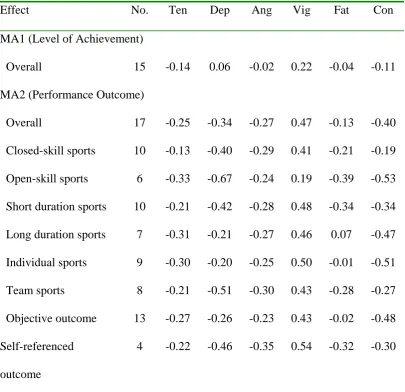
Effect sizes were calculated for all six POMS subscales in each study. ESs and coded variables for each study included in MA1 and MA2 are presented in Table 1. Summary statistics of the meta-analyses are contained in Table 2. For level of achievement, only 39 of 90 effect sizes (43.3%) were in the direction predicted by the mental health model (Morgan, 1985). The weighted mean of all studies in MA1 showed very small effects associated with level of achievement (M =0.10, SD = 0.07). Overall effects were less than .20 for all mood subscales except Vigor (ES = .22) Therefore, except for a small difference in Vigor scores, athletes at different levels of achievement report essentially the same moods. This finding supports the conclusions of Rowley et al. (1995) that the “utility of the POMS in predicting athletic success is questionable” (p.185). However, it should be emphasized that although such a conclusion may hold true when athletic success is interpreted as the level of
achievement that an athlete has attained (e.g., novice, varsity, or elite), it may not necessarily apply to the prediction of performance outcome from mood responses.
For level of performance, 75 of 102 effect sizes (73.5%) were in the direction predicted by the mental health model. The weighted mean of all studies in MA2 showed small to moderate effects associated with level of performance (M = 0.31, SD = 0.12). All the overall effects were in the direction predicted by the mental health model, indicating that successful performances were associated with lower Tension, Depression, Anger, Fatigue and
for Fatigue. It appears, therefore, that POMS scores have some utility in the prediction of performance outcome.
Table 2 also contains the weighted mean effects of mood responses grouped by the potential moderating variables of type and duration of sport and the success criterion used. Results showed that effects were larger for open-skill sports (M = 0.39, SD = 0.18) than closed-skill sports (M = 0.27, SD = 0.12). This finding runs counter to the proposal that performance in closed-skill sports would be more mood-dependent (Terry, 1995a).
Consistent with Terry’s proposals, effects were larger for short duration sports (M = 0.35, SD = 0.10) than long duration sports (M = 0.26, SD = 0.14). This indicates that pre-performance mood is a better predictor of performance in sports that last less than 10 minutes than those of longer duration. Also, effect sizes were marginally smaller for team sports (M = .30, SD = .19) than individual sports (M = .33, SD = .19). Further, effect sizes were larger in studies using a self-referenced performance criterion (M = 0.37, SD = 0.18) than an objective performance measure (M = 0.28, SD = 0.18). Therefore, it appears that the capacity to discriminate the quality of athletic performance from pre-performance mood is greater when performance is judged using self-referenced criteria such as percentage of personal best or the attainment of personal goals as opposed to objective criteria such as win/loss or selection/non-selection.
Discussion
The purpose of the present study was to summarize, using meta-analysis techniques, research findings pertaining to (a) the relationship between POMS scores and levels of athletic achievement, and (b) the relationship between POMS scores and performance outcome among athletes of similar levels of achievement.
present meta-analysis ensured that only those studies which genuinely tested the question of interest were included in MA1. Given that previous quantitative reviews of the literature by Landers (1991) and Rowley et al. (1995) have produced similar results, it is questionable whether there is a valid rationale for continuing this line of research.
The results of MA2, in contrast to previous quantitative reviews, showed that
pre-performance mood responses do have utility in the prediction of pre-performance outcome. This was more evident for short duration sports than long duration sports, more evident for open-skilled sports than closed-skill sports, and more evident when performance was judged using self-referenced criteria than objective criteria. The moderating influence of duration of the sport is unsurprising. Given that the potential for mood fluctuation to occur during
performance will increase in longer duration events, it is logical that the predictive
that the inclusion of skiing, for example, in the closed-skill category is debatable. Given also the absence of an effect for team versus individual sports, it appears that the moderating impact of type of sport on mood-performance relationships warrants further investigation.
The results of MA2 showed that the debilitative effects upon performance of tension and anger were small. This finding is consistent with a recent theoretical model (Lane & Terry, 1998b, 1999) which proposes that the effects of tension and anger upon performance are moderated by depression. Lane and Terry argue that tension and anger may not always exert a negative influence on performance as is often proposed. Their premise is that anger and tension will debilitate performance for an athlete in a depressed mood but show a curvilinear relationship with performance in the absence of any symptoms of depression.
Although POMS has been shown to have utility in predicting performance, the mean overall effect sizes were moderate at best and therefore research designs that moves beyond cross-sectional investigations of mood-performance relationships may prove more
productive. Such lines of investigations may include a within-subjects approach that seeks to identify optimum pre-training or pre-performance moods on an individualized basis (c.f., Hanin, 1989; Morgan et al., 1987; Terry, 1995a). Also, there appears to be a need for intervention studies that assess the effects of manipulating mood toward an individualized optimum mood for training or performance. Moreover, there has been a distinct lack of theory underlying mood-performance research that has contributed to a huge disparity of methodologies and research questions. Further, researchers should give more attention to methodological detail so that the response set of the mood measure and its time of
References
Studies included in the present meta-analysis are indicated with an asterisk (*).
Bell, G. J., & Howe, B. L. (1988). Mood states profiles and motivation of triathletes. Journal of Sport Behavior, 11, 66-77.
*Berger, B. G., & Owen, D. R. (1983). Mood alterations with swimming - Swimmers really do feel better. Psychosomatic Medicine,45, 425-433.
Boyce, L. V. (1987). Psychology fitness, personality, and cognitive strategies of
marathon runners as related to success and gender. Completed Research in Health, Physical Education, Recreation & Dance, 29, 108.
Cavanaugh, S. R. (1982). The mood states of selected collegiate athletes during the season of varsity competition (Doctoral Dissertation, Brigham Young University). Dissertation Abstracts International, 43, 1874A.
Cockerill, I. M., Nevill, A. M., & Lyons, N. (1991). Modelling mood states in athletic performance. Journal of Sports Sciences, 9, 205-212.
Craighead, D., Privette, G., Vallianos, F., & Byrkit, D. (1986). Personality characteristics of basketball players, starters and non starters. International Journal of Sport Psychology, 17, 110-119.
*Daiss, S., LeUnes, A., & Nation, J. (1986). Mood and locus of control of a sample of college and professional football players. Perceptual and Motor Skills,63, 733-734.
Daus, A., Wilson, J., & Freeman, W. (1986). Psychological testing as an auxiliary means of selecting successful college and professional football players. Journal of Sports Medicine and Physical Fitness, 26, 274-278.
Durtschi, S. K., & Weiss, M. R. (1986). Psychological characteristics of elite and non-elite marathon runners. In D. Landers (Ed.), Sport and Elite Performers (pp. 73-80). Champaign, IL: Human Kinetics.
*Dyer, J. B., & Crouch, J. G. (1987). Effects of running on moods: A time series study. Perceptual and Motor Skills, 64, 783-789.
*Feher, P., Meyers, M., & Skelly, W. (1998). Psychological attributes of rock climbers: State and trait attributes. Journal of Sport Behavior, 21, 167-180.
Frazier, S. E. (1986). Psychological characterisation of male and female marathon
runners of various performance levels (Doctoral dissertation, Indiana University) Dissertation Abstracts International, 47, 2076.
Frazier, S. E. (1988). Mood state profiles of chronic exercisers with differing abilities. International Journal of Sport Psychology, 19, 65-71.
Frazier, S. E., & Nagy, S. (1989). Mood state changes of women as a function of regular aerobic exercise. Perceptual and Motor Skills, 68, 283-287.
Friend, J., & LeUnes, A. (1990). Predicting baseball player performance. Journal of Sport Behavior, 13, 73-86.
*Fung, L., & Fu, F. H. (1995). Psychological determinants between wheelchair sport finalists and non-finalists. International Journal of Sport Psychology, 26, 568-579.
Glass, G. V. (1977). Integrating findings: The meta analysis of research. Review of Research in Education,5, 351-379.
*Gondola, J. C., & Tuckman, B.W. (1983). Extent of training and mood enhancement in women runners. Perceptual and Motor Skills, 57, 333-334.
*Gutman, M. C., Pollock, M. L., Foster, C., & Schmidt, D. (1984). Training stress in Olympic speedskaters. A psychological perspective. The Physician and Sportsmedicine,12, 45-57.
Hagberg, J. M., Mullin, J. P., Bahrke, M., & Limburg, J. (1979). Physiological profiles and selected psychological characteristics of national class American cyclists. Journal of Sports Medicine,19, 341-346.
Hall, A., & Terry, P. C. (1995). Trends in mood profiles in the preparation phase and racing phase of the 1993 world rowing championships, Roudnice, the Czech Republic. Journal of Sports Sciences, 13, 56-57.
Hanin, Y. (1989). Interpersonal and group anxiety in sports. In D. Hackfort & C.D. Spielberger (Eds.), Anxiety in Sports: An International Perspective (pp. 137-151). New York: Hemisphere Publishing.
Harris D. (1985). The relationship between player mood state and performance outcome of a women’s intercollegiate softball team (Master’s thesis, Stephen F. Austin State
University). Master’s Abstracts International, 23, 503.
*Hassmen P., & Blomstrand, E. (1991). Mood change and marathon running: A pilot study using a Swedish version of the POMS test. Scandinavian Journal of Psychology, 32, 225-232.
*Hassmen, P., & Blomstrand, E. (1995). Mood state relationships and soccer team performance. The Sport Psychologist, 9, 297-308.
Hassmen, P., Koivula., N., & Hansson, T. (1998). Precompetitive mood states and performance of elite male golfers: Do trait characteristics make a difference? Perceptual and Motor Skills, 86, 1443-1457
*Henschen, K. P., Horvat, M., & Roswal, G. (1992). Psychological profiles of the United States wheelchair basketball Team. International Journal of Sport Psychology, 23, 128-137.
Lane, A. M., & Terry, P. C. (1998a). Predictive effectiveness of mood on cycling time trial performance. Journal of Sports Sciences, 16, 95.
Lane, A. M., & Terry, P. C. (1998b). Mood states as predictors of performance: A conceptual model. Journal of Sports Sciences, 16, 93-94.
Lane, A. M., & Terry, P. C. (1999). The nature of mood: Development of a conceptual model. Journal of Applied Sport Psychology, 11.
Landers, D. M. (1991). Optimizing individual performance. In D. Druckman and R. A. Bjork (Eds.), In the mind’s eye: Enhancing human performance (pp. 193-246). Washington, DC: National Academy Press.
LeUnes, A., & Burger, J. (1998). Bibliography on the Profile of Mood States in sport and exercise, 1971-1995. Journal of Sport Behavior, 21, 53-70.
LeUnes, A., Haywood, S. A., & Daiss, S. (1988). Annotated bibliography of the Profile of Mood States in Sport, 1975-1988. Journal of Sport Behavior, 11, 213-240.
*LeUnes, A., & Nation, J. (1982). Saturday’s heroes: A psychological portrait of college football players. Journal of Sport Behavior, 5, 139-149.
Lindstrom, D. V. (1990). Personality characteristics of ultramarathoners: Finishers vs. nonfinishers (Master’s thesis, San Jose State University) Master’s Abstracts International, 23, 503.
*Mahoney, M. J. (1989). Psychological predictors of elite and non-elite performance in Olympic weightlifting. International Journal of Sport Psychology,20, 1-12.
*McGowan, R., Miller, M., & Henschen, K. (1990). Differences in mood states between belt ranks in karate tournament competitors. Perceptual and Motor Skills, 71, 147-150.
*McGowan, R., Pierce, E., & Jordan, R. (1992). Differences in pre-competitive mood states between black-belt ranks. Perceptual and Motor Skills, 75, 123-128.
McNair, D. M., Lorr, M., & Droppelman, L. F. (1971). Manual for the Profile of Mood States. San Diego: Educational and Industrial Testing Services.
*Meyers, M. C., Sterling, J. C., Treadwell, S., Bourgeois, A. E., & LeUnes, A. (1994). Mood and psychological skills of world-ranked female tennis players. Journal of Sport Behavior, 17, 156-165.
Miller, B. P., & Edgington, G. P. (1984). Psychological mood state distortion in a sporting context. Journal of Sport Behavior, 7, 91-94.
*Miller, B. P., & Miller, A. J. (1985). Psychological correlates of success in elite sportswomen. International Journal of Sport Psychology, 19, 289-295.
Morgan, W. P. (1974). Selected psychological considerations in sport. Research Quarterly for Exercise and Sport, 45, 374-390.
Morgan, W. P. (1980). The trait psychology controversy. Research Quarterly for Exercise and Sport, 51, 50-76.
Morgan, W. P. (1985). Selected psychological factors limiting performance: A mental health model. In D. H. Clarke and H. M. Eckert (Eds.), Limits of Human Performance (pp. 70-80). Champaign, IL: Human Kinetics.
*Morgan, W. P., & Johnson, R. W. (1978). Personality characteristics of successful and unsuccessful oarsmen. International Journal of Sport Psychology, 9, 119-133.
*Morgan, W. P., O’Conner, P. J., Sparling, P. B., & Pate, R. R. (1987). Psychological characterisation of the elite female distance runner. International Journal of Sports Medicine, 8, 124-131.
Morgan, W., O’Conner, P., Ellickson, K., & Bradley, P. (1988). Elite male distance runners: Personality structure, mood states, and performance. International Journal of Sport Psychology, 19, 247-263.
Nagle, F., Morgan, W., Hellickson, R., Serfass, R. & Alexander, J. (1975). Spotting success traits in Olympic contenders. Physician and Sports Medicine, 3, 31-34.
Nation, J., & LeUnes, A. (1983). Personality characteristics of intercollegiate football players as determined by position, classification and redshirt status. Journal of Sport Behavior, 6, 92-102.
Newby, R., & Simpson, S. (1991). Personality profile of nonscholarship college football players. Perceptual and Motor Skills, 73, 1083-1089.
Newby, R., & Simpson, S. (1994). Basketball performance as a function of scores on the Profile of Mood States. Perceptual and Motor Skills, 78, 1142.
Newby, R., & Simpson, S. (1996). Correlations between mood state scores and volleyball performance. Perceptual and Motor Skills, 83, 1153-1154.
Newcombe, P. A., & Boyle, G. J. (1995). High school students’ sports personalities: Variations across participation level, gender, type of sport and success. International Journal of Sport Psychology, 26, 277-294.
North, T., McCullagh, P., & Tran, Z. (1990). Effect of exercise on depression. Exercise and Sport Science Reviews, 18, 379-415.
*Prapavessis, H., Berger, B., & Grove, J. R. (1992). The relationship of training and pre-competition mood states to swimming performance: An exploratory investigation. Australian Journal of Science and Medicine in Sport, 24, 12-17.
Poole, C., Henschen, K. P., Schultz, B., Gordon, R., & and Hill, J. (1986). A longitudinal investigation of the psychological profiles of elite collegiate female athletes according to performance level. In L. Unestahl (Ed.), Contemporary Sport Psychology: Proceedings from the VI World Congress in Sport Psychology (pp. 65-72). Orebro, Sweden: Veje.
*Raglin, J., Morgan, W. P., & Luchsinger, A. (1990). Mood and self motivation in successful and unsuccessful female rowers. Medicine and Science in Sports and Exercise, 22, 849-853.
Ramadan, J. M. (1984). Selected physiological, psychological, and anthropometric characteristics of the Kuwaiti World Cup football team. (Doctoral dissertation, Lousiana State University) Dissertation Abstracts International, 46, 924A.
Renger, R. (1993). A review of the Profile of Mood States (POMS) in the prediction of athletic success. Journal of Applied Sport Psychology, 5, 78-84.
Riddick, C. (1984). Comparative psychological profiles of three groups of collegians: Competitive swimmers, recreational swimmers, and inactive swimmers. Journal of Sport Behavior, 7, 160-174.
Robb, M. D. (1972). The Dynamics of Motor Skill Acquisition. Englewood Cliffs, NJ: Prentice Hall.
Rowley, A., Landers, D., Kyllo, L., & Etnier, J. (1995). Does the iceberg profile discriminate between successful and less successful athletes? A meta-analysis. Journal of Sport and Exercise Psychology, 17, 185-199.
Shacham, S. (1983). A shortened version of the Profile of Mood States. Journal of Personality Assessment, 47, 305-306.
Silva, J. M., Schultz, B., Haslam, R. W., & Murray, D. F. (1981). A psychophysiological assessment of elite wrestlers. Research Quarterly for Exercise and Sport, 52, 348-358.
*Silva, J. M., Schultz, B. B., Haslam, R., Martin, T., & Murray, D. (1985).
Discriminating characteristics of contestants at the United States Olympic wrestling trials. International Journal of Sport Psychology,16, 79-102.
*Simpson, S., & Newby, R. W. (1994). Scores on Profile of Mood States of college football players from non-scholarship and scholarship programmes. Perceptual and Motor Skills, 78, 635-640.
*Terry, P. C. (1993). Mood state profiles as indicators of performance among Olympic and World championship athletes. Journal of Sports Sciences, 13, 214.
Terry, P. C. (1995a). The efficacy of mood state profiling with elite performers. A review and synthesis. The Sport Psychologist, 9, 309-324.
*Terry, P. C. (1995b). Discriminant capability of pre performance mood state profiles during the 1993-1994 World Cup bobsleigh. Journal of Sports Sciences, 13, 77-78.
*Terry, P. C., & Hall, A. (1996). Development of normative data for the Profile of Mood States for use with athletic samples. Journal of Sports Sciences, 14, 47-48.
*Terry, P. C., & Youngs, E. (1996). Discriminant Effectiveness of psychological state measures in predicting selection during field hockey trials. Perceptual and Motor Skills, 82, 371-377.
*Tharion, W., Strowman, S., & Rauch, T. M. (1988). Profile and changes in mood in ultramarathoners. Journal of Sport and Exercise Psychology,10, 229-235.
Thomas, J. & French, K. (1986). The use of meta-analysis in exercise and sport: A tutorial. Research Quarterly for Exercise and Sport, 57, 196-204.
Thomas, J. & Nelson, J. K. (1996). Research methods in physical activity. Champaign, IL: Human Kinetics.
Thomas, T., Zebas, C., Bahrke, M., Araujo, J., & Etheridge, G. (1980). Physiological and psychological correlates of success in track and field athletes.British Journal of Sports
Medicine, 17, 102-109.
Toner M. K. (1981) The relationship of selected physical fitness, skill, and mood variables to success in female high school basketball candidates (Doctoral dissertation, Boston University) Dissertation Abstracts International, 42, 3909A.
*Trafton, T., Meyers, M., & Skelly, W. (1998). Psychological characteristics of the telemark skier. Journal of Sport Behavior, 20, 465-475.
Vanden Auweele, Y., De Cuyper, B., Van Mele, V., & Rzewnicki, R. (1993). Elite performance and personality: From description and prediction to diagnosis and intervention. In R. Singer, M. Murphy, & L. Tennant (Eds.), Handbook of research on sport psychology (pp. 257-289). New York: Macmillan.
Wilson, V., Morley, N., & Bird, E. I. (1980). Mood profiles of marathon runners, joggers and non-exercisers. Perceptual and Motor Skills, 50, 117-118.
Author Note
Christopher J. Beedie, Peter C. Terry, and Andrew M. Lane, Department of Sport Sciences, Brunel University, England
Correspondence concerning this article should be addressed to Dr. Peter C. Terry,
Table 1.
Effect Sizes and Characteristics of Studies (N = 29) included in MA1 and MA2.
Author and Year n Ten Dep Ang Vig Fat Con Type Measure Resp. Time
MA1 (Level of Achievement)
Berger & Owen (1983)a 25 0.44 0.63 0.59 0.16 -0.10 0.55 -- -- - -
Berger & Owen (1983)b 31 0.05 -0.15 -0.27 -0.90 0.07 -0.18 -- -- - -
Dyer & Crouch (1987) 40 -0.13 0.20 -0.63 -0.22 0.19 0.05 -- -- - 1hr
Feher, Meyers, & Skelly, (1998) 57 0.62 0.36 1.04 0.23 0.00 0.49 -- -- pw -
Gondola & Tuckman (1983) 396 -0.21 -0.15 -0.04 0.41 -0.09 -0.14 -- -- - -
Hassmen & Blomstrand (1991) 61 -0.21 -0.16 -0.08 0.32 -0.13 -0.17 -- -- rn 24hr
Mahoney (1989) 50 0.05 -0.33 0.00 0.20 -0.28 -0.16 -- -- - -
McGowan, Miller, & Henschen (1990)c 52 -0.29 0.49 0.61 -0.05 -1.06 0.48 -- -- - 24hr
McGowan, Miller & Henschen (1990)d 55 -0.33 0.46 0.58 0.10 0.67 0.32 -- -- - 24hr
McGowan, Pierce & Jordan (1992) 34 0.03 0.04 -0.74 -0.33 0.16 0.05 -- -- - 24hr
Meyers, Sterling, et al. (1994) 33 0.12 0.00 -0.04 -0.37 0.29 0.21 -- -- - -
Simpson & Newby (1984) 162 -0.20 0.70 -0.30 0.28 -0.57 -0.29 -- -- PW -
Terry & Hall (1996) 1250 -0.64 -0.53 -0.49 0.44 -0.49 -0.76 -- -- RN 24hr
Trafton, Meyers, & Skelly (1998) 43 1.99 1.70 1.31 1.17 0.63 0.39 -- -- - -
MA2 (Performance Outcome)
Fung & Fu (1995) 300 -0.51 -0.11 -0.26 0.69 0.12 -0.86 L/I Select. RN 96hr
Gutman, Pollock, Foster, & Schmidt (1984) 11 -0.46 -0.53 -0.03 1.14 -1.56 -0.14 S/C/I Select. PW -
Hassmen & Blomstrand (1991) 72 -0.29 -0.39 -0.37 0.46 -0.28 -0.39 L/C/I Time RN 24hr
Hassmen & Blomstrand (1995) 18 0.22 -1.42 -0.11 0.35 -1.26 -1.44 L/O/T Win/loss RN 1hr
Henschen, Horvat, & Roswal (1992) 24 -0.92 -0.28 -0.70 -0.31 -0.11 -0.21 L/O/T Select. PW -
Miller & Miller (1985) 20 0.56 -0.41 -0.35 0.08 0.64 0.34 L/O/T Select. - -
Morgan & Johnson, (1978)e 57 0.39 0.06 -0.02 -0.03 0.26 0.11 S/C/T Select. - -
Morgan & Johnson (1978)f 16 -0.57 -1.02 0.59 0.97 -0.19 -0.79 S/C/T Select. - -
Prapavessis & Grove (1991)g 24 0.17 0.08 -0.21 0.13 0.13 -0.01 S/O/I Self-ref. RN 1hr
Prapavessis & Grove (1992)h 35 0.04 0.17 -0.14 0.47 0.09 -0.33 S/O/I Self-ref. RN 1hr
Raglin, Morgan, & Luchsinger (1990) 22 -0.06 -0.55 -0.66 -0.31 -0.81 -1.30 S/O/I Select. PW -
Terry (1993) 79 -0.31 -0.61 -0.37 0.57 -0.15 -0.41 S/C/T Self-ref. RN 24hr
Terry (1995b) 17 0.25 -0.52 -0.39 0.58 -0.59 -0.24 S/C/T Self-ref. RN 24hr
Terry & Slade (1995) 197 -1.75 -1.83 0.48 1.35 -1.69 -2.12 S/O/T Win/loss RN 1hr
Terry & Youngs (1996) 128 -0.48 -0.20 0.30 -0.10 -0.02 -0.21 L/O/T Select. RN 1hr
Tharion, Strowman, & Rauch (1988) 56 0.27 -0.20 -0.20 0.04 0.37 0.71 L/C/I Finisher
s
PFH 24hr
Note. An effect size preceded by a minus sign (-) denotes that successful athletes reported lower POMS scores than unsuccessful athletes. Ten
= tension, Dep = depression, Ang = anger, Vig = vigor, Fat = fatigue, Con = confusion. Type = type of sport - S = short duration, L = long
duration; O = open-skilled sport, C = closed-skill sport; I = individual sport, T = team sport. Measure = measure of performance - Select. =
selection, Self-ref. = self-referenced. Resp. = response set - PW = past week including today, RN = right now, PFH = past few hours. Time =
time of administration. - = not reported. -- = data not relevant to analysis in MA1. a = female, b = male, c = regional championships, d = state
championships, e = heavyweight rowers, f = lightweight rowers, g used Shacham’s (1983) shortened version of the POMS, h used Grove and
Table 2.
Weighted Means of Effect Sizes Grouped by Moderating Variables
Effect No. Ten Dep Ang Vig Fat Con
MA1 (Level of Achievement)
Overall 15 -0.14 0.06 -0.02 0.22 -0.04 -0.11 MA2 (Performance Outcome)
Overall 17 -0.25 -0.34 -0.27 0.47 -0.13 -0.40
Closed-skill sports 10 -0.13 -0.40 -0.29 0.41 -0.21 -0.19 Open-skill sports 6 -0.33 -0.67 -0.24 0.19 -0.39 -0.53 Short duration sports 10 -0.21 -0.42 -0.28 0.48 -0.34 -0.34 Long duration sports 7 -0.31 -0.21 -0.27 0.46 0.07 -0.47
Individual sports 9 -0.30 -0.20 -0.25 0.50 -0.01 -0.51 Team sports 8 -0.21 -0.51 -0.30 0.43 -0.28 -0.27 Objective outcome 13 -0.27 -0.26 -0.23 0.43 -0.02 -0.48 Self-referenced
outcome
4 -0.22 -0.46 -0.35 0.54 -0.32 -0.30