
R E S E A R C H
Open Access
The mutation T477A in HIV-1 reverse
transcriptase (RT) restores normal proteolytic
processing of RT in virus with Gag-Pol mutated in
the p51-RNH cleavage site
Michael E Abram
1, Stefan G Sarafianos
2, Michael A Parniak
3*Abstract
Background:The p51 subunit of the HIV-1 reverse transcriptase (RT) p66/p51 heterodimer arises from proteolytic cleavage of the RT p66 subunit C-terminal ribonuclease H (RNH) domain during virus maturation. Our previous work showed that mutations in the RT p51↓RNH cleavage site resulted in virus with defects in proteolytic processing of RT and significantly attenuated infectivity. In some cases, virus fitness was restored after repeated passage of mutant viruses, due to reversion of the mutated sequences to wild-type. However, in one case, the recovered virus retained the mutated p51↓RNH cleavage site but also developed an additional mutation, T477A, distal to the cleavage site. In this study we have characterized in detail the impact of the T477A mutation on intravirion processing of RT.
Results:While the T477A mutation arose during serial passage only with the F440V mutant background,
introduction of this substitution into a variety of RT p51↓RNH cleavage site lethal mutant backgrounds was able to restore substantial infectivity and normal RT processing to these mutants. T477A had no phenotypic effect on wild-type HIV-1. We also evaluated the impact of T477A on the kinetics of intravirion Gag-Pol polyprotein processing of p51↓RNH cleavage site mutants using the protease inhibitor ritonavir. Early processing intermediates accumulated in p51↓RNH cleavage site mutant viruses, whereas introduction of T477A promoted the completion of processing and formation of the fully processed RT p66/p51 heterodimer.
Conclusions:This work highlights the extraordinary plasticity of HIV-1 in adapting to seemingly lethal mutations that prevent RT heterodimer formation during virion polyprotein maturation. The ability of T477A to restore RT heterodimer formation and thus intravirion stability of the enzyme may arise from increased conformation flexibility in the RT p51↓RNH cleavage site region, due to loss of a hydrogen bond associated with the normal threonine residue, thereby enabling proteolytic cleavage near the normal RT p51↓RNH cleavage site.
Background
Human immunodeficiency virus type 1 (HIV-1) reverse transcriptase (RT) is a multifunctional viral enzyme that catalyzes all chemical steps in the conversion of HIV-1 genomic RNA into double stranded viral DNA. While the RT gene encodes a polypeptide of 66 kDa (translated as a part of a much larger 160 kDa Gag-Pol polypro-tein), RT in infectious virions is a heterodimer of 66
kDa (p66) and 51 kDa (p51) subunits [1]. The latter subunit, p51, is derived from the larger p66 subunit (or a larger RT precursor) by HIV-1 protease (PR)-catalyzed cleavage of the p51↓RNH junction during viral matura-tion. This event results in the removal of a 15 kDa C-terminal ribonuclease H (RNH) domain [2-5]. The ter-tiary folding of each subunit in RT differs, resulting in an asymmetric heterodimer [6,7]. RT catalytic activities are located in the p66 subunit, whereas the p51 subunit of the RT heterodimer is believed to play primarily a structural role [8-10]. In addition to its catalytic func-tion, the RNH domain of the p66 subunit has been * Correspondence: [email protected]
3University of Pittsburgh School of Medicine, Department of Microbiology
and Molecular Genetics, Pittsburgh, PA, 15219, USA
suggested to play a structural role in the maintenance of RT stability [11-16].
Since HIV-1 virions contain essentially equivalent amounts of p66 and p51 RT subunits [17,18], proteolytic
cleavage of the p51↓RNH junction may possibly be an
important factor in the production of replication-com-petent virions. Furthermore, both recombinant RT p66/ p66 homodimers and RT p66/p51 heterodimers show similar catalytic properties (DNA polymerase and RNH activities)in vitro [19-21], which begs the question, why is additional proteolytic cleavage of the p51↓RNH
junc-tion needed in vivo during virus maturation? We
recently showed that mutagenesis of the RT p51↓RNH
protease recognition sequence (AETF440↓ Y441VDG)
resulted in aberrant proteolytic processing producing HIV-1 virions with greatly decreased levels of RT that in many cases was primarily RT p51, leading to substan-tially reduced replication capacity [22]. We hypothesized that the p51↓RNH cleavage event was essential to confer proteolytic stability to RT. Repeated passage of some of these p51↓RNH cleavage site mutant viruses eventually led to the appearance of relatively normal replication kinetics. These recovered viruses possessed normally processed heterodimeric p66/p51 RT. In some cases, the recovery was due to reversion of the mutant sequence
to the normal wild-type p51↓RNH protease recognition
sequence. However, in one case, the recovered virus maintained the mutated protease recognition sequence (F440V), but now possessed a single additional amino acid substitution, T477A, distal to the normal the p51↓RNH cleavage site between F440 and Y441 [22].
In the present work we examined in detail the effect of the conservative T477A substitution on alleviating the detrimental phenotypic effect of the F440V mutation
in the p51↓RNH protease recognition sequence.
Inter-estingly, the T477A substitution also alleviated the phe-notypic impact of many other mutations in the
p51↓RNH cleavage region, despite the fact that this
compensatory substitution did not normally arise in revertants of these mutant viruses. Furthermore, the T477A compensatory substitution was also effective at
restoring infectivity to some p51↓RNH mutants that
never recovered infectivity during repeated passage. In all cases, the addition of the T477A substitution resulted in virions containing seemingly wild-type levels of het-erodimeric p66/p51 RT despite the continued presence
of mutations in the p51↓RNH protease recognition
sequence. We propose that when the p51↓RNH junction
is mutated, the T477A compensatory substitution may enable HIV-1 PR-mediated proteolytic processing of RT p66 at another site close to the normal proteolytic clea-vage point, thereby enabling formation of an RT hetero-dimer refractory to additional proteolytic degradation.
Results
Effect of the RT T477A substitution on infectivity and virion RT content of p51↓RNH cleavage site mutants In order to validate the role of T477A in the reversion phenotype of F440V, we introduced this amino acid substitution into HIV-1 clones containing a variety of
other p51↓RNH cleavage site mutations that we
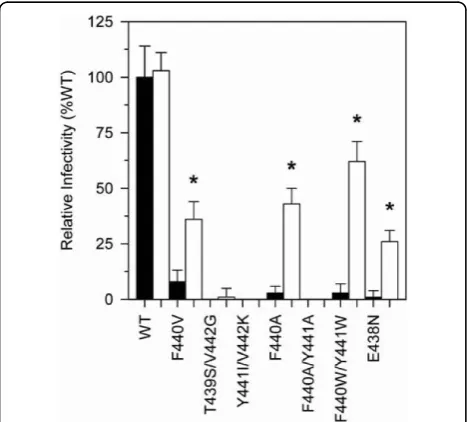
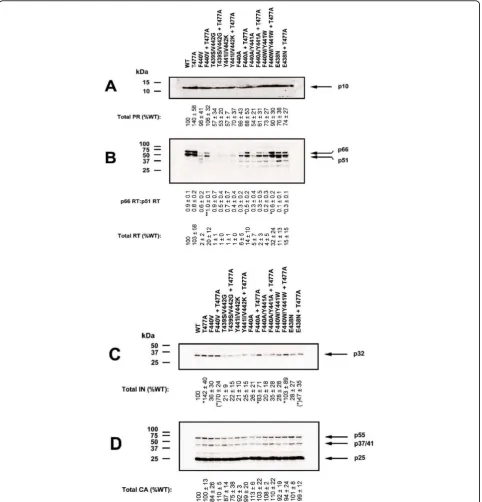
pre-viously showed to be detrimental to proper RT proces-sing, as well as into wild-type HIV-1. Introduction of the T477A mutation into a wild-type HIV-1 background had no effect on virus replication (Fig. 1; Table 1), or on virion Pol protein content (Fig. 2). However, introduc-tion of this substituintroduc-tion into a molecular clone of the
F440V p51↓RNH cleavage site mutant HIV-1 resulted in
a significant increase in infectivity of this mutant virus (Fig. 1, Table 1) as well as a considerable acceleration in viral spread (data not shown), thereby validating the compensatory nature of the T477A substitution in the
context of the F440V p51↓RNH cleavage site mutation.
Interestingly, the T477A substitution also significantly improved the infectivity (Fig. 1, Table 1) and replication
kinetics of 3 out of 6 other p51↓RNH cleavage site
mutants (data not shown) that originally showed severe attenuations in infectivity, despite the fact that this com-pensatory substitution arose only during passage of the F440V mutant.
The p51↓RNH cleavage site mutants that showed
improved infectivity due to the presence of the T477A substitution also showed significantly increased virion levels of RT (Fig. 2B) and integrase (IN) (Fig. 2C) and normalized the ratio of the p66 RT and p51 RT subunit content in most mutant viruses, suggesting near normal proteolytic processing and stability of RT p66 in these mutant viruses (Fig. 2B). The impact of the T477A sub-stitution was not due to increased virion incorporation of Pr160gag-pol, as normal levels of PR were present in all mutant viruses (Fig. 2A), and the presence of T477A did not alter virion incorporation of Pr160gag-pol posses-sing inactive PR (data not shown).
Effect of the RT T477A substitution on intravirion processing of the Pr160Gag-Polpolyprotein
molecular weight polyproteins reactive with either RT-specific or Gag-p24-RT-specific antibodies (Fig. 3A and 3B). The apparent masses of these larger processing inter-mediates are consistent with previous findings and pre-dictions based on protease cleavage sites in the polyproteins [23-26].
Consistent with our previous findings [22], mutations in the p51↓RNH cleavage site resulted in significantly
diminished levels of RT p66/p51 in virions produced in the absence of RTV. In fact, with most mutants,
p51↓RNH cleavage site mutant virions contained
vir-tually no RT immunoreactive proteins (Fig. 3A, left panel). RT antibody reactive proteins increased substan-tially in virions produced in the presence of RTV
con-centrations above 0.1 μM. However, in no case did RTV
treatment lead to the appearance of RT p66/p51 in the mutant virions. Instead, the RT antibody immunoreac-tive proteins corresponded to Gag-Pol polyprotein pro-cessing intermediates between 160 and 100 kDa.
Addition of the T477A substitution to the p51↓RNH
cleavage site mutants resulted in virions with elevated levels of p66 RT at RTV concentrations less than 0.1
μM and p66/p51 RT in the absence of RTV, suggesting
relatively normal processing and proteolytic stability of RT (Fig. 3A, right panel). These virions produced in the
presence of RTV concentrations above 0.1 μM showed
higher molecular weight Gag-Pol polyprotein intermedi-ate profiles similar to those seen in virions lacking the T477A substitution, due to RTV inhibition of normal viral polyprotein processing.
Discussion
The proteolytic processing of Gag and Gag-Pol polypro-teins into their respective structural propolypro-teins and func-tional enzymes is an essential stage in HIV replication. This processing does not occur randomly, but rather appears to comprise some degree of ordered cleavage events to provide functional and infectious virus [23,24,27]. However, the kinetics of and factors defining
these cleavage events in vivo remain poorly defined.
One of the most intriguing polyprotein proteolytic
clea-vage events is the RT p51↓RNH cleavage needed to
[image:3.595.58.538.98.221.2]form the obligate p66/p51 RT heterodimer. While all three pol-derived enzymes (PR, RT, IN) are active only as oligomers, only RT is a heterodimer. We previously showed that mutations introduced into the RT p51↓RNH protease recognition and cleavage site, which
Table 1 Replication capacity of HIV-1 with mutations in the p51↓RNH cleavage site ± T477A
RT p51↓RNH mutation Virus titer (% wild-type control)a
- T477A + T477A
WT 100 100 ± 30 (N.S.)b
F440V < 1 ± 1 10 ± 3 (p < 0.01)
T439S/V442G —c —
Y441I/V442K — —
F440A <1 ± 1 10 ± 5 (p < 0.01)
F440A/Y441A <1 ± 1 1 ± 1 (N.S.)
F440W/Y441W <1 ± 1 32 ± 14 (p < 0.01)
E438N <1 ± 1 5 ± 4 (p < 0.5)
a
Infectious virus titer (TCID50/ml) was determined in MT-2 cells and was normalized by dividing by the amount of viral p24 (ng/ml), as described in Materials and Methods. Data are presented as mean % wild-type virus titer ± standard deviation from four individual experiments.
bPvalues were calculated using a one-tailed Student’st-test assuming equal variance. N.S., not significant. c
No virus titer noted
Figure 1Infectivity of WT and p51↓RNH ± T477A mutant virus in single cycle replication assays. HIV-1 derived from transfection of 293T cells was added to P4R5 indicator cells (5 × 10³), and infectivity was assessed 48 h post infection as indicated in Materials and Methods. Black and white bars indicate p51↓RNH - T477A or p51↓RNH + T477A mutant viruses respectively, derived from transfected 293T cells, normalized to 25 ng viral p24 at time of infection. Infectivity was determined after 48 h of culture by fluorescent measurement ofb-galactosidase gene expression, as described in Materials and Methods. Data are means ± S.D. from 16 independent experiments. Asterisks (*) indicate statistical
[image:3.595.57.291.371.582.2]we predicted would result in accumulation of unpro-cessed RT p66, instead resulted in severe attenuations of HIV-1 infectivity due to inappropriate intravirion degra-dation of RT by the viral protease [22]. Based on these findings, we suggested that the proteolytic cleavage at
the RT p51↓RNH junction to form the RT p66/p51
het-erodimer was essential to stabilize RT and to prevent extensive intravirion HIV PR-mediated degradation of RT.
HIV has an extraordinary adaptive capacity, and we
asked whether virions mutated to prevent RT p51↓RNH
cleavage could surmount this barrier to normal phenoty-pic maturation. We tested this by carrying out long term
passage of RT p51↓RNH cleavage site mutants in
per-missive cells. Three different phenotypes were found,
depending on the initial cleave site mutations intro-duced [22]. Some mutants never recovered replication capacity. Some mutants recovered replication capacity
due to reversion of the p51↓RNH cleavage site
muta-tions to wild-type sequences. In some cases however,
the p51↓RNH cleavage site mutations remained, but
additional amino acid changes in RT were found. The predominant consensus change was the conservative second-site substitution T477A, initially identified in the
background of an F440V p51↓RNH cleavage site
mutant.
[image:5.595.57.541.88.459.2]p51↓RNH cleavage site mutants also resulted in restora-tion of virion RT p66/p51 content and infectivity to near wild-type levels. As an example, introduction of
T477A in the background of the “lethal” F440W/
Y441W mutation resulted in an increase of HIV-1 infectivity from near zero to about 70% of wild-type levels (Fig. 1).
The compensatory nature of the T477A second-site mutation highlights the importance of maintaining a proteolytically stable form of RT during virus matura-tion. The Thr to Ala change at residue 477 is poly-morphic, present in about 4% of HIV-1 sequences [28], suggesting that it may confer some advantage or at least is benign under normal replication conditions. This is consistent with the lack of phenotypic effect following introduction of T477A into a wild-type RT background (Fig. 1 and 2). Our studies suggest that virtually any mutation in the PR-recognition sequence defining the p51↓RNH cleavage site (residues 437-444) leads to non-infectious virus, and work by others had indirectly sug-gested that residue 438 was important for correct RT heterodimer processing [29]. So how can a conservative change such as T477A in the RNH domain of RT possi-bly alleviate this detrimental phenotype? Proteolytic pro-cessing occurs with intermediate forms of RT preceding the final p66/51 heterodimer, and RT structures are available only for the latter. Nonetheless, examination of the RT p66/51 structure enables us to propose the
fol-lowing model. The p51↓RNH cleavage site, defined by
residues F440 and Y441, is part of a b 1 sheet that is
nicely packed against the aA helix that carries T477.
This places the p51↓RNH cleavage site proximal in
space to the T477 residue whose side chain OH engages in a hydrogen bond with the main chain of residue A445 (Fig. 4). Despite the extensive hydrophobic
inter-actions between this helix and the b-sheet throughout
their length, the hydrogen bond between residues A445 and T477 is the only electrostatic interaction between these secondary structure elements. We surmise that a T477A substitution would eliminate this hydrogen bond, resulting in increased regional flexibility such that pro-teolytic cleavage occurs at an alternate site despite the
continued presence of the p51↓RNH mutations. Such
alternate cleavage sites have been previously suggested [5,30], but have yet to be identified directly from virus-derived RT. A comparison of several HIV-1 RT crystal structures provides indirect evidence for the potential flexibility in this region. Specifically, the superposition of the RNH domains of several RT structures shows nota-ble variability in the main chain conformation; and in
some cases (e.g., PDB 1FK9[31]), parts of theb-sheet
(residues 444 - 454) are missing, possibly due to poor electron density resulting from multiple conformations in this region.
The intravirion RT processing defects imparted by the
p51↓RNH cleavage site mutations are similar to those
noted with mutations such as W401A [32], a mutation which impacts RT dimerization [33]. It is not inconcei-vable that the RT p66 monomer would be more proteo-lytically labile than the dimer, thus mutations that prevent RT dimerization would lead to virions with
reduced RT content such as seen with the p51↓RNH
cleavage site mutants. Despite the similarity in the
phe-notype imparted by the W401A and the p51↓RNH
clea-vage site mutations, we do not think that the latter act
by reducing RT dimer formation. The p51↓RNH
clea-vage site is not involved in significant subunit interface interactions, and as well is quite removed from the Trp motif that plays a major role in RT dimer stabilization.
Conclusion
[image:6.595.305.538.356.632.2]In summary, we have demonstrated that both virion infectivity and proteolytic stability of RT with p51↓RNH cleavage site mutations can be restored to various extents by the second-site compensatory mutation
T477A. Studies are currently in progress to characterize the C-terminal amino acid sequence of the RT p51
sub-unit from HIV-1 with p51↓RNH cleavage site mutations
and the T477A substitution in RT in order to determine whether this compensatory mutation enables proteolytic cleavage at a position other than the normal F440↓Y441 location.
Materials and methods Reagents
The following reagents were obtained through the AIDS Research and Reference Reagent Program, Division of
AIDS, NIAD, NIH: anti-HIV-1SF2 p24/25 IgG mAb
(76C) from Dr. Kathelyn Steimer, Chiron Corporation,
and anti-HIV-1HXB2 IN (2C11 and 8G4) IgG mAb from
Dr. Dag Helland. Rabbit anti-HIV-1 PR polyclonal serum directed against PR residues 86-108 [34,35] was a generous gift from Dr. Stuart Le Grice, NCI-Frederick
(Frederick, MD). Anti-HIV-1IIIB RT IgG mAbs
specifi-cally reacting with HIV-1 RT were previously generated in our laboratory [36]. Goat anti-mouse-HRP and don-key anti-rabbit secondary mAb were products of GE HealthCare (formerly Amersham Pharmacia Biotech, Piscataway, NJ). The SuperPico ECL Substrate System for detection of peroxidase-labeled antibody was obtained from PIERCE (Rockford, IL). 4-methylumbelli-feryl-b-D-galactopyranoside (4-MUG), a fluorescent
sub-strate for b-galactosidase, was obtained from
Sigma-Aldrich (St. Louis, MO). HIV-1 p24 antigen ELISA kits were obtained from SAIC-Frederick (Frederick, MD). Sequencing, PCR amplification and mutation-containing oligonucleotide primers were purchased from Invitrogen (Carlsbad, CA).
Cell lines
The human T-lymphocytoid MT-2 and MT-4 cell lines were maintained in RPMI 1640 supplemented with 10% fetal bovine serum (FBS). Human 293T and monkey COS-7 fibroblast cell lines were maintained in
Dulbec-co’s modified Eagle medium (DMEM) supplemented
with 10% FBS. The P4R5 HIV infection indicator cells were obtained from Dr. John Mellors, University of Pittsburgh, and maintained in DMEM/10% FBS
supple-mented with puromycin (0.5μg/mL). P4R5 cells express
CD4, CXCR4 and CCR5 as well as a b-galactosidase
reporter gene under the control of an HIV LTR promo-ter [37].
Preparation, cloning and sequencing of p51↓RNH mutant revertants
As described in our previous report [22], MT-2 cells
were inoculated with p51↓RNH cleavage site mutant
viruses and then maintained in culture for up to 30 d or until cytopathic effects were noted. Virus-containing cell-free culture supernatants were then used to infect fresh MT-2 cells. Cells were isolated 5 d post-infection
and then chromosomal DNA was extracted using the QIAamp DNA Mini Kit protocol (Qiagen Inc., Valencia, CA). The HIV-1 RT-encoding region was amplified by PCR and cloned into pCR-T7/CT TOPO (Invitrogen, Carlsbad, CA) for sequencing analysis.
Mutagenesis of HIV-1 molecular clones and production of recombinant virus
Plasmid pSVC21-BH10 encodes an infectious molecular clone of HIV-1 IIIB (HxB2) and carries an SV40 origin of replication for expression in 293T and COS-7 cells [38]. In our previous study [22], we used pSVC21-BH10 to prepare ten different variants mutated in the RT
p51↓RNH cleavage site (amino acid residues 437-443),
namely A437I, V442S, F440W, F440V, T439S/V442G, Y441I/V442K, F440A, F440A/Y441A, F440W/Y441W, and E438N. We introduced the mutation T477A into each of these p51↓RNH cleavage site mutants as well as
into the wild-type clone using the Quick Change™
Site-Directed Mutagenesis kit protocol (Stratagene, La Jolla, CA). In order to assess the incorporation of the Pr160Gag-Polpolyprotein precursor into recombinant vir-ions, we also prepared a second set of HIV-1 clones containing the D25A inactivating mutation in the PR coding region to prevent proteolytic processing of Pr160Gag-Pol. The presence of all mutations were verified by sequencing. Recombinant virus was prepared by transfection of 293T cells using calcium phosphate co-precipitation. Virus-containing culture supernatants were harvested 60 h post-transfection and clarified by centrifugation (3,000×g, 1 h at 4°C). The level of recom-binant virus production was quantified by measurement of HIV-1 p24 antigen. Virus preparations were then ali-quoted and stored at -80°C until use.
HIV-1 infectivity assays
Infectivity of virus particles produced by transfection of 293T cells was determined by addition of defined quanti-ties of HIV-1 p24 antigen to target infectable cells. Single-cycle viral infectivity was assessed in 96-well microplate assays using P4R5 cells (5 × 10³cells/well). Cells were inoculated with 25 ng HIV-1 p24/well and the extent of infection was evaluated 48 h post-infection using a
fluores-cence-based b-galactosidase detection assay. Briefly,
infected cells were washed, then incubated with 100μL lysis buffer (60 mM Na2HPO4, 40 mM NaH2PO4(pH 7.2),
1 mM MgSO4, 100 mMb-mercaptoethanol, 2% [v/v]
Tri-ton X-100) for 1 h at 37°C.b-galactosidase activity was assessed by addition of 50μL 4-MUG to a final concentra-tion of 0.5 mM, incubaconcentra-tion for 1 h at 37°C, and then quenched with 150μL 0.2 M Na2CO3, pH 11.2.
Multiple-round viral replication (virus spread) was assessed using MT-2 cells cultured in 96-well micro-plates (6.5 × 10⁴ cells/well). Cells were inoculated with 25 ng HIV-1 p24/well. HIV-1 induced cytopathic effects were evaluated daily by microscopic observation of HIV-1 induced syncytium formation (data not shown), as previously described [39,40]. In a separate, but comple-menting experiment (Table 1), each virus was titered on MT-2 cells to evaluate the median tissue culture infec-tive dose (TCID50/ng p24) after seven d post-infection,
as described [41].
Analysis of virion proteins
HIV-1 virions were isolated by centrifugation of aliquots of cell-free culture supernatants (corresponding to 1μg viral p24) at 175,000×g for 1.5 h at 4°C through a 20% (w/v) sucrose cushion. Pelleted virions were lysed in 16
μL of 20 mM Tris-Cl (pH 8.0) containing 120 mM
NaCl, 2 mM EDTA, 0.5% deoxycholate, 0.5% NP-40 (v/ v), as well as the protease inhibitors phenylmethyl sulfo-nyl fluoride (2μg/mL), aprotinin (10 μg/mL) and
pep-statin A (10 μg/mL). Virion protein composition was
assessed by Western blotting after resolution of the pro-teins by 10% SDS-PAGE. Specific viral propro-teins were detected by incubating the blots with anti-HIV-1 RT
mAbs (6μg/mL), anti-HIV-1 IN (mixed 2C11 and 8G4,
1:40 dilution), anti-HIV-1 PR monospecific antiserum
(1:40 dilution) or anti-HIV-1 p24 mAb (3 μg/ml)
fol-lowed by incubation with the appropriate HRP-conju-gated secondary antibody (1:1000 dilution). Non-specific binding was minimized by blocking the blots with 7% (w/v) skim milk/0.05% (v/v) Tween 20 in phosphate buf-fered saline. Normal goat or donkey serum was added to the blocking solution at a 1:100 (v/v) dilution where appropriate. Immunoreactive protein bands were visua-lized and quantified by enhanced chemiluminescence (ECL) using a BioRad VersaDoc Imaging System. Analysis of intravirion proteolytic processing of Pr55Gag and Pr160Gag-Polpolyproteins
The accumulation of polyprotein intermediates formed during HIV-1 PR-mediated processing of Pr160Gag-Pol in nascent HIV-1 virions was assessed by immunoprobing of Western blots of recombinant virions produced in the presence of varying concentrations of the PR inhibi-tor ritonavir (RTV). Briefly, COS-7 cells (1.6 × 10⁵ cells/
well) were transfected with 3 μg of proviral plasmid
DNA (pSVC21-BH10) using LipofectAMINE Plus (Invi-trogen, Carlsbad, CA) for 3 h. The transfection medium was then replaced with cell culture medium containing varying concentrations of RTV. Cell culture superna-tants were harvested 48 h post-transfection and HIV-1 virions were isolated by centrifugation at 175,000×g for 1.5 h at 4°C through a 20% (w/v) sucrose cushion. Puri-fied virions were quantiPuri-fied by analysis of HIV-1 p24
antigen, and virion protein composition was assessed after lysis and SDS-PAGE resolution as described above.
Abbreviations
HIV-1: human immunodeficiency virus type 1; PR: protease; RT: reverse transcriptase; RNH: ribonuclease H; IN: integrase; WT: wild-type; ritonavir: RTV.
Acknowledgements
Research in the Parniak laboratory is supported in part by NIH grants AI073975, AI077424 and AI079801. Research in the Sarafianos laboratory is supported in part by NIH grants AI074389 and AI076119.
Author details
1HIV Drug Resistance Program, National Cancer Institute, Frederick, MD,
21702, USA.2University of Missouri-Columbia, Department of Molecular Microbiology and Immunology, Columbia, MO, 65211, USA.3University of Pittsburgh School of Medicine, Department of Microbiology and Molecular Genetics, Pittsburgh, PA, 15219, USA.
Authors’contributions
MEA designed the study and carried out most of the experimental procedures and data analysis, and drafted the manuscript. SGS contributed to analysis of the structural basis for the observed phenotype. MAP made substantial contributions to the conception and design of the study, data interpretation, and in preparation of the final manuscript.
Competing interests
The authors declare that they have no competing interests.
Received: 5 October 2009
Accepted: 1 February 2010 Published: 1 February 2010
References
1. Tisdale M, Ertl P, Larder BA, Purifoy DJ, Darby G, Powell KL:Characterization of human immunodeficiency virus type 1 reverse transcriptase by using monoclonal antibodies: role of the C terminus in antibody reactivity and enzyme function.J Virol1988,62(10):3662-7.
2. Chattopadhyay D, Evans DB, Deibel MR Jr,et al:Purification and characterization of heterodimeric human immunodeficiency virus type 1 (HIV-1) reverse transcriptase produced by in vitro processing of p66 with recombinant HIV-1 protease.J Biol Chem1992,267(20):14227-32. 3. Fan N, Rank KB, Leone JW,et al:The differential processing of
homodimers of reverse transcriptases from human immunodeficiency viruses type 1 and 2 is a consequence of the distinct specificities of the viral proteases.J Biol Chem1995,270(22):13573-9.
4. Hostomska Z, Matthews DA, Davies JF, Nodes BR, Hostomsky Z:Proteolytic release and crystallization of the RNase H domain of human
immunodeficiency virus type 1 reverse transcriptase.J Biol Chem1991,
266(22):14697-702.
5. Tomasselli AG, Sarcich JL, Barrett LJ, Reardon IM, Howe WJ, Evans DB, Sharma SK, Heinrikson RL:Human immunodeficiency virus type-1 reverse transcriptase and ribonuclease H as substrates of the viral protease.
Protein Sci1993,2(12):2167-76.
6. Kohlstaedt LA, Wang J, Friedman JM, Rice PA, Steitz TA:Crystal structure at 3.5 A resolution of HIV-1 reverse transcriptase complexed with an inhibitor.Science1992,256(5065):1783-90.
7. Wang J, Smerdon SJ, Jager J, Kohlstaedt LA, Rice PA, Friedman JM, Steitz TA:Structural basis of asymmetry in the human immunodeficiency virus type 1 reverse transcriptase heterodimer.Proc Natl Acad Sci USA 1994,91(15):7242-6.
8. Jacobo-Molina A, Arnold E:HIV reverse transcriptase structure-function relationships.Biochemistry1991,30(26):6351-6.
9. Prasad VR, Goff SP:Structure-function studies of HIV reverse transcriptase.
Ann N Y Acad Sci1990,616:11-21.
10. Goff SP, Prasad VR:Linker insertion mutagenesis as probe of structure-function relationships.Methods Enzymol1991,208:586-603.
immunodeficiency virus type I reverse transcriptase. Expression and biochemical analysis.J Biol Chem1994,269(30):19245-9.
12. Prasad VR, Goff SP:Linker insertion mutagenesis of the human immunodeficiency virus reverse transcriptase expressed in bacteria: definition of the minimal polymerase domain.Proc Natl Acad Sci USA 1989,86(9):3104-8.
13. Hizi A, Hughes SH, Shaharabany M:Mutational analysis of the ribonuclease H activity of human immunodeficiency virus 1 reverse transcriptase.Virology1990,175(2):575-80.
14. Mizrahi V, Lazarus GM, Miles LM, Meyers CA, Debouck C:Recombinant HIV-1 reverse transcriptase: purification, primary structure, and polymerase/ ribonuclease H activities.Arch Biochem Biophys1989,273(2):347-58. 15. Tisdale M, Schulze T, Larder BA, Moelling K:Mutations within the RNase H
domain of human immunodeficiency virus type 1 reverse transcriptase abolish virus infectivity.J Gen Virol1991,72(1):59-66.
16. Hizi A, Barber A, Hughes SH:Effects of small insertions on the RNA-dependent DNA polymerase activity of HIV-1 reverse transcriptase.
Virology1989,170(1):326-9.
17. Starnes MC, Gao WY, Ting RY, Cheng YC:Enzyme activity gel analysis of human immunodeficiency virus reverse transcriptase.J Biol Chem1988,
263(11):5132-4.
18. Wu J, Amandoron E, Li X, Wainberg MA, Parniak MA:Monoclonal antibody-mediated inhibition of HIV-1 reverse transcriptase polymerase activity. Interaction with a possible deoxynucleoside triphosphate binding domain.J Biol Chem1993,268(14):9980-5.
19. Fletcher RS, Holleschak G, Nagy E, Arion D, Borkow G, Gu Z, Wainberg MA, Parniak MA:Single-step purification of recombinant wild-type and mutant HIV-1 reverse transcriptase.Protein Expr Purif1996,7(1):27-32. 20. Bathurst IC, Moen LK, Lujan MA, Gibson HL, Feucht PH, Pichuantes S,
Craik CS, Santi DV, Barr PJ:Characterization of the human
immunodeficiency virus type-1 reverse transcriptase enzyme produced in yeast.Biochem Biophys Res Commun1990,171(2):589-95.
21. Hansen J, Schulze T, Mellert W, Moelling K:Identification and
characterization of HIV-specific RNase H by monoclonal antibody.EMBO J1988,7(1):239-43.
22. Abram ME, Parniak MA:Virion instability of human immunodeficiency virus type I reverse transcriptase (RT) mutated in the protease cleavage site between RT p51 and the RT RNase H domain.J Virol2005,
79(18):11952-61.
23. Pettit SC, Everitt LE, Choudhury S, Dunn BM, Kaplan AH:Initial Cleavage of the Human Immunodeficiency Virus Type 1 GagPol Precursor by Its Activated Protease Occurs by an Intramolecular Mechanism.J Virol2004,
78(16):8477-85.
24. Pettit SC, Sheng N, Tritch R, Erickson-Viitanen S, Swanstrom R:The regulation of sequential processing of HIV-1 Gag by the viral protease.
Adv Exp Med Biol1998,436:15-25.
25. Speck RR, Flexner C, Tian CJ, Yu XF:Comparison of human
immunodeficiency virus type 1 Pr55(Gag) and Pr160(Gag-pol) processing intermediates that accumulate in primary and transformed cells treated with peptidic and nonpeptidic protease inhibitors.Antimicrob Agents Chemother2000,44(5):1397-403.
26. Lindhofer H, von der HK, Nitschko H:In vivo processing of Pr160gag-pol from human immunodeficiency virus type 1 (HIV) in acutely infected, cultured human T-lymphocytes.Virology1995,214(2):624-7. 27. Wiegers K, Rutter G, Kottler H, Tessmer U, Hohenberg H, Krausslich HG:
Sequential steps in human immunodeficiency virus particle maturation revealed by alterations of individual Gag polyprotein cleavage sites.J Virol1998,72(4):2846-54.
28. Rhee SY, Gonzales MJ, Kantor R, Betts BJ, Ravela J, Shafer RW:Human immunodeficiency virus reverse transcriptase and protease sequence database.Nucleic Acids Res2003,31(1):298-303.
29. Navarro JM, Damier L, Boretto J, Priet S, Canard B, Quérat G, Sire J:
Glutamic Residue 438 within the Protease-Sensitive Subdomain of HIV-1 Reverse Transcriptase Is Critical for Heterodimer Processing in Viral Particles.Virology2001,290(2):300-8.
30. Graves MC, Meidel MC, Pan YC, Manneberg M, Lahm HW, Gruninger-Leitch F:Identification of a human immunodeficiency virus-1 protease cleavage site within the 66,000 Dalton subunit of reverse transcriptase.
Biochem Biophys Res Commun1990,168(1):30-6.
31. Ren J, Milton J, Weaver KL, Short SA, Stuart DI, Stammers DK:Structural basis for the resilience of efavirenz (DMP-266) to drug resistance mutations in HIV-1 reverse transcriptase.Structure2000,8(10):1089-94. 32. Chiang C-C, Wang S-M, Tseng Y-T, Huang K-J, Wang C-T:Mutations at
human immunodeficiency virus type 1 reverse transcriptase tryptophan repeat motif attenuate the inhibitory effect of efavirenz on virus production.Virology2009,383(2):261-270.
33. Tachedjian G, Orlova M, Sarafianos SG, Arnold E, Goff SP:Nonnucleoside reverse transcriptase inhibitors are chemical enhancers of dimerization of the HIV type 1 reverse transcriptase.Proc Natl Acad Sci USA2001,
98(13):7188-7193.
34. Le Grice SF, Mills J, Mous J:Active site mutagenesis of the AIDS virus protease and its alleviation by trans complementation.EMBO J1988,
7(8):2547-53.
35. Mous J, Heimer EP, Le Grice SF:Processing protease and reverse transcriptase from human immunodeficiency virus type I polyprotein in Escherichia coli.J Virol1988,62(4):1433-6.
36. Li X, Amandoron E, Wainberg MA, Parniak MA:Generation and characterization of murine monoclonal antibodies reactive against N-terminal and other regions of HIV-1 reverse transcriptase.J Med Virol 1993,39(3):251-9.
37. Munk C, Brandt SM, Lucero G, Landau NR:A dominant block to HIV-1 replication at reverse transcription in simian cells.Proc Natl Acad Sci USA 2002,99(21):13843-8.
38. Fisher AG, Collalti E, Ratner L, Gallo RC, Wong-Staal F:A molecular clone of HTLV-III with biological activity.Nature1985,316(6025):262-5.
39. Borkow G, Fletcher RS, Barnard J, Arion D, Motakis D, Dmitrienko GI, Parniak MA:Inhibition of the ribonuclease H and DNA polymerase activities of HIV-1 reverse transcriptase by N-(4-tert-butylbenzoyl)-2-hydroxy-1- naphthaldehyde hydrazone.Biochemistry1997,36(11):3179-85. 40. Motakis D, Parniak MA:A tight-binding mode of inhibition is essential for
anti-human immunodeficiency virus type 1 virucidal activity of nonnucleoside reverse transcriptase inhibitors.Antimicrob Agents Chemother2002,46(6):1851-6.
41. Johnson VA, Byington RE:Techniques in HIV researchNew York, N.Y.: Stockton PressAldovini A, Walker BD 1990, 71-6.
42. Hsiou Y, Ding J, Das K, Clark AD Jr, Hughes SH, Arnold E:Structure of unliganded HIV-1 reverse transcriptase at 2.7 A resolution: implications of conformational changes for polymerization and inhibition mechanisms.Structure1996,4(7):853-60.
43. Pettersen EF, Goddard TD, Huang CC, Couch GS, Greenblatt DM, Meng EC, Ferrin TE:UCSF Chimera–a visualization system for exploratory research and analysis.J Comput Chem2004,25(13):1605-12.
doi:10.1186/1742-4690-7-6
Cite this article as:Abramet al.:The mutation T477A in HIV-1 reverse transcriptase (RT) restores normal proteolytic processing of RT in virus with Gag-Pol mutated in the p51-RNH cleavage site.Retrovirology2010
7:6.
Submit your next manuscript to BioMed Central and take full advantage of:
• Convenient online submission
• Thorough peer review
• No space constraints or color figure charges
• Immediate publication on acceptance
• Inclusion in PubMed, CAS, Scopus and Google Scholar
• Research which is freely available for redistribution

![Figure 4 Positions of the p51↓RNH cleavage site and theresidue T477 in HIV-1 RT. Ribbon diagram of amino acid residues425-560 depicting the RNH domain of HIV-1 RT, adapted from PDB1LDO[42]](https://thumb-us.123doks.com/thumbv2/123dok_us/8340221.305455/6.595.305.538.356.632/figure-positions-cleavage-theresidue-ribbon-residues-depicting-adapted.webp)
