Accepting Editor: Erik Shefsky │ Received: November 17, 2016 │ Revised: March 4, April 4, May 13,May 14, 2017│ Accepted: May 27, 2017.
Cite as: Goff, W. M., & Getenet, S.. (2017). Design basedresearch in doctoral studies: Adding a new dimension to doctoral research. International Journal of Doctoral Studies, 12, 107-121. Retrieved from
http://www.informingscience.org/Publications/3761
(CC BY-NC 4.0) This article is licensed it to you under a Creative Commons Attribution-Noncommercial 4.0 International
License. When you copy and redistribute this paper in full or in part, you need to provide proper attribution to it to ensure
D
ESIGN
-B
ASED
R
ESEARCH IN
D
OCTORAL
S
TUDIES
:
A
DDING A
N
EW
D
IMENSION TO
D
OCTORAL
R
ESEARCH
Wendy M Goff Swinburne University of Technology,
Rowville, VIC, Australia [email protected]
Seyum Getenet* University of Southern Queensland,
Springfield, Australia [email protected]
* Corresponding author
A
BSTRACT
Aim/Purpose Weshow a new dimension to the process of using design-basedresearch a
p-proach in doctoral dissertations.
Background Design-based research is a long-term and concentrated approach to educational inquiry. It is often a recommendationthat doctoral students should not attempt to adopt this approach for their doctoral dissertations. In this paper, we docu-ment two doctoral dissertations that used a design-based research approach in two different contexts.
Methodology The study draws on a qualitative analysis of the methodological approaches of two doctoral dissertations through the lenses of Herrington, McKenney, Reeves and Oliver principles of design-basedresearch approach.
Contribution The findings of this studyadd a new dimension to using design-basedresearch approach in doctoral dissertations in shorter-term and less intensive contexts.
Findings The results of this study indicate that design-based research is not only an e f-fective methodological approach in doctoral dissertations, but it also has the
potential to guide future research direction beyond examination.
Recommendations The findings of this study demonstratethat the design based research approach could bring researchers and practitioners together regardinga common purpose
to design context-based solutionsto educational problems.
for Practitioners
Impact on Society Weshowan alternative view and application of design-basedresearch in
doc-toral dissertations. Also, we identify thebenefits of this type of research for doctoral students after completing their dissertations.
I
NTRODUCTION
The fundamentalassumption of empirical research,in most educational settings,is that practitioners will apply theories andresearch findings. However, we findthat there is often no clear link between changes in practice and results of research(Corbin & Strauss, 2014). Design-Based Research (DBR) evolved near the beginning of the 21st century as a practical research methodology that provided a bridge between theory and practice in a classroom context (Anderson & Shattuck, 2012).It is com-plex and multi-faceted work that has the dual goal of developingtheoretical insights and a solution to a problem (McKeney & Reeves, 2012). The dual goal of generating knowledge about both theory and practice simultaneouslymeans that a close relationship with theory and new research findings is a crucial and ongoing component of the research process. DBR examines and develops theories about processes while also analyzing the effectiveness of a research design with participants, to shape the processes they are studying (Gravemeijer & Cobb, 2006). The recognition of the potential of DBR to advance theory and practice hasseen the approach gain momentum in recent years, particularly in the field of education (van den Akker, Gravemeijer, McKenney,& Nieveen, 2006).
Barab and Squire (2004) define DBR as a series of approaches, with the aim of producing new the
o-ries and practices that potentially impact learning and teaching in naturalistic settings. This series of
approaches has a label in many different terms, such as DBR (Kelly, 2006), development research (van den Akker, 1999), design research (Reeves, Herrington, & Oliver, 2005), developmental research (McKenney & van den Akker, 2005), and design experiments (Brown, 1992; Collins, 1992). It is often purported within the literature that DBR requires intensive and long-termcollaboration between r
e-searchers and practitioners. This collaboration demands the development of solutions to practical problems in learning environments, with the identification of reusable design principles. This is a major driving force of the research. As a result, there is an assumption embedded within the educa-tional field that DBR appears to be a long-term and intensive approach to educationalinquiry. This assumption often projects the notion that doctoral studentshould not attempt to adopt thisa
p-proach for their dissertations (Herrington, McKenney, Reeves,& Oliver, 2007).
However, some studies have begun to highlight the appropriateness of DBR for doctoral studies. Herrington et al. (2007) and Kennedy-Clark (2013) have illustrated the importance and the comp
o-nents of a dissertation proposal utilizing a DBR approach. For example, Kennedy-Clark (2013) su
g-gested that the DBRapproach can provide a platform for higher degree research (HDR)students to
apply a range of analysis methods,data collection tools, andtechniques thatcan lead to a better u
n-derstanding of their study’s relative strengths and weaknesses regardingthese techniques. Herrington et al. (2007) provided specific guidelines on preparing the DBRproposalincluding a sequentialand practical descriptionof proposed research. Similarly, Plomp (2007) and Reeves (2006) have provided some insight to explicitly articulatethe differing phases of a DBR approach, making it easier for do
c-toral students to conceptualizethe approach in action. However, there is still a limited amount of research on how to use the DBR approach, particularly in HDR or doctoral studies contexts (Ke n-nedy-Clark, 2013).
This study’s authors illustrate the practical use of DBR in two doctoral dissertations. The two disse
r-tations designs revolve around the notion of professional development and each formulated a set of draft principles to guide educators involved in supporting the mathematical learning of children. Al-so, we illustrate the challenges of using the DBR approach during the research process of the two doctoral studiesandhighlight how this approach caneffectively utilize and adapt to doctoral disserta-tions. Ourresearch question is, “How can researchers use DBR to approachdifferent doctoral
disser-tations and other short term,less intensive,research contexts?”
L
ITERATURE
R
EVIEW
c-tively frame problems to improve a perceived or current situation or problem. Kennedy-Clark(2013)
considered DBR as a constructivist-basedproposition of an alternative epistemology of practice and presented as a thoughtful conversation with the situation.In addition, it is a methodological approach grounded in a pragmatic epistemology. Pragmatists rejected the quest for certainty, suggesting that science becomes understandable whenthe conception of science as a system of absolute truths is dropped (Maxcy, 2003)and the existence of multiple subjective realitiesis appreciated(Tashakkori & Teddie, 2010).
Pragmatism is a generative mode of inquiry that is concerned with lived experience and interpreta-tion. In fact, lived experience is at the forefront of pragmatic inquiry where the study participants are not subjects of a study,but are experts andknowledgeable participants within their communities (Metcalfe, 2008). At the core of the inquiry is a path intoreality (Cobb, 2011). Therefore, an inquiry
is not only practical and outcome-orientated, but also scientific andshould be entwined with, and lead to, developing new theoretical understandings (Johnson, Onwuegbuzie, & Turner, 2007).
The pragmatic inquiry does not prescribe how an inquiry should take place, but the pragmatic nature of the inquirysupports to reason outhow the choices were made throughout the inquiry(Cobb, 2011). It is through this argument that new theoretical considerations emerge to examine, refine,and developexisting theoretical understandings. DBR provides a vehicle for pragmatic inquiry,through a series of methodological approaches to assist in the exploration of complex phenomena in real-life contexts and in collaboration with people engaged in everyday practice (Herringtonet al., 2007). This series of approaches works simultaneously to improve practice, while also testing, refining,and d
e-veloping a scientific practice (Barab & Squire, 2004). The following two sections describe phases of DBRmapped against typicalelements of a HDRproposaland model the use DBRin doctoral stu d-ies.
D
ESIGNB
ASEDR
ESEARCH INH
IGHERD
EGREER
ESEARCHIn HDRstudy, the development of the research proposal is an integral partof the doctoral process. If done well, the research proposal provides the HDRstudent with arobustplan to implement. It also providesa reliable map for referring to as the candidature unfolds. Most universities tend to provide their HDRstudents with specific guidelines to follow to prepare the research proposal (He r-rington et al., 2007). There are some variances between the requirements of different institutions and disciplines areas to prepare the research proposal. However,typicalguidelines generally include i
n-formation about the development of aims and objectives, rationale, research questions, significance, literature review, theoretical framework, methodology, data collection and data analysis, timeline,and ethical considerations(e.g., Herringtonet al., 2007;Kennedy-Clark,2013).
University guidelines provide HDRstudents with some sound insight into developing a plan for co
n-ducting traditional research. However, if the conceptualized inquiry does not fit neatly into the trad
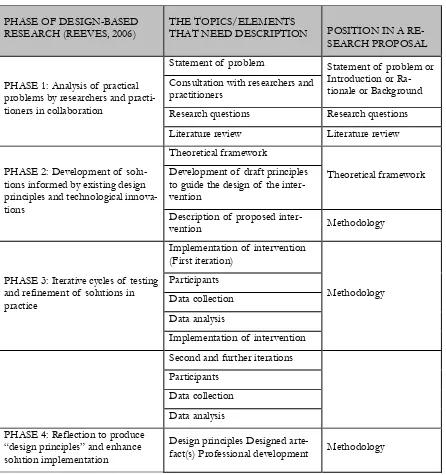
i-tional research design, guidelines provided by universities for doctoralstudents areconfusing rather than helpful when formulating the research proposaland conductthe inquiry(Herringtonet al., 2007). Herrington and colleagues provided insight into this issue by outlining how HDR students adopting a DBR approach might formulate a DBR project within a traditional, predictive doctoral research proposal. To do this, they present four phases of DBRby breaking down the preliminary phase of the approach into two separate phases. The phases of DBR are then juxtaposed with the elements of a traditionaland predictive research proposal to demonstrate ‘fit.’ Table 1highlights this
mapping, as illustrated by Herrington et al. (2007).
Table 1. Design-based research and elements of a research proposal
PHASE OF DESIGN-BASED
RESEARCH(REEVES, 2006) THE TOPICS/ELEMENTS THAT NEEDDESCRIPTION POSITION IN A R
E-SEARCH PROPOSAL
PHASE 1: Analysis of practical problems by researchers and pract
i-tioners in collaboration
Statement of problem Statement of problem or Introduction or Ra-tionale or Background Consultation with researchers and
practitioners
Research questions Research questions
Literature review Literature review
PHASE 2: Development of solu-tions informed by existing design principles and technological
innova-tions
Theoretical framework
Theoretical framework Development of draft principles
to guide the design of the inte
r-vention
Description of proposed
inter-vention Methodology
PHASE 3: Iterative cycles of testing and refinement of solutions in practice
Implementation of intervention (First iteration)
Methodology Participants
Data collection Data analysis
Implementation of intervention
Second and further iterations Participants
Data collection Data analysis PHASE 4: Reflection to produce
“design principles” and enhance solution implementation
Design principles Designed art
e-fact(s) Professional development Methodology
M
ODELS TOUSED
ESIGN-
B
ASEDR
ESEARCH IND
OCTORALS
TUDIESAbdallah and Wegerif (2014) highlight the flexibility of DBR by presenting a version of DBR for doctoralstudies. In contrast to the guidance provided to doctoral students by Herrington and col-leagues(2007), the model does not providea particular format in which to follow but rather “flexibly outlines realistic methods and procedures followed in the study under the DBR umbrella” (Abdallah & Wegerif, 2014, p.15).
Derived from the work of Plomp (2009) the model presented by Abdullah and Wegerif (2014) is
1. Integrating literature and exploratory research to develop initial theoretical framework for design,
2. Implementing this with careful evaluation of processes as well as products in two ite
r-ations, using the results of the study of the first iteration to refine the second itera-tion, and
3. Finally using the results of the second iteration to produce a new and improved the
o-retical framework for design ready for further research study presented as the main outcome of the thesis.
The authors suggest that this model highlights the flexibility of DBR by incorporating the notion that the particular context, nature, and objectives of individual research inquiries are unique (Abdal-lah & Wegerif, 2014). However, in doctoral research, the model is too broad,and as a result,lacks the
specific guidance needed to navigate the different stages of the doctoral process.
Kennedy-Clark (2013)provides an overview of DBR in the HDR experience and contextualize the
phases of DBR in doctoral studies. In a comparison of doctoral theses using DBR, Kennedy-Clark suggests that the three phases of DBR can provide enabling checkpoints that support HDRstudents
in redefining and reflecting on their research as it progresses. In the following section, we have illu
s-trated the three phases of DBR, whichare the preliminary phase, the prototyping phase,and the a
s-sessment phase.
Doctoral students consider the preliminary phase as the stage of the inquiry to formulate the invest
i-gation andprepare the research proposal. This stage incorporates the doctoral proposal and all of the typical requirements that the proposal requires (review of literature, conceptual framework, r
e-search questionsformulation, etc.).
According to Kennedy-Clark(2013), the next phaseof the approach is the prototyping phase, which marks the commencement of the research. This phase also involves a number of iterations ofan intervention or material,with each iteration being a micro cycle of the research. The final phase po
s-ited is the assessment phase. Kennedy-Clark suggests that the purpose at this stage of the inquiry is to conclude the inquiryby discussing how the investigation has answered the research questions. While the checkpoints provided by Kennedy-Clark provide some more specified direction as to how doctoral students might use DBR in the doctoral process, they provide little insight into the flexibility of DBR asa pragmaticmode of inquiry.
TheDBR models discussed make a vital contribution to the field of DBRand provide some gui
d-ance concerning the HDR candidature. However,more insight and guidance into the flexibility of DBR for doctoral research is needed to ensure that studentsand their supervisorsunderstand the potential afforded through the DBR approach.Notably, understanding the challenges of using DBR in doctoral studies paves the way to its effectiveusein doctoral work. Anderson and Shattuck (2012) advisethat one of the challenges for doctoral supervisors and their students in the uptake of a DBR approach lies in the requirement of multiple iterations juxtaposed alongside the time restraint of the HDR candidature. They further suggest that a partial solution is for established education researchers to develop multiyear DBR research agendas that have legitimate space and roles for graduate students to undertake and own significant pieces of this larger agenda(Anderson & Shattuck, 2012). While such solution might be a viable way to assist doctoral supervisorsand studentsin realizing the pote
n-tial of the approach in doctoral work, it requires significant monetary and time investment that might not necessarily be afforded in educational research.
roles of advocate and critic (Design-BasedResearch Collectives, 2003)which can be a difficult path for the novice researcher to navigate.
Despite the challenges, DBR can be drawn upon for a variety of purposes. For example, Thein, Ba
r-bas, Carnevali, Fox, Mahoney, andVensel(2012) used DBR to investigate the effectiveness of teac
h-ing multicultural literature through a collaborative and iterative process of inquiry guidedby
theoreti-cal principles. Hakkarainen (2009) showed its applicability in education to design, implement,and refine a problem-basedlearning course on educational digital video use and production. Similarly, Wang and Hannafin (2005) showed theeffectiveness of the DBR approach to design technology
-enhancedlearning environments. Each of the studies wasiterative, but their duration of iteration varied across the different approaches.This is important insight for doctoral studentsas it highlights the adaptability of the approach for different purposes.
M
ETHOD
In this study, weexamine the methodological approach of two doctoral dissertations against the phases and principles of the DBRthrough aqualitative comparative descriptive approach. Table 1 shows the phases and principles of the DBRsuggested by Reevees (2006) and Herrington et al. (2007). The study also identifies the purposes, brief outcomes,and the challenges of each doctoral study and demonstrates how the approach can be effectively adopted and modified to suit the doctoral inquiry.
D
ATAA
NALYSISThe authors of this study analyzed the data from both doctoral studies alongside with the different phases and principles of the DBR approach. The analysis involved identifying themes and actions that were evident across both studies within each of the DBR phasesand principles. After the
au-thors identified the themes, the two studies were re-analyzed to identify common challenges that were evidentacross each of the inquiries. In the later section, we then examined the data alongside with the traditional doctoral process to establish a set of principles to guide doctoral work that draws on a DBR methodological approach.
B
ACKGROUNDI
NFORMATION-
T
HET
WOD
OCTORALS
TUDIES’
P
URPOSE ANDC
ONTEXTDoctoral study 1: Tertiary level
In doctoral study 1[DS1] (Getenet, 2015), DBR was used to design a Professional Development (PD) program and simultaneously study the research participants’ knowledge of technology integra
t-ed mathematics teaching. Hence, in DS1, the analysis of a learning problem formulatt-ed the research proposal and prompted quite specific ideas for a PD program approach. Alongside the PD program, the researcher included the creation of particular teaching and learningmaterials and methods de-signed to realizeparticipants’ learning gainspredicted by theory and research.The section below il-lustrates the activities conducted in DS1 in each phase.
The preliminary phaseof the research involveda contextual and problem analysisof teachers’
knowledge of technology integrated mathematics teaching,with the development of a conceptual framework based on a review of the research literature. During this phaseof the study, the researc h-er reviewedthe theoretical framework of the study and formulated the PD program guidelines. The guidelinesincluded the formation of teams, identificationof available ICT, and the consideration of web-basedsoftware. Developing the theoretical frameworkfor the study involvedareview of the
through a context analysis. These categoriesare the analysis of learning context, analysis of learners, and analysis of learning tasks.
The second phase of DS1 focused on setting out design guidelines and optimizing the planned PD program through cycles of design, evaluation, and revision (Kelly, 2006; Plomp, 2009). This phase of
the study was iterative,with formative assessment aimed at improving the intervention. Assessing the
quality of the PD program in terms of its practicality and validitywas part of this phase. Participants
in DS1wereactivelyinvolved in shaping each PD program guideline for possible improvement. The
participants further recommended additional PD program guidelines that made the intervention more relevant to their contexts. For example, they suggested the formation of small teams based on their work arrangements.
The last phase of the study was a summative evaluation to determine the extent to which the PD program had met the pre-determined objectives. This phase resulted in recommendations for im-provement to the PD program. This phase also assisted to identifythe effectiveness of the PD pr
o-gram. It involved examining the impact of the PD programon the research participants’ technology integrated mathematics teaching practices by comparing before and after results of participation. In this phase, presenting samples of lessons supportedto show the effectiveness of teacher educators’
ICT integrated mathematics teaching.
In summary, DS1 drew upon DBR to improve practices. As such, the DBR followed in DS1 was helpful for teachers to meet the learning needs of their students. It also provided avoiceto pract i-tioners in the research process.
Doctoral study 2: Transition into the first-year-of-school
DBR was used in doctoral study 2[DS2] (Goff, 2016) to formulate a set of draft principles to guide educators and researchers involved in supporting the mathematical learning of children making the
transitionto school. The research proposal included the analysis of a problem that the researcher had experienced personally, andin her role as both a first-year-of-school and prior-to-school teacher. The problem centered on howto best support thecurrent mathematical understandings, skills, and knowledge of children whenthey start formal education. The research proposal included a theoret
i-cal analysis of the problem,coupled with a proposed solution (intervention) and givento practitio
n-ers for further refinement and implementation. The purpose of the study was not to test the effe
c-tiveness of the proposed intervention, but to draw on the refinement and implementation of the intervention in context,to develop some draft principles for future workin this area. The section below illustrates each phase of DBR as reflected in DS2.
The preliminary phaseof the studyinvolved establishing a sound theoretical construct. The devel-opment of the theoreticalconstructfocused on how the mathematical learning of children best be supported during the transition to school. Once established, the theoretical construct was then drawn upon to develop a tentative research plan: an intervention that focused on supporting the mathemat
i-cal learning of children. In relation to the development of the research proposal, the researcher
pre-sented a tentative plan for the research, but she communicated in her candidature document that the study was emergent, and therefore how it unfolded in practice could not be predetermined.
After confirmation of candidature, the researcher took the research proposal to practitioners for di
s-cussion and refinement. It was at this stage of DS2 (Phase 2) where the researcher recruited partic
i-pants into the study and primed the intervention for implementation in two different contexts. The researcher documented both Phase 1 and Phase 2, whichformed a significant component of the f
i-nal thesis document. The refined intervention involved the establishment of two research teams l
o-cated at two different sites (consisting of a prior-to-school and first-year-of-school teacher and fam
i-lies of children making the transition to school). Each research team wasprovided with the
they made the transition to school. The researchers’ role within the project was to study what tra
n-spired at the two different sites.
The third phase of DS2involved implementing the refined intervention. As the implementation took place, four research team meetings were conducted at each of thetwosites. Research team meetings provided an opportunity for participants to talk about their experiences, including some of the chal-lenges and opportunities that were transpiring. They also provided an opportunity for further
re-finement of the intervention as it unfolded in practice, and afforded the researcher and participants with various opportunities to guide or ‘test-out’ the intervention in different ways. During this phase, the researcher documented the processes as the interventionunfolded at the two different sites. This included the documentation and ‘on-the-run’ analyses of all decisions.
The final phase of the project involved a retrospective analysis of the process from conception to completion. In this phase of DS2, the conceptual framework of the Cultural Interface (Nakata, 2007) was drawn upon to analyze what transpired in practice. The purpose of this retrospective anal-ysis was not to test the effectiveness of the intervention but to derive a set of draft principles that could be further refined and drawn upon in later work. In the thesis,these principles were presented as a starting point for others embarking on similar work(Goff, 2016). The final phase also involved examining the draft principles alongside current research literature. This facilitated a way to provide recommendations for utilizing the draft principles and suggested their application for future work.
The findings of DS2 resulted in six design principles. These results are not definitive but rather pr
o-vide a starting point for those examining how best to support the mathematical learning of children making thetransition to school. They also provide a research trajectory for the doctoral student (Goff, 2016)post candidature. The six design principles are focused on howadults come together to support the mathematical learning of children and provide insight into what might need to be co
n-sidered by those embarking on similar work. The six principles are:
Principle 1 - The transition to school is recognized as a developmental context for adults. Principle 2 - Relationship and partnership are recognized as independent but interconnected co n-cepts.
Principle 3 - Adults are supported to navigate through their transition experience.
Principle 4 - A particular task to perform will provide a reason for ongoing interaction and facilitate partnership.
Principle 5 - Opportunities for ongoing interactions aboutmathematics are afforded and
Principle 6 - Opportunities to reconstruct mathematics in a shared space are provided (Goff, 2016).
R
ESULTS
In this section, we present the results of the study by examining the methodological approaches of
the two doctoral dissertations against the phases and principles of DBR. The results focus on the phases of DBR and the challenges in using the DBR approachas reflected in the two doctoral studies.
P
HASES OFDBR
IN THET
WOD
OCTORALS
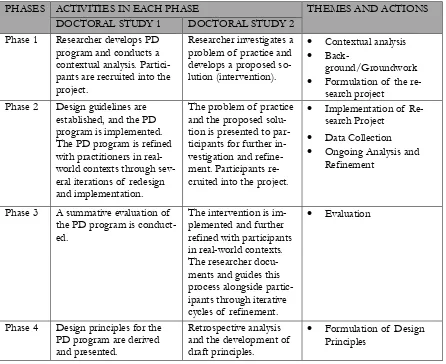
TUDIESTable 2 presents activities in each of the doctoral studies and the themes that emerged across the two studies. The background information of the two doctoral studies described in the method section of
[image:9.612.103.549.132.496.2]this study supported to identify the themesdescribed in Table 2.
Table 2. Summary of themes emerged alongside the phases of the DBR Approach
PHASES ACTIVITIES IN EACH PHASE THEMES ANDACTIONS
DOCTORAL STUDY 1 DOCTORAL STUDY 2
Phase 1 Researcher develops PD program and conducts a contextual analysis. Partic
i-pants are recruited into the project.
Researcher investigates a problem of practice and develops a proposed s
o-lution (intervention).
• Contextual analysis • Bac
k-ground/Groundwork • Formulation of the
re-search project Phase 2 Design guidelines are
established,and the PD program is implemented. The PD program is refined with practitioners in real
-worldcontexts through sev-eral iterations of redesign and implementation.
The problem of practice and the proposed solu-tion is presented to pa
r-ticipants for further i
n-vestigation and refin
e-ment. Participants r
e-cruited into the project.
• Implementation of R
e-search Project • Data Collection • Ongoing Analysis and
Refinement
Phase 3 A summative evaluation of the PD program is conduc t-ed.
The intervention is im-plemented and further refined with participants
in real-worldcontexts. The researcher docu-ments and guides this process alongside parti
c-ipants through iterative cycles of refinement.
• Evaluation
Phase 4 Design principles for the PD program are derived and presented.
Retrospective analysis and the development of draft principles.
• Formulation of Design Principles
As shown in Table 2, even though both doctoral studies have completed similar activities in Phases 1, 3 and 4, the activities completed in Phase 2 were slightly different. For example, the primary focus of DS1 in Phase 2 was designing PD program guidelines and refinement of the PD guidelines working with practitioners in real-worldcontexts. Whereas, the focus of DS2 in Phase 2 was presenting a proposed solution to participants for further investigation and refinementas well as participants’
re-cruitment.
C
HALLENGES INC
ONDUCTING EACHD
OCTORALS
TUDYDoctoral study 1
DS1 encountered a number of challenges. The challenges in DS1included an extensive data set, challenges with how the researcher might position himself as the study unfolded, collaborating with research participants in the research process, and the time constraint to complete the research pr
o-ject. In the following paragraphs, we illustrateeach of the challengesin DS1.
discussions (including workshops). As a result, the researcher made a choice regarding aspects of the
research to emphasizeand selecting the data that addressed the research themes as encapsulated in the research questions. This did not mean that the doctoral study used a small part of the data col-lected. Rather, it documented the whole design process and reported key findings.
The second challenge in DS1was the role of the researcher,either towards the subjective side or
to-wards closerto an objectivist stancein the research process. However, the researcher played a signif
i-cant and positive role in shaping the phenomena under study. As a result, in DS1, the researcher e
n-gaged in creative activitiesof developing PD program guidelinesguidedby existing scientific knowledge and practitioners’ voice. Equally, the researcher was careful not to impose the values and beliefs held but acted asa facilitator throughout the process.
Deeply involving participants in the research process was another challenge identified in DS1. At the
start of DS1, the participants in the study preferred to attach themselves to the matured teaching practiced approaches rather than immersing themselvesin a new approach,which required the use of ICT in their teaching. It took asignificant timeinvestmentto engage effectively the participants in
eachactivity of the research process.
DBR usually takes an extended period so that a PD program can be developed and refined through an iterative process and as a result have a maximum impact on the participants’ practices (Wang & Hannafin, 2005). Due to the restricted timeframe of the doctoral candidature, the study was unable
to incorporatemultiple prototypes for the PD design(Getenet, 2015).
Doctoral Study 2
In DS2(Goff, 2016) similar challenges were encountered. These challenges included decisions around the recruitment of participants, the largedata set that emerged, and the time constraints im-posed by the doctoral process.The recruitment of participants in DS2was an intricate process that demanded a significant component of planning. The close proximity in which the researcher works with participants in DBR necessitates that a sound rapport between researcher and participant is d
e-veloped (Mitchell, 2010). Within the time restraints of the doctoral process, this required careful co
n-sideration and various purposeful steps. For example, the researcher initially met with the partic
i-pants’ supervisors (the school principal and the pre-school coordinator) to explain the project and detail the level of support afforded to the participants. Such steps were planned during the proposal stage of the research and were designed to maximize the time that could be spent developing and building rapport.
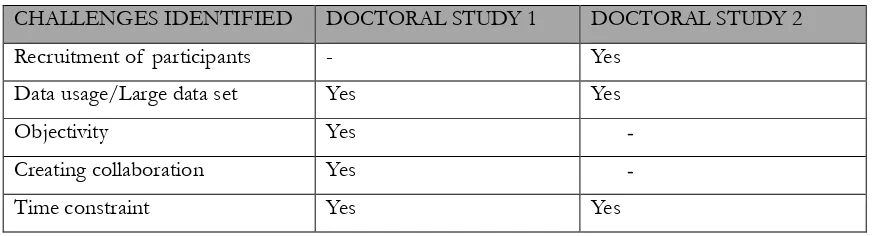
[image:10.612.65.502.599.717.2]Similarly,to DS1, the use of multiple instruments (video-recorded team meetings, research field notes, participant diaries,and email data) and data sources generated a significant amount of data. As a result, choices had to be made about which aspects of the data collected were to be highlighted and emphasized. The researcher chose the relevant data by maintaining an explicit focus on the research questions under investigation, rather than opening the inquiry up to other possibilities that emerged as the investigationunfolded. Table 3 summarizes the challenges identified in DS1 and DS2.
Table 3. Challenges identified in each doctoral studies
CHALLENGES IDENTIFIED DOCTORAL STUDY1 DOCTORAL STUDY 2
Recruitment of participants - Yes
Data usage/Large data set Yes Yes
Objectivity Yes
-Creating collaboration Yes
As shown in Table 3, we have identified that recruitmentof participants, largedata sets,and time constraints were the challenges in both doctoral studies. For example, in relation to time constraint, it is assumed that DBR inquiries are typically in-depth and longitudinal, and involve a research team rather than a solitaryresearcher. In the two doctoral studies,however, such affordances were not
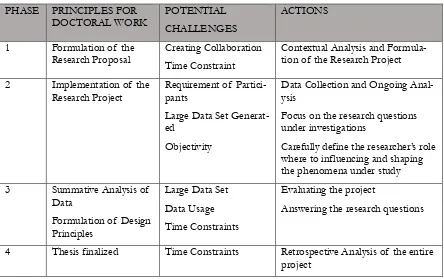
pre-sent due to the nature of the doctoral candidatureand the limited time the doctoral process imposes. To combat these issues, the researcher (in DS2)considered the inquiry beyond the doctoral process. As such, the DBR process was broken down into two distinct components – the doctoral research and a post-doctoral plan. This resulted in a change of purpose of the doctoral research, whereby the aim of the inquiry was to formulate a draft set of design principles that could be both offered to others as a starting point for engaging in similar work and a starting point for post-doctoral studies. In doing so, the nature of depth of the DBR approach was not lost through the time constraints im-posed by the doctoral candidature, nor was the notion that DBR demands an investment in time if it is to generate long-lasting or significant change. Table 4 summarizes the principles for a doctoral di
[image:11.612.103.547.291.570.2]s-sertation, potential challenges as reflected in both doctoral studies and possible actions to overcome those challenges.
Table 4. Principles for DBR in Doctoral Studies
PHASE PRINCIPLES FOR
DOCTORAL WORK POTENTIAL CHALLENGES ACTIONS
1 Formulation of the
Research Proposal Creating CollaborationTime Constraint Contextual Analysis and Formula-tion of the Research Project
2 Implementation of the
Research Project Requirement of Particpants i-Large Data Set Genera t-ed
Objectivity
Data Collection and Ongoing
Anal-ysis
Focus on theresearch questions under investigations
Carefully define the researcher’s role where to influencing and shaping the phenomena under study 3 Summative Analysis of
Data
Formulation of Design Principles
Large Data Set Data Usage Time Constraints
Evaluating the project
Answering the research questions
4 Thesis finalized Time Constraints Retrospective Analysis of the entire project
Formulating a plan that extended beyond the doctoral inquiry also provided the researcher with a trajectory for academic work beyond candidature. This is an important consideration for doctoral candidates to formulate a career in academia.
In summary, both doctoral studies encountered similar challenges in using DBR as a methodological approach.
D
ISCUSSION
i-ous phases and principlesproposed by Reeves (2006) and Herrington et al. (2007). However, the overall goal of methodology for each of the projects was what differed. The goal of the method for DS1was to formulate a set of design principles and complete the DBR process. Whereas, the goal
of DS2was to commence the DBR process by developinga set of draft principles that could be fu
r-ther refined, tested,and built upon post-candidature. Goals of the methodology are an important consideration when navigating the doctoral process, particularly if doctoral students considered DBR asthe methodological approach adopted. Thinking about the doctoral process in different ways such as the beginning of a longitudinal inquiry can facilitate this notion. Consistent with the
recommenda-tions of Anderson and Shattuck (2012), in this study, the authors noted that the doctoral students remainfocused on the goals that they set out to achieve rather than becomingcaught up in the itera-tive and emergent nature of the DBR approach. This implies that the methodology should support the research goals rather than create them.
In each doctoral study, the DBR methodological approach provided a solid basisfromwhich to e
n-gage in educationalinquiry. Each study was situated in the pragmatics of the everyday, was conduc
t-ed in collaboration with practitioners, and was emergent in nature. The DBR principles were ust-ed to satisfy each doctoral study goal working with practitioners. Both doctoral studies were also interve
n-tionist and were designed to address a problem of practice. Identifying similarities across different
inquiries that have adopted a DBR methodological approach provides a basis thatother doctoral candidates can draw upon. The two doctoral studies presented in this paper, coupled with the various phases and activities presented by Reeves(2006) and Herrington et al. (2007), provides insight into
this process.
Mapping the themes that emerged across the two doctoral approaches, alongside the traditional do
c-toral research approach, highlights the effectiveness and flexibility of DBR as an appropriate met
h-odology for doctoral work. Explicating the different stages of the doctoral candidature provides a robust roadmap in which HDR students can align the specific milestones of their candidature alon g-side the variousphases of the approach. It also provides a roadmap for HDR supervisors as they guide and support their students’ candidature.
The design principles for doctoral work highlight the different stages of doctoral work alongside the various phases of the DBR approach. The actions and potential challenges presented provide insight into what activity should take place throughout the candidature as well as highlightthe differing chal-lenges that the HDR student might faceas the study unfolds.
The challenges that emerged in the doctoral studiespresented in this studywere not unlike those challenges identified by others within the DBR research literature (see Anderson & Shattuck, 2012; Dede, 2004). Creating complex interventions with practitioners in real-world contexts is a challenging activity. Researching and driving the research process adds to this complexity, particularly within the doctoral candidature where the added pressures of the limitation of timeand the novice navigation of the research terrain are also present. To overcome some of these challenges,it is important that the doctoral candidate makes use of the human resources that surround them at this time – particu-larlyexperienced researchers and supervisors who are well-positioned to provide guidance and me
n-torship. Maintaining a close relationship and focus on the research questions under investigations will also achieve this goal (see Table 4), as will a preparedness for the common challenges identified in this study. In the two doctoral studies, time constraint was overcome through, for example, owning the significant pieces of the larger research agenda, whichareconsistent with the recommendation of Anderson and Shattuck (2012).
Different from the common trendsof educational research, whichis its emphasis on practices rather
than afocus to improve practice (e.g., Anderson & Shattuck, 2012; McKenney & Reeves, 2012), the two doctoral studies showed the potential advantages of DBR to improve practices through the a
n-derstanding of the problemworking with practitionersunited by a common purpose. For example, DS1included both types of researchon practice and research in practiceconcurrently. That is, it i
n-volved research on a practice by working with practitioners to design a PD programandused as a springboard to improve their educational practices to improve the practitioners’ competencies to use technology in teaching mathematics. This implies that the DBR approach allowed the researchers to work in collaboration with the practitioners to improve practitioners’ practical problems designed to
enhancetheir practices rather than only doing research on them. This is also another dimension for doctoral students to use DBR approach in their doctoral dissertation as a research methodology to influence practiceas well as creatingalong-termpartnership with practitioners.
C
ONCLUSION
In this study, we usedReeves (2006) and Herrington et al.’s (2007) phases and principles of the DBR approach to examine the methodological approaches of two doctoral dissertations. As a result, the authors of this study presented twodifferent doctoral dissertationsthat have adopted a DBR met
h-odological approach. As evident throughout this study, DBR provides an important methodological approach for understanding and addressing problems of practice, particularlyin the educational co
n-text, where a long criticism of educational research is that it is often divorced from the reality of the everyday(Design-BasedResearch Collective, 2003). Doctoral candidates,situated in Faculties and Schools of Education, whoadopt a DBR methodological approach are positionedwell to begin to change this mantra and to generate authentic change within the educational context.
This study has also demonstrated that the DBR approach canbe employed to bring researchers and practitioners together to design context-based solutionsto educational problems, whichhave deep-rooted meaning for practitioners about the relationship betweeneducational theory and practice. As shown in the twodoctoral studies, the researchers and practitionersworked closely together, making meaningful changes to their practice. Thinking creatively about what DBR might look like within the doctoral processand encouraging doctoral students to explore the methodological approach is a way to facilitate this notion. The design principles presented in this study can help guide this exploration. Even though DBR is assumed a long-term and intensive approach to educationalinquiry that do
c-toral students should not attempt to adopt for their docc-toral dissertations, the findings of this study demonstrated that DBRcanbe used in the shorter term and less intensive contexts of doctoral r
e-search. The findings of this study could make a contribution to understandings the challenges of using DBR and possible strategies to overcome those challenges to use DBR approach in doctoral work.
R
EFERENCES
Abdallah, M. M. S.,& Wegerif, R. B. (2014). Design-based research (DBR) in educational enquiry and technological studies: A version for PhD students targeting the integration of new technologies and literacies into educational contexts. ERIC: ED546471. Retrievedfrom http://files.eric.ed.gov/fulltext/ED546471.pdf
Anderson, T., & Shattuck, J. (2012). Design-based research:A decade of progress in education research? Educa-tional Researcher, 41(1), 16-25. doi: 10.3102/0013189x11428813
Barab, S., & Squire, K. (2004). Design-based research: Putting a stake in the ground. The Journal of the Learning Sciences, 13(1), 1–14. doi: 10.1207/s15327809jls1301_1
Brown, A. L. (1992). Design experiments: Theoretical and methodological challenges in creating complex i n-terventions in classroom settings. The Journal of the Learning Sciences, 2(2), 141–178.
doi: 10.1207/s15327809jls0202_2
Cobb, P. (2011). Introduction. In E. Yackel, K. Gravemeijer,& A. Sfard (Eds.), A journey in mathematics education research - Insights from the work of Paul Cobb (pp. 9-17). Dordrecht: Springer.
Corbin, J., & Strauss, A. (2014). Basics of qualitative research: Techniques and procedures for developing grounded theory. London, UK: Sage publications.
Dede, C. (2004). If design-based research is the answer, what is the question? A commentary on Collins, J o-seph, and Bielaczyc; diSessa and Cobb; and Fishman, Marx, Blumenthal, Krajcik, and Soloway in the JLS special issue on design-based research.The Journal of the Learning Sciences, 13(1), 105-114.
doi: 10.1207/s15327809jls1301_5
Design-Based Research Collective. (2003). Design-based research: An emerging paradigm for educational i n-quiry. Educational Researcher, 32(1), 5-8. doi: 10.3102/0013189X032001005
Getenet, S. (2015). Enhancing mathematics teacher educators' technological pedagogical content knowledge through collaborative professional development: Ethiopia. Unpublished doctoral dissertation, University of Tasmania, Launceston, Australia.
Goff, W.M.(2016). Partnership at the cultural interface - How adults come together to support the mathematical learning of children making the transition to school. Unpublished doctoral dissertation, Charles Sturt University,Bathurst, Australia
Gravemeijer, K., & Cobb, P. (2006). Design research from a learning design perspective. In J. Van den Akker, K. Gravemeijer, S. McKenney, & N. Nieveen (Eds.), Educational design research(pp. 17–51). London, England: Routledge.
Hakkarainen, P. (2009). Designing and implementing a PBL course on educational digital video production: Lessons learned from a design-based research. Educational Technology, Research and Development, 57(2), 211– 228. doi: 10.1007/s11423-007-9039-4
Herrington, J., McKenney, S., Reeves, T.,& Oliver, R. (2007). Design-based research and doctoral students: Guidelines for preparing a dissertation proposal. In C. Montgomerie & J. Seale (Eds.), Proceedings of World Conference on Educational Multimedia, Hypermedia and Telecommunications 2007(pp. 4089-4097). Chesapeake, VA: AACE.
Johnson, R.B., Onwuegbuzie, A.J., & Turner, L.A. (2007). Towards a definition of mixed methods research. Journal of Mixed Methods Research, 1(2), 112-133. doi: 10.1177/1558689806298224
Kelly, A. E. (2006). Quality criteria for design research: Evidence and commitments. In J. van den Akker, K. Gravemeijer, S. McKenney, & N. Nieveen (Eds.), Educational design research(pp. 107–118). Abingdon, UK: Routledge.
Kennedy-Clark, S. (2013). Research by design: Design-based research and the higher degree research student. Journal of Learning Design, 6(2), 26-32. doi: http://dx.doi.org/10.5204/jld.v6i2.128
Maxcy, S.J. (2003). Pragmatic threads in mixed methods research in the social sciences: The search for multiple modes of inquiry and the end of the philosophy of formalism. In A. Tashakkori & C. Teddlie (Eds.), Handbook of mixed methods in social and behavioral research (pp. 51-89). Thousand Oaks, CA: Sage. McKenney, S. E., & Reeves, T. C. (2012). Conducting educational design research. New York, NY: Routledge. McKenney, S., & Van Den Akker, J. (2005). Computer-based support for curriculum designers: A case of d
e-velopmental research.Educational Technology Research and Development, 53(2), 41-66. doi: 10.1007/bf02504865 Metcalfe, M. (2008). Pragmatic inquiry. The Journal of the Operational Research Society, 59(8), 1091-1099.
doi: 10.1057/palgrave.jors.2602443
Mitchell, W. (2010). ‘I know how I feel’listening to young people with life-limiting conditions who have learning and communication impairments.Qualitative Social Work,9(2), 185-203. doi: 10.1177/1473325009346460 Nakata, M. (2007). The cultural interface. The Australian Journal of Indigenous Education,36(S1), 7-14.
doi: 10.1017/S1326011100004646
Plomp, T. (2009). Education design research: An introduction. In T. Plomp & N. Nieveen (Eds.), An introduction to educational design research(pp. 9–35). Enschede, The Netherlands: Netherlands Institute for Curriculum Development.
Reeves, T. C., Herrington, J., & Oliver, R. (2005). Design research: A socially responsible approach to instru c-tional technology research in higher education. Journal of Computing in Higher Education, 16(2), 96–115. doi: 10.1007/bf02961476
Smith, P. L., & Ragan, T. J. (2005). Instructional design. Hoboken, NJ: Wiley & Sons.
Tashakkori, A., & Teddie, C. (Eds.). (2010). SAGE handbook of mixed methods in social and behavioural research. London: Sage.
Thein, A. H., Barbas, P., Carnevali, C., Fox, A., Mahoney, A., & Vensel, S. (2012). The affordances of design -based research for studying multicultural literature instruction: Reflections and insights from a teacher -researcher collaboration. English Teaching: Practice and Critique, 11(1), 121–135.Retrievedfrom
http://files.eric.ed.gov/fulltext/EJ970235.pdf
Van den Akker, J. (1999). Principles and methods of development research. In J. van den Akker, R. Branch, K. Gustafson, N. Nieveen, & T. Plomp (Eds), Design Approaches and tools in education and training (pp. 1–15). Dordrecht: Kluwer Academic Publishers.
Van den Akker, J., Gravemeijer, K., McKenney, S., & Nieveen, N. (2006). Introducing educational design r e-search.In J. V. D. Akker, K. Gravemeijer, S. McKenney, & N. Nieveen (Eds.), Educational design research(pp. 3–7). New York, NY: Routledge.
Wang, F., &Hannafin, M. (2005). Design-based research and technology-enhanced learning environments. Edu-cational Technology Research and Development, 53(4), 5-23. doi: 10.1007/bf02504682
B
IOGRAPHIES
Dr Wendy Goffhas worked with schools to develop a variety of
intervention and support programs targeting the social welfare needs of children and families. Her research focuses on adult relationships and how they might impact on the learning and development of children. Throughout her career she has worked as a social welfare worker, a pre
-school teacher, and a primary -school teacher. She joined the tertiary setting in 2010. Wendy is particularly interested in the mathematical learning of children, and her recent work involved the implementation of an intervention focusing on adults noticing and supporting the
mathematical understandings of children making the transition to school. Wendy uses an Educational
Design-Based Research (DBR) methodological approach in her work, and her research is embedded in real-world settings.
Dr Seyum Getenethas worked as a lecturer in Teacher Education Un
i-versity for more than 9years. Hehas also taught primary and secondary schools mathematics. His research interest is onpedagogical content knowledge of mathematics teachers and how professional development is
used as an enabler for change. Most of his research work use Design
-Based Research methodological approach. He is currently working as a