City, University of London Institutional Repository
Citation
:
Asad, M. and Abhayaratne, C. (2013). Kinect depth stream pre-processing for
hand gesture recognition. Paper presented at the 2013 IEEE International Conference on
Image Processing, ICIP 2013, 15 September - 18 September 2013, Melbourne, Australia.
This is the unspecified version of the paper.
This version of the publication may differ from the final published
version.
Permanent repository link:
http://openaccess.city.ac.uk/3583/
Link to published version
:
http://dx.doi.org/10.1109/ICIP.2013.6738770
Copyright and reuse:
City Research Online aims to make research
outputs of City, University of London available to a wider audience.
Copyright and Moral Rights remain with the author(s) and/or copyright
holders. URLs from City Research Online may be freely distributed and
linked to.
City Research Online:
http://openaccess.city.ac.uk/
[email protected]
KINECT DEPTH STREAM PRE-PROCESSING FOR HAND GESTURE RECOGNITION
Muhammad Asad
∗Dept. of Computer Science
City University London, United Kingdom
Charith Abhayaratne
†Dept. of Electronics & Electrical Engineering
University of Sheffield, United Kingdom
ABSTRACT
Over the recent years there has been growing interest to propose a robust and efficient hand gesture recognition (HGR) system, using real-time depth sensors like Microsoft Kinect. The performance of such HGR systems have been affected by the low resolution, noise and quantization error in the depth stream. In this paper, we pro-pose a method to pre-process Kinect depth stream in order to over-come some of these limitations. The design approach utilizes the hand tracker from OpenNI SDK to perform distance invariant seg-mentation of hand region depth stream. This is followed by the con-struction of three different projections of hand in XY, ZX and ZY planes. These projections are then further enhanced using a com-bination of morphological closing and simple averaging based in-terpolation. The evaluation results show above 80% similarity with ground truth, and 1.45-5.35% increase in accuracy for gestures with recognition accuracy less than 90%.
Index Terms— Kinect sensor, pre-processing, depth stream, hand gesture recognition, real-time
1. INTRODUCTION
With the recent introduction of Microsoft Kinect, there has been in-creasing interest in research community to use this inexpensive and powerful sensor in almost every domain in the field of Computer Vision. The main attraction of Kinect sensor in this field is the real-time provision of depth data. Combining this with the functionality of different Computer Vision libraries, a whole new category of ap-plications has started to emerge [1–3].
Since Microsoft Kinect’s introduction in 2010, there have been numerous attempts to use it to propose a number of HGR systems [4–13]. The depth stream acquired from Kinect sensor is low res-olution (640x480) and contains random noise and quantization er-ror [14]. This limits the operating range and functionality of most of the existing techniques, where some approaches also utilize RGB data stream to assist the depth stream based segmentation and HGR [5–10]. Another category of HGR systems utilize only the hand tra-jectory from depth stream to interpret gestures [11–13]. This paper proposes a Kinect depth stream pre-processing method for HGR, which extracts accurate 3D hand posture information and reduces quantization error.
A number of pre-processing methods for Kinect depth stream have been previously proposed. Most of these methods focus on de-noising [15–18] and filling the ’holes’ discontinuity in the depth stream [19–21]. There are some methods which focus on increas-ing the resolution, hence reducincreas-ing the quantization error [22, 23].
∗M. Asad was at the University of Sheffield and is now a PhD student at
the City University London, [email protected] †C. Abhayaratne is with the University of Sheffield, UK [email protected]
Most of these methods are complex for real-time execution and fo-cus on the overall enhancement of the depth streams. There is still a need for a reliable and efficient Kinect depth stream pre-processing method for HGR.
In this paper we propose a Kinect depth stream pre-processing method for HGR systems. The proposed approach involves distance invariant segmentation of hand region from the depth stream (section 2). This segmented depth stream is used to construct projections of the hand region in three different planes. The quantization error in the extracted projections is reduced by using a combination of mor-phological operations and averaging based interpolation. Similarity measure and a neural network based ground truth model is used to evaluate the performance of this method (section 3).
2. PROPOSED DEPTH STREAM PRE-PROCESSING
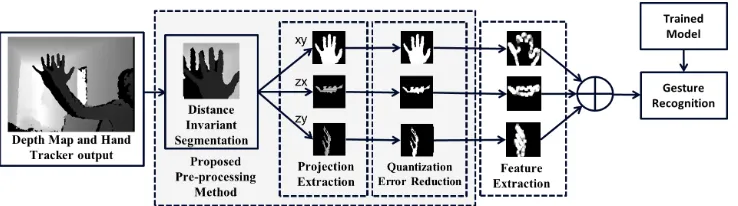
The flowchart of the HGR system is presented in Fig. 1. This system consists of five parts. Distance invariant segmentation step involves segmenting the hand region using distance of the hand from the sen-sor. This is followed by projection extraction in which projections of the hand are extracted in XY, ZX, and ZY planes. Quantization error reduction is then performed and contour features of these projections are extracted. These features are used in the gesture recognition step, where a neural network based classifier recognizes each posture of the hand.
The proposed Kinect depth stream pre-processing approach con-sists of three main steps, which are (i) distance invariant segmenta-tion, (ii) projection extraction and (iii) quantization error reduction. These methods are highlighted in Fig. 1 and discussed in detail be-low.
2.1. Distance Invariant Hand Segmentation
The method proposed in this step performs distance invariant seg-mentation on Kinect depth streamI to obtain hand region depth streamIsby utilizing the hand tracker from OpenNI SDK. This hand tracker extracts a hand pointP = (Px, Py, Pz), defining the loca-tion of the hand in 3D coordinates, which is utilized throughout this paper. We collected a set ofIwith open hand pose at varyingPz.Is was manually segmented from the collected set ofI. For simplicity
Isis kept square in size, with side lengthS. Two sample frames with this hand pose atPz =700mm and 1700mm are shown in Fig. 2(a) and 2(c), respectively, in which the hand point location is marked with a white dot on the palm of the hand. It can be observed from these figures that the size of the hand region decreases with increased
Pz. We use this inverse relationship betweenPz andS along with their values extracted from the set of manually segmentedIsin the following equation to calculate the value ofK.
S= K
Pz
Fig. 1. Flowchart of the HGR system using our proposed pre-processing method.
(a) (b)
(c) (d)
Fig. 2. Distance invariant segmentation atPz = 700mm, (a) depth
streamI, (b) Segmentated depth streamIswith size 156x156 pixels, and atPz= 1700mm, (c) depth streamI, (b) depth streamIswith size 64x64 pixels.
The value ofKcomes out to be 108000. This value is independent of the sensor used, however it is dependent on the output resolution ofI. We use 640x480 pixelIfor our implementation. When using a different resolutionI, the value forKcan be easily recalculated us-ing the above described method. Equation 1 is then used to segment the hand region in all three axis, taking hand point(Px, Py, Pz)as the origin for segmentation. Fig. 2(b) and 2(d) show the output of this distance invariant segmentation for Fig. 2(a) and 2(c) respec-tively.
2.2. Projection Extraction
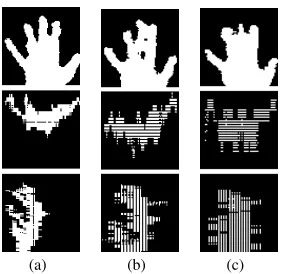
The proposed approach uses a method similar to the construction of action graphs in [24] and silhouette image based 3D matching in [25]. The contribution of this work is to use a series of projections to define a 3D hand gesture. This involves the use of a segmented hand region depth stream to construct three silhouette projections in XY, ZX and ZY plane. These projections provide the front, top and side view of the hand respectively. Each of these projections are stored as a mask (mxy,mzx,mzy) which are used in the next step
(a) (b) (c)
Fig. 3. Projections extracted from segmented hand region depth
stream, (a) mxy projection (front view), (b)mzx projection (top view), (c)mzyProjection (side view).
for quantization error reduction and are given by
mxy(x, y) =
(
1, ifIs(x, y)>0
0, ifIs(x, y) = 0
, (2)
mzx(z−cz, x) =
(
1, ifIs(x, y)>0
0, ifIs(x, y) = 0
, (3)
mzy(z−cz, y) =
(
1, ifIs(x, y)>0
0, ifIs(x, y) = 0
, (4) where Is(x, y) is the segmented depth stream containing depth valuezat each location(x, y)andczis a shifting offset defined by
Pz−S2. The extracted projections are normalized to 64x64 pixels as each projection has different size due to dynamic segmentation size from previous step. Fig. 3 shows the constructed projections of hand region for an open hand pose, which includes noise and quantization errors. The next subsection introduces steps to reduce the quantization error.
2.3. Quantization Error Reduction
In [14], it was found that depth stream contains random noise and quantization error which increases quadratically with increased dis-tance from the sensor. The depth stream is quantized for discrete values of x and y which gives rise to discontinuities when extracting ZX and ZY projection as shown in Fig. 4. The proposed method for this quantization error reduction consists of two different techniques which, when combined, are able to reduce these errors. These ap-proaches are explained below.
2.3.1. Morphological Filtering
[image:3.612.125.494.71.174.2] [image:3.612.55.298.227.427.2] [image:3.612.315.555.229.313.2](a) (b) (c) (d) (e)
Fig. 4. Projections without quantization error reduction showing
mxy(top row),mzx(middle row) andmzy(bottom row) atPz = (a) 700mm, (b) 950mm, (c) 1200mm, (d) 1450mm, (e) 1700mm.
(a) (b) (c) (d) (e)
Fig. 5. Projections with morphological closing based quantization
error reduction showingmxy(top row),m0zx(middle row) andm
0
zy (bottom row) atPz =(a) 700mm, (b) 950mm, (c) 1200mm, (d) 1450mm, (e) 1700mm.
This approach uses two types of structuring elements, depending on the orientation of quantization error gap. These structuring elements are
VSE=
0 1 0 0 1 0 0 1 0
, (5) HSE=
0 0 0 1 1 1 0 0 0
, (6)
whereVSE and HSE correspond to a vertical and horizontal line structuring elements respectively. The selection of these structuring elements for each projection is based on the orientation of disconti-nuities in that particular projection. The outputm0zxandm
0
zyof this step is given by
m0zx= (mzx⊕VSE) VSE, (7)
m0zy= (mzy⊕HSE) HSE, (8) where⊕is morphological dilation and is morphological erosion. These output masks are shown in Fig. 5. It can be observed from this figure that the morphological closing operation only works for
Pz ≤950mm, which is due to lower magnitude of discontinuities at less distances. Therefore, we introduce an interpolation step be-fore these operations to make them work withPz >950mm. This interpolation step is explained in detail in the next subsection.
(a) (b) (c)
Fig. 6. Projections with interpolation based quantization error
re-duction: mxy(top row),mzx(middle row) andmzy (bottom row) atPz=(a) 1200mm, (b) 1450mm, (c) 1700mm.
2.3.2. Interpolation
To reduce the quantization error forPz > 950mm, we introduce a simple averaging based interpolation step. This step is further di-vided into two parts which are (i) searching for the regions with dis-continuities, and (ii) interpolating them using a simple average of previous and next existing values. The method involving detection of these discontinued regions works by traversing through the pro-jection masks in the opposite direction to the discontinuities. The location of the first value found is stored as(prevx, prevy). These values are used along with the immediate next existing line coor-dinates(nextx, nexty)to reconstruct the region in between. The reconstruction step involves finding the midpoint of both line coor-dinates and setting its value to interpolate the region. This recon-struction process is repeated recursively until the number of speci-fied recursion steps is achieved. This interpolation method is applied throughout the projections. The equation for the average based in-terpolation operation is given by
m(prevx+nextx
2 ,
prevy+nexty
2 ) = 1, (9)
wherem ={mzx, mzy}. The computation power required by this step is directly proportional to the size of the input projection and the number of recursive steps. This makes it computationally expensive to fill large quantization error gaps,i.e., quantization error at greater
Pz. To utilize these quantization error reduction techniques effi-ciently, our system uses interpolation steps only forPz >950mm. Furthermore, less number of recursive steps are performed, which are sufficient to reconstruct projection masks when followed by mor-phological closing operations. Fig. 6 shows the output, where the number of recursion steps performed is two. The overall output of the proposed method is shown in Fig. 7, combining both morpholog-ical filtering and interpolation steps. It can be observed that the re-constructed projections have increasing random noise with increas-ing distancePz. Therefore, we impose a range limitation of distance
Pz≤1700mmon our proposed method.
3. EXPERIMENTAL RESULTS AND ANALYSIS
[image:4.612.365.506.73.210.2] [image:4.612.57.296.74.214.2] [image:4.612.56.296.269.408.2](a) (b) (c) (d) (e)
Fig. 7. Projections with the proposed quantization error reduction
step: Mxy (top row), Mzx (middle row) and Mzy (bottom row) atPz = (a) 700mm, (b) 950mm, (c) 1200mm, (d) 1450mm, (e) 1700mm.
600800 1000 1200 1400 1600 0 20 40 60 80 100
Depth Pz
% similarity w.r.t. GT
Gesture 1 MZX
QR WQR
600800 1000 1200 1400 1600 0 20 40 60 80 100
Depth Pz
% similarity w.r.t. GT
Gesture 2 MZX
QR WQR
600800 1000 1200 1400 1600 0 20 40 60 80 100
Depth Pz
% similarity w.r.t. GT
Gesture 3 MZX
QR WQR
600800 1000 1200 1400 1600 0 20 40 60 80 100
Depth Pz
% similarity w.r.t. GT
Gesture 4 MZX
QR WQR
600800 1000 1200 1400 1600 0 20 40 60 80 100
Depth Pz
% similarity w.r.t. GT
Gesture 1 MZY
QR WQR
600800 1000 1200 1400 1600 0 20 40 60 80 100
Depth Pz
% similarity w.r.t. GT
Gesture 2 MZY
QR WQR
600800 1000 1200 1400 1600 0 20 40 60 80 100
Depth Pz
% similarity w.r.t. GT
Gesture 3 MZY
QR WQR
600800 1000 1200 1400 1600 0 20 40 60 80 100
Depth Pz
% similarity w.r.t. GT
Gesture 4 MZY
QR WQR
Fig. 8. Similarity measure of WQR and QR w.r.t. GT for four
ges-ture stages:Mzx(top row) andmzy(bottom row)
(a) (b) (c) (d)
Fig. 9. Projections of four gesture stages used for evaluation showing
Mxy(left),Mzx(center) andMzy(right) (a) stage 1, (b) stage 2, (c) stage 3, (d) stage 4.
When looking at these gestures from front,i.e., XY projection, they are almost similar in shape. However together with other two pro-jections, classifying them becomes an easy task.
[image:5.612.56.297.74.213.2]We captured a dataset containing 2000 samples for each of the four gesture stages , withPz varying between 600mm to 1700mm. Slight variations in the hand postures were also made while record-ing, making the dataset challenging for HGR. Two sets of projec-tions based features were extracted, one using the proposed pre-processing quantization reduction method (QR), while other with-out quantization reduction (WQR). Evaluation was done using two different methods to quantify both the percentage increase in rele-vant pixel count and the accuracy of the HGR. These experimental techniques are presented in the subsections below, along with the analysis of the output.
Table 1. Evaluation Results.Key; QR - Pre-processed Depth stream
withQuantizationReduction; WQR - Pre-processed Depth stream
WithoutQuantizationReduction
Gesture Correct HGR Accuracy (%)
QR WQR QR WQR
1 1972 1959 98.60 97.95
2 1985 1981 99.25 99.05
3 1664 1557 83.20 77.85
4 1763 1734 88.15 86.70
3.1. Similarity measure w.r.t. Ground Truth
The significance of this experimental technique is to quantify the in-crease in similarity of QRw.r.t. the ground truth (GT). To perform this experiment, we extracted 100 equally spaced gesture stages in the range600 ≤ Pz ≤ 1700from QR and WQR of the captured dataset. The projections were manually edited for random error noise and quantization error to generate the GT. The percentage sim-ilarity of QR and WQR were calculated using the following formula
SimilarityT wo Images=
same white pixels
total white pixels in GT. (10)
The results from this similarity measure are presented in Fig. 8, with percentage similarity measure plotted againstPz for ZX and ZY projection of all four gesture stages. It can be observed that with increasedPz there is a significant decrease in similarity of WQR and GT. Whereas, using our quantization reduction technique the similarity measure remains above 80% for most values ofPz.
3.2. Accuracy of the HGR
To further validate the proposed quantization reduction approach, a neural network model for all four gesture stages was constructed using hand labelled ground-truth projections. Gesture stages from each of the two sets of projections (QR and WQR) were recognized using this model. The performance of the output was evaluated by calculating the percentage accuracy using the correct recognition re-sults. The results are presented in Table 1. It can be observed that using quantization reduction steps encouraging results are achieved, particularly for gestures with accuracy less than 90%. This is due to the reason that in most cases the recognition rate is affected by high quantization error in ZX and ZY projections. Reconstructing these projections bring them closer in similarity to the actual ground truth projections, hence accounting for significant increase in perfor-mance.
4. CONCLUSION
[image:5.612.334.528.110.178.2] [image:5.612.54.298.289.425.2]5. REFERENCES
[1] Z. Zhang, “Microsoft kinect sensor and its effect,” IEEE Mul-timedia, vol. 19, no. 2, pp. 4–10, 2012.
[2] RA El-laithy, J. Huang, and M. Yeh, “Study on the use of microsoft kinect for robotics applications,” inIEEE/ION Posi-tion LocaPosi-tion and NavigaPosi-tion Symposium (PLANS), 2012, pp. 1280–1288.
[3] L. Cruz, D. Lucio, and L. Velho, “Kinect and rgbd images: Challenges and applications,” Conference on Graphics, Pat-terns and Images (SIBGRAPI), Tutorial, 2012.
[4] J. Suarez and R.R. Murphy, “Hand gesture recognition with depth images: A review,” inIEEE International Symposium on Robot and Human Interactive Communication (RO-MAN), 2012. IEEE, 2012, pp. 411–417.
[5] M. Tang, “Recognizing hand gestures with microsofts kinect,” Palo Alto: Department of Electrical Engineering of Stanford University:[sn], 2011.
[6] M. Van den Bergh, D. Carton, R. De Nijs, N. Mitsou, C. Land-siedel, K. Kuehnlenz, D. Wollherr, L. Van Gool, and M. Buss, “Real-time 3d hand gesture interaction with a robot for un-derstanding directions from humans,” inIEEE International Symposium on Robot and Human Interactive Communication (RO-MAN), 2011. IEEE, 2011, pp. 357–362.
[7] M. Van den Bergh and L. Van Gool, “Combining rgb and tof cameras for real-time 3d hand gesture interaction,” inIEEE Workshop on Applications of Computer Vision (WACV), 2011. IEEE, 2011, pp. 66–72.
[8] T. Hongyong and Y. Youling, “Finger tracking and gesture recognition with kinect,” inIEEE 12th International Confer-ence on Computer and Information Technology (CIT), 2012. IEEE, 2012, pp. 214–218.
[9] Z. Ren, J. Meng, and J. Yuan, “Depth camera based hand gesture recognition and its applications in human-computer-interaction,” in2011 8th International Conference on Informa-tion, Communications and Signal Processing (ICICS). IEEE, 2011, pp. 1–5.
[10] Z. Ren, J. Meng, J. Yuan, and Z. Zhang, “Robust hand gesture recognition with kinect sensor,” inProceedings of the 19th ACM international conference on Multimedia. ACM, 2011, pp. 759–760.
[11] V. Tam and Ling-Shan Li, “Integrating the kinect camera, gesture recognition and mobile devices for interactive discus-sion,” inIEEE International Conference on Teaching, Assess-ment and Learning for Engineering (TALE), 2012, aug. 2012, pp. H4C–11 –H4C–13.
[12] C. Yang, Y. Jang, J. Beh, D. Han, and H. Ko, “Gesture recogni-tion using depth-based hand tracking for contactless controller application,” inIEEE International Conference on Consumer Electronics (ICCE), 2012. IEEE, 2012, pp. 297–298.
[13] D. Ramirez-Giraldo, S. Molina-Giraldo, A.M. Alvarez-Meza, G. Daza-Santacoloma, and G. Castellanos-Dominguez, “Ker-nel based hand gesture recognition using kinect sensor,” in IEEE Symposium of Image, Signal Processing, and Artificial Vision (STSIVA), 2012. IEEE, 2012, pp. 158–161.
[14] K. Khoshelham and S.O. Elberink, “Accuracy and resolution of kinect depth data for indoor mapping applications,”Sensors, vol. 12, no. 2, pp. 1437–1454, 2012.
[15] G.Y. Lee and Y.S. Ho, “Depth map boundary enhancement using random walk,” inInternational Workshop on Advanced Image Technology, 2012, pp. 118–121.
[16] S. Milani and G. Calvagno, “Joint denoising and interpola-tion of depth maps for ms kinect sensors,” inIEEE Interna-tional Conference on Acoustics, Speech and Signal Processing (ICASSP), 2012. IEEE, 2012, pp. 797–800.
[17] K.R. Lee, R. Khoshabeh, and T. Nguyen, “Sampling-based robust multi-lateral filter for depth enhancement,” pp. 1124– 1128, 2012.
[18] K. Essmaeel, L. Gallo, E. Damiani, G. De Pietro, and A. Di-panda, “Temporal denoising of kinect depth data,” inEighth International Conference on Signal Image Technology and In-ternet Based Systems (SITIS), 2012. IEEE, 2012, pp. 47–52. [19] S. Matyunin, D. Vatolin, Y. Berdnikov, and M. Smirnov,
“Tem-poral filtering for depth maps generated by kinect depth cam-era,” in3DTV Conference: The True Vision-Capture, Trans-mission and Display of 3D Video (3DTV-CON), 2011. IEEE, 2011, pp. 1–4.
[20] K.R. Vijayanagar, M. Loghman, and J. Kim, “Refinement of depth maps generated by low-cost depth sensors,” in Interna-tional SoC Design Conference (ISOCC), 2012. IEEE, 2012, pp. 355–358.
[21] N.E. Yang, Y.G. Kim, and R.H. Park, “Depth hole filling using the depth distribution of neighboring regions of depth holes in the kinect sensor,” inIEEE International Conference on Signal Processing, Communication and Computing (ICSPCC), 2012. IEEE, 2012, pp. 658–661.
[22] C. Yang, H. Liu, R. Green, E. Song, and M. Fan, “Super-resolution for depth maps,” pp. 224–230, 2011.
[23] M. Tall´on, S.D. Babacan, J. Mateos, M.N. Do, R. Molina, A.K. Katsaggelos, and IL Urbana-Champaign, “Upsampling and de-noising of depth maps via joint-segmentation,” pp. 245–249, 2012.
[24] W. Li, Z. Zhang, and Z. Liu, “Action recognition based on a bag of 3d points,” inIEEE Computer Society Confer-ence on Computer Vision and Pattern Recognition Workshops (CVPRW), 2010. IEEE, 2010, pp. 9–14.