City, University of London Institutional Repository
Citation:
Vicary, S.A., Robbins, R.A., Calvo-Merino, B. and Stevens, C.J. (2014). Recognition of dance-like actions: memory for static posture or dynamic movement?. Memory & Cognition, 42(5), pp. 755-767. doi: 10.3758/s13421-014-0395-0This is the accepted version of the paper.
This version of the publication may differ from the final published
version.
Permanent repository link:
http://openaccess.city.ac.uk/4525/Link to published version:
http://dx.doi.org/10.3758/s13421-014-0395-0Copyright and reuse: City Research Online aims to make research
outputs of City, University of London available to a wider audience.
Copyright and Moral Rights remain with the author(s) and/or copyright
holders. URLs from City Research Online may be freely distributed and
linked to.
City Research Online: http://openaccess.city.ac.uk/ [email protected]
This is the Authors’ Copy of the final post-review manuscript published as:
Vicary SA, Stevens CJ, Robbins RA, Calvo-Merino B (2014) Recognition of dance-like actions: Memory for static posture or dynamic movement? Memory and Cognition 42(5):755-67.
doi: 10.3758/s13421-014-0395-0
Recognition of Dance-like Actions: Memory for Static Posture or Dynamic Movement?
Staci A.Vicary1, Rachel A. Robbins1,2,
Beatriz Calvo-Merino3,4, & Catherine J. Stevens1,2
1
The MARCS Institute, University of Western Sydney, Australia
2
The School of Social Sciences and Psychology, University of Western Sydney Australia
3
Department of Psychology, City University London, London, United Kingdom
4
Department of Psychology, Universidad Complutense Madrid, Madrid, Spain
Accepted by Memory & Cognition, 7th January, 2014
Keywords: visual memory; dance; visual perception; form; motion.
Acknowledgements
This research was supported by an Australian Postgraduate Award held by Staci Vicary. Beatriz
Calvo-Merino was funded by the Spanish Ministerio de Economia y Competitividad
(RYC-2008-03090 and PSI2012-34558/ PSIC). We thank the Music, Cognition and Action group at the
Abstract
Dance-like actions are complex visual stimuli involving multiple changes in body posture across
time and space. Visual perception research has demonstrated a difference between processing of
dynamic body movement and processing of static body posture. Yet, it is unclear whether this
processing dissociation continues during retention of body movement and body form in visual
working memory (VWM). When observing a dance-like action, it is likely that static snapshot
images of body posture will be retained alongside of dynamic images of the complete motion.
Therefore, it was hypothesised here that, as in perception, posture and movement will differ in
VWM. Additionally, if body posture and body movement are separable in VWM, as form- and
motion-based items respectively, then there should be differential interference from intervening
form and motion tasks on recognition. Two experiments examined these hypotheses. In
Experiment 1, recognition of postures and movements was tested in conditions in which the
format of study and test stimuli matched (movement-study to movement-test, posture-study to
posture-test) or mismatched (movement-study to posture-test, posture-study to movement-test).
In Experiment 2, recognition of posture and movements was compared after intervening form
and motion tasks. The results indicate that (1) recognition of body movement based only on
posture is possible, but significantly poorer than recognition based on the entire movement
stimulus; and (2) form-based interference does not impair memory for movements, although
motion-based interference does. It is concluded that while static posture information is encoded
Recognition of Dance-Like Actions: Memory for Static Posture or Dynamic Movement?
As a dancer turns and leaps across the stage, they move in and out of multiple body
configurations. An observer of this body movement will simultaneously process both form-based
detail of body shape as well as motion-based detail of the temporal order in which these shapes
appear. Visual perception research demonstrates that such processing of body form and of body
motion differs. That is, although an action consists of a sequence of multiple body postures,
action perception differs to posture-perception. In the current paper we question whether a
similar dissociation between actions and postures occurs in visual memory. To date this question
has not been addressed. This may be in part because visual memory research has focused
primarily on static, non-biological stimuli but also as research on human action has typically
been directed towards perception and production rather than memory. The following sections
first review literature considering visual memory for static and dynamic stimuli and then review
literature considering visual perception of human action and form. Together these research areas
inform two experiments comparing memory for dynamic actions and static postures alone
(Experiment 1) and in the context of other dynamic and static visual tasks (Experiment 2). It is
concluded that, as in perception, action and postures differ in visual memory, relying on partially
dissociable networks.
Working Memory: Static and Dynamic Processing?
Working Memory (WM) is defined as the active portion of the long-term neural network
Recent models of WM build on current understanding of visual perception (Jonides, Lewis, Nee,
Lustig, Berman, & Moore, 2008), visual attention (Oberauer & Bialkova, 2009), and long-term
memory (Cowan, et al., 2005; Zimmer, 2008). These models diverge from the concept of WM as
modality-specific stores, towards the conceptualization of WM as an extension of the perceptual
process (Cowan, 2010; Jones, Hughes, & Macken, 2006; Oberauer, 2009; Zimmer, 2008). Thus,
it is suggested that the way in which stimuli are initially processed will heavily influence the way
in which the stimuli are remembered and retrieved (Engle, 2010; Slotnick & Thakral, 2011;
Wager & Smith, 2003; Wilson, 2001). For example, Jones, Farrand, Stuart, and Morris (1995)
showed that memory for both visual and verbal stimuli is impaired by a range of distractor tasks
irrespective of modality (e.g., both irrelevant speech and spatial tapping) as long as both the
primary and intervening tasks involved change over time; that is, the tasks were dynamic. This
example and others (e.g., see Depoorter & Vandierendonck, 2009; Stevanovski & Jolicouer,
2007) is suggestive of ‘interference-by-process’ (Hughes & Jones, 2005). The form of processing
needed to perceive and encode the items has as much influence on retention of items as does the
modality of item content.
Notable then is the observation that while some stimuli elicit primarily static
(form-based) encoding, such as remembering a configuration of shapes, other stimuli elicit dynamic
(temporal-based) encoding, such as remembering the sequential order in which the shapes
appeared (Logie, 2011). Typically, when investigating visual WM (VWM), visual and spatial
distinctions are made (Luck, 2008). However, tasks used to target visual WM tend to require
participant retains a static pattern of coloured squares (Della-Sala, Gray, Baddeley, Allamano, &
Wilson, 1999; Luck, 2008). By contrast, tasks used to target spatial WM tend to require dynamic
temporal-based processing including, for example, the corsi-block task in which the participant
retains a sequence of visually identified spatial locations (Berch, Krikorian, & Huha, 1998;
Vandierendonck & Szmalec, 2011). This ‘static-visual’ and ‘dynamic-spatial’ association is not
often controlled (Pickering, Gathercole, Hall, & Lloyd, 2001). Therefore, it is plausible that
visuo-spatial dissociations that have been reported may reflect static-dynamic processing
dissociations (Luck, 2008). Confounded in this way, it is difficult to determine which
characteristic — visual or static versus spatial or dynamic is key to retention in WM.
Pickering et al. (2001) proposed that static and dynamic (rather than visual and spatial)
VWM processes are separable, suggesting that the two processes may not mature at the same
rate, leading to different developmental trajectories. Accuracy of VWM for static and dynamic
versions of a visual task was tested with children ranging from 5 to 10 years. In the static version
of the task, the entire visual stimulus was visible at the start of a trial. In the dynamic version of
the task, the stimulus became visible across the duration of the trial. Although both tasks were
targeting visual WM, accuracy differed based on whether the initial processing was static,
based, or dynamic, motion-based. Specifically, while accurate performance on the static
form-based task increased significantly with age, accurate performance on the dynamic motion-form-based
task did not. Although the 10 year olds were more accurate than the 5 year olds in both the
dynamic and static tasks, the slope of the increase from 5 to 10 years was much steeper for the
from, and takes longer to develop than, memory for visual motion. Static-dynamic dissociations
have also been reported in clinical populations. For example, a sample of patients diagnosed with
schizophrenia showed impaired performance on a static form-based task, compared with
non-schizophrenic controls, in the absence of impaired performance on a dynamic motion-based task
(Cocchi, Schenk, Volken, Bovet, Parnas, & Vianin, 2007).
Although only a few studies have disentangled visual form and motion in VWM, those
that have suggest that the retention of visual stimuli is in part determined by the processing
network that was dominant when the stimuli were observed; in other words, whether the stimuli
were primarily form or motion-based. When considering memory for body actions, we can
expect that the type of processing undertaken during action observation will influence the means
by which the actions are retained.
Memory for Body Movement: Form plus Motion Processing?
While it is relatively simple to determine whether a non-body based visual task (such as
the corsi-block task) will require static or dynamic processing, it is relatively difficult to
determine what form of processing will be required in retaining human actions. This is because
human body movement consists of many successive changes in body form across space and time
(Adshead-Lansdale, 1988). Perception and recognition of body movement might then require
both static-form and dynamic-motion based processing. Indeed, while biological motion research
with point light stimuli demonstrates that perception of coherent body movement can occur in
of the human form assists action perception when motion alone is not a useful cue (Blake &
Shiffrar, 2007). Typically, while static point light (PL) stimuli appear to show a random array of
dots, dynamic PL stimuli elicit perception of biological motion, despite no overt body form being
present. This form-from-motion effect tends to suggest that presence of form is not necessary for
action perception. Yet, Beintema & Lappe (2002) demonstrate that when pure motion of PL
markers is rendered useless to participants (as the position of the markers are randomised along
the body and changed unpredictably from frame to frame), participants are still reliably able to
discriminate between actions. When motion is not useful, knowledge of the human form appears
to help structure the perception of different human actions. Similarly, two sequentially presented
static pictures of the whole body are sufficient for motion perception, despite the fact that no
motion is present in the stimulus at all (e.g. Shiffrar & Freyd, 1990). Thus, both form and motion
play an important role in the perception of action and are both likely to be important in memory
for movement.
Neuroimaging and computational research also suggest that perception of motion and
perception of body form may initially occur via separable neural pathways that later converge to
facilitate a coherent dynamic action percept (Giese & Poggio, 2003). For example, while
observation of body posture appears to be associated with extrastriate and fusiform body areas,
observation of action is primarily associated with motion-related areas of the cortex including
pSTS (Allison, Puce, & McCarthy, 2000; Grossman, & Blake, 2002; Downing, Peelen, Wiggett,
& Tew, 2006; Peelen & Downing, 2007; Peuskens, Vanrie, Verfaillie, & Orban, 2005; Urgesi,
regions during action observation, suggesting that both motion and form processes do contribute
to action perception (e.g. Grossman & Blake, 2002; Peelen et al., 2006). If processing format
influences retention in VWM it can be expected that while memory for action and form will
largely differ, some retention of form will also occur after action observation. This is to say that
after observing a dynamic body movement, the observer will have both snapshot memory of the
embodied forms and dynamic memory of the forms in motion. In Experiment 1, a change
detection paradigm with manipulation of study format (movement, posture) and test format
(movement, posture) investigated whether participants could correctly identify an action based
only on a single static image. If so, this suggests that when observing dynamic dance-like
actions, static images of posture are encoded and support recognition.
Further to this, if movement perception results in activation of both form and motion
pathways, then disrupting one processing pathway might not have deleterious effects on memory
for the action. That is, recognition of actions based only on form information may be possible
when motion information is unavailable or the processing pathway has been blocked (i.e. by
being redirected to another task). In this case, action recognition may rely on snapshots of body
posture available from the form processing pathway. In Experiment 2, an interference paradigm
strategically disrupted static and dynamic processing of dance-like actions in posture and
movement format. Although body movement involves both form and motion cues, perception of
body movement most prominently activates the visual motion processing pathway. By contrast,
perception of body postures typically activates the static form-based pathway, with little input
recognition of body movements should be selectively impaired by a motion-based interference
task, while recognition of postures should be selectively impaired by a form-based interference
task.
Experiment 1 Aim, Design and Hypotheses
The aim of Experiment 1 was to determine whether snapshot images of static body
posture can be used for action recognition. Dance-like actions were used as an example of
complex body movement, involving many changes in body postures across time and space,
without being directed towards external objects. A 2 x 2 within-subjects design was used, with
manipulation of study format (movement, posture) and test format (movement, posture).
Therefore, recognition was compared in four conditions: 1) movement study format to
movement test format (movement-movement), 2) movement study format to posture test format
(movement-posture), 3) posture study format to posture test format (posture-posture), and 4)
posture study format to movement test format (posture-movement). Accuracy (hit and false
alarm rates) and reaction time (RT) were the dependent variables.
During the study phase, novice (non-dancer) participants were presented with sequences
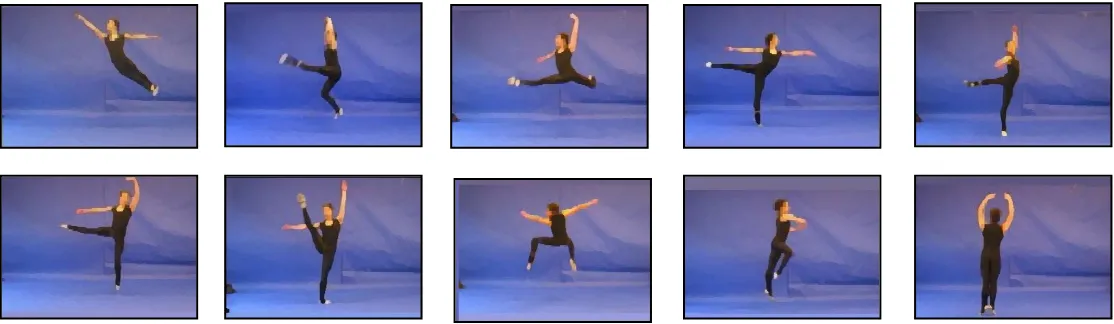
of three dance-like actions as either movements (complete dynamic action) or postures (snapshot
image of posture; see Figure 1). During the test phase, participants decided whether a test item
showed an old or new action, in conditions in which the item format (movement or posture) was
the same as, or different to, the study format. Specifically, participants were instructed to ignore
same action as one of the study items. For example, if a study sequence comprised Movement A,
Movement B and Movement C, and the test item was Posture A the correct response would be
‘old’, despite the change from movement at study to posture at test.
[Figure 1 about here]
First, it was hypothesised that recognition would be best when study and test format
match. Hence, recognition of movement stimuli will be most accurate in the
movement-movement condition in which memory for movement-movements is probed by a complete movement-movement at test.
Likewise, recognition of action postures should be best in the posture-posture condition in which
memory for posture is probed by a posture at test. As movement stimuli potentially contain more
information overall that can be used to support recognition, accuracy is hypothesized to be
greater in the movement-to-movement condition than in posture-to-posture conditions.
Second, in both the movement-movement and posture-posture conditions the format of
the test stimulus exactly matches the format of the study stimulus, meaning that the processing
pathways active during perception are reactivated at test. Recognition rates in these conditions
should be high. Alternatively, in the movement-posture and posture-movement conditions the
study stimulus must be transformed in VWM to enable an accurate response to the test stimulus.
When a movement is observed, both form and motion pathways should be active. Therefore,
accurate posture recognition after encoding of movements during study (movement-posture
condition) should be possible as body posture will have been encoded. However, accuracy
By contrast, when a single posture is observed at study, only form pathways should be
active. Therefore, as movement information is not encoded, movement recognition after
encoding of postures during study (posture-movement condition) should be poor relative to
posture-posture condition. Finally, to provide an accurate response in the posture-movement
condition, participants need to search the movements at test for the posture stimuli they encoded.
Therefore, in the posture-movement condition RT should be slow relative to the
movement-movement condition.
Method
Participants. Thirty-five students enrolled in first-year psychology at the University of Western Sydney (M=22.0, SD=6.59, 3 male) volunteered in return for course credit. All of the
participants were naive to the task. Five participants reported some non-professional dance
experience, primarily involving classes taken during childhood or casual fitness classes (M=9.8
years, SD=6.57 years). Four of these participants had some non-professional experience
specifically with Ballet (M=8.25 years, SD=6.44 years). Data screening revealed no significant
effect of participant dance expertise and so these participants were retained in the sample. All
participants reported normal or corrected to normal vision.
Materials and equipment. Dance-like action stimuli consisted of a set of 10 video-recorded ballet items performed by an experienced male ballet dancer, used previously by
Calvo-Merino, Glaser, Grèzes, Passingham & Haggard (2005). The raw dance-like items were three
performed all 10 movement items wearing fitted black clothing, against a dark blue backdrop.
All movements began from roughly the right hand side of the screen (stage left) and travelled
towards the left (stage right). An additional two movement items were available but not used in
the stimuli set, as the dancer stayed centered within the frame and did not travel right to left. For
the dynamic movement items, the raw action items were played in complete format (25 frames
per second) for three seconds. For the static items, a single frame capturing the peak of the item
was shown on screen for three seconds. The static frame was chosen as that which represented
the critical moment of the action, for example at the height of the jump or full extension of the
leg. This posture represented a maximal state of deviation from the start and end position of the
body in the dynamic phrase. The postures occurred at a different frame and time point for each
item, occurring on average at around two seconds. Each item was presented in the centre of the
computer screen, surrounded by a black background.
The experiment was run on Lenovo PCs with DMDX software (Forster & Forster, 2003).
Responses were made on the computer’s internal keyboard.
Procedure. Participants signed informed consent forms conforming to ethical standards (HREC H9302). Detailed instructions were then given regarding the task. Participants were told
that they would observe sets of three dance-like actions presented either as static ‘photographs’
or dynamic ‘movies’ and they were to try and remember what action was being performed
regardless of the format in which it appeared.
appeared. Subsequently three dance-like actions appeared sequentially in the centre of the screen.
On any given trial all items were either static postures or dynamic movements at study (that is
three movement items or three posture items were shown at study, never a combination of the
two formats). The word ‘test’ was then displayed in the centre the screen, followed by the test
item. Participants responded ‘old’ or ‘new’ using the computer’s shift keys which were labeled
accordingly. Response was time limited with a response period of 5s in total, including the 3s
duration of the test item. Participants were instructed to observe the study items and to respond
“as soon as they know” so that responses could be made at any point during the item. After the
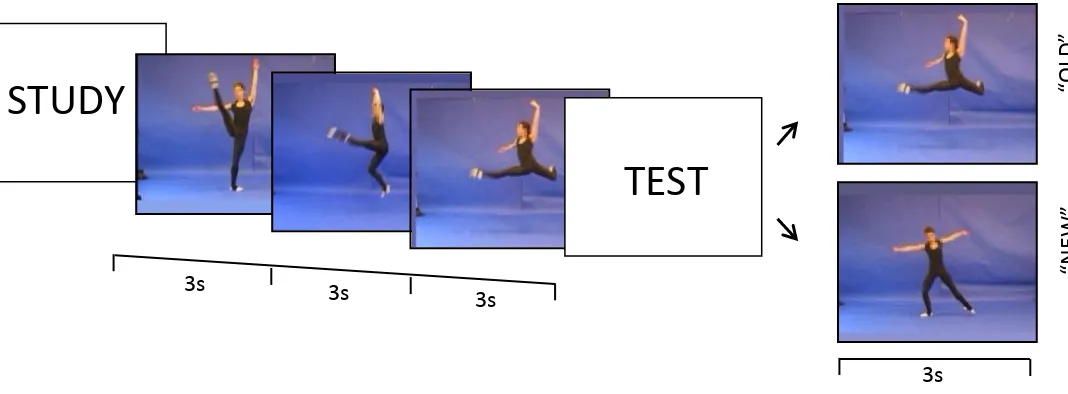
response was recorded and trial completed, a new trial began (see Figure 2).
[Figure 2 about here]
Eight practice trials (one for each study-test combination in old and new trials) with
corrective feedback were completed before the task began. A set of capoeira movements,
matched for kinematics and limb displacement to the ballet items (Calvo-Merino et al., 2005)
were used for the practice trials. In total there were 40 experimental trials with 10 trials for each
study-test combination. Trials were counterbalanced across participants. Within each set of 10
trials, five trials contained a ‘new’ action at test, while five trials contained an ‘old’ item at test.
At the end of the experiment, participants were debriefed and asked to note any strategies they
attempted to use to help them remember the dance-like actions. The experiment took
approximately 35 minutes to complete.
correctly identified as old), correct rejections (new items correctly identified as new), misses (old
items incorrectly identified as new), and false alarms (new item incorrectly identified as old) for
each study-test category. Accuracy was calculated as the proportion of correct responses: (hits +
correct rejections)/ (hits + misses + correct rejections +false alarms), where chance is equal to
0.5
Reaction time (RT) was calculated, both from the onset of the test item (oRT) and from
the offset of the test posture (pRT). For the pRT measure, the point in time at which the test
posture occurs in the dynamic sequence was subtracted from the oRT. Using this measure we can
determine if participants were responding before, after or at the time when the test posture occurs
in the dynamic action. Negative pRTs indicate responses occurring before the test posture, while
positive pRTs indicate responses occurring after the test posture.
Criteria for exclusion, based on results of pilot testing, stated that participants would be
excluded if they had a) more than six missed responses (i.e. no response made) across the
experiment in total (representing 15% of total trials), and/or b) more than two missed responses
in two study-test conditions, and/or c) one or more condition in which the false alarm rate
exceeded the hit rate. Based on these criteria five (out of 35) participants were excluded from
the analysis (three for criteria c and two for criteria b), leaving N=30 (M= 22.5 yrs., SD=6.97
Results and Discussion
Accuracy. Table 1 shows accuracy rates across the study-test conditions. A 2 (Study format; Movement, Posture) x 2 (Test format; Movement, Posture) repeated measures analysis of
variance (ANOVA), with planned comparisons to test specific hypotheses (Tabachnick, Fidell &
Osterlind, 2001).With alpha set at 0.05, the Study Format x Test Format interaction was
significant, F(1,29)= 37.67, p<.001, =.57. As predicted, accuracy was greatest when study and
test format were congruent, and weakened when they were not. Three planned comparisons
clarified this interaction.
[Table 1 about here]
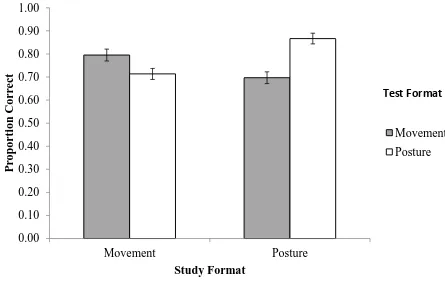
First, accuracy in the posture-posture condition (M=.87, SD=.13), was significantly
greater than accuracy in the movement-movement condition (M=.80, SD=.14) t(29)= 2.13,
p=.04, d=.52. This is somewhat surprising as the movement stimuli arguably contained more
detail that might be used for recognition purposes than do the single key-frame posture stimuli.
However, in a limited capacity VWM system, memory for movements has often found to be best
at around two items (Cortese & Rossi-Arnaud, 2010; Smyth & Pendleton, 1989; Wood, 2007).
The extra detail afforded in the movement, compared to posture, stimuli may exceed VWM
capacity, serving as a distraction rather than a benefit for memory. Alternatively, as the posture
stimuli remained unchanging on the screen for 3 seconds, participants may have had a better
Second, as both form and action pathways are active during perception of body
movement, it was predicted that a movement item may be accurately recognized based only on a
static snapshot of goal posture at test, but that recognition would be best when the entire
movement stimulus was available. This hypothesis was supported with accuracy in the
movement-movement condition significantly greater than accuracy in the movement-posture
condition (M= .71, SD= .13), t(29)=2.92, p=.002, d=.66. With specific reference to the hit and
false alarm rates, it is notable that accuracy in correctly rejecting ‘new’ items was comparable
across the movement-movement and movement-posture conditions (FAR of .22 and .28,
respectively). However, recognition of ‘old’ items from static posture was poor compared with
recognition in the movement-movement condition (HR of .83 and .71, respectively). Participants
were able to correctly dismiss new items equally in the two conditions, but could better recognise
previously seen items when the complete movement stimulus was available.
Finally, as hypothesized, accuracy in the posture-posture condition was significantly
greater than accuracy in the posture-movement condition (M=.70, SD=.14), t(29)= 5.89, p<.001,
d=1.2 (Figure 3). When postures were observed, no motion was encoded and therefore
recognition in the posture-movement condition required a search of the test item for the correct
static posture.
[Figure 3 about here]
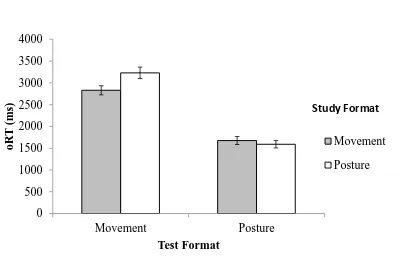
Reaction time. Figure 4 shows average RT from the onset of the test item (oRT). A 2 x 2 repeated measures ANOVA produced a significant Study Format x Test Formatinteraction
(M=1675.97ms, SD= 463) was not significantly different to the oRT in the posture-posture
condition (M=1590.49ms, SD= 408.15) t(29)= 1.49, p=.15, r=.26. This indicates that there was
no difference in RT to postures at test despite the differences in the format of the study sequence.
However, the oRT in the movement-movement condition (M=2838.75ms, SD= 524.10) was
significantly faster than oRT in the posture-movement condition (M=3222.17ms, SD= 682.75),
t(29)=4.38, p<.001, r=.63. As predicted, the time taken to respond to test item in movement
format is significantly slower after observing postures, compared to movements, at study.
[Figure 4 about here]
RT in relation to the test posture (pRT) was also analysed. As the test posture captures
the goal of the movement in this experiment, it is possible that this posture is used to make
recognition judgments even when dynamic movement stimuli are observed. If so, in the
movement-movement condition, responses should have been close in time to the appearance of
the posture. Figure 5 shows that when the test item was a movement (movement-movement and
posture-movement conditions) the response was made around 1s after the onset of the test
posture within the action (M= 909.98ms and 1324.73ms, respectively). In the
movement-movement condition, RT was significantly different from the point in time at which the test
posture occurred within the action t(29)=9.51, p<.001, r=.87.The frame capturing the test posture
was always approximately 2s into the item. This result suggests that the participants were not
responding in reaction to recognition of the posture but observed the entire dynamic item before
In summary, Experiment 1 shows that when body movements are observed, static posture
information is encoded, but form information may not be the primary source of movement
recognition. Recognition of a movement was most accurate when a complete movement item,
compared to the test frame capturing goal posture, was seen again at test. Additionally, the pRT
measure demonstrates that participants observe the entire movement item before responding.
This result suggests that while it is possible to recognise an action based only on static posture, it
is unlikely that this is the primary manner in which an action is temporarily retained.
[Figure 5 about here]
Experiment 2
Pickering et al. (2001) hypothesise that recognition of form (posture) may rely on a
VWM mechanism dissociable from VWM for recognition of motion (action). In Experiment 1,
the movement items were primarily encoded as ‘motion-based’ stimuli, although some posture
based information was stored. As such, VWM for movements should be most impaired by a
secondary task that disrupts dynamic, motion-based processing, in comparison to a secondary
task that disrupts static, form-based processing. Alternatively, motion-based processing plays
little role in VWM for postures and therefore VWM for postures should be impaired by a
secondary task that disrupts form-based processing, in comparison to a secondary task that
disrupts motion-based processing. Experiment 2 investigates this hypothesis using an
Aim, Design and Hypotheses
The aim of Experiment 2 was to dissociate form and motion processing in VWM for
postures and movements. As in Experiment 1, participants observed sequences of three
movements or postures and judged whether a single test item was old or new. To determine if
different WM systems are recruited, static and dynamic visual interference tasks occurred
between study and test. A digital version of the corsi-block task was used for the interference
conditions. The corsi-blocks are a set of blue squares which may be selected as targets by the
appearance of a black circle. The participant’s task is to remember the pattern of target blocks.
This task was classed as static if all the targets were presented simultaneously and dynamic if the
targets appeared sequentially across the trial. To consider the effects of interference on memory
for movements and postures, only congruent movement-movement and posture-posture trials
were included. Therefore a 3 (Interference; Control, Static, Dynamic) x 2 (Item Format;
Movement, Posture) mixed design was implemented, with between subjects manipulation of the
interference factor. Accuracy (proportion correct) was the dependent variable.
It was hypothesised that (1) if body movements are retained primarily via a dynamic,
motion-based VWM, then recognition should be impaired by the dynamic, but not static,
interference task; and (2) if body postures are retained primarily by a static, form-based VWM
process, then recognition of body postures should be impaired by the static, but not dynamic,
interference task. The effect of static and dynamic interference tasks on recognition was
Method
Participants. Sixty students enrolled in first- year psychology at the University of Western Sydney volunteered in return for course credit (M= 25.6 yrs., SD=8.3 yrs.; 17 male; 20
in each Interference group). All participants were naive to the task. Ten participants reported
some non-professional dance experience (M=8.6 years, SD=4.1 years), six of whom had some
prior experience specifically with Ballet (M=8.16 years, SD=7.19 years). Data screening revealed
no significant effect of participant dance expertise and these participants were retained in the
sample. All participants reported normal or corrected to normal vision.
Materials and equipment. Dance-like action stimuli were the same as used in
Experiment 1. Stimuli for the intervening tasks consisted of two digital versions of the
corsi-block task. Both corsi-corsi-block task manipulations consisted of a white rectangle featuring 10 blue
squares at irregular locations. In the static corsi-block task (static task) five black circles
appeared simultaneously on five different squares and remained in place for five seconds. After
five seconds the entire static task disappeared from the screen. Alternatively, for the dynamic
corsi-block task (dynamic task) a single black circle appeared sequentially at five different
locations. This task has been chosen to replicate the dynamic task involving ‘flashing’ matrix
targets used by Pickering et al. (2001). In the dynamic task, each black circle had an 800ms
duration and was separated from the appearance of the next black circle by a 30ms
inter-stimulus-interval (ISI). This is within the range of ISIs typically shown to elicit a percept of
fall within, but not exceed, VWM capacity (Cowan, 2010) and to allow the same patterns to be
presented in the dynamic and static conditions (larger path sizes would require repetition across
blocks which cannot be represented effectively in the static task). Ten corsi-block patterns were
chosen and displayed randomly throughout the experiment. To ensure that the only difference
between the static and dynamic task conditions was the simultaneous or sequential appearance of
the circles, the same patterns were used for both. Both tasks lasted five seconds in total.
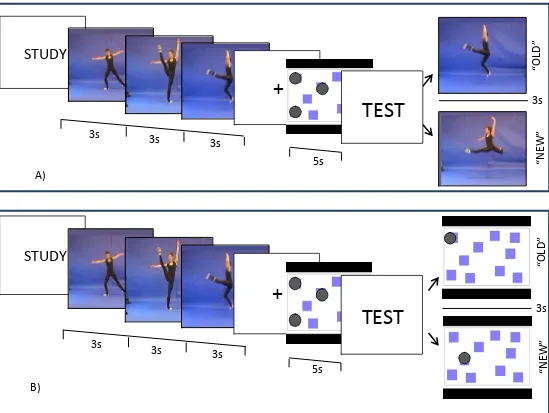
Procedure. The primary (actions) task progressed as in Experiment 1. On each trial in
the static and dynamic interference conditions participants would observe a set of three
dance-like actions (postures or movements), observe the interference task stimulus and then respond to
a test item. On any given trial, the test item could be either a dance-like action or a location from
the block task. Participants were not aware of which test item (dance-like action or
corsi-block location) would be shown at test until the test item was displayed, ensuring that correct
performance required memory of both tasks until the test phase (Cowan & Morey, 2007). In the
control (no interference) condition, the test item was always a dance-like action. As in
Experiment 1, half of the trials had a correct response of ‘old’ and half of ‘new’. For dance-like
actions old and new were defined as in Experiment 1. For the corsi-block location, ‘old’ referred
to a location that was occupied during the interference task, while ‘new’ referred to a location
that was not occupied during the interference task (see Figure 6).
Before completing the task, participants undertook practice trials with corrective
study-test condition. In total 10 trials per stimuli condition were completed, allowing 5 ‘new’
and 5 ‘old’ trials. In the interference conditions, an extra 10 trials per study-interference
condition (i.e. dynamic task with movement study items and dynamic task with posture study
items) format were completed also allowing test of 5 ‘new’ and 5 ‘old’ corsi-block locations per
condition. The experiment took approximately 30 minutes to complete.
[Figure 6 about here]
Results and Discussion
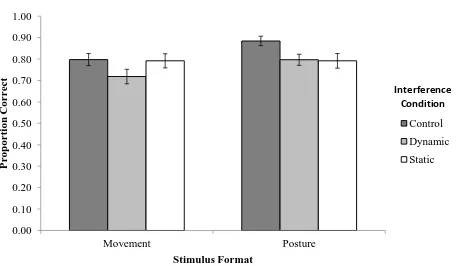
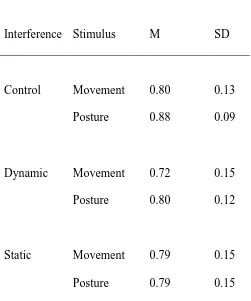
Descriptive statistics are shown in Table 2, and mean proportion correct is shown in
Figure 7. It was hypothesised that if dissociable static and dynamic VWM systems are used to
retain postures and actions, respectively, then a double dissociation should be observed for
accuracy. Specifically, recognition of movement items should be impaired by dynamic, but not
static interference (relative to control), while recognition of postures should be impaired by
static, but not dynamic interference (relative to control).
[Table 2 about here]
Four planned comparisons with alpha maintained at 0.05 tested these pre-specified
hypotheses. As expected, mean accuracy for recognition of movement stimuli in the control
recognition of movement stimuli in the dynamic interference condition (M=.72, SD=.15), p=.04,
d=.58, but did not differ from mean accuracy for recognition of movement stimuli in the static
interference condition (M=.79, SD=.15), p=.89, d=.04. That is, in support of the hypothesis,
recognition of dynamic stimuli was significantly impaired by a dynamic visual interference task,
but was not impaired by a static visual interference task.
However, contrary to hypotheses, mean accuracy for recognition of posture stimuli in the
control interference condition (M= .88, SD= .09) was significantly greater than mean accuracy
for recognition of postures in both the static interference condition (M= .79, SD= .15), p=.01,
r=.74 and dynamic interference condition (M=.80, SD=.12), p=.01, r=83. That is, only partial
support was found for the hypothesis that recognition of static stimuli would be impaired by
performance of a static interference task (supported), but not impaired by a dynamic visual
interference task (not supported).
Scores on the intervening static and dynamic corsi-block tasks were calculated to ensure
one task was not more difficult than the other. Mean accuracy on the static corsi-block task
(M=.54, SD= .26) was lower, but not significantly different from mean accuracy on the dynamic
corsi-block task (M=.63, SD= .33), p=.31. Therefore, differences in accuracy in the primary
recognition task cannot be attributed to differences in difficulty of the intervening tasks.
In summary, results of Experiment 2 show partial support for the hypothesised
dissociation between VWM for static and dynamic visual tasks. Accuracy on the dynamic and
static corsi-block tasks was similar, indicating that the two tasks were of comparable difficulty.
The dynamic corsi-block task impaired accurate recognition of actions relative to control, while
the static corsi-block task did not. That is, consistent with hypotheses, memory for actions is
impaired by a secondary task involving change over visual space, but is not impaired by a
secondary task in which only static visual form is to be encoded. The complementary situation
was not entirely supported. As predicted, accurate recognition of postures was impaired by the
static task, as predicted. However, recognition of postures was also impaired by the dynamic
task.
The lack of a double dissociation in the results of Experiment 2 makes it difficult to
definitively conclude that dissociable dynamic and static VWM networks retain actions and
postures. Consideration of the hit rate values shows that, for movements, recognition accuracy
was poorest in the dynamic interference condition (hit rate of .66). Conversely, for postures,
recognition accuracy was poorest in the static interference condition (hit rate of .79). This is
consistent with predictions. Therefore, at least for recognition of previously seen items, the data
indicate some dissociation between dynamic and static processing. However, this result is
mediated by the false alarm rates. Boththe dynamic and static interference tasks lead to an
increased false alarm rate for posture stimuli relative to control (from .14 to .24 in both cases). It
is this unexpected increase in the false alarm rate that disrupts the predicted response pattern
General Discussion
The current experiments investigated VWM for actions, considering (1) whether VWM
for body movement incorporates memory for body postures (form) and (2) whether memory for
body posture and body movement relies on dissociable form and motion processing networks. To
the best of our knowledge, this is one of the first studies to explicitly compare static and dynamic
versions of the same task on memory for action stimuli. The two behavioural experiments
reported here indicate that, as in perception, dance-like body actions are likely to be primarily
stored as dynamic movements in VWM although some posture based information is encoded and
available to aid recognition. Two results support this conclusion. First, recognition of body
movement based only on posture was possible, but poor relative to recognition based on the
entire movement stimulus. Second, when rehearsal of movement items was disrupted by a
based task, recognition accuracy was unimpaired relative to control conditions. That is,
form-based interference did not impair memory for movements. These results are discussed in turn.
Dance-like actions are more than just postures in VWM
In Experiment 1, participants observed spans of three movements or postures and made
‘old’ or ‘new’ recognition responses when a single action or posture was shown at test.
Neuroimaging and behavioural research has identified distinct neural regions involved in
perception of human body form and human body movement (Downing et al., 2006). Although
body movement appears to primarily activate motion selective neurons in pSTS rather than the
body form selective neurons in EBA. Interestingly, no attempt has been made to determine
whether similar processing dissociations continue to operate in VWM. If perception of body
form differs from perception of body movement, then it is plausible that memory for body form
will also differ to memory for body movement. This is particularly so given recent
conceptualizations of WM not as a series of modality specific stores or workspaces, but as an
extension of the perceptual process and a bridge to long-term memory networks.
If a similar posture and motion dissociation is evident in VWM, then recognition of
actions based on posture alone should be poor, relative to recognition of actions in complete
dynamic format. This hypothesis was supported: while participants could recognize the action
based on posture at above chance levels, recognition accuracy was significantly poorer than
recognition in the movement-movement condition. In the current experiments, postures do not
seem to be encoded preferentially when observing dance-like actions. It is likely that with dance
expertise (e.g. professional training in Ballet) this effect may differ. As ballet deliberately makes
use of goal postures, ballet experts may show enhanced ability to recognize actions based on
images of goal posture alone.
Evidence for separation of postures and movements in VWM in Experiment 1 is
consistent with fMRI research indicating less activity in posture-processing regions (e.g., EBA
and FBA) when continuous movement is observed. When body movement involves many
action sequence and motion processing regions are recruited. However, if the same changes in
body posture occur in a non-biologically plausible way (i.e. because they are viewed out of
order) a coherent action is not perceived and posture processing regions are recruited instead
(Downing et al., 2006). In research with primates, Jellema and Perrett (2003) demonstrated that
pSTS will also respond to discrete static images of body posture if the postures follow one
another in an appropriate temporal sequence (i.e. each displays the next posture within a single
action). In the current experiments, the movements were continuous and biologically plausible.
Results of Experiment 1 indicate that identifying a posture as an instance of a studied movement
item was a difficult, but achievable, task. Therefore, consistent with the neuroimaging results, the
current experiments suggest that even though body form is encoded during movement
observation (allowing the posture to support movement recognition), static snapshots of body
form are not retained in VWM in preference to complete dynamic movements.
This result is interesting for studies of motor skill learning, for example in dance, in
which a teacher will often demonstrate movement phrases and expect that they be remembered
by the learner. Experiment 1 indicates that, while the key forms in the movement may be
retained, the learner will be much better at identifying an instance of the movement if it is shown
again in complete format than if individual movement parts, including key postures, are shown.
Transitions between postures, rather than postures alone, should be emphasized in visual learning
Dynamic Motion Processing and Static Form Processing Differ in VWM
Experiment 2 tested whether actions and postures are different classes of stimuli, encoded
and retained by different VWM mechanisms. If so, then this provides an explanation as to why
the extraction of postures from encoded movements in the movement-posture condition of
Experiment 1 was a difficult and cognitively demanding task, leading to the reduced rates of
accuracy observed.
Experiment 2 compared memory for postures and actions in an interference paradigm to
examine whether distinct VWM networks exist for the retention of actions and postures. A
double dissociation between static and dynamic interference tasks was expected on recognition
of static (postures) and dynamic (movements) items at test. Specifically, it was predicted that
actions would be impaired by dynamic, but not static, interference, and that, conversely, postures
would be impaired by static, but not dynamic, interference. Partial support was found for the
hypotheses, with dissociation between the dynamic and static interference tasks found for
recognition of actions, but not for recognition of postures.
Results of Experiment 2 provide some evidence for distinct dynamic and static VWM
processes and, although not predicted, the observed pattern of interference is not entirely
inconsistent with the prior literature. This is because the dynamic interference task is not purely
dynamic, but also involves form-based processing. Results obtained from experiments using a
regard to the task feature that is thought to have been primarily encoded. For example, some
argue that the dynamic tracking of sequential locations across time and space is a defining factor
of the task (e.g. Cocchi et al., 2007; Pickering et al., 2001). Others, for example Zimmer and
Liesefeld (2011), argue that it is not just the dynamic tracking of locations that is stored in
memory, but also the aggregation of final landing locations into a complete static spatial map
(see also Vandierendonck & Szmalec, 2011). Essentially, the dynamic task used in Experiment 2
may have required not only encoding of a dynamic pattern, but also a static representation of its
final form. If so, both the dynamic and static versions of the corsi-block task should impair
memory for postures as both tasks require form-based memory. Conversely, dynamic
information is only extracted from the dynamic task, with the static task having no explicit
motion or requirement for dynamic tracking. Therefore, if action stimuli that have been studied
dynamically are stored dynamically in memory, then they should only be impaired by the
dynamic task. This interpretation is speculative but provides an explanation for why memory for
the posture stimuli was impaired by both dynamic and static interference tasks, while memory
for movements was impaired by the dynamic task alone.
It is possible here that this effect encoding of form and motion from the dynamic task was heightened by the use of a multi-static ‘dynamic’ interference task instead of one that was smoothly moving. However, given that the test phase required memory for particular
locations it is likely this same effect would persist, even with a task that did involve smooth
movement. In either case, participants would be likely to continue to track individual locations
form could be created immediately in the static interference condition, as all the targets were
identified at the beginning of the trial. Alternatively, the spatial map of visual form had to be
updated continually in a dynamic manner during the dynamic task as the targets were
sequentially revealed. Thus, it is the comparison between the static and the dynamic elements of
the two interference tasks that is crucial in the present experiment. That the static corsi-block
task did not impair memory for movements is a further indication that overall form is not the
primary feature being extracted from the movement. Consistent with Experiment 1, when the
actions are observed in the study phase of the experiment, movement is encoded rather than the
individual postures that comprise the movement.
Despite the lack of a double dissociation between the static and dynamic tasks in
Experiment 2, we have some evidence to suggest body actions may be different to body postures
in VWM. This finding is in accord with neuroimaging findings (e.g. Downing et al., 2006) and
computational modeling research (e.g. Giese & Poggio, 2003) that posit dissociable structures
for perception of human bodies and human body movement. In VWM, as in perception, body
form and body movement rely on dissociable processing systems.
Future research might extend results reported here by investigating potential differences
between static and dynamic VWM for objects and for human body movements. An assumption
made here is that a similar VWM resource is used to retain movement and form as exhibited in
dance-like actions, and as exhibited in the abstract movement of visual objects. There is evidence
research is complicated by the use of static-visual or dynamic-spatial based tasks; that is, the
categories are confounded. In the present study we disentangled these categories and showed
impaired recognition of body movement stimuli after encoding visual motion and impaired
recognition of body postures after encoding visual form. An experiment specifically
manipulating both tasks with body-based stimuli would further clarify the results.
Conclusion
The experiments reported here demonstrate that the perceptual dissociation between body
form and movement is also evident in VWM. Further, they show that while images of body
posture may assist recognition, body form is not the sole means by which dance-like actions are
retained in VWM. The current results suggest that, for an observer, particularly one who is
inexperienced with the type of movement being observed, dance-like actions are retained as
References
Adshead-Lansdale, J. (1988). Dance analysis: Theory and practice. London: Dance Books
Allison, T., Puce, A., & McCarthy, G. (2000). Social perception from visual cues: Role of the
STS region. Trends in Cognitive Sciences, 4, 267-278
Beintema, J.A, & Lappe, M (2002) Perception of biological motion without local image motion,
Proceedings of National Academy of Science, USA, 5661-63
Berch, D., Krikorian, R., & Huha, E. M. (1998). The corsi-block-tapping task: Methodological
and theoretical considerations. Brain and Cognition, 38, 317-338
Blake, R., & Shiffrar, M. (2007). Perception of human motion. Annual Review of Psychology,
58, 47–73. doi:10.1146/annurev.psych.57.102904.190152
Calvo-Merino, B., Glaser, D. E., Grèzes, J., Passingham, R. E., & Haggard, P. (2005). Action
observation and acquired motor skills: An fMRI study with expert dancers. Cerebral
Cortex, 15, 1243-1249
Cocchi, L., Schenk, F., Volken, H., Bovet, P., Parnas, J., & Vianin, P. (2007). Visuo-spatial
processing a dynamic and a static working memory paradigm in schizophrenia. Psychiatry
Cortese, A., & Rossi‐Arnaud, C. (2010). Working memory for ballet moves and spatial locations
in professional ballet dancers. Applied Cognitive Psychology, 24, 266-286
Cowan, N. (2010). The magical mystery four: How is working memory capacity limited, and
why? Current Directions in Psychological Science, 19, 51-57
Cowan, N., Elliot, E. M., Saults, J. S., Morey, C. C., Mattox, S. Hismjatullina, A., & Conway, A.
R. A. (2005). On the capacity of attention: Its estimation and its role in working memory
and cognitive aptitudes, Cognitive Psychology, 51, 42-100
Cowan, N., & Morey, C. C. (2007). How can dual-task working memory retention limits be
investigated? Psychological Science, 18, 686-688
Della-Sala, S., Gray, C., Baddeley, A., Allamano, N., & Wilson, L. (1999). Pattern span: A tool
for unwelding visuo-spatial memory, Neuropsychologia, 37, 1189-1199
Depoorter, A., & Vandierendonck, A. (2009). Evidence for modality-independent order coding
in working memory. The Quarterly Journal of Experimental Psychology, 62, 531-549
Dittrich, W. H. (1993). Action categories and the perception of biological motion. Perception,
22, 15-15.
body area in action perception. Social Neuroscience, 1, 52-62
Engle, R. W. (2010). Role of working-memory capacity in cognitive control. Current
Anthropology, 51, S17-S26
Forster, K. I., & Forster, J. C. (2003). DMDX: A windows display program with millisecond
accuracy. Behavior Research Methods, Instruments, & Computers, 35, 116-124.
Giese, M. A., & Poggio, T. (2003). Neural mechanisms for the recognition of biological
movements. Cognitive Neuroscience, 4, 179-192
Grossman, E. D., & Blake, R. (2002). Brain activity evoked by inverted and imagined biological
motion. Vision Research, 41, 1475-1482
Hughes, R. W., & Jones, D. (2005). The impact of order incongruence between a task-irrelevant
auditory sequence. Journal of Experimental Psychology: Human Perception and
Performance, 3, 316-327
Jellema, T., & Perrett, D. I. (2003). Cells in monkey STS responsive to articulated body motions
and consequent static posture: a case of implied motion? Neuropsychologia, 41,
1728-1737.
phonological storage: Further support for a perceptual-gestural view of short-term memory.
Journal of Memory and Language, 54, 265-281.
Jones, D., Farrand, P., Stuart, G., & Morris, N. (1995). Functional equivalence of verbal and
spatial information in serial short-term memory. Journal of Experimental Psychology:
Learning, Memory, and Cognition, 21, 1008-1018
Jonides, J., Lewis, R. L., Nee, D. E., Lustig, C. A., Berman, M. G., & Moore, K. S. (2008). The
mind and brain of short-term memory. Annual Review Psychology, 59, 193-224.
Logie, R. H. (2011). The functional organization and capacity limits of working memory.
Current Directions in Psychological Science, 20, 240-245.
Luck, S. J. (2008). Visual short-term memory. In Luck, S. J., & Hollingworth, A. (Eds.). (2008).
Visual memory. Oxford University Press (pp. 43-85)
Oberauer, K. (2009). Design for a working memory. Psychology of Learning and Motivation, 51,
45-100.
Oberauer, K., & Bialkova, S. (2009). Accessing information in working memory: Can the focus
of attention grasp two elements at the same time? Journal of Experimental Psychology:
Opacic, T., Stevens, C. J., & Tillmann, B. (2009). Unspoken knowledge: Implicit learning of
structured human dance movement. Journal of Experimental Psychology: Learning,
Memory and Cognition, 35, 1570-1577
Peelen, M. V., & Downing, P. E. (2007). The neural basis of visual body perception. Nature
Reviews Neuroscience, 8, 636-648
Peelen, M. V., Wiggett, A. J., & Downing, P. E. (2006). Patterns of fMRI activity dissociate
overlapping functional brain areas that respond to biological motion. Neuron, 49, 815-822.
Peuskens, H., Vanrie, J., Verfaillie, K., & Orban, G. A. (2005). Specificity of regions processing
biological motion. European Journal of Neuroscience, 21, 2864-2875
Pickering, S. J., Gathercole, S. E., Hall, M., &Lloyd, S. A. (2001). Development of memory for
pattern and path: Further evidence for the fractionation of visuo-spatial memory. The
Quarterly Journal of Experimental Psychology: Section A, 54, 397-420
Shaw, R. E., Flascher, O. M., & Mace, W. M. (1995) Dimensions of event perception, in W.
Prinz & B. Bridgeman (eds.). Handbook of Perception and Action: Volume 1 Perception,
Shiffrar, M., & Freyd, J. J. (1993). Timing and apparent motion path choice with human body
photographs. Psychological Science, 4, 379-384.
Slotnick, S. D., & Thakral, P. P. (2011). Memory for motion and spatial location is mediated by
contralateral and ipsilateral motion processing cortex. NeuroImage, 55,794-800
Smyth, M. M. and Pendleton, L. R. (1989). Working memory for movements. Quarterly Journal
of Experimental Psychology, 41A, 235-250.
Stevanovski, B., & Jolicoeur, P. (2007). Visual short-term memory: Central capacity limitations
in short-term consolidation. Visual Cognition, 15, 532-563.
Tabachnick, B. G., Fidell, L. S., & Osterlind, S. J. (2001). Using multivariate statistics. 4th ed.
Boston: Allyn and Bacon.
Umla-Runge, K., Zimmer, H. D., Krick, C. M., & Reith, W. (2011). fMRI correlates of working
memory: Specific posterior representation sites for motion and position information. Brain
research, 1382, 206-218.
Urgesi, C., Berlucchi, G., & Aglioti, S. M. (2004). Magnetic stimulation of extrastriate body area
Vandierendonck, A., & Szmalec, A. (2011). Spatial working memory. New York: Psychology
Press.
Wager, T. D., &Smith, E. E. (2003). Neuroimaging studies of working memory: A
meta-analysis, Cognitive, Affective and Behavioral Neuroscience, 3, 255-274
Wilson, M. (2001). The case for sensorimotor coding in working memory, Psychonomic Bulletin
and Review, 8, 44-57
Wood, J. N. (2007). Visual working memory for observed actions, Journal of Experimental
Psychology: General, 136, 639-652
Zimmer, H. D. (2008). Visual and spatial working memory: From boxes to networks.
Neuroscience and Biobehavioral Reviews, 32, 1373-1395
Zimmer, H. D., & Liesefeld, H. R. (2011). Spatial information in visual working memory. In A.
Vandierendonck & A. Szmalec (Eds.), Spatial working memory (pp. 46-66). Hove:
Figure 2. Experiment 1, Trial sequence. A posture-posture trial is shown. In the study phase, three postures are shown sequentially. In the test phase, participants indicate ‘old’ or ‘new’ to a posture that was or was not in the study sequence.
STUDY
TEST
“OLD
”
“N
EW”
3s 3s
3s
Figure 3. Experiment 1: Mean accuracy for movements and postures. Maximum = 1, Chance = 0.5. Error bars refer to standard error of the mean.
0.00 0.10 0.20 0.30 0.40 0.50 0.60 0.70 0.80 0.90 1.00
Movement Posture
P
rop
or
tion Cor
re
ct
Study Format
Movement
Posture
Figure 4. Experiment 1: Mean onset Reaction Time (oRT) for movements and postures. Test items had duration of 3 s. oRT was constrained to a maximum of 5 s. Error bars refer to standard error of the mean.
0 500 1000 1500 2000 2500 3000 3500 4000
Movement Posture
oR
T
(m
s)
Test Format
Movement
Posture
Figure 5. Experiment 1: Mean posture Reaction Time (pRT). Positive pRTs indicate responses occurring after the test posture. Negative pRTs indicate responses occurring before the test posture. Error bars refer to standard error of the mean.
-1000 -500 0 500 1000 1500 2000
Movement Posture
p
R
T
(m
s)
Test Format
Movement
Figure 6. Experiment 2: Trial progression. Static interference trials are shown, with posture study format and posture (panel A) or location (panel B) test items. In the study phase (9s), three key-frame images are shown sequentially. In the interference phase (5s), the corsi-block stimulus appears with 5 target marked by black circles. In the test, participants indicate ‘old’ or ‘new’ to a posture or a corsi-block location that was or was not in the study sequence. For an example of the dynamic interference condition with movement stimuli.
A) 5s “OLD ” “N EW”
STUDY
+
TEST
3s 3s
3s 3s
STUDY
+
TEST
B)3s 3s
Figure 7. Experiment 2: Mean accuracy for movements and postures in control (no interference), dynamic and static interference Conditions. Maximum = 1, Chance = 0.5. Error bars refer to standard error of the mean.
0.00 0.10 0.20 0.30 0.40 0.50 0.60 0.70 0.80 0.90 1.00
Movement Posture
Table 1. Experiment 1: Accuracy for postures and movements
Study and Test Format M SD
Movement-Movement 0.80 0.14
Movement-Posture 0.71 0.13
Posture-Posture 0.87 0.13
Table 2. Experiment 2: Accuracy for postures and movements across interference conditions.
Interference Stimulus M SD
Control Movement 0.80 0.13
Posture 0.88 0.09
Dynamic Movement 0.72 0.15
Posture 0.80 0.12
Static Movement 0.79 0.15