Contents lists available atScienceDirect
Journal
of
Computational
Physics
www.elsevier.com/locate/jcp
A
fast
iterative
scheme
for
the
linearized
Boltzmann
equation
Lei Wu
a,∗
,
Jun Zhang
c,
Haihu Liu
d,
Yonghao Zhang
a,
Jason
M. Reese
baJamesWeirFluidsLaboratory,DepartmentofMechanicalandAerospaceEngineering,UniversityofStrathclyde,GlasgowG11XJ,UK bSchoolofEngineering,UniversityofEdinburgh,EdinburghEH93FB,UK
cSchoolofAeronauticScienceandEngineering,BeihangUniversity,Beijing100191,China
dSchoolofEnergyandPowerEngineering,Xi’anJiaotongUniversity,28WestXianningRoad,Xi’an710049,China
a
r
t
i
c
l
e
i
n
f
o
a
b
s
t
r
a
c
t
Articlehistory: Received22June2016
Receivedinrevisedform1March2017 Accepted2March2017
Availableonline7March2017
Keywords:
LinearizedBoltzmannequation Rarefiedgasdynamics Syntheticiterativescheme Lennard–Jonespotential Gasmixture
Iterative schemes to findsteady-state solutions to the Boltzmannequation are efficient for highly rarefiedgas flows, butcan be very slowto converge inthe near-continuum flow regime. In this paper, asynthetic iterative scheme is developed to speed up the solutionofthelinearizedBoltzmannequationbypenalizingthecollisionoperator L into theformL=(L+Nδh)−Nδh,whereδisthegasrarefactionparameter,histhevelocity distributionfunction,and N isatuningparameter controllingtheconvergencerate.The velocity distribution functionis firstsolved by the conventional iterative scheme, then it is corrected suchthat the macroscopic flow velocityis governed by adiffusion-type equationthatisasymptotic-preservingintotheNavier–Stokeslimit.Theefficiencyofthis newschemeisassessedbycalculatingtheeigenvalueoftheiteration,as wellassolving for Poiseuille and thermal transpirationflows. We findthat the fastest convergence of oursyntheticschemeforthelinearizedBoltzmannequationisachievedwhenNδisclose to the average collision frequency. The synthetic iterative schemeis significantly faster thantheconventionaliterativeschemeinboththetransitionandthenear-continuumgas flowregimes.Moreover,duetoitsasymptotic-preservingproperties,thesyntheticiterative schemedoesnotneedhighspatialresolutioninthenear-continuumflowregime,which makesitevenfasterthantheconventionaliterativescheme.Usingthissyntheticscheme, with the fast spectral approximation of the linearized Boltzmann collision operator, Poiseuilleandthermal transpirationflows betweentwo parallelplates,throughchannels of circular/rectangularcross sections and various porous media are calculated over the wholerangeofgasrarefaction.Finally,the flowofaNe–Argas mixtureis solvedbased onthelinearizedBoltzmannequationwiththeLennard–Jonesintermolecularpotentialfor thefirsttime,and thedifferencebetweentheseresultsandthoseusingthehard-sphere potentialisdiscussed.
©2017ElsevierInc.Allrightsreserved.
1. Introduction
TheBoltzmannequationisfundamentaltoabroadrangeofapplicationsfromaerodynamicstomicrofluidics[1],andit isimportanttobeabletosolveitaccuratelyandefficiently.Mostoften,theBoltzmannequationissolvedbythestochastic DirectSimulationMonteCarlo(DSMC)technique,whichusesanumberofsimulatedparticlestomimicthebinarycollisions
*
Correspondingauthor.andstreamingofverylarge numbersofgasmolecules[2].InDSMC,thelengthofthespatialcell andthetime stepneed to be smallerthan thelocal molecularmean freepath andthemean collisiontime, respectively,andfor thisreasonthe techniquebecomesveryslowandcostlyfornear-continuumflows.Althoughtime-relaxedandasymptotic-preservingMonte Carlomethodsallow largertime steps[3,4],the restrictiononthesizeofthespatial cells hasnot yetbeenremoved.The sameproblem,infact,existsindeterministicnumericalmethodsfortheBoltzmannequation,wherethestreamingandthe collisionsaretreatedseparatelyinthesplittingscheme[5,6].
Theunifiedgas-kineticscheme(UGKS)providesanalternativeapproach.ItwasfirstdevelopedfortheBhatnagar–Gross– Krook(BGK)kineticmodel[7,8],thenfortheShakhovmodel[9,10],andfinallygeneralizedtotheBoltzmannequation[11]. It handlesthestreamingandbinarycollisions simultaneouslysothat, fortime-dependent problems,thetimestepisonly limitedbytheCourant–Friedrichs–Lewycondition.Also,theUGKSisasymptotic-preservingintotheNavier–Stokeslimit[12], so thelength ofthe spatial cells canbe significantly largerthan themolecular meanfree path.Moreover, theUGKS isa finitevolumemethod,andtheanalyticalintegralsolutionoftheBGK-typemodelenablesaccuratefluxevaluationatthecell interface, sothat theessential flowphysics can becapturedeven withthecoarsegrids. Theseadvanced propertiesmake theUGKS(anditsimprovedversion:thediscreteUGKS[13,14])amultiscalemethodforefficientandaccuratecalculations ofrarefied gasflowsovera widerangeofthegas rarefaction.Recently, animplicitUGKS hasbeenproposedto eliminate thetimesteplimitationandfurtherimprovethenumericalefficiency[15].
To find a steady-state solution to the Boltzmann equation, an iterative scheme is often used. In the free-molecular flow regime, where binary collisions are negligible, an iterative scheme is efficient, because the gas molecules move in straight way(except thecollisionwithwallsurfaces)sothat anydisturbanceatonepoint canbequicklyfeltby allother points. However, for near-continuumflows the iterations convergeslowly and theresults arevery likely tobe biased by accumulated rounding errors. Althoughthe time and spatial steps can be large, the UGKS still needs a large number of iterations [15].Thisisgoverned bythe underlyingphysics:theexchangeof informationthroughstreaming becomesvery inefficientwhenbinarycollisionsdominate.Therefore,itwouldbeusefultodevelopanefficientnumericalschemetosolve theBoltzmannequationthatbothhastheasymptotic-preservingpropertyintheNavier–Stokeslimit(liketheUGKSwhere thespatialresolutioncanbecoarse)andconvergestothesteady-staterapidly.
Inspired by work on fastiterative methods for radiation transport processes [16], acceleratediterative schemes have been developed for the linearized BGK and Shahkovmodels [17] to overcome slow convergence inthe near-continuum flowregime.Thefastiterativeschemeiscalleda“syntheticiterativescheme”(SIS)sincekineticmodelequationsaresolved in parallel withdiffusion-type equations formacroscopic quantities such asthe flow velocity andheat flux. The SIS has beensuccessfullyappliedtoPoiseuilleflowinchannelswithtwo-dimensionalcrosssectionsofarbitraryshapes[18]using a BGKmodelforsingle-species gases,andflows ofbinary andternarygasmixturesdrivenby localpressure,temperature, andconcentration gradients[19–21,18,22–24]usingtheMcCormack model[25].ThefastconvergenceoftheSISisdueto three factors: first, the macroscopicsynthetic diffusion-type equations exchange theinformation very efficiently; second, the macroscopic flow quantities can be fed back into mesoscopic kinetic models; andthird, macroscopic diffusion-type equationsaresolvedmorequicklythanmesoscopickineticmodelequations.
InthepresentpaperwedevelopaSIStosolvethelinearizedBoltzmannequation(LBE)forPoiseuilleandthermal tran-spirationflows.Althoughforthesingle-speciesLBEthesecanonicalflowshavebeenextensivelystudiedforhard-sphere[26, 27], inversepower-law [28], and even Lennard–Jones [29,30] potentials, numerical results for near-continuum flows are scarce.Moreover,forgasmixturestheseflowshaveonlybeensolvedbasedonthehard-spheremodelinaone-dimensional geometry[31].Wewillcalculatetheseflowsthroughtwo-dimensionalcrosssectionsofarbitraryshape,andinvestigatethe influence ofrealistic intermolecularpotentialsforgas mixtures.The coremethodswe adoptare (i) theSIS originally de-velopedforkineticmodelequations,whichisintroducedinthepreviousparagraph,(ii)thepenalizationmethod[6,32,33], which makes the development of SIS forthe LBE possible,and (iii)the fastspectral method, developed by Mouhot and Pareschi [34] andextended by us to gasmixtures and Lennard–Jonespotentials [35,30], whichenables the efficientand accuratecomputationofthelinearizedBoltzmanncollisionoperator.
The restofthispaper isorganized asfollows.InSec. 2,we briefly introducethe LBEforsingle-species gases andthe conventional iterativescheme(CIS).Then,by analyzingtheSIS forthe BGKmodel,we developa SISfortheLBE andtest itsperformancebycalculatingboththeeigenvaluesofiterationsandPoiseuille/thermaltranspirationflows.Weimprovethe efficiency ofthe proposed SIS byadjusting a parameterin thescheme, whichcan be determined prior tothe numerical simulation.InSec.3,theSISisusedtosolverarefiedgasflowsinmultiscaleproblems.InSec.4,theSISinpolarcoordinates isproposedandnumericalresultsoftheLBEforPoiseuilleflowthroughatubearepresented.InSec.5,theSISisextended totheLBEforgasmixtures,andPoiseuilleflowofaNe–ArmixtureissolvedforthefirsttimebasedontheLennard–Jones potential.InSec.6,weconcludewithasummaryofthenewnumericalmethodandfutureperspectives.
2. Asyntheticschemeforthesingle-speciesLBE
Consider the steady flow of a single-species monatomic gas along a channel of arbitrary cross section in the x1–x2 plane, subjecttosmallpressure/temperaturegradientsinthe x3 direction.The velocitydistributionfunction (VDF)canbe expressedas f
=
feq+
h,wherefeq
(
v)
=
exp
(
−|
v|
2)
istheequilibriumVDFandh
(
x1,
x2,
v)
istheperturbedVDFsatisfying|
h/
feq|1.TheLBEforhis:v1
∂
h∂
x1+
v2∂
h∂
x2=
L
(
h,
feq)
+
S,
(2)withthelinearizedBoltzmanncollisionoperator[28]:
L
=
¨
B
(
|
v−
v∗|
, θ )
[
feq(
v)
h(
v∗)
+
feq(
v∗)
h(
v)
−
feq(
v)
h(
v∗)
]
ddv∗
L+
−
ν
eq(
v)
h(
v).
(3)From Eq.(1) to(3), x
=
(
x1,
x2,
x3)
isthe position vector normalizedby the characteristicflow length,
v=
(
v1,
v2,
v3)
isthe molecular velocityvector normalizedby the mostprobablespeed vm=
2kBT0
/
m (kB is theBoltzmannconstant,T0 isthegas/wall temperature,andmisthe gasmolecularmass), B
(
|
v−
v∗|
,
θ )
isthecollision kerneldeterminedbythe intermolecularpotential[28,30],andν
eq(
v)
=
¨
B
(
|
v−
v∗|
, θ )
feq(
v∗)
ddv∗ (4)
istheequilibriumcollisionfrequency. Finally,S isthesourceterm:
S
=
−
XPv3feq
,
for Poiseuille flow,−
XTv3(
|
v|
2−
5/
2)
feq,
for thermal transpiration flow,(5)
where XP and XT are thepressureandtemperaturegradients,respectively.FortheLBE,since macroscopicquantitiesare proportionalto XP andXT,weassume XP
=
XT= −
1.Themacroscopicquantitiesofinterestaretheflowvelocitynormalizedbythemostprobablespeed:
U3
=
ˆ
v3hdv
,
(6)theshearstressesnormalizedbytheequilibriumgaspressure p0:
P13
=
ˆ
2v1v3hdv
,
P23=
ˆ
2v2v3hdv
,
(7)andtheheatfluxnormalizedby p0vm:
q3
=
ˆ
|
v|
2−
5/
2 v3hdv.
(8)ThedimensionlessmassflowrateMandheatflowrate Q are:
M
=
1A
¨
U3dx1dx2
,
Q
=
1A
¨
q3dx1dx2
,
(9)
where Aistheareaofthecrosssection.
Theintegro-differentialsystemdefinedbyEqs.(2)and(3)isusuallysolvedbytheCIS.Giventhevalueofh(k)atthek-th iterationstep,theVDFatthenextiterationstepiscalculatedbysolvingthefollowingequation:
ν
eqh(k+1)+
v1∂
h(k+1)∂
x1+
v2
∂
h(k+1)∂
x2=
L+
(
h(k),
feq)
+
S,
(10)2.1. SISfortheBGKequation
Tobeginwith,weintroducetheSISfortheBGKequation [17].ThelinearizedBoltzmanncollisionoperatorinEq.(3)is replacedbythatoftheBGKkineticmodel,yieldingthefollowingequationfortheperturbedVDFh:
v1
∂
h∂
x1+
v2∂
h∂
x2=
δ
[
2U3v3feq−
h]
LBG K
+
S,
(11)where
δ
=
p0μv
m(12)
istherarefactionparameter,with
μ
beingthegasshearviscosity.MultiplyingEq.(11)bytheHermitepolynomialsandapplyingtherecursionrelation,asetoffirst-orderpartial differen-tialequationscanbe obtainedforvarious ordersofmoments[36].Here,tworelevantequationsforthemacroscopicflow velocityarelisted:
∂
U3∂
x1= −
δ
P13−
1 4∂
F2,0,1∂
x1−
1 4
∂
F1,1,1∂
x2,
(13)∂
U3∂
x2= −
δ
P23−
1 4∂
F1,1,1∂
x1−
1 4
∂
F0,2,1∂
x2,
(14)where
Fm,n,l
(
x1,
x2)
=
ˆ
h
(
x1,
x2,
v)
Hm(
v1)
Hn(
v2)
Hl(
v3)
dv (15)are thenon-acceleratedhigh-ordermoments,withHn
(
v)
beingthen-thorderphysicists’Hermite polynomial.The combi-nationofEqs.(13)and(14)leadstoanequationofdiffusion-typefortheflowvelocity:∂
2U3∂
x2 1+
∂
2U3∂
x2 2= −
δ
∂
P13∂
x1+
∂
P23∂
x2−
14
∂
2F2,0,1∂
x2 1+
2∂
2F1,1,1
∂
x1∂
x2+
∂
2F0,2,1∂
x2 2 (16a)=
⎧
⎪
⎪
⎨
⎪
⎪
⎩
−
δ
−
14 ∂2F2,0,1 ∂x21
+
2∂2F 1,1,1 ∂x1∂x2
+
∂2F 0,2,1 ∂x22
,
Poiseuille,−
1 4 ∂2F2,0,1∂x2 1
+
2∂2F1,1,1 ∂x1∂x2
+
∂2F0,2,1 ∂x2
2
,
thermal transpiration.(16b)
Note that in obtaining the final equation we have used the relation
∂
P13/∂
x1+
∂
P23/∂
x2=
1 for Poiseuille flow and∂
P13/∂
x1+
∂
P23/∂
x2=
0 forthermaltranspirationflow.TheSISfortheBGKequationthenworksasfollows[17,36]:•
Whenh(k) andU(k)3 areknownatthek-thiterationstep,calculatetheVDFh(k+1)bysolvingthefollowingequation:
δ
h(k+1)+
v1∂
h(k+1)∂
x1+
v2
∂
h(k+1)∂
x2=
2
δ
U(3k)v3feq+
S.
(17)•
Fromh(k+1),calculatethenon-acceleratedmomentsF2,0,1
,
F1,1,1,andF0,2,1.•
Fromh(k+1),calculatetheflowvelocityU(k+1)3 neartheboundary.However,fortheflowvelocityinthebulk(i.e.several computationallayersawayfromtheboundary),U3(k+1)isobtainedbysolvingthediffusion-typeequation(16b).
The above iterativeprocedure is continueduntil convergence. It should be emphasized that the relation
∂
P13/∂
x1+
∂
P23/∂
x2=
1or 0 forPoiseuillefloworthermaltranspirationflow,respectively, iscrucialforthefastconvergenceofthe SIS.Thisisbecausenon-acceleratedmomentsarenegligibleatlargevaluesoftherarefactionparameterδ,
sothesynthetic equation(16b)quicklyadjuststheflowvelocitytothesolutionoftheNavier–Stokesequation,∂
2U3∂
x21+
∂
2U3∂
x22= −
δ,
for Poiseuille flow,
∂
2U3∂
x21+
∂
2U3∂
x22=
0,
for thermal transpiration flow,
(18)
improved because it takes a lot of iterations to reach the condition
∂
P13/∂
x1+
∂
P23/∂
x2=
1 or 0; in the worst-case scenario, it mayeven lead to false convergenceand incorrectsolutions when the spatial resolution isnot highenough. However, Eq. (16b) guarantees the correctness of the solution at large values ofδ,
as it has the asymptotic-preserving propertyintheNavier–Stokeslimit[12].ThispointwillbedemonstratedinSec.2.6below.2.2. SISfortheLBE
The development of a SIS for the LBE is not straightforward, since the collision operator of the LBE is much more complicatedthanthatofthelinearizedBGKmodel.DirectlyfollowingthemethodinSec. 2.1,thefollowingdiffusion-type equationfortheflowvelocityisobtained:
∂
2U3∂
x21+
∂
2U3∂
x22=
2∂
∂
x1ˆ
v1v3Ldv
+
2∂
∂
x2ˆ
v2v3Ldv
−
1 4∂
2F2,0,1∂
x21+
2∂
2F1,1,1∂
x1∂
x2+
∂
2F0,2,1∂
x22,
(19)which,likeEq.(16a),cannotimprovetheslowconvergenceatlargevaluesof
δ.
Tospeed up theconvergence, the relation
∂
P13/∂
x1+
∂
P23/∂
x2=
1or 0 for Poiseuille flow orthermal transpiration flow,respectively,mustbereflectedinthediffusion-typeequation.Forinstance,asinEq.(16b),atermsimilarto−
δ
should appearontheright-hand-sideofEq.(19)forPoiseuilleflow.Toachievethis,wepenalizethelinearizedBoltzmanncollision operatorbythelinearizedBGKoperator[6],i.e.,L
=
(
L−
LBG K)
+
LBG K,
(20)andlet
2
ˆ
v1v3Ldv
=
2ˆ
v1v3
(
L−
LBG K)
dv−
δ
P13,
2
ˆ
v2v3Ldv
=
2ˆ
v2v3
(
L−
LBG K)
dv−
δ
P23.
(21)ThistransformsEq.(19)into
∂
2U3∂
x21+
∂
2U3∂
x22= −
δ
−
1 4∂
2F2,0,1∂
x21+
2∂
2F1,1,1∂
x1∂
x2+
∂
2F0,2,1∂
x22+
2∂
∂
x1ˆ
v1v3
(
L−
LBG K)
dv+
2∂
∂
x2ˆ
v2v3
(
L−
LBG K)
dv,
(22)which is very close to Eq. (16b)for the linearized BGK equation. At large values of the rarefactionparameter
δ,
´
(
L−
LBG K)
v1v3dv and´
(
L−
LBG K)
v2v3dv approach zero, and Eq. (22) possesses the asymptotic-preserving property in the Navier–Stokeslimit[12].Therefore,aSIScanbedevelopedbasedonthisequation.Notethatforthermaltranspirationflow,δ
inEq.(22)shouldbereplacedbyzero,as∂
P13/∂
x1+
∂
P23/∂
x2=
0.TheSISfortheLBEthenworksasthatfortheBGKequations,withsomechanges:
•
Whenh(k)andU(k)3 areknownatthek-thiterationstep,wecalculate
´
v1v3
(
L−
LBG K)
dvand´
v2v3
(
L−
LBG K)
dv.We alsocalculatetheVDFh(k+1/2)bysolvingthefollowingequation:ν
eqh(k+1/2)+
v1∂
h(k+1/2)∂
x1+
v2
∂
h(k+1/2)∂
x2=
L+
(
h(k),
feq)
+
S.
(23)•
Fromh(k+1/2),wecalculatetheflowvelocityU(k+1/2),andthenon-acceleratedmomentsF2,0,1,F1,1,1,andF0,2,1.•
Neartheboundary,weletU3(k+1)=
U3(k+1/2),whilewesolvethediffusion-typeequation(22)toobtaintheflowvelocityinthebulk.
•
AcorrectionoftheVDFisintroducedinaccordancewiththechangedflowvelocity:h(k+1)
=
h(k+1/2)+
2(
U3(k+1)−
U3(k+1/2))
v3feq.
(24)•
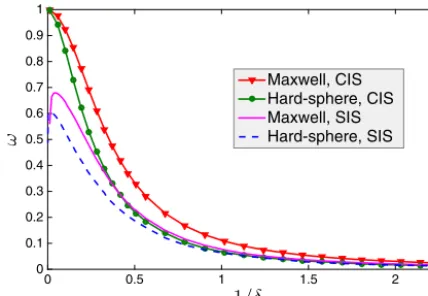
Theabovestepsarerepeateduntilconvergence.Fig. 1.Eigenvalueωversustheinverserarefactionparameter1/δfordifferentiterativeschemesfortheLBEwithMaxwellandhard-spheremolecules(Note thatPoiseuilleandthermaltranspirationflowshavethesameeigenvalue).OurmethodtocalculatetheeigenvaluefortheSISatlargevaluesofδisnot accurate,sincetheconvergenceissofast(itconvergesafteroneiteration)thatwehavefewdatatocalculateλthroughnumericalfitting.However,the trendthatωintheSISdecreaseswith1/δisclearwhen1/δ→0.
2.3. Numericalanalysisoftheconvergencerate
Analyticalsolutionsfortheeigenvalue
ω
havepreviouslybeenintroducedinordertocharacterizetheconvergencerate of theiterativeschemeforthelinearizedBGK equation [17,36].However, thisismoredifficult fortheLBEbecauseofits intricatecollisionoperator.HerewecalculatetheeigenvaluenumericallyinordertostudytheperformanceofboththeSIS andtheCIS.Forsimplicity,weconsideraperiodicsystemoflengthinthex1 direction,whilethesystemishomogeneous inthex2 direction.
FortheCISdescribedbyEq.(10),theVDFissolvedinthefollowingmanner(hereafterinthissection,handU3 should beviewedastheirFouriertransformsinthex1 direction):
h(k+1)
=
L+
(
h(k),
f eq)
+
Sν
eq+
2iπv1,
i=
√
−
1.
(25)Duringiteration,theflowvelocityU3(k+1)
=
´
h(k+1)v3dvisrecorded,anduponconvergencetheresultantseriesoftheflow velocityisfittedbyU3
(
k)
=
U3∞+
C e−λk.Theeigenvalueω
isthencalculatedasω
=
e−λ.Itisobviousthatthesmallerω
is,thefastertheconvergence;thecaseofω
=
1 meansnoconvergence.FortheSIS,theVDFisfirstupdatedaccordingtoEq.(23):
h(k+1/2)
=
L+
(
h(k),
f eq)
+
Sν
eq+
2iπv1.
(26)Thentheflowvelocityiscalculatedaccordingtothediffusion-typeequation(22)as
U(3k+1)
=
(δ
−
2iπA1−
4π
2A2)/
4π
2,
Poiseuille,(
−
2iπA1−
4π
2A2)/
4π
2,
thermal transpiration,(27)
where A1
=
2´
v1v3
(
L−
LBG K)
|h
=h(k)dvandA2=
´
h(k+1/2)
(2
v21−
1)v3dv.Finally,thisflowvelocityisusedtocorrectthe VDFaccordingtoEq.(24):h(k+1)=
h(k+1/2)+
2(U(k+1)3
−
U(k+1/2)
3
)
v3feq,whereU3(k+1/2)=
´
h(k+1/2)v
3dv.Thecalculationof theeigenvaluefortheSISthenfollowsinthesamewayasthatfortheCIS.
Figure 1 presents the eigenvalues for both the SIS andthe CIS. For smallvalues of therarefaction parameter
δ
both schemeshavethesameconvergencerate. However,forlargevaluesofδ,
theCIS hasextremelyslowconvergence(
ω
≈
1), while the SIS converges much faster. It is also interesting to note that the intermolecular potential greatly affects the convergencerate:atthesamevalue ofδ,
thesolutionoftheLBEforhard-sphere moleculesconvergesfasterthanthatfor Maxwellmolecules,1 inboththeSISandtheCIS.2.4. Numericalresultsforspatially-inhomogeneoussystems
We now presentnumerical simulations that demonstratethe efficiencyandaccuracy ofthe SIS forPoiseuille/thermal transpirationflowsbetweeninfiniteparallelplatesandthroughatwo-dimensionalsquarechannel.
1 WeassumethecollisionkernelB(|v−v
Table 1
Mass/heatflowratesinthePoiseuilleflowofhard-sphereandMaxwellmoleculesbetweentwoparallelplates.Itrdenotesthenumberofiterationstepsto reachtheconvergencecriterion =10−10.TheresultsfortheCISarenotshownat
δ=100 becauseitishardtoconverge.
δ Hard-sphere molecules Maxwell molecules
SIS CIS SIS CIS
Itr M −Q Itr M −Q Itr M −Q Itr M −Q
0.01 9 1.454 0.658 9 1.454 0.658 10 1.352 0.549 10 1.352 0.549
0.05 12 1.098 0.470 12 1.098 0.470 16 1.033 0.398 16 1.033 0.398
0.1 15 0.974 0.398 15 0.974 0.398 20 0.926 0.344 20 0.926 0.344
0.5 32 0.781 0.252 33 0.781 0.252 46 0.767 0.233 48 0.767 0.233
1 40 0.754 0.195 49 0.754 0.195 59 0.751 0.188 71 0.751 0.188
2 49 0.782 0.141 91 0.782 0.141 66 0.789 0.143 137 0.789 0.143
5 54 0.977 0.079 283 0.977 0.079 71 0.992 0.085 431 0.992 0.085
10 54 1.365 0.045 777 1.364 0.045 72 1.383 0.050 1183 1.382 0.050
20 55 2.182 0.024 2432 2.177 0.024 72 2.199 0.027 3684 2.194 0.027
30 54 3.009 0.016 4798 3.000 0.016 71 3.025 0.019 7245 3.017 0.019
50 54 4.671 0.010 12038 4.649 0.010 72 4.686 0.012 18136 4.665 0.012
100 55 8.836 0.005 73 8.848 0.006
Wefirst considera gasflowbetweentwo infiniteparallelplateslocated atx1
= −
1/2 and x1=
1/2 (notethat x1 has beennormalizedbythedistancebetweentwoparallelpalates).
Pressureandtemperaturegradientsareappliedinthex3 directiononly,so theflowis homogeneousinthe x2 directionandpartialderivativeswithrespectto x2 can bedropped. Thediscretization ofthethree-dimensionalmolecularvelocity space, aswell asthefastspectral methodtosolvethe lin-earized Boltzmann collision operator, are given in Ref. [28]. We adoptthe diffuse boundary condition for the gas–wall interaction.Duetosymmetry,onlyhalfofthespatialregion(−
1/2≤
x1≤
0)issimulated,withaspecular-reflection bound-ary condition at x1=
0, and the diffuseboundary condition h(
v2>
0)=
0 at x1= −
1/2. The spatial domain is divided into100nonuniformsections,withmostofthediscretepointsplacednearthewall: x1=
(10
−
15s+
6s2)
s3−
0.5,wheres
=
(0,
1,· · ·
,
Ns)/2
Ns.Thesizeofthesmallestsectionis1.24×
10−6,smallenoughtocapturetheKnudsenlayer.Fortheone-dimensionalproblem, theshearstress is P13
=
x1 forPoiseuilleflowandP13=
0 forthermaltranspiration flow.Thediffusion-typeequation(22)isintegratedtogivethefollowingfirst-orderordinarydifferentialequation:∂
U3∂
x1= −
δ
P13−
1 4∂
F2,0,1∂
x1+
2
ˆ
v1v3
(
L−
LBG K)
dv,
(28)which is solved by a second-order upwind finite difference (with a first-order scheme at the wall), with the boundary conditionU3
(
x1= −
1/2)=
´
v3h
(
x1= −
1/2)dvcalculatedfromtheVDFateachiteration.Theiterationsterminatewhenthe relativeerrorsinthemassandheatflowrates(M
=
2´
−01/2U3dx1,Q
=
2´
0−1/2q3dx1)betweentwoconsecutiveiterations arelessthan
=
10−10.AcomparisonbetweentheSISandtheCISistabulatedinTable 1forPoiseuilleflow.Therelativedifferencesinmass/heat flowratesbetweenthetwoschemesislessthan0.5%,whichdemonstratestheaccuracyoftheSIS.The superiorityofthe SIS over the CIS is immediately seen: for the CIS, the number of iteration steps increases rapidly with the rarefaction parameter,whilefortheSISitonlyslightlyincreaseswith
δ
inthefree-molecularandtransitionflowregimesandsaturates inthenear-continuumflowregime(δ
≥
10).Since,comparedtothefastspectralapproximationtotheBoltzmanncollision operatorthetimeforsolvingEq.(28)isnegligible,theCPUtimesavingisproportionaltothetime-stepsaving,andthisis tremendousfortheSIS.Atδ
=
10,theSISisabout15timesfasterthantheCIS,whileatδ
=
50 itisabout220timesfaster. ItisinterestingtonotethatforboththeSISandCIS,solutionsoftheLBEforhard-spheremoleculesconvergeabout1.5 timesfasterthanforMaxwellmolecules,aresultwhichsupportstheconvergenceanalysisinSec.2.3.WealsoconsiderPoiseuille/thermaltranspirationflows alongachannelofsquare crosssection. Duetosymmetry,only one quarterofthe spatial domainis simulated,whichis dividedinto 50
×
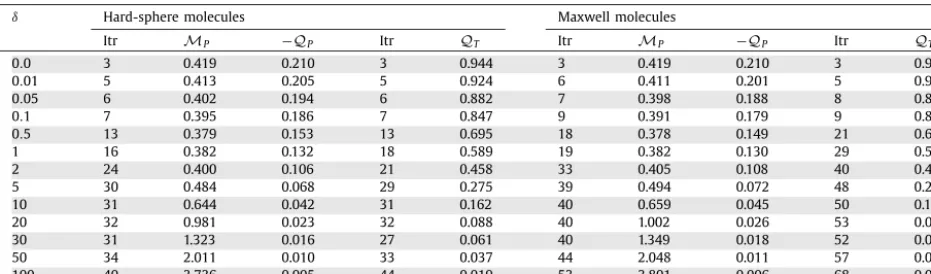
50 non-uniformcells: ineach direction, from the boundary to the center, the length of each cell side forms a geometric progression witha common ratio 1.05. The diffusion-type equation (22)is discretizedby a five-point centraldifference, andsolved by the successive-over-relaxation method[37].Table 2summarizes thenumericalresultsfromtheSIS. Themassflow rateinthermaltranspirationflowis notshown,asaccordingtotheOnsager–CasimirrelationitisequaltotheheatflowrateinPoiseuilleflow. Fromthistable itisseenthatourSISfortheLBEworksefficientlyoverthewholerangeofgasrarefaction.Thisefficient SIS canalso be usedto calculatethe slipcoefficients. In Ref. [38] itwas statedin that thethermal slip coefficientisstronglyaffectedbytheintermolecularpotential.Therefore,wecalculatethiscoefficientbasedontheLBEfor hard-sphere andMaxwellian molecules,andcompare ourresultsto that ofthe Shakhovkinetic model[39].Since inthe near-continuumregime,thedimensionlessmassflowrateinathermaltranspirationflowcanbeexpressedas[40]
M
T=
2σ
Tδ
,
(29)Table 2
Mass/heatflowratesinPoiseuille/thermaltranspirationflowsofhard-sphereandMaxwellmoleculesalongachannelofsquarecrosssection,aswellasthe numberofiterations(Itr)toreachtheconvergencecriterion =10−10intheSIS.
δ Hard-sphere molecules Maxwell molecules
Itr MP −QP Itr QT Itr MP −QP Itr QT
0.0 3 0.419 0.210 3 0.944 3 0.419 0.210 3 0.944
0.01 5 0.413 0.205 5 0.924 6 0.411 0.201 5 0.918
0.05 6 0.402 0.194 6 0.882 7 0.398 0.188 8 0.869
0.1 7 0.395 0.186 7 0.847 9 0.391 0.179 9 0.832
0.5 13 0.379 0.153 13 0.695 18 0.378 0.149 21 0.677
1 16 0.382 0.132 18 0.589 19 0.382 0.130 29 0.572
2 24 0.400 0.106 21 0.458 33 0.405 0.108 40 0.443
5 30 0.484 0.068 29 0.275 39 0.494 0.072 48 0.265
10 31 0.644 0.042 31 0.162 40 0.659 0.045 50 0.157
20 32 0.981 0.023 32 0.088 40 1.002 0.026 53 0.086
30 31 1.323 0.016 27 0.061 40 1.349 0.018 52 0.059
50 34 2.011 0.010 33 0.037 44 2.048 0.011 57 0.036
100 40 3.736 0.005 44 0.019 53 3.801 0.006 68 0.018
Table 3
Thermalslipcoefficientscalculatedbased ontheLBEforthehard-sphere andMaxwellianmolecules,andthecoefficientobtainedfromtheShakhov kineticmodel[38].
Hard-sphere Maxwellian Shakhov model
σT 1.010 1.168 1.175
ThenumericalresultsareshowninTable 3.It isclearthatthereisalargedifference(nearly20%)betweentheLBEfor thehard-sphere gasandtheShakhovmodel,butthedifferencebetweentheLBEfortheMaxwellian gasandtheShakhov model issmall. Thisis probablybecausethe collision frequencies inthe LBEforMaxwellian moleculesandthe Shakhov modelareconstants,whilethatintheLBEforhard-spheremoleculesisafunctionofthemolecularvelocity.Thisexample showsthatitisnecessarytousetheBoltzmannequation eveninthenear-continuumflow regime,andtheSISdeveloped hereisuseful,forexample,inassessingtheaccuracyofvariouskineticgas–surfaceboundaryconditionsbycomparingthe numericalsolutionsforthermaltranspirationflowwithexperimentaldata[41,42].
2.5. Themostefficientscheme
In Sec. 2.4we saw that the SIS for the LBE can be faster than the CIS by several orders of magnitude inthe near-continuum regime. Nowwe lookatthe possibilityofspeedingup theconvergenceevenmore,withoutmodifyingthe SIS toomuch.Tothisend,wepenalizethelinearizedBoltzmanncollisionoperatorintothefollowingform:
L
=
(
L−
N LBG K)
+
N LBG K,
(30)wheretheconstant N isatuningparameterwhichaffectstheconvergencerate.
WithEq.(20)replacedbyEq.(30),thediffusion-typeequation(22)shouldbechangedaccordingly.Ournumericalresults for Poiseuilleflow betweentwo parallelplates show that,fora fixed
δ,
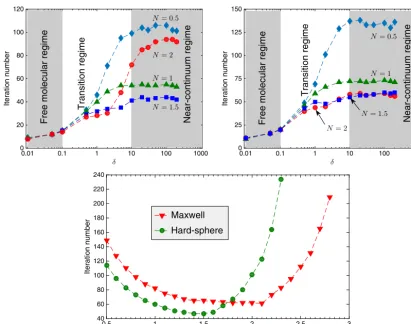
all syntheticschemes withdifferentvaluesof Nconverge to the same solution (with relative errors in flow rates lessthan 0.1%). However, the convergence ratevaries with N.FromthetoprowinFig. 2we seethatinthefreemolecularregimeall schemeshavethesameconvergencerate, whileinthetransitionregimetheschemewithN
<
1 (N>
1)convergesslower(faster)thanthatwithN=
1.Thesituation becomes complicatedin thenear-continuum regime:forhard-sphere molecules,thecasewith N=
1.5 convergesfastest, followedby N=
1,2,and0.5.ForMaxwellmolecules,however,thecaseswithN=
1.5 and N=
2 haveroughlythesame fastconvergence,followedby N=
1 and0.5.Similarbehaviorsareobservedforthethermaltranspirationflow.To furtherinvestigate therelationship betweenthe convergenceiteration step and N inthe syntheticscheme, we fix
δ
=
100 andvaryN.ThenumericalresultsinthebottomrowofFig. 2showthatthefastestconvergenceisachievedwhenN is approximately 2and 1.5forMaxwell andhard-sphere molecules,respectively. This maybe interpreted interms of theaveragecollisionfrequency.IntheLBE,theequilibriumcollisionfrequency
ν
eq isingeneralafunctionofthemolecular velocity.Theaveragecollisionfrequency,¯
ν
=
ˆ
ν
eq(
v)
feq(
v)
dv,
(31)Fig. 2.Toprow:iterationnumberversustherarefactionparameterδintheSIS(theconvergencecriterionis =10−10)forPoiseuilleflowbetweentwo parallelplates.Topleft:hard-spheremolecules.Topright:Maxwellmolecules.Bottomrow:numberofiterationstoconvergenceversusNintheSISwhen therarefactionparameterisδ=100.
respectively—which are very close to the two values for the fastest convergence as seen in the bottom row of Fig. 2. Therefore,toachievethebestperformanceofthesyntheticschemewesuggestusing
N
=
ν
¯
δ
,
(32)whichfurtherreducestheiterationnumberbyabout30%whencomparedtothecaseofN
=
1.2.6. FurtherbenefitinusingSIS
Inadditiontothesignificant speed-upofconvergence,theSIScanalsohelptoreducethespatialresolution.Itis well-knownthatinordertosolvethekineticequationsthesizeofthespatialcellsinthetraditionaldiscretevelocitymethodor theDSMCmethodshouldbesmallerthanthemolecularmeanfreepath,sothatnumericalresultsarereliablebecausethe artificialviscosityismuchsmallerthanthephysicalviscosity.IntheSIS,themacroscopicflowvelocityisobtainedby solv-ingthesyntheticdiffusion-typeequation (22)whichisasymptotic-preservingintotheNavier–Stokesregime,sothespatial resolutioncanberelativelycoarser.
Todemonstratethis,werunthetestcaseinSec.2.4again,butthehalfspatialdomainisinsteaddividedinto10uniform cells;for
δ
=
200,thismeansthatthespatialcellsizeisabout10timeslargerthanthemolecularmeanfreepath.Boththe SIS andCIS onthiscoarse gridare comparedtothe referencesolutions ofTable 1.Since themassflow ratein Poiseuille flowincreasesrapidlywithδ,
we studyhowtheapparent gaspermeabilitychangeswiththerarefactionparameter.Here, theapparentgaspermeability,whichisnormalizedby2,isdefinedas
κ
=
M
Pδ
.
(33)NotethataccordingtotheNavier–Stokesequationwiththeno-slipvelocityboundarycondition,theflowvelocitysatisfies
∂
2U3∂
x12= −
δ,
withU3 x1= ±
1 2
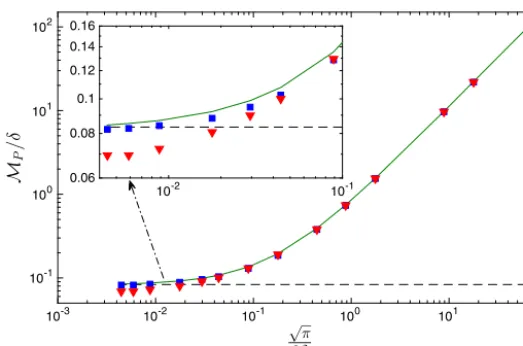
Fig. 3.TheapparentgaspermeabilityinthePoiseuilleflowofahard-spheregasbetweentwoparallelplates.Solidlines:referencesolutionobtainedfrom Table 1.Squaresandtriangles:theSISandCISsolutions,respectively,oftheLBEwhenthehalfspatialregionisdividedinto10uniformsections.Dashed lines:theintrinsicpermeabilityκ=1/12,obtainedfromtheNavier–Stokesequationwiththeno-slipboundarycondition.
Fig. 4.The Sierpinski carpet generated at different levels of recursion. White regions represent the solid, while the gas can flow through the black regions.
ThuswehaveU3
= −
(δ/2)(
x21−
1/4),andκ
=
1/12;thispermeabilityisalsoknownasthe“intrinsic”or“liquid” permeabil-ity.Theapparentgaspermeabilityisalwayslargerthantheintrinsicpermeability,andincreaseswith1/δ (ortheKnudsen number).Figure 3 shows theapparentgaspermeabilityobtainedforthesedifferentspatial resolutions overawide rangeofthe rarefactionparameter.ItisclearthattheSIS,evenwithacoarsespatialresolution,canyieldgoodresults.Thisprovesthat theSISisasymptotic-preservingintotheNavier–Stokesregime.TheCISresults,however,havelargererrorsatlargevalues of
δ.
Forinstance,whenδ
=
150,thenon-acceleratedschemeunderpredictstheapparentgaspermeabilitybyabout12.5%. This errorcontinuesto increaseswithδ:
we havetestedthe BGK modelforδ
=
104 andfound that therelative erroris about62.5%[43].3. SISinmultiscaleproblems
WenowinvestigatetheperformanceoftheSISinmorecomplexgeometries,wheretheproblemsaremultiscaleinthe sensethattherarefactionparametervariesbyseveralordersofmagnitudeduetodifferentcharacteristicflowlengthscales, e.g.flowinafractalgeometry.
3.1. RarefiedgasflowthroughtheSierpinskicarpet
Wefirstconsiderthegasflowthroughatwo-dimensionalcrosssectiondescribedbytheSierpinskicarpet,whichcanbe generated throughrecursion.Beginningwitha square,thesquare iscut into9congruent subsquaresina 3
×
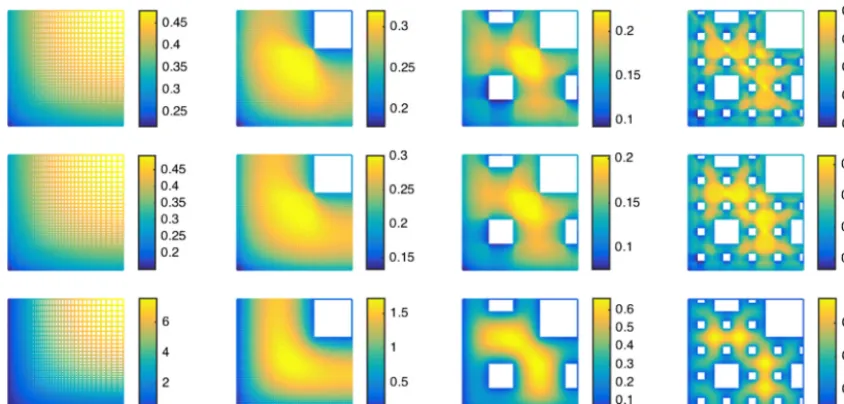
3 grid,and thecentralsubsquareisremoved.Thesameprocedureisthenappliedrecursivelytotheremaining8subsquares.Resulting geometriesafterseverallevelsofrecursionarepresentedinFig. 4.Fig. 5.VelocitycontoursinthePoiseuilleflowofahard-spheregasthroughtheSierpinskicarpetsgeneratedatdifferentlevelsofrecursion(fromtheleft columntotheright,therecursionlevelsare0,1,2,and3,respectively),whenδ=1 (toprow),10(middlerow),and100(bottomrow).Duetosymmetry, onlyonequarterflowdomainisshown.Thegasflowsintothepage.
Figure 5displaysthevelocitycontoursatdifferentgeometriesandfordifferentrarefactionparameters,wherethe char-acteristic flow length
is chosen to be the side length of the largest square. When there is no solid inside the largest square(firstcolumninFig. 5),themaximumvelocityisatthecenterofthedomain.Whentherearesomesolidsinsidethe largestsquare,andwhen
δ
issmall,itseemsthatlargeflowvelocitiesarelocatednearthecentralregions.However,whenδ
islarge,largeflowvelocitiesare localizedbetweenthesmallestsquaresthatareoffsetfromother largersquaresnearby, insteadofinthecentralregionofthecarpets.Thismaybeseenclearly intheflowintheSierpinskicarpetoflevel 3(the rightbottomofFig. 5).Figure 6showsthemassandheatflowratesinthePoiseuilleflowofthehard-spheregasthroughtheSierpinskicarpet. The Knudsen minimum in the mass flow rate can be seen, however, the location of the minimum
M
P shifts towards largervaluesofδ
astherecursionleveloftheSierpinskicarpetincreases.Thisisbecause,inthecalculationofδ
according to Eq. (12), the characteristic flow lengthis chosen to be the side length of the largest square, which is larger than, say, the smallest side length of the solids near which the flow velocity is maximum. As the recursion level increases, the porosity(the voidarea fraction) ofthe Sierpinskicarpetdecreases,so theflow ratesdecrease. Wealso plotinFig. 6
the thermomolecular pressure difference exponent, which is an important parameter determining the performance of a Knudsenpump.Theexponentalwaysincreaseswithdecreasing
δ
andapproachesthevalueof0.5whenδ
→
0 ifthediffuse gas–surfaceboundaryconditionisused[40].Thisalsoindicatesthecorrectnessofournumericalsimulations.3.2. Rarefiedgasflowthroughrandomstructures
We also consider the gas flow through two-dimensional porous media, where the porosity is 0.6. The first porous mediumisgeneratedbyaddingcircularsolidsofdifferentradiirandomlytoasquare.Theradiusratioofthelargestdiscto thesmallestis10.The squareisthen dividedinto200
×
200 uniformcells,andthediscsareapproximatedby the “stair-case”,asvisualizedinFig. 7(a).Thesecondporousmedium,showninFig. 7(b),alsoconsistingof200×
200 uniformcells, isgeneratedbythequartetstructuregenerationset[44].Followingthenumericalsimulations,velocitycontoursaredisplayedinFig. 8forthefreemolecularandnear-continuum flow regimes, while the mass andheat flow ratesare shownin Fig. 9 fromthe free molecular to near-continuum flow regimes.It isinteresting to note that, inthefree molecular flow regime, themass flowrates inthe tworandom porous mediaarenearlythesame.However,inthenear-continuumregime,themassflowrateoftheporousmediumconsistingof randomsquaresisabouttwicethatindiscmedium.Thisresearchmayfindapplicationsinshalegasextraction.
4. Aspecialcase:SISinpolarcoordinates
Fig. 6.MassflowrateMP,heatflowrateQP,andthethermomolecularpressuredifferenceexponent−QP/MP inthePoiseuilleflowofahard-sphere gasthroughtheSierpinskicarpets.Circles,squares,triangles,andpentagramsrepresenttheresultsfortheSierpinskicarpetsgeneratedatrecursionlevel0, 1,2,and3,respectively.
Fig. 7.Porousmediawithaporosityof0.6,consistingof(a)discsofrandompositionandradius,and(b)islandsofdifferentsizeandshapecomposedof multiplesmallsquares.Whiteregionsrepresentthesolid,whilethegascanflowthroughtheblackregions.
LBE will be developed inpolarcoordinates for spatial variables,while the three-dimensionalmolecular velocity space is representedbycylindricalcoordinates.
We consider Poiseuilleflowalong a pipe asanexample, wheretheaxis ofthepipe isalong the x3 direction, andits cross section islocatedin thex1–x2 plane.The spatial coordinatesare normalizedby theradius ofthetube.Introducing thetransformationx1
=
rcosθ,
x2=
rsinθ,
v1=
vrcosθ,
v2=
vrsinθ
,anddefiningtheVDFh=
h(
r,
θ,
vr,
v3)
incylindrical (molecularvelocity)-polar(space)coordinatesvr∈ [
0,+∞
),
θ
∈ [
0,2π
]
,vz∈
(
−∞
,
∞
),
andr∈ [
0,1]
,theLBEcanbewritten as:v1
∂
h∂
r−
v2r
∂
h [image:12.561.129.421.404.558.2]Fig. 8.VelocitycontoursinthePoiseuilleflowofahard-spheregasthroughthetworandomporousmediainFig. 7,whenδ=0.01 (leftcolumn)and300 (rightcolumn).Thegasflowsintothepage.
[image:13.561.58.489.339.668.2]Table 4
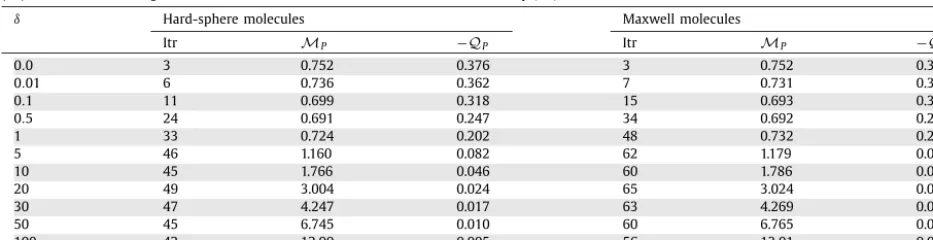
MassandheatflowratesinPoiseuilleflowofhard-sphereandMaxwellmoleculesalongatubeofcircularcrosssection,aswellasthenumberofiterations (Itr)toreachtheconvergencecriterion =10−10intheSIS.WechooseN=1 inEq.(40).
δ Hard-sphere molecules Maxwell molecules
Itr MP −QP Itr MP −QP
0.0 3 0.752 0.376 3 0.752 0.376
0.01 6 0.736 0.362 7 0.731 0.355
0.1 11 0.699 0.318 15 0.693 0.307
0.5 24 0.691 0.247 34 0.692 0.244
1 33 0.724 0.202 48 0.732 0.205
5 46 1.160 0.082 62 1.179 0.091
10 45 1.766 0.046 60 1.786 0.052
20 49 3.004 0.024 65 3.024 0.028
30 47 4.247 0.017 63 4.269 0.019
50 45 6.745 0.010 60 6.765 0.012
100 42 12.99 0.005 56 13.01 0.006
ToconstructtheSIS inpolarcoordinates,adiffusion-type equationfortheflowvelocity U3
(
r)
shouldbe derived.Since theLaplaceoperator∂
2U3/∂
x21+
∂
2U3/∂
x22inEq.(22)canberewrittenas 1r∂ ∂r
r∂∂U3r ,ourgoalistoconstructthe diffusion-typeequationinthefollowingform:
1 r
∂
∂
r r∂
U3∂
r= −
Nδ
+
high-order terms,
(36)bytakingthevelocitymomentoftheLBE(35).
Multiplying Eq.(35) by 2v3 andintegrating over the molecular velocity space, we obtain the equation for the shear stress Prz
=
´
2v3v1hdv
=
´
2v3v2rcos
θ
hdvrdv3dθ
as1 r
∂
∂
r(
r Prz)
=
1.
(37)Multiplying Eq.(35)by v3v1, penalizingthelinearized Boltzmanncollisionoperator intheformofEq.(30),and inte-gratingoverthemolecularvelocityspace,weobtain
∂
∂
rˆ
v3v21hdv
+
1 rˆ
v3
(
v21−
v22)
hdv= −
Nδ
Prz2
+
ˆ
v3v1
(
L−
N LBG K)
dv,
(38)whichissimplified,withthehelpofEq.(37),into
1 r
∂
∂
r r∂
∂
rˆ
2v3v21hdv
+
ˆ
2v3
(
v21−
v22)
hdv−
rˆ
2v3v1
(
L−
N LBG K)
dv= −
Nδ.
(39)Ifweexpress
´
2v3v21hdv=
´
v3
(2
v21−
1)hdv+
U3,thediffusion-typeequationintheformofEq.(36)canbederived.But forpracticalnumericalcalculations,thefollowingfirst-orderordinarydifferentialequationfortheflowvelocityisdesirable:∂
U3∂
r= −
N
δ
r 2−
∂
∂
rˆ
v3
(
2v21−
1)
hdv−
1 rˆ
2v3
(
v21−
v22)
hdv+
ˆ
2v3v1
(
L−
N LBG K)
dv.
(40)Inthenumericalsimulation,thespatial coordinaterisdiscretizedinto150nonuniformpoints,withmostofthepoints located nearthepipe surfacer
=
1.Dueto symmetry,thetruncatedvelocity vr∈
(0,
4) isdiscretizedinto64nonuniform points,withmostofthepointslocatednearvr=
0,whileθ
∈ [
0,π
]
andv3∈
(0,
6)arediscretizedinto40and12uniform points, respectively. The linearized Boltzmann collision operator is approximated by the fast spectral method: first, the spectrum of the VDF is calculated by Fourier transform from the cylindrical molecular velocity space to the Cartesian frequencyspace.Second,thefastspectralmethod[28]isappliedtofindthespectrumofthelinearizedBoltzmanncollision operator in the Cartesian coordinate.Finally, the inverse Fourier transform is used to find the collision operator in the cylindricalspace.TheSISinpolarcoordinateisimplementedinthefollowingthreesteps:first,asusual,Eq.(35)issolvedby theimplicititerativescheme,withthespatialderivativesbeingapproximatedbythesecond-orderupwindfinitedifference. Then, Eq.(40),which isused to expediteconvergenceto thesteady-state solution,isalso solved usingthe second-order upwindfinitedifference, wheretheboundarycondition ofU3(
r)
atr=
1 iscalculatedfromtheVDFobtainedinthe first step.Finally,havingobtainedU3(
r)
fromEq.(40),acorrectionintheVDFisperformed,seeEq.(24).5. SISfortheLBEforgasmixtures
Inthissection we developa SISforthe LBEforbinary gasmixtures.Forsimplicity,onlyPoiseuille flowisconsidered, butthemethodcanbegeneralizedtoflowsdrivenbytemperatureandconcentrationgradients.
Let fA and fB be, respectively, the VDFsof gascomponents Aand B withmolecular massesmA andmB, andmolar fractions
χ
A andχ
B=
1−
χ
A.IntroducingtheequilibriumVDF(inwhichthevelocityisnormalizedby themostprobable speed vm A=
2kBT0
/
mA ofcomponentA[35]):fα,eq
(
v)
=
χ
αmα
π
mA3
/2exp
−
mα|v|
22mA
,
α
=
A or B,
(41)andexpressingtheVDFintheform fα
=
fα,eq+
hα,wherehα areperturbedVDFssatisfying|
hα/
fα,eq|
1,theLBEforhα isv1
∂
hα∂
x1+
v2∂
hα∂
x2=
Lα
+
Sα,
(42)withthelinearizedBoltzmanncollision operators Lα
=
β=1,2Qαβ(
fα,eq,
hβ)
+
Qαβ(
hα,
fβ,eq),
wherethe detailsof Qαβ canbefoundinRef.[35].ThesourcetermforPoiseuilleflowisSα
= −
XPv3fα,eq,
(43)andagainwetake XP
= −
1.When theperturbed VDFsare known,theflow velocitynormalizedby vm A iscalculated asUα
=
´
hαv3dv/
χ
α,shear stressesnormalizedbythetotalgaspressure p0 are Pα13=
2mα´
hαv1v3dv
/
mAand Pα23=
2mα´
hαv2v3dv
/
mA,andthe heat flux normalizedby p0vm A isqα=
´
mα|
v|
2/
mA−
5/2v3hdv.The dimensionless massflow rate
M
andheat flow rateQ
,normalizedbythemostprobablespeedofthegasmixture,arecalculatedasM
α=
1 A
m mA¨
Uαdx1dx2
,
Q
α=
1 A
m mA¨
qαdx1dx2
,
(44)
wherem
=
χ
AmA+
(1
−
χ
A)
mB istheaveragemolecularmassofthemixture.5.1. Thesyntheticschemeforagasmixture
As emphasized above, the relation
∂
P13/∂
x1+
∂
P23/∂
x2=
1 isimportant indeveloping the SIS.For binary mixtures, thisrelationstill holds,butnow shearstresses arereplaced by mixtureshear stresses,i.e. P13=
PA13+
PB13 and P23=
PA23
+
PB23.Thisposesanadditionaldifficulty.Following the basic steps in developing the synthetic equation, we obtain the following two equations for the flow velocityofeachcomponent:
χ
α∂
2Uα∂
x21+
∂
2Uα∂
x22=
2∂
∂
x1ˆ
v1v3Lαdv
+
2∂
∂
x2ˆ
v2v3Lαdv
−
14
∂
2Fα2,0,1∂
x21+
2∂
2Fα1,1,1∂
x1∂
x2+
∂
2F0α,2,1∂
x22,
(45)whereFmα,n,l
=
´
hαHm(
v1)
Hn(
v2)
Hl(
v3)
dv.Toobtaindiffusion-typeequationswhichrecovertheStokesequation(animportantstep,guaranteeingfastconvergence) inthehydrodynamicregime,werewritethelinearizedcollisionoperatoras2:
Lα
=
(
Lα+
Nαδ
hα)
−
Nαδ
hα,
(46)where Nα are two constants, and let 2
´
v1v3Lαdv
=
´
v1v3
(
Lα+
Nαδ
hα)
dv−
Nαδ
mAPα13/
mα and 2´
v2v3Lαdv
=
´
v2v3
(
Lα+
Nαδhα)
dv−
NαδmAPα23/
mα.Then,forcomponentB,Eq.(45)istransformedto2 ThisisbecausethelinearizedBoltzmanncollisionoperatorforsingle-speciesgasescanalsobepenalizedintheformL=
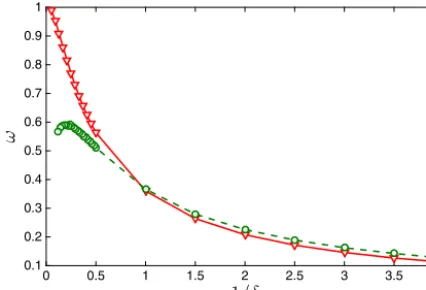
Fig. 10.Eigenvalueωversus the inverse rarefaction parameter 1/δfor the SIS (circles) and the CIS (triangles) for the LBE of an equimolar Ne–Ar mixture.
χ
B∂
2UB∂
x21+
∂
2UB∂
x22= −
NBδ
mA
mB
∂
PB13∂
x1+
∂
PB23∂
x2−
14
∂
2F2B,0,1∂
x21+
2∂
2F1B,1,1∂
x1∂
x2+
∂
2F0B,2,1∂
x22+
2∂
∂
x1ˆ
v1v3
(
LB−
NBδ
fB)
dv+
2∂
∂
x2ˆ
v2v3
(
LB−
NBδ
fB)
dv,
(47)while forcomponentA, byusing therelation
∂
P13/∂
x1+
∂
P23/∂
x2=
1 with P13=
PA13+
PB13 and P23=
PA23+
PB23, Eq.(45)istransformedtoχ
A∂
2UA∂
x21+
∂
2UA∂
x22=
NAδ
∂
PB13∂
x1+
∂
PB23∂
x2−
1
−
14
∂
2F2A,0,1∂
x21+
2∂
2F1A,1,1∂
x1∂
x2+
∂
2F0A,2,1∂
x22+
2∂
∂
x1ˆ
v1v3
(
LA−
NAδ
fA)
dv+
2∂
∂
x2ˆ
v2v3
(
LA−
NAδ
fA)
dv.
(48)We therefore propose theSIS for theLBE forbinary gas mixtures:while the VDFsin Eq.(42)are first solved by the CIS [35],flowvelocitiesareupdatedaccordingtodiffusion-type equations(47)and(48).ThentheVDFsarecorrectedina waysimilartoEq.(24).Notethatthefastestconvergenceisachievedwhen
Nα
=
´
ν
α,eq(
v)
fα,eq(
v)
dvδ
χ
α,
(49)where
ν
α,eq istheequilibriumcollisionfrequencyoftheα
-component.The present SIS isreadily generalizedto multiple-species gas mixtures. Suppose there are j gas components;for the velocity of thefirst component, the term
∂
PB13/∂
x1+
∂
PB23/∂
x2 in the diffusion-type equation (48) can be replace by ji=2
(∂
Pi13/∂
x1+
∂
Pi23/∂
x2),
whilethediffusion-type equationsfor theflow velocitiesofthe other componentsremain thesameasEq.(47),i.e.byreplacing B withthecomponentindexi.ThismethodcanalsobeappliedtotheMcCormack kinetic equation [25] formultiplegasmixture, bysimply replacing Lα inEqs.(47) and(48)withthat inthe McCormack model;theresultingdiffusion-typeequationswillbemuchsimplerthanthoseinRefs. [37,45].5.2. Convergenceanalysis
To show the efficiency of the proposed SIS for binary gas mixtures, we calculate the eigenvalue of the iteration as a function of the inverse rarefaction parameter. The numerical procedure is essentially the same as that in Sec. 2.3for single-species gases.Fig. 10showstheeigenvalueofboththeSIS andCISforanequimolar Ne–Armixture,whereNeand Araretreatedashard-spheremoleculeswithamoleculardiameterratioof0.711.ItisclearthattheSISissuperiortothe CIS atlargevaluesoftherarefactionparameter. Also,whencompared totheSIS fora single-specieshard-sphere gas,the syntheticschemeforabinary gasmixturehasroughlythesamemaximumeigenvalue,i.e.
ω
0.6.So itisexpectedthat the syntheticschemeforabinary gasmixturewill beasefficientasthatfora single-speciesgas.Itis alsointerestingto notethatatsmallvaluesofδ
theeigenvalueoftheSISisslightlyhigherthanthatoftheCIS;thereasonforthisisnotclear. However, thisdoesnot affecttheefficiencyoftheSIS becauseatsmallvaluesofδ
both theSISandCISconvergerapidly, i.e.withinasmallnumberofiterations.5.3. NumericalsimulationsofPoiseuilleflow