EFFECTIVENESS OF AN INDIVIDUALISED
SENSORY STIMULATION PROGRAM FOR
HIGH RISK INFANTS LESS THAN
THREE MONTHS OF AGE
A PROJECT WORK SUBMITTED IN PARTIAL FULFILLMENT OF THE REQUIREMENTS FOR THE DEGREE OF
MASTER OF OCCUPATIONAL THERAPY
(ADVANCED O.T. IN PEADIATRICS)
Submitted By
Reg No. 41091206
JKK MUNIRAJA MEDICAL RESEARCH FOUNDATION
COLLEGE OF OCCUPATIONAL THERAPY
KOMARAPALAYAM
–
638 183
Affiliated by
THE TAMILNADU DR.M.G.R.MEDICAL UNIVERSITY
CHENNAI
–
600 032
EFFECTIVENESS OF AN INDIVIDUALISED
SENSORY STIMULATION PROGRAM FOR HIGH
RISK INFANTS LESS THAN
THREE MONTHS OF AGE
A PROJECT WORK SUBMITTED IN PARTIAL FULFILLMENT OF THE REQUIREMENTS FOR THE DEGREE OF
MASTER OF OCCUPATIONAL THERAPY
(ADVANCED O.T. IN PEADIATRICS)
Submitted By
Reg No. 41091206
JKK MUNIRAJA MEDICAL RESEARCH FOUNDATION
COLLEGE OF OCCUPATIONAL THERAPY
KOMARAPALAYAM – 638 183Affiliated by
THE TAMILNADU DR.M.G.R.MEDICAL UNIVERSITY
CHENNAI
–
600 032
MARCH
–
2011
PRINCIPLE EXTERNAL EXAMINER
CERTIFICATE
This is to certify that the Project work entitled, “EFFECTIVENESS OF AN INDIVIDUALISED SENSORY STIMULATION PROGRAM FOR HIGH RISK INFANTS LESS THAN THREE MONTHS OF AGE Is a bonafide compiled work carried out carried out by Reg. No. 410911206, Final year student, College of Occupational Therapy under J.K.K. Munirajah Medical Research Foundation, Komarapalaym
-638 183, in partial fulfillment for the award of Degree of Master of
Occupational Therapy (Advanced O.T. in Paedatrics) of The Tamilnadu Dr. M.G.R. Medical University, Chennai-32. This work was done under my
supervision and guidance
Mr.M.SARAVANA ROENTGEN MANI, M.I.Th., PRINCIPAL
M.Sc. (OT), PGDR. (OT)
ACKNOWLEDGEMENTS
First and foremost I praise the Almighty God for his grace and abundant
blessing he has showered upon me his invisible presence and guidance,
throughout the complete course of my project study.
I extend my thanks to Dr. J.K.K. MUNIRAJAHH, M.Tech., (Bolton),
Chairman, JKKMMRF College of Occupational Therapy for providing me with
adequate facilities required for the completion of my course.
I am thankful to Mr.M.SARAVANA ROENTGEN MANI, M.O.Th.,
Principal, JKKMMRF College of Occupational Therapy for his guidance,
suggestion and concern at every single state for the successful completion of
this dissertation.
I must express my sincere thanks to Mr. T. JAGADEESAN, who guided
me throughout my project.
I express my thanks to Mr. MURALI Statistician who help me to do
statistical analysis for this project.
I express my thanks to Dr. RAJESH who granted permission to carryout
this study in his place with his supervision.
I express my thanks to Dr. VANATHI BALACHANDRAN, M.D.,
I extend my thanks to LIBRARIANS, JKKMMRF College of Occupational Therapy for their help.
I express my heartful thanks to my beloved family members and friends
for their love, affection, and encouragement, constant inspiration, prayers and
blessing without which I could not have accomplish anything.
I express my hearty thanks to Mr.V.MOHANRAJ & TEAM, M-Tech
Computer Centre, for their active participation with out who on this study would not have been possible.
TABLE OF CONTENTS
S.No. CONTENTS PAGE No.
ABSTRACT
1. INTRODUCTION 01
2. AIM AND OBJECTIVES 03
3. HYPOTHESIS 04
4. REVIEW OF LITERATURE 05
5. RELATED LITERATURE 16
6. METHODOLOGY 23
7. DATA ANALYSIS AND RESULTS 27
8. DISCUSION 46
9. CONCLUSION 51
10. LIMITATIONS AND RECOMMENDATIONS 52
11. REFERENCES 53
ABSTRACT
AIM:To find out the effectiveness of an individualized sensory stimulation
program for high risk infant less than 3 months of age.
METHODS:
Twenty two high risk infants were selected for the study and were
randomly assigned to the control and experimental group. Each group had 11
infants of which 4 were female and 7 were male.
The “sensory profile” was used to evaluated the infants development in
the five (ie) visual auditory, tactile, vestibular and proprioceptive.
RESULTS:
Sensory stimulation in the first 3 months of life is beneficial in facilitating
the development of high risk infants.
KEYWORDS:
INTRODUCTION
Human development is a continuous process and involves the
motor, sensory, perceptual, cognitive, emotional and cultural systems.
All the developing systems of the infant and child are inter-related. Some
take precedence over others at varying stages of development. The
maturation of the Central Nervous System and brain is incomplete at
birth. Maturation occurs gradually as a result of environmental input,
sensory stimulation and cultural influences. The sensory system thus
plays an important role in Central Nervous System maturation during
infancy.
Sensory function is defined as the action of the environment upon
the organism and the reaction of the organism to the environment (Ayres,
1973). A normal newborn has the capacity to perceive a large range of
sensory stimuli in a well organized manner and is remarkably responsive
to visual, auditory, somatosensory and vestibular stimulation. The ability
to perceive and act upon these various sensory stimuli to produce an
adaptive response is the basis for further development and parent – infant
bonding.
High risk infants are those, who have a potential to develop
developmental disabilities, as a result of events that occurred prenatally,
perinatally and postnatally. These infants are especially vulnerable and
liable to manifest difficulties with sensory processing, and therefore have
problems in producing age-appropriate adaptive responses. In addition
the development of these high risk infants depends on the environment in
interactions because of increased stress, anxiety, grief, disappointment
and guilt associated with the birth. The infants themselves may be less
rewarding, less predictable and more difficult to raise.
Facilitating an infant’s organization of the sensory information to
produce age-appropriate adaptive responses is one of the occupational
Therapist’s unique contributions to developmental care and early
intervention. Therapy is aimed at balancing the environmental input with
the infant’s current sensory processing and organizational abilities so as
to promote optimal development. The value of early sensory stimulation
is to provide an increase in an infant’s everyday experiences and
interaction, and thereby facilitate adaptive responses and bonding with
the caretaker.
This study was done to evaluate the effectiveness of a parent
focused individualized stimulation program on the development of high
AIM AND OBJECTIVES
AIM
To find out the effectiveness of an individualized sensory
stimulation program for high risk infants less than 3 months of age.
OBJECTIVES
1. To compare the development of the sensory systems in the Normal
and High risk infants.
2. To evaluate the effectiveness of an individualized sensory
stimulation program in facilitating the development of the sensory
systems, and thereby facilitating normal development in high risk
infants.
3. To evaluate the effectiveness of a parent focused intervention in
HYPOTHESIS
ALTERNATE HYPOTHESIS
There will be significant improvement in the development of the
Sensory systems through individualized sensory stimulation programme
among high risk infants under 3 months of age.
NULL HYPOTHESIS
There will be no significant improvement in the development of
sensory systems through individualized sensory stimulation programme
REVIEW OF LITERATURE
PhD, BSc (Hons) Julie Anne Hayes Applied Psychology, RGN 1 June
2006. This paper describes a non-pharmacological stroking intervention which has been used with premature infants. This intervention is referred
to as Touching and Caressing, Tender in Caring (TAC-TIC) therapy.
Some of the beneficial outcomes resulting from TAC-TIC in healthy
preterms are outlined, along with some of the initial findings from
research using the therapy with the high-risk ventilated premature
neonate. In recent years much research has been conducted on the effects
of supplemental stimulation on the maturation of high risk infants. A look
at some of the previous studies will give a clearer understanding of the
developmental dysfunctions in high risk infants and effectiveness of early
sensory stimulation in facilitating normal development.
J Obstet Gynecol Neonatal Nurse.(2004), Cambridge Journals Onlie. Developmental patterns of physiological response to a multisensory intervention in extremely premature and high-risk infants.
Thirty-seven premature infants born at 23-26 weeks with normal head
ultrasounds or at 24-32 weeks and diagnosed with periventricular
leukomalacia (PVL) and/or intraventricular hemorrhage (IVH) were
studied at 33-35 weeks postconceptional age. Infants were randomly
assigned to control and experimental groups. The experimental group
infants received auditory, tactile, visual, and vestibular (ATVV)
multisensory intervention twice daily from 33 weeks postconceptional
age (PCA) until hospital discharge. HR, RR, and SaO2 were continuously
monitored during baseline, intervention, and the 30-minute
control group infants with and without CNS injury and experimental
group infants without CNS injury had a significant decrease in resting
mean HR, whereas RR and SaO2 remained stable. The infants with PVL
who received the intervention showed increases in HR even at rest.
Conclusions: The absence of a weekly decline in HR for experimental group infants with PVL suggests that PVL may affect
maturation of the autonomic nervous system and increase risk of
decelerative HR changes and associated clinical compromise. Infants
diagnosed with PVL should be closely monitored during procedures or
interventions that may be stressful or involve handling. Further research
is needed to tailor multisensory interventions for infants with PVL
Raweewan Lekskulchai, Joan Cole: 2001 Conducted a randomized controlled trial to evaluate the effect of a Motor
Developmental Program in improving motor performance in Thai infants
born pre-term. Eighty four pre-term infants were randomly assigned to a
control or intervention group. Additionally 27 low risk pre term infants
were included forming a comparative group for this study. The motor
performance was assessed monthly, from term equivalent age to four
months adjusted age with the test of infant motor performance. The
intervention infants received a developmental program which was
upgraded at each monthly visit the intervention group showed the greatest
improvement with significant differences across age and among groups.
Thus the results suggest that an early intervention program is likely
to have a beneficial effect when offered to a similar population of pre
J Perinatol. 2000 Atypical perinatal sensory stimulation and early perceptual development: insights from developmental psychobiology.
Lickliter R. Comparative studies utilizing avian and mammalian embryos
and neonates have proven particularly useful in exploring how alterations
in sensory experience during the perinatal period can affect subsequent
development. This article reviews research drawn from comparative
developmental psychobiology and concludes that the effects of modified
sensory stimulation on perceptual and behavioral development depend on
several related factors, including the timing of stimulation relative to the
developmental stage of the young organism, the overall amount of
sensory stimulation provided or denied, and the type of sensory
stimulation presented. Directions for future research on the care of the
high-risk infant are discussed.
Majnemer A. Rosenblatt B, Riley PS : 1993, Determined the influence of gestational age, birth weight and asphyxia on neonatal
neurobehavioral performance at 40 weeks conceptual age. Seventy four
high risk newborns were selected from a sample of asphyxiated, very low
birth weight and small for gestational age neonates. There were 37
healthy term and 17 low risk pre term controls. The neonates were
evaluated using the Einstein Neonatal Neurobehavioral Assessment
Scale. Results revealed statistically significant differences between high
risk newborns and term controls for the total score (p < 0.001) as well as
for most individual items (p < 0.05). Analysis of high risk subgroups
revealed that small for gestational age and term asphyxiated newborns
had the most abnormal responses. When comparing test performances
between preterm high risk and term controls, the majority of the test
items achieved significance (p < 0.05), however, when compared to low
Am J Occup Ther. 1988, An efficacy study of occupational therapy with high-risk neonates. Case-Smith J. Department of Occupational Therapy, Virginia Commonwealth University, This
single-subject research study with replication evaluated the effect of daily
occupational therapy on the nutritive and nonnutritive sucking behaviors
of three high-risk, premature infants. At the time of entrance into the
study, the infants were 34 to 35 weeks old and were documented poor
feeders. Treatment consisted of individual, multimodal sensory
stimulation, with emphasis on proprioceptive and vestibular input, graded
to the sensory needs of the infants. Movement components of the jaw and
tongue during nutritive and nonnutritive sucking were measured during
baseline and intervention phases to assess the infants' sucking ability. A
comparison of testing results revealed that during intervention the total
sucking scores improved significantly for two of the three infants and that
rapid changes occurred in the oral-motor function of all three infants. The
results of the study suggest that occupational therapy can improve the rate
of development of sucking in the premature neonate. However, future
research needs to be done to isolate the specific techniques of treatment
that produce positive changes.
Resnick MB, Eyler FD, Welson RM, et al ; 1987, Reported similar results after a developmental intervention program that began
while low birth weight, premature infants were still hospitalized in the
intensive care nursery and then continued into the home for the first 2
years of life. The intervention approach was primarily parent focused and
attempted to enhance the quality of the parent child relationship.
Experimental group infants scored significantly higher than control group
infants on the Bayley Mental and Motor Scales at 12 and 24 months
These investigators have subsequently concluded that it appears to
be more advantageous developmentally to work directly with parents,
modeling interventions for them to use with their infants than to work
exclusively with infants. Consequently, they believe that parents should
be integrated into the developmental intervention program from the very
beginning in the NICU so that they can learn to respond appropriately to
the infant’s cues and social overtures (J14).
Pediatric Neurol. 1987 The Effectiveness of Tactile Stimulation as a Form of Early Intervention, The results of studies examining the
effectiveness of tactile stimulation as a form of sensory enrichment for
infants and young children were analyzed by the use of recently
developed quantitative methods that treat research synthesis as a unique
type of scientific inquiry. Nineteen studies meeting certain predetermined
criteria were included in the review. The 19 studies contain 103 statistical
hypothesis tests that evaluated the effectiveness of tactile stimulation
programs. Analysis of these tests, based on the calculation of effect sizes,
revealed that subjects receiving some form of controlled tactile
stimulation performed better on a variety of dependent measures than
subjects not receiving intervention. Larger treatment effects were
associated with pre-experimental designs, and also with studies in which
the internal validity was rated as poor. Several other study characteristics,
such as how the subjects were assigned to conditions and how the
dependent measure was recorded, were related to study outcome as
measured by effect size. The results indicate that an accurate
interpretation of tactile stimulation studies cannot be made without
Am J Occup Ther. 1986, Sensory intervention with the preterm infant in the neonatal intensive care unit. Anderson J. Sensory
intervention, one aspect in the occupational therapy treatment of the
high-risk, preterm infant in the neonatal intensive care unit (NICU), is
discussed. Normal deviations in the healthy preterm baby's development
at the equivalent age of the full-term baby are identified as a basis for
intervention. Environmental factors affecting the preterm infant's
interactions and therapeutic needs, such as the NICU environment and
medical intervention, are reviewed. The rationale underlying the selection
of sensory evaluation and treatment approaches is based on recent
research. These approaches primarily focus on visual, tactile,
proprioceptive, vestibular, and, to a lesser degree, auditory stimulation.
Barrera ME, Rosenbaum PL, Cunningham CE; 1986
Conducted a year long home intervention with low birth weight,
premature infants and their parents after nursery discharge. Study subjects
were randomly assigned to one of the 3 groups :
1. An infant focused intervention group with the objective of
stimulating and enhancing developmental skills.
2. A parent focused intervention group with the objective of
improving the quality of the parent – infant interaction and
3. No – treatment control group.
A full term no treatment comparison group was also used. Their
results indicated that although both intervention approaches were
effective in modifying some aspects of the home environment and to a
lesser degree in improving infants cognitive development, the parent
premature intervention groups consistently outperformed all three
premature groups at each evaluation age (4 to 16 months corrected age)
on both mental and motor measures (J2).
Lopez CJ: 1983 Studied pre-term infants with histories of respiratory intervention. It was found that these infants vocalize less than
healthy pre-term infants. Vocalization consistently decreased with the
number of days in NICU. At discharge these infants were totally silent
unless stimulated by an audit or an adverse stimulus (J1).
Holmes dl, Nagy JN, Slaymaker F, et al : 1982 Found that pre-term and full pre-term infants who required intensive care performed
significantly more poorly than healthy full term infants on the motor and
interactive items of the Brazelton Assessment Scale regardless of
gestational age. Furthermore, those with prolonged hospitalization
performed more poorly on state organization items than the control
group. A possible interpretation of these findings is that the pre-term
infant’s problems in behavioral organization may be attributed not only to
prematurely but also to the severity of medical complications, the
prolonged hospitalization and the influence of environmental factors (J1).
Rose G: 1982 Studied visual recognition memory in 6 month old pre-term and full term infants. It was found that pre term and full term
infants had similar performance, as long as the familiarization time was
lengthened for the pre term infants. This study was compared with a
previous study done with similar subjects. In the first study, pre term
babies after a brief familiarization period, failed to differentiate between
novel and familiar stimuli, while the full term group demonstrated
performances of pre term infants who had received tactile and vestibular
stimulation for two weeks after birth was indistinguishable from the
performance of the full term group. The results of these studies suggest
that pre term and full term infants have similar abilities to store and
retrieve visual information; however, pre-term babies may have a deficit
in the speed of information processing. Furthermore, early tactile and
vestibular stimulation may have positive long term effects on the pre-term
infant’s sensory performance (J1).
Sibylle k Escalona : 1981, Studied 114 infants and their families from birth to age 3 ½ years in order to investigate the interaction between
biologic and social factors as they impinge upon the mental and
psychosocial development of low birth weight infants. The group
showed normal cognitive development through age 15 months. By 28
months of age and thereafter, a severe decline in cognitive status proved
to be associated with social class. Neither neurologic pathology
(excepting severe brain damage) nor gestational age [small for gestational
age (SGA) vs. appropriate for gestational age (AGA)] has a significant
effect on IQ scores at 3 ½ years of age. This study suggested that
environmental deficits and stresses impair early cognitive and
psychosocial development for both full term and premature infants, but
that the latter group is more vulnerable to environmental insufficiencies
than are full term babies (16).
Filed, Widmayer, Stringer, Ignatoof ; 1980 Reported a study including two groups of low socio economic status (SES) black, teenage
mothers and their pre-term infants. The mothers in the experimental
group were trained in age appropriate stimulation procedures via
in infant stimulation techniques, education about infant developmental
milestones and ways to increase communication skills and positive
mother – infant relationships. Intervention efforts for the experimental
group resulted in more optimal growth, higher Denver developmental
screening test scores and more face to face interaction at 4 months (13).
Miranda, Hall: 1977, Evaluated the neonatal pattern of vision as a predictor of mental performance. The study showed that infants who did
not respond in the usual way to specific visual stimulation were usually
considered high risk for neuralgic mental handicap. The neonatal
performance of visual perceptual tasks was found to be highly related to
estimates of later intellectual functioning (J11).
Rice: 1977 Rice Infant Sensor motor Stimulation (a specific
cephalo –caudal massage) was taught to 15 months by visiting nurses.
They applied the stimulation 4 times a day, for the first month the infant
was at home, following discharge from the intensive care nursery. Home
visits were made to encourage the mothers to continue the stimulation
procedure. At 4 months of age the infants had made marked gains in
neuralgic development, weight gain and mental development. Rice
concluded that this parent provided treatment improved the infant’s
development and suggested that it also enhanced the mother – infant
relationship (J15).
Powell: 1974 assessed a group of handled infants at 2, 4 and 6 months using the Bailey scales of Infant Development. He found
significantly better scores at 4 months on both the Mental Developmental
Index and the Psychomotor Developmental Index for the stimulated
Sandra Scarr – Salapatek, Margaret l. Williams: 1973
Conducted a study on 30 low birth weight, socially disadvantaged infants
to demonstrate the advantages of early intervention. The 15 infants in the
experimental group were given special visual, tactile and kinesthetic
stimulation by the nurse in the nursery. The control group received
standard pediatric care for low birth weight infants. They were
maintained in the isolates, being fed and changed with minimum
disturbance. After discharge, the experimental group continued to get
follow up care once a week by the Child Guidance Social Worker.
The results showed that the early stimulation program for the
experimental group was effective in promoting development. The nursery
stimulation program offset the initial advantages of the controls and gave
the experimental group a slight developmental advantage at 4 weeks of
age. At one year of age the experimental group had significantly higher
developmental quotients than the control group who did not receive home
intervention. The result of this study supports programs of early
intervention for biologically socially disadvantaged infants (J16).
Spitz : (1945–1946) In a classic study, Spitz demonstrated extreme sensory deprivation in severally affected children growing up in English
institutions, where all physical needs were met but important sensory
input was lacking. The result needs were met but important sensory input
was lacking. The result of this study as well as others and Lip (Casler,
1961; Goldfarb, 1943; Provence and lipton 1962), suggests that early sensory stimulation in a variety of contexts may play an important role in
Clark – Stewart 1973 Conducted studies on the quality of material
stimulation and its effects on a child’s development. They found that a
child’s intellectual development is correlated with the quality of maternal
responsiveness. They suggest that increased qualitative stimulation by the
mother leads to enhanced intellectual and social performances in later life
RELATED LITERATURE
SENSORY DEVELOPMENT
Sensory modalities include systems for tactile, vestibular,
proprioceptive, visual and auditory awareness. All these senses are
inter-related and inter-dependent and are crucial for normal development.
Normal Development: 0 – 3 Months
TACTILE SYSTEM
The tactile system is functioning in Utero and is fundamental for
learning about self and the environment. Tactile information is both
protective and discriminative. Initially the infant reacts in a gross,
protective manner to touch stimuli, and then becomes more
discriminative in relating to these experiences. Sensitivity to light touch is
dramatically demonstrated by an infant’s reflexive response. A newborn
infant can interpret some of his body sensations and respond with built in
reflex movements (e.g. rooting reflex). Although these innate reactions
are automatic the sensations must be integrated for the reflex to occur in a
meaningful and purposeful way (2). The sensation from a wet diaper
makes the infant uncomfortable, while the touch of his mother’s hand is
comforting. In the first few months the touch sensations are more
important as a source of emotional satisfaction. The touching between an
infant and his mother is essential for brain development and the
Vestibular System
The vestibular system is one of the most well advanced sensory
systems, in terms of both morphology and function (14). Its function is to
modulate movement and is essential for maintenance of the body and
head in space. The sensory receptors for vestibular information are
located in the inner ear, and consist of the semicircular canals, which
process information about gravity motion and rotation of the head, and
the utricle and saccule, which process motion with respect to the position
of the head (9).
The moro reaction and the righting reactions (labyrinthine and neck
righting) are used to assess vestibular function, in addition to the infants
responses to other movement activities such as rocking. The sensations of
gentle body movements tend to organize the brain and are therefore
essential building blocks for other sensations and for self determined
body movements.
Proprioceptive System
The system for proprioception receives information from special
receptors in the joints, muscles, and tendons to provide knowledge about
the body’s position in space. These sensations stimulate the nervous
system to produce movements and tonal changes. For example, turning of
the head to one side elicits the asymmetrical tonic neck reflex (ATNR)
The vestibular and proprioceptive systems function jointly to
supply and react to information about gravity, movement and position in
space (9).
Visual System
Contrary to past beliefs, vision is functioning at birth. At birth, the
eye is fairly well developed. The new born infant appears to have 20/150
vision with a fixed focus of about 20 cms and displays little
accommodation (14). The newborn infant also displays visual fixation
and visual following. The neonate’s visual world is selective and they
seem to prefer curves and and corners over straight contours. Infants also
have early preference for sharp contrast, i.e. black and white stimuli, as
well as for faces (9).
At one month of age infants can recognize their mothers based on
visual information and will actually imitate facial gestures (14). Social
smile usually develops by the first or second month. Visual fixation and
following is well developed by 3 months of age and contribute further to
visual motor development. Evidence suggests that visual fixation ratings
for newborns are better predictors of IQ at 3 to 4 years of age than are
newborn neurological ratings (14).
Auditory System
Current research suggests that within the general range of pitch and
loudness of the human voice, infants hear as well as adults, although
adults are more sensitive to quiet sounds (9). At first the baby responds
Subsequently the infant orients to the sound and seeks its source. By 3
months of age, infants are able to localize auditory stimuli.
High Risk Infants
High risk infants are those infants who are likely to develop
significant developmental deviants as a result of events that occurred
prenatally, perinatally and postnatally.
Risk Factors Include (8).
Prematurity – any neonate born before the 37th week of pregnancy.
Low birth weight – any neonate weighting less than 2500 gms at
birth irrespective of the gestational age.
Intrauterine and perinatal infections.
Neonatal sepsis – Septicemia, Pneumonia and Meningitis.
Respiratory Disorders – including Respiratory distress syndrome,
Meconium aspiration syndrome, Bronchopulmonary dysplasia,
Apnea.
Neonatal jaundice and hyperbilirubinemia.
Neurological and metabolic problems such as hypoxic ischemic
encephalopathy, neonatal seizures, neonatal hypoglycemia.
Congenital malformations such as hydrocephalus, cleft lip and cleft
palate, microcephaly, etc.
SENSORY DYSFUNCTION IN HIGH RISK INFANTS
Sensory stimuli must be received or registered by the brain for a
dysfunctional, responses to stimulation may be diminished, aberrant or
absent. In high risk infants, interruption of sensory reception may occur
peripherally such as poor visual or auditory acuity, or may take place
once the information gets to the brain, causing a central processing
problem (9).
Tactile System
A high risk infant’s tactile experiences may be inconsistent,
unpleasant and painful during the acute phase of hospitalization. Reduced
active postural tone and reduced spontaneous movement frequently seen
in preterm infants may cause decreased tactile exploration. Poor
environmental stimulation at home may reduce the positive tactile
interaction between the parents and the child, thereby, affecting the
emotional bonding. The infant may also have poor protective responses to
touch and delayed development of reflexes such as rooting and grasp.
Vestibular System
In a high risk infant, the normal vestibular input may be reduced,
due to static positioning for prolonged periods or as a result of decreased
holding and rocking during the acute phase of care. This may affect the
development of the righting reactions of the head in prone and supine,
thereby hindering motor development. Further, the high risk infant may
respond adversely to movement transitions and may not be comforted by
rocking. The absence of the moro reflex in these infants is a definite
Proprioceptive System
Proprioceptive input may be reduced in high risk infants as a result
of poor handling. During hospitalization, infants on ventilators or
intravenous tubes are frequently maintained in supine or side lying
positions. Thus they may be deprived of lying prone, the position
considered best for developing early head control. After discharge parents
very often are unaware of the need to position the infant in prone, further
delaying the development of head control.
Visual System
Research has shown that neonates who scored low on fixation and
following had suspect gross motor performance at 4 years (11). A visual
defect may affect the age of smiling, eye following and manipulation and
thus hinder visual motor development.
Auditory System.
High risk infants may have poor orienting responses to auditory
stimuli manifested as a lack of alerting, attentional responses and head
turning. This may adversely affect social interaction and language
development.
A dysfunction in the sensory systems is therefore detrimental to the
overall development of the infant. Sensory defects may lead to emotional
deprivation and reduced manipulation or other experiences. One defect
may lead to another, so that development is retarded by a combination of
great deal of important interaction between infants and their parents has
already occurred and that future patterns may already be set (12).
An attempt should be made, therefore, to capitalize on the
flexibility and pliability of the young nervous system to influence its
development through early intervention. It is necessary to develop the
central nervous system to its fullest potential so that it is compromised to
its minimum (7). It is also essential to give these high risk infants more
normal experiences through early sensory stimulation before more serious
abnormal patterns are established.
PARENT – INFANT INTERACTION AND ITS EFFECT ON DEVELOPMENT
The development of high risk infants depends on the environment
in which the infants live. The pattern of interaction with the parents
exacerbates or attenuates the influence of biologic risk factors in the
child’s development (13). Some family environments are so supportive
that they compensate for risk factors and later developmental problems
are avoided; others are such that they have neither emotional, educational,
nor economic resources to adapt to biologic risk factors, children from the
latter environments tend to maintain deficits into later stages of
development.
Early intervention and parental education is thus required to
facilitate optimal parent infant interaction and normal development in
these high risk infants.
METHODOLOGY
RESEARCH DESIGN
Quasi Experimental Design.
POPULATION
High Risk Infants with less than 3 months of age.
SAMPLING
Convenient sampling
STUDY SETTING
WCF, Hospital Villivakkam, Chennai.
INCLUSION CRITERIA
1. Full term infants with high risk factors including low birth weight,
intrauterine and perinatal infections, neonatal sepsis, respiratory
disorders, hyperbilirubinemia, neurological and metabolic
problems and congenital malformations.
2. Pre term infants completing 40 weeks conceptual age.
EXCLUSION CRITERIA
1. Full term infants who have had hospitalization for more than one
month.
EVALUATION TOOL
The “sensory profile” evaluation format was used to assess the
sensory development in the study group. The format evaluates the
development of the five sensory systems i.e. visual, auditory, tactile,
vestibular, and proprioceptive systems in an infant. This form was
standardized on 100 normal infants between 0-3 months of age. This data
was used for comparison with the study group. Assessment guidelines are
given in the appendix.
PROCEDURE
The high risk infants selected for the study were randomly assigned
to control and experimental groups. The infants in the control group
received the routine care including follow up and therapy by the
occupational Therapist in the OPD once a month.
The experimental group was subjected to a sensory intervention
program for a period of 6 weeks, with once a week follow up in the
hospital. It included parental education and training the first day of
intervention.
Initial evaluation was done on the first day, midterm evaluation
after 3 weeks and final evaluation at the end of 6 weeks.
SENSORY INTERVENTION PROGRAM
The high risk infants in the experimental group were given a
sensory stimulation program which was individualised and based on an
Sensory intervention consisted of applying multi modal sensory
stimulation through the visual, auditory, tactile, vestibular and
proprioceptive systems.
Visual Stimulation : Colorful toys mobiles and the mother’s face were used to stimulate visual fixation and tracking. The mother was
taught to position the child to encourage face to face interaction.
Auditory Stimulation : Toys with soft, low sounds, soothing music and talking to the infants, were used to facilitate altering and
auditory localisaiton. The parents were told to avoid sudden harsh sounds.
The stimulation was done in a quiet environment.
Tactile Stimulation : The infants were given gentle but firm stroking on the upper and lower extremities. Self generated tactile
exploration was facilitated through hand to mouth and face activity. Oral
sensitivity was facilitated by moving the infants hand externally on the
face in motions towards the month. The parents were told to avoid light
touch as it tends to increase behavioral disorganization.
Vestibular Stimulation : The parents were taught to rock the infants gently while cradling the child in the arms. Movement transitions
were also provided by frequently changing the infants body position i.e.
lying prone, side lying, supine and carrying the infant in various
positions. The parents were advised to place the infants in the cradle at
home for short periods.
blanket rolls for support for the feet and body. The infants were swaddled
in between stimulation periods and when being carried. The infants were
also positioned in prone position to facilitate weight bearing.
Each intervention was individualized to the infant’s needs and was
graded based on the infant’s behavior and reactions. Initially uni model
stimulation was used. When the infant could tolerate more than one
stimulus, then several modalities were integrated to provide multi modal
stimulation. Signs of over stimulation including yawning, increased
drowsiness, fussiness, gaze aversion were observed and treatment was
modified accordingly.
The parents were taught to observe for signs of readiness for
interaction before the stimulation. Sings of readiness included relaxed
muscle tone, quiet alert state, periodic eye contact and hand to mouth
movements. The parents were also taught to minimize environmental
stimulation during intervention at home.
Parental education included discussion regarding the infant’s
biological rhythms, sleep wakefulness, and readiness cues. By mutual
observation and discussion the parents were helped to gain skill in
observing the infant’s posture, facial expression and so forth as signals of
the infant’s needs. They were taught the sensory stimulation techniques to
be followed at home and were shown how to encourage adaptive
behavior through the stimulation. The parents were also educated
regarding what to look for and how they can prepare for and assist
DATA ANALYSIS AND RESULTS
Twenty two high risk infants were selected for the study and were
randomly assigned to the control and experimental groups. Each group
had 11 infants of which 4 were female and 7 were male. Nine out of 11
infants in each group were pre-term infants while 2 were full term infants.
The “sensory Profile” was used to evaluate the infants’
development in the five sensory domains i.e. visual auditory, tactile,
vestibular and proprioceptive. Each sensory domain had subdomains
which were scored on a scale of 0-3. the scores of all the subdomains
were added to give the total score for each sensory domain.
The following statistical formulae were used for analyzing the data :
1. Mean (X) is calculated by :
∑X
X = N
Where : ∑ = sum of
X = scores in a distribution
N = number of infants
2. Standard deviation (SD) is calculated by:
SD = ∑(x-x)-2
N
Where: x = scores in a distribution
X = mean
3. Standard error of the mean (SEM) is calculated by :
SD SEM = N
Where: SD = Standard deviation
N = Size of sample
4. ‘t’ value is calculated from :
Difference between the means T=
Standard error of the differences
X 1 – x2
√S1 2
S2
2
- 2r S1 S2
N1 N2 √N1 √N2
Where:
X1 = Mean of the experimental sample
X2 = mean of the control sample
N1 = number of infants in experimental sample
N2 = Number of infants in control sample
S1 = Variance of experimental sample
S2 = variance of control sample
r = correlation coefficient
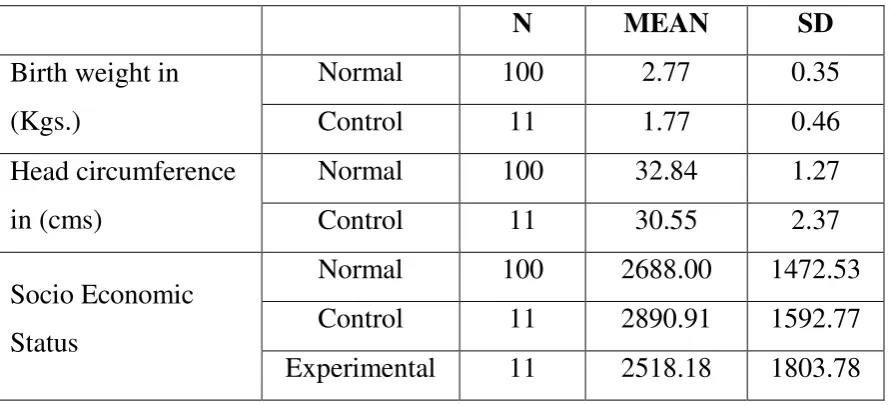
TABLE NO. 1
DESCRIPTIVE STATISTICS – NORMAL & STUDY GROUPS
N MEAN SD
Birth weight in
(Kgs.)
Normal 100 2.77 0.35
Control 11 1.77 0.46
Head circumference
in (cms)
Normal 100 32.84 1.27
Control 11 30.55 2.37
Socio Economic
Status
Normal 100 2688.00 1472.53
Control 11 2890.91 1592.77
Experimental 11 2518.18 1803.78
NS= not significant Sig.= significant
Table No. 1 shows the comparison of the mean birth weight, head
circumference and socioeconomic status between the normal and study
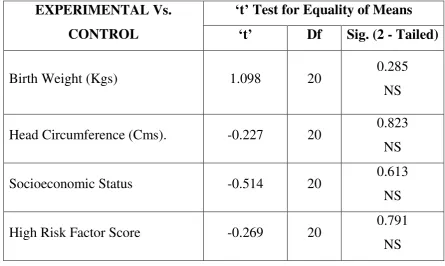
TABLE NO. 2
COMPARISON OF DESCRIPTIVE STATISTICS CONTROL AND EXPERIMENTAL
EXPERIMENTAL Vs. CONTROL
‘t’ Test for Equality of Means
‘t’ Df Sig. (2 - Tailed)
Birth Weight (Kgs) 1.098 20 0.285
NS
Head Circumference (Cms). -0.227 20 0.823
NS
Socioeconomic Status -0.514 20 0.613
NS
High Risk Factor Score -0.269 20 0.791
NS
[image:37.595.99.545.192.458.2]NS = Not significant Sig. = significant
Table No.2 shows that there is no significant difference at the 0.05 level of significance in the birth weight, head circumference,
socioeconomic status and high risk factors between the control and
experimental groups. Both the groups were matched in all these aspects
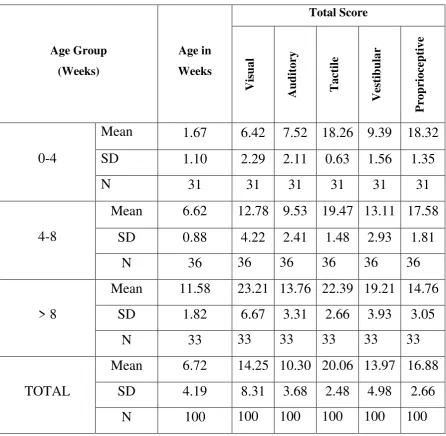
TABLE NO. 3
MEAN AND STANDARD DEVIATION OF NORMALS
Age Group (Weeks) Age in Weeks Total Score Visu al Aud itor y T ac tile Ve stib u lar Pr op rioce p tive 0-4
Mean 1.67 6.42 7.52 18.26 9.39 18.32
SD 1.10 2.29 2.11 0.63 1.56 1.35
N 31 31 31 31 31 31
4-8
Mean 6.62 12.78 9.53 19.47 13.11 17.58
SD 0.88 4.22 2.41 1.48 2.93 1.81
N 36 36 36 36 36 36
> 8
Mean 11.58 23.21 13.76 22.39 19.21 14.76
SD 1.82 6.67 3.31 2.66 3.93 3.05
N 33 33 33 33 33 33
TOTAL
Mean 6.72 14.25 10.30 20.06 13.97 16.88
SD 4.19 8.31 3.68 2.48 4.98 2.66
[image:38.595.93.540.164.600.2]N 100 100 100 100 100 100
Table No. 3 displays the mean and SD for the normal group. The
normal group had been classified according to the age into 3 groups i.e.
0-4 weeks, 4-8 weeks and more than 8 weeks. The results show that the
total scores in the visual, auditory, tactile and vestibular domains increase
with age. The scores in the domain for proprioception decrease as the age
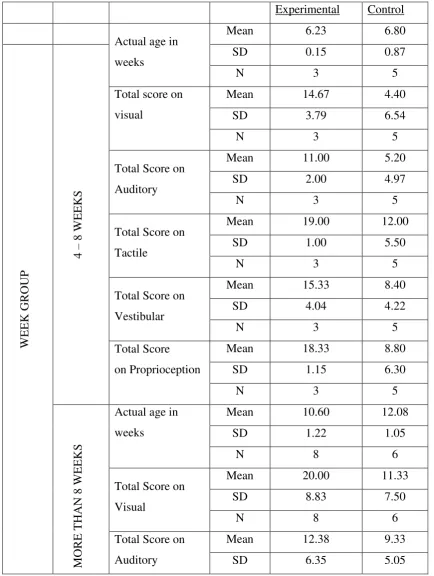
TABLE NO. 4
MEAN AND STANDARD DEVIATION OF STUDY GROUP
Experimental Control
Actual age in
weeks
Mean 6.23 6.80
W EEK GROU P 4 – 8 W EEK S
SD 0.15 0.87
N 3 5
Total score on
visual
Mean 14.67 4.40
SD 3.79 6.54
N 3 5
Total Score on
Auditory
Mean 11.00 5.20
SD 2.00 4.97
N 3 5
Total Score on
Tactile
Mean 19.00 12.00
SD 1.00 5.50
N 3 5
Total Score on
Vestibular
Mean 15.33 8.40
SD 4.04 4.22
N 3 5
Total Score
on Proprioception
Mean 18.33 8.80
SD 1.15 6.30
N 3 5
MORE THA
N 8 W
EEK
S
Actual age in
weeks
Mean 10.60 12.08
SD 1.22 1.05
N 8 6
Total Score on
Visual
Mean 20.00 11.33
SD 8.83 7.50
N 8 6
Total Score on
Auditory
Mean 12.38 9.33
N 8 6
Total Score on
Tactile
Mean 22.13 18.83
SD 3.52 3.60
N 8 6
Total Score on
Vestibular
Mean 18.38 11.33
SD 5.15 5.01
N 8 6
Total Score on
Proprioception
Mean 15.63 14.67
SD 1.41 4.63
N 8 6
Table No. 4 displays the mean and SD for the experimental and the control groups. The results show that the experimental group
consistently scores better than the control group in all the domains.
The infants in the study groups (experimental and control) were
more than 4 weeks of age at the time of evaluation. The 22 infants were
classified according to their age into 2 groups i.e. 4-8 weeks and more
than 8 weeks. These groups were compared to the normal infants in the
[image:40.595.102.536.70.287.2]TABLE NO. 5
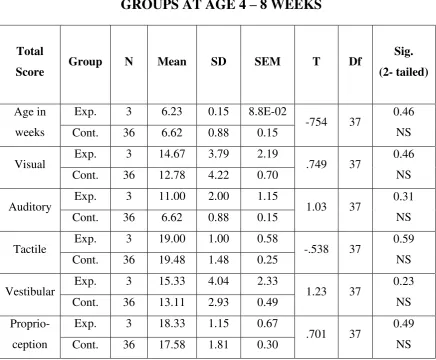
COMPARISON BETWEEN NORMAL AND EXPERIMENTAL GROUPS AT AGE 4 – 8 WEEKS
Total
Score Group N Mean SD SEM T Df
Sig.
(2- tailed)
Age in
weeks
Exp. 3 6.23 0.15 8.8E-02
-754 37 0.46
NS
Cont. 36 6.62 0.88 0.15
Visual Exp. 3 14.67 3.79 2.19 .749 37 0.46
NS
Cont. 36 12.78 4.22 0.70
Auditory Exp. 3 11.00 2.00 1.15 1.03 37 0.31
NS
Cont. 36 6.62 0.88 0.15
Tactile Exp. 3 19.00 1.00 0.58 -.538 37 0.59
NS
Cont. 36 19.48 1.48 0.25
Vestibular Exp. 3 15.33 4.04 2.33 1.23 37 0.23
NS
Cont. 36 13.11 2.93 0.49
Proprio-ception
Exp. 3 18.33 1.15 0.67
.701 37 0.49
NS
Cont. 36 17.58 1.81 0.30
This table compares the mean age and scores between the normal
and the experimental infants in the 4-8 weeks group. The results show
that both the groups are matched in terms of age and that there is no
significant difference in the ages between the two groups at the 0.05 level
of significance.
An analysis of the sensory domains revealed no significant
difference in the scores between the two groups (p > 0.05). This shows
that the sensory development of the infants in the experimental groups is
TABLE NO. 6
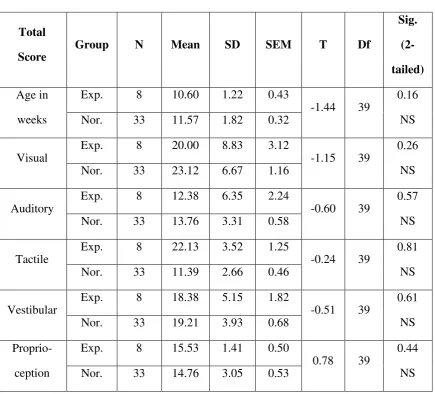
COMPARISON BETWEEN NORMAL AND EXPERIMENTAL GROUPS AT AGE MORE THAN 8 WEEKS
Total
Score
Group N Mean SD SEM T Df
Sig.
(2-
tailed)
Age in
weeks
Exp. 8 10.60 1.22 0.43
-1.44 39
0.16
NS
Nor. 33 11.57 1.82 0.32
Visual
Exp. 8 20.00 8.83 3.12
-1.15 39
0.26
NS
Nor. 33 23.12 6.67 1.16
Auditory
Exp. 8 12.38 6.35 2.24
-0.60 39
0.57
NS
Nor. 33 13.76 3.31 0.58
Tactile
Exp. 8 22.13 3.52 1.25
-0.24 39
0.81
NS
Nor. 33 11.39 2.66 0.46
Vestibular
Exp. 8 18.38 5.15 1.82
-0.51 39
0.61
NS
Nor. 33 19.21 3.93 0.68
Proprio-ception
Exp. 8 15.53 1.41 0.50
0.78 39
0.44
NS
Nor. 33 14.76 3.05 0.53
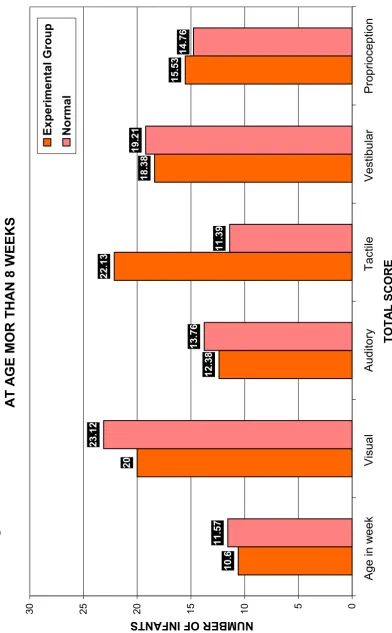
This table compares the age and scores between he normal and the
experimental in the more than 8 weeks group. The results show that there
is a discrepancy in the mean age between the 2 groups, but the difference
is not statistically significant (p > 0.05). The scores in the five sensory
systems are also not significant (p > 0.05). the scores in the five sensory
systems are also not significant (p > 0.05) showing that the infants in the
Fig
. 2: CO
M PA RISON BET W EE N NO RM A L A ND EX PE RIM ENT A L G RO UPS A T A G E M O R T HA
N 8 W
EE KS 1 0 .6 20 1 2 .3 8 2 2 .1 3 1 8 .3 8 1 5 .5 3 1 1 .5 7 2 3 .1 2 1 3 .7 6 1 1 .3 9 1 9 .2 1 1 4 .7 6 0 5 10 15 20 25 30 A g e in w e e k V isua l A u d ito ry T a ctile V e stib u lar P rop ri o ce p tio n TOTA L S CORE NUM BER OF INFAN
TABLE NO. 7
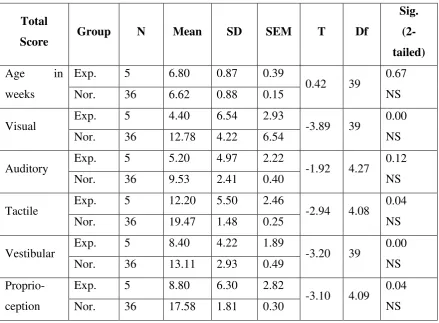
COMPARISON BETWEEN NORMAL AND EXPERIMENTAL GROUPS AGE 4-8 WEEKS
Total
Score Group N Mean SD SEM T Df
Sig.
(2-
tailed)
Age in
weeks
Exp. 5 6.80 0.87 0.39
0.42 39 0.67
NS
Nor. 36 6.62 0.88 0.15
Visual Exp. 5 4.40 6.54 2.93 -3.89 39 0.00
NS
Nor. 36 12.78 4.22 6.54
Auditory Exp. 5 5.20 4.97 2.22 -1.92 4.27 0.12
NS
Nor. 36 9.53 2.41 0.40
Tactile Exp. 5 12.20 5.50 2.46 -2.94 4.08 0.04
NS
Nor. 36 19.47 1.48 0.25
Vestibular Exp. 5 8.40 4.22 1.89 -3.20 39 0.00
NS
Nor. 36 13.11 2.93 0.49
Proprio-ception
Exp. 5 8.80 6.30 2.82
-3.10 4.09 0.04
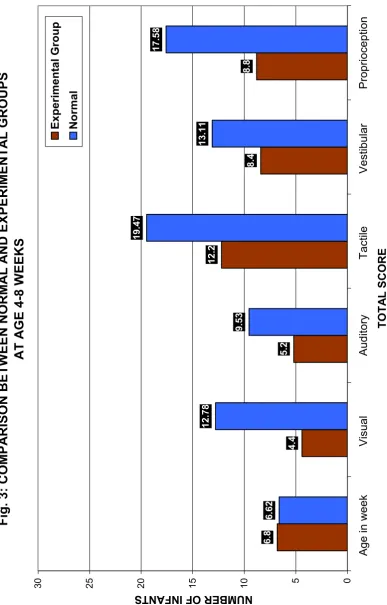
NS
Nor. 36 17.58 1.81 0.30
A comparison the mean ages of the control and the normal sample
showed that there is no statistically significant difference between the 2
groups in the 4-8 month age group (p > 0.05).
The sensory development of the control group was found to be
significantly less (p < 0.05) than the normals in the tactile, and
proprioceptive systems. The difference between the groups in the visual
and vestibular domains is found to be highly significant (p = 0.00) with
the control group performing poorly in comparison to the normals.
Though there was a difference in the auditory scores between the two
Fig
. 3: CO
M PA RISON BET W EE N NO RM A L A ND EX PE RIM ENT A L G RO UPS A T A G E 4 -8 WE EKS 6 .8 4 .4 5 .2 1 2 .2 8 .4 8 .8 6 .6 2 1 2 .7 8 9 .5 3 1 9 .4 7 1 3 .1 1 1 7 .5 8 0 5 10 15 20 25 30 A g e in w e e k V isua l A u d ito ry T a ctile V e stib u lar P rop ri o ce p tio n TOTA L S CORE NUM BER OF INFAN
TABLE NO. 8
COMPARISON BETWEEN NORMAL AND EXPERIMENTAL GROUPS AGE MORE THAN 8 WEEKS
Total
Score Group N Mean SD SEM T Df
Sig.
(2-
tailed)
Age in
weeks
Cont. 6 12.08 1.05 0.43
0.66 37 0.51
NS
Nor. 33 11.58 1.82 0.32
Visual Cont. 6 11.33 7.50 3.06 -3.94 37 0.00
Sig.
Nor. 33 23.21 6.67 1.16
Auditory Cont. 6 9.33 5.05 2.06 -2.78 37 0.01
Sig
Nor. 33 13.76 3.31 0.58
Tactile Cont. 6 18.83 3.60 1.47 -2.86 37 0.01
Sig
Nor. 33 22.39 2.66 0.46
Vestibular Cont. 6 11.33 5.01 2.04 -4.34 37 0.00
Sig
Nor. 33 19.21 3.93 0.68
Proprio-ception
Cont. 6 14.67 4.63 1.89
-0.06 37 0.95
NS
Nor. 33 14.75 3.05 0.53
A comparison of the ages showed that there was no significant
difference between the 2 groups (p > 0.05). There was a significant
differenced in the development of the auditory and tactile syste3ms
between the normal and the control group (p < 0.05). The difference
between the groups in the visual and vestibular domains was found to be
highly significant (p = 0.00). The control group performed significantly
less than the normals in all these domains. The development of the
proprioceptive system in this age group was found to be equivalent to that
Fig
. 4: CO
M PA RISON BET W EE N NO RM A L A ND EX PE RIM ENT A L G RO UPS A T A G E M O R T HA
N 8 W
EE KS 1 2 .0 8 1 1 .3 3 9 .3 3 1 8 .8 3 1 1 .3 3 1 4 .6 7 1 1 .5 8 2 3 .2 1 1 3 .7 6 2 2 .2 9 1 9 .2 1 1 4 .7 5 0 5 10 15 20 25 30 A g e in w e e k V isua l A u d ito ry T a ctile V e stib u lar P rop ri o ce p tio n TOTA L S CORE NUM BER OF INFAN
TS
Con
trol
Norma
TABLE NO. 9
COMPARISON BETWEEN EXPERIMENTAL AND CONTROL GROUPS AGE 4- 8 WEEKS
Total
Score Group N Mean SD SEM T Df
Sig.
(2-
tailed)
Age in
weeks
Exp. 3 6.23 0.15 8.82E-02
-1.42 4.40 0.22
NS
Nor. 5 6.80 0.87 0.39
Visual Exp. 3 14.67 3.79 2.19 2.44 6 0.05
Sig.
Nor. 5 4.40 6.54 2.93
Auditory Exp. 3 11.00 2.00 1.15 1.88 6 0.10
Sig
Nor. 5 5.20 4.97 2.22
Tactile Exp. 3 19.00 1.00 0.59 2.69 4.43 0.05
Sig
Nor. 5 12.20 5.50 2.46
Vestibular Exp. 3 15.33 4.04 2.23 2.28 6 0.06
Sig
Nor. 5 8.40 4.22 1.89
Proprio-ception
Exp. 3 18.33 1.15 0.67
3.29 4.43 0.03
Sig
Nor. 5 8.80 6.30 2.82
The results show that the 2 groups were matched in terms of age.
There was no significant difference between the groups (p > 0.05).
The scores of the experimental group showed a statistically significant
difference in all the five sensory domains (p < 0.05). The results
prove that the sensory development of the experimental group is
Fig
. 5: CO
M PA RISON BET W EE N EX PE RIM ENT A L A ND CO NT RO L G RO UPS A T A G E 4 -8 WE EKS 6 .2 3 1 4 .6 7 11 19 1 5 .3 3 1 8 .3 3 6 .8 1 4 .4 5 .2 1 2 .2 8 .4 8 .8 0 5 10 15 20 25 30 A g e in w e e k V isua l A u d ito ry T a ctile V e stib u lar P rop ri o ce p tio n TOTA L S CORE NUM BER OF INFAN
TABLE NO. 10
COMPARISON BETWEEN EXPERIMENTAL AND CONTROL GROUPS AGE MORE THAN 8 WEEKS
Total
Score Group N Mean SD SEM T Df
Sig.
(2-
tailed)
Age in
weeks
Exp. 8 10.60 1.22 0.43
-2.38 12 0.04
Sig
Cont. 6 12.08 1.05 0.43
Visual Exp. 8 20.00 8.83 3.12 1.93 12 0.08
Sig.
Cont. 6 11.33 7.50 3.06
Auditory Exp. 8 12.38 6.35 2.24 0.96 12 0.35
NS
Cont. 6 9.33 5.04 2.06
Tactile Exp. 8 22.13 3.52 1.25 1.71 12 0.10
Sig
Cont. 6 18.83 3.60 1.47
Vestibular Exp. 8 18.38 5.15 1.82 2.56 12 0.03
Sig
Cont. 6 11.33 5.01 2.04
Proprio-ception
Exp. 8 15.63 1.41 0.50
0.49 5.7 0.64
NS
Cont. 6 14.67 4.63 1.89
The table shows a significant difference in the ages between the
control and experimental group (p , 0.05). the infants in the control group
were older than the ones in the experimental group. The experimental
group performed significantly better (p < 0.05) than the control group in
the tactile, visual, and vestibular domains.
The experimental group had higher scores than the control group in
the auditory and proprioceptive domains but the difference was not found
to be statistically significant.
It was seen that even though the mean age of the control group was
higher than that of the experimental group, these high risk infants who
did not receive intervention scored less than the experimental group in all
Fig
. 6: CO
M PA RISON BET W EE N EX PE RIM ENT A L A ND CO NT RO L G RO UPS A T M O RE T HA
N 8 W
EE KS 1 0 .6 20 1 2 .3 8 2 2 .1 3 1 8 .3 8 1 5 .6 3 1 2 .0 8 1 1 .3 3 9 .3 3 1 8 .8 3 1 1 .3 3 1 4 .6 7 0 5 10 15 20 25 30 A g e in w e e k V isua l A u d ito ry T a ctile V e stib u lar P rop ri o ce p tio n TOTA L S CORE NUM BER OF INFAN
DISCUSSION
The study revealed that the development of the four sensory
systems including the visual, auditory, tactile, and vestibular systems
increases with age. The infant acquires more skills as the age increases
and learns to integrate all the senses to produce more complex adaptive
behaviors. The proprioceptive domain evaluates predominantly the reflex
maturation in infants, except for one subdomain, which evaluates for
active movements. Since these primitive reflexes are present at birth and
get integrated as the infant grows older the scores in this domain drop as
age increases.
COMPARISON BETWEEN THE EXPERIMENTAL AND NORMAL GROUPS
The experimental group infants had low scores on initial evaluation
suggesting the need for treatment. A comparison between the
experimental and the normal group showed that the high risk infants who
received intervention were able to perform at par with the normal. There
was no significant difference at par with the normal. There was no
significant difference in the development of the sensory systems between
the two groups (p > 0.05). The experimental group had slightly higher
scores than the normal group in the visual, auditory, vestibular and
proprioceptive domains.
This result supports the study done by (Rose G in 1982). The
performance of pre-term infants who had received tactile and vestibular
stimulation for 2 weeks after birth was indistinguishable from the
During the study it was observed that one pre-term infant in the
experimental group did not show improvements in the visual and auditory
domains after 6 weeks of intervention. The infant was followed up at 4
months of age and was found to have a global delay in development with
visual and auditory dysfunction. This finding reveals that infants with
significant neurological handicaps may not show improvements with
intervention. Such infants can thus be identified early and placed on
intensive therapy to facilitate development.
These findings reveal that with intervention the development of the
sensory system of high risk infants would be equivalent to that of normal
infants, provided, there is no other significant neurological deficit.
Therefore, a delay in development in any of the systems could
probably be an indication of a neurological deficit or environmental
deprivation. Such infants can be identified early in order to provide
intensive therapy.
COMPARISON BETWEEN CONTROLS AND NORMALS
The results showed that the performance of the control group was
consistently less than that of the normal in the visual, tactile, and
vestibular domains. Though the performance of the 4-8 group in the
auditory domain, and the performance of the above 8 group in the
proprioceptive domain, was less than that of the normal, the difference
was not found to be statistically significant.
These results support the study done by Holmes DL, et al in 1982.
intensive care, performed poorly on the motor and interactive areas, when
compared to the healthy full term infants.
These findings therefore support the need for early intervention in
all high risk infants to promote normal sensory development.
COMPARISON BETWEEN EXPERIMENTAL AND CONTROL GROUP
The results showed that the high risk infants who received
intervention performed significantly better than the control group in all
the sensory domains in the 4-8 weeks group and in the visual, tactile, and
vestibular domains in the more than 8 week group. These results support
the study done by Sandra Scarr-Salapatek, et al in 1973. Their study
showed that infants in the experimental group who were given special
visual, tactile, and kinesthetic stimulation had a slight developmental
advantage over the control group at 4 weeks of age. These results also
support the study done by Raweewan Lekskuchai, et al in 2001 on the
effectiveness of a motor developmental program