AY2011-12
Explaining and Comparing
Practical Modified Gini Index
Amir Shoham
(with Miki Malul, Daniel Shapira)
ACES EU CENTERS OF EXCELLENCE
GRANT DELIVERABLE
GWU
2
Practical Modified Gini Index
Miki Malul, Daniel Shapira and Amir Shoham
Abstract
The Gini index is the most common method for estimating the level of income inequality in
countries. In this paper we suggest a simple modification that takes into account the moderating
effect of in-kind government benefits. Unlike other studies that use micro level data that is rarely
available for many countries or over a period of time, the proposed modified Gini index could be
calculated using just the regularly available data for each country. Such data includes the original
Gini coefficient, government consumption expenditures, GDP and total tax revenue as a percentage
of GDP. This modified version of the Gini index allows us to calculate the level of inequality more
precisely, and make better comparisons between countries and over time.
1. Introduction
The Gini coefficient is a popular and widely-used index for measuring inequality (Lerman and
Yitzhaki, 1984). Evidence for the OECD countries indicates that there has been a significant and
widespread increase in income inequality during the past 20 years (Chapell et al., 2009; OECD,
2008). When inequality is measured in terms of disposable income, the rise was more modest than it
is when comparing market incomes, which indicates that the tax and social transfer systems do
serve to redistribute income towards the poor (Chapell et al., 2009).
We argue that the redistribution role played by the government through the provision of public
services is significant, and should be taken into considerations when calculating the Gini index (see
also Stack, 1978). Neglecting public, in-kind benefits when measuring income might give an
incomplete picture of the distribution of economic inequality (Aaberge et al., 2010) because in-kind
benefits such as education, health insurance, and other public services actually constitute
approximately one-half of the welfare state transfers in developed countries (Atkinson et al., 2002;
Garfinkel et al., 2006).
We suggest a simple, practical modification to the traditional Gini index that can be calculated
using the aggregate data published for each country.
Let us assume two countries with the same Gini index, one where the government provides more in-
kind benefits (education, healthcare, social services, security, etc.) than the government of the other
provides. We argue that the actual level of inequality will be lower in the country which provides
more in-kind benefits. Since the distribution of in-kind benefits is biased toward the low income
families, the traditional Gini index that does not consider the redistribution generated by in-kind
benefits will be biased upward.
Sefton (2002) shows that poorer households receive a greater proportion of non-cash welfare
4
medical services, housing and education) appeared relatively stable across income groups, falling
only marginally as income rose. Nolan and Russell (2001) look at a range of non-cash benefits in
Ireland, including the “free schemes”, such as free travel, free electricity etc. They found that the
medical card scheme was strongly concentrated towards the bottom end of the distribution with 61
percent of medical card spending going towards the bottom 30 percent of the income distribution.
Callan and Keane (2009) showed that the overall pattern of redistribution through public health and
education is “pro-poor”.
Aaberge et al., (2010) showed that inclusion of noncash income (education and healthcare) reduces
inequality by 15-25 percent. He used detailed data regarding the allocation of the public in-kind
benefits among the different individuals in the economy. This approach makes it almost impossible
to generalize for all countries and different years. This paper offers a generalization of this approach
that uses aggregate data that is available for each country.
In the next section, we present the calculation approach of the modified Gini (MGINI). Then, we
illustrate our approach using recent data for the Gini index for the OECD countries and conclude
2. The modified Gini index
Let us consider y()as the accumulated income of the percentile. In that case the Gini index
would be: 1 0 ) ( 2
1 y d
Gini (1)
I I I I y y k i i N i i k i i k k 1 1 1 ) ( where N k k
represents the percentile of the households with income less than the income of the
kth household, and N represents the total number of households.
Now, let us add the provision of public services and assume that
N G I
Iˆi i , where G is the total
in-kind benefits provided by the government. In this case yˆk will be:
SG SG y I G I N kG I I G I N G I I I
y k k
k i i k i i N i i k i i k 1 1 ˆ ) ˆ ( ˆ 1 1 1 1 where the I G
SG represents the services that the government provides as a share of the total net
income in the economy.
SG GINI d y NI I G 1 ) ( ˆ 2 1 ˆ 1 0 (2)
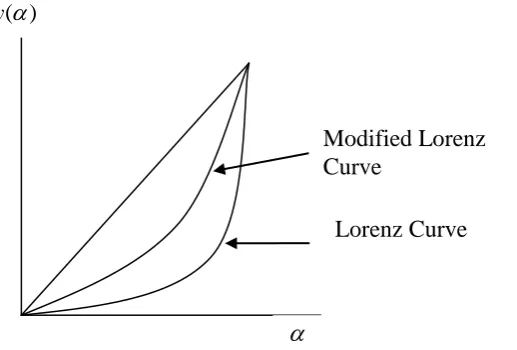
As can be seen in equation 2 and the illustration in figure 1, the modified Gini index is a simple
interpolation, which uses the traditional Gini and the share of public in-kind benefits in the total net
6
The modified Gini index is always lower then the traditional Gini. The larger the share of the public
in-kind benefits, the lower the modified Gini. It converges to the traditional Gini index when no
Figure 1: Lorenz curve: Regular vs. modified Gini
In the next section, we show the results comparing the modified GINI to the traditional Gini for the
OECD countries.
Modified Lorenz Curve
Lorenz Curve )
(
y
8
3. Comparing the modified Gini to the traditional Gini for the OECD countries
In order to modify the Gini index, we need to evaluate the share of government in-kind benefits in
the total net income in the economy (SG). To this end, we use three basic measures: GDP,
government consumption expenditures (G) and total tax revenue as a percentage of GDP (T) to
give:
) 1 ( T GDP
G SG
where GDP(1-T) is a proxy for the total net income of the economy. It should be noted that this is
not exactly the total net income, because the GDP includes the depreciation. The SG as presented
here underestimates the effect of the in-kind benefits on the level of inequality. If we had the
accurate figure, the change in the Gini would be even greater (Recall:
SG GINI MGINI
1 ).
In addition, we assume that the in-kind benefits provided by the government are distributed equally
among all households in the economy. This assumption further underestimates the effect of the
in-kind benefits on the Gini index becauseit is more likely that the lower income percentiles actually
receive a higher share of the in-kind benefits (Callan and Keane 2009; Nolan, 1981).
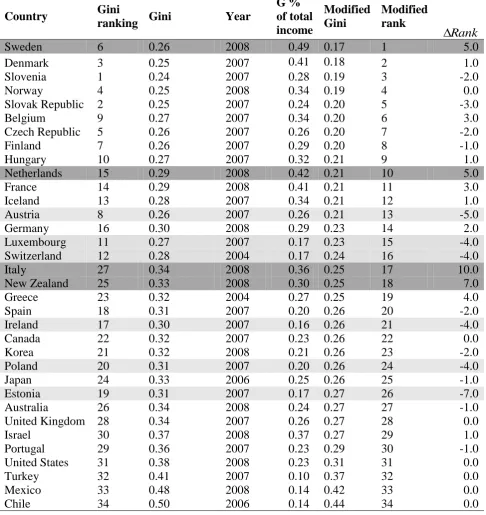
In table 1 we present the modified Gini index vis-à-vis the traditional Gini for the OECD countries.
Table 1: Ranking change when using modified Gini
Country Gini
ranking Gini Year
G % of total income Modified Gini Modified rank Rank
Sweden 6 0.26 2008 0.49 0.17 1 5.0
Denmark 3 0.25 2007 0.41 0.18 2 1.0
Slovenia 1 0.24 2007 0.28 0.19 3 -2.0
Norway 4 0.25 2008 0.34 0.19 4 0.0
Slovak Republic 2 0.25 2007 0.24 0.20 5 -3.0
Belgium 9 0.27 2007 0.34 0.20 6 3.0
Czech Republic 5 0.26 2007 0.26 0.20 7 -2.0
Finland 7 0.26 2007 0.29 0.20 8 -1.0
Hungary 10 0.27 2007 0.32 0.21 9 1.0
Netherlands 15 0.29 2008 0.42 0.21 10 5.0
France 14 0.29 2008 0.41 0.21 11 3.0
Iceland 13 0.28 2007 0.34 0.21 12 1.0
Austria 8 0.26 2007 0.26 0.21 13 -5.0
Germany 16 0.30 2008 0.29 0.23 14 2.0
Luxembourg 11 0.27 2007 0.17 0.23 15 -4.0 Switzerland 12 0.28 2004 0.17 0.24 16 -4.0
Italy 27 0.34 2008 0.36 0.25 17 10.0
New Zealand 25 0.33 2008 0.30 0.25 18 7.0
Greece 23 0.32 2004 0.27 0.25 19 4.0
Spain 18 0.31 2007 0.20 0.26 20 -2.0
Ireland 17 0.30 2007 0.16 0.26 21 -4.0
Canada 22 0.32 2007 0.23 0.26 22 0.0
Korea 21 0.32 2008 0.21 0.26 23 -2.0
Poland 20 0.31 2007 0.20 0.26 24 -4.0
Japan 24 0.33 2006 0.25 0.26 25 -1.0
Estonia 19 0.31 2007 0.17 0.27 26 -7.0
Australia 26 0.34 2008 0.24 0.27 27 -1.0 United Kingdom 28 0.34 2007 0.26 0.27 28 0.0
Israel 30 0.37 2008 0.37 0.27 29 1.0
Portugal 29 0.36 2007 0.23 0.29 30 -1.0 United States 31 0.38 2008 0.23 0.31 31 0.0
Turkey 32 0.41 2007 0.10 0.37 32 0.0
Mexico 33 0.48 2008 0.14 0.42 33 0.0
10
In table 1, we see that there are significant transformations in the ranking when using the modified
Gini index instead of the traditional Gini index. For example, we can see that Italy moved up from
the 27th position to the 17th position. Even though the level of inequality according to the income
distribution is relatively high, the in-kind benefits provided by the government significantly reduces
the inequality. Similar results appear in the cases of Sweden, Netherlands and New Zealand.
According to the modified Gini, Sweden is the country with the lowest inequality in income
distribution, while according to the standard Gini Sweden is ranked 6th. Conversely, we can see that
the rankings of Austria, Luxemburg, Switzerland, Poland and Estonia deteriorate significantly
becausethese countries provide a significantly smaller quantity of in-kind benefits to the public.
The median decrease in the Gini index as a result of inclusion of the in-kind benefits is 15%. For
comparison’s sake, Aaberge (2010) found that for European countries the change in Gini would be
approximately 15-25% when using his more elaborate calculation of in-kind benefits, which is not
very different than our results. However, unlike the method proposed by Aaberge (2010), our
method makes it possible to calculate a modified Gini without having detailed data about the
distribution in-kind benefits, because it uses only the available aggregate data that both developed
4. Conclusion
In this paper, we present a simple modification to the GINI index that can be calculated simply
using the common aggregate data available for each country. This measure which takes into
consideration the value of the in-kind benefits that the government provides allow us to better
understand the inequality in income distribution in the different economies. To the best of our
knowledge, our general approach toward integrating the in-kind benefits into the income
distribution has not yet been presented in the literature. We believe that the modified Gini index can
be used by policy makers and researchers around the world to assess the differences in inequalities
between countries as well as trends in the level of inequality over time more accurately because it
takes in-kind benefits into account without needing access to complicated and rarely available data
12
5. References
Aaberge R., Langorgen, A., Lindgren, P., 2010. The impact of basic public services on the
distribution of income in European countries, in: Atkinson A.B. and Marlier E. (Eds), Income
and Living Conditions in Europe. Eurostat, European Union.
Atkinson, T., Cantillon, B., Marlier, E. Nolan, B., 2002. Social Indicators: The EU and Social
Inclusion. Oxford University Press, Oxford.
Callan T. Keane C., 2009. Non-cash benefits and the distribution of economic welfare. Econ. Soc.
Rev. 40(1), 49–71.
Chapple S., Forster, M., Martin J.P., 2009. Inequality and Well Being in OECD Countries: What
Do We Know? OECD, Paris.
Garfinkel, I., Rainwater, L., Smeeding, T. M., 2006. A re-examination of welfare states and
inequality in rich nations: How in-kind transfers and indirect taxes change the story, J. Pol.
Anal. Manage., 25, 897–919.
Lerman, R. Yitzhaki, S. 1984. A note on the calculation and interpretation of the Gini index, Econ.
Letters, 15, 363–8.
Nolan, B., Russell, H., 2000. Non-cash benefits and poverty in Ireland. Policy Research Series, No.
39, Dublin: The Economic and Social Research Institute.
Nolan, B. 1981. Redistribution of household income in Ireland by taxes and benefits”. Econ. Soc.
Rev. 13.
OECD, 2008. Growing Unequal? Income Distribution in OECD Countries. OECD, Paris.
Sefton, T., 2002. Recent changes in the distribution of the social wage. Case Paper 62, Centre for
Analysis of Social Exclusion.
Stack, S., 1978. The effect of direct government involvement in the economy on the degree of