arXiv:astro-ph/0008443 v1 29 Aug 2000
(will be inserted by hand later) Your thesaurus codes are:
01 (02.14.1 09.16.1 09.16.1 He 2-436 09.16.1 Wray 16-423 11.04.2 11.09.1 Sagittarius)
ASTRONOMY
AND
ASTROPHYSICS
Letter to the Editor
Third-dredge-up oxygen in planetary nebulae
⋆
D. P´equignot1, J. R. Walsh2, A. A. Zijlstra3, and G. Dudziak4
1
Laboratoire d’Astrophysique Extragalactique et de Cosmologie associ´e au CNRS (UMR 8631) et `a l’Universit´e Paris 7, DAEC,
Observatoire de Paris-Meudon, F-92195 Meudon C´edex, France. Email: [email protected]
2
Space Telescope European Co-ordinating Facility, European Southern Observatory, Karl-Schwarzschild Strasse 2, D-85748
Garching bei M¨unchen, Germany. E-mail: [email protected]
3
Department of Physics, University of Manchester Institute of Science and Technology, P.O. Box 88, Manchester, M60 1QD, United Kingdom. Email: [email protected]
4
Department of Physics and Applied Physics, University of Strathclyde, Scotland. E-mail: [email protected]. Received ? / Accepted ?
Abstract. The planetary nebulae He 2-436 and Wray 16-423 in the Sagittarius dwarf galaxy appear to result from nearly twin stars, except that third-dredge-up carbon is more abundant in He 2-436. A thorough photoionization-model analysis implies that ratios Ne/O, S/O and Ar/O are significantly smaller in He 2-436, indicative of third-dredge-up oxygen enrichment. The enrichment of oxygen with respect to carbon is (7±4)%. Excess nitrogen in Wray 16-423 suggests third dredge-up of late-CN-cycle products even in these low-mass, intermediate-metallicity stars.
Key words: Nuclear reactions, nucleosynthesis, abun-dances - (ISM:) planetary nebulae: general - (ISM:) planetary nebulae: individual: He 2436 and Wray 16423 -Galaxies: dwarf - -Galaxies: individual: Sagittarius
1. Introduction
It is usually assumed (e.g. Henry 1989) that the oxygen abundance of a planetary nebula (PN) reflects the metal-licity Z of the interstellar medium (ISM) in which the
parent star formed, inasmuch as the conversion of 16O into 14N due to advanced CNO processing is unimpor-tant, a condition fulfilled in low-mass stars (M <2 M⊙).
Low-mass stars bring to their surface nitrogen (through first dredge-up), produced by CN-cycle conversion of car-bon, and carbon (third dredge-up), produced by 3-α
fu-sion along the Asymptotic Giant Branch (AGB,e.g.Iben & Renzini 1983). During He-burning,14N is transformed notably into 22Ne and some 12C into 16O. Thus third dredge-up is likely to bring freshly synthesized oxygen to the surface of low-mass stars, as suggested by Boothroyd & Sackmann (1988, here BS88) and, in a preliminary form,
Send offprint requests to: D. P´equignot
⋆
Based on observations collected at ESO La Silla, Chile.
by Herwig et al. (2000, here HBD), who invoked intershell dredge-up (“fourth dredge-up”, Iben 1999) by diffusive overshoot. Exposed deep layers of hydrogen-deficient post-AGB stars appear to have quite similar concentrations of oxygen and carbon (Koesterke & Hamann 1997; Herwig et al. 1999) butthe amount of fresh oxygen expelled from AGB stars is unknown. The oxygen abundance is difficult to determine in the atmosphere of evolved stars (e.g. Ful-bright & Kraft 1999) and shows large scatter in PNe of a given galaxy (e.g.Leisy & Dennefeld 1996, here LD96).
In order to reveal the oxygen enrichment of PNe, one must seek for circumstances enabling the detection of a small excess of oxygen. Two PNe, He 2-436 and Wray 16-423, were found (Zijlstra & Walsh 1996, here ZW96; Walsh et al. 1997) to belong to the Sagittarius dwarf galaxy (Ibata et al. 1995). Spatial and kinematic properties point to a common origin for these PNe. Photoionization models (Dudziak et al. 2000, here DPZW) indicate nearly iden-tical depletions with respect to solar for all elements be-yond nitrogen [(−0.55±0.07) dex]. Both PN nuclei are
early-type [WC] stars belonging to nearly the same (H-burning) evolutionary trackM=(1.2±0.1)M⊙, Z=0.004
(Vassiliadis & Wood 1994), consistent with their precur-sors being the intermediate-age carbon stars of Sagittar-ius. As expected, third dredge-up yield was large in these intermediate-Z stars (Marigo et al. 1999), but even larger
2. The Sagittarius dwarf galaxy PN models Spectra of Wray 16-423 and He 2-436 were secured in iden-tical conditions. Their small apparent size led to global spectra of the highest reproducibility and relevance for modeling. The many theoretical line ratios (Hi, Hei,
for-bidden multiplets) allowed to check that statistical errors on measured fluxes were realistic, the few discrepancies being indeed similar in both PNe. Thus, in a direct com-parison, systematic errors are likely to cancel out.
In the photoionization model analysis of DPZW, the error bars attached to the abundances of these PNe were estimated from comparing two independent codes: they represented, at some ”1σlevel”, the uncertainties left
af-ter evaluating the origin of the differences between codes and trying to include systematic errors. Here, only one of the photoionization codes (code NEBU; e.g. Morisset & P´equignot 1996) is used, considering only the statisti-cal error on line fluxes. Because of the neglect of system-atic errors, the intervals are much reduced. Conversely, because of the ”plasticity” allowed by the rather large number of free parameters and the thorough exploration of all possible solutions, the intervals can be enlarged. The abundanceratios, which were not considered in the error analysis of DPZW, are determined with greater accuracy than the individual abundances, as shown below.
Current [WC]-atmosphere models are not reliable: in order not to miss solutions because of restrictive assump-tions, black-body stars with a discontinuity at the He+ limit were employed as a three-parameter sequence and an equivalence was established with the NLTE model stellar atmosphere (effective temperatureTeff), from the grid of
Clegg & Middlemass (1987). Similar free-parameter sets, procedures and convergence criteria were adopted to ob-tain two-sector models for both PNe. The models matched essentially all line fluxes within 1σerrors, that is no more
than a few percent of line strength for most basic lines. The two discrepancies left, one of them involving [Oi] and
the other one [Ariv]/[Ariii], turned out to be identical for
both PNe, suggesting systematic effects.
It was possible to generate several models of each PN satisfying the very strong and numerous observa-tional constraints, as three key line fluxes (Cii 426.7,
[Oii] 372.6 and [Sii] 406.8nm) were not very accurately
determined. Given a Teff for the central star, the model
parameters are constrained by imaging and/or radio con-tinuum data and by (accurate) optical line fluxes. A no-ticeable aspect is the global energy balance. The cool-ing rate, mainly determined by the unknown Ciii] and
Civ UV line fluxes (in addition to [Oiii]), depends on
the carbon abundance, to which Cii is proportional. For
Wray 16-423, the computed Cii flux is always in
agree-ment with observation, stronger limitations being brought by other lines. For He 2-436, considering different models with increasing density in the dense sector (an incomplete inner shell), both the [Oiii]500.7nm/[Oiii]436.3nm ratio
and the [Oiii]500.7nmflux tend to decrease, but can be
reconciled with observation by increasing the oxygen and carbon abundances. As free parameters ensure sufficient flexibility, the uniqueness of the solution breaks down and the boundaries of the set of acceptable models (and abun-dances) are now determined by the Cii flux.
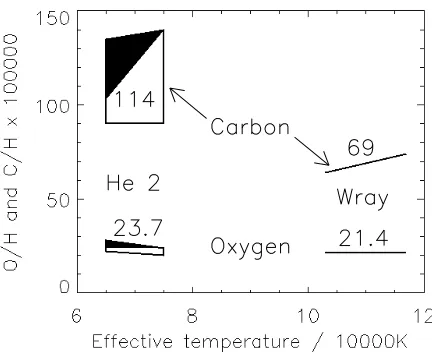
In Fig. 1 are shown for both PNe the ranges of al-lowed carbon and oxygen abundances versus the Teff’s.
VaryingTeff makes the predicted [Sii] 406.8nmand [Oii]
372.6nmfluxes vary relative to other lines in models. For
He 2-436, low or high Teff’s are forbidden as the [Sii] or
[Oii] fluxes become too large. Relaxing somewhat the
er-ror bars attached to these lines increases the allowed range of Teff without much changing the range of acceptable
abundances. As for Wray 16-423, all elements but carbon have abundances virtually independent ofTeff. LowTeff’s
(low C abundances) are forbidden by two independent [Sii] lines being predicted too weak; high Teff’s by one
accurately observed [Sii] line becoming too large. Higher
Teff’s are also excluded by the fact the He+ discontinuity, constrained by Heii468.6nm, would be much larger than
in atmosphere models. Also the shape of the model nebula would then deviate from observation.
The oxygen abundances of the He 2-436 models en-compass the well defined value of Wray 16-423. Neverthe-less oxygen tends to be larger in He 2-436. As a check of this tendency, Wray 16-423 models were run with the oxygen abundance increased by 10%. No satisfactory so-lution could be found. Re-convergence on all parameters was performed until all lines except [Oiii] 500.7nmand
[Oiii] 436.3nm were again satisfactory and the
discrep-ancy on both [Oiii] line fluxes was reduced to a
mini-mum, typically 5σ. Other elemental abundances increased
by 9±1% (except C: 18%). An He 2-436 model of given
Teff was then re-converged to a solution, though with the
condition that the computed [Oiii] line fluxes should
re-produce the discrepancy met in the previous Wray 16-423 model. In this new He 2-436 model, most abundances were shifted upwards relative to the standard solution by 8±1% (except N: 3% and C: 18%), close to the shift imposed on oxygen in the Wray 16-423 model. This numerical exper-iment suggests that systematic errors may substantially shift the derived abundances but not influence conclusions based on differences between the two PN models.
Table 1 lists the absolute helium and oxygen abun-dances by number and other abunabun-dances relative to oxy-gen. For all elements but carbon, the quoted abundance “uncertainty” is obtained by adding linearly the full abun-dance spread of acceptable models to the 1σerror of the
best determined line (the models were constrained to re-produce this line exactly). Percent differences on abun-dance ratios and 1σ error bars (Table 1, col. 4) clearly
show that Ne/O, S/O and Ar/O are smaller in He 2-436 than in Wray 16-423 (3.5, 1.8 and 1.4σconfidence levels
re-spectively, hence 4.2σcollectively). Given that sulfur and
Fig. 1. Acceptable abundances of C and O by number versus Teff of central stars according to model nebulae
for He 2-436 and Wray 16-423. Best-model values are in-dicated. The shaded areas correspond to He 2-436 models having the same sulfur abundance as Wray 16-423 within uncertainties (Sect. 3). ForTeff/104K = 6.5, 105×O/H in-creases from 24 to 28 as 105×C/H increases from 104 to 135. ForTeff/104K = 7.5, the O and C values are 24 and
[image:3.612.302.552.111.212.2]140 respectively.
Table 1.Abundance ratios by number in Sagittarius PNe
Ratio Wray 16-423 He 2-436 diff. (%)
He/H 0.108±0.002 0.108±0.003 0.0±3.6
O/H (21.4±0.2)×10−5
(24.0±4.0)×10−5
–11.5±16.
C/O 3.22±0.23 5.0±0.8 –43.3±17.
N/O 0.213±0.015 0.116±0.006 59.0±8.7
Ne/O 0.168±0.003 0.147±0.005 13.3±3.8
S/O 0.0201±0.0008 0.0162±0.0016 24.0±13.
Ar/O 0.0042±0.0004 0.0029±0.0007 36.6±26.
should hardly be affected either,this very significant trend must be due to a larger oxygen abundance in He 2-436. An explanation involving an abundance fluctuation in the ISM with, e.g., an excess specific to oxygen at the birth place of the parent star of He 2-436 is unlikely, as these stars are twins in most respects (ZW96, DPZW)and the Ne/O ratio is remarkably stable, at∼0.18, in the ISM of even different galaxies (e.g. Henry 1989). Thus the most plausible interpretation of the excess is in terms of oxy-gen production, with the precursor star of He 2-436 having been more efficient than that of Wray 16-423. Since He 2-436 shows a larger carbon excess – the signature of third dredge-up – it is inferred that this process was also able to bring freshly synthesized oxygen to the star surface.
Table 2.Evolution of abundances∗in stellar envelopes
Stage: Init 1st drge-up 3rd drge-up 3rd drge-up
Elmt + CBPa
(Wray) (He 2)
He 8250 9000 10800±200 10800±300
O (17) 16.5±3.2 21.4±0.2 26.0±2.0
C 4 2.5 69.±5. 122.±18.
N 1 2.5 4.6±0.3 3.0±0.3
Ne - 3.4 3.59±0.07 3.8±0.3
S - 0.43 0.43±0.02 0.43±0.02
Ar - 0.08 0.09±0.01 0.07±0.02
∗Abundances by number in units H = 105
a
Cool Bottom Processing (Boothroyd & Sackmann 1999)
3. Discussion
In Table 2 is sketched a possible evolution of the stellar envelope composition, assuming that (1) initial composi-tions were identical in the Wray 16-423 and He 2-436 stars, (2) sulfur abundance was constant, keeping the value de-termined for Wray 16-423 within uncertainties (col. 4 of Table 2), and (3) oxygen abundance varied linearly with that of carbon during third dredge-up (cols. 4, 5). Sulfur is preferred to argon as a reference constant-abundance el-ement, in view of the moderate scatter of the sulfur abun-dance determinations in models and the difficulty met in accounting for the argon ionization (DPZW). Scatter is less for neon, but its nucleogenic status may be less clear-cut and the variation of Ne/O from Wray 16-423 to He 2-436, although significant, is smaller. Reliable sulfur abun-dances are difficult to obtain in PNe, yet this approach is justified considering that models are based on homoge-neous procedures and used only in a differential manner.
Once the sulfur abundance is specified for He 2-436, the range of possible oxygen abundances is narrowed: as-suming the errors are independent, S/O (Table 1, col. 3) and S (Table 2, col. 4) imply 23.6<105×(O/H)<28, an
interval that excludes the O/H value of Wray 16-423. Ow-ing to the linear increase of S with O in the model results, the minimum O/H is in fact slightly larger (Table 2, col. 5; Fig. 1, shaded areas). Let ∆O and ∆C be the increments by number of the oxygen and carbon abundances due to third dredge-up. Taking into account correlations between C and O in He 2-436 models (Fig. 1: the lowest C goes with the lowest O) and assumption (3) above, the difference in abundances between the two PNe shows that extreme val-ues for ∆O/∆C are 2.4/76=0.03 and 6.8/61=0.11.
The extrapolated main-sequence abundance of oxygen (Table 2, col. 3 or 2), obtained assuming carbon is ini-tially much less abundant than in the PNe, is used only to determineZ and relevant initial abundances (see below).
[image:3.612.41.291.439.530.2]high-Z stars using an exponential diffusive overshoot
for-malism. Based on the same concept, HBD obtained pre-liminary models for low-Z stars, suggesting that surface
O/C reaches asymptotically the intershell value, ∼ 1/3. Thus, considering tendencies shown by recent star models, the present coarse estimate would seem to imply that rela-tively little oxygenshould be third-dredged-up. Nonethe-less a PN is formed after many ejection episodes and its abundance may be far from reflecting asymptotic values.
By contrast, neon and argon appear constant within uncertainties and the lower abundance of nitrogen in He 2-436 cannot be due to extensive conversion of this ele-ment into heavier ones. The initial (Table 2, col. 2) and first-dredge-up (col. 3) helium, carbon and nitrogen abun-dances are from Boothroyd & Sackmann (1999) assuming
M=1.2 M⊙ and Z=0.004 (in keeping with extrapolated
oxygen). Second dredge-up does not occur in low-mass stars, but these authors take into account deep-circulation mixing leading to enhanced 13C/12C, as observed along the red giant branch, and to further conversion of initial carbon into nitrogen. This so-called “Cool Bottom Pro-cessing”, sensitive to Z and M, can bring the nitrogen
abundance quite close to that of He 2-436 but perhaps not to the larger one of Wray 16-423 (Table 2). Another source of nitrogen is required.
Mixing of 1H with fresh12C occurs in low-mass AGB stars to produce13C, s-nucleietc, but the hydrodynamics involved is not understood (Lattanzio & Frost 1997). It may not be excluded that some13C can find its way up to the hydrogen shell or that insertion of H-rich pockets into the He/C-rich intershell is, on occasion, efficient enough to allow CN-cycle completion. In this way, low-mass AGB stars could synthesize some14N from fresh12C and mimic intermediate-mass stars in which the so-called “Hot Bot-tom Burning”, together with third dredge-up, is believed to lead to (N-rich) Type I PNe. Within the uncertain-ties of the definition (Torres-Peimbert & Peimbert 1997), Wray 16-423 would in fact be marginally Type I in the Large Magellanic Cloud (LMC). The indication here is that the dredge-up of additional nitrogen was more effec-tive in Wray 16-423, where carbon is less overabundant.
According to BS88, the He/C ratio in the carbon pock-ets that will be dredged-up levels off rapidly at He/C∼8 by number, compatible with the “observed” third-dredge-up ∆He/∆C, which lies anywhere between 15 and −15 (Table 2, cols. 4, 5), but not with the large jump of he-lium between first dredge-up and Wray 16-423. This may suggest, among other possibilities, that the initial helium abundance adopted here for these stars was too small.
Abundances are comparable in the PNe of Sagittarius and LMC (LD96). The abundance scatter in the LMC is likely due to the coexistence of several populations, but Ne/O is expected to be relatively stable, except possibly for differential effects of the kind revealed here. ¿From data of LD96, it is found that log(Ne/O) is –0.61±0.10 and –0.83±0.10 for Type-I and non-Type-I PNe
respec-tively. These determinations bracket the mean Hii-region
value, –0.74 (see LD96), and appear marginally different. Assuming that neon best traces the overall LMC evolu-tion, this suggests that oxygen is relatively depleted in Type I, at least as a consequence of second dredge-up in intermediate-mass stars (see also Dopita & Meathering-ham, 1991), butenhancedin non-Type I by third dredge-up in accord with present finding in Sagittarius PNe.
Abundances are lower in the SMC than in the LMC. Nitrogen-rich PNe of the SMC (type i+I of LD96) are
found among extremely low Z stars, presumably of low
initial mass. Also some halo PNe have N/O>1 (Howard
et al. 1997), at variance with the well-known association of Type I PNe with intermediate-mass stars, but maybe another manifestation of what is occuring in Sagittarius: 14N is enhanced by third dredge-up in low-mass AGB stars
and, due to a combination of efficiency and titration effect, N/O can reach large values for sufficiently smallZ.
The discussion of the Sagittarius PN models (DPZW) makes it clear that improvement of the critical carbon abundance can be expected from more complete observa-tions (UV, far red). Nevertheless the present results can already provide some constraints on the new generation of models for the evolution of low-mass low-Zstars and lead
to a re-interpretation of trends shown by PN abundances in low-Z environments. The production of oxygen by
low-mass stars (∼ 2×10⁻⁴M
⊙/star in Sagittarius) may have
to be considered in galactic-evolution models.
References
Boothroyd, A.I., Sackmann, I.-J., 1988, ApJ 328, 653 (BS88) Boothroyd, A.I., Sackmann, I.-J., 1999, ApJ 510, 232 Clegg, R.E.S., Middlemass, D., 1987, MNRAS 228, 759 Dopita, M.A., Meatheringham, S.J., 1991, ApJ 377, 480 Dudziak, G., P´equignot, D., Zijlstra, A.A., Walsh, J.R., 2000,
A&A, submitted (DPZW)
Fulbright, J.P., Kraft, R.P., 1999, AJ 118, 527 Henry, R.B.C., 1989, MNRAS 241, 453 Herwig, F., 2000, A&A in press
Herwig, F., Bl¨ocker, T., Driebe, T., 2000, Changes in
Abun-dances in AGB stars, Mem. Soc. Astron. Ital. (HBD)
Herwig, F., Bl¨ocker, T., Langer, N., Driebe, T., 1999, A&A
349, L5
Howard, J.W., Henry, R.B.C., McCartney, S., 1997, MNRAS 284, 465
Ibata, R.A., Gilmore, G., Irwin, M.J., 1995, MNRAS 277, 781
Iben, I., 1999, AGB stars, IAU Symp. 191, eds. T. Le Bertre,
A. Lebre, C. Waelkens, p. 591 (Kluwer) Iben, I., Renzini, A., 1983, ARA&A 21, 271 Koesterke, L., Hamann, W.-R., 1997, A&A 320, 91
Lattanzio, J.C., Frost, C.A., 1997,Fundamental Stellar
Prop-erties, IAU Symp. 189, ed. T.R. Bedding, p. 373 (Kluwer) Leisy, P., Dennefeld, M., 1996, A&AS 116, 95 (LD96) Marigo, P., Girardi, L., Bressan, A., 1999, A&A 344, 123 Morisset, C., P´equignot, D., 1996, A&A 320, 91
P´equignot, D., et al., 2000, Astrophysical Plasmas, eds S.J.
Torres-Peimbert, S., Peimbert, M., 1997, Planetary Nebulae, IAU Symp. 180, eds. H. Habing, H. Lamers, p. 175 (Kluwer) Vassiliadis, E., Wood, P.R., 1994, ApJS 92, 125
Walsh, J.R., Dudziak, G., Minniti, D., Zijlstra, A.A., 1997, ApJ 487, 651