CHRONIC ILLNESS TIME
Tanisha Jowsey
Thesis submitted in fulfilment of the requirements for the degree of Doctor of Philosophy
Australian National University
Thesis Declaration
I hereby declare that the work presented is an accurate account of research performed during the academic program towards the degree of Doctor of Philosophy of the Australian National University. This is a thesis by compilation. My contribution to the manuscripts included in this thesis was not uniform; therefore individual statements are included for each manuscript and these statements have been approved by the co-authors as well as my primary supervisor, Dr Simone Dennis. All references to ideas and work of other researchers have been specifically acknowledged. I hereby certify that the work embodied in this thesis has not already been accepted in substance for any degree, and is not being currently submitted in candidature for any other degree.
Signed:
Name: Tanisha Jowsey
For Dad and Mum, who encourage me to think &
For Hugh, who provides timely hugs
“Waste your money and you’re only out of money, but
waste your time and you’ve lost part of your life”
ACKNOWLEDGEMENTS
My PhD studies were, for the most part, good fun. I have several people to thank for this positive experience. First and foremost, my deep gratitude goes to my primary supervisor and chair of my panel, Simone Dennis. Simone understands time and how much time should be spent on particular academic enterprises. Simone also has a keen sense of timing; she knows when a student needs coffee, when they need cake, and when they need that gentle push off a precipice. The cross-disciplinary nature of this PhD, as well as the format of thesis by compilation has made the PhD a very difficult enterprise, one that was made possible by unshaking support, generous feedback and encouragement from Simone. I hope to continue our friendship and collaborations long into the future.
Second to thank are my other PhD supervisory panel members: Laurann Yen, Karen L Gardner, Christine Phillips and Robert Wells. The panel supported my vision and each member contributed to my understanding of the topic in diverse and important ways. For this I am grateful. Third, I thank each of the members of the SCIPPS for their guidance and encouragement, and for the opportunities they provided me. In particular, I thank Jim Gillespie, Steve Leeder, Beverley Essue and my departed friend, Marjan Kljakovic. I’m grateful that I have had the privilege to work with Robin Bunton, Nathaniel Ward and Jose Chema Valderas during my candidature; who have shared their knowledge with me generously.
Thank you to Merran Laver, who assisted me in editing this thesis.
For their support throughout all my academic enterprises I thank my encouraging and loving family: Gran, Mum, Dad, Karla and Nik. Thanks go especially to my Dad, who spent countless hours talking me through some tricky aspects of the PhD. During my second year, Dad told me that when I cannot see the trees for the forest, to find my way back to the last time when I was at the edge of the forest and then re-enter from there. I’ve found this nugget of wisdom to be quite the lifesaver (both for my thesis and my sanity).
I thank my husband Hugh Brocklebank for laughter and countless hugs. I thank Sherlock for his wagging tail. I thank the Brocklebank family and my friends for encouraging words. Specifically, I am very grateful to Ginny Sargent, who has provided enormous practical support in the months leading up to this thesis submission.
In undertaking this research, I was supported financially by an Australian National University Post-graduate Award and a scholarship from the Australian Primary Health Care Research Institute. The Australian Primary Health Care Research Institute also provided me with ongoing work during my candidature. For this I am very grateful. It has kept me off the streets for all 33 months. Thank you.
ABSTRACT
As the term ‘chronic’ suggests, the chronically ill body is one that reorients itself to the ways in which time is perceived, experienced and used, in a multiply of ways. New practices are
developed and routines are established to manage chronic illness in personal and social contexts. As rhythms of bodily life change one’s expectations for the future might change, and their relations with other people (who have their own temporal rhythms) might also change. Meanings attributed to past and present experiences and practices, as well as future plans and imaginings, acquire new significance with chronic illness. Through public health and anthropological lenses this thesis investigates some of the intersections between chronic illness and time.
In his tone-setting analysis of the ways in which chronic illness influences relationships with and to time, Bury (1982) argued that chronic illness invariably creates a ‘biographical disruption’ for the individual with chronic illness. This thesis provides empirical evidence collected in Australia, including self-reported calendar and clock/ed time spent on managing illness, much of which broadly supports Bury’s analysis.
However, this thesis also questions the veracity of Bury’s sure and certain claim; while
acknowledging that chronic illness can be and often is disrupting of the biography, I suggest that there is more variety in experiences of chronic illness than Bury’s theory allows. For instance, people may feel their biographies to be initially disrupted, but the profundity of disruption that Bury attends to may absent itself after a time, as the management of chronic illness fades into the background of habitual life. So too, can chronic illness create cycles of disruption even as the illness moves between stable and unstable phases. Alternatively, people may find that the onset of chronic illness was something they had expected, and experience the illness not so much as disruption but as confirmation to their biography. This thesis identifies several ways in which Bury’s thesis may be nuanced and challenged. Using data gathered over a number of different fields, and covering a wide range of illnesses, I show in this thesis that factors influencing biographical disruption, including the type and severity of illness; the stage of life that the individual is in when they become ill; their previous relationships to their body and to time; the self-management behaviour in which they engage; the amount of time they spend on health practices; and the sense ill persons have of their own agency, impact on whether and how much of a biographical disruption chronic illness is to the person.
THESIS OUTLINE
This thesis demonstrates that people experience time in different ways when they become
chronically ill and as their disease progresses. It also establishes the ways in which temporal structures inform people’s experiences of chronic illness. In order to determine
this, the thesis utilises four datasets. Three datasets were collected by the Serious and
Continuing Illness Policy and Practice Study (SCIPPS); a study that ran for nearly six
years until 2012 in Australia. I was a staff member on SCIPPS for the duration of the
study and contributed to data collection and analysis on all three datasets. I was based in
Canberra at the Australian National University during this time.
The three SCIPPS datasets are: SCIPPS Qualitative Project SCIPPS Indigenous Project SCIPPS Work of Being Ill Survey
The fourth dataset is the Chronic Illness Time Fieldwork; a small confirmatory research
project that I undertook in Canberra during 2012. All data were analysed during my PhD
candidature (the methods are outlined in Chapter two).
I worked with members of the SCIPPS team to analyse and publish SCIPPS data.
Findings of the thesis have been published during my candidature in peer-reviewed
international journals. The format of this thesis is what the Australian National University
terms ‘by compilation’. This thesis by compilation includes six published articles and one
Chapter 1 Introduction
The introduction articulates the thesis topic as one centrally concerned with chronic
illness and time. The chapter provides background information on previous academic
attempts to chart connections between chronic illness experiences and time.
Bury’s theory of disrupted biographies is identified as a key analytical space. Temporal
components that inform biographical disruption are introduced.
Chapter 2 Methods
Four datasets are described, upon which this thesis’ findings rest. The chapter presents an
overview of my contribution to the methods undertaken with these datasets. I also include
detail on the reasons underpinning utilisation of these methods as well as on methods
employed in working with others to create manuscripts for publication. Methods are also
included in each of the article chapters (Chapters 4–10).
Chapter 3 Case studies
The experiences of four people with chronic illness, including myself, are described to demonstrate the way people’s relationships to time are informed by chronic illness. The
case studies illustrate nuances of biographical disruption; past, present and future time;
and calendar and clock/ed time (CCT). Other temporal structures are introduced to
demonstrate the multiplicity of time that people experience through chronic illness.
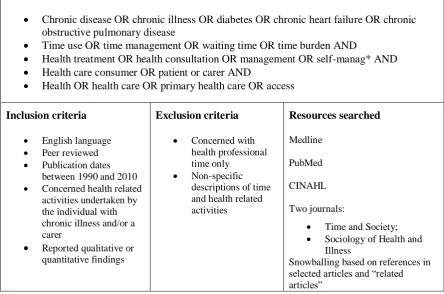
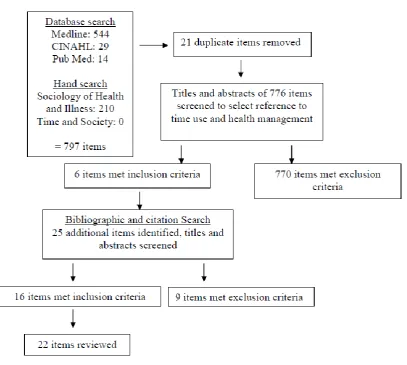
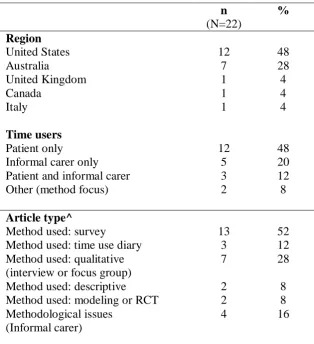
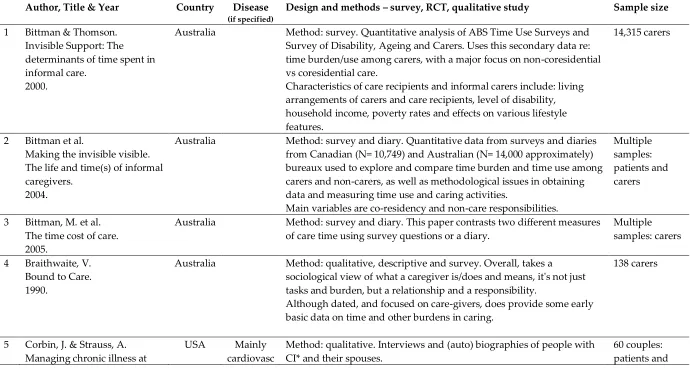
Chapter 4 Time use literature review
Time use studies are becoming common internationally. They broadly capture people’s
informal/family carers. A scoping method is utilised. Areas for further research are
identified.
For author contributions see Appendix 1.
Chapter 5 Time use of people with COPD
Chapters five to seven present important steps towards understanding a complex thing:
the quantifiable aspects of one kind of temporal experience – CCT. Importantly,
quantifiable temporal experiences are readily translated into health service delivery and
self-management options than other temporal experiences, as this thesis demonstrates. In
presenting the time use of people with chronic illness I follow general methods employed
by time use studies globally (Bittman and Thomson, 2000; Bittman et al., 2005; Russell et
al., 2008; Russell et al., 2007; De Vaus, 2004).
Chapter five reports findings from the SCIPPS ‘Work of being ill’ survey. It demonstrates
that management of COPD is associated with high time use. Surprisingly, the amount of
time spent on health practices fluctuates minimally over time. I suggest here that a high
quantity of time spent on health practices may be indicative of biographical disruption.
For author contributions see Appendix 1.
Chapter 6 Time use of people with multi-morbidity
The prevalence of multi-morbidity is rapidly rising in Australia and internationally. Yet
multi-morbidity was identified in Chapter seven as an area that has not received any
attention concerning measured time use. The policy and health service implications of
time use associated with multi-morbidity are manifold. Chapter six reports findings from
health-related activity HRA, tracking the rise in time expenditure alongside increasing number
of chronic illnesses. This focus on time use of people with multi-morbid chronic illness is
the first of its kind.
For author contributions see Appendix 1.
Chapter 7 Time use of informal carers
Chronic illness does not just alter the relationships that people diagnosed with it have to
time; it also informs those who live with and/or provide informal care. Although previous
studies have reported the time use of family carers in Australia, this manuscript is the first
to explore the time use implications of family carers who themselves have chronic illness.
It is also the first to break down time components of caring into specific health-related
activities.
For author contributions see Appendix 1.
Chapter 8 Process time
Chapter eight explores a methodological issue associated with measuring time use, following Davies’ work (1994) on process time. It illustrates how multiple processes
undertaken each day can be difficult to measure in terms of time use due to their being
interrupted and interconnected. This manuscript also introduces worry time as an intrinsic
aspect of chronic illness experience, which is another temporal structure not easily
measured and almost never reflected in time use studies. I argue that worry time disrupts
and informs rhythms such as sleep time (as indicated in Chapter five: case study three).
This chapter makes clear that for some informal carers the demanding and ongoing nature
Chapter 9 Spaces and time use
Findings from the SCIPPS Indigenous study concerning Aboriginal and Torres Strait
Islander patient and carer experiences are reported. Chapter 9 details how different health
care services structure patient time use and patient experience through use of space and
clinician time availability. Time spent waiting is experienced differently in the compared
spaces (Aboriginal and mainstream health services).
For author contributions see Appendix 1.
Chapter 10 Agents in time
Chapter 10 presents findings from the SCIPPS Indigenous project, on people’s
experiences of chronic illness as biographically disrupting and their efforts to manage
disruptions. This is framed in terms of agency. The findings are also understood in relation to Zimbardo’s (2002; Zimbardo & Boyd, 1999) Time Perspectives Theory. I
suggest that the application of Time Perspectives Theory to psychological elements of
support services may help those living with chronic illness to undertake biographical
work. The findings are discussed in terms of implications for self-management programs
in Aboriginal and mainstream health services.
For author contributions see Appendix 1.
Chapter 11 Practical application of findings
A model is presented for understanding the intersections between chronic illness, time,
and society; and how the individual negotiates these intersections. The model shows how
people with chronic illness move between different phases of illness (experienced in and
through the body), which determines their capacity to fulfil social roles and
to health care providers because they provide insight into the lived experiences of people
living with chronic illness. Further, a care plan is proposed to enable people with chronic
illness to anticipate change and manage the temporal components of managing their
health.
Chapter 12 Discussion
The discussion synthesises findings from the thesis. I conclude that the chronically ill
body is one that establishes new rhythms and practices, which become habituated over
time and which alter to accommodate changes in the body and in social life. Such
establishments and habituations usually bring with them experiences of disruption to
biography as well as to the way the individual experiences past, present and future time.
The time required to take on new practices and manage chronic illness in the context of
an existing life can be substantial and while this is usually associated with biographical
disruptions it is not always so. This is informed by several temporally-gauged factors,
which are outlined in the discussion.
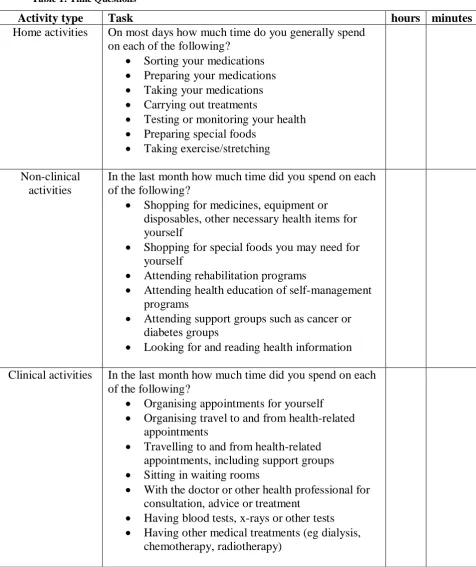
---Alicia, who is 80 years old, has several chronic illnesses.
She is shown here sorting medications for the week; a task that takes thirty minutes each week due to the number of medications and the difficulty of the task (some pills require
cutting in half, which is difficult because of severe osteoarthritis in Alicia’s hands).
PUBLICATIONS AND PRESENTATIONS ARISING FROM THIS RESEARCH
Articles
Jowsey, T. 2011. Perceptions of time and identity: informal family carers of people with chronic illness. Interdisciplinary Net. Oxford, Making Sense of Chronic Disease Series, 1–10
Jowsey, T., McRae, I., Banfield, M., Gillespie, J., Yen, L. 2013. Time to care? Health of informal older carers and time spent on health-related activities: an Australian survey.
BMC Public Health, 13: 374–394
Jowsey, T., McRae, I.S., Valderas, J. M., Dugdale, P., Phillips, R., Bunton, R., Gillespie, J., Banfield, M., Jones, L., Kljakovic, M., Yen, L. 2013. Time’s up. Descriptive
epidemiology of multi-morbidity and time spent on health-related activity by older Australians: a time use survey. Plos One, 8 (4): 1–6 e59379
Jowsey, T., Ward, N.J., Gardner, K.L. 2013. Agents in time: representations of chronic illness. Health Sociology Review, 22 (3): 243-254
Jowsey, T., Yen, L., Bagheri, N., McRae, I.S. 2014. Time spent by people managing chronic obstructive pulmonary disease indicates biographical disruption. International Journal of COPD, 14 (9): 87-97
Jowsey, T., Yen, L., Mathews, P. 2012. Time spent on health-related activities associated with chronic illness: a scoping literature review. BMC Public Health, 12: 1044, 1–21 Jowsey, T., Yen, L., Ward, N.J., McNab, J., Usherwood, T., SCIPPS Team. 2012. It hinges on the door: use of time and space creates community interactions in Australian Aboriginal Community Controlled Health Services. Health Sociology Review, 21 (2): 196–207
Articles (related but not included in the thesis)
Corcoran, K.J., Jowsey, T., Leeder, S. 2012. One size does not fit all: the different experiences of those with chronic heart failure, type 2 diabetes and chronic obstructive pulmonary disease. Australian Health Review, 36, 4: 1–7
Jowsey, T. Time value. 2012. Canberra Lung Life Support Group Newsletter, 11:3–4 Jowsey, T., Pearce-Brown, C., Douglas, K. Yen, L., 2011. What motivates Australian health service users with chronic illness to engage in self-management behaviour? Health Expectations,10 Nov 2011: 1–11, doi: 10.1111/j.1369–7625.2011.00744
Yen L, Jowsey T, McRae IS. 2013. Consultations with complementary and alternative medicine practitioners by older Australians: results from a national survey. BMC Complementary and Alternative Medicine, 2013, 13: 1–16
Yen L, McRae I, Jowsey T, Gillespie J, Dugdale P, et al. 2013. Health work by older people with chronic illness: how much time does it take? Chronic Illness, 1: 1–15
Invited letter
Jowsey, T., McRae, I., Yen, L. 2012. Re: Including the Patient Viewpoint. Annals of Family Medicine, 25 January
Invited speaker
Jowsey, T. Time, chronic illness and health services. Canberra Lung Life Support Group, Burns Club, Kambah, Canberra. 14 February 2013, [60 minutes]
Jowsey, T. Who cares? A research perspective. Carers Australia, Canberra. November 2012 [60 minutes]
Jowsey, T. Weighing a witch: scientific facts to help weigh up your thesis choices. Thesis by Compilation Panel discussion. National Centre for Population Health and
Epidemiology, Australian National University, August 2012 [15 minutes, then 30 minutes as panel speaker]
Jowsey, T. Chronic illness & consumer voices: building a research program in Australia to inform health policy. Department of Primary Health Care, Oxford University, Oxford. 05 September 2011 [60 minutes]
Jowsey, T. People I can call on: Aboriginal and Torres Strait Islander stories of chronic illness. National Health & Medical Research Council, *NAIDOC week staff celebration meeting, NH&MRC, Canberra. 08 July 2011 [20 minutes].
Conference presentations
Jowsey, T., McRae, I., Yen, L. Multi-morbidity - Time's up! PHCResearch Conference, 10–12 July 2013, Sydney [speaker]
Yen, L., Jowsey, T., McRae, I. Time waits for Norman. PHC Research Conference, 10–12 July 2013, Sydney [speaker]
Jowsey, T. Chronic illness: entering a time warp! PHC Research Conference, 10–12 July 2013, Sydney [poster]
Jowsey, T., Yen, L., Banfield, M., Gillespie, J., McRae, I. and the SCIPPS Team. Chronic illness: time to care. PHC Research Conference, 18–20 July 2012, Canberra, Australia [speaker]
Jowsey, T., Gillespie, J., Bunton, R., Banfield, M., Jones, L., McRae, I., Dugdale, P., Taylor, R., Kljakovic, M., Valderas, J.M. and Yen, L. Time use of people with multiple chronic diseases in Australia. World Congress on HealthyAgeing. Kuala Lumpur, Malaysia, 19–22 March 2012 [speaker]
Jowsey, T., Yen, L., McRae, I. Perceptions of time: chronically ill health service users and their family carers. 10th global conference: making sense of health, illness and disease. 6–8 September 2011, University of Oxford, U.K. [speaker]
Jowsey, T., Ward, N.J. Experiences of chronic illness: disrupted biographies and
locations of agency. Commitment to indigenous health: local and national contributions to meeting the challenges. 22 November 2010 Australian National University, Canberra, Australia. [speaker]
Awards
NSW Health 2012 Aboriginal Health Awards. ‘Closing the gap in Aboriginal health through excellence in research, evaluation and building evidence.’ This was awarded to the Serious and Continuing Illness Policy and Practice Study for its research on
Indigenous health. Tanisha Jowsey was a primary investigator in that research.
ANU ResearchFest. June 2012. Jowsey, T. Health over time. Research Poster (awarded 1st Place). Australian National University. $AUD 500
ABBREVIATIONS
ABS Australian Bureau of Statistics
ACCHS Aboriginal Community Controlled Health Services ACT Australian Capital Territory
AIDS acquired immunodeficiency syndrome AMSs Aboriginal Medical Services
ANU Australian National University
BGL blood glucose level
CCT calendar and clock/ed time CHF chronic heart failure CHF congestive heart failure
CI* chronic illness
CI confidence interval
COAD chronic obstructive airways disease COPD chronic obstructive pulmonary disease Diabetes complicated type 2 diabetes
DOA dose administration aids
Dr Doctor
GP general practitioner
GPMP general practitioner management plan
HbA1c glycated haemoglobin or glycosylated haemoglobin HCCA Health Care Consumers’ Association of the ACT
HIV human immunodeficiency virus
HRA health-related activity HSUs health service users
IHIG Indigenous Health Interest Group
MBS Medicare Benefit Schedule
MHSs mainstream health services
NHMRC National Health and Medical Research Council NSA National Seniors Australia
NSW New South Wales
TABLE OF CONTENTS
Abstract ... 5
Thesis Outline ... 6
Publications and presentations arising from this research ... 13
Abbreviations ... 17
Table of Contents ... 19
Chapter 1 Introduction... 21
Chapter 2 Methods ... 60
Chapter 3 Case studies ... 76
Chapter 4 Time use literature review ... 106
Chapter 5 Time use of people with COPD ... 132
Chapter 6 Time use of people with multi-morbidity ... 158
Chapter 7 Time use of informal carers ... 182
Chapter 8 Process time ... 210
Chapter 9 Spaces and time use... 222
Chapter 10 Agents in time ... 246
Chapter 11 Practical application of findings ... 272
Chapter 12 Discussion ... 300
Conclusion ... 312
Thesis reference list ... 314
CHAPTER 1 INTRODUCTION
Chronic illnesses are “health problems that require ongoing management over a period of
years or decades” (World Health Organization, 2002). Although chronic illnesses have
different physiological, biological and pathological properties, they share a common
thread – time. They last for a long time and they require management over time. They
induce different temporal rhythms and different relationships to time than are experienced
by the healthy person, or even the person with acute illness. Chronic illness is responded
to in specific social and biographical ways by people who have chronic illness and by
those people who care for them. Adam writes: “in spite of its omnipresence, time is curiously invisible and constitutes one of the most taken for granted features of our lives”
(1995: 30). In this thesis I contend that chronic illness provides a lens through which time
becomes visible, at least for a while, and that experiences of time previously taken for
granted take on new valence. The omnipresence of time and its multi-layered value in
society must be reflected in policy and service provision of those living with chronic
illness for effective care and illness management. It is for these reasons that my thesis
centralises time as an analytic lens for understanding chronic illness experiences.
As Townsend (2011) asserts, chronic illness is very well researched. Qualitative studies
from sociology, anthropology and public health have reported experience in terms of:
identity (Charmaz, 1995; Adams et al., 1997; Larun and Malterud, 2007; Goldman and
Maclean, 1998; Hagger and Orbell, 2003), discourses and narratives (Horton-Salway,
2001; Greenhalgh et al., 2010), individual/bodily experience (Faircloth et al., 2004a;
et al., 2010; Guell, 2009). Analysis has also been framed in terms of emotion (Furler et
al., 2008 ), risk (Karademas et al., 2008; Martensson et al., 1997; Rhodes and Bowles,
2002) and uncertainty (Carricaburu and Pierret, 1995), self-management (Vassilev et al.,
2011; Lorig et al., 1999; Telford et al., 2006), multi-morbidity (Townsend, 2011; Jowsey
et al., 2009) and interactions with health services (Arney and Bergen, 1983; Aspin et al.,
2012; Greenhalgh, 2009; Townsend 2011).
Chronic illness research has focused on either determinants of behaviour (Strazdins et al.,
2011), or on exploring lived experiences (Jeon et al., 2010). Townsend accounts for the
sociologically constituted field, broadly, in terms of the orientation of work around either
outsider or insider perspectives. She notes that:
Outsider approaches use variable-based explanations for behaviours, for example how cultural components and social disadvantage impact help-seeking. Insider approaches prioritise illness experience as an interpretive social process, best understood by examining meanings of action in context. From the layperson’s standpoint; living with chronic illness requires hard practical, biographical, emotional and moral work. Individuals negotiate symptoms and mobilise strategies in an attempt to maintain daily life, familiar selves and moral identities. Illness puts one at risk of ‘failure in everyday life’and ‘getting through the day’ is a practical and moral priority (2011: 90).
Both categories flow from Parsons’ pioneering 1967 work, which sought to push through
and beyond the then dominant medical model of disease to assert that illness might be
alternatively conceptualised. In his view, it was most fruitfully understood as a ‘disturbance in the normal functioning of the individual’, requiring restorative action.
Those who became ill felt the pressure to recover quickly, so as to effectively carry out
their social roles. In Bury’s (1982) ground-breaking work, the moral dimensions of taking
up and then relinquishing the sick role are clearly evident. While Parsons’ work is
chronically ill, his reach is evident in work on chronic illness since the late 1960s. Bury
notes, for instance, that:
Two traditions have been available to medical sociologists interested in chronic illness. The first stems from the debate over the usefulness or otherwise of Parsonian conceptions of illness and the sick-role. On a negative level, it is maintained that chronic illness appears to deny many of Parsons' assumptions about the patterning of sickness; on a more positive note it suggests separating and developing deviance and adaptive perspective from his theory (Gerhardt, 1979; Gallagher, 1976)…[despite the fact that Parsons’ study is concerned with sickness and not chronic illness] my [Bury’s] study shows, for example, that a chronically ill person can make adaptations to his lifestyle and still have access to periods of [the] classic sick-role behaviour [that Parsons described] when such events as surgical intervention or sudden exacerbations of symptoms occur (1982: 168).
While Townsend’s rough categorising is made on valid differences between insider and
outside orientations as she has described them above, there is considerable variation in the
offerings contained within each category, and the impact of works contained therein is
unevenly arrayed. Bury, for instance, is keen for his work, which Townsend categorises in the ‘insider’ group, not to be associated with a second tradition in work on chronic
illness deeply concerned with experience, namely the ‘interactionist’ tradition. He notes
of it:
As one would expect, this has concentrated on empirical enquiry, detailing the strategic handling of symptoms and disabilities … but the approach has often been frankly descriptive, with only passing reference to wider theoretical concerns… interactionism has been preoccupied with fieldwork rather than explicit theorising. In particular, a willingness to move from descriptive categories of interaction to a wider analysis of cultural and structural forms has been limited (1982: 169).
posed by Parsons in the 1960s is theoretically reflective of the times; developed when
acute sickness was a focal point, and prior to the rise of chronic illness incidence. The
chronically ill individual, Bury suggests, is not subject to the same social obligations of
the individual with acute sickness. Instead, the very nature of chronicity suggests that the individual cannot return to prior ‘healthy’ modes of social obligation. Bury notes,
however, “that a chronically ill person can make adaptations to his lifestyle and still have
access to periods of classic sick-role behaviour when such events as surgical intervention or sudden exacerbations of symptoms occur” (Bury, 1982: 168). That is, the individual
whose health is in such crisis that they require surgical or medical intervention is released
from social obligations, including self-management, for the duration of the exacerbation
or crisis phase (phases of illness, including the crisis phase are described further in
Chapter 11). Chronic illness does not usually begin with the individual in a crisis phases
of this magnitude, however. Often small indicators, symptoms, annoyances become the
subject of the individuals’ attention, and upon medical enquiry, become diagnoses of chronic illness. “Non-communicable diseases” writes Bury, “do not ‘break-out’ they
‘creep-up’” (1982: 170). This creeping, my research shows, may continue for years
before any formal diagnosis of chronic illness is made. It is most often the point of diagnosis that catapults the individual into a ‘critical situation.’ This critical situation
arises from the radical disturbance of habited routines and practices, of “the structures of
everyday life” (Bury, 1982: 169). The individual is rapidly required to undertake new
tasks associated with managing their health and illness.
Bury draws away from the broadly sociological to focus on biographical events:
illness involves a recognition of the worlds of pain and suffering, possibly even of death, which are normally only seen as distant possibilities
or the plight of others. In addition, it brings individuals, their families, and wider social networks face to face with the character of their relationships in stark form, disrupting normal rules of reciprocity and mutual support. The growing dependency involved in chronic illness is a major issue here. Further, the expectations and plans that individuals hold for the future have to be re-examined. Thus, I want to maintain that the development of a chronic illness like rheumatoid arthritis is most usefully regarded as a 'critical situation', a form of biographical disruption, not only as a way of describing what happens, but also to provide a more explicit analytic focus (1982: 169).
Bury’s intention to examine chronic illness as a biographical disruption is noteworthy for
two reasons. The first concerns the enduring presence of ‘disruption’ in analyses of
chronic illness experience – and this is especially pertinent to those studies which
privilege the temporal aspects of being ill, since these studies focus on how one’s future,
having been imagined and even planned for, might unfurl awkwardly in the wake of a
diagnosis. Bury (1982) argued, the onset and establishment of chronic illness can disrupt
a person’s hitherto habitual experience of time – the rhythm of the social world in which
one might be entailed and, more broadly, the anticipation a person has of living out their
days into old age along the lines of the established temporal rhythms of childhood,
adolescence, adulthood, and old age. In work that focused closely on the chronic – that is
the temporal – aspects of chronic illness, conducted among people with rheumatoid
arthritis, Bury identified how this latter sense of time might be disrupted. He coined the phrase ‘biographical disruption’, which has since become synonymous with
anthropological and cognate work focusing on the experience of those with a chronic
So enduring and powerful was Bury’s turn of phrase that 26 years later Morris (2008)
writing on diabetes, took it up to show that those with diabetes could not take up the adult
roles of caring for the self from their parents; for instance, in deciding when to eat or how long to stay out (and away from one’s insulin). These people, he argued, were, ultimately,
slaves to temporal rhythms beyond their control, just as such rhythms had been beyond
their control when they were infants and children, when they ate and slept in the patterns
set by adults. Morris concludes that full membership into the adult world cannot be
accomplished; thus, the biographical potentials of those with diabetes remain necessarily
unfulfilled, so profoundly are they temporally infantilised.
While these two theoreticians begin from different starting points, and deploy different
analytic tools from one another – in contrast with Bury’s modification of Giddens’
approach to critical events, Morris makes use of embodiment from the point of view of
continental philosophy – both their accounts share in common a strong sense that the
relationship the chronically ill person has with and to time is necessarily disrupted and
brings about a future that is less enticing, hopeful and exciting than the future the person
had prior to diagnosis. This sense of disruption and the spectre of future failure typifies
approaches to the study of chronic illness, irrespective of what kind of chronic illness is being studied. The explanatory force of ‘disruption’ also stretches back across the history
of the study of chronic illness; I have already made mention of the analytic force that
Giddens saw in it, most especially for examining the ordinary structures of life, and
Parsons, too, left a clear legacy off the back of his observation, that ‘disturbance in the
normal functioning of the individual’ requires restorative action on the part of the ill
Also revealing of the analytic force shouldered by disrupted biography are the ways in
which others have attended to it in their work, from the time that Bury published his
seminal piece to the present. Indeed, one can scarcely mention chronic illness experiences
in sociology without reference to Bury. In their study of HIV-positive men, Carricaburu
and Pierret (1995) found that although many participants experienced profound
uncertainty (an indicator of biographical disruption), that they established modes of
managing the disruption caused by HIV (especially participants who had haemophilia). However, some participants experienced HIV as ‘biographical reinforcement’ rather than
disruption (especially for participants who had had contracted HIV through homosexual
practices). That is, their present identity constitution was reinforced by the illness because the illness linked them to their “individual and collective pasts” (Carricaburu and Pierret,
1995: 80). HIV, they argue, did not pose a biographical disruption; rather it was merely
one aspect of the biography – the story of the individual’s life – that was connected to
past practices and collective identity.
Similarly, both biographical disruption and reinforcement were identified in Harris’ study
of hepatitis C (Harris, 2009). This biographical reinforcement was again identified
recently by Olsen and colleagues in their study of women living with hepatitis C (Olsen et
al., 2013).
In work conducted by Sanders et al. (2002) concerning people living with osteoarthritis,
most participants had lived with osteoarthritis for more than ten years and had normalised
illness by accounting for the cause of its onset in the context of their lives. This is similar
stroke. In Sanders et al.’s study, although participants “‘played down’ the significance of
arthritis as being normal in the context of their age” (2002: 241) they still reported severe
symptoms, disruptions to biography and a keen sense of stigma associated with their
illness. They experienced symptoms of illness as disruptive yet minimised the meaning of
such disruption in an effort to normalise their embodied state of being (cf. Faircloth et al.,
2004b).
Pound and colleagues note that in their qualitative study of elderly people who had
survived strokes, that stroke as causal of disrupted biography was not a key aspect of
participant experiences. Rather, participants reported that in the context of their lives, chronic illness was “not that bad” (Pound et al., 1998). The authors suggest that the
reason for this may be age-related; that stroke was perceived by some participants as a
part of normal ageing. Bury also noted this link, but from the opposite age-related
direction; whereby young participants in his study who were diagnosed with arthritis saw
the illness as particularly disruptive due to their cultural perceptions and assumptions that
arthritis is an illness for older adults (Bury, 1982: 171). The timing of the illness onset was identified as influential in whether or not a chronic illness was perceived of as disrupting to the individual’s biography (see also, Sanders et al., 2002). Disturbance and
disruption, then, are perhaps just as valid an insight into how the field of chronic illness study has shaped up as ‘insider’ and outsider’ approaches might be.
Bury’s use of ‘disruption’ is also noteworthy for a second reason – and that is I see the
terrain of this thesis as chiefly concerned with analysing whether, as Bury suggests,
chronic illness is necessarily and always disruptive; and to what extent such disruption
periods of fieldwork among chronically ill persons living in Canberra, I pose an argument that calls terms like ‘disruption’ and ‘failure’ – even ‘biography’ – into question. I do so
emphatically not to insist that chronic illness is generally positively experienced, or that a person can expect to be entirely unhindered by chronic illness, or, contra Morris, to
contend that those with a chronic illness do succeed at the manifestations of adulthood
despite their illness. Rather, I call for the unsettlement of the surety of biographical
disruption on the basis of what my own data, collected amongst a range of people with
several chronic illnesses, suggests.
On its strength, I propose the notion that there is a range and diversity in how it is that
people experience chronic illness. It is, according to my data, entirely possible that in
some cases – especially severe cases such as those which constitute Bury’s dataset –
people with chronic illness may experience a disruption in biography, and they may stay
profoundly disrupted. They may feel the kinds of (perhaps even as yet unnamed or
unknown) potentials they possess will remain unrealised, and that their future is bleak –
perhaps because, as Morris argues, there is nothing unknown about the way time will
unfold for them. It will be predictably punctuated by this or that medication, exacerbation,
or intervention, and nothing will be more important than the person’s resentful
progression towards the next lifesaving act they will do in a timetable set beyond or even
against their will. Indeed, I have documented many such cases. But in some other cases,
the sense of disruption may be unrealised, short lived, or diminish to the point where
disruption does not manifest in many meaningful ways at all, or is embodied, become accustomed to, over time, as habitual practice. Failures to accomplish something of one’s
kinds of worlds that have been built up by individuals and communities on the basis of
their perceived especial membership in an exclusive grouping not available to persons
living without illness. This was the case for several Aboriginal elders who used their
experiences and knowledge of diabetes as a form of cultural capital, which they
referenced to teach children in their community how and why to avoid diabetes. Their
direct experiences with diabetes entailed upon them a sense of authority unavailable to
those without diabetes. My thesis, then, is an invitation to the diversity of experiences
which are to be found under the umbrella of the experience of chronic illness, as these can
be captured through a lens privileging the temporal aspects of life.
In suggesting that biographical disruptions are not sufficient to account for the range of
experiences that constitute chronic illness experience and behaviour, I am essentially
arguing against the onset of what Turner (1987) might have called permanent liminality. Liminality is described in van Gennep’s preceding and seminal work Rites of Passage
(1908:189), which set out the tripartite process of change to an individual's status in
society. Rites of passage, those changes from one state in the life course to another, are
conceived as three stages: separation (preliminal), transition (liminal), and incorporation
(post-liminal). Rites of separation symbolically detach the individual from their state, so
as their former social status no longer applies. During the liminal stage, the individual is a
symbolic outsider who has no clearly defined status. During the incorporation stage, the
individual acquires and is fully endowed with a new social status, with which they
re-enter society. Turner suggested that “a liminal state may become ‘fixed’, referring to a
situation in which the suspended character of social life takes on a more permanent
Willet and Deegan (2001) have argued that just such a situation, of permanent liminality,
besets those with disabilities. They argue that:
Physical disability functions in modern society as a status betwixt and between everyday assumptions about "normal" physical strength and functioning. This creates a situation of permanent liminality, or a failure to be incorporated, in hypermodern society especially in the economic marketplace and architectural construction of everyday life and movement (2001: 137).
Is it possible that those who are chronically ill fail to fit into existing recognised temporal
states of the life course, such as adulthood? As I have already indicated, Morris (2008)
argues that those with diabetes cannot accomplish the state of adulthood, instead
remaining caught someplace between the temporal regimes of infancy and those which, at
least in his view, confer upon the individual the full status of independent adulthood.
Willet and Deegan argue that those who are disabled are forever caught in the liminal
phase because society “fails to provide them with stable, socially valued roles” (2001:
137) into which they can be incorporated (see also Davis 1962; Deegan 1975, 1978, 1997,
2000; Deegan and Brooks, 1985; Goffman, 1963; Roth, 1963; Roth and Eddy, 1967).
However, my own research suggests that those with chronic illness (who may or may not
become disabled through their illness) can experience times of liminality – induced, for
example, by exacerbations of illness – but that the overall time for which the individual
has chronic illness is experienced as a new state of being. I suggest that the initial sense of
liminality experienced is one brought on by bodily change that leads to a formal diagnosis
of chronic illness – the transition – that catapults the individual into a new state: one that
is not necessarily experienced thereafter as constantly liminal, rather it can be
status conjured up by illness that will continue, most likely, for the remaining duration of the individual’s life. At times it may become central to the individual’s experience and at
other times it may dissolve into the background of daily rhythms.
While Willet and Deegan (2001) focus on how society fails to accommodate disabled bodies in socially viable and recognised roles, Morris’s (2008) work focuses on how
individuals are unable to fulfil the statues society provides for them that are normally
attained over time – i.e., adulthood. In this thesis, I move beyond how social contexts fail
to accommodate individuals, and how individuals fail to attain socially valued statuses in
favour of an approach that centralises how chronically ill individuals experience illness. This is in direct opposition to Bury’s (1982) claim, that research on those with chronic
illness focused too much on experience in the interactionist vein – and mistook it for
analysis. In contrast, I take experience to be the basis for a rich analysis that centralises
embodied experiences of time, and that makes evident the multiple relationships between
chronic illness and time.
Much of the work that privileges illness experience as it is lived by people with chronic
illness and their informal carers is best characterised as interpretive in that at its heart is an intention to examine the reasons and meanings behind the actions that those living
with chronic illness take. Interpretive analysis, otherwise called an interpretive approach,
interpretive methodology or interpretive description, is a form of research whereby the
researcher seeks to understand human experience as meaningful and historically
contingent (Yanow & Schwartz-Shea, 2006; Thorne et al., 2008). Bevir & Kedar (2008)
observe that the interpretive approach has developed from an anti-naturalist philosophy. They write, “anti-naturalists argue that constitutive features of human life set it apart from
natural sciences as a model. The relevant features of human action are that it is
meaningful and historically contingent” (2008: 505). Meanings, from this perspective, are
constitutive of human action. To employ an interpretive approach is to centralise human
experience – historically-located action and meaning-making – and to derive from there
understanding of wider social processes and phenomena. For instance, Townsend and
colleagues draw attention to how living with chronic illness “requires hard practical, biographical, emotional and moral work” (Townsend, 2011:90) (see also, Townsend, et
al., 2006; Corbin & Strauss, 1985). Bury (1982) is interested in how ill persons engage in
and enact strategies to maintain orderly lives in the face of what he insists is biographical
disruption; and Charmaz (2002) looks closely at illness narratives in order to analyse how
the self is torn down and then reconstructed in the context of chronic illness with special
attention to how a familiar self and a moral identity of person might be preserved or
refashioned in the wake of disruption. Even my own previous work with Jeon and
colleagues has identified struggles people face in attempting to balance the management
of their illness/es in the context of existing social worlds (Jeon, et al., 2010).
In this thesis I apply an interpretive approach to examining experiences of chronic illness
by looking at the time people spend on particular health practices and the meanings that
people living with chronic illness ascribe to experiences of illness and practice. Thorne et
al. write:
does not offer comprehensive and contextualized interpretations of its central phenomena of interest (2004: 3).
This thesis is informed by a wealth of empirical evidence from multiple sources and in
various forms, and as such it addresses the concerns raised by Sandelowski (cited by
Thorne et al. above) and by Townsend (2011), that interpretive studies have frequently
had little empirical evidence to support their claims.
The reason for utilising an interpretive approach in this thesis arose first from my
observation that health policies and health service provision often develop independently
from the experiences of those people they seek to support, and that when those people are
involved their level of involvement is often masked or unclear (Jowsey et al., 2010).
While ‘patient-centric’ models of care have recently become a catch phrase among health
policy makers, public health researchers and even health service providers, patient experiences and the ‘translation of evidence’ are not always reflected in decision-making
processes and policy outcomes (Dwan & McInnes, 2013), nor health service provision.
This is essentially due to the focus of healthcare systems solely on calendar and clock/ed
time (CCT), which denies diversity in time and in patient experience (Ellingsen et al.,
2013).
In order that future health policy and service provision decisions can be informed by
patient experience, I suggest that not only is a body of quality evidence needed, but that
the framing of such evidence through interpretive analysis will keep at the heart of health
centric’ mode of analysis available due to its focus on how individuals behave and derive
meaning from their experiences.
By employing an interpretive approach – to look closely at peoples’ experiences of
chronic illness – I identify diversity of experience that has not been sufficiently accounted
for in the works of others, such as Bury (1982), Morris (2008), and Corbin & Strauss
(1985). The diversity, which I have mentioned above, for example, in terms of individuals
who do not experience disruptions to biography or for whom disruptions are only felt for
short duration, is identified in this thesis through attending to associated meanings and
practices (including those concerning time use).
Anthropology of time and its location within chronic illness research
An exploration of time – how it is perceived and experienced, and its value to individuals
and to society – could begin in a myriad of places. As a beginning, I propose to outline
temporal structures. I suggest that people are informed by multiple temporal structures,
which interweave in peculiar ways. The most obvious structure is CCT – a linear motion
upon which calendars and clocks operate (Adam, 1995; Postill, 2002). It has been
understood both socially and analytically as a key temporal structure underpinning
Western society (Fabian, 1983; Griffiths, 1999; Postill, 2002). CCT includes regular and
predicted beats of 60 seconds to a minute; 60 minutes to an hour; 24 hours to a day; seven
days to a week; 52 weeks to a year; 100 years to a century, and so on. Minor adjustments
to calendars are made so that the number of days in a year matches other rhythms. Some
months have an extra day or two and some years have an extra day in order to align the
sense of order and orderliness can be facilitated. CCT can be used to measure how long
activities, tasks and procedures take; and that length of time can be assigned value – in
the duration of a friendship or of someone’s life, or even the variable amount of money it
might cost to recompense a professional for an hour of work.
CCT is one of many temporal structures that intersect and through which time can be
perceived. Geertz writes:
There are many ways in which men [sic] are made aware, or rather make themselves aware, of the passage of time – by marking the changing of the seasons, the alterations of the moon, or the progress of plant life; by the measured cycling of rites, or agricultural work, or household activities; by the preparation and scheduling of projected acts and the memory and assessment of accomplished ones; by the preservation of genealogies, the recital of legends, or the framing of prophecies. But surely among the most important is the recognition in oneself and in one's fellowmen of the process of biological aging, the appearance, maturation, decay, and disappearance of concrete individuals. How one views this process affects, therefore, and affects profoundly, how one experiences time (Geertz, 1966: 374).
People who experience chronic illness either as those with illness or as carers of those
who are ill, are faced with the certain decay and disappearance of concrete individuals.
Regardless of whether this happens rapidly or over decades, the individual with illness is
faced with increasing restrictions in their body and incapacity to maintain previously held
rhythms and practices. The carer or family member who bears witness to such change is
faced with the disappearance of concrete individuals, which additionally raises for them
questions about their own future – their own disappearance. Surely observations of the
passing of time rendered in such obvious biological terms must, as Geertz asserts,
profoundly affect how the person living with chronic illness experiences time (see also
Munn, 1992). It is through the habitual daily ideas, routines, and practices, that people’s relationships to time can be observed. Just as people’s practices associated with
the body. Health-related practices change as people age, as their health status changes, and in relation to social factors. Such practices are dependent on people’s awareness of
change, of their bodies, and of health practices available to them (which has elsewhere
been described as health literacy (Nutbeam, 2000), and in terms of self-determination,
patient activation and self-management (Jowsey et al., 2011)).
This thesis provides empirical evidence to demonstrate that the chronically ill body is one that brings about changes to people’s ordinary practices and rhythms. Although chronic
illness can create disturbances to rhythms and routines, I argue that they are not
necessarily experienced also as disruptions to biography. The example of chronic
obstructive pulmonary disease (COPD) is useful here to illustrate; as COPD progresses the individual’s capacity to absorb oxygen decreases and so their speed of movement
slows. This gradual change in speed, say in their walking, is experienced in the body as a
gradually habituated change to rhythm and time – one that may or may not take on new
meanings associated with disruption (Bury, 1982; Adam, 1995; Ellingsen et al., 2013).
The ideas pertaining to time and its socio-physical impact posited by Geertz have been
elaborated by Adam (1995). Adam writes:
Time forms an integral part of our lives that is rarely thought about. … Everyone, it seems, holds a very exclusive, personal meaning-cluster of time, a distinct but not fixed composition, one open to changes and linked to shifts in personal circumstances, emotional states, health, age and context (Adam 1995:5).
Following Adam, this thesis brings time to the forefront of discussion and by so doing
illuminates the taken-for-granted yet fundamental ways in which multiple concepts and structures of time inform people’s lived experiences. It explores such ‘meaning-clusters’
While chronic illness itself is well researched (Townsend, 2011) few studies from the
disciplines of sociology, anthropology and public health have centralised time as a key
lens through which chronic illness experiences can be understood (Morris, 2008). Those
that have done so usually only centralise one main temporal structure, and most are
disease-specific – only exploring one type of chronic illness (McKenna et al., 2009;
Rittman et al., 2004; Morris, 2008; Pound et al., 1998; Sanders et al., 2002; Faircloth et
al., 2004b). Bury (1982), Corbin and Strauss (1985, 1992), and Charmaz (Charmaz, 1993)
have each included time in their work concerning all kinds of chronic illnesses, and each
emphasise self-identity. Bury (1982) (informed by data from his rheumatoid arthritis
study) describes the changes to identity that occur in response to chronic illness in terms
of changes to biography (which may be interpreted as biographical time; or past, present and future time). Like Bury (1982), Corbin and Strauss (1985) also describe ‘biographical
work’ undertaken as a result of chronic illness, however they note that ‘illness work’ and
‘everyday life work’ are also required (which they describe as three separate aspects of
work) (1985, 1992). The focus of Corbin and Strauss’ theory is essentially
self-management. Charmaz (1993) identified more than one temporal structure to understand
experiences of chronic illness; however her focus remained on how time and chronic
illness inform self-identity. Charmaz writes “the struggle for control over illness and for control over time is a struggle to control the defining images of self” (Charmaz, 1993:
viii). The main temporal structure referenced in her work is past, present and future time.
There is also reference to calendar and clock/ed time (CCT) and routines. The literature
has scarcely explored how multiple temporal structures relate to the experiences and
practices of people with different kinds of chronic illnesses. Ellingsen et al., (2013) have
recently made a start in addressing this dearth in chronic illness literature concerning
illness (22 had cancer) who were in palliative care. In their attention to embodied time
and rhythms, Ellingsen et al., suggest that people experience ‘outer time’ that links the individual with cultural contexts and setting, ‘relational time’ that links them through
time to other people, and ‘inner time’ that is time experienced in the body. They explore
how these times intersect and are experienced by the palliative person. Their study
presents insight into the experience of time of people with cancer who are nearing death,
however other chronic illnesses are not addressed, nor the experiences of people who
consider death to be in the distant future.
I see my scholarly contribution, as I have described it above, as my response to an
existing set of field-defining affirmations and theses about ‘the’ [singular] experience of
temporality one might expect of a chronic illness diagnosis and manifestation. My thesis seeks to question how it is that we ‘think up’ the analytic space of chronic illness and to
unsettle some existing powerful ideas that presently dominate that space – such as a
singular relationship to time and necessarily negative disruptive experiences of chronic
illness. I seek here to closely explore the specifically temporal components of
biographical disruption and propose that time use can indicate circumstances whereby
biographical disruption may be felt more keenly. I suggest, however, that biographical
disruptions are not sufficient to account for the range of experiences that constitute
chronic illness experience and behaviour.
Unlike Bury and Morris, and unlike Townsend, I focus on how time forms up as rhythm.
This is not to say that disruptions to time flow (Bury, 1982; Morris, 2008) are
change experience and practice. I am concerned more with extending on the work of Ellingsen et al., (2013); suggesting that internal rhythms (‘inner time’) inform the
individual’s interaction with external ones – with the rhythms of other people, of health
services, of spaces, of cultural, social and political processes – and that these interactions inform people’s experiences. The interaction becomes evident in the chronically ill
individual’s time use – their time spent on health-related practices and, consequently,
their time no longer available to spend on other practices. It also becomes evident in the individual’s ideas and meaning-making.
Rhythms, anthropology of the body and time
A rhythm is a sequence of events or processes that occurs with regularity. Regular cycles
are repeated in a rhythm, such as with the predictable changing of seasons or ocean tides.
Rhythm has been described elsewhere in terms of cycles and cyclicity (Subrt, 2001; Rutz,
2012), with emphasis on epoch time1 (Fabian, 1983; Gell, 1992) and external rhythms.
This thesis, however, is more concerned with phenomenological rhythms of the body and
of individual practices. Adam writes:
We eat, sleep, breath, use energy, digest, perceive, think, concentrate, communicate, interact and work in a rhythmic way. All processes of our body are accurately timed and paced so that our organs, tissues and hormones are produced at mutually related rates (Adam, 1995: 46).
As Adam has noted, bodies manifest a multiplicity of processes; each with their own
distinct yet interconnected timings, tempos and rhythms. There are multiple temporalities
1
at play at any given moment in the functioning body. For example, the process of
sleeping is undertaken after approximately 15 hours of waking time. Certain processes
occur at different speeds (Griffiths, 1999) according to whether the body is in waking or
sleeping mode and whether the body had approximately the right amount of time in the
previous mode. The production of enzymes, the growth of muscle tissue, the digestion of food are ‘mutually related’ to sleeping and waking time (Kenny 2010). Adam writes,
As living beings we are permeated by rhythmic cycles which range from very fast chemical and neuronal oscillations, via the slower rhythms of heartbeat, restoration and circadian rhythms, to menstrual and reproductive cycles, and to the very long-range recurrences of seasonal and even climactic changes (1995: 45).
When combined at ‘mutually related rates’, rhythmic processes produce a functioning
body. Rhythmic processes are experienced in the body and it is through the body that the
individual experiences life. As Merleau-Ponty (2002) has noted, it is the body that posits
around us a biological world though which we come to experience external phenomena, and develop perception and representation. Extending on Heidegger’s (1962; 1992)
hermeneutical device (and unfinished work) that ‘being in time’ is a context with which
the individual cannot be separated, Merleau-Ponty (2002) notes that time as a dimension
of being is observable through bodily experience and practice. Ellingsen and colleagues agree: “The ambiguity of being in-the-world is translated by the body and understood
through our relation to time. By considering the body in movement, we can see how it
inhabits time, for example the mobility of the older person may be compromised,
reflecting the passage of time (Ellingsen et al., 2013: 166).” Thusly, it is through the body
that both time and the external world are perceived, and through the body’s rhythms –
Yet despite their omnipresence, rhythms of the body often go unnoticed until they change
or fall out of sync with one another. The chronically ill body is one that manifests a
multiplicity of altered temporalities whereby previously trusted rhythms morph into new
and unknown irregular timings. I now introduce examples from my fieldwork to
demonstrate these relationships between rhythms, the body and time; and how bodily
rhythms and their disturbance are perceived. Felix, a 70 year old man with the onset of
atrial fibulation started “waking up feeling sluggish despite having enough sleep. We
would check my heart beat and it was down at 42 [beats per minute].” His usual sleeping
and waking rhythm meant that Felix expected to awake feeling a rested level of energy,
however the sluggish feeling indicated a change had occurred in his usual bodily rhythm
processes and the low heart beat – which was tracked through time and the body, as
Heidegger (1962) and Merleau-Ponty (2002) suggest – confirmed a disturbance to his
health. Similarly, his wife Lucy, also 70 years old, reported that her underactive thyroid
and high blood pressure caused her to constantly feel “not in rhythm, not in sync.” Jill, a 71 year old woman with a rare illness called Padget’s disease reported that her “bones
grow too quickly,” which had caused overgrowth of her skull and headaches. Spurts of
overgrowth were experienced as interruptions to regular bone growth and caused other
neural rhythms to become disturbed, signalled by headaches. Asynchronies to rhythm,
such as these, are almost always reported as the first noticed sign by the person with
chronic illness that they may be unwell. As 34 year old Ben reported on facebook: “I
pulled out of my usual [exercise] routine about 2 months ago because of my chest pains
(which were particularly intense when I ran or cycled).” These chest pains stimulated
Such asynchronies are managed with one or more of three strategies. First, in some cases
asynchronies can be realigned through the consumption of medication. In his exploration
of the temporal nature of diabetes, for example, Morris (2008) notes that the routine
injection of insulin provides a temporality otherwise lost to the diabetic body. Similarly,
ventolin consumed by the asthmatic body will contribute to relaxation of muscles and
consequently, the restoration of healthier breathing rhythms. Second, the temporal
asynchronies of some chronic illnesses can be adjusted through technology. A pacemaker
for the body with atrial fibrillation will restore a regular – temporally predictable and
rhythmic – heart beat. Renal dialysis machines will extract and clean blood for the body
with renal (kidney) failure. And thirdly, asynchronies caused by chronic illnesses can be
influenced by changes to physical bodily movements and practices. The individual with
angina, for example, can rest in an upright position to reduce fluid congestion in the chest
and improve sleep safety; the individual with type-2 diabetes or lung disease can
undertake physical activity to improve overall health of the body and thus bring closer
alignment to previously held body rhythms. Participants in my fieldwork with a variety of
chronic illnesses demonstrated utilising one or more of these strategies to manage
asynchronies.
Such strategies are strongly articulated within chronic illness self-management experience
and program literature. These strategies are employed to address asynchronies (although
other language is used in public health literature to describe this). Attempts to manage
asynchronies caused by chronic illness include recognition of these changes in bodily
rhythms and techniques for restoring previously held rhythms or striving for biomedically
approved ones in the context of expectations that certain stages of chronic illness bring.