Int. J. Electrochem. Sci., 13 (2018) 3501 – 3515, doi: 10.20964/2018.04.31
International Journal of
ELECTROCHEMICAL
SCIENCE
www.electrochemsci.org
Synergetic Optimization via Composition-Dependent
Nanostructuring in Co-Mo-S Electrocatalysts for Efficient
Hydrogen Evolution in Alkaline Solution
Bo Wang1, Yanhong Liu*,1, Jinhui Hao1, Junbo Zhong2, Furong Yu1, Kewei Zhang1, Hao Shen*,1 and Baodong Mao*,1
1
School of Chemistry and Chemical Engineering, Jiangsu University, Zhenjiang 212013, P.R. China
2
Key Laboratory of Green Catalysis of Higher Education Institutes of Sichuan, College of Chemistry and Environmental Engineering, Sichuan University of Science and Engineering, Zigong 643000, P.R. China
*
E-mail: [email protected], [email protected], [email protected]
Received: 10 January 2018 / Accepted: 6 February 2018 / Published: 6 March 2018
Earth-abundant metal sulfides attracts large attention in recent years for hydrogen production via electrocatalytic water splitting. However, most works have been limited to the acidic condition, whereas the hydrogen evolution reaction (HER) in alkaline condition has rarely been discussed. Here we present an effective strategy for the growing of Co-Mo-S catalysts on carbon cloth via the controllable incorporation of cobalt into MoS2 with L-cysteine and phosphomolybdic acid to achieve
the synergistic interaction of CoS2 and MoS2. The optimized Co-Mo-S catalysts (Co:Mo=1:2) showed
a largely improved HER activity with an overpotential of 92 mV at current density of 10 mA cm-2 and Tafel slope of 82 mV dec-1. The origin of the activity enhancement was investigated through a series of characterizations, where the synergetic effect of the intrinsic fast HER kinetics of metallic CoS2 and
the high active surface area of MoS2 plays a crucial role. With appropriate amount of cobalt, the
Co-Mo-S catalysts show a relatively uniform distribution on the carbon cloth to ensure the large surface area, whereas excessive cobalt results in the formation of the large CoS2 particles with low HER
activity from the low active surface area. Further electrochemical measurements demonstrated that the combination of larger exchange current density of CoS2 and the high electrochemical double–layer
capacitance (proportional to the active surface area) of MoS2 together contributed to the HER activity
enhancement of the Co-Mo-S catalysts. The Co-Mo-S/CC catalysts also show robust stability in alkaline solution. Our work provides a more profound understanding and an interesting view for the design of efficient ternary transition metal sulfide HER catalysts in alkaline condition by synergetic optimization of the intrinsic HER kinetics and the electrochemical active surface area.
1. INTRODUCTION
Driven by rapid depletion of fossil fuels and increasing global warming issues, finding renewable and clean energy is extremely urgent [1, 2].Hydrogen, as an ideal green energy, possesses the highest gravimetric energy density and no pollution which burned was only water [3]. Hydrogen production from electrocatalytic water splitting is becoming more and more important for renewable energy applications [4, 5]. Noble metals such as Pt represents the most effective catalysts, for which the high cost and scarcity nature greatly hinder their widespread applications [6]. Tremendous efforts have been contributed to the development of cost-effective electrocatalysts based on earth-abundant elements, such as transition metal sulphides [7-10], phosphides [11-15], and carbides [16-19] with high activity and stability. On the other hand, alkaline water electrolysis is important for industrial applications. However, even the catalytic activity of Pt is about two orders of magnitude lower than that in acidic electrolytes [20]. It is of great interest to develop cost-effective electrocatalysts based on inexpensive and earth abundant elements for hydrogen evolution reaction (HER) in alkaline environment [16, 21-23].
Transition metal sulfides, as low-cost alternatives, show great promise for alkaline water electrolysis. As demonstrated in acidic HER, ternary metal sulfides including two types of transition metal ions show high activity due to the enhanced intrinsic activity and the fast charge transport because of the synergistic effects of different elements [15, 24-29]. Although the effect of transition metal doped MoSx has been well studied, the reports on mechanism and structure tuning study are much less for alkaline HER. For HER in alkali, an important consideration is the simultaneous optimization of the activity and stability. Markovic et al. reported the CoMoSx chalcogel structure by combining the high activity of CoS2 building blocks with the high stability of MoSx units into a
composite to design an efficient HER electrocatalyst in both alkaline and acidic environments [30]. After that, a few works have been contributed to the structure regulation of transition metal-doped MoS2 electrocatalysts for HER in alkali. Yan et al. have prepared hollow chevrel-phase NiMo3S4 by a
template-directed anion exchange method, which show good HER performance and remarkable robustness in alkali [31]. Recently, porous CoMoS nanosheets with a defect-rich structure have been reported with largely improved HER performance compared to single CoS2 and MoS2 [32]. Interlaced
NiS2-MoS2 nanoflake-nanowires were anchored on titanium foils by a two-step method to achieve
excellent HER catalytic activity [33]. It is of great interest to further explore the structure tuning of the low-cost metal sulfides for alkaline HER towards a sustainable future.
Here, we report a simple strategy for the growing and optimization of Co-Mo-S HER catalysts on carbon cloth (denoted as Co-Mo-S/CC) via the controllable incorporation of cobalt into MoS2 with
an L-cysteine-assisted hydrothermal method (Scheme 1). Much superior HER activity were observed in the Co-Mo-S catalysts compared to the single components (MoS2 or CoS2) under alkaline condition.
The activity of the Co-Mo-S catalysts was optimized by simply varying the Co/Mo ratio, for which morphological effect plays an important role. It was observed that the synergetic effect was achieved through the compromise of the intrinsic fast HER kinetics of CoS2 and the high surface area of MoS2.
a small Tafel slope (82 mV dec-1), and it also offers excellent stability.
Scheme 1. Schematic illustration for the preparation of the Co-Mo-S catalysts on carbon cloth.
2. EXPERIMENTAL SECTION
2.1 Reagents and materials
All chemicals are analytically pure and used without further purification. Carbon cloth (CC) was bought from Hesenbio Ltd. (Shanghai, China). Phosphomolybdic acid (H3PMo12O40·xH2O, PMo12)
was purchased from Sinopharm Chemical Reagent Co. Ltd. L-cysteine (99.5%), cobalt nitrate (Co(NO3)2·6H2O) and potassium hydroxide (KOH) were purchased from Aladdin (China). Graphite
rod (99.9995%) was purchased from Sigma-Aldrich. The water used in the experiments was ultra-pure water.
2.2 Preparation of MoS2, CoS2 and Co-Mo-S on carbon cloth
Firstly, carbon cloth was sonicated with acetone, ethanol and deionized water several times to clean the surface before use. In brief, certain amount of cobalt nitrate and phosphomolybdic acid were used as Co and Mo sources with different ratios (Co and Mo sum of 2 mmol), where L-cysteine (4.3 mmol) aqueous solution (30 mL) was added as both the S source and the reducing agent to form a homogeneous solution. The solution with a piece of CC (1×2 cm2) was transferred into a 50 mL Teflon-lined stainless steel autoclave and maintained at 200 ℃ for 24 h, which was then cooled down to room temperature naturally. The final products (denoted as Co-Mo-S(1:x)/CC, x=1, 2, 3, and 1:x as the molar ratio of Co:Mo) were washed with deionized water and absolute ethanol, and dried in a vacuum oven at 60 ℃ overnight.
Similarly, MoS2/CC and CoS2/CC were obtained with the same method. MoS2/CC was
prepared using 0.167 mmol PMo12 and 4.3 mmol L-cysteine, and CoS2/CC was prepared used 2 mmol
2.3 Characterization
Crystal structure of the samples were studied by X-ray diffraction (XRD) using Cu-Kα radiation source (λ= 1.54056 Å) under 40 kV and 40 mA ranging from 5° to 75° at a scanning rate of 5.0° min-1 (Bruker AXS, Germany). Raman spectra were recorded with an America ThermoFisher (DXR) Laser Raman Spectrometer with a 532 nm laser. The morphology of the samples was observed using a field emission scanning electron microscope (FESEM, Hitachi S-4800, Japan). Transmission electron microscopy (TEM), high-resolution TEM (HRTEM) and scanning transmission electron microscopy (STEM) were also used to explore the structure of the samples with a Tecnai G2 F30 S-Twin (FEI) electron microscope with an accelerating voltage of 200 kV. The X-ray photoelectron spectra (XPS) were obtained using an ESCALAB 250X (Thermo Fisher Scientifc, USA) electron spectrometer with 150 W Al Kα X-ray sources.
2.4 Electrochemical measurements
Electrochemical measurements were performed at room temperature with a CHI 760E electrochemical workstation. A typical three-electrode cell was used, in which the samples were used as the working electrode, a saturated calomel electrode (SCE) as the reference electrode, and a graphite rod as the counter electrode. In all measurements, the SCE reference electrode was calibrated with respect to the reversible hydrogen electrode (RHE), where E(RHE)= E(SCE) + 1.058V in 1.0 M potassium hydroxide (KOH, pH=13.8). The electrochemical measurement was performed with N2
-saturated electrolyte.
Linear sweep voltammetry (LSV) was performed in different electrolyte solutions with the scan rate of 5 mV s-1. Cyclic voltammetry (CV) was conducted at the scan rates of 20, 40, 60, 80 and 100 mV s-1 in the potential rang of 0.1 to 0.2 V for the investigation of electrochemical double-layer capacitances (Cdl). For stability test, CV was performed for 1000 cycles with a scan rate of 100 mV s-1
in the potential range from −0.15 to 0.1 V. The amperometric i−t curves were obtained at a static overpotential of 92 mV. Electrochemical impedance spectroscopy (EIS) measurements were conducted under an overpotential of 140 mV with frequency ranging from 100 kHz to 0.01 Hz with an AC voltage of 5 mV. In order to reflect the actual catalytic currents, all polarization curves were corrected with the iR compensation.
3. RESULTS AND DISCUSSION
3.1. Characterisation of Co-Mo-S/CC nanocomposities
In the synthetic strategy, Co2+ was introduced into MoS2 to adjust the morphologies and to
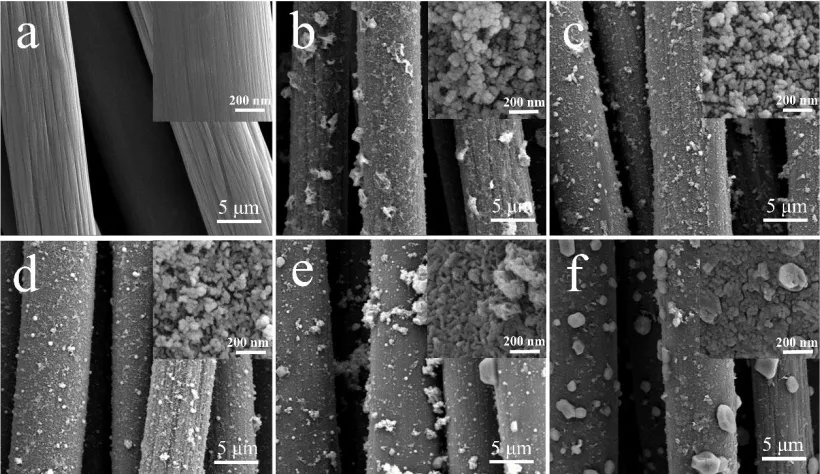
improve the intrinsic activities of MoS2. Fig. 1 shows the SEM images of bare CC, MoS2/CC,
Co-Mo-S(1:3)/CC, Co-Mo-S(1:2)/CC, Co-Mo-S(1:1)/CC and CoS2/CC. Fig. 1b showed the morphology of the
amount aggregates. The introduction of few Co2+ into the precursor solution played a critical role in tuning the nanostructure of Co-Mo-S/CC. As shown in Fig. 1c and 1d, with the Co to Mo molar ratio of 1:3 and 1:2, the relatively uniform Co-Mo-S nanoparticles (~50-100 nm) was well-distributed, on the surface of carbon fibers, simultaneously. Moreover, with further increase of Co:Mo ratio to 1:1 (Fig. 1e) and 2:0 (pure CoS2, Fig. 1f), the surface of carbon fibers emerge massive peanut-like particles with
sizes ranging from 500 nm to 2 μm.
Figure 1. Low-resolution SEM images of (a) bare CC, (b) MoS2/CC, (c) S(1:3)/CC,
Co-Mo-S(1:2)/CC (d), Co-Mo-S(1:1)/CC (e) and CoS2/CC (f), Insets: high magnification SEM images.
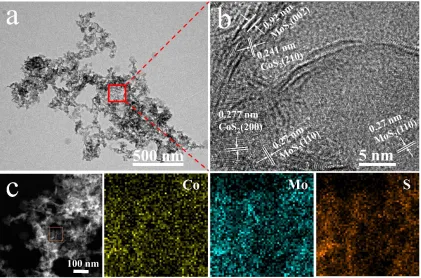
To better elucidate the microscopic structure of Co-Mo-S(1:2)/CC, the Co-Mo-S composites were further peeled off from the carbon cloth by sonication and investigated by TEM. As shown in Fig. 2a, the introduction of Co2+ during the synthesis formed the porous hybrid Co-Mo-S structure. HRTEM image (Fig. 2b) indicates the formation of intimate contacts of CoS2 and MoS2 in the
Co-Mo-S hybrid. The lattice with spacing of 0.241 nm and 0.277 nm are assigned to the (210) and (200) crystal planes of pyrite phase CoS2 [34]. Furthermore, the lattice planes with a spacing of 0.27 nm can
be indexed into the (110) crystal plane of 2H-MoS2, though it is not easy to be distinguished from the
CoS2 (200) plane. Moreover, the spacing of ~0.92 nm between two adjacent monolayers, further
demonstrates the existence of the MoS2 (002) planes with expanded interlayer spacing, which is much
larger than that of the pristine MoS2 of ~0.65 nm, that may come from the introduction of Co2+ into the
[image:5.596.93.503.204.441.2]
Figure 2. Low-magnification TEM image (a), HRTEM image (b) and elemental mapping (c) of the Co-Mo-S(1:2)/CC sample.
XRD was used to investigate the crystal structure of Co-Mo-S samples. As shown in Fig. 3a, the strong diffraction peak at 26° was assigned to the carbon cloth substrate (red line, Co-Mo-S(1:2)/CC). The diffraction peaks at 43.2° can be indexed to the (006) plane of the hexagonal phase 2H-MoS2 (JCPDF# 87-2416) [35, 36]. However, due to the strong interference of carbon cloth, XRD
peaks of Co-Mo-S were not clearly demonstrated. Further, XRD measurement was performed after peeled off from carbon fiber. The two diffraction peaks centered at around 32.5° and 55.2°, can be assigned to the (210) and (200) crystal planes of pyrite phase CoS2 (JCPDF# 70-2865), respectively.
The diffraction peaks at 24°, 43.2°, and 58.7° can be well indexed to the (100), (006) and (110) planes of the hexagonal 2H-MoS2, indicating the coexistence of cobalt and molybdenum elements in
Co-Mo-S/CC [34, 37]. In addition, a new diffraction peak appeared at 9.8°, corresponding to the shift (002) plane of MoS2, which suggests that the introduction of Co2+ enlarged the interlayer spacing in
Co-Mo-S which can lead to high activity for HER. In this case, the spacing between two adjacent layers can be calculated using Bragg’s law nλ = 2dsinθ [38], where n is the order of reflection, λ is the wavelength of the incident X-ray, d is the interlayer spacing and θ is the angle between the incident X-ray and the scattering planes. The calculated spacing between Mo-S layers was about 0.92 nm which is consistent with the observation in HRTEM. Raman spectrum was further measured to identify the structure of the as-obtained sample. As show in Fig. 3b, Co-Mo-S(1:2)/CC displays a peak at 390 cm-1, corresponding to the in-phase stretch (Ag) mode of CoS2 [39]. Moreover, the distinct peak at ∼380 cm-1 associated to
the in-plane E2g1 mode and two distinct peaks at ∼403 and ∼410 cm-1 are associated to the
[image:6.596.89.510.69.347.2][image:7.596.78.523.75.269.2]
Figure 3. (a) XRD patterns of Co-Mo-S(1:2)/CC and the peeled off Co-Mo-S(1:2) samples, and (b) Raman spectra of Co-Mo-S(1:2)/CC.
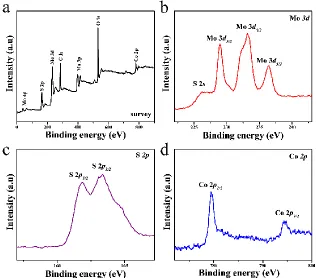
Figure 4. XPS spectra of Co-Mo-S(1:2)/CC: (a) survey, (b) Mo 3d, (c) S 2p, and (d) Co 2p.
XPS was used to examine the chemical composition and chemical element states of Co-Mo-S(1:2)/CC. The survey spectrum recorded from 0 to 900 eV in Fig. 4a confirms the presence of Co, Mo, S, C and O elements. From the high- resolution XPS spectrum of Mo 3d (Fig. 4b), two major peaks at 228.9 and 233 eV were observed and can be assigned to the characteristic doublet peaks of Mo4+ 3d5/2
and 3d3/2 core electrons [42, 43]. In addition, the characteristic peak at 236 eV correspond to Mo-O
[image:7.596.139.455.332.610.2]
45]. Moreover, a small peak appears at 226.6 eV that can be ascribed to the S 2s orbital. The peaks at 161.9 and 163.3 eV can be assigned to the S 2p1/2 and 2p3/2 orbitals, indicating the -2 oxidation state of
sulfur in MoS2 (Fig. 4c) [44]. Fig. 4d showed the Co 2p spectrum, two peaks can be assigned to Co
2p3/2 and Co 2p1/2 at 779.5 and 795.4 eV, respectively. It is worth to note that the intensity of Co
spectrum was lower than other elements, which may be attributed to its lower content in the Co-Mo-S (1:2)/CC sample.
[image:8.596.145.452.230.485.2]3.2. Electrocatalytic activity of Co-Mo-S/CC toward HER
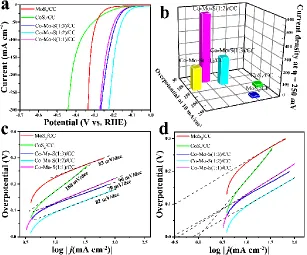
Figure 5. (a) HER polarization curves and (b) HER performance comparison (η10 and current densities
at η = 250 mV) of MoS2/CC, CoS2/CC, S(1:3)/CC, S(1:2)/CC, and
Co-Mo-S(1:1)/CC. (c) Corresponding Tafel slopes obtained from panel (a). (d) Calculated exchange current densities of MoS2/CC, CoS2/CC, S(1:3)/CC, S(1:2)/CC, and
Co-Mo-S(1:1)/CC by applying extrapolation method to the Tafel plots.
To investigate the HER activities of the Co-Mo-S catalysts, electrochemical measurements were carried out using a standard three-electrode cell in N2-saturated 1 M KOH solution. All of the
samples were grown on carbon cloth and were used directly as working electrodes without other treatment. For comparison, the catalytic activities of MoS2/CC and CoS2/CC were also examined with
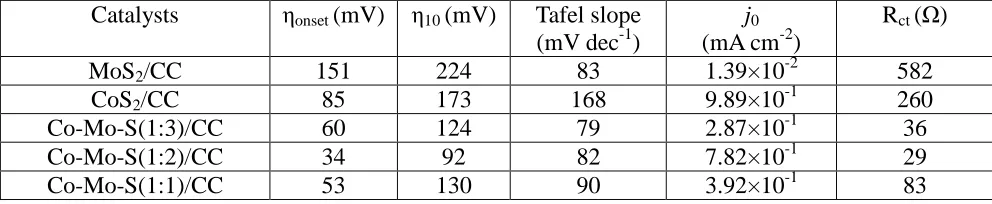
the same setup. As shown in Fig. 5a, the HER onset potentials of CoS2/CC is approximately 85 mV,
substantially lower than that of MoS2/CC (ca. 151 mV), suggesting that CoS2 material is intrinsically
more active than MoS2 [30]. When Co was introduced into MoS2 (Co:Mo = 1:3), the HER
increase of the onset potential (53 mV). Among all the studied samples, Co-Mo-S(1:2)/CC shows the best catalytic activity for HER in alkaline electrolyte with a lower overpotential (92 mV) at the current density of 10 mA cm-2, substantially lower than of CoS2/CC (173 mV) and MoS2/CC (224 mV), which
also outperforms most of the transition metal sulfides electrocatalysts for alkaline HER (Table 1), including defect-rich CoMoS [46], MoS2/Ni3S2 heterostructures [47], and MoS2/Mo [48]. Moreover,
the current density at η = 250 mV of Co-Mo-S(1:2)/CC reaches 570 mA cm-2
, which is 21 and 33.5 times than that of CoS2/CC and MoS2/CC, respectively, indicating the largely improved HER activity
of Co-Mo-S/CC (Fig. 5b).
Table 1. Comparison of HER performance in 1M KOH for Co-Mo-S/CC with reported electrocatalysts.
Catalysts Electrolyte solution ηonset (mV) η10 (mV) Tafel slope
(mV dec-1) Reference
Co-Mo-S/CC 1M KOH 34 92 82 This work
Chevrel-phase NiMo3S4 0.1M KOH 59 257 98 [31]
Defect-rich CoMoS 1M KOH 42 98 82 [46]
MoS2/Ni3S2
heterostructures 1M KOH 50 110 88 [47]
MoS2 nanosheets 236 431 308
MoS2/Mo 1M KOH --- 184 87 [48]
Cu@CoSx/CF 1M KOH 95 134 61 [49]
Ni3S2/nickel foam 1M KOH 59 223 --- [50]
Table 2. Summary of HER activity of Co-Mo-S(1:3)/CC, Co-Mo-S(1:2)/CC, Co-Mo-S(1:1)/CC, CoS2/CC and MoS2/CC in 1 M KOH.
Catalysts ηonset (mV) η10 (mV) Tafel slope
(mV dec-1)
j0
(mA cm-2)
Rct (Ω)
MoS2/CC 151 224 83 1.39×10⁻² 582
CoS2/CC 85 173 168 9.89×10⁻¹ 260
Co-Mo-S(1:3)/CC 60 124 79 2.87×10⁻¹ 36
Co-Mo-S(1:2)/CC 34 92 82 7.82×10⁻¹ 29
Co-Mo-S(1:1)/CC 53 130 90 3.92×10⁻¹ 83
To assess the intrinsic HER activities of the catalysts, Tafel slopes were obtained according to the Tafel equation (η = blog j + a), where η, b, j and a are the overpotential, Tafel slope, current density, and a constant, respectively [51-54]. As shown in Fig. 5c, the Tafel slopes were 79, 82, 90, 168 and 83 mV dec-1 for Co-Mo-S(1:3)/CC, Co-Mo-S(1:2)/CC, Co-Mo-S(1:1)/CC, CoS2/CC and MoS2/CC,
respectively. The Tafel slope of Co-Mo-S(1:2)/CC is much lower than CoS2/CC and MoS2/CC,
suggesting a combined Volmer-Heyrovsky mechanism for HER [35]. Exchange current density (j0)
[image:9.596.50.546.505.607.2]
[55]. As shown in Fig 5d, the j0 value of Co-Mo-S(1:2)/CC was 56 times larger than that of MoS2/CC
(Table 2). The high exchange current density reveals the origin of the excellent HER activity of the Co-Mo-S/CC samples. It worth to mention that CoS2 actually shows the highest exchange current density
and also shows a low onset potential of 85 mV, indicating its high intrinsic activity plays a crucial role in the activity enhancement of Co-Mo-S [30].
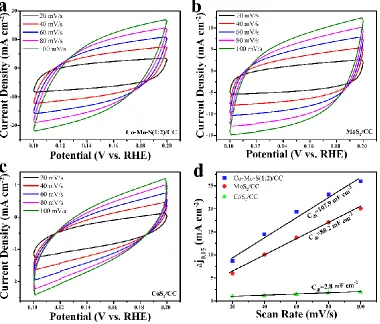
To better understand the effect Co incorporation, the electrochemical double–layer capacitance (Cdl) was further used to estimate the effective surface areas by CV tests in the 0.1–0.2 V region as
shown in Fig 6 [45, 56-58]. As shown in Fig. 6d, the values of Cdl are 107, 88.2 and 2.8 mF cm-2 for
Co-Mo-S(1:2)/CC, MoS2/CC and CoS2/CC, indicating the hybrid Co-Mo-S(1:2)/CC possess the
highest effective surface area for HER. The value of Cdl for MoS2/CC was much larger than that of
CoS2/CC and close to that of Co-Mo-S(1:2)/CC, which suggests that MoS2 plays a main role in the
enlarged surface area of Co-Mo-S with appropriate amount of Co. This also explains the activity loss with the extra Co that forms large particles as shown in Fig 1e, which results in the low active surface area decrease the HER activity.
Figure 6. CV curves of (a) Co-Mo-S(1:2)/CC, (b) MoS2/CC and (c) CoS2/CC measured from 20 to
[image:10.596.110.490.329.653.2]
Figure 7. (a) Nyquist plots of MoS2/CC, CoS2/CC, S(1:3)/CC, S(1:2)/CC, and
Co-Mo-S(1:1)/CC. (b) Plot of charge transport resistance of different samples.
The electrochemical impedances of Co-Mo-S/CC were measured by EIS measurement to investigate the HER kinetics at the interface between the electrode and electrolyte [59, 60]. As shown in Fig. 7a, the fitted results reveal that the Co-Mo-S(1:2)/CC shows the smallest charge-transfer resistance (Rct) than others, indicating a faster Faradaic process in HER kinetics. It worth to mention
that, the value of Rct for CoS2/CC is smaller than MoS2/CC, indicating CoS2/CC possess faster charge
transfer. The Rct values summarized Fig. 6b show the same tendency with the HER overpotential tests
(Fig. 5a), where the charge transfer efficiency is largely improved in the Co-Mo-S catalysts compared to single MoS2 and CoS2.
[image:11.596.89.509.458.630.2]
Scheme 2. Schematic illustration for the synergetic optimization of the Co-Mo-S/CC catalysts employing the high active surface area of MoS2 and the high intrinsic activity of CoS2.
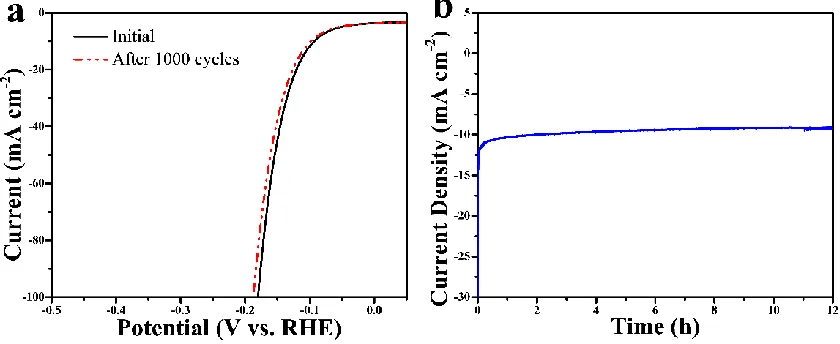
We further evaluated the stability and durability of the Co-Mo-S(1:2)/CC catalyst by continuous CV sweeping from -0.15 to 0.1 V at a scan rate of 100 mV s−1. As shown in Fig. 8a, after 1000 cycles, the current loss is negligible in the polarization curve of Co-Mo-S(1:2)/CC. The long-term durability was conducted around ∼10 mA cm-2 of this catalyst by a continuous current measurement at 92 mV in 1 M KOH solution (Fig. 8b). After 12 hours of continuous test, the Co-Mo-S(1:2)/CC still remain 91% of its original current density, suggests that the robust stability for HER in strong alkaline electrolyte.
Based on the above results, the superior alkaline HER activity and stability of the Co-Mo-S/CC can be ascribed to the following aspects, as a result of the synergetic effect of CoS2 and MoS2 as
shown in Scheme 2. (1) CC acts as a good current collector, which can enhance the charge transport of the composite material [61]; (2) Metallic CoS2 possess the fast intrinsic HER kinetics, where the
semiconducting MoS2 have higher effective surface area, from which the synergetic effect of CoS2 and
MoS2 are possible to achieve an enhanced activity [30]; (3) The incorporation of appropriate amount of
cobalt is crucial to avoid the formation of large CoS2 particles and ensure the high active surface area
and relatively uniform distribution of the Co-Mo-S catalysts on the carbon cloth, which enables the high activity [44]. Our result provides an important guideline for the design of the transition metal doped MoS2 electrocatalysts for efficient alkaline HER by composition-dependent nanostructuring,
which may be of great interest for industrial water electrolyzers.
4. CONCLUSIONS
In summary, we have developed an effective strategy for the growing of Co-Mo-S catalysts on carbon cloth (CC) via introducing cobalt into MoS2 to achieve the synergistic interaction of CoS2 and
MoS2 and demonstrated to be efficient HER catalysts in alkaline condition. The optimized Co-Mo-S
stability for alkaline HER. The enhanced activity and stability of Co-Mo-S/CC are ascribed to the synergistic effect of fast intrinsic HER kinetics of metallic CoS2 and high effective surface area and
abundant active sites of semiconducting MoS2. Our results indicated that one of the most important
consideration is the incorporation of appropriate amount of Co into MoS2 to avoid the overgrowth of
large CoS2 particles and maintain the high surface area of Co-Mo-S nanostructures. This work
broadens our vision for the design of transition metal doped MoS2 by synergetic optimization of the
intrinsic HER kinetics and the active surface area for efficient hydrogen evolution. ACKNOWLEDGEMENTS
We would like to acknowledge the financial supports from the National Natural Science Foundation of China (21501072,21706101 and 61674071), the Jiangsu Specially-Appointed Professors Program, the Natural Science Foundation of Jiangsu Province (BK20150489), the Opening Project of Key Laboratory of Green Chemistry of Sichuan Institutes of Higher Education (LZJ1702), the China Postdoctoral Science Foundation (2016M590419), the Jiangsu Province Postdoctoral Foundation (1501027A), and the Start Funding of Jiangsu University (15JDG011 and 15JDG027).
References
1. N.S. Lewis, D.G. Nocera, Proc. Natl. Acad. Sci. U. S. A., 103 (2006) 15729. 2. J. Wang, H. Zhong, Z. Wang, F. Meng, X. Zhang, ACS Nano, 10 (2016) 2342. 3. S.S. Penner, Energy, 31 (2006) 33.
4. M. Wang, L. Chen, L. Sun, Energy Environ. Sci., 5 (2012) 6763.
5. D. Yan, Y. Li, J. Huo, R. Chen, L. Dai, S. Wang, Adv. Mater., 29 (2017) 1606459. 6. H.B. Gray, Nat. Chem., 1 (2009) 7.
7. X. Zhang, Z. Lai, C. Tan, H. Zhang, Cheminform, 47 (2016) 8816.
8. Y. Cheng, S. Lu, F. Liao, L. Liu, Y. Li, M. Shao, Adv. Funct. Mater., 27 (2017) 1700359.
9. P. Chen, T. Zhou, M. Zhang, Y. Tong, C. Zhong, N. Zhang, L. Zhang, C. Wu, Y. Xie, Adv. Mater., 29 (2017) 1701584.
10. W. Xiao, P. Liu, J. Zhang, W. Song, Y.P. Feng, D. Gao, J. Ding, Adv. Energy Mater., 7 (2017) 1602086.
11. J.F. Callejas, C.G. Read, C.W. Roske, N.S. Lewis, R.E. Schaak, Chem. Mater., 28 (2016) 6017. 12. Y. Shi, B. Zhang, Chem. Soc. Rev., 45 (2016) 1781.
13. Z. Zhou, L. Wei, Y. Wang, H.E. Karahan, Z. Chen, Y. Lei, X. Chen, S. Zhai, X. Liao, Y. Chen, J. Mate. Chem. A, 5 (2017) 20390.
14. H. Duan, D. Li, Y. Tang, Y. He, J.S. Fang, R. Wang, H. Lv, P.P. Lopes, A.P. Paulikas, H. Li, J. Am. Chem. Soc., 139 (2017) 5494.
15. K. Xu, D. Hui, M. Zhang, C. Min, Z. Hao, L. Zhang, C. Wu, X. Yi, Adv. Mater., 29 (2017) 1606980. 16. J. Wang, F. Xu, H. Jin, Y. Chen, Y. Wang, Adv. Mater., 29 (2017) 1605838.
17. B.W. Hao, Y.X. Bao, Y. Le, X.Y. Yu, W.L. Xiong, Nat. Commun., 6 (2015) 6512.
18. J.S. Li, Y. Wang, C.H. Liu, S.L. Li, Y.G. Wang, L.Z. Dong, Z.H. Dai, Y.F. Li, Y.Q. Lan, Nat. Commun., 7 (2016) 11204.
19. H. Lin, N. Liu, Z. Shi, Y. Guo, Y. Tang, Q. Gao, Adv. Funct. Mater., 26 (2016) 5590. 20. W. Sheng, H.A. Gasteiger, S.H. Yang, Acta Crystallogr., 157 (2010) B1529.
21. Y. Zheng, Y. Jiao, M. Jaroniec, S.Z. Qiao, Angew. Chem., 54 (2015) 52.
22. L. Yang, W. Zhou, J. Lu, D. Hou, Y. Ke, G. Li, Z. Tang, X. Kang, S. Chen, Nano Energy, 22 (2016) 490.
23. J. Lai, S. Li, F. Wu, M. Saqib, R. Luque, G. Xu, Energy Environ. Sci., 9 (2016) 1210.
26. T. Liu, X. Ma, D. Liu, S. Hao, G. Du, Y. Ma, A.M. Asiri, X. Sun, L. Chen, ACS Cataly., 7 (2017) 98. 27. Y. Feng, X.Y. Yu, U. Paik, Chem. Commun., 52 (2016) 1633.
28. B. Mao, Q. Dong, Z. Xiao, C. Exstrom, S. Darveau, T. Webber, B. Lund, H. Huang, Z. Kang, J. Huang, J. Mate. Chem. A, 1 (2013) 12060.
29. J. Pan, C. Song, X. Wang, X. Yuan, Y. Fang, C. Guo, W. Zhao, F. Huang, Inorg. Chem. Front., 4 (2017) 1895.
30. J. Staszakjirkovský, C.D. Malliakas, P.P. Lopes, N. Danilovic, S.S. Kota, K.C. Chang, B. Genorio, D. Strmcnik, V.R. Stamenkovic, M.G. Kanatzidis, Nat. Mater., 15 (2016) 197.
31. J. Jiang, M. Gao, W. Sheng, Y. Yan, Angew. Chem., 55 (2016) 15240.
32. Z. Wu, J. Guo, J. Wang, R. Liu, W. Xiao, C. Xuan, K. Xia, D. Wang, ACS Appl. Mater. Interfaces, 9 (2017) 5288.
33. T. An, Y. Wang, J. Tang, W. Wei, X. Cui, A.M. Alenizi, L. Zhang, G. Zheng, J. Mate. Chem. A, 4 (2016) 13439.
34. Y. Guo, L. Gan, C. Shang, E. Wang, J. Wang, Adv. Funct. Mater., 27 (2017) 1602699.
35. B. Mao, Y. Yuan, Y. Shao, B. Yang, Z. Xiao, J. Huang, Nanosci. Nanotech. Lett., 6 (2014) 685. 36. J. Huang, D. Hou, Y. Zhou, W. Zhou, G. Li, Z. Tang, L. Li, S. Chen, J. Mate. Chem. A, 3 (2015)
22886.
37. C. Wang, B. Ren, D. Li, Q. Jin, H. Cui, J. Mate. Chem. A, 5 (2017) 13196. 38. E. Atkins, Phys. Today, 10 (1978) 50.
39. M. Cabán-Acevedo, M.L. Stone, J.R. Schmidt, J.G. Thomas, Q. Ding, H.C. Chang, M.L. Tsai, J.H. He, S. Jin, Nat. Mater., 14 (2015) 1245.
40. K. Chang, W. Chen, ACS Nano, 5 (2011) 4720.
41. G. Gong, Y. Liu, B. Mao, B. Wang, L. Tan, D. Li, W. Shi, RSC Adv., 6 (2016) 99023. 42. X. Zheng, J. Xu, K. Yan, H. Wang, Z. Wang, S. Yang, Chem. Mater., 26 (2014) 2344.
43. J. Huang, D. Hou, Y. Zhou, W. Zhou, G. Li, Z. Tang, L. Li, S. Chen, J. Mate. Chem. A, 3 (2015) 22886.
44. J. Miao, F.X. Xiao, H.B. Yang, Y.K. Si, J. Chen, Z. Fan, Y.Y. Hsu, H.M. Chen, H. Zhang, B. Liu, Sci. Adv., 1 (2015) 1500259.
45. Y.J. Tang, Y. Wang, X.L. Wang, S.L. Li, W. Huang, L.Z. Dong, C.H. Liu, Y.F. Li, Y.Q. Lan, Adv. Energy Mater., 6 (2016) 1600116.
46. Z. Wu, J. Guo, W. Jie, L. Rong, W. Xiao, C. Xuan, K. Xia, D. Wang, ACS Appl. Mater. Interfaces, 9 (2017) 5288.
47. J. Zhang, T. Wang, P. Liu, Z. Liao, S. Liu, X. Zhuang, M. Chen, E. Zschech, X. Feng, Nat. Commun., 8 (2017) 15437.
48. Z. Pu, Q. Liu, A.M. Asiri, Y. Luo, X. Sun, Y. He, Electrochim. Acta, 168 (2015) 133.
49. Y. Liu, Q. Li, R. Si, G.D. Li, W. Li, D.P. Liu, D. Wang, L. Sun, Y. Zhang, X. Zou, Adv. Mater., 29 (2017) 1606200.
50. L.L. Feng, G. Yu, Y. Wu, G.D. Li, H. Li, Y. Sun, T. Asefa, W. Chen, X. Zou, J. Am. Chem. Soc., 137 (2015) 14023.
51. P. Joo, K. Jo, G. Ahn, D. Voiry, Y.J. Hu, S. Ryu, M. Chhowalla, B.S. Kim, Nano Lett., 14 (2014) 6456.
52. Y.Y. Chen, Y. Zhang, X. Zhang, T. Tang, H. Luo, S. Niu, Z.H. Dai, L.J. Wan, J.S. Hu, Adv. Mater., 29 (2017) 1703311.
53. J. Zhang, T. Wang, P. Liu, Z. Liao, S. Liu, X. Zhuang, M. Chen, E. Zschech, X. Feng, Nat. Commun., 8 (2017) 15437.
54. M. Fang, W. Gao, G. Dong, Z. Xia, S.P. Yip, Y. Qin, Y. Qu, J.C. Ho, Nano Energy, 27 (2016) 247. 55. X. Zou, Y. Zhang, Chem. Soc. Rev., 44 (2015) 5148.
56. S. Wang, D. Yan, S. Dou, L. Tao, Z. Liu, Z. Liu, J. Huo, J. Mate. Chem. A, 4 (2016) 13726. 57. M.R. Gao, M.K.Y. Chan, Y. Sun, Nat. Commun., 6 (2015) 7493.
59. Z. Wang, D. Cao, L. Wen, R. Xu, M. Obergfell, Y. Mi, Z. Zhan, N. Nasori, J. Demsar, Y. Lei, Nat. Commun., 7 (2016) 10348.
60. M.S. Faber, R. Dziedzic, M.A. Lukowski, N.S. Kaiser, Q. Ding, S. Jin, J. Am. Chem. Soc., 136 (2014) 10053.
61. F. Li, L. Chen, G.P. Knowles, D.R. Macfarlane, J. Zhang, Angew. Chem., 56 (2017) 505.