THE OPEN-AIR CLASSROOM - A PRELIMINARY
STUDY OF OUTDOOR CLASSROOMS FOR PRIMARY
SCHOOLS IN MALAYSIA
By
Maheran Yaman
Submitted in fulfilment of the requirements of the degree of
Doctor of Philosophy
Schools of Architecture and Education
University of Tasmania
Australia
STATEMENT OF AUTHENTICITY OF MATERIAL
This thesis contains no material which has been accepted for the award of any other degree or diploma in any institution and to the best of my knowledge,and belief, the research contains no material previously published or written by another person, except where due reference has been made in the text of the thesis.
Signed
STATEMENT OF AUTHORITY OF ACCESS TO LOAN
AND COPYING
The University of Tasmania and its approved officers and representatives are authorised to loan or make limited copies of this thesis for general dispersal in the interests of academic research, subject to the Copyright act 1968.
Signed
- Maheran Yaman
Preface
A man with a book, a pool of shade and a circle of disciples. Sheikh Abd al-Raziq, sitting beneath an acacia and prodding the air with his much-thumbed manual of Islamic law, is the embodiment of orthodoxy. Around the old man his pupils crane forward — sitting in circle, listening and asking questions. The scene is archetypal. It is how Islam has been expounded to the people for over 1400 years. This is how the Prophet first expounded God's law for mankind, and the faithful still discover a new something of its original drama in its superbly appropriate setting. As an image of religious instruction its fundamental immediacy must be the envy of every reformer, be he
Christian, Hindu, or whatever persuasion (Musallam, 1983).
The perception of teaching and learning in an environment directly connected with the surrounding natural environment attracted me as a landscape architect, to extend my research to the environmental conditions of primary schools in my home country of Malaysia.
I believe: that the Prophet has taught us to be responsible to the natural environment around us, but we forget the essentials of his teachings in this respect, due to more recent colonial influences and economic rationalism. Therefore, I engaged in research to find out if there is an alternative to the current indoor restricted Malaysian primary school environment, in the hope that I could find an alternative, which more closely follows Islamic teachings about a responsible exchange between the natural and built environment in the context of a modern society.
The results of this research are not fully Conclusive. However, I believe that I have developed an architectural/landscape architectural model of a school, which could improve thermal comfort and teaching and learning in Malaysian schools. I also have been assured by my research that the new school model may provide an economical and low energy use model of school buildings for the future.
Abstract
My research is based on the hypothesis that the increased use of outdoor classrooms in primary education in Malaysia could provide many benefits to Malaysian society. These include environmental, social and cost benefits, additional space for students, significant learning opportunities and improved thermal comfort in primary school buildings.
This research analyses and provides qualitative and quantitative data to inform the design of a prototypical model of structures achieving cost-effective solutions, while providing a significant improvement in perceived human comfort within schools. It was hypothesised that the cost-saving achieved.by the use of such structures for outdoor classrooms could be used to improve the landscaping on school sites.
The research sought to explain, from an historical perspective, how the current
situation with regard to the provision of school buildings in Malaysia has arisen and to develop appropriate recommendations for improvements based on Malaysia's culture, heritage and stakeholders' opinions. By means of a qualitative survey of opinions of building professional and teachers the research sought to establish if a need exists to improve teaching and learning spaces in Malaysian primary schools. The research also sought to establish to what extent contemporary educational theories have influenced Malaysian teachers' views about the educational needs of students and how these might best be achieved in relation to teaching and learning spaces in government funded Malaysian primary schools.
Acknowledgements
I am indebted to many people in writing this thesis. My apologies are due if all their names are not mentioned.
First, I wish to thank the University of Tasmania, Australia and International Islamic University in Malaysia who gave me the opportunity to study in Australia and provided support, scholarships and facilities during my research. My thanks to
Professor Ismawi Zen, from International Islamic University, who supported my study leave.
My heartfelt thanks are due to the University of Tasmania, my supervisor Dr Andras Kelly and co-supervisor Dr Margaret Robertson, who supervised the writing of this thesis. They have devoted enormous amounts of time to counselling, questioning, encouraging me and to criticising early drafts of the thesis. Their comments and discussion concerning every aspect of the initial draft and subsequent revisions were invaluable. Their contrasting viewpoints never ceased to provoke me to develop and clarify my own thoughts on the work.
I am especially indebted to the Head of School of Architecture, Professor Roger Fay, who supported me all the way through the thesiS', as well as reviewing and
commenting on the specific arguments made in the dissertation. I am also indebted to other staff in the School of Architecture particularly Dr Catriona McLeod, Dr
Zbigniew Bromberek and Jay Burleigh for their help, comments and guidance.
like to thank my colleagues in the research higher degrees room: Dr Wahyu Dewanto, Nina Hamilton, Chris Morgan and Tham Man Lok.
During my field research in Malaysia and abroad, many people either through direct discussion or through e-mail also supported me. I would like to express my gratitude to Mr David Bower from, the Department of Education in Tasmania; Mr Samuel Martin from Artas Architects, Tasmania. Australia; Josef Prayotomo from Indonesia; Mr Prakash Nair from America; Puan Ainun Jariah and family from Kulliyah of Education, International Islamic University, Malaysia; Puan Sri Nila Inangda Manyam Keumala; Puan Hazrina Hussein and Encik Ibrahim Mohd from the University Malaya; Encik Abdul Rahman Abdullah (AMN), Encik Anwar Ahmad (AMN) and Puan Maisarah Ahmad from the Department of Architecture and Engineering; and Puan Hazilah Gumri from the Department of Quantity Surveyors, City Hall Kuala Lumpur.
I would also like to thank the family of Dato' (Ir) Azizuddin Meor Hamzah and Datin Rohani Puteh, Yang Mulia Raja Salasabillah, Encik Alwi Ginen and Puan Anomah, Puan Satila Ramli from the Ministry of Education Malaysia. Special thanks are due to the thirty two teachers who participated in the study, from three government funded Malaysian primary school in Kuala Lumpur, for their time and large amount of valuable feedback.
Glossary
Almari cupboard (from Portuguese word)
A priori a priority
Baba and nyonya peranakan mixed marriage between the local Malays in Malacca and Chinese traders from mainland China
Baju shirt (Malay)
Bum iputra literally 'sons of the soil' - Malays and other indigenous peoples.
Bahasa Melayu referred to in Malaysia as Bahasa Kebangsaan, the national language
Cawan cups (Chinese)
Cetis money lender from an Indian caste
Escola (Portuguese)
ESD Environmentally Sustainable Design
Feringgi Portuguese
Hablu min nan nas relationship between humankind
Hablu min allah between humankind and the Creator
Hablul min nal alamin humans and Creation-(the environment)
Hadari sustainable
Halaqah circle (seating in circle)
Hijab headgear for Muslim ladies
Hinayana and Mahayana famous Indian epic
In vivo directly
Jawi Malay written in Arabic characters
Kaabah kiblat point in Mecca
Kampong village (Malay)
Kapitan Cina captain (Chinese)
Kawi early Arabic written use for Malay manuscript
Khalifah Vice-regent
Kiblat Muslim prayers point to Mecca
Koranic the holy book or scriptures send to Prophet Muhammad
ICufia headgear for male Muslim
Kurikulum Bersepadu Sekolah Rendah (KBSR)
New Comprehensive Primary School Curriculum
Kurikulum Bersepadu Sekolah Menengah (KBSA/V
New Comprehensive Secondary School Curriculum
lwan water channel
Lebai / Tamil word labbai (written ilappai)
Lepak Madrasa Mandur Masjid Muafakat Mussulman Panya Pasantren relax pious man
religious Koranic school overseer (Portuguese) mosque
cooperation Muslim man
Pondok Tok Kenali Ujian Pendidikan Sekolah
Samanthi Sila Sanuk Sarong Sejarah Melayu Sekolah
Tok Kenali's school
Rendah (UPSR)
Primary School Assessment Test (PSAT) concentration (Sanskrit)
moral conduct (Sanskrit) playful (Sanskrit)
a length of cloth wrapped around the waist Malay Annals
school
Seperti Belanda diberi tanah
translated as 'it's like giving land to a Dutchman'
Sayang anak ditangan-tangankan
spare the rod and spoil the child
Songkok traditional Malay head gear
SITC Sultan Idris Teaching College
Sunna (sunni) following the prophet Muhammad do's
Surau building smaller than mosque/ mussolla
Rabbis Jewish religious teacher
Ringgit Malaysian currency (RM)
Rumi the Malay language in Latin characters
Rukunegara national ideology
Teko kettle (Chinese)
Ustazs or ulamas pious or religious teacher in Islam
Mo-Lo-Yu mentioned in the New History of the T'ang. Refers to the country
of `Malayu,' or Malaysia.
Shih-li-fo-shoh This refers to the country of Srivijaya (Chinese)
Madras schools education building system
Raja Class Royal class
Raja School Royal school
Malay College, Kuala Kangsar (MCKK)
Eton of the East
Bab-ud-Darjat Gateway to High Rank
UMS Unfederated Malay States
PFS Penang Free School
`3Rs'- Reading, Writing and Arithmetic Integration.
This policy stresses the following important aspects of education: citizenship, national unity and moral development, living skills (manipulative skills,
Keywords
Cost-effective Cultural
Environmentally Sustainable Design (ESD) Government funded primary school
Hot-humid tropical climate Human comfort
Madrasa
Outdoor environment Prototype
Stakeholder Students Teachers
CONTENTS
STATEMENT OF AUTHENTICITY OF MATERIAL
STATEMENT OF AUTHORITY OF ACCESS TO LOAN AND COPYING ii
Preface iii
Abstract iv
Acknowledgements
Glossary vii
Keywords ix
List of Contents
List of Tables xii
List of Figures xiii
List of Appendices xiv
CHAPTER 1: INTRODUCTION
1.1 Overview of current education in Malaysia 1
1.2 Research background 3
1.3 Malaysian history: An overview 4
1.4 An overview of the history of school education in Malaysia 5
1.5 Primary education 7
1.6 Private education 7
1.7 The government policy on education 7 1.8 Current primary education curriculum in Malaysia 8
1.9 Research design 9
CHAPTER 2: SCHOOL SPACES AND THEIR EVOLUTION IN THE MALAYSIAN CONTEXT
2.1 Introduction 16
2.2 Classical to mediaeval period 17
2.3 The change of teaching spaces from indoor to outdoor 19 2.4 Islamic architecture and the development of the madrasa 20 2.5 The development of the English school 23 2.6 Open air learning experiments in England 28
2.7 Conclusion 30
CHAPTER 3: THE CONTEXT OF CURRENT MALAYSIAN SCHOOLING
3.0 Introduction 33
Part A 35
3.1 An overview of early Malaysian settlement 35 3.2 Early European educational influences in Malaysia 39 3.3 The Portuguese influence 1509 to 1640 40
Part B 46
3.5 The influence of pedagogical ideas on primary school design 46
3.6 The education context 47
3.7 Other Western pedagogical theories 53
3.8 School demographics 61
3.9 Play behaviour and design 65
Part C 79
3.10 Thermal comfort 79
3.11 The Malaysian environment 90
3.12 School building in Malaysia 94
3.13 Conclusion 108
3.14 Summary 109
CHAPTER 4: RESEARCH METHODOLOGY
4.1 Introduction 111
4.2 Research design 112
4.3 Development phases of the research 116
4.4 Ethics 117
4.5 Reliability and validity 117
4.6 Data collection 119
4.7 Sampling technique 120
4.8 Description of study participants 122
4.9 Survey questionnaire 122
4.10 In-depth interview 124
4.11 Study Model 126
4.12 Views of teachers and education officer 129 4.13 Quantity surveyor's and structural engineer's perspectives 129
4.14 Post Occupancy Evaluation 130
4.15 Data Classification 133
4.16 Interpretation of data 133
4.17 Analysis of the interview data 134
4.18 Summary 134
CHAPTER FIVE: RESULTS
5.1 Introduction 136
5.2 Results of the literature review 140
5.3 Results of the primary school teachers survey 142
Part A 144
5.4 Results of the survey of professionals 152
5.5 Investigative Issue 1 160
5.6 Investigative Issue 2 161
Part B 169
5.8 Investigative Issue 4 172
5.9 Investigative Issue 5 186
5.10 Conclusion 191
CHAPTER 6: ANALYSIS AND EVALUATION
6.1 Introduction 193
6.2 Investigative Issue 1 194
6.3 Investigative Issue 2 195
6.4 Investigative Issue 3 198
6.5 Investigative Issues 1, 2 and 3: Synthesis and findings 204
6.6 Investigative Issue 4 214
6.7 Investigative Issue 5 225
6.8 Responses from Malaysian building professionals 227
6.9 Conclusion 230
CHAPTER 7: CONCLUSION 232
3
7.1 Introduction 232
7.2 Responses to the Research questions 233
7.3 Limitations of the research 236
7.4 Further research and recommendations 238
7.5 Conclusion 239
REFERENCES 241
LIST OF TABLES
CHAPTER 3 Part C
•
Table 3.1 Human adaptation strategies in response to thermal stimuli 87 Table 3.2 Comparisons of air temperatures in 1989 and 1999 89 Table 3.3 Comparisons of air humidity in 1989 and 1999 89 Table 3.4 Indoor classroom temperatures in Kuala Lumpur schools 91 Table 3.5 Indoor classrooms' microclimatic conditions in School 1 92 Table 3.6 Indoor classrooms' microclimatic conditions in School 2 92 Table 3.7 Indoor classrooms' microclimatic conditions in School 3 93 Table 3.8 Prediction of thermal neutrality in 6 Malaysian cities 94 Table 3.9 Insulating value of clothing elements based on ASHRAE 1985 98 CHAPTER 5
Part A
Table 5.3 Samples of year group taught indicating comfort/discomfort 147 Table 5.4 Teachers' preferences for teaching outdoors 149 Table 5.5 Professional participants' views on teaching outdoors 154 Table 5.6 Keyword frequencies and percentage responses from teachers 155 Table 5.7 Keyword indicating 'Controlling' 156 Table 5.8 Keywords indicating 'Exam orientated' 157 Table 5.9 • Keywords indicating 'Boring' 157 Table 5.10 Keywords frequencies and percentage responses from teachers 158 Table 5.11 Keywords indicating 'Amenities' 158 Table 5.12 Keywords indicating 'More spaces' 159 Part B
Table 5.13 General comparison of school grounds 176 Table 5.14 • General comparison of school grounds on functional spaces 177 Table 5.15 Site development area break down 183 Table 5.16 Categories of open-air classroom models above RM 45,000 184 Table 5:17 Category of open-air classroom model less than RM 45,000 185 CHAPTER 6
Table 6.1 Comparison of architectural influences 209 Table 6.2 Comparison of the educational qualities 213 Table 6.3 Comparison of the proposed school model with current practice 224 Table 6.4 Comparison of the potential for user control 225
LIST OF FIGURES
CHAPTER 1
Figure 1.1 Map showing the location of Malaysia (Hew, 1990, p.125) 6 Figure 1.2 Map showing the state boundaries in Malaysia (Hew, 1990, p.125) 6 CHAPTER 2
Figure 2.1 Figure 2.2 Figure 2.3 Figure 2.4 Figure 2.5 Figure 2.6 Figure 2.7 Figure 2.8
An imaginary mosaic illustration of 'The academy' 18 (Right) The Madrasa al-Firdaus in Aleppo (Left) and the Courtyard20 Woodlands Comprehensive School, Coventry, 1956 25 A typical modern Malaysian primary school 25 Examples of other types of classrooms by the English Committee 27 Central School of the National Society, Baldwin's Gardens 28 Pelham's open-air school during the rest period in summer (1909) 29 The open-air pavilion type school at Sheffield in summer (1911) 29 CHAPTER 3
Part C Figure 3.2 Figure 3.3 Figure 3.4 Figure 3.5 Figure 3.6 Figure 3.7 Figure 3.8 Figure 3.9 Figure 3.10' Figure 3.11
Olgyay's 1963 `Bioclimatic Chart' 82 The psycho-physiological model of thermal perception 84 Typical floor plan of standard government funded primary school 96 Section showing construction and building material of the school 97
Olgyay andOlgyay, 1963, p.102 100
Siddique, 1977; Szokolay, 1980 and Harris and Welke, 1982 100 Effect of vegetation on ground temperature in the forest 104 Effect of vegetation on air temperature 105
Cooling effect of vegetation 105
Cooling effect of many types of vegetation 105
CHAPTER 4
Figure 4.1 Research design 114
CHAPTER 5 Part B Figure 5.1 Figure 5.2: Figure 5.3 Figure 5.4 Figure 5.5 Figure 5.6 Figure 5.7
Prototype teaching modules (40 pupils)
Plan and section for prototype modules (400 pupils) Study model for outdoor classroom type 1
Study model for outdoor classroom type 16 Study model for outdoor classroom type 25 Study model for outdoor classroom type 38 Formalised model 173 173 178 179 180 181 182 CHAPTER 6
Figure 6.1 Traditional building diagrams plans and sections 207 Figure 6.2 A current typical Malaysian primary school plan 207 Figure 6.3 A current typical Malaysian primary school section 208
LIST OF APPENDICES
APPENDIX A 255
Potential connections between Malaysian primary schools' curriculum subjects and their school grounds
Table Al Table A2 Table A3 Table A4
Relationship between languages subjects and the physical environment
Relationship between music as a subject and the physical environment
Relationship between drama as a subject and the physical environment
Table A5 Relationship between economics as a subject in math and the physical environment
Table A6 Relationship between information technology in math as a subject and the physical environment
Table A7 Relationship between history as a subject and the physical environment
Traditional production methods Early forms of power
Table A8: Relationship between arts, crafts and design as a subject and the physical environment
Table A9: Relationship between sciences and skills of surviving as a combination subjects from two different groups of subjects and the physical environment
Table A10: Relationship between simple physics as a branch of sciences subject and the physical environment
Table All: Relationship between physical education subject and the physical environment
Table Al2: Relationship between basic Biology science as a subject and the physical environment
Table A13: Relationship between geography as a subject and the physical environment Table A14: Relationship between religious education as a subject and the
physical environment
Table A15: Relationship between English school grounds with sports as a subject alone and the physical environment in Malaysia Table A16: Relationship between hobbies or arts and crafts area on school
grounds as informal and hidden curriculum implementation and the physical environment
The following natural phenomena located ground schools have multiple purposes that could be used in the curriculum. The lists indicate possible activities in these spaces. School gardens nature area
Natural water area Woodland
Outdoor eating area Seating and quiet area Obstacle course Courtyard area Memorial garden
Garden and ornamental area
Playground and adventure playground Sports grounds
APPENDIX B 264
Figure B4: Shrewsbury, Allatt's school, 1800
Figure B5: Winchester College and Eton ground floor plan
Figure 86: Rugby school, 1816, the ground floor plan shows some gardens
APPENDIX C 271
A summary of four twentieth century educators' and theorists' ideas which have influenced recent pedagogy compared with Malaysian practices.
Table Cl: Comparisons of pedagogy in schools
Table C2: Comparisons of environmental demographics Table C3: Comparisons of subjects studied in schools Table C4: Comparisons of social demographics in schools
APPENDIX D 274
Costing and Structural studies
Costings for open air-classrooms constructed from different building materials, based on a 10 x 10m structure for a standard classroom without services costs. Costs are • compared with current costs and types of materials used
(RM 450.00/m square = RM 45,000.
(NB. The exchange rate is calculated at RM 2.00 at AUD1.00, current at the time of printing)
APPENDIX E 294
Suitable vegetation in schools as another factors influencing climatic cooling
APPENDIX F 300
Wildlife attracted to plants suitable for school grounds Birds for forest / woodland species site
Butterflies species suitable for school grounds
APPENDIX G 302
Malay, lban and Mandarin idioms related to the environment
APPENDIX H 303
Information sheet for Headmaster / Mistress, Information sheet for Teachers
Information sheet for Education Officer Information sheet for building professionals Statement of Informed Consent
APPENDIX I 315
Analysis of questiomiaire
APPENDIX J 329
Summary of keywords analysis from participants in Appendix I
APPENDIX K 336
Chapter 1 Introduction
CHAPTER 1: INTRODUCTION
1.1 Overview of current education in Malaysia
The research is relevant to the intentions of the Malaysian Ministry of Education, expressed in the 2001 budget, to increase funds for education. The timing for the research into the physical environment in primary schools is appropriate, as towards the end of Prime Minister Mahathir's era, about 5.39 billion Malaysian Ringgit
(AUD 2.7 billion), will be spent in 5,000 schools. A percentage of this funding will be used to construct 332 new primary schools and additionally, 330 million
Malaysian Ringgit will be spent to upgrade conditions in existing schools (Mohamad, 2001).
As Malaysia is predominantly inhabited by Malay Muslims, Islamic teaching, with its environmentally related aspects, is an important part of the educational
framework. This research suggests that the proposed increased use of outdoor classroom teaching is in accordance with original Islamic teaching ideas and methods, which have hitherto been neglected in favour of an emphasis on rote-learning of the Koran (Al-Quran) (Winstedt, 1950; Stevenson, 1975). For the purpose of this thesis, outdoor classrooms are defined as spaces which have a roof, adequate floor and semi-open side panels. The design layout of the classrooms includes: acoustics screens, earth forms and sufficient distance between each open classroom to reduce internal noise but maintain cross ventilation. For valuable items, security might also be provided by lockable storage within buildings or other outside locations (Yaman,2002). In addition, outdoor classroom teaching based on the
madrasa system, (for example, Pondok Tok Kenali), can provide improved thermal comfort without air-conditioning and a generally improved physical teaching and learning environment.
Chapter 1 Introduction
need to develop the mind through learning and systematic inquiry is the cornerstone of Islamic philosophy and forms the basis of the National Education Philosophy in Malaysia. Historically, Islamic teaching valued and explored humankind's
relationship with the environment (Creation). Today there is considerable discussion about the importance of the environment in the Malaysian Education System, from the lower levels to the university level (Singham, 2003).
In reality, there is not much environmental input into education, not even in the existing courses offered in the Teacher Training Colleges. Dr. Othman Lebar (2000,) from Sultan Idris Teaching College (SITC) suggests that the situation in the education world in Malaysia seems like "a ship not anchoring at the port" {p.5}, meaning that the objectives of Islamic education have not yet been fully achieved. The Malaysian National Education System is designed to direct education as a whole and it is under the control of the Ministry of Education, which is responsible for managing a comprehensive school system ranging from primary to university level. This body regulates syllabi and controls national examinations. However, according to the Malaysian Minister of Education Dr. Musa Mohammad (2002), the objectives for education, in Malaysia have not yet been fully achieved.
Throughout history, education theorists have often considered the importance of the needs of young people and their interaction with the physical environment. For example, Steiner developed a system, which considered the child's spiritual and emotional upbringing from an anthroposophical viewpoint which means that students voice should be the focus. One of the educational arguments that support reform in this area is derived from Robertson and Gerber's (2000) view that adults should listen to what children say. They suggest that children should have their own opinions about their education, instead of just learning what adults decide for them (Robertson and Gerber, 2000).
Chapter 1 Introduction
1.2 Research background
This research investigates whether there is a need to modify the physical limitations of the school environment in order to make it more comfortable and better suited to the users' educational needs and to incorporate the outdoor environment into educational programmes. Thus the main focus of the research is on the physical environment of primary schools, in particular in regard to the sustainability of the built environment in hot and humid tropical climates such as Malaysia. There are many reasons for improving the physical environment of schools in tropical environments, including: issues of human comfort, the creation of an improved educational environment and environmentally sustainable design issues.
It is evident that both teachers and students can perform their tasks better in a comfortable environment. Mechanical cooling will obviously improve the thermal comfort in hot and humid tropical climates. However, air conditioning of a whole school is expensive and has continuous maintenance problems. It also adds to the heat load on surrounding buildings (Keumala et al., 1999).
According to Karyono (2002), the importance of environmentally sustainable energy usage involving state of the art technology is widely recognised. He suggests that the continuous consumption of non-renewable energy may contribute to environmental catastrophe, such as global warming. Therefore, environmentally sustainable designs for school buildings are imperative. In line with this belief, a key focus of this research is whether in hot and humid tropical climates, school environments can be improved without mechanical cooling.
Chapter 1 Introduction
more varied and perhaps intellectually more stimulating surroundings, compared to the standardised and often bland classrooms currently used in Malaysia. A mix of open and enclosed classrooms would also reduce the reliance on fossil energy for cooling for the operational life of the buildings.
In order to develop ideas for the potential improvement of the Malaysian primary school environment, the historical roots of the current education system and its physical school environment are investigated. An overview of the history of Malaysian society and the historical origins of its school education system was carried out at the outset of this study and is provided in the following section.
1.3 Malaysian history: An overview
In 2004 the Malaysian population consisted of more than 23.6 million people, of whom approximately 65.1% weret Bumiputra, (literally 'sons of the soil', including Malays and other indigenous peoples). Peninsular Malaysia was originally inhabited by some 70,000 peoples of indigenous stock, including Negrito, Senoi, Jalcun and Temelai (Rahman, 2004). The ethnic groups in Malaysia are Chinese, (26%), Indian, (7.7%) and others, (1.2%). Islam is the official religion and 60% were Muslims, with
19% Buddhists and smaller groups of Confucians or Taoists, (2.5%), Christians, (9%) and Hindus, (6%).
The official language is Bahasa Melayu (referred to in Malaysia as Bahasa
Kebangsaan or the 'national language') and various Malay dialects are also spoken. The Chinese population speaks Hoklcien, Cantonese and other Chinese languages and the Indian population speaks a variety of Dravidian and Indo-European
languages, predominantly Tamil (Crean, 1996). The indigenous groups usually speak some Malay, in addition to their own tribal languages.
Chapter 1 Introduction
Indian, Chinese, Arabic, Javanese, Buginese, Acehnese, Cambodian, Thai, Portuguese, Dutch, British and Japanese.
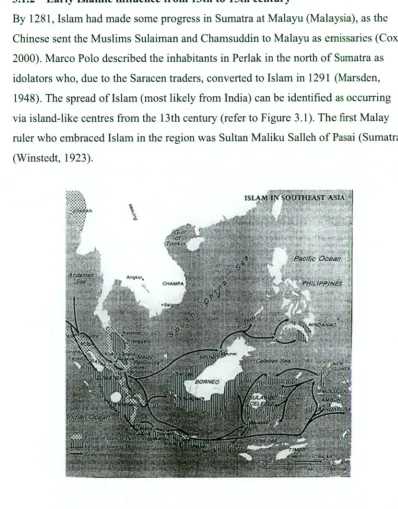
The most sweeping religious change affecting the Malay Peninsula was the transition from Hinduism to Islam in the 15th century. Malaysia has a big history of foreign colonisation. The Malay Peninsula, in particular Malacca, was the major trading centre of Chinese naval trading missions and the staging post for Chinese overseas explorations until 1421, when China changed its policy towards the extension of overseas influence and trading (Johnston, 2003). Portuguese colonial influence began in 1511, followed by Dutch colonisation in 1641. The British presence in South East Asia dates back to the 17th century. In 1786 the British began trading as the British East India Company, based in Penang. They set up the Straits Settlement colonies of Penang, Malacca and Singapore after 1826. In 1914, the British colonial
administration extended their territory to the whole of the Malay Peninsula (refer to Figures 1.1 and 1.2). Later trading activities led to the migration of labourers from China and India. Malaysia received independence from the British in 1957. In 1965, Singapore separated from the Federation of Malaysian states (Crean, 1996). The history of Malaysia is discussed further in Chapter 3, Part A.
1.4 An overview of the history of school education in Malaysia
The current education system in Malaysia was standardised by the administration in the 1950s, when Abdul Razak bin Hussein, (the head of the Education Committee in
1956), realised that the segregation of education during the British administration had divided West Malaysian society. In order for nationals of diverse ethnic origins to live in peace and harmony, the government wanted to create a common aim in education. The new educational policy became a part of the preparation for national independence in 1957 (Andaya and Leonard, 1982). However, the main features of
Chapter 1 Introduction
[image:24.564.113.465.136.348.2]attainment targets, including the incorporation of environmental education (Singham,
2003).
[image:24.564.116.457.396.651.2]Figure 1.1: Map showing the location of Malaysia (Hew, 1990, p.125)
Chapter 1 Introduction
1.5 Primary education
The National Primary education in Malaysia uses Malay as the language of instruction and covers the six years from Primary one to six. It aims to provide a good foundation for pupils in reading, writing and arithmetic. At the end of the six years, students sit for the 'Primary School Assessment Test' (PSAT) or Ujian Pendidikan Sekolah Rendah (UPSR), before entering secondary school. Irrespective of their performance in the PSAT, all primary school pupils are promoted to Form one, the foundation year of secondary education. Secondary education is a direct continuation of primary level education, but is ethnically segregated. The schools are divided into four types: National Primary School, Chinese National Primary School, Tamil National Primary School, Arabic National Primary Type School (Syed Zin, 2002).
1.6 Private education
In Malaysia, the establishment of private schools is governed mainly by the Education Act (1961). Private Education in Malaysia consists of the following categories: Pre-School Education, Private Primary Education, Regular Private Primary Educational Institutions, Chinese Private Primary Educational Institutions, Expatriate Private Primary Educational Institutions and International Schools. The current primary school grounds, which are usually quite generous in private schools, are used for an environment-related curriculum as well as to teach a range of formal curriculum subjects such as Physical Education, Language subjects (for example, English and Languages other than English) Mathematics, Science, Technology and Design, Information Technology, Geography, History, Religious Education, Drama, Art and Music based lessons (Syed Zin, 2002).
1.7 The government policy on education
Chapter 1 Introduction
the changing needs of the country. Among these changes are: the adaptation of the Primary School Curriculum Integration or Kurikulum Bersepadu Sekolah Rendah
(KBSR), `3Rs'- Reading, Writing and Arithmetic, and the creation of
both
the 'Smart School' and the 'Visionary School'. This policy stresses: citizenship, national unity and moral development, living skills (manipulative skills, entrepreneurship and family life education), languages (communicative skills) and information technology. The Malaysian Education Policy gives complete authority to the Ministry ofEducation for the development of the National Education Policy, based
on
the 'National Ideology', which is commonly referred to as the Rukunegaraand
adheres to Malaysia's aspirations of unity and development (Singham, 2003).However, the practice of the education system contradicts the objectives
of
Rukunegara, as it maintains separate cultural groups. Although, children at primary school, are taught in Bahasa Malaysia they speak their ethnic language at home, as well as learning their ethnic language as a subject at school. Furthermore,
in
Malaysia as outlined above, there are several types of primary and secondaryschools, which are divided according to the ethnic languages of the
pupils.
All follow the National Curriculum and use the Malay Language prior to promotionto
Secondary One, with Bahasa Malaysia as the medium of instruction. However, the Chinese or Tamil school students are required to spend a 'transition year' to enable them to adapt to the National Curriculum effectively (Singham, 2003).
1.8 Current primary education curriculum in Malaysia
The Kurikulum Baru Sekolah Rendah (KBSR) or the New Primary Schools Curriculum (the prototype primary school syllabus of government funded schools approved by the Ministry of Education in Malaysia) includes nine subjects from Primary one to Primary six, involving children from the age of seven to twelve. The compulsory subjects are: Languages, including Malay (the National language), English (as a second language) and other mother tongue languages, such
as
Chinese and Indian (including various dialects such as Cantonese, Hakka,Mandarin,
Chapter 1 Introduction
1.8.1 The current education curriculum and the physical environment Both the existing older school designs and the current primary school designs are largely based on English standard school design models of earlier eras. The functional planning of the more modern Malaysian schools (because of the British colonial influenced) still adheres to a model now outdated in the Western world. This teaching and learning model is highly structured and rigid. Additionally, the
European origin of the architectural design of schools to suit a cool climate has created an inflexible physical environment in most Malaysian government primary schools. The building complexes usually demonstrate little regard for the tempering effects of shade and natural ventilation on climate, which is required in hot and humid tropical climates and successfully employed in most traditional Malay buildings. Thus tree planting is usually limited and unrelated to the buildings (Wan, 2000). Similarly, school buildings usually have very little connection to the
surrounding landscape. For example, apart from sports fields the school site is usually paved with heat absorbing hard material (refer to Appendix A).
The current Malaysian school type has not been developed to mitigate the adverse effects of hot and humid tropical climates, but has evolved from European school design, modified by pragmatic and quasi-functional reasons. Nor is the current school design model related to historic Islamic schools with their shaded courtyards and open-fronted classrooms, opening onto the colonnaded courtyard perimeter (Hattstein and Delius, 2000).
1.9 Research design
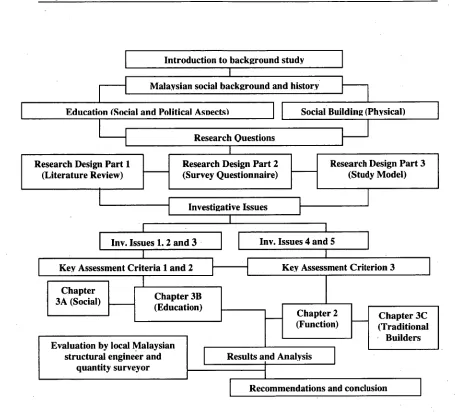
The research is multifaceted, considering architectural and educational aspects of primary school education in Malaysia, which demands a dual design approach to fit the research context.
1.9.1 The Research context
Chapter 1 Introduction
• Malaysian primary school design is based on the English school model, which is better suited to cold weather conditions and based on the Western monastic model.
• It will be demonstrated that schools based on Eastern design models such as the madrasa, incorporate elements such as external landscaping, open classrooms and vernacular traditions, which provide more productive and comfortable environments than the European school model in hot and humid tropical climates.
• Due to recent changes in educational policy in Malaysia, the construction and refurbishment of primary schools must be as cost-effective as possible, without impacting negatively on the health and comfort of students and teachers.
1.9.2 Research hypothesis
Increased use of outdoor teaching and learning spaces may contribute to improved school environments in the hot and humid tropical climate context of Malaysia.
1.9.3 Research aim's
• To develop a series of Key Assessment Criteria, by which the appropriate design of Malaysian primary schools can be assessed.
• To develop a series of appropriate models on which to base the design of future Malaysian primary schools.
1.9.4 Research objectives
1. To undertake a literature review to provide background information in the following key research areas:
• History and form of traditional English school models (Chapter 2). • History of Malaysian demography (Chapter 3, Part A).
• History of non-European schools in Malaysia and in Oriental, Eastern and Western countries (Chapter 3, Part B).
in-Chapter 1 Introduction
4. Propose a design model and test it against the Key Assessment Criteria derived from the data from the research questions.
5. Seek feedback from a Malaysian structural engineer and a quantity surveyor. 6. Modify the model following feedback.
7. Make recommendations for implementations of each aspect of the model in response to the research questions and the Key Assessment Criteria.
1.9.5 Key Assessment Criteria
The Key Assessment Criteria developed as an outcome of this research may form the basis for future research.
1.9.6 Research questions
The research revolved around the need to develop a more appropriate primary school model that considers Malaysian climatic conditions and Environmentally Sustainable Design (ESD) principles. This involved using external landscaping following the principles of existing non-European models (such as the madrasa), which offer cost-effective benefits to users (students and teachers), optimising health and comfort and improving learning outcomes.
The proposed improved physical environment should produce substantial financial savings compared to the current standard school building practice. The financial resources thus saved could be used to fund major improvements in the landscaping of school grounds. The improved, high quality school landscapes would both improve the human comfort conditions of the classroom structures and provide the conditions and environment for pupils to experience aesthetically rich and
ecologically positive educational surroundings. The specific research questions investigated are:
Research question 1: What is the nature of current teaching and learning spaces in government funded primary schools in Malaysia?
Chapter 1 Introduction
1.9.7 Research method
The research seeks to develop an understanding of the background to the need for change in the Malaysian primary school system and to develop appropriate ideas and proposals to meet the perceived need for improvements to the standard Malaysian school environment. To clarify these points, an overview of the history and origins of the Malaysian education system is given, with reference to the dual influences of European and Koranic schools.
The literature review is then extended, to include an overview of the history of school architecture, including English and Koranic schools and their architecture, which have formed the basis of Malaysian school contemporary education. Theories in relation to outdoor education are investigated with reference to the present
Malaysian school curriculum design, to determine their possible relevance to environmental education. A variety of hypothetical school models are developed to assess their perceived climatic, aesthetic and economic benefits, when compared to the fully enclosed standardised classroom buildings used at present.
The methods used in this research provide information which can be used to suggest improvements in design in primary school in Malaysia, as described below.
1.9.8 Research parameters
Malaysian primary schools have been selected as the focus of this research, because it.seems practical to start at the earliest stage of compulsory education provided by the government of Malaysia. The research is based on initially my personal
Chapter 1 Introduction
1.9.9 Investigative Issues
The Investigative Issues include an overview of ways in which Malaysian education incorporates and uses outdoor space. This information is interpreted against a background of the historic origins of and influences on the present Malaysian educational system and significant historic examples of outdoor teaching and learning both in Islamic and European educational history. This information is used to develop an external classroom space model for use in the Malaysian education system. A comparison is made between how architectural models incorporate outdoor spaces and the performance of traditional schools in Malaysia. This leads to the proposal for a new school model incorporating outdoor teaching and learning spaces which is applicable to standard Malaysian school sites.
Finally, stakeholder views are sought to ascertain current educational thinking and its relationship to teaching, learning and the natural environment. The data gathered are used to propose a design for improved outdoor classrooms spaces, which can be integrated into the physical environment of standard primary schools sites in Malaysia.
1.9.10 Thesis structure•
Chapter 1 includes background research on the current state of Malaysian primary school design and gives an overview of education issues in the Malaysian context. This chapter also includes an overview of the research hypothesis, the research questions, the research aims, the research objectives, the research methods, the investigative issues and the parameters of the research.
Chapter 2 provides the research background, describing the context of the history and form of traditional English models, which have influenced Malaysian school architecture.
Chapter 3 includes a literature review of:
• The historical background of current Malaysian demography (Part A). • The history of schools in Malaysia and in Oriental, Eastern and Western
countries (Part B).
Chapter 1 Introduction
In the context of Malaysia's demographic heritage from pre-colonial, colonial and post-colonial periods, this section demonstrates the importance of Islamic beliefs to Malaysian educational philosophy. The description is based on official policy documents. The influence of recent Western pedagogies on education in Malaysia is described.
Part C shows how human comfort is catered for by school architecture in Malaysia at present. It presents a persuasive argument for the enhancement of learning, teaching and play through expanded use of outdoor spaces, which also incorporates the traditional links between people and their natural environments.
Chapter 4 describes the research method in three parts. First, a literature review of the multifaceted connections between education and architecture is undertaken. This led to the development of a questionnaire for stakeholder focus groups and an in-depth interview for educational stakeholders. This is conducted using model images as guided pictures (derived from the literature review) as an indicator of the intended outdoor teaching, learning and playing spaces. The questionnaire, focus group and in-depth group interviews are conducted for the purpose of validating the proposed • architectural Study Model.
A primary school design model is developed from the questionnaire data and the literature review. This model is based on a comparison of present day Malaysian primary school buildings spaces with the British A.i Metric Standards (Fairwater and Sliwa, 1972), the European Standards (Neufert, 1980) and the Australian Commonwealth Standards (Bower, 2003) for primary school spaces_ The model was developed to show how the use of the outdoor environment could be incorporated, with the aim of improving human comfort during teaching, learning and play, on a hypothetical site in a Malaysian primary school, without mechanical cooling and with direct connection to the surrounding landscape. Finally, local professionals (a Malaysian structural engineer and a quantity surveyors) evaluate the models.
Chapter 1 Introduction
Criteria. The Key Assessment Criteria are based on the findings of the background research on the current state of Malaysian primary school design.
Chapter 5 discusses the findings of the questionnaire, in terms of the research
questions and the Key Assessment Criteria. It describes the results of the quantitative and qualitative data gathering and provides a preliminary analysis of the data.
Chapter 6 proposes a model for primary schools in Malaysia and again tests each component against the research questions and the Key Assessment Criteria. The model is used to seek feedback from a Malaysian structural engineer and quantity surveyors. Later, the model is modified as a formalised model.
Chapter 2 School Spaces and their Evolution in the Malaysian Context Literature Review Part A
CHAPTER 2: SCHOOL SPACES AND THEIR
EVOLUTION IN THE MALAYSIAN CONTEXT
2.1 Introduction
Until recently, educational ideas and practices in the Western world were based on classroom teaching developments that had been in use since the Middle Ages. These have persisted in Malaysian education and school architecture. However, during the early 20th century, new ideas were developing in education in Western countries.
As British schools have had the most enduring influence on the present Malaysian school environment, it is important to identify the origins of the philosophy of education, organisation and architectural forms of these schools. Accordingly, a brief overview of the history of Western education and its physical environment is given in this chapter, as this contributed significantly to the shape of British education and in turn, Malaysian education since colonisation by the British in the 17th century. Although the British influence on Malaysia's schools and their architecture has been strong, it is important to note that Malaysia has a rich
and
diverse cultural heritage from which to draw, including educational philosophy and building design. In particular, as a predominantly Muslim country, there is a rich tradition of Muslim thought and architecture, which this research argues, has been neglected during colonial and post-colonial times. However, the Muslim cultural heritage contains elements that are very much in agreement with modem Western pedagogical thinking and Environmentally Sustainable Design (ESD) concepts. Therefore, this chapter presents both an overview of the history of pre-British colonial schools in Malaysia and the history and theoretical backgroundof
traditional Malay Islamic schools.• Chapter 2 School Spaces and their Evolution in the Malaysian Context Literature Review Part A A discussion of the development of Islamic architecture, in particular the
development of the madrasa (in conjunction with the mosque), is given, in order to show the influences on traditional Malay Islamic schools, in comparison with Islamic architecture elsewhere. It is postulated that this discussion may provide relevant cultural perspectives on teaching and architecture, to inform possible future
culturally sensitive school design solutions for Malaysian schools and to support the validity of the use of outdoor classrooms in the Malaysian cultural context.
2.2 Classical to mediaeval period
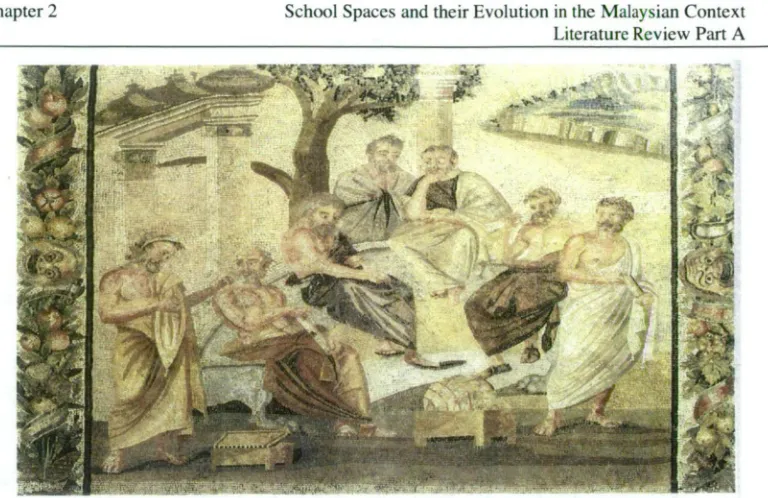
The extant literature concerning the development of the Western school contains numerous references to open-air education in the past. For example: Diogenes (from 341 BC to 270 BC) (in de Botton, 2004) and the Epicureans (from 306 BC to 270 BC) conducted classes in a natural setting. Although little physical evidence remains of pre-mediaeval schools, Greek and Roman classical writings mentioned
Chapter 2 School Spaces and their Evolution in the Malaysian Context Literature Review Part A
Figure 2.1: An imaginary mosaic illustration of 'The Academy' (Richardson, 2000, p.364)
During the same period in Europe, the mediaeval Christian garden emphasised "geometry and containment" and the "taming of the wilderness" (van Zuylen, 1995, p.38) as did monastic education. Education in the monasteries was ascetic and inward looking and most educated persons were clerics who gained their education within the confined, protective and restrictive walls of the monastery. Early Christian teaching gave little regard to the untamed natural world and to earthly life, as
rewards were obtained in the "afterlife" only (p.38). Although gardens and scientific study were important elements of monastic education, earthly life and the physical world were considered a distraction from pious thinking and monastic life.
Chapter 2 School Spaces and their Evolution in the Malaysian Context Literature Review Part A 2.3 The change of teaching spaces from indoor to outdoor
After the fall of the Roman Empire in the late 5th century, political unrest in Europe led to the restriction of teaching to the monasteries. The natural world represented in the gardens of the European monastery (and the Muslim equivalent the madrasa,
similarly situated in the mosque complex) was used as a source of contemplation and scientific study. The garden was also used as a tool of research and teaching, as van Zuylen (1995,) points out,
...during the Middle Ages, monasteries played a pivotal role in preserving the arts and sciences, including kitchen and physic-or medicinal-gardening skills. Their libraries were repositories of classical garden literature (p..33).
The later botanic gardens of the Renaissance were inspired by Mediaeval physic gardens which according to van Zuylen (1995) were
...rooted in Islamic learning [and] founded by Arab physicians from Spain. For example, the renowned medical school at Montpellier had a physic garden around 1250. (p.37)
Gardens in the Islamic tradition first appeared in Europe in the 8th century, when the Arabs conquered large areas of Spain. The Muslims preserved the ancient Greek botanical texts and translated them from 830 BC onwards. However, Christians and Muslims saw nature from somewhat different perspectives: monastic schools and gardens in the Judaeo-Christian tradition were generally seen as "morally edited space, as in the garden of Eden" (Richardson, 2000, p.234).
According to van Zuylen (1995),
Monks cultivated subsistence gardens with their own hands and by the sweat of their own brows. Their genuine feeling for nature was nurtured by their traditional belief in the biblical Garden of Eden. Tending these earthly equivalents of paradise lost — and promised — provided food for the soul as well as the body (p.33).
Chapter 2 School Spaces and their Evolution in the Malaysian Context Literature Review Part A
The Arabs were early exponents of environmentally sensitive design, channelling water to modify their courtyard sanctuaries, to create comfortable surroundings in which to make their religious ablutions, contemplate and study. This was
exemplified in the 11th century Madrasa Al-Firdaus ,which:
... combines a legal school as well as mausoleums and monastery in one complex. The courtyard measures approximately 55x45 metres, with a triple domed mosque flanked by two mausoleums on its southern side. The halls along the eastern and western sides were probably used for teaching and meetings. Passages lead through past the iwan (water channel) on the northern side to separate residential wings. There was originally a garden in the north of the madrasa with a second iwan opening off it...the rectangular courtyard of this elegant complex is flanked on three sides by arcades ... a wide iwan opens out off the northern side of the courtyard. The octagonal pool with cloverleaf inner walls in the middle of the courtyard is typical (Hattstein and Delius, 2000, p.179).
[image:38.562.72.488.116.799.2]2.4 Islamic architecture and the development of the madrasa
Figure 2.2: (Right) The Madrasa al-Firdaus in Aleppo and the Courtyard (Left)
Chapter 2 School Spaces and their Evolution in the Malaysian Context Literature Review Part A prototype for future Islamic school architecture. For example, the Al-Agami family in the city founded three schools:
Parts of their palace have survived, including a courtyard with an octagonal fountain surrounded by four iwans. Ghazi's wife ... was responsible for the most famous legal school in Aleppo, the Madrasa al-Firdaus (School of Paradise). This madrasa, which was used simultaneously as a mosque, mausoleum and Sufi monastery, is laid out around a courtyard with an octagonal fountain flanked on three sides by arcades. On the northern sides there is a wide iwan, behind which the living quarters of the students are locate.., there was originally a garden in the north of the madrasa with a second iwan opening of it (Hattstein and Delius, 2000, p.178-179).
During the 13th, the Merinids, (who conquered present day Morocco and established a dynasty), founded numerous madrasa, including the Misbahiya built near the Qarawiyin mosque in 1346. This madrasa "was used as a hostel by the students of the University of Fez until the mid 20th century and is still in use today" (Hattstein and Delius, 2000, p.312). The design of the madrasa reflected the political system of the time. During the Seljuk period in Turkey the madrasa was an important tool in the reorganisation of the political system which was molded to fit the government's religious policy. During the 15th century, Nizam (the emperor of Seljuk and one of the political architects of early Islam) developed a political state based on sunna law. The instruments of this form of political control were the madrasa, which were not simply Koranic schools, but universities for the future juristic and administrative elites, and to this end they tied religion and state together from day one. These madrasa "provided the model for all later madrasa" (p.350).
Theology, jurisprudence, languages, literature, the natural sciences and political science were all taught in the madrasa. This was a major change in Islamic
education, as previously the most important place of learning was the mosque or the Koranic school. The power of the madrasa, was further reinforced by students' dependence on government funding as:
Chapter 2 School Spaces and their Evolution in the Malaysian Context Literature Review Part A
According to Hattstein and Delius the Central Asian type of madrasa came into being at the beginning of the 15th century and as several of these madrasa survived, it is still possible to observe the design, which influenced later madrasa in Malaysia and elsewhere:
The three oldest surviving madrasas in Central Asia date back to this period... These madrasas were theological colleges in which the material sciences, including mathematics and astronomy ..., were also taught. All three of the Ulugh Beg Madrasas in Bukhara (1418), Samarciand (1417 to 1420), and Gishduwan (1437) were built using the same schema, for the arrangement of space seen in the Bu Inaniya
madrasa (Hattstein and Delius, 2000, p.518).
The following quotation was found inscribed on the carved door of the Bukhara
madrasa and (according to legend) referred to a ruling by Ulugh Beg "To strive for knowledge is the duty of each and every Muslim man and woman" (Hattstein and Delius, 2000, p.518). This inscription reflects the importance placed on education in Islamic societies such as Malaysia, as discussed further in Chapter 3, Section B: Present Malaysian educational ideas.
2.4.1 Madrasa in present day Malaysia
The design of the traditional madrasa is used in mosques and universities in present day Malaysia, but not in primary or high schools as government schools have preferred the 19th century British model. It seems to be self-evident that many traditional elements of the madrasa could be adapted for use in government schools without the religious connotations. For example, the building approach could include and s,culturally climatically appropriate design interventions, such as: the
development of the 'halaqah' which refers to group study sitting in a circle and also reflects the Islamic practice of circling laabah' in Mecca; use of the Iciblat' or point of prayers for all Muslims, to provide a focus of activity within the school;
sensitivity regarding the design of toilets not to face the liblat ' point; use of local building materials following local tropical architecture forms of buildings and roof designs. Also spaces should be flexible to allow for gathering during Malay Muslim festivals, to permit communal activities. Examples of these culturally specific design interventions can be found the International Islamic University Malaysia (Zen,
Chapter 2 School Spaces and their Evolution in the Malaysian Context Literature Review Part A comfort in the tropical, hot and humid climate of Malaysia, as vernacular
architecture has for many centuries in other hot Islamic countries (Afshar, 1970, pp.29-44) (refer to Appendix B, Figure B1).
2.5 The development of the English school
The oldest surviving mediaeval schools in England, such as Winchester College built in 1382 and Eton, built in 1440, clearly show the influence of monastic architecture and planning on the newly emerging colleges of the 14th and 15th centuries
(Cookson, 2004). According to Seaborne (1971 p.2) "these colleges with their tightly-organised structure, reflected a reaction against the often ill-disciplined and undifferentiated character of earlier schooling".
Remaining evidence of the large schoolrooms shows a highly organised layout with fixed benches (Seaborne, 1971). After the dissolution of the monasteries by Henry VIII, former monastic buildings were converted to school use:, for example at Canterbury, Chester and Gloucester. Schools in England remained strongly disciplinarian and it is interesting to note that almost all school seals from the 16th century to the 18th century show the teacher or headmaster holding a birch rod (refer to Appendix B, Figure B2, Seaborne, 1971).
School building design began to diverge from its monastic origins from the 16th century onwards. However, the spatial and hierarchical influence of the monastery can still be traced in these buildings up to the 18th century (Keyes, 2003).
Flogging and other forms of punishment remained universal in the school system and caused major rebellions at the end of the 18th century at Eton (Seaborne, 1971). attitude towards punishment is echoed in the saying, 'spare the rod and spoil the child' and is reflected in Malay Islamic education by the phrase, `sayang anak ditangan-tangankan', 'pity the child who is never struck.
Chapter 2 School Spaces and their Evolution in the Malaysian Context Literature Review Part A simpler, often built with a Georgian façade and planned with a large schoolroom and a master's house attached, which included accommodation for boarders (refer to Appendix B, Figure B3, Seaborne, 1971).
Towards the end of the 18th century, (the age of Enlightenment) the original and restricted Classics-based grammar school curriculum began to change and many schools introduced science, geography and mathematics into their curriculum (Seaborne, 1971).
The emergence of the smaller non-conformist religious schools helped to change both the curriculum and the architectural language and planning of the new schools. The Kingswood school, founded near Bristol in 1786 by John Wesley, is an example of this. The curriculum included reading, writing, arithmetic, English, French, Latin, Greek, Hebrew, history, geography, chronology, rhetoric, logic, ethics, geometry, algebra, physics and music (Seaborne, 1971). Gardening was encouraged and individual small garden plots were provided in the grounds (refer to Appendix B, Figure B4).
. sow max urns. 11111111 On If IN magi 011111111ra,
01811111WIllaiini MUNI
wilt
.Amit
[image:43.566.81.485.43.778.2]Chapter 2 School Spaces and their Evolution in the Malaysian Context Literature Review Part A
Figure 2.3: Woodlands Comprehensive School, Coventry, 1956 (Seaborne and Lowe, 1977)
Chapter 2 School Spaces and their Evolution in the Malaysian Context Literature Review Part A In the early 1800s, Joseph Lancaster's 'model' schools entered the British
educational scene. The Lancastrian model plan advocated enormous schoolrooms of (21.3 x 9.8 metres) containing twenty rows of desks for 320 pupils, facing the master's platform (0.65 square metres space for each pupil). The level of the floor was to be raised slightly towards the back (refer to Figures 2.5 to 2.6). Lancaster's model also recommended ducted warm air heating (Seaborne, 1971).
Architect Andrew Bell developed a similar but slightly less rigid system of classrooms for primary school education called 'the Madras school' in Madras, India. The 'Madras school' was an inheritance from the British colonial era
influenced by the ideas of Joseph Lancaster. Although school architecture in England changed during and following the 1960s, pedagogy and classroom design in
Malaysia has remained frozen as it was at the end of the colonial period (Stanfield, 2004).
I
t 1 I J
1
SC H 00 I. SCHOO L
(e)
30 feet
pstmes
cs?
.9 metres
Chapter 2 School Spaces and their Evolution in the Malaysian Context Literature Review Part A
(a)
I
Ei
If
r
SCHOOL
11111
■
196.1111
=11
[image:45.565.75.493.64.585.2](b)
Figure 2.5: Examples of other types of classrooms design issued by the English Committee of the Council on Education: a) Plan for 112 children; b) Plan for 116 children; and c) Plan for 120
Chapter 2 School Spaces and their Evolution in the Malaysian Context Literature Review Part A
Figure 2.6: Central School of the National Society, Baldwin's Gardens, London, 19th century, an example of Dr. Andrew Bell's Madras School, applied in Penang Free School, 1816, Malaysia
(Seaborne, 1971) 2.6 Open-air learning experiments in England
Chapter 2 School Spaces and their Evolution in the Malaysian Context Literature Review Part A
Figure 2.7: Pelham's open-air school during the rest period in summer (1909) (Seaborne and Lowe, 1977)
Chapter 2 School Spaces and their Evolution in the Malaysian Context Literature Review Part A
The interior design of Malay schools during the British colonial period (from the early 19th century to 1957), was based on the attitudes to education implicit in the design of cloistered monasteries. Obedience and fear towards teachers was
inculcated by flogging and corporal punishment, as the main forms of discipline. This was continued in the 'Lancastrian monitoring system' where learning and• teaching were mainly based on rote-learning (memorising) and older students were selected to teach younger ones. Classroom space remained square, with students standing or (later on) sitting in rows, which produced a sterile regimented response to learning (Seaborne, 1971). This changed little until new subjects were introduced to the curriculum and more emphasis was placed on new exploratory teaching and learning methods.
As buildings were designed with increased student capacity, with a limited number of teachers, they began to change and expand. During the 20th century, teaching became somewhat more relaxed in comparison with the Lancastrian system.
2.7 Conclusion
Historically there have been examples of successful schools incorporating outdoor teaching spaces, such as Plato's Academy, the Epicurean schools, DiOgenes schools, early monastic schools and Islamic Koranic schools or madrasa, all of which used the environment as a stimulating teaching space and learning resource. The
Chapter 2 School Spaces and their Evolution in the Malaysian Context Literature Review Part A Malaysia is a predominantly Muslim country and therefore it is significant to the Malaysian context that traditional Islamic teaching from the time of the Prophet incorporated outdoor space in building design (similar to the early Greek and mediaeval monastic schools in Europe).
The narrow interpretation of education, which had developed in Britain by the 17th century, disregarded the importance of the impact of outdoor elements to earlier approaches to education. Additionally, because of the impact of British colonisation, the pedagogy and architecture of government funded primary schools in Malaysia did not evolve in its own context„ but still follows the regimented early British colonial plan.
The 'Madras school', was an inheritance from the British colonial era, designed by architect Andrew Bell and influenced by the ideas of Joseph Lancaster. Although school architecture in England changed during the 1960s and in the following period, pedagogy in Malaysia did not develop further. However, there have been minor changes in Malaysian school architecture. For example, one difference between the English contemporary school and the typical Malaysian school is the increased use of open corridors and an open ground floor, to accommodate airflow in the tropical climate (refer to Figure 2.4). Although the 1911 open-air pavilion type school in Sheffield (designed for the use of underprivileged children during the summer holidays), is suitable for the Malaysian climate as it allows cross ventilation, it was not adopted in Malaysia (refer to Figures 2.7 to 2.8).
Chapter 2 School Spaces and their Evolution in the Malaysian Context Literature Review Part A