Engineering
Coexistenc
e
Commentary from Elm Farm Organic Research Centreon the Government’s proposals to allow GM crops to be grown alongside organic and conventional farming in England.
Engineering Coexistence
-an edifice built on flawed foundations
In July 2006, the Department for Environment, Food and Rural Affairs (Defra) published its proposals for arrangements that will allow the growing of genetically modified (GM) crops alongside organic and conventional (but non-GM) crops in England.These were contained in a consultation document – “Consultation on proposals for managing the coexistence of GM, conventional and organic crops”- for which responses are sought by the 20th October 2006.
Although these proposals deal only with oil seed rape, maize, beet and potato they provide the basis and framework that will be applied to all crops in the future. To date, Defra appears to have responded only to the views of the Supply Chain Initiative on Modified Agricultural Crops (SCIMAC) – the industry body representing the National Farmers Union, British Society of Plant Breeders, Crop Protection Association, Agricultural Industries Confederation and the British Sugar Beet Seed Producers Association – who could probably claim to be co-authors of this consultation document.
In fact, “consultation” is one of a number of words that Defra seems to redefine or at least modify whenever genetic engineering is the issue, others such as “adventitious”, “unavoidable” and “threshold”, come up later. Elm Farm Organic Research Centre is only one of a number of organic organisations to have discussed coexistence with Defra officials and to have been resolutely ignored by them. It seems the only reason they engaged in discussions at all was to become equipped to refute our views in their “consultation” document. They certainly have not adopted any of them, as the proposals are virtually identical to the ones they – and SCIMAC – first proposed several years ago.
In our opinion, if these proposals are implemented they will form the basis for all GM cropping in the UK; and whilst the risks of widespread contamination posed by beet, maize and potatoes might not be great, those presented by oil seed rape and the ubiquitous cereals and grasses are huge. These proposals are just not robust enough; they give the industry a license to pollute; and they will force all of us to live in a country with a background level of GM contamination. Which raises the question; if Defra is so prejudiced, is it worth responding to the consultation document? Yes – even though they have ignored public opinion expressed in the GM Nation
debate; even though they have ignored the Cabinet Office study that showed there was no case for the commercialisation of GM cropping in this country; even though they have dismissed the more robust coexistence regulations introduced by other countries. It is necessary to respond because; a) there is unlikely to be any other chance to register dissent; b) there is a new Minister and team in place and it might be that they are less prejudicial than the GM industry focused Defra officials; and c) even if they are not, they just might have enough political sense not to press ahead with proposals that are unpopular – not to mention undemocratic and probably unworkable.
We have called this paper “Engineering Coexistence – an edifice built on flawed foundations” because it reflects the nature of the proposals and how they have been developed. Coexistence implies co-operation and working together but this has not been the approach to drawing up the proposals which has been top-down design and manipulation.
The proposals are based on a deceitful use of the term ”adventitious and technically unavoidable” which so perverts its real meaning – accidental and something that cannot be avoided – that it becomes meaningless. In doing so it allows the possibility of routine contamination of non-GM and organic crops up to a level of 0.9% in the product sold to the final consumer; a level which will inevitably be swamped as more GM crops and acreages are planted: not least because of a proposal of breathtaking deceit which will allow unlabelled and undeclared GM contamination of up to 0.5% in seed crops.
We are particularly disappointed with the proposals because, whilst our primary concern is to protect the organic sector and organic farmers, we were willing to give Defra the benefit of the doubt that it could develop a fair and reasonable coexistence regime. But they have not even tried; they have attempted to build an edifice to hide the fact that they really do not care if GM contamination becomes routine and widespread; and that they have no regard for farmers, gardeners or the public who do not want this.
There is still a chance though; this is still a consultation period and if enough people make their views known then maybe wiser councils will emerge in Defra and throw out these proposals.
Lawrence WoodwardO.B.E.
Setting the scene
The time has come for countries throughout Europe to set down just how they propose to regulate the arrival and spread of genetically modified (GM) crop technology along side established farming systems, including organic production.In fact, a number of countries, those who seem to be more cautious than the UK, have already done so. It is a complex area of policy which has the simple aim of minimising the inevitable contamination – “pollution” - that GM crops will cause.
EU Directive 2001/18/EC calls for member states to take appropriate national measures on coexistence (“living side by side in mutual toleration”) in order to avoid unintended presence of Genetically Modified Organisms (GMOs) in other products. This has resulted in a consultation from the Department for Environment, Food and Rural Affairs (Defra) on the issue in England (Scotland, Wales and Northern Ireland will hold their own consultations soon). The Government's current proposals for coexistence between GM, conventional and organic crops in England will allow routine GM contamination – ”pollution” – of our food, crops and the countryside.
The consultation document – “Consultation on proposals for managing the coexistence of GM, conventional and organic crops”- is available electronically or hard copy from:
Department for Environment, Food and Rural Affairs Nobel House, 17 Smith Square, London SW1P 3JR
Telephone 020 7238 6000 Website: www.defra.gov.uk
Responses are sought by the 20th October 2006 and we urge all readers to respond.
This paper has been produced to assist in that process. We are not here attempting a line by line analysis of the proposals but are seeking to draw attention to several key points and to let you know what we think of them. Our own detailed response to the consultation document will not be submitted until close to the final response date but we have posted our draft – as a work in progress – on our website
(www.organicresearchcentre.com and www.efrc.com) – should you wish to consult it.
To say we are disappointed by the proposals would be a profound understatement. To be blunt, we expected better from Defra. The whole process of drawing up the proposals, the proposals themselves and very probably the consultation has at its core a breathtaking degree of disingenuity.
For starters, although there is pretence otherwise, the basic premise of precaution that everything should be done to minimise cross contamination has been ignored. A co-operative rather than adversarial approach is the best way forward for coexistence. But co-operation assumes that there is give and take on both sides. The consultation document does not reflect much give from the GM industry. In places it reads suspiciously as though it has been written by the GM industry itself.
For the last eight years Government ministers have lined up to assure the organic sector that everything would be done to ensure that any introduction of GM crops did not compromise the viability of UK organic agriculture. This was Jeff Rooker, Minister of State, Ministry of Agriculture, Fisheries and Food in July 1998 -
“...our desire is to ensure that the introduction of GMOs on a trial basis, an experimental basis, or even a full-crop basis, in no way damages organic farming.”
“...it would be stupid for the Government to push more money into converting to organic farming while allowing the farmers who take that brave step to be damaged by other actions… “
And this was Ian Pearson MP, Defra Minister of State for Climate Change and Environment, speaking in June 2006 -“We are supporting the expansion of organic farming and want to ensure that the possible introduction of GM crops does not unreasonably prejudice the organic sector. “
But politicians have short memories. Despite such promises, as they stand now, the Government’s proposals for GM coexistence would seriously harm the production of organic and other crops and food.
The consultation says it specifically addresses those crops likely to be first commercialised in the UK (oil seed rape, maize, beet and potato). The regulatory approach suggested is not robust enough even for these crops and gives rise to additional and greater concerns of such a light touch being rolled out for all GM crops in this country. The recently reported incidences in the USA and Europe of contamination of rice and of the grass Agrostis stoloniferademonstrate the risks we are dealing with and they highlight the importance of introducing a comprehensive and robust coexistence regime, whatever the crop.
At the heart of the proposals it is the interpretation and application of the meaning of the word “adventitious” which causes greatest concern. Its use within the context of the consultation is disingenuous. A pure understanding of
adventitious and the standard dictionary definition of the word is “accidental”. Real accidents should not be factored into routine tolerances for contamination but this is what is being proposed. It is no accident that bureaucrats have chosen adventitious as le mot juste– with it they hope to avoid veering into areas of pollution or even contamination and certainly any examination of what is accidental and technically unavoidable. It is classic, sanitised Euro-speak.
Set against the background that both organic and
conventional non-GM farmers wish to sell their output without any GM contamination and wish to have farm fields and their surroundings that are not contaminated, the aim of coexistence protocols should be to keep contamination at the lowest detectable level or surrogate zero. Defra maintains that it is unrealistic and disproportionate to strive for zero
contamination. Why? The methods – such as adequate separation distances – that can generally achieve lowest detectable levels are known but Defra has dismissed them on the grounds that they are too onerous for the GM industry.
Instead they wrap up and hide the inevitable contamination within a threshold of 0.9% - a figure based on an EU political assessment that this is the highest figure that might be
acceptable to consumers - which they say is for “adventitious”, that is accidental and technically unavoidable contamination. But it is avoidable; they just do not want to bother to take the steps necessary to avoid it. There is enough smoke and mirrors here to cover a whole convention of illusionists. We believe that a threshold of 0.9% for adventitious presence in the final product should be set for labelling purposes. With the variability of sampling and testing for GM presence and the likelihood of increasing environmental GM pollution, such a threshold is necessary to provide a legal buffer for producers. However, it is crucial that this is not a target to be worked towards, but a threshold that is rarely approached. GM
production should aim for surrogate zero or the lowest detectable level of contamination with procedures and processes put in place to achieve this. Consequently it is critical that seed contamination levels are set minimally.
A proper calculation of separation distances for each crop type is crucial in achieving minimal levels of contamination. However, the proposed separation regime is inadequate and muddled.
In addition, the coexistence proposals ignore both the food chain beyond the farmgate where additional contamination is possible and indeed likely if GM crops become common and the non-commercial food chain that exists in allotments and domestic gardens. This is not acceptable – gardeners and allotment holders should enjoy the same protection from GM contamination as commercial farmers.
Coexistence terminology
Adventitious:
Accidental, additional, foreign, appearing casually, developed out of the usual order or place.
Coexistence:
The condition of living/existing side by side in mutual toleration.
Separation distance:
A legally defined distance that a GM crop can be grown from a non-GM crop of the same species.
Notification distance:
Distance from a proposed GM crop that the GM farmer has to notify their neighbours of this intent.
Surrogate zero:
Short hand for the lowest detectable level.
Lowest detectable level:
The creeping march of GM technology across the farming globe has now achieved such momentum that is debatable if it can ever be stopped. We have taken the view that, given the political context in Europe, attempts to use contamination levels as a political weapon could easily backfire to the detriment of organic producers who might be overburdened by a too onerous regulatory system.
We had hoped for a realistic debate about targets and thresholds but Defra’s approach has been as extreme as those it accuses of unreasonable opposition. The victim is the possibility of sensible coexistence measures.
The target levels of contamination in any GM coexistence regime are the keystones of an enduring system which prevent organic and conventional non-GM cropping from being swamped over time by GM neighbours. GM production should aim for a non-detectable level of contamination and
procedures and processes must be put in place to ensure this. However, a maximum envelope figure of 0.9% contamination for truly adventitious presence in the final product is required to protect producers. With the variability of sampling and testing for GM presence and the likelihood of increasing environmental GM pollution such a threshold is necessary to provide a legal buffer for producers.
Truly adventitious means just that – accidental contamination and not contamination achieved by lax separation, seed production or other procedures. Adventitious presence is not a standard production tolerance and such measures as crop separation distances must not be set at values which will routinely push at the threshold of 0.9% contamination.
Seed contamination is discussed in detail elsewhere in this paper but the proposed acceptance of seed contamination levels of between 0.3 and 0.5% would result in an extremely limited margin for error to meet a 0.9% level in the final product. Any contamination of seed must not be above the lowest detectable level so those products further up the chain have a chance of staying within limits.
The current proposals as presented by Defra choose to disregard any part of the food chain after the farm. In addition they work to a GM level of near to 0.9% at the farm gate not in the final product. This allows no margin for any additional presence once the product has left the farm. The level of 0.9% is intended to be, and should only ever be, seen as a labelling threshold for the product sold to the ultimate end user. It should not be a target for on-farm contamination.
Targets set at the outset of GM co-existence must take into account ratcheting up of GM contamination in both the supply chain and in the growing and wider natural environment.
The consultation document raises the question as to whether a separate threshold contamination level should be set for organic and conventional non-GM crops. This idea has been
widely discussed by organic organisations throughout Europe and at first glance seems attractive as it; a) could meet consumer wishes for organic produce which is unambiguously free of GM contamination; and b) offer scope for the
development of enhanced differentiation and added value to organic crops. However, in our view the extra costs and regulatory burden that organic producers would have to shoulder themselves offset these seeming advantages. We also believe that sampling and testing variability means that a threshold at the level some propose (0.1% or the lowest detectable level) would be iniquitous at best and probably unworkable. Moreover, in our view an effective regulatory and liability regime is more likely to be put in place if there is one unified system covering all non-GM producers operating a 0.9% threshold for genuinely adventitious and technically unavoidable contamination.
Organic producers are not allowed to use GMOs or their derivatives in their systems. Their customers therefore rightly expect that the final product will be free of GM residues. Any coexistence regime should respect this position and seek to ensure that avoidable contamination, from whatever source, does not enter the production chain. In the document Defra argues that the normal operation of the market will decide whether GM crops are successful or not. At present, as The British Retail Consortium reported in August 2006, the UK consumer is rejecting GM products. However, in some cases it is likely we will arrive at a position where the consumer has no choice. There is information from Brazil indicating that once the level of GM Soya cultivation in that country exceeds 20%, segregation of GM and non-GM will be uneconomic resulting in a solely GM production line. Not much scope for consumer choice there. There is also considerable pressure being put on those Brazilian ports, which are maintaining segregated GM free facilities, to handle GM Soya. This is clearly an area where the market is not being allowed to develop freely and raises real concern that this could be replicated over a range of commodities ensuring that the interests of GM companies, and not the consumer, win out.
The government clearly sees GM coexistence as a solely trade issue. The proposed regime excludes contamination of crops grown for own use e.g. fodder maize. It also dismisses the general public, as allotment holders and domestic gardeners are not covered by the proposed regulation. A GM farmer neighbour could grow GM crops on a garden or allotment boundary with no requirement to inform the
gardener. This is not acceptable. These growers and their crops should enjoy the same protection as all others. Many allotment and back garden growers produce their own food because they know what has been done to it and what is in it. They should not be denied that right.
The need of organic and other non-GM farmers to keep their seed “free” of contamination is perhaps the most crucial agronomic area in the whole coexistence debate. Allowing any contamination in seed – the very start of the production chain – is nonsensical and effectively destroys coexistence because it removes any chance of organic producers maintaining surrogate zero levels of GM contamination, as consumers wish, and significantly weakens the chances of keeping contamination – adventitious or not – below a 0.9% threshold in products.
Yet, incredibly Defra proposes to allow GM contamination of conventional and organic seeds up to 0.3% in rape and 0.5% in maize, sugar beet and potato without any labelling or notification of the contamination. It will open the way for similar thresholds for other seeds in the future. Such levels will lead to inevitable GM contamination of field crops and to the final product.
Work done by the EU Scientific Committee on Plants (SCP) shows that at those levels of seed contamination, allowing only 0.2% for cross pollination (none for sugar beet) and virtually nothing for other potential sources of contamination (such as plant volunteers, harvesting, transport and storage) GM threshold levels of 0.81% for oil seed rape, 0.77% for maize, and 0.67% for sugar beet are quickly reached. These levels are all perilously close to the 0.9% threshold – which is meant to be for accidental and unavoidable contamination anyway -even with very conservative estimates for the other potential contamination sources and allowing nothing for contamination further down the food chain.
There are a number of areas in the consultation document where Defra’s proposals do not adequately cover seed
contamination issues. It is claimed that because beet is biennial it is easily controlled thereby ignoring the real likelihood of beet cross pollinating with native species, hybridising and creating a reservoir of GM in the environment. This must be addressed in any detailed coexistence regime. Defra says it is ”desirable” for beet farmers to minimise cross pollination from bolters. This is a weak and ill-defined term,
it must be replaced with “essential” to minimise bolters. The likely transfer of seed by machinery is down played. The argument put forward is that it is disproportionate to expect a complete clean down between farms. The requirement would be to clean those parts of machinery that are readily accessible. This is not acceptable. It might be acceptable for a farmer to accept the risk of machines moving within their own farms. However, it is not acceptable for machinery that is moving between farms and likely to contaminate roadways and other farms once it has left the GM farm.
Clean seed
Separation distances
[image:6.595.31.282.348.462.2]Separation distances – i.e. the distance between a GM crop and a non-GM crop of the same species - are a critical component of any GM coexistence regime. One might expect a coexistence protocol to identify a separation distance that will afford the maximum protection from contamination for the non-GM crop. However, this is not the case in these proposals.
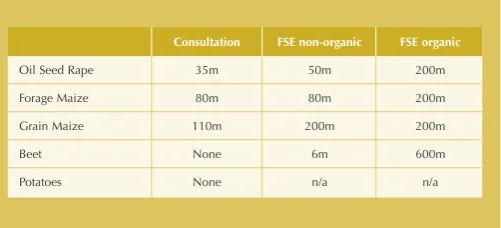
Table 1 The statutory separation distances proposed in the Defra consultation document along with those used in the recent Farm Scale Evaluation (FSE) trials for organic and non-organic crops.
As can be seen, in most cases the proposed statutory separation distances are significantly reduced from those used in the FSE trials. These distances are based on the work undertaken by the National Institute of Agricultural Botany (NIAB) which uses modelling data from the FSEs. The validity of the work itself is not in question but Defra has used it to select separation distances that will result in a contamination level of between 0.1 and 0.6%.
Other research has shown (Treu & Emberlin, 2000) that pollen from oil seed rape and maize can travel considerably greater distances than those used in the NIAB modelling and in some cases have shown high levels of GM present over hundreds of metres. The findings of these two reports are not necessarily contradictory. In fact there are data points (outliers and extreme events) in the NIAB data that would account for the events reported in the Treu & Emberlin (2000) review.
What both reports demonstrate is the uncertainty in this area and the impossibility of producing a definitive separation distance. The amount of unwanted GM presence in any crop will depend on a range of factors including the mode of travel of pollen (wind, insect etc), the size and shape of the field of the non-GM crop and the GM donor crop, topography of the area, weather conditions etc. Taking all these into account, the risk of an unwanted GM presence must be managed in such a way as to minimise it in most circumstances. The separation distances in these proposals do not adequately do that.
Oilseed Rape (winter and spring)
The NIAB research shows a rapid drop off of GM presence in non-GM oilseed rape as the distance increases from the GM source (see Fig. 1). After 30-40m the GM residue is approaching lowest detectable levels (with the occasional blip further out).
Further analysis of the data (taking into account the field depth and amount of GM material in the GM variety) shows that the separation distance of 35m, as proposed by Defra, would result in GM contamination of between 0.1-0.3%.
This is not acceptable because; a) it is avoidable if the separation distance was increased and is therefore not adventitious; and b) a level of 0.3% accounts for a third of the 0.9% labelling level therefore leaving a reduced margin for genuine accidental contamination further down the supply chain.
Separation distances should be set to achieve the lowest detectable level of contamination and in this case is easily manageable through a small increase in the separation distance (of 20m).
Therefore based on Defra’s own evidence a
separation distance of 55m – and not the proposed 35m - for winter and spring oil seed rape is manageable, reasonable and would protect non-GM farmers.
Consultation FSE non-organic FSE organic
Oil Seed Rape 35m 50m 200m
Forage Maize 80m 80m 200m
Grain Maize 110m 200m 200m
Beet None 6m 600m
Contamination Contamination Se p ar at io n D is ta n ce (m ) Se p ar at io n D is ta n ce (m ) 55 50 45 40 35 30 25 20 15 10 5 100 90 80 70 60 50 40 30 20 10
0.1% 1% 0.1% 1%
100 m 200 m 400 m 600 m 100 m 200 m 400 m 600 m Contamination Contamination Se p ar at io n D is ta n ce (m ) Se p ar at io n D is ta n ce (m ) 55 50 45 40 35 30 25 20 15 10 5 100 90 80 70 60 50 40 30 20 10
0.1% 1% 0.1% 1%
[image:7.595.44.285.243.663.2]100 m 200 m 400 m 600 m 100 m 200 m 400 m 600 m Figure 1 Graph of separation distances required to have 98%
confidence of meeting various thresholds of GM DNA/Genome in winter oil seed rape planted in fields of 100, 200, 400 or 600m depth (after NIAB 2006).
Maize
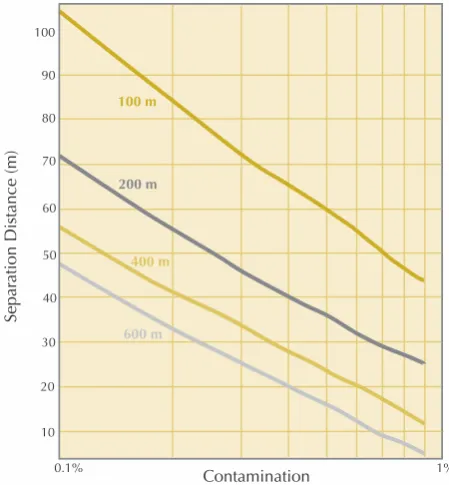
NIAB data shows that there is a more variable drop off in GM contamination in maize. Taking into account the field depth and amount of GM material in the GM variety it shows that the distance of 110m for grain maize, proposed by Defra, would result in contamination only at the lowest detectable level (Fig 2).
However, they propose a reduced separation distance for fodder maize of 90m. Due to the likelihood of confusion between crops, a single separation distance should be set for maize of 110m.
Potatoes and beet
The consultation document proposes no separation distances for potatoes and beet, which, at first glance, seems alarming.
However, due to the production systems for these crops it is probably reasonable as the seed element of potatoes are not utilised and beet should not be allowed to flower and set seed. The major issue for these crops is to do with ground keepers and volunteers in potatoes and bolters in beet.
It is for these reasons that a statutory backing for the code of best practice is essential – a voluntary scheme, as proposed, will not adequately ensure that any GM contamination is not transferred in this way.
[image:7.595.303.528.492.735.2]Seed production for both of these crops must have separation distances that achieve the lowest detectable level of GM presence.
Figure 2 Graph of separation distances required to have 98% confidence of meeting various thresholds of GM DNA/Genome in grain maize planted in fields of 100, 200, 400 or 600 m depth (after NIAB 2006).
References:
NIAB (2006). Report on the separation distances required to ensure GM content of harvested material from neighbouring fields is below specified limits in non-seed crops of oilseed rape, maize and sugar beet. January 2006 update following a report by NIAB, commissioned by Defra in 2000.
To set notification distances at the same figure as separation distances is not acceptable. The separation distances have been set on the basis of the modelled flow of pollen. We know that there will be pollen flow that does not fit this model (due to
weather conditions, topography etc). Therefore notification distances must be set at much greater distances to allow those producers who wish to grow GM-free produce to adjust their cropping plans.
It is simply not appropriate when introducing such a novel technology as GM crops for Government to pursue a light touch regime. A far more precautionary and managed approach to their production is the most appropriate way forward.
As it is currently drafted, the coexistence proposals contain statutory and voluntary elements. This is inadequate. All areas of the coexistence regime are essential and must be statutory. For example, a code of practice describing the control of GM crop “volunteers” as “desirable” is hopeless. A full, statutory requirement to adhere to an agreed best practice must be laid down.
Defra appears to be overly worried about a disproportionate burden of regulation on GM farmers. Rather, this should be turned on its head to question disproportionate burdens on non-GM farmers. It is the proposed GM crops which are the novel introduction and which generate additional impacts on other farmers both economically and environmentally.
In their commitment to organic production it is organic farmers themselves who accept all of the additional certification, regulation and legislative burdens associated with organic verification. Would it not be appropriate for GM farmers to do the same?
A voluntary code of practice, proposed by Defra as the basic regulatory approach, is too weak, potentially toothless and a poor tool with which to address the concerns of consumers. The voluntary aspects of the proposed coexistence regime are particularly woolly in their thinking. For example one suggestion is that two neighbouring farmers could agree on measures other than crop separation distances. This is of great concern. How would this be managed and documented? It
appears to be a recipe for conflict and yet another symptom of a rush towards reducing red tape to allow easier introduction of GM without thinking through the issues.
When fields of GM crops are to be grown, a statutory notification of this fact is essential. This not only informs neighbours of their presence but allows the build-up of a national register of GM growing. Only with such a register of where and when GM crops have been sown will any track of trends in contamination or in sourcing of contamination data for cases of redress be possible. Concerns about the destruction of crops included on a public register by activists are
understandable but ultimately are trumped by the democratic need for openness and transparency.
The surveyor’s body, the RICS (Royal Institution of Chartered Surveyors), has repeatedly pointed out that a national register is needed to track the spread of GM crops and their associated impacts on land values.
The consultation assumes that coexistence is only an issue in the single year of planting. This is not the case and a record of what and where GM crops have been grown is essential not only to monitor the code of practice and coexistence
regulations but also as a safeguard for any unforeseen problems in the future.
A register could be used in conjunction with the notification requirement. Consent forms could be used to populate the register. Any costs of the register must be borne by the GM industry. It is an issue created by them and public money should not be spent on it.
As currently drafted the regime’s notification dates of 1st March and 1st August are probably workable with the current proposed crops but a non-response to a notification being accepted as a positive response is not acceptable. This is
Notification distances
No light touch – the regulatory framework
clearly open to abuse. There must be a statutory requirement to respond to any notification with a clear and transparent paper chain to demonstrate that the process has been undertaken and adhered to. In fact, notification based only on farmer to farmer communication is inadequate. All users of the countryside have a right to know if GM crops are to be grown in their area so that they can assess the impact it might have on their activities now and in the future.
Defra is currently a Government department enduring wide-ranging and substantial budget cuts. The coexistence regime, as drafted, assumes that much of the administration and policing functions will be carried out by Defra farm inspectors. What guarantees of on-going funding for this work can be provided by Defra? Indeed, is there current capacity at Defra to carry out this work at all?
The EU Directive 2001/18/EC calls for Member States to take appropriate national measures on coexistence in order to avoid unintended presence of GMOs in other products. Coexistence is considered by the EU commission as a case for subsidiarity (responsibility of the national governments) within the tight guidelines of the EU directive.The European
Commissioner for Agriculture and Rural Development, Mariann Fischer Boel, describes this as providing the Christmas tree for member states to decorate. What she failed to mention is that the Commission also provides the box of decorations that these trees can be decorated with and that additional adornments will be rejected and swiftly removed from the tree.
The UK Government in this proposal for English
coexistence is unique among European partners in pushing for a hands-off, light touch regime with an emphasis on
minimising red tape. Most other countries have opted for a legislative approach to coexistence, although Spain has been growing GM maize commercially since 1998 under a non-binding code of good practice.
There is currently legislation in place in five member states; Germany, Denmark, Portugal, the Czech Republic and Austria. Others, such as Hungary, have submitted plans for approval to the Commission but have had them rejected on the basis that they restricted authorised GMOs from the market (although this was the clear “decoration” that the government of Hungary wanted). Others member states are at differing stages of development of their own legislation.
The coexistence regimes of the five member states and those in later drafts vary in their approach. Generally the responsibility for implementing coexistence measures has been placed on those farmers who grow GM crops.
Some states (Portugal and Luxembourg) have defined regions
where certain type of GMOs cannot be cultivated due to the difficulties in achieving coexistence. Others take the UK approach and have segregation measures on a crop by crop basis.
All member states have set up a national register of GM crop cultivation (with differing levels of information) which is accessible to the public. The thrust of the Defra consultation on the register puts England in a minority of one suggesting that it is not part of coexistence and not wanting to implement such a measure. Most regimes also require GM farmers to notify neighbouring farmers of their intention to grow GM crops. However, there are currently no proposals for cross-border coexistence regulations.
Liability is covered in different countries either under existing civil liability laws or a new compensation scheme. Some countries are also encouraging GM farmers to take out third party insurance (although the long-term availability of such a policy is questionable).
Germany has strengthened its liability civil codes to include a principle of “joint and several liability” of all neighbouring farmers which might have caused the cross-contamination so that a farmer who has sustained damage will be free to decide which neighbour to claim compensation from. Denmark has introduced a compensation scheme that is financed by a levy on GM crop cultivation.
Although these regimes are now in place in these five countries there has been limited GM production in any of the countries to test whether they are effective or enforceable. But it is clear that they are all more robust, rigorous and comprehensive than our Micky Mouse proposals. They are all attempting to tackle the issue seriously, openly and honestly, unlike the dishonest and flawed edifice Defra is trying to engineer.
It is highly likely that across England in the timeframe of the first GM crop production to a point of review, after say 2 or 3 years, non-GM produce that has become GM contaminated will be of lower value. The principle must be established that any losses must be compensated for by the GM farmer, as must any additional costs including additional storage, transport etc. This must also include the cost of sampling and testing.
Farmers should not have to resort to civil law to gain redress. A voluntary redress scheme is also unacceptable as the lesson from other industries is that that they are biased towards the industry and toothless in many cases. A statutory redress mechanism must be put in place – funded by the GM industry.
Some crucial misunderstandings are evident in the current proposals. For example, losses will be paid on a whole field basis. As it can take 2-3 days to test for GM contamination on a farm, how would farmers deal with crops from each field? Are they supposed to store each field separately pending analysis? What if the product leaves the farm ahead of these test results?
The key rule should be that profit foregone, if sold as GM, is the minimum that should be provided. Defra’s draft of coexistence identifies a range of contamination derived losses that would be expected but does not go far enough. Consequential losses for a producer could be important for example, such as the loss of a supply contract to a supermarket due to the adventitious presence of GM. This is a direct cost of GM contamination which should be borne by the GM “polluter”.
Defra must understand that it is highly likely that contracts will be lost due to GM contamination. The document says that this is a function of the market and that it will be covered by contract law and therefore is not included in the compensation scheme. This is not acceptable and shows a worrying lack of understanding of the UK food chain. It makes an assumption that there are binding contracts in place. This is not the case in many farmer/customer relationships especially when involving supermarkets or their processors.
When coexistence goes wrong…
Add your voice - do respond
The issue of the coexistence of GM crops with organic and conventional, non-GM farming, and indeed with the whole countryside is crucial. However prejudicial the consultation process seems, it is critical for people to take part because that is the only way the deceit that Defra is proposing to play on the English countryside (and the rest of the UK) can be overcome.
The closing date of the consultation is 20th October 2006. Written responses should be sent to:
Department for Environment, Food and Rural Affairs GM Policy Team
Zone 4/E5 Ashdown House 123 Victoria Street London SW1E 6DE
Key issues to consider
As currently proposed only crop separation distances will be statutory. Voluntary industry codes for the remainder of the coexistence regime have no teeth. Such codes are vague and leave too little responsibility on the shoulders of GM farmers and too much on their organic and “conventional” farming neighbours. Statutory measures, as in other countries, must be the basis of coexistence arrangements.
Coexistence measures that allow routine contamination up to 0.9% at the farm gate allow no further buffer to any further contamination along the food chain. Adventitious tolerances should be just that – accidental and unavoidable not systemised contamination. Coexistence measures should aim for contamination at the lowest detectable level.
Allowing contamination in seed – the very start of the production chain – is nonsensical.
The consultation fails to deal adequately with issues of liability and redress for damage caused by GM crops. Industry led compensation is weak and does not extend to consequential loss such as the loss of contracts.
Despite the fact that Defra argues that the costs, burdens and security considerations of a register are considerable, a national register is needed. It will form the information basis for liability claims and is needed for future land use decision making.
The coexistence regime deliberately excludes gardeners and other non-commercial growers on the false assumption that because their produce is not sold it does not require labelling if it has a GM presence. All growers, however small, must be covered by the coexistence and liability regime.
Voluntary measures are unacceptable.
GM contamination will become routine
if these proposals are accepted.
There should be no contamination
allowed in any seed.
Liability proposals are inadequate.
A GM public register is needed.
Support Elm Farm Organic
Research Centre’s efforts
to protect organic food
and farming from
GM contamination
The Government's plans for coexistence between GM, conventional and organic crops in England will allow routine GM contamination – “pollution” – of our food, crops and the countryside. The basic premise that everything should be done to minimise cross contamination has been ignored. As they stand, the Government’s proposals for GM co-existence would seriously harm the production of organic crops and food.
Elm Farm Organic Research Centre has been actively involved in the GM debate and its impact on organic farming since 1992, arguing the precautionary principle and the case for ring-fencing organic farming; presenting information to Government through its Expert Groups; taking part in debates; analysing and communicating research information and highlighting developments as they occur.
We have also been developing ways that the organic sector can help itself by identifying the areas it is vulnerable to GM contamination and working to protect it – particularly in the area of seed and plant breeding, where in the UK and the EU we are working at the forefront of developments in organic seed production and plant breeding.
But we need your support to enable us to continue to allocate the resources required to address the scientific, development and communication issues that the advance of GM technology generates.
Please send your donation to us at Elm Farm Organic Research Centre, FREEPOST, SCE15022, Newbury, RG20 0ZA – no stamp needed. Cheques payable to Progressive Farming Trust Ltd or ring us on 01488 658298 to donate by credit or debit card.
You can increase the value of any donation, at no extra cost to you, by gift aiding your donation – please include the words “ I am a UK taxpayer and I would like Elm Farm Organic Research Centre to treat this and all donations I have or will make in the future as Gift Aid Donations”. Grateful thanks to all who have supported us in the past and to those who do so now.