USING NARRATIVES IN COLLABORATIVE WRITING
An example
Nishadi De Silva
School of Electronics and Computer Science, University of Southampton, SO17 1BJ, UK [email protected]
Keywords: Collaborative writing, Coherence, Narrative-based writing, Document narratives, Rhetorical Structure Theory (RST)
Abstract: Document coherence is often harder to achieve in collaborative writing owing to a lack of group consensus and misaligned contributions by the co-authors. By ‘coherence’ we refer to the feature of a text that makes it easy to read and understand. This can be linked to the implicit story that a document conveys to its reader. Despite being an integral aspect of a successful document, software support for coherence is minimal. Collaborative writing tools do ensure syntactic consistency but this still does not guarantee coherence. Other approaches such as agreeing on an outline at the start can improve the document but outlines too have their shortcomings. Previously, we introduced a technique called narrative-based writing to fill these gaps and built a prototype of a tool that allows co-authors to engage in this method. The purpose of this paper is to present an example of how a team of authors can make use of this narrative-based technique and tool, and show how the corresponding document evolves.
1 INTRODUCTION
Collaborative writing (CW) is a necessity in today’s academic and industrial settings. It is the process in which multiple authors work together to produce a single document. It is not just the sharing of opinions but also the contribution of the various sections which are collated to form the final document.
CW has several advantages over single-author writing. In a survey by Noël and Robert (2004), the participants agreed that CW resulted in richer documents owing to diverse ideas and input from co-authors with different expertise. In theory, CW should also take less time since the authors produce the text simultaneously. Also, if each section is written by the relevant expert in the team, it is likely that the text will be better and more accurate. Participants of the same survey, however, had also pointed out the disadvantages of CW including difficult group management and coordination (Noël and Robert, 2004), and documents that are poorly structured. Extra coordination is needed in CW, especially when the authors are geographically dispersed. The team leader may need to edit the sections contributed by the authors so that they fit into the document. All this could lead to an increase
in the time spent, in comparison to the time required for a single author to write the same document. The overall coherence of the final document may also suffer. There are several reasons why this would be the case. For instance, some co-authors lower down in the hierarchy may not be aware of the whole purpose and structure of the document (e.g. a PhD student delegated some writing by his supervisor). The authors may just have different opinions about how the document should be structured. The sections thus created may not fit together properly leading to documents that have, in the past, been described as ‘arbitrary’ (Lowry et al., 2004). This is the focus of our research.
combinations, only a few (if not, just one) of them will make sense. While this is easy to detect and repair in a short text like a paragraph, it is much harder in large documents, particularly when multiple authors are involved.
While software tools assist many aspects of collaboration excellently, support for this attribute of writing is almost non-existent. The best effort is made by tools that merge concurrent changes accurately to ensure syntactic consistency (e.g. CVS). However, syntactic consistency alone does not guarantee coherence (De-Silva and Skaf-Molli, 2006).
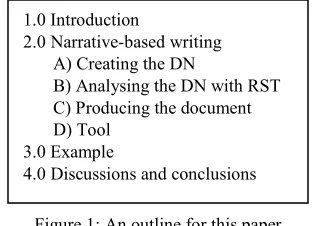
[image:2.595.101.257.393.506.2]There is evidence to suggest that a period of planning can significantly enhance the quality and coherence of a document (Torrance and Bouayad-Agha, 2001). Such a plan would make the authors aware of the goals and structure of the document. A popular technique used for this purpose is outlining. An outline is “an orderly plan…showing the division of ideas and their arrangement in relation to one another” (Roth, 1999). When done at the start, it gives the authors an overall view of the structure of the document and they can write their text accordingly.
Figure 1: An outline for this paper
Relationships between the ideas in an outline are shown by indentation (main topic and sub-topic) and the use of the same type of symbol for concepts of equal importance (e.g. A, B, C). However, an outline lacks explicit information as to why a certain section was placed where it is and its relationships with the rest of the document. In our opinion, such information can assist authors to improve coherence. Narrative-based writing (De-Silva and Henderson, 2005, Henderson and De-Silva, 2006) was developed to fill this gap.
The next section briefly describes narrative-based writing and the corresponding tool. In Section 3, we present an example that shows a team of writers making use of narratives to plan a research paper. Finally, the conclusions and discussions are presented.
2 NARRATIVE-BASED WRITING
Narrative-based writing makes use of some of the concepts from narratives in technical documents. It is based on the idea that coherence can be linked to the inherent ‘story’ conveyed by a document to its readers. The more consistent the story is, the better the document. Thereby, the method requires the authors to begin the writing process by ruminating on the story that their document will contain. An explicit précis of this story is called a Document Narrative or a DN, for short. Parts of this DN will correspond to sections in the document.
The DN can then be analysed using Rhetorical Structure Theory (RST) (Mann and Thompson, 1988). RST is a discourse theory developed by linguists to analyse and improve the coherence of texts. It asserts a hierarchical structure on the text, based on relationships between the segments in the text such as Motivation and Justify. It is not possible to explain RST in detail in this paper but a short description of it is given in section 2.2.
Finally, once the authors are satisfied with the DN, they can get to work on the document. These three steps are summarised below.
1. Ruminate on the story and create the DN. 2. Analyse the DN using RST in order to evaluate
and improve its coherence. The authors may decide to repeat steps 1 and 2 until they are convinced that the DN is the optimal for their document.
3. Use the DN as a guide to writing the actual document, checking that the expanded text maps on to the DN so as to implement the story and its RST analysis.
The rest of this section explains these three steps.
2.1 Creating the DN
A narrative, by definition, is a representation of events (Onega and Landa, 1996, Abbott, 2002) and has been used to refer to a wide variety of texts and dialogues. Even though there is some debate about the difference between a narrative and a story, they are taken to mean the same thing in our research.
A DN is a short text, no more than half a page long, that captures the story of a document. Articulating a coherent DN is not always straightforward and may require some time and thought. However, the process of thinking about this story first will, in our opinion, help converge different opinions from the authors and create a deeper understanding before writing. For larger
1.0 Introduction
2.0 Narrative-based writing A) Creating the DN
B) Analysing the DN with RST C) Producing the document D) Tool
3.0 Example
documents like books and theses, a DN can be created for the whole document and then for the subsequent chapters or sections too.
DNs for some types of documents such as a research proposal can be found in (De-Silva and Henderson, 2005, Henderson and De-Silva, 2006).
2.2 Analysing the DN with RST
It is now possible to analyse the DN using RST. There are several formal theories to analyse texts (Lehnert, 1981, Hobbs, 1985). RST was chosen for this research because it is relatively simple, makes use of tree structures (easier to visualise) and provides a means of evaluating coherence. Using RST in this way, to analyse the DN ahead of embarking on writing the actual document, amounts to a pragmatic method of using RST in document synthesis, as opposed to the document analysis for which it is popularly used.
The first step in the RST analysis is to break the text into segments. Segments can be of arbitrary size, but are typically clauses. Some segments are crucial to the understanding of the text and they are called nuclei (N). Others provide information to support the nuclei and are called satellites (S).
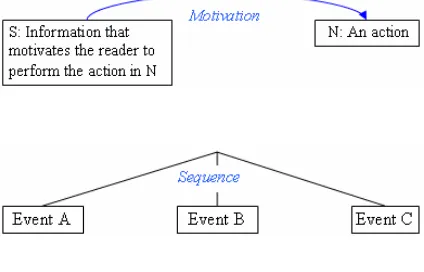
Once the segments have been identified, relationships are defined between them. Relationships can be illustrated using diagrams as shown below. Most relationships link a satellite to a nucleus (so-called hypotactic relationships, e.g. Motivation). A few relationships link multiple nuclei (so-called paratactic relationships, e.g. Sequence). Text coherence in RST arises due to a set of constraints and an overall effect that is defined for each relationship (Mann and Thompson, 1988) (see Figure 3).
Figure 2: An example of a hypotactic relationship (Motivation) and a paratactic relationship (Sequence). Note that the arrows in a hypotactic relationship point towards its nucleus.
There are 23 relationships defined in the original paper (Mann and Thompson, 1988). However, only nine of them have been consistently used in our analysis of technical documents so far. They are Background, Contrast, Elaboration, Enablement, Evidence, Justify, Motivation and Sequence. It is still too early to predict if this subset of relationships is sufficient for analyses of all technical documents. More research is required.
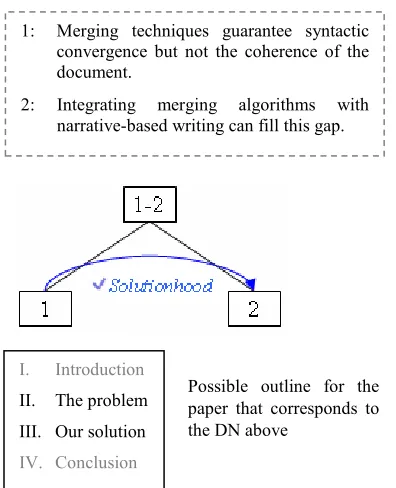
These relationships can be applied recursively to form a tree called a rhetorical structure tree (RS-tree). For instance, the DN in Figure 5 ahead has two segments. In the RST analysis, these two segments are linked by a SOLUTIONHOOD relationship (segment 1 is the problem – satellite - and segment 2 is the solution - nucleus). Had the DN been larger with more segments, the span created by this relationship (i.e. the joining of segments 1 and 2) could have, in turn, become involved in another RST relationship. This continues until all the segments are part of the RS-tree. Depending on the analyst, there can be several valid RS-trees for a given DN.
Benefits of doing the RST analysis are:
• It is conjectured that if a text can be placed in a well-formed RS-tree, the text is likely to be more coherent (Marcu, 2000, Mann and Thompson, 1988). This feature is used in this research as a guideline for coherence in the DNs. If the author struggles to fit the segments into a RS-tree, it is recommended that he or she re-think the DN.
• An RST analysis forces the authors to question the existence and positioning of each section in the DN. This helps to identify sections that play no role in strengthening the document or segments that are currently missing. This leads to a better document.
• The tree diagrams also provide a useful graphical representation of the narrative structure of the document.
Motivation
Constraints on N Presents an unrealised action Constraints on N+S Comprehending S increases the
reader’s desire to perform the action in N
The effect The reader’s desire to perform the action in N is increased
[image:3.595.304.527.102.193.2] [image:3.595.79.291.528.664.2]2.3 Producing the document
After a successful analysis, the authors can be reasonably confident that the DN is coherent and begin constructing the document. As a general rule, the sequence of sections in the document should correspond to the sequence of segments in the DN. The content of each of the sections will depend on the RST relationships that the associated segment in the DN is involved with. For instance, in a document introducing a new software tool, descriptions of successful applications of the software or positive comments from the users may help satisfy a Motivation relationship in the RST analysis.
2.4 Prototype of the tool
We recognised that one way to introduce narrative-based writing to teams of geographically-dispersed authors would be to make it available via an easily accessible tool. Therefore, a prototype of a tool was built to enable co-authors to create and analyse a DN at the start of their writing process. The rest of this section outlines the features of this tool.
The tool was implemented as a Java Web Service and a JSP client because this was a simple way to create an easily accessible, shared document. The web-based interface makes it easy for authors to access the tool and requires no software installation prior to use (assuming most users today will have a Web Browser). The DN and RST relationship data are stored in a relational database. Currently we use Microsoft Access but are investigating alternative databases.
Java methods were written for the following major functions: read, edit, review and merge DNs. It is important to note that the authors can use these functions asynchronously without interference (more experiments are being conducted regarding this). An initial Business Process model for this tool can be found in (Henderson and De-Silva, 2006). This model has since changed to accommodate more functionality.
• The tool contains a list of predefined DNs for some popular types of documents (e.g. research proposal, an abstract, a conference presentation and so on). At the start, authors can either select and modify a DN from this list, or create a new DN.
• Once a DN has been created, the users are presented with a list of tasks (e.g. edit the DN, edit the RST analysis, review or merge DNs).
Users can select the version they wish to work on from a drop-down list of all the versions for this DN.
• In the tool, we have introduced the concept of the status of a RST relationship. A relationship is said to be “satisfied” if its nucleus and satellite fulfil the definitions that Mann and Thompson described for them. This is determined by the authors. Until explicitly stated otherwise, a relationship will remain “unsatisfied”. Similarly, changes to parts of a RS-tree can change the status of affected relationships to “unsatisfied”. When the DN is displayed, all satisfied RST relationships are shown in blue and unsatisfied relationships in red, thus drawing the authors’ attention to sections in the DN that may need changing. This is particularly useful since changes made by other authors may render some parts of the RST analysis untrue.
• Once the analysis is complete, the DN can be reviewed. Authors can verify that all the RST relationships are satisfied.
• When a change is made to the RS-tree, a new version of it is created. However, only the affected parts of the tree are copied. The remaining parts of the tree are linked to from the parent version. This is similar to the technique of storing deltas (changes) in tools such as CVS (Cederqvist, 2002) and RCS (Tichy, 1982).
• Two versions of the DN can also be merged, particularly those derived from the same parent version. At the moment, the merge algorithm is very simple. In the future, a better algorithm will be devised.
• The HTML user interface of the tool is simple (see screenshot in Figure 4). The left frame contains the menus, a link to the Help document and a table showing the history of the versions of this DN. The DN is displayed in the upper frame on the right. A second version of the DN can be viewed at the same time in a separate window. This is useful for comparisons.
3 EXAMPLE
This section presents an example that shows how the narrative-based technique and tool can be used by a team of authors to structure their document. The example is a rational reconstruction of the process by which the paper by De Silva and Skaf-Molli (2006) was written. The authors were in two different countries and did not meet face-to-face to plan it. A lot of the structure was determined by exchanging DNs and drafts by e-mail. A fictional third author has, however, been introduced here to make the writing task more complex. Apart from that, the example has been kept deliberately small so that the necessary aspects of collaboration can be demonstrated within the space limitations in this paper.
The CW task involves three authors (A, B and C) writing a joint research paper about merging algorithms and narrative-based writing. Authors A and B are authorities on merging algorithms while Author C is researching on narrative-based writing. They hope to divide the sections of the document according to their expertise.
To start the process, Author A comes up with a basic DN for the paper. He inputs the DN into the tool and does a simple RST analysis of it. Both the DN and RS-tree now become available to the other authors (version 1). These are shown in Figure 5.
Version 1 (created by Author A)
1: Merging techniques guarantee syntactic convergence but not the coherence of the document.
[image:5.595.90.511.67.330.2]2: Integrating merging algorithms with narrative-based writing can fill this gap. Figure 4: Screen shot of the tool showing version 1 of a DN for an abstract of a paper
I. Introduction
II. The problem III. Our solution IV. Conclusion
Possible outline for the paper that corresponds to the DN above
[image:5.595.307.505.412.656.2]The sections that need to be in the document according to the DN are listed in the outline. Note that the ‘Introduction’ and ‘Conclusion’ are mandatory for most papers and are not governed by the DN in this case (hence, they are in grey). Sections II and III in the outline correspond to the two segments in the DN and implement the SOLUTIONHOOD relationship between them.
In theory, a paper with this structure should be sufficient. However, the structure is flat and lacking in detail. The general norm is to introduce some background material before talking about the research problem. However, what should this background material be and where should it be placed (seeing as several areas of research need to be introduced)? In our opinion, this is where a DN can play a major role. Trying to say the story, naturally, will help answer some of these questions.
So, Author B responds by e-mail:
“It’s likely that many people at this conference will be from a collaborative writing background. While being aware of merging techniques, narrative-based writing will be new to them. We should definitely include some background material on merging techniques, collaborative writing and, in particular, narrative-based writing. What do you think?”
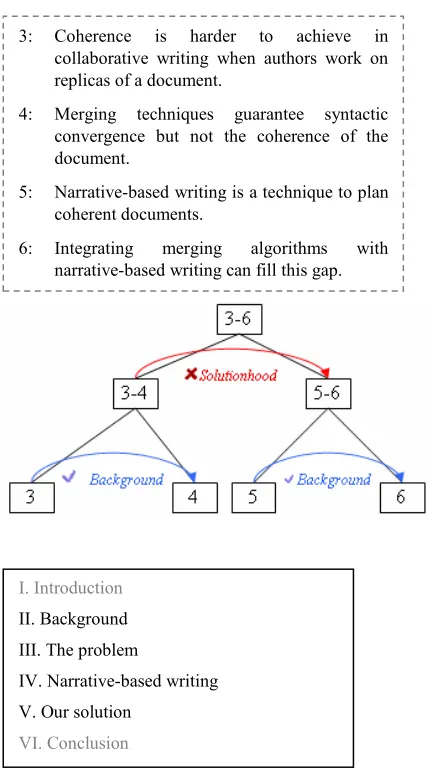
Author B goes on to make multiple changes to the RS-tree. She adds two new segments to the DN and changes the RST analysis. In the tool, this would have to be done in several stages because the tool tracks and records every change by creating a new version. These intermediate stages have been omitted for simplicity and the version by Author B has been labelled as version 2 in Figure 6. (Note that the segments in the DNs have all been uniquely labelled for clarity, even though some segments appear in all the DNs.)
Note that Author B has linked two pieces of background information into the DN. Segment 3 about collaborative writing is the background to the problem and segment 5 about narrative-based writing is the background to the solution. This, in her opinion, is the most natural way to narrate this story. These changes are accepted by the other authors.
The SOLUTIONHOOD relationship is marked by the tool as being unsatisfied due to the changes made to the DN. Despite not doing a formal review
of the relationships to change its state to “satisfied”, the authors agree that it is still valid and get started with the writing. Authors A and B agree to do sections I, II, III and VI. Author C gets assigned sections IV and V. They are aware of how these sections should be linked (dictated by the RST relationships).
Version 2 (derived from version 1 by Author B)
Figure 6: Version 2 of the DN and RS-tree (created by Author B), and possible outline for the paper
Meanwhile, Author C recognises the lack of a MOTIVATION or JUSTIFY relationship in the DN to address the ‘So what? How is this useful?’ question that may arise in the reader’s mind. To rectify this, Author C adds a new node and a MOTIVATION relationship to version 1 of the DN. She believes this will improve the document.
3: Coherence is harder to achieve in collaborative writing when authors work on replicas of a document.
4: Merging techniques guarantee syntactic convergence but not the coherence of the document.
5: Narrative-based writing is a technique to plan coherent documents.
6: Integrating merging algorithms with narrative-based writing can fill this gap.
I. Introduction
II. Background III. The problem
IV. Narrative-based writing V. Our solution
[image:6.595.307.521.205.590.2]Version 3 (derived from version 1 by Author C)
Figure 7: Version 3 of the DN and RS-tree (created by Author C)
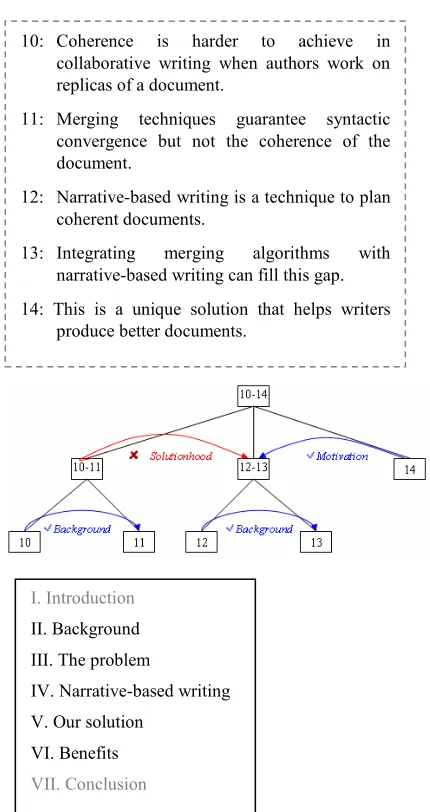
In Figure 7, note that segments 8 and 9 are involved in a MOTIVATION relationship. Segment 9 provides the motivation to carry out the research outlined in segment 8. Section IV in the outline corresponds to segment 9 in the DN.
The other authors realise the usefulness of a MOTIVATION relationship in the DN and agree that it is an essential component of a winning paper. However, they still think the background material in Version 2 is important too. Seeing that both version 2 and version 3 were derived from version 1, they use the tool to merge the two DNs to produce the results below (version 4 in Figure 8).
The authors are confident with this merged version. The RST relationships are all still valid (even though the tool has marked SOLUTIONHOOD as “unsatisfied” according to the implemented protocol). The scene for the paper is set by sections II and III which will explain why coherence is harder in CW, give an overview of the shortcomings of current merging techniques and describe how this affects documents. Next, the solution is introduced together with a short tutorial on narrative-based writing which is necessary to fully comprehend the nature of the proposed work.
Version 4 (merged from versions 2 and 3 by Author A)
Figure 8: Version 4 of the DN and RS-tree (created by Author A)
The Benefits section can contain applications or examples of where the solution will help the existing situation. This will be the motivation that led to the development of these ideas.
For the actual paper, the DN was changed again so that the satellite of the MOTIVATION relationship preceded the solution and so on. However, we stop the example here because the essential attributes of how the DN and the tool can assist in planning a document have been shown.
7: Merging techniques guarantee syntactic convergence but not the coherence of the document.
8: Integrating merging algorithms with narrative-based writing can fill this gap.
9: This is a unique solution that helps writers produce better documents.
I. Introduction
II. The problem III. Our solution IV. Benefits IV. Conclusion
10: Coherence is harder to achieve in collaborative writing when authors work on replicas of a document.
11: Merging techniques guarantee syntactic convergence but not the coherence of the document.
12: Narrative-based writing is a technique to plan coherent documents.
13: Integrating merging algorithms with narrative-based writing can fill this gap.
14: This is a unique solution that helps writers produce better documents.
I. Introduction
II. Background III. The problem
IV. Narrative-based writing V. Our solution
[image:7.595.73.284.113.381.2] [image:7.595.306.521.119.525.2]4 DISCUSSIONS AND
CONCLUSIONS
Coherence is the attribute of a document that makes it easy to understand, and is often harder to achieve in CW because multiple authors are responsible for the content. Coherence can be linked to the implicit story conveyed by the document to the readers. However, software support for this aspect of writing is almost non-existent. Even planning techniques such as outlining do not seem to adequately address the problem. Narrative-based writing is a planning technique that was introduced to address this problem. It involves creating a DN and analysing it using RST to evaluate and improve its coherence. The segments in the DN correspond to sections in the document. We claim that a better DN will lead to a better document.
The DN provides a way of quickly discovering the natural progression of concepts in a document. The authors need to think of the best possible story that their ideas can be fitted into. The corresponding RST analysis gives some evaluation of the story’s coherence and also helps point out ill-fitting story segments and better alternatives. When several authors have opinions on the content of the paper, forcing themselves to create a DN helps combine these ideas into a coherent whole.
A tool has been built to help authors engage in narrative-based writing. The tool helps manage the versions, store the RS-trees and draw the authors’ attention to unsatisfied relationships (particularly beneficial in large analyses). This paper has presented an example that shows how this tool and technique can be used by a team of authors. The changes in the DN made by each author are reflected in the plan for their document. The DN is updated until all the co-authors are confident that it is the most effective for the purpose of their document.
Existing CW tools like CVS already have advanced features to manage and merge versions, making it unnecessary for us to re-visit these areas in our implementation. What existing tools appear to lack is support for coherence. We anticipate that the inclusion of DNs and support for RS-trees in these tools will bridge this gap, and assist co-authors even further.
REFERENCES
ABBOTT, H. P. (2002) The cambridge introduction to narrative, Cambridge, UK, Cambridge University Press.
CEDERQVIST, P. (2002) Version Management with CVS, Network Theory Ltd.
DE-SILVA, N. & HENDERSON, P. (2005) Narrative Support for Technical Documents: Formalising Rhetorical Structure Theory. 7th International Conference on Enterprise Information Systems (ICEIS). Miami, FL, USA.
DE-SILVA, N. & SKAF-MOLLI, H. (2006) Narratives to preserve coherence in collaborative writing. The Eighth International Workshop on Collaborative Editing Systems. Banff, Canada.
HENDERSON, P. & DE-SILVA, N. (2006) A narrative approach to collaborative writing: A business process model. 8th International Conference on Enterprise Information Systems (ICEIS). Cyprus.
HOBBS, J. R. (1985) On the coherence and structure of discourse. Center for the study of language and information, Stanford University.
LEHNERT, W. (1981) Plot Units: A Narrative Summarization Strategy. IN LEHNERT, W. & RINGLE, M. (Eds.) Strategies for Natural Language Processing. New Jersey, Lawrence Erlbaum Associates.
LOWRY, P. B., CURTIS, A. & LOWRY, M. R. (2004) Building a taxonomy and nomenclature of collaborative writing to improve interdisciplinary research and practice. Journal of Business Communication, 41, 66-99.
MANN, W. & THOMPSON, S. (1988) Rhetorical Structure Theory: Toward a functional theory of text organisation. Text, 8, 243-281.
MARCU, D. (2000) The Theory and Practice of Discourse Parsing and Summarization, The MIT Press.
NOËL, S. & ROBERT, J.-M. (2004) Empirical Study on Collaborative Writing: What do co-authors do, use, and like? Computer Supported Cooperative Work, 13. ONEGA, S. & LANDA, J. (1996) Introduction. IN
ONEGA, S. & LANDA, J. (Eds.) Narratology. New York and London, Longman Group Ltd.
ROTH, A. J. (1999) The research paper: process, form and content, USA, Thomas Learning Inc.
TICHY, W. F. (1982) Design, implementation, and evaluation of a Revision Control System. 6th international conference on Software engineering. Tokyo, Japan, IEEE Computer Society Press.