
Computational intelligence in e mail traffic analysis
257
0
0
Full text
(2)
(3) Statement of Originality This thesis contains no material which has been accepted for a degree or diploma by the University or any other institution, except by way of background information and duly acknowledged in the thesis. To the best of my knowledge and belief, this thesis contains no material previously published or written by another person except where due acknowledgement is made in the text of the thesis, nor does the thesis contain any material that infringes copyright.. Mark Jyn-Huey Lim Date: Friday 30th May 2008.. Statement of Authority of Access This thesis may be made available for loan and limited copying in accordance with the Copyright Act 1968.. Mark Jyn-Huey Lim Date: Friday 30th May 2008.. i.
(4) Abstract In law enforcement, tools and techniques are required that enable forensic analysts to uncover electronic evidence about the communication activities of possible criminal or terrorist suspects. This is needed in order to better understand the actions of criminal or terrorist groups and to also understand the communication patterns of suspected individuals. The extraction of useful information from electronic communication data is a difficult task, due to the large amounts of data and also due to the difficulty in making sense of unusual activities in the data. This thesis considers the problem of aiding the analyst to provide a better understanding about the communication behaviour of suspected individuals. The type of data considered for the thesis is e-mail traffic, which is based on information obtained from e-mail message headers but not the content of e-mails. This thesis proposes a “computational intelligence” approach for analysing email traffic, by using a set of computational techniques to provide different perspectives for examining the communication behaviour of suspect e-mail accounts. This is considered important, since a range of views on e-mail traffic behaviour can provide the user/analyst a more overall understanding about the behaviour of suspect e-mail accounts. The purpose of using a set of computational techniques is to utilise the capabilities of each technique, so that the combined effect of using those techniques present useful information to the user/analyst about a suspect e-mail account’s traffic behaviour. The computational techniques used for the research in this thesis are visualisation and feature extraction techniques, which each provide different ways of examining e-mail traffic behaviour. Visualisation is used to provide a visual method of interpreting, exploring, and understanding the communication patterns present in e-mail traffic data. The two visualisation techniques used for visualization are social network visualisation and time-series visualisation. Feature extraction techniques are another type of technique used to analyse e-mail traffic behaviour, by providing information that locate features in the data, indicating where unusual changes in communication activity are occurring. The two techniques used for ii.
(5) feature extraction in the research are decision tree classification and hierarchical fuzzy inference. Two case studies are provided in this thesis. The first case study explores the detection of unusual variations in traffic behaviour from simulated e-mail traffic data, while the second case study explores the rating of abnormal communication changes from the Enron e-mail corpus dataset. Both case studies demonstrate that computational intelligence is a useful approach for providing the user/analyst a better understanding about the traffic behaviour of suspect e-mail accounts.. iii.
(6) Acknowledgements The work produced in this thesis has only been made possible through the support of a number of people, whom I would like to thank. Firstly, to Prof. Michael Negnevitsky and Mrs. Jacky Hartnett, both of whom I am grateful to have as my supervisors. Prof. Michael Negnevitsky has been a great mentor who has provided me insightful advice that has helped me to develop as a person and as a researcher. Mrs. Jacky Hartnett has been wonderful as my co-supervisor and is someone I have always enjoyed sharing lively discussions with during our meetings. Secondly, I would like to thank all of my colleagues with whom I have shared room 337 during my PhD candidature: Warwick Gillespe, Shao Kwan Ng, Dao Thuan An Le, Yin Chin Choo, Jeffrey Poh, Jonathan Culberg, and Ahsan Latheef. All of these people have shared parts of the PhD journey with me and have been wonderful people who have made my postgraduate experience an enjoyable and interesting one. I would like to make special mention of my colleague Cameron Potter, who has been really great in helping me adjust to postgraduate life during the beginning of my PhD candidature. Cameron was someone I looked up to as a fellow PhD candidate and whose drive and motivation for his research has inspired me to do the same with mine. Thirdly, I owe special thanks to my friend Andrew Durdin, whose in-depth knowledge of Python and Mac computers have been really essential in providing me the knowledge I need for doing my work. Andrew has been a great friend who has helped me troubleshoot technical problems that are just out of my reach. Also special thanks to Deborah Ploughman, who helped proof read Chapters 2 and 3 of my thesis. Finally, none of this would have been possible without the love and support of my mum and dad, Kim and Yong Seng Lim, and my brother David Lim, who have been behind me through the whole of my PhD studies.. iv.
(7) Contents. Abstract. ii. Acknowledgements. iv. Contents. ix. List of Figures. xv. List of Tables. xvii. Preface. xix. 1. Introduction. 1. 1.1. E-mail Communications . . . . . . . . . . . . . . . . . . . . .. 1. 1.2. Involvement Of E-mail In Illegal Activities . . . . . . . . . . .. 3. 1.3. Investigation of Suspected Individuals . . . . . . . . . . . . . .. 4. 1.3.1. Computer Forensics . . . . . . . . . . . . . . . . . . .. 5. E-mail Analysis Methods . . . . . . . . . . . . . . . . . . . . .. 7. 1.4.1. E-mail Content Analysis . . . . . . . . . . . . . . . . .. 7. 1.4.2. E-mail Traffic Analysis . . . . . . . . . . . . . . . . . .. 9. 1.5. Difficulties Associated With Analysing E-mail Data . . . . . . .. 11. 1.6. Problem Statement . . . . . . . . . . . . . . . . . . . . . . . .. 12. 1.7. Thesis Contribution and Layout . . . . . . . . . . . . . . . . .. 13. 1.4. v.
(8) CONTENTS. 2. 3. Behaviour Analysis of E-mail Traffic. 15. 2.1. Introduction . . . . . . . . . . . . . . . . . . . . . . . . . . . .. 15. 2.2. Behaviour Analysis Methods . . . . . . . . . . . . . . . . . . .. 16. 2.2.1. Individual Behaviour Analysis . . . . . . . . . . . . . .. 18. 2.2.2. Behaviour Comparison Analysis . . . . . . . . . . . . .. 25. 2.2.3. Clique Behaviour Analysis . . . . . . . . . . . . . . . .. 31. 2.2.4. Network Behaviour Analysis . . . . . . . . . . . . . . .. 34. 2.3. Discussion . . . . . . . . . . . . . . . . . . . . . . . . . . . . .. 38. 2.4. Summary . . . . . . . . . . . . . . . . . . . . . . . . . . . . .. 43. E-mail Traffic Analysis Using Computational Intelligence. 45. 3.1. Introduction . . . . . . . . . . . . . . . . . . . . . . . . . . . .. 45. 3.2. Computational Intelligence . . . . . . . . . . . . . . . . . . . .. 46. 3.3. Visualisation Techniques . . . . . . . . . . . . . . . . . . . . .. 49. 3.3.1. Social Network Visualisation . . . . . . . . . . . . . . .. 52. 3.3.2. Time-Series Visualisation . . . . . . . . . . . . . . . .. 56. Feature Extraction Techniques . . . . . . . . . . . . . . . . . .. 61. 3.4.1. Decision Tree Classification . . . . . . . . . . . . . . .. 63. 3.4.2. Hierarchical Fuzzy Inference . . . . . . . . . . . . . . .. 70. Summary . . . . . . . . . . . . . . . . . . . . . . . . . . . . .. 82. 3.4. 3.5 4. Development of the E-mail Traffic Analysis System. 85. 4.1. Introduction . . . . . . . . . . . . . . . . . . . . . . . . . . . .. 85. 4.2. System Architecture . . . . . . . . . . . . . . . . . . . . . . . .. 86. 4.2.1. Overview of the System . . . . . . . . . . . . . . . . .. 87. 4.2.2. Implementation . . . . . . . . . . . . . . . . . . . . . .. 92. E-mail Traffic Data . . . . . . . . . . . . . . . . . . . . . . . .. 93. 4.3.1. Simulated E-mail Traffic Data . . . . . . . . . . . . . .. 94. 4.3.1.1. Conceptual E-mail System Model . . . . . . .. 95. 4.3.1.2. Personality Traits of the Behaviour Model . .. 96. 4.3. vi.
(9) CONTENTS. 4.3.2. 5. Sending and Replying Delay Distributions . .. 99. 4.3.1.4. Generation of Simulated Data . . . . . . . . . 102. The Enron E-mail Dataset . . . . . . . . . . . . . . . . 106. 4.4. Analysing The Data . . . . . . . . . . . . . . . . . . . . . . . . 110. 4.5. Summary . . . . . . . . . . . . . . . . . . . . . . . . . . . . . 115. The E-mail Traffic Analysis System Evaluation and Case Studies. 118. 5.1. Introduction . . . . . . . . . . . . . . . . . . . . . . . . . . . . 118. 5.2. E-mail Traffic Data Simulation and Analysis . . . . . . . . . . . 119. 5.3. 6. 4.3.1.3. 5.2.1. Case Study 1 . . . . . . . . . . . . . . . . . . . . . . . 119. 5.2.2. Case Study 2 . . . . . . . . . . . . . . . . . . . . . . . 128. 5.2.3. Discussion . . . . . . . . . . . . . . . . . . . . . . . . 133. Case Study: Enron E-mail Traffic Data . . . . . . . . . . . . . . 140 5.3.1. Analysis of Enron Employee’s Traffic Behaviour . . . . 140. 5.3.2. Discussion . . . . . . . . . . . . . . . . . . . . . . . . 147. 5.4. Concluding Remarks . . . . . . . . . . . . . . . . . . . . . . . 149. 5.5. Summary . . . . . . . . . . . . . . . . . . . . . . . . . . . . . 150. Summary and Further Studies. 154. 6.1. Investigations Involving E-mail As Evidence . . . . . . . . . . . 154. 6.2. Analysis of E-mail Traffic Behaviour . . . . . . . . . . . . . . . 155. 6.3. Major Contributions . . . . . . . . . . . . . . . . . . . . . . . . 157. 6.4. 6.3.1. Utilising A Combination Of Techniques To Examine Email Traffic Behaviour . . . . . . . . . . . . . . . . . . 157. 6.3.2. Development Of A Personality Trait Based E-mail Traffic Simulation Tool . . . . . . . . . . . . . . . . . . . . 159. 6.3.3. Development Of A Novel System Architecture For Email Traffic Analysis . . . . . . . . . . . . . . . . . . . 159. Further Studies . . . . . . . . . . . . . . . . . . . . . . . . . . 161 6.4.1. Extending the Conceptual E-mail System Model . . . . 161. 6.4.2. Further Evaluation Of Decision Tree Classification . . . 162 vii.
(10) CONTENTS. 6.5. 6.4.3. Investigation Of Other Hierarchical Fuzzy Inference Architectures . . . . . . . . . . . . . . . . . . . . . . . . 162. 6.4.4. Correlating E-mail Content Analysis And E-mail Traffic Analysis Results . . . . . . . . . . . . . . . . . . . . . 164. Conclusion . . . . . . . . . . . . . . . . . . . . . . . . . . . . 165. References. 166. Appendices. 178. A E-mail Traffic Database Schema. 178. A.1 ‘emailSystems’ Table . . . . . . . . . . . . . . . . . . . . . . . 180 A.2 ‘emailClients’ Table . . . . . . . . . . . . . . . . . . . . . . . . 180 A.3 ‘emailTraffic’ Table . . . . . . . . . . . . . . . . . . . . . . . . 180 A.4 ‘sendingDelays’ Table . . . . . . . . . . . . . . . . . . . . . . 181 A.5 ‘replyingDelays’ Table . . . . . . . . . . . . . . . . . . . . . . 181 A.6 ‘suspiciousClients’ Table . . . . . . . . . . . . . . . . . . . . . 182 A.7 ‘MITDNormProfiles’ Table . . . . . . . . . . . . . . . . . . . . 182 A.8 ‘TDNormProfiles’ Table (Obsolete) . . . . . . . . . . . . . . . 184 A.9 ‘ADAnalysisInfo’ Table . . . . . . . . . . . . . . . . . . . . . . 184 A.10 ‘AnomalyDetectionTypes’ Table . . . . . . . . . . . . . . . . . 185 B Class Diagram For The E-mail System Simulation Model. 186. C Enron Events Timeline. 188. D Former Employees of Enron. 190. E Hierarchical Fuzzy Inference System Development. 193. E.1 Architecture . . . . . . . . . . . . . . . . . . . . . . . . . . . . 193 E.2 Summary Of The Rule Bases . . . . . . . . . . . . . . . . . . . 193 E.3 Input And Output Variable Fuzzy Sets . . . . . . . . . . . . . . 194 E.4 Input-Output Mappings Of The Fuzzy System Modules . . . . . 202 viii.
(11) CONTENTS. F Simulated E-mail Traffic Data Analysis Results. 206. F.1. Case Study 1 Decision Tree Results . . . . . . . . . . . . . . . 206. F.2. Case Study 2 Decision Tree Results . . . . . . . . . . . . . . . 210. G Enron E-mail Traffic Data Analysis Results. ix. 214.
(12) List of Figures 1.1. The parts of an e-mail message that are used for content and traffic analysis. . . . . . . . . . . . . . . . . . . . . . . . . . .. 7. 2.1. Different levels of analysis for examining e-mail traffic behaviour. 17. 2.2. Diagram illustrating the idea of individual behaviour analysis. .. 18. 2.3. Example of a user’s 24-hour sending usage profile. . . . . . . .. 19. 2.4. Example of the frequency table and histogram used for the Recipient Frequencies method [1], with kind permission of Springer Science and Business Media. . . . . . . . . . . . . . . . . . . .. 20. Comparison of the past and recent sending usage patterns for an individual. . . . . . . . . . . . . . . . . . . . . . . . . . . . . .. 21. Example of the rolling window approach used to detect variac tions in recipient frequencies [2] °ACM, Inc. Reprinted by permission. . . . . . . . . . . . . . . . . . . . . . . . . . . . . . .. 23. 2.7. Observing abnormal behaviour from different perspectives. . . .. 24. 2.8. Example of how the abnormal behaviour of individual e-mail accounts may be summarised . . . . . . . . . . . . . . . . . . .. 25. The concept of behaviour comparison analysis. . . . . . . . . .. 26. 2.10 Concept map of the 15 behavioural features defined by [3]. . . .. 28. 2.11 Concept of the comparison approaches used. . . . . . . . . . . .. 29. 2.12 Diagram illustrating the idea of clique behaviour analysis. . . . .. 32. 2.13 Diagram of clique profiling, based on the clique diagrams originally drawn by [2]. . . . . . . . . . . . . . . . . . . . . . . . .. 33. 2.14 The concept of network behaviour analysis. . . . . . . . . . . .. 34. 2.5. 2.6. 2.9. x.
(13) LIST OF FIGURES. 2.15 Diagram showing the hidden group’s e-mail traffic communication and structure, based on the diagrams originally drawn by [4]. . . . . . . . . . . . . . . . . . . . . . . . . . . . . . . . . .. 36. 2.16 Further investigation of abnormal network activity. . . . . . . .. 38. 3.1. Extracting and comparing different types of information about the data. . . . . . . . . . . . . . . . . . . . . . . . . . . . . . .. 47. 3.2. Simple example of multi-dimensional data. . . . . . . . . . . .. 48. 3.3. Computational techniques used for e-mail traffic analysis. . . . .. 49. 3.4. Steps of the visualisation process, based on a diagram drawn by [5]. . . . . . . . . . . . . . . . . . . . . . . . . . . . . . . . . .. 50. 3.5. Simple diagram showing the components of a social network graph. 52. 3.6. The social network visualisation process. . . . . . . . . . . . .. 53. 3.7. Social network visualisation of data from Table 3.2. . . . . . . .. 55. 3.8. Example of a large network of 355 e-mail users. . . . . . . . . .. 56. 3.9. Example of different notations used for representing time-series data. . . . . . . . . . . . . . . . . . . . . . . . . . . . . . . . .. 57. 3.10 Time-series visualisation process. . . . . . . . . . . . . . . . .. 58. 3.11 Example of e-mail traffic volume using a weekly time-scale. . .. 59. 3.12 Example of e-mail traffic volume using a daily time-scale. . . .. 60. 3.13 Steps of the feature extraction process. . . . . . . . . . . . . . .. 61. 3.14 The information obtained through each step of feature extraction.. 61. 3.15 Steps of the decision tree classification process. . . . . . . . . .. 63. 3.16 The data produced after each step of the decision tree process. .. 63. 3.17 Example of how decision tree classification partitions the data. .. 64. 3.18 Decision tree representation used for describing the data. . . . .. 65. 3.19 Decision tree classification process used for e-mail traffic analysis. 66 3.20 Data produced for finding unusual interactions. . . . . . . . . .. 66. 3.21 Two decision trees produced for incoming and outgoing e-mail traffic. . . . . . . . . . . . . . . . . . . . . . . . . . . . . . . .. 69. 3.22 Comparison between Boolean logic and fuzzy logic. . . . . . .. 71. xi.
(14) LIST OF FIGURES. 3.23 Example of a linguistic variable and its associated fuzzy set. . .. 71. 3.24 Different architectures for a hierarchical fuzzy system of 4 variables. . . . . . . . . . . . . . . . . . . . . . . . . . . . . . . .. 72. 3.25 Analysis of the suspect’s communication links. . . . . . . . . .. 73. 3.26 Mapping of e-mail traffic behaviour measurements. . . . . . . .. 76. 3.27 Process used for finding abnormal changes in communication behaviour. . . . . . . . . . . . . . . . . . . . . . . . . . . . . .. 78. 3.28 Data produced for finding abnormal communication links. . . .. 79. 3.29 Analysing each of the suspect’s communication links. . . . . . .. 79. 3.30 Examples of unknown sending delay and replying delay cases. .. 81. 3.31 The architecture used for the hierarchical fuzzy inference system.. 82. 4.1. Overview of the e-mail traffic analysis system. . . . . . . . . . .. 88. 4.2. Implementation of the e-mail traffic analysis system. . . . . . .. 93. 4.3. The entities making up the e-mail system model. . . . . . . . .. 95. 4.4. Layout for the sending delay normal distribution. . . . . . . . . 100. 4.5. Layout for the replying delay normal distribution. . . . . . . . . 101. 4.6. Flow diagram of the simulation model set-up and simulation process. . . . . . . . . . . . . . . . . . . . . . . . . . . . . . . . . 104. 4.7. The main graphical user interface for the e-mail system model generation program. . . . . . . . . . . . . . . . . . . . . . . . . 105. 4.8. The behaviour editor part of the e-mail system model generation program. . . . . . . . . . . . . . . . . . . . . . . . . . . . . . . 105. 4.9. Events diagram for events in the conceptual e-mail system model. 106. 4.10 Overview of how simulated data is entered into the e-mail traffic analysis system. . . . . . . . . . . . . . . . . . . . . . . . . . . 106 4.11 Steps for exploring the data using visualisation techniques. . . . 111 4.12 Steps for analysing the data with decision tree classification. . . 113 4.13 Steps for analysing the data with hierarchical fuzzy inference. . 114 5.1. The setup configuration given for the social connections between e-mail clients. . . . . . . . . . . . . . . . . . . . . . . . . . . . 120 xii.
(15) LIST OF FIGURES. 5.2. Stacked column chart showing the behavioural profiles of each e-mail client and their behaviour model ID. . . . . . . . . . . . 120. 5.3. Column chart showing the personality trait degree values of all the e-mail clients. . . . . . . . . . . . . . . . . . . . . . . . . . 121. 5.4. Number of e-mail messages sent and received by the e-mail clients over 120 simulation days. . . . . . . . . . . . . . . . . . . . . . 121. 5.5. Overview of communications between the 10 e-mail clients. . . 122. 5.6. Weekly time-series overview of the 10 e-mail clients, with clientB selected. . . . . . . . . . . . . . . . . . . . . . . . . . . . . . . 123. 5.7. Unusual changes in interactions found from both the inboxes and outboxes of e-mail clients (i.e. changes found in both directions). 125. 5.8. Unusual changes in interactions found from either the inbox or outbox of e-mail clients (i.e. changes found only in one direction). 125. 5.9. Decision tree for clientG showing unusual changes in incoming interactions. . . . . . . . . . . . . . . . . . . . . . . . . . . . . 126. 5.10 Decision tree for clientG showing unusual changes in outgoing interactions. . . . . . . . . . . . . . . . . . . . . . . . . . . . . 126 5.11 Weekly time-series data of e-mail traffic between clientG and clientI, showing a drop in traffic after week 6 or around day 47. . 127 5.12 Weekly time-series data of e-mail traffic between clientG and clientD, showing an increase in traffic after week 6. . . . . . . . 127 5.13 Daily time-series data for the interaction between clientG and clientF from days 35 to 56 (i.e. weeks 5 to 8). . . . . . . . . . . 127 5.14 The behavioural profiles of each e-mail client in the simulation model. . . . . . . . . . . . . . . . . . . . . . . . . . . . . . . . 129 5.15 The setup configuration given for the e-mail clients’ social connections for case study 2. . . . . . . . . . . . . . . . . . . . . . 129 5.16 Number of e-mail messages sent and received by e-mail clients over 182 simulation days. . . . . . . . . . . . . . . . . . . . . . 130 5.17 Social network overview of the 9 e-mail clients. . . . . . . . . . 130 5.18 Social network diagrams showing where the decision tree identified unusual changes in interaction from two directions. . . . . 132. xiii.
(16) LIST OF FIGURES. 5.19 Social network diagrams showing where the decision tree identified unusual changes in interaction in one direction. . . . . . . 132 5.20 Weekly time-series data for clientG, showing the general e-mail traffic activity. . . . . . . . . . . . . . . . . . . . . . . . . . . . 134 5.21 Decision tree classification output for clientG’s unusual changes in incoming e-mail traffic interactions. . . . . . . . . . . . . . . 134 5.22 Decision tree classification output for clientG’s unusual changes in outgoing e-mail traffic interactions. . . . . . . . . . . . . . . 135 5.23 Weekly time-series of traffic between clientG and clientA, highlighting the week 15 (≈ day 108) with a drop in number of outgoing e-mails on week 14. . . . . . . . . . . . . . . . . . . . . 135 5.24 Weekly time-series data for clientG and clientC, highlighting the week 15 (≈ day 108) with a significant rise in number of e-mails from clientG to clientC. . . . . . . . . . . . . . . . . . . . . . . 135 5.25 Daily time-series data for clientG and clientC, showing an unusual increase in daily e-mail traffic activity after day 108. . . . 136 5.26 Social network diagrams highlighting the change in communications between clientG and clientC before and after day 108. . . . 136 5.27 Jeffrey Skilling’s e-mail addresses (orange) and his circle of associates (blue) from 1st January 1999 to 1st August 2000 (17 months). . . . . . . . . . . . . . . . . . . . . . . . . . . . . . . 143 5.28 Jeffrey Skilling’s e-mail addresses (orange) and his circle of associates (blue) from 1st February 2001 to 1st September 2001 (7 months). . . . . . . . . . . . . . . . . . . . . . . . . . . . . . . 143 5.29 Weekly time-series overview of traffic from Jeffrey Skilling’s email accounts from 1st January 1999 to 1st September 2001. . . 144 5.30 Social network diagrams of Jeffrey Skilling’s top ten ranked communication links. . . . . . . . . . . . . . . . . . . . . . . . . . 145 5.31 Weekly time-series of Jeffrey Skilling and Rosalee Fleming, focusing on the surveillance period. . . . . . . . . . . . . . . . . 146 5.32 Weekly time-series of Jeffrey Skilling and Steven Kean, focusing on the surveillance period. . . . . . . . . . . . . . . . . . . . . 146 6.1. A suggestion for a trimmed down version of the hierarchical architecture. . . . . . . . . . . . . . . . . . . . . . . . . . . . . . 163 xiv.
(17) LIST OF FIGURES. A.1 Diagram of the schema layout for the e-mail traffic database. . . 179 B.1 Legend of the symbols used in the class diagram. . . . . . . . . 186 B.2 Class diagram of the implementation of the conceptual e-mail system simulation model. . . . . . . . . . . . . . . . . . . . . . 187 C.1 Events associated with Jeffrey Skilling’s employment and the collapse of Enron. . . . . . . . . . . . . . . . . . . . . . . . . . 189 E.1 Architecture of the hierarchical fuzzy inference system. . . . . . 194 E.2 The fuzzy sets used for the input and output variables of L1RB1. 195 E.3 The fuzzy sets used for the input and output variables of L1RB2. 196 E.4 The fuzzy sets used for the input and output variables of L1RB3. 197 E.5 The fuzzy sets used for the input and output variables of L1RB4. 198 E.6 The fuzzy sets used for the input and output variables of L2RB1. 199 E.7 The fuzzy sets used for the input and output variables of L2RB2. 200 E.8 The fuzzy sets used for the input and output variables of L3RB1. 201 E.9 The input-output mappings for the first and second rule bases of layer 1. . . . . . . . . . . . . . . . . . . . . . . . . . . . . . . 203 E.10 The input-output mappings for the third and fourth rule bases of layer 1. . . . . . . . . . . . . . . . . . . . . . . . . . . . . . . 204 E.11 The input-output mappings for layer 2 of the hierarchy. . . . . . 205 E.12 The input-output mapping for L3RB1 in layer 3 of the hierarchy. 205. xv.
(18) List of Tables 3.1. Example of e-mail traffic log data. . . . . . . . . . . . . . . . .. 51. 3.2. Example of relational data extracted from e-mail traffic data. . .. 54. 3.3. Example of time-series e-mail traffic data. . . . . . . . . . . . .. 59. 3.4. Example of data attributes and the assigned class labels. . . . . .. 64. 3.5. Example of attributes and class label used for unusual incoming e-mail traffic. . . . . . . . . . . . . . . . . . . . . . . . . . . .. 68. Example of attributes and class label used for unusual outgoing e-mail traffic. . . . . . . . . . . . . . . . . . . . . . . . . . . .. 68. Filtering options available through the use of the Data Parameter Selector component. . . . . . . . . . . . . . . . . . . . . . . .. 90. Description of the personality trait dimensions, through the use of trait pair examples. . . . . . . . . . . . . . . . . . . . . . . .. 97. The relationship between the effect of personality trait dimensions on e-mail communication behaviour, based on intuitive assumptions. . . . . . . . . . . . . . . . . . . . . . . . . . . . . .. 99. 3.6. 4.1. 4.2. 4.3. 5.1. Unusual changes in interaction behaviour found by decision tree classification. . . . . . . . . . . . . . . . . . . . . . . . . . . . 124. 5.2. Unusual changes in interactions derived from the two decision tree outputs produced using WEKA. . . . . . . . . . . . . . . . 131. 5.3. A listing of e-mail addresses possibly belonging to Jeffrey Skilling.141. 5.4. A listing of the top ten abnormality ratings from the communication links analysed. . . . . . . . . . . . . . . . . . . . . . . . 144. D.1 Information on Kenneth Lay, Jeffrey Skilling, and Andrew Fastow.191 xvi.
(19) LIST OF TABLES. D.2 Information on Richard A. Causey and John M. Forney . . . . . 192 E.1 Summary of the rule bases used for the hierarchical fuzzy inference system. . . . . . . . . . . . . . . . . . . . . . . . . . . . . 194 F.1. Decision tree results for clientA to clientD from simulation case study 1. . . . . . . . . . . . . . . . . . . . . . . . . . . . . . . 207. F.2. Decision tree results for clientE to clientH from simulation case study 1. . . . . . . . . . . . . . . . . . . . . . . . . . . . . . . 208. F.3. Decision tree results for clientI and clientJ from simulation case study 1. . . . . . . . . . . . . . . . . . . . . . . . . . . . . . . 209. F.4. Decision tree results for clientA to clientC from simulation case study 2. . . . . . . . . . . . . . . . . . . . . . . . . . . . . . . 211. F.5. Decision tree results for clientD to clientF from simulation case study 2. . . . . . . . . . . . . . . . . . . . . . . . . . . . . . . 212. F.6. Decision tree results for clientG to clientI from simulation case study 2. . . . . . . . . . . . . . . . . . . . . . . . . . . . . . . 213. G.1 Enron case study behaviour measurements, rows 1 to 40. . . . . 216 G.2 Enron case study behaviour measurements, rows 41 to 80. . . . 217 G.3 Enron case study behaviour measurements, rows 81 to 120. . . . 218 G.4 Enron case study behaviour measurements, rows 121 to 160. . . 219 G.5 Enron case study behaviour measurements, rows 161 to 200. . . 220 G.6 Enron case study behaviour measurements, rows 201 to 240. . . 221 G.7 Enron case study behaviour measurements, rows 241 to 280. . . 222 G.8 Enron case study behaviour measurements, rows 281 to 320. . . 223 G.9 Enron case study behaviour measurements, rows 321 to 360. . . 224 G.10 Enron case study behaviour measurements, rows 361 to 400. . . 225 G.11 Enron case study behaviour measurements, rows 401 to 440. . . 226 G.12 Enron case study behaviour measurements, rows 441 to 480. . . 227 G.13 Enron case study behaviour measurements, rows 481 to 520. . . 228 G.14 Enron case study behaviour measurements, rows 521 to 525. . . 229 xvii.
(20) Trademark Notice The following are trademarks or registered trademarks of their respective companies: MATLAB is a registered trademark of The Mathsworks, Inc.;. xviii.
(21) Preface E-mail is an Internet application that has become a popular form of electronic communications, allowing people to quickly send messages to others and to distribute messages to large groups of people. However, there are certain individuals in society who use e-mail as a means for aiding with the conduct of illegal or criminal activities. Law enforcement agencies require ways of analysing a suspected individual’s e-mail data, in order to extract and obtain important evidence linking the suspect with the occurrence of a crime. The work in this thesis considers the problem of examining the e-mail data of a known suspected individual by analysing the traffic component of their communications, but not the content of their messages. This thesis proposes an approach, termed “computational intelligence”, which utilises a combination of computational techniques to provide different perspectives on a suspected individual’s communication behaviour. This thesis describes how computational intelligence can be used to investigate the overall changes in an individual’s email traffic behaviour patterns and also provide useful information that aids in understanding those changes in behaviour. The work described in this thesis was conducted from February 2004 to January 2008 at the School of Engineering, University of Tasmania. The candidate’s research supervision was provided by Prof. Michael Negnevitsky from the School of Engineering, University of Tasmania, and Mrs. Jacky Hartnett from the School of Computing, University of Tasmania.. Thesis Organisation This thesis is organised into six chapters. The following is a brief description of each chapter: • Chapter 1 provides an introduction to e-mail communications and overviews the range of problems associated with the use of e-mail by society. It then xix.
(22) PREFACE. describes the involvement of e-mail in illegal or criminal activities and how law enforcement agencies investigate electronic data for evidence of a suspected individual’s involvement with a crime. The chapter then provides an overview of e-mail analysis methods that may be used to extract useful information from e-mail data and finally provides a statement of the problem considered for the research. • Chapter 2 examines the different methods used for performing behaviour analysis of e-mail traffic and describes how these methods detect unusual or abnormal e-mail traffic behaviour. The chapter then highlights the main limitations associated with the existing e-mail traffic behaviour analysis methods. • Chapter 3 describes the computational intelligence approach for analysing e-mail traffic behaviour. The chapter defines the meaning of “computational intelligence” and describes how the approach utilises a combination of computational techniques to analyse e-mail traffic behaviour. The chapter then describes the visualisation and feature extraction techniques used in the research for obtaining information about an individual’s e-mail traffic behaviour patterns. The visualisation techniques described are timeseries and social network visualisation, and the feature extraction techniques described are decision tree classification and hierarchical fuzzy inference. • Chapter 4 describes the e-mail traffic analysis system developed for the research, which integrates each of the visualisation and feature extraction techniques described in Chapter 3. The chapter provides an overview of the e-mail traffic analysis system’s architecture and how the system can be used to analyse the e-mail traffic behaviour patterns of suspected individuals. The chapter also describes the two types of e-mail traffic data used to evaluate the e-mail traffic analysis system, which are: simulated e-mail traffic data and data from the Enron e-mail corpus. • Chapter 5 presents two sets of case studies that evaluate the e-mail traffic analysis system and demonstrate the use of computational intelligence. The first set of case studies evaluate the e-mail traffic analysis system using simulated e-mail traffic data, while the second set of case studies evaluate the system using the Enron e-mail corpus. The chapter then discusses and compares the results of both sets of case studies.. xx.
(23) PREFACE. • Chapter 6 finally summarises the major contributions of the thesis and provides suggestions for further studies to extend the research work presented in this thesis.. Supporting Publications There have been a number of journal and conference papers published during the course of the candidate’s study. These publications are listed below in chronological order: 1. M. J.-H. Lim, M. Negnevitsky, and J. Hartnett, “Artificial Intelligence Applications for Analysis of E-mail Communication Activities,” in The 2nd International Conference on Artificial Intelligence in Science and Technology (AISAT 2004), M. Negnevitsky, Ed. Hobart, Tasmania, Australia: University of Tasmania, 2004, pp. 109 - 113. 2. M. Negnevitsky, M. J.-H. Lim, J. Hartnett, and L. Reznik, “Email Communications Analysis: How to Use Computational Intelligence Methods and Tools?,” in IEEE International Conference on Computational Intelligence for Homeland Security and Personal Safety. Orlando, FL, USA: IEEE, 2005, pp. 16 - 23. 3. M. J. Lim, M. Negnevitsky, and J. Hartnett, “Tracking and Monitoring E-mail Traffic Activities of Criminal and Terrorist Organisations Using Visualisation Tools,” in 6th Australian Information Warfare & Security Conference, G. Pye and M. Warren, Eds. Geelong, Victoria, Australia: School of Information Systems, Deakin University, 2005, pp. 112 - 124. 4. M. J.-H. Lim, M. Negnevitsky, and J. Hartnett, “Personality Trait Based Simulation Model of the E-mail System,” International Journal of Network Security, vol. 3, no. 2, pp. 164-182, 2006. 5. M. J.-H. Lim, M. Negnevitsky, and J. Hartnett, “E-mail Traffic Analysis Using Visualisation and Decision Trees,” in IEEE International Conference on Intelligence and Security Informatics, ISI 2006, vol. 3975 / 2006, S. Mehrotra, D. D. Zeng, H. Chen, B. Thuraisingham, and F.-Y. Wang, Eds. San Diego, CA, USA: Springer Berlin / Heidelberg, 2006, pp. 680681.. xxi.
(24) PREFACE. 6. M. J. Lim, M. Negnevitsky, and J. Hartnett, “Tracking and Monitoring E-mail Traffic Activities of Criminal and Terrorist Organisations Using Visualisation Tools,” Journal of Information Warfare, vol. 5, no. 2, pp. 46 - 60, 2006. 7. M. J.-H. Lim, M. Negnevitsky, and J. Hartnett, “A Fuzzy Approach For Detecting Anomalous Behaviour in E-mail Traffic,” in 4th Australian Digital Forensics Conference, C. Valli and A. Woodward, Eds. Perth, Western Australia: School of Computer and Information Science, Edith Cowan University, 2006, pp. 36 - 49. 8. M. J.-H. Lim, M. Negnevitsky, and J. Hartnett, “Detecting Abnormal Changes in E-mail Traffic Using Hierarchical Fuzzy Systems,” in IEEE International Conference on Fuzzy Systems (FUZZ-IEEE 2007). Imperial College, London, UK: IEEE, 2007, pp. 1309-1314.. xxii.
(25) Glossary Acronyms CEO COO FERC FK ISP MIME NLP PK RFC SEC SMTP UML. Chief Executive Officer Chief Operating Officer Federal Energy Regulatory Commission Foreign Key Internet Service Provider Multipurpose Internet Mail Extensions Natural Language Processing Primary Key Request for Comments Securities and Exchange Commission Simple Mail Transfer Protocol Unified Modeling Language. Terms Abnormal Behaviour Analyst Anomaly Detection. Behaviour that significantly deviates from typical or historically observed behaviour. Refers to an individual whose role is to analyse and to obtain useful information from data. A method commonly used in computer network intrusion detection, where it is used for detecting new types of intrusion attacks previously unknown to the computer system or computer network.. xxiii.
(26) GLOSSARY. Artificial Intelligence. Behaviour Behaviour Comparison Analysis. Chapter 11 Bankruptcy Protection Clique. Clique Behaviour Analysis Computational Intelligence. Computational niques. Tech-. Computer Forensics. Digital Forensics Discrete-Event Simulation. E-mail Client. Computational techniques that perform tasks that would require “intelligence” if it were performed by humans. Refers to the overt actions of an individual that can be directly observed by others. Defined in this thesis as the comparison of two or more e-mail accounts, to determine the similarity or differences in communication behaviour. A part of the United States Bankruptcy Code that allows companies to reorganise their business in order to recover from crippling debt. Generally defined as a term referring to small clusters of individuals that frequently communicate with each other. Defined in this thesis as the analysis of small clusters of e-mail accounts to examine their group interaction behaviour. An approach for using a set of computational techniques, to extract information from data and present the information to the user/analyst in a useful and intelligent manner. Defined in this thesis as techniques of extracting information from data in regard to the data properties. A process that applies an array of tools and techniques to obtain forensic evidence from digital or electronic data. Same meaning as “Computer Forensics” A type simulation methodology whereby a system is modelled with state variables that change instantaneously at separate points in time. These points in time are ones where an “event” occurs. See “E-mail User”.. xxiv.
(27) GLOSSARY. E-mail Content Analysis. E-mail Header. Message. E-mail Traffic. E-mail Traffic Analysis. E-mail User Feature Extraction Techniques. Individual Analysis Law Agency. Behaviour. Enforcement. Natural Language Processing Network. Defined in this thesis as a type of e-mail analysis method that extracts information related to the textual content of messages sent by e-mail users. The initial section of an e-mail message that contains information such as the delivery route of the message, the time/date when the message was sent and received, the type of formatting used for the main body of the e-mail message. Information derived from the header section of e-mail messages, but not the content of e-mails (e.g. sender, receiver, and date/time information) Defined in this thesis as a type of e-mail analysis method that extracts information related to the transit and delivery of e-mail messages sent by e-mail users. Refers to an individual who uses e-mail communications to communicate with others. Computational techniques that extract and process information from data, to locate data records that possess particular features or patterns. Defined in this thesis as the analysis of an individual e-mail account’s traffic communication behaviour. A department or organisation that performs the service of enforcing the law, to ensure that individuals are not conducting illegal activities. A field of artificial intelligence that focuses on analysing and understanding spoken or written language. A term often used to describe complex systems that consist of a number of interconnected and interacting components.. xxv.
(28) GLOSSARY. Network Analysis. Behaviour. Personality Trait Dimensions Replying Delay. Sending Delay. Social Network Text mining. Time-Series Traits Unusual Behaviour User Visualisation. Defined in this thesis as the analysis of the relationships and connections between a large group of e-mail users, to extract information about their overall “network” behaviour. A set of trait dimensions that describe particular aspects of an individual’s personality. The time delay between the sending of an email message to a recipient and the recipient sending a reply message back to the sender. The time delay between the sending of one email message and the sending of the next e-mail message. A system of agents that interact with each other and have some pattern of contact between them. An area where techniques are applied for extracting information from text documents in order to discover critical patterns or features describing the document’s contents. A series of values where the quantity varies over time. Words that describe the manner in which someone acts, thinks or feels. Behaviour that seems different from what is normally expected. Refers to the individual who uses the software application or software system. A process that involves the transformation of data into graphical images.. xxvi.
(29) Chapter 1 Introduction 1.1. E-mail Communications. Electronic mail or e-mail, is an Internet communications application that has transformed the way people can conduct person-to-person communications. Email originated during the 1970s, where the idea of computer-based messaging systems were being developed as experimental systems [6]. The current e-mail system originated from the US Ministry of Defense’s ARPANET project and the ARPANET’s e-mail proposals were published as the SMTP protocol RFC 821 [7] and RFC 822 [8] in 1982 [6, 9]. These were later updated by RFC 2821 [10] and RFC 2822 [11]. Following the early development of e-mail, there has been a rapid growth in the use and popularity of e-mail as an Internet communications application since the early 1990’s [9]. The popular use of e-mail is due to a number of features that make e-mail a convenient method of communication over the Internet. In terms of composing a message and sending it, e-mail is easy to write, quick to send, and allows a single message to be sent to large groups of people. A feature that makes e-mail unique in comparison to other forms of person-to-person Internet communication is the asynchronous nature of using e-mail. Synchronous communication applications like instant messaging and Internet chat rooms for example, allow people to communicate while requiring both parties to be on-line simultaneously. E-mail on the other hand, is asynchronous in that it does not require both parties to be on-line at the same time and provides more time for individuals to compose their message before sending it. These features make email a useful electronic communication medium in which individuals can easily send and read messages at their own convenience. 1.
(30) CHAPTER 1. INTRODUCTION. Apart from the features of e-mail just described, there are other factors that have been attributed to the rapid growth in e-mail usage by society. One of these is the introduction of graphical based e-mail client software, which enables the user to easily compose, manage, and read e-mail messages. Graphical based client software, such as Eudora or Microsoft Outlook, provided a more interactive interface compared to the command based interfaces that were originally used by early email clients on UNIX systems [12]. Another factor was the introduction of webbased e-mail clients [12], which means that an individual’s e-mail messages can be checked from any computer with connection to the Internet. This helped to simplify access to e-mail accounts by requiring only a web browser to view and manage e-mail messages, thus making it another convenient method of accessing e-mail accounts. Other factors that have been attributed to the rapid growth of e-mail are: development of multimedia encoding systems such as MIME (Multipurpose Internet Mail Extension), enabling the sending of formatted documents, images, sound, web pages, and small computer applications [12]; and the setup of mailing list servers, which enabled the formation of discussion lists, allowing users to conduct informal discussions about topics of interest [12]. Each of these factors have led to making e-mail more accessible to society, hence leading to its now popular and widespread use.. Problems Associated With E-mail Communications While e-mail has transformed the way individuals can communicate with large numbers of people and over vast distances, there are problems that have emerged as a result of wider e-mail use by society. Firstly, spam e-mail (unsolicited email) and e-mail based computer viruses have been a major problem, and have been the subject for research into methods of detecting or preventing the propagation of spam e-mails (e.g. [13, 14, 15, 16]) or virus e-mails (e.g. [3, 17, 18]). Likewise, there have also been problems with e-mails that that try to solicit confidential information (e.g. credit card details) from e-mail users by falsely posing as a trusted agent [19]. These types of e-mails are known as “phishing” e-mails and have also been the subject of research into methods of detecting these types of fake messages [19]. Another type of problem associated with e-mail is the management of large amounts of e-mail messages received by individuals. The sheer number of email messages present in people’s inboxes often causes a burden for e-mail users when trying to search through or sort their e-mail messages. Methods are currently being investigated for assisting the user with sorting and organising their 2.
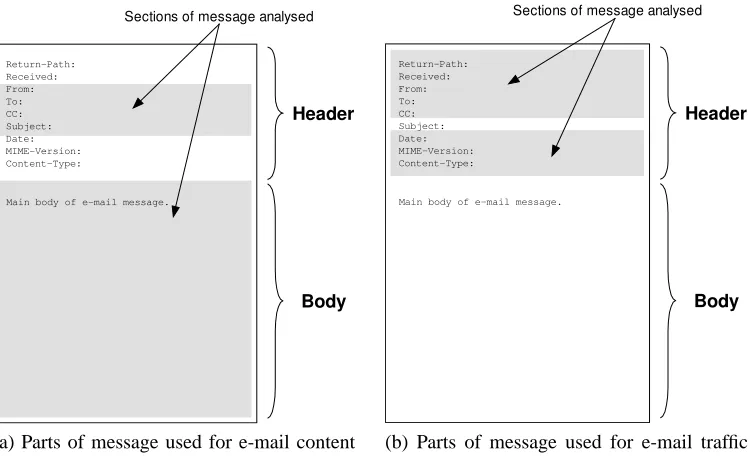
(31) 1.2. INVOLVEMENT OF E-MAIL IN ILLEGAL ACTIVITIES. e-mails, given the increasing amount of e-mail messages received by individuals on a day-to-day basis [18, 20, 21]. The problem that is the subject for this research is the examination of e-mail data belonging to suspected individuals who use e-mail as a means for conducting illegal or criminal activities.. 1.2. Involvement Of E-mail In Illegal Activities. While e-mail may be used in association with lawful activities, there are certain individuals who use e-mail communications as a means in which to help plan, coordinate, or conduct illegal activities. The possible use of e-mail by such individuals is due to a number of features of e-mail, which make it a convenient method of communication to aid with illegal activities. Firstly, e-mail has a global reach, meaning that it is easy for an individual to communicate with another person located anywhere around the world. Due to this, there are generally no restrictions that would prevent an individual from using e-mail to communicate across different countries. Secondly, using e-mail is inexpensive since there are no costs for the user to send any number of e-mail messages to other people. This makes it a cheap and cost effective method for individuals involved in illegal activities, since there are no added financial costs for using the technology in comparison to other electronic communication technologies such as mobile phones, where there is usually a charge associated with using the service. Thirdly, e-mail is ideal for direct group communication since it allows the addresses of the intended recipients to be specified as part of the e-mail message header or placed as part of a mailing list. This makes it very quick to send a message directly to a particular group of people. Finally, e-mail allows an individual to remain anonymous since a false name or false identity can be used when subscribing to new e-mail accounts. This allows the individual’s true identity to remain hidden while using e-mail. Thus, the combinations of these features make e-mail a convenient communication medium that could be used to aid certain individuals with conducting illegal activities. Given the possible use of e-mail to aid with illegal activities, there are various types of illegal or criminal activities in which an individual may use computers or information technology, such as e-mail, to aid in performing unlawful acts. These types of activities may be grouped into two categories. The first category is where computers are used as a communications tool to help conduct the crime [22]. The crimes that usually fall into this category are “traditional” crimes, for example: stalking, child sex exploitation, identity theft, financial fraud, and 3.
(32) CHAPTER 1. INTRODUCTION. corporate espionage, which can also be conducted off-line without involving the use of a computer. The crimes that fall into this category may involve the use of e-mail, for example in a case where e-mail has been used to distribute child pornography [23]. The second category is where computers are used as targets for the illegal activity [22]. In this particular category, computer systems are targeted for the purpose of either acquiring information stored on a system without authorization, altering the data stored on the system, or to interfere with the availability of the computer or server. Again, e-mail may be involved in these types of crimes, for example where an e-mail server is attacked by being overwhelmed by an unusually large number of e-mail messages, causing it to stop functioning properly [24]. In either situation where computers or information technology is involved with the conduct of illegal or criminal activity, there are usually traces of data left on the computer system that leaves a record of the activity that has occurred. These traces of data can be used as important evidence to prove that a suspected individual has been involved with the conduct of unlawful activity. The use of such evidence is required by law enforcement agencies when investigating cases of illegal or criminal activity.. 1.3. Investigation of Suspected Individuals. In the criminal justice process, law enforcement agencies are involved in the role of investigating cases of illegal or criminal activities [25, 26]. As part of investigations, physical or electronic evidence is usually obtained for analysis to determine whether particular suspects have been associated with committing criminal offences. After investigation, law enforcement agencies then decide whether a case should be followed on by further actions. These actions may involve either an arrest of the suspect or summoning the suspect before a magistrate or judge, and then laying criminal charges against the suspect [25]. During investigations by law enforcement agencies, a process called “forensics” is used to collect, extract, and analyse evidence associated with a case of illegal or criminal activity. Forensics applies various scientific methods or techniques to help reconstruct the series of events that have occurred in relation to a crime [22, 27]. The purpose of the process is to obtain a more complete understanding of the unlawful activity that has occurred, in order to link a suspect to a crime using the available trace evidence [22]. 4.
(33) 1.3. INVESTIGATION OF SUSPECTED INDIVIDUALS. 1.3.1 Computer Forensics In investigations where electronic evidence is involved, law enforcement agencies rely on the processes of “forensic computing” or “computer forensics” to examine the activities of suspected individuals. This process draws upon methods and techniques from a range of disciplines (e.g. software engineering, cryptography, electronic engineering, and data communications), and involves the application of information technology to search for electronic evidence [28]. Computer forensics has been defined by [28] as: “the process of identifying, preserving, analysing and presenting digital evidence in a manner that is legally acceptable”. Computer forensics comprises of four key elements, as described by [28]: • Identification of digital evidence - This is the first step in the forensic process, which involves identifying what type of evidence is present and knowing what type of information is stored on a computer system or electronic device. • Preservation of digital evidence - This is a crucial part of the forensic process, whereby any examination of the electronic data is to be carried out in the least intrusive manner (i.e. minimising changes to the original data). This is important given the likelihood of judicial scrutiny of the evidence in a court of law. Any alteration of the data that is of evidential value must be accounted for and justified. • Analysis of digital evidence - This step involves the extraction, processing and interpretation of digital data. The product of the analysis step is information interpreted from the data that is understandable by humans. • Presentation of digital evidence - The final step of the forensic process is the actual presentation of the evidence in a court of law. Computer forensics is becoming an increasingly important part of forensic examinations carried out by law enforcement agencies. This is because of the increasing pervasiveness of computers and information technology into people’s daily lives and also people’s increasing reliance on the Internet for various services [29]. Due to this, law enforcement agencies have to be able to deal with the increasing body of electronic evidence associated with investigations.. 5.
(34) CHAPTER 1. INTRODUCTION. E-mail Investigations For investigation of crimes involving e-mail, it firstly needs to be determined by computer forensic investigators whether e-mail use was involved in the illegal or criminal activity concerned [30]. For example, in a possible case of child pornography distribution, it needs to be determined whether the suspected individual used e-mail to send and share child pornography images. This is an important step to consider, given there needs to be a clear reason for examining e-mail data to use it as evidence to prove a suspect’s involvement in a crime. Once it has been determined that e-mail use was involved, the next step in the investigation is for investigators to obtain access to the computers or electronic devices that store the e-mail data [30]. There are a variety of places where e-mail data may be stored. E-mail data may reside on the computers or electronic devices used by the suspect, for example: their desktop computer, laptop computer, or mobile phone. Other places where e-mail data may be stored is on the Internet Service Provider’s e-mail servers. These are possible sources of e-mail data storage that law enforcement agencies may need to search in order to access, obtain, and seize e-mail data as evidence of the crime. After seizure and preservation of the original e-mail data, the next step in the investigation is analysis of the e-mail data. There have been only few publications that describe the exact tools or techniques used by law enforcement agencies to analyse e-mail data. This is due to the fact that law enforcement agencies avoid the disclosure of methods used for computer forensic analysis [31]. What is known however, is that there are a wide variety of commercial “off-the-shelf” software products that may be used to perform forensic analysis of e-mail data [30]. Despite this, it is still important to consider the tools and techniques used to analyse e-mail data, given that there is still a need by law enforcement to develop better tools and techniques to help analyse electronic data [31]. Also, there is a need for methods that enable law enforcement investigators to search through massive amounts of data to locate vital evidence associated with a crime [31]. Thus, this is where one can consider the different types of e-mail analysis methods available that may be utilised for examining a suspected individual’s e-mail data.. 6.
(35) 1.4. E-MAIL ANALYSIS METHODS. 1.4. E-mail Analysis Methods. E-mail data in its original text format contains a great deal of information that can be examined to provide useful knowledge about patterns of communication occurring between e-mail users. However, human analysis of e-mail data in its original text format is an extremely difficult and time consuming task, given the large amounts of data that may be involved. This is where e-mail analysis methods can be utilised for the examination of e-mail data, in order to aid in extracting information on meaningful patterns or features hidden in the data. There are two types of e-mail analysis methods that may be employed to examine e-mail data for computer forensic purposes: e-mail content analysis and e-mail traffic analysis. Both of these methods provide different ways of analysing the data, and extract different types of information about the communication activities of individuals using e-mail. These methods also use different parts of an e-mail message for analysis, as shown in Figure 1.1. Sections of message analysed. Sections of message analysed. Return-Path: Received: From: To: CC: Subject: Date: MIME-Version: Content-Type:. Return-Path: Received: From: To: CC: Subject: Date: MIME-Version: Content-Type:. Header. Header. Main body of e-mail message.. Main body of e-mail message.. Body. Body. (a) Parts of message used for e-mail content analysis.. (b) Parts of message used for e-mail traffic analysis.. Figure 1.1: The parts of an e-mail message that are used for content and traffic analysis.. 1.4.1 E-mail Content Analysis E-mail content analysis is defined here as a type of analysis method that extracts information related to the textual content of messages sent by e-mail users. The purpose of this form of analysis is to obtain useful information about the patterns 7.
(36) CHAPTER 1. INTRODUCTION. or features associated with the use of words entered into e-mail messages. There are various parts of an e-mail message that can be examined for content analysis, such as the Subject, To, From, and Body fields [32, 33, 34]. Each of the fields used for e-mail content analysis are highlighted in Figure 1.1(a). Based on the text information contained in each e-mail message, e-mail content analysis techniques are able to analyse for particular patterns or features related to the linguistic characteristics of the text used in the e-mail messages. The techniques used to extract this information come from areas such as text mining [35], natural language processing (NLP) [36], or statistics. Techniques in each of these areas provide different ways of examining the content-based information contained in e-mail. Some brief examples of approaches that have been proposed for analysing e-mail content are: analysis of user topic interests [37], analysis of an individual’s word usage patterns [38], message thread analysis [39], and authorship analysis [40]. The use of e-mail content analysis for computer forensic analysis of e-mail data offers a number of advantages compared to human analysis of individual e-mail messages. One of these is that the techniques used for e-mail content analysis enable the forensic analyst to identify patterns of word usage or particular linguistic features in e-mail messages, which would otherwise be unnoticed by the analyst. Another advantage is that content analysis offers a method of summarising or overviewing the textual content of e-mail messages without requiring the analyst to examine each individual e-mail message. However, there are certain drawbacks that limit the use of e-mail content analysis. Firstly, if the body of certain e-mail messages is encrypted, then content analysis techniques will be unable to extract any information about what is contained in the main body of those messages. This defeats the purpose of e-mail content analysis and provides another problem for the analyst in terms of needing to break the encryption if the text content of the encrypted message is to be analysed. Another drawback is that content analysis techniques mainly focus on the textual content of e-mails, but provide little information about other characteristics such as time-based information or the presence of attachments. This limits the use of e-mail content analysis from analysing other types characteristics that may be present in e-mail data. While these are drawbacks limit the use of e-mail content analysis in these situations, e-mail traffic analysis is another type of method that can be considered for analysing e-mail data.. 8.
(37) 1.4. E-MAIL ANALYSIS METHODS. 1.4.2 E-mail Traffic Analysis E-mail traffic analysis is defined here as a type of analysis method that extracts information related to the transit and delivery of e-mail messages sent by e-mail users. The main purpose of e-mail traffic analysis is to obtain useful information about the exchange of messages between e-mail users and the types of messages sent, without examining the content of the e-mail messages. The information examined for traffic analysis is derived from the header section of e-mail messages, given that the header contains fields related to the transport of e-mail [9]. The header fields that can generally be used for traffic analysis are those related to the sender, recipient, and date/time information [4] (e.g. From, To, CC, BCC, and Date fields). Other header fields such as Content-Type, may be used for traffic analysis to provide other types of information about the e-mail messages (e.g. the presence of attachments or the types of attachments being sent) [3]. A header field that is generally not used for traffic analysis the Subject field, since it provides user specified information related the content of e-mail messages. Examples of header fields that can be used for traffic analysis are illustrated and highlighted in Figure 1.1(b). Using the information contained in e-mail message headers, traffic analysis techniques are able to analyse for patterns or features associated with the communication interactions occurring between e-mail users. The techniques that can be used for e-mail traffic analysis come from a variety of areas, including: statistics, visualisation, and artificial intelligence. Techniques from each of these areas enable particular types of traffic information to be obtained about the individuals using e-mail. Some brief examples of types of information that can be extracted from e-mail using traffic analysis methods are: the usage patterns of individual e-mail users [41, 42], the interaction behaviour between an e-mail user and their contacts [2], and the connections emerging from interactions between groups of e-mail users [43, 44]. The application of e-mail traffic analysis for computer forensic purposes offers a number of benefits in comparison to human analysis of individual e-mail messages and e-mail content analysis. One of these benefits is that e-mail traffic analysis provides a way of overviewing the interactions occurring between email users and enable the observation of events that occurred as a result of email exchanges between e-mail users. This may provide useful information for forensic analysts, given that they need to obtain information from the data that allows the reconstruction of events associated with a crime. The second benefit 9.
(38) CHAPTER 1. INTRODUCTION. of e-mail traffic analysis is that it enables the identification of patterns of interaction occurring between e-mail users, which would otherwise be unnoticed by the analyst when examining individual e-mail messages. Finally, in comparison to e-mail content analysis, e-mail traffic analysis techniques are not hindered by the presence of encrypted e-mails, since traffic analysis focuses on the transit and delivery of e-mail messages rather than its contents. Although there are benefits of using e-mail traffic analysis techniques, there are also some problems that make it difficult to apply traffic analysis techniques in certain situations. The first of these is the use of fake or falsely generated e-mail addresses by certain individuals, in order to hide their true identity and the origin of where their e-mails are sent from. This can be done by the individual sending e-mails through anonymous remailers, which are able to conceal the sender’s true identity from the recipient [45]. The use of such tactics can cause problems for e-mail traffic analysis techniques, since it is dependent on knowing the identity of the sender and recipient addresses, and also how e-mail messages are being transported through the Internet. The second problem is knowing whether certain e-mail accounts belong to a particular individual. While traffic analysis techniques are able to examine the patterns of communications associated with interactions between e-mail users, it is still difficult to determine whether certain e-mail accounts are associated with a particular individual. This problem is due to the fact that an individual may use multiple e-mail accounts and also by the fact that the e-mail addresses used by individuals do not necessarily represent the individual’s real identity. It is still yet to be determined whether e-mail traffic analysis techniques are able to accurately identify a particular individual from their e-mail traffic communication activity. Overall, while e-mail content analysis and e-mail traffic analysis provide different methods of analysing e-mail data, the use of these methods may not necessarily have to be mutually exclusive. E-mail content analysis techniques may be used alongside e-mail traffic analysis techniques, in order to provide wider coverage about the communication activities of the individuals using e-mail. This approach may prove to be useful, given that the combination of both analysis methods could be used to overcome limitations that exist when using these methods individually. However, to determine the practical application of e-mail content and e-mail traffic analysis methods for computer forensic purposes, one needs to consider the current difficulties faced by law enforcement agencies in analysing e-mail data.. 10.
(39) 1.5. DIFFICULTIES ASSOCIATED WITH ANALYSING E-MAIL DATA. 1.5. Difficulties Associated With Analysing E-mail Data. Law enforcement agencies currently face a number of challenges associated with the investigation of electronic evidence [46]. The reports by [29, 31] highlight a range of problems related to the investigation of crimes involving the use of computers and information technology. Some of the problems identified by [29, 31] are particularly relevant to the analysis of e-mail communications data. Each of these problems are described below.. Knowing Where To Look For Evidence Firstly, there is the problem of sifting through large amounts of data to search for evidence indicating the occurrence of illegal or criminal activities, hence the proverbial term: “finding the needle in the haystack”. The large amounts of electronic data collected for investigation makes it a difficult and time consuming task to analyse the data for evidence of unlawful activities. Knowing where to begin searching for vital evidence of such activities is a task which may become insurmountable for investigators [31].. Anonymity and Traceability Another problem is the ability of individuals to remain anonymous and difficult to trace when using the on-line environment [29]. On the Internet, individuals can use false names or provide false identification to sign up for new e-mail accounts (e.g. signing up for free web-based e-mail accounts such as Hotmail or Yahoo Mail). Along with the use of false information for e-mail accounts, individuals may also use multiple e-mail accounts, which makes it difficult to determine how many e-mail accounts are used by a particular individual and to confirm the e-mail accounts that belong to the same individual. In terms of traceability, it is also possible that some individuals may use anonymous remailer servers to hide the source and destination addresses of their e-mail messages, making it difficult to trace the path travelled by those messages [45, 47]. Thus, these problems associated with anonymity and traceability makes it difficult to accurately identify and locate possible suspects in the data.. 11.
(40) CHAPTER 1. INTRODUCTION. Encryption of Data One of the major difficulties faced by law enforcement is the possibility of electronic data and communications being encrypted, meaning that offenders can keep information secure from outside perusal [29, 31]. This makes it difficult for law enforcement agencies to examine electronic evidence, given that this can hinder investigation efforts due to the additional effort and cost associated with cracking the encryption [29]. Encryption is a problem relevant to e-mail communications, given that e-mail messages can be sent as encrypted messages [48]. In the case of e-mail encryption, the message content is scrambled to prevent people other than the sender and intended recipient from reading the e-mail message.. Development of Better Tools to Analyse The Data The final problem relevant to the analysis of e-mail data is the availability of tools that aid with analysing electronic evidence. It has been noted by [31] that law enforcement require the need to develop or obtain their own tools and techniques in order to better deal with the difficulties associated with investigating electronic evidence. The use of cutting-edge technology by law enforcement for investigations may prove to be valuable for uncovering useful information about suspected individuals.. 1.6. Problem Statement. This research considers the use of e-mail traffic analysis to examine the e-mail communication activities of a suspected individual. The purpose of the research is to determine how to aid the user or analyst in examining a suspect’s overall changes in e-mail traffic communication behaviour, given the situation where the identity and e-mail addresses of the suspect is already known. The objective of the research is to focus on investigating analysis techniques that can provide useful information about a suspect’s changes in communication behaviour, based on the examination of their e-mail traffic data. The scope of this research is to consider how traffic analysis techniques can be applied during the analysis stage of the computer forensic process. Other stages of the computer forensic process: Identification of digital evidence, Preservation of digital evidence, and Presentation of digital evidence, while still important, are considered to be outside the scope of this research. 12.
(41) 1.7. THESIS CONTRIBUTION AND LAYOUT. In addition to objective set out for the research, this research is to also consider the following problems: • Analysing large data sets: Given the large amounts of e-mail data usually required to be analysed, how does one determine where to start the analysis? What would be the best method of approaching this? • Making the analysis tractable: From the large amounts of e-mail data available, what is the best way of narrowing down the search? What approach can be used to narrow down the amount of data analysed? • Finding particular patterns or features in the data: What type of patterns or features could be used for finding and locating a suspect’s change in email traffic communication behaviour? What will these patterns or features tell the user or analyst about the individual being investigated? • Making sense of patterns, relationships, or features present in the data: What type of analysis techniques can be used to help the user/analyst make sense of hidden patterns, relationships, or features present in the e-mail data? • Helping the user/analyst do their investigation: What is the best approach for allowing the user to carry out their investigation?. 1.7. Thesis Contribution and Layout. This thesis proposes an approach, termed “computational intelligence”, which utilises a combination of computational techniques to provide different viewpoints on a suspected individual’s communication behaviour. This thesis describes how computational intelligence can be used in e-mail traffic analysis to provide useful information and aid with understanding a suspected individual’s overall changes in communication behaviour. The remainder of this thesis is set out as follows: Chapter 2 describes the existing methods used for analysing e-mail traffic behaviour and describes how these methods detect occurrences of unusual or abnormal communication behaviour. Chapter 3 describes the computational intelligence approach and explains the purpose of utilising a combination of computational techniques for analysing e13.
(42) CHAPTER 1. INTRODUCTION. mail traffic behaviour. The chapter then describes the visualisation and feature extraction techniques used in the research for examining e-mail traffic behaviour. Chapter 4 describes the e-mail traffic analysis system developed for the research and how it integrates the visualisation and feature extraction techniques to provide different perspectives on a suspect’s e-mail traffic behaviour. The chapter then describes the e-mail traffic data used for evaluating the e-mail traffic analysis system and how the e-mail traffic analysis system can be used to analyse the data. Chapter 5 presents two sets of case studies that evaluate the e-mail traffic analysis system. The first set of case studies uses simulated e-mail traffic data to evaluate the e-mail traffic analysis system, while the second set of case studies uses data from the Enron e-mail corpus. Finally, Chapter 6 summarises the major contributions of the thesis and discusses suggestions for further studies to extend the research work presented in this thesis.. 14.
(43) Chapter 2 Behaviour Analysis of E-mail Traffic 2.1. Introduction. Behaviour is a term that is used to refer to the overt actions of an individual that can be directly observed by others [49]. Actions such as driving a car or using the Internet, are examples of an individual’s behaviour that be observed by other people. In the analysis of e-mail traffic communications, behaviour relates to a wide variety of observable actions made by individuals or groups of individuals communicating via e-mail. These actions performed by individuals or groups of individuals can reveal information about their patterns of communication as well as information about the level of communication activity occurring between e-mail users. The purpose of this chapter is to review the behaviour analysis methods that have been used for studying e-mail traffic communication behaviour. The behaviour analysis methods reviewed in this chapter generally relate to methods that detect unusual or abnormal communication behaviour, since such methods may have useful applications for law enforcement work. The chapter firstly describes behaviour analysis and how e-mail traffic behaviour has been studied from different levels of analysis. This is then followed by a description of the behaviour analysis methods that have been used for analysing e-mail traffic behaviour, which are grouped into four categories: Individual Behaviour Analysis, Behaviour Comparison Analysis, Clique Behaviour Analysis, and Network Behaviour Analysis. The final part of the chapter then discusses the current limitations with the behaviour analysis methods used for analysing e-mail traffic behaviour. 15.
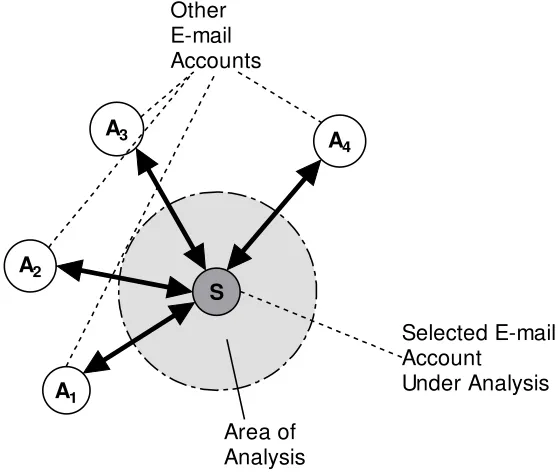
Figure
![Figure 2.4: Example of the frequency table and histogram used for the RecipientFrequencies method [1], with kind permission of Springer Science and BusinessMedia.](https://thumb-us.123doks.com/thumbv2/123dok_us/8437227.333441/48.595.75.453.73.383/example-frequency-histogram-recipientfrequencies-permission-springer-science-businessmedia.webp)
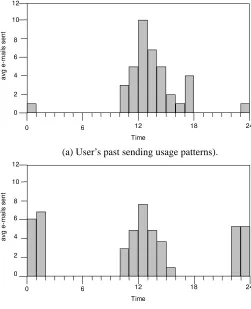
+7
![Figure 2.6: Example of the rolling window approach used to detect variations inrecipient frequencies [2] c⃝ACM, Inc](https://thumb-us.123doks.com/thumbv2/123dok_us/8437227.333441/51.595.193.465.353.591/figure-example-rolling-window-approach-variations-inrecipient-frequencies.webp)
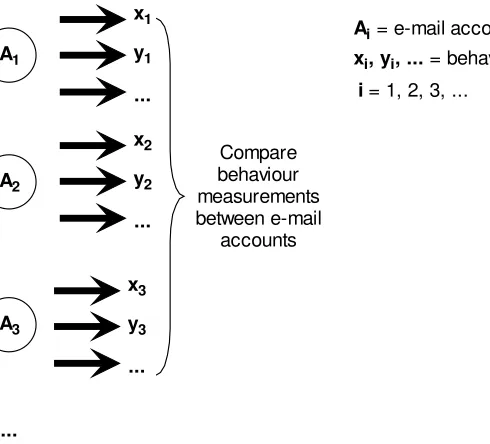
![Figure 2.10: Concept map of the 15 behavioural features defined by [3].](https://thumb-us.123doks.com/thumbv2/123dok_us/8437227.333441/56.595.74.449.71.317/figure-concept-map-behavioural-features-dened.webp)
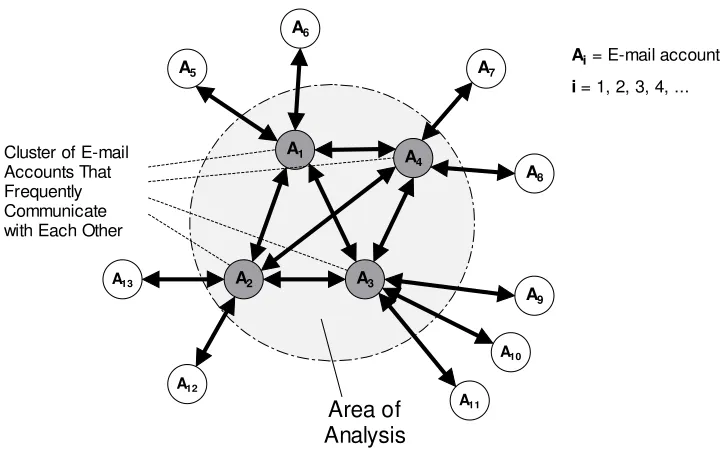
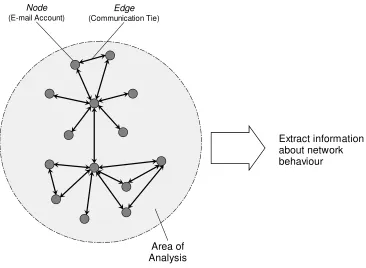
![Figure 2.15: Diagram showing the hidden group’s e-mail traffic communicationand structure, based on the diagrams originally drawn by [4].](https://thumb-us.123doks.com/thumbv2/123dok_us/8437227.333441/64.595.77.430.297.564/figure-diagram-showing-trafc-communicationand-structure-diagrams-originally.webp)
Related documents
Chapter 2 - A Four-Plex Real-Time PCR Assay, Based on rfbE, stx1, stx2, and eae Genes, for the Detection and Quantification of Shiga toxin-producing Escherichia coli O157 in Cattle
early treatment cessation (discontinuation) or intermittent missed doses (suboptimal dosing
Whether the need is to control one of the application categories such as P2P, social networking or a more general application visibility and control requirement, the Palo Alto
two regions highlighting the different evolution of agricultural development, pricing policies, foreign trade and macro-economic policy styles, the role of informal
We expect consumers to place more value on assurances that reduce information asymmetry with respect to quality assurance attributes relative to a simple ex post
such as express contract, contract implied in fact, contract implied in law, quantum meruit, and constructive trust. 1995); Western States Construction, Inc. Decisions in many of
For the subsequent events, while significant ARs and CARs were not found for most firms, Devro Plc, a sausage casting producer, recorded a 0.128 CARs over the 3 day event window of
The state must assure that in the interest of advancing transparency and providing Oregon Health Plan enrollees with the information necessary to make informed choices, the
