AN EXPLORATORY STUDY OF LEADER-MEMBER
EXCHANGE IN CHINA, AND THE ROLE OF GUANXI IN THE
LMX PROCESS
A Dissertation submitted by Gwenda Latham, MBA
For the award of Doctor of Philosophy
ii
KEY WORDS
Leader-member exchange (LMX) Affect
Loyalty Contribution
Professional respect
Guanxi
Lun
Perceived similarity Perceived liking
Perceived subordinate performance Subordinates‟ perspective
iii
This thesis investigated how guanxi was related to exchange relationships between supervisors and subordinates in China. Since guanxi is a relationship-based phenomenon and extends into all levels and domains of Chinese society, it was argued that it would be associated with the relationships that were established between supervisors and subordinates.
This thesis used a model of both supervisors‟ and subordinates‟ perspectives of leader member exchange (LMX) and the impact of guanxi on those relationships. The thesis replicated some established relationships, and then added to the literature by providing an elaboration of how guanxi is related to LMX through its different dimensions. A multi-dimensional approach to LMX and a differential behaviours approach to guanxi were used to test hypotheses.
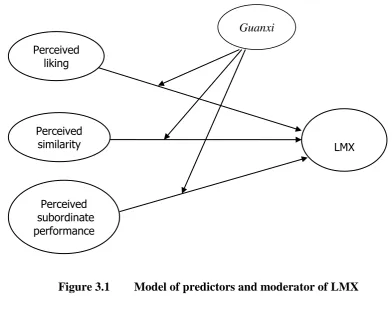
In order to establish guanxi’s influence on leadership relations in China, this thesis used LMX as the dependent variable, which was measured using the multi-dimensional LMX-MDM scale. The thesis first tested the variables of perceived similarity, perceived liking and perceived subordinate performance as antecedents of LMX, since previous research in western countries had found them to be predictors of LMX (Engle & Lord 1997; Kacmar et al. 2009; Liden et al. 1993). Guanxi was introduced as a moderating variable, since it was hypothesized that it would
influence the relationships between the three predictor variables and LMX-MDM. Data were collected from five manufacturing organizations in the Jiangmen region of southern China. Both supervisors and subordinates responded to the questionnaire. The sample comprised 284 supervisor-subordinate dyads.
Correlation and hierarchical regression analyses of the data were conducted in order to test hypotheses concerning the moderating role of guanxi in the relationships between supervisors and subordinates.
The results showed that all predictor variables had positive relationships with LMX-MDM, but that these results differed according to the different dimensions of LMX-MDM that were used as dependent variables. Guanxi as a moderator had the greatest impact on the loyalty and contribution dimensions of LMX-MDM.
The results differed between supervisors‟ and subordinates‟ perspectives. While
guanxi had a direct positive effect on all dimensions of LMX-MDM from the supervisor‟s perspective, it had a direct effect on only two dimensions from the subordinates‟ perspective.
iv undertaken.
The thesis was the first study that combined multi-dimensional LMX theory with the impact of guanxi on LMX in China. The thesis showed how LMX manifests itself in China and how the indigenous practice of guanxi influences the supervisor-subordinate exchange relationship. It showed that guanxi was a positive force in relationships between supervisors and subordinates, but that the positive impact was reflected through different dimensions of LMX, and to varying degrees between dimensions of LMX. It therefore revealed the importance of using a multi-dimensional, rather than uni-multi-dimensional, measure of LMX. It demonstrated that supervisors and subordinates had different views of LMX, and different attitudes towards the impact of guanxi in their dyadic relationships. It therefore highlighted the importance of taking both supervisor and subordinate perspectives when
leadership relations are the focus of research. This implies that theory development requires a dual perspective approach towards LMX and a multi-dimensional
v
I certify that the ideas, experimental work, results, analyses, software and conclusions reported in this dissertation are entirely my own effort, except where otherwise acknowledged. I also certify that the work is original and has not been previously submitted for any other award, except where otherwise acknowledged.
______________________________ ________________
Signature of Candidate Date
ENDORSEMENT
______________________________ ________________
Signature of Supervisor/s Date
vi
Like all others who have gone down this path, I owe thanks to many people. Dr Raymond Gordon, my principal supervisor, provided a combination of
professionalism and friendliness that was just right. He was responsive to my questions, and always took the approach of planting suggestions for me to mull over rather than insisting that I do this or do that. I appreciated his thorough approach and his manner of prodding at those times when my work was lacking depth. And to my associate supervisor, Dr Dennis Rose, I also owe thanks. His support, friendliness and incisive comments made for a productive and pleasant relationship.
To Dr Eva Khong, who helped me in immeasurable ways, I offer special thanks. She used her own guanxi in order to help me make contact with companies in China. She took a great deal of time in helping to set up my data collection, she introduced me to her mainland Chinese contacts who were essential to the success of the data collection, she assisted with translation, and generously offered help and support. To that I have to add warmth and friendliness from one to whom I will always be
grateful. To Director Li, I also give my thanks for making arrangements with his business contacts for me to visit their organizations in China and to collect data. This help, the dinners that he hosted, the exchange of gifts and social interaction truly epitomized guanxi in action.
To my husband Denis, more thanks. He was always supportive, even when it meant lonely nights for him. Practical and helpful as always, he even double checked the thousands of entries of my data!
vii
KEY WORDS ... ii
ABSTRACT ... iii
CERTIFICATION OF DISSERTATION ... v
ACKNOWLEDGEMENTS ... vi
TABLE OF CONTENTS ... vii
LIST OF FIGURES ... xii
LIST OF TABLES ... xiii
CHAPTER 1 INTRODUCTION ... 1
1.1 Background to the research ... 1
1.2 Research problem ... 4
1.2.1 Major bodies of theory ... 4
1.2.2 Research sub-questions ... 6
1.3 Justification for the research ... 6
1.3.1 Theoretical contribution ... 8
1.3.2 Practical contribution ... 9
1.4 Methodology ... 9
1.5 Outline of the thesis ... 10
1.6 Definitions ... 11
1.7 Delimitations of scope and key assumptions ... 12
1.8 Publication from thesis ... 12
viii
2.1 Introduction ... 14
2.2 Traditional leadership theories ... 14
2.3 Social exchange theory as foundation of LMX ... 15
2.4 Role theory as foundation of LMX... 16
2.5 Development of LMX theory ... 16
2.5.1 VDL theory – the forerunner to LMX ... 16
2.5.2 LMX as a relationship quality continuum ... 17
2.5.3 Development of process oriented models of LMX ... 17
2.6 LMX and organizational outcomes ... 19
2.7 Measurement of LMX ... 19
2.8 Dimensions of LMX ... 20
2.8.1 Theoretical justification for a multi-dimensional approach towards LMX ... 20
2.8.2 Empirical justification for a multi-dimensional approach towards LMX ... 22
2.9 Theoretical background and development of LMX-MDM ... 22
2.10 LMX-MDM as an overall measure of LMX... 24
2.11 LMX-MDM as a multi-dimensional measure of LMX ... 25
2.12 Perspectives of LMX... 29
2.13 LMX in China ... 29
2.14 Antecedents of LMX ... 31
2.14.1 Perceived similarity as antecedent of LMX ... 31
2.14.2 Perceived liking as antecedent of LMX ... 36
2.14.3 Perceived subordinate performance as antecedent of LMX ... 39
2.15 Guanxi ... 42
2.15.1 Origins of guanxi ... 43
2.15.2 Confucianism and guanxi ... 43
ix
2.15.6 Particularistic guanxi versus differential behaviours guanxi ... 47
2.15.7 Measurement of guanxi ... 49
2.15.8 Guanxi and LMX ... 50
2.16 Conclusion ... 55
CHAPTER 3 METHODOLOGY ... 56
3.1 Introduction ... 56
3.2 Justification for the methodology ... 56
3.3 Justification for the individual level of analysis ... 58
3.3.1 Theoretical justification for the individual level of analysis ... 58
3.3.2 Empirical justification for the individual level of analysis ... 59
3.4 Research procedures ... 60
3.4.1 Sample ... 60
3.4.2 Data collection method ... 62
3.4.3 Materials ... 62
3.4.3.1 Subordinates‟ questionnaire ... 62
3.4.3.2 Supervisors‟ questionnaire ... 67
3.4.4 Ethical clearance ... 69
3.4.5 Development of questionnaires ... 69
3.4.6 Sampling strategy and procedure ... 69
3.4.7 Ethical considerations ... 70
3.4.8 Data analysis techniques used ... 71
3.5 Conclusion ... 72
CHAPTER 4 RESULTS ... 73
4.1 Introduction ... 73
4.2 Significance of tests ... 73
4.3 Data screening ... 73
4.3.1 Missing data ... 74
x
4.3.5 Multicollinearity ... 75
4.3.6 Normality, linearity and homoscedasticity ... 75
4.4 Descriptive statistics ... 76
4.5 Correlations ... 77
4.6 Hypothesis testing ... 85
4.6.1 Perceived similarity, perceived liking, perceived subordinate performance, guanxi and overall LMX-MDM ... 85
4.6.2 Perceived similarity, perceived liking, perceived subordinate performance, guanxi and the LMX-MDM dimension of affect ... 90
4.6.3 Perceived similarity, perceived liking, perceived subordinate performance, guanxi and the LMX-MDM dimension of loyalty ... 95
4.6.4 Perceived similarity, perceived liking, perceived subordinate performance, guanxi and the LMX-MDM dimension of contribution ... 100
4.6.5 Perceived similarity, perceived liking, perceived subordinate performance, guanxi and the LMX-MDM dimension of professional respect ... 105
4.7 Conclusion ... 110
CHAPTER 5 DISCUSSION ... 111
5.1 Introduction ... 111
5.2 The research question re-visited... 113
5.3 Perceived similarity, perceived liking, perceived subordinate performance, guanxi and overall LMX (Hypotheses H1a, H2a, H3a, H4a, H5a, H6a) ... 114
5.4 Perceived similarity, perceived liking, perceived subordinate performance, guanxi and the LMX-MDM dimension of affect (Hypotheses H1b, H2b, H3b, H4b, H5b, H6b) ... 117
5.5 Perceived similarity, perceived liking, perceived subordinate performance, guanxi and the LMX-MDM dimension of loyalty (Hypotheses H1c, H2c, H3c, H4c, H5c, H6c) ... 120
xi
respect (Hypotheses H1e, H2e, H3e, H4e, H5e, H6e) ... 125
5.8 Overall conclusions ... 127
5.9 Implications for theory ... 127
5.10 Implications for practice ... 128
5.11 Limitations ... 129
5.12 Further research ... 130
5.13 Conclusion ... 131
REFERENCES ... 132
APPENDIX A – SUBORDINATES’ QUESTIONNAIRE ... 162
APPENDIX B - ADJUSTED PERCEIVED SIMILARITY SCALE (SUBORDINATE) ... 168
APPENDIX C - ADJUSTED LMX-MDM SCALE (SUBORDINATE) ... 169
APPENDIX D – SUPERVISORS’ QUESTIONNAIRE ... 170
APPENDIX E - ADJUSTED PERCEIVED SIMILARITY SCALE (SUPERVISOR) ... 176
APPENDIX F - ADJUSTED LMX-MDM SCALE (SUPERVISOR) ... 177
xii
xiii
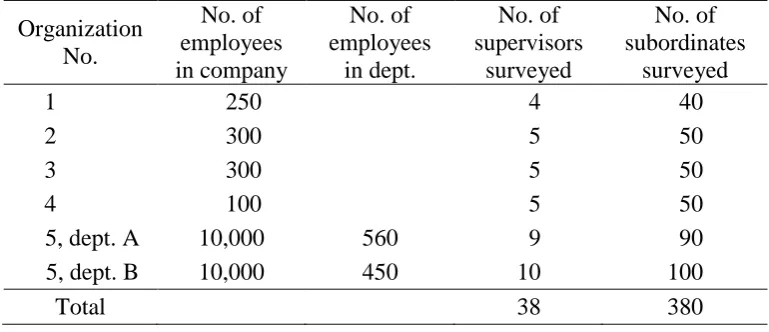
Table 3.1 Number of supervisors and subordinates from five manufacturing enterprises ... 61 Table 4.1 Descriptive statistics of measured variables from subordinates'
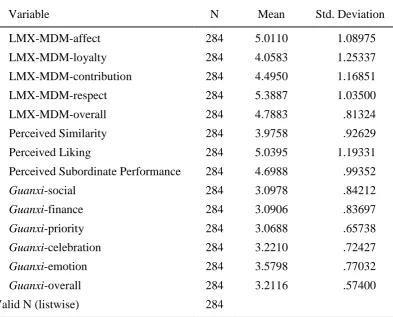
perspective ... 76 Table 4.2 Descriptive statistics of measured variables from supervisors'
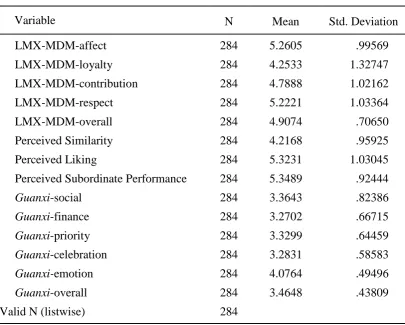
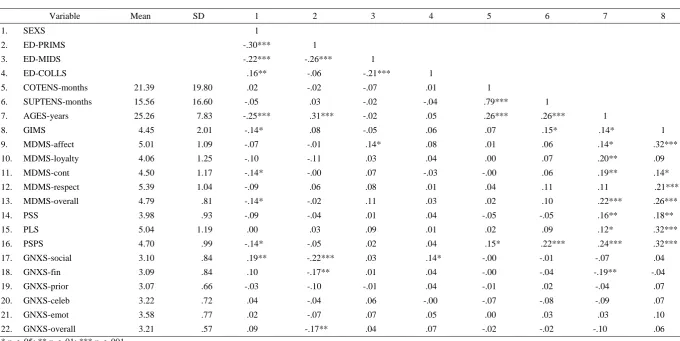
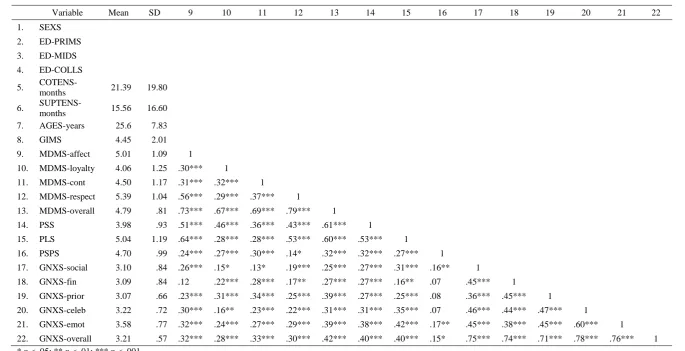
perspective ... 77 Table 4.3 Means, standard deviations and correlations for study variables
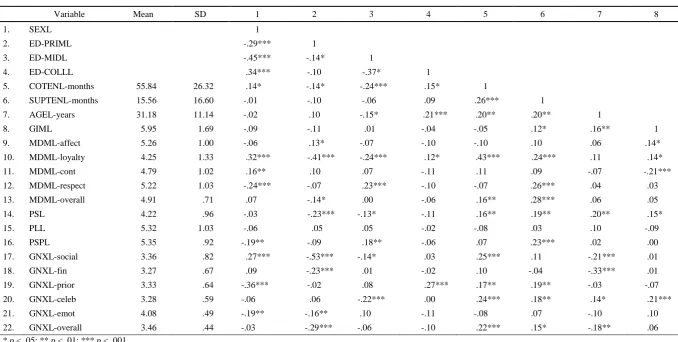
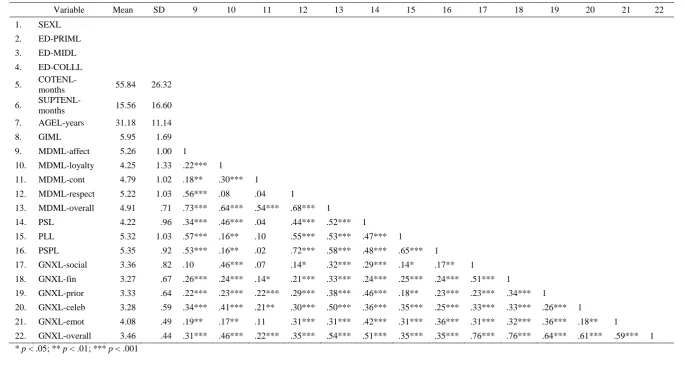
(subordinates‟ perspective) ... 78 Table 4.4 Means, standard deviations and correlations for study variables
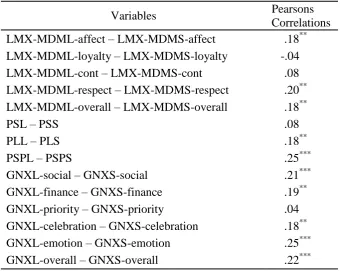
(supervisors‟ perspective) ... 81 Table 4.5 Correlations between supervisors‟ and subordinates‟ ratings of
the same variables ... 84 Table 4.6 Hypotheses tested, with summary of support (S)/non-support (NS)
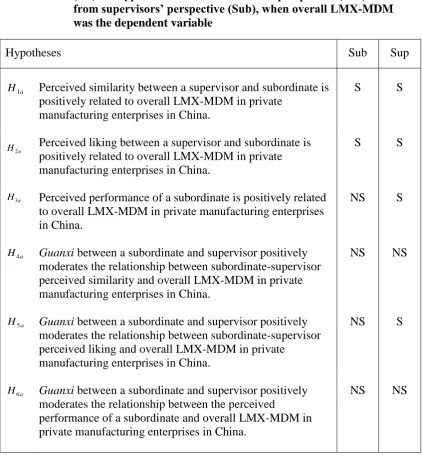
for hypotheses from subordinates‟ perspective (Sub) and from supervisors‟ perspective (Sub), when overall LMX-MDM was the dependent variable ... 86 Table 4.7 Hierarchical regression analysis of LMX-MDMS-overall on
perceived similarity, perceived liking, perceived subordinate performance and the moderator of guanxi (subordinates‟
perspective) ... 87 Table 4.8 Hierarchical regression analysis of LMX-MDML-overall on
perceived similarity, perceived liking, perceived subordinate performance and the moderator of guanxi (supervisors‟
perspective) ... 89 Table 4.9 Hypotheses tested, with summary of support (S)/non-support (NS)
for hypotheses from subordinates‟ perspective (Sub) and from supervisors‟ perspective (Sub), when LMX-MDM-affect was the
dependent variable ... 91 Table 4.10 Hierarchical regression analysis of LMX-MDMS-affect on
perceived similarity, perceived liking, perceived subordinate performance and the moderator of guanxi (subordinates‟
perspective) ... 92 Table 4.11 Hierarchical regression analysis of LMX-MDML-affect on
perceived similarity, perceived liking, perceived subordinate performance and the moderator of guanxi (supervisors‟
xiv
supervisors‟ perspective (Sub), when LMX-MDM-loyalty was
the dependent variable ... 96 Table 4.13 Hierarchical regression analysis of LMX-MDMS-loyalty on
perceived similarity, perceived liking, perceived subordinate performance and the moderator of guanxi (subordinates‟
perspective) ... 97 Table 4.14 Hierarchical regression analysis of LMX-MDML-loyalty on
perceived similarity, perceived liking, perceived subordinate performance and the moderator of guanxi (supervisors‟
perspective) ... 99 Table 4.15 Hypotheses tested, with summary of support (S)/non-support (NS)
for hypotheses from subordinates‟ perspective (Sub) and from supervisors‟ perspective (Sub), when LMX-MDM-contribution
was the dependent variable ... 101 Table 4.16 Hierarchical regression analysis of LMX-MDMS-contribution on
perceived similarity, perceived liking, perceived subordinate performance and the moderator of guanxi (subordinates‟
perspective) ... 102 Table 4.17 Hierarchical regression analysis of LMX-MDML-contribution on
perceived similarity, perceived liking, perceived subordinate performance and the moderator of guanxi (supervisors‟
perspective) ... 104 Table 4.18 Hypotheses tested, with summary of support (S)/non-support (NS)
for hypotheses from subordinates‟ perspective (Sub) and from supervisors‟ perspective (Sub), when LMX-MDM-professional
respect was the dependent variable ... 106 Table 4.19 Hierarchical regression analysis of LMX-MDMS-professional
respect on perceived similarity, perceived liking, perceived subordinate performance and the moderator of guanxi
(subordinates‟ perspective) ... 107 Table 4.20 Hierarchical regression analysis of LMX-MDML-professional
respect on perceived similarity, perceived liking, perceived subordinate performance and the moderator of guanxi
An exploratory study of leader-member exchange in China, and the role of guanxi in the LMX process
1
INTRODUCTION
1.1 Background to the research
China is a country which has been through tremendous societal changes, and which is rapidly industrializing (OECD 2010). The changes might lead observers to think that China is becoming more westernized and is casting off its traditional norms and practices. However, there is a paradox in Chinese society: capitalism is being embraced, while at the same time, Confucian-based cultural values and established behavioural norms remain very strong (Guo & Miller 2010; Hofstede & Bond 1988; Ralston et al. 1995; Ralston et al. 2008).
The philosophy of Confucianism is that man is a relational being, and that a person cannot be considered in isolation from his relationships (Bond & Hwang 1986; Redding 1990). People adopt multiple standards of behaviour for interactions with different people at different hierarchical levels of society. The honouring of role requirements ensures that social stability is maintained (Bond & Hwang 1986; Warner & Zhu 2002). The phenomenon of guanxi has a strong connection to Confucianism since guanxi involves the establishment and maintenance of relationships. The relationships of guanxi involve mutual interest and benefit, reciprocal obligation and indebtedness (Hwang 1987; King 1991; So & Walker 2006). Relationships are regarded as extremely important across all strata of Chinese society, and guanxi ensures that relationships are kept in harmony.
Since guanxi involves relationships, it would be expected to have an impact on the type of relationships that are established at work between people in different hierarchical levels. The leadership theory that considers the supervisor-subordinate relationship is LMX theory. There is thus a hypothesized connection between guanxi
and LMX since both are concerned with relationships.
Effective leadership has been recognized as important for growth and development at all levels of society - national, regional, local and organizational (Barrick et al. 1991; Bass 1997; Carmeli, Gelbard & Gefen 2010; Carmeli,
An exploratory study of leader-member exchange in China, and the role of guanxi in the LMX process
2
The focus in all of the above mentioned theories is on the leader. Subordinates‟ abilities or characteristics may influence the leader‟s style or behaviour, but it is the leader‟s style, actions, motivation, ethics or reactions to situations that determine whether leadership is effective or otherwise. In traditional leadership theories, subordinates exist under a leadership situation, rather than taking an active role in the type of leadership that evolves in an organization. However, since there can be no leaders without followers, it is apparent that, rather than being passive players in the leadership situation, followers may themselves be active contributors to leadership effectiveness.
The leadership theory that reflects the contribution of both leaders and followers to leadership effectiveness is that of LMX, which has at its core the dyadic
relationship between leader and follower. LMX theory holds that leaders establish different relationships with different followers (Dienesch & Liden 1986; Graen & Uhl-Bien 1995).
The origins of LMX lie in the Vertical Dyad Linkage (VDL) model of
leadership (Dansereau, Graen & Haga 1975; Graen & Cashman 1975) in which some subordinates are given a high degree of negotiating latitude while other subordinates are given a low degree of negotiating latitude by their supervisors. This differential treatment by supervisors towards subordinates results in in-groups and out-groups. Those subordinates who become members of the in-group are given more leadership attention, receive more interesting job assignments and are evaluated more
favourably by the supervisor, and hence experience more job satisfaction and have better interpersonal relations with supervisors (Cashman et al. 1976; Dansereau, Graen & Haga 1975). Those subordinates who become members of the out-group are given less responsibility and less interesting work tasks, receive less favourable performance evaluations, and their relations with the supervisor are based on formal exchanges only (Liden & Graen 1980).
The VDL theory evolved into LMX theory in which there is a process of
development of supervisor-subordinate relationships (Dienesch & Liden 1986; Graen & Scandura 1987). This development involves supervisors testing subordinates with certain tasks or assignments. When a subordinate accepts and completes such tasks successfully, the relationship becomes a high-quality exchange relationship
characterized by trust, loyalty and positive work contributions. A low-quality relationship between the supervisor and subordinate is characterized by adherence to the employment contract only.
The VDL theory explained supervisor-subordinate relationships in terms of an in-group/out-group dichotomous classification (Graen & Cashman 1975). The LMX theory explains those relationships in terms of a relationship quality continuum, with relationships varying from high to low quality according to the outcomes of various interactions between supervisors and subordinates.
An exploratory study of leader-member exchange in China, and the role of guanxi in the LMX process
3
relationship can be built on one, two or all three dimensions, resulting in a high-quality or low-high-quality relationship. Building on Dienesch and Liden‟s (1986) work, Liden and Maslyn (1998) identified a fourth dimension, that of „professional respect‟, and developed and validated a multi-dimensional LMX scale which was named LMX-MDM.
Of the various predictors of LMX that have been investigated, perceived similarity, perceived liking and perceived subordinate performance have received support. Perceived similarity is a strong predictor of LMX (Bauer & Green 1996; Bernerth et al. 2008; Engle & Lord 1997; Liden, Wayne & Stilwell 1993;
Schaubroeck & Lam 2002; Suazo, Turnley & Mai-Dalton 2008) whereas
demographic similarity is relatively unimportant in LMX development (Graen & Cashman 1975; Green, Anderson & Shivers 1996; Kacmar et al. 2009; Liden, Wayne & Stilwell 1993; Murphy & Ensher 1999). Perceived liking is a predictor of LMX (Day & Crain 1992; Dockery & Steiner 1990; Kacmar et al 2009; Liden, Wayne & Stilwell 1993; Wayne & Ferris 1990), as is perceived subordinate performance (Bauer & Green 1996; Deluga & Perry 1994; Kim & Organ 1982; Liden, Wayne & Stilwell 1993; Nahrgang, Morgeson & Ilies 2009).
Most of the studies of LMX and its predictors have used the uni-dimensional measure of LMX7 (Graen & Scandura 1987), rather than the multi-dimensional measure of LMX-MDM (Liden & Maslyn 1998). So although the relationships between predictors and overall LMX have been established, when a uni-dimensional LMX measure is used, it is not known through which currencies of exchange those relationships have been developed. A multi-dimensional measure of LMX not only demonstrates the various types of high-quality exchange relationships that may occur, but is also consistent with Role Theory (Graen 1976; Katz & Kahn 1978) and Social Exchange Theory (Blau 1964; Gouldner 1960; Sparrowe & Liden 1997) upon which LMX theory is based.
The LMX-MDM scale not only includes different currencies of exchange, it is the only scale that has an affect component. The previously established relationships between predictors and uni-dimensional LMX may in fact neglect the importance of affect. In the case of the predictors of perceived similarity and perceived liking, there is an established similarity-attraction relationship: an expression by one person of similar opinions to another person results in increasingly positive interactions between the two, and an increase in mutual attraction (Byrne 1971; Byrne & Griffett 1973). In addition, the „halo‟ effect demonstrates that the affective influence of global evaluation on evaluations of specific attributes is strong (Nisbett & Wilson 1977). So it is likely that perceived similarity and perceived liking are predictors of LMX through the affect dimension.
It is also likely that perceived subordinate performance predicts LMX through the dimensions of contribution and professional respect. Perceived subordinate performance refers to the work effort of subordinates, their output, and their degree of competence on the job. It is reasonable to think that these aspects would be reflected in the perception of a dyad partner‟s contribution to the exchange
An exploratory study of leader-member exchange in China, and the role of guanxi in the LMX process
4
Questions regarding the operation of LMX are relevant in China, which is a relationship based society. China has its own particular cultural characteristics that make any study of relationships contingent upon an understanding of those
characteristics and, in particular, the impact of guanxi.
There is a connection between guanxi and LMX, since both involve
relationships - LMX with relationships at work, guanxi with both work and non-work relationships (Law et al. 2000, Wong, CS et al. 2003). Thus, it is likely that guanxi
plays a role in the exchange relationships between supervisors and subordinates because Confucianism dictates that people conduct themselves according to their place in the social order, and observe certain rituals in their interpersonal
relationships. It is therefore likely that the role of guanxi in the LMX process may be that of moderator.
Although there have been studies in China that have validated both the uni-dimensional LMX7 scale and the multi-uni-dimensional LMX-MDM scale (Schaubroeck & Lam 2002; Wang et al. 2005), it is not known how guanxi exerts its influence on LMX, or whether guanxi has a direct or an indirect influence on LMX. In addition, it is not known through which dimensions of LMX guanxi’s impacts are manifested. It may be that the influence of guanxi on LMX is an indirect one through the predictor variables of perceived similarity, perceived liking and perceived subordinate
performance. However, the writer has not found any studies that have examined the role of these antecedents of LMX-MDM in China. There is thus a need for an examination and testing of all such relationships.
1.2 Research problem
The problem addressed in this research is:
To what extent is guanxi related to aspects of the supervisor-subordinate relationship in private manufacturing enterprises in China?
In this thesis, I argue that guanxi is a ubiquitous phenomenon in China that extends into the work context and positively influences the LMX relationship. I further argue that this association is more pronounced for supervisors than for subordinates because the prevailing Confucian influenced culture obliges those in higher hierarchical positions to be generous and kind towards those in inferior positions.
1.2.1 Major bodies of theory
The major bodies of theory which will be covered in chapter 2 are briefly presented here.
An exploratory study of leader-member exchange in China, and the role of guanxi in the LMX process
5
are specifically discussed in this thesis are the uni-dimensional LMX7 scale and the multi-dimensional LMX-MDM scale. When the specific scales are discussed, the two mentioned abbreviations are used. When the theory of leader member exchange is discussed, it is referred to as LMX.
The theory of LMX is the major theoretical basis for this thesis. LMX theory holds that a supervisor establishes different relationships with different subordinates (Dansereau, Graen & Haga 1975; Dienesch & Liden 1986; Graen & Scandura 1987). Some relationships become high-quality, whereby trust, loyalty and extra
consideration characterize the relationship. Other relationships are low-quality and are characterized by adherence to the employment contract only (Dansereau, Graen & Haga 1975; Liden & Graen 1980; Liden & Maslyn 1998).
LMX theory has its foundations in social exchange theory and role theory. Social exchange theory considers that supervisors and subordinates develop interpersonal relationships, and that favourable treatment of a subordinate by a supervisor will result in the subordinates developing a feeling of obligation towards the supervisor (Bateman & Organ 1983; Gouldner 1960). A „norm of reciprocity‟ prevails, which serves to maintain social stability, since there is an implicit
understanding by all parties of the rights and duties involved in reciprocal obligations (Gouldner 1960; Liden, Sparrowe & Wayne 1997).
Role theory takes the position that a person acts in relation to and in response to expectations of others (Kahn et al. 1964; Katz & Kahn 1978). Expectations are communicated in many ways, both directly and indirectly, and are influential in a person‟s behaviour and motivation (Katz & Kahn 1978).
Both social exchange theory and role theory provide support for regarding LMX as a dimensional concept. Dienesch and Liden (1986) developed a multi-dimensional model of LMX in order to reflect the various ways in which exchange relationships could be developed. The „currencies of exchange‟ that they developed were those of affect, loyalty and contribution. Liden and Maslyn (1998) added another dimension - professional respect - in their operationalization of LMX, and created the multi-dimensional LMX-MDM scale. It is the LMX-MDM scale that is used in this thesis because it highlights the different ways that exchange relationships develop, and it acknowledges that all high-quality exchanges are not necessarily the same – they can be based on one or more distinct currencies of exchange.
Role theory and social exchange theory also provide a window into the
An exploratory study of leader-member exchange in China, and the role of guanxi in the LMX process
6
1.2.2 Research sub-questions
1. To what extent is supervisor-subordinate perceived similarity related to the quality of the supervisor-subordinate relationship in private
manufacturing enterprises in China?
2. To what extent is supervisor-subordinate perceived liking related to the quality of the supervisor-subordinate relationship in private
manufacturing enterprises in China?
3. To what extent is perceived subordinate work performance related to the quality of the supervisor-subordinate relationship in private
manufacturing enterprises in China?
4. To what extent does guanxi moderate the relationship between supervisor-subordinate perceived similarity and the quality of the supervisor-subordinate relationship in private manufacturing enterprises in China?
5. To what extent does guanxi moderate the relationship between supervisor-subordinate perceived liking and the quality of the
supervisor-subordinate relationship in private manufacturing enterprises in China?
6. To what extent does guanxi moderate the relationship between perceived subordinate work performance and the quality of the
supervisor-subordinate relationship in private manufacturing enterprises in China? For the above questions, I conclude in this thesis that perceived similarity, perceived liking and perceived subordinate performance contribute to high-quality relationships between subordinates and supervisors in China. I also conclude that the contribution of each is manifested in different aspects of the supervisor-subordinate relationship. A further conclusion is that subordinates and supervisors differ in their perceptions of the relative contributions of perceived similarity, perceived liking and perceived subordinate performance in high-quality relationships. Furthermore, I conclude that guanxi influences the supervisor-subordinate exchange relationship in China in different ways. I argue that although guanxi is a concept based on mutual obligation, supervisors are more likely than subordinates to act upon these
obligations because the Confucian-based culture places responsibility for the welfare of those in inferior positions upon those in superior positions.
1.3 Justification for the research
An exploratory study of leader-member exchange in China, and the role of guanxi in the LMX process
7
Martinsons 1999; Zhang 2004). Since 1980, five Special Economic Zones and a number of Open Coastal Areas have been created. The purpose of these zones and areas is to develop a foreign oriented economy, to develop export industries, to accelerate the infusion of new technology into Chinese industries, and to lead the country in economic development (Yeung, Lee & Kee 2009). In order to achieve these goals, preferential policies for conducting business and investment in the zones and areas have been implemented (The Information Office of Jiangmen Municipal People‟s Government 2005). As a result, very high rates of growth in the Special Economic Zones and Open Coastal Areas have been achieved, and have contributed greatly to China‟s development. In the three decades from 1979 to 2009, China‟s real increase in gross domestic product ranged from 3.8% to 15.2% per annum <http://www.chinability.com/GDP.htm>. Its average annual GDP rate of growth between 1989 and 2011 was 9.3% <http://www.tradingeconomics.com/china/gdp-growth-annual>. The privatization drive and the ongoing reforms since 1978 of state-owned enterprises have generated much interest, resulting in significant research being conducted into the operations and leadership of state-owned
enterprises and foreign joint ventures (Han, Kakabadse & Kakabadse 2010; Li et al. 1999; Liu, Burridge & Sinclair 2002; Selvarajah & Meyer 2008; Smith, Wang & Leung 1997; Wang & Takao 1994; Zhang 2001).
However, there has been little research into leadership within domestic private enterprises in China. Yet it is the domestic private sector that is growing at the most rapid rate. The siying qiye forms of private enterprises in China are those enterprises that are „owned by individuals, employ more than eight people; can take forms of sole proprietorship, partnerships, limited liability companies, shareholding cooperatives‟ (Asian Development Bank 2003, p. 6). Data from the State Administration of Industry and Commerce show that China‟s private enterprises increased from 4.3 million in 2006 to more than 8.4 million at the end of 2010, with an average annual growth rate of 14.3 percent during the period (Xiao 2011). In 2000, 24 million people were employed by the siying qiye (International Finance Corporation 2000). By the end of 2010, that figure had risen to 180 million people employed (Xiao 2011). The private sector is now responsible for 60 percent of Chinese GDP (EAF team, ANU 2010) and is now the engine of growth for the whole of China.
With this pace of development occurring in China, it is tempting to conclude that China is shedding its time-honoured cultural values and leadership practices. However, the reality is that traditional cultural values and practices prevail; the traditional Confucian value of interpersonal competence is still regarded as the most important attribute of a leader (Ling, Chia and Fang 2000). Strongly associated with social and business relations in China is the concept of guanxi, a system of
An exploratory study of leader-member exchange in China, and the role of guanxi in the LMX process
8
guanxi is based on interpersonal relationships, and since LMX is a theory of relationships, there arises an opportunity to explore how these two concepts are related.
Research has yielded significant information about both LMX theory (Day & Crain 1992; Dienesch & Liden 1986; Graen & Uhl-Bien 1995; Liden & Maslyn 1998; Liden, Sparrowe & Wayne 1997; Schriesheim, Castro & Cogliser 1999; Wang, Law & Chen 2008), and the operation of guanxi in China (Chen & Chen 2004; Fu, Tsui & Dess 2006; Hui, Law & Chen 1999; Hwang 1987; Jacobs 1979; Leung, Heung & Wong 2008; Tsui & Farh 1997). However, the writer has not found any study that combines multi-dimensional LMX theory and the impact of guanxi on the
development of multi-dimensional LMX in a Chinese context. The contribution of this thesis will therefore be to establish if and how guanxi is related to LMX in China. An additional contribution of the thesis will be to establish whether the impact of
guanxi is felt through individual dimensions or a combination of individual dimensions of LMX in China.
If this thesis can discover the extent to which guanxi is related to the relationship between supervisors and employees, there are both theoretical and practical outcomes. The understanding of how the LMX theory operates in China, a context different to that in which most of the current LMX research has been
conducted, can be enhanced. Such an insight may be of great practical use, given the rise of China in global commerce and political influence (Ikenberry 2008; Kaplinsky 2006).
1.3.1 Theoretical contribution
This thesis will be the first study that explains the impact of guanxi on different dimensions of LMX in a mainland China context. It will provide an explanation of the role of guanxi in the relationships that develop between supervisors and
subordinates in China. It will show how LMX theory operates in China, a context different to that in which most of the current LMX research has been conducted. It will provide a partial replication and an extension of earlier studies that have investigated LMX in various contexts (for example, the United States, Germany, Turkey, India, the United Kingdom).
It will provide an explanation of how different antecedents contribute to LMX in China through different LMX dimensions. Consequently it will provide justification for the use of a multi-dimensional, rather than uni-dimensional, measure of LMX.
An exploratory study of leader-member exchange in China, and the role of guanxi in the LMX process
9
The thesis will highlight the differences between supervisors‟ and subordinates‟ perceptions of LMX. Consequently, it will provide justification for using the
perspectives of both supervisors and subordinates in LMX research.
The thesis will provide details on the hypothesized interactions between three antecedents and guanxi on LMX. It will be the first study that shows how guanxi
relations are manifested through different dimensions of LMX in China.
1.3.2 Practical contribution
If the extent of guanxi in Chinese private enterprises can be determined, companies can take steps to cultivate appropriate guanxi connections in order to create more effective organizational leadership and thus to achieve desirable
organizational outcomes. And, companies wishing to set up operations in China may then be armed with an understanding of how effective leadership manifests itself and develops in Chinese organizations.
If researchers can determine the impact of guanxi on particular dimensions of LMX, measures taken to develop guanxi can be more specifically focused on those dimensions of more importance. This could be a more cost effective strategy than general measures taken to improve overall LMX.
1.4 Methodology
This thesis uses correlation and regression analyses in order to determine the relationships between predictor variables and an outcome variable within the context of LMX theory, and to assess the impact (if any) of guanxi on those relationships. The analyses are conducted from two perspectives, that of the supervisor and that of the subordinate.
The predictor variables are those of perceived similarity, perceived liking and perceived subordinate performance, all of which previous research has found to be associated with LMX (Bauer & Green 1996; Engle & Lord 1997; Kacmar et al. 2009; Lefkowitz 2000; Liden, Wayne & Stilwell 1993; Nahrgang, Morgeson & Ilies 2009). The outcome variable is LMX, considered as a multi-dimensional construct.
Since it is hypothesized that guanxi has an impact on the strength of the relationships between predictor and outcome variables, guanxi is treated as a
moderating variable. Moderation is tested using the method described by Aiken and West (1991).
An exploratory study of leader-member exchange in China, and the role of guanxi in the LMX process
10
independent variables predict the outcome variable of LMX, and to determine the moderating effect of guanxi in these relationships.
The type of regression analysis used is that of hierarchical regression, which is appropriate when the researcher wishes to determine the relative importance of a predictor variable, over and above the contributions of other predictors, to a criterion variable (Cohen et al. 2003). In this case, prior research has established the
relationships between the three predictors of perceived similarity, perceived liking and perceived subordinate performance and the criterion variable of LMX. By adding the moderator of guanxi to the regression in a sequential manner, it can be determined how much it adds to the criterion variable. Chapter 4 provides further details of the justification for the methodology.
For all analyses, both subordinates‟ and supervisors‟ perspectives are utilized. Meta-analyses have revealed low correlations between supervisor and subordinate perceptions of LMX in those studies that have measured both perspectives (Gerstner & Day 1997; Sin, Nahrgang & Morgeson 2009), indicating that supervisors‟ and subordinates‟ views of LMX diverge significantly. This thesis follows
recommendations by previous researchers (Gerstner & Day 1997; Greguras & Ford 2006; Scandura 1999; Scandura & Schriesheim 1994; Schriesheim, Neider & Scandura 1998) that a dual perspective approach be followed so that the researcher can determine if perceptions are common to both supervisors and subordinates.
The data for this thesis are based on a quantitative cross-sectional survey. The survey instrument was translated into Chinese, and then back-translated, following Brislin‟s (1986) procedure. The survey was administered face to face on the organizations‟ premises. A face to face method was chosen because it was
considered that this would maximize the response rate. In addition, by using a face to face method whereby the respondents handed their completed questionnaires directly to research assistants, it was thought that respondents would be reassured that their responses would be confidential. Chapter 4 provides further details of the data collection.
The findings show the following: 1) perceived similarity, perceived liking and perceived subordinate performance all predict LMX, 2) the influence of the predictor variables differs across the separate dimensions of LMX-MDM, 3) guanxi‟s
moderating role varies between the different dimensions of LMX-MDM, and 4) results differ between subordinates and supervisors.
1.5 Outline of the thesis
An exploratory study of leader-member exchange in China, and the role of guanxi in the LMX process
11
results of the data analysis, while chapter 5 presents a discussion of the findings, as well as implications for theory and practice.
1.6 Definitions
Since researchers often adopt different definitions of the same terms, the key terms are defined below in order to establish the positions taken in this thesis.
Perceived liking – a form of affect that refers to the perceived degree of interpersonal attraction in a relationship (Liden, Wayne & Stilwell 1993).
Perceived similarity – the extent to which a subordinate/supervisor perceives a supervisor/subordinate to be similar to himself or herself (Turban & Jones (1988).
Perceived subordinate performance – the subjective judgment of a subordinate‟s work output and contribution (Chen, Tsui & Farh 2002).
Guanxi- the quality of relationships between two parties formed mainly for
instrumental purposes in fulfilling personal objectives of the parties involved (Wong, CS et al. 2003).
Leader member exchange (LMX) – the quality of the relationship that a supervisor and subordinate develop (Dienesch & Liden 1986).
This thesis adopts the multi-dimensional view of LMX which forms the basis of the LMX-MDM scale of Liden and Maslyn (1998). The four dimensions of the LMX-MDM scale are defined below.
Affect – „the mutual affection the members of the dyad have for each other based primarily on interpersonal attraction rather than work or professional values‟ (Liden & Maslyn 1998, p. 50).
Loyalty – „the expression of public support for the goals and the personal character of the other member of the LMX dyad‟ (Liden & Maslyn 1998, p. 50).
Contribution – „perception of the current level of work-oriented activity each
member puts forth toward the mutual goals (explicit or implicit) of the dyad‟ (Liden & Maslyn 1998, p. 50).
Professional respect – „perception of the degree to which each member of the dyad has built a reputation, within and/or outside the organization, of excelling at his or her line of work‟ (Liden & Maslyn 1998, p. 50).
An exploratory study of leader-member exchange in China, and the role of guanxi in the LMX process
12
1.7 Delimitations of scope and key assumptions
This thesis is limited to the multi-dimensional view of LMX, as represented by the LMX-MDM scale, rather than the uni-dimensional view that dominated research into LMX until the mid-1990s. The multi-dimensional view was employed since both role theory (Kahn et al. 1964; Katz & Kahn 1978) and social exchange theory (Blau 1964; Gouldner 1960), which provide the bases for LMX theory, offer support for regarding LMX as multi-dimensional.
LMX, as measured by the LMX-MDM scale, is the dependent variable, while the predictor variables are limited to perceived similarity, perceived liking and perceived subordinate performance. Research has provided support for these variables as predictors of LMX (Bauer & Green 1996; Lefkowitz 2000; Liden, Wayne & Stilwell 1993).
The moderating variable is guanxi. Guanxi is treated as a concept of differential behaviours among people. Research has provided support for guanxi as a variable that contributes to positive relationships between supervisors and subordinates (Chen, Tsui & Farh 2002; Hui et al. 1998; Wong, Wong & Wong 2010) and to successful organizational operations in China (Warren, Dunfee & Li 2004; Wong & Huang 2003; Xin & Pearce 1996).
The perspectives taken are those of both supervisors and subordinates. Correlations between supervisors‟ and subordinates‟ perceptions of LMX in those studies that have measured both perceptions have been low (Gerstner & Day 1997; Sin, Nahrgang & Morgeson 2009). Since these different perceptions of supervisors and subordinates could be affected by different factors, a dual perspective approach is taken (Gerstner & Day 1997). The leaders in this sample are at the supervisor level, while the subordinates are the immediate subordinates of the supervisors.
The sample was taken from private manufacturing organizations in the Pearl River Delta region of southern China. It was a convenience sample, so the findings are generalizable to the sample, but may not be generalizable to the whole of China. However, given that the sample comprised enterprises that had set up operations in the Special Economic Zone under the government‟s policy initiatives (Jiangmen Municipal People‟s Government 2005), it is reasonable to suggest that the findings might also extend to businesses operating in the other Special Economic Zones of China.
1.8 Publication from thesis
An exploratory study of leader-member exchange in China, and the role of guanxi in the LMX process
13
Latham, G & Gordon, R 2009, „Beware of different guanxi measurements when doing research in China‟, paper presented at the 23rd Australia and New Zealand Academy of Management Conference, Melbourne, December.
1.9 Conclusion
An exploratory study of leader-member exchange in China, and the role of guanxi in the LMX process
14
LITERATURE REVIEW AND HYPOTHESIS DEVELOPMENT
2.1 Introduction
Chapter 1 has argued that the LMX theory of leadership can explain why the same supervisors may have different relationships with different subordinates. It has also argued that perceived similarity, perceived liking and perceived subordinate performance are important influences on exchange relationships. However, previous research has not made clear how perceived similarity, perceived liking and perceived subordinate performance manifest themselves through different components of the exchange relationship. Previous research has generally adopted just one side of the exchange relationship, usually that of the subordinate. However, since there are two sides to the exchange relationship, the perspectives of those two sides ought to be taken into account if a complete understanding of LMX is to be achieved. Chapter 1 has also argued that relationships in China are of critical importance, and that the indigenous concept of guanxi influences all interactions. There is thus a probable connection between LMX and guanxi. Further, there is a need for research to establish if guanxi influences the process of LMX and to examine how individual dimensions of LMX may be influenced by guanxi.
Chapter 2 reviews the literature concerning the early development of VDL theory and its evolution into LMX. The LMX theoretical foundations of social exchange theory and role theory are reviewed, followed by the development of the process oriented models of LMX. LMX measurement issues and associated
problems are also discussed. The development of multi-dimensional empirical work is followed by an explanation of the importance of different perspectives of LMX. This is followed by a review of the LMX antecedents of perceived similarity, perceived liking and perceived subordinate performance. Hypotheses associated with the research are then presented.
Chapter 2 continues with a review of the origins of guanxi and its association with Confucianism. This is followed by a classification of guanxi, and the differing ways that guanxi has been measured. The proposed association between guanxi and LMX is then discussed. Hypotheses associated with the research problem are then presented.
2.2 Traditional leadership theories
An exploratory study of leader-member exchange in China, and the role of guanxi in the LMX process
15
& Graen 1980). This assumption of an average leadership style (ALS) was found in trait theories (Korman 1968; Stogdill 1948) and behavioural theories (Fleishman 1953a, 1953b; Halpin 1954). The focus of these leadership theories was on the characteristics of the leader and how these characteristics determined whether the leader was effective or ineffective (Graen & Uhl-Bien 1995). These theories assumed that the subordinates of a superior were a homogeneous group of individuals, considered generically as the „work group‟, and that the superior behaved in the same manner toward each of the work group members (Dansereau, Graen & Haga 1975).
Fiedler‟s contingency theory (Fiedler 1967, 1972a, 1972b) took the position that a leader‟s most effective style was determined by leader-member relations, task structure and leader position power. The path goal theory of leadership (House 1971; House & Mitchell 1974) described the way that leaders clarified the path for goal achievement by subordinates. Effective leadership was dependent on employee and environmental contingent factors, as well as leadership styles which may be
supportive, directive, participative or achievement-oriented. Both Fiedler‟s contingency theory (Fiedler 1967, 1972a, 1972b) and the path goal theory of
leadership (House 1971; House & Mitchell 1974) shifted the focus from an exclusive concentration on the leader to a consideration of situational factors for effective leadership, but none of those situational factors encompassed individual differences or dyadic relationships.
However, LMX theory takes the view that the same leadership style is not necessarily used with all subordinates, but that the supervisor develops a different relationship with each subordinate (Dansereau, Graen & Haga 1975; Graen &
Cashman 1975; Liden & Graen 1980; Graen, Novak & Sommerkamp 1982; Graen & Scandura, 1987; Liden & Maslyn 1998). It is this LMX differentiation (Liden et al. 2006) that makes LMX theory a radical departure from all previous leadership theories.
2.3 Social exchange theory as foundation of LMX
Social exchange theory (Blau 1964; Gouldner 1960) has provided a major theoretical foundation for LMX. Social exchange theory holds that supervisors develop interpersonal relationships with their subordinates, and that a subordinate who has received favourable treatment will develop a feeling of obligation towards the supervisor (Bateman & Organ 1983; Gouldner 1960). According to the norm of reciprocity (Gouldner 1960), a subordinate who receives support, either tangible or intangible, from their supervisor feels obliged to reciprocate by displaying
behaviours or attitudes that the supervisor values, such as improved job performance and organizational citizenship behaviour.
An exploratory study of leader-member exchange in China, and the role of guanxi in the LMX process
16
are generated), and interest (the motive of making an exchange) (Gouldner 1960). Through these elements, the social systems are maintained in balance since there is an implicit understanding of reciprocal obligations, with each party to a relationship having rights and duties which maintain that relationship (Liden, Sparrowe & Wayne 1997). The reciprocal exchange does not include explicit bargaining (Molm 2003); rather, the interactions are dependent on the actions of another person (Blau 1964). This interdependence reduces risk and encourages cooperation (Molm 1994), and consequently, there is potential for a high-quality relationship to develop
(Cropanzano & Mitchell 2005).
2.4 Role theory as foundation of LMX
Role theory (Kahn et al. 1964; Katz & Kahn 1978) has provided further theoretical foundations for LMX. According to role theory, a person in an
organization is faced with a set of role expectations from that group of colleagues who depend on the person‟s performance in some manner (Katz & Kahn 1978). The group of colleagues develops expectations about required behaviours, norms,
attitudes or values as part of the person‟s role. These expectations are communicated in many ways, either directly or indirectly. Consequently, the expectations influence the person‟s behaviour and his or her motivation for role performance (Biddle 1986; Katz & Kahn 1978). In this process, the person plays an active part in that he or she may accept, reject or renegotiate roles. The person may receive multiple sets of expectations, and may or may not be able to act in accordance with those expectations (Tsui 1984).
2.5 Development of LMX theory
LMX theory has gone through various levels of development since the 1970s. It began as an in-group/out-group classification, and evolved into the process oriented models that form the basis of most current LMX research.
2.5.1 VDL theory – the forerunner to LMX
LMX theory grew from the Vertical Dyad Linkage (VDL) model of leadership (Cashman et al. 1976; Dansereau, Graen & Haga 1975; Graen 1976; Graen & Cashman 1975) in which supervisors differentiate among their subordinates. Early investigations of LMX found that different respondents reported different
descriptions of the same supervisor (Graen 1976; Graen, Liden & Hoel 1982; Graen, Novak & Sommerkamp 1982; Graen & Schiemann 1978). From such findings came the VDL theory, whereby some subordinates, because of their competence,
An exploratory study of leader-member exchange in China, and the role of guanxi in the LMX process
17
(Cashman et al. 1976; Dansereau, Graen & Haga 1975). They display increased effort and personal loyalty towards supervisors (Schriesheim et al. 2001). In exchange, supervisors provide the in-group members with rewards such as support, organizational resources or greater attention. Those subordinates who are not given preferential treatment form the out-group, and are given less responsible and more mundane work tasks, while their relationships with the supervisor are based on more formal exchanges (Liden & Graen 1980). These subordinates do not make efforts beyond normal work expectations, and consequently do not receive benefits in exchange from their supervisors.
2.5.2 LMX as a relationship quality continuum
The VDL model of leadership evolved into LMX, which incorporated role theory. According to role theory (Kahn et al. 1964; Katz & Kahn 1978)
organizational members carry out their work tasks in a manner that is dependent on their role expectations. Graen‟s (1976) theoretical work, based on Kahn et al.‟s (1964) model, proposed that roles were determined only partially by formal job descriptions; many roles were more often determined through informal routes. During this role making process, interpersonal exchanges between individuals and a new member are used to influence the new member to behave in a certain way, or to comply with role expectations. The leader plays a relatively more significant part in this process because of his or her greater authority and power (Graen 1976).
However, a leader has limited time and energy, and therefore can only develop close working relationships with a few subordinates (Graen 1976). Rather than a classification into the two VDL categories of in-group and out-group, these differential relationships with individual subordinates can be classified along a relationship quality continuum. Those relationships based only on the specifications in the employment contract are low-quality relationships (low LMX), and those relationships based on mutual trust, support (Liden & Graen 1980), and liking (Dansereau, Graen & Haga 1975), are high-quality relationships (high LMX).
2.5.3 Development of process oriented models of LMX
Graen and Scandura (1987) extended LMX theory by focusing on the LMX process of development. In their role making model of LMX, they presented a
development process of three phases: role-taking, role-making and role-routinization. In the first phase of role-taking, the supervisor communicates a sent role to the
subordinate, and this constitutes pressure on the individual to conform to a role
An exploratory study of leader-member exchange in China, and the role of guanxi in the LMX process
18
The second phase of role-making involves the supervisor presenting a challenging task to the subordinate (Graen & Scandura 1987). Acceptance by the subordinate enables the supervisor-subordinate relationship to develop into a high-quality exchange relationship based on social exchange, with its concomitant reciprocal behaviours and attitudes. The second phase is where the supervisor and subordinate begin to strengthen the relationship (Bauer & Green 1996).
The third phase of role-routinization is reached when the behaviours of
supervisor and subordinate become interdependent (Graen & Scandura 1987), after which the quality of their exchanges remains stable (Liden, Sparrowe & Wayne 1997). This phase indicates a mature relationship of common understandings, trust, collaboration and mutual expectations.
A significant extension of LMX theory was advanced by Dienesch and Liden (1986) who developed a three-stage process oriented model of LMX. The first stage is the initial interaction between supervisor and subordinate, when characteristics and behaviours of both supervisor and subordinate influence the interaction and the initial development of LMX. The second stage is that of delegation, where the supervisor „tests‟ the subordinate with a trial assignment. The third stage is the subordinate‟s behaviour in response to the task, and the supervisor‟s subsequent attributions for the subordinate‟s behaviour. These attributions may be influenced by certain biases and a subordinate‟s upward influence behaviour. Behaviour and attributions then, are the vital factors in LMX development, but contextual factors such as work group
composition, organizational policies, a supervisor‟s power, and organizational culture may affect LMX development (Dienesch & Liden 1986). In Dienesch and Liden‟s (1986) model, the three-stage process results in an exchange quality relationship that can be classified along continuous dimensions of loyalty, mutual affection and positive work contributions.
Both Dienesch and Liden‟s (1986) model and Graen and Scandura‟s (1987) model provide a process view of LMX. Major reviews of the literature (Dienesch & Liden 1986; Graen & Uhl-Bien 1995; Liden, Sparrowe & Wayne 1997; Schriesheim, Castro & Cogliser 1999) and meta-analyses (Gerstner & Day 1997; Ilies, Nahrgang & Morgeson 2007; Sin, Nahrgang & Morgeson 2009) reveal that this theoretical approach has provided the foundation for most empirical LMX research.
An exploratory study of leader-member exchange in China, and the role of guanxi in the LMX process
19
2.6 LMX and organizational outcomes
The importance of LMX theory is reflected in the large body of work that has shown associations between high-quality LMX and various positive organizational outcomes (Graen & Uhl-Bien 1995; Liden, Sparrowe & Wayne 1997). LMX has been consistently found to be negatively related to turnover (Dulebohn et al. in press; Graen, Liden & Hoel 1982), turnover intentions (Gerstner & Day 1997; Han & Jekel 2011; Vecchio & Gobdel 1984) and psychological contract breach (Chen, Tsui & Zhong 2008; Suazo, Turnley & Mai-Dalton 2008). It has been found to be positively related to organizational commitment (Brunetto, Farr-Wharton & Schacklock 2009; Gerstner & Day 1997; Yousaf et al. 2011), job satisfaction (Bhal, Gulati & Ansari 2009; Dulebohn et al. in press; Erdogan & Enders 2007; Turban, Jones & Rozelle 1990), productivity (Scandura & Graen 1984), subordinate extra-role performance (Liden & Graen 1980; Wayne & Green 1993), trust in supervisor (Wat & Shaffer 2005), employee well-being (Epitropaki & Martin 2005), organizational social exchange (Loi, Mao & Ngo 2009), justice perceptions (Piccolo et al. 2008) and organizational citizenship behaviour (Hui, Law & Chen 1999; Ilies, Nahrgang & Morgeson 2007; Walumbwa, Cropanzano & Goldman 2011; Wang, Chu & Ni 2010).
Further positive relationships have been found with degree of delegation (Bauer & Green 1996; Scandura, Graen & Novak 1986; Schriesheim, Neider & Scandura 1998), satisfaction with the leader (Dansereau, Graen & Haga 1975; Duchon, Green & Taber 1986; Vecchio & Gobdel 1984), corporate social responsibility (Ouyang 2011), newcomer social integration (Chen & Eldridge 2011) and the mitigation of dysfunctional effects of unmet expectations (Major et al. 1995). A large body of work has shown that performance ratings are positively associated with LMX (Bauer et al. 2006; Graen, Novak & Sommerkamp 1982; Judge & Ferris 1993; Kacmar et al. 2003; Loi et al. 2011).
2.7 Measurement of LMX
A large and significant body of work on LMX now exists, but also significant is that much of the work done in the LMX field has resulted in many measures having been developed and used in empirical testing. The first version of the LMX theory was the Vertical Dyad Linkage model (Cashman et al. 1976; Dansereau, Graen & Haga 1975), where a two-item measure of negotiating latitude was used for its measurement. Further items were later added (Graen & Cashman 1975; Graen, Novak & Sommerkamp 1982; Liden & Graen 1980; Vecchio 1985), and the new measure came to be known as LMX.
An exploratory study of leader-member exchange in China, and the role of guanxi in the LMX process
20
Green, Anderson & Shivers 1996; Liden, Wayne & Stilwell 1993; Scandura & Graen 1984), an 8 item scale (Jones, Glaman & Johnson 1993), a 12 item scale (Liden & Maslyn 1998; Wakabayashi & Graen 1984; Wakabayashi et al. 1980), a 14-item scale (Wakabayashi, Graen & Uhl-Bien 1990), a 16 item scale (Dockery & Steiner 1990), and a 17 item scale (Deluga & Perry 1994). This inconsistent
operationalization of the LMX construct has created difficulties in making meaningful comparisons of results from different studies that have used different LMX measures (Gerstner & Day 1997).
Although many LMX scales have been developed, it is the uni-dimensional LMX7 scale that has most commonly been used (Gerstner & Day 1997). The LMX7 scale was first developed by Graen, Novak and Sommerkamp (1982), and reported by Scandura and Graen (1984). However, several researchers (Liden & Maslyn 1998; Schriesheim, Castro & Cogliser 1999) have criticized the LMX7 scale for its lack of adequate psychometric information. In a review of the development of LMX, Graen and Uhl-Bien (1995) recommended that the LMX7 scale, with minor changes, be used to measure the quality of exchange relationships. However, the authors did not publish psychometric information for this modified scale. The LMX7 scale has been the basis for a great deal of LMX research (Gerstner & Day 1997; Graen & Uhl-Bien 1995; Ilies, Nahrgang & Morgeson 2007; Liden, Sparrowe & Wayne 1997), yet the fact that it may not be a sound measure of LMX (Liden & Maslyn 1998; Schriesheim, Castro & Cogliser 1999) suggests a need for the development of a psychometrically sound measure of LMX.
2.8 Dimensions of LMX
Graen and Uhl-Bien (1995) acknowledged that there were multiple dimensions of LMX, and suggested that these sub-dimensions were respect, trust, and obligation. Despite this acknowledgment of several dimensions, the authors argued that the dimensions were so highly correlated, they could be measured with a single measure of LMX. Although the LMX7 scale has been criticized due to its uni-dimensionality (Liden & Maslyn 1998; Schriesheim, Castro & Cogliser 1999), Gerstner and Day (1997), in a meta-analysis, recommended it when uni-dimensional exchange quality was being investigated, since they found it to be the soundest instrument that had been developed up to that point in time. However, a uni-dimensional LMX measure does not capture the complexities of different exchange relationships, so a multi-dimensional approach towards LMX provides scope for unravelling those complexities.
2.8.1 Theoretical justification for a multi-dimensional approach towards LMX
Despite uni-dimensional measures of LMX having been used in most studies of LMX until the mid-1990s (Schriesheim, Castro & Cogliser 1999), a
An exploratory study of leader-member exchange in China, and the role of guanxi in the LMX process
21
foundation has been provided by role theory (Graen 1976; Katz & Kahn 1978) and social exchange theory (Blau 1964; Gouldner 1960).
Graen and Scandura‟s (1987) model proposed that a three-phase developmental process occurred during various role making episodes, these phases being role taking, role making and role routinization. Supervisors communicated their expectations to subordinates through work tasks, and the degree of subordinate compliance with these expectations determined the nature of the supervisor‟s reciprocation. This reciprocation could take the form of providing work related resources, giving challenging task assignments, and providing autonomy to the subordinate (Graen & Scandura 1987). Since these exchanges were work-related, LMX was considered to be a uni-dimensional construct (Graen 1976; Graen & Scandura 1987; Graen & Uhl-Bien 1995). However, role theory emphasises that roles are multi-dimensional (Katz & Kahn 1978). Supervisors may play the roles of resource allocator, negotiator, liaison figure, and so on, while some subordinates may concentrate on work tasks, others on social behaviours, and others still on both (Motowidlo 1994; Werner 1994). Consequently, the different roles taken on by the members of the dyad contribute to different types of LMX relationships (Dienesch & Liden 1986; Liden & Maslyn 1998).
Social exchange theory also provides support for regarding LMX as multi-dimensional (Dienesch & Liden 1986; Liden & Maslyn 1998; Sparrowe & Liden 1997). According to social exchange theory, exchanges of resources and support create an obligation to reciprocate (Gouldner 1960). The division of labour creates this mutual dependence of people, and gives rise to a „norm of reciprocity‟ which „defines certain actions and obligations as repayments for benefits received‟ (Gouldner 1960, p. 170). It is only social exchange, as opposed to economic exchange, that generates feelings of personal obligation and gratitude (Blau 1964). Economic exchanges involve specific material obligations, so each party knows the precise manner in which obligations are to be discharged. In contrast, the obligations associated with social exchange are diverse and imprecise, and do not have a specific standard of measurement (Blau 1964). What is actually exchanged may be equal or unequal, and may be tangible or intangible. In an organizational context, various material and non-material goods are exchanged (Liden & Maslyn 1998), for example, advice, friendship, information, resources (Krackhardt 1992; Sparrowe & Liden 1997), and therefore, differentiated relationships can develop according to the
dimensions of social exchange that occur between dyad members. Seemingly similar high-quality relationships measured with a uni-dimensional LMX scale may actually be dissimilar since, for example, one high-quality relationship may be based on friendship, while another high-quality relationship may be based on contributions to a work project (Liden & Maslyn 1998; Liden, Sparrowe & Wayne 1997).
An exploratory study of leader-member exchange in China, and the role of guanxi in the LMX process
22
2.8.2 Empirical justification for a multi-dimensional approach towards LMX
Empirical work has provided support for LMX as a multi-dimensional construct. In Liden, Wayne and Stilwell‟s (1993) longitudinal study on the early development of LMX, the authors found that affective variables of expectations, perceived liking and perceived similarity were important contributors to LMX development. Previous work had suggested that performance was the principal variable in LMX
development (Graen 1976; Graen & Scandura 1987). However, Liden, Wayne and Stilwell‟s (1993) work showed that perceived liking and perceived similarity made greater contributions to LMX than supervisor ratings of perceived subordinate performance. In addition, perceived subordinate performance was a significant predictor of LMX only at 2 weeks, whereas perceived liking and perceived similarity were significant predictors at 2 weeks as well as later time periods. Liden, Wayne and Stilwell‟s (1993) results thus provided support for Dienesch and Liden‟s (1986) proposal that LMX was a multi-dimensional construct.
Additional support for conceptualizing LMX as a multi-dimensional construct c