Copyright © 2004, American Society for Microbiology. All Rights Reserved.
Immediate-Early Expression of the Herpes Simplex Virus Type 1
ICP27 Transcript Is Not Critical for Efficient Replication
In Vitro or In Vivo
Aixu Sun,
1† G. V. Devi-Rao,
1† M. K. Rice,
1L. W. Gary,
2D. C. Bloom,
2R. M. Sandri-Goldin,
3P. Ghazal,
4and E. K. Wagner
1*
Department of Molecular Biology and Biochemistry
1and Department of Microbiology and Molecular Genetics
3and
Center for Virus Research, University of California, Irvine, California; Department of Molecular Genetics &
Microbiology, University of Florida College of Medicine, Gainesville, Florida
2; and Genomic Technology
and Informatics Centre, University of Edinburgh Medical School,
Edinburgh, United Kingdom
4Received 11 February 2004/Accepted 28 May 2004
We constructed a promoter mutation altering the immediate-early expression of the herpes simplex virus
type 1 (HSV-1) ICP27 transcript and its cognate wild-type rescue viruses in order to assess the role of the
ICP27 protein in the earliest stages of viral infection by global transcriptional analysis with a DNA microarray.
This mutant, ICP27/VP16, replaces the whole ICP27 promoter/enhancer with the VP16 promoter. It
demon-strates loss of immediate-early expression of ICP27 according to the criteria expression in the absence of de
novo protein synthesis and earliest expression in the kinetic cascade. Significant differences in relative
transcript abundances between the mutant and wild-type rescue viruses were limited at the earliest times
measured and not evident at all by 4 h after infection. Consistent with this observation, levels of some critical
proteins were reduced in the mutant as compared to rescue virus infections at the earliest times tested, but
were equivalent by 8 h postinfection. Further, both single and multistep levels of virus replication were
equivalent with both mutant and rescue viruses. Thus, altering the immediate-early kinetics of ICP27 leads to
a suboptimal quantitative lag phase in gene expression but without consequence for replication fitness in vitro.
Infections in vivo also revealed equivalent ability of mutant and rescue viruses to invade the central nervous
system of mice following footpad injections. Limitations to an immediate-early role of ICP27 in the biology of
HSV are discussed in light of these observations.
The early phase of the well-characterized herpes simplex
virus type 1 (HSV-1) cascade of transcript abundance has two
components: immediate-early (
␣
) and early (

). The former,
originally defined by expression in the absence of de novo
protein synthesis and characterized by promoter/enhancer
el-ements (TATGARAT boxes) activated by the interaction
be-tween the virion-associated VP16 activator and cellular
“adap-tor” DNA binding proteins (2, 3, 13, 21, 35, 41, 42), can be
shown kinetically to be the earliest expressed in abundance by
use of kinetic labeling and most completely by DNA
microar-ray technology (39, 48). A requirement for very early
expres-sion of the HSV-1
␣
transcripts for efficient viral replication is
buttressed by our recent use of DNA microarrays to
demon-strate that a kinetically normal productive cascade can be
in-duced in cells infected with a viral mutant lacking the VP16
activator of immediate-early transcription only when cells are
stressed in such a manner as to lead to the expression of the
immediate-early transcripts at the earliest stages of infection
(43). The functions of most immediate-early transcripts are
fully consistent with the timing of their expression; thus,
ex-pression of the extremely catholic transcriptional activator
ICP4 is required for efficient expression of all other viral
tran-scripts in the context of the viral genome (4, 9, 10, 24, 25). The
requirement for ICP0 protein function is cell cycle and
multi-plicity of infection (MOI) dependent (8, 11) and has recently
been shown to have a major role in HSV-1 genome
circular-ization, potentially acting as a major switch in the productive/
latent infection pathway in neurons (20). The function of the
ICP22 protein also appears to be cell cycle dependent and have
a role in the ability of virus to replicate efficiently in certain
differentiated cell types (7, 26, 27, 30). Finally, the protein
encoded by the ICP47 transcript interferes with major
histo-compatibility complex class I-mediated antigen presentation
and thus can be envisioned as having a major role in the ability
of HSV to establish long-term infections as well as augmenting
reactivation from latency (12, 18, 47).
While transcriptional effects have been ascribed to the
ICP27 protein, they have yet to be well characterized (28, 29,
31), and in light of the above discussion, the timing of
expres-sion of the immediate-early ICP27 protein stands as somewhat
of a kinetic conundrum. Its well-characterized activities as a
mediator of splicing inhibition and transport of unspliced
tran-scripts from the nucleus to the cytoplasm are required
through-out the replication cycle; however, while viral mutants lacking
this gene express at least the majority of early transcripts at
normal or above normal levels, the levels of many late
tran-scripts are significantly reduced (15–17, 19, 23). In order to
investigate functions of ICP27 requiring expression
immedi-* Corresponding author. Mailing address: Department of Molecular
Biology and Biochemistry and Center for Virus Research, University
of California, Irvine, CA 92717-3900. Phone: (949) 824-5370. Fax:
(949) 824-8551. E-mail: [email protected].
† A. Sun and G. V. Devi-Rao contributed equally to this work.
10470
on November 8, 2019 by guest
http://jvi.asm.org/
ately upon infection, we generated an HSV-1 mutant in which
the timing of expression of the transcript was altered. This
mutant, ICP27/VP16, substitutes the leaky-late (
␥
) VP16
pro-moter for the entire ICP27 propro-moter. While it failed to express
the ICP27 transcript with immediate-early kinetics,
accumula-tion of viral transcripts as measured by DNA microarrays was
equivalent to that of rescue virus by 3 to 4 h following low-MOI
infection of several differentiated cultured cell lines. Protein
levels were somewhat affected at the earliest times measured,
but both mutant and rescue viruses replicated to equivalent
titers with equivalent kinetics in single- and multistep growth
experiments on several different primary cell lines. Further, the
mutant displayed no significant alteration in the course of
infection in mice injected in the footpad according to several
parameters of viral neuropathogenesis, including the ability to
establish a latent infection in dorsal root ganglia (DRG) and
the ability to efficiently recover virus from such ganglia upon
explant cocultivation. This rather surprising set of results
sug-gests a number of testable hypotheses, which are discussed
along with other implications of these findings.
MATERIALS AND METHODS
Cells and viruses.Human foreskin fibroblasts (HFFs) have been described in several previous publications (1, 36), and murine embryo fibroblasts (MEFs; NIH 3T3 cells) were obtained from the American Type Culture Collection. The cells were maintained at 37°C under 5% CO2in Dulbecco’s modified Eagle’s medium
containing 10% fetal bovine serum, 100 U of penicillin per ml, and 100g of streptomycin per ml. Cultures of 107HFF or MEF cells in 150-cm2flasks or
100-mm-diameter dishes were used for infections—usually at an MOI of 1 PFU/cell or less. Virus was adsorbed for 30 min prior to the addition of fresh overlay medium consisting of Dulbecco’s modified Eagle’s medium containing 5% fetal bovine serum.
The ICP27 promoter mutant and its rescue were constructed on a background of the 17syn⫹strain of HSV-1. The modified promoter-containing fragment was cotransfected with infectious 17syn⫹DNA into rabbit skin cells, and recombi-nants were identified and isolated by hybridization screening and plaque purifi-cation as described previously (22, 40). The basic approach was to introduce the modified promoters, each containing a short sequence of bacterial DNA to use as a screening marker into a KOS-derived SalI/EcoRI DNA fragment spanning bases 107379 to 110095 in which the BamHI site at 107536 had been converted into an XbaI site. This converted site lies ca. 270 bases upstream of the ICP27 transcript cap site and essentially 100 bases upstream of a 115-bp fragment of HSV-1 DNA bounded by SmaI sites containing the TATGARAT box (TATG TGATGT). The VP16/ICP27 promoter mutation was made by substituting the wild-type (WT) sequences from the converted BamHI site to an AgeI site at⫹72 relative to the ICP27 cap site with the VP16 promoter (⫺286 relative to the VP16 cap site to⫹6). This promoter construct has been described previously and contains a 360-bp fragment of the bacterial-galactosidase gene as a screening marker (14). Once recombinant viruses were purified, infectious DNA was iso-lated, and a rescue was generated by recombining the original KOS-derived 4,425-bp SalI-to-EcoRI fragment containing the converted XbaI site.
In one set of control experiments, transcript abundance of a GFP/ICP27-null mutant constructed on a background of HSV-1 strain KOS was compared to that of WT KOS virus. The ICP27-null mutant virus 27-GFP was isolated by marker transfer of a DNA fragment containing the GFP (green fluorescent protein) gene from plasmid NES-27-GFP (32). The GFP coding sequence was cloned into a DrdI site upstream of the translational start site of the ICP27 gene in plasmid pSG130B/S (15) and an EcoRI site at the position of amino acid 504 in ICP27, which is eight residues from the translational stop codon. Therefore, the GFP coding sequence replaced the ICP27 coding sequence and is under the control of the ICP27 promoter and utilizes the ICP27 poly(A) site. Following transfection of complementing 2-2 cells (34) with intact HSV-1 KOS DNA and the ICP27-GFP DNA fragment, progeny were plated on 2-2 cells and recombinants were screened by observing green fluorescence under an epifluorescent microscope. The 27-GFP recombinant virus was plaque purified four times, and the presence of the GFP sequences was confirmed by Southern blot analysis. The mutant grows as efficiently as WT virus on 2-2 cells but has a titer that is 6 to 7 logs lower on Vero cells.
RNA preparation and generation of fluorescein- or biotin-tagged cDNA. In-fected cells were harvested at various times after infection, and total RNA was extracted with Trizol reagent (Molecular Research Center, Inc., Cincinnati, Ohio) as described previously (1, 43). Random hexamer-primed fluorescein (Enzo, Roche)- or biotin (Enzo, Life Sciences)-labeled cDNA was synthesized from 50- to 250-ng aliquots of purified poly(A)⫹RNA by reverse transcription using Superscript II reverse transcriptase (Gibco-BRL). Fluorescein- or biotin-labeled cDNA was purified by ultrafiltration through a Microcon centrifugal filter device column (YM-30; Millipore).
Generation of microarrays, hybridization, and scanning.The characteristics and construction of our HSV-1-specific oligonucleotide-based DNA microarray have been described previously (39, 43). In the present series of experiments, we used a two-color nucleic acid microarray resonance light-scattering-based (RLS) method (Genicon Sciences; http://www.invitrogen.com/content.cfm?pageid⫽9912) (44–46) and a MAUI hybridization system (BioMicro Systems, Inc.; http://www .biomicro.com/products/new_maui.html). This procedure, which is shown graphi-cally in both the company’s website and that of E.K.W. (http://darwin.bio.uci.edu /⬃faculty/wagner/hsv9fnew.html), utilizes nano-size gold and silver particles, which have the property of scattering polychromatic or white light, to tag the hybridization probe. The scattering is characterized by preferential radiation of a specific reso-nance wavelength for each metal tag. In comparative control experiments using RNA isolated from HSV-1-infected cells at various times after infection, we found that 50- to 100-ng samples of poly(A)-containing RNA provided hybridization sen-sitivity comparable to that seen with 2 to 3g of such RNA by Cy3/Cy5 fluorescent labeling. In RLS, signal intensity is a function of exposure time to white light, and we found, again using comparative controls, that under conditions of exposure in which all samples provided signal intensities within range of the detector (ca. 500 to 40,000 arbitrary units), the relative levels of hybridization to individual oligonucleotide probes were entirely equivalent by the two methods.
For RLS detection, microarrays were prehybridized and hybridized with cDNA probes for 18 h and rinsed for scanning with a proprietary HiLight dual-color kit (QIAGEN, Genicon Sciences) at 52°C in a MAUI hybrid mixer assembly. All procedures were as described in the instructions with the labeling kit. After hybridization, the slides were washed, blocked, bound by the gold and silver RLS method, and carefully dried in a dust-free environment, and the arrays were sealed by dipping in archiving solution also supplied with the kit. Microar-rays were scanned with a GSD-501 HiLight reader (designed for the RLS system; QIAGEN).
Net signals were calculated in a Microsoft Excel spreadsheet by subtracting the signal from a ring of area equal to each spotted probe immediately surrounding the probe data spot from the corresponding individual experimental spots. The median net value of each probe (spotted in triplicate) was taken as the experimental value. To compare data from the various experimental conditions, the net hybrid-ization values were used in two ways. First, each experimental condition was re-peated at least three times, the median values from those experiments were deter-mined, and the 75th percentile rank for the total viral hybridization was calculated as described previously (39, 43). To compare the abundance of specific transcripts present in cells infected with either mutant or control (rescue) virus, relative tran-script abundance for each experiment was determined for the conditions being considered. These were then compared by Student’s two-tailedttest, assuming unequal variance and with the null hypothesis being that the true values under those two conditions are identical. The original data as well as selected data not shown in the manuscript will be available (accession no. 00030, 00032, GXE-00033, and GXE-00034) in the MIAME compliant GTI expression database (GPXdb; http://mendel.gti.ed.ac.uk:8080/GPX/cgi_bin/gpx.cgi).
Analysis of the levels of representative viral proteins in infected cells.Samples of total protein extracted from 3T3 cells infected at 1 PFU per cell with the appropriate mutant and/or WT virus described were fractionated by sodium dodecyl sulfate-polyacrylamide gel electrophoresis (SDS-PAGE) and transferred to nitrocellulose membranes as described previously (34). The blots were then probed for the proteins indicated (ICP4, ICP0, ICP27, gD, and gC) with mono-clonal antibodies from the Goodwin Institute. Bands were visualized by en-hanced chemiluminescence).
Assay of in vivo replication of the ICP27 recombinants and rescue viruses following footpad inoculation of mice.Four- to 6-week-old ND4 mice (Harlan) were infected with 105PFU (total per mouse) of each recombinant on both rear
footpads as previously described (5, 6). The feet were injected subepithelially with 50l of a sterile 10% saline solution 4 h prior to infection. At 1, 3, and 5 days postinfection (p.i.), four mice per recombinant per time point were eutha-nized and the feet, spinal ganglia, and spinal cords were dissected and snap-frozen in liquid nitrogen. Total infectious virus present in each tissue was deter-mined as described previously (6). Briefly, the combined feet, spinal ganglia, and spinal cords for each time point were homogenized as 10% (wt/vol) suspensions
V
OL. 78, 2004
KINETIC MUTANT OF HSV-1 ICP27
10471
on November 8, 2019 by guest
http://jvi.asm.org/
in minimal essential medium (MEM) and centrifuged at 3,000⫻gfor 5 min to clear cell debris. Infectious virus present in each sample was determined by a standard plaque assay on rabbit skin cells (RSC). The MEM used for homoge-nates of the feet was supplemented with 2⫻antibiotics (500 U of penicillin and 500g of streptomycin/ml) and amphotericin B (5g/ml).
Latent infection and explant cocultivation of murine DRG.For latent infec-tion of DRG with the ICP27 recombinants and their rescuants, 6-week-old ND4 mice (Harlan) were inoculated with 500 PFU of each recombinant on both rear footpads. The feet were pretreated with 10% saline (as described above). One month p.i., the mice were euthanized and DRG were dissected (positions L4 to L6) and transferred to 24-well tissue culture dishes containing a monolayer of rabbit skin cells. The explant cultures were scored daily for reactivation as assessed by cytopathic effect of the rabbit skin cells. The cultures were fed every other day, and maintained for 21 days postexplant. Explant cultures that failed to demonstrate reactivation were scored as negative at this time point.
Virus replication.Both single- and multiple-round virus replication experi-ments were carried out as follows. The required number of replicate cultures of 1063T3 cells were grown to confluence, fed overnight with culture medium
containing 5% serum, and then infected with either mutant or rescue virus. Cell count was confirmed with a control culture. For single-cycle growth, replicate cul-tures were infected with 103PFU of virus and two separate plates for each virus were
harvested for titration at 12 and 24 h following this. For multicycle replication, cultures were infected at an MOI of 0.1 PFU/cell, and two cultures each were harvested at 6, 24, 30, 48, and 54 h p.i. Finally, single-step growth experiments were carried out by infecting cultures at an MOI of 10 PFU/cell and harvesting and measuring virus yields 20 h later. In all cases, cells were overlaid with MEM con-taining 10% newborn calf serum following a 40-min virus adsorption period. Cells were freeze-thawed three times and sonicated following harvest, and titrations were carried out on Vero cells. Each experiment was repeated three times.
RESULTS
Promoter modifications result in loss of immediate-early
kinetics of expression of the ICP27 transcript.
As a
prelimi-nary experiment, we used Northern blots to confirm the loss of
expression of ICP27 under conditions of cycloheximide
block-age of de novo protein synthesis and the recovery of this
expression with the cognate rescue viruses (data not shown). In
order to carry out a global, quantitative analysis of the role of
immediate-early ICP27 expression in all viral transcript levels,
we used HSV-1 DNA microarrays to compare transcript
abun-dance in cells infected with the ICP27/VP16 promoter mutants
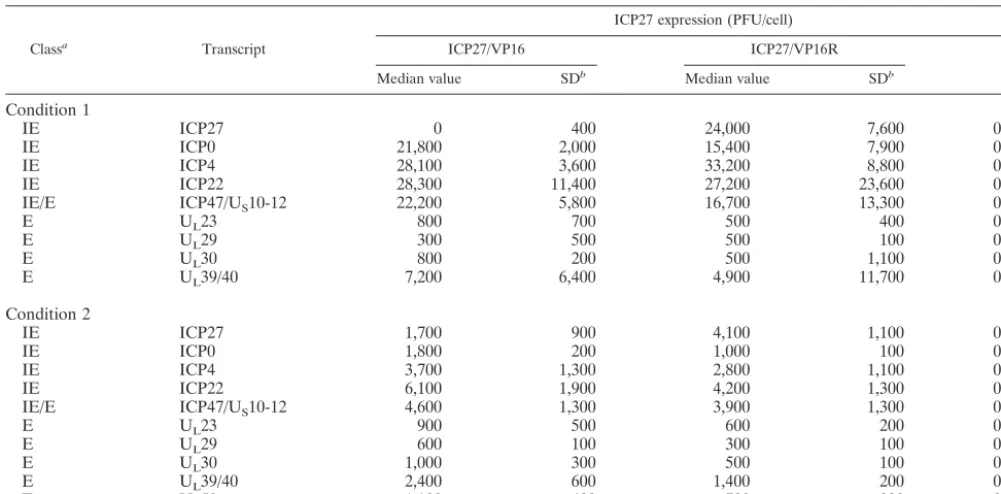
with that in their cognate rescue viruses. Table 1 includes data
obtained following infections in PFU per cell for relative
tran-script abundance at 3 h p.i. in the presence of 60-
g/ml
cyclo-heximide as well as at 1 h p.i. in untreated cells. Under
con-ditions of inhibition of de novo protein synthesis, of the five
immediate-early transcripts only ICP27 was significantly
re-duced in expression in mutant infections, ranging from
unde-tectable to at least fivefold less in individual experiments. Also
shown in Table 1, the expression of the early unique long (U
L)
transcripts U
L23, U
L29, U
L30, and U
L50 was essentially
unde-tectable in both infections. The levels of U
L39/40 were
some-what more variable, consistent with the known leakiness of this
transcript under marginally complete conditions of inhibition
of protein synthesis, and this leakiness (especially in the VP16
promoter substitution) serves as an internal reference to the
greatly reduced or absent expression of ICP27 under these
conditions.
[image:3.603.42.543.81.328.2]After 1 h without inhibitor present, the infection with the
WT rescue viruses showed transcript abundance patterns
typ-ical for this time after infection (39): i.e., a preponderance of
TABLE 1. Loss of immediate-early expression of ICP27 with the ICP27/VP16 kinetic mutant
Classa Transcript
ICP27 expression (PFU/cell)
ICP27/VP16 ICP27/VP16R
Pc
Median value SDb Median value SDb
Condition 1
IE
ICP27
0
400
24,000
7,600
0.039
IE
ICP0
21,800
2,000
15,400
7,900
0.365
IE
ICP4
28,100
3,600
33,200
8,800
0.870
IE
ICP22
28,300
11,400
27,200
23,600
0.828
IE/E
ICP47/U
S10-12
22,200
5,800
16,700
13,300
0.771
E
U
L23
800
700
500
400
0.663
E
U
L29
300
500
500
100
0.681
E
U
L30
800
200
500
1,100
0.813
E
U
L39/40
7,200
6,400
4,900
11,700
0.925
Condition 2
IE
ICP27
1,700
900
4,100
1,100
0.066
IE
ICP0
1,800
200
1,000
100
0.007
IE
ICP4
3,700
1,300
2,800
1,100
0.466
IE
ICP22
6,100
1,900
4,200
1,300
0.227
IE/E
ICP47/U
S10-12
4,600
1,300
3,900
1,300
0.291
E
U
L23
900
500
600
200
0.250
E
U
L29
600
100
300
100
0.057
E
U
L30
1,000
300
500
100
0.053
E
U
L39/40
2,400
600
1,400
200
0.060
E
U
L50
1,100
400
700
200
0.121
aCells were preincubated for 60 min in the presence of cycloheximide prior to infection, and the drug was present during virus adsorption. IE, immediate early; E,
early. Condition 1, 3 h p.i. in the presence of 60-g/ml cycloheximide; condition 2, 1 h p.i. at an MOI of 1 PFU/cell. Infection was initiated at a multiplicity of 1 PFU per cell. Only selected transcripts are shown. The original data (accession no. GXE-00030, GXE-00032, GXE-00033, and GXE-00034) is available in the MIAME-compliant GTI expression database, GPXdb (http://mendel.gti.ed.ac.uk:8080/GPX/cgi_bin/gpx.cgi).
bSD, standard deviation.
cAbsolute (nonnormalized) values of transcript levels for three separate infections at the various time points were compared by Student’sttest (MS-Excel based)
as described in Materials and Methods. The null hypothesis is that the true values for the WT and mutant viruses are identical.
on November 8, 2019 by guest
http://jvi.asm.org/
the five immediate-early transcripts, levels of the early
ribonu-cleotide reductase (U
L39/40) nearly as high as those of the
immediate-early ones, and readily detectable levels of a
num-ber of other early transcripts, including that encoding
thymi-dine kinase (U
L23). In the cells infected with the ICP27/VP16
mutant, only ICP27 of the immediate-early transcripts
ap-peared reduced in relative abundance as compared to the
rescue virus. Interestingly, levels of U
L29, U
L30, and U
L39/40
mRNAs were higher in the mutant than in the rescue virus,
with marginal significance, while the overexpression of ICP0 in
the mutant was significantly higher in the mutant than in the
rescue virus infections (
P
⫽
0.007).
Lack of immediate-early kinetics in ICP27 expression had
minimal effects on the accumulation of HSV-1 transcripts by
2 h and none at later times p.i.
The complete absence of
expression of the ICP27 protein is known to have profound
effects on the accumulation of viral transcripts (cf. reference
33). As a control, we confirmed these effects in the context of
the cell types currently used and the ability of the extremely
high-sensitivity RLS detection of hybrids on DNA microarrays
to provide an accurate quantitative measure of these changes
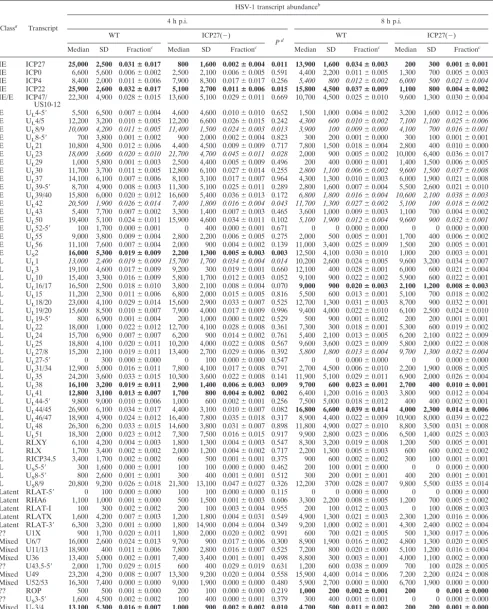
by comparing the relative abundances of viral transcripts at 4
and 8 h p.i. with a full ICP27-null mutant (GFP/ICP27) to
those in a WT infection (Table 2). Since the reciprocity
be-tween exposure time and signal strength is not linear as it is
with fluorescent tags (39), we utilized relative transcript
abun-dance at any given time as a measure of deviations from the
WT patterns. We have highlighted those table entries where
differences in these relative abundances are statistically highly
significant (
P
ⱕ
0.05 by
t
test). Values for those transcripts
whose fractional abundance in the cells infected by mutant
virus is increased by greater than a factor of 0.8 (mainly early)
are shown in italic, while those whose relative abundance is
decreased by this factor (mainly late) are shown in boldface.
Since we are using a different chip, different cells, and
polyad-enylated versus total RNA in the present experiments, we did
not attempt to fully correlate the transcript abundances seen
with those reported in the earlier report, especially since the
methods we are currently using are not applicable to
measur-ing large differences in absolute transcript levels. Given these
provisos, the transcript abundance patterns reported here are
consistent with those in HeLa cells infected with a null mutant
(ICP27lacz) at a different MOI (36). This new null mutant has
a significantly lower reversion frequency since the whole open
reading frame is deleted from the viral genome.
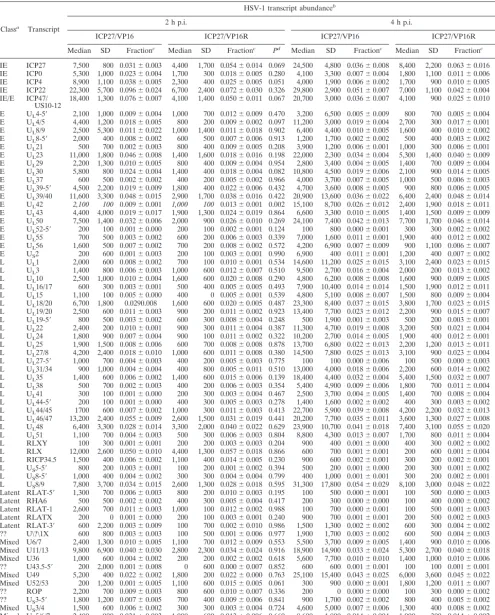
As shown in Table 3, at 2 h after infection at an MOI of 0.1
PFU/cell, the relative abundance of only the U
L42 transcript
was significantly different in a comparison between infections
with the ICP27/VP16 mutant and its WT rescue virus, while
differences in relative levels of ICP27, ICP4, ICP47/U
S10–12
(unique short region 10-12), and U
L4/5 are of marginal
signif-icance. Interestingly, while ICP27 is still reduced in relative
abundance in the mutant infections, the relative levels of the
other transcripts noted are increased. At later times following
infection with an MOI of 0.1 PFU/cell, there were no statistical
differences seen in relative transcript abundance in
compari-sons between the kinetic mutant and its cognate rescue virus;
furthermore, no consistent differences in the overall transcript
abundance seen in infections with mutant versus WT rescue
virus were observed.
We also carried out comparisons of RNA abundance at 6
and 8 h after infection of human HFFs and SK-N-SH
(neuro-blastoma) cells as well as mouse neural bulb cells at a
multi-plicity of 1 to 5 PFU/cell and also observed no significant
differences in relative (or absolute) transcript abundance (data
not shown).
Levels of viral proteins are consistent with the transcription
abundance measurements for both ICP27 kinetic mutants.
We
measured levels of ICP4, ICP0, ICP27 (WT or mutant), gC,
and gD at 4 and 8 h following infections with the mutant, its
rescue, ICP27-null, and WT viruses. These data are shown in
Fig. 1. Following infections at 1 PFU/cell, the 27-GFP (null)
virus overexpresses ICP4 and ICP0 at 4 h as compared to WT
virus, but as seen in Table 2, the relative abundance of the
transcripts expressing these proteins is similar to that of the
WT virus. At this MOI, the ICP27/VP16 mutant and its rescue
virus behaved identically to the WT control at both 4 and 8 h,
ICP4 and ICP0 were equal in the mutant and its rescue virus,
and these levels were equivalent to WT levels.
Lack of the ability of ICP27 RNA to accumulate in the
absence of de novo protein synthesis has no effect upon levels
of virus replication in cultured cells.
We examined the relative
[image:4.603.319.521.69.200.2]efficiency of replication of the ICP27 promoter mutant with its
rescue virus after both single and multiple replication cycles in
order to assess the effect of the transcriptional effects seen;
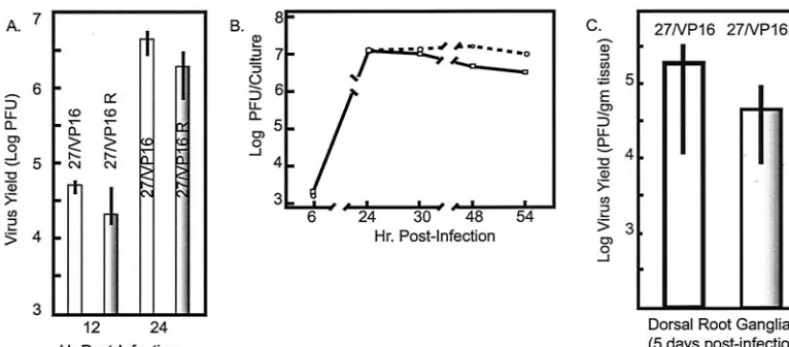
these data are shown in Fig. 2. For single-cycle replication,
aliquots of 1,000 PFU of the appropriate virus were used to
infect replicate cultures of confluent MEFs, and virus titers
were determined 12 and 24 h after virus adsorption. Based
upon three replicate experiments, we found there was no
sig-nificant difference in virus yield between the mutant and rescue
viruses (Fig. 2A). In a second set of experiments, cultures were
infected at an MOI of 0.1 PFU/cell and virus yields were
determined 6, 24, 30, 48, and 54 h after virus adsorption. Here
too, no significant difference in yield was seen between the
mutant and rescue viruses (Fig. 2B). Finally, we confirmed the
equivalent replication of the mutant as compared to its rescue
and WT virus in a classic single-step growth experiment in
which cells were infected at 10 PFU/cell and harvested 20 h
FIG. 1. Western blot analysis of HSV protein synthesis following
infection with ICP27 mutants. Extracts from cells with the indicated
viruses were fractionated by SDS-PAGE, the proteins were transferred
to nitrocellulose, and the blots were probed with antibodies specific for
ICP4, ICP0, ICP27, gB, and gC. Infections were performed at an MOI
of 1 for the indicated times.
V
OL. 78, 2004
KINETIC MUTANT OF HSV-1 ICP27
10473
on November 8, 2019 by guest
http://jvi.asm.org/
Classa Transcript
HSV-1 transcript abundanceb
Pd
4 h p.i. 8 h p.i.
WT ICP27(⫺)
Pd WT ICP27(⫺)
Median SD Fractionc Median SD Fractionc Median SD Fractionc Median SD Fractionc
IE ICP27 25,000 2,500 0.031ⴞ0.017 800 1,600 0.002ⴞ0.004 0.011 13,900 1,600 0.034ⴞ0.003 200 300 0.001ⴞ0.001 0.002
IE ICP0 6,600 5,600 0.006⫾0.002 2,500 2,100 0.006⫾0.005 0.591 4,400 2,200 0.011⫾0.005 1,300 700 0.005⫾0.003 0.214 IE ICP4 8,400 2,000 0.011⫾0.006 7,900 8,300 0.017⫾0.017 0.256 5,400 800 0.012⫾0.002 6,000 500 0.021⫾0.004 0.035 IE ICP22 25,900 2,600 0.032ⴞ0.017 5,100 2,700 0.011ⴞ0.006 0.015 15,800 4,500 0.037ⴞ0.009 1,100 800 0.004ⴞ0.002 0.014
IE/E ICP47/
US10-12 22,300 4,900 0.028⫾0.015 13,600 5,100 0.029⫾0.011 0.669 10,700 4,500 0.025⫾0.010 9,600 1,300 0.030⫾0.004 0.558 E UL4-5⬘ 5,500 6,500 0.007⫾0.004 4,600 4,600 0.010⫾0.010 0.652 1,500 1,000 0.004⫾0.002 3,200 1,600 0.012⫾0.006 0.242
E UL4/5 12,200 3,200 0.010⫾0.005 12,200 6,600 0.026⫾0.015 0.242 4,300 600 0.010⫾0.002 7,100 1,100 0.025⫾0.006 0.047
E UL8/9 10,000 4,200 0.011⫾0.005 11,400 1,500 0.024⫾0.003 0.013 3,900 100 0.009⫾0.000 4,100 700 0.016⫾0.001 0.019
E UL8-5⬘ 700 3,800 0.001⫾0.002 900 2,000 0.002⫾0.004 0.823 300 200 0.001⫾0.000 300 100 0.001⫾0.001 0.308
E UL21 10,800 4,300 0.012⫾0.006 4,400 4,500 0.009⫾0.009 0.717 7,800 1,500 0.018⫾0.004 2,800 400 0.010⫾0.000 0.098
E UL23 18,000 3,600 0.020⫾0.010 21,700 4,700 0.045⫾0.011 0.028 2,000 900 0.005⫾0.002 10,000 6,400 0.036⫾0.017 0.059
E UL29 1,000 5,800 0.001⫾0.003 2,500 4,400 0.005⫾0.009 0.496 200 400 0.000⫾0.001 1,400 1,500 0.006⫾0.005 0.180
E UL30 11,700 3,700 0.011⫾0.005 12,800 6,100 0.027⫾0.014 0.255 2,800 1,100 0.006⫾0.002 9,600 1,500 0.037⫾0.008 0.018
E UL37 14,100 6,100 0.007⫾0.006 8,100 3,100 0.017⫾0.007 0.964 4,300 1,300 0.010⫾0.003 6,000 1,900 0.021⫾0.008 0.145
E UL39-5⬘ 8,700 4,900 0.008⫾0.003 11,300 5,100 0.025⫾0.011 0.289 2,800 1,600 0.007⫾0.004 5,500 2,600 0.021⫾0.010 0.196
E UL39/40 15,800 6,000 0.020⫾0.012 16,600 5,400 0.036⫾0.013 0.172 6,800 1,800 0.016⫾0.004 10,600 2,100 0.038⫾0.003 0.001
E UL42 20,500 1,900 0.026⫾0.014 7,400 1,800 0.016⫾0.004 0.043 11,700 1,300 0.027⫾0.002 5,100 100 0.018⫾0.002 0.004
E UL43 5,400 7,700 0.007⫾0.002 3,300 1,400 0.007⫾0.003 0.465 3,600 1,000 0.009⫾0.003 1,100 700 0.004⫾0.002 0.250
E UL50 19,400 5,100 0.024⫾0.011 15,900 4,600 0.034⫾0.011 0.102 5,100 1,900 0.012⫾0.004 9,600 900 0.032⫾0.001 0.008
E UL52-5⬘ 100 1,700 0.000⫾0.001 0 400 0.000⫾0.001 0.671 0 0 0.000⫾0.000 0 0 0.000⫾0.000 0.877
E UL55 9,000 3,800 0.009⫾0.004 2,800 2,200 0.006⫾0.005 0.275 2,000 500 0.005⫾0.001 1,700 400 0.006⫾0.002 0.167
E UL56 11,100 7,600 0.007⫾0.004 2,000 900 0.004⫾0.002 0.139 11,000 3,400 0.025⫾0.009 1,500 200 0.005⫾0.001 0.051
E US2 16,000 5,300 0.019ⴞ0.009 2,200 1,300 0.005ⴞ0.003 0.003 12,500 4,100 0.030⫾0.010 1,000 200 0.003⫾0.001 0.057
L UL1 13,000 2,400 0.019⫾0.009 15,700 1,700 0.034⫾0.004 0.014 10,200 2,600 0.024⫾0.005 9,600 3,200 0.034⫾0.007 0.197
L UL3 19,100 4,600 0.017⫾0.009 9,200 300 0.019⫾0.001 0.660 12,100 400 0.028⫾0.001 6,000 600 0.021⫾0.004 0.104
L UL10 15,400 3,300 0.016⫾0.009 5,800 1,700 0.012⫾0.003 0.052 9,100 900 0.022⫾0.002 5,900 600 0.022⫾0.001 0.642
L UL16/17 16,500 2,500 0.018⫾0.010 3,800 2,100 0.008⫾0.004 0.070 9,000 900 0.020ⴞ0.003 2,100 1,200 0.008ⴞ0.003 0.006
L UL15 11,200 2,300 0.011⫾0.006 6,800 2,000 0.015⫾0.005 0.816 5,500 600 0.013⫾0.001 5,100 700 0.018⫾0.002 0.045
L UL18/20 23,000 4,100 0.029⫾0.014 15,600 2,900 0.033⫾0.007 0.525 12,700 1,300 0.031⫾0.003 8,700 900 0.032⫾0.001 0.309
L UL19/20 15,600 8,500 0.010⫾0.007 7,900 4,000 0.017⫾0.009 0.996 9,400 4,000 0.022⫾0.010 6,100 2,500 0.024⫾0.010 0.825
L UL19-5⬘ 800 6,900 0.001⫾0.004 200 1,000 0.000⫾0.002 0.529 500 900 0.001⫾0.002 200 200 0.001⫾0.001 0.531
L UL22 18,000 1,000 0.022⫾0.012 12,700 4,100 0.028⫾0.008 0.361 7,300 300 0.018⫾0.001 5,300 600 0.019⫾0.002 0.340
L UL24 15,700 6,900 0.007⫾0.007 6,200 900 0.014⫾0.002 0.761 5,400 2,100 0.013⫾0.005 6,200 2,100 0.022⫾0.009 0.227
L UL25 18,800 4,100 0.020⫾0.011 10,200 4,000 0.022⫾0.008 0.567 9,600 3,600 0.023⫾0.009 5,800 2,000 0.022⫾0.008 0.662
L UL27/8 15,200 2,100 0.019⫾0.011 13,400 2,700 0.029⫾0.006 0.392 5,800 1,800 0.013⫾0.004 9,700 1,300 0.032⫾0.004 0.003
L UL27-5⬘ 0 300 0.000⫾0.000 0 100 0.000⫾0.000 0.547 0 0 0.000⫾0.000 0 0 0.000⫾0.000 0.043
L UL31/34 12,900 5,000 0.016⫾0.011 7,800 4,100 0.017⫾0.008 0.791 2,700 4,500 0.006⫾0.010 2,200 1,900 0.008⫾0.005 0.890
L UL35 24,200 3,600 0.033⫾0.015 10,300 3,600 0.022⫾0.008 0.141 11,900 5,100 0.029⫾0.011 6,900 2,000 0.026⫾0.004 0.401
L UL38 16,100 3,200 0.019ⴞ0.011 2,900 1,400 0.006ⴞ0.003 0.009 9,700 600 0.023ⴞ0.001 2,700 400 0.010ⴞ0.001 0.000
L UL41 12,800 3,100 0.013ⴞ0.007 1,700 800 0.004ⴞ0.002 0.002 6,400 1,200 0.016⫾0.003 3,800 900 0.012⫾0.004 0.293
L UL44-5⬘ 9,800 9,000 0.010⫾0.006 1,000 600 0.002⫾0.001 0.256 7,500 5,000 0.018⫾0.012 400 400 0.002⫾0.001 0.212
L UL44/45 26,900 6,100 0.034⫾0.017 4,400 3,100 0.010⫾0.007 0.082 16,800 6,600 0.039ⴞ0.014 4,000 2,300 0.014ⴞ0.006 0.046
L UL46/47 18,900 4,900 0.024⫾0.012 16,400 7,800 0.035⫾0.018 0.317 8,900 4,400 0.022⫾0.009 10,900 8,000 0.039⫾0.022 0.215
L UL48 26,300 6,200 0.033⫾0.015 14,600 3,800 0.031⫾0.007 0.898 11,800 4,900 0.027⫾0.010 8,800 3,500 0.031⫾0.008 0.787
L UL51 18,300 2,000 0.023⫾0.012 7,300 7,500 0.016⫾0.015 0.917 9,900 2,800 0.023⫾0.006 6,500 1,400 0.025⫾0.003 0.739
L RLXY 6,100 4,200 0.004⫾0.003 1,800 1,300 0.004⫾0.003 0.547 8,300 3,200 0.019⫾0.008 1,200 500 0.005⫾0.001 0.078 L RLX 1,700 3,400 0.002⫾0.002 2,000 1,200 0.004⫾0.002 0.717 2,200 1,300 0.005⫾0.003 600 600 0.002⫾0.002 0.470 L RICP34.5 3,400 1,700 0.002⫾0.002 600 500 0.001⫾0.001 0.375 900 600 0.002⫾0.002 300 100 0.001⫾0.001 0.366 L US5-5⬘ 300 1,600 0.000⫾0.001 100 100 0.000⫾0.000 0.462 200 100 0.001⫾0.000 0 0 0.000⫾0.000 0.211
L US8-5⬘ 800 2,600 0.001⫾0.001 300 400 0.001⫾0.001 0.512 300 200 0.001⫾0.001 400 200 0.001⫾0.001 0.493
L US8/9 20,800 9,200 0.026⫾0.018 21,300 13,100 0.047⫾0.027 0.326 12,200 3700 0.028⫾0.007 9,800 5,500 0.035⫾0.014 0.399
Latent RLAT-5⬘ 0 100 0.000⫾0.000 100 100 0.000⫾0.000 0.115 0 0 0.000⫾0.000 0 0 0.000⫾0.000 0.752 Latent RHA6 1,100 1,000 0.001⫾0.000 500 1,500 0.001⫾0.003 0.606 3,300 2,200 0.008⫾0.005 1,200 700 0.005⫾0.002 0.267 Latent RLAT-I 100 300 0.002⫾0.002 200 100 0.003⫾0.004 0.955 200 100 0.012⫾0.003 0 100 0.008⫾0.003 0.283 Latent RLATX 1,600 4,200 0.007⫾0.003 1,200 1,800 0.004⫾0.031 0.549 4,900 1,300 0.021⫾0.003 2,300 1,200 0.016⫾0.006 0.344 Latent RLAT-3⬘ 6,300 3,200 0.001⫾0.000 1,800 14,900 0.004⫾0.004 0.349 9,200 1,000 0.002⫾0.001 4,300 2,400 0.002⫾0.004 0.566 ?? U1X 900 1,700 0.020⫾0.011 1,800 2,000 0.020⫾0.002 0.991 600 700 0.021⫾0.005 500 1,300 0.017⫾0.006 0.607 Mixed U6/7 16,000 2,600 0.024⫾0.013 9,700 900 0.017⫾0.006 0.300 8,900 1,900 0.016⫾0.002 4,800 1,300 0.020⫾0.005 0.511 Mixed U11/13 18,900 400 0.011⫾0.006 7,800 2,800 0.016⫾0.007 0.525 7,200 800 0.020⫾0.000 5,100 1,200 0.016⫾0.004 0.162 Mixed U36 13,400 5,000 0.002⫾0.001 7,400 3,400 0.001⫾0.001 0.498 8,800 300 0.003⫾0.001 4,000 1,100 0.002⫾0.000 0.919 ?? U43.5-5⬘ 2,000 1,700 0.029⫾0.015 600 400 0.029⫾0.019 0.631 1,200 600 0.038⫾0.009 700 100 0.028⫾0.005 0.273 Mixed U49 23,200 4,200 0.008⫾0.007 13,300 9,200 0.020⫾0.004 0.558 15,900 4,400 0.014⫾0.006 7,200 2,200 0.024⫾0.008 0.234 Mixed U52/53 16,300 7,400 0.000⫾0.000 9,000 1,900 0.000⫾0.000 0.480 5,900 2,700 0.000⫾0.000 6,700 1,900 0.000⫾0.000 0.440 ?? ROP 500 500 0.001⫾0.000 200 100 0.000⫾0.000 0.219 1,000 200 0.002ⴞ0.001 200 0 0.001ⴞ0.000 0.036
?? US3-5⬘ 1,600 4,500 0.002⫾0.002 100 400 0.000⫾0.001 0.379 300 400 0.001⫾0.001 0 0 0.000⫾0.000 0.255
Mixed US3/4 13,100 5,300 0.016ⴞ0.007 1,000 900 0.002ⴞ0.002 0.010 4,700 500 0.011ⴞ0.002 200 200 0.001ⴞ0.000 0.005
Mixed US5/6/7 17,900 4,900 0.014⫾0.008 12,300 800 0.027⫾0.002 0.086 7,000 2,100 0.017⫾0.005 8,500 1,600 0.033⫾0.007 0.066
aIE, immediate early; E, early; L, late.
bInfection was initiated at a multiplicity of 0.1 PFU/cell. All data are based on three replicate experiments. SD, standard deviation. Boldface means that the fractional
values in mutant infections is reduced by 0.8 or greater as compared to WT, where the differences are significant atPⱕ0.05. Italic means that fractional values in WT infections are reduced by 0.8 or greater as compared to the mutant, where the differences are significant atPⱕ0.05.
cFractional values are the medians of the individual fractional values calculated from the total viral signal for each experiment as described in Materials and Methods;
the standard deviation is shown.
dRelative values of transcript levels were compared by Student’sttest as described in Materials and Methods. The null hypothesis is that the true values for theWT
and mutant viruses are identical.
10474
on November 8, 2019 by guest
http://jvi.asm.org/
[image:5.603.46.540.59.668.2]later. No statistically significant differences in virus “burst” size
was seen between any of the infections tested (data not shown).
The viral recombinants with altered temporal expression of
ICP27 showed similar patterns of replication and spread in
the mouse following footpad inoculation.
Footpad inoculation
of mice provides a sensitive means of assessing even subtle
differences in virulence and viral replication (5). In order to
assess whether the ICP27 promoter mutant under study
dis-played alterations in replication in vivo, mice were inoculated
on both rear footpads with 10
5PFU. Four mice per viral
recombinant (or its rescue virus) per time point were infected,
and mice were sacrificed at 1, 3, and 5 days p.i.. Feet, DRG,
and spinal cords from the mice were dissected, and amounts of
infection virus were determined. These analyses revealed that
there were no significant differences in amounts of infectious
virus detected when the ICP27 promoter mutants were
com-pared with their cognate WT rescue viruses or the parental
17
syn
⫹virus. All viruses showed similar yields of infectious
virus in the feet throughout the course of the infection (data
not shown). This was not surprising given the demonstrated
ability of the virus to replicate normally in cultured fibroblasts.
Measurement of virus yields in DRG and spinal cords provides
an indication of whether the ICP27 kinetic mutants exhibited
any alteration in their ability to replicate within neurons in
vivo. Typically, viruses with alterations in the ability to
repli-cate within neurons initially show a reduction in viral yields
within the sensory neurons of the DRG (6, 37). As shown in
Fig. 2C, the viruses tested yielded similar amounts of virus in
the DRG assayed at 5 days p.i. and there was no statistically
significant difference between the ICP27/VP16 recombinant
and its rescue virus (
P
⫽
0.3112, respectively, two-tailed
t
test).
Similarly, at day 5 p.i., all viruses were detected in similar
amounts in the spinal cord (data not shown), demonstrating
that the mutants were both capable of normal patterns of
spread through the nervous system.
ICP27/VP16 both reactivate efficiently from mouse DRG
following explant cocultivation.
In order to assess whether the
altered temporal expression of ICP27 might exert an influence
on the relative ability of these recombinants to reactivate from
latency, mice were infected with 500 PFU of the mutant and
rescue viruses in order to establish a latent infection. Thirty
days p.i., four mice per virus were sacrificed and individual
DRG (six per mouse) were explanted (see Materials and
Methods). Ganglia from both mice infected with ICP27/VP16
and its rescue virus began to show evidence of reactivation by
day 5 and reactivated as efficiently (
⬎
90% of ganglia were
explant positive by day 18) as their rescue viruses (data not
shown).
DISCUSSION
The overall goal of the study described herein was to begin
an analysis of possible functions of the immediate-early HSV-1
ICP27 transcript correlated with its kinetics of expression. It
should be noted that these kinetics are somewhat different
from those displayed by the other HSV-1 immediate-early
transcripts. This has been measured both globally for relative
levels of transcript abundance and directly by pulse-labeling
(39, 48). Although ICP27 is expressed at the very outset of the
infection cycle, rates of expression and relative transcript
abun-dance remain high during the first 3 h or so following infections
at moderate MOIs, while rates of synthesis and relative
abun-dances of ICP4 and ICP0 are highest at the earliest times
measured and rapidly decline thereafter, consistent with the
known shutoff functions of the ICP4 protein. The continued
expression of the ICP27 transcript fits well with the protein’s
function in RNA transport.
[image:6.603.97.492.71.244.2]While our results clearly demonstrate that abrogation of the
immediate-early expression of ICP27 has an effect on the
ear-liest patterns of transcript abundance in the viral replication
FIG. 2. Replication of the ICP27/VP16 kinetic mutant in vitro and in vivo. (A) Cultures of confluent MEFs were infected with 1,000 PFU of
virus as described in the text, and the titer of the virus yield was determined 12 and 24 h p.i. The experiment is described in the Results section.
(B) Multistep replication of the ICP27/VP16 kinetic mutant in confluent MEFs. Circles represent the rescue values, and squares represent the
mutant values. The vertical size of the symbols is a measure of the standard deviation of each experimental determination (see Results and
Materials and Methods for details). (C) Recovery of the ICP27/VP16 kinetic mutant in mouse DRG at 5 days following footpad infection (see
Results and Materials and Methods for details).
V
OL. 78, 2004
KINETIC MUTANT OF HSV-1 ICP27
10475
on November 8, 2019 by guest
http://jvi.asm.org/
Classa Transcript
HSV-1 transcript abundanceb
2 h p.i. 4 h p.i.
ICP27/VP16 ICP27/VP16R ICP27/VP16 ICP27/VP16R
Median SD Fractionc Median SD Fractionc Pd Median SD Fractionc Median SD Fractionc Pd
IE ICP27 7,500 800 0.031⫾0.003 4,400 1,700 0.054⫾0.014 0.069 24,500 4,800 0.036⫾0.008 8,400 2,200 0.063⫾0.016 0.128 IE ICP0 5,300 1,000 0.023⫾0.004 1,700 300 0.018⫾0.005 0.280 4,100 3,300 0.007⫾0.004 1,800 1,100 0.011⫾0.006 0.552 IE ICP4 8,900 1,100 0.038⫾0.005 2,300 400 0.025⫾0.005 0.051 4,000 1,900 0.006⫾0.002 1,700 900 0.010⫾0.005 0.282 IE ICP22 22,300 5,700 0.096⫾0.024 6,700 2,400 0.072⫾0.030 0.326 29,800 2,900 0.051⫾0.007 7,000 1,100 0.042⫾0.004 0.331 IE/E ICP47/
US10-12 18,400 1,300 0.076⫾0.007 4,100 1,400 0.050⫾0.011 0.067 20,700 3,000 0.036⫾0.007 4,100 900 0.025⫾0.010 0.509 E UL4-5⬘ 2,100 1,000 0.009⫾0.004 1,000 700 0.012⫾0.009 0.470 3,200 6,500 0.005⫾0.009 800 700 0.005⫾0.004 0.809
E UL4/5 4,400 1,200 0.018⫾0.005 800 200 0.009⫾0.002 0.097 11,200 3,000 0.019⫾0.004 2,700 300 0.017⫾0.001 0.956
E UL8/9 2,500 5,300 0.011⫾0.022 1,000 1,400 0.011⫾0.018 0.902 6,400 4,400 0.010⫾0.005 1,600 400 0.010⫾0.002 0.502
E UL8-5⬘ 2,000 400 0.008⫾0.002 600 500 0.007⫾0.006 0.913 1,200 1,700 0.002⫾0.002 500 400 0.003⫾0.002 0.777
E UL21 500 700 0.002⫾0.003 800 400 0.009⫾0.005 0.208 3,900 1,200 0.006⫾0.001 1,000 300 0.006⫾0.001 0.636
E UL23 11,000 1,800 0.046⫾0.008 1,400 1,600 0.018⫾0.016 0.198 22,000 2,300 0.034⫾0.004 5,300 1,400 0.040⫾0.009 0.543
E UL29 2,200 1,300 0.010⫾0.005 800 400 0.009⫾0.004 0.954 2,800 3,400 0.004⫾0.005 1,400 700 0.009⫾0.004 0.824
E UL30 5,800 800 0.024⫾0.004 1,400 400 0.018⫾0.004 0.082 10,800 4,500 0.019⫾0.006 2,100 900 0.014⫾0.005 0.987
E UL37 600 500 0.002⫾0.002 400 200 0.005⫾0.002 0.966 4,000 3,700 0.007⫾0.005 1,000 500 0.006⫾0.003 0.894
E UL39-5⬘ 4,500 2,200 0.019⫾0.009 1,800 400 0.022⫾0.006 0.432 4,700 3,600 0.008⫾0.005 900 800 0.006⫾0.005 0.853
E UL39/40 11,600 3,300 0.048⫾0.015 2,900 1,700 0.038⫾0.016 0.422 20,900 13,600 0.036⫾0.022 6,400 2,400 0.048⫾0.014 0.663
E UL42 2,100 100 0.009⫾0.001 1,000 100 0.013⫾0.001 0.002 15,100 8,700 0.026⫾0.012 2,400 1,900 0.018⫾0.011 0.690
E UL43 4,400 4,000 0.019⫾0.017 1,900 1,300 0.024⫾0.019 0.864 6,600 3,300 0.010⫾0.005 1,400 1,500 0.009⫾0.009 0.714
E UL50 7,500 1,400 0.032⫾0.006 2,000 900 0.026⫾0.010 0.269 24,100 7,400 0.042⫾0.013 7,700 1,700 0.046⫾0.014 0.627
E UL52-5⬘ 200 100 0.001⫾0.000 200 100 0.002⫾0.001 0.124 100 800 0.000⫾0.001 300 300 0.002⫾0.002 0.390
E UL55 700 500 0.003⫾0.002 600 200 0.006⫾0.003 0.339 7,000 1,600 0.011⫾0.001 1,900 400 0.012⫾0.002 0.649
E UL56 1,600 500 0.007⫾0.002 700 200 0.008⫾0.002 0.572 4,200 6,900 0.007⫾0.009 900 1,100 0.006⫾0.007 0.873
E US2 200 600 0.001⫾0.003 200 100 0.003⫾0.001 0.990 6,900 400 0.011⫾0.001 1,200 400 0.007⫾0.002 0.143
L UL1 2,000 600 0.008⫾0.002 700 100 0.010⫾0.001 0.534 14,600 11,200 0.025⫾0.015 3,100 2,400 0.023⫾0.015 0.922
L UL3 1,400 800 0.006⫾0.003 1,000 600 0.012⫾0.007 0.510 9,500 2,700 0.016⫾0.004 2,000 200 0.013⫾0.002 0.639
L UL10 2,500 1,000 0.010⫾0.004 1,600 600 0.020⫾0.008 0.290 4,800 6,200 0.008⫾0.008 1,600 900 0.009⫾0.005 0.797
L UL16/17 600 300 0.003⫾0.001 500 400 0.005⫾0.005 0.493 7,900 10,400 0.014⫾0.014 1,500 1,900 0.012⫾0.011 0.937
L UL15 1,100 100 0.005⫾0.000 400 0 0.005⫾0.001 0.539 4,800 5,100 0.008⫾0.007 1,500 800 0.009⫾0.004 0.978
L UL18/20 6,700 1,800 0.0290.008 1,600 600 0.020⫾0.005 0.487 23,300 8,400 0.037⫾0.015 3,800 1,700 0.023⫾0.015 0.880
L UL19/20 2,500 600 0.011⫾0.003 900 200 0.011⫾0.002 0.923 13,400 7,700 0.023⫾0.012 2,200 900 0.015⫾0.007 0.603
L UL19-5⬘ 800 500 0.003⫾0.002 600 300 0.008⫾0.004 0.248 500 1,900 0.001⫾0.003 500 200 0.003⫾0.001 0.922
L UL22 2,400 200 0.010⫾0.001 900 300 0.011⫾0.004 0.387 11,300 4,700 0.019⫾0.008 3,200 500 0.021⫾0.004 0.916
L UL24 1,800 900 0.007⫾0.004 900 100 0.011⫾0.002 0.322 10,200 2,700 0.014⫾0.005 1,900 400 0.012⫾0.001 0.390
L UL25 1,900 1,500 0.008⫾0.006 600 700 0.008⫾0.008 0.878 13,700 6,800 0.022⫾0.013 2,200 1,200 0.013⫾0.011 0.852
L UL27/8 4,200 2,400 0.018⫾0.010 1,000 600 0.011⫾0.008 0.380 14,500 7,800 0.025⫾0.013 3,100 900 0.023⫾0.004 0.514
L UL27-5⬘ 1,000 700 0.004⫾0.003 400 200 0.005⫾0.003 0.775 100 100 0.000⫾0.006 100 500 0.000⫾0.003 0.376
L UL31/34 900 1,000 0.004⫾0.004 400 800 0.005⫾0.011 0.510 13,000 4,000 0.018⫾0.006 2,200 600 0.014⫾0.002 0.194
L UL35 1,400 600 0.006⫾0.002 1,400 600 0.015⫾0.006 0.139 18,400 4,400 0.032⫾0.004 5,400 1,500 0.032⫾0.007 0.929
L UL38 500 700 0.002⫾0.003 400 200 0.006⫾0.003 0.354 5,400 4,900 0.009⫾0.006 1,800 700 0.011⫾0.004 0.672
L UL41 300 100 0.001⫾0.000 200 300 0.003⫾0.004 0.467 2,500 3,700 0.004⫾0.005 1,400 700 0.008⫾0.004 0.880
L UL44-5⬘ 200 100 0.001⫾0.000 400 300 0.005⫾0.003 0.278 1,400 1,600 0.002⫾0.002 400 300 0.003⫾0.002 0.864
L UL44/45 1700 600 0.007⫾0.002 1,000 300 0.011⫾0.003 0.413 22,700 5,900 0.039⫾0.008 4,200 2,200 0.032⫾0.013 0.943
L UL46/47 13,200 2,400 0.055⫾0.009 2,600 1,500 0.031⫾0.019 0.441 20,200 7,700 0.035⫾0.011 3,600 1,300 0.027⫾0.008 0.732
L UL48 6,400 3,300 0.028⫾0.014 3,300 2,000 0.040⫾0.022 0.629 23,900 10,700 0.041⫾0.018 7,400 3,100 0.055⫾0.020 0.986
L UL51 1,100 700 0.004⫾0.003 500 300 0.006⫾0.003 0.804 8,800 4,300 0.013⫾0.007 1,700 800 0.011⫾0.004 0.351
L RLXY 100 300 0.001⫾0.001 200 200 0.003⫾0.003 0.204 900 400 0.001⫾0.000 400 300 0.002⫾0.002 0.305 L RLX 12,000 2,600 0.050⫾0.010 4,400 1,300 0.057⫾0.018 0.866 600 700 0.001⫾0.001 200 600 0.001⫾0.004 0.533 L RICP34.5 1,500 400 0.006⫾0.002 1,100 400 0.014⫾0.005 0.230 900 600 0.002⫾0.001 300 200 0.002⫾0.001 0.294 L US5-5⬘ 800 200 0.003⫾0.001 100 200 0.001⫾0.002 0.394 500 200 0.001⫾0.000 200 300 0.001⫾0.002 0.392
L US8-5⬘ 1,000 400 0.004⫾0.002 300 300 0.004⫾0.004 0.799 400 1,000 0.001⫾0.001 300 200 0.002⫾0.001 0.844
L US8/9 7,800 3,700 0.034⫾0.015 2,600 1,300 0.028⫾0.018 0.595 31,300 17,800 0.054⫾0.029 8,100 3,000 0.048⫾0.022 0.935
Latent RLAT-5⬘ 1,300 700 0.006⫾0.003 800 200 0.010⫾0.003 0.195 100 500 0.000⫾0.001 100 500 0.000⫾0.003 0.466 Latent RHA6 500 500 0.002⫾0.002 400 300 0.005⫾0.004 0.417 200 300 0.000⫾0.000 100 400 0.000⫾0.002 0.460 Latent RLAT-1 2,600 700 0.011⫾0.003 1,000 100 0.012⫾0.002 0.988 100 700 0.000⫾0.001 100 500 0.001⫾0.003 0.544 Latent RLATX 200 0 0.001⫾0.000 200 100 0.003⫾0.001 0.240 900 700 0.001⫾0.001 200 500 0.002⫾0.003 0.863 Latent RLAT-3⬘ 600 2,200 0.003⫾0.009 100 700 0.002⫾0.010 0.986 1,500 1,300 0.002⫾0.002 600 300 0.004⫾0.002 0.871 ?? U\?\1X 600 800 0.003⫾0.003 100 500 0.001⫾0.006 0.977 1,900 1,700 0.003⫾0.002 600 500 0.004⫾0.003 0.647 Mixed U6/7 2,400 1,300 0.010⫾0.005 1,100 700 0.012⫾0.009 0.553 5,500 3,700 0.009⫾0.005 1,400 900 0.010⫾0.006 0.636 Mixed U11/13 9,800 6,900 0.040⫾0.030 2,800 2,300 0.034⫾0.024 0.916 18,900 14,900 0.033⫾0.024 5,300 2,700 0.040⫾0.018 0.992 Mixed U36 1,000 600 0.004⫾0.002 200 200 0.002⫾0.002 0.618 5,600 7,700 0.010⫾0.010 1,400 1,000 0.010⫾0.006 0.892 ?? U43.5-5⬘ 200 2,000 0.001⫾0.008 0 600 0.000⫾0.007 0.852 600 600 0.001⫾0.001 100 100 0.001⫾0.001 0.874 Mixed U49 5,200 400 0.022⫾0.002 1,800 200 0.022⫾0.000 0.763 25,100 15,400 0.043⫾0.025 6,000 3,600 0.045⫾0.022 0.068 Mixed U52/53 200 1,200 0.001⫾0.005 1,100 600 0.015⫾0.005 0.061 300 900 0.000⫾0.001 1,800 1,200 0.011⫾0.007 0.467 ?? ROP 2,200 700 0.009⫾0.003 800 600 0.010⫾0.007 0.336 200 0 0.000⫾0.000 100 300 0.000⫾0.002 0.398 ?? US3-5⬘ 1,800 1,200 0.007⫾0.005 700 400 0.009⫾0.006 0.841 900 1,700 0.002⫾0.002 800 400 0.005⫾0.002 0.557
Mixed US3/4 1,500 600 0.006⫾0.002 300 300 0.003⫾0.004 0.724 4,600 5,000 0.007⫾0.006 1,300 400 0.008⫾0.002 0.534
Mixed US5/6/7 2,400 900 0.031⫾0.003 1,000 600 0.013⫾0.006 0.669 8,600 1,800 0.014⫾0.004 1,900 300 0.014⫾0.002 0.648 aIE, immediate early; E, early; L, late.
bInfection was initiated at a multiplicity of 0.1 PFU per cell. All data are based on three replicate experiments. SD, standard deviation. Italic means that fractional
values in WT infections are reduced by 0.8 or greater as compared to the mutant, where the differences are significant atPⱕ0.05.
cFractional values are the medians of the individual fractional values calculated from the total viral signal for each experiment as described in Materials and Methods;
the standard deviation of these values is shown.
dRelative values of transcript levels were compared by Student’sttest as described in Materials and Methods. The null hypothesis is that the true values for the WT
and mutant viruses are identical.
10476
on November 8, 2019 by guest
http://jvi.asm.org/
[image:7.603.45.541.59.675.2]cascade, it is not clear how vital the precise timing of this
expression is to the virus in a biological sense. Thus, the kinetic
mutant of ICP27 demonstrate altered patterns of transcript
abundance at the earliest times studied (Tables 1 and 3), but
unlike the situation with a deletion mutant, delayed expression
has no measurable effect on virus replication in vitro or in vivo.
The observation of “robustness” in the interleaving of viral
functions in the early stages of the replication cycle has been
documented in recent studies in which the entire
immediate-early cascade is disrupted due to loss of activation by VP16
(43), but the complete lack of any discernible biological
man-ifestation was unexpected.
Finally, we should note that the evolutionary stability of the
immediate-early kinetic signature for the ICP27 transcript is a
strong argument in favor of the timing of expression of this
viral protein being critical and essential during the earliest
window of viral gene expression in at least some tissue
impor-tant in the natural history of HSV-1. Naively, we assumed that
this window was part of the latency/reactivation system of the
virus, given the potential for tissue-specific restriction during
either establishment of or reactivation from the latent state (cf.
38). The results presented here suggest that any such
restric-tion is subtler than measurable in several well-established
pathogenicity models for HSV-1 infections. Importantly, the
observed phenotype of time-based differences in quantitative
transcript expression but neutral fitness strongly suggests a
threshold model for activation of viral expression that
incor-porates a high level of regulatory network robustness. Again,
further kinetic modification of ICP27 expression in
combina-tion with other viral mutants as well as utilizacombina-tion of more
demanding models may well illuminate finer detail; at the very
least, however, the data here suggests critical limitations to the
pathogenicity models utilized.
ACKNOWLEDGMENTS
This work was supported by PHS grants CA11861 and CA90287 to
E.K.W.; AI48633 to D.C.B; AI21515 to R.M.S-G.; and the British
Biotechnology Science Research Council, Wellcome Trust and
Scot-tish Higher Education Funding Council to P.G.
J. Sunabe, Qian Dai, and Carole Dehmel provided excellent
tech-nical assistance.
REFERENCES
1. Aguilar, J. S., D. Roy, P. Ghazal, and E. K. Wagner.2002. Dimethyl sulfoxide blocks herpes simplex virus-1 productive infection in vitro acting at different stages with positive cooperativity. Application of micro-array analysis. BMC Infect. Dis.2:9. [Online.] http://www.biomedcentral.com.
2. Arnosti, D. N., C. M. Preston, M. Hagmann, W. Schaffner, R. G. Hope, G. Laughlan, and B. F. Luisi.1993. Specific transcriptional activationin vitroby the herpes simplex virus protein VP16. Nucleic Acids Res.21:5570–5576. 3. Bailey, A. C., and R. Thompson.1992. A sequence-specific DNA-binding
protein recognising a GA-rich element cooperates with Oct-1 at the herpes simplex virus type 1 IE3 promoter. Intervirology34:74–85.
4. Beard, P., S. Faber, K. W. Wilcox, and L. I. Pizer.1986. Herpes simplex virus immediate early infected-cell polypeptide 4 binds to DNA and promotes transcription. Proc. Natl. Acad. Sci. USA83:4016–4020.
5. Bloom, D. C.1999. HSV vectors for gene therapy, p. 369–386.InS. M. Brown and A. R. MacLean (ed.), Methods in molecular medicine. Humana Press, Inc., Totowa, N.J.
6. Bloom, D. C., and J. G. Stevens.1994. Neuron-specific restriction of a herpes simplex virus recombinant maps to the UL5 gene. J. Virol.68:3761–3772. 7. Bruni, R., and B. Roizman.1998. Herpes simplex virus 1 regulatory protein
ICP22 interacts with a new cell cycle-regulated factor and accumulates in a cell cycle-dependent fashion in infected cells. J. Virol.72:8525–8531. 8. Cai, W., and P. A. Schaffer.1992. Herpes simplex virus type 1 ICP0 regulates
expression of immediate-early, early, and late genes in productively infected cells. J. Virol.66:2904–2915.
9. DeLuca, N. A., M. A. Courtney, and P. A. Schaffer.1984. Temperature-sensitive mutants in herpes simplex virus type 1 ICP4 permissive for early gene expression. J. Virol.52:767–776.
10. DeLuca, N. A., and P. A. Schaffer.1985. Activation of immediate-early, early, and late promoters by temperature-sensitive and wild-type forms of herpes simplex virus type 1 protein ICP4. Mol. Cell. Biol.5:1997–2208.
11. Everett, R. D.1989. Construction and characterization of herpes simplex virus type 1 mutants with defined lesions in immediate early gene 1. J. Gen. Virol.70:1185–1202.
12. Fru¨h, K., K. Ahn, H. Djaballah, P. Sempe´, P. M. Van Endert, R. Tampe´, P. A. Peterson, and Y. Yang.1995. A viral inhibitor of peptide transporters for antigen presentation. Nature375:415–418.
13. Gelman, I. H., and S. J. Silverstein.1987. Herpes simplex virus immediate-early promoters are responsive to virus and celltrans-acting factors. J. Virol.
61:2286–2296.
14. Guzowski, J. F., and E. K. Wagner.1993. Mutational analysis of the herpes simplex virus type 1 strict late UL38 promoter/leader reveals two regions
critical in transcriptional regulation. J. Virol.67:5098–5108.
15. Hardwicke, M. A., P. J. Vaughan, R. E. Sekulovich, R. O’Conner, and R. M. Sandri-Goldin.1989. The regions important for the activator and repressor functions of herpes simplex virus type 1␣protein ICP27 map to the C-terminal half of the molecule. J. Virol.63:4590–4602.
16. Hardy, W. R., and R. M. Sandri-Goldin.1994. Herpes simplex virus inhibits host cell splicing, and regulatory protein ICP27 is required for this effect. J. Virol.68:7790–7799.
17. Hibbard, M. K., and R. M. Sandri-Goldin.1995. Arginine-rich regions suc-ceeding the nuclear localization region of the herpes simplex virus type 1 regulatory protein ICP27 are required for efficient nuclear localization and late gene expression. J. Virol.69:4656–4667.
18. Hill, A., P. Jugovic, I. York, G. Russ, J. Bennink, J. Yewdell, H. Ploegh, and D. Johnson.1995. Herpes simplex virus turns off the TAP to evade host immunity. Nature375:411–415.
19. Hill, J. M., F. Sedarati, R. T. Javier, E. K. Wagner, and J. G. Stevens.1990. Herpes simplex virus latent phase transcription facilitates in vivo reactiva-tion. Virology174:117–125.
20. Jackson, S. A., and N. A DeLuca.2003. Relationship of herpes simplex virus genome configuration to productive and persistent infections. Proc. Natl. Acad. Sci. USA100:7871–7876.
21. Kristie, T. M., and P. A. Sharp.1990. Interactions of the Oct-1 POU sub-domains with specific DNA sequences and with the HSV␣-trans-activator protein. Genes Dev.4:2383–2396.
22. Lieu, P. T., and E. K. Wagner.2000. The kinetics of VP5 mRNA expression is not critical for viral replication in cultured cells. J. Virol.74:2770–2776. 23. McLauchlan, J., A. Phelan, C. Loney, R. M. Sandri-Goldin, and J. B.
Clem-ents.1992. Herpes simplex virus IE63 acts at the posttranscriptional level to stimulate viral mRNA 3⬘processing. J. Virol.66:6939–6945.
24. Michael, N., and B. Roizman.1989. Binding of the herpes simplex virus major regulatory protein to viral DNA. Proc. Natl. Acad. Sci. USA86:9808– 9812.
25. Michael, N., D. Spector, P. Mavromara-Nazos, T. M. Kristie, and B. Roiz-man.1988. The DNA-binding properties of the major regulatory protein alpha 4 of herpes simplex viruses. Science239:1531–1534.
26. Poffenberger, K. L., A. D. Idowu, E. B. Fraser-Smith, P. E. Raichlen, and R. C. Herman.1994. A herpes simplex virus type 1 ICP22 deletion mutant is altered for virulence and latency in vivo. Arch. Virol.139:111–119. 27. Poffenberger, K. L., P. E. Raichlen, and R. C. Herman.1993. In vitro
characterization of a herpes simplex virus type 1 ICP22 deletion mutant. Virus Genes7:171–186.
28. Rice, S. A., and D. M. Knipe.1988. Gene-specific transactivation by herpes simplex virus type 1 alpha protein ICP27. J. Virol.62:3814–3823. 29. Rice, S. A., and D. M. Knipe.1990. Genetic evidence for two distinct
trans-activation functions of the herpes simplex virus␣protein ICP27. J. Virol.
64:1704–1715.
30. Rice, S. A., M. C. Long, V. Lam, P. A. Schaffer, and C. A. Spencer.1995. Herpes simplex virus immediate-early protein ICP22 is required for viral modification of host RNA polymerase II and establishment of the normal viral transcription program. J. Virol.69:5550–5559.
31. Sacks, W. R., C. C. Greene, D. P. Aschman, and P. A. Schaffer.1985. Herpes simplex virus type 1 ICP27 is an essential regulatory protein. J. Virol.55:
796–805.
32. Sandri-Goldin, R. M.1998. ICP27 mediates HSV RNA export by shuttling through a leucine-rich nuclear export signal and binding viral intronless RNAs through an RGG motif. Genes Dev.12:868–879.
33. Sandri-Goldin, R. M., and G. E. Mendoza.1992. A herpesvirus regulatory protein appears to act post-transcriptionally by affecting mRNA processing. Genes Dev.6:848–863.
34. Smith, I. L., M. A. Hardwicke, and R. M. Sandri-Goldin.1992. Evidence that the herpes simplex virus immediate early protein ICP27 acts post-transcrip-tionally during infection to regulate gene expression. Virology186:74–86. 35. Stern, S., and W. Herr.1991. The herpes simplex virustrans-activator VP16
recognizes the Oct-1 homeo domain: evidence for a homeo domain recog-nition subdomain. Genes Dev.5:2555–2566.
V
OL. 78, 2004
KINETIC MUTANT OF HSV-1 ICP27
10477
on November 8, 2019 by guest
http://jvi.asm.org/
36. Stingley, S. W., J. J. G. Ramirez, S. A. Aguilar, K. Simmen, R. M. Sandri-Goldin, P. Ghazal, and E. K. Wagner.2000. Global analysis of herpes simplex virus type 1 transcription using an oligonucleotide-based DNA mi-croarray. J. Virol.74:9916–9927.
37. Tran, R. K., P. T. Lieu, J. S. Aguilar, E. K. Wagner, and D. C. Bloom.2004. Altering the expression kinetics of VP5 results in altered virulence and pathogenesis of herpes simplex virus type 1 in mice. J. Virol.76:2199–2205. 38. Wagner, E. K., and D. C. Bloom.1997. Experimental investigation of herpes
simplex virus latency. Clin. Microbiol. Rev.10:419–443.
39. Wagner, E. K., R. J. J. Garcia, S. W. Stingley, J. S. Aguilar, L. Buehler, G. B. Devi-Rao, and P. Ghazal.2002. Practical approaches to long oligonucleotide-based DNA microarrays: lessons from herpesvirues. Prog. Nucleic Acid Res. Mol. Biol.71:445–491.
40. Wagner, E. K., M. D. Petroski, N. T. Pande, P. T. Lieu, and M. K. Rice.1998. Analysis of factors influencing the kinetics of herpes simplex virus transcript expression utilizing recombinant virus. Methods16:105–116.
41. Wilson, A. C., M. A. Cleary, J.-S. Lai, K. LaMarco, M. G. Peterson, and W. Herr.1993. Combinatorial control of transcription: the herpes simplex virus VP16-induced complex. Cold Spring Harbor Symp. Quant. Biol.58:167–178. 42. Xiao, P., and J. P. Capone.1990. A cellular factor binds to the herpes simplex
virus type 1 transactivator Vmw65 and is required for Vmw65-dependent protein-DNA complex assembly with Oct-1. Mol. Cell. Biol.10:4974–4977. 43. Yang, W. C., G. V. Devi-Rao, P. Ghazal, E. K. Wagner, and S. J. Triezenberg.
2002. General and specific alterations in programming of global viral gene expression during infection by VP16 activation-deficient mutants of herpes simplex virus type 1. J. Virol.76:12758–12774.
44. Yguerabide, J., and E. E. Yguerabide.1998. Light-scattering submicroscopic particles as highly fluorescent analogs and their use as tracer labels in clinical and biological applications. Anal. Biochem.262:137–156.
45. Yguerabide, J., and E. E. Yguerabide.1998. Light-scattering submicroscopic particles as highly fluorescent analogs and their use as tracer labels in clinical and biological applications. Anal. Biochem.262:157–176.
46. Yguerabide, J., and E. E. Yguerabide.2001. Resonance light scattering particles as ultrasensitive labels for detection of analytes in a wide range of applications. J. Cell Biochem. Suppl.37:71–81.
47. York, I. A., C. Roop, D. W. Andrews, S. R. Riddell, F. L. Graham, and D. C. Johnson.1994. A cytosolic herpes simplex virus protein inhibits antigen presentation to CH8⫹T lymphocytes. Cell77:525–535.
48. Zhang, Y.-F., and E. K. Wagner.1987. The kinetics of expression of indi-vidual herpes simplex virus type 1 transcripts. Virus Genes1:49–60.
on November 8, 2019 by guest
http://jvi.asm.org/