determinations of 14 eclipsing systems
.
White Rose Research Online URL for this paper:
http://eprints.whiterose.ac.uk/109566/
Version: Accepted Version
Article:
Savoury, C.D.J., Littlefair, S.P. orcid.org/0000-0001-7221-855X, Dhillon, V.S. et al. (6 more
authors) (2011) Cataclysmic variables below the period gap: mass determinations of 14
eclipsing systems. Monthly Notices of the Royal Astronomical Society , 415. pp.
2025-2041. ISSN 0035-8711
https://doi.org/10.1111/j.1365-2966.2011.18707.x
[email protected]
https://eprints.whiterose.ac.uk/
Reuse
Unless indicated otherwise, fulltext items are protected by copyright with all rights reserved. The copyright
exception in section 29 of the Copyright, Designs and Patents Act 1988 allows the making of a single copy
solely for the purpose of non-commercial research or private study within the limits of fair dealing. The
publisher or other rights-holder may allow further reproduction and re-use of this version - refer to the White
Rose Research Online record for this item. Where records identify the publisher as the copyright holder,
users can verify any specific terms of use on the publisher’s website.
Takedown
If you consider content in White Rose Research Online to be in breach of UK law, please notify us by
CTCV J1300-3052 CTCV J2354-4700 SDSS J1152+4049 OU Vir DV UMa XZ Eri SDSS 1702
q 0.240±0.021 0.1097±0.0008 0.155±0.006 0.1641±0.0013 0.1778±0.0022 0.118±0.003 0.248±0.005
Mw/M⊙ 0.736±0.014 0.935±0.031 0.560±0.028 0.703±0.012 1.098±0.024 0.769±0.017 0.91±0.03 Rw/R⊙ 0.01111±0.00018 0.0089±0.0003 0.0135±0.0004 0.01191±0.00017 0.00703±0.00028 0.01081±0.00022 0.0092±0.0004 logg 8.21±0.02 8.51±0.04 7.93±0.05 8.13±0.02 8.78±0.04 8.26±0.03 8.47±0.05
Tw(K) 11100±800 14800±700 12400±1400 22300±2100 15500±2400 15300±1900 15200±1200
Mr/M⊙ 0.177±0.021 0.101±0.003 0.087±0.006 0.1157±0.0022 0.196±0.005 0.091±0.004 0.223±0.010 Rr/R⊙ 0.215±0.008 0.1463±0.0016 0.142±0.003 0.1634±0.0010 0.2176±0.0018 0.1350±0.0018 0.252±0.004 a/R⊙ 0.813±0.011 0.692±0.008 0.606±0.010 0.686±0.004 0.892±0.006 0.621±0.005 0.945±0.012 Kw(kms−1) 90±8 51.9±0.6 60±3 66.4±0.6 78.9±1.0 53.6±1.5 94.0±2.2
Kr(kms−1) 372.2±2.5 482±6 387±6 403.0±2.3 443±3 452±3 380±4
i◦ 86.3±1.1 89.26±0.28 82.38±0.23 79.60±0.04 82.93±0.10 80.02±0.12 82.55±0.17
d(pc) 375±13 674±19 543±21 570±70 504±30 371±19 270±16
Porb(mins) 128.0746325(14)∗ 94.3923889(14)∗ 97.518753(4)∗ 104.696803(7)1 123.6278190(20)2 88.069667(7)2 144.11821(13)3
SDSS 1035 SDSS 1507 SDSS 0903 SDSS 1227 SDSS 1433 SDSS 1502 SDSS 1501
q 0.0571±0.0010 0.0647±0.0018 0.113±0.004 0.1115±0.0016 0.0661±0.0007 0.1099±0.0007 0.101±0.010
Mw/M⊙ 0.835±0.009 0.892±0.008 0.872±0.011 0.796±0.018 0.865±0.005 0.709±0.004 0.767±0.027 Rw/R⊙ 0.00991±0.00010 0.00956±0.00013 0.00947±0.00019 0.01052±0.00022 0.00962±0.00006 0.01145±0.00005 0.0107±0.0003 logg 8.37±0.01 8.45±0.01 8.42±0.02 8.29±0.02 8.41±0.01 8.17±0.01 8.26±0.04
Tw(K) 10000±1100 11300±1000 13300±1700 15900±1400 12700±1500 11800±1200 10800±1500
Mr/M⊙ 0.0475±0.0012 0.0575±0.0020 0.099±0.004 0.0889±0.0025 0.0571±0.0007 0.0781±0.0008 0.077±0.010 Rr/R⊙ 0.1047±0.0008 0.0969±0.0011 0.1358±0.0020 0.1365±0.0013 0.1074±0.0004 0.1241±0.0003 0.122±0.005 a/R⊙ 0.5977±0.0022 0.5329±0.0019 0.632±0.003 0.640±0.005 0.5869±0.0012 0.5844±0.0013 0.588±0.008 Kw(kms−1) 28.5±0.6 35.1±1.0 54.6±2.0 51.3±0.8 33.8±0.3 50.4±0.4 48±5
Kr(kms−1) 499.3±1.5 543.7±1.2 481.7±1.9 460±3 511.1±0.9 456.5±0.8 470.5±3.2
i◦ 83.98±0.08 83.47±0.12 82.09±0.19 84.29±0.10 84.36±0.05 88.35±0.17 82.8±0.5
d(pc) 174±12 168±12 299±14 400±13 226±12 175±11 306±21
Porb(mins) 82.08965(29)4,6 66.61192(6)5,6 85.065902(13)6 90.661019(10)6 78.106657(3)6 84.82984(7)6 81.85141771(28)∗
arXiv:1103.2713v1 [astro-ph.SR] 14 Mar 2011
Cataclysmic Variables below the Period Gap: Mass
Determinations of 14 Eclipsing Systems
C. D. J. Savoury
1⋆, S. P. Littlefair
1, V. S. Dhillon
1, T. R. Marsh
2, B. T. G¨
ansicke
2,
C. M. Copperwheat
2, P. Kerry
1, R. D. G. Hickman
2and S. G. Parsons
21Dept of Physics and Astronomy, University of Sheffield, Sheffield, S3 7RH, UK 2Dept of Physics, University of Warwick, Coventry, CV4 7AL, UK
Submitted for publication in the Monthly Notices of the Royal Astronomical Society 15 March 2011
ABSTRACT
We present high-speed, three-colour photometry of the eclipsing cataclysmic vari-ables CTCV J1300-3052, CTCV J2354-4700 and SDSS J115207.00+404947.8. These systems have orbital periods of 128.07, 94.39 and 97.52 minutes respectively, placing all three systems below the observed “period gap” for cataclysmic variables. For each system we determine the system parameters by fitting a parameterised model to the observed eclipse light curve by χ2minimisation.
We also present an updated analysis of all other eclipsing systems previously analysed by our group. The updated analysis utilises Markov Chain Monte Carlo techniques which enable us to arrive confidently at the best fits for each system with more robust determinations of our errors. A new bright spot model is also adopted, that allows better modelling of bright-spot dominated systems. In addition, we correct a bug in the old code which resulted in the white dwarf radius being underestimated, and consequently both the white dwarf and donor mass being overestimated. New donor masses are generally between 1 and 2σof those originally published, with the exception of SDSS 1502 (−2.9σ, ∆Mr=−0.012M⊙) and DV UMa (+6.1σ, ∆Mr= +0.039M⊙).
We note that the donor mass of SDSS 1501 has been revised upwards by 0.024M⊙
(+1.9σ). This system was previously identified as having evolved passed the minimum orbital period for cataclysmic variables, but the new mass determination suggests otherwise. Our new analysis confirms that SDSS 1035 and SDSS 1433 have evolved past the period minimum for cataclysmic variables, corroborating our earlier studies. We find that the radii of donor stars are oversized when compared to theoretical models, by approximately 10 percent. We show that this can be explained by invoking either enhanced angular momentum loss, or by taking into account the effects of star spots. We are unable to favour one cause over the other, as we lack enough precise mass determinations for systems with orbital periods between 100 and 130 minutes, where evolutionary tracks begin to diverge significantly.
We also find a strong tendency towards high white dwarf masses within our sample, and no evidence for any He-core white dwarfs. The dominance of high mass white dwarfs implies that erosion of the white dwarf during the nova outburst must be negligible, or that not all of the mass accreted is ejected during nova cycles, resulting in the white dwarf growing in mass.
Key words: binaries: close - binaries: eclipsing - stars: dwarf novae - stars: low mass, brown dwarfs - stars: novae, cataclysmic variables - stars: evolution.
⋆ E-mail:[email protected]
1 INTRODUCTION
the gas stream collides with the edge of the accretion disc, often resulting in an ‘orbital hump’ in the light curve at phases 0.6−1.0 due to the area of enhanced emission ro-tating into our line of sight. For an excellent overview of CVs, see Warner (1995) and Hellier (2001). The light curves of eclipsing CVs can be quite complex, with the accretion disc, white dwarf and bright spot all being eclipsed in rapid succession. When observed with time resolutions of the or-der of a few seconds, this eclipse structure allows the sys-tem parameters to be determined to a high degree of pre-cision with relatively few assumptions (Wood et al. 1986). Over the last eight years our group has used the high-speed, three-colour cameraultracam (Dhillon et al. 2007) to
ob-tain such time-resolution. The ability to image in three dif-ferent wave-bands simultaneously makesultracaman ideal
tool to study the complex, highly variable light curves of CVs. Using ultracam data, we have obtained system
pa-rameters for several short period systems (e.g. Feline et al. 2004a, 2004b; Littlefair et al. 2006a, 2007, 2008), including the first system accreting from a sub-stellar donor (Littlefair et al. 2006b).
Despite extensive study over recent decades, there are still several outstanding issues with evolutionary theories of CVs that have wide ranging implications for all close binary systems. The secular evolution of CVs is driven by angu-lar momentum losses from the binary orbit. In the standard model, systems with orbital periods below∼130 minutes are thought to lose angular momentum via gravitational radi-ation. Angular momentum losses sustain mass transfer and subsequently drive the system to shorter orbital periods, un-til the point where the donor star becomes degenerate (e.g. Paczynski 1981). Here, the donor star is driven out of ther-mal equilibrium and begins to expand in response to mass-loss, driving the system to longer orbital periods. We there-fore expect to observe a period cut-off aroundPorb≃65−70
minutes, dubbed the “period minimum”, in addition to a build up of systems at this minimum period (the “period spike”; Kolb & Baraffe 1999). The period spike has recently been identified by G¨ansicke et al. (2009), whose study of SDSS CVs found an accumulation of systems with orbital periods between 80 and 86 minutes. This is significantly longer than expected. A larger than expected orbital period implies that the orbital separation is larger than expected, nd thus the radii of the donor star must also be larger than expected in order to remain Roche-lobe filling. Recent ob-servations by Littlefair et al. (2008) support this, suggesting that the donor stars in short period CVs are roughly 10 per-cent larger than predicted by the models of Kolb & Baraffe (1999). The reason why the donor stars appear oversized remains uncertain. Possible explanations include some form of enhanced angular momentum loss (e.g. Patterson 1998; Kolb & Baraffe 1999; Willems et al. 2005) which would in-crease mass loss and drive the donor stars further from ther-mal equilibrium, or missing stellar physics in the form of magnetic activity coupled with the effects of rapid rotation (e.g. Chabrier et al. 2007).
One way to determine why the donor stars appear oversized is to compare the shape of the observed donor mass-period relationship (M2 − Porb), and by
implica-tion, mass-radius (M2−R2) relationship, to the models of
Kolb & Baraffe (1999), calculated with enhanced angular momentum loss or modified stellar physics. These models,
in principle, make different predictions for the shape of the mass-period relationship and the position of the period min-imum. Both the shape of the mass-period relationship and the position of the period minimum are dependent on the ratioκ=τM/τKH, whereτMandτKHare the mass-loss and
thermal timescales of the donor star respectively. Initially, κ≫1, and the donor is able to contract in response to mass-loss. As the system evolves to shorter orbital periods both timescales increase, although the thermal timescale increases much faster than the mass-loss timescale. This results inκ decreasing with orbital period. When the two timescales be-come comparable, the donor is unable to contract rapidly enough to maintain thermal equilibrium and becomes over-sized for a given mass. Since donor expansion does not occur until the thermal and mass-loss timescales become compa-rable, if enhanced angular momentum loss is responsible for the oversized CV donors, the systemsimmediatelybelow the period gap would not be expected to be far from thermal equilibrium. In contrast, star spots would inhibit the con-vective processes in all CV donors below the period gap (assuming of course that spot properties are similar at all masses). Models that include the effects of enhanced angu-lar momentum loss and star spot coverage therefore begin to diverge significantly in ˙M andM2 at orbital periods of 100
minutes. We can distinguish between these models if we have a sample of CVs that covers a wide range of orbital periods and whose component masses and radii are known to a high degree of precision (e.g.σM2∼0.005M⊙). Unfortunately we
lack enough precise mass-radii determinations for systems with orbital periods between 95 and 130 minutes. To over-come this shortage we observed eclipses of three CVs below the period gap: CTCV J1300-3052, CTCV J2354-4700 and SDSS J115207.00+404947.8 (hereafter CTCV 1300, CTCV 2354 and SDSS 1152).
CTCV 2354 and CTCV 1300 were discovered as part of the Cal´an-Tololo Survey follow up (Tappert et al. 2004). During the follow up, both systems were found to be eclips-ing with orbital periods of 94.4 and 128.1 minutes, respec-tively. Basic, non-time resolved, spectroscopic data was ob-tained for each system. The spectrum of CTCV 1300 showed features typical of the three main components in CVs: strong emission lines from the accretion disc, broad, shallow absorp-tion features from the white dwarf and red continuum and absorption bands from the donor. CTCV 2354 was found to contain strong emission lines of H and He, generally typical of a dwarf nova in quiescence.
SDSS 1152 was identified as a CV by Szkody et al. (2007). The system shows broad, double-peaked, Balmer emission lines, which are characteristic of a high-inclination accreting binary. Follow up work by Southworth et al. (2010) found the system to have an orbital period of 97.5 minutes.
In this paper we present ultracam light curves of
CTCV 1300 (u′g′r′i′), CTCV 2354 (u′g′r′) and SDSS 1152
(u′g′r′), and in each case attempt to determine the
J1227+5139, SDSS J1433+1011, SDSS J1501+5501 and SDSS J1502+3334 (Littlefair et al. 2008). Our primary rea-son for doing so was the introduction of a new analysis util-ising Markov Chain Monte Carlo (MCMC) techniques and an updated bright spot model. The MCMC analysis is more reliable at converging to a best fit than the downhill simplex algorithm used previously, while the new bright spot model allows for a more realistic modelling of bright spot domi-nated systems (e.g. CTCV 1300, DV UMa, SDSS 1702) and should thus provide more accurate values of the mass ratio, q. While implementing these changes, we also discovered a bug in the code previously used to bin the light curves (see e.g. Littlefair et al. 2006a for details of the original code) which resulted in the white dwarf radius being underesti-mated, and consequently, the white dwarf and donor mass being overestimated. Full details are provided in section 3.3.
2 OBSERVATIONS
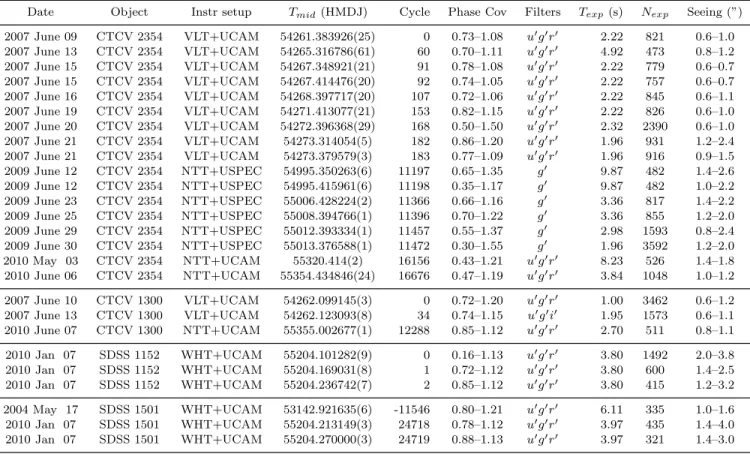
In Table 1 we present details of the observations used to analyse CTCV 1300, CTCV 2354, SDSS 1152 and SDSS 1501. For observations of other systems we refer the reader to table 1 in the following publications: Feline et al. 2004a (OU Vir), Feline et al. 2004b (XZ Eri and DV UMa), Littlefair et al. 2006a (SDSS 1702), Littlefair et al. 2007 (SDSS 1507) and Littlefair et al. 2008 (SDSS 0903, SDSS 1227, SDSS 1433, SDSS 1501 and SDSS 1502).
For reasons outlined in section 3.3 we do not use the SDSS 1501 data listed in Littlefair et al. (2008). Instead we model a single eclipse observed in 2004 (Table 1). Not all of the eclipses listed in Table 1 are used for determining system parameters. This is because the eclipses have poor signal-to-noise, or lack clear bright spot features. The eclipses not used for determining system parameters are however still used to refine our orbital ephemerides (section 3.1). These eclipses include CTCV 2354 cycle numbers 11197, 11198, 11366, 11396, 11457, 11472 and SDSS 1501 cycles 24718 and 24719. CTCV 2354 cycle numbers 16156, 16676 and CTCV 1300 cycle number 12888 are analysed separately in section 3.4 because the shape of the eclipse has changed significantly in comparison to the 2007 data (see section 3.2).
Data reduction was carried out in a standard man-ner using theultracampipeline reduction software, as
de-scribed in Feline (2005) and Dhillon et al. (2007). A nearby comparison star was used to correct the data for trans-parency variations. Observations of the standard stars G162-66, G27-45 and G93-48 were used to correct the magnitudes to the standard SDSS system (Smith et al. 2002). Due to time constraints and poor weather, we were unable to ob-serve a standard star to flux calibrate our data for SDSS 1152. Consequently, we have used the Sloan magnitudes of the comparison stars and corrected for different instrumen-tal response. To do this, we use measured response curves for filters and dichroics to create overall response curves for
ultracam. These are then combined with curves of
theoret-ical extinction and library spectra (Pickles 1998) to obtain syntheticultracam colours. The same process is then
re-peated for the SDSS colour set, with the difference between the two sets being the correction applied.
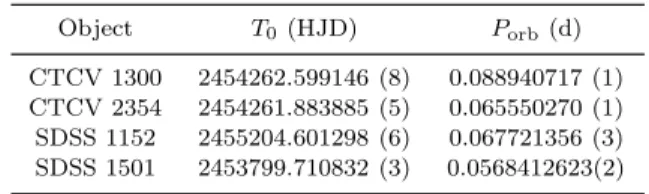
Table 2.Orbital ephemerides.
Object T0 (HJD) Porb(d)
CTCV 1300 2454262.599146 (8) 0.088940717 (1) CTCV 2354 2454261.883885 (5) 0.065550270 (1) SDSS 1152 2455204.601298 (6) 0.067721356 (3) SDSS 1501 2453799.710832 (3) 0.0568412623(2)
3 RESULTS
3.1 Orbital ephemerides
The times of white dwarf mid-ingressTwi and mid-egress
Twe were determined by locating the minimum and
maxi-mum times, respectively, of the smoothed light-curve deriva-tive. Mid-eclipse times, Tmid, were determined by
assum-ing the white dwarf eclipse to be symmetric around phase one and takingTmid = (Twi+Twe)/2. Eclipse times were
taken from the literature for CTCV 1300, CTCV 2354 (Tappert et al. 2004), SDSS 1501 (Littlefair et al. 2008) and SDSS 1152 (Southworth et al. 2010) and combined with our mid-eclipse times shown in Table 1. The errors on our data were adjusted to giveχ2= 1 with respect to a linear fit. In each case we observe no cycle ambiguity. We do however, observe a significant, O-C offset between our data and the times published by Tappert et al. (2004) for CTCV 1300 and CTCV 2354. For CTCV 1300, the average difference is 165.9 seconds, while for CTCV 2354 it is 148.0 seconds. We believe this to be due to the differing methods of calculatingTmid;
Tappert et al. (2004) calculatedTmid by fitting a parabola
to the overall eclipse structure, whereas we determinedTmid
from the white dwarf eclipse. We therefore subtract these av-erage offsets from the published literature values and take the resulting O-C difference as our uncertainty on that time. Where possible, we averaged the measured mid-eclipse times in ther′ andg′ bands to fit the ephemeris. Due to the low
signal-to-noise of the eclipse of CTCV 2354 in May 2010, measuring the times of white dwarf mid-ingressTwiand
mid-egressTwe was not possible. Consequently, the eclipse times
and errors were measured by eye in theg′andr′bands and
then averaged in order to estimate the cycle number. This time was not used to refine the ephemeris but is included for completeness. The ephemerides found are shown in Table 2.
3.2 Light curve morphology and variations
3.2.1 CTCV J1300-3052
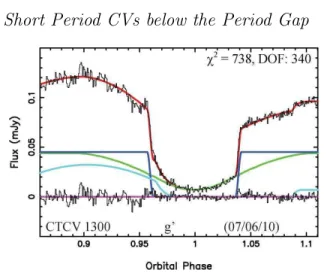
Fig. 1 (top) shows the two observed eclipses of CTCV 1300 from the 2007 data set folded on orbital phase in theg′band.
Table 1.Journal of observations. The dead-time between exposures was 0.025 s for all observations. The relative GPS time stamping on each data point is accurate to 50µs. Instr setup denotes the telescope (WHT, NTT or VLT) and instrument used for each observation, where UCAM and USPEC representultracamandultraspec, respectively. Phase Cov corresponds to the phase coverage of the eclipse,
taking the eclipse of the white dwarf as phase 1.TexpandNexpdenote the exposure time, and number of exposures, respectively.
Date Object Instr setup Tmid (HMDJ) Cycle Phase Cov Filters Texp(s) Nexp Seeing (”)
2007 June 09 CTCV 2354 VLT+UCAM 54261.383926(25) 0 0.73–1.08 u′g′r′ 2.22 821 0.6–1.0 2007 June 13 CTCV 2354 VLT+UCAM 54265.316786(61) 60 0.70–1.11 u′g′r′ 4.92 473 0.8–1.2 2007 June 15 CTCV 2354 VLT+UCAM 54267.348921(21) 91 0.78–1.08 u′g′r′ 2.22 779 0.6–0.7 2007 June 15 CTCV 2354 VLT+UCAM 54267.414476(20) 92 0.74–1.05 u′g′r′ 2.22 757 0.6–0.7 2007 June 16 CTCV 2354 VLT+UCAM 54268.397717(20) 107 0.72–1.06 u′g′r′ 2.22 845 0.6–1.1 2007 June 19 CTCV 2354 VLT+UCAM 54271.413077(21) 153 0.82–1.15 u′g′r′ 2.22 826 0.6–1.0 2007 June 20 CTCV 2354 VLT+UCAM 54272.396368(29) 168 0.50–1.50 u′g′r′ 2.32 2390 0.6–1.0 2007 June 21 CTCV 2354 VLT+UCAM 54273.314054(5) 182 0.86–1.20 u′g′r′ 1.96 931 1.2–2.4 2007 June 21 CTCV 2354 VLT+UCAM 54273.379579(3) 183 0.77–1.09 u′g′r′ 1.96 916 0.9–1.5 2009 June 12 CTCV 2354 NTT+USPEC 54995.350263(6) 11197 0.65–1.35 g′
9.87 482 1.4–2.6 2009 June 12 CTCV 2354 NTT+USPEC 54995.415961(6) 11198 0.35–1.17 g′ 9.87 482 1.0–2.2 2009 June 23 CTCV 2354 NTT+USPEC 55006.428224(2) 11366 0.66–1.16 g′ 3.36 817 1.4–2.2 2009 June 25 CTCV 2354 NTT+USPEC 55008.394766(1) 11396 0.70–1.22 g′ 3.36 855 1.2–2.0 2009 June 29 CTCV 2354 NTT+USPEC 55012.393334(1) 11457 0.55–1.37 g′ 2.98 1593 0.8–2.4 2009 June 30 CTCV 2354 NTT+USPEC 55013.376588(1) 11472 0.30–1.55 g′ 1.96 3592 1.2–2.0 2010 May 03 CTCV 2354 NTT+UCAM 55320.414(2) 16156 0.43–1.21 u′g′r′ 8.23 526 1.4–1.8 2010 June 06 CTCV 2354 NTT+UCAM 55354.434846(24) 16676 0.47–1.19 u′g′r′ 3.84 1048 1.0–1.2
2007 June 10 CTCV 1300 VLT+UCAM 54262.099145(3) 0 0.72–1.20 u′g′r′ 1.00 3462 0.6–1.2 2007 June 13 CTCV 1300 VLT+UCAM 54262.123093(8) 34 0.74–1.15 u′g′i′ 1.95 1573 0.6–1.1 2010 June 07 CTCV 1300 NTT+UCAM 55355.002677(1) 12288 0.85–1.12 u′g′r′ 2.70 511 0.8–1.1
2010 Jan 07 SDSS 1152 WHT+UCAM 55204.101282(9) 0 0.16–1.13 u′g′r′ 3.80 1492 2.0–3.8 2010 Jan 07 SDSS 1152 WHT+UCAM 55204.169031(8) 1 0.72–1.12 u′g′r′ 3.80 600 1.4–2.5 2010 Jan 07 SDSS 1152 WHT+UCAM 55204.236742(7) 2 0.85–1.12 u′g′r′ 3.80 415 1.2–3.2
2004 May 17 SDSS 1501 WHT+UCAM 53142.921635(6) -11546 0.80–1.21 u′g′r′ 6.11 335 1.0–1.6 2010 Jan 07 SDSS 1501 WHT+UCAM 55204.213149(3) 24718 0.78–1.12 u′g′r′ 3.97 435 1.4–4.0 2010 Jan 07 SDSS 1501 WHT+UCAM 55204.270000(3) 24719 0.88–1.13 u′g′r′ 3.97 321 1.4–3.0
and is clearly visible in Fig. 2. The flickering is reduced be-tween phases corresponding to the white dwarf ingress and bright spot egress, indicating the source of the flickering is the inner disc and/or bright spot. Due to the heavy flicker-ing, we decided to fit each night individually rather than fit to a phase-folded average, in order to provide a more robust estimation of our uncertainties. Our 2010 observations are discussed in section 3.4.1.
3.2.2 CTCV J2354-4700
Fig. 1 (middle) shows all of the observed eclipses from the 2007 data set of CTCV 2354 folded on orbital phase in theg′
band. The white dwarf ingress and egress features are clearly visible and along with the accretion disc dominate the shape of the light curve. A weak bright spot ingress feature is vis-ible at an orbital phase of 0.995, however the system suf-fers from heavy flickering, making it difficult to identify the bright spot egress. The shape of the average light curve in-dicates possible egress features at phases 1.060 and 1.080, but given the scatter we cannot be certain whether these represent genuine egress features or merely heavy flickering. The flickering is reduced between phases corresponding to the white dwarf ingress and egress, indicating the source of the flickering is the inner disc. Our observations from 2009 and 2010 are discussed in section 3.4.2.
3.2.3 SDSS J1152+4049
Fig. 1 (bottom) shows all of the observed eclipses from the 2010 data set of SDSS 1152 folded on orbital phase in the g′band. The signal-to-noise ratio of our data is low in
com-parison to other systems, but we still see a clear bright spot ingress feature at phase 0.975 in addition to a clear bright spot egress feature at phase 1.075. The white dwarf features are clear, and dominate the overall shape of the light curve. Like CTCV 1300, the eclipse of the accretion disc is difficult to discern by eye, which again suggests that the accretion disc contributes little light to this system.
3.3 Light curve modelling
Figure 1.ultracamg′ band light curves of CTCV 1300 (2007,
top), CTCV 2354 (2007, middle) and SDSS 1152 (2010, bottom).
Obviously these assumptions cannot be tested directly, but it has been shown that the masses derived with this model are consistent with other methods commonly employed in CVs over a range of orbital periods (e.g. Feline et al. 2004b; Tulloch et al. 2009; Copperwheat et al. 2010). The model used by Littlefair et al. (2008) had to be adapted due to the prominent bright spot observed in CTCV 1300 (Fig. 1). The ‘old’ model fails to correctly model the bright spot ingress and egress features in this system satisfactorily and results in a poor fit. We have thus adapted the model to account for a more complex bright spot by adding four new parame-ters, following Copperwheat et al. (2010), bringing the total number of variables to 14. These are:
(i) The mass ratio,q=Mr/Mw.
(ii) The white dwarf eclipse phase full-width at half-depth, ∆φ.
(iii) The outer disc radius, Rd/a, where a is the binary
separation.
(iv) The white dwarf limb-darkening coefficient,Uw.
(v) The white dwarf radius,Rw/a.
(vi) The bright-spot scale,S/a. The bright spot is mod-elled as two linear strips passing through the intersection of the gas stream and disc. One strip is isotropic, while the other beams in a given direction. Both strips occupy the same physical space. The intensity distribution is given by (X/S)Ye−(X/S)Z
, whereX is the distance along the strips. The non-isotropic strip does not beam perpendicular to its surface. Instead the beaming direction is defined by two an-gles,θtilt andθyaw.
(vii) The first exponent,Y, of the bright spot intensity distribution.
(viii) The second exponent,Z, of the bright spot intensity distribution.
(ix) The bright-spot angle,θaz, measured relative to the
line joining the white dwarf and the secondary star. This allows adjustment of the phase of the orbital hump.
(x) The tilt angle, θtilt, that defines the beaming
direc-tion of the non-isotropic strip. This angle is measured out of the plane of the disc, such thatθtilt = 0 would beam light
perpendicular to the plane of the disc.
(xi) The yaw angle, θyaw. This angle also defines the
beaming direction of the non-isotropic strip, but in the plane of the disc and with respect to the first strip.
(xii) The fraction of bright spot light that is isotropic, fiso.
(xiii) The disc exponent,b, describing the power law of the radial intensity distribution of the disc.
(xiv) A phase offset,φ0.
The data are not good enough to determine the white dwarf limb-darkening coefficient,Uw, accurately. To find an
appropriate limb-darkening coefficient, we follow the pro-cedure outlined in Littlefair et al. (2007), whereby an es-timate of the white dwarf effective temperature and mass is obtained from a first iteration of the fitting process out-lined below, assuming a limb-darkening coefficient of 0.345. Littlefair et al. (2007) show that typical uncertainties inUw
are ∼5%, which leads to uncertainties in Rw/a of ∼1%.
These errors have negligible impact on our final system pa-rameters.
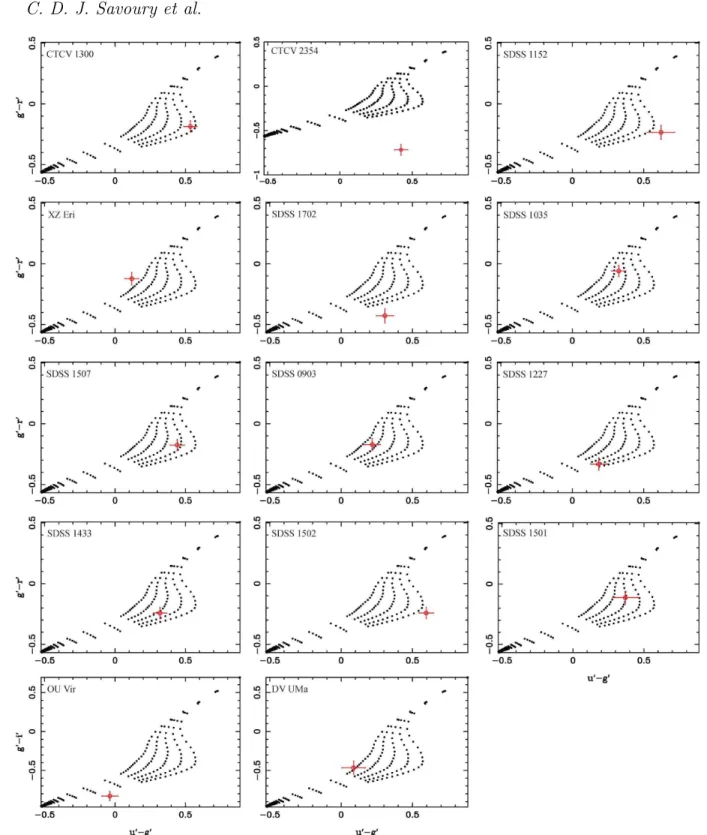
As well as the parameters described above, the model also provides an estimate of the flux contribution from the white dwarf, bright spot, accretion disc and donor. The white dwarf temperature and distance are found by fitting the white dwarf fluxes from our model to the predictions of white dwarf model atmospheres (Bergeron et al. 1995), as shown in Fig. 3. We find that with the exception of CTCV 2354, all of the systems analysed lie near, or within, the range of white dwarf colours allowed by the atmosphere models of Bergeron et al. (1995), although the systems do not always lie near the track for the appropriate mass and ra-dius of the white dwarf. Littlefair et al. (2008) compare the temperatures derived using light curve fits to those found us-ing SDSS spectra and GALEX (Galaxy Evolution Explorer) fluxes for a small number of systems and conclude their white dwarf temperatures are accurate to∼1000K. The sys-tems examined by Littlefair et al. (2008) are all found to lie close to the Bergeron tracks; it is likely that systems that lie far from the tracks are less accurate. We note our tempera-tures have larger uncertainties than those of Littlefair et al. (2008). This is because our temperatures take into account the uncertainty in white dwarf mass when comparing the white dwarf fluxes to the models of Bergeron et al. (1995).
It is possible that our white dwarf colours are affected by contamination from the disc or bright spot, or an un-modelled light source such as a boundary layer. If our white dwarf colours are incorrect, then our derived white dwarf temperatures will be affected. Changing the white dwarf temperature will alterUw. Our model fitting measuresRw/a
and uses a mass-radius relationship to infer Mw, which is
then used to find the mass of the donor star. However,Uw
andRw are partially degenerate, soUwtherefore affectsRw
and Mw. Mw is also affected by temperature changes
the luminosity of the system, and hence distance estimate. It is therefore important to quantify the effect that incor-rect white dwarf temperatures may have on distance esti-mates and our final derived system parameters. To do this, we altered the white dwarf temperature by 2000K and per-formed the fitting procedure described above on our best quality, white-dwarf dominated systems. For lower quality data, the random errors dominate over any systematic er-rors, and thus changes to the best quality data represent a worst case scenario. We find that changing the white dwarf temperature by 2000K changesRw/a by less than 1σ. The
white dwarf distance estimates change by 10-20pc. We there-fore conclude any error in white dwarf temperature that may occur does not affect our final system parameters by a sig-nificant amount. We note here that our moedelling does not include treatment of any boundary layer around the white dwarf, and assumes all of the white dwarf’s surface is visi-ble. Either effect could lead to systematic uncertainty in our white dwarf radii (Wood et al. 1986).
A Markov Chain Monte Carlo (MCMC) analysis was used to adjust all parameters bar UW. MCMC analysis is
an ideal tool as not only does it provide a robust method for quantifying the uncertainties in the various system param-eters, it is more likely to converge on the global minimum χ2 rather than a local minimumχ2. We refer the reader to Ford (2006), Gregory (2007) and references therein for ex-cellent overviews of MCMC chains and Bayesian statistics and limit ourselves to a simple overview.
MCMC is a random walk process where at each step in the chain we draw a set of model parameters from a nor-mal, multi-variate distribution. This is governed by a co-variance array, which we estimate from the initial stages of the MCMC chain. The step is either accepted or rejected based on a transition probability, which is a function of the change inχ2. We adopt a transition probability given by the
Metropolis-Hastings (M-H) rule, that is P = exp−∆χ2/2. The sizes of the steps in the MCMC chain are multiplied by a scale factor, tuned to keep the acceptance rate near 0.23, which is found to be the optimal value for multi-variate chains such as these (Roberts et al. 1997).
A typical MCMC chain included some 700,000 steps, split into two, 350,000 step sections. The first section is used to convergetowards the global minimum and estimate the covariance matrix (known as the burn-in phase). The sec-ond section fine tunes the solution by sampling areas of pa-rameter space around the minimum. In doing so, we also produce a robust estimation of our uncertainties. Together, these steps are usually sufficient to enable the model to con-verge on the statistical best fit, regardless of the initial start-ing parameters.
While implementing the MCMC code, we discovered a bug in our original code. The re-binning code used to av-erage several light curves together mistreated the widths of the bins, which in turn affected the trapezoidal integration of the model over these bins. The direct result was that in cases of heavy binning, such as systems with heavy flickering or where several light curves had been averaged together (e.g. SDSS 1502), the white dwarf radius, Rw/a, was
underesti-mated. The exact amount depended on the level of binning used. This consequently resulted in an overestimate of the white dwarf mass. Since the mass of the donor star, Mr,
is related to the white dwarf massMw byMr =qMw, we
were also left with an overestimate of the donor mass. This problem affects all of our previously published eclipsing-CV papers (Feline et al. 2004a, 2004b; Littlefair et al. 2006a, 2006b, 2007, 2008) by differing amounts. However, in most cases re-modelling provides new system parameters that are within 1−2σof our original results, with only two exceptions (see section 3.4). The new results are presented in Table 3.
For each system we ran an MCMC simulation on each phase-folded u′, g′, r′ or i′ light curve from an arbitrary
starting position. Exceptions include CTCV 1300, where each night of observations was fit individually, and SDSS 1152 and SDSS 1501, for which we only calculated fits in theg′andr′bands due tou′-band data of insufficient
qual-ity to constrain the model. Where no u′ band MCMC fit
could be obtained, we fit and scaled theg′ band model to
theu′ band light curves withoutχ2 optimisation. This
al-lows us to estimate the white dwarf flux in the u′
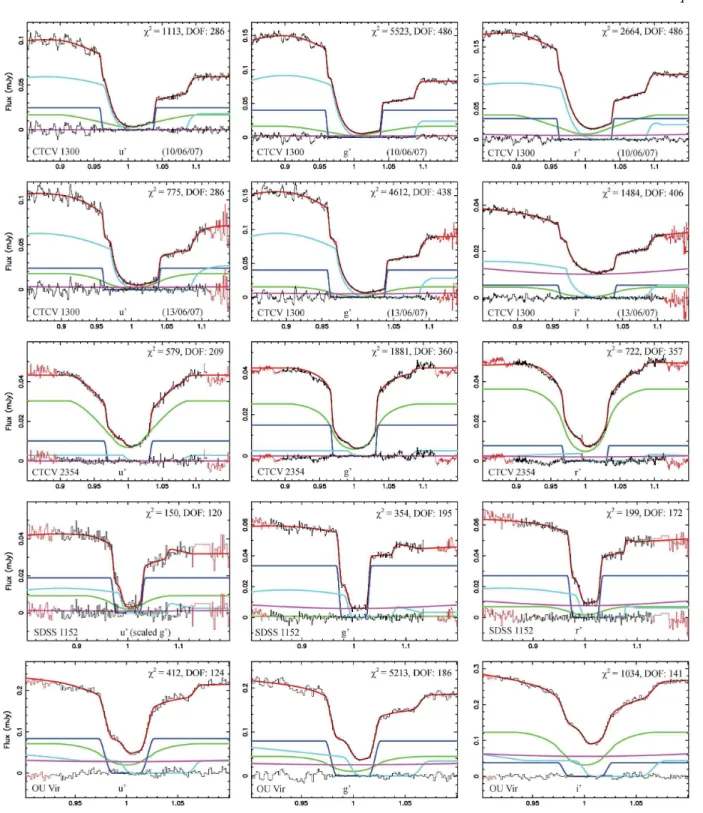
band, and thus estimate the white dwarf temperature. In the case of SDSS 1501, we also fit a different data set to the 2006 WHT data of Littlefair et al. (2008). We fit our model to the single light curve dated 2004 May 17. This 2004 data was not fit by Littlefair et al. (2008) as the simplex meth-ods used gave a seemingly good fit to the 2006 data. De-spite appearing to have converged to a good fit, the MCMC analysis revealed that the 2006 data does not constrain the model, most likely due to the very weak bright spot features. The 2004 data shows much clearer and well-defined bright-spot features than the 2006 data (see Fig.1 of Littlefair et al. 2008), and so despite only having one eclipse (and thus lower signal-to-noise) it is favoured for the fitting process. In general our fits to each system are in excellent agreement with the light curves (see Fig. 2), giving us confidence that our new models accurately describe each system.
To obtain final system parameters we combine our MCMC chains with Kepler’s 3rd law, the orbital period, our derived white dwarf temperature, and a series of white dwarf mass-radius relationships. We favour the relationships of Wood (1995), because they have thicker hydrogen lay-ers which may be more appropriate for CVs. However, they do not reach high enough masses for some of our systems. Above Mw = 1.0M⊙, we adopt the mass-radius
relation-ships of Panei et al. (2000). In turn, these models do not extend beyondMw = 1.2M⊙; above this mass we use the
Hamada & Salpeter (1961) relationship. No attempt is made to remove discontinuities from the resulting mass-radius re-lationship.
We calculate the mass ratio q, white dwarf mass Mw/M⊙, white dwarf radiusRw/R⊙, donor massMr/M⊙,
donor radiusRr/R⊙, inclinationi, binary separationa/R⊙
and radial velocities of the white dwarf and donor star (Kw
and Kr, respectively) for each step of the MCMC chain.
sim-plicity, since the distributions are mostly symmetrical, we take an average of the upper and lower error bounds. The final adopted system parameters are shown in Table 3, al-though Fig. 7 and 8 show the true 67% confidence levels for the white dwarf mass and donor mass respectively, for each system.
3.4 Notes on individual systems
3.4.1 CTCV 1300
As noted in section 3.3, the two eclipses of CTCV 1300 were modelled individually due to the heavy pre-eclipse flicker-ing present in each light curve. Theu′g′r′ eclipses from the
night of 2007 June 10 gave consistent results, as did the u′g′i′ eclipses from the night of 2007 June 13. However,
re-sults from the individual nights were not consistent with each other, and we are presented with two distinct solutions which are the result of heavy pre-eclipse flickering altering the shape of the bright spot ingress feature. This in turn gives two very different values for the mass ratio,q. Encour-agingly we find our white dwarf masses and radii are consis-tent between nights. To derive the final system parameters we use the PDFs as outlined in section 3.3 and then take an average of the solution from each night. The error is taken as the standard deviation between the two values.
In Fig. 5 we see a g′-band eclipse from June 2010
to-gether with a modified version of the model obtained from the 2007 dataset. This new model is found by starting from an average of the two 2007 fits and using a downhill sim-plex method to vary all parameters bar q, ∆φ, Rw/a and
Uw. These parameters should not change with time, and so
the simplex fit will confirm if our bright spot positions and white dwarf dwarf radius are correct, and thus if our system parameters are reliable. We use a simplex method for two reasons; firstly since we are performing a consistency check and are not extracting system parameters from the fitting process we do not require a full MCMC analysis. Secondly, the bright spot flux appears to have reduced significantly, and the strength of the bright spot ingress feature means that we cannot constrain a full fit using the MCMC model used previously. The model confirms the bright spot flux has decreased considerably, although an orbital hump is still visible. The white dwarf flux remains almost unchanged, al-though the disc appears brighter. The fit to the data is good, indicating that the models derived from the 2007 data (and used to derive our system parameters) are reliable.
3.4.2 CTCV 2354
In section 3.2.2 we noted that the shape of the light curve in Fig. 1 indicated possible bright spot egress features around phases 1.060 and 1.080. Fig. 2 shows that our model has fit the bright spot egress feature at phase 1.080. Given the strength and shape of the bright spot features and general scatter present in the light curve we cannot be certain if the bright spot positions have been correctly identified by our model, and thus there is some element of doubt as to the value obtained for our mass ratio and thus donor mass. It is at this point we draw the readers attention to our 2010 data, shown in Fig. 6. The eclipse dated 2010 May 3 (centre panel) shows clear bright spot ingress and egress features, with a
Figure 5.Our June 2010g′band eclipse of CTCV 1300, together with a modified model found using the 2007 data. Starting from an average of the two 2007 models, we ran a downhill simplex fit varying all parameters barq, ∆φ,Rw/aandUw.
clear orbital hump visible from phases 0.70–0.95. The system is much brighter in this state than the 2007 data previously modelled, in part due to a dramatic increase in bright spot flux. As with CTCV 1300 we carried out a downhill simplex method to vary all parameters bar q, ∆φ, Rw/a and Uw.
Our fit to the eclipse of May 3 is especially pleasing, as its excellent agreement with the light curve confirms that our 2007 model correctly identified the bright spot egress feature and thus the mass ratio obtained is reliable.
Fig. 6 also shows a single eclipse observed just one month later (June 2010, right panel), and six eclipses av-eraged together from June 2009 (left panel). Both of these datasets are fit with a downhill simplex model as above. The June 2009 and June 2010 datasets are in stark contrast to the May 2010 data, with the bright spot features appear-ing extremely faint (2009), or seemappear-ingly non-existent (June 2010). The disc flux in the June 2010 data appears to have increased significantly, giving rise to a distinct “u” shape. The rapid change in bright spot and disc light curves over such short (1 month - 1 year) time scales suggests that the disc is highly unstable.
3.4.3 DV UMa
Our donor mass derived for DV UMa has increased by 6.1σ (∆M=0.039M⊙) from that published by Feline et al.
Table 3 (system parameters) goes here (landscape). See separate file (table3params).
Figure 2.The phased-foldedu′g′r′ oru′g′i′ light curves of the CVs listed in Table 3, fitted using the model outlined in section 3.3. The data (black) are shown with the fit (red) overlaid and the residuals plotted below (black). Below are the separate light curves of the white dwarf (dark blue), bright spot (light blue), accretion disc (green) and the secondary star (purple). Data points omitted from the fit are shown in red.χ2 values for each fit, together with the number of degrees of freedom (DOF) are also shown.
3.4.4 SDSS 1502
Our new fits to SDSS 1502 decrease the donor mass by 2.9σ(∆Mr= 0.012M⊙) from that of Littlefair et al. (2008).
Our mass ratio and inclination are consistent with those of Littlefair et al. (2008), however our white dwarf radius,Rw,
has increased by 13 percent (3.4σ). We believe the primary
Figure 2–continued
3.4.5 SDSS 1501
The most important change of all of our re-modelled sys-tems is for that of SDSS 1501. Whilst our donor mass has only increased by 1.9σ from that of Littlefair et al. (2008), we note that our uncertainties are large (σMr= 0.010M⊙)
and the mass difference is large enough to take this system from being a post-period-bounce system, to a pre-period-bounce system. Although our errors do not formally rule
Figure 2–continued
it is clear that the 2006 data used by Littlefair et al. (2008) does not constrain the mass ratio,q, tightly enough. In con-trast, the 2004 data shows much clearer bright spot features, and we therefore favour this over the 2006 data as discussed in section 3.3.
4 DISCUSSION
4.1 White dwarf masses
Population studies by Willems et al. (2005) predict that be-tween 40 and 80 percent of CVs are born with He-core white dwarfs (Mw .0.50M⊙) and therefore He-core white
Figure 3.The white dwarf colours derived from our model fitted together with the white dwarf models of Bergeron et al. (1995). From top to bottom, each curve represents log g = 9.0, 8.5, 8.0, 7.5 and 7.0 respectively. The measured white dwarf colours are shown here in red, and are used to derive the white dwarf temperature, which in turn is used to correct the white dwarf mass-radius relationships used later to obtain the final system parameters.
SDSS 1152 is found to have to the lowest white dwarf mass with Mw = 0.560±0.028. The mass distribution of
Kepler et al. (2007) for SDSS white dwarfs suggests He-WDs have a typical mass of ∼0.38M⊙. The most massive
He-WDs are thought to form from single RGB stars, which due to extreme mass loss are able to avoid the Helium flash; D’Cruz et al. (1996) consider models with a range of mass
loss rates on the RGB and manage to produce He-WDs with masses up to∼0.48M⊙. It is likely that this represents an
upper limit to the mass of He-WDs and hence SDSS 1152 is too massive to be a viable candidate for a He-core white dwarf.
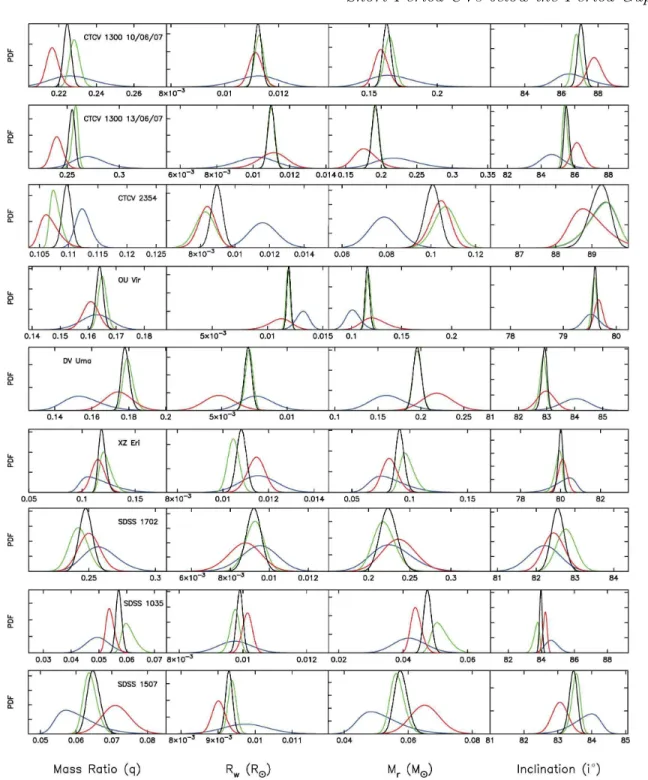
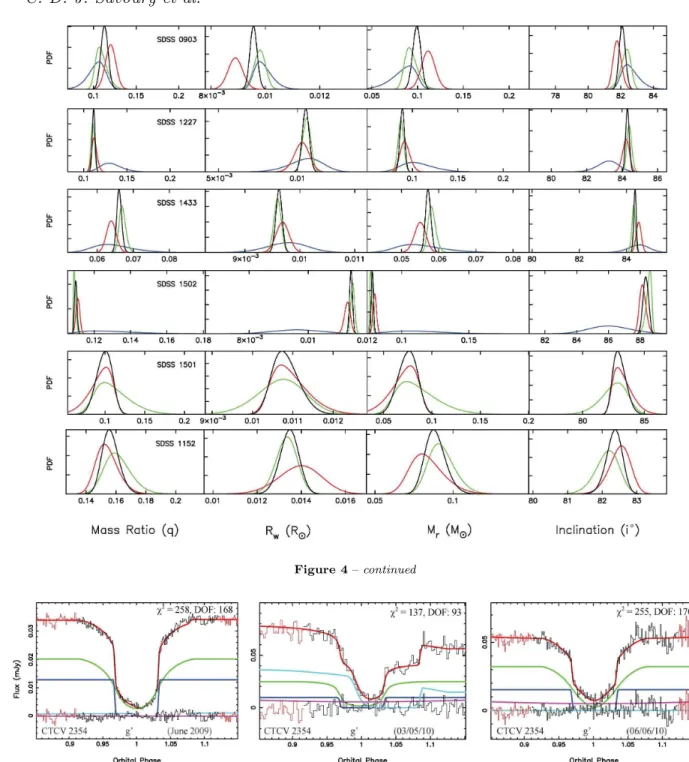
aver-Figure 4.The normalised probability density functions for each system, derived using the MCMC chains, orbital period and the mass– radius relationships of Wood (1995), Panei et al. (2000) and Hamada & Salpeter (1961), at the appropriate white dwarf temperature. The red curve represents ther′ ori′band fit, the green represents theg′ band, and blue curve (where present) represents theu′band. The black represents the total, combined PDF. Shown are the PDFs for mass ratioq, white dwarf radiusRw/R⊙, donor massMr/M⊙,
and inclinationi◦.
age mass for single DA white dwarfs. Using the same method as Knigge (2006), we calculated the average white dwarf mass of our entire sample to beMw= 0.81±0.04M⊙, with
an intrinsic scatter of 0.13M⊙. In comparison, Liebert et al.
(2005) find the mean mass of DA white dwarfs to be Mw∼0.603M⊙, while Kepler et al. (2007) find a mean mass
ofMw= 0.593±0.016M⊙.
Our study thus supports previous findings (e.g. Warner 1973, 1976; Ritter 1976, 1985; Robinson 1976;
Smith & Dhillon 1998; Knigge 2006) that white dwarfs in CVs are on average much higher in mass than single field stars. Like Littlefair et al. (2008), we compare our masses to the average mass ofMw = 0.73±0.05M⊙ for white dwarfs
in CVs below the period gap (Knigge 2006) and find that our white dwarf masses are generally much higher. This is especially so for systems Porb 6 95 mins, where we find a
mean white dwarf mass of Mw = 0.83±0.02M⊙, with an
Figure 4–continued
Figure 6.Ourg′band observations of CTCV 2354 from 2009 (left), 2010 May 3 (centre) and 2010 June 6 (right), fit with a modified version of the model obtained from the 2007 data as described in section 3.4.2.
are revised, and have accordingly moved downwards in mass compared to Littlefair et al. (2008), but as Fig. 7 shows, for Porb 695 mins, 8 out of 9 systems are more massive than
the average found by Knigge (2006), with SDSS 1502 the only exception. On the same plot, we also plot the disper-sion of masses as found by Knigge (2006) and the mean mass of single SDSS white dwarfs found by Kepler et al. (2007). Note that the Knigge (2006) sample contains three systems also included in our study: OU Vir, DV UMa and XZ Eri, using the old mass determinations of Feline et al. (2004a, 2004b). We see most of our masses are within the dispersion found, indicating that no individual white dwarf mass is un-usual. However 8 out of 9 systems above average does seem
anomalously high, considering that if we model the white dwarf masses as a Gaussian distribution, the probability of such an occurrence is less than 2 percent (independent of the actual mean or variance). Such difference between our sample and that of Knigge (2006) is concerning, and it is therefore desirable to consider the selection effects, consid-ering the majority of our short period systems are all SDSS objects (Szkody et al. 2004, 2005, 2006, 2007).
The majority of SDSS CVs found are generally rejected quasar candidates with a limiting magnitude ofg′= 19−20,
and are initially selected for follow up on the basis ofu′
-g′
Mw>0.50M⊙are blue enough to pass the SDSS colour cuts
and conclude that selection effects such as these are unlikely to explain the high mass bias of our white dwarf sample. However, the majority of the systems we have studied are close (g′∼17.5−19.5) to theg′= 19 limit of the SDSS
sur-vey. This raises the possibility that the SDSS sample only finds the brightest of the short period CVs. Ritter & Burkert (1986) have shown that CVs with high mass white dwarfs are brighter than their low mass counterparts. This suggests there maybe some bias towards high mass dwarfs. However, this conclusion is not appropriate to the systems studied here: Ritter & Burkert (1986) only consider the effects of ac-cretion luminosity whereas in most of our systems the white dwarf considerably outshines the accretion disc.
Zorotovic et al. (2011) consider selection effects in white dwarf dominated SDSS systems with a variety of differ-ent mass transfer rates and conclude there is actually bias
againsthigh mass white dwarfs. They find a 0.90M⊙ white
dwarf is approximately 0.15 magnitudes fainter than a 0.75M⊙white dwarf, which corresponds to a decreased
de-tection efficiency of∼20%. This suggests that our finding of high mass white dwarfs at short orbital periods is not due to selection effects, and is in fact a true representation of the intrinsic mass distribution of CVs. However, this analysis only considers white dwarf luminosity; in some of our sys-tems the bright spot features are prominent, and contribute significantly to the overall flux of the system. It remains possible that the finding of very high white dwarf masses for our short period CVs is due to selection effects. How-ever, a full and thorough quantification of any bias would require detailed calculations of the luminosity of white-dwarf dominated systems (including bright spot emission) plus an investigation of the selection effects in the SDSS sample. Such an analysis is beyond the scope of this paper.
Our results have important consequences for the mod-elling of nova outbursts and their impact on the long-term evolution on CVs. Typical calculations show that the mass of the white dwarf decreases by between 1 and 5 percent per 1000 nova cycles (e.g. Yaron et al. 2005; Epelstain et al. 2007). The dominance of high-mass white dwarfs in our sam-ple of short period systems suggests that any white dwarf erosion due to nova explosions must be minimal, or that not all of the accreted matter is ejected during nova ig-nition, resulting in the white dwarf mass increasing over time. This could, in principle enable the white dwarfs in cataclysmic variables to grow in mass until they reach the Chandrasekhar limit.
4.2 Period bounce
Population synthesis models for cataclysmic variables (e.g. Kolb 1993; Willems et al. 2005) all predict that large num-bers of the CV population (∼15 - 70 percent) have evolved past the period minimum. This has always been in stark contrast to observations, possibly in part due to selection effects (e.g. Littlefair et al. 2003).
Littlefair et al. (2006b, 2007, 2008) identified four sys-tems (SDSS 1035, SDSS 1507, SDSS 1433, SDSS 1501) with donors below the sub-stellar limit, three of which are likely to be post-period-bounce CVs (SDSS 1035, SDSS 1501 and SDSS 1433). Our subsequent re-analysis gives three systems (SDSS 1035, SDSS 1507, SDSS 1433) with donors below
the sub-stellar limit, two of which (for reasons outlined be-low) we believe are post-period-bounce CVs (SDSS 1035 and SDSS 1433). SDSS 1501, which no longer features as a post-period-bounce system, is discussed in greater detail in sec-tion 3.4.5.
Sirotkin & Kim (2010) claim that SDSS 1433 cannot be considered a post-period-bounce object since the mass transfer rates and donor star temperatures implied are too high. The mass transfer rate is found using an estimate of the white dwarf temperature (Townsley & G¨ansicke 2009), while the donor star temperature is inferred using a semi-empirical relationship that is also dependent on the white dwarf temperature. The white dwarf temperature used by Sirotkin & Kim (2010) is that derived by Littlefair et al. (2008) from model fitting. We believe, at least in this case, that using ˙MandT2is an unreliable test of the evolutionary
status of CVs donors, since accurate determinations of the white dwarf temperature are difficult to obtain. Of all the system parameters we have derived, the white dwarf tem-peratures are the least well constrained, and this does not take into account systematic errors. Since the white dwarf temperature is found using the flux from just three colours, and our model does not include all possible sources of lumi-nosity (e.g. a boundary layer), there is a good chance our white dwarf temperatures are affected by systematic errors at some level, as discussed in section 3.3. Instead, we focus on the donor star mass,Mr.
If the angular momentum loss rate is similar for sys-tems with identical system parameters, we expect all CVs to follow very similar evolutionary tracks with a single lo-cus in the period relationship (and by analogy, mass-radius relationship) for CV donors, as shown in Fig. 8. The empirical donor star mass-radius relationship derived by Knigge (2006) shows that a single evolutionary track does very well at describing the observedM2−Porb
relation-ship, although the shape of that relationship is poorly con-strained at low masses. A single evolutionary path also ex-plains the presence of the “period spike”, a long sought after feature in the orbital period distribution recently identified by G¨ansicke et al. (2009). We therefore expect there to be a unique donor mass corresponding to the minimum orbital period, below which an object becomes a period-bouncer. The exact mass at which this occurs is very uncertain, and does not necessarily correspond to the sub-stellar limit (Patterson 2009). From the empirical work of Knigge (2006), the best estimate for Mbounce is Mr = 0.063±0.009M⊙.
Three of our systems (SDSS 1035, SDSS 1433 and SDSS 1507) fall well below this value, although SDSS 1507 is an unusual system, and is discussed in the following section. As in Littlefair et al. (2008), we do not include it in our sample of post-period minimum CVs. We therefore have two strong candidates for post-period minimum CVs (SDSS 1035 and SDSS 1433) from our total sample of 14 CVs (nine of which are SDSS systems). From this, we estimate that 14±7 per-cent of all CVs below the period gap, and 22±11 percent of all short period CVs (Porb695 mins) have evolved past
Figure 7.White dwarf mass as a function of orbital period. The mean white dwarf mass for systems below the period gap, as found by Knigge (2006) is shown with a solid line, along with the associated intrinsic scatter (dashed line). The mean white dwarf mass in single stars as found by Kepler et al. (2007) is shown by a dotted line.
is broadly consistent with other surveys, allowing for nor-malisation of survey volumes.
4.3 SDSS 1507
The orbital period of SDSS 1507 is far below the well-defined period minimum and thus the nature of this system is of great interest to theorists and observers. It is possible that this system represents the true orbital period minimum as predicted by Kolb & Baraffe (1999). However, if this is indeed the case, we would expect a large number of sys-tems between orbital periods of 67 minutes, and 83 minutes where the period spike is observed (G¨ansicke et al. 2009). These systems are not observed, and hence it is likely that some other mechanism is responsible. Littlefair et al. (2007) speculate that this system was either formed directly from a white dwarf/brown dwarf binary, while Patterson et al. (2008) argue that the system could be a member of the halo. Both derive system parameters, and both obtain distance estimates to the system.
Our derived system parameters are consistent with those of Littlefair et al. (2007) and Patterson et al. (2008), within uncertainties. Our distance estimate is in excellent agreement with Littlefair et al. (2007), which is not supris-ing since we both calculate the distance ussupris-ing the same methods and dataset. However, our new distance estimate still places the system nearer than that of Patterson et al. (2008). Patterson et al. (2008) obtain a lower limit to the distance using parallax. The parallax value implies a dis-tance d > 175 pc, which taken alone, is consistent with
our estimate of d = 168±12 pc. Patterson combines his parallax with a range of other observational constraints us-ing Bayesian methods to yield a final distance estimate of d= 230±40 pc. If our distance ofd= 168±12 pc is nearer the true distance, then combining with Patterson’s proper motion measurement of 0.16′′/yryields a transverse velocity
ofd= 128±9 kms−1. This lower transverse velocity is still
very much an outlier in the distribution of 354 CVs shown in Fig.1 of Patterson et al. (2008). Therefore, regardless of which distance is correct, the proper motion of SDSS 1507 still supports halo membership.
4.4 Exploring the standard model of CV evolution
Fig. 8 shows the evolutionary models of Kolb & Baraffe (1999) calculated with enhanced mass-transfer rates. Also shown is a model with 50 percent star spot coverage on the surface of the donor. Positions of the period minimum, and period gap as found by Knigge (2006) are also shown. Mass determinations for all systems presented here are included. We see that the standard theoretical models are a poor fit to the data. For a given mass, the models of Kolb & Baraffe (1999) significantly underestimate the orbital period, and thus the donor radii.
100 minutes. Unfortunately, in this regime there are few sys-tems with precisely known donor masses. Clearly, we require more mass determinations for systems with orbital periods between 100 and 130 minutes.
5 CONCLUSIONS
We present high-speed, three-colour photometry of a sample of 14 eclipsing CVs. Of these CVs, nine are short period (Porb695 minutes), and one is within the period gap. For
each of the 14 objects we determine the system parameters by fitting a physical model of the binary to the observed light curve byχ2minimisation. We find that two of our nine
short period systems appear to have evolved past the period minimum, and thus supports various assertions that between 15 and 70 per cent of the CV population has evolved past the orbital period minimum. The donor star masses and radii are not consistent with model predictions, with the majority of donor stars being ∼10 per cent larger than predicted. Our derived masses and radii show that this can explained by either enhancing themass transfer rate or modifying the stellar physics of the donor star to take into account star spot coverage. Unfortunately, we still lack enough precise donor masses between orbital periods of 100 and 130 minutes to choose between these alternatives.
Finally, we find that the white dwarfs in our sample show a strong tendency towards high masses. The high mass dominance implies that the white dwarfs in CVs are not significantly eroded by nova outbursts, and may actually increase over several nova cycles. We find no evidence for He-core white dwarfs within our sample, despite predictions that between 40 and 80 percent of short period CVs should contain He-core white dwarfs.
6 ACKNOWLEDGEMENTS
We would like to thank our referee, Joe Patterson for his useful comments. We also thank Christian Knigge for useful discussions on white dwarf bias and selection effects. CDJS acknowledges the support of an STFC PhD. SPL acknowl-edges the support of an RCUK Fellowship. CMC and TRM are supported under grant ST/F002599/1 from the Science and Technology Facilities Council (STFC). ultracam and ultraspec are supported by STFC grant ST/G003092/1.
This research has made use of NASA’s Astrophysics Data System Bibliographic Services. This article is based on ob-servations made withultracammounted on the Isaac
New-ton Group’s WHT, andultracamandultraspecmounted
on the European Southern Observatory’s NTT and VLT telescopes.
REFERENCES
Bergeron P., Wesemael F., Beauchamp A., 1995, PASP, 107, 1047
Chabrier G., Gallardo J., Baraffe I., 2007, A&A, 472, L17 Copperwheat C., Marsh T., Dhillon V., Littlefair S., Hick-man R., G¨ansicke B., Southworth J., 2010, MNRAS, 402, 1824
D’Cruz N., Dorman B., Rood R., O’Connell R., 1996, ApJ, 446, 359
Dhillon V., et al 2007, MNRAS, 378, 825
Epelstain N., Yaron O., Kovetz A., Prialnik D., 2007, MN-RAS, 374, 1449
Feline W., 2005, PhD thesis, The University of Sheffield Feline W., Dhillon V., Marsh T., Stevenson M., Watson C.,
Brinkworth C., 2004a, MNRAS, 347, 1173
Feline W., Dhillon V., Marsh T., Brinkworth C., 2004b, MNRAS, 355, 1
Ford E., 2006, ApJ, 642, 505
G¨ansicke B., Dillon M., Southworth J., Thornstensen J., Rodr´ıguez-Gil P., Aungwerojwit A., Marsh T., et al. 2009, MNRAS, 397, 2170
Gregory P., 2007, MNRAS, 381, 1607 Hamada T., Salpeter E., 1961, ApJ, 134, 683
Hellier C., 2001, Cataclysmic Variable Stars. Praxis Pub-lishing Ltd, Chichester
Horne K., Marsh T., Cheng F., Hubany I., Lanz T., 1994, ApJ, 426, 294
Kepler S., Kleinman S., Nitta A., Koester D., Castanheira B., Giovannini O., Althaus L., 2007, in Napiwotzki R., Burleigh M., eds, 15th European Workshop on White Dwarfs Vol. 372 of ASPCS, The white dwarf mass dis-tribution. pp 35–40
Knigge C., 2006, MNRAS, 373, 484 Kolb U., 1993, A&A, 271, 149
Kolb U., Baraffe I., 1999, MNRAS, 309, 1034
Liebert J., Bergeron P., Holberg J., 2005, ApJS, 156, 47 Littlefair S., Dhillon V., Martn E., 2003, MNRAS, 340, 264 Littlefair S., Dhillon V., Marsh T., G¨ansicke B., 2006a,
MNRAS, 371, 1435
Littlefair S., Dhillon V., Marsh T., G¨ansicke B., South-worth J., Watson C., 2006b, Sci, 314, 1578
Littlefair S., Dhillon V., Marsh T., G¨ansicke B., Baraffe I., Watson C., 2007, MNRAS, 381, 827
Littlefair S., Dhillon V., Marsh T., G¨ansicke B., South-worth J., Baraffe I., Watson C., Copperwheat C., 2008, MNRAS, 388, 1582
Paczynski B., 1981, Acta Astron., 31, 1
Panei J., Althaus L., Benvenuto O., 2000, A&A, 353, 970 Patterson J., 1998, PASP, 110, 1132
Patterson J., 2009, ArXiv e-prints
Patterson J., Thornstensen J., Knigge C., 2008, PASP, 120, 510
Pickles A., 1998, PASP, 110, 863 Ritter H., 1976, MNRAS, 175, 279 Ritter H., 1985, A&A, 148, 207
Ritter H., Burkert A., 1986, A&A, 158, 161
Roberts G., Gelman A., Gilks W., 1997, Annual of Applied Probability, 7, 110
Robinsons E. L., 1976, ApJ, 203, 485
Sirotkin F. V., Kim W.-T., 2010, ApJ, 721, 1356 Smith D., Dhillon V., 1998, MNRAS, 301, 767 Smith J., et al. 2002, AJ, 123, 2121
Southworth J., Copperwheat C. M., G¨ansicke B. T., Pyrzas S., 2010, A&A, 510, A100+
Figure 8.TheM2−Porbrelationship for our dataset. Mass determinations for all systems usingultracamdata are included. Our three
new systems, in addition to other objects of particular interest are labelled. The evolutionary models of Kolb & Baraffe (1999) calculated with different mass-transfer rates are shown with red (dashed) and blue (dot-dashed) lines. A model with 50 percent star spot coverage on the surface of the donor is shown with an orange (dotted) line. The solid (black) line shows the empirical mass-radius relationship as found by Knigge (2006). The position of the period minimum and period gap, as found by Knigge (2006), are also shown.
Tappert C., Augusteijn T., Maza J., 2004, MNRAS, 354, 321
Townsley D., G¨ansicke B., 2009, ApJ, 693, 1007
Tulloch S., Rodr´ıguez-Gil P., Dhillon V., 2009, MNRAS, 397, L82
Warner B., 1973, MNRAS, 162, 189
Warner B., 1976, in IAU Symposium, Vol.73, Structure and Evolution of Close Binary Systems, ed. P. Eggleton, S. Mitton & J.Whelan, 85-+
Warner B., 1995, Cataclysmic Variable Stars. Cambridge University Press, Cambridge
Willems B., Kolb U., Sandquist E., Taam R., Dubus G., 2005, ApJ, 635, 1263
Wood J., Irwin M., Pringle J., 1985, MNRAS, 214, 475 Wood J., Horne K., Berriman G., Wade R., O’Donoghue
D., Warner B., 1986, MNRAS, 219, 629
Wood M., 1995, in Koester D., Werner K., eds, LNP Vol. 443,White Dwarfs.Springer-Verlag, Berlin. p.41
Yaron O., Prialnik D., Shara M., Kovetz A., 2005, ApJ, 623, 398
Zorotovic, M., Schriber. M.R., G¨ansicke., B.T., 2011,A&A,