1
BIG Energy Upgrade:
Local Authorities procurement
2 Authors
Professor S.C. Lenny Koh Dr Andrea Genovese Dr Adolf Acquaye Dr Jonathan Morris
Publication Date November 2013
Publisher
Centre for Energy Environment and Sustainability, University of Sheffield 2013
For citation and reprints, please contact the Centre for Energy Environment and Sustainability Copyright © 2013 The University of Sheffield; Centre for Energy, Environment and Sustainability
All rights reserved. No part of this report may be reproduced, adapted, stored in a retrieval system or transmitted by any means, including photocopying, recording, or other electronic or mechanical methods without the prior written permission of the publisher.
For permission request, please contact: Professor Lenny Koh
Centre for Energy, Environment and Sustainability The University of Sheffield
3 Acknowledgement
This work has been undertaken by the University of Sheffield as a part of the Work-Package 2 of the Energy Innovation for Deprived Communities (also known as and referred to in this report as the BIG Energy Upgrade). The BIG Energy Upgrade is a flagship £14.9 million programme, part financed by the European Union Regional Development Fund (ERDF) through the Yorkshire and Humber ERDF Programme 2007-13, addressing the priority needs of reduction in carbon emissions and creation of jobs. To address the issues in an integrated approach the University of Sheffield has brought together a multidisciplinary team of academics who are working alongside Local Authorities, ALMOs, social housing providers and an energy services company in delivering this project.
We would like to thank the Local Authorities that have taken part in this research, namely: Barnsley MBC, Doncaster MBC, Kirklees Council, Leeds City Council, North Lincolnshire Council and North East Lincolnshire Council.
4
Table of Contents
1. Introduction ... 6
2. Methodological Notes ... 8
3. Emerging Supply Chain Configurations ... 9
3.1 The Standard Power-House Configuration ... 9
3.2 Global Service Configuration ... 11
3.3 Framework Configuration ... 12
3.4 Revised Power-House Configuration ... 13
3.5 Wider Implications of Emerging Supply Chain Configurations ... 14
4. Benchmarking Procurement ... 18
5. Interventions Case studies ... 21
Interventions Case Study 1: An Implementation of the “Revised” Supply Chain Configuration ... 21
Interventions Case Study 2: Establishing a Network of Procurement Professionals ... 23
6. Conclusions ... 24
7. Areas of Future Work ………... 25
8. References.……….26
5 Executive Summary
This report documents the effectiveness of Local Authorities (LAs) procurement practices in implementing housing stock energy efficiency retrofit services and ensuring these services bring economic benefit to the region. This report identifies the procurement practices of six Local Authorities in the Yorkshire and Humberside region, highlighting current best practices in: procurement practices; supply chain configuration; and performance evaluation. This was achieved through the use of focus groups and semi-structured interviews with LA representatives (Appendix 1). This work was undertaken as part of the BIG Energy Upgrade Programme, a project part financed through the European Regional Development Fund (ERDF) for the Yorkshire and Humber Programme 2007-13.
Evidence was gathered from discussions and face-to-face interviews with Local Authorities and associated housing partners. The key findings from these interactions were that Local Authorities are adjusting to the current economic climate and financial restrains, leading to:
• An emergence of public-private partnership between Local Authorities/ALMOs and large tier 1 contractor firms (‘the power house’)
• Involvement of sub-contractors and material suppliers outside the control of LAs, leading to increased risk of economic benefits leaving the region
• Increased costs due to mark-ups at multiple levels in the supply chain
• Supply chains configured due to lack of expertise and resources in Local Authorities in-house procurement offices
• Situations where LAs directly acquire materials and only tender installations of the required measures has the potential to increase SME involvement and benefit the local economy
6 economy, operations, and workforce to provide quantitative evidence of procurement decisions having long-term positive benefits on the local economy.
1.
Introduction
The effective management of the procurement process and supply chain delivery of projects has become an important issue for Local Authorities (LAs). This is particularly so given the role that effective and efficient procurement practices and supply chain delivery can play in contemporary value creation, organisational savings and improvement in the operational efficiency in public-private interaction and partnerships. Hence, underpinned by empirical findings and field analysis, the task of Work Package 2 within the Energy Innovation for Deprived Communities–Big Energy Upgrade (EIDC–BEU) project seeks to produce robust evidence and analysis on improvement opportunities and strategies in public procurement practice.
The previous Work Package 2 report highlighted the Green Deal opportunities and market failures which drive the need to identify best practices in the procurement and supply chain and delivery; principles and approaches in developing procurement best practices and an analysis of field work which highlights the current situations, current practices and potential best practices in procurement by the Local Authorities (LAs’). As a follow up to the initial work, this report presents the findings and analysis resulting from further research, and some evidence of implemented interventions related to suggested recommendations to the LAs.
A key finding of the first report highlighted the emergence of a dominant supply chain configuration (named the Power House supply chain configuration). Initial analysis of this emerging configuration which characterised that used by LAs suggested that the performance of the Power House configuration in terms of supporting the involvement of SMEs and stimulating regional economic growth is low. As such it was recommended that new forms of supply chain configurations, which support regional SMEs involvement in large scale projects undertaken by LA and for specific projects such as the forthcoming Green Deal is needed.
7 procurement policies to meet the challenge of economic constraints but aim for effective management and operational efficiency.
To address these issues, the following sections of this report are structured as follows:
8
2.
Methodological Notes
The empirical research project undertaken and involving six Local Authorities (LAs) and their housing partners from the Yorkshire and Humber region was underpinned by theoretical developments in management studies. LAs are involved in many diverse large-scale projects. In order to bring a focus on the diverse stakeholders who may also exist in such instances, the research focused on procurement practices and supply chain delivery related to large-scale projects; specifically housing improvement and energy efficiency retrofitting sector within the region.
One of the aims of the project was to identify the characteristics and interactions of the key stakeholders in the procurement and supply chain delivery of large scale projects by LAs, with a special focus on emerging supply chain configurations. A Delphi-like research methodology (combining an initial questionnaire survey, several rounds of semi-structured interviews and focus groups) was employed (see Figure 1). The advantage of this methodology is to allow for the creation of shared knowledge and agreement on topics for which expert opinions are the only source of information available (Weaver 1971). The structure of the investigation in the first phase used initial market surveys (developed within the earlier scoping study of the project), face-to-face and telephone interviews, and a focus group session to formulate initial constructs.
9
Figure 1: Project Methodology
3.
Emerging Supply Chain Configurations
In this section, the emerging configurations for the procurement process and supply chain delivery of public sector (Local Authorities) projects are discussed within a wider context. The emergence of these supply chain paradigms can be seen as a response from LAs to the challenges they face, as outlined in previous phases of this research.
The discussion draws upon different factors such as supply chain management, governance, project management and service delivery amongst others.
3.1 The Standard Power-House Configuration
10
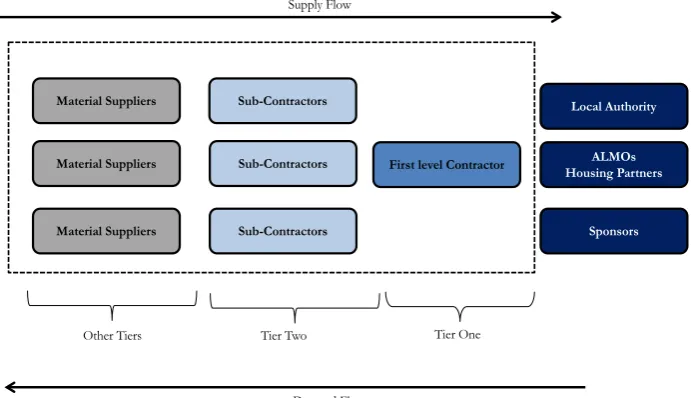
Figure 2: The Standard Power-House Configuration
The key stakeholders in this configuration include LAs, ALMOs, procurement consultancy firms, tier-one contractors and tier-two sub-contractors (usually regional businesses). The relationships of these key stakeholders in the power-house configuration demonstrates the importance of public and private partnership built on the private sector stakeholders providing expertise in exchange for economic resources from the public sector while risks and rewards are shared between them.
The Standard Power-House configuration implies that projects are tendered on a one-to-one basis, by utilizing competitive tendering and procurement tools. In this configuration, the appointed contractor is just concerned with a single lot of work (whose specification, in terms of size and scope, is well defined) that has to be undertaken. The First Level contractor sources raw materials and involves subcontractors. New projects arising in the same area of interest are tendered separately, and the First Level Contractor would have no preferential route in bidding for it.
“This is generally true, but, to be frank, we have to admit that once a contractor gets the first job, it will be much easier for them to succeed in future. Preliminary bidding costs may reduce significantly, as they will already get some knowledge about the context. This may lead to reduced competition. This is not a rule, but phenomena like this may happen”, said a procurement officer at one of the interviewed LAs.
Within this supply chain configuration, the power fulcrum (namely, the set of key decision makers in the supply chain) is mainly driven by the LAs, ALMOs, procurement consultancy firms and tier-one contractors. As emerged from the previous empirical analysis, it has to be noticed that
Local Authority
ALMOs Housing Partners
Sponsors
First level Contractor Sub-Contractors
Material Suppliers
Sub-Contractors
Sub-Contractors Material Suppliers
Material Suppliers
Tier One Tier Two
Other Tiers
Supply Flow
11 within this supply chain configuration, several players (Procurement Consultancy Firm, Fist Level Contractor, sub-contractors and a relevant quota of the suppliers) can be represented by large national players, coming from outside the local region. This implies that the adoption of the
Standard Power House configuration increases the risk of LA sponsored projects having minimal impact on the regional economy in terms of job creation, SMEs involvement and such projects acting as an economic stimulus.
3.2 Global Service Configuration
The Global Service Power-House configuration (Figure 3) is a slight deviant of the Standard Power House configuration. In this configuration type, Local Authorities and their partners tend to outsource the whole set of activities within the described sector to a First Level Contractor for a given amount of time (typically, 3 to 5 years). First Level contractors, in this case, become a close partner of the Local Authority. Essentially, for a given period of time, they also provide additional services (planning, management) to the LA. As in the case of Standard Power House
[image:11.595.136.474.389.577.2]configuration, the First Level contractor can source raw materials and involve subcontractors.
Figure 3: The Global Service Configuration
This model became particularly popular in the 1980s, when councils started to experience severe funding cuts, and could award to a contractor also the administrative activities related to projects and day-to-day maintenance. Two of the surveyed LAs currently adopt this approach, showing that it is still commonly used. However, its effectiveness is highly disputed.
“We are currently adopting this model; a main contractor is responsible for all the work we undertake on our housing stock for a fixed period of time. However, to be frank, benefits are becoming less and less apparent. The
Local Authority
ALMOs Housing Partners
Sponsors
First level Contractor Sub-Contractors
Material Suppliers
Sub-Contractors
Sub-Contractors Material Suppliers
Material Suppliers
Tier One Tier Two
Other Tiers
Supply Flow
12
main contractor is also responsible for sourcing the components to be installed. We end up paying more than we could pay sourcing them autonomously. Also, very frequently the main contractor does not carry on any installation work; therefore, sub-contractors come in, and the council, obviously, has to pay for their profit. We may reconsider this model in the future, since the contract with our main contractor is going to expire soon”, said a Procurement officer at one of the surveyed ALMOs.
On the other hand, the model can be one of the few options for small LAs that do not rely on big procurement offices due to staff cuts and lack of replacements. “We have a procurement team that is basically made up of a single person. Adopting this model is probably the only way we can go ahead also to get administrative support”, said a Procurement officer at one of the surveyed ALMOs.
3.3 Framework Configuration
[image:12.595.105.498.379.581.2]In the Framework Power House (Figure 4) is the supply chain is shaped by the utilization of Framework contracts.
Figure 4: The Framework Configuration
By utilising this procurement tool, Local Authorities can take on board a number of potential first-level contractors (usually a shortlist deriving from an initial screening process). Then, as work arises, lots can be awarded to any of the shortlisted contractors based on a quicker selection process. Usually the framework appointment lasts for a number of years (typically, from 3 to 5). First Level contractors, in this case, become a preferred partner of the Local Authority. In these instances the First Level contractor can source raw materials and involve subcontractors.
Local Authority
ALMOs Housing Partners
Sponsors
First level Contractor Material Suppliers
Material Suppliers
Material Suppliers
Tier One Tier Two
Other Tiers
Supply Flow
Demand Flow
First level Contractor
First level Contractor Sub-Contractors
Sub-Contractors
Sub-Contractors Sub-Contractors
13 “Through this configuration, we can increase at the maximum possible level the competition among big contractors, by saving on tendering costs. It is a very advantageous way of procuring goods; however, we have to mention that, due to high competition, profit margins may squeeze for main contractors. This could have very bad implications from quality point of view”, said said a Procurement officer at one of the surveyed ALMOs.
3.4 Revised Power-House Configuration
In order to maximise the involvement of SMEs in the supply chain, a further variant to the
Standard Power House configuration can be provided. In the RevisedPower-House configuration, the supply chain is shaped by a more active role of the Local Authority. In this case, Local Authorities (through the Housing Partner and, potentially, the procurement consultant) directly acquire the materials to be installed from the distributor (that will source them from a supplier). In addition, the LA will only tender the installation of the acquired measures. This type of configuration can help the involvement of SMEs, as it does not require massive amount of capital to be invested by the contractors and sub-contractors (that are just providing workforce resources). Furthermore, LAs can also better control the quality of materials under a wide range of dimensions (environmental impact, innovation, reliability, projected useful life).
Figure 4: The Revised Power-House Configuration
“This model would allow more SMEs to bid. Indeed, they should not be worried about capital costs required to buy materials to be installed. Furthermore, this process would also be beneficial from a standardization point of view: everybody would be installing the same materials and components that would reduce maintenance costs. However, there are some obstacles. Indeed, this process will require lot of labour for supply chain planning and warehousing capacity for storing materials. At the moment, the council is not prepared to face this challenge and risk”, said a Procurement officer at one of the surveyed ALMOs.
Local Authority ALMOs
Housing Partners Consultancies Procurement
Material Suppliers
Sub-Contractors
Sponsor Distributor
Sub-Contractors
[image:13.595.65.525.400.603.2]14 This model has been adopted by one of the surveyed ALMOs, that has completely revised its supply chain configuration by building? a warehouse in its premises, where all the major components and materials required in refurbishment and retrofitting projects are stored.
“We were used to have many different types of fans in our properties! With this new approach, we just have one, that goes into all properties. Costs are kept at minimum, as we can buy bulk quantities of spare parts, while standardisation is maximised. Also, we are able to consolidate deliveries and shipments, reducing CO2 emissions
due to transportation. In a few words, we have regained control of our supply chain!”, said one of the procurement officers at this ALMO.
In this case, the power-fulcrum of the configuration lies with the LA, which acts as a supply chain planner and has the power to control and mitigate any conflict and risk that may occur. The configuration can be also implemented in a slightly different fashion, in which inventories, though acquired by the LAs/ALMOs, are physically stocked and managed by vendors, thus reducing the risks associated with carrying them for public authorities.
3.5 Wider Implications of Emerging Supply Chain Configurations
From the presented supply chain configurations presented it can be argued that the emerging supply chain configurations are linked to distinct management style principles. That is, these supply chain configuration groups indirectly present different degrees of centralised planning by the LAs and of private-public partnership.
The mentioned supply chain configurations can be considered as ideal types (Doty and Glick, 1994; Genovese et al., 2013) as they can be linked to expected performance. The dimensions across which performance can be measured (reported, with related performances, in Table 1) include:
• Public-Private Partnership Degree, representing the extent to which Local Authorities keep control of the whole supply chain;
• Standardisation Level, concerned with the homogeneity of installed materials and components and their maintenance easiness;
15 • SMEs involvement, representing the level of involvement of small and medium businesses
at every tier in the supply chain;
• Planning and Management Requirement for LAs, representing the level of planning activities required to LAs in order to manage the configuration.
Supply Chain
Configuration Public-Private
Partnership
Degree
Standardisation
Level Economies of Scale
Optimisation
SMEs
Involvement Planning and Management Requirement for LAs
Materials Quality
Standard Average Average Average Low Average Highly
variable Global
Service Very High High Highly variable Low Low Highly variable
Framework Average Low Average Low to
Average Average to High Potentially Low
Revised Very Low High High Average Very High High
Table 1: Energy Efficiency Retrofitting Supply Chains performances
For example, the Global Service configuration implies a high public-private partnership degree (as the first level contractor will be actually controlling the whole supply chain). However, it may also allow for the optimisation of economies of scale (given the large quantities of materials and components purchased and installed) and also ensures that highly standardised materials and components are installed (which favours easy maintenance and post-sales activities), while ensuring that the administrative activities for LAs are kept at minimum. In this case, indeed, given the peculiar structure of the supply chain, and the specific power fulcrum, the first level contractor is interested in optimizing supply chain planning, as this will immediately result in higher profit margin for himself. However, as highlighted above, this configuration does not favour the participation of local SMEs to projects, as big contractors generally have their own list of preferred sub-contractors; furthermore, LAs may lose control of their supply chains, as the “power fulcrum” in this scenario shifts towards the main contractor.
On the other extreme of the spectrum, the Revised configuration allows for a much higher level of public control. As LAs play a sort of ‘middle-man’ role by coordinating purchasing and orchestrating the whole supply chain. Standardization and economies of scale level can be still significantly high.
16 3.6 Discussion of Supply Chain Configurations
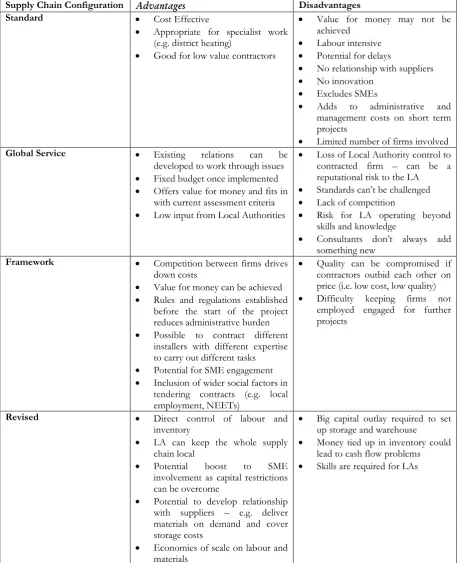
From a focus group of representatives from Local Authorities and ALMOs, it was possible to evaluate how practitioners viewed the advantages and disadvantages of each supply chain configuration and evaluate how these experiences link to the academic and policy literature. These are summarised in Table 2.
From discussion with stakeholders, the standard configuration was seen to be the most cost effective and the best for specialist projects (e.g. district heating). This configuration was highlighted as being suitable for low value contractors and could be tailored for specific schemes. However the nature of the configuration meant that projects often ended up being very labour intensive, and led to extra administrative and management costs on the project. This had the effect of reducing value for money, meaning that projects missed achieving key criteria. This configuration limited the number of firms involved on projects and was seen as prohibitive to the inclusion of SMEs.
In the current economic and financial climate, Local Authorities found promising attributes in the Global Service configuration. This configuration provided LAs with a fixed budget, and achieving the value for money criteria. The low input required from LAs and the potential to develop close relationships with contractors were cited as positive factors of this configuration. However LAs were aware of the reputational risk posed by this configuration should contractors operate in a way that is contrary to the wishes of the LA. The general lack of control, in particular over standards, in projects under this configuration was seen as a major disadvantage by LAs. Issues with post-project were cited, with LAs appearing unsure of their roles in maintenance of the housing stock once installations had been completed.
17
Supply Chain Configuration Advantages Disadvantages
Standard • Cost Effective
• Appropriate for specialist work (e.g. district heating)
• Good for low value contractors
• Value for money may not be
achieved
• Labour intensive
• Potential for delays
• No relationship with suppliers
• No innovation
• Excludes SMEs
• Adds to administrative and
management costs on short term projects
• Limited number of firms involved
Global Service • Existing relations can be
developed to work through issues
• Fixed budget once implemented
• Offers value for money and fits in with current assessment criteria
• Low input from Local Authorities
• Loss of Local Authority control to contracted firm – can be a reputational risk to the LA
• Standards can’t be challenged
• Lack of competition
• Risk for LA operating beyond
skills and knowledge
• Consultants don’t always add
something new
Framework • Competition between firms drives
down costs
• Value for money can be achieved
• Rules and regulations established before the start of the project reduces administrative burden
• Possible to contract different installers with different expertise to carry out different tasks
• Potential for SME engagement
• Inclusion of wider social factors in tendering contracts (e.g. local employment, NEETs)
• Quality can be compromised if contractors outbid each other on price (i.e. low cost, low quality)
• Difficulty keeping firms not
employed engaged for further projects
Revised • Direct control of labour and
inventory
• LA can keep the whole supply chain local
• Potential boost to SME
involvement as capital restrictions can be overcome
• Potential to develop relationship with suppliers – e.g. deliver materials on demand and cover storage costs
• Economies of scale on labour and materials
• Big capital outlay required to set up storage and warehouse
• Money tied up in inventory could lead to cash flow problems
[image:17.595.69.529.73.637.2]• Skills are required for LAs
Table 2: Procurement and Supply Chain configurations discussion results
18 ‘frozen out’, with chosen suppliers becoming a closed group. This can cause relational problems between LA and potential future partners and could also lead to complacency for existing firms. Key contractors may also compromise on quality in a bid to outbid each other for work.
The revised framework provoked the most discussion between LA representatives. The configuration was highlighted as useful for LAs to maintain control of the supply chain through Local Authorities having direct control on materials and labour. With the LA taking the responsibility for capital, this reduces the barriers to SME involvement. The main obstacles to this configuration are the large capital outlays to secure warehouse facilities and to acquire inventory. This may cause cash flow problems in the future for Local Authorities if their finance is tied up in inventory. One method of overcoming this obstacle was for the LAs to develop relationships with approved suppliers, obtaining materials at short notice and on demand. The advantage of this is that the approved supplier may contribute to warehouse and other storage costs.
From these focus groups it was highlighted that there is not one supply configuration that is dominant and overwhelmingly positive for LAs to engage in. Local Authorities found that each configuration had its benefits for certain types and sizes of projects. While a standardised approach to procurement and supply chain configuration would reduce the demands and pressures on Local Authorities, the current climate of budget cuts and a lack of expertise in councils surrounding supply chain issues make this a difficult scenario to operate.
4.
Benchmarking Procurement
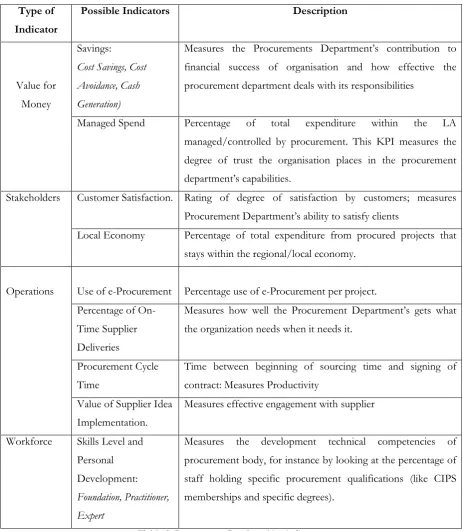
Given the amount of emphasis that contemporary LAs place on Procurement, it is not surprising that organisations are developing tools to benchmark the performance of their own procurement department.
19
Type of Indicator
Possible Indicators Description
Value for Money
Savings:
Cost Savings, Cost Avoidance, Cash Generation)
Measures the Procurements Department’s contribution to financial success of organisation and how effective the procurement department deals with its responsibilities
Managed Spend Percentage of total expenditure within the LA
managed/controlled by procurement. This KPI measures the degree of trust the organisation places in the procurement department’s capabilities.
Stakeholders Customer Satisfaction. Rating of degree of satisfaction by customers; measures Procurement Department’s ability to satisfy clients
Local Economy Percentage of total expenditure from procured projects that stays within the regional/local economy.
Operations Use of e-Procurement Percentage use of e-Procurement per project. Percentage of
On-Time Supplier Deliveries
Measures how well the Procurement Department’s gets what the organization needs when it needs it.
Procurement Cycle Time
Time between beginning of sourcing time and signing of contract: Measures Productivity
Value of Supplier Idea Implementation.
Measures effective engagement with supplier
Workforce Skills Level and Personal Development:
Foundation, Practitioner, Expert
[image:19.595.66.530.88.620.2]Measures the development technical competencies of procurement body, for instance by looking at the percentage of staff holding specific procurement qualifications (like CIPS memberships and specific degrees).
Table 3: Procurement Benchmarking indicators
Feedback from the stakeholders indicated that there is a lack of a unifying theme for Local Authorities to quantitatively benchmark their procurement performances for future monitoring and comparisons against other LAs. One Local Authority Procurement Officer said:
21
5.
Interventions Case studies
Interventions Case Study 1
An Implementation of the “Revised” Configuration
The case study presented outlines the management of the procurement process and supply chain delivery of large scale projects by Doncaster Metropolitan Borough Council and their housing partners: St. Leger Homes. The Case Study which represents an example of Best Practice illustrates the progress Local Authorities can make by using public-private partnerships as a means of delivering operational efficiencies with added benefits such as using funded projects to stimulate regional economic growth and engaging better with SMEs in the process. Specifically, it assesses the nature and implication of a revised form of the Power House configuration for Local Authorities involved in Procurement and Supply Chain delivery of large scale projects.
Local Authority and Housing Partner
Created in 1974, The Metropolitan Borough of Doncaster is a metropolitan borough of South Yorkshire in Yorkshire and the Humber Region of England. The borough covers Mexborough, Conisbrough, Thorne and Finningley in addition to Doncaster. With a population of 302, 500 it was ranked 34th in English Districts by population in 2011
according to the Office of National Statistics.
St. Leger Homes of Doncaster was set up by Doncaster Council in 2005 to manage the day-to-day running of 21,000 council homes and to deliver a major programme of Government investment to bring council homes up to the Decent Homes Standard. It is an ‘Arms Length Management Organisation (ALMO)’, a limited, not-for-profit company and wholly owned by Metropolitan Borough of Doncaster. It works in partnership with Doncaster Council and customers to provide quality homes in quality neighbourhoods in the Borough.
Previous Procurement Practice and Supply Chain Delivery
St. Leger Homes have previously recognized and validated the Standard Power House Configuration
as a model employed in the delivery of large scale projects. Previously, they adopted the
22 called first level contractors in Fig. 3). Examples of these firms are two companies based in South Yorkshire: Bramall (A firm part of the Keepmoat Group based in Doncaster); Henry Boots plc (based in Sheffield). The procurement process is performed in-house with legal support to the procurement team provided by the Council.
Summarized Findings
It was established that within this configuration, the Power Fulcrum (the key decision makers in the supply chain) is driven by Doncaster Council, St. Ledger Homes and by the principal contractors within the framework contract. The Framework Power House Configuration encouraged standardization in project delivery and economies of scale. However, it works against localisation and SMEs involvement in the procurement process and supply chain delivery.
Impacts
St Ledger Homes has recently completely revised its supply chain configuration and now adopts the Revised Power-House Configuration reported in Figure 4. The council has acquired a warehouse on its premises, where all the major components and materials required in refurbishment and retrofitting projects are stored. Thanks to this, the ALMO can buy bulk quantities, save money and improve standardisation.
“We were used to have many different types of fans in our properties! With this new approach, we just have one, which goes into all properties. Costs are kept at minimum, as we can buy bulk quantities of spare parts, while standardisation is maximised. Also, we are able to consolidate deliveries and shipments, reducing CO2 emissions
due to transportation. In a few words, we have regained control of our supply chain!” said one of the procurement officers at St. Leger Homes.
Further evidence suggests that SMEs are being better integrated into the procurement and supply chain delivery of projects initiated by Doncaster Council. This ensures that a greater percentage of the economic benefits of such projects are retained within the region as a result of the procurement and supply chain strategy centred on the Revised Power-House Configuration.
23
Interventions Case Study 2:
Establishing a Network of Procurement Professionals
The case study presented outlines the emergence of a network of procurement professionals and officers from the Local Authorities involved in the delivery of the Big Energy Upgrade project. By utilising a common contractual framework (Efficiency North), officers from each LA have got the opportunity of getting to know their colleagues in similar positions in other institutions, sharing experiences and best practices.
“Through the framework, we had the opportunity of knowing our colleagues; furthermore, a specific IT infrastructure is provided for sharing suppliers and contractors performance data under specific project performed in all the different Local Authorities who have joined the framework. It is a centralised data warehouse in which even average costs are comparable. Furthermore, an instant-messaging service is available for all the members of the framework. This has had a terrific impact on the amount of information we share: best practices, internal policies, tender documents. In this way, we can learn from each other experience and be more aware about mistakes to be avoided”, said a Procurement officer at one of the surveyed ALMOs.
24
6.
Conclusions
The public sector and especially Local Authorities are undergoing huge cuts in funding. A huge proportion of budget allocated for the delivery of projects. There is now a greater emphasis on effective and efficient procurement practices as an integral way of creating economic savings and operational efficiency in councils. The lack of extant body of literature and policy documents that provides a theoretical base to an empirical research, and that critically investigates alternative configuration of procurement-driven supply chains in the public sector necessitated this study.
The findings suggest that there are a number of configurations for public sector procurement and supply chain delivery. Predominantly, these configurations are based on the Standard Power House Configurations and its derivations, namely: Global Service Configuration and Framework Configuration. In these supply chain configurations, the Power Fulcrum (the key decision makers in the supply chain) is comprised of: the LAs, ALMOs and the First Tier contractors. In these configurations, LAs do not have total control of the supply chain. Instead, it is the First Tier contractors who exert dominance in the supply chain to the detriment of SMEs, who find it difficult to fully engage in the supply chain. It was established that these configurations also present a number of challenges to supply chain actors, specifically in the dynamics in the relationship between the principal and the agents. These include: trust, behaviour, communication, capacity management, and risk.
Based on the short comings of the Standard Power House Configurations and its deviants, the Revised Power House Model has been formulated. This configuration shifts the Power Fulcrum towards LAs and ALMOs, enabling them to maintain total control of the supply chain without leveraging power to first tier contractors. Evidence suggests that this configuration has the potential to better integrate SMEs into the procurement process and into the supply chain.
Evidence from the six LAs involved in the study suggests that the Revised Power House Configuration has been adopted by Doncaster Metropolitan Borough Council, through their St.Leger Homes ALMO. This configuration is under consideration (with some modifications, for instance in terms of vendor managed inventory) by NPS Barnsley, North Lincolnshire Homes and Kirklees NH.
25 a wide range of indicators that have been implemented by different LAs to monitor outcomes and successes.
Furthermore, the report has provided case studies based on interventions implemented by project partners. It is envisaged that this study will provide public sector bodies (such as Local Authorities) with empirical evidence needed for the review and modification in the way procurement-driven supply chains are managed.
7.
Areas of Future Work
From our findings, we have identified that there is a requirement for further work to fully understand Local Authority procurement decisions and supply chain configurations. This is essential to balance procurement decisions between short-term economic gains and long-term benefits that arise from maintaining greater control of the supply chain. Two main tasks will take the focus of the next research stage through conducting semi-structured interviews with Local Authorities to gain precise figures to measure the benefits of implementing a new supply chain configuration. The first task is to capture the quantitative benefits from LA procurement operations. These include job creation and job savings that arise from specific procurement decisions and supply chain configurations. For example, do discounts and job creation arise from adopting the revised framework?
26
8.
References
Ciliberti, F., J. de Haan, et al. (2011). "CSR codes and the principal-agent problem in supply chains: four case studies." Journal of Cleaner Production 19(8): 885-894.
Genovese, A., S. C. Lenny Koh, et al. (2013). "Energy efficiency retrofitting services supply chains: Evidence about stakeholders and configurations from the Yorskhire and Humber region case." International Journal of Production Economics(0).
Jones, T. M. (1995). "Instrumental Stakeholder Theory: A Synthesis of Ethics and Economics." The Academy of Management Review 20(2): 404-437.
Lille, G. L. and R. Grewal, Eds. (2012). Applications of agency theory in B2B marketing: review and future directions (Chapter 3)-In: Handbook on Business to Business Marketing, Edward Elgar.
Tate, W. L., L. M. Ellram, et al. (2010). "An Agency Theory perspective on the purchase of marketing services." Industrial Marketing Management 39(5): 806-819.
Weaver, W. T. (1971). "The Delphi Forecasting Method." The Phi Delta Kappan 52(5): 267-271. Wiseman, R. M., G. Cuevas-Rodríguez, et al. (2012). "Towards a Social Theory of Agency."