Improving Clinical Practice Outcomes for Nurses
with an Interactive Emulator
Les Bowtell1, Alexander A. Kist1, Daniel Osbourne 1, Victoria Parker2,
1 Faculty of Engineering and Surveying, University of Sothern Queensland, Toowoomba, Australia 2 Faculty of Science, University of Sothern Queensland, Toowoomba, Australia
Abstract: Historically, nursing students have shown great difficulty in mastering equipment during clinical practice sessions. A typical example is the Intravenous (IV) pump infusion driver. Traditional training methods have relied upon on-campus practical group training sessions. Recent work in this area has demonstrated that Remote Access Laboratories (RAL) can be employed to enhance nursing education by providing access to an IV pump driver learning activity. The prototype closely mimicked the interface and audible feedback of a commonly used IV pump driver; and controlled a peristaltic pump to deliver the prescribed rates and volumes. This project takes this approach a step further and investigates a completely emulated interface in the same RAL environment. The aim is to target five problem areas that were previously identified. These include the screen navigation and data entry of the IV pump driver; and the correct calculation and entry of medication volumes and rates from a standard fluid chart. To address these issues the learning environment was modified to include a guided learning mode, integrated scaffolding resources and facility of self-assessment. This paper discusses implementation and results of a pilot study to evaluate the effectiveness of this approach. Initial results are promising and show a distinct improvement in the practical capability of those students who participated in the trial.
Keywords-remote access laboratories, nursing, emulation
I. INTRODUCTION
During clinical practice sessions, nursing students have to learn how to use equipment such as Intravenous (IV) pump infusion drivers. Traditionally, training has largely relied upon on-campus practical group training sessions. Nursing students have shown great difficulty in mastering equipment during the limited time that students have practicing using the equipment. This is particular relevant as a large number students at this University study by distance education and are located off campus.
Remote Access Laboratories have been discussed in engineering education for more than a decade as a way to provide off side access to equipment. The FoES has developed a RAL system that allows for student access to hardware and software experiments on campus. As part of a recent study on the use of RAL activities in non-engineering discipline, an IV Pump RAL activity has been developed. Students are presented with an on screen interface that mimics a commonly used IV pump driver. Inputs from the interface are used to control a peristaltic pump to deliver prescribed rates and volumes.
Testing the interface with students raised the question; whether the physical pump adds anything to the learning
activity. This project therefore takes the approach of using a completely emulated interface, potentially without any underlying hardware at all. Student access is still provided via the RAL environment with directly integrates with the learning management system, Moodle. The key aim of the activity is to address problem areas for students that were identified undertaking the previous study; the issues are: screen navigation, data entry, correct fluid calculations, entry of medication volumes and rates using a standard fluid chart.
To address these issues the learning environment that was develop as part of the RAL learning activity was modified to include a guided learning mode, integrated resources, and a self-assessment mode. This paper discusses the implementation of the system in detail.
This paper addresses the research question of how well an emulated RAL IV pump activity can support skills acquisition for nursing students and whether an emulated RAL activity can better address intended learning outcomes than group hands on training. The key contributions of this work include a detailed description of the learning activity design and initial evaluation results highlighting student perceptions of this novel learning activity.
The reminder of the paper is organised as follows: Section II discusses relates work and introduces the framework that underpins this project. Section 3 describes the learning activity and its implementation in detail. Section 4 introduces the evaluation methodology and Section 5 discusses results and findings. The paper concludes with Section 6.
II. THEORETICAL FRAMEWORK
Remote access laboratories have been proposed as methods for offside access to remotely controlled hardware, such as robots [1] or laboratories [2] . While these technologies are widely discussed in Engineering Education, such technologies are not commonly used by other disciplines. To make these technologies accessible to other disciplines, the traditional concept of RAL as purely controlling hardware has been expanded by Kist et al. [3] to remote conceptual experimentation in any form. In this context, laboratory experiments are ways to create “episodes:” “recollections of events in which the [learner] took part or at least observed,” with the result that the experience is “linked to propositions [about facts, concepts, ideas] so that those propositions in turn are remembered and understood” [4, pp.765-766] . This means that remote laboratories are events that help students to develop
a better understanding of concepts by creating a learning experience via a remote interface.
Barak’s [5] proposes instructional principles about the effective design and used of ICT supported learning. These principles apply to both ICT base laboratory work as well as ICT based emulation. The principles, based on behavioural, cognitive and social learning theory include: “learning is contextual, learning is an active process, learning is a social process, reflective practice plays a central role in learning” [5, pp.122-123] .
An “environment, in which the pupil can construct knowledge and can reflect upon his interactions and thinking” is important [6] and enforces that “learning implies the initiation of a thinking process” [p. 228]. Slangen & Sloep [6] citing Jonassen [7] highlight three thinking tasks, i.e. basic, critical and creative thinking that are part of a complex thinking process. “Mind tools are computer applications that, when used by learners to represent what they know, necessarily engage them in critical thinking about the content they are studying …” [8] and “they require students to think about what they know in different, meaningful ways” [pp.24]. The learning activity that is d i s c u s s e d in this paper can therefore be described as a mind tool.
Remote simulations in nursing education have been discusses as teaching strategies to improve clinical reasoning skills of students [9-11]. Besides the obvious educational advantages, the most important reason for implementing simulated learning programs in n u r s e education has been identified by Messmer [12] as reducing patient death rates. The author suggests that technologies can prepare nursing students better to perform competently in stressful incidents [12].
The key advantages of simulated clinical situations include the limited safety concerns. Instructors are also able to completely control the situation; examples include fully synthesized, robotic simulations [13, 14]. Such virtual simulations allow students to gain competence by practicing skills over and over without patient risk [13]. Simulations in this context are different from simulations in the context of engineering as situations are simulated not systems. Remote access technology in nursing and healthcare is largely focussing on remote robotic presence technologies [15, 16]. Using RAL technology in conjunction with an IV pump emulator allows for learning activities that achieve similar learning outcomes as have been highlighted in context of simulations in nursing education.
III. IV PUMP DRIVER LEARNING ACTIVITY
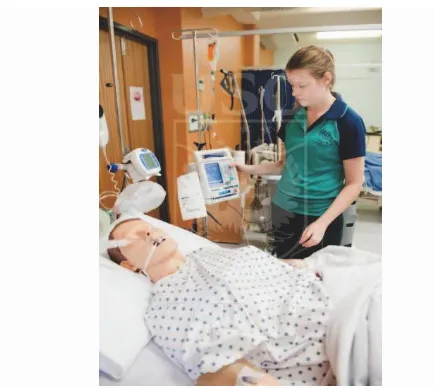
Setting up IV pump drivers is an integral part of nursing practice. Figure 1 shows a first year nursing student tending to an IV pump driver as part of a residential school practical class. A component of a patient’s medication chart nurses are given an intravenous medication fluids order form. The role of the nurse is to disseminate this fluids order into the necessary volume and flow-rate settings of the IV pump driver. Critical competencies are tested by application of the fluids order to the prospective patient. These range from strict adherence to a patient’s rights, to the correct evaluation of a patient’s respiratory and cardiovascular clinical observations to take appropriate remedial action in a timely fashion.
The concept of remote simulation as a teaching strategy in nursing education, while not an entirely new concept, has
Figure 1. 1st
year nursing student tending to an IV infusion
targeted learning outcomes. Based on experience and feedback received in the pilot stages of this project [17], target learning areas were identified.
Problem areas include:
• Hardware interface competencies
• Dissemination of typical medication fluids-chart information into correct volume and rate entries in the infusion pump.
• Increased student interaction during an i n f u s i o n to include patient response criticalities.
The IV pump driver was developed to specifically address these issues.
IV. ENHANCED LEARNING ACTIVITY
To complement the existing pilot RAL activity and increase student interactivity patient scenarios were added. For example mid way through an 8hr medication infusion an abnormal heart rate may be detected, the student then needs to take corrective action such as stopping the infusion and recalculate and re- enter the doses. General information on how to use the pump interface and scaffolding material to aid rate and volume calculations were included in the so-called ‘learning mode’ of the emulator. This included relevant video and still images as in Fig. 3., along with other practical course material. After a student has gained confidence with the system a realistic assessment mode can be performed. In this mode the user can choose one of four different scenarios with a number of interventions during the infusion period. During the assessment mode key measures of success are evaluated, these are displayed in summary form at the end of the assessment.
Traditionally a ‘user’s manual’ is the main resource used by trainees to gain a working knowledge of an IV infusion pump driver. Unlike modern software systems there is no on-line help or guided navigation for users. To overcome this shortcoming the RAL nursing infusion emulator implements multiple modes to cater for different levels of practical experience.
[image:2.595.313.530.45.239.2]approach to implement a learning mode. The user is visually and audibly prompted through the typical clinical steps of loading the line through to rate and volume selection and patient checks. This allows familiarisation with the interface and aims to mimic the role of a practical instructor. Standard prompts of each step indicate the required action and highlight the appropriate key to press.
Learning mode provides a less staged approach with selective hints to help guide the user through the basic entry of infusion rates and volume to be dispensed. This mode also queries the student at key operational stages with regard to performance of the required patient inspections and verbal advisement of specific patient rights.
After students have familiarised themselves with the pump and are confident in their abilities, an assessment mode is able to be accessed. Much like in the actual on campus Residential School assessment the student is given a case study to complete. Fluids orders are presented within the training system to further enhance the learning environment. These sessions are timed and any errors in calculations, process or clinical reasoning are recorded, during this assessment not additional help is available to the user. These additional enhancements will be assessed in the pilot study described in the following section.
V. IV PUMP DRIVER EMULATOR IMPLEMENTATION
A. Logical Sequencing and Machine Interaction
The system has two distinct control elements: A programmable logic controller to execute logic based functions; and a SCADA software system to deal with HMI tasks. The sequenced demonstration mode is achieved using so called step - transition logic within the programmable controller. Each logical condition must be met before transitioning to the next functional stage within the sequence. Logical sequences can be interrupted at any stage to allow the user the flexibility of referring back to support material, other than in assessment mode. This material is viewed and run within the SCADA software runtime environment and therefore there is a required level of interactivity between the programmable controller and SCADA system. The SCADA
Figure 3: Support material access
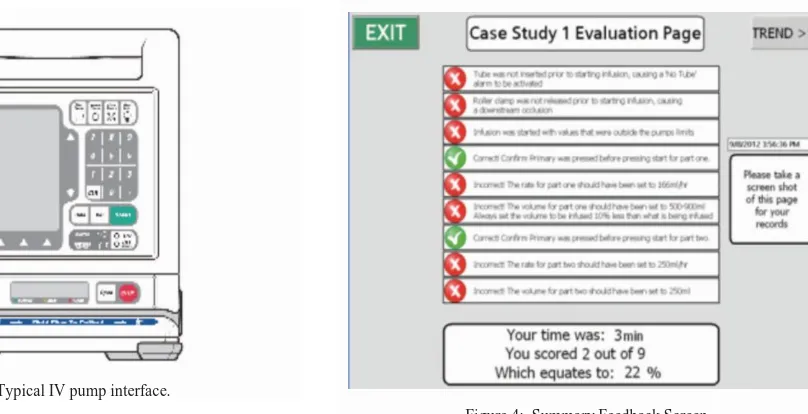
package chosen for this system allows easy integration with the programmable controller at a number of levels. This allows seamless integration of the sequencing, audio and video aspects of the training system. It also means that usage data can be extracted from the HMI system, logically evaluated against a performance rubric and the results displayed at the end of an assessment session. Fig. 4. shows a summary screen indicating strengths and weaknesses so students can self assess their progress.
The SCADA system software allows interaction with the user based the keypad and menu buttons. The on-screen mimic of the infusion pump screen and keypads, as shown in Fig. 2., is accomplished by associating object specific properties to graphical representations of each and every key, button and arrow. Special care is taken to ensure that navigation of screens and entry of data is functionally identical to that of the real infusion pump.
B. Human Machine Interface Design
In practice the main interactive element for the clinical nursing student is the infusion pump HMI. As medical instruments require effective use when the operator is using gloves the interface is not a touch-enabled device and is less intuitive
Figure 2: Typical IV pump interface.
[image:3.595.310.556.43.215.2] [image:3.595.138.542.542.749.2]than modern touch screen devices. In this case access to screen elements is via a membrane keypad with numeric entry keypad for entry of flow-rate and volumetric data. The SCADA system software [34] allows interaction via the same style keypad, buttons and lights as the real system. Where possible the exact functionality of the IV infusion driver is mimicked by the SCADA system, including aspects such as sequence timing, visual and audible cues and warnings. The only exception to this approach was with the overall infusion timeframe which may take hours in practice.
C. Emulator Access
Students at this institution are able to access the IV Pump Emulator using the pre-existing RAL system [18]. The system allows access to experiment bookings through the Learning Management System with which the students are already familiar.
VI. METHODOLOGY
In the initial phase of the project student understanding was evaluated with 2 hour observations of classes. This included the way students and teachers use the IV pump for learning and teaching with data collection via a student focus group, both done by external consultants. The focus group's aim was to gain insight into what students do to acquire the target skill and what their understanding of the skill is. Questions were used to prompt discussion around focal issues. The questions included:
• We saw one lab where people were being taught about setting up IV drips. Can you tell us about what that lab was like for you – what you were learning, was it hard, daunting, enjoyable etc?
• What were the main things that you as nurses had to learn?
• How do you learn that?
• What did you struggle with most about this part of your course?
• You were allowed to take home drip bags to practice preparing the line. Did you practice it? How much? • Where does this skill fit into nursing generally? • Where does it fit into your course?
• Is there anything that you would like to see changed about the way you are taught this skill?
• What are you doing to improve your decision making processes in clinical settings?
• What is your prior experience if any of online services such as Telehealth, online banking etc?
• What online tools do you use to support your learning – downloaded lectures, etc.
The information gathered by the focus groups was used to enhance the features of the IV pump system and also contributed to the evaluation design for the second phase of the project.
VII. EVALUATION
A pilot study is currently being undertaken to assess the effectiveness of the RAL based enhanced learning system. This study is being carried out in two stages, the first completed stage of Semester 2, 2012, will be followed up with a study in Semester 2, 2013. The pilot study aims to directly compare a
group’s practical ability and clinical reasoning skills. This is done in a residential school assessment after either having completed the standard elements of study with or without the on-line component and a third group with both face to face and supplementary on-line training.
In the Semester 2, 2012 study, 49 students from the course, NUR2000 Medications in Nursing Practise, were recruited and allocated to one of three groups. Group 1 participants (n = 13) were from the external-only cohort of Bachelor of Nursing students. The remaining 36 students were allocated randomly to Group 2 (n = 18) or Group 3 (n = 18). Group 1 participants were involved in online-only training of the emulated IV pump. Learning outcomes were assessed during a residential school on their performance using an actual IV pump, prior to any face to face instruction during class time.
Group 2 participants were on-campus students who used the actual IV pump in laboratory classes and were not given access to the emulated IV pump as an additional learning resource. Group 3 participants were also on-campus students who used the actual IV pump in class, but who were offered access to the emulated IV pump as an additional learning resource. Group 2 and 3 participants were involved in training in class using the actual IV pump for 2 hours. Group 1 participants were encouraged to use the emulated IV pump as often as possible but not exceeding 2 hours. At the time of writing, only the four Group 1 participants had completed the program.
Despite several attempts to engage and encourage Group 1 participants to use the emulated IV pump program online, only six performed the initial login to register to use the Remote Access Laboratory (RAL) program and just four actually used the emulated IV pump. The learning outcomes of the four participants were based on their performance on using the actual IV pump. This assessment took place during a residential school before any instruction was given on how to use the actual IV pump. The participants individually performed a series of activities including turning the pump on and off, loading the IV giving set into the pump and programming different rates and volumes from problem-based medication calculations. Sessions were timed and scores were allocated for each activity. The total number of points available was 130.
The period of time for which each participant used the emulated IV pump program prior to attending residential school was recorded, with times ranging from 20 minutes to 2 hours. Time taken for the participants to complete the activities ranged from 13 – 15 minutes and the scores achieved ranged from 108 – 119. A positive correlation (r = .71, p = .29) was evident between the time spent using the emulated IV pump and the scores achieved using the actual IV pump in class.
Global, around the clock access means students can safely update or refresh their knowledge just prior to clinical
[6] L. A. M. P. Slangen and P. B. Sloep, "Mind tools contributing to an ICT-rich learning environment for technology education in primary schools," International Journal of Continuing Engineering Education
placement in real-life situations. Access to the training system
and Life Long Learning, vol. 15, pp. 225-239, 2005.
is on a one to one basis, where there is no risk of a dominant
group member ‘taking over’. On the other hand should a [7] D. H. Jonassen, thinking: Merrill, 2000.Computers as mindtools for schools: engaging critical
student require additional information or a guided tour of the [8] D. Jonassen, C. Carr, and H.-P. Yueh, "Computers as mindtools for experiment this is now also possible. engaging learners in critical thinking," TechTrends, vol. 43, pp. 24-32,
1998.
In relation to perceptions of the login process, instructions received via email and booking procedures, 80% of responses were positive, 10% were neutral, and 10% were negative about the number of steps required to login and book to use the program. Where the participants rated their perception of the learning mode, resource page, case studies and the assessment mode, 96% responded positively with only 1 neutral response. Further, 100% of participants felt confident using the emulated IV pump and 100% agreed they would like to see greater use of online teaching technologies for education nursing students in the use of laboratory equipment.
When asked about the best features of the online pump, two participants commented about the benefits of “being able to practise anytime”. Other comments included “great explanation, easy instructions” and the “visual” and “real life” features of the emulated pump. When asked about the features of the pump that could be improved, one respondent commented about “improving the graphics”. Another participant suggested that the program should “just be available and not have to book into a particular session”. Finally, one participant commented the video instruction on loading the line into the pump should be “more interactive”.
VIII. FINDINGS
ACKNOWLEDGEMENT
The authors would like to thank Lesley Jolly and Hannah Jolly for their assistance with the evaluation and the Associate Deans (Learning and Teaching) at USQ for their support for this research project.
REFERENCES
[1] G. V. Kondraske, R. A. Volz, D. H. Johnson, D. Tesar, J. C. Trinkle, and C. R. Price, "Network-based infrastructure for distributed remote operations and robotics research," Robotics and Automation, IEEE
Transactions on, vol. 9, pp. 702-704, 1993.
[2] B. Aktan, C. A. Bohus, L. A. Crowl, and M. H. Shor, "Distance learning applied to control engineering laboratories," Education, IEEE
Transactions on, vol. 39, pp. 320-326, 1996.
[3] A. A. Kist, A. Maxwell, and P. Gibbings, "Expanding the Concept of Remote Access Laboratories " presented at the 119th ASEE Annual Conference and Exposition, San Antonio, Texas, 2012.
[4] R. T. White, "The link between the laboratory and learning,"
International Journal of Science Education, vol. 18, pp. 761 - 774,
1996.
[5] M. Barak, "Instructional principles for fostering learning with ICT: teachers' perspectives as learners and instructors," Education and
Information Technologies, vol. 11, pp. 121-135, 2006.
IX. CONCLUSIONS
This paper has described the second phase of a collaborative project between the Department of Nursing and Midwifery and the Faculty of Engineering to enhance RAL based Clinical Practice activities for nursing education. An enhanced prototype of a remotely accessible infusion pump emulator has been designed and built.
Initial feedback is very positive and shows strong justification for the use of an emulator to assist students in their clinical practice studies. The added enhancements to the original experimental design [17] have been received well by students. In particular, the summary feedback at the end of assessment mode as in Fig. 4. has inspired student confidence which appears to translate well into similar clinical competency test scores.
There are also some clear lessons from this assessment regarding ease of emulator access and booking system complexity. The cost of expanding the emulator system to cater for 300 students or more is expected to be far less than the equivalent outlay for physical experiment setup used in the project's initial stages. At the same time student feedback regarding the enhanced emulator's useability has exceeded previous good results from stage 1. In the specific context of digitally controlled experimentation with finite degrees of freedom, remote emulation appears to be an improvement on being there.
[9] T. Levett-Jones, et al, "'The 'five rights' of clinical reasoning: An educational model to enhance nursing students' ability to identify and manage clinically 'at risk' patients'," Nurse Education Today, vol. 30, pp. 515-520, 2010.
[10] N. Harder, "Use of Simulation in Teaching and Learning in Health Sciences: A Systematic Review," Journal of Nursing Education, vol. 49, pp. 23-28, 2010.
[11] T. Pike and V. O'Donell, "The impact of clinical simulation on learner self-efficacy in pre-registration nursing education," Nurse Education
Today, 2010.
[12] P. Messmer, "Enhancing Nurse-Physician Collaboration Using Pediatric Simulation," Journal of Continuing Education in Nursing, vol. 39, 2008.
[13] Rauen, "Simulation as a Teaching Strategy for Nursing Education and Orientation in Cardiac Surgery " Critical Care Nurse, vol. 24, pp. 46- 51, 2004.
[14] E. Bandman, Bandman, B, "Critical Thinking in Nursing," 1995. [15] D. Sampsel, G. Bharwani, D. Mehling, and S. Smith, "Robots as Faculty: Student and Faculty Perceptions," Clinical Simulation in
Nursing, vol. In Press, Corrected Proof, 2010.
[16] Medical_News_Today, "Robot Joins Nursing Institute Of West Central Ohio To Address Faculty Shortage," 2007.
[17] L. Bowtell, C. Moloney, A. A. Kist, V. Parker, A. Maxwell, and N. Reedy, "Using remote access laboratories in nursing education," presented at the 9th International Conference on Remote Engineering and Virtual Instrumentation (REV 2012), Bilbao, Spain, 2012. [18] A. A. Kist and P. Gibbings, "Inception and management of remote