R E S E A R C H
Open Access
CO
2
flagging - an improved method for the
collection of questing ticks
C
ă
lin M Gherman
1, Andrei D Mihalca
1*, Mirabela O Dumitrache
1, Adriana Györke
1, Ioan Oroian
2,
Mignon Sandor
2and Vasile Cozma
1Abstract
Background:Most epidemiological studies on tick-borne pathogens involve collection of ticks from the
environment. An efficient collection method is essential for large sample pools. Our main aim was to evaluate the efficacy of a new method, where traditional flagging was enhanced by the use of CO2dispersed into the white flannel. The CO2was spread through a rubber hose network inserted into the flag blanket. The research was conducted in spring, in March-April 2011 in two locations from Cluj County, Romania.
Methods:The research was conducted in March-April 2011 in two locations from Cluj County, Romania. The flag to be tested contained a fine silicone rubber hose network which dispersed the CO2in the shaft. On each collection site n=30 samplings were performed. Each sampling consisted in the simultaneous use of both flags (with and without CO2) by two persons. The CO2concentration level on the flag canvas surface was measured. The efficacy of the method was determined by counting comparatively the total number of ticks and separate developmental stage count.
Results:Using the CO2improved flag, 2411 (59%)Ixodes ricinusand 100 (53.8%)Dermacentor marginatusticks were captured, while the CO2-free flag accounted for the collection of 1670I. ricinus(41%) and 86 (46.2%)D. marginatus
ticks. The addition of CO2prompted a concentration difference on the surface of the flag ranging between 756.5 and 1135.0 ppm with a mean value of 848.9 ppm.
Conclusion:The study showed that the CO2enhanced sweep flag increased the ability ofI. ricinus(p<0001) but not ofD. marginatusto be attracted to the flag blanket.
Keywords:Flagging, Carbon dioxide, Questing ticks,Ixodes ricinus
Background
Ticks (suborder Ixodida) are obligate blood-sucking acarines attacking a wide variety of hosts from all tetra-pod vertebrate classes [1,2]. Around 700 species of hard ticks are currently recognized as valid species [1]. Most of these species are three-host ticks (i.e. each stage detaches after engorgement) [3,4]. Regardless of the number of hosts, each tick must find a suitable host. In three-host ticks, most of their multiannual life is not spent attached to the host but as free-living organisms. Thus, newly hatched larvae, unfed nymphs and unfed
adults are in a permanent host finding state. Host detec-tion and attachment in Ixodidae is achieved through three main alternative behavioral patterns: questing, hunting and tick-host cohabitation (nidiculous ticks) [4].
Most epidemiological studies on tick-borne pathogens involve collection of ticks from the environment [5]. Thus, an efficient collection method is essential for large datasets. Tick collection methods had been reviewed by Gray [6]. He divided these methods into four major cat-egories: (1) flagging or dragging methods; (2) trapping using carbon dioxide baits; (3) collecting from hosts and (4) walking (i.e. on the clothes of the collectors). Despite all these methods are relative and do not estimate dens-ity (number per unit area) or absolute size (total number as measured in mark-release-recapture methods) [7], each of these has a variable efficacy depending on several
* Correspondence:[email protected]
1Department of Parasitology and Parasitic Diseases, University of Agricultural
Sciences and Veterinary Medicine Cluj-Napoca, Calea Mănăştur 3-5, Cluj-Napoca 400372, Romania
Full list of author information is available at the end of the article
factors (i.e. habitat type, tick species, developmental stage etc.). Nevertheless, all methods have been improved over the time in order to increase their effi-cacy [8].
One of the most important ticks species (regarding its range, abundance, and vectorial importance) in the Palearctic region, with tendency to expand its spread in Northern Europe [9,10], isIxodes ricinus [11]. The host seeking strategy of all developmental stages in I. ricinus
is questing, when ticks are typically positioned on the vegetation with their legs extended, waiting for a moving host to which they attach [12]. Though, questing is a complex behavioral process, which involves responses to stimuli like host movement, concentration of environ-mental carbon dioxide and increase of temperature [4]. The most commonly used method for collection of questing ticks is flagging. However, flagging stimulates only the tick sensor for movement, and leaves the other two sensorial components of questing (i.e. carbon diox-ide and temperature) unexploited.
The vast majority of ecological and epidemiological studies of tick-borne pathogens involve collection of un-fed ticks from the environment. In this view, our main aim was to evaluate the efficacy of a new method, where traditional flagging was enhanced by the use of dispersed CO2into the white flannel.
Methods
Sweep and flag design
The sweep consists of a shaft and a flag. The shaft is constructed from a hollow aluminum tube, and the flag from white technical flannel. A JBL 500 g CO2 bottle with a CO2 solenoid regulator attached (both aquarium use, JBL AquariumW, Germany) were fixed with plastic lock seals on the shaft. A silicone rubber hose was attached to the CO2 solenoid regulator; the hose was introduced through the aluminum shaft and connected to the flag. The rubber hose was pierced (to release CO2) and attached to the flag by sewing forming a net-work structure (Figure 1). The hose was made of bending-resistant silicone rubber with the inner diam-eter of 1 mm and the outer diamdiam-eter of 2 mm with a wall thickness of 0.5 mm.
The flag surface area was 0.48 m2 (80 x 60 cm) to allow unrestricted passage across all types of vegetation. Two identical flags were made; one of them with CO2 and the other without CO2(control).
Study area
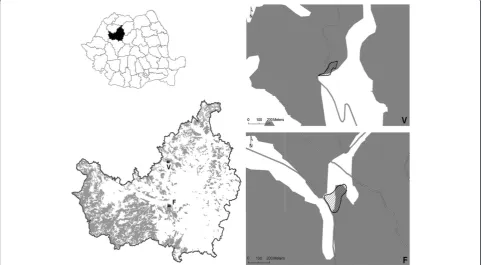
Two hilly areas were chosen: Vultureni and Faget, both in Cluj county (Figure 2), according to preliminary results of sampling for the evaluation of the presence of tick-borne pathogens in Romania (manuscript under preparation). The habitats consisted in herbaceous
vegetation alternating with small shrubs, located at the edge of woods, specific areas for ticks. The climate is moderate continental, influenced by the vicinity of the Apuseni Mountains and Atlantic influences from west of the country, in autumn and winter [13]. The study was conducted in spring, between the end of March and the end of April 2011, as tick abundance is higher in North-western Romania in this season [14]. The GPS was used to measure the distance.
Sampling procedure
On each collection site n = 30 samplings were performed (total 60 samplings in the two sites). Each sampling con-sisted in the simultaneous use of both flags, (with and without CO2), on 2 m wide adjacent areas, by two per-sons who had interchanged the sweep every fifty meters for the homogeneity of results. After each 5 m the flags were checked for ticks. All ticks were collected regard-less their species and fixed in pure ethanol. Specific identification was performed using morphological keys [15] under a binocular microscope.
Determination of carbon dioxide
The CO2concentration level on the flag canvas surface was measured using a portable CIRAS-2 Photosynthesis System equipped with a SRC-1 Soil Respiration Cham-ber (PP Systems International IncW, USA). CO2 level was determined at a single time, but from several points of the flag (n = 20) according to instruction manual and recommendations [16]. The results were expressed in ppm as compared to the standard CO2concentration of 393.71 ppm (reference data for 24.04.2011) [16].
Statistical analysis
The efficacy of the method was determined by counting the total number of ticks and separate developmental stage count, attached to the CO2flag compared with the control (CO2-free flag). For statistical analysis, the values were compared in CHI-SQUARE TEST [17]. A p value of <0.05 was considered statistically significant. The relative risk (RR) is a ratio of the probability of the event occurring in the exposed group versus a non-exposed group [18].
Results
A total number of 4267 of ticks belonging to two species were collected in the 60 samplings: I. ricinus (n = 4081) andDermacentor marginatus(n = 186).
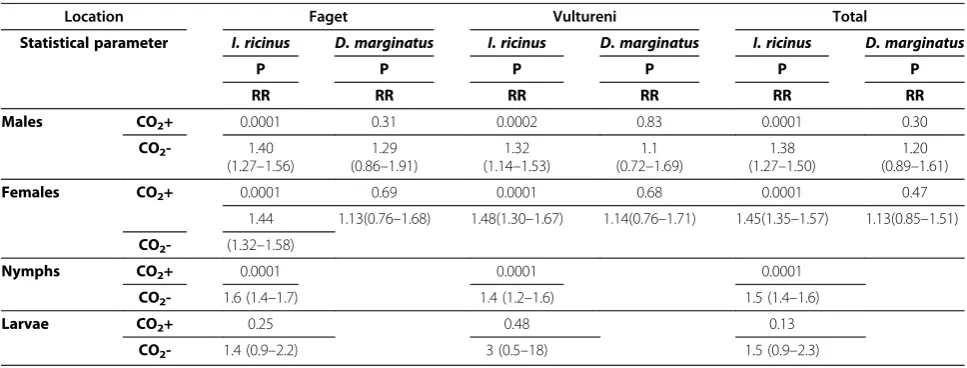
The statistical analysis revealed highly statistically sig-nificant (p<0001) difference between the two variables in adults and nymphs, in both locations and overall; for larvae, the recorded statistical differences were not sig-nificant (Table 2). Carbon dioxide flagging was more ef-fective than CO2-free flagging, with average values of RR ranging between 1.4 and 1.6 for adults and nymphs.
The addition of CO2prompted a difference on the sur-face of the flag ranging between 756.5 and 1135.0 ppm with a mean value of 848.9 ppm.
Discussion
[image:3.595.61.541.88.318.2]Flagging is the most widespread tick collection method. Over time, several improvements to this method were Figure 1Sweep CO2flag diagram.
[image:3.595.57.540.449.714.2]proposed [8] and now there is many types used: double walking flagging and double walking with baited flagging [19], walking flagging with a loose-fitting and white cot-ton flannel garment worn [20] and strip-flag method [21]. The successful hosts attack inIxodesspecies expressed as the ability to adhere to a flannel flag is influenced by many factors: light and/or shadow, radiation heat (temperature), mechanical vibration of questing sub-strate, host odor, and CO2concentration [22].
Chemical mediators also known as semiochemicals are as well important for behavioral patterns in ticks. These information-bearing compounds are secreted by animals into the external environment, and when recognized they trigger a specific behavioral response such as food location, sexual partner location or escape [23]. Semio-chemicals are categorized into four major categories: (1) pheromones; (2) allomones; (3) kairomones; and (4) synomones [24].
Carbon dioxide acts like an attractant kairomone for ticks [25]. Experimentally, it acted as an attracting agent causing almost immediate activation in the soft ticks
Ornithodoros coriaceus quiescent ticks [25]. Adults of
Dermacentor andersoni respond also very well to stimu-lation with carbon dioxide. Garcia, 1965, described a sys-tem based on release of CO2 for the collection of D.
andersoni. The system involved a piece of dry ice placed on a wire mesh platform in the desired area. The results indicate that the CO2 method is more sensitive for de-tection of adult ticks than is the conventional flagging technique [26]. Carbon dioxide (dry ice) trapping method was demonstrated to be effective in the collec-tion of some tick species: I. ricinus [5], Amblyomma americanum[27-29] and A. hebraeum[30]. Our method is important in Europe as it enhances the capture of I. ricinus, the main vector of Borrelia burgdorferi s.l. and the tick-borne encephalitis (TBE) virus [31].
Our results are consistent with those cited above. The number of adults and nymphs ofI. ricinuscollected was significantly increased using CO2 enhanced blanket comparing with flagging without CO2. The lower num-ber of larvae collected can be explained by the months of sampling, March-April, when larvae may be not fully active and by the quality of blanket, made by technical flannel, material which may not have reached the lower levels of the vegetation where larvae sit to quest.
[image:4.595.55.291.110.292.2]These data show that the responsiveness to CO2 is enhanced during host-seeking periods of the life cycle and reduced at other times [32]. However, others [29] did not establish significant differences between flagging method with a strip blanket and CO2 traps or rabbits scent baits. The response time of ticks to host attachment was shown to be dependent on the tick species and CO2 concentration in the environment [33]. In Amblyomma maculatum, A. americanum and Dermacentor variabilis,
Table 1 Number of questingIxodes ricinusticks collected by flagging with and without CO2
Location/stage/method Faget Vultureni Total (both locations)
IR DM IR DM IR DM
Males CO2+ 456 27 211 22 667 49
CO2- 325 21 160 20 485 41
Females CO2+ 587 26 281 25 868 51
CO2- 407 23 190 22 597 45
Nymphs CO2+ 547 0 304 0 851 0
CO2- 353 0 218 0 571 0
Larvae CO2+ 22 0 3 0 25 0
CO2- 16 0 1 0 17 0
TOTAL CO2+ 1612 53 799 47 2411 100
CO2- 1101 44 569 42 1670 86
Per location 2713 97 1368 89 4081 186
Table 2 Statistical significance of tick collection efficacy using flagging with and without CO2
Location Faget Vultureni Total
Statistical parameter I. ricinus D. marginatus I. ricinus D. marginatus I. ricinus D. marginatus
P P P P P P
RR RR RR RR RR RR
Males CO2+ 0.0001 0.31 0.0002 0.83 0.0001 0.30
1.40 (1.27–1.56)
1.29 (0.86–1.91)
1.32 (1.14–1.53)
1.1 (0.72–1.69)
1.38 (1.27–1.50)
1.20 (0.89–1.61)
CO2
-Females CO2+ 0.0001 0.69 0.0001 0.68 0.0001 0.47
1.44 1.13(0.76–1.68) 1.48(1.30–1.67) 1.14(0.76–1.71) 1.45(1.35–1.57) 1.13(0.85–1.51)
CO2- (1.32–1.58)
Nymphs CO2+ 0.0001 0.0001 0.0001
1.5 (1.4–1.6)
CO2- 1.6 (1.4–1.7) 1.4 (1.2–1.6)
Larvae CO2+ 0.25 0.48 0.13
[image:4.595.56.540.550.734.2]the groups preconditioned with low ambient CO2 (422 ppm) always produced response times of longer dur-ation than ticks preconditioned to high ambient CO2 (956 ppm) [34].
The lack of statistical significance for D. marginatus
between the two collecting methods compared in the present study might be caused by the major differences in the sample size. The small total number ofD. margin-atus collected (regardless the method used) can be explained by the typical area of this species which pre-fers biotopes characterized by xerophilic plant commu-nities: dry pasture shrub communities, grazing black locust forests (Robinietum), forest-steppe or grikes (Quercetum pubescentis and Cometo-Quercetum), mar-gins of oak forests and bushy ridges between the fields and field paths [35]. Our study area is characterized by deforested hills and covered with low vegetation; pre-dominant species in forest areas are hornbeam, birch, poplar, hazel, elm, ash and maple. AlthoughD. margina-tus is almost as widespread in Romania as I. ricinus, [36], the population density is significantly lower in most of the sampled localities [37]. Regarding seasonality, in Eastern Europe, D. marginatus is most numerous in February and March [38] and most of our sampling was done in April.
Flagging technique seems to work better for other spe-cies: Ixodes dammini [27], I. pacificus, D. occidentalis
and D. variabilis [32], I. rubicundus [39] or I. ricinus
[40]. Four different methods of surveying were tested for
D. variabilis and I. banksi and it was shown that the most successful was flagging, compared with carbon di-oxide trapping, nest boxes and collection from hosts [41].
Concerning the temperature, I. persulcatus is a more cold-resistant tick thanI. ricinusand it is more success-ful both in adhering to the flag and in remaining attached to it at two ranges: 6–10°C and 17–22°C [42]. In general a greater percentage of I. rubicundus dis-played an appetence response at lower (12, 17 and 21°C) than at high (30°C) temperatures [39]. It is known that all life stages ofI. ricinus are equipped to sense shifts in light intensity. This allowsI. ricinusto use onset of dark-ness to trigger mobility when desiccation risk is reduced in nature [43]. The nymphs are stimulated to walk hori-zontally by humidity and host scent. When the atmos-phere is sufficiently wet they are likely to walk towards odor secreted by host skin [44,45]. The larvae ofI. hirsti
seem to be more sensitive to shade and heat, while they were unresponsive to CO2concentration and host odor [46]. Radiation heat and shadowing caused the greatest percentage of I. rubicundus to display an appetence re-sponse; shadowing and radiation heat had the least effect on R. punctatus [22]. A single mechanical perturbation of the substratum caused a mean of 50% ofI. rubicundus
to display an appetence response. Constant mechanical perturbation resulted in a progressive decrease in the proportion of ticks reacting [22]. Host scent is known to initiate questing behavior inI. persulcatus,I. ricinusand
I. crenulatus. Both I. ricinus and I. crenulatus respond strongly to sheep wool [47,48].
Entire-blanket flagging is a better sampling method for
I. ricinus comparing with others variants of flagging or dragging. Significantly more nymphs and adults were caught by the entire-blanket versus strip-blanket flagging [49]. Flagging was 1.5–1.7 times as effective as dragging; impregnation of the cloths with different substances, like host odor, increased the efficacy by 2.4 (dragging) to 2.8 (flagging) times [39]. From several types of material used (i.e. cotton, woolen flannel, “molleton” - soft thick cot-ton, and toweling - spongecloth), the last was the best cloth type to optimize the number of ticks collected [36]. However, dry-ice-baited tick-traps is more effective for ticks with increased mobility, like A. americanum
[27].
Our enhanced technique that combines, for the first time, classical flagging and carbon dioxide trapping methods improved significantly the ability ofI. ricinusto adhere to flag blanket. By introducing CO2in the white blanket we tried to simulate the time approach of a host to the tick. Sudden increase of the CO2concentration in the air stimulates its vivacity and questing position, in-creasing the chance of attachment of ticks to the flag.
Conclusion
The study showed that the CO2 enhanced sweep flag increased the ability ofI. ricinus(p<0001) but not ofD. marginatusto be attracted to the flag blanket.
Competing interests
The authors declare that they have no competing interests.
Acknowledgements
This research was financed by project PCCE 7/2010 by CNCSIS.
Author details 1
Department of Parasitology and Parasitic Diseases, University of Agricultural Sciences and Veterinary Medicine Cluj-Napoca, Calea Mănăştur 3-5, Cluj-Napoca 400372, Romania.2Department of Plant and Environmental Protection, University of Agricultural Sciences and Veterinary Medicine Cluj-Napoca, Calea Mănăştur 3-5, Cluj-Napoca 400372, Romania.
Authors’contributions
GCM wrote the manuscript, performed flagging. MAD concept idea, performed the flagging. DMO identified the ticks. GA statistical analysis. OI measurement of CO2. SM measurement of CO2. CV team coordinator. All
authors read and approved the final manuscript.
Received: 28 December 2011 Accepted: 21 June 2012 Published: 21 June 2012
References
2. Keirans JE:Systematics of the Ixodida (Argasidae, Ixodidae,
Nuttalliellidae): An overview and some problems. InTick Vector Biology, Medical and Veterinary Aspects. Edited by Fivaz B, Petney T, Horak I. Berlin: Springer Verlag; 1992:1–21.
3. Oliver JH Jr:Biology and systematics of ticks (Acari: Ixodida).Annu Rev Ecol Syst1989,20:397–430.
4. Petney NT, Robbins RG, Guglielmone AA, Apanaskevich DA, Estrada-Peña A, Horak IG, Shao R:A Look at the World of Ticks. InProgress in Parasitology. Edited by Mehlhorn H. Berlin: Springer Verlag; 2011:283–296.
5. Capelli G, Ravagnan S, Montarsi F, Ciocchetta S, Cazzin S, Porcellato E, Babiker AM, Cassini R, Salviato A, Cattoli G, Otranto D:Occurrence and identification of risk areas of Ixodes ricinus-borne pathogens: a costeffectiveness analysis in north-eastern Italy.Parasite Vector2012,5:61. 6. Gray JS:A carbon dioxide trap for prolonged sampling ofIxodes ricinusL.
populations.Exp Appl Acarol1985,1:35–44.
7. Braks M, Van der Giessen J, Kretzschmar M, Van Pelt W, Scholte EJ, Reusken C, Zeller H, Van Bortel W, Sprong H:Towards an integrated approach in surveillance of vector-borne diseases in Europe.Parasite Vector2011, 4:192.
8. Carroll JF, Schmidtmann ET:Tick sweep: modification of the tick drag-flag method for sampling nymphs of the deer tick (Acari: Ixodidae).J Med Entomol1992,29(2):352–355.
9. Jore S, Viljugrein H, Hofshagen M, Brun-Hansen H, Kristoffersen AB, Nygård K, Brun E, Ottesen P, Sævik BK, Ytrehus B:Multi-source analysis reveals latitudinal and altitudinal shifts in range of Ixodes ricinus at its northern distribution limit.Parasite Vector2011,4:84.
10. Jaenson TG, Jaenson DG, Eisen L, Petersson E, Lindgren E:Changes in the geographical distribution and abundance of the tick Ixodes ricinus during the past 30 years in Sweden.Parasite Vector2012,5:8.
11. Estrada-Peña A:Geostatistics as predictive tools to estimateIxodes ricinus (Acari: Ixodidae) habitat suitability in the western Palearctic from AVHRR satellite imagery.Exp Appl Acarol1999,23:337–349.
12. Randolph SE:Tick ecology: processes and patterns behind the epidemiological risk posed by ixodid ticks as vectors.Parasitol2004,129: S37–S65.
13. Trusca V, Alecu M:Romania General Facts. InRomania’s Third National Communication on Climate Change under the United Nations Framework Convention on Climate Change. Edited by Ministry of Environment and Water Management. Holstebro: Grue & Hornstrup; 2005:21–65.
14. Chiţimia L:[Ecology of Ixodidae in Southwestern Romania] [in Romanian]. PhD Thesis. Timişoara: Universitatea deŞtiinţe Agricoleşi MedicinăVeterinarăa Banatului; 2006:283.
15. Feider Z:[Fauna of the Popular Republic of Romania. Volume 5/2. Acaromorpha, Suprafamily Ixodoidea] [in Romanian]. Bucureşti: Editura Academiei Republicii Populare Române; 1965.
16. Conway T, Tans P:NOAA/ESRL.www.esrl.noaa.gov/gmd/ccgg/trends/. Accessed 30 november 2011.
17. Snedecor GW, Cochran WG:Statistical Methods. 8th edition. Ames: Iowa State University Press; 1989.
18. Localio AR, Margolis DJ, Berlin JA:Relative risks and confidence intervals were easily computed indirectly from multivariable logistic regression.J Clin Epidemiol2007,60(9):874–882.
19. Fernández-Ruvalcaba M, Jesus F, De La Torre P, Cordoba-Juarez G, García-Vazquez Z, Rosario-Cruz R, Saltijeral-Oaxaca J:Animal bait effect on the recovery ofBoophilus micropluslarvae from experimentally infested grass in Morelos, Mexico.Parasitol Latinoam2003,58:54–58.
20. Chapman ES, Siegle TE:A novel method for tick retrieval reveals northern migration ofAmblyomma americanuminto Pike County, IL, USA.Int J Acarol2000,26(4):391–393.
21. Gray JS, Lohan G:The development of a sampling method for the tick Ixodes ricinus and its use in a redwater fever area.Ann Appl Biol1982, 101(3):421–427.
22. Fourie LJ, Snyman A, Kok DJ, Horak IG, Van Zyl JM:The appetence behaviour of two South African paralysis-inducing ixodid ticks.Exp Appl Acarol1993,17:921–930.
23. Sonenshine DE:Pheromones and other semiochemicals of ticks and their use in tick control.Parasitology2004,129:S405–S425.
24. Evenden ML, Judd GJR, Borden JH:A synomone imparting distinct sex pheromone communication channels forChoristonuera rosaceana (Harris) and Pandemis limitata (Robinson) (Lepidoptera: Tortricidae). Chemoecology1999,9:73–80.
25. Garcia R:Carbon dioxide as an attractant for certain ticks (Acarina: Argasidae and Ixodidae).Ann Entomol Soc Am1962,55(5):605–606. 26. Garcia R:Collection ofDermacentor andersoni(stiles) with carbon dioxide
and its application in studies of Colorado tick fever virus.Am J Trop Med Hyg1965,14(6):1090–1093.
27. Ginsberg HS, Ewing CP:Comparison of flagging, walking, trapping, and collecting from hosts as sampling methods for northern deer ticks, Ixodes dammini, and lone-star ticks,Amblyomma americanum(Acari: Ixodidae).Exp Appl Acarol1989,7:313–322.
28. Kinzer DR, Presley SM, Hair JA:Comparative efficiency of flagging and carbon dioxide-baited sticky traps for collecting the lone star tick,Amblyomma americanum (Acarina: Ixodidae). J Med Entomol
1990, 27(5):750–755.
29. Schulze TL, Jordan RA, Hung RW:Biases associated with several sampling methods used to estimate abundance ofIxodes scapularis andAmblyomma americanum (Acari: Ixodidae).J Med Entomol1997, 34(6):615–623.
30. Anderson RB, Scrimgeour GJ, Kaufman WR:Responses of the tick, Amblyomma hebraeum(Acari: Ixodidae), to carbon dioxide.Exp Appl Acarol1998,22:667–681.
31. Dautel H, Kahl O:Ticks (Acari: Ixodoidea) and their medical importance in the urban environment. InProceedings of the Third International Conference on Urban Pests: 19–22 July 1999. Edited by Robinson WH, Rettich F, Rambo GW. Prague:; 1999:73–82.
32. Li X, Dunley JE:Optimal sampling and spatial distribution ofIxodes pacificus,Dermacentor occidentalisandDermacentor variabilisticks (Acari: Ixodidae).Exp Appl Acarol1998,22:233–248.
33. Gray JS:Studies on the larval activity of the tick Ixodes ricinus L. in Co. Wicklow, Ireland.Exp Appl Acarol1985,1:307–316.
34. Holscher KH, Gearhart HL, Barker RW:Electrophysiological responses of three tick species to carbon dioxide in the laboratory and field.Ann Entomol Soc Am1980,73(3):288–292.
35. Nosek J:The ecology, bionomics, behaviour and public health importance ofDermacentor marginatusandD. reticulatusticks.Wiad Parazyt1972,XVIII(4-5-6):721–725.
36. Mihalca AD, Dumitrache MO, MagdaşC, Gherman CM, Domşa C, Mircean V, Ghira IV, Pocora V, Ionescu DT, Sikó Barabási S, Cozma V, Sándor AD: Synopsis of the hard ticks (Acari: Ixodidae) of Romania with update on host associations and geographical distribution.Exp Appl Acarol2012, doi:10.1007/s10493-012-9566-5.
37. Mihalca AD, Gherman CM, Magdas V, Dumitrache MO, Győrke A, Sándor AD, Domşa C, Oltean M, Mircean V, Mărcuţan DI, D’Amico G, Păduraru AO, Cozma V:Ixodes ricinusis the dominant questing tick in forest habitats in Romania: the results from a countrywide dragging campaign.Exp Appl Acarol2012, doi:10.1007/s10493-012-9568-3.
38. Hornok S:Allochronic seasonal peak activities ofDermacentorand Haemaphysalisspp. under continental climate in Hungary.Vet Parasitol
2009,163:366–369.
39. Fourie LJ, Van Der Lingen F, Kok DJ:Improvement of field sampling methods for adult Karoo paralysis ticks,Ixodes rubicundus(Acari: Ixodidae), through addition of host odour.Exp Appl Acarol1995, 19:93–101.
40. Vassallo M, Pichon B, Cabaret J, Figureau C, Perez-Eid C:Methodology for sampling questing nymphs ofIxodes Ricinus (Acari: Ixodidae), the principal vector of lyme disease in Europe.J Med Entomol
2000, 37(3):335–339.
41. Keaney P:The Effectiveness Of Various Trapping Techniques In Collecting Ixodes scapularis and Other Species of Ticks,Bios 569 - Practicum in Aquatic Biology, 1651 Turtle Creek Ct. Advisor: Dr. Craig. 1994.
42. Uspensky I:Ability of successful attack in two species of ixodid ticks (Acari Ixodidae) as a manifestation of their aggressiveness.Exp Appl Acarol1993,17:673–683.
43. Perret JL, Guerin PM, Diehl PA, Vlimant M, Gern L:Darkness induces mobility, and saturation deficit limits questing duration, in the tick Ixodes ricinus.J Exp Biol2003,206:1809–1815.
44. Crooks E, Randolph SE:Walking byIxodes ricinusticks: intrinsic and extrinsic factors determine the attraction of moisture or host odour.J Exp Biol2006,209:2138–2142.
46. Oorebeek M, Sharrad T, Kleindorfer S:What attracts larvalIxodes hirsti (Acari: Ixodidae) to their host?Parasitol Res2009,104:623–628. 47. Lees AD:The behaviour and physiology of ticks.Acarol1969,11(3):397–410. 48. Elizarov YA, Vasewta AA:A distant orientation of blood-sucking ixodid
ticks to the host’s attractant factors. (in Russian).Parazit Sb1976, 10:136–141.
49. Tack W, Madder M, De Frenne P, Vanhellemont M, Gruwez R, Verheyen K: The effects of sampling method and vegetation type on the estimated abundance ofIxodes ricinusticks in forests.Exp Appl Acarol
2011,54:285–292.
doi:10.1186/1756-3305-5-125
Cite this article as:Ghermanet al.:CO2flagging - an improved method
for the collection of questing ticks.Parasites & Vectors20125:125.
Submit your next manuscript to BioMed Central and take full advantage of:
• Convenient online submission
• Thorough peer review
• No space constraints or color figure charges
• Immediate publication on acceptance
• Inclusion in PubMed, CAS, Scopus and Google Scholar
• Research which is freely available for redistribution