Rochester Institute of Technology
RIT Scholar Works
Theses
Thesis/Dissertation Collections
8-25-1995
Matched wavelet construction and its application
to target detection
Joseph Chapa
Follow this and additional works at:
http://scholarworks.rit.edu/theses
This Dissertation is brought to you for free and open access by the Thesis/Dissertation Collections at RIT Scholar Works. It has been accepted for
inclusion in Theses by an authorized administrator of RIT Scholar Works. For more information, please contact
Recommended Citation
Dr. Mark Fairchild, Coordinator, Ph.D. Degree Program
Matched Wavelet Construction and Its
Application to Target Detection
by
Major Joseph O. Chapa, USAF
B.S. Illinois College (1981)
B.E.E. Auburn University (1983)
M.S. Stanford University (1986)
A thesis submitted in partial fulfillment of the
requirements for the degree of Ph.D. in the
Center for Imaging Science
Rochester Institute of Technology
August 25, 1995
Signature of the Author
_
Jo§eph O. Chapa
Accepted
by
--J~!~~__=__.>.~I1__.:.'1_=____J
CENTER FOR IMAGING SCIENCE
ROCHESTER INSTITUTE OF TECHNOLOGY
ROCHESTER, NEW YORK
CERTIFICATE OF APPROVAL
Ph.D. DEGREE DISSERTATION
The Ph.D. Degree Dissertation of Joseph O. Chapa
has been examined and approved
by
the
dissertation committee as satisfactory for the
dissertation requirement for the
Ph.D. degree
in
Imaging Science
Dr. Mysore Raghuveer, Thesis Advisor
Dr. Edwin Hoefer
Dr. Harvey Rhody
THESIS RELEASE PERMISSION
ROCHESTER INSTITUTE OF TECHNOLOGY
CENTER FOR IMAGING SCIENCE
Title of Thesis: Matched Wavelet Construction and Its Application to Target Detection
I, Joseph O. Chapa, hereby grant permission to the Wallace Memorial Library of
R.I.T.
to reproduce
my thesis in whole or
in
part. Any reproduction will not be for commercial use or profit.
Signature:
_
<::7/25/15
ACKNOWLEDGEMENTS
I
wish to acknowledgemy Sovereign God for his love
and provision andfor faith in
Christ
whichHe
workedin
me andfor
thehope
thatHe
gave mefrom
thefirst
day
of
thisschoolassignment, through
every
obstacle andevery
success.I
wishto thankmy
loving
wife,Debbie,
for her
patience,love,
support, and encouragement
during
thecourseof
thisPh.D.
program.I
would alsolike
to thankmy
children,Katie,
Joey, Frank,
andBecky
for
theirlove
andunderstanding
evenduring
timesof
stressin
theirDad's
life.
I
wishto thankmy
advisor,Dr. Mysore
Raghuveer,
for
his
patience, guidance,
andknowl
edgeas
he helped
me throughmy
researchandforteaching
me,by
example,
thedifference
between
a student andascholar.I
wishto thankmy
committee,Dr. Edwin
Hoefer,
Dr.
Harvey
Rhody,
andDr. Navalgund
Abstract
This
dissertation develops
a new waveletdesign
technique thatproduces a waveletthatmatchesadesired
signal
in
theleast
squaressense.The Wavelet Transform lias become
very
popularin
signal andimage
processing
overthelast 6
yearsbecause it is
alinear
transformwith aninfinite
numberof
possiblebasis
functions
thatprovideslocalization in both
time(space)
andfrequency
(spatial frequency).
The Wavelet Transform is very
similarto thematchedfilter
problem, wherethewaveletactsas a zero mean matchedfilter. In
pattern recognition applications wherethe outputof
theWavelet Transform is
tobe
maximized,
it is necessary
to use wavelets thatarespecifically
matchedto the signalof
interest.
Most
current waveletdesign techniques,
however,
do
notdesign
thewaveletdirectly,
but
rather,build
a composite waveletfrom
alibrary
of previously designed
wavelets,modify
thebases in
anexisting
mul-tiresolutionanalysis ordesign
a multiresolution analysisthatis
generatedby
ascaling function
whichhas
a specificcorresponding
wavelet.In
thisdissertation,
an algorithmfor
finding
both
symmetric and asymmetric matched waveletsis developed. It
willbe
shownthatundercertainconditions, thematched waveletsgenerate an orthonormalbasis of
theHilbert
spacecontaining
allfinite energy
signals.The
matched orthonormal wavelets give risetoa pair
of Quadrature Mirror Filters
(QMF)
thatcanbe
usedin
thefast Discrete Wavelet Transform.
It
will alsobe
shown thatas the conditions are relaxed, thealgorithm produces
dyadic
wavelets which when usedin
theWavelet Transform
provides significant redundancy
in
the transformdomain.
Finally,
thisdissertation develops
ashift,
scale and rotationinvariant
techniquefor
detecting
anContents
1
Introduction
1
2
Background
4
2. 1
Hilbert Spaces
4
2.2
Fourier
Analysis
7
2.3
Wavelet
Analysis
12
3
Wavelet
Theory
Development
15
3.1
Continuous
Wavelet Transform
15
3.2
Dyadic Wavelets
20
3.3
Frames
21
3.4
Orthonormal Wavelets
23
3.5
Multiresolution Analysis
24
3.5.1
Properties
ofcj>andip
30
3.6
Discrete Wavelet Transform
33
3.7
2-Dimensional DWT
42
3.8
Limitations
to the
MRA
andDWT
45
3.8.1
MRAs
45
3.8.2
DWT
45
4
Wavelet Design Techniques
48
4.1
Compactly
Supported Wavelets
48
4.2
Wavelets for Signal Representation
51
4.3
Entropy-Based Best Basis Selection
52
4.4
Matching
Pursuit
withTime-Frequency
Dictionaries
53
4.5
Multiresolution Analysis-type Wavelets
54
4.6
Biorthogonal Wavelets: The
Lifting
Scheme
57
5
Matching
aWavelet
to
aSignal
60
5.1
Motivation: Signal Detection
60
5.2
Orthonormal MRAs
62
5.3
Matching
aWavelet
toaSignal
64
5.3.1
Finding
the
scaling function from
a wavelet64
5.3.2
Properties
ofthe
wavelet spectrum amplitude66
5.3.3
Matching
Spectrum Amplitudes
68
5.3.4
Properties
ofthe
wavelet spectrumphase69
5.3.5
Matching
Spectrum Phase
73
5.4
Generating
Matched Wavelet Frames
74
6
Examples
79
6. 1
Orthonormal Wavelets
79
6.1.1
Meyer's
Wavelet
80
6.1.2
Gabor's Wavelet
84
6.1.3
Daubechies'D4
wavelet88
6. 1
.4Transient
signal94
6.2
Dyadic Wavelets
100
6.2.1
Gabor's Wavelet
100
7
Applications
to
Image
Object Detection
105
7.1
The Radon Transform
105
7.2
Image Reconstruction
andBackprojection
108
7.2.1
Reconstruction
by
direct Fourier Methods
108
7.2.2
Reconstruction
by
backprojection
109
7.3
The Wavelet Radon Transform
110
7.4
Matched Wavelets
andObject Detection
115
7.4.1
Training
onaKnown Object
115
7.4.2
Object Detection
125
7.4.3
Detection Results for
anUnknown Object
131
8
Summary
139
8.1
Future Research
140
8.2
Conclusion
140
List
of
Figures
2. 1
Orthonormal
projection6
2.2
Short-Time
Fourier Transform
10
2.3
Time-frequency
map
-Short Time Fourier Transform
11
2.4
Time-scale map
-Wavelet Transform
14
3.1
The Gabor
orMorlet
wavelet17
3.2
Continuous Wavelet Transform
of atransientsignal19
3.3
Multiresolution Decomposition
ofL2(3?)
26
3.4
N-level
Multiresolution Decomposition
28
3.5
Daubechies'D4 Wavelet
andScaling
Function
28
3.6
Multiresolution Decomposition Example using
theD4
wavelet29
3.7
Discrete Wavelet Transform
35
3.8
Discrete
Multiresolution Decomposition
oftransientsignalD4 filters
37
3.9
Decomposition/Reconstruction
cycle withQMF filters
38
3.10
DWT Decomposition/Reconstruction
-Effects
ontheSignal
Spectrum, a) Original
Signal;
b)
Spectrum
ofH
andG;
c) Spectrum
ofCj~l andD''1;
d)
Spectrum
ofC^1 andD'-1;
e)
Spectrum
ofC^'"1 and>j_1;f)
Spectrum
ofCjandDj;
g) Spectrum
ofCj39
3.11
2-D Multiresolution Decomposition
43
3.12
Multiresolution
Decomposition
ofLena
Using
Daubechies'D4 Wavelet
44
5.1
Algorithm
Flow Chart
75
6. 1
Constraint
Matrix
-A
for 2n/3
<u <
87r/3
80
6.2
Construction
oftheconstraint matrixA
81
6.3
Meyer's
wavelet82
6.4
Amplitude Match in
thepassband-Meyer
83
6.5
Meyer's scaling function
83
6.6
Gabor's
wavelet84
6.7
Gabor's
spectrum and poisson summation85
6.8
Amplitude
matchin
thepassband-Gabor's
wavelet85
6.9
Matched
wavelet spectrum and poisson summation-Gabor
86
6. 10
Scaling
function
spectrum and poisson summation-Gabor
86
6.11
Matched
wavelet vsGabor's
wavelet87
6.12
Scaling
function
-Gabor
87
6.13
Daubechies'D4 Wavelet
andScaling
Function
88
6.14
Truncated Spectrum
andPoisson
Summation
-D4
89
6.15 Amplitude
Match
in
thepassband-D4
89
6.16
Matched Wavelet Spectrum
andPoisson Sum.
D4
90
6.17
Scaling
Function Spectrum
andPoisson Sum.
D4
90
6.18
Matched Wavelet
Group Delay
vsdesired
-D4
91
6.19
Scaling
Function
Group
Delays: Derived
vsTruth
-D4
92
6.20
Matched Wavelet
andScaling
Function
vsdesired
-D4
93
6.21
QMF
filters
g(k)
andh(k)
-D4
93
6.22
Transient Signal
94
6.23
Desired Signal Spectrum
andPoisson
Sum
- transient95
6.24
Amplitude Match in
thepassband- transient95
6.25
Matched Wavelet Spectrum
andPoisson
Sum
-transient
96
6.26
Scaling
Function
Spectrum
andPoisson Sum
6.27 Matched
Wavelet
Group
Delay
vsdesired
-transient
97
6.28
Matched Wavelet
vsdesired
signal-transient
97
6.29
Scaling
Function
-transient
98
6.30
QMF filters g(k)
andh(k)
- transient99
6.31
Constraint
Matrix
-A
for 0
< u> <
4ir
100
6.32
Amplitude Match in
theextended passband-Gabor
101
6.33
Matched Dyadic Wavelet
vsGabor's
wavelet101
6.34
Matched Dyadic
wavelet spectrum and poisson summation-Gabor
102
6.35
Amplitude Match in
theextended passband-D4
103
6.36
Matched Dyadic
wavelet spectrum and poisson summation-D4
103
6.37
Matched Dyadic Wavelet
vsD4
wavelet104
7.1
Projection geometry for
tomographicprocessing
106
7.2
Radon Transform
of a rectangleimage
107
7.3
Projection Slice Theorem
109
7.4
Backprojection
ofqg(p)
110
7.5
Image Reconstruction using
theBackprojection Algorithm
...Ill
7.6
Geometry
for
theWavelet Radon Transform
Ill
7.7
Image
of a rectangular object112
7.8
Projections
of rectangleimage
at8 equally
spaced angularintervals
113
7.9
Wavelet
Radon Transform
of rectangleimage using
theD4
wavelet114
7.10
Training
Procedure for Object Detection
116
7.11
Training
image
offighter
aircraft117
7.12
Projections
offighter
aircrafttakenat8
equally
spacedangles118
7.13
Dilated
projections andtheirassociatedmatchedwavelets-pass
0
119
7.14
Wavelet Radon Transform
ofjet
aircraft projections- pass0
120
7.15
Peak
valuesfrom
theWRT
-matchedwaveletsvs
Meyer's
wavelet122
7.16
Projections
andtheirestimate7.17
Dilated
projections andtheirassociated matchedwavelets-pass
1
124
7.18
Projections
andtheirestimate-pass
1
125
7.19
Object Detection Algorithm
126
7.20
Normalized Circular
Correlation,
s -0128
7.21
Results
ofbackprojected detection
anddetail
signals -0130
7.22
Test image
for
detection
131
7.23
Projections
andtheirestimate- testimage,
pass0
132
7.24
Wavelet Radon Transform
ofTest
image
projections-pass
0
133
7.25
Normalized Circular
Correlation,
s-Test image
134
7.26
Results
ofbackprojected
detection
anddetail
signals-Test
image
136
7.27
Wavelet Radon
Transform
ofTest image
projections-pass
1
137
7.28
Test
image
projections andtheirestimateList
of
Tables
6.1
h(k)
for
ip
matchedtofD
^
Chapter 1
Introduction
For many
years, the
primary linear
mathematical analysistool
usedto transform
signalinformation
wasthe
Fourier Transform.
However,
the
end ofthe1980's
sawthe
development
of an alternative mathematical
framework,
called the wavelettransform,
withapplicationsin
signal andimage
analysis[30].
While
much ofthe
theory
associated withit is
not newand canbe described in
aHilbert
spacesetting,
it did
provide a consolidatedframework for
a number ofpreviously diverse
disciplines,
like
multiresolution
analysis usedin
computervision,
subbandcoding developed for
speechandimage
compression,
and orthonormal
basis
expansionsdeveloped in
applied mathematics[30].
The Fourier Transform
of asignal,
f{x),
givenby
/oo
f{x)e~wxdx,
(1.1)
-oo
is
a projection operation ontothe
basis formed
by dilating
the
complexexponential,
elx.The Wavelet
Transform,
givenby
f{x)\a\-3ii>[^-)dx,
(1.2)
is
aprojection operationontothebasis formed
by dilating
andshifting
a"mother"wavelet, ip(x),whichis
zeromeananddecays very rapidly in
x.These
properties ofthe
wavelet provide an advantage overFourier
analysisbecause
the
Wavelet Transform
canachievelocalization
in both
time
andfrequency
orin
the
case ofimages,
space and spatialfrequency
[10]. That
is
to
say
that the
Wavelet
Transform
canwaveletanalysisover
Fourier
analysisis
the
flexibility
in
thetransform
operator usedfor decomposition
orsignal representation.
Fourier
methods arelocked into bases
that
arebased
onthe
complexexponentialkernel,
e8x.Wavelet
transforms
canhave
many different
operators.They
may
ormay
notbe
orthogonal,
and
they
may
ormay
notform bases. Even in
the
case of orthonormalbases,
there
are stillinfinitely
many
wavelets
that
satisfy
the
appropriate conditions.Because
ofthis
flexibility,
it is
possible,
andwise, to
choose or
design
a waveletthat
is
matchedto the
application.Many
waveletdesign
techiques
have been
developed
sincethe
early
theoretical
workofthe
waveletpioneers.
However,
mostofthe techniques
do
notdirectly
match a waveletto
a signal ofinterest.
Many
build
adaptive waveletsfrom existing
wavelets andtheir
effectivenessis dependent
onthe
effectivenessof
the
existing
wavelets used.Others
impose
requirements onthe
waveletsto
ensure somedegree
ofsmoothness or
differentiability,
which guaranteesthe
waveletto
exhibit certainproperties,
but does
notguarantee
anything
withregardsto
its
shape.Using
adaptive waveletsfor image
pattern recognitionis very
attractivebecause
ofthe
scale(or
zoom)
insensitivity
ofthe
wavelettransform.
For
instance,
if
a wavelet canbe
constructedthat
matchesa pattern of
interest in
animage,
then the
peak ofthe wavelettransform
(or
lack
thereof)
willindicate
whether
the
patternis
present(or
not)
anddue
to the
localization
properties ofthe wavelet,
wherethe
pattern
is located.
Applying
the
Continous Wavelet Transform
(CWT)
to the
image
wouldbe
too
data
intensive because
ofthe
redundancy
containedin
the
CWT. The 2-D Discrete Wavelet
transform
is
muchfaster because it
processesthe
projection coefficients only.However,
it is
not shift or rotationinvariant,
making
its
applicationto
pattern recognition oflimited
use.These
two problems,
waveletmatching
and applicationto
pattern recognition are addressedin
this
dissertation.
First,
a waveletdesign
algorithmis developed
that takes
any 1-D
signal asinput
andfinds
the
waveletthat
comes closestto
it in
the
least
squares sense.The
algorithm assumesthat the
waveletis bandlimited. The bandlimit
conditions canbe
set suchthat the
resultant waveletis
an orthonormalbasis
ofthe
function
spaceL2(Jr.),
orthey
canbe
relaxed orwidened,
sothat the
algorithm generatesa"dyadic"wavelet.
Second,
atarget
detection
andidentification
algorithmis
developed based
onthe
detec-tion
algorithmis
shift,
scale and rotationinvariant.
The Radon Transform is
usedto
reducethe
data
burden
onthe
CWT
andto
provide somedegree
of rotationinvariance.
Using
matched waveletsin
the
CWT
provides scale and shiftinvariance
aswellasoptimalamplitudedetection.
The
matched waveletalgorithm
in
conjunctionwiththe
targetdetection
algorithm provide athorough
framework from
whichmore
detailed
target
classification algorithms couldbe
developed.
This
dissertation
provides anin-depth
reviewofwavelettheory,
first in Chapter 2
with a short reviewof
Hilbert
spaces and a comparisonbetween Fourier
andWavelet
analysis.Chapter 3
provides anhistor
ical chronology
ofthe
development
of wavelettheory
from
the
Continuous
Wavelet Transform
ofMorlet
and
Grossman
to
multiresolution analyses andthe
Discrete Wavelet Transform
ofMallat. Several
currentwavelet
design
techniques
are presentedin Chapter 4
as motivationfor
the
matching
algorithmdevel
oped
in Chapter 5. Chapter 6
gives several examples ofthe
waveletmatching
algorithmto
demonstrate
its
performance andto
assist anyonetrying
to
implement
the
algorithmthemselves.
After
asummary
ofthe
Radon Transform
andimage
reconstructionusing
backprojection,
Chapter 7
providesthe
step
by
step
development
ofthe target
detection
andidentification
algorithmtaking
advantage ofthe
matchedwavelet algorithm of
Chapter 5. Chapter 8
providesasummary
ofthe
researchresults containedin
this
Chapter 2
Background
This
chapter containsbrief background
materialthat
willbe
helpful
in understanding
the
development
of waveletanalysis.
The
first
section containsdefinitions
oftermsusedthroughoutthe
dissertation,
andan
introduction
to
Hilbert
spaces, the
projectiontheorem
andits
applicationto
signal representationsin Hilbert
spaces.The Fourier
seriesis
shown tobe
adirect
application ofthe
projectiontheorem
onthe
Hilbert
space of allperiodic,
finite energy
signals.The
limitations
ofFourier
analysison real worldsignals are
indentified followed
by
the
introduction
ofthe
Short Time Fourier Transform (STFT). The
last
sectionintroduces
wavelet analysisas a recent solutionto the
limitations
ofFourier
analysis andthe
STFT. More detailed development
of wavelettheory
willbe
providedin Chapter 3.
2.1
Hilbert
Spaces
The Hilbert
spaceis
acomplete,linear
vector space witha norm|| ||
andaninner
product(,
)defined
[22]. There
aretwo
Hilbert
spaces usedin
waveletanalysis,L2(3?),
and,
12{Z),
where3?
is
the set ofall real numbers and
Z
is
the
setofallintegers.
Definition
1
The Hilbert
spaceL2($l)
consistsof
complex-valued, measurablefunctions,
x(t),
onthe
real
line, !R,
where/oo
\x{t)\2dt
<
oo(2.1)
andthe
integral
is
theLebesque integral. The
normofxL2(JJ)
is
defined
asINI
=(^_Jx(t)|2di)2.
(2.2)
The inner
productofx, y
G
L2(SR)
is defined
as/oo
x(t)y(t)dt
(2.3)
-oo
where
y(t) is
thecomplex conjugate ofy(t).Definition 2 The
Hilbert
space12{Z)
consistsof
all complex valued sequencesof
scalarsx=
{.,r]-.i,T]o,Ti1,---}
far
whichoo
Y
N2<
(2-4)
i=oo
for
alli
G
Z,
theinteger
numberline. The
norm ofxis
defined
asi
OO
\
2INI
=E
N2(2-5)
\i=oo
/
The inner
product ofx={...,
77-1,770,771,
. ..} and
y
={.
. .
,
v-i,i/0,
i>i,...} is
defined
as00
Y
Wi-(2.6)
i= 00
A
set of vectorsin
aHilbert
space, X{ e
H,
is
saidto
be
orthonormalif
X{
J_
xj
for i
^
j
for
allXi e
H
and
if
eachvectorhas
unitnorm, that
is,
\Xi,
Xj)
<1
for i
=j
(2.7)
0
for i
^ j
The
projectiontheorem
is
afundamental
theorem
usedin
vectorspace analysis andis
usedto
formulate
the
mathematics ofboth Fourier
and waveletdecompositions for
functions
in Hilbert
spaces.Theorem 1 Projection Theorem Let H be
aHilbert
space andM
aclosedsubspaceof H.
Corre
sponding
toany
vectorxH,
thereis
a unique vectormo G
M
suchthat\\x
-mo||
<
||x
m||
for
all m
G
M.
Furthermore,
anecessary
and sufficient conditionthatm G
M be
theuniqueminimizing
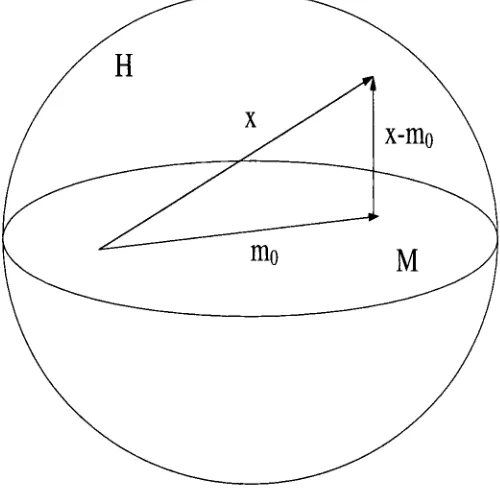
The Projection Theorem
statesthatif
we wantto
constructa vectormo G
M,
a subspace ofH,
thenwecan
do
so uniquely.Furthermore,
the
vectorthat
best
approximates x willbe
the
onethat
minimizesthenormof
the
errorvector,
||x
mo
||
,andtheerrorvector,
x mo,willbe
orthogonalto theapproximationsubspace,
M (Figure
2.1)
[22].
Suppose
we wantto
construct anapproximation ofxG
if from
a set of vectorsy
={yi,y2,-,Vn}
G
[image:20.563.154.404.211.459.2]M,
whereM is
a closed subspace ofH
andy is
abasis
ofM.
Then,
the approximation,
or projectionFigure 2. 1
:Orthonormal
projectionof x onto
M is
alinear
combination ofj/j
(PMx)
=Y
aiVi
i=l(2.8)
where
PM
is
the
projection operatorontothe
subspaceM [22]. From
the
Projection
Theorem,
the
best
approximation of x will
be
the
onethat
minimizes\\x
-Pmx\\
and x-PMx
willbe
orthogonalto
allelementsofy,
that
is,
Substituting
(2.8)
into
(2.9)
givesn
(x-YajyjiVi)=-
(2-10)
Since
the
Hilbert
spaceis linear
andthe
inner
productis
alinear
operator,
(2.10)
canbe
rewritten asn
(x,yi)
=Yaj(yj^i)-c2-11)
If y
G
M is
an orthonormalbasis
ofM,
then
(y,,
yj)
=0 for i
^
j
and||yj||
=1. Equation
(2.11)
reduces
to
(x,yi)
=ai
(2.12)
making
(2.8)
n
{pMx)
=Y(xiyi)yi-(2-i3)
2=1
Equation
(2.13)
givesthe
expressionfor
the
projectionofthe vector x ontoan orthonormalbasis y
ofM [22].
2.2
Fourier
Analysis
Signal
andimage
analysishas
long
benefited
from
Fourier
analysis,
wherethe
set offunctions,
el2nkx/T,
forms
an orthonormalbasis
ofL2(0,
T),
the
Hilbert
spaceconsisting
ofall squareintegrable
functions
defined
onthe
interval
[0,
T]. All
periodicfunctions,
withperiodT,
alsoresidein
L2(0,
T),
sincethey
can
be completely described
by
one period onthe
interval
[0,
T]. Since
L2(0,
T)
is
aHilbert
space,
it
has
aninner
productandanorm[10]
defined
as{f,9)
=^J^Hx)^x)dx
(2.14)
_ i
11/11
={f,f)=(^[\f(x)?dx^
2(2.15)
Since
ei2nkx/Tis
an orthonormalbasis
ofL2(0,T),
f(x)
G
L2(0,T)
canbe
representedusing
(2.13)
rT
1 fl
ck
=(f(x),ei2-^)
=-Jo
f(x)e-^dx.
(2.17)
The
function, /,
is decomposed into
the sum ofinfinitely
many
mutually
orthogonalcomponents,
9k{x)
= Ckel2lTkxlT, where
orthogonality
means:(9n,9m}
=0,
for
allm^
n.(2.18)
That
(2.18)
holds
is
a consequence ofthe
fact
that:
wk{x)
=e?2*kxlT
A;
={...,-1,0,1,...}
(2.19)
is
an orthonormalbasis
ofL2(0, T)
[10]. It
is important
to
notefurther
that the
orthonormalbasis,
wk,
is formed
by dilating
(known
asintegral
dilation)
a singlefunction,
ei2nxChui
[10]
emphasizesthe
significance of
these
facts in
theintroduction
to
his book:
Let
us summarizethis
remarkablefact
by
saying
that
every 2-K-periodic
squareintegrable
function is
generatedby
a"superposition
"of integral
dilations
of
thebasic
function w(x)
= eix.Chui develops his
section onFourier
analysisassuming
a period of2tt, thereby
giving
riseto
his
mentionof
27r
-periodicfunctions
andthe
basic function
eixThe decomposition in
(2.16)
and(2.17)
is known
astheFourier
series expansion of/(x)[17].
The
basis,
e'27rfex/r,
is
a complex exponentialwithfundamental
frequency,
o
=1/71. Integer
multiples ofthe
fundamental
frequency
are calledharmonics.
So,
a periodicfunction
of periodT,
canbe perfectly
represented
by
the
sum of a complex exponential at afundamental
frequency
andits harmonics.
The
weights of
these
complex exponentialcomponents, ck,
constitutethe
frequency
spectrum of/.
It is
oftencalled
the
line
spectrumbecause it is discrete.
Square
integrable,
non-periodic,
functions
whosedomain is
the
realnumberline,
3?,
constitutethe
Hilbert
space,
L2(3?),
withits inner
product andnormdefined
as:The Fourier
series off(x)
G
L2(3)
does
notexist since/
is
non-periodic andits domain is
the
entirereal
line,
3. The
frequency
spectrum of/
can stillbe determined
by
taking
its inner
product withthe
function,
el2rr^x,
whereis
thecontinuousfrequency
variable[17].Letting
uj =27r
gives/oo
f(x)e-^xdx.
(2.22)
-oo
F(u)
is
the
Fourier Transform
off(x)
andis
atleast
piecewise continuous[17].The Fourier Transform
can
be
interpreted
in
a manner similarto the
Fourier
series.A non-periodic,
squareintegrable
function,
f(x)
G
L2(3?)
canbe
representedby
the
integral
sum of complex exponentials with weights givenby
the
frequency
spectrum,
F(w),
1
f/(*)
=/
F{u)ewxdu}.
(2.23)
The Fourier Series
andFourier Transform
are powerfultools
for
determining
the
frequency
contentof
discrete
and continuous signals.However,
in
orderto
study
the spectralbehavior
ofanalog
signalsfrom its
Fourier
Transform,
full
knowledge
ofthe
signalin
the
time
or spacedomain
mustbe
obtained[10].In
addition,
if
a signalis
alteredin
a small neighborhood of sometimeinstant,
thenthe
entire spectrumis
affected.If
a signal of somefrequency
existsfor
afinite
period oftime,
the
Fourier Transform does
notgive
visibility into
wherein
time the
signal occurred.Being
ableto
determine
wherein
time
asig
nalof some
frequency
occursis
calledtime
localization.
Being
ableto
determine
the
frequency
contentof a signal at a particular
frequency
is
calledfrequency
localization. The Fourier Transform
providesexcellent
frequency
localization,
but
poortime
localization [10].
In
orderto
obtainlocalization in both
time
andfrequency,
an additional parameter mustbe
added.Gabor
[16]
wasthe
first
to
adaptFourier
analysisto
include
a modulationwindow,
g(x)
[30]. Gabor's
Short-Time Fourier Transform
(STFT)
[30],
5(r,
u),
is
given as/oo
f(x)g(x
-r)e~lu}dx.
(2.24)
-oo
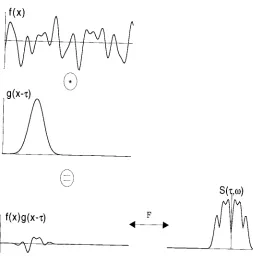
The
signalis
weightedby
afinite
duration
window, g(x),
priorto
taking
the
Fourier Transform (Figure
2.2). The
additionalparameter,
r,is
the
translationparameterofthe
window andit
providesthe
addiS(yD)
f(x)g(x-t)
[image:24.563.156.409.199.472.2]<
?
is
presentin
the
signalfor
afinite
duration,
it
will showup in
S(t,
u)
at values ofrcorresponding
to
the location
ofthe
frequency
pulse.The
function,
S(t,
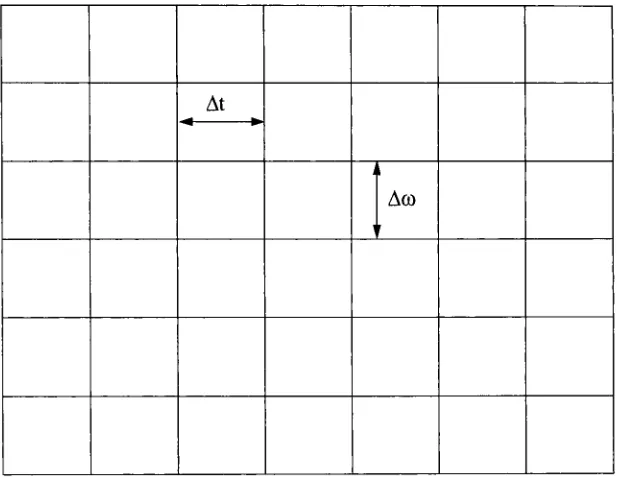
u),provides atwo
dimensional
map
oftime
andfrequency
(Figure
2.3)
[30].
By
fixing frequency
at somevalue,
u/0>S(t,
lo0)
gives a1-D function
indi-At
ii
[image:25.563.128.437.140.379.2]Am
Figure 2.3:
Time-frequency
map
-Short Time Fourier Transform
eating
wherein
timeu0
existed.Alternatively,
by fixing
t = r0,S(to,
lj)
givesthe
Fourier Transform
for
that
timeslice of/.
The
resolutionin
both
timeandfrequency
depend
onthewindowfunction
g(t).Time
andfrequency
resolutionsaretraded
offaccording
to the
uncertainty
principle[10,
30]
1
Time-bandwidth
product =AtAw
>where
At
andAw
arethe
rms measures oftime
width andbandwidth
givenby
{J^(s-3(g))|g(s)|2<fr}*At
=Au
={n.
(W
\\G\\
(2.25)
(2.26)
G(w)
is
the
Fourier Transform
ofg(x)
andthe operator,
E(-)
is
given asm
-^}/}fd\
(2.28)
For
this reason,
a gaussian windowis
often used sinceit
satisfiesthe
equality
of(2.25)
[30].
However,
modulating
the
signal with a gaussianwindowcorrelatesthe
Fourier
coefficients and thereforedestroys
orthonormality.
Furthermore,
the windowfunction,
g(x),
withits corresponding
frequency
spectrum,
G(u),
setsboth
the time
andfrequency
resolutionsfor
the
entiretime-frequency
plane.This
is
adisad
vantage
for analyzing
signals withboth high
andlow
frequencies [10]. In
orderto
properly
represent asignal of some
fundamental
frequency,
the
window must contain oneor more periodsofthat
signal.Low
frequency
signals,
therefore,
requirelong
time windows,
which correspondsto
high
resolutionin
thefre
quency domain. High
frequency
signals require a smalltime
windowin
orderto
capture one or moreperiods.
The
smalltime
windowcorrespondsto
low
resolutionin
the
frequency
domain. The STFT's
windowwidths are
fixed in both
time
andfrequency,
asillustrated in Figure
2.3,
andtherefore,
cannoteffectively
analyze signalscontaining both high
andlow frequencies [10].
The
obvious solutionto
Gabor's Short-Time Fourier Transform is
an orthonormalbasis
ofL2(3?)
that
providesboth
time
andfrequency
localization
for
signalswithhigh
andlow frequencies. Wavelet
analysis provides
just
such asolution.2.3
Wavelet Analysis
The "basic
wavelet"or
"mother
wavelet"
is
afunction,
ip(x)
G
L2(3R),
whoseFourier transform,
\1>(u),
satisfies
the
admissibility
condition[10, 12, 14, 23,
27]:
C
=/
l-^pP-du
<
oo.(2.29)
/
-00 IWSince tp
(x)
G
L2(3?),
then
/oo
\Mx)
-oo|2
must
be
true,
which meansthat
ip(x)
musthave,
effectively,
finite
support.Assuming ^(w)
is
continuous,
(2.29)
and(2.30) imply
*(0)
=0, <?f
ip{x)dx =
0.
Joo
(2.31)
This
is
the
reasonthat
tp is
calleda"wavelet"[10]. In
orderfor ip
to
have
an averageof0
(2.31),
it
mustbe
wave-likein
nature.In
orderfor it
tobe in
L2(3R),
it
mustbe effectively finite
or of shortduration
asin
(2.30),
hence
the
term"small
wave"or "wavelet."
Equation
(2.31)
alsoindicates
that
ip(x) has
the
characteristicsof a
bandpass filter.
If
welet
, ,_i
, ,x
b.
il>a,b
=\a\
2V>(^),
(232)
then the
continuous wavelettransform
(CWT)
[10, 12,
30]
is defined
as, r r
b
Wf(a,b)
=(/,tM
=\a\~2
/
f{x)ip{
)dx
(2.33)
J oo ^
where
f(x)
G
L2(?R),
a;
b
G
3?,
anda^
0. The
parameters,
aandb,
arethe
scale and shiftparameters,
respectively,
andthey
providelocalization in both
the time
andfrequency
domains. The
parameterb
centers
the
wavelet att
=b
andascalesthe
waveletfunction,
ip,onthe
a;-axis.The CWT is
analogousto the
Fourier Transform
wherefrequency
has
been
replacedby
scale,
sinceagivesinsight into
the
fre
quency
content of apassband,
not a singlefrequency. The bandwidth
ofthe
passband changes with a[10,
30]
suchthatAco
=
K.
(2.34)
U!
This
characteristicis
commonin
communicationtheory
andis
called"constant
Q"
(Figure
2.4)
[10,
30].
Now,
thewindowing function is effectively
the support ofthewavelet,
ip, whichchanges witha.It
is
not
fixed
asin
the
case ofthe
STFT,
and cantherefore
provideboth
time
andfrequency
localization
of1
Aa
Ab
Chapter
3
Wavelet
Theory
Development
In
this chapter, the
history
ofthe
development
of wavelettheory
willbe
presentedfrom
the
original workof
Morlet
andGrossman
through the
algorithmdevelopment
ofStephane Mallat. The development
ofwavelet
theory
wasmotivatedby
theneedtoanalyze afinite energy
signal with asingle,
finite energy
function,
called awavelet,
dilated
andshiftedby
real parameters.It
wasshownthatthe
conditiononthe
analyzing
function
was simple andeasily
met.As
the
constraints onthe
dilation
and shift parameterstightened,
for
instance,
confinementto
%>,
the
conditions onthe
analyzing function
alsoincreased. It
was shown
by
Meyer
that
if
the
dilation
parameter values were constrainedto
be
powers of2
andthe
shiftparametervalues
to
be integer
multiples ofpowersof2,
then awavelet couldbe found
suchthat
its
shifts anddilates formed
anorthonormalbasis
ofL2(K). This
chaptergoesthrough
in
chronologicalorder
the
development
of each"class"of wavelet andthe
conditions associated witheach,
culminating
with orthonormal
bases
and multiresolutionanalyses.3.1
Continuous
Wavelet Transform
J.
Morlet,
aFrench
geophysicist,
first
proposedthe
use of"wavelets
of constantshape"
for
analyzing
seismic
data. His
referenceto
constant shape wasintended
to
contrast thesenewfunctions
withthe
Short Time Fourier Transform
(STFT),
which are not ofconstantshape[14].
A.
Grossman,
aFrench
a square
integrable
representationoffunctions
in
I/2(3ft)
andthis
representation was referredto
asthe
wavelet
transform
[14,
30]. The
wavelettransform
is defined
asfollows:
Definition 3
(Continuous Wavelet
Transform)
[10]Ifip
G
L2(3)
satisfiesthe "admissibility" condition:
_
[ |*(w)|2
C,/>
=/
| |doj
< oo,
(3.1)
J-oo
|w|
wften?
*(w)
wr/zeFourier
transform oftp,
thenip is
called a"basic
wavelet".Relative
toevery
basic
waveletip, thecontinuous wavelet
transform
(CWT)
onL2(3?)
is
defined
by
Wf(a,b)
=(f,ipa,b)
f
i
(
x-b\
=
J^f(x)\a\-21p\jdx
(3.2)
for
f
G
L2(3?),
anda,
b
G
3?
witha^
0.
The
waveletoperator,
ipa,b(x)
=\a\-*ip
(^
J
,(3-3)
is
adilated
and shifted version of a singlefunction,
ip(x),
sometimes referredto
asthe
motherwavelet,
and
it
maps a onedimensional
signalinto
atwo
dimensional
analysisdomain,
thatis,
scale,
a,andshift,
b. This mapping
providesvisibility into
thefrequency
contentof asignalthroughthe
scaleparameter,
a,
andtime
localization
through the
shiftparameter,
b,
a significant advantage over standardFourier
analysis.
Figure3.1
showsthe
effect ofthe
dilation
and shiftparameters,
aandb
onthe
wavelet operator.The
waveletshown,
usedby
Morlet
andGrossman,
is
acosinefunction
modulatedby
agaussianwindow.Notice
that
as aincreases,
the
wavelet gets wider and shorterin
height
and when adecreases,
the
waveletgets
thinner
andtaller.
This
effect provides azoom-in,
zoom-outcapability in
the
frequency
domain.
The bandwidth
ofthe
waveletfor
small ais
large
andthe
bandwidth for large
ais
small.Of
course,
changes
in b
shiftthe
waveletup
anddown
the
x-axisgiving
full
two
dimensional latitude
in
both
time
and
frequency.
The
admissibility
condition(3.1)
onip
implies
T f
*(0)
=0 <=>/
ip(x)dx =0.
(3.4)
a=2
b=-2
\t=-a=0.5
b=1
a=0.25
b=3
Figure 3.1:
The Gabor
orMorlet
waveletTherefore,
tp
has
an average value of0,
actslike
ahighpass
orbandpass filter
andhence
must oscillate.The
fact
that
ip
G
L2(3)
meansthat
ip has finite energy
andtherefore
mustfall
offfairly
rapidly.These
two
features
are what motivatedMorlet
andGrossman
to
referto these
functions
as"wavelets"or shortwaves.
The admissibility
condition(3.1)
was notspecifically derived
withthese
features in
mind.Rather,
the
admissibility
conditionis
necessary for
the
inverse
transform to
exist andfor
the
inverse
waveletoperator
itself
to
be
a shifted anddilated
version ofa motherwavelet,
referredto
asthe
dual
of ip.Theorem 2 (Inverse Wavelet
Transform)
[10]
Let ip be
abasic
wavelet whichdefines
aCWT,
Wf.
Then
i /-oo /-oo
dadb
f(x)
=7T
/
W7MWa,6(s)-2-(3-5)
(sip
Joo
Joo
"D
Kaiser
[19]
providesavery
understandablederivation
ofboth
the
Inverse Wavelet
Transform
andthe
for dyadic
waveletsandframes.
Using
Parseval's
theorem,
(3.2)
canbe
rewritten asWf(a,b)
=(f,i,aJb)
=(F^a>b)
(3.6)
where
F()
is
the
Fourier Transform
off(x)
and*a,6(0
is
tne
Fourier Transform
ofipa,b{x),
given as*a,ft(0
=\a\h-i2*tb*{a)
(3.7)
where
\&()
is
the
Fourier Transform
ofip(x).Expanding
the
inner
product of(3.6)
gives/oo J
Wf{a,b)
=/
F{)\a\2y{a()e-i2^bd
Joo
-oo roo , /-oo =\a\2
/
F()*K2^6d
(3.8)
JOO
The
right
side of(3.8)
is
the
Inverse Fourier Transform
ofF()\I>(a),
sotaking
the
Fourier Transform
of
both
sides with respectto
b
gives/oo ,
Wf{a,b)e-l2^bdb=
|o|2F()tf(a)
(3.9)
-oo
Kaiser
uses some clever manipulationto
isolate
F()
in
(3.9).
He
multipliesboth
sidesby
|o|
2\JJ(a)
and
integrates
with respectto
awherethe
measureofintegration
is
da/\a\2rr^.,wiM,-*^
=r>oi(.oi
Joo Joo
|"|
Joo
|0|
=
f-(
/I*(a0|2n
./-oo|a|
=TOZtf)
(3.10)
wherestf)
= /l*K)l2n-
(311)
Joo
\\
Choosing
da/|a|2asthe
measureassociatedwiththe
integral
in
(3.10)
guaranteesthat
the
admissibility
condition
is
aconstantandtherefore
guaranteesthat the
dual
canbe
representedas a shifted anddilated
version ofamotherwavelet
[19]. Now
F()
in
(3.10)
canbe
solvedif
andonly if
0
<
A
<
Z~l()
<
B
<
00,F(0
=Z~\i)
r
r
W7M)|a|*(a0e-**^.
(3-12)
Substituting
w =at;
in (3. 1
1)
givesthe
admissibility
condition,
whichis
a constant andtherefore
bounded,
|*(w)12
-dto
(3.13)
-oo
|<^|
Substituting Z()
=C,/,
in
(3.12)
andtaking
the
Inverse Fourier Transform
ofboth
sides with respectto
gives1
foo foo___ . i
/x-b\ dndb
(3.14)
f{x)
=yr
/
W7(a,6)a
^V
y-(^
./-ooy-ooV
a /|a
x
-b\
dadb
which
is
the
form
ofthe
Inverse Wavelet Transform
givenin Theorem 2.
Figure 3.2
shows an exampleofa continuous wavelettransform.
The
signalbeing
analyzedis
atran
sient sinusoidwith
exponentially
decaying
amplitude.The analyzing
waveletis Morlet's
waveletfrom
Figure 3.1. The
horizontal
axisis
shift,
b,
andthe
vertical axisis
scale,
a with aincreasing
downward.
Hi
Figure
3.2:
Continuous Wavelet Transform
of atransientsignalThe
transient
signalhas
an average value of0,
sofor large
valuesofa, the
CWT
vanishes since avery
wide wavelettends to
average overthe transient
signal.The CWT
alsovanishesfor
very
small values of a sincethe
signal appears constant over avery
shortinterval.
There
is
a value ofa,
however,
that
coin cidesvery nicely
withthe
oscillation ofthe transient signal,
thereby
producing
avery
large
responsein
the
shiftparameter,
b,
givestheapproximatelocation
ofthe transient
signal.The
continuouswavelettransform,
characterizedby
a,
b
G
3?,
wherea^
0,
is
rathersimpleto
useand requires
very few
restrictions onthe
analyzing
wavelet.However,
it
contains alot
ofredundancy
andis
computationally intensive.
Notice in Figure 3.2
the
high
degree
of correlationin
theCWT. This
correlation
is
due
to the
redundancy
andcanbe
removedby
less
redundant representations.The
following
sections willshowthe
development
ofdifferent
classes of wavelets withlesser degrees
ofredundancy
asa andb
arefurther
constrained.While
theseconstraints add conditions onthe wavelets,
they
lead
to
the
generation ofbases,
newdesign
techniques,
andfast
algorithmsfor
the
wavelettransform.
3.2
Dyadic Wavelets
In
orderto
reducethe
computationalburden
ofthe
CWT,
let
the
scale parametertake
on values of a =V
where
j^
andb
G
3ft. The
wavelettransformbecomes
Wf{2>,b)
=(f,ip2J<b)
/oo ,
=
/
f(x)
2-2ip(2'Jx-bTd)dx
(3.15)
Joo
This
class of waveletsis
known
as"dyadic"
waveletsand are
defined
asfollows:
Definition 4 (Dyadic
Wavelets) [10]
A function ip
G
L2(3ft)
is
called adyadic
waveletif
there existtwopositive constants
A
andB,
with0
<A
<B
<
oo, suchthat2
<
B.
(3.16)
A<
Y
|*(2~J'w)
j=-oo
Condition
(3.16)
is known
asthe
stability
condition and againis driven
by
the
necessity for
aninverse
transform.
Since
(3.15)
has
the
sameform
asthe
CWT,
but
with a =2J,
then
(3.11)
must stillhold
where a=
2j.
Substituting
Aa
= 2^+1 - 2j = 2jfor
da
gives
da/
a=1.
Summing
overj
givesz(0
=Y\v{2Jz)\2
(3-17>
jEZAs
before,
Z()
mustbe
bounded,
whichleads
to the
stability
condition0
<
A
<
Y
|*
(2J0
jezNotice
this time that
Z()
mustnotnecessarily be
a constant.However,
sinceit is
bounded,
the
Inverse
Wavelet
Transform
canbe found
by
substituting
a = 2J andAa
= 2Jinto
(3.12)
andsumming
overj
instead
ofintegrating
overa,F(0
=Y
r
Z-\i)Wf{2\b)2^{2^)e-i2^b~jeZJ-oo L> =
Y
[ 2~JWf(2j,b)22ty{2J0e-i2ntb(3.19)
jez J-2Jwhere
*(f)
=#(f)/Z(f)
andZ{()
is
givenin (3.17).
Taking
the
Inverse Fourier Transform
ofboth
sides of
(3.19)
givesthe
expressionfor
the
Inverse Wavelet Transform using dyadic
wavelets,
/(*)
=Y
I"
2~JWf(2?,b)2-H
(X^)
db
(3.20)
jeZJ-oo
\
lJJ
where
ip(x) is
the
Inverse Fourier Transform
ofSfr()
andis
the
dual
waveletto
ip(x).3.3
Frames
The
nextstep in reducing
the
computationalburden
ofthe
CWT
is
to
samplethe
shiftparameter,
letting
bj^k
=k2^ba,
wherebo
is
a constantknown
asthe
sampling
rate[10]. Now
the
wavelet operatoris
givenas
iPbo-j,k(x)
=2-2iP(2-iX
-kb0)
(3.21)
and
the
wavelettransform
givenby
W/(ai,6J-fc)
=(/,^6oW-,fc)
(3.22)
The
condition onthe
waveletalsotightens
beyond
the
stability
condition,
namely,
^||/||2<
Y
K/^o;i,*>|2<|l/U2(3-23)
j,kez
where
||
||2is
the
L2(3ft)
norm and0
<
A
<
B
<
oo.This
conditionis identical
to that
for
aframe
ofL2
(Jr.)
,meaning
that
in
orderfor ip
to
be
a wavelet withthe
statedconditionson a andb,
it
mustgenerateDefinition
5 (Frames
ofL2(U)) [10]
A
function ip
G
L2(3ft)
is
saidtogenerate aframe
{ipb0-,j,k}
of
L2(3ft)
withsampling
ratebo
>0
if
(3.23)
holds for
some positive constantsA
andB,
whichare calledframe bounds.
If
A
=B,
then theframe is
calledatightframe.
Before giving
the
expressionfor
the
inverse
transform,
let T be
alinear
operatoronI/2(3ft),
defined
by
Tf=Y
(f^b0;jtk)A0;j,k
(3.24)
j,kez
where
/
G
L2(3ft). Then
the
dual
ofipb0-,j,k
is
givenby
ip{f
=T~lipbo]jtk
andthe
inverse
wavelettransform
by
j,kez
If
A
=B
=1,
then ipb0;j,k
is
an orthonormalbasis
ofL2(3ft). If A
=B
^
1,
then the
frame
is
calleda
tight
frame,
which actslike
anorthonormalbasis,
but may
not evenbe
linearly
independent
[12].
The
intent
ofdiscretizing
both
the
scaleandshift parametersis
to
reducethe
redundancy
ofthewavelettrans
form. Frames
provide anintermediate step between
the
continuous wavelettransform,
which containsthe
maximum amount ofredundancy,
andwaveletorthonormalbases,
whichgeneratedecompositions
with no redundancy.
The
ratio ofthe
frame
bounds, B/A,
actslike
aredundancy indicator. For
instance,
in
speechprocessing,
B/A is
very
large
indicating
alot
ofredundancy in
the
wavelettransform
andin
fact
approximatesthe
continuous wavelettransform
[12].
At
the
otherextreme,
applicationslike image
compression,
requiring
noredundancy,
constrainthe waveletssothat
they
generate atight
frame,
that
is,
B/A
=1.
A. Grossman
withthe
help
ofY. Meyer first
realizedthe
importance
ofthe
frame
concept with regards
to
wavelet analysis.Meyer
showedhow
the
waveletframe
construction wasthe
sameasthat
ofthe
Weyl-Heisenberg
coherent states.However,
for
the
W-H
coherentstates,
if
abasis,
g,
was required(no
redundancy)
as opposedtoaframe,
theneitherxg(x)
orwG(w)
wasnotsquareintegrable (not in
L2(3?))[12]. Meyer
set outto
showthat
Grossman's
waveletframes
were subjectto the
samelimitation,
but instead
discovered
abandlimited,
orthonormal waveletbasis
suchthat
xip(x)
andw$(w)
wereboth
in
L2(!ft)
[13].
This
discovery
led many
ofthewavelet pioneerstoward
developing
themathematicsfor
3.4
Orthonormal Wavelets
Y. Meyer
showedthat
for
a- 2j
and
b
= k2i(assume
b0
=1),
there
exists afamily
offunctions,
{V'j.jfe
=2~:>/2ip(2-3x
-k)}
that
form
anorthonormalbasis
ofL2(K).
Chui
andMallat define
anorthonormal
waveletbasis
asfollows.
Definition 6
(Orthonormal Wavelet
Bases)
[10, 23,
27]
A function ip
G
L2(3?)
is
called an orthonormal wavelet
if
thefamily
{ipj,k},
is
anorthonormalbasis
ofL2(?R), thatis,
(i>j,k, i>l,m)
=Sj,i h,m
(3.26)
where
Sj,k
= '1
for
j
=k
0
j^k
(3.27)
and
every
f
G
L
(3?)
canbe
written as00 oo
/(*)=
Y
Y
d{2L2iP{2jx-k)
(3.28)
j=ook= oo
Equation
(3.26)
indicates
that the
family
ofwavelets, ipjtk
is
orthogonalin
two
dimensions. Integer
translates
ofthe
wavelet at a given scale are orthogonalto
one another(6k^m)
as are wavelets attwo
different
scales(5jj). At
a givenscale,
j,
(ipj)k,ipj,m)
=5k,m
andipjjk
forms
an orthonormalbasis
ofWj,
a subspace ofL2(3). Because
oforthogonality
acrossscales,
Wj
J.
Wj
for
allj
^
I.
Therefore,
applying (2. 1
3)
to the
projection of/
ontoWj
givesoo
9i(x)
=(Qi,f)(x)=
Y
d{2L2iP(Vx-k)
(3.29)
k oo
where
gi(x)
G
Wj
and/oo
4
=</. Vv,fc>
=/
f{x)22iP{Vx
-k)dx
(3.30)
J
ooQi
is
the
projectionoperator withrespectto the
basis
ip.Substituting (3.29)
into
(3.28)
givesoo
which says
that
/
canbe decomposed into
aninfinite
sum ofits
projections ontoorthogonal subspaces,Wj
[10].
Furthermore,
L2(5ft)
canbe
expressed asthe
direct
sumoforthogonal subspacesWj
L2(3ft0
=...+W_1+Wo+Wi+...
(3.32)
Because
the
wavelethas
the
characteristic of abandpass filter
(3.4),
the
projectionoperator,
Q3,,
is
effectively projecting
orfiltering
outthe
detail
orhigh
frequency
content of/
at scalej,
and(3.31)
showsthat
/
consists ofthe
infinite
sum ofthese
detail
functions,
(QLf){x)
[10, 12, 23,
27].
Furthermore,
the
detail
functions
{Q^f){x),
containedin
Wj,
are orthogonalto
oneanother sinceWj
_LW\
for
allj
^
I.
3.5
Multiresolution Analysis
A
majorbreakthrough in
the
understanding
of orthonormalwaveletbases
came whenY. Meyer
andS.
Mallat
imposed
the
concept of multiresolution analysis on waveletdecompositions [14].
Mallat
had
been working
withthe
Laplacian
pyramid algorithmdeveloped
by
Burt
andAdelson
[6]
and recognizedthat thesequence of
functions
generatedby
an orthonormalwaveletwerein
essence"detail"functions
that
representatedthe
information lost in going from
onescaleto
alower
scale[13].
He
andY Meyer
developed
the
mathematicsfor
what cameto
be known
as amultiresolution analysis.Let
Vj
be defined
as a subspaceofL2(5ft)
whereVj
=...
+Wi_3+Wj_2+Wi_1
(3.33)
Then,
the
direct
sumdecomposition
ofL2(5ft)
in
(3.32)
canbe
rewritten[10, 23]
asL2(3fJ)
=Vj+Wj+Wj+i+
(3.34)
From
(3.33),
it is
clearthat
Vj+1
=Vj+Wj
(3.35)
and
Vj
forms
a nestedsequenceof subspaces ofZ/2(Jft),
that
is,
Let
<pjtk
be
a set offunctions
thatspansthesubspaceVj
[10],
where(pjtk
= 2%4>(2jx
-k)
(3.37)
Then,
any function in
Vj
canbe
representedby
alinear
combination of</>jjfe.oo
P(x)=
Y
&*<P@x-k)
(3.38)
k=oo
Assume
4>jtk
forms
an orthonormalbasis
ofVj,
then
((f>j,k,(f>j,m)
=h,m
(3.39)
and,
4
=</j(*)A*>
(3-40)
This
assumptionis
not asbold
asit may
seem.The Fourier
transform
of(3.39),
calledthe
Poisson
summation,
is
a27r
periodicfunction
givenby
00
Y
|$(w
+
27rfc)|2 =1
(3.41)
k=oowhere
3>(w)
is
the
Fourier
transform
of <p{x).Let0(x)
be
afunction
suchthat
(^
spansV}, then^>j_(x)
can
be found
suchthat
it
satisfies(3.39)
by
way
ofthe
following
orthogonalizing
"trick"andtaking
the
inverse Fourier
transform
[10]:
*M
=^
r
(3.42)
(Er=-ool^
+
2^)|2)
=where
0
<
A
<
| EfeL-oo
l$(w
+
2nk)\2<
B
<
oofor
allu.Because
a non-orthogonalfunction
that
spansVj
canbe
orthogonalizedusing
(3.42),
it is
safeto
assumethat (pj>k
is
orthonormalin
the
first
place.
Now,
if
fjis
afunction in
the
subspaceVj,
then
by
(3.35)
it
canbe
representedby
the
sum ofits
projections on
Wj_i
andV}_i
[10,
12]
f(X)
=Since
Q^,-1(/)
representsthe
detail
off3 at scalej
1,
then
7^_1(/)
must represent fJ withthose
details
removed,
thatis,
alower
resolutionapproximation offJ at scalej
-1
[10,
12,
23]. Subsequent
projectionsonto complement
subspaces,
V
andW,
producethe
decomposition map
shownin Figure 3.3.
Vj
containslower
andlower
resolution approximations of f3 asj
- -oo.The
nested sequence ofV=U(W)
Vi
"j-2
'j-i
Wj,
'Wj.2
Vj-3
Wj.3
Figure 3.3:
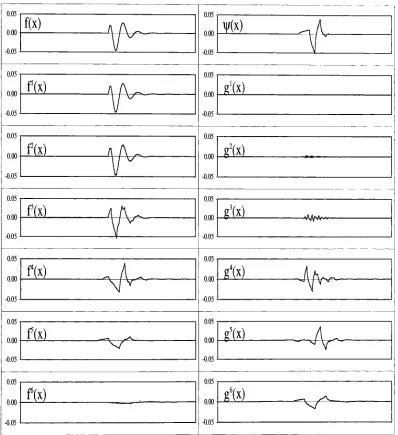
Multiresolution Decomposition
ofL2(3f)
subspaces
is
called a multiresolution analysis and satisfiesthe
following
conditions:Definition 7 Multiresolution
Analysis/70, 12, 23,
24,
27]
The
sequenceof
subspaces,
Vj,
form
a multiresolution analysisif
thefollowing
conditions aresatisfied:1.
...cV-iCVoCVi...;2.
closL2({JjeZVj)
=L2(5ft);
3-
f)jZVj
={0};
4.
Vj+i
=5.
f(x)eVj^f{2x)Vj+ujeZ
Items 7.1
and7.2
state thata multiresolution analysisis
anested sequenceofsubspaces whose unionspans
L2(5ft). Item 7.3
statesthat
thereis
no portionofL2(3?)
that
is
commonto
all subspacesVj,
exceptthe
all zerofun