·r
,l
...
•..
•,.
•
.
...
I , ,
~·-
..-,
'.;·
-
..
'"
t·
I
~ .
•
t
... "::""" ... ~ .. - . -·--·-' .. ._
.,
EUR 2881.e
PART IV
EUROPEAN ATOMIC ENERGY COMMUNITY - EURATOM
SAXTON· PLUTONIUM. PROGRAM
! '
Quarterly
Pf
ogress Report
for the. peiiod e~ding June 30, 1965
by
N.R.
NELSON
.(Westing~ouse At6mic Powe~ Division)
1966
EURA TOM/US: Agr~ement for Cooperation
:.r +
· EURAEC R~rt NOr 1420 prepared by the
Westin!lhouse Electric. Corporation, Pittsburgh, Pa. - USA
i I
"
j
LEGAL NOTICE
This document was prepared under the sponsorship of the Commission of the European Atomic Energy Community (Euratom) in pufsuance of the joint programme laid down by the Agreement for Cooperation signed on 8 November 1958 between the Government of the United States of America and the European Atomic Energy Community.
It is specified that neither the Euratom Commission, nor the Government· of the United States, their contractors or any person acting on their behalf:
Make any warranty or representation, express or implied, with respect to the accuracy; completeness, or usefulness of the information con-tained in this document, or that the use of any information, apparatus, method, or process disclosed in this document may not infringe privately owned rights; or
Assume any liability with respect to the use of, or for damages resulting from the use of any information, apparatus, method or process disclosed in this document.
This report is on sale ar the addresses listed on cover page: 4
at the price of FF 12.50 FB 125.- DM 10.- Lit. 1560 Fl.
9.-When ordering, please quote the EUR number and the title, which are indicated on the cover of each report.
Printed by Guyot, s.a.
Brussels, Febroary 1966
This document was reproduced on the basis of the best available copy.
EUR 1681.e
PART IV
EUROPEAN ATOMIC ENERGY COMMUNITY - EURATOM
SAXTON PLUTONIUM PROGRAM
Quarterly Progress Report
EUR 2681.e
PART IV
for the period ending June 30, 1965
by
N.R. NELSON
(Westinghouse Atomic Power Division)
S.-\XTO~ PLUTOl\IL\I PROCRAi\I Quarterly Progress Report for the period ending J unc 30, l 9tl5 by N.R. KELSOJ\ (\YC'stinghonsc ,\ tornic Power Division)
European Atomic Energy Cornmunitv - El;R,\TOM EURA TOM/US Agreement for Coop~ration
E_URAEC Report No. 1420 prepared by the v\'estingl1ouse Electric Corporation
Pittsburgh, Pa. (USA) '
AEC Contract No. AT(30-l)-3385
Brussels, February I 966 - \JO pages - 5 figures - FE 125
The Ji)lanning and analyses of critical experiments are completed to the point where_ rt can be seen that the design methods used are Yerified bv critical
expenment data. '
. All fuel_ rods to be used in Saxton Core II ha Ye been completed and are being mstalled m 9 X 9 enclosures. A :3 X 3 sub-assembly has been compkted ancl has been operated satisfactorily in Saxton Core I for a short time.
EURATOM/US Agreement for Cooperation
EURAEC Report No. 1420 prepared by the
SUMMARY
The planning and analyses of critical experiments are completed to 1he point where it can be seen that the design _methods used are verified by critical experiment data.
All fuel rods to be used in Saxton Core II have been completed and are being installed in 9 x 9 enclosures. A 3 X 3 sub-assembly has been completed and has been operated satisfactorily in Saxton Core I for a short time.
A supplement to the Safeguards Report has been submitted. The supplement answers all questions raised to date by the ACRS and by the AED Division of Reactor Licensing.
CONTENTS
SAX100 Project Administration
-SAX-210 Nuclear Fuel Design
SAX-220 Fuel Design - Mechanical, Thermal &
HudraulicSAX230 Fuel Design Materials
-SAX-250 Planning uid Analysis of Critical
Experiments-SAXF-310 Fuel Fabrication - Materials
SAXF-320 Fuel Inspection and Assembly
SAX330 New Fuel Shipping
-SAX-340 Safeguards Analysis
SAX-350 Alpha Protection - - -
-SAX-400 Performance of Critical
Experiments-SAX-510 Nuclear Analyses of Operation
PerformanceRemaining SubTasks
-Page Number
100-1
210-1
220-1
230-1
250-1
310-1
320-1
330-1
340-1
350-1
400-1
510-1
Figure No.
250.1
250.2
250.3
250.4
250-5
LIST OF FIGURES
Title
A Comparison of LASER Calculations with a Variation in the Scattering Kernel
with LEOPARD Calculations for Five Hanford :-.1ixed-Oxide (Pu02-uo2 ) Experiments
A Comparison of LASER and LEOPARD
Calculations for Three Different Sets of Thermal Para.meters for U-235, Pu-239, and Pu-241
Average Ratio of (r-activity/Heat-up Rate)
for Six Axial Positions on the 1.6 w/o
and the 3.7 w/o uo
2 Fuel Rods
P-uo
2 Factors versus Time after Shutdown
Comparison of Calculated and Measured
Power Distributions for a Two-Region Assembly
Page Number
250-9
250-13
250-25
250-26 •
SAX-100 Project Administration N. R. Nelson
All fuel rods to be used in Saxton Core II have been completed by ?;T.JMEC and by Battelle and have been received by Westinghouse. Critical experiments with these rods have been completed and the rods are now being sent to Cheswick for installation into Saxton 9 x 9 enclosures. Conpletion is scheduled by the end of July.
The 3 x 3 subassembly containing four pelletized and four vipac rods plus a central instrumentation thimble h~s been completed, installed in a peripheral test hole in Saxton Core I and has been operated satisfactorily at power for a short ti~e. During refuelinr, in August, the subasserribly will be shifted to the central test hole where it will be used for flux measurements durinG zero power and startup tests in Saxton Core II.
A preliminary set of zero power and startup tests for Saxton Core II have been outlined.
License approval has been received for shipment of 9 x 9 Pu02
-uo
2new fuel assemblies to Saxton. Shipment containers will be completed by mid-July.
SAX-210 Nuclear Fuel Design
F. L. Langford, W. L. Orr
SAX-220 Fuel Design - Mechanical, Thermal
&
Hydraulic H. N. Andrews, N. J. Georges, E. A. BasslerThe objective of this subtask is to develop mechanical, thermal and hydraulic specifications and design for the Pu0
2
-uo
2 rods and assemblies.The design and manufacture of the plutonium 3 x 3 fuel assembly was completed in this period and the assembly was installed in the Saxton reactor at the N-3 nozzle location.
The plutonium 3 x 3 fuel assembly is similar to previous Saxton
3 x 3 test assemblies in that it consists of a fuel subassembly and a latch assembly which is used for handling the subassembly and supporting it within the reactor. In the plutonium assembly,
however, a flux wire thimble has been substituted in place of the center fuel rod. The fuel subassembly is contained on WAPD
drawing 540F534 and the complete fuel assembly is contained on drawing 540F391.
The flux wire thimble is actually a part of the latch assembly and
is supported axially from the conoseal adaptor at the top of the latch. Thus, when the latch assembly is disconnected from the fuel subassembly to gain access to the removable fuel rods, the thimble
will be withdrawn from the subassembly. A special tool has been designed to aid in guiding the thimble back into the subassembly when the latch is reconnected. The tool is shown on drawing
540F762.
Engineering follow and consultation\Ere provided during manufacture of fuel rods at NUMEC and at Battelle, during manufacture of the
SAX-230 Fuel Design - Materials
R. J. Allio, A. Biancheria
The work under this task leading to a set of material specifications
was completed during the second quarter. A topical report is in
preparation and will be issued during the first quarter of fiscal
1966:
SAX-250 Planning and _ _?i.nalysis of Critic al Experir:1ents
F. L. Lru1gford, W. L. Orr, R.H. Chastain, H. I. Sternberg,
L. Bindler*, P. Deramaix* , R. J. Nath
A. Introduction and Summary
1. Introduction
The objective of this task is to plan, design, and analyze
the critical experiments carried out at the Westinghouse
Reactor Evaluation Center (WREC) to verify the Saxton plutonium
nuclear design. The same fuel rods used in these experiments
will be used in Saxton Core II, which will be operated in the
Saxton reactor for about two years.
During this quarter, the WREC critical experiment program was
completed. A detailed program of analysis is now in progress
for comparison with the experimental results.
2. Summary
The following statements briefly summarize the work performed
during the quarter:
a. The measurements program described in the previous
l
quarterly was completed. A major portion of the required
data processing was also completed.
b. A criticality study for both the Hanford and WREC critical
experiments was carried out using the LEOPARD2 and LASER3
*
On leave from CEN, Mel Belgium and Belgo-Nucleaire, Brussels, Belgium*
**
workingcodes. LA.SER, which includes a modified version of the
4
THERMOS code,produces a small difference in reactivity and in the reaction rate in Pu-239 and Pu-240 from that of LEOPARD. The use of different thermal cross section sets was also investigated. The cross sections reported by Wescott
5
at the1964
.Geneva Conference have beenselected as the basic set to be used in the post-critical comparison of analysis with the WREC experiments.
c. The analysis of certain specific exper~mental configurations was completed and a comparison of the results with experi-mental values has been made. The comparisons show the following:
(1) Reactivity calculations carried out in advance of the critical program are in excellent agreement with the experimental values when an allowance in calculated keff based on an analysis of Hanford criticals is included. This comparison confirDS the validity of
including the allowance in the Saxton design calculations and indicates that only a small revision in the reactivity and lifetime predictior.s are necessary as a result of the experimental informatior. obtained.
(2) Post-critical reactivity calculations using LASER and revised thermal cross sections agree well with experiment ·without the necessity of including an allowance in
calculated keff. The correlation using LEOPARD is also improved with the revised cross sections.
(3) The measured reactivity worth of boron in a two-zone configuration simulating the Saxton design with an
inner region of Pu0
2-uo2 fuel and an outer region of
uo
2 fuel was in good agreement with the predicted
boron concentration requirement.
(4)
Power peaking effects were investigated in singleregion cores composed of uo
2 and Puo2-uo2 fuels. The
analysis over-predicts power peaking for both fuels.
Consequently, the calculated hot-spot factors for the
Saxton design are believed to be conservative.
(5) The measurement of relative power by fuel rod gamma
scan in cores composed of two different types of fuel
is subject to error when the gamma decay characteristics
and the energy per fission of the two fuels are different.
Therefore, an experiment was carried out to relate the
heat-rate to gamma activity after shutdovn for both
uranium and plutonium fuels. Based on these results, a
time-dependent factor was developed to relate gamma
activity to rod power. The factor was used in a
comparison of analysis with experiment for two-zone
cores. A second method involving the irradiation of
foils of the two fuel materials was carried out. The
time-dependent gamma decay in the two foil types was
B.
served as a check on the heat-rate experiment.
While there are small differences in the two
experiments and in the PDQ-36 analysis, previous
calculations of the power sharing in multi-region
cores are satisfactory.
Scope of the Experimental Program and Supporting Analysis
The planned mea_surements program was outlined in the previous
quarterly report. During this quarter, the program was completed.
In carrying out the program, certain changes were made in the
sequence of experiments and it was necessary to add a number of
experiments to those originally planned. To illustrate the extent
of the measurements that were carried out and the scope of the
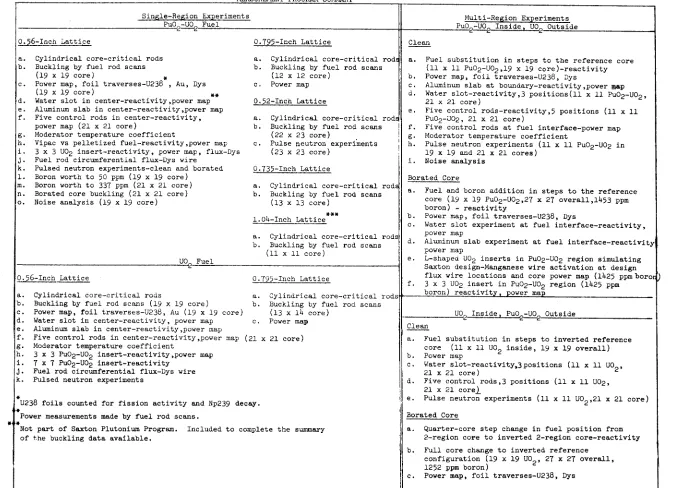
analysis that is now in progress, a revised summary of experiments
is included in Table 250,1.
The processing of the data from the experiments summarized in
Table 250.1 required about one-half of the analytic effort of the
quarter.
C. Criticality Study
1. Objective
Previous reactivity calculations using the LEOPARD code
resulted in an average discrepancy of%
2.6%
llk/k for sixt\)
"" 0
I
V,
TABLE 250.l
MEASUREMENT PROGRAM SUMMARY
Single-Region Experiments
ll
Multi-Region Experiments~~~~~~~~~~~~~~~~~P_u~o2~ Fuel .. Puo2~ Inside, uo
2 Outside 0.56-Inch Lattipe
a. b.
C •
d. e. f. g. h. i. j . k. l. m. n. o.
Cylindrical core-critical rods Buckling by fuel rod scans
(19 x 19 core) *
Au, Dys Power map, foil traverses-U238 ,
(19 x 19 core)
**
Water slot in center-reactivity,power map Aluminum slab in center-reactivity,power map Five control rods in center-reactivity, power map (21 x 21 core)
Moderator temperature coefficient
Vipac vs pelletized fuel-reactivity,power map 3 x 3 U02 insert-reactivity, power map, flux-Dys Fuel rod circumferential flux-Dys wire
Pulsed neutron experiments-clean and borated Boron worth to 50 ppm (19 x 19 core)
Boron worth to 337 ppm (21 x 21 core) Borated core buckling (21 x 21 core) Noise analysis (19 x 19 core)
UO- Fuel -" 0.56-Inch Lattice
0.795-Inch Lattice
a. Cylindrical core-critical rod! b. Buckling by fuel rod scans
(12 x 12 core) c. Power map
0.52-Inch Lattice
a. Cylindrical core-critical rod~ b. Buckling by fuel rod scans I
(22 x 23 core) i
C • Pulse neutron experiments (23 x 23 core)
Clean
a. Fuel substitution in steps to the reference core (11 x 11 Pu02-U02 ,19 x 19 core)-reactivity b. Power map, foil traverses-U238, Dys
c. Aluminum slab at boundary-reactivity,power map
d. Water slot-reactivity,3 positions(ll x 11 Pu02-U02, 21 x 21 core)
e.
f. g. h.
Five control rods-reactivity,5 positions (11 x 11 PuO?-U02, 21 x 21 core)
Five control rods at fuel interface-power map Moderator temperature coefficient
:, i.
Pulse neutron experiments (11 x 11 Pu02-uo2 in 19 x 19 and 21 x 21 cores)
Noise analysis 0.735-Inch Lattice
a. Cylindrical core-critical rodi b. Buckling by fuel rod scans
(13 x 13 core)
***
1.04-Inch Lattice
a. Cylindrical core-critical rods b. Buckling by fuel rod scans
(11 x 11 core)
0.795-Inch Lattice
Borated Core
a. Fuel and boron addition in steps to the reference core (19 x 19 Pu02-U02,27 x 27 overall,1453 ppm boron) - reactivity
b. Power map, foil traverses-U238, Dys
c. Water slot experiment at fuel interface-reactivity, power map
d. Aluminum slab experiment at fuel interface-reactivity power map
e. L-shaped uo2 inserts in Pu02-U02 region simulating Saxton design-Manganese wire activation at design flux wire locations and core power map (1425 ppm bororlJ f. 3 x 3 U02 insert in Pu02-U02 region (1425 ppm
a. Cylindrical core-critical rodsJt boron) reactivity, power map a. Cylindrical core-critical rods
b. Buckling by fuel rod scans (19 x 19 core) b. Buckling by fuel rod scans c. Power map, foil traverses-U238, Au (19 x 19 core) (13 x 14 core)
d. Water slot in center-reactivity, power map c. Power map e. Aluminum slab in center-reactivity,power map
f. Five control rods in center-reactivity,power map (21 x 21 core) g. Moderator temperature coefficient
h. 3 x 3 Pu02-U02 insert-reactivity,power map
i. 7 x 7 Pu02-U02 insert-reactivity
j. Fuel rod circumferential flux-Dys wire k. Pulsed neutron experiments
* U238 foils counted for fission activity and Np239 decay.
* Power measurements made by fuel rod scans .
•••
Not part of Saxton Plutonium Program. Included to complete the summary oft.he buckling data available.1 uo2 Inside, Puo2-uo2,~o~u_t_s_i_de~~~~~~~~~ Clean
a. Fuel substitution in steps to inverted reference
b. Power map core (11 x 11 uo2 inside, 19 x 19 overall)
il C • Water slot-reacti vi ty,3 positions
21 x 21 core) (11 x 11 uo2,
d. Five control rods,3 positions (11 x 11 U02, 21 x 21 core)
e. Pulse neutron experiments (11 X 11 U0
2,21 X 21 core) Borated Core
a. Quarter-core step change in fuel position from 2-region core to inverted 2-region core-reactivity
[image:17.872.100.774.39.527.2]mixed-oxide
(Puo
2
-uo
2) critical and/or approach-to-criticalexperiments conducted at Hanford
7.
An allowance to accountfor this difference was included throughout the design
calculations for the Saxton plutonium core and in the criticality
predictions for the WREC critical experiments. A criticality
study was completed during the quarter to investigate the
reasons for this difference and to determine the best methods
and cross sections to be used in the post-critical analysis of
the WREC experiments. Specifically the study was directed to
an investigation of the effect of:
a. variations in the heterogeneous thermal treatment of the cell,
b. variations in the scattering kernel for H
2
o,
c. and variations in the· thermal para.meters for U-235, Pu-239,
and Pu-241.
2. Methods
To study these variations, LASER and LEOPARD calculations were
compared. The basic difference between these two programs is
in the calculations performed in the thermal energy group. In
LASER, the thermal calculation consists of a modification of
the THERMOS code, a cell transport theory code in space and
energy, that is expanded in energy to a cut-off of 1.855 ev.
Thus the Pu-240 resonance at 1.05 ev is included in the
thermal range. The thermal spectrum in LEOPARD, on the other
hand, is determined by a Wigner-Wilkins SOFOCATE calculation
3.
with disadvantage factors determined using a modified form of the Amouyal-Benoist calculation at 172 energy levels
from zero to a 0.625 ev cut-off. Both codes use a consistent B-1 MUFT IV calculation in the fast energy group. Therefore the difference in the fast group is the energy level at which the fast group ends.
Hanford Experiments
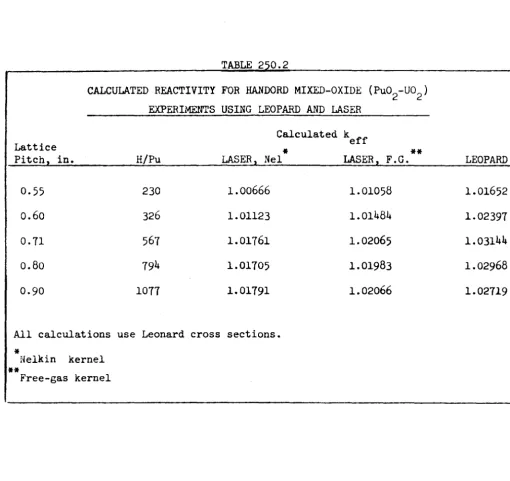
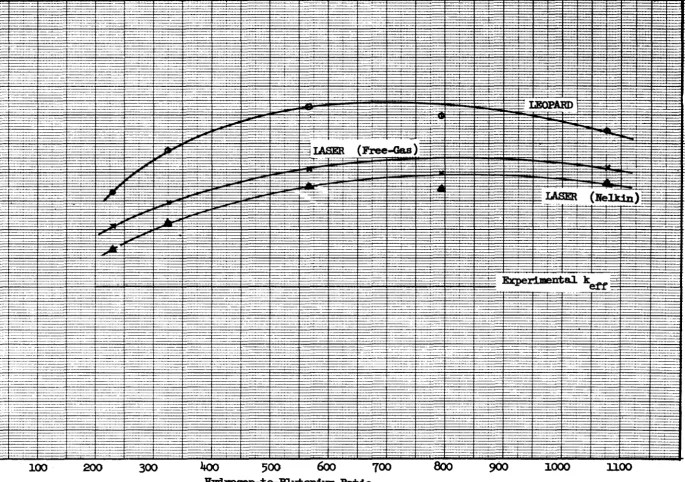
The heterogeneous treatment of the unit cell in space and energy in LASER leads to a spatially varying spectrum which in all regions of the cell is harder than the mean spectrum of the cell determined in LEOPARD. The harder spectrum results in a difference in the reaction rates in the plutonium isotopes and a difference in the calculated reactivity. The reactivity results from LASER and LEOPARD for the Hanford mixed-oxide experiments are summarized in Table 250.2 and Figure 250.1. The LASER results also show the effect of a variation in the scattering kernel. (The LASER free-gas kernel is equivalent to that contained in LEOPARD).
TABLE 250.2
CALCULATED REACTIVITY FOR HANDORD MIXED-OXIDE (Pu0
2
-uo
2) EXPERIMENTS USING LEOPARD AND LASERLattice
Calculated keff
*
Pitch. in. H/Pu LASER, Nel LASER. F.G.
0.55 230 1.00666 1.01058
0.60 326 1.01123 1.01484
o.
71 567 1.01761 1.02065o.Bo
794 1.01705 1.019830.90 1077 1.01791 1.02066
All calculations use Leonard cross sections.
*
Nelkin kernel**
Free-gas kernel250-8
**
LEOPARD1.01652
1.02397
1.03144
1.02968
[image:20.581.49.559.82.562.2]I\) V1 0 I \0
j
I
=
==r-::-
- -
---- _____ _.._=-=±=
_ _ L _ _ ~ - - - -
::.==:t:=
--1 - - -
---1. ()li. ~ ·
-
i---~ +
-+--1.03
~
---,----y---,,-LEOPARD
-1==- t==
-+=
f-
--r-=~
- - IASER (Free-Gas)1.~
-USER
(Belkin)---+-t=
1.01
,"
1.00 tee-- Experimental kett
+--- - ~ --.-_ -+== +-
-0.99
0.98
'
--+-- j___c_
--+-- E t-
t----;---+-
_g
:!:=
---+-=----===t=.
-
----+ -
+-- :_-~
~-
=-t=--t--- ~ --=j::~~ - ~ - - -
-:=t==---::_'=t=
-t--c=t:=
-=t----:--
--1---¥k~4====±=
- - · - - --+---- -=-~
l=:=:_~-J
=
----I
-=r===:
+-,--_==+==
-~~
---+---+--o·
100 200 3004oo
500
6oo
700
8oo
900
I.OOO 1100 [image:21.874.133.818.19.500.2]As part of the criticality study, the influence of a
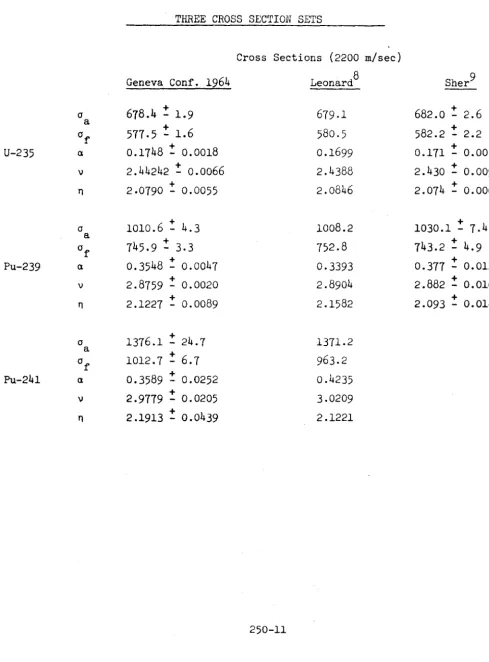
variation in the thermal parameters of U-235, Pu-239, and Pu-241 was also investigated. Table 250.3 summarizes the 2200 m/sec parameters for three different cross section sets.
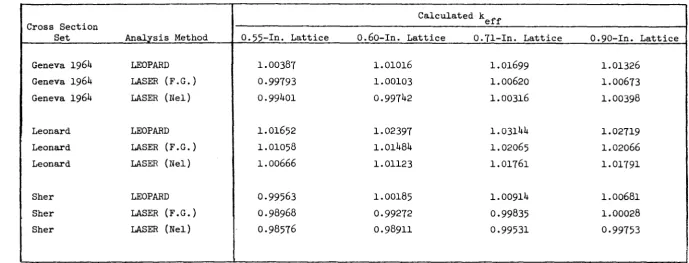
The three cross section sets of Table 250.3 were used in a series of LEOPARD and LASER calculations for four of the
Hanford experiments. The results are summarized in Table 250.4 and Figure 250.2. The results show that with LAS~R the
most favorable comparison of analysis with experiment is obtained with the 1964 Geneva Conference cross sections while for LEOPARD the best correlation is obtained with the Sher cross sections.
4.
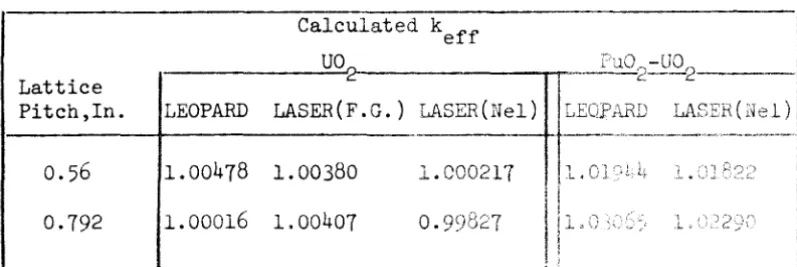
WREC ExperimentsCriticality calculations were carried out using the LASER and LEOPARD code for two of the WREC critical lattices for both
uo
2 and Pu02
-uo
2 fuels. The following results were obtained using Leonard cross sections.Calculated keff
uo
~-,,, uo
, _ _ _ _ _ _ _ __,_,____________ '" '5 2-- ~ 2 - - - - •
Lattice
j
1_P_i_t_c_h_,_r_n_. _ _ 1_Eo_P_ARD ___ LA_s_E_R_(_F_._G_._l _ ~SER(Nel) ~EQ~,::
~S,H(M~
0.56 1.00478 1.00380 .,,_,000217 1 c,CJ · , .. "
. I
I
1. 00407 0. 99827
I
I 1 cL ~ L '0.792 1.00016
- i
, _ _ _ _ _ _ __._ _ _ _ _ _ _ _ _ _ _ _ _ _ _ ~,"---~-.----s-M,l•,
[image:22.578.124.523.590.723.2]TABLE 250.3
CROSS SECTION PARAMETERS AT 2200 M/SEC FOR
THREE CROSS SECTION SETS
Cross Sections (2200 m/sec)
Geneva Conf. 1964 Leonard 8 Sher9
+
679.1 +
0 678.4 - 1.9 682.0 - 2.6
a
+
580.5 +
of 577. 5 - 1.6 582.2 - 2.2
U-235 a 0.1748
!
0.0018 0.1699 0.171!
0.003\) 2.44242
:!:
0.0066 2.4388 2.430:!:
0.009+
2.0846 2.074 :!: 0.006
11 2.0790 - 0.0055
+
1008.2 +
0 1010.6 - 4.3 1030.l - 7.4
a
+ +
of 745.9 - 3.3 752.8 743.2 - 4.9
Pu-239 a 0.3548 :!: 0.0047 0.3393 0.377 :!: 0.011
\) 2.8759 :!: 0.0020 2.8904 2.882 :!: 0.016
11 2.1227 :!: 0.0089 2.1582 2.093 :!: 0.014
0 1376.1 :!: 24.7 1371.2
a
+
of 1012.7 - 6.7 963.2
Pu-241 a 0.3589
:!:
0.0252 o.4235\) 2.9779 :!: 0.0205 3.0209
[image:23.588.32.522.155.818.2]I\) \.11
0
I
... I\)
Cross Section Set
Geneva 1964
Geneva 1964
Geneva 1964
Leonard
Leonard
Leonard
Sher
Sher Sher
TABLE 250.4
CALCULATED REACTIVITY FOR HANFORD MIXED-OXIDE (Pu0
2
-uo
2) EXPERIMENTS WITH DIFFERENT CROSS SECTIONS AND SCATTERING KERNELSCalculated keff
Analysis Method 0.55-In. Lattice o.60-In. Lattice 0.71-In. Lattice
LEOPARD 1.00387 1.01016 1.01699
LASER (F. G. ) 0.99793 1.00103 1.00620
LASER (Nel) 0.99401 0.99742 1.00316
LEOPARD 1.01652 1.02397 1.03144
LASER (F .G.) 1.01058 1.01484 1. 02065
LASER (Nel) 1.00666 1.01123 1.01761
LEOPARD 0.99563 1.00185 1.00914
LASER (F.G.) 0.98968 0.99272 0.99835
LASER (Nel) 0.98576 0.98911 0,99531
0,90-In. Lattice
1.01326
1.00673
1.00398
1.02719
1.02066
1.01791
1.00681
1.00028
[image:24.878.107.796.211.473.2]t ~ .; ~·
ir:11!
II I t
l I 11 j.
!
I
I
. II•
f
ii t, ' f
ii
J ,t;
' ' j ' ' !
I 11
'l
1
!1 , 11 1 1 ! 1 1 1 1 11 111 ! I 1 ,111 1 ·11111 t!i 1 1.1 1111 1 l' 1 : ~
l
J:i
l i I[id
li
i
I
'1
ii!
I I:.' (
ti11 1/1 III
ii
!]II
ii ,[ tll
1111 I! 11, Iil
I
I A1
111 I I I, 11
I
'I
'ii I I ' I/ I " II! I ·! I'I
1' 11 I• 11 I ' I I tt+ 1t 'I I ' I I' I }I ft11 l :11 1 f r i ,':I 11i 11 111! ~ 1111 i1, I Ii! I 11 1:. i
I .1!; i I I I I I ~
J
11 111
11::
litltui
L~ll
I'@~: 1:·1 11ill '
1~~ ~ 1111[:~u
:i
1111,!1 11 11:u 11:1r1111. !1 11 1 ;11I 11 1:1 ;:11 t1111i 11,1111n ,.~ 111L1 11 r1 11 •
1n
r:;11 11' :111111 ++.t
11 Im1mrr
111 111 1 11111 1i11il ::·; 1: !
w11111
,.11 . ,·l~
1: 11;1 ::1 11<
~
i
it ;
1
ii11u
1J
f;
JL
1) 111111 1111
. '
1 1
11
t, 11 +
~.'i
; l 11: I :
i:
1n
!~
I Ii
I : i ' I : I [ ! t I 111 11 II
I I·1
I Ii [ I 11rrr
ii :
11
r !i;
,,,I
I I;: I I l I i ii
I ' 1i
l8
fH1
I :· I I 111, !I I 'if 11 I ,· ill' I\
I
I 11 ,1 ' I 11 I IU~' 1 11 111 '1 II' I ' 1
I
' ,._
s
fl-11 ,: 11: ,,1 +t++
:!t~+
~
, ;
i.1.:· 111 . , 1+i
Lu P+ 1.
1i·~+H ·::
1 • fll+-1+114
1J1 I ii .. -a
!
I 11i:I! H
! r 11 1::1,L!
1:· ;::'
I : li1! i I!'I '
11
ill
I 11! I
~
I ' !l: :
11,i! 1iil
ii
f1
1
l
!I
l
1 ! 1:
~
j
1
II ., ,1111 1:i I! 11::11111 I:!
rtt·1
:':I
1111'I
I Ii::
1i'1i 1; ii 111·t Iii II illill[
1!1![
,
l '1
!~
J
-• '1, I ' I i I W+ µ.;_;I j I i. I l ' ' I I I 1 ' ! I I ·' 1'1 ftl+
ii
i
f . .1-W-W,.ll.LLU..W.l.U.lil.ll.lilll.l:1
JJI - .
I
!!
! ,'I ,,, I I f I 'I' 1·1t t:1 'I
·II ,II ' 'I
' I ' I i ,,I I ·1· 1'! If• ,1 I ' f ! i Tl 0\i I I i1;:·i Iii I i ! iii i 1 •1111111 I 'ir Ii I I ! ! 11 ·, 1 Ill I :: :Ii, i:' li1 Ii .~ El ~.
I
I, I I! 111 IiI
I I I I:: I! I, : ! I, I I,! 11 i I I I ' 11 I I 11 111 1·11 I I . 11, I ·'I 11 I 11 ...., ::::!I :: 1111 ii I Ii I I I,, l:11 : I:,! I ii' I iii i ,I I I 1: Ji' 11 iiil ,' I I 11,j. , 11 ~ Iii! i I'
I
~:I
I
/1::!:
It[:ilii
1ift Ii
il!1 ::ilil
!;
f!i ~!1litl llii
Jrr
In
!11!,1:ll~!iii
in1Tji
1rr
1 1IULiln.w..Lilill.ll' ill.lllLUi.LLi Ll.l
fa~
,11111,, ,11 flit 1,:·1: 11,111: :1·1
, : , , ,1 1:. :111 111, .. 1, 1: 1'i[ll l'i'·1 ·,tl, :: 1,: 1111 :r1 1 1111
~'(j'
11j
11
1
1 •
1 1:1 1 111
1
.,,..
iiL ...
'I I 1; ,;1 :.1111 :1 I I : 1;:i1'th1; :!,; 111 ;1:1 :: !1(J ITJ; 1,h liw :·1 rni'!i 111 11++1 Ii Ii M ~- iv)''ii .. ' I''
>! I ! :: 1 ;, '~ I+ riTTTTi, ,, '·r'
,t"11. (I! !ii i~ Ttn J;.+' H ::1r'
l
1'·'8 "·
j' I i': I ! I' ii! I : : ! I ; I I I, : I I I' Ii l I j I I' Ii : ! ! : : : 'I : I': i I ''!I I' I I I I: 'I 11 ''I
...
,
(\IIill ' 11,, "' f .. ' ·' ,1 .. , ... ,I, ,1, ' ' " I ' II .. , 11 .. 1, ' ' I ' " I '111 I
1 11
ii
:
1 r ! , I , 1 1 : 11: 11: 1 11 ,1
; I ~
JI
j: 1. 1 1t~n ,
1 1 'I 1 1 1., , , 1 I I : i· r I Ii 1, i 11 t 1 · ~ , 111 1 · , 11 '
,n
~, .
ll I , • 1 ,i
+H+++:t-H1+t! tt! )++-If t-HI +tr +++H+tt+f +++H+tt+tttttl !++1, 1++1: H-tl +tt+l++++111 +tl ++++H+++_J '**! 1++H'l+tt+++-l l'l-i! 1+t :: I +l'-..1o1-<1
1
.1 !c+t1++i++ i't-fH-1 '\I++ 1, + . . - ' l'HJ+H+~~ -++++++Nl'H. le+i'.++t i +++He+ii ++++-++++.i+++1e1-1 ~
i
11lll
1\ll
l ' I 1!I:
'riil1
1i!!1 i·t!
Ii
Ll.;J
!
iI
i11ii1}1i:i :.
!f!tlll
lll
'iJ.
ii
Ii
I!1
I 11 (\J' I :1 I '
ii
I 11: 11 I I II I 'I I '' I 11 I i l I I II I' i "I' i ~H Ii I ·11tl
I ! f I l I I I I ; i I i ! i I I I , ! t I i I i I I i I I ! I i I I I ! ... · .... ' I ~ 1 ... i u.1-W-U-W-l-W-W'.U, i U.I-U...U.w..1-W..W-U.l-W-W.W.W.U
.r, 1'!'. 11 I
l I
1 11.1!!
W
ii!!
Ii+J
1~~
11
1'
li,ll
:IUI~!
Ui,M ·.::
:t!I
1111.,,.,.H=l·=w..u.J-U-U.W..UH:r11l!1
11111; ::
IiIii!
Ii I il 1i 11!ii
I Ii Iii 1:1n1
tr
1r::1T! 111t1r1
ii
I 111 Iii
i 11tt1 11
8
1··1,!i '"
I 1111' 11 11·1 11 I 1· 111 I ~ I'' ~J!I
µ
1:11
~1 1 ·11~ 1
1
'
I
II '"I'
111 111 ...:.,: I I ii I ! Ii i :.~ fl.ltl i : I I t I i I I 1 1
J' LW I
ill
l I; I f I 11. 1':.d. : : ti' I I
i(
! . I ' ! ;11, . . w..i.u..u..1-10...~~I,_ i W-1 U-U-1.U.I-U.UW.UUJI . . ,:!1:1111,:1, I: I'll ',I I,::: '111 1:, 1, I, 'I,' 'Ill Ii· 1:11
ii
IH- 1rt1, :••, I ,1t ' I ,,11:t 11~ l'I I' \!ii
'
; : I' I'! !11. i I : 11'; : I: I '' ': ; I: I ii : i I I: I :! I 'I,\ I i ! I!! I I: It I , I
ii
I Ii Iii i I i 11 1 I I i U' Iii'! ii1i I I , ,I
'11 !'1.;l'1l1·: ' 'I., I,,,,' ':;;:.~i1i:
W:''i , 1 ' ;::Ii ''I :· i ' ! :·1!: ;::' '. ',, ... , ' I i ' ' , ' ' I; I , , I' !1111 ~ IJ'tt': I iJ,i ''ll, ' ' ' I 11' '~llil ! ,i' ',, ·i II I I l1llli 'i I 'I Ii I:iTI
i'.:i
11·:Iii
iii1; H
if! ,·:iif?
t/
1r
Hlti·t
1iii:;tliJir
1:1ttr
1·11
trrt
:111
1
1 i
I
lli1
il118
...t
*
For the
uo
2 critical lattices both LASER and LEOPARD are
in good agreement with the experiments while for the Pu0
2
-uo
2fuel the results obtained with LASER are slightly better
for the two lattices than those obtained with LEOPARD. The
discrepancy between the calculated keff and experiment for
the LEOPARD results for both Pu0
2
-uo
2 lattices averages% 0.025. This is the same allowance as that included in the
criticality predictions for the Pu0
2
-uo
2 experiments.The use of Sher cross sections for the
uo
2 experiments would
result in an unsatisfactory comparison of analysis with
*
experiment. Therefore, LEOPARD calculations for both fuels
were carried out using the 1964 Geneva Conference cross
sections. In addition, LASER calculations were carried out
for the Pu0
2
-uo
2 experiments. The following results wereobtained:
Calculated keff
Lattice
'.Puo
2-uo
2Pitch,In.
uo
2 LEOPARD LASER(F.G.)
0.56 1.00589 1.00839 0.998
0.792 1.00205 1.01749 1.003
The LEOPARD code used contains a number of small revisions from that used previously. The changes include the removal of k bias, a revised Dancoff, a revised SOFOCATE integration, and a correction in a U-235 cross section. The net effect on calculated keff due to these changes is small.
D.
Good agreement between
analysis and
experiment was obtained
for the
uo
2 critical experiments and an improvement in the comparison was obtained for the Pu0
2
-uo
2 experiments. Inthe case of LASER the agreement for both lattices is excellent.
Based on this study the 1964 Geneva Conference cross sections
were selected as the most satisfactory set to be used in the
post-critical evaluation of the WREC experiments.
Comparison of Analysis with the WREC Experiments
1. Buckling Measurements and Criticality Calculations
Critical buckling measurements were made for five different lattices with the Pu0
2
-uo
2 fuel and two different lattices for the conventional Saxtonuo
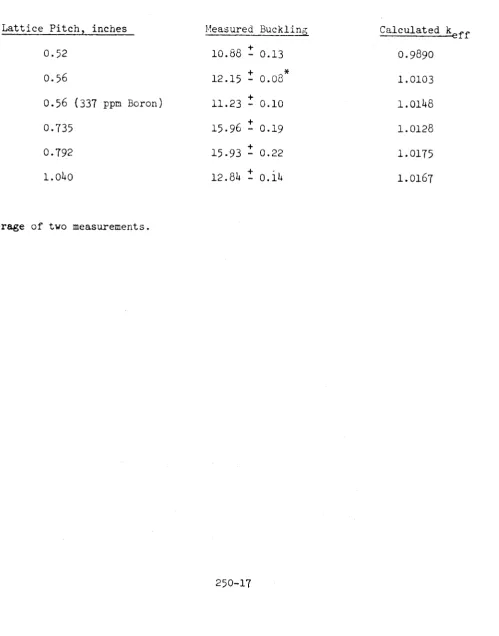
2 fuel. The basic lattice used for a major part of the experimental program was that containing the same H/Pu ratio as the Saxton design at temperature, the 0.56 inch lattice. In this lattice the buckling was measured in two separate experiments as a check on the precision of the measurements. The buckling was also measured in a borated
configuration containing 337 ppm boron in the 0.56 inch lattice. Table 250.5 contains a summary of the experimental results.
The measured buckllngs of Table 250.5 were used in the revised version of LEOPARD with the 1964 Geneva Conference cross sections. These results for the Pu0
I\) V1 0 I I-' 0\
TABLB 250.5
BUCKLING AND REFLECTOR SAVINGS RESULTS FOR THE WREC CRITICAL EXPERIMENTS
Lattice Loading
~
uo
2'Q
5. 74 w/o U235o SS Clad
§
0. 792" Pitch•r-i
el
O. 56" Pitch::>
No. of Critical 1{ods
182
(13 X 14)
361
(19 X 19)
Critical Buckling
{CM-2) x 103
+
13.68 - 0.19
+
12.71 - 0.14
- - - -
-
- -
-
- - - - -
- - -
-
-Pu02
-uo
26.6 w/o Puo
2
Zr.-4 Clad 0.792" Pitch
*
0.56" Pitch(2)
Cl)I O. 56" Pitch
~ 337 ppm Boron
><
0
§I
O. 735" Pitch•r-i
Q
0
~I
0.52" Pitch..-t ii.
1. 04" Pitch
144
(12 X 12)
361
(19 X 19)
441
(21 X 21)
169
(13 X 13)
506
(22 X 23)
121
(11 X 11)
+
15.93 - 0.22
+
12.15 - 0.08
+
11.23 - 0.10
- +
15.96 - 0.19
+
10.88,.. 0.13
+
12.84 - 0.14
Radial Reflector Savings ( CM. )
+
12.43 - o.41
+
14.31 - 0.25
-
-
~-+
12.90 - 0.20
+
15.10 - 0.14
+
13.98 - 0.18
+
12.78 - 0.25
+
15.76 - o.44 (22 Rods) 14.51 ± 0.37
(23 Rods)
12.27 ± 0.10
*
Number in parentheses indicates number of experiments performed.fAverage temperature of the two experiments.
Axial Reflector Savine_s (CM-2
+
7.78 - 0.08 (Bott.)
0.21
±
0.04 (Top)+
8.77 - 0.14 (Bott.)
2.65
!
0,05 (Top)+
6.47
+
0.12 (Bott.)3,05 - 0.12 (Top)
+
8.10
+
0.29 (Bott.)4.52 - 0.14 (Top)
+
8.38 - 0.15 (Bott.)
4.99
±
0.15 (Top)+
6.83 - 0.17 (Bott.)
+
8.56 - 0.29 (Bott.)
4.86
±
0.29 (Top)6.23 ~ 0,09 (Bott.)
3,80
±
0.09 (Top)Water 'l'emp.
roe)
17.3
lcJ. 0
*
TABLE 250.6
CALCULATED REACTIVITY FOR THE WREC Pu0
2
-uo
2 CRITICALEXPERIMENTS USING THE LEOPARD CODE AND Tllli 1964 GENEVA CONFERENCE CROSS SECTIONS
Lattice Pitch, inches
0.52
0.56
0.56 (337 ppm Boron)
0.735
0.792
1.040
Average of two measurements.
Measured Buckling
10.88
!
0.13+ *
12.15 - 0.08
+
11.23 - 0.10
15.96
!
0.19+
15.93 - 0.22
12.84
!
o.i4Calculated k ff
0.9890
1.0103
1.0148
1.0128
1.0175
[image:29.693.39.539.201.838.2]2. Reactivity, Power Peaking, Power Sharing
In the last-quarter1, the measurements program was summarized.
In that summary the number of fuel rods required for criticality
and the boron content requirements for the expected configurations
was included. The analysis on which these predictions were
based was carried out using the LEOPARD-PDQ codes with Leonard
cross sections. While the previous discussion shows that an
improvement in the correlation can be obtained using a different
cross section set, a comparison of the predictions with the
measurements using the same methods as those used in the initial
Saxton design calculations is necessary to determine if the
expected performance is adversely affected by a difference
between the analysis and experiment that may be indicated.
Three important areas from the standpoint of their influence on
the operation of a plutonium core in the Saxton reactor are the
following:
a. Reactivity - The initial reactivity available in the design
is important from the standpoint of both lifetime and
control.
b. Power Peaking Effects - In the Saxton design, the power
level at which the core can be operated is limited by the
maximum hot-spot that occurs at water slots within the
plutonium region. Thus, it is important to know if the
analysis correctly predicts power peaking effects in
regions of increased moderation.
c. Power Sharing - The relative power produced in each of
the two different fueled regions is important in establishing
the power level at which the core can operate. If more
power than expected is produced in the plutonium region where the hot-spot occurs, it would be necessary to reduce the total core power to avoid exceeding the hot-spot
limitation.
a. Reactivity
A comparison of the number of fuel. rods required for criticality witn the predicted requirements for both the
uo
2 and the Pu02-uo
2 critical configurations shows that the analysis and experiment are in good agreement. The analysis predicted 356 fuel rods would be required for criticality in a square core with a 0.56 inch pitch for tile UO,) fuel. A total of 31+6 rods was actually needed.c.
For a square core of Puo.2
-uo
2 fuel at the 0.56 inch pitch, the expected fuel rod requirement was 355 rods. The actual requirement was 343 rods. In the prediction of fuel rod requirements for configurations containing Pu0
2
-uo
2 fuel, an allowance was included to account for a possiblediscrepancy between analysis and experiment. As discussed in a previous paragraph, the discrepancy between the
which is the same as the allowance included in the
criticality predi_ctions for the Pu0
2-uo2 experiments.
The same methods of analysis and cross sections were
also used in the Saxton design calculations. Because
good agreement was demonstrated in the reactivity
predictions, only a small revision in the original
reactivity and lifetime predictions for the design core
is necessary at this time. Another major test of the
.analysis methods will be available af'ter the zero power
physics tests are completed in the Saxton reactor under
a separate task.
Based on the analysis of a two-region borated core, a
just-critical boron concentration of 1525 ppm was expected.
A boron worth measurement was made at 1430 ppm boron at
partial water height for a core consisting of a 27 x 27
rod assembly with an inner region of 361 Puo
2-uo2 f'uel
rods (19 x 19) and an outer region of 368 uo
2 fuel rods.
Extrapolating the measurement to the boron requirement
for a fully inundated core indicates~ 1550 ppm would be
required. Thus, no adverse effects are expected in the
design core due to a discrepancy in boron worth.
b. Power Peaking Effects
In the single region cores, power peaking effects were
investigated near water slots. In these cores, a water
slot was formed by removing five fuel rods in a line
in the center of the core. Power measurements were
made in the adjacent rods before and after the water
slot was formed. Experiments were also carried out
with an aluminum slab installed in the water slot to
displace part of the water. Conventional methods of
analysis, LEOPARD-PDQ-3, were then applied to the
specific experimental configurations. The following
comparison of analysis with experiment was obtained for
the rod nearest the slot where the maximum error occurs.
(Both analysis and experiment are normalized to a rod
that is not influenced by the slot.)
H
2
o
SlotAl-H
2
o
SlotAnalysis/Experiment
uo
2 Core Pu02
-uo
2 Core1.056 1.078
1.010 1.040
In these calculations, the group constants used for the
water slots were obtained from a LEOPARD calculation using
the material composition of the slot alone. Thus the
constants, designated soft-spectrum constants, were
determined by the use of a flux spectrum that.is not
representative of the spectrum that exists in the slot.
determined by defining a unit cell for the fuel rods surrounding the slot and including in the LEOPARD calculation an extra region composed of the materials contained within the slot. Group constants were then determined from the group averaged microscopic cross sections and the number density of the slot materials. The following list compares the results obtained using the two methods.
H
2o Slot Al-H
2o Slot
Analysis/Experiment Soft-Spectrum Extra Region
1.056 1.010
1.026 1.003
Additional calculations in the Puo
2
-uo
2 cores are now in progress using cross sections selected for the post-critical comparisons and alternate methods suggested by these initial results.The results of these studies show the analysis over-predicts the power peaking near water slots for both fuels. The largest discrepancy occurs in the plutonium fueled cores. Consequently, the hot channel factors calculated for the Saxton design are believed to be conservative.
c. Power Sharing
In cores composed of different types of fuel, it is difficult to determine the relative power production by a gamma scan of fuel rods if the gamma source and decay characteristics of the two fuels are different. Since the Saxton core will contain separate regions of uranium and plutonium fuel, it is necessary to know the amount of power produced in each region to avoid exceeding an
imposed hot-spot limit expected to occur in the plutonium region near water slots. Consequently, power measurements in two-region cores were carried out during the WREC
critical program. However, to interpret the data it is necessary to relate the measured gamma activity to the power produced in the fuel rod.
Two different methods were used to determine the desired relationship. In the first, an experiment was conducted in which the heat-rate in the fuel rods was measured and related to the gamma activity after shutdown as determined by the subsequent gamma counting of the rods. Three
separate measurements were performed using various uranium and plutonium fuel rods. The first heat-rate experiment was made with two
uo
2 fueled rods of different enrichment,
1.6
w/o enricheduo
*
gamma activation in each uranium fuel rod is proportional to power, the ratio of gamma activity to heat-rate would be a constant if the heat-rate was also directly propor-tional to power. Figure 250.3 shows that the ratios for the two rods were the same. Therefore, it was concluded that the method was a reasonable one to use in a comparison of uranium and plutonium fuels.
The same type of experiment was carried out for the Saxton
uo
2 fuel rods (5.7 w/o U-235) and the Puo2
-uo
2 fuel rods(6.6
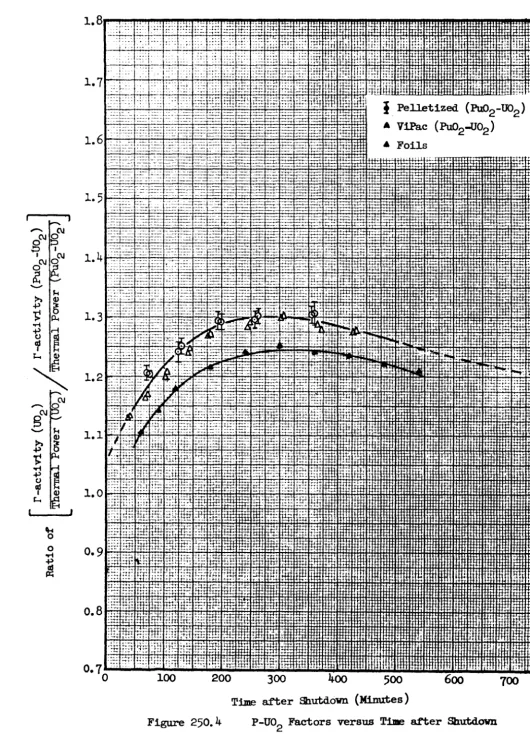
w/o Pu02) made with both vibratory-compacted and pelletized fuel. The resulting ratio of gamma activity after shutdown to the thermal power in a uranium fuel rod relative to the same ratio in a plutonium fuel rod as a function of time after shutdown is shown in Figure 250.4. This curve represents a time-dependent multiplication factor that is applied to the measured gamma activity in the plutonium fuel. The size of the factor used depends on the time after shutdown the rod is scanned.
*
The second method of relating gamma activity to power involved the irradiation and subsequent gamma scan of foils composed of the two different fuel materials, foils of Pu-U-Al from the Pu0
2
-uo
2 and foils of U-Al from theuo
2.Data developed by the foil irradiation method was supplied by G. 1. Hamilton.
I\) Vl 0 I I\) Vl
-=F---=t=-c:::::::: ·:_:~- ---~--::==:E~:+==+=
5.'1 ___ --~- ~-.--,:~:-,· ~
~~---= _,
~-·-t----' __.
-
---4---=
-i4.5
S=f.:~:-'
=
~ 4.o ... _
i
-
I
p:;
§' 3.5
I
-:;;
GJ
~
~
E
~ 3.0u
'
s::.. -2.5 2.0 - ~·==1==t===
----~~~~--_=:
~
·4<:·~
--'f-~
--~:;~~-=r=-=- :,---r----1==-=4
1~-+'--- ==:i~ +=-=i:.:-:.1=0:::;,---.
-~~;=:
i--:-:--+- -'"-=I:'=~
_:.i
1-·-
--+-·--
~~~=*=--..: .. c:i:;::~
~
""'
""-"·
--
~:2:==:--==-.. --
----t=_-·•··*~~~~~·l~t.
·J :,--:
P.-r--~ +'-± +---·::j=-t=:=J.::,:
~
2
_;__8__.__,+-,+-Legend1.6
v/o
002 3. 7v/o
UO,., ;,;::~-::±±·
t--~-
t::=:::i=i-c+'-:z:trr
.:q::.1
·-'EE=!
f-1-:::::i:·
,_-TT:.. ' . ---=~ t:..::=...r :~.:-_ •
-: .r--~:~~
.t~l--~==.E:::~
:i:.:..:-~-==t=:t--'-.+-~-=l-=+:::t=
---+---==_2-r::-
.:*----=r==
-::=±
4 .. f--- ==t==~c ... :.; .. 1_:::
-=F= ::=--=t=.::: =--==
:-=-t=:=: ~
t:=:=t=
--4'"~-==J=~U==§
_, I!',,, ~--·--t-:·
-~==c
.,..,
- -
~~m
.
>:AI~,~~ff
- -=~---··:_ --- :-:-...: ::::.-r::.
---·
-200 210 220 230 240 250 260 270 28o 29() 300 310 320
[image:37.884.107.818.30.516.2]Ele.psed Time After Scram (Minutes)
Figure 250.3 Average Ratio of (r~ctivity/Heat-~ Rate) for Six .Axia1
Positions on the 1.6 w/o and the 3. 7 w/o
uo
1.8
1.7
l~·
::l::,
.t!l ... :;i;.-. " UI: li:_fi ..r 1
. . ... r,., ··1
1.6
::~~-1-\:>
·=:~~~;=:·F
~~~~-:-::~~-
~~~-~-~ qp:-;!E:rE·-;
~~~~~~ ~-~~r.~ :~~r~
~~1=:-:
~;=
~-=~~
=
£
a.:;:;
i
Pelletized (Pu02-uo
2) .A ViPac (Pu02
..uo
2)1.5
1.4
0.7
0
!:-:1
:t~
jH
~T: ;~;:~~!!100 200
Figure 250.4
~.~:.1.X - ·
· ~ ' r - ~ j
~-.-,-• Foils
H--t--,...+ ~ -~ .. -<t~
-
-+-+---.,...--~·~-;::::::.-~-~-1'" .
-.--c...-..,..-1...-+++_•+-t
m
..
111:i • ,300 400
Time after Sb.utdown ·'
i:tH!
500 (Minutes) ., I • 600 ,.;+ ... 1 ~ " " ' +
-T~l-t:..f-"--:u:
..-. +
~ ' a ~ ffi;
P::::d~s
-. ~?~
§ lt +~~;_:: :11!.rf~t~:_-::;:~:_;! ! ~ r-H
~~~~~~ ~
"'ttt;- ... -+-t p: ~ ::it! 1-,~
;
.
,} :m!:l ii
Et
1 t 'u u
t'
tJ :r,.
f
: i;-yj''"
700
P-Uo
2 Factors versus Time after Slmtdovn
[image:38.706.135.665.64.809.2]The gamma activity of the foils as a function of time
after shutdown was det~rmined. Later, the La 140 activity
in each foil was measured. Using the yields for each type
of fission, the number of fissions occurring in each foil
was established. The resulting ratio of gamma activity
after shutdown per fission event was corrected for the
difference in energy release per fission and a like ratio
to that of the heat-rate experiment was developed. This
time-dependent ratio based on the foil experiment is also
shown in Figure 250.4. It is similar in shape but
approximately 5% below that determined by the first method.
Power distributions for a number of the two-region experiments
conducted at the WREC were determined from measurements using
the relationships shown in Figure 250.4. Figure 250.5 compares
the analytic and measured power distributions for a 19 x 19 core
containing 121 Pu0
2
-uo
2 fuel rods (11 x ·11) in an inner region.The results show comparatively good agreement is obtained with
both methods. From the initial comparisons, it is believed that
little adverse effect on performance is introduced from the
standpoint of a possible discrepancy in power sharing. The
; Rod Power, Heat-Rate Method
t+H-++rH-t+tt+tt+-'-l--:-ttttt+ttt-1++-t-ttr-hi+'-'-;-t-'-l+++-t+t-+ttt+t-++J-+tr,rrrHmtt-:-t+:-tmctr+:-:r. Integrated Rod Power, PDQ .Analysis
-Ii!! i i1
i
htf! !l;J
~t ::::,:
(Traverse along flats)" ~ t ' ' ' 1 t ,-TT ' j-,-ntttt++tt++ttttttm-t· +++f+ttf+f++-H-tl
5
0 l 23
[image:40.715.149.642.55.761.2]uo
2 Rods:rraa
Fuel Interf'aaeFigure
250.5
Comparison of Calculated and Measured PowerDistributions for a Two-Region Assembly
References
l. N. R. Nelson, "Saxton Plutonium Program Quarterly Progress Report for the Period Ending March 31, 1965," WCAP-3385-3 (1965).
2. R. F. Barry, "LEOPARD - A Spectrum Dependent Non-Spatial Depletion Code for the IBM-7094;' WCAP-3741 (1963).
3. C. G. Poncelet, "Burnup Physics of Heterogeneous Reactor Lattices," WCAP-6069 (1965).
4. H. Honeck, "THERMOS, A Thermalization Transport Theory Code for neactor Lattice Calculations, d B.i:iL-5826 (1961).
5. C. H. Westcott, "Survey of Nuclear Data for Reactor Calculations,"
A/Conf. 28/P.717 (1964).
6. W. R. Cadwell, et. al. , "PDQ-3, A Program for the Solution of the Neutron Diffusion Equations in Two-Dimensions on the IBM-704," WAPD-TM-179 O<ay 1960).
7, N. R. Nelson, "Saxton Plutonium Program Quarterly Progress Report
for the Period Ending September 30, 1964," WCAP-3385-1 (1964).
8. B. R. Leonard, Jr., "Survey of the Status of Low Energy Cress
Sections of Fissile Nuclides," HW-69342 (1961).
SAXF-310 Fuel Fabrication - Materials
R. J. Allio, A. Biancheria, R. N. Stanutz, M. D. Houston
The objective of this subtask is to procure the required number of
Puo
2-uo2 bearing fuel rods for the program and to assure that
manufacturing and quality control procedures meet Westinghouse
requirements.
Vibrationally Compacted Fuel
During the period, Battelle Northwest Laboratories repacked their
dynapak tie punch and re-densified the Batch A powder. Although a
portion of the recycled powder was slightly below the specified
particle density, its use was authorized with the proviso that the
specified density in the rods must be achieved. The powder was
employed to load the remaining required rods. Supplemental chemical
analyses by NUMEC indicated that the powders in Batch A and Batch B
were within specification.
All the vibrationally compacted fuel rods have been loaded, welded,
inspected, shipped and received. Quality control and inspection
records are being reviewed to insure proper completion of the
contract.
Pelletized Fuel
NUMEC has loaded and welded all of the pelletized rods. Seven rods,
which were being held at KUMEC as possible rejects, were examined by
Westinghouse personnel. Six of the rods were accepted for use in the
critical experiments only, and one was rejected. The seventh rod is
being repaired by NUMEC. These rods and the remaining rods at NUMEC
will be shipped as a unit as soon as the rejected rod is repaired.
Due to equipment difficulties, NUMEC has not completed all of the
contractual chemical analyses required for record purposes. The
remaining analyses are expected to be completed during the next report
period.
NUMEC has started to reprocess scrap. During the next quarter, all
scrap should be reprocessed, returned to the AEC and settlement made
SAXF-320 Fuel Inspection and Assembly
W. E. Ray, R. Duncan, R. H. Rahiser, M.A. Parker
The objectives of this task are to assist vendors of materials and of fuel rods in inspecting their products to meet specifications, to conduct receiving inspections upon receipt of the fuel rods by Westinghouse and to fabricate and inspect fuel assemblies (exclusive of 9 x Y enclosures supplied by Westinghouse on a non-reimbursable basis).
During this period the inspection of Pu0
2
-uo
2 fuel and fuel rods was completed at Battelle Northwest Laboratories and at NUMEC on all rods to be used in the core. Additional autoclave corrosion tests andfinal inspections remain for about seven rods being accepted conditionally at .HUMEC. Review of quality control and inspection records is in progress.
The fabrication and inspection of the 3·x 3 subassembly have been completed. In addition, the related subassembly holding down latch and the guidance tool for thimble insertion were completed.
The use of Pu0
2
-uo
2 fuel rods and of Core II5,7%
enricheduo
2 fuel rods for critical experiments has been completed. Shipment of rods to the Westinghouse Fuel Manufacturing Plant at Cheswick has been started. Installation of fuel rods into Saxton 9 x 9 enclosures will be completed by the end of July.SAX-330
New Fuel Shipping
H. E. Walchli, H. W. Keller
Design drawings for the Saxton 9 x 9 Puo
2 fuel assembly shipping containers have been completed. A modified SELNI container will be used to ship the normal 9 x 9 assemblies in a horizontal position.
A special drum type container will be used to ship the special 9 x 9
assembly in an inclined position. Fabrication of both containers has been initiated. Completion is scheduled by mid-July.
S.t>.X-340 Safeguards Analysis R. C. Nichols
The change requests to the Saxton Technical Specifications and Operating License along with a safeguards analysis were submitted
to the AEC Division of Reactor Licensing to cover the plutonium fueled 3 x 3 subassembly. The necessary license changes were
granted by the AEC and the 3 x 3 is presently operating in a peripheral location.
The Safeguards Report for the partial plutonium core II and the necessary change requests were also submitted to DRL. Information meetings were held with the DRL staff and an ACRS subcommittee. The ACRS subcommittee had not had sufficient time to become familiar with the details of the report and as a result their questions were mostly general in nature and were answered at the
meeting. Four areas were covered which the subcommittee stated
would probably be covered more fully at the full ACRS Committee meeting. These areas were:
1. fiow much plutonium might reach the vapor container following the hypothetical accident and failure of core cooling?
2. How well do the critical experiments check with the predicted results?
3. What type of reactivity follow will be conducted?
4.
W-nat is the unexplained reactivity limit beyond which the reactor would not be operated?~he DRL staff had covered the report in great detail and as a result had a great many questions. !,lost of these questions were resolved at the ~eeting. However, the staff did have eight areas in which t~ey felt additional information was required. These areas were outlined informally at the meeting and received
officially at a later date. Answers were prepared and submitted ta the A"Z,C as Supplement :i"o. 1 to the Safeguards Report. Supplement Jo. 1 is included at the end of this section.
It was learned at these meetings that the plutonium core would
not be on the Aay agenda for the ACRS. Subsequent to these meetings, it was learned that the ACRS was not going to consider any cases at the June meeting and that the review of the plutonium core would not be conducted until the July meeting. Efforts on the part of the DRL staff to have a special meeting of the ACRS were not successful.