International Journal of Innovative Technology and Exploring Engineering (IJITEE) ISSN: 2278-3075,Volume-8 Issue-12, October 2019
Abstract: The objective of the present study is to compare the performance of G+11 multi-storied building. For this purpose five different models of regular, single step vertically irregular, dual step vertically irregular building with and without shear walls are considered. Two different cases of aspect ratio in the geometric irregular frames are considered. In the first case, single step vertically irregular structure with and without shearwall at an aspect ratio(A/L) of 0.28 after third storey in x and y-direction. In second case, dual step vertically irregular structure with and without shearwall at an aspect ratio(A/L) of 0.57 after sixth storey in x and y-direction. In addition to that, the study includes the failure criteria in formation of hinges and behavior of formation of hinges in different structures strengthened with shearwall. In this study Nonlinear static pushover analyses are conducted to study and analyze the structure. The buildings are modeled using ETABS 2017 software and seismic loads are calculated as per IS: 1893-2002(Part-1).
Keywords: setback buildings, shear wall, pushover analyses, storey displacement, base shear.
I.INTRODUCTION
Today most of the structures are widely constructed as an irregular structure due to its architectural point of view. Due to vertical irregularity in structures are mostly prone to earthquake and wind forces. Thus the structures must be designed in such a way to resist the ground motions under the factor of safety of life. Generally there are two types of irregularities in structures 1) plan irregularity 2) vertical irregularity. A structure is said to be regular when it is symmetrical to axis and even distribution of mass, stiffness and strength along the height. A structure is said to be irregular when there is uneven distribution of mass, strength and stiffness between adjoining storeys of the structure. Thus irregularity in structures creates complex problems in structure like torsion forces which causes imbalances in structure due to these lateral forces. One of the most commonly used lateral load resisting system in building is shear wall system. Thus shearwall are quite effective in resisting lateral forces which are implemented on the structure. When the shearwall is properly modeled and provided in advantageous position it is very effective in resisting lateral forces.
Revised Manuscript Received on September 05, 2019.
Mohd Azharuddin, Master of Technology in structural engineering, Department of civil engineering, Anurag group of institutions, Venkatapur, Ghatkesar, Medchal Dist-TS, India. Email: [email protected] Dr. A. Vimala, Professor, Department of civil engineering, Anurag group of institutions, Venkatapur, Ghatkesar, Medchal Dist-TS, India. Email: [email protected]
II.OBJECTIVES
The broad objectives of the present study are stated herein. To study the comparative performance of regular and
irregular buildings strengthened with shear walls by varying aspect ratio (A/L) of vertical irregularity. To study the effect of providing shear walls in seismic
performance of vertically irregular RC frame buildings by pushover analysis.
To identify the formation of plastic hinges and failure mechanism in the typical building under the expected design earthquake load.
III.MODELINGANDANALYSIS
[image:1.595.322.533.378.546.2]Various models that have been prepared for the present study is being represented in the table 1. As total five models were made, for 12 storey building as shown below:
Table 1 Details of different models of buildings:
Building models Description
Model1 Regular building
Model2
Single step vertically irregular building with an aspect ratio of
0.28
Model3
Single step vertically irregular building with shearwall at an aspect
ratio of 0.28
Model4
Dual step vertically irregular building with an aspect ratio of
0.57
Model5
Dual step vertically irregular building with shearwall at an aspect
ratio of 0.57
The below table 2 describes the different parameters of building like plan dimension, storey height, bay width, thickness of slab and shearwall, section sizes.
.
Nonlinear Behaviour of Vertically Irregular
Structures using Shearwall
Table 2 Details of geometrical building description:
[image:2.595.47.271.69.248.2]The table 3 shows the setback ratios considered according to IS1893:2002(part1), clause 7.1. Thus vertical irregularity exists when A/L>0.15
Table 3 Details of Building Setback Ratios:
Building specifications Setback ratio (A/L)
Storey levels at which Irregularity is
introduced
Regular - -
Single step vertically
Irregular 0.28 3
Single step vertically Irregular with core
shearwall
0.28 3
Dual step vertically
irregular 0.57 6
Dual step vertically Irregular with core
shearwall
0.57 6
The below table 4 shows the loads and the material properties considered in the buildings according to the code IS 456:2000.
Table 4 Loads and Material Properties of Structure:
Grade of concrete M25
Grade of steel Fe550
Live load 2 kN/m²
Wall load 12.19kN/m²
Parapet wall load 4.6 kN/m²
[image:2.595.334.529.277.412.2]Floor finishes 1 kN/m²
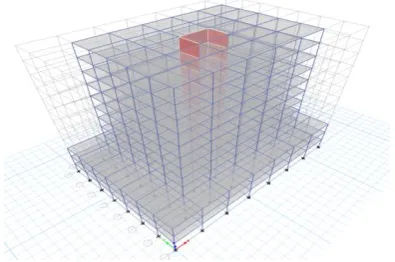
Figure 1: 3D view of Regular Building
[image:2.595.39.291.303.519.2]From the figure 1 the symmetrical plan dimension of the building is 40m x 28m. The entire length in the X direction is 40m which have been divided into seven bays of 5.71m and seven bays in Y-direction of 4m of entire length 28m. The height of building is 36m with 12storey levels.
Figure 2: 3D view of Single step Irregular structure From the figure 2 the vertically irregular RC building whose plan dimension is 40m X 28m. The single step vertical irregularity is considered after third floor level in x and y-direction. The entire length in the X direction is 40m which have been divided into seven bays of 5.71m and seven bays in Y-direction of 4m of entire length 28m. The height of building is 36m with 12storey levels.
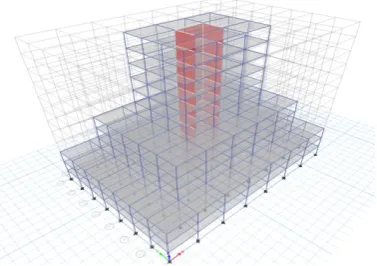
Figure 3: 3D view of Single step Irregular structure with core shear wall
From the Figure 3 the vertically irregular RC building with core shearwall whose plan dimension is 40m X 28m. The single step vertical irregularity is considered after third floor level in x and y-direction.
Type of building Regular and Irregular
building
Plan dimension 40X28m
Storey height 3m
No of bays in x-direction 7
No of bays in y-direction 7
Bay width in x and y-direction 5.71 and 4m
No. Of Storey’s G+11
Size of beams B1=350X350m
Size of columns C1=450X450m
Thickness of slab 150 mm
[image:2.595.333.531.532.663.2] [image:2.595.52.289.563.751.2]International Journal of Innovative Technology and Exploring Engineering (IJITEE) ISSN: 2278-3075,Volume-8 Issue-12, October 2019
[image:3.595.304.545.48.198.2]The entire length in the X direction is 40m which have been divided into seven bays of 5.71m and seven bays in Y-direction of 4m of entire length 28m. The height of building is 36m with 12storey levels.
Figure 4: 3D view of Dual step Irregular structure From the Figure 4 the vertically irregular RC building whose plan dimension is 40m X 28m. The single and dual step vertical irregularity is considered after third and sixth floor level in x and y-direction. The entire length in the X direction is 40m which have been divided into seven bays of 5.71m and seven bays in Y-direction of 4m of entire length 28m. The height of building is 36m with 12storey levels.
Figure 5: 3D view of Dual step Irregular structure with core shear wall
From the Figure 5 the vertically irregular RC building with core shearwall whose plan dimension is 40m X 28m. The single and dual step vertical irregularity is considered after third and sixth floor level in x and y-direction. The entire length in the X direction is 40m which have been divided into seven bays of 5.71m and seven bays in Y-direction of 4m of entire length 28m. The height of building is 36m with 12storey levels.
IV.RESULTS AND DISCUSSIONS
A. Analysis results:-
[image:3.595.81.268.102.233.2]Nonlinear static analysis is performed for different cases like regular, single step vertically irregular, dual step vertically irregular with core shearwall with different aspect ratios of vertical irregularity. The results of 12 storey building were recorded and are represented:
Figure 6: Comparison of Pushover Curve of Building Frames
From figure 6 as the vertical irregularity aspect ratio in structure increases the displacement of the structure increases and the base shear carrying capacity decreases. But when shearwall are introduced onto the structure the displacement decreases and base shear carrying capacity increases. Hence the presence of shear wall in irregular structures can affect the seismic behavior of frame structure to large extent, and the shear wall increases the strength and lateral stiffness of the structure.
B. FORMATION OF HINGES:
Figure 7: Formations of Hinges in Regular Buildingby Applying Load in X-Direction
(a) XZ Frame (b) YZ Frame
[image:3.595.80.269.353.486.2] [image:3.595.313.552.380.555.2]Figure 8: Formations of Hinges in Single Step Irregular Buildingby Applying Load in X-Direction
(a) XZ Frame (b) YZ Frame
[image:4.595.54.285.76.204.2]The following figure 8 shows the distribution of hinges for twelve-storey seven bay single step vertically irregular building in XZ and YZ frame obtained from the application of push load in X-direction. The formation of hinges started at a displacement of 185.192mm and distributed to the total structure reaching to collapse state at a displacement of 214.647mm.
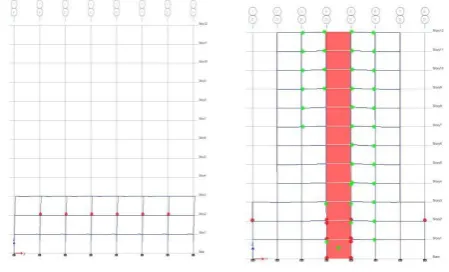
Figure 9: Formations of Hinges in Single Step Irregular Core Shearwall Building by Applying Load in
X-Direction
(a) XZ Frame (b) YZ Frame
[image:4.595.308.525.332.475.2]The following figure 9 shows the distribution of hinges for twelve-storey seven bay single Step vertically irregular building with core shearwall in XZ and YZ frame obtained from the application of push load in X-direction. The formation of hinges started at a displacement of 75.763mm and distributed to the total structure reaching to collapse state at a displacement of 115.695mm. The beginning of hinge formation occurred in the column shearwall joint connections of the bottom ground storey level and distributed to upper storey levels while the collapse failure in the structure is due to shearwall column joint connections and the columns of third storey bottom columns where the single step vertical irregularity starts.
Figure 10: Formations of Hinges in Dual Step Irregular Buildingby Applying Load in X-Direction
(a) XZ Frame (b) YZ Frame
The following figure 10 shows the distribution of hinges for twelve-storey seven bay dual step vertically irregular building in XZ and YZ frame obtained from the application of push load in X-direction. The formation of hinges started at a displacement of 147.451mm and distributed to the total structure reaching to collapse state at a displacement of 280.56mm.
Figure 11: Formations of Hinges in Dual Step Irregular Buildingby Applying Load in X-Direction
(a) XZ Frame (b) YZ Frame
The following figure 11 shows the distribution of hinges for twelve-storey seven bay dual step vertically irregular building with core shearwall in XZ and YZ frame obtained from the application of push load in X-direction. The formation of hinges started at a displacement of 91.806mm and distributed to the total structure reaching to collapse state at a displacement of 128.22mm..
V.CONCLUSIONS
The following are the major conclusions from the present study:
1) As the vertical irregularity aspect ratio is increased from 0.28 to 0.57 the base shear is decreased by 7.11% and 10.7% when compared to regular building. Therefore it can be concluded that increased aspect ratio in the seismic prone areas is not recommended without shear wall. 2) When the core shearwall is introduced, base shear is
increased to 8.47% and 5.3% when compared to 0.28 and 0.57 aspect ratio buildings
[image:4.595.56.281.340.476.2]International Journal of Innovative Technology and Exploring Engineering (IJITEE) ISSN: 2278-3075,Volume-8 Issue-12, October 2019
should be provided with shear wall.
3) The displacement is increased by 10.3% in case of aspect ratio of 0.28 and 22.87% in case of aspect ratio of 0.57 when compared to regular building. Therefore it is concluded that the building with increased aspect ratio is having more displacement at lesser base shear carrying capacity.
4) As the core shearwall is provided to aspect ratio of 0.28 and 0.57 frames the displacements are decreased by 50.62% and 48.70% when compared to aspect ratio of 0.28 and 0.57 frames without shearwall frames. As the provision of shear wall, decreases the displacement of structure it can be concluded that provision of shear wall will reduce the seismic vulnerability.
5) The hinges formations in regular building are normally observed in the beams than it transfers to the columns and the first collapse hinges formed in the ground storey columns.
6) But as the aspect ratio increases for irregular buildings the collapse hinges are concentrated at the outer peripheral columns of ground storey where the irregularity begins. 7) Thus when the shearwall is introduced in an irregular
structures the collapse hinges are concentrated at the shearwall columns joint connections and the upper storey level outer peripheral columns where the irregularity begins.
8) Finally, it can be conclude that the failure of the irregular structure with shear wall is a ductile failure as the local members are yielding first.
REFERENCES
1. Resmi Vinod, Nimiya Rose Joshuva (2018) “Modification Techniques for Setback Structures Using Pushover Analysis” International Journal of Innovations in Engineering and Technology (IJIET), Volume 11, Issue 2, September-2018.
2. Chethana, Sowmya (2018) “Study and analysis of regular and irregular buildings with different shear wall position using ETABS”, International Research Journal of Engineering and Technology (IRJET), Volume: 05, Issue: 06, June -2018.
3. Elavenil and Albert Philip (2017) “Seismic Analysis of High Rise Buildings with Plan Irregularity”, International journal of civil engineering and technology, vol8, sep-2017.
4. Vidyashree, Dr. M.D Vijayananda, Kirankumar (2016) “Static and Dynamic analysis of regular and irregular shape building with or without shearwall” International Research Journal of Engineering and Technology (IRJET), Volume: 03, Issue: 05, May-2016.
5. Rana and Raheem (2015) “Seismic Analysis of Regular & Vertical Geometric Irregular RCC Framed Building”, International Research Journal of Engineering and Technology (IRJET), Volume: 02 Issue: 04, July-2015.
6. Ravikanth Chittiprolu and Ramancharla Pradeep Kumar (2014) “Significance of Shear Wall in Highrise Irregular Buildings” , Earthquake Engineering Research Centre, International Institute of Information Technology,Vol. 4, Issue 2, June 2014.
7. Hiremath and Hussain (2014) “Effect of Change in Shear Wall Location
with Uniform and Varying Thickness in High Rise
Building”,International Journal of Science and Research (IJSR), Volume 3, Issue 10, October 2014.
8. V.Vara prasad, T. Sujatha, J. Supriya (2014) “Optimum Location of a Shear Wall in High Rise U-Shape Building”, International Journal of Engineering Research & Technology (IJERT), Vol. 3 Issue 8, August – 2014.
9. Varsha, R. Harne (2014) “Comparative Study of Strength of RC Shear Wall at Different Location on Multi-storied Residential Building”, International Journal of Civil Engineering Research, Volume 5, (2014).
AUTHORS PROFILE
Mohd Azharuddin, Master of Technology in structural engineering, Department of civil engineering, Anurag group of institutions, Venkatapur, Ghatkesar, Medchal Dist-TS, India.
Dr. A. Vimala, Professor, Department of civil
engineering, Anurag group of