Abstract: Due to its robustness to multipath delay spread and impulse noise, and also elevated spectral efficiency like characteristics, OFDM technology has been commonly adopted in contemporary wireless communication systems like LTE. The heart of an OFDM system is Channel estimator and the efficiency of channel estimation (CE) has a direct impact on the bit error rate performance of the system also the CE performance itself depends on effective estimation of fading channel hence the channel estimation problem has to be addressed. The popular LS based CE method is accepted for its simplicity but is found to be vulnerable to noise whereas the simple MMSE based CE that provides fine-tuned estimation still suffers from complexity as it depends on the knowledge of channel statistics (KCS). Hence a two level channel estimation technique that is a combination of kalman filter and thresholding scheme which denoises the LS initial estimates is proposed. The kalman filter tracks the estimates with initial data as LS estimates and threshold helps in selecting the significant data thus denoising the estimates and also filters the redundancy in estimated data. On comparing the existed CE techniques with that of the proposed scheme, the MSE performance of proposed scheme is found to be optimal and simple to that of the LMMSE technique.
Index Terms: Channel Estimation, Kalman filter, OFDM system, threshold and two level schemes.
I. INTRODUCTION
Bit rates attained in wireless communication systems in the cellular and local region have steadily risen over the years. Multiple access method used by the earliest digital cellular systems such as GSM [1] employed time division multiple access technique. Whereas the second generation used CDMA [2] and the third generation cellular systems use direct sequence spread spectrum and other multiple access techniques [3]. These techniques do not meet the requirements of increasing data rates and scalability. The next generation technologies demanding for higher data rate leads to utilization of a wider transmission bandwidth.
However, with wide bandwidths, frequency selectivity of the channel becomes more severe and thus making the problem of inter-symbol interference (ISI) serious. Time domain adaptive equalizers are used to eliminate ISI in a conventional single carrier communication system. But with increasing data rates the design complexity of Equalizers also increases. So, multicarrier technique preferably Orthogonal Frequency Division Multiplexing (OFDM) comes into picture
Revised Manuscript Received on August 05, 2019
T. Hima Bindu, Electronics and Communication Engineering, Velagapudi Ramakrishna Engineering College, Vijayawada, India.
P. Dedeepya, Electronics and Communication Engineering, Velagapudi Ramakrishna Engineering College, Vijayawada, India.
to combat the frequency-selective fading in a wide band channel. OFDM divides the entire channel into sub-bands, or subcarriers, each modulated by a low data stream thus by spacing carriers much closer together orthogonally leads to wider transmission bandwidths [4].
Any Mobile wireless communication is adversely affected by the interference of multipath resulting from nearby reflections and other barriers. The system requires a precise estimate of time-varying channel to provide reliability and elevated information rates at the receiver. Channel is estimated on transmission of pilot data over the subcarriers by employing either comb type, block type or lattice type pilot structures as mentioned in [5]; it is then followed by interpolation for entire channel information on all subcarriers. Here Comb type structure with linear interpolation technique is preferred [ref] as it is suitable our scenario. The conventional technique existed for channel estimation are Least Squares (LS) and Minimum Mean Square Error (MMSE), MMSE renders better performance to CE but it requires a priori Knowledge of Channel Statistics (KCS) like noise variance , channel length L, channel taps Nt, average power of CIR taps and power delay profile etc.,[6] whereas LS doesn’t require any KCS parameters. Therefore, LS based CE is incorporated but the result is badly affected by noise and the accuracy is poor. Hence, denoising thresholds are used on the channel reaction estimated by LS to further improve their MSE efficiency.
Till date, the literature has suggested distinct time-domain thresholds based on distinct optimization approaches. A time domain threshold separates important Channel impulse Response (CIR) taps from the noisy taps which increases the system Mean Square Error (MSE) performance effectively. The thresholds existed were defined by assuming the KCS parameters. Some of them are discussed as follows. The conventional LS systems uses truncation scheme where no threshold is considered but assumes L mentioned in [6]where the CIR estimates within L are considered and truncates the estimates after L. But the efficiency of MSE in [7] is found to be higher than that of the truncation scheme in [6] where the CIR taps are chosen based on the threshold, which is a fraction of energy of a peak channel tap. In [8] LS estimates are obtained along with generalized Akaike information criterion that is
developed to estimate and L by assuming initial large value of L. This method improved the MSE performance than that in [7] but poor performance when compared to [8]. A sub-optimal threshold has
been proposed in [7] which is a function of channel
A Simple Two-Level Channel Estimation
Scheme for OFDM System
length and significant channel taps. Using wavelet domain, a threshold that is function of standard deviation has been proposed in [9] which is obtained by wavelet decomposing the noise. For MSE minimization an optimal threshold that requires prior noise variance, significant taps was formulated in [10]. Thus it is evident that, in order to obtain to better MSE performance threshold based schemes are to be employed which is a function of KCS parameters, so one or more of these have to be estimated and also it is noted that there is a trade-off between performance and complexity.
Due to high mobility, wireless channels display non-stationary response. Many considered the issue of time varying channel tracking before applying threshold in the literature. In [1] and [12] basis expansion models were used for channel time variation approximation but it accounts for ICI. A delay subspace tracking approach using RLS adaptive filter for SISO-OFDM systems was implemented in [13] which consumes high complexity. To avoid this, kalman Filter (KF) is used in [14] which has lower complexity burden. Similar works also considered the problem of channel sparsity with an attractive solution based on hierarchical Bayesian kalman filter mentioned in [15]. The advantages of kalman filtering over other filters is it can adapt to changing levels of measurement noise unlike the FIR filter that fails to update the weight vectors [16]. From [17] it is clear that for the scenario of time varying channels KF is well suitable technique that is followed by PFE and TMMSE thresholding schemes in [17]. But the complexity order of the system is still high. Hence a combination scheme of KF and simple threshold is proposed in this paper. The remainder of the paper is organized as follows; Section II deals the design of OFDM system design, common CE techniques along with the tracking and thresholding schemes are discussed. The simulation results were analyzed in Section III and the paper is Concluded n in Section IV
.
II. OFDMSYSTEMDESIGNANDCHANNEL ESTIMATION
A. System design
Considering an OFDM of N subcarriers and let Xk, represents the transmitted ith symbol , where k is the transmitted subcarrier index. The pilots are sent on few chosen subcarriers out of total N subcarriers. The resultant pilot and data to be transmitted is converted by IDFT, and CP is added to each symbol. At the receiver inverse operations were performed to get back the original symbols, the resultant OFDM symbol is expressed in frequency domain as follows.
(1)
Where H represents channel frequency response (CFR) and U represents AWGN. In this paper we study the conventional CE techniques namely LS and the low rank version of MMSE.
B. Least Squares Estimation
Using the transmitted and received symbol, the LS based CE is obtained at the known pilot locations from (2) below
(2)
The resulting CFR at pilot locations is then interpolated linearly to obtain LS estimated CFR,
(3)
Where . After applying IDFT on the CFR of LS
estimates, its CIR can be obtained from (4)
(4)
C. Minimum Mean Square Error Estimation
The MMSE method of channel estimation is a better estimator as it minimizes MSE effectively but has high complexity. From [18] the MMSE estimation over pilot subcarriers is given by (5)
(5)
Where is the auto-correlation matrix and is the
variance of noise, F is the DFT matrix and denotes Hermitian transpose.
The low rank MMSE named as Linear Minimum mean square error (LMMSE) was proposed in [19], the LMMSE algorithm improves the precision of estimation with statistical information of the channel to minimize the mean-squared error. It is an optimal linear filter to the LS estimation.
D. Kalman filtering
Here the time varying channels are considered, which can be effectively tracked by kalman Filter. It is a linear time varying system that evaluates the state estimate which minimizes the mean square error. It is a powerful supporting the estimation of past, present and future states. In general, the Kalman Filter equations were categorized into two sets of equationsas state space model for time varying channel.
1. Time Update equations
(n) = A (n-1)+ (n) (6)
2. Measurement Equation
(n) = (n) + (n) (7)
Where P and Q are zero mean white Gaussian noises. Time update equation (6) is used for predicting the state and covariance matrix, while the measurement equation (7) is responsible for filtering. The time update equation is accountable for current state estimate forward in time and the measurement equation adjusts the projected estimate by an actual extent at that time. Hence time update equation is called predictor equation and measurement equation as update or corrector equation. The Kalman filter based channel estimation algorithm was described in [19] the following four stepsbelow [20]
Obtained from equation (4) Step 2: Filter initialization
(0)=0p and (0)=Ip
Step 3: Time Update
((n+1) = A n) (State Prediction) (8)
n+1) = A n) AH+Q
(Prediction error covariance) (9)
Step 4: Measurement update
Kg= n)( n)+R)
-1
(Kalman Gain) (10)
(n) = (n) + Kg ( (n)- (n) )(State estimation)(11)
n) = n) (I-K) (Estimation Error Covariance) (12)
Where HLS is the initial LS estimate, CP is the error covariance matrix, Q and R were prediction and measurement noises respectively.
E. Thresholding
From the so obtained Kalman filter response, significant data is tuned using the threshold. From the existing literature survey, it is evident that one or more KCS parameters are involved in threshold expressions. Thus a threshold, which uses optimal number of KCS parameters but can render better MSE, has to be developed. To derive such threshold, auto covariance function is computed using (13)
(13)
From the auto-covariance function, auto covariance matrix R is obtained, from which L Eigen values are computed. The threshold is derived from those Eigen values based on the SNR values i.e., for high SNR values, maximum Eigen value is taken as , whereas for lower SNR’s, sum of Eigen values is taken. As the channel environment changes, the function of Eigen value changes thus leading to optimal MSE performance than that of other thresholds discussed in previous section. However, the complexity persists with the demand of performance.
III. SIMULATIONRESULTS
[image:3.595.316.534.54.139.2]The efficiency of an OFDM scheme with the CE that includes tracking and thresholding is assessed using system MATLAB simulations. For an OFDM system with comb-type pilot structure, let be the transmitted OFDM symbol over kth subcarrier index, further system design specifications were tabulated below, using these specifications of OFDM, the first CFR in (1) is estimated at the pilot positions using LS method. Then the so obtained CFR is interpolated over each OFDM symbol to obtain CFR coefficients at all data and pilot positions. From the CFR, CIR is computed and is observed to be noisy. Although several thresholding techniques were proposed as seen in literature survey to reduce those noisy estimates, tracking the channel using the kalman filter helps to obtain low noise estimates before thresholding itself.
Table 1. OFDM System parameters Parameters Specification
FFT size 256
No. of subcarriers 256
Type of pilot insertion Comb type
Modulation scheme 64-QAM
Channel Model Rayleigh Channel
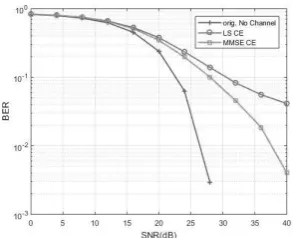
Initially the existing LS and MMSE channel estimation technique are simulated for various modulation schemes like 8-PSK and 16-QAM as shown in Fig. 1 and Fig.2. It is observed that compared to LS, the MMSE is much close to true channel coefficients and higher the modulation scheme better is the performance unless the subcarriers and FFT size are varied for a particular OFDM system. Based on these observations QAM in Fig. 2 is better than PSK in Fig.1. Later those initial LS estimates which are noisy are treated with threshold technique that doesn’t employ Kalman filter and are compared. By employing the threshold scheme alone over LS estimates, the MSE curve shifts towards to LMMSE curve but it didn’t contribute much for good MSE.
Hence tracking block is inserted between initial estimation block and thresholding block. From Jellali et al., [18] it is clear that the KF tracker along with the two proposed thresholds provides much better MSE compared to all previous schemes with significant order of complexity and to further reduce it making suitable for time varying channels we have proposed a combination scheme called two-level estimation scheme, where the KF is followed by simple threshold scheme. These schemes were compared and plotted as shown in Fig.3. From the figure, it is clear that Jellali scheme curve is very close to LMMSE and the proposed scheme is bit far off that curve proving it to be simplest technique. Fig 4 and Fig 5 shows the comparison between general CE techniques and the considered simple threshold with and without tracking filters KF, it is observed that the threshold along with KF curve is better than threshold alone curve. To summarize the results, the complex MMSE channel estimation technique that outstands with its best MSE performance is less opted because of its complex natured estimation. It can be replaced by using the combination scheme where
the simple LS technique that has noisy results can be turned into optimal estimates upon filtering and thresholding.
[image:3.595.355.502.592.711.2]Fig.2 Channel estimation techniques compared for 16-QAM modulation scheme
Fig.3 Comparison of Channel estimation technique for Kalman Filter with & without threshold vs Jellali
technique
Fig.4 Simple Channel estimation technique with and without KF vs LS
Fig.5 Channel estimation technique without and with KF
IV. CONCLUSION
In this paper an efficient channel estimation scheme for OFDM on multipath time varying channels has been presented. The proposed combination of kalman filter tracking and thresholding acts like a denoiser is found to provide better results. On observing the simulation results the BER performance of the proposed simple scheme is close to that of LMMSE technique and could even provide better
length in any time varying channel. Though the kalman filter that acts as a tracker seems to be additional complex block in system, it becomes an advantage as it drives the system with enhanced BER performance. Here the Kalman filter used was assumed to be linear. But for a non-linear system, extended kalman filter is suggested as a tracker and the work can be further extended by considering various channel environment scenarios and can be compared for different channel tap lengths.
REFERENCES
1. M.Rahnema, April 1993, “Overview of the GSM system and protocol architecture”, IEEE communication magazine, 31(4), pp.92-100. 2. Amit Dixit Aanchal Garg,Sap 2014, “A study on cellular GSM &CDMA
based for New Generation Mobile Radio system”, pp. 419-426. 3. Hasan M, Thakur J.M and Podder P,Apr 2016, “Design and
implementation of FHSS and DSSS for secure Data Transmission”,International Journal of Signal Proc.,4(2).
4. Sukhpal singh and Harmanjot singh, 2015, “Review paper on OFDM concepts and applications”, IJEDR, 3(3).
5. Coleri S, Ergen M, Puri A and Bahai,2002, “A channel estimation technique based on pilot arrangement in OFDM systems”, IEEE Trans.on Broadcasting, 48(3), pp. 223-229.
6. Jan-Jaap Van de Beek, Ove E, Magnus S, Sarah K W and Per O Borjesson , July 1995, “On channel estimation in OFDM systems”, IEEE Vehicular Tech. conference (VTC’96) in chicago, pp. 815-819. 7. Hlaing Minn and Vijay K B, 2000, “An Investiagtion into time domain
approach for OFDM channel estimation”, IEEE Trans. On Broadcasting, pp. 240-248.
8. Raghavendra and Giridhar K, Jan 2005, “Improving Channel Estimatiion in OFDM systems for sparse multipath channels”,IEEE signal Process. Letters, pp. 52-55.
9. A. Alnuaimy, Ismail M and Ali M,2010, “Successive data schism and interpolation for channel estimation in OFDM using Wavlet denoising”, in 12th International Conf. on Advanced Comm. Tech, pp.661-665. 10. Stefano R, Giovanni E.C and Alessandro V-C,2012, “OFDM channel
estimation based on impulse response decimation: analysis and novel algorithms”, IEEE Transaction Comm.
11. Zijian T, Rocco C C and Paolo B May 2007, “Pilot-Assisted Time-Varying Channel Estimation for OFDM sytems”,IEEE Transaction signal process., 55(5), pp. 2226-2238.
12. Zijian T, Geert Leus, Rocco C C and Paolo Banelli,2006, “Pilot assisted time varying OFDM channel estimation”, Proc.
13. Osvalso S, Yeheskel Bar-Ness and Spagnolini, “Pilot-Based channel estimation for OFDM systems by tracking the delay-subspace,” IEEE Transaction on wireless comm., 3(1), pp. 315-325.
14. Min H, Xiang Chen, Shidong Zhou and Jing W,2006, “Low-complexity Subspace Tracking Based Channel Estimation method for OFDM systems in Time-varying channels” IEEE Int. Conf. Comm., Istanbul, Turkey, pp. 4618-4623.
15. Evripidis K, Kin L and Wei D, “Tracking dynamic sprase signals using hierarchical Bayesian Kalman Filters”, IEEE Int. Conf. on Acoustics, Speech and signal process., pp. 6546-6550.
16. John Proakis Digital communications,1989, McGraw-Hill.
17. Zakia J and Leila N A, Dec 2017“Fast Fading Channel Estimation by Kalman Filtering and CIR support Tracking”, IEEE Trans. On Broadcasting, 63(4), pp. 635-643.
18. Van de Beek, Sandell M and p.O.Borjesson, Jul 1997, “ML Estimationof time and frequency offset in OFDM systems”, IEEE Trans. On Signall Process.,45(7), pp. 1800-1805.
19. Ove Edfors, Magnus S, J.-J. Van de Beek, Sarah K. Wilson and Per O.
Borjesson, Apr 1996, “OFDM Channel estimation by Singular value decomposition”, IEEE Veh. Tech. Conf.,Atalanta, USA,pp. 923-927.
20. Omar M Elbadri and Ahmed S. Elbarsha, “Kalman-Filter Channel
hoto
AUTHORS PROFILE
T. Hima Bindu is pursuing M.Tech with specialization in the field of Communication and Signal Processing Engineering in Velagapudi Ramakrishna Siddhartha Engineering College, Kanuru, Vijayawada.