Abstract: The majority of existing numerical methods for predicting the effect of corrosion on steel elements are oriented using experimental results and established dependencies. It is wrong to think that solving a corrosion problem will be achieved automatically by applying several numerical models. First, it is necessary to carry out, systemize and process numerical and statistically determined number of experimental observations, measurements and results. Under the same corrosive conditions, different mathematical calculation models can be created, but each of these models will be a private solution to the problem being investigated. A theoretically grounded calculation model should exist for the compilation of an appropriate mathematical model to properly describe the corrosion process and its influence as a system of private mathematical equations.
This paper presents the possibility of predicting the corrosion impact on steel elements. The negative influence of corrosion on mechanical properties is known, which necessitates the compilation of numerical algorithms to predict its impact in order to predict, develop and automate the necessary calculations. This makes it easier to determine the effect of corrosion on materials.
This type of algorithm should be universal and can be used in any case to determine the consequences or the expected impact that indicates the corrosion of the materials. Dependencies are used which are known for corrosion development, including a numerical algorithm for creating theoretical models. Types of forecasts and types of models for development of the corrosion process are considered. Several basic types of models are proposed, which can be programmed as a numerical algorithm. A computational block-scheme of the proposed models is presented. A theoretical conceptual computational model was developed to predict the influence of corrosion on steel elements.
Index Terms: conception, forecasting, corrosion influence, steel elements, sustainable development.
I. INTRODUCTION
In practical engineering, corrosion of steels is defined as the destruction of metals due to chemical and electrochemical interaction with aggressive environments.
In the ISO system, this concept is slightly wider, taking into account physic-chemical interactions between the metal and the environment.
A factor influencing the speed, type and distribution of corrosion and the nature of the metal staging, structure, internal stress, condition surfaces are called internal factors [22-24].
Factors influencing the same parameters of corrosion but related to corrosive composition among process conditions -
Revised Manuscript Received on June 13, 2019
Antonio Shopov, Department “Mechanics and Mathematics”, VSU
“LubenKaravelov”, 175“Suxodolska” str., Sofia, Bulgaria.
temperature, humidity, exchange between and i.e., are called external corrosion factors [22-24].
According to the mechanism of the process of corrosion are divided into two types - electrochemistry and chemical corrosion [24]. Chemical corrosion resulting from a heterogeneous reaction between metals and the environment in the absence of moisture [24]. It is housed in industrial facilities, gas pipelines with aggressive gas mixtures [24]. One of the main factors for its flow is contained in the gases. All metals, including noble metals, are covered on the oxide layer. For the protective properties of this layer is important not its thickness but its density. Electrochemical corrosion - is characteristic of the steel, the destruction is the occurrence and the flow of electric current from one part of the metals to other parts. This is due to the action of numerous microscopic galvanic elements formed on the surface of the metal [22-24]. Under the conditions of different steel structures, their loss of mechanical properties is directly influenced by the development of corrosion [3].
Steel is the most commonly used material in heavy machinery, construction and another major’s equipment. At least 25% of the steel during its operation disappears as a result of the corrosion process. Corrosion losses and damage should be reduced. This process is irreversible and often leads to accidents and the need for major repairs of the steel elements, so its development should be monitored and the effect determined at an early stage [1].
For the development of corrosion in times of exploitation can be determined by direct measurement - depth, damage, mass of products from corrosion, etc [22-27].
Another way is the changing characteristics of the steel - mechanical strength, electrical conducting, etc. Can be used remotely periodic verification of factors - temperature and humidity, concentration of air pollution, etc [22-27].
There are a variety of corrosion factors and corrosion conditions (diagnostics) should be used today's computational capabilities. One predictive model will be led to capabilities for creating and deploying automated computing systems to determine at what point in time corrosion will lead to an initial stage of the emergency state in construction, enabling predictable repairs and planning the necessary resources.
Changes that occur as a consequence of corrosion require a theoretically-computation conceptual to be used to model the corrosion impact on a steel element to assess the effects of corrosion.
II. MODELOFTHE
CORROSIONPROCESS
Theoretical-Computation Conception for
Forecasting on Corrosion Influence into Steel
Elements at Sustainable Development
The development of corrosion under the influence of a working environment can be described as operational corrosion [5]. Experimental data for the study of corroded steel elements exploited at aggressive corrosive environment and after treatment can establish a formula for detecting the corrosive impact on certain mechanical parameters, describing with an indicative function.
An example of this is determining the influence of corrosion over time on yield strain values [4].
εy t = A1. t9+ A2. t8+ A3. t7+ A4. t6+ A5. t5+
A6. t4+ A7. t3+ A8. t2+ A9. t + εy(1)
where: А1, А2, А3, А4, А5, А6, А7, А8 и А9 is constant values and need to be determined experimentally in every case [4].
On the other hand, another non-linear formula is determined to determine the Young’s module depending on the corrosion influence (function on stress) [2]:
E σ =A.σ3+B.σ2+C.σ, (2)
Where: A, B and C are constant values and need to be determined experimentally in every case, depending on the changes of the diameter and the corrosion resistance of steel (changing of area on section) [2].
When performing an analysis, the common between the formulas is that there is a polynomial equation that can be written in the form of:
Cr = Xn. τn+ Xn−1. τn−1+ Xn−2. τn−2… + X0. τ + Cr0(3)
Where: Cr is the value at a given point in time as a consequence of the corrosive impact, Xn is the coefficient depending on the type of the steel elements, τ is the time of the corrosive action of the corresponding corrosion category, Cr0 is the value before the corrosive impact, n is the number of degrees of the polynomial equation.
Considering this regularity, as well as factors such as the probability of corrosion and fracture irregularities along the cross-sectional perimeter of the elements, it is possible to predict the variation in the corrosion impact on the steel structures during operation, especially needed in the reconstruction of the construction elements and the assessment of the fitness of the structures for further operation.
III. FORECASTINGTHEDEVELOPMENTOF
CORROSIONPROCESS
A. Forecast
Forecasting is the probability assessment of the status of an object and is a process and / or phenomenon at a given time in the future, for example in terms of corrosion. In relation to the issue under consideration, it is the prognosis of the indicators formed for the development of the process. The model obtained using the methods described and used for
forecasting is called a forecast. It must meet the following requirements [13-17]:
• match the foreseen completeness, adaptability and evolution to allow the introduction of changes and additions to consistently approximate to the required accuracy; • be sufficiently abstract to be able to change the number of
factors needed and to ensure the reliability of the results obtained;
• have time constraints to achieve quick results by means of short-term forecasting and exclusion of large machine-time costs through long-term forecasting or estimating forecasts; • be oriented towards realization by means of known
technical means and built on established terminology; • provide useful information about the process regarding the
research task;
• enable real-time verification of actual corrosion processes The principles and rules that unify and divide the common properties of models are outlined in the special literature [13-17].
B. Types of models
Depending on the number of variables involved in the model description in the analysis phase, the forecasting entities are divided by the [13-17] quantitative scale:
• sub-local (1 ... 3 factors); • local (4 ... 14 factors); • sub global (15 ... 35 factors);
• global (with the number of significant variables 36 ... 100); • super global (more than 100 factors); [13-17].
The corrosion processes and its prediction mainly concern the first three classes. In particular, atmospheric corrosion is often the subject of such a forecast [25].
In addition to the quantitative scale, the prediction method is significantly influenced by the complexity of the site: • super simple - these are objects that have no significant
interconnections between the variables. For them, forecasts can be constructed by sequentially analyzing the independent variables Xt (factors) that make up the description of objects on all scales;
• simple - in the description of which there is a pair of links between the variables. In these cases, forecasts are generated by the regression pair models, simple expert methods for assessing the magnitude and nature of links between the variables;
• sophisticated - in which, with an appropriate description that takes into account the relationships and joint influences of several significant factors - from three or more, while clearly outlining the main influential factors. As a mathematical apparatus, in this case, multiple regression and correlation analysis methods, expert tables for mutual influence and preference assessment are used;
• super complex - objects, in the description of which it is necessary to take into account the interrelationships between all variables. The main methods for studying them are multiple, correlation, factoring, and variance analysis, taking into account the reliability of the forecast [13-17]. • based on forecasting factors, we can divide them into two
main groups:
certain time points as a regular component is understood to be a description of the process that is free from a random component - noise or other occasional, non - elementary or elemental factors);
• aperiodic, describing the regular component in the form of an aperiodic continuous function of time.
Corrosion processes are mainly due to aperiodic factors and, more rarely, to discrete ones.
C. Modeling
In the course of the operation of structures, equipment and equipment, it is often necessary to solve tasks related to the assessment of the actual state and the forecasting of its change in order to take timely measures to prevent the moment of failure of the structure and to establish the actual stock of technical fitness.
If the determination of the current corrosion condition basically leads through its results to an immediate assessment of the corrosion effects and the identified consequences, the forecasting based on the experimental data suggests also available hypothesis making possible to outline the progress of the corrosion processes and the modification of the technical condition and behavior of the site in the future. Physical and mathematical modeling is used in these cases. Physical modeling to assess the status of objects and to predict the development of corrosion processes has limited capabilities in decision-making in individual cases [6-12]. Mathematical modeling offers considerably larger, universal and practically inexhaustible possibilities [12, 14].
The general principles of mathematical models development and their exploitation for assessment of the residual operating life of structures, equipment and equipment are presented in groups in the statement below.
Process modeling involves the creation of a logical, analytical, graphical or any other accurate description that corresponds to reality and allows to analyze and assess the dynamics of its development depending on the specific conditions. The type of description is in most cases determined by the intended use of the model being developed and the presence of a statistically matched and / or study that allows the estimation of the degree of approximation of the model to the actual processes. In the case of models reflecting the dependence of the corrosion process on the time running in stationary conditions, it is necessary to have a statistical material for the depth of corrosion –lk, which can be expressed analytically in function of time (eq. 4) and thus to obtain a model simplified for the solution of the task [23, 26]
lk = v0. τ (4)
Where: ν0is the initial rate of corrosion; τ is the time. If it is necessary to assess the change in the state of the structure or object by the degree of its corrosive elements occurring in non-stationary conditions of operation, it is necessary to create a significantly more complicated model, allowing to find a correlation between the corrosion condition evaluation indicators of factors (X1, X2, .... Xn), determining the nature of the development of corrosion processes.
Different functional, informational and morphological models are created in the studies, while observing the reproducibility requirements, and on this basis the overall
model of the system is built. Modeling can be complete, incomplete and approximate [8-9, 14].
Full modeling is done by considering the ratio (eq. 5) [22-24, 26]:
m = μ. M0 (5)
Where: m are the matrices of the model, and μ and M0 are respectively the coefficients and the parameters of the original [22-24, 26].
In the case of incomplete modeling, the model represents a function similar to the original, in the general form described by the expression (eq. 6)[22-24, 26]:
𝑀 = ρ 𝑀0. 𝑥, 𝜏 (6)
Where: ρ is some function of the original, and x are spatial coordinates[22-24, 26].
Approximate modeling takes into account only the most important factors of the process, in this case corrosion, by a system that looks like this in general (eq. 7) [6]:
𝑚 = 𝜇. 𝑀0
𝑀 = 𝑠𝑢𝑏 𝑀0 (7)
In their composition, the models can be physical, mathematical, with natural elements and mixed.Physical models are constructed by the method of similarity and analogy, incorporating interconnected diverse elements. They help to reproduce the process of corrosion in laboratory conditions.
Mathematical models reflect real-life corrosion processes using mathematical equations and their graphical representation in the form of tabular information, nomograms, blocks, systems with sets of equations connected in a vertical and horizontal hierarchy, forming matrices of solutions of different cases, including and cybernetic models as well as blocks built on a block. This format also covers algorithmic descriptions that are often used to represent a pattern of objects for which there is no analytical description, or the model itself is a preparation for programmable calculation, as is the case with corrosion processes, and is often done directly in the programming language, these two possibilities may well coincide. Variety of mathematical modeling are graphs, especially in the form of target tree structures that are successfully used in programming [6-12].
Cybernetic models are rich to be simple and complete. Simple ones are static models that do not take into account changes in corrosion factors over time. Full models take into account the dynamics of the change in the factors of corrosion over time as well as the correlation between them. In order to fulfill the main task of cybernetics - management of the system integrity, it is necessary for the complete model of corrosion processes to include, in addition to the main factors, the constraints and the relationship between them. To determine the effectiveness of corrosion protection methods, such models must also contain criteria and functions for optimality [6-12].
process-testing tools and complete complexes).
Mixed elements of their composition contain complex tools and time synchronizers of the modeling process, which are necessary for the study of the use of the objects according to their purpose. In this case, corrosion is one of the factors that reduces the likelihood that the object will fulfill its repertoire over time.
Besides, in their description, the models of both corrosion and other processes can be deterministic, stochastic, heuristic and mixed.
Deterministic models are given in the form of logical, algebraic and differential equations or their solutions recorded in function of time, as well as experimental data obtained in natural conditions or in conducting accelerated corrosion tests.
Probability models are based on random number operations when the nature of the corrosion process is unknown [25]. Heuristic patterns are formed on the basis of hypotheses that take into account the possible direction of development of the corrosion process.
Mixed models are a combination of models already described. Heuristic and mixed patterns are rarely used because their relevance in analyzing corrosion protection variants is only justified in complex systems with mutually exclusive elements of popular corrosion protection [25]. The deterministic models are most often used in the research and diagnostics of corrosion processes. Determining the real value of the speed of the corrosion process and the change of this velocity is part of the subject of the study of the kinetics of corrosion processes and is a leading goal in their modeling. Typically, at corrosion rate [26] we mean the average velocity Vcp of the corrosion process (eq. 8):
Vср= τ−1 ln1 k,i(8)
Where: lk,i – the corrosive effect at a given point in time;
The actual speed of the corrosion process is significantly different from the average one and has characteristics that should not be taken into account in operating conditions, especially when forecasting corrosion risk.
The corrosion process always starts from the surface of the metal and is characterized by deep development. The corrosion process itself is the result of various reasons considered above and can not be uniform [26]. Corrosion depression in depth can be presented as an analytical model using the following formula (eq. 9) [22-23, 26]:
lk = lk,y 1 − exp kτ
τ (9) Where: lk,y – the depth of corrosion at the beginning of the process; Kτ – constant value for the private case of corrosion;
The actual vd velocity of the corrosion process is found after dipping equation [26] (eq. 10):
vd= v0. exp −τk
τ (10)
The models formed by eq. 3 and eq. 4 describe only part of the corrosion process - only in the area of the defined meanings of lk,y. The analytical model [26-27] (eq. 11) is
determined to express the actual rate of corrosion process as a whole from the zero meaning by empirical way:
V τ = lk′ τ = vd. τ. (kl. τ2+ kl′. τ + kl")−1 (11)
Where κl ,κl’ , κl” – constant quantities, corresponding to the depth of the penetration of corrosion in the metal, the speed and acceleration of the corrosion process.
Model analysis with eq. 5 shows that corrosion velocity is a complex non-linear function that is constantly changing over time. At the initial moment the speed is always zero, which also characterizes the inertia of the corrosion process, but then increases and slows down. Its maximum value must coincide at the point of intersection of the aperiodic curve, indicating the magnitude of the depth of corrosion, and over time it can be expressed with a set and established value. When calculating the average corrosion rate, which is essentially a fictitious magnitude, the possibility of kinetic analysis of the corrosion process is actually excluded and prevents its diagnosis and prognosis.
Recently, in the construction of the mathematical models of the different physical processes, the identification method representing the construction of the process model based on the primary information obtained under operating conditions [8-9] is successfully applied, which can be represented by the following expression, the approximate value of the linear operator A0 (eq. 12) is determined:
ll τ = A0. x τ (12)
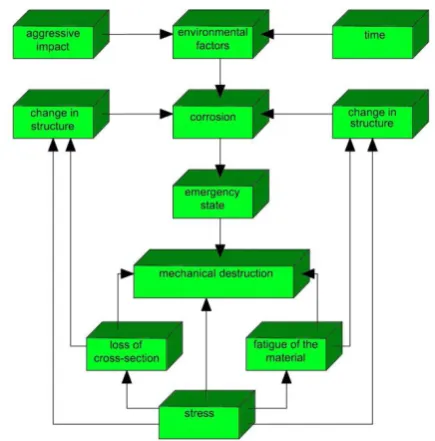
Particularly important for defining the mathematical model is the question of adaptation. Models based on information about the initial processes can lead to erroneous conclusions about the actual corrosion situation. To rule out the possibility of such errors, adaptive models are adopted to allow for adjustment at a given point in time in accordance with changing conditions. [8-9]. In developing the model of corrosion processes, it is important to find the optimal algorithm that provides the necessary qualities of the obtained model with minimal effort and means and to maximize the use of accumulated experience. From fig. 1 basis, the modeling process is divided into several
interrelated stages.
Fig.1. Bearing steel elements with corrosion in structures
By its very nature, the first stage forms the possibilities of the future model to express the process of corrosion, aging and biological damage.
In the second stage, the model itself is constructed, allowing for a full account of the set of factors influencing the process and their complex interaction between them. If the process can be described with analytical equations, a determinate pattern is obtained. If this is not possible, then a probability description should be made and a stochastic model
constructed [10].
In the third stage, the model is corrected for the following reasons. In the preliminary investigation of the corrosion process it may be that the capabilities of the mathematical apparatus and the computing technique are insufficient for correct calculation and complete solving of the tasks. There is a need for a reasonable simplification of the model, with an assessment of its capabilities. When formalized links are used, either the relationships used earlier in the analysis of related processes or statistical data obtained from the processing of information for individual experiments with similar conditions are used. Naturally, in these cases, the degree of approximation of the results obtained using the models to the real values and reliable meanings may be insufficient. For correction purposes, matching results is a necessary condition. Finally, in the course of the preliminary analysis, a weak sensitivity of the model may occur to the change in the individual factors that have a significant impact on the process or excessive sensitivity to the secondary factors. In this case, it is necessary to specify the formalized description of the constituent processes and the connection between the different factors.
In the fourth stage, the accuracy of modeling is assessed in
full, specifying the model's capabilities and making recommendations for use.
It is a rule that, in the process of using the model, it is corrected periodically or automatically if the model has a high adaptability, or according to the algorithm discussed above. Periodic adjustment is especially important for forecasting models as the extent to which the model responds to the actual process at the beginning of the forecast directly affects the accuracy.
D. Forecasting process development
The prognosis is a probabilistic assessment of the status of an object (process or phenomenon) at a given point in time in the future [8-9], for example on site status with respect to corrosion, aging and biological damage. With regard to the issue under consideration, forecasting is a process of forming signposts for the development of the processes under consideration. The model derived from the methods used to predict is called prognostic. It must meet the following requirements:
•match the foreseen completeness, adaptability and evolution, and allow the introduction of amendments and additions to achieve a consistent approach to the required precision;
• be sufficiently abstract to allow variation in the number of factors required and to ensure the reliability of the results obtained;
• have reasonable time to solve the problem in order to achieve quick results in short-term forecasting and to exclude large machine-time costs for processing results in long-term forecasting or estimating forecasts;
• be oriented towards implementation through well-known technical means and be based on established terminology; • ensure that useful information on the process is given
regarding the research task;
• Provide opportunities for verifying accuracy in accordance with actual corrosion, aging and bio-deterioration processes.
The principles and rules that define the common properties of the models are described in the special literature [7-11]. Depending on the number of variables included in the analysis model, the prediction objects are subdivided into sub local (from 1 to 3 factors), local (from 4 to 14 factors), sub-group (from 15 to 35 factors), global (in total, the number of significant variables 35 to 100) and super-globalized (with more than 100 factors) [9, 14]. The processes of corrosion, aging and biodegradation as prediction objects mainly concern the first three classes. In particular, as mentioned, atmospheric corrosion is a sub-globalized prediction object [25]. Apart from the number of variables, the prediction method is also influenced by the complexity of the object [14]:
• super-simple - these are objects without significant relationships between the variables. For them, estimates can be constructed by sequentially analyzing independent variables Xt (factors) that make up the description of objects of any magnitude;
• simple - in the description of which there are double correlations between the
for regression pairs,
uncomplicated expert methods for assessing the degree and nature of interconnections between variables;
• complex - for the relevant description, it is necessary to take into account the interrelation and the joint influence of several significant factors - three or more, in which the main influential factors can be separated. As a mathematical apparatus, multiple regression and correlation analysis methods are used, expert tables for assessing mutual influence and preferences;
• super complex - objects whose description should account for the relationship between all variables. The main methods for their study are multiple, correlation, factor and dispersion analyze.
• the processes under consideration, depending on their mechanism, flow conditions and degree of study, can be dealt with in complexity to one of the first three sites. • by the nature of development over time, the objects of
forecasting are divided into:
• discrete, whose constant trend changes at certain points of time, with a constant component being a description of the process that is free from random compilation or interference;
• aperiodic, having a description of the constant component in the form of an aperiodic continuous function of time. Corrosive processes usually refer to aperiodic forecasting objects and, more rarely, to discrete ones. The same can be said about aging and biofeedback.
E. Modeling a computing system The patterns can be [7-11]:
• deterministic, described with sufficient accuracy to predict, with occasional components being ignored;
• stochastic, in which it is necessary to take into account the random components of the factors, taking into account the necessary precision and the requirements of the forecasting task;
•mixed, containing components of deterministic and stochastic character.
Deterministic objects imply a priori known laws of the kinetics of corrosion processes. The estimate is based on purely local information, which is processed directly from the controlled object.
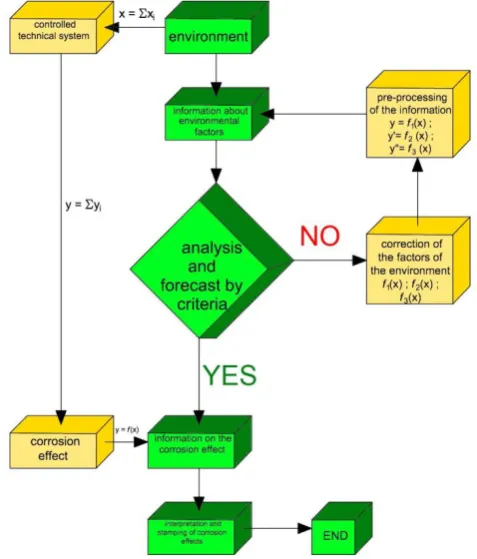
The resulting parameters are introduced into the existing model by the kinetics of the process equations. Linear deterministic systems [8] implement the principle of superposition, according to which the effect of the corrosion effect resulting from the influence of several factors is equal to the sum of the effects of the influence of each factor separately. Schemes of the main stages of collecting, processing and analyzing information for predictive deterministic objects and deterministic prognosis of corrosion processes are presented as variants of the situation.
[image:6.595.330.524.50.357.2]• Variant I - according to the input parameters is shown in Fig. 2 and is used to predict the effects of corrosion damage in operating conditions using parameters that characterize the immediate situation.
Fig.2. Scheme of variant I - by input parameters
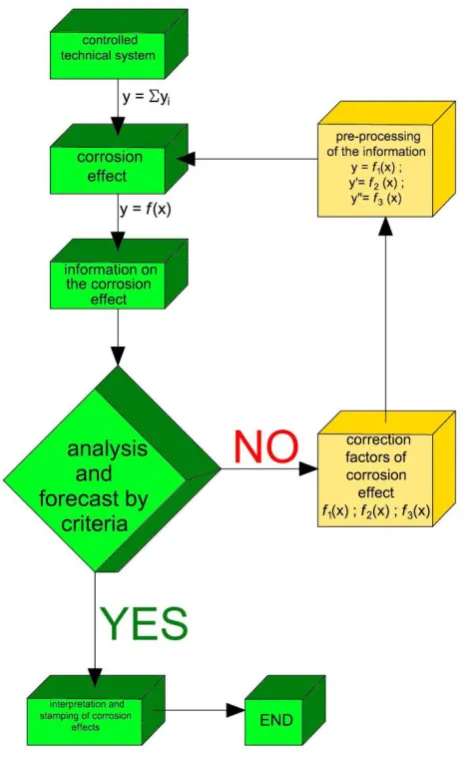
Fig. 3. Scheme of variant II - Input / Output Parameters
• VariantII - by input / output parameters is shown in Fig. 3. Provides and forecasts
[image:6.595.308.547.406.686.2]the subsequent processing of this information. Controlled parameters are fixed and adjusted. The effect of the influence factors is fixed at the outlet by external inspection of the structure during maintenance or repair after a certain period of time. The option does not allow full automation of the operational situation monitoring system [6, 25-27] .
Fig. 4. Diagram of variant III - by baseline (simplified)
• VariantIII - by default or simplified is shown in Fig. 4. Its performance is suitable for both trial and laboratory use. Under real operating conditions, this is unacceptable as the results are related to allowing the development of processes that may lead to the failure of the technical system as well as the occurrence of an emergency situation of the operating equipment.
Fig. 5. Scheme of variant IV - based on output parameters reporting the failure or failure of the technical system
• VariantIV - by baseline parameters is presented in Fig. 5, taking into account the level of failure or failure of the technical system. This scheme can be realized by taking into account the most important parameters of the external factors affecting the corrosion. For predictive data, it is advisable to compare the results of laboratory tests and in natural conditions to improve the corrosion process model.
Fig. 6. Diagram of the main stages of collecting, processing and analyzing information for stochastic prognostication of corrosion processes
[image:7.595.48.288.637.745.2]predicting different types of situation leading to the occurrence of corrosion. Their implementation is much more complicated than the implementation of determinate objects. The difficulty lies in the fact that it is practically impossible to trace the cause and effect of phenomena that objectively exist in all processes of change in the state of the material,
including corrosion processes. Mixed
(determinate-stochastic) objects efficiently combine the benefits and eliminate the damage. They are based on a well-studied model of determinate objects, as well as the statistical information needed to determine the specific process parameters.
F. Compilation of a block diagram algorithm
Mixed object models in in (x) are used for extrapolation prediction methods [7-11] and can be used for modeling (eq. 13) of the corrosion effect - KE (x):
KE x = in x = f a, x + η x (13)
Where: f (a, x) - a regular (deterministic) component describing the overall trend of change in the current (trend) trend and continuing for the projection period; η (x) is a random (stochastic) component, it is generally considered to be an uncorrelated random process resulting from unregistered or insignificant factors with zero mathematical expectation.
Its estimates are necessary to determine the accuracy of the forecast [12].Forecasting extrapolations have their own features and techniques. These include: pre-processing of digital information, including smoothing of empirical data, eliminating arbitrary fluctuations and revealing a trend [12]; • converting features to bring them to a perspective that is
convenient to predict; analyzing the nature of the predicted process of corrosion, aging and bodily damage, revealing its logic and physics, allowing to conclude on the type of extrapolation and to determine the limits of change in its parameters. In this case, the nature of the trend (increase, decrease, extremes, inflection points, symmetry, limits, boundaries) is evaluated.
The sequence of operations to select the function type to describe almost every process of damage under the influence of environmental factors and its prediction by extrapolation is given in a special literature [13-17].The following procedure for predicting additional polarity is adopted:
• visual comparative analysis of the graphical representation of the corrosion process (smoothed series) with a limited number of simple extrapolation and interpolation functions using polynomials; automatic selection of the extrapolating function type;
Fig. 7. Block diagram of the algorithm for calculating the predicted effects of corrosion influence
[image:8.595.328.546.370.591.2]• smoothing extrapolation and sliding average method. In Fig. 7 is a block diagram of the algorithm for calculating the predicted values by aligning the extrapolation of the step polynomial used in the description of the corrosion processes.
IV. FORECASTINGFORSUSTAINABLE
DEVELOPMENT
The sustainability forecasting decision begins [13, 15]: When formulating the material requirements in the article, the scope of its operational usability is determined when defining the conditions under which the material will be used in the article in particular;
• design based on the selected model and corrosion function • when choosing the material that is available in this product; • when the reliability and reliability requirements of the
forecast are formulated.
• the predictive task solution includes the following steps: • choosing an aging model of the material to the parameters
entering it;
Determination and refinement of parameter values entering the aging function using available material and product information (passive prediction) or special tests (active prognosis); formulation of the solution to the forecast problem.
Fig. 8. Block scheme of the algorithm for calculating the predicted effects of corrosion influence in sustainable development
[image:8.595.57.294.664.745.2]uthor-1 Photo
V. DISCUSION
Corrosion prediction patterns on materials are complex complexes of unrelated data that are used to assess corrosion effects. They are difficult to compile and use, and should always be used as a calculation tool, and if necessary, compared to experimental results.
The application of the models is limited to a number of arithmetic actions with numbers, which numbers should always be compared with known values of experimental data, using approximation of the values and evaluation of the error obtained. Created computational models are a computational process with available computational errors, as there is a probability of summing infinitely small rows, and in this case the models become unsustainable. In order to apply the models in practice, there should be a corrosive impact, the solution being the only one to be clear of errors (sustainable). The modeling approach leads to the use of composite polynomial mathematical equations, which facilitates the process of predicting the corrosion influence on steel elements and the ability to compile programs. The need to use specific experimental data for the particular steel element is eliminated. The proposed mathematical models allow a combination of the benefits of a particular model at the expense of another.
Despite the application of these models, their theoretical basis and algorithms are not able to fully account for corrosion because they use data and assumptions on a theoretical level.
VI. CONCLUSION
To predict a process that depends on too many aggregate factors is a complex task. The proposed algorithms and models to predict the development of corrosion and hence to predict its impact is an idealistic model based on theory and research. This model should be applied in practical terms with a view to its refinement and eventual determination of unknown constants, which will be subject to the mathematical dependencies reflected in probability theory.
Undoubtedly, in the eventual programming of the model and the participation of a sufficient number of databases in the corresponding development of the corrosion in a metal element, this model will have its practical applicability.
ACKNOWLEDGMENT
This research was supported by “Hyosel” Ltd., Sofia, Bulgaria.
The author would like to thank for the support on BorislavBonev, Technical University of Sofia, Faculty of Electronic Engineering and Technologies, Department „Microelectronics “.
REFERENCES
1. A. Shopov. Stochastic way for calculation of strength on construction steel with corrosion. In: XVIII Anniversary International Scientific Conference by Construction and Architecture “VSU’2018“, Sofia, Bulgaria, vol.1, no.1, pp.413-418, 2018, in Bulgarian.
2. A. Shopov and B. Bonev. Change of young’s module on steel specimens with corrosion by experiment. International Journal of Modeling and Optimization, vol.9, no.2, pp.102-107, 2019.
3. A. Shopov and B. Bonev. Experimental determination on the change of geometrical characteristics and the theoretical ultimate-load capacity
of corroded steel samples. International Journal of Civil Engineering and Technology vol.10, no.2, pp.320-329, 2019.
4. A. Shopov. Calculation on yield strain depending on time of corrosion influence. International Journal of Innovative Technology and Exploring Engineering, vol.8, no.7, pp. 2391-2396, 2019.
5. C. Taylor. Corrosion informatics: an integrated approach to modelling corrosion. Corrosion Engineering, Science and Technology, vol.50, no.7, pp. 490-508, 2015
6. M. Powell. Approximation theory and methods. Cambridge university press, 1981. ISBN 9780521295147
7. R.Sioshansiand A.Conejo Optimization in Engineering: Models and Algorithms. Springer, 2017. ISBN 9783319567679
8. D. Rader, Deterministic operations research: models and methods in linear optimization. John Wiley & Sons, 2010. ISBN 9780470484517 9. M. Davis. Markov models & optimization. Routledge, 2018.
ISBN9780203748039
10. Ch. Cassandras and J. Lygeros. Stochastic hybrid systems. CRC Press, 2007. ISBN 9780849390838
11. J. Kim and J. Shao. Statistical methods for handling incomplete data. Chapman and Hall/CRC, 2013. ISBN9781439849637
12. J. Devore. Probability and Statistics for Engineering and the Sciences. Cengage Learning, 2015, ISBN 9781305251809
13. J. Sachs The Age of Sustainable Development . Columbia University Press. 2015, ISBN 9780231173155
14. R. Hyndman and G. Athanasopoulos. Forecasting: principles and practice. OTexts, 2018. ISBN 9780987507112
15. P. Schwartz. The Art of the Long View: Planning for the Future in an Uncertain World. Currency Doubleday, 1995, ISBN 9780385267328 16. H.Pishro-Nik. Introduction to Probability, Statistics, and Random
Processes. Kappa Research, 2014, ISBN 9780990637202
17. E. Jaynes. Probability Theory: The Logic of Science. Cambridge University Press. 2003, ISBN 9780521592710
18. H. Paul Williams. Model Building in Mathematical Programming, John Wiley & Sons, 2013, ISBN 9781118443330
19. Y.Collette and P. Siarry. Multiobjective Optimization: Principles and Case Studies., Springer, ISBN 9783642072833
20. L. Srinath. Linear Programming: Principles and Applications., Palgrave, 1983, ISBN 9780333362228
21. P. Papalambros and D. Wilde. Principles of Optimal Design: Modeling and Computation, Cambridge University Press, ISBN 9780521622158 22. Z. Ahmad. Principles of corrosion engineering and corrosion control.
Elsevier, 2006, ISBN: 9780750659246
23. Ph. Schweitzer. Fundamentals of Corrosion: Mechanisms, Causes, and Preventative Methods. CRC press, 2009. ISBN 9781420067705 24. Tz. Tzenov. Corrosion of materials. Albatros, 2006, ISBN
9789547510715, in Bulgarian
25. Ch. Leygraf, et al. Atmospheric corrosion. John Wiley & Sons, 2016.ISBN 9781118762189
26. Ph. Marcus (ed.), Corrosion mechanisms in theory and practice. CRC press, 2017. ISBN 9781138073630
27. R. Jones (ed.). Environmental effects on engineered materials. CRC Press, 2001. ISBN 9780824700744
AUTHORSPROFILE
Antonio Shopovis in department “Mechanics and