Abstract: Internet of Things (IoT) is a technology which incorporates objects together via communication technologies and enables task automation. Nowadays, huge amount of solid wastes are generated and waste management has become a major concern. Therefore, this work proposes a novel IoT-based system for garbage collection and disposal which integrates house hold bins (HHB) and mobile garbage collector (MGC) which have mobility for automatic garbage collection and disposal. The HHB collects the garbage waste upto its threshold limit, when it reaches the threshold level it finds the nearest MGC with the help of optimal scheduling and routing algorithm to transfers the wastes to MGC, when MGC reaches the threshold level, it disposes those collected garbage to the dump yard. The implementation of optimal scheduling and routing algorithm on this system is evaluated under testbed environment and its performance found to be very effective than the existing technologies.
Index Terms: IoT, Smart Bins, Garbage Disposal, Smart city, MGC, HHB, Sensors
I. INTRODUCTION
Waste collection and disposal management is a crucial problem for both urban and rural areas. Every human is a potential producer of waste and thus a contributor to this problem. Waste is generated by domestic, commercial, industries and by diversified instances. Nowadays solid waste is one of the main metropolitan city lifestyle materials. With rapid growth of population and urbanization, yearly waste generation is estimated to rise by 70% from 2016 levels to 3.40 billion tonnes in 2050 based on the survey report of worldwide [1]. It creates huge pressure on city infrastructures like transportation, water, housing, power, city services and waste collection. Waste collection processes are one of the most difficult tasks in the rural atmosphere because the amount of wastes generated by residential, commercial, industrial sites are huge. Therefore, smart waste management is used for reducing the cost of waste collection as well as time consumed for collecting and disposing waste in the city. Similarly, waste collection by using smart assembly decreases the road traffic and keeps the environment clean. Managing waste collection is essential for building sustainable and liveable cities, but still it is a big challenge for many developing countries and cities. Rajkumar Joshi et al stated that the effective waste
Revised Manuscript Received on May 10, 2019
M.Vishnu Monishan, Department of Computer Science, Bharathiar University, Coimbatore, India.
P.B.Pankajavalli, Department of Computer Science, Bharathiar University, Coimbatore, India.
G.S.Karthick, Department of Computer Science, Bharathiar University, Coimbatore, India.
management is costly, often comprising 20%–50% of municipal budgets [2]. Adoption of essential waste management in smart city needs integrated systems that are well-organized, maintainable, and socially supported. Due to the industrial and technology development, a consumption pattern of the people all over the globe has been changed. These are due to massive quantities of different types of solid waste generated every day. So this motivated to establish an effective way for collection of solid waste and utilization of waste rather than focused on disposal alone. Therefore, waste management includes management of activities related to produce, store, collect, transport, reuse, recycle, process and dispose, which should be environmentally compatible, accepting budgets, and energy conservation [13]. Hence, using House Hold Bins (HHB’s) incorporating Mobile Garbage Collectors (MGC’s) into smart city operations may become more effective. Each bin integrated with Micro controller, Bluetooth, Radio Frequency (RF) transmitter, receiver and battery. It also embedded with Infrared (IR) sensors, gas sensors, rain sensors, actuators and motors. Optimal Scheduling and Routing Algorithm is proposed for effective scheduling and routing of HHB’s and MGC’s. This research work allows the management services for waste collection and monitoring smart bins in an efficient way. Dependable and instant piece of knowledge on the amount of waste might enable an efficient timetable management and allow a well route planning for the disposal of containers, which are arranged randomly.
II. RELATED WORKS
T. Anagnostopoulos et al. proposed a “Top-k Query based Dynamic Scheduling for IoT-enabled Smart City Waste Collection System” to address the challenges of real-time scheduling which is driven by sensor data streams. An Android app along with a user-friendly Graphical User Interface (GUI) is developed and presented in order to evaluate a waste collection scenario using experimental data. This proposed system architecture incorporates a heterogeneous fleet of trucks for serving the waste collection infrastructure. Dynamic scheduling algorithm locates the first available truck which can load waste from the filled bins using a top-k query which exploits real-time data from the relation. Also, data is stored in a spatial database in which mobile top-k queries specifies the number of the filled bins in order to initiate dynamic scheduling. An Android app has been developed for the drivers, which have a
user-friendly GUI interface with the IoT system.
Implementation of Novel Optimal Scheduling
and Routing Algorithm on IoT-Based Garbage
Disposal System
R. Fujdiak et al. implemented the genetic algorithm on advanced municipal waste collection in smart city, which mainly focusses on IoT vision that introduces promising and economical solutions for massive data collection and its analysis. To optimize the logistic procedure of waste collection, this article used the genetic algorithm for the calculation of more efficient garbage-truck routes. As an output, the research work provides a set of simulations focused on the mentioned area. Floyd-Warshal, Travelling Salesman Problem (TSP) formulation, Genetic, Dijkstra algorithms are implemented within the integrated simulation framework which is developed as an open source solution with respect to future modifications.
Hong et al. developed an IoT-based smart garbage system to reduce the amount of food waste. In this work, battery-based Smart Garbage Bins (SGBs) exchanges information with each other using wireless mesh networks. The server collects and analyses the information for service provisioning. Furthermore, the SGS includes various IoT techniques, which considers the user convenience and increases the battery lifetime through two types of energy-efficient operations of the SGB’s which are stand-alone operation and cooperation-based operation. This proposed SGS has been operated as a pilot project in Gangnam district, Seoul, Republic of Korea, for one-year period. The experiment showed that the average amount of food waste could be reduced by 33%.
Islam et al. proposed an integrated system connected with RFID, Global Positioning System (GPS), General Packet Radio Services (GPRS), Geographic Information System (GIS) and web camera which solve the issues of solid waste in urban areas. All the components are equipped with the smart bins. Central system officer’s analysis the actual performance of the system. It helps in saving the time and saves the fuel of garbage collection trucks. Thus, that system helped to minimize collection route and fuel cost.
S. Lokuliyana et al. introduced "IGOE IoT framework for waste collection optimization" uses a sensor network based on disposal sites, deployed around the city. The sensor nodes notify relevant authorities about the availability of waste to be collected. A mobile application is built for citizens to alert authorities about an overflow of an authorized disposal site or unauthorized dumping site of waste. The same application is used by the authorities to convey messages to the citizens. An optimization algorithm is used to create the route in which the trucks use to collect the garbage from the disposal sites. Finally, an analysis is done to calculate the delay of the waste collection process, effective waste collection rate and the waste collection process efficiency. The whole system is built as a framework and is named the IGOE waste collection framework.
Minh T et al. introduced a memetic algorithm to perform routing enforced with time windows and conflicts context. Model incorporates a combination of flow and set partitioning formulation to achieve multi-objective optimization.
Rahul Kumar Borah et al. proposed the remote strong waste management prototype for sharp urban environment, which empowers the common associations to screen the status of dustbins remotely via web server and keep urban environment clean, with reduced cost and time. At the point when dustbin reaches its threshold level, waste management division receives an alert message using Global System for Mobile communications (GSM).
Sahil Mirchandani et al. proposed the IoT enabled dustbins, which uses RFID tags for tracking of the wastes linked with a
web-based online system and according to the weight of waste added, host server calculates the quantity and updates in the database of virtual wallet. Also, it measures the quantity of the dustbins and updates the status of each dustbin on the municipality server. It notifies them when the dustbin is full and provides the shortest route to empty all the dustbins based on the capacity of the municipal waste loading vehicles. The capacity of trucks is calculated and updated each time according to the number of dustbins serviced by the trucks, as soon as it completes a route assigned to it. Furthermore, the user is assisted in material waste classification through the application and also the smart bin knows its content and can report back to the rest of the recycling chain about its contents. This system, target two crucial problems, which are cost efficiency in waste sorting and waste collection processes. Stellingwerff et al evaluates dynamic route planning techniques applied for underground bins for waste collection. This model decreases the volume of carbon dioxide produced in the environment from garbage collection trucks by making dynamic scheduling routing more effective.
III. PROPOSED SYSTEM ARCHITECTURE
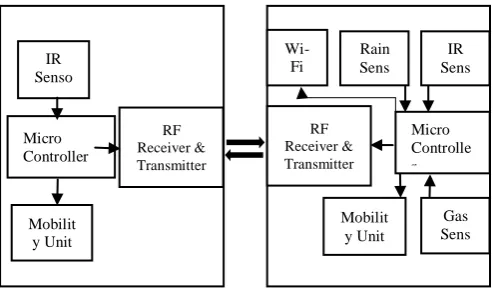
[image:2.595.308.555.355.507.2]The figure 3.1 represents the system architecture of IoT based garbage disposal system. (HHB and MGC)
Figure 3.1 Proposed System Architecture
IoT enables the transformation of cities into smart cities with the innovative services. Solid waste collection in smart cities is becoming a tedious task, with the exploration of embedded technologies on waste bins changed the solid waste collection process as dynamic. In this research work, two various kinds of bins such as House-Hold-Bin (HHB) and Mobile Garbage Collector (MGC) are used for effectual waste collection in houses and streets. The design and working of these two bins are evaluated under testbed environment and also it uses Bluetooth technology for establishing communication with work station. HHB consists of various hardware components namely: microcontroller, IR sensor, RF receiver and transmitter, mobility unit and power supply unit. IR sensor is used for continuous monitoring of waste level in the bin and its data is processed by microcontroller. Mobility unit incorporates wheels and stepper motors which provides mobility to the bins. RF receiver and transmitter are used for establishing communication with other MGC’s. MGC consists
of many hardware
components namely:
microcontroller, IR sensor, rain sensor, gas sensor,
IR Senso
r
Mobilit y Unit
RF Receiver & Transmitter
IR Sens
or
Micro Controlle r
Mobilit y Unit RF Receiver & Transmitter
Gas Sens or Rain
Sens or
Wi-Fi
Bluetooth module, mobility unit and RF receiver and transmitter. IR sensor is used for continuous monitoring of waste level in the bin and its data is processed by microcontroller. Rain sensor is used for sensing the occurrence of rain and whenever the rain is detected, it triggers the microcontroller to freezes the activities of MGC. Gas sensor is used for sensing the carbon monoxide gas generated by the waste materials and on excess generation of carbon monoxide gas, an alert message is sent to the nearest monitoring center. Mobility unit incorporates wheels and stepper motors which provides mobility to the bins. RF receiver and transmitter are used for establishing communication with other HHB’s. However, HHB’s and MGC’s are facilitated with mobility, in which HHB is used in homes whereas MGC’s are used in streets. The solid waste is collected from houses through HHB’s and transferred to MGC’s which are moving in the streets that replaces the usage of static common garbage collector. Static common garbage collector is immobile in nature and degrades the quality of environment where it is being placed. MGC’s are user friendly because it can move on the local and small street roads. Conversely, HHB’s and MGC’s are incorporated to achieve easier and efficient solid waste collection from houses and to transfer those wastages to dumps. The level of HHB’s and MGC’s are continuously monitored via IR sensors. If the level of MGC reaches its threshold, it moves towards the dump yard for the disposal. Whenever the solid waste level of HHB reaches the threshold, the information is communicated to the nearest MGC on the street. Then the nearest MGC arrives the meeting point and also the HHB reaches the meeting point for transferring the waste to MGC. The meeting point is a place where HHB and MGC are assembling for waste transferring but those meeting points are dynamically changed according to the current location of MGC’s.
3.1 Implementation of Optimal Scheduling and Routing Algorithm
An optimistic scheduling algorithm is proposed for transferring the waste from HHB to MGC by three major functions: a) identifying the nearest MGC, b) to find the meeting point where the HHB and MGC meet, c) to find the shortest path. This section deals with explanation of Optimal Scheduling and Routing Algorithm. Let us consider a set of HHB’s as x and a set of MGC’s as y. The optimistic scheduling algorithm is depicted in the Table 4.1. This proposed algorithm initially verifies the status of MGC’s and HHB’s. When the volume of a particular MGC reaches a threshold, then MGC is supposed to dispose the waste at the dump yard. The threshold for both HHB & MGC is set to the 3/4th of bins content. i.e waste reaching the 3/4th of bin is said to be the threshold which varies with respect to bin size. Conversely, when the volume of a particular HHB reaches a threshold then the proposed algorithm does the following operations: (i) identifies the nearest MGC with respect to a certain HHB, (ii) determines the meeting point where both HHB and MGC meets, (iii) calculates the shortest path rx from xi to m, (iv) calculates the
shortest path ry from the nearly identified yj to m. Accordingly,
nearest function does the job with two inputs namely: (i) the HHB which must be emptied and (ii) the set of MGC’s (y) collectors. This nearest function is concerned to perform a sequential search for finding the nearest MGC from set of y with respect to the current HHB location. Finally, this function returns the identified nearest MGC.
Point function requires two inputs: (i) HHB which must be emptied and (ii) the nearest MGC serves as mobile garbage collector to a particular HHB point. The meeting point is an intersection between a house where HHB is found to be full and nearest MGC. The meeting point is computed by calculating the distance of every individual pair between the HHB to m and m to the nearest MGC. Subsequently, this function performs the sequential search and returns the meeting point by identifying the minimal distance. Finally, the optimized routing function takes two inputs: (i) a bin ‘b’ which can be either a HHB or a nearest MGC, and (ii) a meeting point collection ‘m’. The purpose of this function is to compute the minimum set of distance between b and m. This function makes use of Resource Constraint Shortest Path Algorithm (RCSPA) proposed by Avella et al, then this algorithm is modified to fit into our research strategy. The resource constrained shortest path problem (CSP) asks for the computation of a least cost path obeying a set of resource constraints It is initially fortified with all the set of meeting points and the distance between the bin b and m. This function returns the shortest path rb between the bin b and m.
3.2 Algorithm: Optimal Scheduling and Routing Algorithm for IoT based Smart Garbage Disposal System
Table 3.1 Optimal Scheduling and Routing Algorithm
Input
// xi is a set of house-hold-bin moving from home to
meeting point
// yj is a set of mobile garbage collector moving on
local street roads
Output
rx // Returns the shortest path from xi to meeting point m ry // Returns the shortest path from yj to meeting point m
while (true) do
if (vj ≥ ɷ) then // Volume of yj reaches the threshold ɷ
vj=0 // yj tends to be emptied
end if
if (vi ≥ ɷ) then // Volume of xi reaches the threshold ɷ
ny=nearest(xi, ) // Identifies the nearest yj to meeting
point
m=point(xi, ny) // Identifies the meeting point m on the street
or local road
rx=route(xi, m) //Calculates the shortest path from xi to m
ry=route(ny, m) // Calculates the shortest path from ny to m
vx=0
end if end for
Table 3.2 Sub Procedure Nearest
Initialize Nearest() Input
xi // xi is a house-hold-bin moving from home to meeting
point
// yj is a set of mobile garbage collector moving on
local street roads
Output
ny // Nearest yj to corresponding xi
n=y1// Initializes the first y
miny=distance(xi, n) //Minimum the distance between xi and
n
for ( ) do // Calculates the ny with minimum
distance from xi
n=yj// Set the next yj
if (miny>distance(xi,n)) then
miny=distance(xi,n)
ny=n // Identifies the nearest yj to xi
end if end for
3.2.2 Sub Procedure Meeting Point
Table 3.3 Sub Procedure Meeting Point
Initialize Point() Input
xi // xi is a house-hold-bin moving from home to meeting
point
ny // Mobile Garbage Collector yj moving on street roads
nearest to xi Output
m // Meeting point between xi and ny
=radius(xi,nj) //Meeting points in junction of
street roads between xi and ny
temp=m1 // Initializes the first
minx=distance(temp,xi) // Minimum distance between mq
and xi
miny= distance(temp, ny) // Minimum distance between mq
and ny
for (mp ) do // Find the meeting point with
minimum distance between both xi and ny
temp=mp // Set the next
if((minx+miny)>(distance(temp,xi)+distance(temp,nj))) then
minx=distance(temp,xi)
miny=distance(temp,nj)
m=temp // Get the nearest m from between xi and nj
end if end for
3.2.3 Sub Procedure Route
Table 3.4 Sub Procedure Distance
Initialize Distance( ) Input
b // b {xi, nj} is either a xi or nj bin m // Identified meeting point
Output
rb // route from b to m
c=init{s1, s2,…,s∞) // Initialize the set of vertices
d=init{ t1, t2,…,t∞) // Initialize the set of edges
e=init{ u1, u2,…,u∞) // Initialize the weights
rb=dijkstra(c,d,e) // Computes the route
IV. RESULTS AND DISCUSSION
[image:4.595.305.561.199.542.2]This section deals with the experimental designed two smart bins i.e HHB’s and MGC’s. The proposed algorithm is tested on the two HHB’s (x=2) and the two MGC’s (y=2). The threshold level is denoted as ɷ for HHB & MGC which are invariable to its size, indicating waste reaches its maximum level of containers. The distance travelled by a HHB through its path from house to the meeting point m and time spent to transfer the waste from HHB to nearest MGC is measured for five repetitive trial runs as shown in the Table 4.1
Table 4.1 HHB’s average distance and time for traversing rx
Trial Run No.
Volume Distance (Meters)
Time (mm:ss)
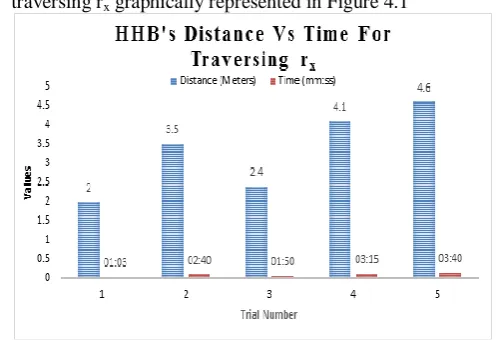
1 ɷ 2.0 01:03
2 ɷ 3.5 02:40
3 ɷ 2.4 01:50
4 ɷ 4.1 03:15
5 ɷ 4.6 03:40
Avg. Distance = 3.32
Avg. Time = 02:29
[image:4.595.305.555.359.529.2]The variation in distance and time taken by HHB for traversing rx graphically represented in Figure 4.1
Figure 4.1 HHBs distance vs time for Traversing rx
Table 4.2 MGC’s average distance and time for traversing ry
Trial Run No.
Volume Distance (Meters)
Time (mm:ss)
1 ɷ 7.2 05:15
2 ɷ 7.5 05:35
3 ɷ 8.8 06:40
4 ɷ 9.1 07:25
5 ɷ 9.6 08:00
Avg. Distance = 8.44
Avg. Time = 06:35
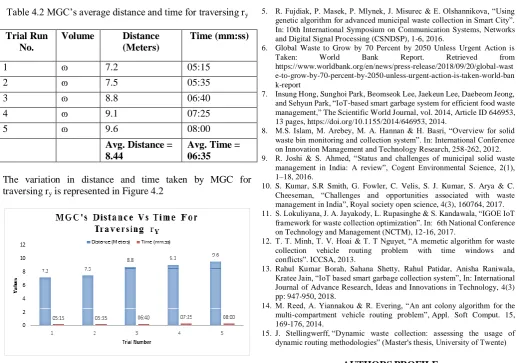
The variation in distance and time taken by MGC for traversing ry is represented in Figure 4.2
Figure 4.2 MGCs Distance vs Time for Traversing ry
V. CONCLUSION
Garbage collection and disposal is one of the services provided by smart cities, which must be redesigned by incorporating dynamic models with stable approaches. This research work integrates the HHB’s and MGC’s for automating the collection and disposal of house-hold wastes. The strengths of this methodology are: i) it incurs low cost for garbage collection and disposal ii) it provides the healthier environment. A novel optimal scheduling and routing algorithm has been proposed for effective garbage collection and disposal by identifying shortest route between HHB’s and MGC’s. This proposed novel algorithm was experimentally evaluated on trial-run under test-bed environment. The results proved that the proposed system highly constitutes a well-organized innovation for IoT-enabled garbage collection and disposal within smart cities.
REFERENCES
1. R. Agarwal, M. Chaudhary, & J. Singh, “Waste Management Initiatives in India for Human Well Being”, European Scientific Journal, 7881(June), 105–127, 2015.
2. T. Anagnostopoulos, A.B Zaslavsky, A. Medvedev & S. Khoruzhnicov, “Top -- k Query Based Dynamic Scheduling for IoT-enabled Smart City Waste Collection”, In: 2015 16th IEEE International Conference on Mobile Data Management, 2, 50-55, 2015.
3. P. Avella, M. Boccia & A. Sforza, “Resource Constrained Shortest Path Problems in Path Planning for Fleet Management”, J. Math. Model. Algorithms, 3, 1-17, 2004
4. S. Dugdhe, P. Shelar, S. Jire & A. Apte, “Efficient waste collection system”. In: International Conference on Internet of Things and Applications (IOTA), 143-147, 2016.
5. R. Fujdiak, P. Masek, P. Mlynek, J. Misurec & E. Olshannikova, “Using genetic algorithm for advanced municipal waste collection in Smart City”. In: 10th International Symposium on Communication Systems, Networks and Digital Signal Processing (CSNDSP), 1-6, 2016.
6. Global Waste to Grow by 70 Percent by 2050 Unless Urgent Action is Taken: World Bank Report. Retrieved from https://www.worldbank.org/en/news/press-release/2018/09/20/global-wast e-to-grow-by-70-percent-by-2050-unless-urgent-action-is-taken-world-ban k-report
7. Insung Hong, Sunghoi Park, Beomseok Lee, Jaekeun Lee, Daebeom Jeong, and Sehyun Park, “IoT-based smart garbage system for efficient food waste management,” The Scientific World Journal, vol. 2014, Article ID 646953, 13 pages, https://doi.org/10.1155/2014/646953, 2014.
8. M.S. Islam, M. Arebey, M. A. Hannan & H. Basri, “Overview for solid waste bin monitoring and collection system”. In: International Conference on Innovation Management and Technology Research, 258-262, 2012. 9. R. Joshi & S. Ahmed, “Status and challenges of municipal solid waste
management in India: A review”, Cogent Environmental Science, 2(1), 1–18, 2016.
10. S. Kumar, S.R Smith, G. Fowler, C. Velis, S. J. Kumar, S. Arya & C. Cheeseman, “Challenges and opportunities associated with waste management in India”, Royal society open science, 4(3), 160764, 2017. 11. S. Lokuliyana, J. A. Jayakody, L. Rupasinghe & S. Kandawala, “IGOE IoT
framework for waste collection optimization”. In: 6th National Conference on Technology and Management (NCTM), 12-16, 2017.
12. T. T. Minh, T. V. Hoai & T. T Nguyet, “A memetic algorithm for waste collection vehicle routing problem with time windows and conflicts”. ICCSA, 2013.
13. Rahul Kumar Borah, Sahana Shetty, Rahul Patidar, Anisha Raniwala, Kratee Jain, “IoT based smart garbage collection system”, In: International Journal of Advance Research, Ideas and Innovations in Technology, 4(3) pp: 947-950, 2018.
14. M. Reed, A. Yiannakou & R. Evering, “An ant colony algorithm for the multi-compartment vehicle routing problem”, Appl. Soft Comput. 15, 169-176, 2014.
15. J. Stellingwerff, “Dynamic waste collection: assessing the usage of dynamic routing methodologies” (Master's thesis, University of Twente)
AUTHORSPROFILE
M. Vishnu Monishan is a M.Phil Research Scholars in Department of Computer Science, Bharathiar University, TamilNadu, India. His research interests include Internet of Things, cloud computing, and technology innovation. Vishnu Monishan received his Master’s degree in Computer Science from the University at Bharathiar University in 2017. He received his Bachelor’s degree in Computer Science from Sankara College of Science and Commerce in 2015.
P. B. Pankajavalli is an Assistant Professor in the Department of Computer Science, School of Computer Science and Engineering, Bharathiar University, Coimbatore, Tamil Nadu, India. She obtained her Post Graduation MCA under Bharathiar University in 2003 and M.E., degree under Anna University in 2011and Ph.D., degree in Computer Science from Mother Teresa Women’s University in the year 2013. She has published more than 30 papers in journals and in Conferences both at National and International level. She has published many book chapters and filed an Indian Patent. She has received Best Teacher Award from Lions Club, Erode. Her areas of interest include Ad-hoc Networks, Wireless Sensor Networks and Internet of Things.
G.S.Karthick is a PhD Research Scholar in the Department of Computer Science, School of Computer Science and Engineering, Bharathiar University, Coimbatore, Tamil Nadu. He has received Post Graduation M.Sc. Computer Science in 2017 from Bharathiar University (UD), Coimbatore, and Tamil Nadu. He has published research papers in International Journals and presented papers in International and National Conferences. He has published many book chapters and filed an Indian Patent. His area of specializations and research interests are Wireless Sensor Networks, Internet of Things and