This is a repository copy of
Measurement of the spin temperature of optically cooled nuclei
and GaAs hyperfine constants in GaAs/AlGaAs quantum dots
.
White Rose Research Online URL for this paper:
http://eprints.whiterose.ac.uk/116353/
Version: Accepted Version
Article:
Chekhovich, E.A., Ulhaq, A., Zallo, E. et al. (3 more authors) (2017) Measurement of the
spin temperature of optically cooled nuclei and GaAs hyperfine constants in GaAs/AlGaAs
quantum dots. Nature Materials, 16 (10). pp. 982-986. ISSN 1476-1122
https://doi.org/10.1038/nmat4959
© 2017 Macmillan Publishers Limited, part of Springer Nature. This is an author produced
version of a paper subsequently published in Nature Materials. Uploaded in accordance
with the publisher's self-archiving policy.
[email protected] https://eprints.whiterose.ac.uk/ Reuse
Unless indicated otherwise, fulltext items are protected by copyright with all rights reserved. The copyright exception in section 29 of the Copyright, Designs and Patents Act 1988 allows the making of a single copy solely for the purpose of non-commercial research or private study within the limits of fair dealing. The publisher or other rights-holder may allow further reproduction and re-use of this version - refer to the White Rose Research Online record for this item. Where records identify the publisher as the copyright holder, users can verify any specific terms of use on the publisher’s website.
Takedown
If you consider content in White Rose Research Online to be in breach of UK law, please notify us by
constants in GaAs/AlGaAs quantum dots
E. A. Chekhovich1, A. Ulhaq1, E. Zallo2,3, F. Ding2, O. G. Schmidt2, and M. S. Skolnick1
1
Department of Physics and Astronomy, University of Sheffield, Sheffield, S3 7RH, United Kingdom. 2Institute for Integrative Nanoscience, IFW Dresden,
Helmholtz str. D-01069, Dresden, Germany. and
3
Paul-Drude-Institut f¨ur Festk¨orperelektronik, Hausvogteiplatz 5-7, 10117 Berlin, Germany.
Deep cooling of electron and nuclear spins is equivalent to achieving polarization degrees close to 100% and is a key requirement in solid state quantum information technologies [1–7]. While polarization of individual nuclear spins in dia-mond [2] and SiC [3] reaches 99% and beyond, it has been limited to 50-65% for the nuclei in quantum dots [8–10]. Theoretical models have attributed this limit to formation of coherent ”dark” nuclear spin states [11–13] but experi-mental verification is lacking, especially due to the poor accuracy of polarization degree measure-ments. Here we measure the nuclear polarization in GaAs/AlGaAs quantum dots with high accu-racy using a new approach enabled by manipula-tion of the nuclear spin states with radiofrequency pulses. Polarizations up to 80% are observed – the highest reported so far for optical cooling in quantum dots. This value is still not limited by nuclear coherence effects. Instead we find that optically cooled nuclei are well described within a classical spin temperature framework [14]. Our findings unlock a route for further progress to-wards quantum dot electron spin qubits where deep cooling of the mesoscopic nuclear spin en-semble is used to achieve long qubit coherence [4, 5]. Moreover, GaAs hyperfine material con-stants are measured here experimentally for the first time.
Optically active III-V semiconductors quantum dots (QDs) are considered for applications in quantum infor-mation technologies and have major advantages, such as versatile device fabrication techniques and strong inter-action between charge spin and light. However, magnetic coupling with the randomly polarized nuclei of the QD, makes the spin state of the electron vulnerable to dephas-ing and decoherence [15]. It has been shown that prepa-ration of the nuclear spins in a ”narrowed” state [5, 16] with reduced fluctuations but without significant net po-larization suppresses electron spin dephasing [17]. How-ever the improvement is limited to what can be achieved with electron spin echo. A far more attractive approach is to induce nuclear spin bath polarization close to 100%, which would not only yield extreme ”narrowing”, but also open the way for a completely new regime where electron-nuclear spin system has bosonic properties and exhibits
effects similar to cavity quantum electrodynamics – such a regime is itself a prerequisite for ambitious proposals to use nuclei for quantum memories [18] and simulators [7]. However, it proved difficult to achieve or even iden-tify the obstacles to such 100% polarization. In QDs the complexity of the problem arises from the mesoscopic na-ture of the nuclear spin bath: the typical number of spins 104−106 is too large to access each individual nucleus,
yet too small to ignore quantum correlations, coherence and fluctuations [11–13]. The problem is complicated fur-ther by inhomogeneity of the electron-nuclear interaction within the QD volume.
In QDs the degree of nuclear spin polarizationPNwas
previously estimated [8] by measuring the resulting hy-perfine shiftEhf, which is the change in the energy
split-ting of the Sz = ±1/2 electron spin levels. The shift
produced by each nuclear isotope is:
Ehf=kAIPN, (1)
whereI is the nuclear spin,A is the hyperfine constant characterizing the isotope and material only, andk is a factor (0≤k≤1) describing the spatial non-uniformities of the nuclear polarization, electron envelope wavefunc-tion, and chemical composition in a specific QD struc-ture. While Ehf can be measured very accurately, the
uncertainty inAandk, leads to uncertainty inPN. Here
we demonstrate measurement of PN not relying on
as-sumptions aboutA andk, but based on direct mapping of the spin-3/2 eigenstate populations. Notably, this al-lows Eq. 1 to be factorised leading to an accurate value forAwhich have not yet been measured experimentally despite GaAs being one of the most important semicon-ductors.
We achieve PN ≈ 80% and spin temperature TN ≈
1.3 mK at a bath temperature of T = 4.2 K. The ob-servedPN exceeds the predicted values for the quantum
limit for nuclear spin cooling [12, 13] and further exper-iments rule out the coherent ”dark” nuclear spin states as a single fundamental obstacle. Instead we expect the currently achieved PN to be limited by competing
2
32.85 32.90 32.95 33.00
0 5 10 15 20 25 30 35 c
Q
u
a
n
tu
m
d
o
t
N
M
R
s
ig
n
a
l
(
µ
e
V
)
Radio frequency (MHz)
νL~32.94 MHz ν Q~65 kHz
-1
/2
↔
+
1
/2
+
1
/2
↔
+
3
/2
-3
/2
↔
-1
/2
a
Electron spin
Nuclear spins AlGaAs
GaAs
~50 nm
B
z
b
νL
νL-νQ
νL+νQ
[image:3.612.158.454.56.306.2]m = +3/2 m = +1/2 m = -1/2 m = -3/2
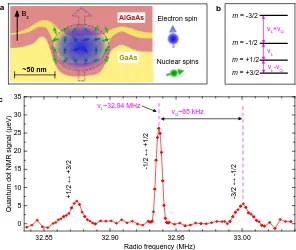
FIG. 1. Electron and nuclear spins in quantum dots. a,Schematic of a nanohole in-filled GaAs/AlGaAs quantum dot.
An electron (blue) with spinS=1/2 trapped in the dot interacts with>104 nuclear spins (green), each possessing a nuclear
spin I=3/2 for gallium and arsenic, orI=5/2 for aluminium. b, Energy levels of a nuclear spin I=3/2 have distinct spin
projectionsmalong magnetic fieldBz. Level splitting is dominated by the Zeeman effect (characterized by Larmor frequency
νL∝Bz), while qadrupolar effects cause additional changes in energies (characterized by frequencyνQ withνQ ≪νL). (c,)
Nuclear magnetic resonance (NMR) spectrum measured on75As nuclei of a single QD B1 atB
z ≈4.5 T: transitions between
individual levelsm are clearly resolved due to quadrupolar effects induced by stressing the sample along the [110] direction.
The Larmor and quadrupolar frequencies are found to beνL≈32.94 MHz andνQ≈65 kHz respectively.
We study individual GaAs/AlGaAs QDs grown by in-situ nanohole etching and filling [19]. A schematic cross-section of such a QD is shown in Fig. 1a. An individ-ual electron with spin S=1/2 can be trapped in a QD typically consisting of∼105 atoms with predominantly
I=3/2 nuclear spins. The hyperfine coupling (electron-nuclear magnetic interaction) has a dual effect of enabling polarization (cooling) of the nuclear spin by optically po-larized electrons and providing a mechanism for optical probing of the net nuclear polarization via detection of the hyperfine shift Ehf (see Eq. 1) in the QD
lumines-cence spectrum [8, 9]. (Further details on techniques can be found in Methods and Supplementary Notes 1 and 2.)
All experiments are performed at magnetic fieldBz>
4 T along the sample growth axis (z) – the resulting Zeeman shifts mhνL (h is Planck’s constant) dominate
the nuclear spin energy level structure (Fig. 1b), the spin states have well-defined projections malong the z -axis, and the frequencies of all dipole-allowed transitions
m↔m+ 1 equal the Larmor frequencyνL =γNBz/(2π)
(γN is the nuclear gyromagnetic ratio). Strain induced
quadrupolar effects give rise to small additional shifts
m2hν
Q/2 leading to a triplet of dipole-allowed transitions
with splittingνQ. The transition frequencies are probed
by measuring the nuclear magnetic resonance (NMR) spectrum as shown in Fig. 1c. Two features of the spec-trum are important for this work: (i)νQ≪νL in a wide
range of magnetic fields, so that the nuclear spin levels are nearly equidistant allowing straightforward use of the nuclear spin temperature concept [14, 20], (ii) the NMR triplet is well resolved, providing access to individual spin transitions and eventually allowing the spin temperature to be measured.
The collective state of the nuclear spin bath induced via optical cooling can be characterized by the population probabilities pm of the levels with spin projections m.
In thermal equilibrium the system is described by the canonical Boltzmann distribution:
pm=emβ/ +I X
m=−I
emβ, (2)
where dimensionless inverse temperatureβ =hνL/kbTN
is introduced andkbis the Boltzmann constant. For spin
I=1/2 any statistical distribution is described by Eq. 2 with someTN. However, forI >1/2 the nuclear spin
b
-1
/2
↔
+
1
/2
+
1
/2
↔
+
3
/2
Q
u
a
n
tu
m
d
o
t
N
M
R
sp
e
ct
ru
m
-3
/2
↔
-1
/2
a
p-3/2 p-1/2 p+1/2 p+3/2
Radio frequency
R
a
d
io
f
re
q
u
e
n
cy
e
xci
ta
ti
o
n
in
te
n
si
ty
(a
rb
.
u
n
it
s)
-3/2 ↔ +3/2 -1/2 ↔ +3/2 +1/2 ↔ +3/2 c p
+3/2p+1/2p-1/2 p-3/2
FIG. 2. Manipulation of the nuclear spin states in
quantum dots. a,Population probabilitiespmof the nuclear
spin levels with m = −3/2..+3/2 corresponding to
Boltz-mann distribution with polarization degreePN ≈+80%. b,
Schematic NMR spectrum of the spin-3/2 nuclei (dashed line) and the rectangular spectral bands of the radio frequency (rf) magnetic field used for selective saturation of the NMR
tran-sitions. c, Modified population that result from the initial
distributionaupon application of the corresponding rf band
inb. For example, selective saturation of the +1/2↔+3/2
NMR transition equalizes the p+1/2 and p+3/2 populations
without affectingp−1/2andp−3/2, while saturation of all three
transitions equalizes allpm. Such measurements produce
op-tically detected hyperfine shifts proportional to various linear
combinations of pm, combined together, they allow for the
statistical distributionpmof the optically cooled nuclei to be
reconstructed.
couple all states of the system leaving the total energy as the only constant of motion [14]. The polarization degree
PN= +I X
m=−I
mpm/I. (3)
is uniquely related to β and TN when pm are given by
Eq. 2. An example of a Boltzmann distribution with
PN≈+80% is sketched in Fig. 2a forI=3/2: most nuclei
are in am= +3/2 state with less than 2% occupying the
m=−3/2 state.
We probe pm distribution by manipulating it with
radio-frequency (rf) pulses as demonstrated in Figs. 2b,c. This is possible since the optically-detected hyperfine shift depends on PN and hence on pm (Eqs. 1, 3).
For example, a long rf pulse exciting selectively the +1/2 ↔ +3/2 NMR transition equalizes the p+1/2 and
p+3/2 populations. The resulting change in hyperfine
shift ∆E+1/2↔+3/2
hf =−kA(p+3/2−p+1/2)/2 is
propor-tional to the differencep+3/2−p+1/2 of theinitial state.
In a similar way, the hyperfine shifts arising from satu-ration of one, two or three NMR transitions can be cal-culated (see Methods) and combined to reconstruct the statistical distributionpm produced by optical cooling.
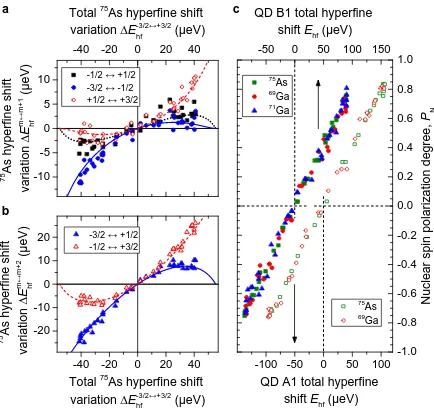
This approach is demonstrated experimentally in
Figs. 3a,b for75As nuclei in QD B1. After optical
cool-ing with light of a variable circular polarization degree, rf is applied to saturate selectively one or two NMR transitions. The resulting changes in hyperfine shifts ∆Em↔m+1
hf and ∆Em
↔m+2
hf are shown by the symbols
versus the total75As hyperfine shift ∆E−3/2↔+3/2
hf
varia-tion measured by saturating three NMR transivaria-tions. The pronounced non-linearities in the data are a clear signa-ture of large, comparable to unity|PN|, since at|PN| ≪1
(high temperature limit) all exponentsemβin Eq. 2 tend
to 1 +mβ and non-linearities vanish. For quantitative analysis we combine Eqs. 1, 3 and the spin temperature hypothesis of Eq. 2 (see derivation in Methods) and use
kAproduct as the sole fitting parameter. For QD B1 all five model curves (shown by the lines in Figs. 3a,b) are in good agreement with experiment forkA= 36.9±1.6µeV (95% confidence interval). This confirms the validity of the spin temperature hypothesis for the optically cooled nuclei. The smallest observed absolute temperature is found to be TN ≈ ±1.3 mK for 75As at Bz = 4.5 T
corresponding toPN≈ ±74%.
The measurements of Fig. 3b were repeated on differ-ent isotopes in several QDs each time in good agreemdiffer-ent with the spin temperature hypothesis. The derived po-larizations PN of the individual isotopes are shown in
Fig. 3c (top scale) as a function of the total hyperfine shift of all isotopes in dot B1. Similar results for an-other QD A1 atBz = 8.0 T are shown as well (bottom
scale) demonstrating PN up to∼ ±80% (corresponding
toTN≈+2.0 mK for75As). To our knowledgePN≈80%
is the largest reported for III-V QDs. Two factors are at play here: (i) The efficiency of nuclear spin cooling in the studied GaAs/AlGaAs nanohole dots is somewhat higher than in the previous studies: for example, the total hy-perfine shifts Ehf = ±100 µeV observed here (Fig. 3c)
can be directly compared toEhf=±90µeV observed in
GaAs/AlGaAs fluctuation dots [8]. (ii) What is more im-portant, our measurement ofPNdoes not depend on the
uncertainties in hyperfine constantsAand dot structural parameterk– it is likely thatPNwas underestimated in
earlier studies.
From Fig. 3(c) we find that optical cooling produces the samePN for all isotopes. Since the Larmor
frequen-ciesνLof the isotopes are significantly different (a factor
of∼1.78 for71Ga and75As) their spin temperaturesT N
are different too. In other words, optical cooling leaves the Zeeman reservoir of each isotope in a state of in-ternal thermal equilibrium, but out of equilibrium with other isotopes. Detailed measurements show that while
TN changes, under given optical pumping conditions the
inverse temperatureβis nearly invariant for different iso-topes and magnetic fieldsBz = 4.5−8.5 T (with
maxi-mum|β| ≈1.43 corresponding to PN≈80%). This can
4
-40 -20 0 20 40
-10 -5 0 5 10
-40 -20 0 20 40 -20 -10 0 10 20 c b 7 5A s h y p e rf in e s h if t v a ri a ti o n ∆ E m ↔ m + 1 h f ( µ e V )
Total 75
As hyperfine shift
variation ∆E-3/2↔+3/2
hf (µeV)
-1/2 ↔ +1/2 -3/2 ↔ -1/2 +1/2 ↔ +3/2 a 7 5A s h y p e rf in e s h if t v a ri a ti o n ∆ E m ↔ m + 2 h f ( µ e V )
Total 75
As hyperfine shift
variation ∆E-3/2↔+3/2
hf (µeV) -3/2 ↔ +1/2 -1/2 ↔ +3/2
-50 0 50 100 150
QD B1 total hyperfine
shift Ehf (µeV)
75
As
69
Ga
71Ga
-100 -50 0 50 100 -1.0 -0.8 -0.6 -0.4 -0.2 0.0 0.2 0.4 0.6 0.8 1.0 75 As 69Ga N u c le a r s p in p o la ri z a ti o n d e g re e , PN
QD A1 total hyperfine
[image:5.612.64.281.62.267.2]shift Ehf (µeV)
FIG. 3. Probing nuclear spin temperature in a
quan-tum dot. a,Symbols show hyperfine shifts induced by
selec-tive saturation of each of the three dipolar NMR transitions
of the spin-3/275As nuclei as a function of the hyperfine shift
measured by simultaneous saturation of all NMR transitions
in an individual QD B1 atBz ≈4.5 T.b, Same experiment
with simultaneous saturation of two NMR transitions
pro-vides better signal to noise ratio. Lines in a and b show
model calculation with hyperfine constant as the only fitting
parameter. The largest polarization of75As achieved in this
experimentPN≈ ±74% corresponds to nuclear spin
tempera-tureTN≈ ±1.3 mK.c,polarization degreePNof each isotope
as a function of the total hyperfine shiftEhfof all isotopes in
QD B1 (top scale, full symbols,Bz=4.5 T) and A1 (bottom
scale, open symbols,Bz =8.0 T). All experimental plots in
(a-c) are obtained by varying the degree of circular polarization of the optical pumping.
the electron spin projectionSzby±1 is accompanied by a
∓1 change in the nuclear spin projectionm, with each nu-cleus behaving independently, interacting only with the polarized electron spin [12, 21]. This leads to an invariant nuclear pm+1/pm=eβ determined only by the electron
spin properties. From the thermodynamics perspective, the isotopic difference inTNcan be seen to result from the
insufficient ”complexity” of the electron-nuclear flip-flop process: in particular it does not provide enough inter-action pathways to equilibrate the Zeeman reservoirs of different isotopes.
The above findings are contrary to the theoretical pre-dictions that quantum coherence between different nuclei gives rise to so-called nuclear ”dark” states, limiting the maximum achievable |PN| in QDs [11–13]. It has been
proposed that dark states can be disrupted by small per-turbations of the electron wavefunction [11, 12] or simply by the nuclear-nuclear dipolar interaction [12]. Here we perform experiments where optical pumping is blocked periodically (which empties the dot) with off-times up
to 120 ms. Such off-times exceed notably the nuclear spin transverse relaxation time T2 < 5 ms (Ref. [22])
ensuring complete decoherence of the nuclei and disrup-tion of the dark states via dipole-dipole interacdisrup-tion. On the other hand, off-times are much shorter than the nu-clear spin longitudinal relaxation time T1 >500 s (Ref.
[23]) minimizing any decay of |PN|. However, pumping
interruption was found to have no effect onPN
suggest-ing that nuclear dark states are not a limitsuggest-ing factor for achieving|PN|up to 80%. Evidently, there are intrinsic
mechanisms disrupting nuclear spin coherence – inhomo-geneity of the hyperfine interaction is the well understood one [12], while other, yet unexplored factors may include inhomogeneous quadrupolar shifts, or fluctuating electric fields arising from optically generated charges in neigh-boring QDs or traps.
With ”dark” nuclear states ruled out for the studied structures, it is important to understand what limits|PN|
at ≈80% and hence find a way to achieve |PN| ≈100%.
Here we limit ourselves to varying the parameters in the particular cooling scheme used in this work, which employs optical pumping with a continious-wave mul-timode laser (linewidth ∼4 GHz). We find that the largest |PN| ≈ 80 % (as in Fig. 3) is achieved by
excit-ing∼55 meV above the exciton ground state (see Sup-plementary Note 3). Under such conditions, the limi-tations to |PN| may arise from the loss of electron spin
polarization during energy relaxation, and competing ef-fects of heavy and light hole excitation [24]. Moreover the maximum|PN| is observed under optical excitation
powers∼1000 times larger than the saturation power of the QD photoluminescence, i.e. spin cooling may be re-lated to multiexciton complexes rather than the ground state exciton. Under such conditions optically induced nuclear spin relaxation [25] could be a significant lim-iting factor, whereas tunneling of the electrons through the thin (7nm) AlGaAs bottom barrier may increase|PN|
by enabling fast recycling of the spin-polarized electrons through the QD. Additional studies are needed to explain why the nuclear spin cooling scheme used here is most efficient at such high optical powers and excess photon energies. However, the nuclear spin temperature mea-surement techniques presented here are not limited to the particular cooling mechanism and can be readily used to explore alternative cooling protocols.
de-termined by a single hyperfine parameter A defined as [28, 29]
A= (2µ0/3)~γNgeµb|ψ(0)|2, (4)
wherege≈2 is the free electron g-factor,µ0 is magnetic
constant,µbis Bohr magneton,~=h/(2π), and the
elec-tron wavefunction density |ψ(0)|2 at the nucleus is the
only parameter characterizing the material (GaAs). By definition, fully polarized (|PN| = 1) spin-I nuclei
pro-duce electron hyperfine shiftEhf =AI regardless of the
electron envelope wavefunction [29]. However, the effec-tive hyperfine constantkAobtained from experiment on QDs is reduced by a factork≤1 which includes the non-uniformity of the wavefunction and nuclear polarization. Analysis presented in Supplementary Note 4 and based on the measurements of kA in dots with different electron confinement, shows that the spa-tial non-uniformity of PN requires a correction of
∼ 10%, which when applied leads to the 95%-confidence estimates |ψAs(0)|2=(9.25±0.20)×1031 m−3
and|ψGa(0)|2=(6.57±0.25)×1031 m−3, corresponding to
A=43.5±0.9 µeV (75As), A=43.1±1.6 µeV (69Ga), and
A=54.8±2.1µeV (71Ga). These experimental values
gen-erally agree with the original estimates of Paget et al. [29] based on the studies on InSb [28]. On the other hand the ratio |ψAs(0)|2/|ψGa(0)|2 ≈ 1.41 which has the highest
experimental accuracy deviates from ∼1.69 of Ref. [29]: the directly measured A values can be used for a more accurate modeling of GaAs electronic band structure.
Previous extensive experiments on optical probing of the QD nuclear spins have been limited to the nuclear mean-field approach [15]. The nuclear spin thermometry reported here is the first study beyond this framework and provides new routes to understanding the micro-scopic state of the nuclear spin bath. Such understanding is key to developing a self-consistent fully quantum de-scription of the QD electron-nuclear spin system, which is still lacking. The existing quantum models [5, 12, 13, 16] employ significant simplifications (e.g. small numbers of nuclei, often limited toI=1/2 spins) and are sensitive to input parameters (e.g. inhomogeneity of the hyperfine coupling) that are known only approximately. Our ob-servations can be fed back to the existing models (e.g. to identify realistic parameters that would restrict nu-clear ”dark” states to polarizations exceeding 80%) and used to develop improved models. We also envisage fur-ther experimental developments. The spin fur- thermome-try techniques can be transferred to self-assembled dots where despite large inhomogeneous quadrupolar effects the m = ±1/2 subensemble can be used [22] to ex-plore mesoscopic nuclear spin thermodynamics both in high magnetic fields as studied here, and in low fields where the spin temperature concept does not apply to the full spin 3/2 or 9/2 manifolds [30]. Further in-sights into the microscopic structure of the nuclear spin state can be achieved by exploring the correlations in
the dipole-dipole interaction reservoir – its temperature can be probed via thermal mixing with the Zeeman en-ergy reservoir [14], whose temperature can be detected reliably as shown here. Such nuclear-nuclear correlations have not been studied in QDs experimentally but are pre-dicted to have strong impact on the coherent evolution of the electron-nuclear system [5].
[1] Atature, M., Dreiser, J., Badolato, A., Hogele, A.,
Kar-rai, K., and Imamoglu, A. Quantum-Dot Spin-State
Preparation with Near-Unity Fidelity.Science312, 551–
553 (2006).
[2] Jacques, V., Neumann, P., Beck, J., Markham, M., Twitchen, D., Meijer, J., Kaiser, F., Balasubramanian, G., Jelezko, F., and Wrachtrup, J. Dynamic polarization of single nuclear spins by optical pumping of nitrogen-vacancy color centers in diamond at room temperature. Phys. Rev. Lett.102, 057403 (2009).
[3] Falk, A. L., Klimov, P. V., Iv´ady, V., Sz´asz, K., Christle,
D. J., Koehl, W. F., Gali, A., and Awschalom, D. D. Optical polarization of nuclear spins in silicon carbide. Phys. Rev. Lett.114, 247603 (2015).
[4] Burkard, G., Loss, D., and DiVincenzo, D. P. Coupled
quantum dots as quantum gates.Phys. Rev. B59, 2070–
2078 (1999).
[5] Schliemann, J., Khaetskii, A. V., and Loss, D. Spin
de-cay and quantum parallelism. Phys. Rev. B66, 245303
(2002).
[6] Kurucz, Z., Sørensen, M. W., Taylor, J. M., Lukin, M. D., and Fleischhauer, M. Qubit protection in nuclear-spin
quantum dot memories. Phys. Rev. Lett. 103, 010502
(2009).
[7] Roumpos, G., Master, C. P., and Yamamoto, Y. Quan-tum simulation of spin ordering with nuclear spins in a
solid-state lattice. Phys. Rev. B75, 094415 (2007).
[8] Gammon, D., Efros, A. L., Kennedy, T. A., Rosen, M., Katzer, D. S., Park, D., Brown, S. W., Korenev, V. L., and Merkulov, I. A. Electron and nuclear spin interac-tions in the optical spectra of single GaAs quantum dots. Phys. Rev. Lett.86, 5176–5179 (2001).
[9] Chekhovich, E. A., Makhonin, M. N., Kavokin, K. V., Krysa, A. B., Skolnick, M. S., and Tartakovskii, A. I. Pumping of nuclear spins by optical excitation of
spin-forbidden transitions in a quantum dot. Phys. Rev. Lett.
104, 066804 (2010).
[10] Petersen, G., Hoffmann, E. A., Schuh, D.,
Wegschei-der, W., Giedke, G., and Ludwig, S. Large nuclear
spin polarization in gate-defined quantum dots using a
single-domain nanomagnet.Phys. Rev. Lett.110, 177602
(2013).
[11] Imamo¯glu, A., Knill, E., Tian, L., and Zoller, P. Optical
pumping of quantum-dot nuclear spins. Phys. Rev. Lett.
91, 017402 (2003).
[12] Christ, H., Cirac, J. I., and Giedke, G. Quantum
descrip-tion of nuclear spin cooling in a quantum dot.Phys. Rev.
B75, 155324 (2007).
[13] Hildmann, J., Kavousanaki, E., Burkard, G., and Ribeiro, H. Quantum limit for nuclear spin
6
205302 (2014).
[14] Goldman, M. Spin temperature and nuclear magnetic
resonance in solids. Oxford University Press, Oxford, (1970).
[15] Urbaszek, B., Marie, X., Amand, T., Krebs, O., Voisin, P., Maletinsky, P., Hoegele, A., and Imamoglu, A. Nu-clear spin physics in quantum dots: An optical
investi-gation. Rev. Mod. Phys.85, 79–133 (2013).
[16] Barnes, E., Cywi´nski, L., and Das Sarma, S.
Nonpertur-bative master equation solution of central spin dephasing
dynamics. Phys. Rev. Lett.109, 140403 (2012).
[17] Xu, X., Yao, W., Sun, B., Steel, D. G., Bracker, A. S.,
Gammon, D., and Sham, L. J. Optically controlled
locking of the nuclear field via coherent dark-state
spec-troscopy. Nature459, 1105–1109 (2009).
[18] Schwager, H., Cirac, J. I., and Giedke, G. Quantum in-terface between light and nuclear spins in quantum dots. Phys. Rev. B81, 045309 (2010).
[19] Atkinson, P., Zallo, E., and Schmidt, O. G.
In-dependent wavelength and density control of uniform GaAs/AlGaAs quantum dots grown by infilling
self-assembled nanoholes. J. Appl. Phys.112, 054303 (2012).
[20] Paravastu, A. K. and Reimer, J. A. Nuclear spin tem-perature and magnetization transport in laser-enhanced
NMR of bulk GaAs. Phys. Rev. B71, 045215 (2005).
[21] D’Yakonov, M. I. and Perel, V. I. Optical orientation in a system of electrons and lattice nuclei in semiconductors.
theory. Sov. Phys. JETP38, 177 (1974).
[22] Chekhovich, E. A., Hopkinson, M., Skolnick, M. S., and Tartakovskii, A. I. Suppression of nuclear spin bath fluc-tuations in self-assembled quantum dots induced by
in-homogeneous strain. Nat Commun6, 6348 (2015).
[23] Ulhaq, A., Duan, Q., Zallo, E., Ding, F., Schmidt, O. G., Tartakovskii, A. I., Skolnick, M. S., and Chekhovich,
E. A. Vanishing electron g factor and long-lived
nu-clear spin polarization in weakly strained nanohole-filled
GaAs/AlGaAs quantum dots. Phys. Rev. B93, 165306
(2016).
[24] Sesti, E. L., Wheeler, D. D., Hayes, S. E., Saha, D., Sanders, G. D., and Stanton, C. J. Assignments of transi-tions in optically-pumped NMR of GaAs/AlGaAs
quan-tum wells on a bulk GaAs substrate. Phys. Rev. B 90,
125301 (2014).
[25] Paget, D., Amand, T., and Korb, J.-P. Light-induced
nuclear quadrupolar relaxation in semiconductors. Phys.
Rev. B77, 245201 (2008).
[26] Van de Walle, C. G. and Bl¨ochl, P. E. First-principles
calculations of hyperfine parameters. Phys. Rev. B47,
4244–4255 (1993).
[27] Yin, C., Rancic, M., de Boo, G. G., Stavrias, N., Mc-Callum, J. C., Sellars, M. J., and Rogge, S. Optical
addressing of an individual erbium ion in silicon. Nature
497, 91–94 (2013).
[28] Gueron, M. Density of the conduction electrons at the
nuclei in indium antimonide.Phys. Rev.135, A200–A205
(1964).
[29] Paget, D., Lampel, G., Sapoval, B., and Safarov, V. I. Low field electron-nuclear spin coupling in gallium
ar-senide under optical pumping conditions. Phys. Rev. B
15, 5780–5796 (1977).
[30] Maletinsky, P., Kroner, M., and Imamoglu, A. Break-down of the nuclear-spin-temperature approach in
quantum-dot demagnetization experiments. Nat Phys5,
407 – 411 (2009).
ACKNOWLEDGMENTS. The authors are grate-ful to Armando Rastelli (Linz), Yongheng Huo (Hefei) and Andreas Waeber (TU Munich) for fruitful discus-sions. This work has been supported by the EPSRC Pro-gramme Grant EP/J007544/1. E.A.C. was supported by a University of Sheffield Vice-Chancellor’s Fellowship and a Royal Society University Research Fellowship.
AUTHOR CONTRIBUTIONS. E.Z., F.D. and O.G.S. designed and grew the samples. E.A.C. and A.U. developed the techniques and conducted the ex-periments. E.A.C. conceived the project and analyzed the data. E.A.C. and M.S.S. wrote the manuscript with input from all authors.
ADDITIONAL INFORMATION. Correspon-dence and requests for materials should be addressed to E.A.C. ([email protected]).
DATA AVAILABILITY.The data that support the findings of this study are available from the correspond-ing author upon reasonable request.
METHODS
Experimental techniques. We use neutral quantum dots, i.e. without optical excitation the dots are empty. All experiments were conducted in a helium bath cryo-stat atT=4.2 K. In all measurements we use theOptical cooling - rf depolarization - Optical readout protocol de-scribed previously in detail [22, 31]. The rf depolarization is performed in the absence of optical excitation. The role of the short optical readout pulse is to excite photolumi-nescence whose spectrum is then analyzed with a double spectrometer and a CCD camera.
Photoluminescence of a neutral QD results from re-combination of an electron with spin up (↑) or down (↓) and a hole with spin up (⇑) or down (⇓) along the sample growth direction (z axis). We observe emission of both the ”bright” excitons|⇑↓i,|⇓↑iand ”dark” excitons|⇑↑i,
|⇓↓ithat gain oscillator strength from the bright states due to the reduced quantum dot symmetry.
The net nuclear spin polarization shifts the energies of the exciton states. The shifts are dominated by the sign of the electron spinzprojection, they are ≈+Ehf/2 for
|⇓↑i and |⇑↑i states, and ≈ −Ehf/2 for |⇑↓i and |⇓↓i
states. In order to determineEhf accurately we measure
the energy difference of the|⇓↑iand|⇓↓ibright and dark states (or of the|⇑↑i and |⇑↓idark and bright states). In this way we eliminate any contribution of the hole hyperfine interaction, as well as any simultaneous shifts of all exciton states arising e.g. from charge fluctuations in the dot vicinity.
Relation between the nuclear spin popula-tion probabilities pm and the optically detected
hyperfine shifts. In experiments we use long and weak (no Rabi oscillations) radio frequency (rf) ex-citation. If rf is resonant with the NMR transition between states m and m + 1 its effect is to change and equalize the populations of these states so that
pm, pm+1 →(pm+pm+1)/2, while population
probabil-ities of all other nuclear spin states remain unchanged. One can then use Eqs 1 and 3 to calculate the change in the optically detected hyperfine shift ∆Ehf arising from
such manipulation ofpm. For example form= +1/2 and
m+ 1 = +3/2 we calculate as follows: ∆E+1/2↔+3/2
hf =
kAh(+3 2)
p+3/2+p+1/2
2 + (+ 1 2)
p+3/2+p+1/2
2 i
− kA
(+3
2)p+3/2+ (+ 1 2)p+1/2
= −kA(p+3/2−p+1/2)/2,
i.e. the hyperfine shift ∆Ehf depends only on the
difference in the initial populations of the states excited with rf.
In a similar way, simultaneous saturation of the NMR transitions m ↔ m+ 1 and m + 1 ↔ m+ 2 leads to the following redistribution of the populations:
pm, pm+1, pm+2 → (pm+pm+1+pm+2)/3. Saturation
of all 3 NMR transition of spin I=3/2 nuclei leads to
p−3/2, p−1/2, p+1/2, p+3/2 → (p−3/2 +p−1/2 +p+1/2 +
p+3/2)/4 = 1/4, where the last equality is due to
nor-malizationPI
m=−Ipm= 1. Using Eqs. 1, 3 we evaluate
the changes in the hyperfine shift ∆Ehf for each case:
∆Em↔m+1
hf =−kA(pm+1−pm)/2 =
=−kA e
(m+1)β−emβ
4 cosh(β/2) + 4 cosh(3β/2), ∆Em↔m+2
hf =−kA(pm+2−pm) =
=−kAe(m+1)βsinh(β/2)/cosh(β),
∆E−I↔+I
hf =−kAPNI=
=−kA[3/2 + 1/cosh(β)] tanh(β/2).
(5)
The last expression in each of these equations is obtained by substituting the Boltzmann distribution (Eq. 2).
Unlike ∆Em↔m+1
hf and ∆E
m↔m+2
hf , the ∆E
−I↔+I hf
variation is a monotonic function of β with β ∈
(−∞,+∞). It is thus possible to express β in terms of ∆E−I↔+I
hf and then substitute it into expressions for
∆Em↔m+1
hf and ∆E
m↔m+2
hf , eliminating β. Since there
is no analytical solution we do this by making para-metric plots of ∆Em↔m+1
hf and ∆E
m↔m+2
hf as a
func-tion of ∆E−I↔+I
hf such as shown in Figs. 3a,b by the
lines. ThekA product is an overall scaling factor used as a parameter to fit the experimental data. One can see that such fitting can be achieved reliably only be-cause largePNis reached in experiment: only then there
are pronounced asymmetries and nonlinearities in the ∆Em↔m+1
hf (∆E
−I↔+I
hf ) and ∆E m↔m+2
hf (∆E
−I↔+I
hf )
de-pendencies (observed in Figs. 3a,b). By contrast, in the high temperature limit (β → 0, PN → 0) Eq. 5 yields
linear dependencies ∆Em↔m+1
hf = (1/10)∆E
−I↔+I
hf ,
∆Em↔m+2
hf = (4/10)∆E
−I↔+I
hf independent of m, so
that experiment can be described with anykA, making fitting impossible.
Once kAis obtained from fitting, one can use the last of Eq. 5 to uniquely relate the experimentally measured ∆E−I↔+I
hf , and the quantities of interest such as
polar-ization degree PN, the inverse temperature β, and the
nuclear spin temperatureTN itself.
[31] Chekhovich, E. A., Kavokin, K. V., Puebla, J., Krysa, A. B., Hopkinson, M., Andreev, A. D., Sanchez, A. M., Beanland, R., Skolnick, M. S., and Tartakovskii, A. I. Structural analysis of strained quantum dots using
nu-clear magnetic resonance. Nature Nanotech. 7, 646–650