Page 2 3 5 9 18 23 32 42 42 46 46 47 49 50 59 64 72 77 78 79 83 109 113 114 115 118 121 121 143 143 146 195 ERRATA
L in e Should read
17 . . . , 1952))
6 . . . l i q u i d s . ( A ld e r and W a in w r ig h t, 1957) 7 c la s s ( n o t g l a s s )
23 . . . London (1942) i n . . . 12 . . . = —jj_. _F . . .
13 a ( n o t 0 )
7 momentum ( n o t v e l o c i t y ) 4 s h e l l ( n o t s h a l l ) 10 p r o v id e ( n o t form )
5 exp ( n o t r x p )
18 . . . a n a l y t i c p r o p e r t i e s o f th e in t e g r a n d . The e r r o r . . . 22 s p h e r i c a l l y ( n o t s p h e r i c a l by)
52 e t c . cm3/mole ( n o t cm3/M) 20 d e l e t e by
19 c h o ic e s ( n o t e s t im a t e s ) 11 C row ell ( n o t C ro w e l)
10 i n t e g r a t i o n ( n o t i n t e g r a t i o n ) 11 were ( n o t where)
9 . . . t h i s i s more . . .
B i s r i n g r a d iu s r a t h e r than d ia m e te r As f o r page 79.
23 . . . f u n c t i o n f o r th e l i q u i d ta ke s t h r e e m inutes 15 n e v e r t h e le s s ( n o t ne ve r th e l e s s )
17 books ( n o t bookes)
16 . . . between a n g u la r momentum f l u x and th e heat 3 . . . = - f ( ppp + P+ ) . dA
16 f a s h i o n , t h e n , ( n o t o c c u r r i n g ) 17 f a s h i o n , t h e n , ( n o t o c c u r r i n g ) 17 l e d ( n o t le a d )
23 sh o u ld ( n o t s o u ld ) 2 C u r t i s s ( n o t C u r t i s )
by
DENIS JAMES EVANS
A t h e s i s s u b m i t t e d t o t h e A u s t r a l i a n N a t i o n a l U n i v e r s i t y f o r t h e d e g r e e o f D o c t o r o f P h i l o s o p h y .
PREFACE
Thi s work was c a r r i e d o u t as p a r t o f a j o i n t p r o j e c t between t h e Computer C e n t r e and t h e D i f f u s i o n Res e ar c h U n i t a t t h e A u s t r a l i a n N a t i o n a l
U n i v e r s i t y . I g r a t e f u l l y a cknowle dge t h e f i n a n c i a l a s s i s t a n c e o f a Commonwealth P o s t g r a d u a t e Award d u r i n g t h i s p e r i o d .
ABSTRACT
This t h e s i s d e s c r i b e s t h e s t a t i s t i c a l mechanics o f polya tomic m o l e c u l e s . I t i s assumed t h r o u g h o u t t h i s work t h a t t h e s e mole cules may be t r e a t e d as c l a s s i c a l r i g i d bo di es i n t e r a c t i n g w i t h one a n o t h e r through a n g l e d epende nt i n t e r a c t i o n p o t e n t i a l s . Although most o f t h e numerical t e c h n i q u e s used t o c a l c u l a t e t h e bulk p r o p e r t i e s o f p ol ya to mi cs have a w i d e r a p p l i c a b i l i t y , t h e main theme o f t h i s t h e s i s i s t h e p r e d i c t i o n
and c o r r e l a t i o n o f t h e ma cr osc opi c p r o p e r t i e s o f benzene u s in g i n t e r a c t i o n p o t e n t i a l s t h a t a r e de velope d in t h e second and f o u r t h c h a p t e r s .
Two i n t e r a c t i o n p o t e n t i a l s a r e proposed f o r t h i s purp os e. The f i r s t t o be d evelope d i s a t h r e e - b o d y p o t e n t i a l based on a t e n s o r formalism which i s e x a c t in t h e long range l i m i t , w h i l e t h e second i s a r e l a t i v e l y si mp le two-body p o t e n t i a l . I t i s b e l i e v e d t h a t in r e g a r d t o t h e p r e d i c t i o n o f a wide v a r i e t y o f ma cr o sc o pi c p r o p e r t i e s o f benzene in a l l t h r e e p h a s e s , t h a t both o f t h e s e p o t e n t i a l s a r e more a c c u r a t e than any p r e v i o u s l y known benzene i n t e r a c t i o n p o t e n t i a l s .
Both p o t e n t i a l s a r e developed by f i t t i n g t o e x pe r i me n t a l d a t a f o r t h e second v i r i a l c o e f f i c i e n t o f benzene vapour and t h e s t r u c t u r e and s u b l i m a t i o n e ner gy o f t h e low t e m p e r a t u r e and p r e s s u r e benzene c r y s t a l .
The s i m p l e r benzene p o t e n t i a l i s then used t o p r e d i c t t h e s t r u c t u r e o f l i q u i d benzene and t h e t r a n s p o r t c o e f f i c i e n t s o f d i l u t e benzene vapour.
This t h e s i s d e s c r i b e s t h e f i r s t d i r e c t c a l c u l a t i o n o f t h e t r a n s p o r t c o e f f i c i e n t s o f a d i l u t e pol ya t omi c gas u s i n g a r e a l i s t i c i n t e r a c t i o n p o t e n t i a l . The
formalism described is q u ite general applying to f l u i d s o f a r b i t r a r y d e n s ity , composed o f molecules in t e r a c t in g through a r b it r a r y N-body p o te n tia ls .
The work described in t h i s th e sis has been reported in a number o f papers
D.J. Evans, Computational Methods in Mathematical Physics, edited by R.S. Anderssen and R.O. Watts, Queensland U n iv e rs ity Press, 1974.
CAPTIONS TO FIGURES
This l i s t of c a p t i o n s does n o t i n c l u d e a l l f i g u r e s s i n c e many o f t h e f i g u r e s a r e e i t h e r e x p l a i n e d in d e t a i l in t h e t e x t o r a r e s e l f - e x p l a n a t o r y .
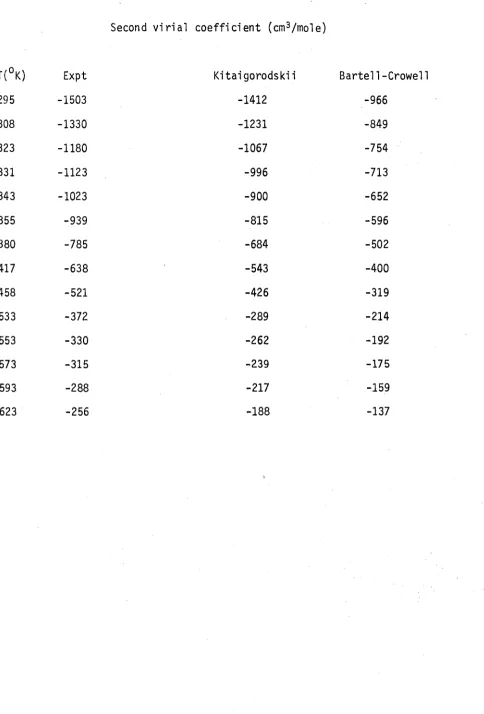
Fi g. 3 . 1 : Un it s o f B a r e cm3/Mole.
F i g . 3 . 2 : Experimental d a t a given as c i r c l e s , i s from Keyes e t a l . , (193 6) ; Kell e t a l . , ( 1 9 6 5 ) ; Vukalovick e t a l . , (1967) and Kell e t a l . , (1968). ( s e e Evans and W a t t s , 1974).
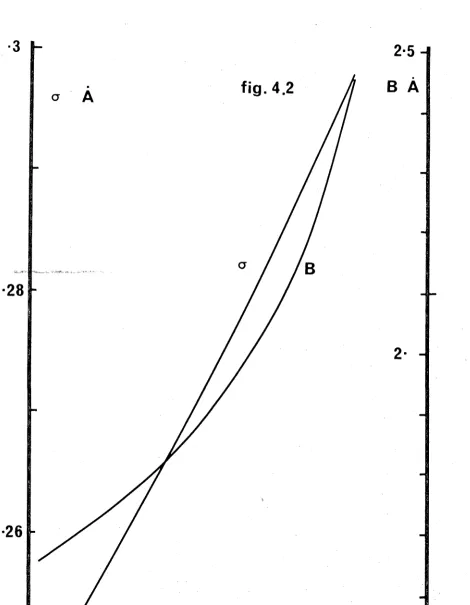
Fig. 4 . 1 : Experimental d a t a i s from Bottomley and S p u r l i n g , (1966).
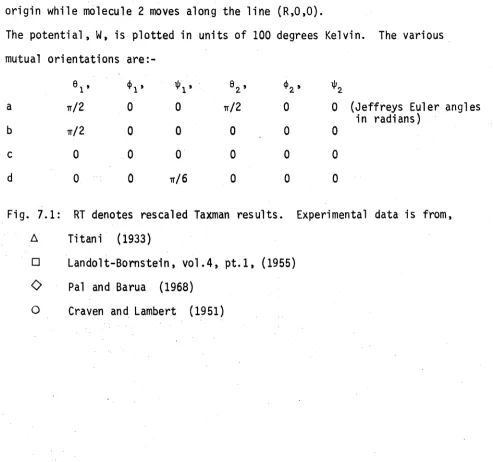
Fig. 4 . 3 : Res cale d t e n s o r p o t e n t i a l . Molecule 1 has i t s c e n t r o i d on t h e o r i g i n w h i l e mol ec ul e 2 moves a lon g t h e l i n e ( R , 0 , 0 ) .
The p o t e n t i a l , W, i s p l o t t e d in u n i t s o f 100 d e g re es Kelvin. The v a r i o u s mutual o r i e n t a t i o n s a r e :
-V
V
V
V
d>
>*2
a it / 2
0
0
tt/ 20
0
( J e f f r e y s E u l e r a n g l e sin r a d i a n s )
b tt/ 2
0
0
0
0
0
c
0
0
0
0
0
0
d
0
0
tt/ 60
0
0
Fi g. 7 . 1 : RT d e n o t es r e s c a l e d Taxman r e s u l t s . Experimental d a t a i s from, A T i t a n i (1933)
□ Landolt-■Bornstein, v o l . 4 , p t . l , (1955)
o
Pal and Barua (1968) [image:7.554.33.533.42.820.2] [image:7.554.36.529.348.810.2]TABLE OF CONTENTS P r e f a c e
Ac k no wl ed g eme n ts A b s t r a c t
C a p t i o n s t o f i g u r e s
CHAPTER 1 : INTRODUCTION 1
CHAPTER 2 : ASYMPTOTIC INTERACTIONS BETWEEN ANISOTROPIC MOLECULES 8
§ 2 . 1 I n t r o d u c t i o n c 9
§ 2 . 2 E l e c t r o s t a t i c and i n d u c t i o n i n t e r a c t i o n s 11 § 2 . 3 F o r c e s o f qu a nt um m e c h a n i c a l o r i g i n 17 § 2 . 4 C o n t r a c t i o n o f t e n s o r f orms 22 CHAPTER 3 : THE SECOND VIRIAL COEFFICIENT OF GASES COMPOSED OF RIGID
POLYATOMICS 27
§ 3 . 1 D e r i v a t i o n o f t h e s e c o n d v i r i a l c o e f f i c i e n t
f o r r i g i d m o l e c u l e s 28
§ 3 . 2 N o n - p r o d u c t i n t e g r a t i o n f o r m u l a e 35 § 3 . 3 Com pa ri s on o f f o r m u l a e a c c u r a c y 46 § 3 . 4 Example: The s e c o n d v i r i a l c o e f f i c i e n t o f s t e a m 50 CHAPTER 4 : THE DEVELOPMENT OF BENZENE INTERACTION POTENTIALS 58 § 4 . 1 B r i e f h i s t o r y o f p r o p o s a l s f o r b e n z e n e p o t e n t i a l s 59 § 4 . 2 The d e v e l o p m e n t o f a t e n s o r form f o r t h e b e n z e n e
p o t e n t i a l 67
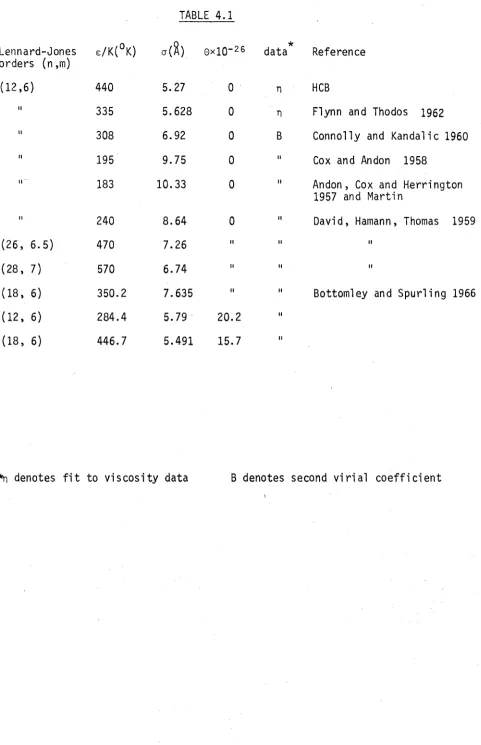
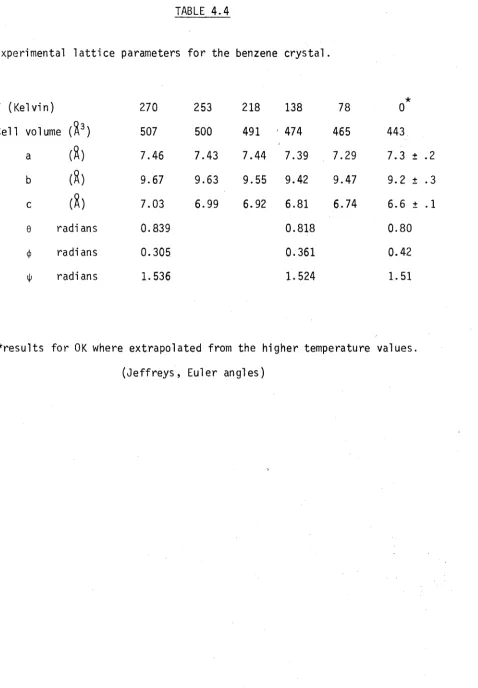
§ 4 . 3 P a r a m e t e r e s t i m a t i o n u s i n g s e c o n d v i r i a l c o e f f i c i e n t
d a t a 72
§ 5 . 2 The Mont e C a r l o me t h o d 95
§ 5 . 3 The Mo n t e C a r l o s i m u l a t i o n o f l i q u i d b e n z e n e 99
§ 5 . 4 C o n c l u s i o n 109
CHAPTER 6 : TRANSPORT PROCESSES IN WEAKLY ANISOTROPIC FLUIDS COMPOSED
OF RIGID POLYATOMIC MOLECULES 111
§ 6 . 1 I n t r o d u c t i o n 112
§ 6 . 2 The e q u a t i o n s o f c o n s e r v a t i o n 117
§ 6 . 3 S t a t i s t i c a l m e c h a n i c a l e x p r e s s i o n s f o r h y d r o d y n a m i c
v a r i a b l e s 127
§ 6 . 4 K u b o - Gr ee n e x p r e s s i o n s f o r t r a n s p o r t c o e f f i c i e n t s 138
CHAPTER 7 : TRANSPORT COEFFICIENTS OF DILUTE POLYATOMIC GASES 142
§ 7 . 1 I n t r o d u c t i o n 143
§ 7 . 2 The WCU and Taxman f o r m a l i s m s 149
§ 7 . 3 Me t h o d 154
§ 7 . 4 C o n v e r g e n c e and a c c u r a c y o f t h e r e s u l t s 162
§ 7 . 5 C o m p a r i s o n o f model p r e d i c t i o n s w i t h e x p e r i m e n t 174
APPENDIX I : E u l e r A n g l e s 178
APPENDIX I I : An A s i d e on t h e R o t a t i o n a l Dy n a mi cs o f C l a s s i c a l
R i g i d B o d i e s 180
APPENDIX I I I : P r o o f t h a t t h e p r e s s u r e t e n s o r i s s y m m e t r i c i n an
o r i e n t a t i o n a l l y i s o t r o p i c f l u i d 183
1.
CHAPTER 1 INTRODUCTION
Mechanics p r o v i d e s an e s s e n t i a l l y e xa c t d e s c r i p t i o n o f t h e temporal e v o l u t i o n o f a system gi ven a complete d e s c r i p t i o n o f t h e s t a t e o f the system a t some i n i t i a l t i m e . S t a t i s t i c a l mechanics, which we s h a l l t ake t o i n c l u d e both e q u i l i b r i u m and n o n - e q u i l i b r i u m s t a t i s t i c a l mechanics, makes r e a son abl e p r e d i c t i o n s about t h e pr oba bl e s t a t e s o f a system from an
i n c o m p l e t e knowledge o f i t s s t a t e a t a gi ven p o i n t o f t i m e . The use o f s t a t i s t i c a l mechanics i s u s u a l l y r e s er v e d f o r macroscopi c syst ems, where t h e v er y l a r g e number o f degrees o f freedom, t y p i c a l l y o f t h e o r d e r o f A vo g ad r o' s number, p r e v en t s t he d i r e c t use o f mechanics.
S t a t i s t i c a l mechanics p r o v i d e s a means o f d e r i v i n g t h e thermodynamic b e h a v i o u r o f macroscopi c systems from a knowledge o f t h e mutual i n t e r a c t i o n s o f t h e p a r t i c l e s o f which t h e system i s composed. The purpose o f
s t a t i s t i c a l mechanics i s t h e r e f o r e t w o - f o l d . I t can " d e r i v e " t h e laws o f
bot h e q u i l i b r i u m and n o n - e q u i l i b r i u m thermodynamics from mechanical p r i n c i p l e s , t h e r e b y u n i f y i n g o u r knowledge o f p h y s i c s . A t a more p r a c t i c a l l e v e l ,
many o f t h e b u l k p r o p e r t i e s o f a system can be c a l c u l a t e d from a knowledge o f t h e i n t e r m o l e c u l a r i n t e r a c t i o n p o t e n t i a l s g o ve r n in g t h e b e h a v i o u r o f i t s c o n s t i t u e n t m ol e c u l e s .
J u s t as t h e r e are two branches o f t hermodynamics, one f o r e q u i l i b r i u m systems ( P i p p a r d , 1966-»Buckingham,1964) and one f o r n o n - e q u i l i b r i u m systems
(de Groot and Mazur, 1963; F i t t s , 1962) t h e r e are two d i v i s i o n s o f
s a t i s f i e s our knowledge o f the macro-system. From a knowledge o f the average behaviour o f the microstates w ith in the ensemble the thermodynamic p ro p e rtie s o f the macro-system can be calcu la te d . Non-equilibrium
s t a t i s t i c a l mechanics is less well developed than e q u ilib riu m s t a t i s t i c a l mechanics, and the most w idely used the orie s r e fe r only to systems th a t
are close to e q u ilib riu m . This is not a great handicap since no n-equilibrium thermodynamics deals only w ith small deviation s from the e q u ilib riu m state and the m a jo rity o f everyday, p r a c tic a l n o n -e q u ilib riu m or tra n s p o rt processes occur in f l u i d s close to e q u ilib riu m ( i . e . in f lu i d s where the approximate phenomenological equations governing tra n s p o rt are l i n e a r ) . The i n t r i n s i c d i f f i c u l t i e s o f tr e a tin g n o n -e q u ilib riu m , or tra n s p o rt processes, in dense f l u i d s meant th a t a tra n s p o rt theory s p e c if ic to d i l u t e gases, k in e t ic th e o ry , was the f i r s t to be developed. This formalism was developed by Maxwell (1867) and Boltzmann (1872) s h o r tly before the Gibbs theory of
e q u ilib riu m s t a t i s t i c a l mechanics, The more general theory o f no n-equilibrium s t a t i s t i c a l mechanics, appropriate to any de nsity regime, was developed much l a t e r by a number o f workers (Kubo (1957), Green (1954, 1952)
although the e a r l i e r work o f E instein (1910) and Onsager (1931a,b) ind ica ted the general d ire c tio n s such a theory should fo llo w . The general formalism, known v a rio u s ly as l in e a r response theory or Kubo-Green th e o ry , expresses tra n s p o rt c o e ffic ie n t s in terms o f in te g ra ls over time c o r re la tio n functions evaluated in the e q u ilib riu m s ta te .
3.
spherical "point" p a r t i c l e s devoid of int er nal degrees of freedom are
r e l a t i v e l y well understood. However, even f or monoatomic f l u i d s the
evaluation of s t a t i s t i c a l mechanical expressions required f or the p r e d i c t
ion of many system properties is quite d i f f i c u l t and i t has only been with
the aid of the modern e l e c tr on i c computer t h a t progress has been made
toward the understanding of monoatomic l i q ui d s.
For dense systems three basic computer simulation methods are
a v a i l a b l e : the Monte Carlo method (Metropolis et a l . 1953) which is
extensively used f o r the calculat ion of equilibrium pr op er ti es , the
t
molecular dynamics technique (Wainwright and Al de r, 1957) which can be
used to fol low the temporal evolution of equi libri um or non-equilibrium
systems and the steady-state molecular dynamics technique (Hoover and
Ashurst, 19 75) which,as i t name suggests, applies d i r e c t l y to steady state
systems. For d i l u t e gases, t h eor et ic al s im pl i f i c a t i o n s are possible which
reduce the numerical complexity of the c al cul at ion of many bulk properties.
The c or rel at ion i nt eg ra ls can be s im p li f i e d to y i e l d expressions f o r the
transport c oe f f i c i e n t s of d i l u t e gases which are very s i m i l a r to the f i r s t
order Chapman Enskog solutions of the Boltzmann e quat ion( Mor i, 1958 and
Green, 1954 ). Mori and Green have therefore provided a bridge between k i n e t i c
theory and the general theory o f non-equilibrium s t a t i s t i c a l mechanics, namely
l i n e a r response theory. For the equilibrium properties of a d i l u t e gas the
v i r i a l expansion of the Gibbs p a r t i t i o n function (Mayer and Mayer, 1940)
s i m p l i f i e s the calculat ion of the equation of s t a te . All of these techniques
have been used ext ensively in the study of monatomic systems in a l l three
phases ( H i r s c h f e l d e r , Curtiss and Bi rd, 1954 - henceforth referred to as
P r io r to the development o f sim ula tion techniques the e q u ilib riu m p ro p e rtie s o f dense f l u i d s were calcu la ted using a number o f approximate methods based upon the s o lu tio n o f in te g ra l equations (Percus and Yevick, 1958; Percus, 1962 and Van Leeuwen, Groenveld and de Boer, 1959). In a sense these methods can be looked upon as an approximate extension o f v i r i a l expansion techniques to dense systems.
With a view to reducing computer time requirements, a number o f p e rtu rb a tio n approaches have also evolved. A reference system is simulated by p a r t ic le s in te r a c tin g through a nu m erica lly simple in te r a c tio n p o te n tia l
c
so th a t the c a lc u la tio n o f i t s p rope rties can be performed ra p id ly using e it h e r Monte Carlo or molecular dynamics methods. The reference system is then used to compute the thermodynamic p rope rties o f a more r e a l i s t i c system using p e rtu rb a tio n theory (Zwanzig, 1954; Barker and Henderson,
1971). This technique is often almost as accurate, and u su a lly more e f f i c i e n t than, performing a d ir e c t sim ulation using the r e a l i s t i c
p o te n tia l fu n c tio n . Although a number o f pe rtu rb a tio n theories have been proposed f o r the tra n s p o rt p ro p e rtie s o f dense f lu i d s these have so f a r proved e it h e r in c o r r e c t or in t r a c t a b le (Watts, 1971; Coidea,1973;
Frisch and Berne, 1965 , and H a r r is , 1971).
Although the basic techniques used f o r monoatomic f l u i d s general ize to cover the corresponding s itu a tio n s in v o lv in g polyatomic f l u i d s , i t has only been f a i r l y re c e n tly th a t d e ta ile d work has been reported on the s t a t i s t i c a l mechanics o f polyatomic systems (Rowlinson, 1951; W illia m s, 1966). These systems are o f considerable i n t e r e s t , since the vast m a jo rity o f substances we meet in the la b o ra to ry are composed o f polyatomic
5.
l i t t l e time describing the formal equilibrium s t a t i s t i c a l mechanics of poly
atomic systems. However, the extra degrees of freedom possessed by poly
atomic molecules have profound e f fec ts on the transport processes of such
f l u i d s . An o u t l i n e of these e ff ec ts is contained in Chapter 6.
In our study of the s t a t i s t i c a l mechanics of polyatomic systems
we shall use the benzene molecule as a paradigm f or a r e l a t i v e l y large
glass of polyatomics. Apart from the f a ct t ha t i t is a compound of some
i n t r i n s i c i n t e r e s t , being the fundamental aromatic hydrocarbon , i t is a
highly non- sphe ri ca l, non-polar molecule t ha t is r e l a t i v e l y l a r g e , heavy
and r i g i d . Because of i t s size we expect t hat classical mechanics should
provide an accurate description of i t s dynamical behaviour. The r e l a t i v e l y
high frequencies of the normal modes of the molecule suggest t ha t with the
exception of a few p rop er t ie s, discussed in Chapter 7, i t is a good approx
imation to ignore the i nt er nal v ibr at iona l degrees of freedom of the
molecule. I t s non-polar character means t ha t a study of benzene should pro
vide a useful complement to the work that has been underway f o r some time
into the s t a t i s t i c a l mechanics of the polar water molecule (Rowlinson,
1951; Rahman and S t i l l i n g e r , 1971; Watts, 1974). Also, the large degree
of non-sphericity implies t h a t techniques f o r t r e a t i n g polyatomics as
perturbations of spherical molecules (Pople, 1954; Rushbrooke e t a l . , 1973)
are l i k e l y to be r e l a t i v e l y i n e f f i c i e n t when compared with methods that
approach the non-sphericity d i r e c t l y .
In p a r t , t his thesis w i l l concern i t s e l f with developing r e a l i s t i c
i n t er a ct i on p ot en ti al s s pe c i f i c to benzene molecules. These potentials
enable the accurate prediction o f the bulk properties of benzene in a l l
three phases. However, the methods used to perform these calculations have
a wider a p p l i c a b i l i t y . Any polyatomic molecule whose dynamical behaviour
may be approximated by assuming t h a t i t is a classical r i g i d body i n t er ac ti ng
through an angle-dependent i n t er a ct i on potenti al may be studied using the
Two d i s t i n c t types of benzene i n t er ac ti on potential are developed.
The f i r s t is a r e l a t i v e l y accurate potenti al based upon the Jansen T-tensor
formalism (Jansen, 1958). This potential correl ates data concerning the
quadrupole moment, pola r i z a b i 1i t y tensor and i onizat ion potential of the
benzene molecule with the second v i r i a l c o e f f i c i e n t of benzene vapour and
the st ructure and sublimation energy of the benzene c r y s t a l . This potential
is too complex, however, to be used in the time consuming calculations of
the l i q u i d structure and the d i l u t e gas transport c oe f f i c i e n t s o f benzene.
A simpler potenti al was developed to be used f o r these purposes. A
general-s.
i z a t i o n of the empirical Lennard-Jones ( 12 ,6 ) potenti al (Lennard-Jones,
1924) was found to be quit e accurate in s pi te of i t s s i m p l i c i t y . This
po tenti al predicts the second v i r i a l c o e f f i c i e n t , shear viscosit y and
thermal conductivity of benzene vapour and the sublimation energy and uni t
c ell volume of the benzene c r y s t a l , a l l wi thin combined numerical and
computational e rrors.
Chapter 2 gives a short account of the general theory of aniso
t r o p i c i n te ra c ti on potenti als using the T-tensor formalism. In the f i r s t
part of Chapter 3 the formal theory of the v i r i a l expansion f or d i l u t e poly
atomic gases is described while in the l a t e r h a l f of the chapter numerical
procedures are developed which enable the highly e f f i c i e n t calculation of the
second v i r i a l c o e f f i c i e n t of polyatomics. The actual calculation of the second
v i r i a l c o e f f i c i e n t of benzene as modelled by various t e n t a t i v e l y proposed
i n t e r a ct i o n p o t e n t i a l s , is used in Chapter 4 , together with model predictions
of the s t a b i l i t y and structure o f the benzene c r y s t a l , to develop and
r e f i n e the proposed p o te n t i a l s . Chapter 4 eventually leads to the two
benzene i n t er a ct i on potenti als discussed e a r l i e r , the T-tensor potential
and the generalized Lennard-Jones p o t e n t i a l . In Chapter 5 the generalized
Lennard-Jones potenti al is used to predict the structure of l i q u i d benzene.
The general transport theory of f l u i d s composed of r i g i d polyatomic molecules
7.
CHAPTER 2
Asymptotic i n t e r a c t i o n s between a n i s ot r o p i c molecules
§2.1 I nt ro d uc t io n
§2.2 E l e c t r o s t a t i c and i nduction i n t e r a c t i o n s
§2.3 Forces of quantum mechanical o r i g i n
9.
§2.1 I n t r o d uc t i on .
In t his chapter we develop concepts and methods f o r handling those
anisotropic int er ac ti ons which w i l l prove useful in devising a benzene i n t e r
action p o t e n t i a l . This chapter should also provide a useful introduction to
the theory of anisotropic i nt er a ct ions since the formalism we shall use is
quite general and provides a uniform framework within which to t r e a t
a large class of possible i n t e r a c t i o n s .
Long range intermolecul ar forces are l a r g e ly of three types: the
int er ac ti ons between molecules with permanent e l e c t r o s t a t i c moments, the
t
induction forces that arise between such molecules when t h e i r permanent
moments induce f u r t h e r (temporary) moments in the pol ari za bl e molecules
about them, and dispersion forces which owe t h e i r o r ig i n to correl ati ons of
the quantum mechanical f luct uat i ons in the charge d i s t r i b u t i o n of the i n t e r
acting molecules..
All of these forces involve e l e c t r o s t a t i c s and we might expect a
s i m i l a r set o f int er ac ti ons to e x i s t between the magnetic moments of molecules.
Unless molecules have permanent magnetic moments of e le c tr on ic rather than
nuclear o r i g i n ( i . e . paramagnetic molecules) these forces are n eg l i g i b l e by
comparison with the corresponding e l e c t r o s t a t i c forces (HCB chapt. 12).
Further, since we are u l t i m a t e l y concerned with benzene,which is diamagnetic,
we w i l l not need to mention magnetic i nt er act ions f ur t h e r .
There are a number o f schemes f o r calc ul at in g the e l e c t r o s t a t i c
f i e l d s of anisotropic charge d i s t r i b u t i o n s . One could represent the d i s t r i b u t
ion by a set of monopoles ( point charges). This was done by London (1941) in
his monopole representation o f anisotropic dispersion forces. A l t e r n a t i v e l y ,
the charge d i st r ib u t i o n s could be expanded in spherical harmonics (HCB) and this
technique is found useful in accurate quantum mechanical calculations of
However, by f a r the simplest method is to use a tensor formalism
t hat arises n a t u r a l l y from a Taylor series expansion of the charge d i s t r i b u t i o n
This technique has been elegant ly described by Jansen (1958) and y ields f in al
expressions f o r e l e c t r o s t a t i c f i e l d s and potenti als as contractions of multi pole
moment tensors with "i nt er ac ti on T-tensors" of various ranks. Throughout t his
11.
§2.2 E l e c t r o s t a t i c and induction in te r a c t io n s
We introduce the T-tensor notation by considering the e l e c t r o s t a t i c
f i e l d produced by the permanent e l e c t r o s t a t i c moments of a molecule. Suppose
t h a t molecule i consists of a number of point charges e . at p o s i t i o n s r ^
and we wish to know the e l e c t r o s t a t i c p o t e n t i a l ^ , at a position JR. From the
theory of e l e c t r o s t a t i c s (Panofsky and P h i l l i p s , 1969) we know
e •
V(- ) ' ^ 4ne T F l ^ (2. 1)
(We are using r a t i o n a l i z e d MKS units throughout). Now i f |R] > max -Hr . | > ai t ~01 > we can expand V(JR) in a uniformly convergent Taylor se r i e s
V(R)
— 4tT£
o aiI eai 1R " ^ a i ’^R (1) + i r r2! —ai —ai 2r *R (R)
( - I ) " Axi *n
n: (2.2)
where the notation [ n ] implies t h a t an n^h order tensor contraction is to be
performed. This expression can be wri tten more compactly as
,n+l
V(R) = I ■ N|n)(n] I ( n ) (R)
n=0 n ' - 1
where is the 2nth multipole moment tensor
(2.3)
, ( n ) . 1
, Ie r n
47Te„ L a —a 0 a
(2.4)
and where i s the n^h rank T-tensor
Using the fact that the electrostatic f i e l d £ is given by £ = - £(V) we see that
(n)
F = I (-1)
n=0
n -i [n] I (n+1)
( R)
n: (2.6)
We can use this notation to calculate the interaction of benzene molecules. The lowest order, non-zero multi pole moment tensor of benzene is the quadrupole moment. We shall see la t e r that this quantity is not known to high accuracy. Higher order moments are not known at all and so we will
r e s t r ic t ourselves to considering systems where the only permanent moments are quadrupole.
Consider a system of N permanent quadrupoles which are dipole polarizable. (Benzene molecules exhibit higher order po la r iz a b il it ie s but again no experimental estimates for these p o la r iz a b il it ie s are known). Each of these N molecules experiences the collective electrostatic f i e l d of the other N-l molecules. This f ie ld is not simply the sum of the fields due to
the permanent quadrupoles,si nee the po la r iz a b il it ie s of the molecules modify the system f i e l d . I f molecule i experiences an elect ri c f i e l d £ then the f ie ld induces a dipole moment given by
IND (2) c
- (2.7)
gj?j the second rank dipole p o la r iz a b il it y tensor of molecule i is in general an anisotropic tensor. The multi pole moments considered in our N-particle system are thus
where (0)
= a 1
IND (2) c
n = 1 ' - ( j ) * ( J ) , E ( j )
■
42!P
Z5 II ro
= g(") n > 2
O
II
V a i » i = 1
13.
From (2.8) and (2.6) we can find implicit equations for the el ectro
s t a t i c fields and potentials:
~ ( i )
N
I l
j=l -T
j i ’ - MjS ' E( j)} + —2 - j i
N ( 2 )
B(j) (2.9) PJ and (i) N l j=l
t( 1 )
“j i ä(j) ' L(j) — 2 -ji : nN(j)(2!
PJ
(2.10)
where = I (9 i j ) -9jj
J J
Similar expressions to (2.9) and (2.10) were considered by Barker (1953) for
a system of polarizable dipoles.
I t is not possible to obtain a closed solution of these equations
and consequently an approximation is used. Assume that all intermolecular
(not intramolecular) distances are scaled by a factor A (i.e.
I _ R - “ JELjI
) ar|d write as an expansion in inverse powers of A :£<i> (2.11) Substituting into (2.9) and equating like powers of A i t is found that
L ( 0
l
2 I j i' I t( 3) : J 2)-(j) (2.12)£ 7(i)
V
‘ 2 I j i 1 T( 2) • B(j ( 2) • V’l
tI.kj(3) , ( 2 ): ( k )
(2.13)
W 1’
J L
t( 2 )1 2 I ^
v
i 2) f l ( k ) rt£k( 3 ) M(2)
0 ( t )
where £ means sum over i excluding the value o f the adjacent l e f t hand index. Two points can be made from these equations. F i r s t £ 4 depends on the po sitions and o r ie n ta tio n s o f one molecule, F_7 upon two molecules, !F upon three
molecules ... There are thus many body c o n trib u tio n s to the e l e c t r i c f i e l d . Among the c o n trib u tio n s to the f i e l d £ ? (or higher order terms) there w i l l be three body c o n trib u tio n s and pseudo two body terms, the l a t t e r being formed when i f j f k = i . W ithin £_ the pseudo two body terms are formed when
i + j f k (=i ) ^ a (= j) and pseudo three body terms when i f j f k t % - i and when i f j J k (=i ) f &.
Secondly, the expressions show the r e la t iv e importance o f these many body terms increases w ith increasing density ( i . e . decreasing x) since _F
4+3n
(n = 1,2,3 . . . ) i s p ropo rtion al to the scale distance to the -(4+3n)t '1 power. In a s im ila r way we can generate a series s o lu tio n f o r the e le c t r o s t a t ic p o t e n t ia l. S u b s titu tin g equation (2.11) in to (2.10) gives:
(1)
y ' _ 1 j ( 2)
L 9 = i2 = j i
( 2 ) i ( l ) ( 2 )
S(j)
y'
t^ 3^
N ( k )( 2 )
(2.15)
Using a s im ila r T a ylor series argument one can show th a t the element o f in te r a c tio n energy, dW,is given by
dW = \ v2(V) : d | £ ) (2.16)
15.
, ( 2 )
N 1 ( I j l 1 V (i )
i =1 c ^ : dN
2
0(1 (2.17)
- - I I I
*( 2 ) : ii(j4 ) :
J
• s ! ! '! ' Hi?) ! 1,7 • *iil ' iK1 ' «Ik!
J K
• s i r r [' » 7 ; i 7 • »7 •
• =7 • i 7 : »7 *....
<
m
«
( 2 )
I t is usual to use the irreducible quadrupole tensor ' instead of
( 2 )
‘ . Following Buckingham (1959) we define this quantity as
(2) =
7M^TrWl
(2.19)where 1 is the Kronecker delta and Tr( ) implies the value of the trace. (Note
HCB uses a different definition of q). Using Poisson's equation of electro
stat i cs in the free field situation,one can show that the use of the
irreducible quadrupole tensor merely alters (2.18) by a scalar factor so that
__ L y y' Q(2) : t( 4 ) : 9 ( 2 )
18 l l - (i ) l i j =(.i) i J (j)
* 4 H ' r i|!): i7 •
: 4(1
(2)
■ i j |
I 1
(i) : r i j 5 • »(j) • §i f f
• »(k) • I k t } •' 8(t)We can see from (2.20) that the f i r s t term represents the permanent
quadrupolar in te ra ctio n . The remaining terms represent induction e ffects.
Although Barker (1953) has derived an equation analogous to (2.20) fo r a
system of polarizable dipoles Evans and Watts (1975 a) gives the f i r s t
1 7
.
§2.3 Forces of Quantum Mechanical Origin
Quantum mechanical forces arise even in the absence of permanent
multi pole moments. They can be conveniently subdivided into two types:
long range, where overlap of electronic wave functions is negligible and
short range, where overlap is dominant. Wavefunction overlap and the operation
of the Pauli exclusion principle, which prevents two electrons (fermions)
from having the same quantum numbers, are of paramount importance in the cal
culations of short range forces. Upon the close approach of two molecules,
they may react chemically with subsequent electronic rearrangements or repel
each other depending upon their in i t i a l electronic structure. The full
quantum mechanical calculation of these intermolecular forces is very
complicated and we shall not be considering such studies in detail (Margenau
and Kestner, 1969). Suffice to say that for the molecules in which we are
interested and which upon close approach maintain th e ir chemical integrity, i t
is well known that the repulsive forces between them can be approximated by
an exponential function (HCB)
Wrep = e exp (2-2D
In the absence of calculations giving a detailed description of the
relevant molecular wavefunctions e and a may be treated as parameters to
L.ne ooerdiiu!'
be adjusted to f i t experimental data.
At long range the repulsive forces become insignificant and quantum
mechanical forces become dominated by the so-called dispersion forces. These
arise from correlations in the quantum mechanical fluctuations of the charge
distributions of molecules. These fluctuations can be thought of as
producing instantaneous multi pole moments in the molecules, which subsequently
interact with each other. In our calculations we shall only be interested
We begin by deriving a quantum mechanical expression fo r the dipole
p o la riz a b ility tensor of a molecule. The energy of a polarizable body in a
uniform e le c tric fie ld is well-known (HCB) and is given by
W = - I F • a • £ (2.22)
We shall use equation (2.22) to id e n tify the p o la riz a b ility tensor
from quantum mechanical expressions. I f we form ally transform equation (2.4)
to obtain the dipole moment operator (S c h iff, 1968, chapt.8).
ÜL = 4^7- l ea ra (2.23)
O a
we can calculate the change re la tiv e to the unperturbed ground state ofthe
energy o f a molecule exposed to a uniform e le c tric f ie ld , £_. The perturbing
hamiltonian Hpert is given by
Hpert = y_ • £ (2.24)
excluding higher order multi pole interactions. According to Rayleigh-
Schrodinger perturbation theory (S c h iff, 1968) the f i r s t correction to the
energy of the molecule,disregarding any permanent multi pole in te ra ctio n s,
appears in the second order o f the perturbation
<0 I Hpert n >
E_ - E. (2.25)
where n labels the energy eigenstates of the unperturbed molecule and where
we are using the Dirac bra ket notation. To sim p lify the analysis we assume
tha t the ground state is nondegenerate and that the s ig n ific a n t contributions
to the perturbation energy come from a narrow band of energies. Making th is
( 2 . 2 6 ) W
(
2)
= Fj. < 01 yj n> < n [ y_| 0 > #
n^O ÄE
Comparing ( 2 . 2 6 ) w i t h ( 2 . 2 2 ) we see t h a t t h e p o l a r i z a b i l i t y i s g i v e n by
ot = 2 < Q | y ] n > < n l u j O >
n^O ÄE
( 2 . 2 7 )
We now c o n s i d e r t h e i n t e r a c t i o n s o f two s i m i l a r mol ecu les i and j . At l a r g e d i s t a n c e s d i p o l a r i n t e r a c t i o n s dominate and t o t h i s l e v e l o f
a p p r o x i m a t i o n we can w r i t e t h e p e r t u r b i n g h a m i l t o n i a n as
Hp e r t ( 2 . 2 8 )
Again i g n o r i n g permanent m u l t i p o l a r e f f e c t s , t h e f i r s t c o r r e c t i o n t o t h e energy o f t h e system appears i n t h e second o r d e r o f p e r t u r b a t i o n t h e o r y . We f i n d t h a t
(2)
- I,
vy°
l< ° i ° > per t l ni ni >1 2 ÄE
( 2 . 2 9 )
where we have assumed t h a t o v e r l a p o f w a v e f u n c t i o n s i s i n s i g n i f i c a n t and where we have made t h e same assumption as t o degeneracy and energy l e v e l spaci ngs
as we d i d f o r t h e e x t e r n a l f i e l d case. Equat ion ( 2 . 2 9 ) can be expanded as
( 2 ) - i< 0 ^ 1 " , > • i! j2) • < ^ 1 " - >
< ni Iü-j!0-j > • l i j 2) • < n j | M j | 0 > 2 AE ( 2 . 3 0 ) Comparing ( 2 . 3 0 ) w i t h ( 2 . 2 7 ) we see t h a t we can express t h e i n t e r a c t i o n
( 2 )
A i f j 2 )
8 - i l ( 2)l“ T J J l-J( * ) -JT (2.31)
This is the T-tensor equivalent of an expression o rig in a lly derived fo r the
dipole dispersion energy of two anisotropic molecules by de Boer (1942).
I f one proceeds to th ird order perturbation theory, again ignoring
multipoles of higher order than dipole, one observes that there are no correct
ions to (2.31) fo r the interaction of two molecules and that there is a three-body
dispersion force. This calculation proceeds exactly as the one above but is
considerably more lengthy/ The result was f i r s t published by Stogryn (1970)
_ 3aE
16 (2.32)
where i f j f k f i . The index constraint prevents the occurrenceof pseudo
two-body terms sim ilar to the ones we described fo r induction interactions.
This completes our general discussion of the asymptotic forms of
anisotropic interactions. I t is important to realize that the expressions we
have derived fo r the various types of interactions are only the f i r s t few
terms of a m ultiply i n f i n i t e series. The dispersion interactions we have des
cribed are lim ited to dipolar terms and th ird order perturbations. At short
range higher order multi pole moments, p o la riz a b ilitie s and perturbations are
required for the accurate description of the interactions. (Schweig, 1969 or
Buckingham, 1965). At close distances,allowances should be made for effects
of wavefunction overalap.
At large distances the theory would appear to be exact but th is is
not quite so. Our analysis assumes that e le ctro sta tic potentials propagate
instantaneously whereas in fact they do so at the velocity of li g h t (Panofsky
and P h illip s , 1969, chpt-20). This effect is important for dispersion forces
(Casimer and Polder, 1948 or Mitchell et a l . 1972) as these forces arise from
the correlated electromagnetic interactions of instantaneous multi pole moments.
21.
molecules changes from a 1/R6 dependence to a 1/R7 one. This is called the
retardation e ffe c t and i t is s ig n ific a n t only at distances larger than the wave
length o f the radiation from the v irtu a l o s c illa to r of energy AE. Using
expressions derived by M itchell et a l.(1972) the dispersion potential fo r benzene
is reduced to approximately h a lf of the London estimate at a distance
o f roughly 190 8. A ll of the macroscopic properties of benzene which we
shall consider in la te r chapters are determined by the nature of the interaction
§2.4 C o n t r a c t i o n o f t e n s o r f o r m s .
We a r e now equipped w i t h a number o f t e n s o r for mulae which d e s c r i b e t h e long r ange i n t e r a c t i o n s between a n i s o t r o p i c m o l e c u l e s . For molecules
p o s s e s s i n g a high d e g r e e o f symmetry ( e . g . s p h e r i c a l symmetry, a x i a l symmetry e t c . ) c o n s i d e r a b l y more e f f i c i e n t e x p r e s s i o n s f o r t h e i n t e r a c t i o n s can be developed
from t h e t e n s o r for mul ae by e x p r e s s i n g t h e r e q u i r e d t e n s o r s in terms of a s e t o f i n d e p e n d e n t symmetry v e c t o r s . The t e n s o r c o n t r a c t i o n s a r e t he n performed a l g e b r a i c a l l y . For s p h e r i c a l symmetry t h i s r e d u c t i o n y i e l d s t h e usual London d i s p e r s i o n f or mul a (London, 1930).
C o n s i d e r t h e i n d u c t i o n i n t e r a c t i o n o f two a x i a l l y symmetric m o l e c u l e s . From e q u a t i o n ( 2 . 2 0 )
'IND _1_
18 l - io.
t( 3 )
- i j “j
x ( 3 )
iji
Si( 3 ) . ( 2 )
+ fij • I j i ' ' »i I < ? >- 1 J
( 2 . 3 3 )
The symmetry v e c t o r s o f such a system a r e R_, t h e r e l a t i v e p o s i t i o n v e c t o r o f t h e two m o l e c u l e s , and u. and u_. , u n i t v e c t o r s p a r a l l e l t o t h e symmetry a x i s
' J
o f t h e two m o l e c u l e s . From t h e d e f i n i t i o n ( 2 . 5 ) we can e x p r e s s T - t e n s o r s in terms o f t h e c a r t e s i a n components o f R_, x^. The f i v e l o we s t o r d e r T - t e n s o r s
a r e found t o b e ,
T * ° - -1/R ( 2 . 3 4 )
( l ) x / R 3 ( 2 . 3 5 )
T V = « / R 3 -3 x x / R 5
2 3.
• (3)
aßy - 3 ( x Y 6 aß + xQ 6 ß aY + x a 6 ßy ) / R 5 + 15(x a x 0 x )/R7ß y (2.37)
- - 3 (6 . 6 Q + 6 6 + 6 . 6 )/ R 5
aßy6 6y aß ß6 otY a6 ßy
+ 1 5 ( x * X 6 + X . X0 6 + X . X 6 . + X X 0 6 .
6 Y aß 6 ß aY 6 a ßy a ß y6
+ X X 6 + X D X 6 J / R 7
a Y 35 3 Y a6'
-105 x x Q x x . / R 9 . (2.38)
a ß Y o
By considering t h e i r invariance with respect to ro tat ion s about the symmetry axis u_ we can express the p o l a r i z a b i l i t y and quadrupole tensors in terms o f the
p r i n c i p l e components of those tensors and the symmetry vector. In a coordinate frame where the Z-axis is p a r a l l e l to u_ the p o l a r i z a b i l i t y tensor takes the form
(2.39)
a is called the p r i n c i p l e p o l a r i z a b i l i t y tensor. By applying Euler r o t a t i o n ~P
matrices (Appendix I ) one can show th a t in an a r b i t r a r y coordinate system
ö = a1 u _ _ u + a ^ | (2.40)
where a 1 = ay - a^.
In the same fa sh io n } the p r i n c i p l e traceless quadrupole tensor is found to be
f - W o oj
2 = i 0 -hQ 0> (2.41)
i 0 0 Qj
where 0 = (2.42)
In an arbitrary coordinate frame
§ = § (3 u u - I) (2.43)
We are now in a position to begin the reduction of the tensor
expressions. As an example consider the permanent quadrupole interaction.
We subdivide the T-tensor into three parts so th a t,
f ( 4 ) ( 4 ) ( 4 ) ]
V-iJ( I ) - i j ( I I ) - i d ( 111) j (2.44)
where l | 4| contains those parts of f 4^ proportional to R 9, T/jT those parts
- 7 / 4 \ - 5
proportional to R and T^/^those parts proportional to R . The simplest
component of to contract is T ^ . Its contribution to W^ is easily
computed from
W* = S i : - 1 0 5 R R R R / R 9 : § j
so that
W 105 Q2 [9I 4 M-i
R 1- 1
R R R R • u, u,
J J
- f i±i : R i i B. : l -•J
+ i I • R R R R : i 1
4 =
- - - =J
= . 1 0 5 J i i ; 9 x ? x ? - 3 R 2 ( x ? + x z ) + R4 ' ( 2 . 4 5 )
4 p 9 L ' J 1 J J
where x • = .R
The other components of are more tedious to compute but are handled
2 5.
WI I QQ
105 Q2 135 Q2 4 R5 4 R7
( X2 + X2 + 4 x i Xj Xi j )
45 Q2 4 R7
r \
7 (x? + X ? ) + 2R2
l 1 3 J ( 2 . 4 6 )
where X. . = u . “ I - Ju .
and
,111 27 Q 2 R
r
2 2< X _ . X . +
1 A
2Xli
45 Q2 4 R5( 2 . 4 7 )
Combining ( 2 . 4 5 ) , ( 2 . 4 6 ) and ( 2 . 4 7 ) we f i n d t h a t i n t e r a c t i o n e n e r g y o f two a x i a l q u a d r u p o l e s e x p r e s s e d i n t e r ms o f symmetry v e c t o r s c a l a r p r o d u c t s i s
3 Q2 35 aJa? ' ( A 7 + A7 ) + 4Ai Aj Ai j l
4 R5 R4 b r2 J
+ 1 + Z x . . ( 2 . 4 8 )
I f one c o n s t r a i n s R, t o be p a r a l l e l t o t h e l a b o r a t o r y Z - a x i s we o b t a i n t h e we l l - known s p e c i a l c a s e o f e q u a t i o n ( 2 . 4 8 ) namel y
I
=
Oi
QQ 4 r 2 1 + 2 c o s 2 6 + 35 c o s 2 6^ c o s 2 6^
- 5 ( c o s 2 e.. + c o s 2 6 j ) - 20 cos e.. COS 0 . COS <J> J
( 2 . 4 9 )
S i m i l a r e q u a t i o n s can be d e r i v e d f o r t h e i n d u c t i o n and d i s p e r s i o n i n t e r a c t i o n though t h e i r r e d u c t i o n i s c o n s i d e r a b l y more t e d i o u s . They a r e
IND
+ R2
9 Q2
8 R14 { 25al Ai ( Xi +Aj )
Aj-+ 2 0 ( X ? Aj-+Xj)X^XjX^j) Aj-+ 5a^( X^Aj-+Xj)
+ R4 [ a 1 ( ( ^ - + Aj ) + + 4 ( X ^ + X j ) X i2 j. ]
- 2a^(x^+Xj)| + 2a^ R5| (2.50)
WDISP = ' l 6oli + 2al a l + a l Ai j
+ - X i 3 a 1 a i ( x ? + X j2 ) - e ^ X . j X j X . j
+ 9 2 2 2
,4 a i Ai Aj (2.51)
These e q u a t i o n s a r e c a p a b l e o f ver y e f f i c i e n t e v a l u a t i o n on a computer. Buckingham (1965) has p r e v i o u s l y d e r i v e d an e q u i v a l e n t form o f e q u a t i o n ( 2. 51) but so f a r as i s known t o t h e a u t h o r , Evans and Watts (1975 b) gave t he f i r s t d e r i v a t i o n of t h e i n d u c t i o n f o r c e between two a x i a l l y symmet r i c, d i p o l e
2 7.
CHAPTER 3
The Second Vi r i a l C o e f f i c i e n t o f Gases Composed of Rigid Polyatomics
§3.1 Derivation of the second v i r i a l c o e f f i c i e n t f o r r i g i d molecules §3.2 Non-product i n t e g r a ti o n formulae
§3.3 Comparison o f formulae accuracy
§3.1 Derivation of the second v i r i a l c o e f f i c i e n t f o r r i g i d molecules
The v i r i a l expansion equation o f state o f gases was f i r s t introduced as a method of summarizing experimental PVT data (pressure, volume and
temperature data) by Kammerlingh Onnes (1901) long before th e o re ti c a l expressions were known f o r the expansion c o e f f i c i e n t s . The expansion relates the
pressure ,P, temperature ,T, and volume per p a r t i cl e , v , o f a gas to a power series in v- 1 ,
= 1 + B(T) v" 1 + C(T) v " 2+ ... (3.1) The c o e f f i c i e n t s B( T) , C(T), . . . are known as the second, t h i r d , . . . . v i r i a l c o e f f i c i e n t s resp ect iv el y.
From a knowledge o f s t a t i s t i c a l mechanics and o f the inte rmolecular po te n tia l function we can,in p r i n c i p l e , calc ula te a l l o f the v i r i a l c o e f f i c i e n t s . In p r a c t i c e , such calc ula tio ns become d i f f i c u l t very qu ic k ly f o r the higher
order c o e f f i c i e n t s even f o r molecules o f spherical symmetry possessing no in te rn a l degrees o f freedom (e .g. Barker and Monaghan, 1962). Calculations o f the low order v i r i a l c o e f f i c i e n t s f o r systems composed o f spherical p a r t i c l e s have provided very helpful information concerning the i n t e r a c t i o n p o te n ti a l s o f such p a r t i c l e s . (Mason and Spu rling, 1969). In chapter 4 we shall describe how such ca lc ula tio ns were used to develop a parameterized model f o r the highly non-spherical i n t e r a c t i o n po te n ti al o f benzene. In t h i s chapter we describe
how the second v i r i a l c o e f f i c i e n t is related t h e o r e t i c a l l y to the po ten tial function of r i g i d polyatomic molecules and,given th a t r e l a t i o n s h i p , how to
29.
The th e o re ti c a l expansion which gives expressions f o r a l l of the v i r i a l c o e f f i c i e n t s is known as the c l u s t e r expansion (Mayer and Mayer, 1940) and i t can be r e a d i l y derived using s t a t i s t i c a l mechanics. Although t h i s expansion is well known f o r systems composed o f p a r t i c l e s devoid o f i n te rn a l degrees of freedom ( r o t a t i o n a l or v i b r a t i o n a l ) , the corresponding expansion
f o r systems that have those degrees of freedom is not well known. We w i l l give a de riv ati on o f the expression f o r the second v i r i a l c o e f f i c i e n t f o r systems composed o f molecules possessing r o ta ti o n a l as well as t r a n s l a t i o n a l degrees of freedom, assuming tha t the dynamical behaviour o f such molecules can be adequately described by cl as si ca l mechanics. Some j u s t i f i c a t i o n f o r these
assumptions, at l e a s t as they apply to benzene, w i l l be given in l a t e r chapters. Although we derive only the generalized second v i r i a l c o e f f i c i e n t i t w i l l become c l e a r, once th a t de riv at io n has been made, how to w r i t e expressions f o r higher order v i r i a l c o e f f i c i e n t s from the corresponding expressions f o r molecules without in te rn a l degrees o f freedom.
Using the canonical ensemble, consider systems composed o f N r i g i d , id e n t i c a l molecules in a box o f volume V and l e t N, V -* °° in such a way th a t the volume per p a r t i c l e v
v = V/N (3.2)
is kept constant. To apply the Gibbs ensemble theory (Huang, 1963, chapters 7 and 8) we need to know the hamiltonian H, f o r t h i s system. The system we are considering has 6N degrees of freedom, 3N f o r t r a n s l a t i o n and 3N f o r r o t a t i o n , and is therefore completely described by 6N generalized coordinates q . , together with t h e i r 6N conjugate momenta p . . The dynamics of the system is completely described by the canonical equationsof motion (Goldstein, 1971)
iä ( P . q ) = q. (3.3)
3p, ' '
= -Pi
!H (p ,q )
where H (p ,q ), the hamiltonian o f the system, has the value
H(p,q) = E (3.5)
where E is the t o t a l energy o f the system.
For any given system the generalized coordinates are non-unique and here we w i l l use the f a m i li a r cartesian components o f p o s itio n w ith respect to some la b o ra to ry frame o f reference
| r ^ j I i = 1,3; j = l ,Nj = | r ^ | j = l ,n| (3.6)
as t r a n s la t io n a l coordinates and Euler angles (fo llo w in g G o ld stein's (1971) d e f i n i t i o n - see Appendix I )
j I i =1 »3; j = 1 ,n| = |a_j | j = l ,n| (3.7)
5
{(V*rV|j=1>N}
f o r the ro ta tio n a l coordinates.
The momenta conjugate to these coordinates are well known (G o ld ste in , 1971). For the tr a n s la tio n a l coordinates they are the cartesian components o f lin e a r momentum
| p i j I i = l .3; j=1,n) = (jDj I j=1,n) (3.8 where
p_. = mr. = mdr/dt (3.9)
and where m is the mass of a molecule. The momenta conjugate to the Euler angles are
31.
It is shown in appedix II that
where
f cosijj, sine sinip O'
j -sinip, sine cosi^ 0
I
{ 0 cos e 1
and I
P is the principle inertia tensor,
o
o
I = 0 I 0
=p 2
lo
0 r3-(3.11)
(3-12)
(3.13)
Comparing equation (3.9) and (3.11) we can see that the relationships
for rotational variables are considerably more complex than the corresponding
ones for translational variables. Not surprisingly, the hamiltonian for this
system is quite complicated and we do not give i t here (Appendix II) . The
energy of the system can be expressed quite simply in terms of non-canonical
variables as
N
I
i = iPi . 1
2 %>1
V
+ j I w.,(r,a)^ i / j J
(3.14)
where is the principle angular velocity. I t is well known that the second
virial coefficient is independent of many body potentials (see for instance
Barker et a l . 1974). Provided we remember that the principle angular velocity
is a function of conjugate angular momenta and Euler angles, we can regard
(3.14) as a hamiltonian. In Appendix II we show that the functional relation
between these variables is
The canonical p a r t i t i o n function,Q^, f or a system of r i g i d non-spherical p ar t i c l e s
can be w r i t t e n as
Q (V,T) = ) dq6N dp6N exp -BH(p,q) (3.16)
N N, hbN
where 6 = 1/kT and h is Planck's constant.
We can use equation (3.15) to change variables in ( 3 . 1 6 ) , so t hat
i n teg ra ti on is with respect to the p r i n c i p l e angular v e l o c i t y rather than the
conjugate angular v e l oc i ty
,
Jj
fdp3N d r 3N da3N d . 3N T T O 6XP ' ßE
QN(V.T) = J--- 6W ~ ~P --- (3.17)
in N; h01'1
The Jacobean o f the tra nsfo rm atio n can be evaluated by reducing i t to block form
9(^,1^) N ^ “ i ’-Pen)
1 = n i =1 3 ( >^pi ) (3.18)
which f u r t h e r reduces to
3 ( 0 , ^ ) N 9p .
3 ( a , a i ^ ) = n
i =1 N
= n (sin e. I. I 2 I 3) (3.19)
i = l
S u b s tit ut in g (3.19) i n to (3.17) and performing the gaussian inte gr a ti on s over l i n e a r momenta and p r i n c i p l e angular v e l o c i t i e s we have,
QN(V.T) = --- -3 W
ldr3N
d“ 3N n (sin exp (-8W) ( 3.20)N n: x3N x3N > i = i 1
t r rot
where x^r and are the t r a n s l a t i o n a l and r ot a ti on al thermal wavelengths
3 3.
X h2
t r / 2TrmkT
h2 lr o t
2 n ( I . I 2I 3) 1 / 3 kT
( 3.21)
( 3.22)
From e q u i l i b r i u m s t a t i s t i c a l mechanics, the pressure o f the system can be expressed i n terms o f a volume d e r i v a t i v e o f the canonical p a r t i t i o n f u n c t i o n
_P
kT
I
N sv An QnWe can r e - w r i t e ( 3 . 2 3) as
( 3.23)
P4 = 1 + v «
KT 3V (3-24)
where i n the thermodynamic l i m i t (N,V -> °°)
An — ! d r 3N da3N n ( s i n e . ) n (1 + f . . )
r j i 1 i > j ^
( 3.25)
and where f ^ i s the Mayer f - f u n c t i o n (Mayer, 1942)
f ij = exp
(- ßV _1
(3.26) The pr oduct over i , j i n (3.25) can be expanded
n
i > j (1+fi j )
i + i i>j
+ 1
i >j >k >£
( 3.27)
Now i f max I f . .I over the range o f the arguments o f the p o t e n t i a l i s f and
I J M i dX
° i f max
( v v)2j
, o! f 2^ max (r o/ v) 43
Thus i f the gas is s u f f i c i e n t l y di lu te so that r Q/v < 1 , i t is a good approxima
tion to ignore all but the f i r s t two terms. Within this approximation Z is
given by,
Z = ^ stn I (8it2)N sine
12 f12 (3.28)
where and a_ are the position and orientation of molecule 2 with respect
to a coordinate frame fixed in molecule 1. Substituting equation (3.28) into
(3.24) we obtain
Pv
kT 1 - ) - 1 2 fdr da, - 1 2 sin 0 12 f 12 ( 3. 2 9)
16tt2v
We have thus calculated the f i r s t correction to the ideal gas equation of state
for gases composed of rig id polyatomic molecules. The second v i r i a l coefficient
is given by
- - 7 7 T K l 2 di l 2 0 12 f 12 ( 3 - 3 0 >
lOTT J
Had we retained terms of order f 2 in equation (3.27) we would have derived an
expression fo r the third v i r i a l coefficient. I t is easily seen that i f the
interaction potential is independent of the mutual orientation of the molecules
we obtain the usual result for the second v i r i a l coefficient of spherical
molecules (HCB)
f°°
B<T>spherical = j d ri * f i * (3' 31)
35.
§3.2 Non-product integration formulae
The problem of calculating the second virial coefficient for rigid
non-spherical molecules has been reduced to quadratures. In general, i t is
not possible to evaluate equation (3.30) analytically. The usual method of
calculating one dimensional integrals numerically is to use an integration
formula such as the trapezoidal rule, Simpson's rule or perhaps a Gaussian
integration formula (Conte and de Boor, 1972). All such rules replace the
integration by a weighted sum of function values
If we consider definite integrals over the range (-1, +1) then Simpson's
rul e i s ,
The weights w. and the sample points are chosen so that Simpson's rule is
exact i f f(x) is a polynomial of order less than 4.
The integrand in equation (3.33) will in general not be such a
polynomial and in fact i t is not usually sufficiently smooth that one application
of the rule will give the required accuracy. The range of integration is
divided into a large number of subintervals so that applying the integration
rule to each one in turn, and then adding the contributions, gives an accurate
estimate for the integral.
An N-dimensional integration can be expressed as a product of one
dimensional integrals
(3.32)
(3.33)
(3.34)
so that at least in theory we can calculate multiple integrals using one
d x f(x) « I l w. (xi)
(XN?
1
(3.35)
so that the weights obtained by the successive application of one-dimensional
rules are products of one-dimensional weights. We call such methods of
calculating multiple integrals product methods. Further, i f the one
dimensional rule is of order m (that i s , i t is exact for polynomials of degree
less than m + 1) then the product application of these rules in N dimensions
will be exact i f f (x_) takes the form
m m a «
f M = l ... I A„ „ X, • • • • xn N ( 3 - 3 6 )
From equation (3.35) we can see that i f the one-dimensional rule we are using
requires p function evaluations then i t s product application to N dimensions N
will require p function evaluations. Obviously, N does not have to be very
large for this to be a prohibitively expensive method. This is especially so
when we remember that in any practical problem we must use many subdivisions of
each dimension»applying the rule to each in turn. Consider the six dimensional
integration needed for the second virial coefficient. If we use Simpson's rule
we may require about 10 subdivisions for each variable to obtain suffi cient
accuracy and since Simpson's rule uses three function evaluations per
subinterval, we require 106 * 36 function evaluations in all!
Fortunately, there are more efficient ways of calculating multiple
integrals. One possibility is the Monte-Carlo integration procedure (Hammersley
and Handscomb, 1964). This method makes use of fast random number generators
available on most computers to make a s t a t i s t i c a l estimate of integrals using
random sampling techniques. In practice, the Monte-Carlo technique has a